Yellen’s Lifeblood

The QRA was quite the dud
Though mentioned, in Q3 a flood
Of new bonds are coming
To keep the gov humming
As debt is Ms Yellen’s lifeblood
 
So, now all eyes turn to the Fed
With doves looking on with much dread
According to Nick
Chair Powell will stick
With Higher for Longer ahead


Below is the actual QRA release from the Treasury which I thought would be useful to help everyone understand how benign the statement seems, although it has great importance.  

WASHINGTON – The U.S. Department of the Treasury today announced its current estimates of privately-held net marketable borrowing[1] for the April – June 2024 and July – September 2024 quarters. 

  • During the April – June 2024 quarter, Treasury expects to borrow $243 billion in privately-held  net marketable debt, assuming an end-of-June cash balance of $750 billion.[2]  The borrowing estimate is $41 billion higher than announced in January 2024, largely due to lower cash receipts, partially offset by a higher beginning of quarter cash balance.[3]
  • During the July – September 2024 quarter, Treasury expects to borrow $847 billion in privately-held net marketable debt, assuming an end-of-September cash balance of $850 billion.

During the January – March 2024 quarter, Treasury borrowed $748 billion in privately-held net marketable debt and ended the quarter with a cash balance of $775 billion.  In January 2024, Treasury estimated borrowing of $760 billion and assumed an end-of-March cash balance of $750 billion.  Privately-held net marketable borrowing was $12 billion lower largely because higher cash receipts and lower outlays were partially offset by a $25 billion higher ending cash balance.  

Additional financing details relating to Treasury’s Quarterly Refunding will be released at 8:30 a.m. on Wednesday, May 1, 2024.

The market response was muted, at best, as bonds barely budged throughout the day.  Clearly, the surprise that we received back in October was not part of today’s message.  Two things I would note are first, Q3 borrowing is a huge number, $847 billion expected, although it seems to have been largely ignored; and second, the action really comes tomorrow when Yellen will describe the mix of coupons and T-bills that she plans to issue this quarter.  However, given the Q2 numbers are so much smaller than either Q1 or Q3, while there may be some signaling effect, the actual impact on the fixed income markets seems likely to be muted.

Which takes us to the FOMC meeting that begins this morning and will conclude tomorrow at 2:00pm with the statement and then Chairman Powell will hold his press conference at 2:30.  But I have a funny feeling we already know what is going to happen as this morning’s WSJ had an article from the Fed whisperer, Nick Timiraos, explaining that higher for longer was still the play and that while there was no cause yet to consider rate hikes, the recent inflation data has done nothing to convince the Chairman that cuts are due anytime soon.  Now, this seems obvious to those of us paying attention given that the data continues to show a far more robust economy than many had anticipated, and more importantly, there has not been any type of inflation related print that indicated price pressures are abating very quickly.  Of course, one never knows what will happen at the presser, but it seems highly unlikely that the committee is in the mood to cut rates.

On this subject, if there is a move toward the dovish side, either with the statement or things Powell says in the press conference, I would take those very seriously as that would imply the Fed is no longer worried about inflation, per se, but more about doing what they perceive will benefit the current administration.  That would be hugely negative, in my view, for both the dollar and the bond market, although stocks and commodities would likely benefit greatly.  Ironically, it is not clear to me that cutting rates is going to be any help to President Biden as it is not going to change mortgage rates very much, and certainly not going to reduce credit card rates, so all it is likely to do is feed more inflation.  But one of the underlying narratives seems to be that a rate cut helps Biden’s election chances.  

Ok, with the Treasury and Fed out of the way, let’s look at overnight price action.  After modest gains in the US yesterday, most Asian equity markets performed well, although mainland Chinese shares were under some pressure (CSI 300 -0.5%).  This is interesting given the stories that the Chinese government is considering stepping up its support for the economy there with more borrowing at the national and local levels (total of ~$680B) to support overall activity as well as the property market.  I would have thought that was a positive, but I would have been wrong.  In Europe, preliminary GDP data showed that the economy across the major nations was not quite as bad as last quarter, but certainly not showing much strength.  Perhaps we are bottoming, but there is no V-shaped rebound coming.  Ultimately, equity markets on the continent are all lower as a result, with losses ranging from tiny (CAC -0.1%) to larger (IBEX -1.3%).  As to US futures, they are essentially unchanged this morning.

Meanwhile, bond yields are edging higher this morning with Treasuries (+1bp) just barely so, but all of Europe seeing yields rise by 3bps.  Perhaps investors are growing concerned that a rebound in growth in Europe is going to force rates higher, but the data this morning was really minimal.  In truth, I wouldn’t make much of today’s moves and rather focus on the trend since the beginning of the year where yields everywhere have rebounded following Treasuries.

In the commodity markets, oil (+0.4%) is bouncing slightly this morning after a couple of weak sessions as there appears to be a growing narrative that a ceasefire in Gaza is closer to being negotiated.  At least that’s the story making the rounds.  I will believe it when I see it actually happen.  But metals markets are under pressure this morning with all the main ones sharply lower (Au -0.8%, Ag -1.5%, Cu -1.0%, Al -0.5%).  Now, given how far these have moved higher over the past month, it should be no surprise there is a correction.  Has this changed the longer-term narrative?  I think not, but remember, nothing goes up in a straight line.

Finally, the dollar is modestly stronger this morning as the yen (-0.4%) starts to give back some of its intervention inspired gains from yesterday.  Apparently, the MOF spent ¥5.5 trillion (~$35B) in their activities yesterday and we are more than 1% lower (dollar higher) than the yen’s post intervention peak.  I expect that we will continue to see this move, especially if the Fed maintains its current policy stance.  Elsewhere, commodity currencies are under pressure (AUD -0.5%, ZAR -0.4%) on the back of the weaker metals prices while financially oriented currencies have shown much less activity, with all of them somewhere on the order of 0.2% weaker.  As I wrote above, a substantive change by the Fed will have an impact on the dollar, I just don’t see that happening this week.

On the data front, there are a few things released this morning as follows: Employment Cost Index (exp +1.0%), Case-Shiller Home Prices (6.7%), Chicago PMI (44.9) and Consumer Confidence (104.0).  The ECI is something to which the Fed pays close attention as one of the best measures of the wage situation in the US.  As you can see from the below chart, while those costs have been declining, they remain well above the pre-pandemic levels and thus remain a concern for the Fed.  And a move back to 1.0% would indicate things have stopped declining.
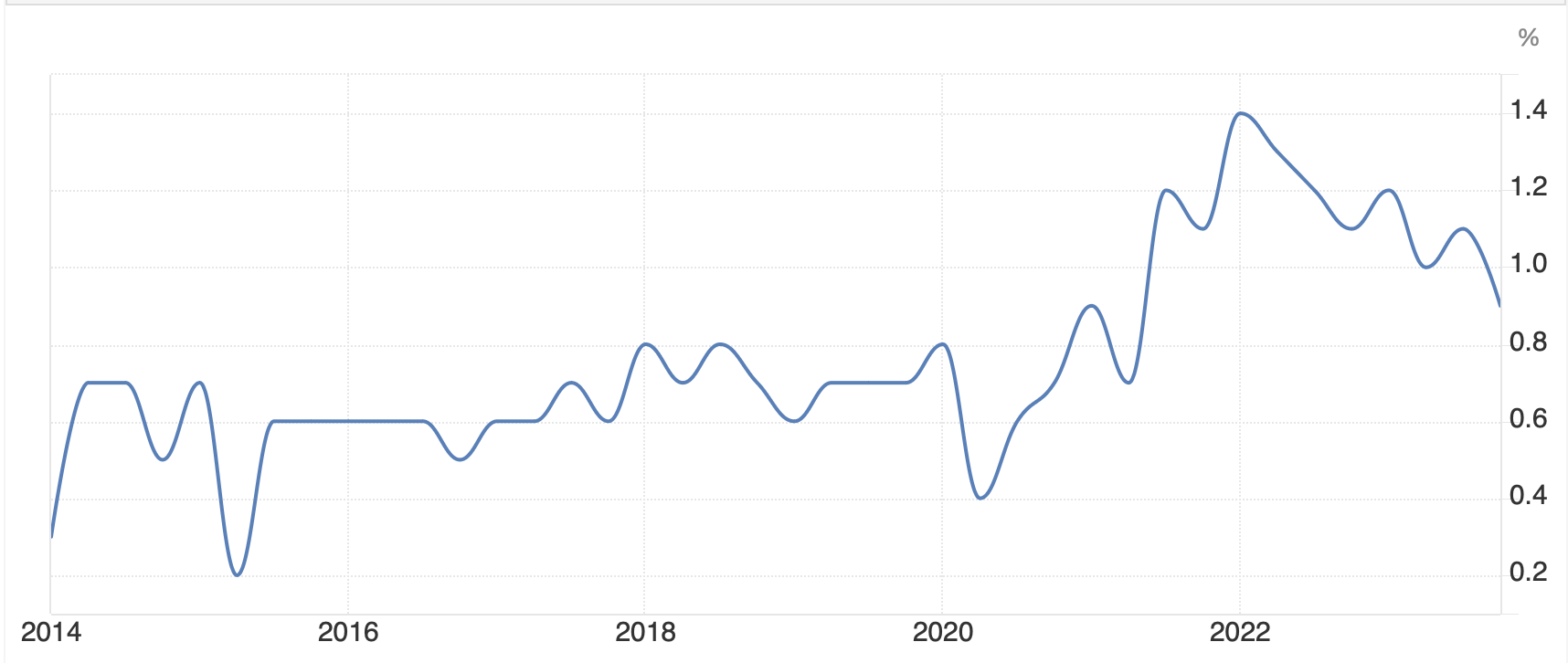
Source: tradingeconomics.com

That’s really all we have today as the market awaits tomorrow’s Fed as well as Friday’s NFP data.  My take is there is very little chance the Japanese come back into the market soon, and so a grind higher in the dollar remains my base case.

Good luck

Adf

‘Voiding a Crisis

There once was a fellow named Jay
Whose job, as it works out today
Is managing prices
And ‘voiding a crisis
A mandate from which he can’t stray
 
The problem he has, as it stands
Is others are tying his hands
So, prices keep rising
And he’s now realizing
He’s no longer giving commands

Friday’s PCE data was not as hot as some had feared, but certainly showed no signs of cooling.  To recap, the M/M numbers for both headline and core were 0.3%, as expected, although at the second decimal they must have been higher because both Y/Y numbers were higher than expected at 2.7% headline and 2.8% core.  As can be seen in the chart below from tradingeconomics.com, both the core (blue line) and headline (gray line) have the appearance of having bottomed.

While things certainly could have been worse, especially based on the price deflator data we saw in the GDP report, this cannot have helped Chair Powell’s attitude.  Remember, too, that 0.3% rises annualize to a bit more than 3.6%, far higher than the ostensible target.  The inflation fight has not yet been won by the Fed although I expect that we are going to hear a lot of commentary going forward that it has.  Wednesday brings the FOMC meeting, something on which we will touch tomorrow, and obviously a critical aspect of the discussion.  One other thing, given the data was not as hot as feared, it took until yesterday for the Fed whisperer to write his article, which was focused on the long-term neutral rate rather than inflation per se.

Did they sell or not?
Looking at charts, possibly
But they’ll never say

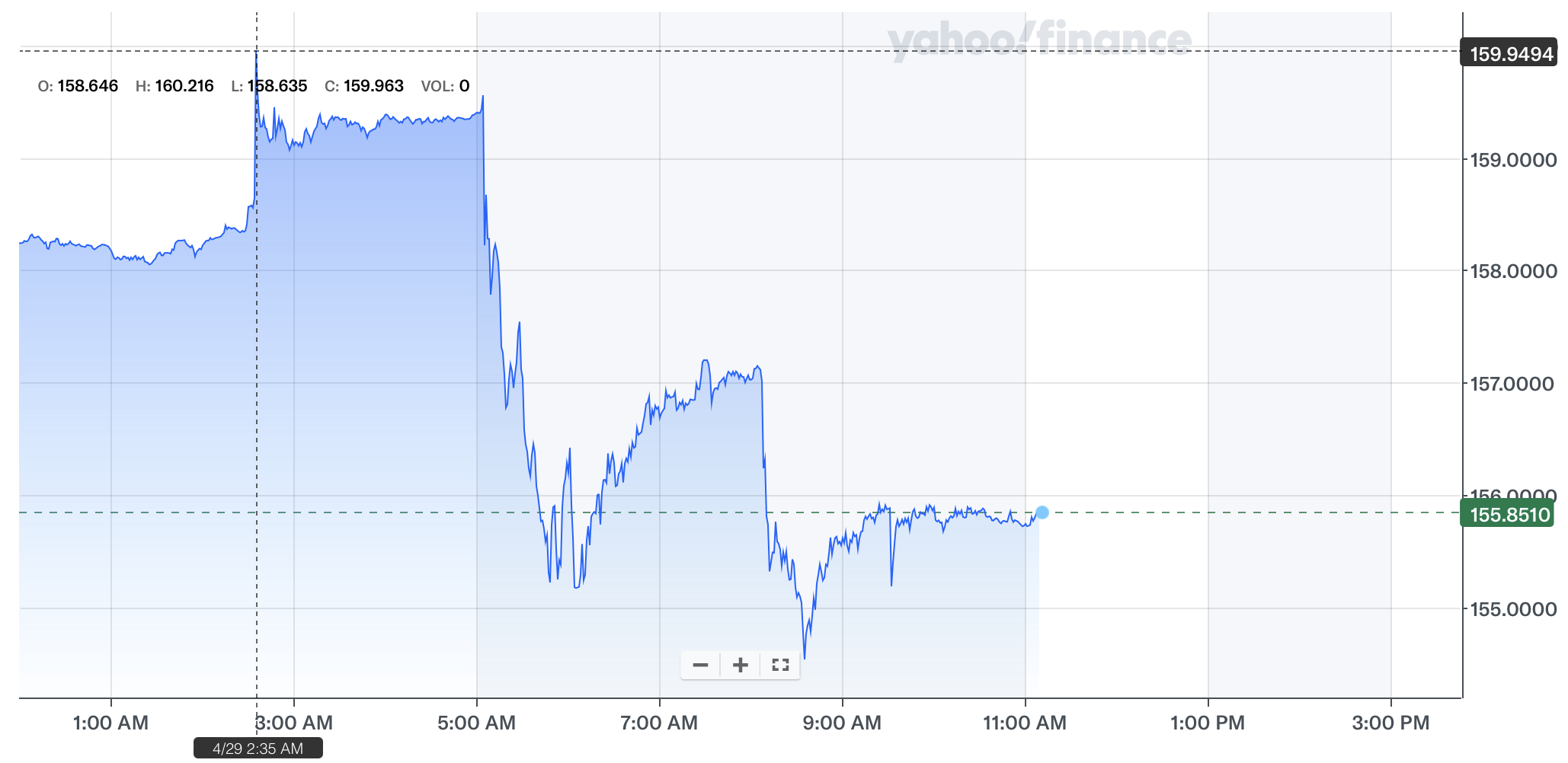
The next story of note was the fact that USDJPY trade above 160 last night, during the early hours of the session.  As can be seen from the below chart from yahoo finance, it seemed to have touched 160.216 before slipping back to the mid-159’s and then collapsing a few hours later, back to its current state just below 156.

Something to remember is that it is golden week in Japan, with the nation on holiday yesterday so banks were, at most, running skeleton staffs of junior traders and market liquidity was significantly impaired.  But the question today is, did the BOJ intervene on behalf of the MOF.  From what I have been able to glean, there was significant selling by the big three Japanese banks, certainly a sign that intervention was possible.  Of course, the chart shows how sudden the decline was, also an indication that it could have been intervention.  The best explanation I have heard for the initial move above 160 was it was some bank(s) running stop-losses at the level, as well as triggering barriers there in the options market.  At this hour (6:15), the yen has appreciated by 1.6% from Friday’s closing levels.  However, I sincerely doubt that we have seen the end of the weakness in the yen.  This is especially true if Chair Powell comes across as more hawkish on Wednesday, something that is clearly quite possible.

The last thing to note for today
Is Yellen and her QRA
How much will she borrow?
And Wednesday, not ’morrow
We’ll learn if more bonds are in play

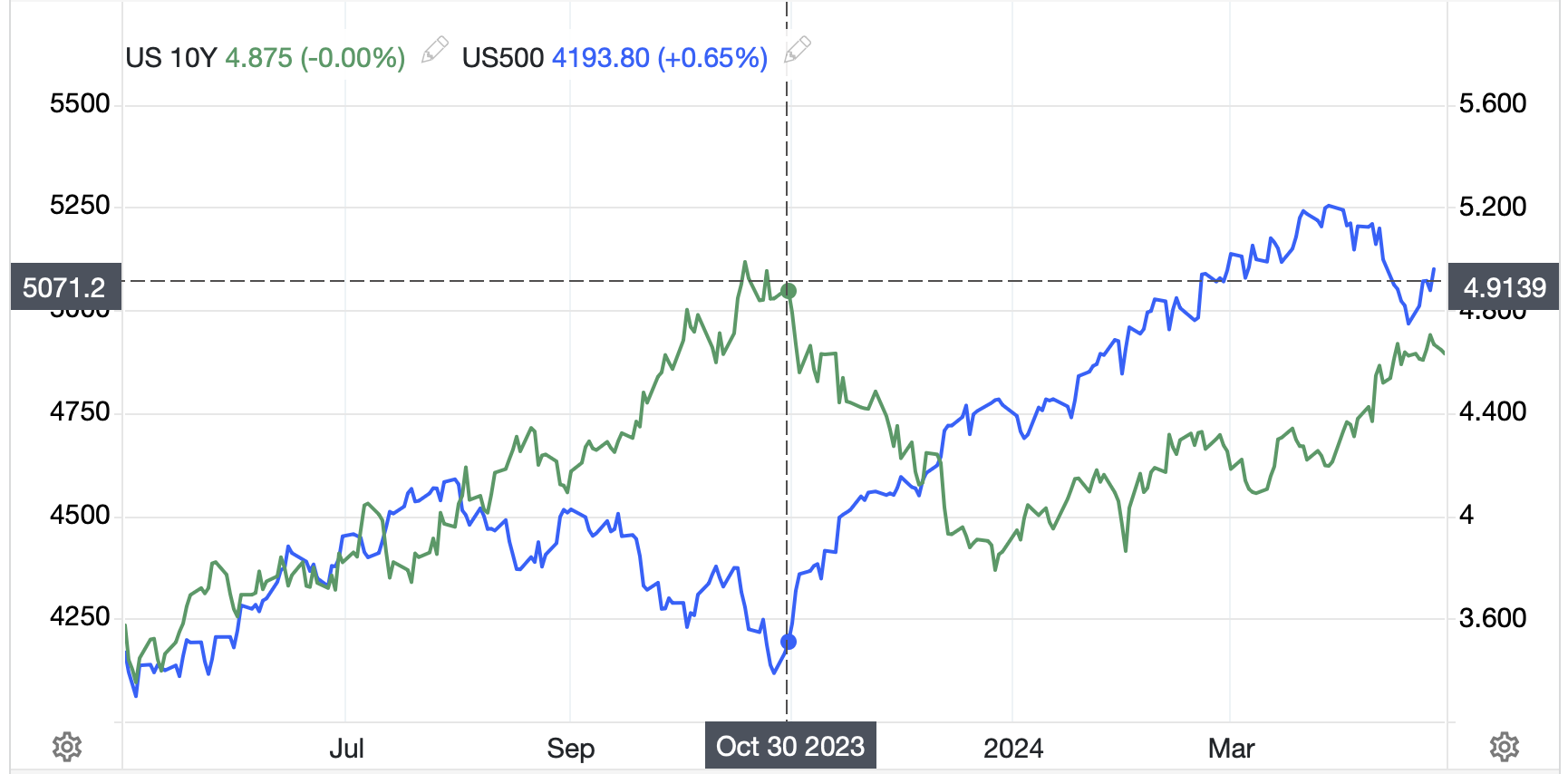
This brings us to the Quarterly Refunding Announcement (QRA) to be released at 3:00 this afternoon.  While historically, the only people who cared about this report were bond market geeks, it has gained a significant amount of status since the October 31st announcement where the Treasury indicated it would be issuing less debt than had been expected.  That led directly to the massive bond market rally at the end of last year as well as the concomitant stock market rally.  Looking at the below chart from tradingeconomics.com, it is pretty clear when things turned around, and it was right when the QRA came about.

Once we know the borrowing plans from this afternoon, we will learn on Wednesday the mix of borrowing that will be coming, and whether Secretary Yellen will continue to issue a more significant amount of debt in T-bills, or if she will try her hand at notes and bonds again.  Given that yields have been climbing lately, I suspect there will be more T-Bill issuance than is the historic norm, which has been about 20% of total borrowing, but perhaps not the 80% she issued last quarter.  Ultimately, the real concern today is that the estimated borrowing numbers could be larger than current forecasts, and perhaps just as importantly, the question of just how much was borrowed last quarter.  The sustainability of this process is starting to be called into question although I don’t expect anything to happen quite yet.  

Ok, that’s enough for one day!  A quick recap of the overnight session shows that Chinese shares rallied on the back of news from Beijing that the government was relaxing some regulations in the property sector.  In fact, that was sufficient to help all Asian equity markets higher on the order of 0.5% – 1.0%.  Meanwhile, European bourses are mixed this morning with both the DAX and CAC little changed, the FTSE 100 edging higher by 0.5%, but other continental exchanges under pressure.   As to US futures, they are very modestly higher this morning after Friday’s rally.

In the bond market, after modestly higher yields on Friday, this morning is seeing Treasury yields slip 4bps and European sovereigns fall between 5bps and 7bps.  Clearly, there is not much concern that the QRA is going to indicate massive new borrowing, but I guess we will know this afternoon.  

Commodity prices are on the quiet side this morning with oil basically unchanged, as is gold as both hold onto last week’s gains.  However, copper (+0.5%) continues to rally and is now just $0.30/pound below its all-time highs of $4.89.  There are many stories regarding the copper market with some discussing hoarding by the Chinese and others focused on the needs of the ongoing ‘energy transition’ which will need significant amounts of the red metal to electrify everything.  While it has run up quite quickly of late, I must admit the long-term view remains positive in my mind between the absence of new mines and the needs of the transition although a pullback would not be a surprise.

Finally, the dollar, aside from vs. the yen, is generally lower across the board.  While it remains in the upper end of its recent trading range, it appears the sharp decline in USDJPY has had knock-on effects elsewhere. The financial currencies, like EUR (+0.3%), GBP (+0.4%) and CHF (+0.3%) are all firmer as are the commodity bloc (NOK +0.3%, ZAR +0.45%, AUD+0.5%).  In fact, I am hard-pressed to find a currency that is underperforming the greenback.  Positioning in dollars has been quite long lately so ahead of this week’s FOMC meeting as well as the NFP on Friday, it is quite likely that we are seeing a little reduction in those positions.  However, we will need to see a change in the data to change the longer-term view.

Obviously, there is a ton of stuff coming out this week.

TodayQRA 
TuesdayEmployment Cost Index1.0%
 Case Shiller Home Prices6.7%
 Chicago PMI44.9
 Consumer Confidence104.0
WednesdayADP Employment 179K
 ISM Manufacturing50.1
 JOLTS Job Openings8.68M
 FOMC Rate Decision5.50% (unchanged)
ThursdayInitial Claims212K
 Continuing Claims1782K
 Nonfarm Productivity0.8%
 Unit Labor Costs3.2%
 Factory Orders1.6%
FridayNonfarm Payrolls243K
 Private Payrolls180K
 Manufacturing Payrolls7K
 Unemployment Rate3.8%
 Average Hourly Earnings0.3% (4.1% Y/Y)
 Average Weekly Hours34.4
 Participation Rate62.7%
 ISM Services52.0

Source: tradingeconomics.com

In addition to all this, on Friday we will hear from two Fed speakers, Williams and Goolsbee, and I imagine if they are unhappy with the market response to their messaging on Wednesday, we will hear from more.

Ultimately, this is an important week to help us understand how things are going in the economy and how the Fed is thinking about everything.  As long as payrolls continue to hang in there, any chance of Fed dovishness seems to diminish by the day.  But stranger things have happened.  As to the dollar, today’s position adjustments make sense and I suspect there will be a few more before the big news hits on Wednesday and Friday.  Til then, I think all we can do is watch and wait.

Good luck

Adf

Nary a Doubt

The two things we’re watching today
Are Jay and the new QRA
The pundits are out
With nary a doubt
That easing is coming our way

But what if this faith is misplaced
And Jay, at the presser, bald-faced
Says policy ease
Is not what we please
And we’ll not get there in great haste

Reading the Fed Whisperer, Nick Timiraos of the WSJ, this morning was enlightening only to the extent that everybody he interviewed demonstrated they have no idea what will happen, and merely described what they would like to see.  Now, in fairness, I don’t think Powell himself really knows how things are going to play out as we continue to see mixed pictures on the economy.  For every strong datapoint (e.g., GDP, JOLTS, Case Shiller) indicating that there are many potential inflationary pressures extant, we see some softer data points (e.g., PCE, Empire Manufacturing, Dallas Fed) that indicate policy is excessively restrictive.  While it is very clear that the Fed will not adjust policy today, a look at Fed funds futures shows that the market is pricing in a 45% chance of a cut in March.  A month ago, that was over 70%, so Powell must be a bit happier, but 6 weeks is such a long time in this context, anything can happen between now and then.  And, oh yeah, the market is still pricing in 6 cuts this year.

Of course, long before the FOMC statement and Powell presser this afternoon, the Treasury will release its QRA and the market will learn if Secretary Yellen is going to continue down her recent path of leaning toward more T-bills and less coupons.  Based on her continuous comments that the soft landing has been achieved and inflation is no longer a problem, it seems quite clear that she wants to see the Fed cut rates soon.  After all, lower interest rates take pressure off the budget deficit, which is entirely her baby at this point.  Interestingly, she could essentially force Powell’s hand in this situation as follows:

1.     Issuing a high percentage of T-bills will lead to
2.     Reducing the RRP balances and bank reserves which will
3.     Force the Fed to respond by slowing/ending QT to prevent any systemic problems like seen in September 2019

Remember, we have already heard from Powell, as well as Dallas Fed President Lorie Logan, whose previous role was at the NY Fed overseeing the Fed’s reserve portfolio, that the time to discuss slowing or ending QT was fast arriving.  By itself, that is a policy ease, but it would also be a signal that further changes were on their way.  In fact, a continued heavy reliance on T-bill issuance would have two vectors to support the bond market; ending QT reduces the amount of bonds the market needs to absorb and reducing new supply by itself will do exactly the same thing.  At least for as long as inflation remains quiescent.  And in the end, that remains the biggest unknown, inflation.  All these plans and ideas revolve around the premise that the Fed has won its inflation fight.  But I ask you, what if they haven’t?

Too much digital ink has been spilled already on the inflation question and the two camps remain at distinct odds.  Forgetting all the conspiracy theorists who claim inflation is really 10% or more, and looking only at serious economists and analysts, while all agree that the rate of inflation has fallen from its peak levels in the summer of 2022, there is still a pretty even split between the two sides.  While I fall on the side of stickier inflation than the market is pricing, I can understand the other side of the story.  But the point is, there are two very real sides to the story and the outcome remains unwritten.  However, if inflation does remain stickier than the doves believe, it will destroy their entire thesis of why the Fed should be easing policy.  Given the stock market is making new highs regularly, I suspect investors and traders have largely bought into the ‘inflation is over’ view.  Just be careful if it’s not.

Ok, as we await today’s activities, let’s look at what happened overnight.  Following a mixed session in the US yesterday, Asian markets turned back the clock a few weeks with the Nikkei (+0.6%) continuing its longer-term rally while both the Hang Seng (-1.4%) and CSI 300 (-0.9%) revert to their losing ways.  It seems that investors simply do not believe that President Xi has either the ability or willingness to do anything to support the stock market there, at least, if not the economy.  I believe it would be a mistake to believe he is not willing, which calls into question exactly what they are going to do to prevent things from starting to impact the economy more negatively.  And perhaps we have seen the first steps.  The other noteworthy story in the WSJ this morning was about how Chinese authorities are “discouraging” negative takes on the economy from being published and instead telling news outlets to publish stories about the bright prospects there.

Moving on to Europe, the main indices have moved very little thus far today after a mixture of data showing inflation in Germany and France continue to decline but Retail Sales in Germany (-1.6%) and Switzerland (-0.8%) and Industrial Sales in Italy (-1.0%) all falling sharply in December.  Given the weak GDP data yesterday on the continent, none of this can be surprising.  Finally, US futures are mostly lower this morning, led by the NASDAQ (-1.0%) despite (because of?) what seemed to be solid earnings from Microsoft and Alphabet.  In the end, though, I sense that investors are far more focused on the QRA and FOMC right now.

Treasury yields are unchanged this morning but that is after a 4bp decline yesterday and we have seen European sovereign yields slide this morning as well, between 1bp and 3bps, which seems to be a catch up move to the Treasuries.  I must mention Australian government bonds, which saw yields tumble 13bps overnight on the back of a much softer than expected CPI reading which has the market talking rate cuts there again.  Finally, JGB yields edged 2bps higher, despite weaker than expected Retail Sales and IP data.

Oil prices (-1.1%) are backing off this morning after another positive day yesterday and a very strong month of January, where WTI rose > 9%.  (My take is that will not help the CPI data when it comes out in a few weeks’ time.)  Meanwhile, metals prices are trading near unchanged on the day as traders here are also awaiting the new information.

It should be no surprise that the dollar is, net, little changed this morning on the same premise of waiting for Godot Powell.  Looking at my screen, I don’t see any currency that has moved more than 0.3% in either direction so really no information yet today.

In addition to the QRA and FOMC meeting, we see the ADP Employment Report (exp 145K), the Employment cost Index (1.0%) and Chicago PMI (48.0).  Careful attention should be paid to the ECI as the Fed focuses on that metric for wage inflation data.  As an indication, prior to the pandemic, that index averaged around 0.6%, but since then, it is more like 1.0% on a quarterly basis.  That annualizes to more than 4% and will maintain upward pressure on inflation if it stays there.  Just something else to keep in mind.

If pressed, I believe that the QRA will show reduced coupon issuance and Powell will be more dovish than not.  While we know the Treasury is political, by definition, and will do everything in its power to stay in power and get re-elected, my take is the Fed is in that camp as well.  I would not be surprised to see a more dovish take this afternoon after the QRA this morning.  And initially, at least, that tells me the dollar will trade back toward its recent lows ceteris paribus.

Good luck
Adf

There’ll Be No Crash

Said Janet, I know we’ve been spending
Too much, but you’re not comprehending
I’ve plenty of cash
So, there’ll be no crash
Instead, stocks will keep on ascending

Til Wednesday, we’ll keep the suspense
But really, it’s just common sense
Chair Powell and I
Will help the Big Guy
And policy ease will commence

Well, the first shoe dropped yesterday afternoon as the Treasury explained that they would “only” be borrowing $760 billion in Q1, a solid $56 billion less than had been expected by the market as of yesterday morning.  With that significant reduction in potential Treasury issuance, the bulls went nuts and both stocks (+0.75%) and bonds (-7bps) rallied.  A cynic might believe that Secretary Yellen was trying to manipulate the stock market higher, but we all know that could never be the case.  At any rate, this sets us up for Wednesday when first thing in the morning we will see the Quarterly Refunding Announcement (QRA), where Yellen will describe the ratio of short-dated T-bills to long-dated coupon issuance, and then at 2:00, the FOMC Statement will be released with Chairman Powell speaking at the press conference 30 minutes later.

Given the excitement over yesterday’s events, I suspect that at least one of the two events tomorrow will be dovish rates/bullish equities but have no idea which way it will play out.  In the end, though, it doesn’t really matter.  Ultimately what we have learned is that Yellen is running the show, and all Powell can do is respond.  The one thing I have to wonder is, what if the government spends more than the $760 billion in Q1?  Where will that money come from, and what will the impact be on the markets?  (Obviously, they will simply borrow more, but it will not be an issue as there is no limit these days, nor for an entire year going forward.)  However, for now, that is just a concern for grumpy old men like me.

In China, though they have announced
More stimulus and stocks first bounced
It seems traders feel
Xi ain’t got that zeal
So, sellers once more have all pounced

You may recall last week when the Chinese stock market rallied sharply after a series of announcements regarding government support.  First there was the story of CNY 2 trillion of cash that would be coming home and invested in equities and then the PBOC cut the RRR by 50 basis points, freeing up another CNY 1 trillion.  These moves were supposed to demonstrate that Xi was going to fix things.  And he did…for a week.  But now, equity markets in both Hong Kong (-2.7%) and on the mainland (-1.8%) are falling again as it seems market participants have come to believe that there are too many problems for a mere CNY 3 trillion to fix.  And they could well be correct.

After all, China has been inflating their economy for decades and the property bubble they have blown is not nearly popped yet.  While this could be a modest correction in the beginning of a trend higher, I have a feeling that the fundamentals have a long way to go before they make sense for international investors.  With the European economy having stagnated for the past 5 quarters and the US moving an increasing amount of business to Mexico from China, it will be tough sledding in China, I fear.  Ultimately, I continue to believe the renminbi will suffer as it will be the most likely outlet valve.  But for now, I guess they can stand the pain.

And those are today’s stories as the market braces itself for tomorrow’s QRA and FOMC, Thursday’s BOE and Friday’s NFP data.  In the meantime, let’s recap the rest of the overnight action.

Despite the robust performance in the US yesterday, only Japan and Australia managed to show any signs of life in Asia overnight as China dragged down all the other regional markets.  This cannot be too surprising given the importance of the Chinese economy there, and if it is lagging other nations are going to struggle as well.  Europe, however, is having a much better go of it, with gains across the board, led by Spain’s IBEX (+1.25%) after both real and nominal GDP rose more than expected with inflation ticking higher alongside economic activity.  That may not bode well for the inflation story in Europe, but for now, everyone’s happy and the ECB comments have all pointed to rate cuts by the middle of the year.  As to US futures, at this hour (7:45) they are just barely on the red side of unchanged, with no market even -0.1%.

You will not be surprised that European yields slipped yesterday after the US bond rally as the combination of a prospect of lower yields in the US alongside the slightly more dovish talk from the ECB speakers was plenty of catalyst for a bond rally there.  While yields have edged back higher by 2bps or 3 bps this morning, they remain below yesterday morning’s levels.  In the US, Treasury yields have continued their decline, down another 1bp overnight while JGB yields have edged down another 1bp as well.  One other market to note, China, saw yields slip 3bps overnight and they are now at their lowest level since the early 2000’s as the market anticipated further policy ease from the government and PBOC.

Oil prices (-0.65%) are off a bit this morning as they continue to consolidate last week’s gains.  Clearly there is still concern regarding the US response to the attacks on its base in Jordan over the weekend as the intensity of that response is still completely unknown.  Weakness in China is not helping the oil market and European GDP data has also worked against the demand story, so uncertainty remains the watchword.  As to gold, it is continuing to creep higher but remains in its recent 2020/2060 trading range.  Lastly, the base metals are a touch softer this morning, but only a touch.

Finally, the dollar is a bit softer this morning after a benign day yesterday.  In a way, this is surprising as I would have expected the greenback to slide alongside Treasury yields, but I guess given the broader dovishness from ECB and other central bankers, on a relative basis not much changed.  As well, traders are reluctant to take large positions ahead of tomorrow’s big QRA and FOMC announcements.  As such, I suspect that we are going to see a very quiet session here across the board, just like we had overnight.

On the data front, while not as exciting as tomorrow, we do see Case Shiller Home Prices (exp 5.8%), JOLTS Job Openings (8.75M) and Consumer Confidence (115.0) this morning.  I keep listening to all the people who are telling me that falling housing prices are going to drive inflation lower, and the only reason the CPI and PCE calculations aren’t already lower is because they both have them at a lag.  Then I look at Case Shiller and say, what falling housing prices?  Anecdotally, in my neighborhood, we continue to see bidding wars and homes selling above asking.  If rates are really going to come down further, I suspect that will only drive that process even further.  The deflation story just makes no sense to me.  But anyway, probably not much today and all eyes are on tomorrow.

Good luck
Adf

Not One Whit

Both headline and core PCE
Were softer, with both below three
But under the hood
It’s not quite as good
As housing and transport are key
 
The narrative, though, will not quit
Assuring us all this is it
Rate cuts will come soon
And stocks to the moon
But so far, for proof, not one whit.
 
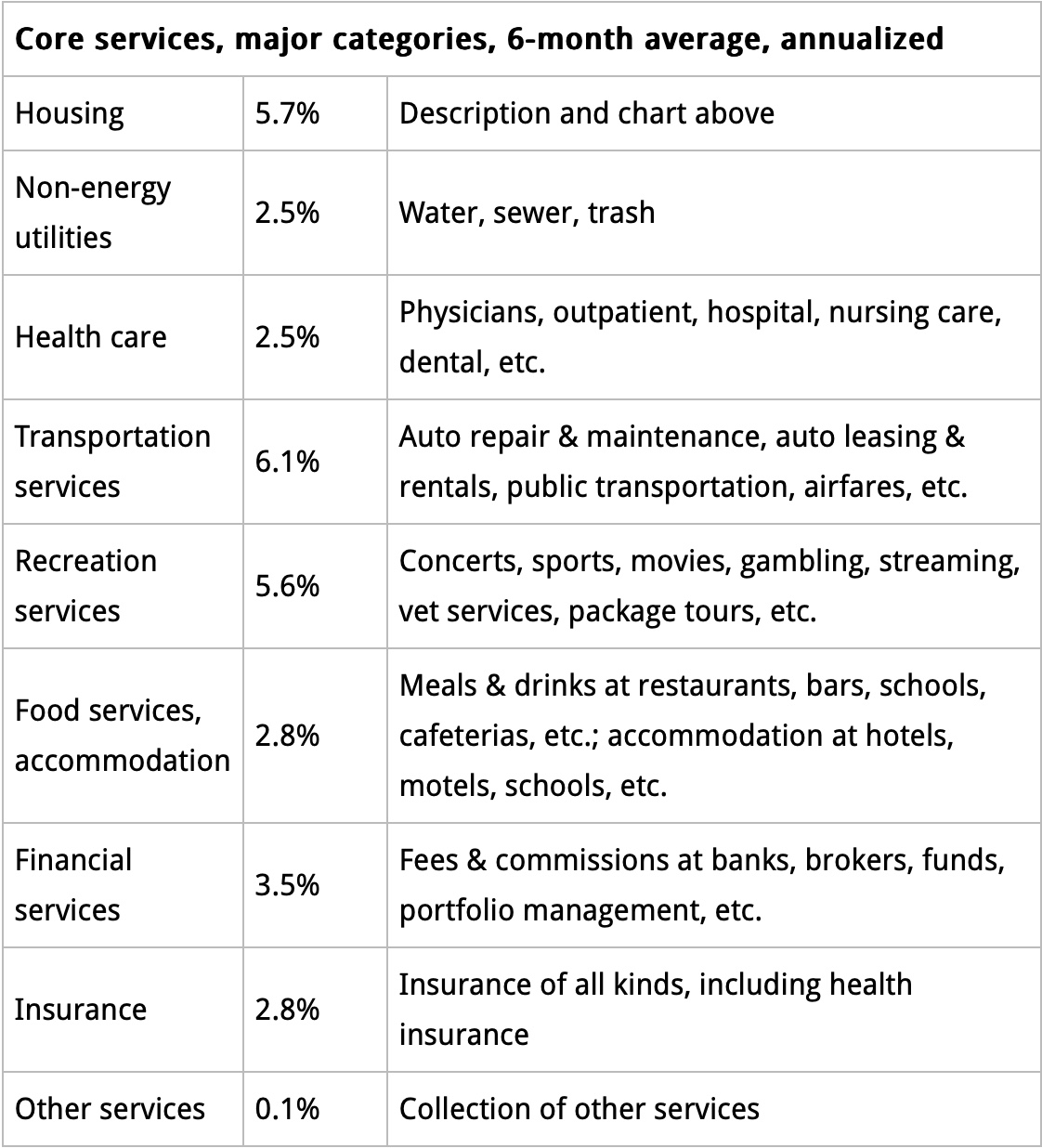
There is a very good analyst who writes regularly on the macroeconomic story named Wolf Richter.  In the wake of Friday’s PCE data release, he published an article that had the following table:

It is not hard to look at this table and see a bit of the reality we all face, rather than the widely touted headline numbers regarding inflation.  Housing continues to be sticky at much higher inflation rates than target, as well as transportation services, recreation services and financial services.  But even the other stuff, seems to be running above the elusive 2.0% level.  Now, this is the annualized rate of the past 6 months’ average readings.  But as I highlighted last week regarding CPI, this seems to be the new benchmark.  My point is that while the narrative is really working hard to convince us all that inflation is collapsing and the Fed is massively over-tight in its policy and needs to CUT RATES NOW, this breakdown doesn’t look quite the same.  My belief is the Fed remains on hold much longer than the market is expecting/hoping for, and that at some point, equity markets and risk assets are going to come to grips with that reality.  Just not quite yet.

Of course, maybe the narrative is spot on, and inflation is going to smoothly decline back to the 2% level while economic growth continues its recent above-trend course.  But personally, I have to fade that bet.  Based on the amount of continued fiscal stimulus, as well as the Fed’s discussion of slowing QT and their indication of rate cuts later this year, I believe that while the growth story is viable, it will be accompanied with much hotter inflation than is currently priced.  The fact that breakeven inflation rates are priced at 2.50% in the 10-year does not mean that is what is going to happen.  Just like the fact that the Fed funds futures market is currently pricing between 5 and 6 rate cuts in 2024 does not mean that is what is going to happen.  Let’s face it, nobody knows how the rest of the year is going to play out.  The one thing, however, of which we can be sure is that Treasury Secretary Yellen will spend as much money as possible in her effort to get President Biden re-elected.  That alone tells me that inflation is set to rebound.

And there is one other thing to remember, as things heat up in the Red Sea, and shipping avoids the area completely, the cost of transiting stuff from point A to point B continues to rise.  The cost is measured both in the dollars charged for the service and the extra 10-14 days it takes to complete the trip around the Cape of Good Hope in South Africa.  It seems that the Biden Administration’s foreign policy has unwittingly had a negative impact on its economic policy plans.  

In sum, when I look at both the data and the activities around the world, it remains very difficult to accept the narrative that inflation is collapsing so quickly that the Fed MUST cut rates and cut them soon.  The combination of still robust US growth on the back of excessive fiscal stimulus and the increased tensions in the oil market lead me to a very different conclusion.

With that in mind, let’s see what happened overnight.  Equity markets in Asia were mixed as Japan (Nikkei +0.8%) and Hong Kong (Hang Seng +0.8%) both rallied but mainland Chinese shares (CSI -0.9%) fell.  This was somewhat surprising as China, in their continuing efforts to prop up their stock markets, have restricted the lending of any securities for short sales while a HK court ruled Evergrande (remember them?) should be liquidated completely.  Perhaps the Chinese real estate situation is not quite fixed yet after all.  I suspect that we will see other liquidations as well before it is all over.  In the meantime, European bourses are mixed with the DAX (-0.4%) lagging while the FTSE 100 (+0.25%) is top dog today.  There’s been no news of which to speak so this seems like position adjustments ahead of the Fed’s activities later this week.  US futures, too, are mixed and little changed at this hour (7:15).

Bond markets, though, are really loving all the rate cut talk and are growing more confident that they will be coming soon as inflation collapses.  Treasury yields are lower by 3bps this morning and the entire European sovereign market has rallied with yields down an impressive 5bps-7bps today.  The only outlier is the JGB market, which saw the 10-year benchmark yield edge up 1bp.  It is much easier for me to believe that the ECB is going to cut as inflation in the Eurozone slows alongside the faltering growth story than to believe that the Fed is going to cut into an economy growing 3+%.  But that’s just me.

In the commodity markets, oil (+0.3%) continues to find support as the tensions in the Middle East expand after an attack in Jordan killed three US servicemen there.  Oil is higher by 5% in the past week and more than 11% in the past month.  It seems to me that will not help the inflation story.  At the same time, we are seeing demand for precious metals as gold (+0.5%) and sliver (+1.0%) are both rallying on the increased nervousness around the world.  Perhaps more interestingly is that copper is marginally higher this morning, something that would seem contra to the escalating tensions.

Finally, the dollar has rallied a bit this morning on net, although it is not a universal move by any stretch.  For instance, while European currencies are broadly weaker, in Asia and Oceania, we are seeing strength with AUD and NZD (both +0.4%) and JPY (+0.2%) fimer.  As to the rest of the world, it is a mixed session with minimal movement.  Feels like a wait and see situation given all the data and info coming this week.

Speaking of the data this week, there is much to absorb.

TodayTreasury Funding Amount$816B
 Dallas Fed Manufacturing-23
TuesdayCase Shiller Home Prices5.8%
 JOLTS Job Openings8.75M
 Consumer Confidence115
WednesdayADP Employment135K
 Treasury QRA 
 Employment Cost Index1.1%
 Chicago PMI48
 FOMC Meeting5.5% (unchanged)
ThursdayInitial Claims210K
 Continuing Claims1835K
 Nonfarm Productivity2.5%
 Unit Labor Costs1.7%
 ISM Manufacturing47.3
 Construction Spending0.5%
FridayNonfarm Payrolls173K
 Private Payrolls145K
 Manufacturing Payrolls2K
 Unemployment Rate3.8%
 Average Hourly Earnings0.3% (4.1% Y/Y)
 Average Weekly Hours34.3
 Participation Rate62.4%
 Factory Orders0.2%
 Michigan Confidence78.8

Source tradingeconomics.com

The first thing to understand is that this morning, the Treasury will be releasing how much funding they expect to need in Q1 of this year, currently expected at $816 billion, but Wednesday’s QRA will describe the mix of the borrowings.  Recall that last quarter, Secretary Yellen changed the mix of short-dated paper to long-dated coupons substantially and completely reversed the bond market rout that was ongoing at the time.  If she continues to issue far more bills than coupons, it should support the bond market and help continue to juice risk assets.  Any substantial increase in coupon issuance is likely to be met with a significant stock and bond market sell-off.  So, which do you think she will do?

Otherwise, looking at the other data, certainly there is no indication that housing prices are moderating.  The Fed will not change rates on Wednesday, but everyone is waiting to see if they will remove the line in their statement about potentially needing to raise rates going forward.  Perhaps there will be a little two-step where the QRA points to more bond issuance, but the Fed sounds more dovish to offset that news.  And of course, Friday’s NFP data will be keenly watched by all observers as any signs that the labor market is cracking will get the rate cut juices flowing even faster.

All in all, we have a lot of new information coming to our screens this week.  At this point, it is a mug’s game to try to guess how things will play out.  However, if we see dovishness from the Fed or the QRA (more bill issuance) then I expect risk assets to perform well and the dollar not so much.  The opposite should be true as well, a surprisingly hawkish Fed or more coupon issuance will not be welcomed by the bulls, at least not the equity bulls.  The dollar bulls will be happy.

Good luck

Adf

Bad News is Good

It seems that when bad news is good
Some things are not well understood
So, risk assets rally
And traders who dally
Miss out making gains that they could

But that was the story last week
And looking ahead we shall seek
The narrative changes
That altered the ranges
Of assets that used to look bleak

It has been a pretty quiet session overall and, in truth, the upcoming week does not look all that interesting from a market perspective.  While we do get the RBA policy announcement tonight (exp 25bp hike to 4.35%), and a great deal of Fedspeak including Powell on both Wednesday and Thursday, from a data perspective, there is nothing of note on the horizon.

As such, I feel like it is a good time to review the recent data and policy decisions that have led to the market gyrations through which we have been living.  If you recall, heading into last week, the narrative had been focused on the continued bear steepening of the yield curve as bond yields were rising on the anticipation of a significant increase in supply.  This movement was weighing on equity markets, which had just finished an awful week.  While risk was under pressure, we saw dollar strength although oil markets were in the midst of pricing out an expansion of the Israeli-Hamas conflict into a wider Middle East war impacting oil production or shipments.  Generally, the mood was bearish and there were many questions as to the timing of the much-anticipated recession.

And then last week turned almost everything on its head.  Starting with the BOJ, which adjusted its YCC policy again, although in a more flexible manner, removing the hard cap on yields at 1.00% and instead calling that a goal, rather than a cap.  Not surprisingly, the first move was for JGB yields to rise sharply, although they have not yet touched 1.00%, and, also, not surprisingly, the BOJ was in the market with an unscheduled round of JGB purchases the next day.  In the end, I think it is fair to say that while the BOJ is still running the easiest monetary policy in the world, it is somewhat tighter at the margin.

Meanwhile, the Fed’s reaction function seems to have been adjusted by the bond market’s bear steepening price action.  Several weeks prior to the FOMC meeting last week, Dallas Fed President Lorrie Logan was the first to mention that higher long-dated yields were tightening financial conditions and doing some of the Fed’s work for them.  Subsequently, we heard several other Fed speakers reiterate that idea, with some going as far as saying they thought it was worth between 50bps and 75bps of tightening.  At the FOMC press conference last Wednesday, Chairman Powell jumped on that bandwagon, and though he attempted to sound somewhat hawkish, claiming that they remained data dependent and if inflation remained hot, they would hike again, nobody really believes him anymore.  According to the Fed funds futures market, the current probability of a rate hike in December is down to 9.8%.  That was nearly 30% just before the FOMC meeting and has been sliding ever since.

It seems fair to ask, what has changed all these attitudes?  I would argue that the Treasury’s Quarterly Refunding Announcement (QRA) which is generally completely under the radar, was the big news that altered the narrative.  Then, adding to the new momentum, we got clearly weaker than expected employment data, implying that the Fed’s data dependence was going to be heading toward rate cuts sooner rather than rate hikes at all.

Briefly, the QRA is, as its name suggests, the document the Treasury issues each quarter to inform the market of how much new Treasury debt will be issued for the next two quarters, as well as the anticipated mix of issuance between T-bills and longer dated coupons.  In the most recent version, Secretary Yellen indicated that the Q4 issuance would be lower than had previously been expected, and she also indicated that a greater proportion would be in T-bills than expected.  The combination of these two features cut the legs out from under the oversupply issue, at least temporarily (there is still an enormous amount of debt coming) and combined with what had clearly been developing short bond positions by the hedge fund and CTA communities, saw a major reversal in bond prices with yields declining > 40bps last week.

It should be no surprise that stock markets took that news and ran with it.  Part of the previous narrative was the continuous rise in yields was devaluing future earnings in the equity market.  As well, earnings season saw decent numbers, but lots of lower guidance by company management downgrading future assessments.  While Q3 GDP was a hot, hot, hot 4.9%, the Atlanta Fed’s first look at Q4 GDP is for a much more sedate 1.2%.  If that is what Q4 is going to look like, it is hard to get excited about earnings growth.  So, prior to last week, equity markets had declined ~10% from their recent highs, a very normal correction, and the big question was, is this the beginning of the next leg lower in a longer-term bear market, or was this just a correction?

Taken together, and adding in a much weaker than forecast NFP report on Friday, where the headline number fell to 150K, and there were revisions lower for the previous two months by an additional 40K while the Unemployment Rate ticked up to 3.9%, its highest print since January 2022 and 0.5% higher than the cycle lows, the new market narrative seems to be as follows: the Fed is done hiking and the only question is when they will start to cut rates.  The high in longer-term yields has been seen as well since the data is starting to roll over.  This will lead to further downward pressure on inflation and the soft landing will be completed.  The upshot of this narrative is, of course, BUY STONKS!!!

And that was the outcome from Wednesday on last week, a major reversal in equity market weakness, a huge rally in bond prices and decline in yields and a general warm and fuzzy feeling.  And who knows, maybe they will be correct.  But…

  1. The combination of higher stocks and lower bond yields has eased financial conditions considerably in just the past week.  This implies the Fed may be forced to act to continue their program lest inflation reasserts itself.
  2. The idea that slowing growth is a positive for equity prices seems a bit skewed as slowing growth typically leads to weaker profits.
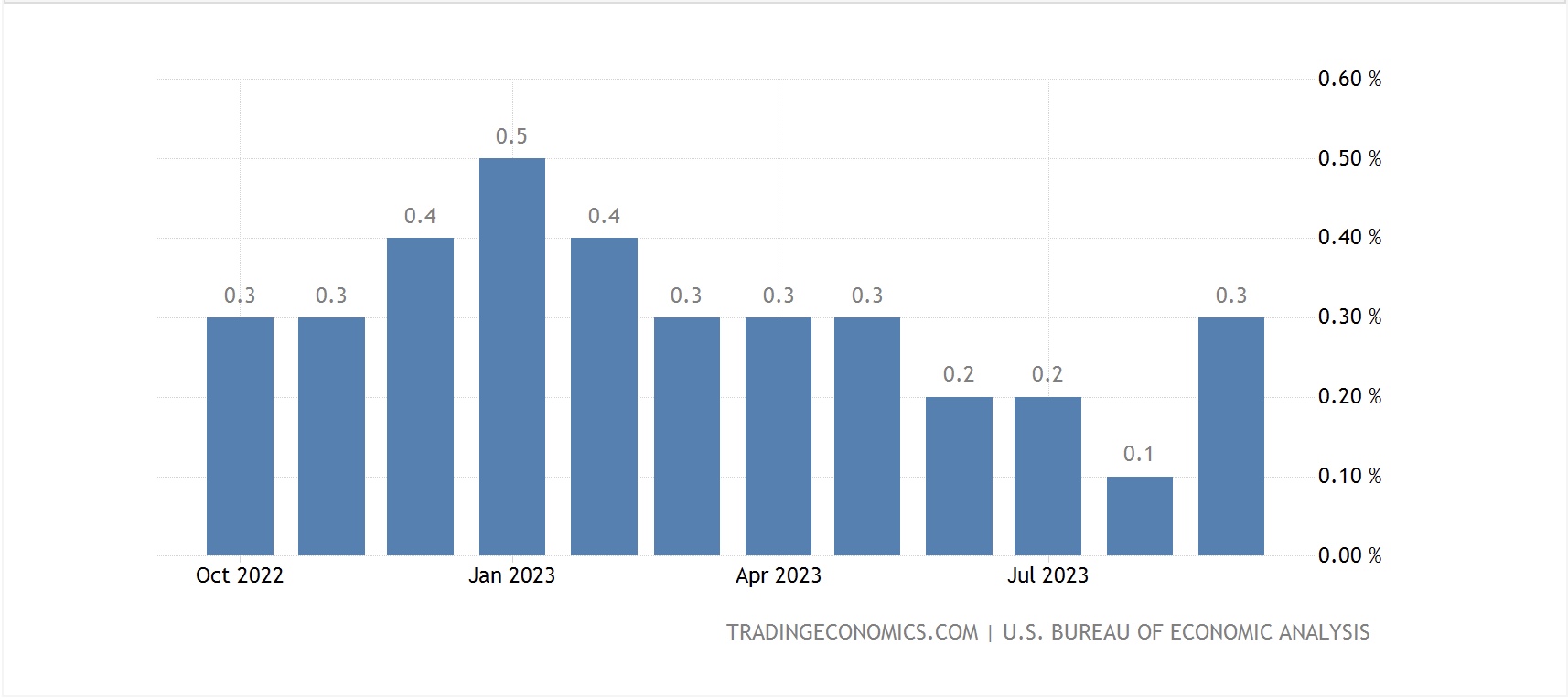
  3. Inflation is not dead yet, and the most recent Core PCE reading did not indicate that it is slowing that rapidly.  As can be seen from the chart below, 0.3% M/M PCE equates to 3.6% annual, well above the Fed’s target.

While I believe that the market is going to run with this narrative for a while, and we could easily see stocks continue to rebound and yields grind a touch lower, I fear that reality will set in soon enough and these moves will prove ephemeral.

Tying this up with a bow on the dollar leaves me with the following view; as long as this current narrative holds, the dollar will remain under pressure.  I suspect this can last through the end of the year, although much beyond that I am far less certain.  I would contend there are two ways things can evolve from here:

  1. This relaxation in financial conditions forces the Fed to reassert themselves and they start hiking rates again.  In this case, the dollar will once again rise as no other central banks will have the ability to keep up with a newly hawkish Fed, or
  2. The much-anticipated recession finally shows up, perhaps in Q1 2024, and the Fed, after a little hesitation starts to ease policy.  However, by that time, I suspect that the rest of the world will also be in recession and central banks elsewhere will be cutting rates even more quickly.  While the dollar is likely to slide initially, I don’t think it will decline very far as in that situation, it seems likely that the US will remain the proverbial ‘cleanest shirt in the dirty laundry.’

As for today, it is hard to get excited about anything really, at least with respect to the FX market.

There will be no poetry tomorrow, but I will return on Wednesday.

Good luck

Adf

Bulls’ Fondest Dreams

While everyone focused on Jay
The earlier news of the day
Showed Janet would not
The long bond, allot,
Too much, thus yields faded away

Combining that news with the Fed
And all of the things that Jay said
It certainly seems
The bulls’ fondest dreams
Are likely to still be ahead

While most of the headlines yesterday afternoon and this morning revolve around the FOMC meeting and, more importantly, Powell’s press conference, I would argue that as I discussed yesterday, the biggest story was the QRA early in the morning.  Historically, the Treasury has tried to keep T-Bill issuance between 15% and 20% of total Treasury issuance.  However, a look at the current mix shows that Secretary Yellen already has that ratio up to 22.6%.  One of the big questions was how that would play out going forward.

Recall, one of the narratives that has been invoked for the Treasury bond sell-off with corresponding rising yields, has been the supply story.  You know, the US is running massive budget deficits and needs to issue more debt to fund it, so there is a lot more supply coming.  A key assumption in this story was that the mix of debt, which already favored T-Bills, would not change much so the new debt would be forced into the back end of the curve.  Well, that’s not how things worked.  The QRA indicated that the Treasury was going to issue a lot more T-Bills, a total of $1.1 trillion over the next two quarters, raising the proportion of T-Bills to 23.2%, even further above the old ceiling.  Of course, the result is much less issuance in the 5yr and longer space, thus undercutting the excess supply argument.

The results cannot be surprising as even before Powell started speaking, 10-year yields had fallen 11bps although they continued to decline afterwards as well, finishing the day lower by 16bps or so.  All in all, an impressive bond rally.  But let’s consider for a moment a different consequence of yesterday’s announcements, the shape of the yield curve.  Prior to the QRA and the Fed, the yield curve, as measured by the 2yr-10yr spread had fallen from a low of -108bps to just -15bps and it seemed almost certain that it would normalize soon.  However, now that the QRA has shown there will be more issuance out to 2yrs and less beyond, the immediate impact is the curve is going to go back to inverting further, (it is already back to -22bps) at least until such time as the Fed actually does cut rates.  I have a feeling that we are going to hear a lot more about recession again even though Powell explicitly said the Fed was not expecting one.  In fact, Powell and the Fed may be the only people not expecting a recession at this point!

A quick look at the Fed funds futures market shows that for the December FOMC meeting, the market is currently pricing a 20% probability of a 25bp rate hike.  That is slightly lower than before the FOMC meeting yesterday, but within the margin of error.  However, at this point, the market has a 43% probability of a rate cut in May, with that probability growing as you head out further in time.  One of the things Powell reiterated yesterday is that the committee is not even discussing the idea of a rate cut.  Of course, he also said that they don’t believe a recession is coming so it is not surprising the market has a different rate view than the Fed.

In the end, I think this is a seminal shift in policy with the combination of Treasury and Fed actions indicative of a much easier policy stance going forward.  I have built my views based on the Fed maintaining its higher for longer stance and continuing to stress the system which remains massively leveraged.  However, if he is no longer going to follow that path, and I think we learned yesterday that the inflection point is here, then we need to rethink the future.  One consequence of this policy change, though, is that inflation, which I have maintained is going to remain far stickier than many anticipate, is going to become an even bigger problem down the road.  I just don’t know how far down the road that will be.  But for now, I think we are going to continue to see equities rebound into year end, bond yields fall, the dollar fall, and commodity prices rebound.  This is going to be a classic risk-on scenario through the end of the year in my view.

And despite, or perhaps because of, continued weaker data, that is what we are seeing in markets around the world.  Yesterday’s ISM Manufacturing data was quite soft at 46.7, and this morning the PMI data from the rest of the world was generally awful with all European readings between 40 and 45.  Yesterday’s ADP Employment data was soft, at 113K which just added fuel to the policy easing fire and though the JOLTS Job Openings data was still strong, the net perception is slower times are ahead, and with them, lower interest rates.

A look around markets shows that after yesterday’s US rally, with the NASDAQ leading the way higher by 1.6%, Asian shares rallied (Nikkei +1.1%, Hang Seng +0.75%) and we are seeing strength across the board in Europe with all major indices higher by at least 1.25%.  And don’t worry, US futures are pushing higher again, up about 0.5% at this hour (7:15).

It is, of course, no surprise that bond yields around the world are lower with European sovereigns declining by between 7bps and 12bps after both Australia and New Zealand saw yields tumble 16pbs and 25bps respectively.  Even JGB yields are softer by 3bps.  In fact, Dutch central bank president Klaas Knot, one of the most hawkish ECB members, is on the tape this morning with the following quote, “We should be a little patient and not raise rates too much.”  That may be the most dovish thing he has ever said.  The point here is that until such time as inflation really comes roaring back (and I fear that day will come), the direction of travel in interest rates is lower.

Oil prices, which remained under some pressure in the past week, have bounced 1.4% this morning with the movement seeming to be a response to the policy changes while gold (+0.3%) is also climbing, although a bit slower than I might have expected.  But we are seeing strength throughout the commodity complex on the lower rate story with copper (+0.5%) rallying despite the prospects of a recession.

Finally, the dollar is under pressure across the board with the DXY down -0.7% led by the euro (+0.6%), AUD (+0.7%) and NZD (+0.95%).  The yen (+0.4%) is a bit of a laggard today, though remains above the 150 level, but I suspect that we are going to see dollar weakness continue going forward.  Against EMG currencies, we are also looking at a weaker greenback with KRW (+1.0%) leading the way, but strength through APAC and EEMEA and MXN (+0.6%) firmer as the only representative of LATAM that is trading at this hour.  Yesterday Banco Central do Brazil cut their SELIC rate by 50bps to 12.25% as widely expected and BRL rallied 2% on the day.  Again, the theme is now a weaker dollar going forward.

To show how big a deal yesterday was, the BOE meets this morning, and nobody is even discussing it.  Expectations are for no policy change, although perhaps given the sudden dovishness breaking out worldwide, they will consider a cut!  We also see a bunch of US data as follows: Initial Claims (exp 210K), Continuing Claims (1800K), Nonfarm Productivity (4.1%), Unit Labor Costs (0.7%) and Factory Orders (2.4%).   There are no Fed speakers on the schedule today, but they get started again tomorrow.  Remember, tomorrow we also see NFP, so still some fireworks potentially.

For now, though, the new trend is risk on, dollar down.  

Good luck

Adf

News Not to Like

Before we all hear from Chair Jay
This morning we’ll see QRA
The question is will
The bond market kill
The vibe all things are okay

While no one expects a rate hike
Of late, there’s been news not to like
Both housing and wages
Have moved up in stages
Though as yet, there’s not been a spike

We are definitely in a period where there is a huge amount of new information to digest on a daily basis, whether it is data or policy actions by central banks and finance ministries.  During times like this, we have historically seen slightly less liquidity in markets as the big market-makers reduce their activity to prevent major blowups.  Of course, the result is that we have periods that are quite punctuated by sharp moves on the back of the latest soundbite.

So, with that in mind, let’s look at today’s stories.  Starting last night, we saw JGB yields rise to yet another new high for the move, touching 0.98%, before the BOJ executed an unscheduled bond-buying exercise to push back a bit.  Ultimately, the 10-year JGB closed back at 0.94%, but despite the brave words from Ueda-san yesterday, it is clear there will be no collapse in the JGB market.  They simply will not allow anything like that to happen.  At the same time, USDJPY retraced about 0.3% of its recent decline, but continues to hold above 151 for now.  We did hear from Kanda-san, the new Mr Yen, that they were watching carefully, but given the rise in JGB yields has been matched by the rise in Treasury yields, it is hard to get too bullish, yet, on the yen.  

This is the first big assumption that has not played out as anticipated.  Prior to the BOJ meeting, the working assumption was that when they adjusted YCC the yen would start to rally sharply.  My view has always been that the yen won’t rally sharply until the Fed changes their tune, and that is not yet in the cards.  If the BOJ intervenes, it is probably a good opportunity to sell at those firmer yen levels as until policies change, a weaker yen remains the most likely outcome.

Turning to the US, at 8:30 this morning the Treasury is due to announce the makeup of the $776 billion of debt they will be borrowing this quarter.  The key issue is how much will be short-dated T-bills and how much will be pushed out the curve.  The higher the percentage of long-dated issuance, the more pressure we will see on the bond market going forward.  The 10-year yield is already back to 4.90% this morning, rising another 3bps, and we are seeing pressure throughout Europe as well with yields there up between 1bp and 3bps except for Italian BTPs which have seen yields rise 9bps this morning.  That has taken the Bund-BTP spread back to 200bps, the place where the ECB starts to get concerned.

But back to the US, where a second key narrative assumption has been that housing prices would be falling, thus reducing pressure on the inflation metrics over time.  Alas, that assumption, too, has been called into question after yesterday’s Case Shiller home price data showed a rise in home prices across the country, back toward the peak seen in June 2022.  While the number of transactions continues to decline, given the reduction in both supply and demand it seems that it is still a sellers’ market.  If housing prices don’t decline, then it seems even more unlikely that rents will decline and that means that inflation is going to remain much stickier than the Fed would like to see.  This does not accord well with the thesis that a slowing economy is going to help bring down housing demand followed by slowing inflation.  

As well, there was another data point yesterday, the Employment Cost Index, which rose a more than expected 1.1% Q/Q, and looking at the chart of its recent movement, shows little inclination that it is heading lower.  This is a key data point for the Fed as rising wages is something of which they are greatly afraid given the belief in its impact on prices.  While the White House may have celebrated the UAW’s ability to extract significant gains from the big three automakers, I’m guessing the Fed was a bit more circumspect on the effects those wage gains will have on overall wages in the economy and inflation accordingly.  

Adding all this up tells me that the ongoing belief that inflation is going to be declining steadily going forward, thus allowing the Fed to reduce the Fed funds rate and achieve the highly sought soft-landing is in for a rude awakening.  Rather, I remain quite concerned that monetary policy is going to remain much tighter for much longer than the market bulls believe.  And that means that I remain quite concerned equity multiples will derate lower along with equity markets overall.

Turning to the overnight price action, after a late rebound in the US taking all three major indices higher on the day, though just by 0.3% or so, we saw a big boost in Tokyo, with the Nikkei jumping 2.4%, as it seems there is joy in the idea that the BOJ may allow yields to rise further.  Either that or they were happy to see the BOJ buy bonds, I can’t tell which!  Europe, though, is a touch softer this morning with very marginal declines and US futures markets are looking to reverse yesterday’s gains, all -0.35% or so, at this hour (8:00).

Oil prices are higher this morning, up 1.8% as concerns about escalation in the Middle East seem to be growing after some comments about a wider war and further attacks by both Iranian and Hamas leaders.  Gold is little changed today but did suffer in yesterday’s month end activity although copper is firmer this morning in something of a surprise given the continuing weak PMI data we have been seeing.

Finally, the dollar continues to flex its muscles as the DXY is back just below 107 with both the euro and pound lower this morning by about -0.25%, and virtually all EEMEA currencies under pressure as well.  Other than the yen’s modest rebound, the dollar is higher vs. just about everything.

On the data front, in addition to the QRA and the FOMC later this afternoon, we see ISM Manufacturing (exp 49.0), Construction Spending (0.5%) and JOLTS Job Openings (9.25M).  Overnight we saw weaker PMI data from Japan (48.7) and China (Caixin 49.5), although for some reason, European PMI data is not released until tomorrow.

At this point, it is very much a wait and see session but as far as I can tell, the big picture has not yet changed.  Inflation remains stickier than the Fed wants, and the market seems to believe which leads me to believe we are going to see yields remain higher for quite a while yet.  I would estimate we will see 5.5% 10-year yields before we see 4.5% yields and if that is the direction of travel, equity markets are going to have a tough time while the dollar maintains its bid.

Good luck

Adf

A Havoc Nightmare

While real wages fall
Kishida’s polls fall faster
Will Ueda act?

The first big thing this week is tonight’s BOJ meeting where many in the market are anticipating another tweak to the current YCC framework.  I have seen several analysts calling for a widening of the band to +/- 1.25% from the current +/- 1.00%.  While current yields have yet to reach the cap, they continue to grind higher and are currently at 0.88%, new highs for the move.  Ironically, it is likely the BOJ will need to buy even more JGB’s if they make an adjustment as the wider band would give the green light for speculators to short bonds even more aggressively.  Recall, since they widened from 0.50% to 1.00%, there have been at least five unscheduled bond buying episodes by the BOJ, with the last one, just a week ago, being the largest to date.

One thing to remember about the BOJ is that the concept of central bank independence is not as strong in Japan as it is, perhaps, elsewhere in the Western world.  (Of course, it is not that strong elsewhere either, but Japan is closer to China on this front than the US).  At any rate, the most recent polls in Japan show that PM Kishida’s approval ratings have fallen to new lows for his tenure, with an approval of just 33% according to the most recent Nikkei poll.  And this was after the announcement that he was cutting taxes to help people deal with the consistently rising inflation in Japan.  While it has not grown to levels seen in the US or Europe, it is clearly far higher than they have seen there in more than a generation.

But it doesn’t seem to be enough.  Now, there is no requirement for an election until sometime in 2025, but that doesn’t mean Kishida-san won’t feel the pressure to do more.  And arguably, one of the things they can do to fight inflation is raise rates and see if the yen can recapture some of the 35%+ that it has declined over the past two years.  

So, will they act?  My one observation on this is that unlike the Fed, which never likes to surprise the market, the BOJ has figured out that they only way they can have an impact is if they do surprise the market.  Given that an increasing number of people are starting to look for this outcome, I think the probability of a BOJ policy change tonight is quite low.  I would not be surprised, if I am correct, to see USDJPY head back through 150 and start to grind to new highs above the 152+ peak seen just before the intervention last year.

Meanwhile, for the rest of the week
Both meetings and data might wreak
A havoc nightmare
So, traders, beware
Of comments or data that’s bleak

Beyond tonight’s BOJ meeting, the week is jam-packed with other potential market moving catalysts between central bank meetings (FOMC on Wednesday, BOE on Thursday) and important data including ISM (Wednesday) and NFP on Friday.  However, there is one other thing set to be released Wednesday morning, well before the FOMC announcement and that is the Quarterly Refunding Announcement (QRA).  While, as its name suggests, this is released every quarter, it has generally been relegated to the agate type of market information as a technical feature for bond traders.  But this time, it has gained far more interest given the combination of the bond market’s performance since the last QRA (yields are higher by 80ish basis points) and the fact that the government budget deficit is continuing to grow with many new forecasts for a $2 trillion deficit this year thus a need for even more borrowing. 

Back in August at the last QRA, the Treasury increased issuance more than anticipated which has been seen as one of the drivers of the recent bond market decline.  If they were to increase it significantly again, there is certainly concern that bond yields can move much higher still.  Now, the Treasury could issue more short-term T-bills to take pressure off the bond market but bills already represent about 22% of the total debt outstanding.  That is a couple of points higher than the top of the historic range of 15%-20% and may be seen as a point of contention.  The positive is that given T-bill yields are all above 5.3%, there will be plenty of demand for their issuance.  However, on the flip side, that means that refinancing will need to occur far more frequently and that makes it subject to market dislocations and disruptions.

Another key part of the discussion will be just how large Secretary Yellen wants to keep the Treasury General Account (TGA), which is the government’s ‘checking’ account at the Fed.  As of Thursday, it held $835 billion and there has been talk she wants to increase it to $1 trillion to make sure the government has ample liquidity going forward, especially if there is another issue regarding government financing in Congress.  Historically, the Treasury has issued bills when they are seeking to build up balances in the TGA, which would tend toward seeing even more bills issued rather than substantial growth in the longer-dated maturities.  All in all, it is possible the QRA is going to have the largest potential impact on markets this week so beware.

In truth, the overnight session has been somewhat dull.  While the Israeli-Palestinian situation has seemed to enter a new phase regarding Israel’s incursion into Gaza, markets are non-plussed over the matter with bond yields little changed across the board, the dollar little changed across the board and oil prices sliding (-1.5%) this morning.  Even gold (-0.6%), which has been the best performer in the wake of the middle east crisis, has slipped back below the $2000/oz level, although remains higher by almost 10% in the past month.

In fact, the one area where things are moving is in equity space where we are seeing gains across the board in Europe, somewhere between 0.5% and 1.1%, in the major bourses as inflation data there showed that price rises have begun to slow down and Germany’s economy “only” shrunk by -0.1% in Q3, a much better than expected outcome!  US futures are also higher at this hour (7:15), up by 0.5% or so after a pretty awful week last week.  In fact, the only real outlier was Japan where the Nikkei slid -0.5% as Chinese shares were stronger along with most of the APAC markets.

As mentioned earlier, though, we do have a lot of news coming out this week so let’s go through it here:

TuesdayBOJ Rate Decision-0.1% (unchanged)
 BOJ YCC+ / – 1.00% (unchanged)
 Case Shiller Home Prices1.6%
 Chicago PMI45
 Consumer Confidence100
WednesdayADP Employment150K
 QRA$114 billion (+$11 billion)
 ISM Manufacturing49.0
 JOLTS Job Openings9.2M
 Construction Spending0.4%
 FOMC Decision5.5% (unchanged)
ThursdayBOE Decision5.25% (unchanged)
 Initial Claims210K
 Continuing Claims1795K
 Nonfarm Productivity4.0%
 Unit Labor Costs0.8%
 Factory Orders1.9%
FridayNonfarm Payrolls188K
 Private Payrolls145K
 Manufacturing Payrolls0K
 Unemployment Rate3.8%
 Average Hourly Earnings0.3% (4.0% Y/Y)
 Average Weekly Hours34.4
 ISM Services53.0

Source: tradingeconomics.com

So, as you can see, there is a lot of stuff coming our way starting tonight in Tokyo.  What that tells me is that we are not likely to see very much movement today as traders and investors await the plethora of new information that is due.  However, by the end of the week, we could have a very different narrative.  

Good luck

Adf