
Buyers’ Chagrin

Last month everything was just fine

As stocks traded up on cloud nine
But this week has been,
To buyers’ chagrin,
Less fun, and perhaps e’en malign

While soft is the landing of choice
And one where the Fed would rejoice
As data keeps slipping
The narrative’s flipping
Said some, in a very low voice

Oops!  ADP Employment fell further last month, down to 103K, well below forecast and moving into a more dangerous territory for the growth story.  Last month’s outcome was revised lower as well and the 3-month moving average is now 99K.  This is certainly not a level that inspires confidence in future economic activity.  Now, we all know that ADP is not the really important number, that is Friday’s NFP, but of late, the story there has also not been that fantastic either.  Last month printed just 150K, and revisions for virtually the entire year have been lower.  All I’m saying is that I get a soft landing requires slowing growth which will impact the employment situation.  But this is a $27 trillion economy, and not something that is steered so easily.  Be prepared for the narrative to start to slip from soft-landing to recession and perhaps onto deep recession.  

One number does not a trend make, but as I discussed yesterday, the weight of evidence is beginning to pile up on the slowing growth story.  The market that really is buying the recession story is the oil market, where prices fell a further 4% yesterday with WTI settling below $70/bbl.  That is not a market that is convinced demand is going to be robust!

I guess the question is, at what point does the data stop confirming the goldilocks wishes and point to a more significant economic decline?  With respect to the employment situation, I suspect we will need to see a series of negative NFP prints as the Unemployment Rate rises.  While the former has not yet been seen, the Unemployment Rate has risen by 0.5% over the past seven months.  While tomorrow’s rate is forecast to be unchanged at 3.9%, there will be much angst in some circles if it goes higher.  As far as other metrics, Retail Sales, which had a very strong run in Q3, slipped last month and is forecast to be -0.1% when released next week.  Currently, the GDPNow forecast from the Atlanta Fed is calling for a 1.3% growth rate in Q4, much weaker than last quarter but not recessionary.

Combining these ideas, plus the other ancillary ones that come from the plethora of data released each month, it is easy to understand the belief in the soft landing.  But remember this, monetary policy famously works with long and variable lags.  That is just as true when the Fed is easing policy as when they are tightening policy.  Currently, there is an ongoing debate over whether the Fed’s 525 basis points of tightening is fully embedded in the economy, or if there is still more pain to come.  But if we are already seeing economic activity slow and the Fed continues to expound its higher for longer mantra, it is easy to make the case that the slowdown will be far deeper than a soft landing.  

One other thing, all this is happening while measured inflation remains well above the Fed’s target which is likely to remain a constraining factor on their behavior going forward.  If pressed, I would say the economy is heading toward a more significant recession, probably starting in Q1 or early Q2 of next year unless we see a remarkable turn of events in the US.  Given the intransigence that the current House of Representatives is demonstrating with respect to funding Ukraine, it appears that fiscal help may be a quarter or two later than hoped.  Be prepared.

Is the BOJ

Ready to change policy?
No breath-holding please!

One other thing of note was an article in Nikkei Japan that discussed recent comments from Governor Ueda as well as Deputy Governor Himino, where the implication seems to be that the committee there is contemplating the idea of raising their base rate to 0.0% or even 0.1% from its current -0.1% level.  Certainly, the market is willing to believe this story as evidenced by the moves last night where 10-year JGB yields jumped 11bps while the Nikkei fell 1.75%.  As to the yen, this morning it is the outlier in the FX market, with a 1.4% rally and is now trading back to its strongest level (weakest dollar) since August.  While the most recent inflation data from Japan has continued to show consumer prices rising above the BOJ’s 2% target, 19 straight months now, wages remain more benign and that is a key metric there.  While I’m sure that the BOJ will alter policy at some point, it still feels like it is a mid 2024 event.

And one other thing to note with respect to USDJPY, tomorrow the December futures options on the CME expire and there is some very substantial open interest at strike prices right here.  Apparently, a single buyer purchased upwards of $2 billion notional of JPY calls with strike prices ranging from 145.50 down to 144.75 back in mid-November, which are now at- and in-the-money.  The thing to look for here is a choppier market as dealers hedge their gamma risk.  And don’t be surprised if we see another leg lower in USDJPY before they expire tomorrow.

Ok, let’s look at how all the other markets have behaved overnight as we await today’s Initial Claims data, but more importantly, tomorrow’s payroll report.  After another soft showing in the US yesterday regarding equity markets, Asia, aside from Japan were broadly weaker, albeit not dramatically so.  In Europe, the screens are all red too, but the losses are quite small, between -0.1% and -0.2%.  Adding to the idea that there is very little ongoing, US futures, at this hour (7:30) are essentially unchanged.

Turning to the bond markets, Treasury yields, which had fallen below 4.10% briefly yesterday, have bounced on the day and are firmer by 5bps.  But European sovereign bonds are little changed on the day with only UK Gilts (+5bps) an outlier here.  Perhaps that move was on the back of the Halifax House Price Index, which rose slightly more than expected, but I suspect it has more to do with position adjustments ahead of tomorrow’s US payroll data.  After all, remember, the US is still the straw that stirs the drink.

After a horrific day yesterday, oil (+0.6%) is trying to stabilize although WTI remains below $70/bbl.  There is now talk in the market that OPEC+ is going to cut production further, although given they just held their monthly confab last week, this seems premature.  Gold (+0.4%) is finding support again after its wild ride earlier in the week, and copper and aluminum are both showing green today.

Finally, the dollar, away from the yen, is mixed with modest weakness vs. most G10 currencies, and a completely uncertain picture in the EMG bloc.  For instance, MXN (-0.5%) is under pressure this morning while ZAR (+0.9%) is putting in quite a performance.  Looking at the entire space, it is hard to characterize a general theme here today.  As such, it strikes me that choppiness ahead of tomorrow’s data is the most likely outcome in the session.

As mentioned before, Initial (exp 222K) and Continuing (1910K) Claims are the only data this morning although we do see Consumer Credit ($9.0B) this afternoon at 3:00pm.  Right now, the dollar is trendless, except perhaps against the yen, although that means that hedging should be quite viable right now.  As to the broader economic trend, tomorrow’s data will really set the tone for the FOMC meeting next week, and for Q1 next year.

Good luck

Adf
Hawk-Eyed

A landing that’s soft will require

A joblessness growth multiplier
Demand needs to slide
Enough so hawk-eyed
Fed members, rate cuts can inspire

The thing is, when looking at data
The trend hasn’t been all that great-a
While prices are falling
Growth seems to be stalling
More quickly than Jay’d advocate-a

As we await the onslaught of data starting this morning with ADP Employment and culminating in Friday’s Payroll and Michigan Sentiment reports, I thought it would be worthwhile to try to take a more holistic look at the recent data releases to see if the goldilocks/soft landing narrative makes sense, or if there is a growing probability of a more imposing slowdown in growth, aka a recession.

The problem is, when looking at the past one month’s worth of data, the trend in either direction is not that clear.  One of the things that has been true for a while is that there continues to be a dichotomy between the survey data and the hard figures.  Survey data has tended toward weakness, with one outlier, the most recent Chicago PMI print at 55.8.  But otherwise, ISM data has been quite soft for manufacturing and so-so for services.  Looking at the regional Fed surveys, it has been generally much worse with more negative outcomes than positive ones.  

At the same time, we all remember last week’s blowout GDP result for Q3 at 5.2% and we continue to see employment growth, albeit at a slowing pace to what was ongoing last year and earlier this year.  Retail Sales finally fell slightly last month, but that is after a string of much stronger than expected prints, arguably why Q3 GDP was so strong.  Perhaps the more worrying points are that the Continuing Claims data has started to grow more rapidly, meaning that people are remaining on unemployment insurance for longer and longer periods and yesterday’s JOLTS data was substantially lower than expectations and lower than the November reading.  Finally, Durable Goods and Factory Orders have been quite weak.

If I try to add it up, it seems to point to a weaker outcome than a soft-landing with the proper question, will the recession be mild or sharp?  Funnily enough I think the data highlights the Biden administration’s ‘messaging’ problem.  Surveys are generally quite negative and now hard data seems to be rolling over.  That is clearly not the story that a president running for re-election is seeking to tell.  

All this begs the question, how will the Fed respond?  And here’s the deal, at least in this poet’s view; the current market pricing of upwards of 125 basis points of rate cuts through 2024 is not the most likely outcome.  Rather, I continue to strongly believe that we will see either very little movement, as higher for longer maintains, or we will see 300-350bps of cuts as a full-blown recession becomes evident.  

To complete the exercise, let’s game out how markets may behave in those two situations.  If the Fed holds to its guns and maintains the current policy stance with Fed funds at 5.50% and QT ongoing, risk assets seem likely to have problems going forward.  It is quite easy to believe that the key driver to last month’s massive equity rally was the pricing of easier monetary policy to support the economy, and by extension profitability and the stock market.  So, if the Fed does not accommodate this view, at some point investors and traders are going to need to reevaluate the pricing of their holdings and we could see a sharp decline in equities.  As well, this would likely result in a further inversion in the yield curve as expectations for a future recession would grow.  On the commodity front, this ought to weigh on both the energy and metals complexes even further than their current pricing.  Recall, I have been highlighting that the commodities markets seem to be the only ones pricing in a recession.  As to the dollar, in this scenario I expect to see it regain its strength as the rest of the world will be sliding into recession regardless of the US outcome, so rate cuts will be on the table for the ECB, BOE, BOC, and PBOC.

Alternatively, the economic situation in the US could well deteriorate far more rapidly than the current goldilocks set believes.  In fact, I believe that is what it will take to get the much larger rate cuts that everybody seems to be pining for.  But ask yourself, do you really want rate cuts because economic activity is collapsing?  That seems a tough time to be snapping up risk assets.  In fact, historically, equity market declines through recessions occur while the central bank is cutting rates.  Be careful what you wish for here.

But, to finish the scenario analysis, much weaker economic data (think negative NFP as a first step along with Unemployment at 4.5%) will almost certainly result in cyclically declining inflation data and a dramatic fall in demand.  So, equity markets would be under pressure everywhere.  meanwhile, the normalization of the yield curve would finally occur with the front end falling far faster than the back.  In the commodity markets, I think precious metals will outperform as real rates tumble and safety is sought.  However, industrial metals would decline and likely so would energy prices, both driving inflation lower.  As to the dollar, this is much trickier.  At this point, I would argue the Eurozone is ahead of the US in the economic down wave and so will also be cutting rates.  The dollar’s performance will be a product of the relative policy response and I suspect will result in a very choppy market.  At least against G10 currencies.  Versus its EMG counterparts, I suspect the dollar will significantly underperform absent a global recession.

But enough daydreaming, let’s take a look at the overnight session.  From an equity perspective, yesterday’s late rally in the US, getting things back close to unchanged, was followed by strength in Asia, notably in Japan (Nikkei +2.0%) but also across the board with India’s Sensex making yet more new all-time highs, and modest strength in Europe despite some weak German Factory Orders data.  Or perhaps because of that as traders grow their belief the ECB is going to start cutting rates soon.  US futures are edging higher at this hour (7:00), but only by 0.2% or so.

In the bond market, after a day where yields fell sharply, this morning we are seeing a slight bounce with Treasury yields backing up by 3bps and European sovereign yields edging higher by between 1bp and 3bps.  The European bond market is clearly of the opinion that the ECB is done hiking with that confirmation coming from the Schnabel comments yesterday morning.  Now, the only question is when they start to cut.  Something else to note is that JGB yields have fallen 3bps this morning and are essentially back at levels seen in early September before the BOJ’s latest comments about the 1% cap being a guideline, not a hard cap.  Perhaps the argument that the BOJ was going to normalize its policy was a bit premature.  

On the commodity front, oil prices continue to slide, down another 0.7% this morning and nearly 8% this week.  While this is great for when we go to fill up the gas tank, it is a harbinger of a weaker economy going forward, which may not be so great overall.  Gold prices have stabilized and are still above $2000/oz and we are also seeing stabilization in the base metals prices right now.

Finally, the dollar, which rallied nicely yesterday, and in fact has been climbing for the past week, is little changed this morning stabilizing with the euro below 1.08 and USDJPY above 147.  There continues to be a narrative that is calling for the dollar’s demise, and in fact, I understand the idea based on the belief that the Fed is turning easy.  But for right now, it is also becoming clear that the rest of the world’s central banks are rolling over on their policy tightening and given the lack of a strong interest rate incentive, plus the fact that a weaker global economy will send investors looking for safe havens, the dollar is likely to maintain its recent strength, if not strengthen further going forward.  In order to see a substantial dollar decline, IMHO, we will need to see the US enter a sharp recession without the rest of the world following in our footsteps.  As I see that to be an unlikely outcome, my guess is we have seen the bottom of the dollar for the foreseeable future.

On the data front, we start today with the ADP Employment (exp 130K) and also see the Trade Balance (-$64.2B), Nonfarm Productivity (4.9%) and Unit Labor Costs (-0.9%).  From North of the Border, at 10:00 we see the Ivey PMI (their ISM data, expected at 54.2) and the BOC interest rate decision where there is no change expected and there is no press conference either.

I really wanted to get bearish on the dollar and felt that way when we heard Fed Governor Waller talk about rate cuts, but lately, the news from everywhere is negative and I just don’t see the dollar suffering in this situation.  Stable, yes; falling no.

Good luck

Adf

Could Cause Contraction

A story that’s gained lots of traction
Is Jay will soon jump into action
By cutting the rates
They charge for short dates
Cause high real rates could cause contraction

In fact, this idea ‘s gone mainstream
And it’s now a favorite theme
But history shows
The ‘conomy grows
Despite real rates high with esteem

After a spate of slightly softer than expected data in the US, it is very clear the consensus in markets is that not only is the Fed finished raising rates, but that cuts are coming soon.  At this point, based on pricing on the CME for Fed funds futures, the Fed is going to cut rates by 100 basis points next year.  While I’m certainly no PhD economist (thank goodness!), this strikes me as a mistake.  Consider the following:

  1. If the economy really does go into recession in Q1 or Q2 of next year, where GDP turns negative and the Unemployment Rate rises close to 5.0%, it strikes me that the Fed is going to cut a lot more than 100bps.  In fact, the one thing we know is that Fed funds tend to decline much more rapidly than they rise as the Fed is usually responding late to some crisis.  So, a simple model can be created that shows 100bps of rate cuts is made up of a 20% probability of no movement at all; a 60% probability of 50bps of cuts next year as they try to tweak policy at the margin, and a 20% probability of 350bps of cuts as they respond to a recession and get aggressive.  Now, you can adjust those probabilities in any number of ways, but that seems reasonable to me.  However, that is not the market narrative.  Rather, the narrative is that the Fed is going to start to cut rates because policy is already overtight (real rates are positive) and they will want to get ahead of the curve.
  2. However, exactly why will the Fed need to cut, absent a full-blown recession?  Going back to 1982, these are the highest and lowest levels for real 10Yr yields, real Fed funds (defined as Fed funds – CPI) and Y/Y GDP each quarter:
 Real 10YrReal Fed fundsGDP Y/Y
Max7.60%8.30%9.60%
Min-0.35%-7.90%-2.20%

            Data: FRED database, calculations Fxpoet

So, we have seen real yields, both short- and long-term much higher and much lower than the current situation.  But the funny thing is, the relationship between GDP growth and real interest rates, whether 10Yr or overnight, is basically zero.  In fact, I ran the numbers and came up with an R2 of just 0.03 which tells me that there is no relationship of which to speak.  My point is just because real rates have risen to a positive level in the past year does not mean that the Fed has ‘overtightened’.  It just means that they have tightened policy trying to address what they still see as too high inflation.  It also does not indicate that because real yields have risen over the past quarters, that the economy is about to crash.  That’s not to say we are going to necessarily avoid recession, but the point is it will take much more than modestly higher real interest rates to push us over the edge.  At least that’s my view.

But for now, most markets are getting quite excited about the idea that peak interest rates are behind us and that the upcoming lower interest rates are going to support risk assets, especially equities, aggressively.  I feel a lot can go wrong with that model, but then I’m just an FX guy.

The Argentine people have spoken
As they want to fix what’s been broken
So, starting today
The new prez, Milei
Must change more than merely a token

A brief comment on this electoral outcome.  While Argentina’s economy is quite small on the global scale, I believe this is a harbinger of far more electoral shake-ups in 2024 and 2025.  We need only go back to 2015 when the Austrian presidential election was initially called for the complete outlier candidate, a non-politician as well as a right-wing firebrand, before being overturned by the courts there.  That story preceded the Brexit vote and then, of course, the election of Donald J Trump as US President in 2016.  People were very clearly tired of the political elite explaining why the masses needed to suffer while the elite got along just fine.  

The ensuing resistance by the entrenched politicians was fierce and so we saw Trump lose his reelection bid amidst great turmoil and then the election and collapse of Liz Truss in the UK.  But it appears that things have gotten worse in the broad populace’s collective mind, with inflation remaining stubbornly high, and perceptions of opportunity shrinking.  Combining those features with a growing distrust of media and government pronouncements after the Covid situation, where vaccines did not prove as efficacious as promised and, in fact, seemed to result in at least as many harms as benefits, and people are ready for a new look.

So, be prepared for some more non-traditional electoral winners next year.  Presidential elections are due in Taiwan, Mexico and the US with major regional elections throughout Germany, Canada, South Korea, India and the UK as well as the European Parliament.  Many people are quite pissed off at the incumbents around the world so look for more fragmentation and new faces.

This implies that much of how we consider the macroeconomic picture could well change.  And that means market volatility seems likely to increase further.  Just something to keep in mind, and an even more important reason to maintain hedges for major exposures, whether FX or interest rates.

Ok, it was easy to spend time on these issues as there is really nothing else going on.  Overnight, the only news was that the PBOC left their Loan Prime rates unchanged, as expected, so not really newsworthy.  Else, the biggest news over the weekend was arguably the Argentine elections.

It should not be surprising that market movement has been quite muted with the biggest equity move in Hong Kong (+1.85%) which is just a retracement of its recent woes.  Otherwise, Japanese markets fell somewhat (-0.6%) and the rest of APAC was very muted.  In Europe, there is a mix of gains and losses with nothing more than +/- 0.25%, so no real news and US futures are essentially unchanged at this hour (7:00).

Bond yields are, overall, a touch firmer this morning with Treasury and most European sovereign yields up 3bps.  But that is after another decline on Friday, and the 10yr remains quite close to its new home of 4.50%.  The ‘inflation is dead’ theme had a lot of proponents last week, but as we head into this, holiday shortened, week with limited new economic data, I suspect that things are going to be quiet without any new trends taking hold.  The market technicians explain that 4.33% and then 4.00% are the key yield supports.  So far, the first has held and I expect we will need to see much softer data to break it.

Oil prices are rebounding further this morning, up 1.5%, as there is talk that OPEC+ may be set to cut production even further with the price now below the level when they first initiated cuts in the summer.  There seems to be a disconnect between the official supply and demand data and the price, where the data would indicate prices should be higher.  One possible explanation has been that more Iranian oil has been reaching the market than officially allowed and so weighing on prices.  Alas, that is a very hard story to prove.  As to the metals markets, precious metals are softer this morning, but still retain the bulk of their recent gains while copper (+0.4%) is higher after Chinese demand indicators started to show strength.  

Finally, the dollar is starting to edge lower this morning as NY walks in the door after a very quiet overnight session.  USDJPY is the leader here, falling -0.8%, and we are seeing a large decline in USDCNY (-0.55%) as well.  Recently, there has been a distinct uptick in the number of pundits who are calling for a sharp decline in USDJPY.  Much is predicated on reading between the lines on Ueda-san’s pronouncements and expecting that QQE is finally going to end there.  Ironically, 10yr JGB yields are down to 0.74%, well below the highs seen at the beginning of the month and do not appear to be headed higher, at least for now.  To the extent that the Japanese MOF actually does want a stronger yen, something about which I am not at all certain, one must beware the idea that they could come in and intervene now, when they are jumping on the bandwagon rather than trying to stop a rush against them.  It would certainly be a lot more effective and would likely change a lot of opinions.  The one thing I have learned in my time in the markets is that when USDJPY starts to move lower, it can do so very quickly and for quite a long way.  

Away from those two currencies, both Aussie and Kiwi are firmer by about 0.6%, benefitting from strength in the renminbi as well as most commodity prices.  Not surprisingly, NOK (+0.5%) is rallying although it is a bit more surprising that CAD is essentially unchanged on the day.  Also remarkable is that CNY is the biggest mover in the EMG space, with most other currencies just barely changed on the day.

During this holiday week, there is very little data to be released with Existing Home Sales (exp 3.9M) tomorrow along with the FOMC Minutes and then Durable Goods (-3.2%, +0.1% ex transport) on Wednesday along with the Claims data.  Happily, it appears that the FOMC has taken this week off and will not be adding to their recent commentary.

Overall, the short-term trend appears to favor softness in interest rates leading to modest strength in risk assets and weakness in the dollar.  I am not yet convinced that is the long-term view, but for this week, I think that’s a fair bet.

Good luck

Adf

The Bond, or Not the Bond

The bond, or not the bond, that is the question:
Whether ‘tis nobler for the Fed to consider
That long-term yields have offered outrageous fortune,
Or to take Arms against a Sea of inflation
And in opposing it: hike rates yet again

(with deepest apologies to William Shakespeare)

For some reason, the ongoing cacophony of Fedspeak regarding whether the rise in long-term yields is helping the Fed in their efforts, or whether it is merely incidental, brought this famous soliloquy to mind.  We have had no less than eight different Fed speakers from the time Dallas Fed president Logan first mentioned the idea several weeks ago through yesterday discuss the subject with the majority continuing to latch on to the benefits for the Fed, although some dismiss the issue.  Now, in any definition of financial conditions I have ever seen, long-term yields are part of the construction, so it is perfectly reasonable to take them into account.  Clearly, the Fed is aware of this as QE was created entirely to ease financial conditions and consisted of simply buying bonds to lower long-term yields.  However, now that the Fed is in QT mode, their ability to control the long end of the curve has vanished.  In fact, if anything it is simply pushing those yields higher by removing themselves, a price-insensitive buyer, from the mix.

The problem for Chairman Powell is that whatever the Fed’s reaction function is with respect to data, the market’s reaction function to any hint that the Fed has finished tightening policy is well understood by one and all; BUY STONKS!!  The reason I believe this is a concern for Powell and co. is that they fear a rally in equities will signal an all-clear on the inflation front.  And it is abundantly clear that there is nobody on the FOMC who is prepared to claim victory over inflation.  That is exclusively the stance of the CNBC bulls and the administration sycophants who are paid to make that case specifically.  Reality, however, continues to demonstrate that inflation remains a feature of our everyday lives and I suspect that the FOMC mostly understands that.  Remember, too, that the Fed is data dependent, or so they say, which implies that they are not in a position to anticipate the death of inflation, rather they will only accept that premise when they see the body.

Where does this leave us now?  I suspect that the ongoing dance between the Fed and the markets with respect to the future of inflation will continue to play out for at least another year.  In fact, nothing has changed my view that inflation will remain well above their 2.0% target for the foreseeable future, likely finding a new home in the 3.5% +/- range.  And as long as Powell is Fed Chair, I see no indication he is willing to reverse course.  While the Fed may not hike rates again, certainly the market does not believe that is going to be the case with just a 9.6% probability of a hike in December now priced, I find it extremely difficult to believe they will cut rates anytime soon absent clear signs that we are already in a recession.

Though soft-landing bulls have all scoffed
The fact that the data was soft
In China implies
It cannot surprise
If growth worldwide can’t stay aloft

So, is a recession coming soon to an economy near you?  That is the $64 trillion question and one where there are myriad views expressed daily.  The most recent inkling that economic activity is slowing more sharply than had previously been thought was the surprisingly weak Chinese trade data, where not only did their trade surplus decline substantially (to a still robust $56.5B) but exports fell in absolute terms, they did not merely rise more slowly than imports.  The implication is that global growth is slowing more rapidly than the narrative explains.  

We already know that Europe is in a world of trouble with Germany the current sick man of the continent, but we also have seen the latest Atlanta Fed GDPNow data showing that growth in the US is slowing as well with the latest reading at 1.2%.  The UK is struggling as are many Asian nations, notably South Korea and Taiwan, or at least their export industries which are the key economic drivers there.

Another clue is the recent sharp decline in the price of oil, which has fallen -5.0% this week and ~-10% in the past month.  Clearly, a part of this price decline is based on the growing belief (hope?) that the Israeli-Palestinian conflict will not spread into a wider Middle East conflagration that affects oil production.  But part of this is the fact that oil inventories are building as are gasoline and diesel inventories with the result that prices are falling sharply.  Given it wasn’t that long ago when there were shortages in these products, it appears that demand is falling sharply as well.  Remember, diesel fuel is what drives the world as essentially no industry or commerce could continue without its use.  The fact that less is being used is a clear signal of slowing activity.

Putting it all together shows that amidst what appears to be a slowing global growth impulse, markets are pricing out further central bank monetary policy tightening.  Equity markets have been looking at the second part of that equation, less tightening and potential easing, while ignoring the first part, slower growth leading to lower profits.  It is very easy, at least for me, to accept the idea that markets have not yet understood that slower economic activity will lead to lower profits and subsequently, lower equity prices.  Alas, I understand that sequence so remain quite cautious overall.

Ok, how has this translated overnight?  Well, after a modest rally in the US yesterday, equity markets in Asia were a bit softer, declining on the order of -0.35% while European bourses are edging slightly higher this morning, maybe +0.1%.  US futures at this hour (7:45) are basically unchanged as we all await Chairman Powell’s dulcet tones at 10:15 this morning.

Bond yields are also quiet this morning with Treasuries (+2bps) one of the larger movers as European sovereigns are almost all unchanged right now.  It seems that the market has found a new temporary home around the 4.60% level and the yield curve inversion continues to deepen, now at -36bps.  JGB yields, which have fallen from their recent YCC-tweak induced highs, have edged up overnight by 3bps, but are at 0.85%, still far from the 1.00% target or cap or concept, whatever they are calling it now.

We already know that oil is under pressure, having fallen sharply yesterday and another -1.2% this morning.  In fact, at $76.35/bbl, it is trading at its lowest level since mid-July.  Gold, too, has been suffering, down -0.3% this morning and drifting further away from the $2000/oz level as those Middle East fears seem to dissipate.  Copper and aluminum are also under pressure on the slowing growth story worldwide.  Foodstuffs, however, are generally bid lately, as we can all discern every time we go grocery shopping.

Finally, the dollar is back to its dominant ways again, rallying vs. almost all its counterparts in both the G10 and EMG blocs.  USDJPY is marching back toward 151 this morning, the euro is back below 1.07 and the pound back below 1.23.  Meanwhile, in the EMG space, ZAR (-1.1%) is the laggard although it has competition from CLP (-0.9%), KRW (-0.7%) and HUF (-0.7%) as virtually the entire bloc is under pressure.  In fact, CNY (-0.15%) is about the best performer as the PBOC continues to prevent any significant further declines.

Aside from Powell’s speech this morning, we hear from Williams, Barr and Jefferson, but there is absolutely no data to be released.  Given the dearth of new data on the calendar, this week is going to continue to be all about the Fedspeak.  In fact, Powell speaks again tomorrow and there are 5 more speakers as well by Friday, so rather than data, this week is about parsing language.  Of course, Powell will set the tone today, and I am confident he will continue to push back on the idea the Fed is done.  But we shall see.

In the end, it still seems to me that a higher dollar is the path of least resistance.  Manage accordingly.

Good luck

Adf

Wrecked

There once was a Treasury note
Whose yield every trader could quote
Of late, its price dive
To yields above five
Has tongues wagging while bond bears gloat

Now, looking ahead I expect
This rise in yields could architect
More problems worldwide
As risk assets slide
And equity markets get wrecked

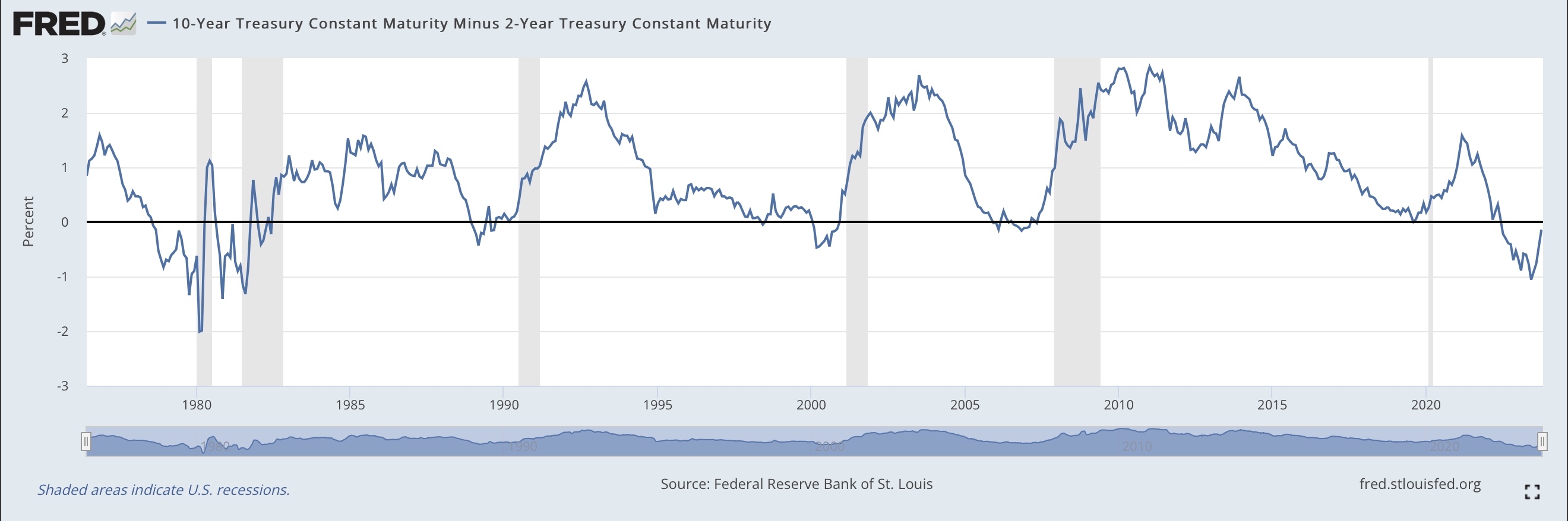
There is only one story in financial markets today, and that is the fact that the 10-year US Treasury note is now yielding above 5.0%.  We briefly touched that level last Thursday, and then saw a pullback in yields on Friday, but today there is no question about a breach of that key psychological level.  As a corollary to that price action, the 2yr-10yr spread is down to -12bps and looks quite clearly as though it is going to complete the normalization process this week.  The real question is, how much further will it steepen?  A quick look at the chart below from the St Louis Fed’s FRED database shows that the average steepness of this spread is somewhere around +100bps.  The implication is that if the Fed continues to hold Fed funds at their current level, and higher for longer is the way forward, then 10-year Treasury yields could easily head to 6.00% and simply be back to their long-term relationship with the 2-year Treasury.

The other thing to note is why there is so much focus on the shape of the yield curve.  As you can see from the shaded gray areas on this chart, every recession was preceded by a curve inversion (negative 2yr-10yr spread) but then when the recession was in process, the curve was steepening dramatically.  It is this history that has economists and analysts concerned given the speed with which the curve is steepening of late.

And yet…two headlines in the WSJ this morning show a completely opposite expectation.   A Recession is no Longer the Consensus is one of them, explaining a survey of economists now shows that fewer than half anticipate a recession will arrive at all, let alone soon.  In addition, we have The Economy was Supposed to Slow by Now.  Instead it’s Revving Up” which describes the fact that recent data has been firmer than expected (see Retail Sales and NFP earlier this month) and now the proverbial soft landing is the new consensus call.  

Now, maybe this time really will be different, but that is always a hard pill to swallow.  There are many things that continue to haunt the economy with respect to things like bank lending standards tightening and consumer debt and delinquencies rising, neither a sign of economic strength.  In fact, there was a terrific note published this weekend on Substack by GrahamsBenjamins going into more detail.  The point is that there is a significant amount of economic stress in the economy and that combined with the rapid steepening of the yield curve has always been a sign of a looming recession.  And folks, if (when?) that recession arrives, you can be confident that risk assets are going to decline sharply in value.  Just sayin!

Ok, with that cheery opening, let’s see how markets have behaved overnight.  Following last week’s lousy price action in the US, Asian shares were lower across the board, somewhere between -0.75% and -1.0% while European bourses are also lower, perhaps a little less dramatically, with an average decline on the order of -0.5%.  US futures, too, are in the red, -0.6% or so at this hour (7:15), and not feeling very good.

Meanwhile, we already know the Treasury story, but it is important to understand that European sovereign yields are also rising rapidly, with most of them higher between 4bps and 6bps this morning.  That critical Bund-BTP spread continues to trade just north of 200bps and holds the potential to be quite destabilizing if it widens much further.  As well, we saw JGB yields creep up 2bps and are now at 0.85%. Inflation in Japan has been above 3.0% for the past 14 months,  and more and more analysts are concluding the BOJ is going to have to tweak their policy yet again.  There is far more to the bond market than just Treasuries, although Treasuries are clearly still story number one.

On the commodity front, oil (-0.6%) is a bit softer this morning although this seems a consolidation of last week’s strength.  The biggest question in this market is the tension between the possible recession and a corresponding reduction in demand, and the structural supply shortages that are currently being exacerbated by the Saudi and Russian production cuts.  My money is still on higher prices over time.  Meanwhile, gold is little changed this morning, holding up quite well in the face of rising yields and seeming to be showcasing its haven status of late.  As to the base metals, both copper and aluminum continue to grind lower with copper having fallen to its lowest level in a year and seemingly an indication of economic weakness to come.

Finally, the dollar is mixed to slightly softer this morning although slightly is the operative word.  Looking across the G10 currencies, the Skandies are under a bit of pressure, but the majors are essentially unchanged.  The real news is that the correlation between the dollar and Treasury yields seems to be disintegrating.  If that is changing, then there are certainly many reasons to believe the dollar can decline given the US fiscal situation and the continuous growth in the US debt portfolio.  As is often said, nothing matters until it matters.  Throughout my entire career, spanning > 40 years, there has been a constant drumbeat of how the dollar should decline because of the massive budget and trade deficits that the US has run consistently.  And that drumbeat has been studiously ignored for all that time.  But perhaps, it will soon matter.  While that is not my base forecast, one has to assign that outcome some real probability.

On the data front this week, this is what we see:

TodayChicago Fed National Activity-0.16
TuesdayFlash PMI Manufacturing49.5
 Flash PMI Services49.9
WednesdayNew Home Sales680K
ThursdayInitial Claims209K
 Continuing Claims1720K
 Durable Goods1.5%
 -ex Transport0.2%
 GDP Q34.2%
FridayPersonal income0.4%
 Personal Spending0.5%
 Core PCE0.3% (3.7% Y/Y)
 Michigan Sentiment63.0

Source: Tradingeconomics.com

Weirdly, while the Fed is supposed to be in its quiet period, I see three speeches scheduled, with Chairman Powell ostensibly speaking Wednesday afternoon.  I will need to confirm that as it would be highly unusual at this time.

It seems to me the big question is whether the dollar – rates correlation is breaking down.  If that is the case, then I will need to rethink, and likely adjust, my views of a stronger dollar over time, at least vs. the majors.  But tick by tick price action is not necessary for the relationship to generally hold.  I still like the dollar over time but am certainly going to review the situation more closely to see if something truly has changed.

Good luck

Adf

Selling will be THE New Sport

Last Friday the payroll report
Inspired some bears to sell short
As job growth starts shrinking
It seems that their thinking
Is selling will be THE new sport

But bulls will all argue the Fed
Will act if there’s weakness ahead
Rate cuts will come soon
And yields will then swoon
As stocks rise to green from the red

A brief recap of Friday’s payrolls data shows a mixed picture overall.  The positives were the NFP was higher than forecast, as were manufacturing jobs, and hours worked rose along with the participation rate.  The negatives were that the revisions to previous data were once again lower, the seventh time in the past eight months, and the Unemployment Rate jumped 0.3% to 3.8%.  Not surprisingly, the market response was as confusing as the data with equity markets in the US closing ever so slightly higher on the day while bond yields rose pretty sharply.  The latter was a bit of a surprise as there seemed to have been a growing consensus that we have seen the peak in yields.  I guess, though, if the idea is now there is no recession coming, then higher yields would be appropriate.  And that idea is gaining traction everywhere as evidenced by this morning’s report from the “great vampire squid wrapped around the face of humanity” as described by Rolling Stone Magazine in 2010, aka Goldman Sachs, that they now believe the probability of a recession has fallen to just 15%.

This poet’s view is that Friday’s data was hardly conclusive in either direction for the Fed which will be looking closely at the CPI data to be released next week, as well as myriad other signals on the economy and its prospects ahead of their next meeting in a few weeks’ time.  For instance, the Atlanta Fed’s GDPNow forecast is still at 5.6%, a crazy high number in my view, but one that is likely to have credence with those in the Eccles Building as evidence the economy is still quite strong.

Perhaps the more interesting thing about today’s market activity is that bond yields around the world are higher despite a run of pretty awful Services PMI data across Europe and Asia.  The most notable Asian casualty was China, where the Caixin PMI Servies was released at 51.8, more than 2 points below last month and nearly 2 points below expectations.  Then, we got to see weak prints from Spain, Italy, France, Germany and the UK, all in recession territory below 50.0 and most failing to meet weakened expectations.  Net, the situation doesn’t look that good for the Eurozone as the economy appears to be sliding into a full-blown recession across all nations, while price pressures remain stickily high.  After today’s weak PMI data, the probability of an ECB rate hike in September has fallen to just 25% from 50% last week.  And yet, sovereign yields continue to climb.  They got issues over there!

So, we’ve seen weakness in China and weakness in Europe.  What about the US?  While recent data has begun to disappoint slightly, it is not nearly in the same camp as the rest of the world.  Tomorrow’s ISM Services index is forecast to be 52.5, not huge, but clearly not recessionary.  And, in fact, while the jobs report was mixed, it was not a disaster.  While there is still good reason to believe a recession is coming to the US, perhaps by the end of this year, the US remains well ahead of the rest of the world in terms of growth at this stage.

With that in mind, it can be no surprise that the dollar is soaring today higher against every one of its major counterparts in both the G10 and EMG blocs.  While the particular drivers are different, they are all of a piece in the sense that problems elsewhere are greater than in the US.  In the G10, AUD (-1.45%) and NZD (-1.2%) are the worst performers having fallen immediately after the weak Chinese data.  But the best performer is CAD (-0.4%) to give an idea of just how strong the dollar is today.  In the EMG bloc, HUF (-1.4%) is the laggard after a ruling that the central bank’s losses would not be paid for by the government, but just deferred until they start to make money again.  Meanwhile, they have significant budget issues as well, so both fiscal and monetary concerns there.  But the entire bloc is under pressure, with APAC currencies suffering on the China news while EEMEA currencies feel the pain of a weakening Eurozone.  Today is not indicative of the looming end of dollar hegemony, that’s for sure.

As to yields, as mentioned above they are firmer across the board, with 10yr Treasuries up 4bps and all European sovereigns seeing yields higher by between 2.5bps and 4.0bps.  while I’m no market technician, looking at the below chart (source Bloomberg) of 10yr Treasury yields, it is not hard to see the strong trend higher at this point.

In the equity markets, it is no surprise that Chinese shares were softer, nor most of the APAC markets, although the Nikkei (+0.3%) managed to close higher as the weaker yen improves profit performance for many large Japanese companies.  European bourses are mixed at this hour, with net, little movement and US futures are also mixed, with the NASDAQ a bit softer but the DOW up a touch at this hour (8:00).

Finally, in the commodity space, oil (-0.5%) is under some pressure this morning, although given the magnitude of the dollar’s strength, I would have thought we would see much more pressure on the commodity markets.  It seems that the Saudi production cuts are having their desired impact and are likely to continue to push prices there higher.  Of more interest is the fact that gold (-0.4%) is retaining most of its recent gains despite a strong dollar, indicating that there is buying interest all over the place for the barbarous relic.  Base metals this morning are somewhat softer, which is to be expected given the PMI data.

Speaking of data, because the payroll data was so early this month, this week is pretty quiet with CPI not released until next week.  However, here is what is on the calendar:

TodayFactory Orders-2.5%
 -ex Transports0.1%
WednesdayTrade Balance-$68.0B
 ISM Services52.5
 Fed Beige Book 
ThursdayInitial Claims234K
 Continuing Claims1715K
 Nonfarm Productivity3.4%
 Unit Labor Costs1.9%
FridayConsumer Credit$17.0B

Source: Bloomberg

On the Fed front, we hear from 7 speakers plus retired St Louis Fed President Bullard over 10 events this week.  As we approach the quiet period starting Saturday, the most noteworthy comments since Powell’s Jackson Hole speech have been from Harker who thought that enough has been done and cuts next year made sense.  It will be key if we hear other Fed speakers reiterate that sentiment or continue to push back.  This week, NY Fed President Williams is probably the most impactful speaker on the docket. 

In the end, while I definitely see signs of macroeconomic weakness in the US, they are much less concerning than those elsewhere in the world and so nothing has changed my view of dollar strength for the time being.

Good luck

Adf

Further Downhill

The data from China is still
Desultory and likely will
Result in support
In order, quite short,
Lest Xi’s plans go further downhill

Perhaps, though, he’ll find a reprieve
If Jay and his brethren perceive
Employment is slowing
And risks are now growing
Recession they’re soon to achieve

Poor President Xi.  Well, not really, but you have to admit his plans for widespread prosperity in China have certainly not lived up to the hype lately.  Last night, PMI data was released, and like the Flash PMI data we saw last week in Europe and the US, it remains quite weak.  Specifically, Manufacturing PMI printed at 49.7, slightly better than expectations but still below the key 50.0 level.  Non-manufacturing PMI printed at 51.0, continuing its slide toward recession and indicative that there is no strong growth impulse coming from any portion of the economy there.

Remember, manufacturing remains a much larger piece of the Chinese economy (28%) than that of the US economy (11%), so weakness there is really problematic for the overall economic situation.  And while the PBOC continues to try to prevent excessive weakness in the renminbi, Chinese exporters clearly need the support of a weaker currency to thrive.  Finally, given the slowing economic situation in Europe, which is now China’s largest export market, demand for their products is simply weak.  

To date, the Chinese government has not really provided substantial support to the economy, certainly there has been no fiscal ‘bazooka,’ and monetary efforts have been at the margin.  In the current environment, it remains hard to make a case for China’s natural rebound until the rest of the global economy rebounds.  And woe betide Xi if (when) the US goes into recession.  Things there will only get worse.  The FX market is uninterested in the PBOC’s views of where USDCNY should trade, maintaining a 1.5% dollar premium vs. the daily fixing rate.  At some point, the PBOC is going to have to relent and USDCNY will go higher, in my view to 7.50 or beyond.

Speaking of recession, while the Atlanta Fed’s GDPNow forecast for Q3 is at 5.90% (a remarkably high number in my view), yesterday we saw Q2 GDP revised lower to 2.1%, with the Personal Consumption component falling to 1.7%.  At the same time, Gross Domestic Income (GDI) in Q2 was released at +0.5%, substantially lower than GDP.  (GDI and GDP are supposed to measure the same thing from different sides of the equation.  GDP represents expenditures while GDI represents income.  Eventually, they must be equal, by definition, but the estimates until all the data is finally received can vary.  In fact, looking at GDI, it was negative in Q4 and Q1 and is just barely growing now.  This is another reason many are looking for a US recession soon.) 

In this vein, Richmond Fed president but non-voter, Raphael Bostic, in a speech overnight in South Africa said, “I feel policy is appropriately restrictive.  We should be cautious and patient and let restrictive policy continue to influence the economy, lest we risk tightening too much and inflicting unnecessary economic pain.  However, that does not mean I am for easing policy any time soon.”  So, this is not exactly the same message we heard from Chairman Powell last week, but the caveat of not cutting is certainly in line.  I suspect, especially if we start to see weaker labor market data, that more FOMC members are going to feel comfortable that rates have gone high enough.  At least that will be the case as long as inflation remains quiescent.  However, if it starts to pick up again, that will be a different story.

Ok, let’s look at the overnight session.  It should be no surprise, given the Chinese data, that equity markets there were underwater, with losses on the order of -0.6% in Hong Kong and on the mainland.  However, the Nikkei (+0.9%) was the star performer across all markets on the strength of strong Retail Sales data.  As to Europe, the DAX (+0.5%) is managing some gains, but the rest of the space is little changed on the day.  It seems the CPI data that has been released from Europe, showing higher prices in Germany, France and Italy despite weakening growth has raised concerns about another ECB rate hike.  As to US futures, at this hour (7:30) they are little changed to slightly higher.

Bond yields are falling today, especially in Europe where they are lower by about 5bp-6bp across the board.  It seems that there is more concern over the growth story, or lack thereof, than the inflation story right now.  In the Treasury market, yields are lower by 2bps as well, although remain well above the 4.0% level.  This has been a response to yet another weak headline labor number with yesterday’s ADP Employment figure reported at 177K.  It seems that the huge revision higher to the previous month, a 47K increase, was ignored.  However, this is setting the stage for tomorrow’s NFP, that’s for sure.

Oil prices (+0.8%) continue to rebound after another huge inventory draw last week and despite concerns over an impending recession.  Gold (+0.1%) has been performing extremely well given the dollar’s rebound, but the base metals remain recession focused, or at least focused on Chinese weakness, and are under pressure again today.

Finally, the dollar is firmer this morning, with only the yen (+0.2%) gaining in the G10 bloc as even NOK (-0.65%) is falling despite oil’s rally.  In fact, this move looks an awful lot like a risk-off move, especially when considering the rally in Treasuries, except the equity market didn’t get the memo.  In the emerging markets, the situation is similar, with many more laggards than gainers and much larger movement to the downside.  ZAR (-0.75%) is the worst performer followed by HUF (-07%) and CZK (-0.6%) although the entire EEMEA bloc is down sharply.  However, these currencies are simply showing their high beta attachment to the euro, which is lower by -0.5% this morning.  Again, given the data from Europe, this can be no surprise.

On the US data front, this morning brings the weekly Initial (exp 235K) and Continuing (1706K) Claims data as well as Personal Income (0.3%), Personal Spending (0.7%), the all-important Core PCE (0.2% M/M, 4.2% Y/Y) and finally Chicago PMI (44.2).  Yesterday’s data was soft and if that continues into today’s session, I suspect the ‘bad news is good’ theme will play out.  That should entail a further decline in yields and the dollar while equities continue higher.  However, any strength is likely to see the opposite.  Remember, too, tomorrow is the NFP report, so given the holiday weekend upcoming, it seems likely that positioning is already quite low and trading desks are thinly staffed.  In other words, liquidity could be reduced and moves more exaggerated accordingly.  However, until we see that recession and drop in inflation, my default view remains the dollar is better off than not.

Good luck

Adf

Lacking In Gains

The PMI data remains
A place clearly lacking in gains
At least cross the pond
And Asia beyond
But will the US feel those pains?

The hard data hasn’t supported
That weakness, but is it distorted?
The latest we hear
Is NFP’s near
Revisions that show growth’s been thwarted

As market participants look ahead to Friday’s Powell speech at Jackson Hole, and seemingly more importantly to Nvidia’s earnings report and forecasts this afternoon, we must look at a few things that are going on in the economy.  The most noteworthy situation is that there remains, at least in the US, a wide gap between the survey data and the actual data.  We continue to see weak readings from the regional Fed manufacturing surveys, as well as PMI and ISM data, yet the key numbers, like NFP and Retail Sales continue to perform at a better than expected rate consistently.  While we await this morning’s Flash PMI data (exp Mfg 49.0, Services 52.2, Composite 51.5), which are essentially unchanged from last month’s readings and perhaps the best in the G10, there is a story this morning that the NFP data is going to be revised down by 650K jobs at the preliminary revisions today.  That is a huge adjustment and one that would certainly call into question the ongoing strength in the labor market.

It is not yet clear if it will impact the Unemployment Rate but if this story is accurate, it will almost certainly impact some of the thinking at the Eccles Building.  Consider that, after revisions, the seven NFP numbers have totaled 1807K so far this year, with the last two months showing 185K and 187K respectively.  If that 650K number is correct, and it comes from the past two months, then they will be revised into negative territory, a very different indication than anyone has considered to date.  However, even if it is more evenly spread across the year, it still represents more than one-third of the alleged jobs created.  This feels important to me.  While I have no way of determining if this story is accurate, it is important to understand it is making its way through the markets.  If this is the case, I would expect that the market’s view on the economy, as well as the Fed’s is likely to change somewhat.  

Arguably, the market response would be to alter pricing for interest rates going forward with more rate cuts priced in and priced in sooner than the middle of next year.  At the same time, though, former St Louis Fed President Bullard was interviewed by the WSJ yesterday and was crowing about how the market got the recession call wrong and the economy is doing much better than expected.  These diametrically opposed views are the norm in the markets these days, with no clear consensus that things are going to improve or worsen.  Again, it is this situation that informs why hedges for natural exposures are so important.

Turning to the other PMI’s released this morning, the story in Europe remains one of desultory growth or outright shrinkage.  The German manufacturing sector PMI printed at 39.1, better than last month’s 38.8, but still deep in recessionary territory.  While the French and Eurozone numbers were a bit better, they were both well in recession territory.  In fact, given the weakness of this data, and the fact that the ‘hard’ data in Europe has also been soft, the new narrative is the ECB is finished.  What had been a 50:50 probability for a hike in September has fallen to a one-third chance and if we continue to see weaker data, I expect that will fall further.  As to the UK, it also saw weak PMI data, with both Services and Manufacturing below the key 50 level, and the market has pulled back to just two 25bp rate hikes over the next 6 months despite the fact that inflation in the UK remains the highest in the developed world at 6.9% core, while the base rate sits at 5.25%.

It is not hard to look at this data and understand why the dollar continues to perform well.  Despite all the problems in the US, especially regarding the debt and massive interest payments, as well as the recent credit downgrade by Fitch, the US remains the most attractive opportunity around in the G10.  In fact, this is why that story about the massive downward revision in NFP data is so important.  Without it, the distinction is very clear, buy the USD, but if it is true, opinions are likely to change somewhat.

Turning to the overnight session, while most markets managed to do reasonably well in Asia, the mainland equity markets continue to suffer with the CSI 300 down -1.6%.  In Europe, the picture is mixed with some early gains being ceded and only the UK (+0.7%) managing to stay positive while the continent slips slightly into the red.  US futures, meanwhile, are barely in the green as all eyes await the Nvidia earnings after the close.

In the bond market, it is a one-way street with yields falling across the board and in a meaningful way.  Treasuries are actually the laggard with yields only down by 5bps while European sovereigns have seen yield declines of 9bps and UK gilts of 11bps.  Clearly, the bond market is responding to the weak PMI data and anticipating weakness in the US as well.  One other interesting thing is that the yield curve inversion, which had been unwinding for the past week or two, widened again yesterday and is back above the -75bp level, having traded as low as -65bps just a few days ago.

Recession is the view in the commodity space as well, at least in energy, as oil prices (-1.5%) fall again and are now back below the $80/bbl level.  Stories of more Iranian crude making its way to the market as well as fears over reduced demand are having an impact.  Interestingly, the metals markets are holding up this morning with both base and precious varieties all in the green led by copper (+1.0%).  This is a harder outcome to square with the recession fears.

Finally, the dollar is doing quite well this morning, which given the growing risk-off attitude makes some sense.  Vs. the G10, only the yen (+0.25%) has managed any gains, and they are small.  Meanwhile, the rest of the bloc is weaker across the board led by the pound (-0.9%) and NOK (-0.9%) for obvious reasons.  In the EMG bloc, ZAR (+0.5%) is the lone gainer of note after South African data implied better times ahead.  On the flipside, though, weakness is broad based with APAC, EEMEA and LATAM currencies all under pressure amidst the risk sentiment today.

Yesterday’s Existing Home Sales data was a bit softer than expected and as well as the PMI data due, we also see New Home Sales (exp 703K) and that NFP revision.  Clearly, all eyes will be on that last piece of data given the rumors of a large decrease.  So, we will need to see how that comes.  If it is benign, then I expect risk appetite may return as the bulls look for a big Nvidia story this afternoon.  However, if that huge revision appears, I suspect risk will remain in abeyance for now.

Net, nothing has changed the medium-term view of dollar strength, but the day to day remains open to the news.

Good luck

Adf

Quite a Surprise

While many are looking ahead
To Europe, Japan and the Fed
Today’s PMI’s
Were quite a surprise
As weakness was truly widespread

Meanwhile, from Beijing, what we heard
Was policies they now preferred
Included support
For housing to thwart
The story that weakness occurred

While most market participants are anxiously awaiting this week’s central bank meetings for the next steps in monetary policy by the big 3 (Fed, ECB & BOJ), we did see a bit of surprising news from two sources this morning which has led to some market reactions.  The first thing to note was that the Chinese remain very disappointed that they cannot will their economy to grow faster in isolation and so have announced yet another round of policies intended to foster economic growth.  

The key plank of this policy is to further relax property investment rules, the so-called three red lines from several years ago, in order to encourage people to start buying houses again.  The property slump in China was first recognized when China Evergrande, one of the largest property development companies in the country, started down its road to bankruptcy nearly 2 years ago.  Since then, it has been a slow-motion train wreck with many more firms needing to halt debt payments, restructure debt and even go out of business.  Naturally, this didn’t sit well with the Chinese government, especially since property was a key part of the social safety net.  (Chinese families bought property as a nest egg investment since price appreciation had been so strong for so long.  Price declines have scared new investment away at the same time that many families need to cash in on their investment, adding further downward pressure to the housing market.)

The other main plank of this policy change was a renewed effort to deal with local government debt.  Historically, local governments would issue debt to fund economic investment and would repay that debt by selling property to investors and home buyers.  But with the property market in such a slump, these local governments no longer have the cash flow available to stay current on the debt, let alone repay it.  As such, the Chinese government is going to step into the market and restructure the debt in some manner with simple restructuring on the table as well as debt-swaps, where I assume debt holders will wind up with equity ownership of some extremely illiquid assets.  Neither of these things points to economic strength in China so I would continue to look for further measures as well as more direct fiscal support as we go forward.  As well, although CNY is little changed today, do not be surprised to see it continue its weakening trend.

The other major news this morning came from the Flash PMI data across Europe, which was, in a word, putrid.  While the initial data overnight from Australia and Japan was a bit soft, the continent redefined weakness.  Manufacturing remains mired in a serious recession in Europe as evidenced by Germany’s 38.8 reading, far below expectations and the second lowest print in the series, exceeded only by the Covid lows in April 2020.  But the weakness was widespread with France (44.5) underperforming expectations and the Eurozone as a whole (42.7) even worse.  Services data, while better than Manufacturing is also softening, and the Composite readings show are sub 50 across the board.  UK data was also soft, just not quite as awful, but the general takeaway is growth is slowing in the Eurozone and the UK.

Later this morning we see the US numbers (exp 46.2 Mfg, 54.0 Sevices) as well as the Chicago Fed National Activity Index (exp -0.13), which will help flesh out the story of US economic activity as well.  But the big picture remains that economic activity around the world is suffering, of that we can be sure.

And yet, despite this weakening growth story, expectations for rate hikes by both the Fed and ECB remain a virtual lock although the BOJ seems likely to remain on hold for a while yet.  We will delve into the central banking story tomorrow though.  For today, markets continue to respond to the PMI data as well as the China story.

And how have they reacted you may ask?  Well, starting in Asia, Chinese shares did not seem to like the announcements coming from Beijing as both the Hang Seng (-2.1%) and CSI (-0.45%) suffered although the Nikkei (+1.25%) embraced the idea that the BOJ was going to continue to print as much money as possible.  It should be no surprise that European bourses are in the red after that data with a particular note for Spain (-0.8%) which is also dealing with an election outcome that seems destined to result in another hung parliament.  But don’t worry, US futures continue to point to modest gains at this hour (8:00) although that remains highly earnings dependent I believe.

In the bond market, yields are lower across the board with Treasuries (-3.3bps) that laggard as virtually all the European sovereigns have seen yields slide by 6bps or so.  Apparently, the European investment community is not willing to believe the ECB will continue to raise interest rates into a very obvious recession on the continent.  We shall see if they do so.  As to JGB’s, they saw yields rise 2.4bps, but are still not too close to the YCC cap.  I expect that we will see a little more volatility in the JGB market ahead of Friday’s BOJ announcement as speculators try to get ahead of any potential policy change.

In the commodity space, oil (+0.75%) continues its recent winning ways and is up more than 11% in the past month.  Given the economic news, this has to be a supply driven story.  I have written many times about the structural deficit in oil that we are likely to face given the ESG movement’s systematic underinvestment in oil production.  The problem is that even with a recession, oil demand continues to grow and even the IEA, a complete convert to ESG and net-zero ideas, admits that oil demand will grow to a new record this year in excess of 102 million bbl/day globally.  Rising demand and static or falling supply will drive prices higher, that much is clear.  The base metals are under a bit of pressure, though, this morning, responding as would be expected to the weaker economic story and gold (+0.3%) continues to find support, arguably today on the basis of lower yields around the world.

Finally, the dollar is mixed, although I would argue leaning slightly stronger today.  The worst performer is CZK (-0.8%) which is suffering from weakness in its largest export market, Germany, as well as continuing to respond to central bank comments from late last week about policy ease.  On the flip side, ZAR (+0.7%) as there is a growing influx of investment into rand bonds given the huge yield advantage.  In the G10, JPY (+0.45%) is today’s leader, although if the BOJ stands pat, I have to believe that further weakness is in the future.  Meanwhile, EUR (-0.3%) is the laggard on the back of that terrible PMI data.

There is a lot of data out there this week in addition to the 3 big central bank meetings.

Today	Chicago Fed National Activity	-0.13
Tuesday	Case Shiller Home Prices	-2.40%
	Consumer Confidence	112.0
	Richmond Fed	-10
Wednesday	New Home Sales	725K
	FOMC Decision	5.50% (current 5.25%)
Thursday	ECB Decision	3.75% (current 3.50%)
	Initial Claims	235K
	Continuing Claims	1750K
	GDP Q2 (2nd look)	1.8%
	Durable Goods	1.0%
	-ex Transport	0.1%
Friday	BOJ Decision	-0.1% (current -0.1%)
	Personal Income	0.5%
	Personal Spending	0.4%
	Core PCE Deflator	0.2% (4.2% Y/Y)
	Michigan Sentiment	72.6
Source: Bloomberg

Obviously, there is plenty of information to be gleaned this week, although there are no scheduled Fed speakers after the meeting and press conference on Wednesday.  I guess they are all going on vacation!  

My read on the current situation is that economic activity continues to slow, although perhaps not yet to a recessionary level.  As well, I fear that inflationary pressures will remain stickier than we would like and that for now, the Fed is not feeling any pressure to end their current higher for longer policy.  In fact, it will be next week’s NFP data that is the first really critical release, as a weak number there will start to give weight to the idea that the terminal rate has been reached.  However, if we see strength in job growth, pencil in at least one more hike past Wednesday.  As to the dollar, I am confident that if the US is ending their tightening cycle, the other major central banks will be ending theirs soon as well.  I see no dollar collapse, nor even significant weakness for quite a while yet.

Good luck
Adf


Truly Mind-Blowing

Officials see no
Urgency to rock the boat
YCC ‘s still law

As reported in numerous places overnight, the BOJ has let slip that they are not considering any changes to the current policy mix at their meeting next week.  You may recall that there has been an uptick in discussion about the ongoing review that began just last month and the idea that Ueda-san was preparing to tweak YCC or to end YCC or something else.  That has been a key driving force in the recent rise in JGB yields, which had climbed 10bps, to as high as 0.47%, during July.  Short JPY positions in the currency market were getting covered in waves and we saw the yen strengthen more than 5% in the first two weeks of July.

This was all part of the narrative of the dollar’s imminent decline and used in conjunction with the rising de-dollarization narrative as part of a new world order type of argument.  Nobody wanted to hold dollars, and this was the proof!  

Oops!  Maybe this narrative will need to be tweaked a bit as not only has the BOJ thrown a serious amount of cold water on the changing YCC story, with JGB yields slipping a further 2.5bps last night, but this morning we were also treated to a story about India’s Foreign Minister explaining the country will not support any common BRICS currency for trade.  There is no doubt that Russia and China would like to see the dollar lose its global hegemonic status, but wishes are just that.  Do not dismiss the dollar at any time in the near future, it is not going to lose its current status.  However, that doesn’t mean it will stop fluctuating in FX markets, those are two different things.

There once was a great big recession
Forecast by the ‘nomics profession
The Fed had raised rates
For thirteen straight dates
And so, growth seemed out of the question

But so far the data is showing
The ‘cononmy’s seems to be growing
With joblessness sinking
Quite many are thinking
No landing.  It’s truly mind-blowing

Aside from the yen news, the market continues to try to understand the current economic cycle, which is clearly not very similar to any cycle in recent memory.  Every day I read things from very accomplished analysts about the imminent decline in the US economy and how the Fed will be forced to eat crow soon enough.  As well, if I scroll a bit further down my Fintwit feed, I find different accomplished analysts who explain that the no landing scenario is the best estimate and that the economy is on solid footing with inflation declining smoothly and heading back to its “natural” spot of 2%.  

And in fairness, one can slice the data up in many different ways to draw both conclusions.  One of the most interesting features of this situation is how different asset classes are concluding very different things from the data.  Broadly speaking, the US equity market is all-in on the no-landing scenario, trading higher almost every day (yesterday’s NASDAQ performance excepted and due to some weaker than expected earnings numbers), while the commodity space is far more circumspect over continued growth with base metals, especially, under broad pressure for the past several months.  Given the importance of copper and aluminum in the industrial process for almost every manufactured item, the pricing certainly indicates anticipated weakness in demand.  We know this because there is no excess supply on the way.

As to the bond market, I fear that the signal-to-noise ratio from bond yields has greatly diminished during the period of QE.  I am not one to easily dismiss the recession signal from the inverted yield curve, and as we currently sit at -100bps for the 2yr-10yr curve and -160bps for the 3m-10yr, both extremely large inversions, it is easy to conclude that a recession is on its way.  

But consider, if you look at all the recessions that are used as the basis for the strength of this signal, only the Covid recession occurred after the Fed began its QE program in 2009.  Prior to the GFC, the Fed just never held very many long-term Treasury bonds and $0.00 of mortgage-backed securities on its balance sheet.  It is not hard to believe that the Fed has substantially distorted the yield curve for the past 14 years, driving long-term rates far lower than they otherwise would have been based on economic conditions.  What would 10-year Treasury yields look like if the Fed didn’t own the ~$7.25 trillion of long-dated paper that currently sits on the balance sheet?  I suggest 10-year yields would be A LOT higher.  100bps?  Maybe.  Maybe more, maybe less, but 10-year yields are not really telling us that investors believe the economy is going to slow down.  Rather, I might suggest they are telling us that many players are bidding for bonds because they must for regulatory reasons (banks and insurance companies) and that there isn’t as much supply available as the gross issuance would indicate.

But, keeping that in mind, the data that gets released regularly continues to confuse.  For instance, yesterday saw Initial Claims data fall further, back to 228K and below all forecasts.  The rising trend that we had seen a few months ago seems to be reversing.  At the same time, the Philly Fed data was weaker than expected at -13.5 and Existing Home Sales fell to 4.16M.  Finally, Leading Indicators printed at -0.7%, a tick worse than forecast and the 15th consecutive negative reading of this indicator.  So, which is it?  Employment strength means growth?  Or weakening manufacturing and housing points to weakness?  As I wrote earlier this week, we need a new term to describe the current economy, as recession in the traditional view doesn’t seem right, but growth remains lackluster at best with parts of the economy, notably manufacturing, seemingly in contraction.

Well, as we head into the weekend, that is a lot to consider, and perhaps inspiration will strike and we will all understand things on Monday.  Just don’t count on it!  Meanwhile, ending the week, equities are kind of unhappy, with the Nikkei not taking kindly to the BOJ talk and probably a few more losers than gainers in Asia.  That same sentiment prevails in Europe, with both gainers and losers but leaning toward negative while US futures are bouncing from yesterday’s declines.
Bond yields are drifting a bit lower this morning, but only on the order of 1bp-2bps in the US and Europe, although Gilt yields have risen 2bps on the back of much stronger than expected UK Retail Sales data released today.  We’ve already discussed JGB’s, and I expect those yields to grind lower from here along with the yen.

Oil, however, has continued its recent strong performance, up 1.2% this morning on supply concerns as there were larger than expected draws on inventories this week.  Meanwhile, gold (-0.2%) is edging lower as the dollar regains its footing.  Today, copper and aluminum are both a bit firmer, but their recent trend continues downward.

Finally, the dollar is definitely in fine fettle this morning, rallying against all its G10 counterparts except NOK (+0.4%) which is obviously benefitting from oil’s rally.  The yen (-1.15%) is the laggard, which given the BOJ news, is no surprise.  Meanwhile, in the EMG space, it is a sea of red with THB (-1.3%) the worst performer followed by KRW (-1.1%) and TWD (-0.5%).  The baht saw a setback with the ongoing political machinations as hopes for a new government have been delayed, if not dashed, while the won saw its exports fall sharply as Chinese economic activity slows.  Taiwan is feeling the same effects as South Korea in that regard.

And that’s really it for today.  There is no data nor any speakers on the calendar, so the dollar seems likely to simply follow today’s sentiment which, given its weakness over the past several sessions, is likely to see more short covering and potentially a bit more strength.

Good luck and good weekend
Adf