Trumpian Thunder

No respite was found yesterday
With risk assets given away
Now traders all wonder
If Trumpian thunder
Will ever, a rally, convey
 
But from the cheap seats what seems clear
Is Trump, for right now, will adhere
To efforts to trim
The grift and the skim
A prospect his enemies fear


The only discussion in markets today is about yesterday’s sharp declines in equity markets.  Questions about how long this can continue or how long President Trump can withstand the pain that accompanies these declines are rampant.  However, thus far the indications are that he and his administration are aware of the risks but also committed to achieving his goals of more domestic manufacturing activity and a perceived fairness or leveling of the international commerce playing field.

We have heard from Trump, Bessent and Commerce Secretary Lutnick, that there is going to be some pain, but they believe it will be short-lived in nature.  And ask yourself this, given how overextended both market valuations and debt metrics had become, was there any way to address these issues (assuming you believed they were issues) without some pain?  Of course not.  I have long maintained that what needs to happen in the US economy is for markets to be allowed to clear, all markets, whether housing or financial, and that we have not seen that happen for more than 50 years.  

While perhaps the case can be made that the housing market came close to clearing in the wake of the GFC, consider what has happened since then with the implementation of waves of QE and ZIRP.  The chart below from the St Louis Fed’s FRED database shows their housing index over time.  Ask yourself if you think the housing market really cleared?  And more importantly, look at the acceleration since then.  President Trump has made clear his focus is on Main Street, not Wall Street, and it is easy to argue that a key driver of this massive rise in house prices has been the Fed and their efforts to prop up Wall Street.  Reversing that is going to be painful.  Hell, simply stopping that move will be painful.

As to equity markets, the only clearing event that we have seen was the crash of the NASDAQ after the tech bubble burst in 2000.  But again, the Fed was there cutting rates and easing policy to support things.  The best evidence that equity markets are at unsustainable levels comes from the valuation metrics, with things like the Shiller CAPE ratio pushed to levels only ever seen in that tech bubble, and clearly significantly above long-term mean (17.21) and median (16.03) levels with today’s current reading of 35.34.

Source: multpl.com

All of this is my way of saying that I do not believe we are anywhere near the end of this process.  While many of you don’t remember President Reagan, at the beginning of his first term, he stood by Fed Chairman Volcker in his efforts to squelch inflation, when Volcker raised Fed funds to 22.0% (see below) and the economy suffered two quick recessions in 1980 and 1982.  

However, that was the medicine that was needed to break inflation’s back and begin a 40-year run of stability and growth in the US amid low inflation.  It is not hard to believe that we are going to need to see another cleansing bout of austerity to once again reset the economy.  And remember, Trump is not running again, so is not worried about reelection.  If we do have a recession soon, it will likely be over and the recovery under way as we head into the next elections, a perfect political outcome for his party.

Ok, let’s see how other markets responded to yesterday’s US declines.  In Asian equity markets, Tokyo (-0.6%) slid, but nowhere near the declines seen in the US.  China (+0.3%) and Hong Kong (0.0%) basically ignored the situation, but the rest of Asia saw a lot more red on the screen with large losses seen in Korea, Taiwan, Australia, Malaysia, Singapore and the Philippines.  In Europe, though, the price action is mixed with some gainers (DAX +0.4%, CAC +0.2%) and laggards (IBEX -0.2%, FTSE 100 -0.15%) as it appears funds continue to flow from the US markets to Europe on the back of the mooted defense buildup.  US futures at this hour (7:10), are very modestly higher, 0.15% across the board, but my take is there is further pain to come.

In the bond market, yesterday saw a flight to safety with Treasury yields sliding 10bps and although we did not see similar moves in European sovereigns.  This morning, Treasury yields are unchanged from the close while European bonds are showing modestly higher yields, between 1bp and 3bps.  JGB’s though, saw yields follow Treasuries lower, dropping -6bps last night as not only did US yields fall, but Japanese Q4 GDP data was released at a weaker than preliminarily reported 2.2%.  Although that was higher than Q3, and represents solid growth, it is not quite what was in the market.

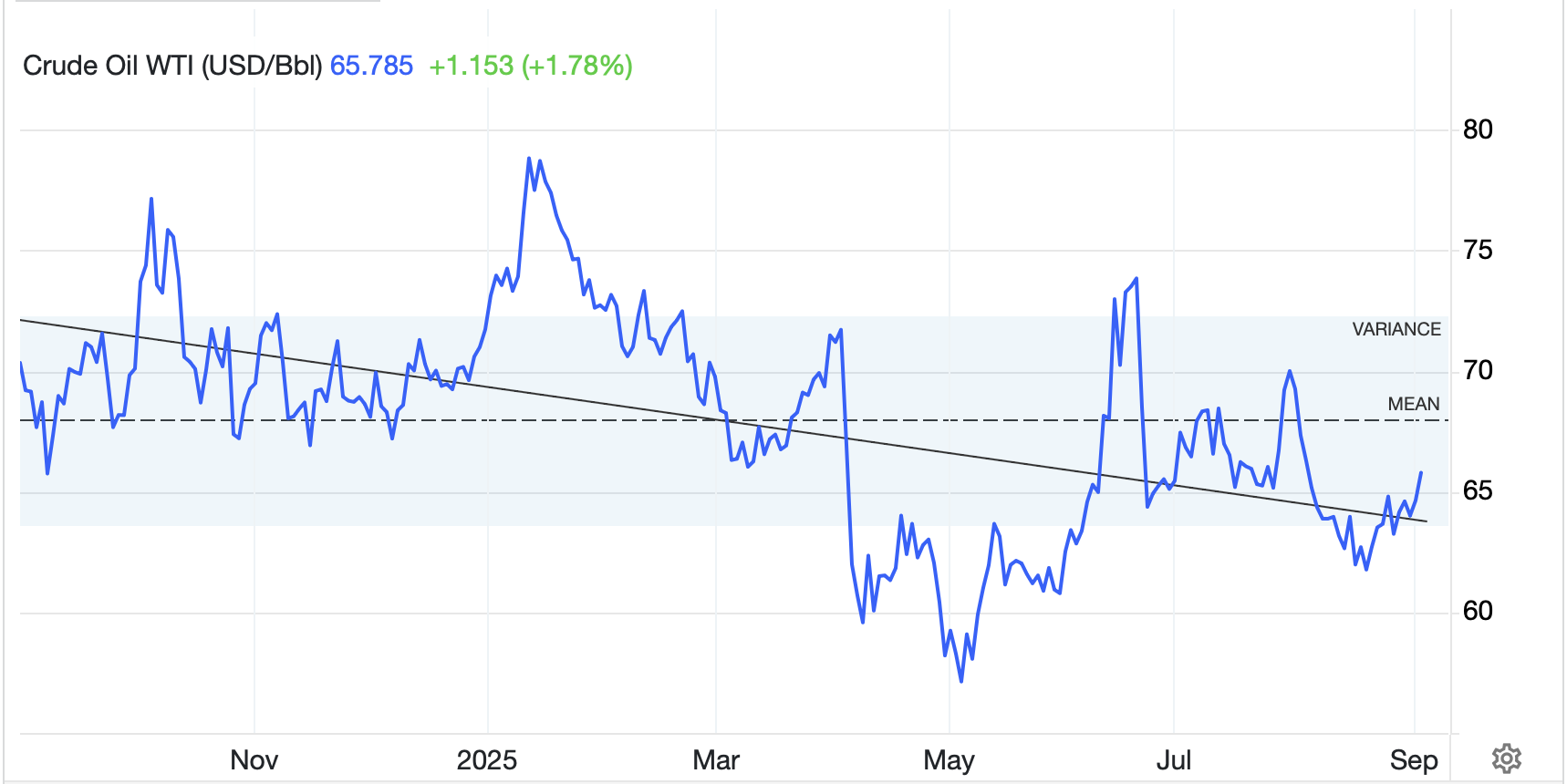
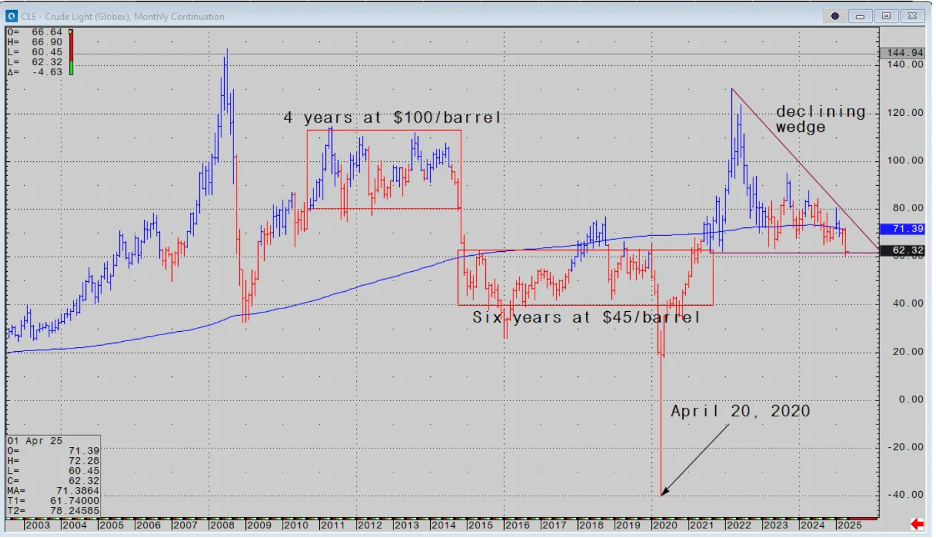
In the commodity market, oil (+0.9%) while higher this morning continues to hold its downtrend as per the below chart.  With further Russia/Ukraine peace talks starting up in Saudi Arabia, the prospects of Russian oil coming back to the market seem to be growing.

Source: tradingeconomics.com

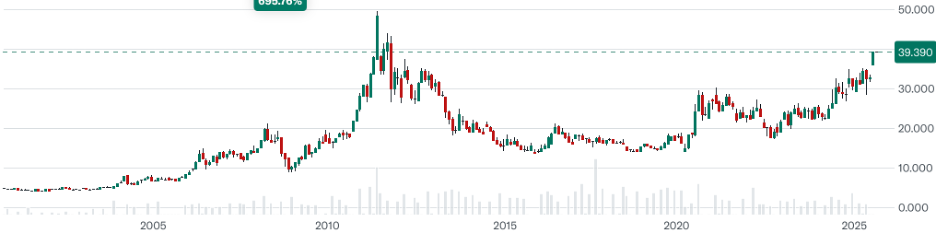
As to the metals markets, gold (+1.0%) is the laggard this morning with both silver (+1.6%) and copper (+1.9%) leading the space higher.  If US equities are responding to a growing probability of a US recession, then I would have expected the industrial metals to soften.  However, after several down days, this could well be just a reflexive trading bounce.  We will need to see further movement to get a better sense of things.

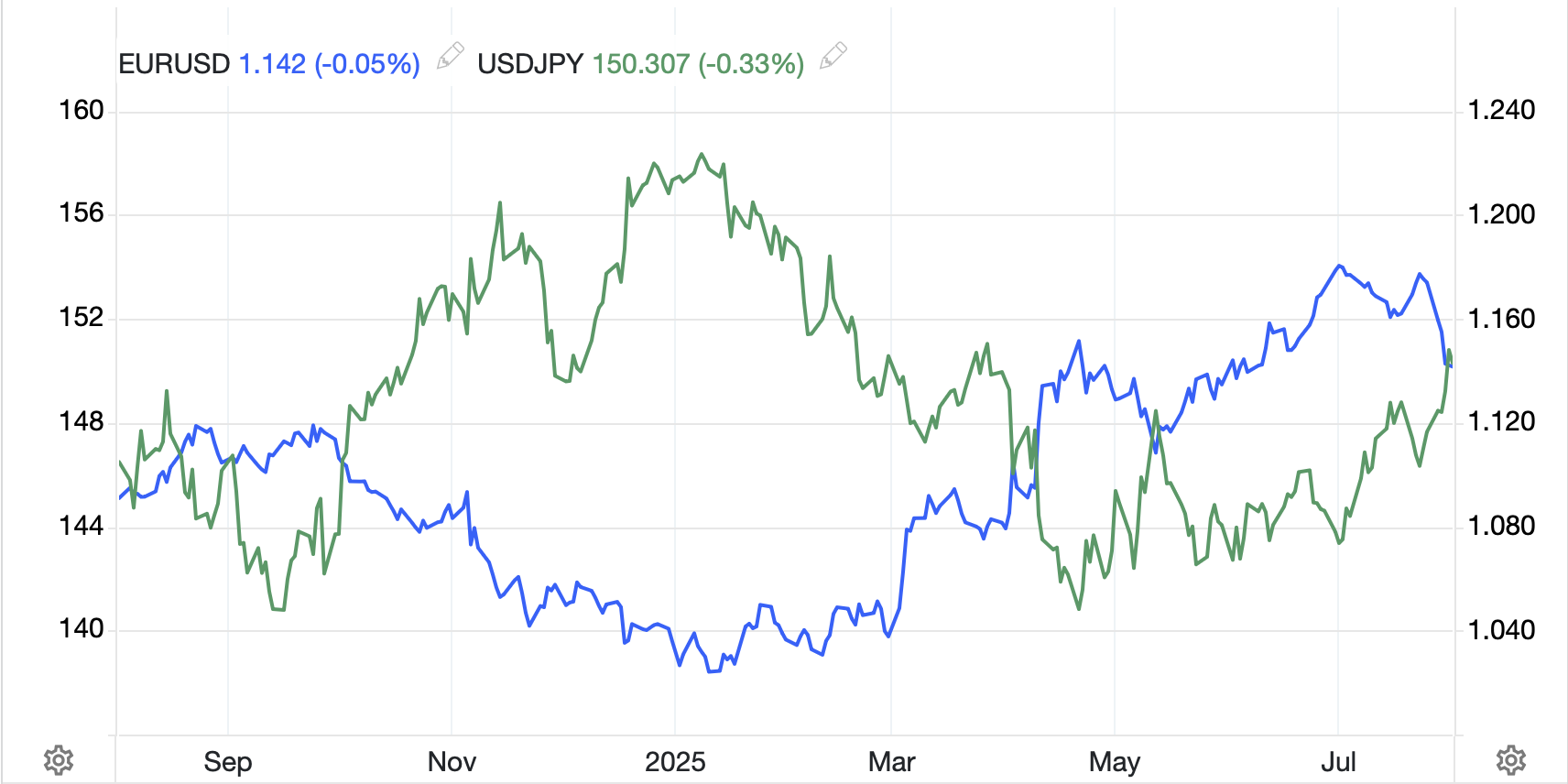
Finally, the dollar remains under pressure generally with the euro (+0.5%) once again gaining ground and touching the 1.09 level for the first time since the US presidential election.  Not surprisingly, that has dragged the CE4 currencies higher as well, but the dollar’s weakness is seen vs. CNY (+0.4%), KRW (+0.5%), SEK (+0.45%), NOK (+0.8%) and even CAD (+0.25%).  Again, the big picture here is that the current policy aims for the US have begun to alter the concept of US exceptionalism with regards to the stock market.  As funds flow elsewhere, the dollar is quite likely to continue to decline.  This will be reinforced if we continue to see 10-year Treasury yields decline.

On the data front, while today is not very exciting, we do see CPI and PPI this week.

TodayJOLTS Job Openings7.75M
WednesdayCPI0.3% (2.9% Y/Y)
 Ex food & energy0.3% (3.2% Y/Y)
ThursdayInitial Claims225K
 Continuing Claims1910K
 PPI0.3% (3.3% Y/Y)
 Ex food & energy0.3% (3.6% Y/Y)
FridayMichigan Sentiment66.3

Source: tradingeconomics.com

We are now in the Fed’s quiet period so there are no Fed speakers until their meeting next Wednesday, but as I have been saying, nobody is really paying much attention to them anyway.  I think we have seen some major changes evolve and that means that equities are likely to remain under pressure along with the dollar, while bonds should hold their own.

Good luck

Adf

Recession in Sight

There once was a policy view
That tariffs, we all should eschew
But President Trump
Explained on the stump
To this idea, he wouldn’t hew
 
And so, as the clock struck midnight
Trump’s tariffs once more saw the light
Most analysts say
The tariffs will weigh
On growth, with recession in sight


By now you are all aware that as of 12:01 EST this morning, 25% tariffs have been imposed on all imports from both Canada and Mexico except energy products, which have seen 10% tariffs imposed.  As well, all Chinese imports have been hit with an additional 10% tariff.  Once again, President Trump has proven to be a man of his word, promising these tariffs during his election campaign and imposing them now.

The mainstream view is that these tariffs are a disaster and will send the economy into a recession.  In fact, the International Chamber of Commerce said a depression was likely.  As well, there is much concern that inflation will rise during the recession, which for Keynesians must be a very difficult concept to grasp given their strongly held belief that a recession will result in declining inflation.

Now remember, I am just a poet, so please take that into account when I offer my views here.  First, we have no idea how things will play out.  The one thing about which I am extremely confident is that there will be numerous behavioral changes by everyone because of these tariffs.  The first question is who will absorb the cost of the tariffs.  Remember, essentially the definition of a recession is that demand is declining.  Will companies be able to pass through the higher costs?  In some instances, they likely will, but in others probably not.  Anecdotally, there was a story in the WSJ that Chipotle will see its costs rise because of the tariff on avocados from Mexico but will not change their prices to account for that.  I’m confident they are not the only company who will absorb those costs.

However, there will certainly be companies that believe they can raise prices and maintain their sales and will try to do that.  My point is each company will evaluate the environment under which they operate and respond in the profit-maximizing manner, but each company’s scenario will be different.

Second, let’s consider the reason that President Trump is such a strong believer in tariffs.  He sees them as the stick to achieve his goals.  I would argue there are two goals in sight.  With Canada and Mexico, he is still unsatisfied with their efforts on the border and with fentanyl smuggling and is very keen to push that to completion.  However, the broader goal is to return manufacturing to America from its decampment overseas, mostly to Southeast Asia, during the past forty years.  And remember, he is seeking to implement a carrot as well, looking to cut corporate taxes to 15% going forward, which would put the US in the lowest quartile of corporate tax rates in the world.  While this morning the headlines are all about the tariffs and their potential destruction, just yesterday, Taiwan Semiconductor announced they would be investing $100 billion to build new fabrication plants in Arizona.  That is exactly the response Trump is seeking.

We all recognize that the world today is very different than it was even two months ago as President Trump has taken an extraordinary number of steps to implement the ideas upon which he was elected.  Interestingly, a large majority of the public remains strongly in his camp with approval ratings for many of his policies well above 60% and as high as 80%.  While markets are clearly unhappy as they have no idea how things will play out, and companies are now faced with far more uncertainty as they attempt to plan for their future, there is no reason to believe this process is going to change anytime soon.  

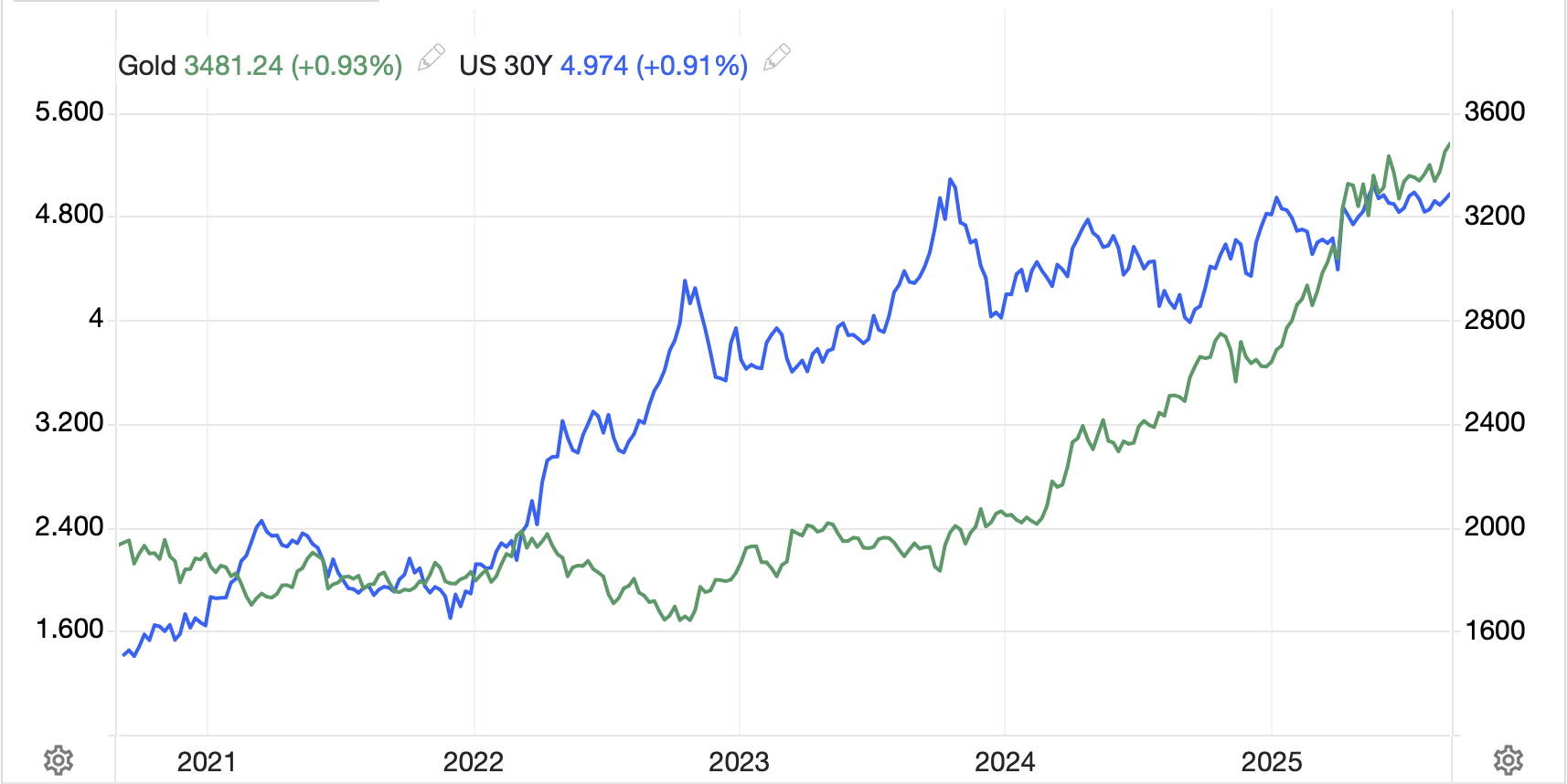
Keep one other thing in mind, unlike Trump’s first term in office, where he was constantly touting the strength of the stock market as a vote of confidence, this time around he and Treasury Secretary Bessent have been entirely focused on the 10-year yield and getting that rate down.  After a 7bp decline yesterday, he has been successful there. (see chart below) I would be surprised if Trump speaks about the stock market much at all for a while.

Source: tradingeconomics.com

With that in mind, let’s see how markets have been handling the tariff imposition.  After yesterday’s rout in the US, where a higher open morphed into a sharply lower close on the day, we saw red throughout Asia (Nikkei -1.2%, Hang Seng -0.3%, CSI 300 -0.1%) and Europe (DAX -2.1%, CAC -1.2%, IBEX -2.3%).  In fact, it is far harder to find a market that has rallied at all, although US futures at this hour (6:40) are pointing slightly higher.  However, after the sharp declines, an early bounce is not uncommon though not necessarily a harbinger of activity for the day.  All of this makes sense as public companies are likely going to see impacts on their profitability either because of reduced sales or reduced margins, or both, with tariffs now in place.  (Well, private companies are going to feel the same pressures, but there are no markets for them to worry about.). The worry for investors is given the extremely high price multiples that currently exist across so many companies, margin pressures can be problematic for stock prices.  For the near term, it is easy to make the case that equities have further to fall.

In the bond market, after yesterday’s Treasury yield decline, there has been a modest 1bp bounce, although as per the above chart, the trend remains lower.  In Europe, the news just hit the tape that the Eurozone is creating a plan to rearm the continent allowing for European countries to exceed debt restrictions to enable them to borrow and spend the money on this task.  The mooted amount is €800 billion, meaning that markets can expect that much new debt issuance across the continent in the coming months and years.  However, it appears investors are viewing the situation overall and are far more concerned with potential slowing growth than on increased issuance as yields have slipped one or two basis points across all nations in Europe.  Perhaps that is a signal that there is little belief in the likelihood of this new plan coming to fruition.

In the commodity markets, oil (-1.4%) continues its slide as a combination of worries over future growth due to the US tariffs and the OPEC+ announcement that they would start to bring production back online beginning in April (just 138K bbl/day, but the signal is quite clear that more is on the way) has traders unnerved.  Certainly, this is part of what President Trump is seeking, lower oil prices to help keep a lid on inflation, and there is no doubt he has pressured OPEC+ on the issue.  Remember, too, that if gasoline prices fall at the pump, that is a key driver of inflation perceptions for everyone.  As to the metals markets, we are seeing a split this morning with precious (Au +1.0%, Ag +0.65%) rallying on uncertainty and fear while copper (-1.2%) seems to be suffering on recession fears.

Finally, the dollar is lower again this morning with the DXY breaking back below 106 for the first time since early December as a signal of the broad trend.  This is interesting as the textbooks claim that if the US imposes tariffs, the dollar will strengthen, or more accurately other currencies will weaken, to offset those tariffs, and yet this morning CNY (+0.55%) and CAD (+0.45%) are bucking that trend although MXN (-0.2%) is behaving as most would expect.  But the dollar’s weakness is broad based, and my take is given the movement in interest rates, which are suddenly declining far more rapidly than anticipated just a week ago (Fed funds futures are now pricing in 75bps of cuts this year with a 11% probability of a cut in March, up from 2% last week) the dollar bull case is under real pressure.  I have maintained all along that if the Fed reignited their easing policy, the dollar would suffer.  Funnily enough, despite any angst between Chairman Powell (remember him?) and President Trump, they both may see lower rates as their preferred outcome.  In that case, the dollar has further to fall.

There is no hard data set to be released today although we do hear from NY Fed President Williams this afternoon.  This could be the first hint that the Fed’s caution is abating, and further rate cuts are in store.  Of course, with Powell on the calendar for Friday, if there is a change in tone, most market participants will be waiting to hear it from him.

The watchword has shifted from caution to uncertainty.  The tariffs have thrown sand into the gears of the economy and markets.  It remains to be seen how much impact they will have, but for now, fear is rising although the dollar is not following suit.  I think Trump must be happy, but I’m not sure how many in the markets are.

Good luck

Adf

Much Havoc

Colombia tried to prevent
Deportees, who homeward were sent
But Trump’s strong response
Meant that in a nonce
Gustavo, his knee quickly bent
 
Meanwhile, all the talk of AI
This weekend has pundits awry
The Chinese DeepSeek
Could very well wreak
Much havoc in stocks priced sky-high


If there was any doubt that things were going to be different under a Trump administration than virtually any previous administration, even his first term, they were dispelled this weekend.  By now you will all have heard the story of the Colombian president, Gustavo Petro (he of the 26% local approval rating) and his refusal to allow two US C-17 military transports filled with Colombian deportees, land in Bogota.  Apparently, when Trump was informed while playing golf, after birdieing the 3rd hole, he tweeted that the US would immediately impose 25% tariffs on everything Colombia exports to the US, rising to 50% in one week if this policy was not changed.  By the time he finished the 6th hole, President Petro reversed his policy and even offered the Colombian presidential plane to come and pick up the deportees.

While the golf portion of the story is amusing, the lesson to the rest of the world is that President Trump is very serious about his electoral promises, and he will utilize the entire might of the US government to achieve his goals.  For smaller nations with little power and leverage, it means that toeing the line is the only solution.  For larger nations, it certainly is a wakeup call to the idea that the US attitude toward international relations has dramatically changed.  As Machiavelli explained, it is better to be feared than loved, and it seems abundantly clear that President Trump understands that.

Perhaps the biggest takeaway from this situation, though, is that the US government is no longer the slow-moving behemoth to which it had evolved over the past decades.  The rest of the world is going to find itself needing to respond very quickly to things that in the past were sent to committees for study and review but now are decided instantly.  If you want to understand why I believe volatility is set to increase across all asset classes, this is the crux of the issue.

Turning to the tech world, the buzz is all about DeepSeek, which is a Chinese AI model that allegedly outperforms OpenAI’s top model, or performs just as well, although it costs a fraction of what OpenAI and others (Microsoft, Google, etc.) spent to train the model and it uses far less advanced chips which are also much less expensive and less power hungry.  Because this is all a new story, it remains unclear if DeepSeek will be an effective replacement for the others, or if it excels in only one or two areas and still lags elsewhere.  

But the market impact has been instantaneous and dramatic.  At this hour (6:00am), the NASDAQ (-4.5%) is leading US equity markets lower with the S&P (-2.4%) along for the ride.  Nvidia (-10.6% in premarket trading) is leading the way, but I suspect that this news will be negative for the entire US tech sector.  After all, it was certainly priced at premium levels.  

Source: tradingeconomics.com

In the short term, I expect we are going to hear a lot more analysis of why this is a game changing event and how the future that was so clear just last week is now cloudy.  However, while this will almost certainly take the shine off the megacap tech companies for a while, I think it would be a mistake to dismiss their futures because of this.  Two things in their favor are they still have virtually infinite resources, and they have dramatically large installed networks which means that changing things will be very difficult.  While their equity prices can decline a lot, it doesn’t mean their businesses are going to collapse.

PS, spare a thought for the impact on the energy sector here as well.  One of the narratives that has been fed lately is that all this AI will require gobs of power that will need a lot more power production.  It was a key feature of the Uranium story as nuclear is seen as one of the few sources capable of delivering the reliable power necessary.  I suspect that this part of the narrative will need to adjust as well if the AI story has actually changed.  But keep in mind that with efficiency comes more demand, so perhaps this is just a temporary downdraft.  Again, volatility is the name of the game.

Ok, let’s see how these stories have impacted the rest of the world.  With all the news over the weekend, you may not recall that US equity markets edged lower on Friday.  Well, Asian markets were mixed overnight with the Nikkei (-0.9%) following the US, although also reacting to the fact that the yen (+1.3%) rallied sharply as well.  Meanwhile, Hong Kong (+0.7%) managed to gain while mainland Chinese shares (-0.4%) certainly showed no benefit from the changing attitudes in tech.  Elsewhere in the region, Korea (+0.9%) and Taiwan (+1.0%) rallied while India (-1.1%) and Indonesia (-0.9%) fell and the rest of the region batted back and forth. In Europe, red is the dominant color, likely on the generally weak US performance although there are no European tech companies of note (perhaps ASML).  But the DAX (-1.2%) is leading the way down followed by the CAC (-0.9%) and the bulk of the rest of the continent and the UK.  Let’s just say that equities are not in favor this morning.

However, what we are seeing is a major bond market rally as Treasury yields (-12bps) tumble as risk is very definitely off.  European sovereign yields are also lower, by between -5bps and -7bps, and JGB yields (-2bps) also slipped, although relative to the rest of the world, they held up pretty well.  Interestingly, with all the talk about DeepSeek and the impact on the tech community, there has been virtually no discussion about the myriad central bank meetings this week, including, of course, the Fed on Wednesday where the market still sees no chance of a rate cut.

Commodity markets are relatively calm this morning as oil (-0.6%) is a touch lower although there has been no news of note.  The background story is that President Trump and Saudi Arabia’s Mohammed bin Salman are talking about increasing production to drive oil prices lower, but that remains more rumor than anything else.  As the polar vortex has passed, and forecasts are for warmer weather, NatGas (-6.2%) is sliding.  In the metals markets, very little movement is ongoing as traders try to determine what all the new news means.

Finally, the dollar is under some pressure this morning despite the risk off attitude that prevails.  I suppose it is because one of the recent drivers of the dollar’s strength has been the insatiable demand for the megacap tech stocks.  It seems that for now, that demand has been satiated.  So, the yen is behaving in its traditional safe haven role, as is the CHF (+0.85%) but the euro (+0.15%) and pound (+0.15%) are both a touch higher.  That said, we are definitely seeing emerging market currencies under pressure as they have nothing to do with tech and everything to do with the very obvious change in attitude regarding how the US is going to deal with smaller nations that don’t accede to US demands, especially regarding immigration.  So, MXN (-1.0%), COP (-1.1%), ZAR (-1.4%) and BRL (-0.6%) are all under significant pressure.  CE4 currencies, though, are not in the line of fire, so are little changed this morning.  

On the data front, remarkably, it almost seems an afterthought given what we just saw this weekend, but along with the Fed, BOC and ECB, we get PCE on Friday.

TodayNew Home Sales670K
TuesdayConsumer Confidence106.0
WednesdayBank of Canada Rate Decision3.0% (current 3.25%)
 FOMC Rate Decision4..5% (current 4.5%)
ThursdayECB Rate Decision2.75% (current 3.0%)
 Initial Claims220K
 Continuing Claims1885K
 Q4 GDP2.8%
FridayPersonal Income0.4%
 Personal Spending0.5%
 PCE0.3% (2.6% Y/Y)
 Core PCE0.2% (2.8% Y/Y)
 Chicago PMI40.0

Source: tradingeconomics.com

At this point, the central bank story is background noise, not the major theme, but by Wednesday I expect that all eyes will be on Chairman Powell as he describes the Fed’s thoughts at the press conference.  Of course, that assumes that there are no other political earthquakes, which may not be a very good assumption these days.  I think we are in a seismic zone for now.  

As to the dollar, if DeepSeek really is an Nvidia killer, then it is not hard to derive a scenario that says, US equity markets are going to decline, along with growth expectations.  The Fed will cut more aggressively, and the dollar will start to really fall as well.  I’m not forecasting that, just highlighting a possible, if not likely, scenario in the event the world believes the AI story is not going to be as expensive and profitable for the Mag7 as they thought last week.  Once again, the key is to hedge your risks, because as you learned this weekend, things change, and they can change quickly!

Good luck

Adf
Just Won’t Evanesce

The RBA left rates on hold
And sounded quite dovish, all told
Meanwhile in Brazil
Old Lula is ill
With something much worse than a cold
 
In Syria, things are a mess
In Taipei they’re feeling some stress
With all this unfolding
It’s no shock beholding
Risk assets just won’t evanesce


Risk is the topic du jour as pretty much everywhere one looks around the world, things are afoot that can inculcate fear (and loathing) rather than embrace those animal spirits.  Perhaps the least frightful, but most directly impactful regarding markets, was the RBA meeting last night at which the committee left rates on hold, as universally expected, but appeared to turn (finally) to the dovish side of the ledger.  The policy statement explained, “Some of the upside risks to inflation appear to have eased and while the level of aggregate demand still appears to be above the economy’s supply capacity, that gap continues to close.  The board is gaining some confidence that inflation is moving sustainably toward target.”   However, the proof is in the pudding and a quick look at the AUD (-0.7%) shows that the market has come to believe the RBA is finally joining the central bank rate cutting party.

Source: tradingeconomics.com

The trend seems pretty clear and it is hard to make a case for a reversal absent a massive spike in inflation Down Under forcing the RBA to change direction or something coming from the US focusing on weakening the USD, but given nothing like that seems likely until Mr Trump is officially in office, I am concerned that the Aussie dog will live up to its nickname and make new lows going forward, perhaps testing 0.6000 before this is over.

Speaking of currencies under pressure, elsewhere in the Southern Hemisphere we find the Brazilian real which has fallen to new historic lows, with the dollar now trading above 6.08.  For those of you who hate to pay away the points in USDBRL to hedge your balance sheet assets, the reason that you need to do it is very evident from the chart below.

Source: tradingeconomics.com

While there were several short-term dips in the dollar during the past year, the spot rate (at which you remeasure your balance sheet each month) moved from 4.92 to 6.08 in 12 months, nearly a 24% decline in the real.  A one-year forward would have cost far less, something like 40-45 big figures, or less than half the actual move, and would have given you certainty as to the cost.  Hedging matters!

Now, why, you may ask is this happening?  Well, news that Brazilian president Lula da Silva had emergency brain surgery has clearly not helped the currency.  Suddenly there are many questions over who is running the country and how they will address the ongoing fiscal issues that are extant.  As an aside, this is likely another deterrent to the idea of a BRICS currency appearing any time soon, if ever.

Turning our gaze elsewhere, the situation in Syria continues to unfold with no clear outcome although increased concerns over what will happen with the beleaguered people of that nation and whether it will foment yet another immigration wave into Europe and elsewhere in the Middle East.  However, right now, the oil market remains nonplussed over this issue as evidenced by yet another day of quiet trading and a slow drift lower in the price (-0.55%).

However, we cannot ignore Taiwan, where China is currently in the process of military maneuvers that appear to be simulating a naval blockade of the nation.  Price action here has shown the TWD (-0.4%) sliding further and pushing back toward its weakest level in more than 15 years (since the GFC), while the TAIEX stock index (-0.65%) is also feeling a little heat, although the story there has been one of consistent gains over the past several years, following the NASDAQ higher given the breadth of technology companies there, notably TSMC.

Putting it all together leaves one wanting with respect to their risk appetite this morning as today seems like another step closer to that Fourth Turning.  So, it should be no surprise that after a down day yesterday in the US, with all three major equity indices declining, we have seen far more red than green on the screens overnight.  The exception to this rule was in Korea, where the KOSPI (+2.4%) rose sharply as it appears that things are starting to revert to more normalcy there politically.  President Yoon is under pressure to resign and seems likely to be impeached and the government is back to functioning in more of its ordinary manner.  But elsewhere in Asia, Hong Kong (-0.5%), Australia (-0.5%) and most of the smaller regional bourses were lower although the Nikkei (+0.5%) rallied on the back of the yen’s renewed weakness, and mainland Chinese shares (+0.7%) seemed to begin to believe that more stimulus is, in fact, on its way.  We shall see about that.

In Europe, the bourses range from flat (DAX, IBEX) to down CAC (-0.5%), FTSE 100 (-0.5%) with both these nations suffering from their own political distress.  French President Macron is trying to form a government but categorically refuses to include Marine Le Pen’s RN party so has no chance of a majority with concerns growing over the fiscal situation there.  Apparently, if they cannot get a financing bill passed, the French will get to experience the heretofore unique American experience of a government shutdown.  Meanwhile, PM Starmer is watching his ratings circle the drain as his government continues to try to raise revenues by raising taxes on the rich and finding out that one thing rich people are really good at is creating new methods of operations to avoid paying higher taxes.  While there is no vote necessary in the UK for years (remember, Starmer won election just this past July 4th) it certainly feels like his government is going to fall sooner rather than later.  Meanwhile, US futures are little changed at this hour (7:30).

In the bond market, yields are rebounding with Treasuries higher by 3bps this morning after a 3bp rally yesterday.  In Europe, there is very little change except for UK Gilts (+4bps) with concerns over inflation rising there while in Asia, Australian yields slipped 6bps on the dovish RBA.  Generally speaking, the bond market has not been very exciting lately which is one reason, I believe, that things have not fallen apart.  If we start to see more volatility here, watch out.

In the commodity markets, aside from oil’s modest decline, gold (+0.65%) continues to find support in this risk-off scenario although both copper and silver are little changed this morning after solid rallies yesterday.

Finally, the dollar is higher again this morning, with the DXY well back above 106.00 and every G10 currency declining led by NZD (-1.0%).  This is suffering from the RBA’s dovishness which is expected to allow the RBNZ to maintain, or even increase, its own dovishness.  But the whole bloc is softer.  In the EMG bloc, there are a few currencies that are holding their own vs. the dollar this morning, but only just, with MXN (+0.2%) arguably the strongest currency around while CNY (+0.1%) is also relatively strong.  But elsewhere in this bloc, ZAR (-0.7%), PLN (-0.55%), and CLP (-0.4%) are indicative of the type of price action we are seeing across the board.  This is a dollar day, though, not really focusing on individual currency foibles.

On the data front, we see only Nonfarm Productivity (exp 2.2%) and Unit Labor Costs (1.5%) and that is really it.  There was nothing yesterday and all eyes are truthfully turned toward tomorrow’s CPI data.  Things don’t feel very positive right now, so I expect risk to remain on its back foot to start the day.  However, given the number of uncertain situations that abound, anything can happen to either change that view or reinforce it.  Once again, this is why you hedge, to mitigate the markets’ inherent volatility.

Good luck

Adf
Chaos is Spreading

Around the world, chaos is spreading
As government norms get a shredding
Korea’s the latest
But not near the greatest
Seems to the Fourth Turning we’re heading

While Russia/Ukraine knows no end
And Israel seeks to defend
The French are about
To toss Michel out
And all this ere Trump does ascend


If you view markets through a macro lens, the current environment can only be described as insane.  Niel Howe and William Strauss wrote a book back in 1997 called The Fourth Turning (which I cannot recommend highly enough) that described a generational cycle structure that has played out for hundreds of years.  If you have ever heard the saying 

  • Hard times make strong men (1st Turning)
  • Strong men make good times (2nd Turning)
  • Good times make soft men (3rd Turning)
  • Soft men make hard times (4th Turning)

Or anything in the same vein, this book basically describes the process and how it evolves.  The essence is that about every 20-25 years, a new generation, raised by its parents whose formative years were in the previous Turning, falls into one of these scenarios.  Howe and Strauss explained that at the time they wrote the book, we were in the middle of the 3rd Turning, and that the 4th Turning would be upon us through the 2020’s.  One of the features they highlighted was that every 4th Turning was highlighted by major conflict (WWII, Civil War, Revolutionary War, etc.) with the implication that we could well be heading toward one now.

Of course, we already have a few minor wars with Russia/Ukraine (although that seems to have the potential to be more problematic) and Israel/Hezbollah/Hamas, with Iran hanging around the edges there.  In a funny way, we have to hope this is the worst we get, but there are still more than 5 years left in the decade for things to deteriorate, so we are not nearly out of the woods yet.  

But turmoil comes in many forms and political turmoil is also rampant these days.  This is evident by the number of sitting governments that have been ejected in the most recent elections as well as the increasingly strident blaming of others for a nation’s current problems.  In this vein, the latest situation will happen shortly when the French parliament votes on a no-confidence motion against the current PM, Michel Barnier.  As it is, he is merely a caretaker PM put in place by President Macron after Macron’s election gamble in June failed miserably.  Adding to France’s problems, and one way this comes back to the markets, is that the French fiscal situation is dire, with a current budget deficit exceeding 6% of GDP and no good way to shrink it.  In fact, Barnier’s efforts to do so are what led to the current vote.  I have already discussed French yields rising relative to their European peers and the underperformance of the CAC as well. 

On the one hand, today’s vote, which is tipped to eject Barnier, may well be the peak (or nadir) of the situation and things will only improve from the current worst case.  However, it strikes me this is not likely to be the case.  Rather, there are such a multitude of problems regarding immigration, culture, economic activity and government responsiveness, that we have not nearly found the end.  My fear is we will need to see things deteriorate far more than they have before populations come together and agree that ending the mess is the most important outcome.  Right now, there are two sides dug in on most issues and the split feels pretty even.  As such, neither side is going to give up what they believe for the greater good, at least not yet.

And before I move on to the markets, I cannot ignore the remarkable events in South Korea yesterday, where President Yoon Suk Yeol declared martial law in the early hours on the basis of the opposition’s efforts to paralyze the government (I guess that means they didn’t agree with him).  In the end, the Korean Parliament voted to rescind the order, and the military has since stood down with all eyes on the next steps including likely impeachment hearings for the President.  Not surprisingly, Korean assets suffered during this situation with the won tumbling briefly, more than 2.6%, before retracing the bulk of those losses once the order was rescinded.  

Source: tradingeconomics.com

Too, the KOSPI (-1.5%) suffered although that was off the worst levels of the day after things settled down.  The point to keep in mind here is that markets are subsidiaries of economies.  They may give indications of expectations for the future, or sentiments of the current situation, but if we continue to see geopolitical flare ups, markets are going to respond as investors seek havens.  In this case, the dollar, despite all its flaws, remains the safest choice in many investors’ eyes, so should remain well bid overall.

Ok, let’s look at how markets have been behaving through this current turmoil.  In Asia, given the events in Korea, it ought not be surprising that equities had little traction.  Japanese shares were unchanged as were Hong Kong although mainland Chinese (-0.5%) and Australian (-0.4%) shares were under some pressure.  That said, Australia suffered on weaker than forecast GDP data which puts more pressure on the RBA to cut rates despite inflation remaining sticky.  Australia dragged down New Zealand (-1.5%) shares as well with really the only notable winner overnight being Taiwan (+1.0%).  In Europe, investors seem to be betting on a more aggressive ECB as somewhat weaker than expected PMI Services data has led to gains on the continent (DAX +0.85%, CAC +0.5%, IBEX +0.7%) although UK shares (-0.2%) are not enjoying the same boost.  I guess the French market has already priced in the lack of a working government, hence the market’s underperformance all year.  US futures, at this hour (8:00) are pointing higher by between 0.3% and 0.6%.

In the bond market, yields are rising, with Treasuries (+4bps) leading the way although most of Europe are higher by between 3bps and 4bps.  It has the feel that bond markets are starting to decouple from central banks as they see inflationary pressures building and central banks still in active cutting mode.  I fear this will get messier as time goes on.

In the commodity markets, oil is unchanged this morning, right at $70/bbl, having continued its rally for the week on news that OPEC+ will maintain its production cuts through March 2025.  NatGas (-2.0%) has been sliding since the spike seen 2 weeks ago ahead of the current cold spell as warmer weather is forecast for next week.  In the metals market, gold (-0.2%) seems stuck in the mud right now while silver (-1.3%) and copper (-0.6%) appear to be victims of the dollar’s strength.

Turning to the dollar, it is stronger across the board with AUD (-1.3%) the laggard after that GDP data and it dragged NZD (-1.0%) down with it.  JPY (-1.1%) is also under pressure as hopes for that BOJ rate hike dissipate.  Away from those, the euro (-0.2%) and pound (-0.1%) are softer, but much less so.  In the EMG bloc, ZAR (-0.5%) is feeling the weight of the weaker metals prices and we are seeing BRL (-0.3%) and CLP (-0.1%) also sliding slightly although both are stabilizing after more pronounced weakness earlier in the week.

On the data front, this morning brings ADP Employment. (exp 150K) along with ISM Services (55.5) and then the Fed’s Beige Book.  Perhaps of more importance, at 12:45, Chairman Powell will be speaking and taking questions, so all eyes will be there looking for clues as to how the Fed will be viewing things going forward.  Fed funds futures have been increasing the probability of that rate cut, now up to 74%, which implies we are going to see one, regardless of the inflation story.

Central banks around the world are in a bind as inflation refuses to fall like they want but many nations are seeing slowing economic activity.  In the end, I expect that the rate cutting cycle has not ended, but the dollar is likely to remain well bid given both its haven status and the fact that the US economy is outperforming everywhere else.

Good luck

Adf
Whining and Bleating

In Rio, the G20’s meeting
With typical whining and bleating
No progress was made
On tariffs or trade
And Trump, though not there, took a beating
 
Seems leaders in most of these nations
Are fearful of future relations
With Trump and the States
Which just demonstrates
How low are their own expectations


I guess the idea of these broad talking shops is rooted in a desire to keep open lines of communication between parties with different views on the way things should be in the world.  But, boy, the G20 has really deteriorated over time.  Probably, this is merely a symptom of the underlying changes in international relations.  Remember, the G20 is an outgrowth of the Group of 7 nations (US, Germany, UK, Japan, France, Canada and Italy) and only began in 1999.  The idea was to help develop the globalization initiative by creating an organization that included both developed and developing nations.  It was this group that led to China joining the WTO in 2001 and, ironically, which laid the groundwork for its own slow disintegration.

This is not to say that these leaders are going to stop meeting each year, just that the opportunity for substantive policy proposals has likely passed us by.  And understand, this has been the case for a while now as the Chinese mercantilist policy has seemingly reached the end of its global acceptance.  While President-elect Trump tends to get the most bashing for this, one need look no further than Europe to see tariff and non-tariff barriers rising quickly.  Below, I will allow Bloomberg’s reporters to summarize some of the key issues highlighting the lack of agreement on anything.

  • Germany’s Olaf Scholz and France’s Emmanuel Macron are pushing for tougher language in the summit communique against Hamas and Russia on the wars. Brazil doesn’t want to reopen the text, fearing that it will reignite battles over other issues too. 
  • UK Prime Minister Keir Starmer irritated Chinese officials by raising human rights and the issue of Taiwan with President Xi Jinping at their first bilateral meeting.
  • The potential impact of Donald Trump’s impending return to the White House on trade and diplomatic relations hung over many of the day’s bilaterals. 
  • The rivalry between host Brazil’s Luiz Inacio Lula da Silva and Argentina’s Javier Milei was on full display on everything from the role of the state in fighting poverty to climate change, with the latter leader maintaining his contrarian stance to some of the key points in the summit’s statement.
  • There was even drama around the traditional family photo, which US President Joe Biden, Canada’s Justin Trudeau and Italian Prime Minister Giorgia Meloni somehow missed.

As I said, I expect that these meetings will continue but their usefulness is very likely to continue to deteriorate.  One way you know that this process has reached the end of the road is that no financial markets have reacted to any commentary from anyone at the meeting.  In the past, the G20 statement or comments from leaders on the sidelines would move markets as they implied policy shifts.  No longer.  Remember, too, that at least four of these leaders are lame ducks (Biden, Macron, Scholz and Trudeau) and will be out of office within a year.

Away from the photos and sun
Investors see fear and not fun
Ukraine’s getting hotter
Midst greater manslaughter
While pundits, new stories, have spun

However, if we step away from the glitz (?) of the G20 meeting, markets are demonstrating a fearful tone this morning.  Yesterday saw US equities with a mixed session as investors continue to try to determine the impacts of President Trump’s return.  Will there be tariffs?  If so, how big and on what products?  And which companies will benefit or be hurt by the process.  Generally speaking, the thought has been small-cap companies would be the big beneficiaries while both Big Pharma and Big Food would feel pressure from this new administration.  But how has that impacted other nations and other markets?

In truth, I have a feeling one of the key issues this morning is that President Biden’s change in policy to allow Ukraine to fire long-range missiles into Russia is now a growing concern.  Russia has altered their nuclear response policy, essentially threatening that if this keeps up, they will both blame the US and NATO and respond with nuclear weapons if they determine that is appropriate.  Funnily enough, investors, especially those in Europe, have determined that may not be a positive outcome for European companies.  Hence, bourses across the continent are all lower this morning with declines greater than -1.1% everywhere with Poland (-2.1%) the laggard.  As to Asian markets overnight, they were broadly firmer as the potential escalation in Europe is likely to have a smaller impact there.  But US futures are under pressure this morning, -0.4% across the board at this hour (6:30).

That risk off feeling is being felt in bond markets as well, with yields falling everywhere as investors switch from stocks to bonds.  Treasury yields have fallen -6bps and we are seeing similar declines, between -4bps and -6bps, across the continent as well.  Fear is palpable this morning here.

This fear is clear in the commodity markets as well where oil (-1.0% after a 3.3% rally yesterday) is softer along with copper (-0.7%) but precious metals (Au +0.8%, Ag +0.5%) are both in demand.  The one other noteworthy move this morning is NatGas (+0.6%), bucking the oil trend as despite the oft-feared global boiling (to use UN Secretary General Antonio Guterres term), Europe is feeling an unseasonable cold spell with rain and temperatures just 40° Fahrenheit, some 15° below normal.

Finally, the dollar is back on top this morning as fear has driven investors and savers to holding the greenback despite all its problems.  Using the Dollar Index (DXY) as our proxy, you can see from the below chart that despite all the huffing and puffing that the post-election climb of the dollar had ended last Thursday, in fact, we have only seen a very modest correction of the sharp election move and my take is we have higher to go from here.

Source: tradingeconomics.com

Adding to the risk-off thesis is the fact the JPY (+0.4%) is firmer and CHF (0.0%) has not declined with both of those traditional havens holding up well.  One other note is AUD (-0.2%) is one of the better performers after the RBA Minutes last night indicated that the central bank Down Under is also in no hurry to cut rates with fears of inflation still percolating there.  A quick look across the EMG bloc shows us that virtually all these currencies are softer with PLN (-0.8%) and ZAR (-0.65%) the laggards.  I guess given the concerns over Poland and a potential escalation of the war in Ukraine, it is no surprise the zloty is under pressure.

On the data front, this morning brings Housing Starts (exp 1.33M) and Building Permits (1.43M) as well as Canadian inflation (1.9% headline, 2.4% Median).  There are no Fed speakers scheduled today and quite frankly; it doesn’t strike me that Housing data is critical to decision making right now.  Fear is in the air and that is likely to continue to drive markets.  With that in mind, a deeper equity correction along with continued USD strength seem like the best bets for the day.

Good luck

Adf

A Warning

Though Trump has been leading the news
With folks asking who he will choose
As agency chiefs
That share his beliefs
For markets, today brings new cues
 
Inflation will soon be released
And though Jay claims he killed this beast
The data this morning
May well be a warning
Inflation, in fact, has not ceased


Source: tradingeconomics.com

Beauty (and everything else) is in the eye of the beholder.  So, what are we to make of the above chart which shows the past ten years’ worth of monthly Core CPI readings prior to this morning’s release.  Some eyes will travel to the peak in April 2021 (0.812%) and see a downward sloping line from there.  The implication is that the trend is your friend and that things are going well.  Others will gravitate to the June 2023 print (0.195%) and see that except for a blip lower in June 2024 (0.1%), the series looks like it may have bottomed and, if anything, has found a new home.

Remember, that if the monthly print is 0.3%, that annualizes to 3.7% Core CPI.  That seems pretty far above the 2.0% target that the Fed is shooting for and would call into question exactly why they are cutting interest rates.  In fact, you can look at the above chart and see that prior to the pandemic, core CPI on a monthly basis was below 0.3% every month except one, with many clearly down near the 0.1% level.

As much as Powell and his minions want to convince us that inflation is heading back to their goal and everything is ok, the evidence does not yet seem to be pointing in that direction.  For today, current median analyst expectations are for a headline of 0.2% M/M, 2.6% Y/Y and a core of 0.3% M/M, 3.3% Y/Y.  Even if the data comes as expected, it would seem very difficult to justify continuing to cut rates given the equity market remains essentially at all-time highs, while Treasury yields (-1bp today, +12bps yesterday) seem like they are starting to price in higher long-term inflation.

However, something interesting seems to be happening with the Fed speakers.  Richmond Fed President Barkin yesterday explained that things look pretty good, but declined to even consider forecasting where things will go.  As well, Minneapolis Fed President Kashkari indicated that while inflation has declined, it does not yet seem dead.  The Fed funds futures market is now pricing just a 62% probability of a rate cut in December.  One month ago, it was pricing an 84% probability.  As I have maintained, it seems increasingly difficult for the Fed to make the case that rate cuts are necessary given the economic data that we continue to see.  I understand that there are still a large group of pundits who believe things are much worse when you dig under the surface of the data, and I also understand that most people in the country don’t believe that things are going that well, hence the landslide election results for Mr Trump.  However, based on the data that the Fed allegedly follows, rate cuts seem difficult to support.  Today will be another piece of the puzzle.  If the data is hot, I expect risk assets to suffer more and the dollar to continue its rally.  If the data is soft, look for new records in stocks while the dollar retraces some of its recent gains.

With that in mind, let’s look at what happened overnight in markets.  Yesterday’s modest declines in the US market were followed by more selling than buying in Asia with the Nikkei (-1.7%) leading the way lower but weakness also seen in Australia (-0.75%), Korea (-2.65%), India (-1.25%) and Taiwan (-0.5%) as an indication of the general sense in the time zone.  The outlier here was mainland China (+0.6%) where hope remains eternal that the government will fire their bazooka.  In Europe, though, this morning is seeing a hint of red with most major indices lower by just -0.1% and Spain’s IBEX (+0.2%) even managing a small gain.  The commentary from the continent is over fears of how things will evolve with the new Trump administration and his threat of more tariffs on European exports.

But here’s something to consider.  If Trump is successful in quickly negotiating an end to the Russia/Ukraine war, won’t that be a huge benefit to Europe?  After all, if the war is over, they will be able to restart imports of cheap Russian NatGas which should have an immediate impact on their overall cost of energy, especially Germany, and help the economies there substantially.  I know they love to scream because they all hate Trump, but it seems like he could help them a lot if they would let him.  Oh yeah, US futures are a touch lower, -0.2%, at this hour (7:10).

Anyway, in the bond market, after yesterday’s rout in the US, yields are little changed this morning but in Europe, yields are climbing as they weren’t able to keep up with US yields yesterday.  So, on the continent, yields are higher between 2bps and 4bps after rising 4bps – 6bps yesterday.  In Asia, JGB yields jumped 4bps on the global rise in bond yields and are now back above 1.0%.  However, that has not been nearly enough to help the yen (-0.2%), which continues to weaken and is pushing back above 155.00 this morning.  

In the commodity markets, oil (+0.2%) is edging higher, but that seems to be consolidation after what has been a pretty awful week for the black sticky stuff.  OPEC reduced its demand forecasts for the 4th consecutive month, something else that is weighing on the price and, of course, the Trump administration is going to seek to make it much easier to explore for and produce more oil.  In the metals markets, gold (+0.5%) seems to have found a temporary bottom along with silver (+0.8%) although the damage has been substantial this week.  However, copper and aluminum remain under pressure as fears over continued weakness in China seem to be weighing on the price.

Finally, the dollar has stopped rising sharply, although it is not really declining very much, at least not vs. the G10 currencies.  In fact, vs. the G10, the dollar is softer by just 0.1% or so vs. the entire bloc other than the yen mentioned above.  However, vs. the EMG bloc, the dollar has ceded some more gains with KRW (+0.7%) the leader but MXN (+0.4%), CNY (+0.35%) and ZAR (+0.6%) all bouncing back after a week of substantial declines.  We all know nothing goes up or down in a straight line, so this consolidation is just that, it is not a trend change by any stretch.  A quick look at the MXN chart below, which is essentially what we have seen everywhere, explains just how insignificant the overnight movement has been relative to the recent trend.

Source: tradingeconomics.com

On the data front, aside from the CPI data, we hear from three more Fed speakers (Logan, Musalem and Schmid) so it will be interesting to see if they are starting to change their sense of how things are going to progress.  Of course, all eyes will be on Powell’s speech Thursday afternoon, but perhaps there are some clues to be had here.

It is not clear to me that anything has changed in the big picture.  The US economy continues to be the strongest one around and now has the added impetus of expectations for more positivity with the change in the administration.  In that environment, my long-term view on the dollar remains it has further to run.

Good luck

Adf

Quite Drear

The world is apparently ending
‘Cause stocks just will not stop descending
So, calls have increased
For fifty, at least
And government to up its spending
 
The cause of this rout is unclear
Though data of late’s been quite drear
If growth is much slower
Then stocks can go lower
And that, my good friends, triggers fear


The only topic on market practitioners’ lips this morning is the ongoing sell-off in equity markets around the world.  The US returned after the Labor Day holiday and sold equities aggressively with the NASDAQ falling more than 3.25% and the other major indices all declining at least -1.5%.  This led to a disastrous opening in Asia with the Nikkei (-4.25%) leading the way down as fears of a repeat of the early August rout were rampant.  While things never got to that point, we did see both Korea and Taiwan markets fall even more than Tokyo with declines between -4.5% and -5.0%.  This negative sentiment is alive and well in Europe with every market lower there, although the declines are less pronounced, between -0.7% and -1.1%, and US futures are lower this morning as well, down anywhere between -0.3% and -0.6% at this hour (6:30).

So, what’s happening?  Is there something new that was previously unknown?  The first place to look is the data which saw ISM manufacturing rise less than expected to 47.2, a number that historically represents recession, with the added problem of the ISM Prices Paid reading at 54.0, higher than expected and a potential harbinger that inflation may not be declining as quickly the Fed expects.  Add to that a weaker than expected Construction Spending result, -0.3%, and you have the makings of some potential dreariness on the economic front.  The problem with this thesis is that the equity market opened prior to the releases and was already down -1.0% by the time they hit the tape.

Perhaps it is simply the end of summer blues as historically, September seems to be the worst month for equity performance, although I don’t put much credence in the idea that just because something has happened at a particular time before in markets, it will happen again.  Seasonality is real, especially in things like commodities, but is technology really seasonal?  And tech was leading the way lower.

Of course, markets have a long history of simply moving up and down over time without any specific catalyst.  Positioning and changes in sentiment evolve over time and sometimes they combine to move markets more than would otherwise be expected.

From a macro perspective, I believe that this week will teach us a great deal as the ISM data along with the employment data will give further evidence of the potential for that widely hoped for soft-landing or whether things are declining more rapidly.  Certainly, we continue to read of problems arising elsewhere in the world with the VW news about potential plant closings and weakness in Chinese PMI data overnight indicating that President Xi may need to do more to support his economy.  The thing about sentiment is that it doesn’t necessarily need a clear catalyst to change.  

Source: Horace.org

In the end, I’m hard-pressed to define anything that has changed since Friday afternoon.  However, it appears that sentiment is clearly far more circumspect about the future of economic activity and how that will be able to support the current extremely high valuations of so many companies.  As Ace Greenberg, then Chairman of Bear Stearns said when asked about what happened in the wake of Black Monday in 1987, “markets move, next question.”  

To this poet’s eyes, the big picture remains that economic activity is continuing to slow down around the world, and that price pressures in the US are lagging that decline.  It appears that China is flooding the global markets with manufactured goods as domestic consumption there remains lackluster, thus goods price inflation remains under control.  However, there is no sign that central banks or governments are reducing the amount of available liquidity which is finding its way into services pricing, and that is a much larger part of the economy, hence likely to sustain inflation readings going forward.  I’m confident the Fed will cut rates in 2 weeks’ time, but I’m also highly concerned that the result will be inflation remaining higher than ‘target’ going forward.  The one thing on Powell’s side right now is the decline in oil, and by extension gasoline (see chart below where gasoline futures fell >15% in August), prices, which will help push headline numbers lower.

Source: tradingeconomics.com

So, how did other markets behave while stocks were getting hammered?  Treasury yields fell 9bps yesterday after the data release and are lower by another 2bps this morning.  Clear risk-off behavior.  In Europe, sovereign bonds are all seeing declines this morning between -4bps and -5bps after declines yesterday as well and even JGB yields are lower by -4bps this morning.  investors are running for the relative safety of fixed income right now.

In the commodity markets, oil (+1.3%) is bouncing off the lows seen yesterday, when WTI traded down to $69.15/bbl briefly, as the recent decline has OPEC rethinking their decision to start increasing supply next month.  You may recall that when they cut production, they kept renewing that decision every few months but were set to slowly increase production again starting in October.  However, the sharp decline in the price of oil has them backtracking now.  The problem is that the evidence of slowing economic activity is weighing on the price here.  I suspect that until there is clear evidence that economic activity is rebounding, oil could remain under pressure.  In the metals markets, they were also sold off sharply yesterday, but have basically stopped declining for now, consolidating those losses.  Gold continues to be the best performer as the combination of risk-off and ongoing central bank purchases are supporting it well enough.  This is clearer if you look at the price of gold in other currencies, where it continues to make new highs.  But the industrial metals will have a difficult road ahead with slowing growth.

Finally, the dollar, after a strong rally yesterday, is little changed this morning.  In fact, most currencies are within a few basis points of their closing levels yesterday with only MXN (-0.35%) and SEK (-0.3%) showing any semblance of weakness while ZAR (+0.3%) and JPY (+0.3%) are the biggest gainers.  The yen story is clearly the haven aspect with Japanese investors bringing funds home.  Both the peso and krona are likely feeling a little pressure from the declines in commodity prices, while the rand has bucked that trend after reporting higher than expected GDP growth in Q2 and higher Business Confidence this morning.

Data today brings the Trade Balance (exp -$79.0B) at 8:30 and then the JOLTs Job Openings (8.10M) and Factory Orders (4.7$, -0.2% ex transport) at 10:00.  We also will see the BOC cut rates 25bps this morning, although nobody is paying much attention to Canada with all eyes on the Fed and ECB.

While a lower opening seems baked in, I wouldn’t be surprised to see a bounce of some sort by this afternoon as market participants seem to have a hard time allowing prices to fall for too long.  But there appears to be ample reason for further equity declines and further risk reduction, which historically has supported the dollar.

Good luck

Adf
Taboo’s Been Broken

The calendar’s now turned the page
So, summer has moved to backstage
Thus, risk is retreating
And people are treating
The autumn as though it’s a phage
 
Meanwhile, German voters have spoken
And fears are a new trend’s awoken
Political leaning
Is rightward, thus meaning
A longstanding taboo’s been broken


Arguably, the biggest story from the long weekend was the voting in two German states, Thuringia and Saxony, where the Alternative for Germany (AfD) won one-third of the vote in each state thus destroying the traditional political calculus.  AfD is the right-wing party that has been described as neo-nazi and fascist regularly by the media (of course, the Republican party in the US has also been described in those same words), but more importantly, represents a complete rejection of the current status quo in Germany.  But perhaps the bigger concern for the German political elite is that an entirely new party, the Sarah Wagenknecht Alliance (BSW) won 15.5% and 11.5% of the votes in those two states respectively.  The BSW is a far-left party that espouses some of the same opinions, notably on immigration, as the AfD.  In other words, nearly half the electorate voted against the traditional parties as apparently people in Germany are not very happy.

To complete this story, the issue is that AfD, with which all parties have sworn against working in the parliament, has enough votes for a blocking minority, meaning they can (and almost certainly will) prevent the appointment of new judges and any constitutional changes that they don’t like.  As I said, the political calculus in Germany has changed significantly.  In fact, the parties in the current federal coalition (SPD, FDP and the Greens) saw their share of the vote fall to just 10.3% and 12.4%, respectively, in the two states.

I highlight this issue because it is indicative of the ongoing changes in Europe that may well undermine the single currency’s potential, and assumed, future strength based on the dollar’s assumed future weakness.  After all, whether or not the Fed embarks on a long period of rate cutting, or simply implements a token cut or two, given the political upheaval in Europe, is that going to be a good place for industry to invest?  Their energy policies have been hugely counterproductive, and Europe has about the most expensive energy in the Western world.  In fact, Volkswagen AG, has indicated it may be closing plants in Germany for the first time in the company’s long history.  It has simply become too expensive a place to do business.

This is not to imply that the euro (-0.25%) is going to collapse imminently.  Germany is only one of twenty nations in the Eurozone, albeit the largest economy by far.  But the story in Germany is not isolated to that nation.  We have seen similarly poor energy decisions and similar voter responses in other nations (notably the Netherlands, France and Austria). Whatever you think about the dollar, it is very difficult to get excited about the euro in my view.  

But let’s turn our attention to risk writ large.  I keep reading that September is historically the weakest month in the US equity markets and given the number of sources of strong repute that have written such, am willing to take that at face value.  As well, apparently, US households are the most bullish equities, or at least have the largest equity positions as a portion of their assets, in history (see chart below from @InvariantPersp1 on X).

It strikes me that the combination of extreme long positioning and a historical tendency for weakness may open up some downside in the equity markets, at least for a period.  Of course, if you are old enough to remember the yen carry trade debacle all the way back at the beginning of August, you know that even if we see a big downdraft, it can be reversed quite quickly.  And given both the Fed and ECB (and BOE) all meet later this month, it is not hard to believe that if equities were to decline sharply before their meetings, we could see larger than expected rate cuts across the board.  For now, the market continues to price a one-third probability of a 50bp cut by the Fed while expectations are for the ECB to cut in September and a 50% probability of an October cut.  

Net, do not be surprised if September has nearly as much volatility as August as the idea of max-long equity exposure into a slowing economy with still high inflation feels like a tenuous position.  We shall see.

Ok, let’s try to catch up to overnight activity, which has generally been of the risk-off variety.  Since Friday’s close, the story has been more negative than positive with Japanese (-1.1%) and Chinese (-1.5%) markets falling amid slightly softer than expected data and a more general malaise.  In Europe, too, things have been soft with today’s declines ranging from -0.2% (CAC) to -0.8% (Spain’s IBEX) and everything in between.  This is completely in sync with US futures markets which are all lower by at least -0.6% at this hour (7:20).  

Interestingly, while risk is under pressure, the traditional havens of government bonds are not seeing much benefit with Treasury yields edging higher by 1bp and similar moves throughout much of Europe although both Gilts and Bunds have seen yields edge lower by 1bp.  JGB yields have also edged higher by 1bp and are creeping, ever so slowly, back toward 1.00%.  This follows comments by BOJ Governor Ueda that he really means it when he says they BOJ will normalize policy.  The caveat is that will occur only if the economy meets their expectations with growth rising and inflation remaining high.  However, inflation continues to be fairly stable with services inflation actually declining there, thus undermining his message somewhat.

In the commodity markets, oil (-2.3%) has been taking it on the chin for the past week as the combination of the weaker demand story on a slowing global economy combines with growing confirmation that OPEC+ is going to end their production cuts starting next month, thus adding to supply, has weighed heavily on prices.  Back in January, I wrote a piece discussing my change of view on the long-term prospects for oil prices, which I flipped from bullish to bearish.  The essence of the piece was that there is plenty of oil around, it is political decisions that prevent its extraction.  As the politics of everything around the world continues to quickly change, I think this is an important baseline to keep in mind, although that doesn’t mean we won’t see short term spikes in oil’s price.  However, right now, it looks awful on the charts.

As to the metals markets, they have been under some pressure lately as well, notably copper and silver, with each of those falling more than 5% in the past week.  Gold, however, continues to find buyers as the bigger picture concerns of monetary debasement combine with still active central bank purchasers to support the barbarous relic.

Finally, the dollar is quite strong this morning, rallying against almost all its counterparts.  The commodity bloc are the laggards with AUD (-0.8%), NOK (-0.75%), NZD (-0.7%) and SEK (-0.5%) all suffering in the G10 with only JPY (+0.5%) rallying, arguably playing its haven role.  In the EMG bloc, ZAR (-0.8%), and the CE4 (-0.5% each) are under pressure along with KRW (-0.4%) and even CNY (-0.2%).  LATAM is the surprise with MXN (-0.1%) little changed at this hour.

On the data front, this is a big week that culminates in the payroll report on Friday.

TodayISM Manufacturing47.5
 Construction Spending0.0%
WednesdayTrade Balance-$78.9B
 JOLTs Job Openings8.10M
 Factory Orders4.6%
 -ex Transport-0.2%
ThursdayADP Employment145K
 Initial Claims230K
 Continuing Claims1870K
 Nonfarm Productivity2.4%
 Unit Labor Costs0.9%
 ISM Services51.1
FridayNonfarm Payrolls165K
 Private Payrolls138K
 Manufacturing Payrolls0K
 Unemployment Rate4.2%
 Average Hourly Earnings0.3% (3.7% Y/Y)
 Average Weekly Hours34.3
 Participation Rate62.6%

Source: tradingeconomics.com

Obviously, all eyes will be on NFP as the Fed has clearly turned its primary attention to the employment side of its mandate.  However, don’t fall asleep on the JOLTs data tomorrow, as that has also been part of Powell’s calculus. (seems there was a lot of calculus today, I hope you all managed to get through that in college 😂).  Remember, too, that CPI comes next week and then the FOMC meeting is the following week, so there is no respite.

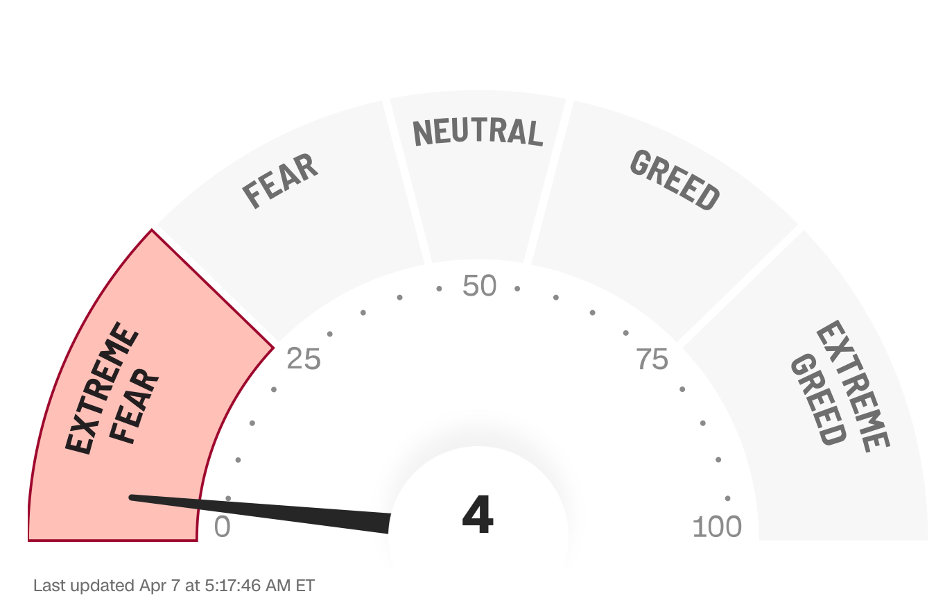
This morning, risk feels unwanted.  With equity markets still within spitting distance of their all-time highs, it appears there is ample room for some down days ahead.  Of course, Friday will be key.  Regarding the dollar, for now, I believe the bounce continues.  But Friday will dictate the medium term, at least until the FOMC meeting.

Good luck

Adf
A New Boogeyman

Confusion today is what reigns
As no pundit clearly explains
Why previous claims
Have gone up in flames
And how much more pain still remains
 
They still blame the Bank of Japan
With spoiling their well thought out plan
And too, yesterday
When bonds went astray
It gave them a new boogeyman


Yesterday started out so well for all those who were convinced that it was the BOJ’s surprising and extreme actions last week that led to an unwarranted selloff in stocks and other risk assets.  First off, the BOJ, via one of its members Ichida-san, basically apologized for their actions and said that they would not be making any other changes after all.  That led to a rally in equities and a sell-off in bonds as risk assets were suddenly back in favor.  Alas, by the end of the day, that was no longer the case.

But let’s look at what the BOJ actually did last week.  On the interest rate front, they raised their base rate to 0.25% and regarding their balance sheet, they indicated they had a plan to slow down its growth at a very gradual pace.  Remember, they did not say they were going to sell JGBs, they said that by 2026 they would be buying half as many JGBs as they do today.

Also, let’s remember that inflation in Japan is currently measured at 2.8%, so the base rate remains deeply negative in real terms.  I understand the signaling impact of what they did as any change in the status quo while there is a significantly leveraged market can have major impacts.  And that is what we saw during the past week.  It is also important to remember that given the length of time that the Japanese have maintained their ZIRP/NIRP monetary policy, the opportunity for very large institutions to build up very large positions was, to be succinct, very large.  The chart below shows for just how long Japanese interest rates have been near zero, more than twenty years.

Source: tradingeconomics.com

My point is that Japanese investors have been seeking alternative opportunities for an entire generation.  As well, the concept of the carry trade has been in place for that same amount of time.  It will take a long time for these ideas to be changed and the positions along with them.  Now, according to a Bloomberg article, JPMorgan’s analysts claimed that three-quarters of the carry trade has already been unwound.  And maybe they are right about that.  But I assure you that three-quarters of Japanese investors have not adjusted their positions in the fixed income market.  We have not come to the end of this road.

So, analysts found another cause for yesterday’s negative outcomes, the 10-year bond auction.  It turns out that investors are seeking more yield than the market had anticipated ahead of the auction.  This led to a 3 basis point tail, meaning that the auction cleared at a yield, 3.96%, 3 basis points higher than traders were pricing ahead of time (typical 10-year tails are well less than 1bp.)  There were less bids than anticipated, and generally this is not a good story for Secretary Yellen and the Treasury.  The story that circulated was that the reason stocks fell in the afternoon was the weak auction.  Alas, the timing of that does not make sense.  Equity markets had already given back their morning gains before the auction results were announced and were lower on the day at 1:00pm.  But narrative writers need a story, and that was a good one.

So, what really happened?  Who knows?  But FWIW this poet has seen enough market action during his career to recognize that while fundamentals matter in the long-run, daily changes are often completely random, or at least seemingly so.  Large orders can drive markets, especially when liquidity is lower because of holiday schedules and the time of year.  And lately, the combination of algorithmic trading and extreme retail speculation will also move markets in surprising directions.

I believe that we remain in a period of change.  Monetary policies around the world are adjusting to the realities of inflation remaining stickier than policymakers want to believe.  In addition, the political cycle continues to be difficult to forecast, notably in the US, with market perceptions of very different economic policies to be implemented depending on the next US president.  And finally, I believe the best way to describe the global economy is that it is in transition.  After a decade or more of easy money policies around the world, as those policies start to change, they impact different segments of the economy at different rates.  This means that some parts of an economy can be in recession while other parts can be doing fine.  And that gives rise to confusing data with no broad trend.  This may explain why manufacturing survey data is so weak while service survey data has held up well.  

My best guess is that we are going to continue to see confusion until policy makers are more aligned.  In fact, that is why there are so many calls for the Fed to start cutting rates soon, so they can catch up and unify monetary policies around the world.

Ok, let’s see how things looked overnight.  After yesterday’s reversal and lower closes in the US, that theme was extended largely around the world.  Japanese shares fell (-0.75%) as did shares everywhere else in Asia (Korea, India, Australia, etc.) except in China, where both mainland and Hong Kong shares were essentially flat.  The story is no better in Europe where shares are lower by between -0.7% (DAX ) and -1.1% (CAC, FTSE 100) as investors demonstrate they are concerned with the future.  As to the US, at this hour (7:15) futures are very slightly lower.

In the bond market, after yesterday’s poor auction, and ahead of today’s 30-year Treasury auction, yields have fallen from their highest points.  Treasury yields (-3bps) are pacing the European sovereign market (Bunds -3bps, OATs -3bps, Gilts -1bp, BTPs -2bps) as the fear factor on stocks seems to be encouraging some haven buying.  But the most interesting thing was that JGB yields fell -5bps overnight and are now back down to 0.84%.  The BOJ Summary of Opinions (effectively their Minutes) was released last night and clarified that they are not interested in a rapid tightening of policy.  Given GDP growth was negative last quarter, this can be no surprise.

In the commodity markets, oil is little changed this morning but has recouped most of its losses from the past week and sits back at $75/bbl.  This is still a range-bound situation, and we need something really big to change that.  Gold (+1.1%) is making a comeback and back over $2400/oz as the fear factor seems to be playing a role here today.  However, copper (-0.2%) continues to demonstrate short-term concerns over economic activity around the world.

Finally, the dollar is having a much less volatile session than we have seen recently.  AUD (+0.5%) is the biggest mover I can find after hawkish comments from the RBA, claiming they will not hesitate to raise interest rates again if inflation reappears.  However, the yen (+0.15%) seems like it has found at least a temporary home, perhaps gaining some support on what appears to be a risk off day.  Funnily, though, the major risk proxies in the EMG space, ZAR and MXN are virtually unchanged this morning.  I believe that like most markets today, more clues are sought before views are expressed.

Speaking of clues, this morning brings the other US data with Initial (exp 240K) and Continuing (1870K) Claims at 8:30.  Richmond Fed president Barkin speaks at 3:00 this afternoon, the same time we will hear from Banxico on their rate decision (no change expected).  But once again, there is not much new information expected, so markets are going to respond, in my view, to equity activity.  If US stocks can find support, look for other markets to follow along.  However, that does not feel like today’s message.  As to the dollar, against the majors, I think it has found a temporary range.

Good luck

Adf