Not Yet Diktat

The punditry’s now all atwitter
That joblessness is a transmitter
Of lower inflation
Thus, Powell’s flirtation
With turning into a rate slitter

But so far, the confidence that
Inflation is falling toward flat
Has not yet arrived
And could be short-lived
So, rate cuts are not yet diktat

As expected, Chairman Powell’s testimony to the Senate Banking Committee was THE story of the day yesterday.  However, it was not that interesting a story despite scads of digital ink spilled on the subject.  What was everybody so excited about?  Well, here are some key quotes and you can be the judge.  In his opening remarks, he explained, “Elevated inflation is not the only risk we face,” and “The latest data show that labor-market conditions have now cooled considerably from where they were two years ago—and I wouldn’t have said that until the last couple of readings.”  Scintillating, I know!

What does it mean?  The quick and dirty is that the Fed has become a bit more evenhanded in their views that the employment side of their mandate may soon force decisions that conflict with the inflation side of their mandate.  So, if the Unemployment Rate continues to rise going forward, even if inflation does not continue its recent downward trajectory, the Fed may decide employment is now more important and respond.

Doves everywhere are clamoring for the Fed to cut before it’s too late and the labor market collapses.  Meanwhile, hawks will explain that at 4.1%, while that is higher than the recent past, the Unemployment Rate remains quite well behaved, especially in the context of NFP results that have averaged 222K over the past six months.

But we really know that this was a nothingburger because a look at markets showed that nothing happened.  The major equity indices all closed +/- 0.15% while 10-year Treasury yields were unchanged from the morning and higher by 2bps from Monday.  Neither did the dollar or commodities move in any substantial way from their early morning levels.   So, now Powell will speak to the House Financial Services Committee today, give identical testimony and fend off whatever inane questions they ask there.  But he was clear that there would be no indications of the timing of any policy changes and that is certain to be true today as well.

And truly, that was the entire session yesterday.  There was no data released and aside from Powell, nobody cared about what other speakers said.  And as you can see above, Powell didn’t really say that much.  So, let’s take a look at the overnight session to see if there was anything interesting at all.

In equity markets, the one place that is trying to hang with the US tech sector is Japan, where the Nikkei rallied another 0.6% overnight and is now higher by 30% this year, second only to the NASDAQ’s 34% rise.  While some of this is excitement about tech, I believe a larger proportion of the gains is due to the yen’s ongoing weakness as many of the companies in the index have their JPY earnings benefit greatly from their export sales.  Elsewhere in the time zone, though, equities were under modest pressure with Chinese, Hong Kong and Australian shares all sliding a bit.  The news of note here was Chinese inflation data, which showed limited price pressures as consumption on the mainland remains lackluster, at best.

Europe, however, is in a much better mood as all the major indices around the continent are higher this morning led by Spain’s 1.0% rise but followed closely by France (+0.9%) and Germany (+0.75%).  Here, too, there has been a lack of data, so I guess the narrative has become that despite the electoral outcomes, investors have overcome their concerns that the new governments will destroy their respective economies.  I guess the one truth is that the new governments will try to spend as much money as possible as quickly as possible, and so support economic activity.  Meanwhile, the recent pattern in the US, higher NASDAQ, lower DJIA and limited movement in the S&P is playing out in the futures this morning as well.

In the bond market, Treasury yields have slipped back 2bps overnight, trading at the same levels as Monday, but there has been a much more aggressive bond rally in Europe with sovereign yields falling between 6bps and 9bps this morning.  It appears that investors are counting on the Fed to maintain its inflation fight, thus helping reduce global inflation pressures, and are responding to declining inflation from China as a rationale to add duration to their portfolios.  While the direction of travel is no surprise given the Treasury yield decline, it is a bit surprising the movement is this large.

In the commodity markets, oil (-0.2%) continues under pressure as the combination of relief that Hurricane Beryl had limited impacts and the potential for a cease-fire in Gaza have oil traders questioning the recent price action.  Arguably, a bigger concern is that slowing economic activity may begin to reduce demand, but that is not the main story today.  In the metals markets, both gold and silver are edging higher this morning while copper is essentially unchanged.  I continue to believe that the Fed is going to be the key driver in this space as if they do cut rates sooner than currently forecast, it seems likely that commodity prices will rise while the dollar declines.

But the dollar is not yet declining in any meaningful way with the DXY still trading above 105.00.  The big outlier today is NOK (-0.95%) which is not only suffering on oil’s recent declines but is also responding to this morning’s inflation data which showed more significant progress on returning it to target.  Core inflation printed at 3.4%, down from 4.1% last month and below the 3.6% estimates.  This has encouraged traders to believe the Norgesbank is going to cut rates sooner than previously expected, hence the krone’s decline.  As to the rest of the G10, NZD (-0.9%) is also under pressure as the RBNZ was less hawkish than anticipated last night, although they did leave rates unchanged.  After those two, though, the G10 is dead.  One thing to note is that USDJPY is back at 161.50, just a few pips below the most recent dollar highs seen last week, although, given the very calm nature of the move, we have not heard much from the MOF on the subject.

As to the EMG bloc, MXN (+0.45%) is continuing its rally after yesterday’s higher than expected CPI data from south of the border has traders looking for continuing policy tightness, pushing back any thoughts of an early ease.  Elsewhere, ZAR (-0.4%) continues its wild back and forth, so much so that it is difficult to pin any fundamentals to the movement.

There is no data of note today so all eyes will be on Chairman Powell when he testifies at 10:00 to the House.  In addition to Powell, we will hear from Governors Bowman and Cook as well as Chicago Fed president Goolsbee.  But really, can anything they say overshadow Powell?  I think not.

It is shaping up as another dull day as it seems unlikely Powell will tell us anything new.  As such, I would look for a quiet session as we all await tomorrow’s CPI data.

Good luck
Adf
The Fat Lady

Is the fat lady
Starting to sing?  Listen for
More threats to be sure


Tell me if you’ve heard this one before, “It’s desirable for exchange rates to move stably. Rapid, one-sided moves are undesirable. In particular, we’re deeply concerned about the effect on the economy.”

Or this one, “We are watching moves with a high sense of urgency, analyzing the factors behind the moves, and will take necessary actions.”

Of course, the answer is yes, these are essentially verbatim of what Shunichi Suzuki, Japanese FinMin, said earlier this week, as well as several times back in April prior to their last bout of intervention.  It is probably step 3 on the 7-step program that leads to eventual intervention by the MOF/BOJ.   And those are his direct comments from last night in the wake of USDJPY trading to yet another new high (160.88) for the move.  The last time the currency was that weak vs. the dollar was in 1986.  

Now, perhaps I can help him analyze the factors behind the moves.  Why look, the entire interest rate complex in Japan remains significantly below the same metrics anywhere else in the world, but from a G10 perspective, specifically vs. the US.  As well, the commentary from the various Fed speakers we have heard just this week continues to indicate higher for longer remains the play.  Recall, Governor Bowman even suggested the possibility of raising rates if circumstances dictated.  I might suggest to Suzuki-san, that as long as the BOJ maintains ZIRP, and continues to hold 50% of the JGB market, the yen will remain under pressure. 

The question remains, just how high can USDJPY go?  And the answer remains much higher.  I continue to believe that we will need to see a quick move to 163, at least, before the MOF tries to slow things down again, meaning by Monday latest.  If, instead, the market simply hangs around at this new level, I expect more jawboning but no action.  The one caveat is that next Thursday is July 4th, when all banks in NY will be closed and market liquidity will be extremely suspect.  It would not be a surprise if they were to take advantage of those thin markets and aggressively sell dollars then.  It would certainly have an outsized impact.  We shall see.

Today’s likely to be at peace
As folks eye tomorrow’s release
Of PCE data
And so, options’ theta
Is vanishing like Credit Suisse

The truth is, away from the yen story, there is very little of consequence ongoing as the market sets its sights on tomorrow’s PCE data.   This evening’s Presidential debate will certainly be interesting and likely be entertaining, but it is not clear it will impact markets.  And while we continue to see gyrations in various markets, the big themes remain stable.  The Fed is not about to change its stripes as we have heard repeatedly since the FOMC meeting, the economy continues to move along, albeit at a somewhat slower pace than Q1, but not showing any hint of recession at this stage, and the geopolitical situation is constant with Russia/Ukraine and Israel/Gaza continuing to wreak havoc and destruction mostly in the background.  As such, I expect that we are going to be subject to more idiosyncratic movements in markets for now.
 
So, let’s look at what happened overnight.  After yesterday’s very limited equity moves in the US, most of Asia was in the red led by the Hang Seng (-2.1%) as tech shares were under pressure.  But the Nikkei (-0.8%) and Shanghai (-0.75%) also fell with the former a bit surprising given both the weaker yen and the surprisingly better than expected Retail Sales data released, while the latter seemed to respond to declining Industrial Profit data that was released.  As it happens, Australia shares were also softer as inflation data there continues to show stubborn strength squashing any ideas of an RBA rate cut soon.  In Europe, red is also the most common color with the CAC (-0.5%) and IBEX in Spain (-0.5%) leading the way lower.  Most other markets are softer although the DAX (+0.1%) is bucking the trend, despite lacking an obvious catalyst for the move.  And let’s face it, 0.1% is not really relevant to anything.  At this hour (7:00), US futures are pointing slightly lower ahead of the weekly Claims data.
 
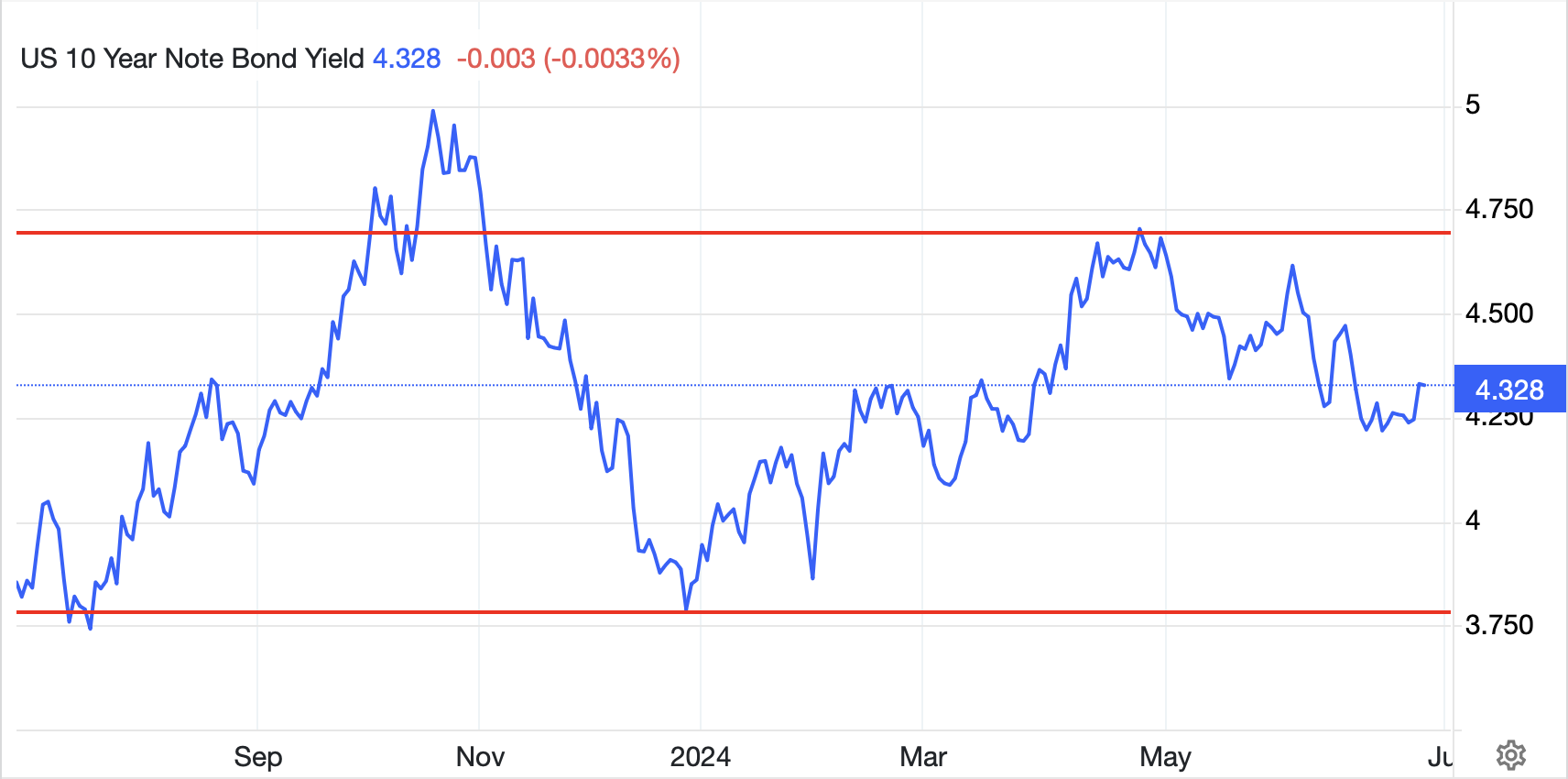
In the bond markets, yields in the US backed up by 5bps and have stayed there this morning.  in Europe, the markets closed before the US move finished, so this morning, yields across the continent are higher by 3bps or so as they catch up to the US.  In Asia, the movement was stronger with JGBs +5bps and Australian bonds +10bps on the back of the US move as well as Australia’s growing inflation concerns (Consumer Inflation Expectations rose to 4.4%).  It strikes me, looking at the chart below, that yields have been in a wide range, about 90 basis points, for the past year and that we are currently pretty much in the middle of that range.  It is hard to get too excited about things until we break this range in my view.

Source: tradingeconomics.com

In the commodity space, oil (+0.35%) is rebounding slightly this morning after weakness in the wake of larger than expected inventory data released yesterday, with an over 6-million-barrel increase compared to expectations of a 5.5-million-barrel drawdown.  As to the metals markets, gold (+0.7%), which suffered on the back of the strong dollar yesterday, is rebounding and taking silver with it, although the industrial metals remain under pressure.

Finally, the dollar, which was king of the hill yesterday, with the Dollar Index trading back above 106 for a while, is softening a touch this morning, probably about 0.2% or so against its major counterparts.  However, while that is the general result today, there is one outlier, ZAR (-1.15%) which continues to demonstrate remarkable volatility amidst the political situation with no cabinet yet named.  Perhaps the driver this morning was the softening inflation picture enticing traders to believe that SARB may be considering rate cuts soon.

On the data front, this morning brings the weekly Initial (exp 236K) and Continuing (1820K) Claims data along with Durable Goods (-0.1%, +0.2% ex Transport), final Q1 GDP (1.4%) and its components of note like Final Sales (1.7%) and its Price Index (3.3%).  Remarkably, there are no Fed speakers due today either.  I think we need to keep a close eye on the employment situation as it has been slowly worsening overall.  It wasn’t that long ago when Initial Claims were pegged at 212K every week.  Now they have grown by more than 20K and any lurch higher will be noticed.  Next week’s NFP is going to be critical with the potential for a significant impact as it will be released the day after the July 4th holiday, a day when trading desks will be very lightly staffed.

For today, it is hard to get excited about anything, but if we continue to see the slow deterioration of US data, that will eventually feed into the rate picture and the dollar’s value as well.

Good luck

Adf

Cash in a Flash

A century has passed us by
Since T+1 rules did apply
But starting today
That is the new way
So, what does this new rule imply?
 
For buyers, they’ll need to have cash
At hand, else their trades will all crash
While sellers get paid
Next day and can trade
Or else have their cash in a flash
 
The problem is those overseas
Are likely to feel quite a squeeze
‘Cause getting the bucks
May soon be the crux
Of trading, and cause much unease


Today is, in fact, quite momentous as North American equity markets (US, Canada and Mexico) are all converting to T+1 settlement.  This means that if you buy a stock today in your Fidelity (or other) account, you need to pay for it tomorrow.  Since 2017, that timeline was two business days, and prior to that it was three business days (1987-2017) and five business days (1929-1987).  Obviously, technology played an important part in the process as the electronification of trading and back-office systems allowed more information to be processed more quickly and removed the need to physically deliver share certificates.

Now, while this is an interesting historical fact, the importance of the change comes from the potential impact on the foreign exchange markets.  In the US equity market (which remember represents nearly 70% of global equity market values), most traders have cash or access to funding in their accounts and so this is of limited consequence.  But, for foreign investors, it is a much bigger deal.  

Consider a European fund manager who is investing throughout a given day and then is reconciling their position at the end of the day to determine how many dollars they need to settle the transactions.  Prior to today, they could find out, and execute the FX trade to buy those dollars any time during the next day with full confidence the funds would flow on a timely basis.  However, starting today, their timeline to determine the balances due and execute the transactions will be reduced to a matter of hours.  And not just any hours, but probably the worst hours to transact FX during the 24-hour session.  Given that equity markets in the US close at 4:00pm, and most bank trading desks leave around 5:00pm, the prime time for those executions is going to be in the twilight of the FX market, when the global day rolls over and only Wellington, NZ banks are even awake.  Liquidity during this time period is notoriously limited and the opportunity for outsized moves is significant.

None of this is likely to have an impact today, necessarily, but it could well have an impact as soon as Thursday or Friday when the month comes to an end and there are significant equity rebalancing flows.  In fact, thinking it through, Friday afternoons that happen to be month ends, like this week, are going to be subject to the most stress as there is no market and Sunday evening is going to potentially be subject to a lot of same-day FX settlement, which is not the strongest suit for that market.  

I bring this up for two reasons; first, it is well worth understanding and may impact market characteristics going forward, and second, there is absolutely nothing else happening today!  There has been almost no new information in the macroeconomic sense since Friday’s Michigan Sentiment numbers were released as yesterday brought only modestly softer than anticipated German Ifo results.  At the same time, with the ECB slated to meet next week, the plethora of ECB speakers have clearly agreed that there will be a 25-basis point cut next week, but there is still a lot of uncertainty as to when the next cut may arrive.  Meanwhile, Fed speakers will not shut up at all, but continue to promulgate the same message they have been pushing forward, higher for longer until they have confidence inflation is going to achieve their target.  Arguably, that makes Friday quite interesting as the PCE data will be released.

So, with nothing else of note, let’s take a quick run through the overnight session.  Quiet continues to be the best descriptor of things with Japanese shares virtually unchanged although Chinese shares fell (CSI 300 -0.7%) despite ongoing talk of further government support for the property market there.  Elsewhere in the region, markets were mixed with an equal number of gainers (Taiwan, Indonesia, Singapore) and laggards (India, Australia, New Zealand) with most of the rest very little changed.  It was not very exciting!  In Europe, while the screen is red, other than the CAC in Paris (-0.6%) the movement has been extremely limited.  Meanwhile, US futures are currently basically unchanged ahead of the open.

Bond markets, too, have been quiet overall with Treasury yields unchanged since Friday, and European sovereigns mostly edging higher by between 1bp and 2bps.  The exceptions here are the UK (-3bps) despite (because of?) a better-than-expected Retail Sales print. In Asia, while JGB yields did not move overnight, yesterday they did trade to a new high of 1.02%, although the impact on the yen remains di minimus.

In the commodity markets, oil has bounced from last week’s lows after Israel’s recent military activities in Rafah have some concerned that an escalation in that conflict is on its way and may include other parties.  Meanwhile, gold and silver prices, both of which rallied sharply yesterday, are consolidating those gains and remain well above the trading bottoms put in last week.  Copper, too, is rebounding although there is a lot of discussion in the market about how it has been massively overbought by speculators and has further to decline.  Regardless of the short-term trading implications, I believe there is no question that the long-term view here must be very bullish as there simply is not going to be enough supply for all the demands coming our way, especially given the still strong view amongst many that the energy transition must happen ASAP.

Finally, the dollar is a touch softer this morning, but only a touch.  While the greenback has been pretty steadily declining all month, the entire movement has been less than 2%, at least based on the DXY.  As to USDJPY, it remains in a very tight range between 156.50 and 157.00 lately as traders clearly remain comfortable running short positions, but the rush to add to those positions has faded. As to the other currency that continues to be questioned, the CNY continues to edge lower a few basis points each day, as the PBOC weakens its value in the daily fixing by a similar amount.  Nothing has changed my view that the renminbi will drift lower, but it is clear that the PBOC is going to control it all the way.

On the data front, it is a very quiet start to the week, but things get interesting toward the end.

TodayCase-Shiller Home Prices7.3%
 Consumer Confidence95.9
WednesdayFed’s beige Book 
ThursdayInitial Claims218K
 Continuing Claims1800K
 Q1 GDP1.3%
FridayPersonal Income0.3%
 Personal Spending0.3%
 PCE0.3% (2.7% Y/Y)
 Core PCE0.3% (2.8% Y/Y)
 Chicago PMI 
Source: tradingeconomics.com

In addition to this, we hear from seven more Fed speakers over nine venues this week and unless PCE collapses, and only one speaker comes after the release, it seems highly unlikely that they will change their tune.  Recall, the Minutes last week were seen as far more hawkish than Powell’s press conference immediately following the meeting, and that confused the soft-landing crowd.  As of this morning, the Fed funds futures market is pricing in about a 50% probability of a cut in September and a total of just 34bps of cuts now for the full year.

My view remains that the Fed is unlikely to cut anytime soon as the data will not give them confidence their inflation target is in view.  With that in mind, I foresee the best opportunity for a surprise as more aggressive rate cuts elsewhere in the world which will support the dollar.  Just not today.

Good luck

Adf

Bears Will Riposte

With CPI later this week

And many Fed members to speak

The news of the day

Is China’s array

Of debt issues they will soon seek


However, what matters the most

For markets is Wednesday’s signpost

If CPI’s cool

The bulls will still rule

But hot and the bears will riposte


While we all await Wednesday’s CPI data with bated breath, there are, in fact, other things happening in the world that can have an impact on markets and economies as well as on the narrative.  The story that seems to be getting the most press today is the leaked plans of China’s ultra-long bond issuance that was first hinted at two weeks ago.  The details show they are planning to issue, as soon as next Friday, the first tranche of 20-year bonds, with 50-year bonds coming in June and then the lion’s share of the issuance, 30-year bonds, due by November.  The total amount to be issued is CNY 1 trillion split as CNY 300 billion of 20-yr, CNY 600 billion of 30-yr and CNY 100 billion of 50-yr.

The reason this story is getting so much press is that the natural consequence of this issuance is that the national government is going to be spending that money on numerous projects, mainly infrastructure it seems, in an effort to ensure they achieve President Xi’s 5% GDP growth target for 2024.  This has knock-on implications for inflation, as it is unlikely that China’s disinflationary impulse can extend greatly with all this additional spending, and for markets as there will be clear impacts on Chinese interest rates, the CNY exchange rate and Chinese equity markets.  After all, CNY 1 trillion (~$138 billion) is a lot of money to push through in a short period of time so there will undoubtedly be some leakage from real economic activity into financial actions, and ultimately, that money will impact the performance of many companies to boot. 

A funny thing about leaked information is often the timing of those leaks.  After all, I’m pretty sure that it was no accident that this news managed to escape into the wild on the day after China’s loan data showed some pretty awful results.  For instance, what they term Total Social Financing, which is defined as a broad measure of credit and liquidity in the economy, FELL CNY 200 billion in April, the first decline in the history of the series since it began in 2002.  As well, New Yuan loans fell to CNY 730 billion, far below forecasts of CNY 1.2 trillion and down substantially from March’s data.  While this was not a historic low amount, it was definitely in the lower decile of readings and an indication that economic activity is just not doing much there.

As it happens, given the news was more about the specific timing than the idea of the issuance, the impact on the yuan was limited as it has barely moved.  Onshore Chinese equity markets did erase some early losses to close flat on the day after the news leaked into the market and Hong Kong shares rallied nicely, up 0.80%. 

But in truth, beyond this story, there has been very little of interest as all eyes turn to Wednesday morning’s CPI release.  I will offer my views on how that may play out tomorrow, so for now, let’s just quickly survey the overnight session and take a look at what is on deck this week, especially given the number of Fed speakers we shall hear.

Away from the Chinese markets, the only other equity market in Asia with a major move was Taiwan’s TAIEX (+0.7%), clearly benefitting on the idea that some of that money would head across the Strait, with the rest of the region +/- 0.2% or less.  Again, waiting for CPI is still the major idea.  This is true in Europe as well, although the bias is for very small losses, on the order of -0.2% or less, rather than the small gains seen in Asia.  Not surprisingly, US futures are virtually still asleep at this hour (6:45) and unchanged from Friday’s levels.

In the bond market, yields are edging lower by 2bps pretty much across the board, with Treasuries leading the way and virtually every European sovereign following suit by the same amount.  As always, the US market remains the dominant player here.  In Japan, though, yields crept higher by 3bps after the BOJ explained that they would be reducing their QQE purchases to ¥425 billion, from ¥475 billion last month.  Perhaps they really are trying to tighten policy!

In the commodity markets, oil (+0.6%) is edging higher after a generally rough week last week.  There has been no new news here, so this is all simply trading machinations.  Of more interest are the metals markets with copper (+0.9%) continuing its recent rally as it responds to the Chinese infrastructure spending news.  However, precious metals are under pressure today with gold (-0.75%) having a great deal of difficulty finding a bid as the market argument of whether inflation is picking up or not remains untested.

Finally, the dollar is mostly little changed with only a few currencies showing any life this morning, all in the EEMEA bloc.  ZAR (+0.4%) is firmer despite gold’s decline, as traders focus on hints that the SARB is going to maintain its tight monetary policy for even longer, not following the ECB when they cut in June.  Meanwhile, CZK (+0.5%) rallied on stronger than expected CPI data with the M/M number coming at +0.7% and talk that the central bank will be holding firm for longer than previously anticipated.

Looking at this week’s data and commentary, there is much ground to cover although we start off slow with nothing today:

TuesdayNFIB Small Biz Optimism88.1
 PPI0.3% (2.2% Y/Y)
 -ex food & energy0.2% (2.4% Y/Y)
WednesdayCPI0.4% (3.4% Y/Y)
 -ex food & energy0.3% (3.6% Y/Y)
 Empire State Mfg-10
 Retail Sales0.4%
 -ex autos0.2%
ThursdayInitial Claims220K
 Continuing Claims1790K
 Housing Starts1.41M
 Building Permits1.48M
 Philly Fed7.7
 IP0.1%
 Capacity Utilization78.4%
FridayLeading Indicators-0.3%
Source: tradingeconomics.com

In addition to all that, we hear from, count ‘em, 11 Fed speakers during the week, including Chair Powell Tuesday morning (before CPI although he will probably know the number).  As well, he speaks again next Sunday afternoon.  I maintain they all speak too much and too often, and we would be far better off if they simply adjusted policy as they saw fit and ended forward guidance!

But we know they will never shut up, so we must deal with it as it comes.  As to today, it is hard to get excited about anything happening of note given the perceived importance of the rest of the week.  So, look for a quiet day today, a perfect day to initiate some hedges amid benign market conditions.

Good luck

Adf

Not Harebrained

While here in the States there’s no chance
That rate cuts, by June, will advance
In England, we learned
They’re growing concerned
The ‘conomy’s still in a trance

So yesterday, Bailey explained
By June, a rate cut’s not hairbrained
But, closer to home
The Frisco Fed gnome
Said cutting rates will be restrained

You can tell that very little continues to happen in the macro world when the key stories that are in the discussion regard secondary players and their commentary.  While it is true that Andrew Bailey is the governor of the Bank of England, the reality is that the UK is just a secondary player on the world stage.  However, after their meeting yesterday, much digital ink has been spilled over the potential for the BOE to cut rates at the June meeting.  Prior to this meeting, it seemed that the BOE was tracking the Fed rather than the ECB, but that idea has now been dispelled.  Governor Bailey indicated that come June, a rate cut “is neither ruled out nor a fait accompli.”  However, he did comment that cuts were likely “over the coming quarters” and the market took him up on the news, with yields sliding and stocks rallying.

A key to the discussion is the fact that the BOE will see two more CPI reports between now and the next meeting on June 20th.  As well, both the ECB and the Fed will have met and potentially acted before they next meet.  As such, despite the fact that the BOE’s own forecasts showed improvement in both GDP and CPI over the next 3 years with current policy, the market is all-in on the cuts for June.  Well, maybe not all-in, but has increased the probability to 50%, up from just under one-third prior to the meeting.  Regarding the pound, if we continue to hear more dovish cooing from the Old Lady, especially given the fact that the Fed is clearly on hold, I expect it could drift back toward 1.20 over time.

Which brings us to the Fed, and an unscheduled appearance by San Francisco Fed president, Mary Daly, yesterday afternoon.  The two key comments she made were as follows: “There’s considerable, now, uncertainty about what the next few months of inflation will be and what we should do in response,” and “It’s far too early to declare that the labor market is fragile or faltering.”  In essence, this is repeating everything that we have heard consistently since the FOMC meeting last week.  I would boil it down to ‘as much as we are desperate to cut rates, neither prices nor the labor market are falling quickly enough to allow us to do so soon.’

Add it all up and you get a picture of a still tight Fed with no indication of a policy ease in the next quarter, at least, while another major central bank elsewhere has opened the doors to cutting rates.  Arguably, this should be a positive for the dollar except for the fact that this has been known, and the basic narrative for a while, so is already in the price.  If these policy divergences maintain for a much longer time, through the end of the year or beyond, then perhaps we will see more aggressive dollar strength.  But for now, I think the FX markets are going to be a dull affair.  The caveat here is if we see US data move away from its current trajectory, either picking up and pushing price pressures higher, or falling more rapidly resulting in a worse employment situation.

One last thing on the prospects for the US economy; there is still a large contingent of analysts who have been parsing the data and looking at secondary indicators and sub-indices of headline data, and who believe that a recession is much closer than the market is currently pricing.  Things like credit card delinquencies and the growing number of bankruptcies, as well as the discrepancy between the establishment and household surveys in the employment data have reached levels consistent with recessions in the past.  While last year I expected that would be the case, at this point, I believe that the ongoing massive fiscal spending (budget deficits >6% of GDP) and the ongoing availability of cheap energy continuing to draw investment into the US will prevent any substantive downturn for the rest of the year, at least.

As to market activity, yesterday’s higher than expected Initial Claims data (231K, highest since October) got the bulls all excited and drove a risk rally in stocks in the US which has been followed all around the globe.  Asian markets saw gains in Japan (+0.4%), Hong Kong (+2.3%) and almost everywhere else in the region except China which was flat on the day.  Meanwhile, European bourses are all green as well, led by the UK (+0.7%) on the back of stronger GDP data as well as the hopes for lower rates in the near future.  But the entire continent is higher as well, mostly on the order of 0.5%.  As to US futures, higher by 0.25% at this hour (7:30).

In the bond market, while Treasury yields drifted lower yesterday after that claims data, this morning they are higher by 1 basis point.  In Europe, though, sovereign yields are slipping 2bps to 3bps as traders and investors get more convinced of rate cuts coming soon.  Overnight, JGB markets did nothing.

In the commodity markets, Wednesday’s declines are a distant memory as we have seen oil (+0.7%) rally again this morning despite modest inventory builds which may be being offset by concerns that Israel is ignoring the recent pressure to stop its Rafah incursion.  However, the precious metals are not ignoring that story with both gold and silver higher by more than 1% this morning and copper rising 2.4%.  The day-to-day vagaries of these markets remain confusing, but the long-term trend, I believe, remains strongly intact, and that is higher prices going forward.

Finally, the dollar is little changed this morning but maintaining its gains from earlier in the week.  Looking across my screen, no currency has moved more than 0.3% in either direction, a clear sign that very little of note is happening.  As I wrote above, absent a major change in policy, I think the dollar is range bound for now.

On the data front, this morning brings only Michigan Sentiment (exp 76) and then a few more Fed speeches from Kashkari, Bowman, Goolsbee and Barr.  Regarding the data, I believe it will need to be a big miss in either direction to get much market reaction.  Regarding the Fedspeak, given the consistency with which every speaker has thus far explained they lack the confidence that 2% is in view, I see very little is likely to be newsworthy.

For today, don’t look for much at all.  For the longer term, the dollar’s future depends on how much longer the Fed maintains its relative tightness, and if that spread widens because either the Fed brings hikes back on the table or other central banks cut more aggressively.  But for now, as we enter the summer, I don’t see much at all.

Good luck and good weekend
Adf

Adrift

Investors are biding their time
As Fedspeak continues to rhyme
It’s higher for longer
As long as growth’s stronger
Defining today’s paradigm

So, how might the narrative shift?
Are Jay and the Fed just adrift?
Next week’s CPI
If it prints too high
Might well, for the bears, be a gift

As promised on Monday, this week remains quite innocuous in terms of both market information and market movement.  There have been precious few pieces of news that have worked to alter the current situation.  The Fed speakers we have heard, when they discussed monetary policy, seem to be reading from the same text.  It can be boiled down to, the policy rate will remain at current levels until such time that something changes with respect to inflation or employment.  We will not rule out a hike, (despite the fact that Powell apparently did so last week) but are nowhere near ready to cut given the current inflation status.

With this in mind, it should be no surprise that markets remain extremely quiet.  After all, how can one change a view if nothing has changed?  So, the US story is pretty well understood for now and until CPI is released next Wednesday, I see no reason for any major movement in either equities or bonds here, and by extension elsewhere in the world.

Moving on from the US, Ueda-san continues to hint that the BOJ may do something, but last night’s Summary of Opinions from the BOJ (effectively their Minutes) almost implied, if you squint hard enough, that they could do it sometime soonish.  Clearly there is a bit of concern over the yen (-0.35%) which continues to drift back toward the levels seen when they intervened.  However, the very fact that just a week after they were aggressively selling dollars, it has pushed back to 156.00 tells you that absent a policy move, nothing is going to change.

As an aside here, this is quite important for the global economy, and certainly global markets.  Ultimately, Japanese monetary policy has been the driver of a huge amount of global liquidity flowing into asset markets around the world.  My understanding is that Japanese households also have somewhere on the order of $7 trillion in cash available to invest still at home, which historically was never a concern there given the complete absence of inflation in the country.  But now that inflation is rising there, and yields remain so paltry compared to elsewhere in the world, especially the US, if even a portion of that starts to flow more rapidly out of Japan, it will have an enormous impact everywhere.  On the flipside, Japan is also the largest international investor around, as a nation, and if the BOJ does allow rates to rise and that capital flows back home, that too would be a dramatic shift in global markets.  Ultimately, this is the reason we all care so much about what the BOJ does…it impacts us all.

The only other thing of note today is the BOE meeting where no change is expected in policy, but all will be searching for clues as to when they will cut rates.  The last vote was 8-1 to remain on hold with the lone holdout seeking a cut.  While expectations are for that to continue today, there is some discussion that a second dove may raise their hand for a cut.  It is widely accepted that cuts are the next move, and the real question is will they be following the ECB and cutting in June or wait until August.  FWIW, I expect a June cut by pretty much all the central banks other than the Fed (and of course the BOJ).  Economic activity is bumping along at effectively stagnation levels elsewhere in the G10 and inflation has been consistently softening everywhere except in the US.  While CPI is still higher than all their targets, central banks are desperate to get back to cutting rates and so will move with alacrity once they get started.

And that’s really all we have today.  Yesterday’s lackluster US session was followed up with a mixed bag in Asian equity markets (Nikkei -0.35%, Hang Seng +1.2%, CSI 300 +0.95%) and we are seeing a similar mixed picture in Europe with gainers (Germany, Switzerland) and laggards (Spain, Italy) while the rest are basically unchanged on the day.  However, at this hour (7:00), US futures are pointing a bit lower, down -0.3% across the board.

In the bond market, yesterday’s 10-year Treasury auction was met with mediocre demand and this morning yields are higher by 2bps.  There continues to be a great deal of discussion as to whether 10-year yields are going to head back above 5.0%, where they briefly touched last October as inflation reignites fears, or whether the oft mooted recession will finally arrive, and yields will tumble as the Fed cuts.  While my take is the former is more likely, at this point, there is no conclusive evidence for either view.  It should be no surprise, however, that European sovereign yields are also higher this morning, on the order of 3bps to 4bps, as they track Treasury yields closely.  Perhaps more surprising is that JGB yields rose 3bps overnight, and are now 0.91%, once again tracking toward their highs seen in October.  Clearly, there is a growing belief that the BOJ is going to do something sooner rather than later, but I will believe it when I see it.  Of course, if they do alter policy, that will change my views on many things.

In the commodity markets, oil (+0.85%) is rising again this morning and just about touching $80/bbl again. While some will say this is being driven by the Israeli incursion into Rafah, my take is this is simply the ebb and flow of a market that is in a trading range.  Since the summer of 2022, WTI has traded between $70/bbl and $90/bbl and I believe we will need to see some major changes in the situation for that to change.  Do not be surprised to see the Biden administration tap the SPR again in the lead up to the election in an effort to depress gasoline prices.  And do not be surprised to see OPEC+ cut production further if they do.  Consider this, though, if Trump is elected, there will be a major reversal in US energy policy and ‘drill baby drill’ will be back in vogue.  I suspect energy prices may decline then.

Turning to the metals markets, after a soft session yesterday, we are seeing a modest rebound led by silver (+1.3%) with gold, copper and aluminum all barely creeping higher by 0.1% or 0.2%.

Finally, the dollar cannot be held back.  As Treasury yields edge higher, the dollar is following and this morning is firmer against most of its counterparts, albeit not dramatically so.  Aside from the yen’s ongoing weakness, the pound (-0.3%) is not responding favorably to the fact that the BOE left rates on hold, and as I suspected, hinted at cuts to come with the vote coming out 7-2 as I proposed above.  Otherwise, most movement is extremely modest with one outlier, ZAR (+0.3%) rallying on the back of the metals rebound.

On the data front, this morning we see Initial (exp 210K) and Continuing (1790K) Claims and that is all she wrote.  We don’t even have any Fed speakers today, so it is shaping up as another very quiet session.  The big picture remains the same so until the Fed turns dovish, the dollar should hold its own.

Good luck
Adf

Dull as Can Be

While last week a great deal was learned
‘Bout how much the Fed is concerned
That prices won’t fall
Chair Powell’s clear call
Was higher for longer’s returned

And next week, we’ll see CPI
A critical piece of the pie
Is ‘flation still hot?
And if it is not
Will traders, more equities, buy?

But this week is dull as can be
With virtually nothing to see
No data of note
And no anecdote
About which the masses agree

There is precious little to discuss this morning.  The market is still generally in a good mood for risk assets on the back of the combination of the perceived Powell dovishness and the softer than expected NFP data which adds to the opinion that monetary policy going forward will loosen further.  And this week offers virtually no data at all, just the weekly Claims data and then Michigan Confidence on Friday.

Granted, we will hear from several Fed speakers, a process which got started yesterday when Richmond Fed president Barkin explained that, while hopeful inflation declines, he continues to believe that the current policy stance is “sufficiently restrictive.”  Meanwhile, NY Fed president Williams assured us that, eventually there will be rate cuts, that GDP would remain solid and that the Fed is looking at the “totality” of the economic data.  Given how frequently Chairman Powell used that word, totality, I have the feeling that at the end of the FOMC meeting last Wednesday, Powell reminded every speaker to use that phrase in their speeches.  I only say that because I would contend it is not a word used regularly by the population, even when it might be appropriate.

But did we actually learn anything new from these two?  I would argue we have not, nor is it likely that any of the other speakers lined up this week, starting with Kashkari today and followed by Governors Jefferson and Cook tomorrow, SF President Daly on Thursday and Governors Bowman and Barr along with Chicago president Goolsbee on Friday, will tell us anything new at all.

So, where does that leave us?  With no new data and a low probability of new Fed opinions to be revealed, this week has all the earmarks of a complete nothingburger.  Granted we hear from both the Swedish Riskbank (no change expected) and the BOE (no change expected) but given the lack of likely policy adjustment, markets will be trying to discern the subtleties of their comments.  And the one thing we all know extremely well is that markets know absolutely nothing about subtlety.  With this in mind, my expectations are that the current driving force, the underlying bullish thesis based on slowly easing monetary policies around the world, will continue to be the main driver of markets this week.  This is not to say that things are on autopilot, but until we see a new piece of information, range trading with a bias toward higher risk asset prices seems to be the most likely outcome.

This was generally what we saw overnight with most Asian markets performing well led by the Nikkei (+1.6%), catching up after the Golden Week holidays, but other than Hong Kong (-0.5%), the rest of the region was green.  Europe, too, is having a good session, with gains ranging from the CAC (+0.3%) to the FTSE 100 (+1.0%).  However, at this hour (7:20), US futures are essentially flat.

Bond markets are still feeling good about the Fed and weaker employment data with yields continuing to drift lower.  This morning, Treasuries have seen yields decline 3bps, while in Europe, continental sovereigns are seeing similar yield declines.  The big exception is the UK, where gilt yields are down 9bps this morning despite any news of note or commentary by BOE policymakers.  I think there is a growing anticipation that the BOE is going to pivot more dovish on Thursday which is driving this story.  Finally, with Japan back in session, JGB yields also declined 3bps as the yen’s recent strength (albeit not today where it has drifted lower by -0.2%) has allayed some market fears that the BOJ will need to be more aggressive in their policy tightening.

Commodities, which have had a terrific run are under pressure this morning, although given the absence of new information, this has all the hallmarks of a trading correction.  But oil (-0.4%) cannot gain any traction despite the fact that Israel is in the process of their long-awaited incursion into Rafah while ceasefire talks have faltered.  Metals, too, are under pressure across the board, but on the order of -0.4% for all of them.  Given the recent movement, this cannot be surprising (nothing goes up in a straight line) and I expect that we will see directionless price activity for the next several sessions.

Finally, the dollar is ever so slightly firmer this morning, with DXY having bounced off the 105 level and USDJPY starting to rise again with no sign that the MOF is keen to do anything else.  But as I look across the board, the largest movement of any currency, G10 or EMG, has been just 0.3% (both KRW and NOK having fallen that amount) which is really indicative of the doldrums into which this market has fallen.  I will say that there is growing talk that the next big trade is to be long yen (short dollars) with more and more people indicating they see higher Japanese rates coming while the Fed drifts toward eventual rate cuts.  The hard part about this trade is it is extremely expensive to carry for any length of time.  Until the Fed preps the market for cuts, rather than its current higher for even longer stance, I would be wary of the trade.  However, as I explained yesterday, for hedgers, this is exactly when options make the most sense.

And that’s really all there is.  Consumer Credit (exp $15.0B) is released this afternoon at 3:00 and Mr Kashkari speaks at 11:30.  It beggars’ belief that he will say something new and exciting so I anticipate a very dull session across the board today.

Good luck
Adf

Somewhat Decreased

The OECD has released
Its forecasts for West and for East
Alas what they’ve said
Is looking ahead
The growth story’s somewhat decreased

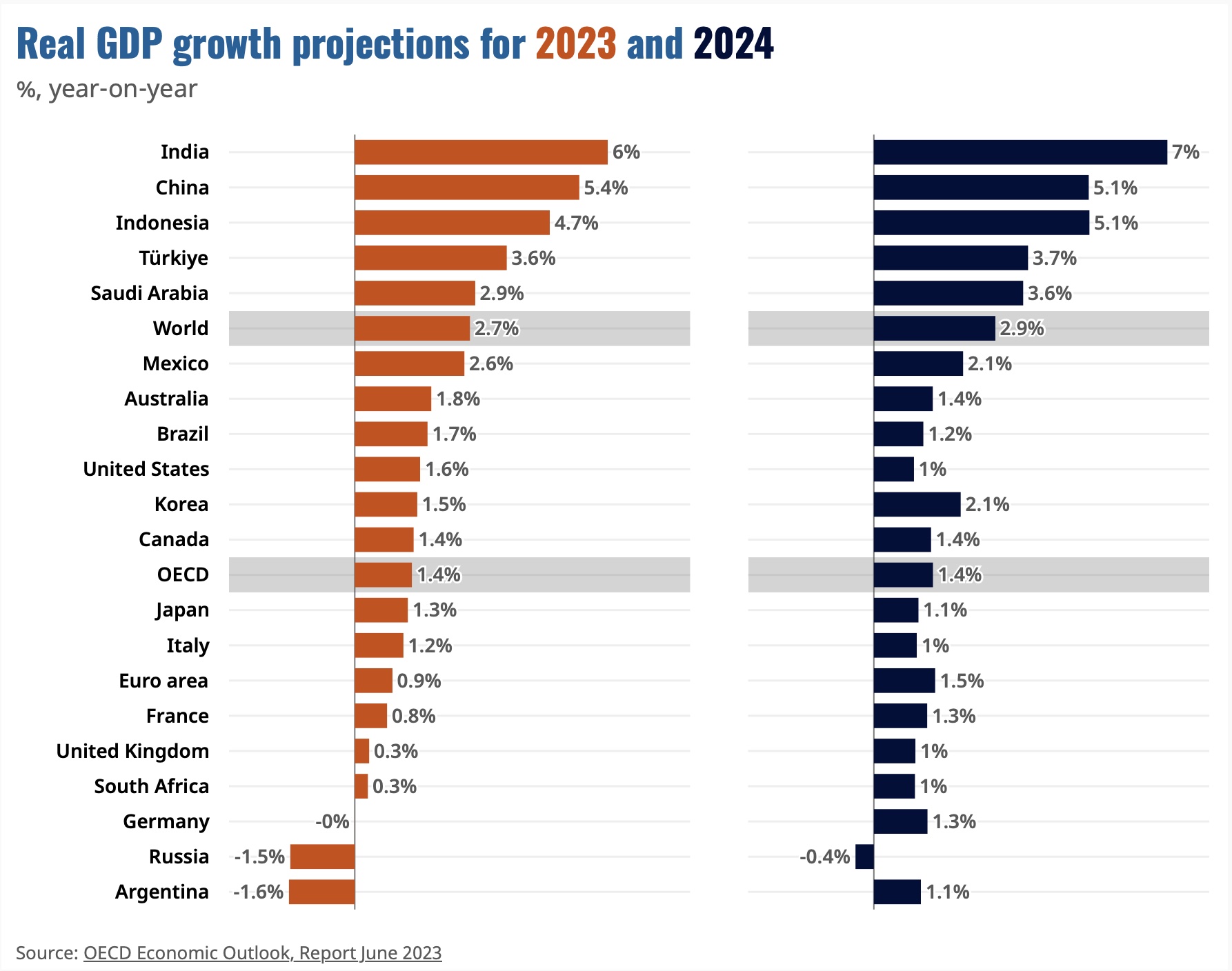
It’s another extremely dull day in markets as the passing of the debt ceiling crisis has left traders and investors looking for anything new at all to help catalyze trading ideas.  Granted, all market participants are anxiously awaiting next Wednesday’s FOMC meeting, but there is a lot of time between now and then to fill.  As there was a dearth of new data of importance overnight, the talk of the market is the OECD’s release of their June 2023 Report on global GDP growth as per the below:

In truth, it does not make for great reading as the estimates point to continued subdued growth, well below the pre-pandemic average of 3.4% globally.  As well, they highlight that this slower growth trajectory will be matched with higher inflation (exp 6.6% in 2023 and 4.3% in 2024), a truly unenviable situation.  Of course, just like every forecast, these must be taken with a grain of salt as the one thing we know about forecasting is…it’s really hard, especially about the future.  It is not clear that anybody altered their views on anything after the release of the report, but it has been the talk of the town.


Aside from that, I must follow up on a comment from yesterday’s note regarding the interest rate adjustments made in China, as it seems there is even more nuance involved.  The big 4 Chinese banks have reduced their onshore deposit rates for USD by about 30bps to try to discourage dollar hoarding and incremental additions to the carry trade.  With US rates now above 5%, the carry opportunity to hold dollars relative to renminbi has been quite significant and has been a key driver of the renminbi’s weakness this year.  In fact, from the renminbi’s high point this year in mid-January, it has weakened nearly 6.6%, which is quite far for a currency that traditionally runs with about a 4% annualized volatility.


One other thing to consider here is that the fact that Chinese banks had to lower their USD deposit rates in order to discourage the owning of dollars seems at odds with the idea that the Chinese are getting out of their dollar holdings.  Rather, it might be a signal that the Chinese people, regardless of what their government may want, seem pretty comfortable holding the greenback. 


And, my goodness, there is virtually nothing else marketwise to discuss from the overnight session.  Equity markets have been generally quiet overall, with modest gains or losses following yesterday’s very modest US rally.  Major European bourses are +/- 0.1% on the day although we did see the Nikkei fall -1.8% overnight, arguably on the back of the latest Policy proposal by PM Kishida which calls for more spending and debt.


Bond markets are also quite subdued with yields edging slightly higher in most places, but just on the order of 1bp-2bps, hardly a worry.  The one noteworthy thing here is now that the debt ceiling has been suspended, the Treasury issued just under $400 billion in T-bills yesterday and is likely to continue on that pace for the rest of the month as they refill the TGA.  The market impact is that the curve’s inversion is increasing with 2yr-10yr now back to -83bps and seemingly heading far lower again.  A test of -100bps seems entirely likely here.  Meanwhile, the 3m-10yr spread is -163bps, which is far below the levels seen even in the 1970’s and 1980’s during Volcker’s time in office.  Given the amount of issuance likely still forthcoming, I suspect this can fall further still.  It is not clear to me that this is a positive for the market.


Turning to commodities, oil (+1.1%) is rebounding slightly as it retraces yesterday’s losses while metals markets are a bit more positive today with copper (+0.5%) and aluminum (+0.75%) both rebounding although gold is little changed on the day.  I sense that part of this is related to the dollar softening a bit, as the growth story just does not seem that positive.


Speaking of the dollar, other than vs. the Turkish lira, which has collapsed nearly 7% this morning after President Erdogan’s new government took office, it is generally a bit softer on the day.  With oil’s rebound, NOK (+0.8%) is leading the G10 higher followed by SEK (+0.6%) and AUD (+0.4%) on broader commodity strength, but the whole bloc is firmer.  In the EMG bloc, ZAR (+1.0%) is the leader, also on better commodity pricing as well as an increasingly positive outlook on the power situation there, followed by the rest of the bloc (save TRY) edging up between 0.1% and 0.3%.  There really aren’t any other good stories there.


And that’s all she wrote.  This morning we see the Trade Balance (exp -$75.8B) and this afternoon, Consumer Credit ($22.0B), but these days, neither of those is likely to matter to the trading community.  I expect another dull day, and potentially a whole week of dull until the CPI data next Tuesday and then the FOMC meeting on Wednesday.  At this stage, the medium-term trend is for modest dollar strength, but on a given day, there doesn’t seem to be much directional impetus in either direction.


Good luck

Adf

Quite a Surprise

Down Under, in quite a surprise

The RBA did analyze

Inflation of late

And then couldn’t wait

To raise rates to multi-year highs


Explaining inflation’s been hot

The Governor and his team thought

If we don’t act now

We may well endow

The idea, our goal, we forgot


You know it is a dull day when the biggest news in the market is that the RBA surprised markets and raised their base rates by 25bps last night, taking the level to 4.10% and implying in their accompanying statement that more hikes were still on the table.  The money line from Governor Lowe was as follows, “The board remains alert to the risk that expectations of ongoing high inflation contribute to larger increases in both prices and wages, especially given the limited spare capacity in the economy and the still very low rate or unemployment.”   That does not sound like a central bank that has finished their hiking efforts and the market is now pricing a 50% probability of another rate hike by August.   It should be no surprise that the Aussie dollar (+0.6%) is the leading performer in the FX markets today, especially given that the dollar remains well bid overall.


In China, the PBOC

Has lately begun to agree

That growth’s in a slump

So, it’s time to pump

It up with a rate cut or three


The other interesting news overnight was that the PBOC has asked Chinese commercial banks, notably the big five banks, to cut deposit rates to their clients by 5bps in order to help encourage more spending, and correspondingly more growth.  Clearly, all is not well in the Middle Kingdom with respect to the economic situation although it is very interesting that the PBOC is not adjusting rates themselves.  Now, the big five state-owned banks are a critical part of Chinese monetary policy transmission, so a PBOC rate cut would feed through those institutions anyway, but I believe this is more theater in an effort to separate the government’s actions from direct support for the economy.  In the end, it’s all the same, as the Chinese rebound is very clearly under pressure.  One of the key drags remains the property sector and it is just not clear how the Chinese are going to solve that problem.  As of yet, like every government, they have simply kicked the can down the road a bit.  As to the renminbi, it continues to trade on the soft side, with the dollar above 7.10, although it is certainly not collapsing. 


However, after these two stories, there has been a dearth of news to drive things with just some desultory Factory Orders data from Germany (-0.4% M/M, -9.9% Y/Y) helping to remind everyone that the German economy, and by extension the Eurozone, has many issues yet to overcome after the loss of their cheap Russian energy.  So, let’s take a quick tour of markets and call it a day.


Yesterday’s big announcement from Apple regarding their new headset was less than scintillating to the trading community and we saw US equity indices slip a bit.  Overnight, while the Nikkei (+0.9%) managed a rally, the rest of the space generally fell and Europe, this morning is all in the red as well, albeit only on the order of -0.2%.  In fact, that -0.2% describes the US futures markets at this hour (7:30) too.


Bond yields have edged a bit lower on this modest risk off session with Treasuries (-1.1bps) consolidating their recent losses (yield gains) while European sovereigns have seen more demand with yields there lower by about -4bps across the board.  We haven’t touched on JGBs lately because there has been absolutely nothing happening in that market with the 10yr trading at 0.42%, still well below the YCC cap, and showing no pressure higher of note.


The one place where we have seen real movement this morning is commodity prices with oil (-2.2%) giving up almost all its post Saudi production cut gains.  The commodity market continues to be the leading proponent of a recession as can be seen in the base metals as well with both copper and aluminum under pressure today.  Meanwhile, gold (+0.1%) continues to hold its own despite pretty consistent dollar strength, definitely an unusual outcome and perhaps a commentary on general risk attitudes being heightened.


As to the dollar, it should be no surprise that NOK (-0.6%) is the G10 laggard given oil’s declines, but other than that and AUD’s gains, the rest of the G10 is split with modest gains and losses, although the euro (-0.2%) seems to be feeling a little heat from those lousy German numbers.  In the EMG space, though, there is a lot more dollar buying evident with both APAC and EMEA currencies under pressure.   Part of this movement seems to be related to some softer CPI prints encouraging the belief that interest rate rises are less likely, and part of this seems to be a bit of risk-off sentiment.


And that’s all there is today.  There is no US data to be released and, of course, the Fed is in their quiet period ahead of next week’s FOMC meeting.  As such, when it comes to the dollar, I expect that its recent underlying strength will remain barring a complete reversal in risk sentiment.


Good luck

Adf


Starting to Wane

The rebound is starting to wane
In England, in France and in Spain
But prices keep rising
With German’s realizing
They’ve not yet transcended their pain

First, some housekeeping, I will be on my mandatory two-week leave starting Monday, so there will be no poetry after today until September 7.

Meanwhile, this morning’s market activity is bereft of interesting goings-on, with very few stories of note as the summer holiday season is clearly in full swing.  Perhaps the three most notable events were UK Retail Sales, German PPI and new Chinese legislation.  Frankly, none of them paint a very positive picture regarding either the economy or markets going forward.

Starting at the top, UK Retail Sales (-2.4% in July) fell short of expectations, with the Y/Y reading back down to +1.8% from a revised +6.8% and the universal description of the situation as the reopening rebound is over.  The spread of the delta variant continues to add pressure as closures are dotted throughout the country, and sentiment seems to be turning lower.  It ought be no surprise that the pound (-0.15%) has fallen further, taking its month-to-date losses to 2.5%.  Too, the FTSE 100 (-0.2%) is under pressure, although it does remain in a broader uptrend, unlike the pound.  However, the first indication here is that risk is being sold off, which seems a pretty good description of the day.

Next, we turn to Germany’s PPI reading (10.4% Y/Y, 1.9% M/M) which is actually the largest annual rise since January 1975, where prices were impacted by the oil crisis!  While we have all been constantly reassured that inflation is a fleeting event and there is absolutely no indication that the ECB will see this number and consider tightening policy in any way, shape or form, I suspect that the good people of Germany may see things a bit differently.  The chatter from Germany is a growing concern over rapidly rising prices with a real chance of political fallout coming.  Remember, Germany goes to the polls next month in an effort to replace Chancellor Merkel, who has been running the country for the past 16 years.  Currently no candidate looks particularly strong, so a weak coalition seems a very possible outcome.  It is not clear that a weakened Germany will be a positive for the euro, which while unchanged on the day has been trending steadily lower for the past two months and yesterday broke below, what I believe is, a key support level at 1.1704.  Look for further declines here.

And finally, the Chinese passed a stricter personal data protection law prohibiting private companies from collecting and keeping data on their customers without explicit permission, a practice that had heretofore been commonplace. This appears to be yet another attack on the tech sector in China as President Xi ensures that the Chinese tech behemoths are disempowered.  After all, similarly to the US, the value of the big platforms comes from these companies’ abilities to compile and monetize the meta-data they collect by using it for targeted advertising.  Of course, the law says nothing about the Chinese government collecting that data and maintaining it, as that is part and parcel of the new normal in China.  One cannot be surprised that Chinese equity markets continue to decline on the back of these ongoing attacks against formerly unsullied companies, with the Hang Seng (-1.85%) now lower by 21% from its peak in February, and showing no signs of stopping as international funds flow out of the country.  Shanghai (-1.1%) also fell sharply, but given this index has more SOE’s and less tech, its decline from its February peak is only 9%.  As to the renminbi, it softened a bit further and is pushing slowly back above 6.50 at this time, its weakest level since April.

Otherwise, nada.  Equity markets are in the red everywhere, with the Nikkei (-1.0%) also slipping and we are seeing losses throughout Europe (DAX -0.4%, CAC -0.3%, FTSE 100 -0.2%) as well.  US futures, too, are pointing lower, with all three indices looking at 0.4% declines.  Of course, yesterday, things looked awful at this hour and both the NASDAQ and S&P 500 managed to close higher on the day, albeit only slightly.

Bonds are definitely in the ascendancy with yields continuing to slide.  Treasury yields are lower by 1.5 bps, Bunds and OATs by 0.5bps and Gilts by 2.0bps.  The question to be asked here, though, is, does this represent confidence that inflation is truly transitory?, or is this a commentary on future economic activity?, or perhaps, is this simply the recognition that central banks have distorted these markets so much they no longer give useful signals?  Whatever the underlying driver, the reality of bonds’ haven appeal remains and given the signals from the equity market, falling bond yields are not a big surprise.

Commodity prices remain under pressure generally, with oil (-0.8%) continuing its recent decline.  After a massive rally from last November through its peak in early July, crude has fallen 17% as of this morning.  In this case, while I understand the story regarding weakening economic growth, it seems to me the long term picture here remains quite positive as the Biden administration’s efforts to end oil production in the US, or at the very least starve it of future growth, means that supply is going to lag demand for years to come.  That implies higher prices are on the way.  As to the rest of the space, gold (+0.25%) continues to trade in its 1775-1805 range since mid-June with the exception of the two-day blip lower that was quickly erased.  Copper’s recent downtrend remains intact although it has bounce 0.3% this morning, and the rest of the industrial metals are either side of unchanged.

The dollar is broadly stronger this morning, with CAD (-0.7%) the weakest of the G10 currencies, clearly suffering from oil’s decline but also, seemingly, from self-inflicted wounds regarding its draconian Covid policies.  The Loonie has now fallen 4.25% this month with half of that coming in just the last two sessions.  But we are seeing continued weakness throughout the commodity bloc here with NOK (-0.45%) and AUD and NZD (both -0.3%) continuing their recent declines.  On the plus side, only CHF (+0.2%) has shown any strength of note.

Emerging market currencies are also under pressure this morning led by ZAR (-0.6%) and MXN (-0.4%) as softer commodity prices weigh heavily here.  We also continue to see weakness in some APAC currencies, with IDR (-0.35%) and KRW (-0.3%) suffering from concerns over the ongoing spread of the delta variant and the corresponding investor funds outflow from those nations.  On the flipside, PHP (+0.35%) was the only gainer of note in the region after the government loosened some Covid restrictions.

There is no economic data today and only one Fed speaker, Dallas Fed President Kaplan.  Of course, Kaplan has been the most vocal calling for tapering, so we already know his view, and after the Minutes from Wednesday, it seems he has persuaded many of his colleagues.  But once again I ask, if the economy is slowing, which I believe to be the case, will the Fed really start to remove accommodation?  I don’t believe that will be the case.  However, for now, the market is likely to bide its time until next week’s Jackson Hole speech by Powell.  Beware summer choppiness due to lack of liquidity and look for the current dollar uptrend to continue while I’m away.

Good luck, good weekend and stay safe
Adf