Like a Stone

When Ueda-san
Raised rates, stocks responded by
Falling like a stone
 
Now Ueda-san
Is treading lightly, lest an
Avalanche begins


I’m sure we all remember the day, just three weeks ago, when the Nikkei Index fell more than 12% leading to a global rout in stocks.  At that time, the proximate cause was claimed to be the combination of a more hawkish BOJ and a less dovish FOMC leading to a massive unwinding of the yen carry trade.  It was a great story, and almost certainly contained much truth.  But was it really the only thing going on?

It seems quite plausible that the dramatic market reactions at that time may have been sparked by that combination of central bank events, but the sole reason the moves were so dramatic was the fact that leverage in the markets has become a key driving force in everything that occurs.  This is the reason that central banks around the world, which continue to try to reduce their balance sheets, are forced to move so slowly.  There have already been two noteworthy accidents in balance sheet reduction processes; the September 2019 repo problem in the US and the October 2022 UK pension problem, both of which were exacerbated, if not specifically driven, by excess leverage.

With this in mind, the most recent market dislocation was the main topic of discussion last night in Tokyo when BOJ Governor Ueda was called on the carpet in a special session of the Diet to explain what he’s doing.  (As an aside, the underlying premise that cannot be forgotten is that despite all the alleged focus on economic outcomes, the only thing that gets governments exorcised is when stock markets fall sharply.  At that point, inquiries are opened!)

At any rate, last night, Ueda-san explained the following: “If we are able to confirm a rising certainty that the economy and prices will stay in line with forecasts, there’s no change to our stance that we’ll continue to adjust the degree of easing.” He followed that with, “We will watch financial markets with an extremely high sense of urgency for the time being.”  In other words, the BOJ is still set on tightening monetary policy but will continue with their major goal, which is to prevent significant market dislocation (read declines).  

The upshot here is that nothing has really changed, at least at the BOJ.  Given the pace with which the BOJ acts on a regular basis, it is not surprising that they expect to continue to tighten policy very gradually and will adjust the pace to prevent major financial market moves.  The market response to these comments was for the yen to rally initially, with the dollar falling nearly one full yen, but then reversing course as Ueda backed away from excessive hawkishness.

A graph with lines and numbers

Description automatically generated

Source: tradingeconomics.com

Which takes us to Chairman Powell and his speech this morning.

There once was a banker named Jay
Whose goal was for both sides to play
When joblessness rose
The question he’d pose
Was, see how inflation’s at bay?

It is somewhat ironic to me that the most recent market ructions were a response to the combined efforts of the BOJ on a Tuesday night and the Fed on a Wednesday morning, less than 12 hours apart.  And here we are this morning with Ueda-san having spoken on a Thursday night with Chair Powell slated to speak Friday morning, although this time a bit more like 15 hours apart.  Should we be concerned that more ructions are coming?
 
As per the above, it seems as though the BOJ is going to make every effort to tighten policy, albeit slowly, given that the inflation picture in Japan is not improving in the manner they would like to see.  In fact, last night, the latest figures were released showing that headline inflation remained at 2.8% and core rose a tick to 2.7%, although that was the expected outcome.  The one bright spot was their “super-core” reading fell to 1.9%.  In the past, I was given to understand that super-core was the number that mattered the most to the BOJ, but given Ueda seems keen to continue to tighten policy, I suspect it will not be the focus for now.
 
Which takes us to the other side of this equation, the Fed.  What will Chairman Powell tell us today?  Well, yesterday we heard both sides of the argument from FOMC members with Boston’s Susan Collins and Philadelphia’s Patrick Harker both explaining that the time for cutting rates was coming soon and that the process would be gradual.  On the other side, the host of the Jackson Hole shindig, newly named KC Fed president Jeffrey Schmid, explained, “It makes sense for me to really look at some of the data that comes in the next few weeks. Before we act — at least before I act, or recommend acting — I think we need to see a little bit more.”  
 
Based on the Minutes released on Wednesday, it certainly appears that the committee is ready to cut rates next month.  The real question is at what pace will they continue once they start.  Despite all the hubbub about the NFP revisions in the Twitterverse, none of the FOMC members interviewed explained that it altered their opinions about the economy.  As I type, three hours before Powell speaks, the Fed funds futures market is pricing a 26.5% probability of a 50bp hike with a 25bp hike fully priced in.  I have read arguments by some analysts that they need to start with 50bps because the payroll revisions paint a less positive picture of the economy.  But it is hard for me to believe that Powell will want to act more than gradually absent a major dislocation in the data still due between now and the next meeting.  If NFP is <50K or the Unemployment Rate jumps to 4.5% or 4.6%, that could see a 50bp cut, but otherwise, I believe Powell will be measured and not really give us anything new today.
 
Ok, let’s look at how markets have behaved ahead of his speech.  After yesterday’s disappointing US session, the Nikkei shook off any initial concerns about Ueda’s hawkishness and rallied 0.4% on the session.  But most of the rest of the region was in the red, with Hong Kong, Korea and Australia all sliding although the CSI 300 managed a 0.4% gain.  In Europe, though, green is the theme with every major market firmer this morning led by Spain’s IBEX (+0.7%) and Germany’s DAX (+0.65%).  There was no notable data, so it is not clear the driver here.  Of course, US futures are rallying at this hour as well, with the NASDAQ futures higher by 1.0% leading the way.  Based on these markets, there is clearly a belief that Powell will be dovish.
 
In the bond markets, Treasury yields have slipped 1bp this morning but have been hanging around the 3.85% level for several sessions.  There was a dip on Wednesday after the Minutes seemed dovish, but that reversed course before the day ended and we have done nothing since.  In Europe, investors and traders are also biding their time with virtually no change in yields there.  Finally, JGB yields did rise by 3bps in response to Ueda’s marginal hawkishness.
 
In the commodity markets, oil (+1.3%) is continuing to rebound from its recent lows in what looks like a technical trading bounce although the EIA data on Wednesday did show more inventory draws than expected.  In the metals markets, while yesterday was a terrible day in the space, with metals selling off hard during the NY session, this morning they have rebounded and are higher across the board.  Nothing has changed my view that if the Fed turns dovish, metals markets, and commodities in general, will rally sharply.
 
Finally, the dollar is under pressure this morning, slipping broadly, but not deeply.  The euro is unchanged, while the pound (+0.2%) and AUD (+0.4%) pace the gainers in the G10.  In the EMG bloc, ZAR (+0.4%), MXN (+0.3%) and KRW (+0.3%) all showed modest strength as it appears traders are looking for a somewhat dovish Powell speech as well.  The dollar will be quite reactive to Powell, I believe, so watch closely.
 
In addition to Powell, and any other FOMC members that are interviewed at the symposium, we only see New Home Sales (exp 630K).  Yesterday, Existing Home Sales stopped their declines and printed as expected at 3.95M.  Claims data was also as expected although the Chicago Fed National Activity Index printed at a much lower than expected -0.34 after a revision lower to the previous month.  That is a negative economic indicator.
 
This poet’s view is Powell will try to be as middle of the road as possible, acknowledging the likelihood of a cut in September but not promising anything beyond that.  That said, I believe the market is looking for a much more dovish speech.  If he does not provide that, I expect that we could see some market negativity overall with the dollar rebounding.
 
Good luck and good weekend
Adf

Ueda-san Blinked

Let’s consider fear
It’s not only for traders
Ueda-san blinked


I’m old enough to remember the time when the BOJ turned hawkish, raised their base rate by the most in 15 years and promised to keep going. As well, Ueda-san explained they would slowly reduce their presence in the JGB market.  In fact, I’m willing to wager you remember that too.  After all, that was the message the market gleaned from the BOJ policy meeting that ended on July 31st, just seven days ago.  Since then, equity markets around the world have fallen dramatically, the yen rallied dramatically, bond yields declined dramatically, and risk was definitively reduced.

Narratives were being rewritten around the world and concerns over the strength of the US economy were raised.  Remember the lackluster employment report and all the discussion of the Sahm Rule having been triggered which implied the US was already in a recession?  The global fear was if the US fell into recession, it would drag the rest of the world with it, since for now, the US economy is the strongest one around.

Well, apparently, policymakers around the world decided that the recent market chaos was a bit too uncomfortable for their political masters.  It is a fair question to ask whether it was the BOJ’s more hawkish actions or the FOMC’s less dovish actions which drove recent market gyrations.  But last night, the BOJ is the one that blinked first.  Deputy Governor Shinichi Uchida, speaking to local business leaders in northern Japan said the following [emphasis added]:

“I believe that the bank needs to maintain monetary easing with the current policy interest rate for the time being, with developments in financial and capital markets at home and abroad being extremely volatile. In contrast to the process of policy interest rate hikes in Europe and the United States, Japan’s economy is not in a situation where the bank may fall behind the curve if it does not raise the policy interest rate at a certain pace. Therefore, the bank will not raise its policy interest rate when financial and capital markets are unstable.”

And presto!  Fear has receded dramatically with the removal of concerns of further tightening by the BOJ, at least anytime soon.  The biggest response was by the yen (-1.9%), with the dollar now having retraced about 50% of its decline vs. the yen since the BOJ meeting as per the chart below. (You can see where USDJPY was at the time of the BOJ announcement on the chart.). So, is everything better in the world?  Clearly not, but one of the drivers of recent volatility has been walked back.  As I wrote back on Monday, no politician is willing to tolerate short-term pain for long-term gain, and this is simply further proof of that statement.

Source: tradingeconomics.com

As to the rest of the market complex, most other asset classes are also unwinding some of the recent fear driven moves.  Looking at equities, yesterday’s rebound extended further throughout almost every market in Asia with Japan’s Nikkei (+1.1%) rebounding more than 3% from its early session lows and gains of more than 1% in virtually every market in the time zone.  The lone outlier here was China’s CSI 300 which was essentially flat on the day.  Throughout Europe, as well, we are seeing gains of 1% or more across the board led by the IBEX (+1.65%) and CAC (+1.6%).  As to US futures, at this hour (6:45) they too are showing gains of 1% or more.  

One of the key themes among certain analyst circles has been that the BOJ’s ongoing liquidity spigot, which was ostensibly turned off last week, was THE key driver of all markets globally.  In fact, the conspiratorial view was that global monetary policy was highly coordinated and that the reason the Fed was able to maintain its current policy stance effectively was because the BOJ would knowingly maintain its ultra easy policy. Ostensibly, this allowed the Fed to be seen as fighting inflation, the key political issue in the US, while Japan was able to maintain that inflation was still not stably at their target despite their core rate having printed above the 2% target for the past 28 consecutive months. I am not a fan of conspiracy theories as somebody always talks, but the results that we have seen over the past several years certainly indicate that was possible.

The question going forward is, will the BOJ restart their policy tightening this year?  Perhaps, the next coordinated steps will be the Fed’s first cut in September, and possibly November, followed by the BOJ getting back on the tightening path by December.  But for now, it appears that the past week was far too much market excitement for policymakers to handle.

Turning to bond markets, yields around the world are rebounding with 10-year Treasury yields higher by 4bps this morning and European sovereign yields higher by between 6bps and 9bps.  UK Gilt yields are also 4bps higher and overnight in Asia, Australia, New Zealand and other countries saw yields rebound as well.  The only outlier here was Japan, with JGB yields unchanged.  The armchair analysis is that bonds as havens are not nearly as critical today as they seemed to be on Monday and Tuesday.  If the policy directive is the Fed cuts next, this process should be able to continue.

In the commodity markets, we are also seeing a reversal of the recent losses with oil (+1.75%) really bouncing sharply.  Arguably, part of this move is concern over the anticipated Iranian attacks on Israel and whether that will spill over into a wider Middle East conflagration impacting supply.  But part of this is likely just a trading response to the recent sharp declines seen.  In the metals markets, gold (+0.5%) and silver (+1.0%) are bouncing although gold has been the best performer in this space throughout the past gyrations.  Copper (-1.7%) though is still under pressure and indicating that economic activity is slowing.

Finally, the dollar is firmer this morning, at least based on the DXY, led by its strength vs. the yen and CHF (-1.3%).  However, looking at other currencies, we see AUD (+0.8%), NOK (+1.35%), SEK (+1.0%) and even CAD (+0.4%) all stronger.  As well, both MXN (+1.6%) and ZAR (+1.0%) are firmer as it appears that traders are feeling more confident their carry trade positions are going to work well again.  It should be noted that CNY (-0.4%) has reversed course, lagging the yen move, but then it lagged the yen strengthening move very dramatically.  Currencies remain the final outlet valve for economies as they adjust to changes in policy.  As such, with this new narrative of the BOJ backing off and the Fed getting set to cut, I expect that volatility in this space is likely to settle down for the time being.  We will need a new catalyst to get people trading, and it seems the next opportunity will be next week’s US CPI followed by the Jackson Hole Symposium at the end of the month.  Perhaps, although the beginning of August was far more volatile than expected, we are about to settle back into the doldrums.

There is no first-tier data released today but we do see the EIA oil inventories where further drawdowns are expected.  Yesterday’s API was fairly neutral, but right now, it seems that the story is the Middle East, not inventories.  Interestingly, there are no Fed speakers on the calendar either, although as we have seen consistently, it seems likely that we will hear from at least one before the day is through.

Today is a relief rally based on what appears to be a slight change in the narrative.  It seems the apocalypse of tighter Japanese monetary policy and still tight US monetary policy is to be avoided.  If that is the case, then look for markets to return toward their pre-BOJ levels, at least for now.  For the dollar writ large, I feel like we could see general underperformance although there are clearly still a few currencies that may weaken further, notably the yen.

Good luck

Adf

Towards the Stars

As the yen declines
Pressure on the BOJ
Climbs up towards the stars


Intervention in the currency markets has a long and undistinguished history.  At least that is true for nations that have open capital accounts.  In fact, a key reason that countries impose and maintain capital account restrictions is to avoid the situation of having their currency collapse when the locals fear future loss of purchasing power, i.e. inflation is rising. While there have been situations where a central bank has been able to prevent a significant movement in the past, it has almost always been in an effort to prevent too much currency strength, never weakness.  

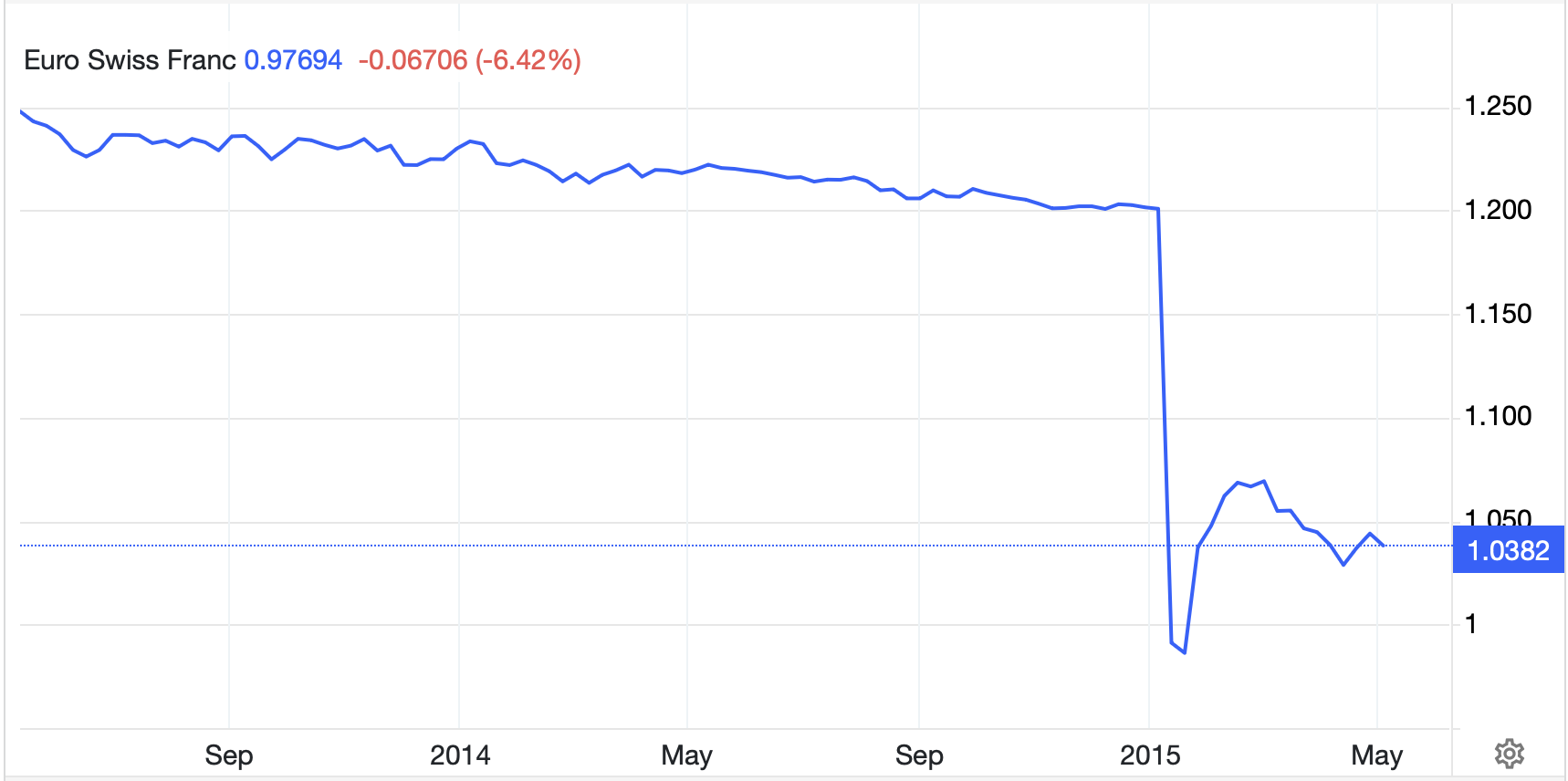
A great example is Switzerland in January 2015.  As you can see from the chart below of the EURCHF cross, Switzerland was explicitly targeting a level, 1.20, in the cross as the strongest the Swiss franc could trade (lower numbers indicate a stronger CHF).  This was in an effort to support the export sectors of the economy during a period shortly after the Eurozone crisis when Europeans were quite keen to convert their funds to Swiss francs as a more effective store of value.  

Source: tradingeconommics.com

The upshot was that the Swiss National Bank wound up effectively printing and selling hundreds of billions of francs, receiving dollars and euros and then investing those proceeds into the US stock market.  At one point, they were the largest shareholder in Apple!  But even in this case, where you would expect a nation could prevent their currency from rising too far or too fast, the process overwhelmed the SNB and one day in January 2015 they simply said, enough.  That 25% appreciation in the franc took about 15 minutes to accomplish and as evidenced by today’s exchange rate of 0.9768, it has never been unwound.

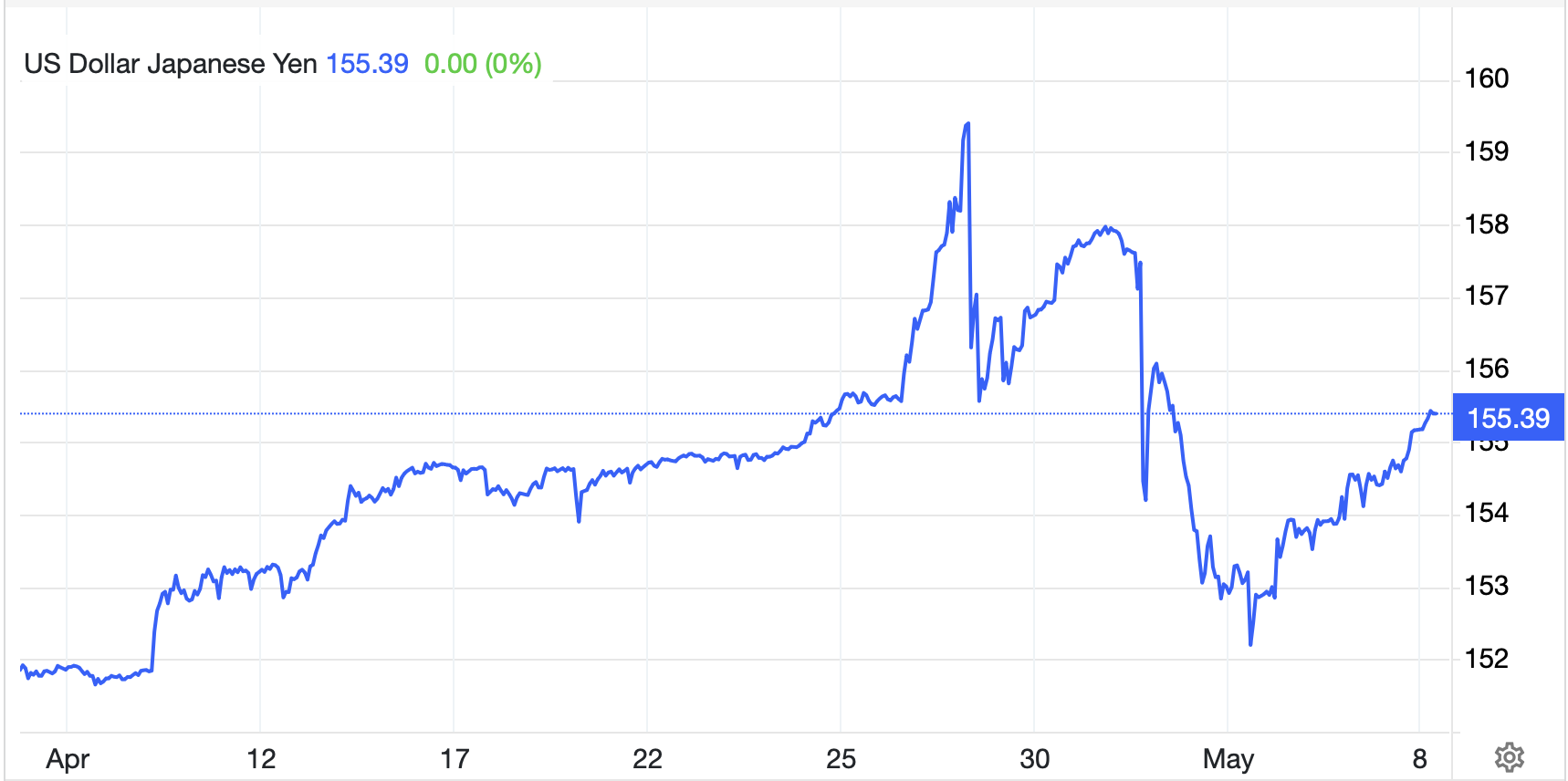
And that’s what happened to a central bank that is trying to prevent its own currency from strengthening.  For central banks to prevent weakness is an entirely different story and a MUCH harder task.  As I have repeatedly explained, the only way to change the trajectory of a currency is to alter monetary policy.  At this time, given the Fed’s commitment to higher for even longer, the only way Japan can prevent more substantial yen weakness is for the BOJ to tighten policy even further.  This is made evident in the below chart of the price action in USDJPY for the past month.  In it, you can see when it spiked above 160 on April 28th, and the subsequent intervention that day and then two days later.  

Source: tradingeconomics.com

However, in both cases, despite spending upwards of $60 billion intervening, the yen immediately resumed its downtrend (dollar uptrend) and this morning it is back above 155.  It is this price action that appears to have finally awoken Ueda-san as last night, in an appearance at the Japanese parliament, he explained the following, “Foreign exchange rates make a significant impact on the economy and inflation.  Depending on those moves, a monetary policy response might be needed.”  Ya think!  Ueda-san was followed in parliament by FinMin Suzuki who repeated something he said last week, “Since Japan relies on overseas markets for food and energy, and a large portion of its transactions are denominated in dollars, a weaker yen could raise prices of imported goods.”  While those comments are self-evident, the fact that he needed to repeat them is indicative of the idea that Japan is getting increasingly uncomfortable with the current yen exchange rate.

So, will Ueda-san raise rates at the next meeting in June?  Will he alter their QQE policy and explicitly explain they will no longer be buying JGBs?  Certainly, the market is on edge right now given the two bouts of intervention from last week, but not so on edge that it isn’t continuing to sell the currency and capture the carry.  At this point, you cannot rule out a third wave of intervention, and certainly we should expect more jawboning.  But in the end, if they are serious about the yen being too weak, Ueda-san will have to move.  At this point, I am not convinced, but the meeting is on June 14th, so there is plenty of time for things to become clearer.

And other than that, quite frankly, not much is going on.  So, let’s take a tour of markets to see how things stand this morning.

Yesterday’s equity markets in the US were tantamount to being unchanged across the board, at least that is true of the major indices.  There were certainly individual equities that moved.  In Asia, it was a mixed picture with both Japanese (Nikkei -1.6%) and Chinese (CSI 300 -0.8%) shares in the red, which dragged down HK shares.  But elsewhere in the region, we saw more gains than losses, albeit none of the movement was that large overall.  Meanwhile, in Europe, all the markets are looking robust this morning with gains ranging from 0.5% (DAX, FTSE 100) to 1.0% (CAC) and everywhere in between.  The Swedish Riksbank cut rates by 25bps, as anticipated this morning, and perhaps that has encouraged investors to believe the ECB is going to embark on a more significant easing campaign starting next month.  Certainly, the limited data we saw this morning, (German IP -0.4%, Spanish IP -1.2%, Italian Retail Sales 0.0%) are not indicative of an economy that is growing strongly.  Finally, US futures are just a touch lower, -0.2%, at this hour (7:15).

Despite the weakness in Eurozone data, and the absence of US data, yields are rebounding a bit this morning with Treasuries higher by 3bps and the entire European sovereign spectrum seeing yields rise by 3bps to 4bps.  It seems unlikely that the weak Eurozone data is the driver and I suspect that this movement is more a trading reaction based on the recent decline in yields.  After all, just one week ago, yields were more than 20 basis points higher, so a little rebound can be no surprise.

In the commodity markets, oil (-1.1%) is under pressure as rising inventories outweigh ongoing concerns over Israel’s Rafah initiative.  While the EIA data is generally considered the most important, yesterday’s API data showed a build of more than 500K barrels vs. expectations of a 1.4M barrel draw.  At the end of the day, this is still a supply/demand driven price, and if supply is more ample, prices will fall.  In the metals markets, precious metals continue to trade choppily around recent levels, but we are starting to see some weakness in the industrial space with both copper (-1.25%) and aluminum (-1.6%) under pressure this morning.  Certainly, if economic activity is starting to wane, these metals are likely to suffer.

Finally, in the FX markets, the dollar is continuing to rebound from its recent selloff, gaining against virtually all its counterparts, both EMG and G10.  SEK (-0.5%) is the biggest mover in the G10 after the rate cut, but JPY (-0.45%) is not far behind.  We are also seeing weakness in AUD (-0.4%) on the back of those metal declines.  As to the EMG bloc, ZAR (-0.7%) is the laggard there, also on the metals weakness, but we saw KRW (-0.5%) suffer overnight as well amidst the general dollar strength.

Once again, there is no US data on the calendar although we hear from three more Fed speakers, Boston’s Collins as well as governor’s Cook and Jefferson.  Yesterday, Mr Kashkari did not give us any new information, indicating that higher for longer still makes the most sense and even questioning the level of the neutral rate, implying it may be higher than previously thought.  But there have been no cracks in the current story that the Fed is not going to alter policy soon.

While day-to-day movements remain subject to many vagaries, the reality is that the trend in the dollar has been higher all year and as long as monetary policies around the world remain as currently priced, with the Fed the most hawkish of all, the dollar should grind higher over time.

Good luck

Adf

Offsides

The PPI data revealed
Inflation has clearly not healed
Will Jay and the Fed,
When looking ahead
Now tell us one cut’s been repealed?

So, now here we are at the Ides
Of March, as opinion divides
Some still say a cut
Will come in June, but
Some others think, no that’s offsides

Once again, the inflation data did nothing to help the case for a rate cut anytime soon in the US.  This time the PPI data showed that prices rose far more than expected in February, 0.6% at the headline level and 0.3% at the core level.  The rises, when broken down, were across the spectrum of goods and services.  The point is despite what appears to be an overriding desire to cut rates by June, the data is not cooperating for Jay and his friends.  Will this be enough to dissuade them?  We still have 3 more months before the critical time and the market, despite itself, is now putting all its eggs in the June basket, having reduced the May probability to just 7%.  Clearly, it remains highly dependent on how the data progresses, and not just the inflation data, but also the employment data, but for now, I find it hard to make the case that the Fed should be cutting rates anytime soon.

Of course, there remains a large contingent of analysts, economists and pundits who believe that the Fed should cut next week, or May at the latest, as they are already doing grave damage to the economy.  You may recall the immediate response by the Nick Timiraos article to the hotter than expected CPI data.  Well, this morning, we have Bloomberg with an article that claims a solid majority of the forty-nine economists they surveyed continue to look for the first cut in June and three cuts this year.  It certainly appears there is a great effort to convince us that those rate cuts are coming, although as I have maintained, if the Fed is truly data dependent, the data is not pointing to cutting rates as the appropriate move at this time.  This argument discussion will continue for the foreseeable future, that is the only certainty.

Wages have blossomed
Will Ueda-san enjoy
The view, and end NIRP?

The preliminary indication from the Shunto wage negotiations shows that the average wage increases in Japan this year will be 5.28%, the largest rise in decades.  Apparently, Toyota accepted the union’s demands fully and didn’t even offer a counter!  When comparing this outcome to the most recent CPI readings in Japan, which showed a headline rate of 2.2% and a Core of 2.0%, it certainly appears that there could be some wage driven price increases upcoming.  As has been mentioned repeatedly, this was seen as a key issue for the BOJ ahead of their meeting this coming Monday night (Tuesday in Japan) in terms of being a sufficient catalyst for the BOJ to finally raise their overnight interest rate from its current -0.10%.

Now, while Ueda-san’s own words have seemed more circumspect, the growing consensus amongst the analyst community in Tokyo is that the move will happen next week with no need to wait until the April meeting.  But a funny thing has been ongoing in markets while this consensus has been building, the yen has been falling.  While there was essentially no movement overnight, since Monday, when the discussion began to heat up, the yen has declined more than 1.5% in value, almost as though the market is selling the news ahead of the news.  Perhaps of more interest is the fact that 2-year JGB yields have fallen this week by 2bps, which while not a great deal overall, represents a reversal of the gradual increase that has ostensibly been driven by the upcoming BOJ policy tightening.  I have a funny feeling that while NIRP may well turn into ZIRP next week, as the market looks ahead, there is much less tightening perceived in the future.  I have maintained that a move beyond +0.2% would be highly unlikely this year, and possibly next year.  As such, when considering the FX rate, USDJPY remains far more beholden to the Fed and US interest rates than to whatever the BOJ does at the margins.  Let’s face it, if the BOJ hikes rates to 0.2% by December, but Fed funds remains at 5.5%, it is still a very difficult case to buy yen.

And those have been the key stories driving things since I last wrote.  A look at the overnight session shows that Asian equity markets were mixed with the Nikkei sliding a bit, while the Hang Seng fell sharply (-1.4%), perhaps on fears of increased tech stress between China and the US.  However, the CSI 300 managed a small gain despite weak Loan data and the rest of the bloc saw a lot of red on the screen, following the US session losses yesterday.  In Europe this morning, it is the opposite reaction with green across the screen led by Spain (+1.1%) but modest strength everywhere as inflation data from Italy and France seemed to show more moderation.  Meanwhile, at this hour (7:30), US futures are edging higher by 0.3%, essentially unwinding yesterday’s losses.

In the bond market, yesterday’s PPI data saw bonds sell off aggressively in the US with yields across the entire curve rising 10bps.  This morning, Treasury yields have backed off 2bps, but remain at 4.27%, above what is perceived to be a trading pivot level of 4.20%.   European yields also rose yesterday, albeit not quite as aggressively as US yields, and this morning they are essentially unchanged.

In the commodity markets, oil (-0.5%) is giving back a bit of its recent gains but WTI remains above $80/bbl and Brent crude above $85/bbl.  Apparently, the IEA has revised its global oil demand figures higher by more than 1 million bbl/day and despite the fact that there is ample spare capacity in OPEC, the market is tightening right now.  Gold, which sold off yesterday on the rising rates / higher dollar situation, is rebounding a bit this morning, +0.3%.  Interestingly, copper (+1.3%) did not sell off on the interest rate or dollar story and is now back at its highest levels in nearly a year and firmly above $4.00/Lb.  Something is going on here which seems to be a positive hint for growth.

Finally, the dollar, which rocked yesterday, rising almost 0.65% across the board with some significant gains vs. specific currencies, is essentially unchanged overall this morning, holding onto those gains.  In fact, there are a few currencies that are still feeling pressure like KRW (-0.5%) and NZD (-0.5%) but there has been a modest bounce in ZAR (+0.4%) on the back of the strong metals complex.  Net, the DXY is unchanged on the day, back above the 103 level.

We finish the week with some more secondary data as follows:  Empire State Manufacturing (exp -7.0), IP (0.0%), Capacity Utilization (78.5%) and Michigan Sentiment (76.9).  Now, we have seen secondary data have an impact recently, and given the quiet period prevents any Fedspeak, market participants are looking for any clues they can find.  It will be very interesting to see if today’s data indicates that the economy is continuing at its above trend growth rate or implies things are fading.  My observation is manufacturing continues to struggle overall, and sentiment on the economy isn’t great, so I would look for weakness rather than strength.  In that case, perhaps bonds rally further, and the dollar unwinds some of yesterday’s gains.

Good luck and good weekend
Adf

Who Do You Trust?

At this point, it’s who do you trust?
‘Bout ‘flation, ‘cause as I’ve discussed
To some it seems hot
For others, it’s not
And so far, no one’s got it sussed

The thing is this PCE story
Is more than just mere allegory
Chair Jay and his team
Still harp on the theme
That higher for longer brings glory

I read far too much economic analysis each day as I try to glean interesting ideas from very smart people who are happy to offer them up.  Hopefully, my doing this allows you to spend your time doing more important things while still keeping abreast of the macroeconomic situation.  But, boy, I cannot remember a time when there was such vehement disagreement on a single statistic.  There have been many times where economic bulls look at all the data and see great things while the bears see death warmed over.  But that is generally based on a collection of items.  However, right now, literally every other piece that I read, all published by very reputable analysts and economists tells the opposite story.  One piece will explain that yesterday’s 0.4% rise in core PCE was just an aberration and that it is destined to reverse lower going forward largely because housing inflation is going to decline.  The next piece will point to yesterday’s release and explain that the recent three-month or six-month trend has turned higher in the critical core services component, and that there is no sign it is going to reverse.

The greatest (or worst) thing about economics is since it is not a hard science, everybody can have a view, typically back it up with some piece of data or another and make their case.  While ultimately, the proof is in the pudding, when economists are wrong, they will typically fall back on they missed the timing, not the actual direction of travel.

By this time, if you have been following my writings, you are aware I am in the ‘inflation is sticky’ camp, and I have not been surprised by the fact that it has stopped declining.  For 2 years we have been hearing that housing inflation is due to fall because of a massive supply of new apartments coming on the market soon, and yet I believe it is now 28 consecutive months where the housing component of CPI has risen at least 0.4% on the month.  I think one of the problems with the oversupply analysis is that it doesn’t account for the fact that a large proportion of those apartments are luxury apartments with very pricey rents.  As such, it is difficult for average or median rental prices to decline.  At the same time, the Case-Shiller Home price index rose 6.1% last month, which is not indicating any decline in single family home prices.  Given the proportion of housing in the inflation indices, whether CPI or PCE, if shelter costs are rising, you can bet that inflation will be rising.  And that’s where we stand.

The next question is, what does this mean for the Fed and their reaction function and then, how will it impact financial markets?  Well, we heard from four more Fed speakers yesterday and they remained consistent with their recent comments, i.e., there’s no need to rush as the economy remains strong and inflation isn’t declining as quickly as we hoped, but we remain confident that the time for rate cuts will come as the year progresses.  As of this morning, the market is pricing about an 80% chance of a June rate cut and is still pricing 3 ½ cuts for the year.  Meanwhile, Treasury yields have edged lower by 2bps, but remain well above the levels seen just one month ago, more than 40bps higher.  And lastly on this subject, equity markets are basically ignoring the data completely and focusing on internal factors like flows.  As such, my thought yesterday that they might stumble a bit, even with a lower PCE print, turned out to be completely wrong.  The party is still raging there.

As we look ahead, I would contend that the big picture remains exactly the same.  On the price front, yesterday’s data did nothing to dissuade me from my sticky inflation thesis.  At the same time, yesterday’s other data showed that manufacturing remains in a recession (Chicago PMI fell to 44.0), but the labor market is holding up (Initial Claims edged higher to 215K, although Continuing Claims were substantially higher at 1905K).  For much of last year I was far more focused on the NFP number as being the most important based on the idea that the Fed could not withstand a significant uptick in Unemployment for political reasons.  I have a sense that dynamic is going to reassert itself going forward.  If last month’s number was the aberration that many claim, and we see weakness next Friday, I believe that will really impact the narrative and we will see May come back on the table for the first rate cut.  But if it remains strong, the bar for cutting rates will remain quite high.

With that in mind, let’s look at the overnight session.  Asia was on fire with the Nikkei (+1.9%) leading the way after Ueda-san pushed back on the message from Takata we discussed yesterday.  He cautioned patience was necessary and until they saw and digested the wage outcomes later this month, there was no reason to do anything, especially given the recent weakness in GDP growth.  That caused the yen to give back yesterday’s gains and a weaker yen tends to help Japanese stocks.  But there was strength in China, albeit not as much, with the indices there and in Hong Kong rising by 0.5% or so.  We did see Chinese PMI data which printed as expected (Manufacturing 49.1, Non-Manufacturing 51.4, Caixin 50.9), which implies nothing has changed on the mainland regarding the economy.  Next week’s plenary sessions are still the China bulls’ hope for more stimulus.

European shares are generally firmer, with only the CAC (0.0%) the laggard as the rest are higher by 0.5% or more.  PMI data here was also largely in line with the Flash data last week and is being spun as the beginning of a turn higher.  However, ECB speakers continue to push back on the need for rate cuts soon which is not supporting equities on the continent.  As to the US futures market, after another rally to all-time highs yesterday, this morning sees very little movement ahead of the ISM data.

While Treasury yields have edged lower, all of Europe have seen their sovereign yields rise by between 3bps and 6bps, arguably on the idea that the worst of the economic story has passed.  I’m not sure I agree with that, but that is all I can get from the data.  Overnight, JGB yields edged 1bp higher, but are still sitting right at 0.70%, the level at which they have been trading for the past 5 weeks give or take a nickel.

Oil prices (+1.2%) are continuing their recent rise with WTI pushing back toward $80/bbl, as traders continue to expect OPEC+ to maintain their production cuts.  As well, from a market internal perspective, the backwardation in the curve is steepening.  Briefly, this means that front month prices are higher than prices further out the curve, which in the futures market is a signal that there is excess demand for physical.  That demand is the bullish signal.  As to the metals markets, gold (+0.5%) is breaking above its recent range high at $2050/oz, as the dollar, after a strong day yesterday, is ceding some of those gains.  However, base metals can’t get going with both copper and aluminum sliding by about -0.25% this morning.

Finally, as mentioned, the dollar is sagging a little with only the yen performing worse.  But its losses are generally quite modest, on the order of 0.1% or 0.2% for both G10 and EMG currencies.  And while it is under pressure today, the trend so far in 2024 is still very clearly for dollar strength.  Given the continued hawkish tone from the Fed, I see no reason for that to change anytime soon.

On the data front, both ISM Manufacturing (exp 49.5) and Michigan Sentiment (79.6) are due at 10:00 this morning and then we hear from five different Fed speakers as the day progresses, including Governor Waller, maybe the second most influential voice on the FOMC.  It is hard for me to believe that they are going to change their tune, especially given that yesterday’s PCE data gave no hint that their 2.0% target was right around the corner.

Summing up, consider the fact that the US continues to benefit from a massive fiscal impulse, relatively cheap and abundant energy prices and the tightest monetary policy in the G10.  With that in mind, we continue to see international capital flow into the country (look at the stock market!) and I suspect those things need to change for the dollar’s trend to change.  That is not going to happen today.

Good luck and good weekend
Adf

Not Even a Token

Like spring rains falling
So too, Japanese prices
Continue to slide


Once upon a time there was a tiny thought about Japan tightening monetary policy.  This thought, which had been seen lurking in the shadows of markets for the past thirty years, was largely ignored by all the ‘right’ people.  The illiterati economic gliteratti were all quite convinced that this would never happen as Japan was in a death spiral of rising debt and a shrinking population.  According to all the classical economic texts, interest rates could never rise again.

Then, one day there came along a virus that disrupted the world.  All the ‘important’ people in all the major nations determined that shutting down all economic activity while simultaneously printing trillions upon trillions of dollars, euros, pounds, and yen, and more importantly, giving that money to the people, was the best thing to do.  Not that surprisingly, with all that extra money chasing after fewer available goods and services, prices rose sharply almost everywhere.  Even in Japan, a nation that had suffered a generation-long deflationary bout, where companies literally apologized if they determined that a price rise was in order to cover rising expenses, prices started to go up more broadly.

This excited the policymakers in Japan as it was something they had been trying to achieve for the past 30 years.  It also excited the trading community as they became convinced that Japanese interest rates were set to explode higher.  And for a little while, Japanese inflation rates rose, surpassing the 2.0% target that had only been briefly brushed three times during that generation, the most recent being in the wake of the Covid actions.  Analysts were convinced that the new BOJ Governor, Kazuo Ueda, was getting set to raise the policy rate from its current level of -0.10%, its home for the past 8 years.  Traders positioned for JGB yields to rise and for the yen to strengthen against its currency counterparts.

Alas, so far this tale has not had that happy ending.  Instead, last night CPI in Japan printed at 2.2% headline, 2.0% core with both measures clearly trending lower for the past 18 months at least.  To be clear, in the very short term, these prints were marginally higher than market forecasts, which has resulted in a touch of strength in the yen (+0.3%), and a 1bp rise in 10-year JGB yields.  But bigger picture, this has further called into question the idea that Japanese inflation is going to remain stable at the BOJ’s 2% target.  In this situation, the idea the BOJ will tighten policy seems increasingly remote.  As such, all those delusions of tight money have been, once again, laid to rest.  The moral of this story is that; in Japan, the only money is easy money!

The newest Fed member has spoken
And Schmid said that things just ain’t broken
Thus, patience is needed
And so, he conceded
No rate cuts, not even a token
 
The Kansas City Fed’s new president, Jeffrey Schmid, made his first public comments yesterday but it could well have been his predecessor, uber-hawk Esther George, given that he hewed to the party line as follows:, “With inflation running above target, labor markets tight, and demand showing considerable momentum, my own view is that there is no need to preemptively adjust the stance of policy.  I believe that the best course of action is to be patient, continue to watch how the economy responds to the policy tightening that has occurred, and wait for convincing evidence that the inflation fight has been won.”  That’s pretty clear, and while he is not a current voter, it is simply another voice telling us that the Fed is not anxious to alter policy at all.  Even the market gets it now, with the March meeting down to a 0.5% probability of a cut, the May meeting down to a 16.3% probability and even the June meeting down to a 60% probability.  For all of 2024, the market is now pricing in just 3 ½ cuts, pretty darn close to the last dot plot.  Kudos to the Fed for getting their message across.
 
However, beyond those two stories, there is precious little to discuss this morning.  Data, beyond the Japanese CPI, has been sparse and the ECB speakers have also stayed true to their recent mantra of no reason to cut rates yet.  As such, it is not that surprising that markets remain mired in tight ranges overall.
 
Looking first at equity markets, after a lackluster session in the US yesterday, Japanese share prices were essentially unchanged although we did see some strength in Chinese shares with both the Hang Seng (+0.9%) and CSI 300 (+1.2%) rallying nicely on the back of increasing hopes for more Chinese stimulus coming in March at the annual plenary sessions.  As to the rest of Asia, activity was mixed with some countries seeing gains (India, Australia) and some losses (South Korea and Taiwan).  European bourses are also mixed with some gainers (Germany) and losers (Spain) while others have gone nowhere at all.  Finally, at this hour (6:45), US futures are ever so slightly firmer, just 0.1%.
 
In the bond market, both Treasuries and European sovereigns are seeing a bit of buying with yields lower by 1bp across the board.  Yesterday’s US 5-year auction was also somewhat unloved with a 0.8bp tail, quite large for that maturity.  It does appear that there is increasing pressure on the Treasury market as the pace of issuance picks up.  Over time, I believe this is going to matter a lot more to markets than it has thus far.
 
Oil prices, which rallied most of yesterday, are giving back some of those gains, down -0.4% this morning.  The rally was ostensibly based on further Red Sea concerns, but that really doesn’t make much sense given there were no new events there.  More likely, there was some short covering and analysts were looking for a story to tell.  Metals markets, though are in better shape this morning with gains in both precious (gold +0.3%) and base (copper +0.2%, aluminum +1.0%), largely on the back of the dollar’s modest weakness.
 
Which brings us to the dollar and the most confusing part of the session.  While it is true Treasury yields are lower by 1bp, that does not seem enough to weigh on the dollar, especially given the universal nature of yield declines.  The US curve actually inverted further, with the 2yr-10yr spread back to 42bps (it had been hanging around 25bps-30bps for several months), so that could be weighing on the greenback.  But whatever the cause, we are seeing pretty uniform weakness, although other than ZAR (+0.75%) which has clearly been helped by the metals rally, the rest of the movement is pretty modest, +/- 0.2% or less with more currencies gaining than losing.  I do not believe that the reaction function has changed here.  Rather, sometimes the FX market moves in funny ways.
 
On the data front, this morning brings Durable Goods (exp -4.5%, +0.2% ex transport) and Case-Shiller Home Prices (6.0%).  Yesterday saw a softer than expected New Home Sales and a weaker than expected Dallas Fed survey, although it was better than January’s print.  As well, we hear from Vice Chairman Barr, but there has been very little wavering from the message that patience is a virtue, and I don’t expect Mr Barr will change that tune.
 
The equity bulls took a rest yesterday but are clearly looking for more reasons to get back to buying.  To me, the potential problem will be home prices as, if they continue to rise, it will reduce hopes for any rate cuts at all, and there are still a number of pockets in the economy that are highly reliant on low interest rates to succeed.  Commercial real estate is simply the most frequently discussed, but consider much of the tech sector, where ideas that had been funded with free money that will not get the time of day if there is a cost of capital.  Ultimately, nothing has changed my idea of the dollar benefitting further as the market continues to understand that the Fed is not set to cut rates any time soon.  Of course, Thursday’s Core PCE could change a lot of views, mine included.
 
Good luck
Adf

So Puissant

Ueda explained
When NIRP disappears, ZIRP is
His view of the world

“Even if we end minus rates, the accommodative financial conditions will likely continue.”  This was the key comment from Kazuo Ueda’s testimony in parliament last night, which followed a similar comment from BOJ Deputy Governor Shinichi Uchida on Thursday.  It should be no surprise that this is the case as the recent data from Tokyo, notably the inflation data, has been softening quickly and reducing the need for tighter policy.  After all, for two decades the BOJ has been trying to overcome a generational view that deflation is a given and instill an inflationary mindset in the populace there.  If inflation readings are falling, they will definitely not be in a hurry to raise interest rates.

It appears, from these comments, that while the BOJ may lift the key deposit rate from its current -0.10% level, it would be a mistake to look for very much movement.  My money is on either 0.00% or +0.10% as the peak.  It should also be no surprise that the yen has suffered further on these comments with USDJPY having traded as high as 149.55 overnight, although it has since slipped back to unchanged at 149.40.  There remains a great deal of belief that the BOJ is highly focused on 150.00 as a line in the sand to prevent further weakness.  Personally, I think their line in the sand is higher, at least at 152.00 and perhaps even higher than that.  They are very consciously making dovish comments while listening to every Fed speaker reiterate higher for longer and no rate cuts in the US anytime soon.  They know the yen will fall further and are already prepared for that outcome; I assure you.

The talk of the market today
Is whether revisions display
That CPI’s recent
Decline is so puissant
Or if tis a ‘flation doomsday

It should not be that surprising that in a market bereft of serious data, traders and analysts are turning over every stone to find something on which to hang their hat.  Today’s story is the annual CPI revisions that are due from the Bureau of Labor Statistics at 8:30 this morning.  The reason this is getting so much play is that last year, the revision was dramatic, adjusting the annualized rate up to 4.3% from its pre-revision level of 3.1%, and casting doubt on just how much progress the Fed had actually made in their inflation battle.  But last year was a dramatic outlier with respect to revisions as historically, the average adjustment is something like 3 basis points, so the different between 3.10% and 3.13%.  In other words, nothing.

However, the concerns come from the fact that ever since Covid changed so much in the economy, measuring the data has become far more complex leading to potentially larger revisions.  I have no way of knowing what will happen here, and I suspect there is an equal chance of the revisions showing CPI has actually been lower than reported, but the point is, this obscure data adjustment has become the topic du jour on an otherwise quiet day.

What we can do is game out how markets may respond to a surprisingly large adjustment in either direction.  If, like last year, the revisions show inflation is running hotter than previously reported, I would look for bonds to sell off further, especially the 2-year, as it would push the probability of a rate cut further into the future.  This would likely weigh on stocks and support the dollar overall.  Oil has been in its own world, rallying on the increased middle east tensions, but metals would suffer, I think.  And if the revision is substantially lower, just turn around all those movements.  Any large revision will be a binary event.

But really, those were the major discussion points overnight.  Turning to the markets, after another set of records in the US (although the S&P 500 couldn’t quite make 5000), Japanese equities rallied further on the interest rate story from above, setting new 34-year highs and approaching the 1989 bubble peak.  Chinese shares are closed for a while now, but the Hang Seng, in a half-day session, managed to slide another -0.8%.  However, the rest of Asia was in the green.  In Europe, there is very little net movement this morning as we continue to hear from ECB speakers that rates will not be cut soon, although it is not clear anybody believes them given the overall economic weakness.  Lastly in the US, futures are a touch higher at this hour (7:45), but only about 0.2%.

In the bond market, yields continue to edge higher with Treasuries up 2bps, and most European sovereigns higher by just 1bp.  Interestingly, despite the Ueda comments overnight, JGB yields have crept 2bps higher along with everything else.  It is hard to know if bond investors are more concerned with sticky inflation or massive issuance, but something has them uncomfortable this morning.

Oil, which has rallied all week is unchanged this morning as the market digests the fact that there will be no cease-fire between Israel and Hamas, and the Houthis continue to fire missiles into the Red Sea.  As to the latter, given that ship traffic has fallen to near zero, that seems like a waste of ammunition, but so be it.  Metals markets, meanwhile, are a touch softer this morning with copper the underperformer (-0.5%) although precious metals have edged lower as well.

Finally, the dollar continues to perform well overall, as we have already discussed the yen, but are also seeing it edge higher against most of its counterparts in the G10.  The exception is NZD (+0.6%) which seems to believe that the RBNZ, after having paused in their rate hiking cycle, may raise rates yet again.  On the EMG side, the most noteworthy mover is ZAR (-0.35%) suffering from metals weakness although we are seeing a bit of strength from the LATAM bloc with both MXN and BRL edging higher this morning.

And that’s really it today.  Not only is there no additional data, but no Fed speakers are scheduled either.  Next week will see a number of holidays around the world as Carnival begins alongside the Chinese New Year.  Really, Tuesday’s CPI is the next key data point for us all.  Until then, I expect that traders will want to close the S&P over 5000 but do not see an explosive move higher coming.  As to the dollar, there is no reason for it to cede its recent gains.

Good luck and good weekend
Adf

Others to Blame

Apparently, President Xi
Is not very happy to see
That stocks made in China
Have lost all their shine-a
So, feels he must buy by decree
 
The upshot is two trillion yuan
Is what he will spend, whereupon
He’ll then get to claim
Twas others to blame
Though it’s his ideas that keep on
 
Last night the BOJ meeting was the non-event that was widely expected.  There was no change in policy and when looking at their forecasts, if anything they lowered their inflation views a touch for next year, thus reducing the chance of a policy change even more.  The follow-on commentary was not very inciteful either, explaining that they are prepared to take additional easing measures if necessary but uncertainties on the price outlook are high.  In other words, we still don’t know how to achieve our goal of sustainable 2% inflation so we’re going to watch a bit longer.
 
The punditry has decided that Ueda-san is going to adjust policy at the April meeting after the spring wage negotiations have been completed, but personally, i don’t believe he feels a compelling need to do anything absent a major decline in the yen from current levels.  After all, the economy is still ticking over nicely and the stock market has been rallying consistently for a year and is back at 34-year highs, approaching the 1989 bubble peak.  However, if USD/JPY were to trade back above 150 again and start to move more quickly, I suspect that might be the catalyst the BOJ and Ueda-san need to change their tune.
 
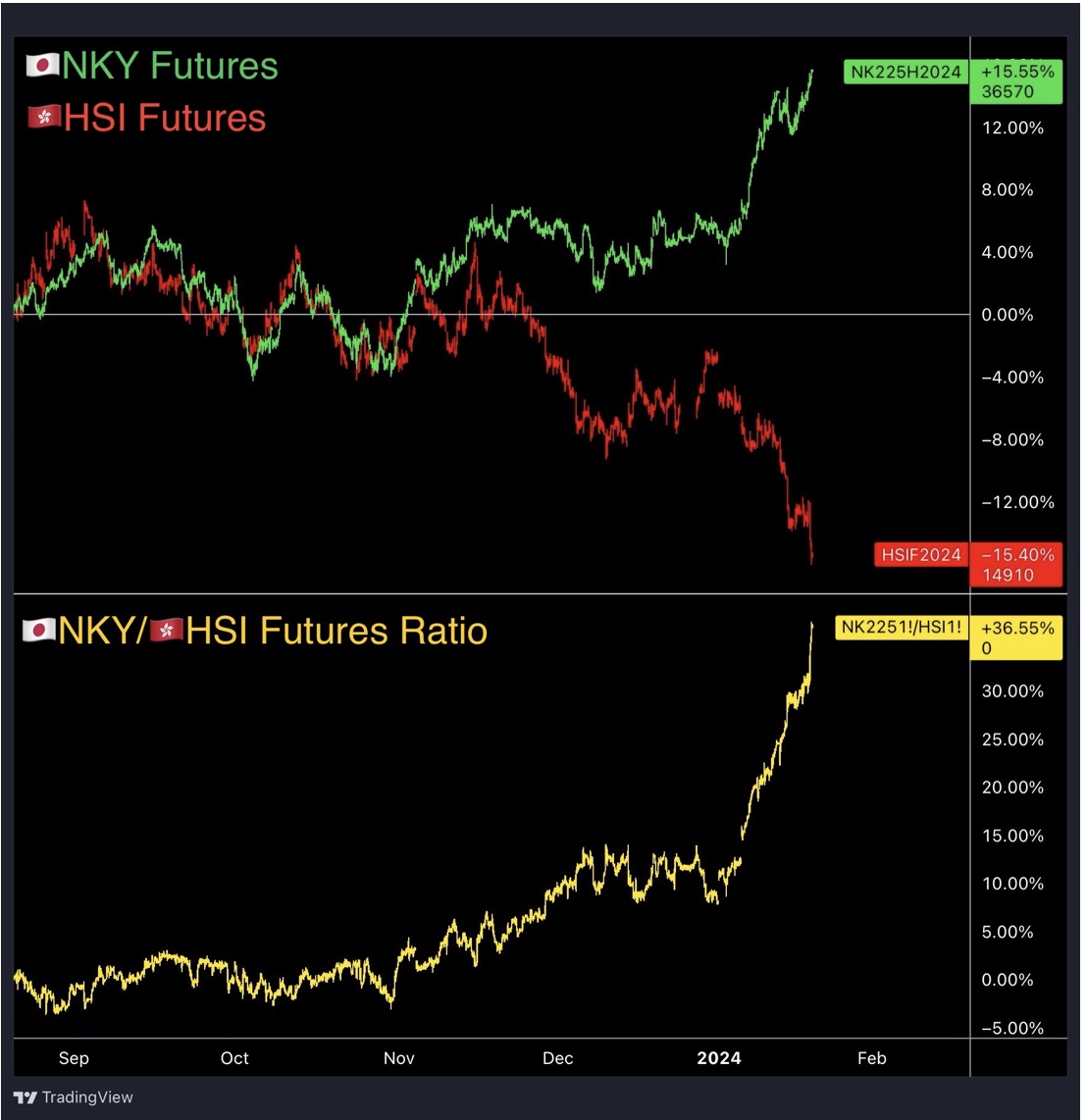
Arguably, of far more interest last night was the news that China is now considering a support package for the stock market there!  (For a communist country, it is quite ironic how much Xi Jinping cares about the most capitalistic institution there is, the stock market.)  The headline number is CNY 2 trillion (~$278 billion) which will be sourced from Chinese state-owned companies (SOEs) overseas and ostensibly will flow into the offshore market for Chinese shares as well as the Hang Seng in Hong Kong.  The below chart, courtesy of Weston Nakamura’s excellent substack is quite explanatory as to why Xi may be feeling some pressure.


The dramatic widening of the spread between Hong Kong and Japanese shares has been remarkable in the first three weeks of 2024, a substantial acceleration of what we have seen since November of last year.  My sense is Xi is taking it personally that the world is dismissing China as a serious global player as evidenced by the fact that nobody wants to invest there at all.  Obviously, there are sanction and tariff issues as well as a comprehensive effort by many western companies to reduce their reliance on China as part of their individual supply chains, but I guess this has become too much to bear for President Xi. 

While this mooted number is twice as large as the previous discussions, it remains to be seen if it will be effective beyond the knee-jerk response by the Hang Seng today (+2.6%).  After all, the Chinese property market is still a disaster, and all the other problems remain intact.  Chinese share prices have been falling for 3 years now, and my sense is it will take real policy changes rather than a buying spree by SOEs to change any views.  Perhaps communist-based stock markets are an oxymoron after all.

Away from those two stories though, not very much is ongoing.  Mainland Chinese shares also rose, but far less, just 0.4%, while Japanese shares were essentially unchanged on the day after the BOJ’s meeting.  In Europe, equity markets are a touch softer, although only about -0.2% or so across the board and after yet another positive day in the US yesterday, US futures are pointing slightly higher at this hour (7:45), about 0.2%.

In the bond market, yesterday’s price action is being reversed with yields across the US (+2bps) and Europe (+2bps across virtually all nations) backing up a bit.  As there continues to be a lack of data on which to trade, this price action seems almost like a classic risk-on take, with equities higher, the dollar softer, and bonds falling in price as well.  However, given that the movement is just 2bps, I would not get excited about any new information here.

In the commodity markets, oil (-0.75%) is slipping a bit this morning, but has been performing pretty well over the past week on the back of the ongoing tensions in the Middle East.  However, we are seeing positive price action in the metals space this morning with gold (+0.2%) and copper (+0.5%) both pushing a bit higher.

Finally, the dollar is mixed this morning, with no consistency across either the G10 or EMG blocs.  CNY (+0.3%) has rallied on the strength of the financing package while ZAR (+0.8%) is benefitting from the metals complex rally, as is CLP (+0.35%) and AUD (+0.25%).  However, the euro (-0.2%) is sliding along with several EMG currencies, notably PLN (-0.75%) and MXN (-0.5%), as idiosyncratic stories drive markets this morning rather than a broad dollar narrative.

The only marginal piece of data this morning is the Richmond Fed Manufacturing Index (exp -11), yet another manufacturing index that has been performing quite poorly.  Interestingly, there was a Twitter (X?) thread this morning from Anna Wong (@annaeconomist), a senior economist at Bloomberg, describing some potential reasons as to why the Initial Claims data, which has been running far lower than the recessionistas expect due to eligibility issues and the fact that UI pays so little, people would rather driver for Uber than collect.  This is another indirect sign that the economy is not nearly as positive as many, especially the soft-landing proponents and equity bulls, would have you believe.  Food for thought.

As to the rest of the day, given the lack of other data as well as the anticipation of the Thursday and Friday info on GDP and PCE, I anticipate a quiet session overall.  Momentum remains higher in stocks, but bonds are uncertain, and the dollar is mixed.  Don’t look for too much movement in either direction here today.

Good luck

Adf

Buyers’ Chagrin

Last month everything was just fine

As stocks traded up on cloud nine
But this week has been,
To buyers’ chagrin,
Less fun, and perhaps e’en malign

While soft is the landing of choice
And one where the Fed would rejoice
As data keeps slipping
The narrative’s flipping
Said some, in a very low voice

Oops!  ADP Employment fell further last month, down to 103K, well below forecast and moving into a more dangerous territory for the growth story.  Last month’s outcome was revised lower as well and the 3-month moving average is now 99K.  This is certainly not a level that inspires confidence in future economic activity.  Now, we all know that ADP is not the really important number, that is Friday’s NFP, but of late, the story there has also not been that fantastic either.  Last month printed just 150K, and revisions for virtually the entire year have been lower.  All I’m saying is that I get a soft landing requires slowing growth which will impact the employment situation.  But this is a $27 trillion economy, and not something that is steered so easily.  Be prepared for the narrative to start to slip from soft-landing to recession and perhaps onto deep recession.  

One number does not a trend make, but as I discussed yesterday, the weight of evidence is beginning to pile up on the slowing growth story.  The market that really is buying the recession story is the oil market, where prices fell a further 4% yesterday with WTI settling below $70/bbl.  That is not a market that is convinced demand is going to be robust!

I guess the question is, at what point does the data stop confirming the goldilocks wishes and point to a more significant economic decline?  With respect to the employment situation, I suspect we will need to see a series of negative NFP prints as the Unemployment Rate rises.  While the former has not yet been seen, the Unemployment Rate has risen by 0.5% over the past seven months.  While tomorrow’s rate is forecast to be unchanged at 3.9%, there will be much angst in some circles if it goes higher.  As far as other metrics, Retail Sales, which had a very strong run in Q3, slipped last month and is forecast to be -0.1% when released next week.  Currently, the GDPNow forecast from the Atlanta Fed is calling for a 1.3% growth rate in Q4, much weaker than last quarter but not recessionary.

Combining these ideas, plus the other ancillary ones that come from the plethora of data released each month, it is easy to understand the belief in the soft landing.  But remember this, monetary policy famously works with long and variable lags.  That is just as true when the Fed is easing policy as when they are tightening policy.  Currently, there is an ongoing debate over whether the Fed’s 525 basis points of tightening is fully embedded in the economy, or if there is still more pain to come.  But if we are already seeing economic activity slow and the Fed continues to expound its higher for longer mantra, it is easy to make the case that the slowdown will be far deeper than a soft landing.  

One other thing, all this is happening while measured inflation remains well above the Fed’s target which is likely to remain a constraining factor on their behavior going forward.  If pressed, I would say the economy is heading toward a more significant recession, probably starting in Q1 or early Q2 of next year unless we see a remarkable turn of events in the US.  Given the intransigence that the current House of Representatives is demonstrating with respect to funding Ukraine, it appears that fiscal help may be a quarter or two later than hoped.  Be prepared.

Is the BOJ

Ready to change policy?
No breath-holding please!

One other thing of note was an article in Nikkei Japan that discussed recent comments from Governor Ueda as well as Deputy Governor Himino, where the implication seems to be that the committee there is contemplating the idea of raising their base rate to 0.0% or even 0.1% from its current -0.1% level.  Certainly, the market is willing to believe this story as evidenced by the moves last night where 10-year JGB yields jumped 11bps while the Nikkei fell 1.75%.  As to the yen, this morning it is the outlier in the FX market, with a 1.4% rally and is now trading back to its strongest level (weakest dollar) since August.  While the most recent inflation data from Japan has continued to show consumer prices rising above the BOJ’s 2% target, 19 straight months now, wages remain more benign and that is a key metric there.  While I’m sure that the BOJ will alter policy at some point, it still feels like it is a mid 2024 event.

And one other thing to note with respect to USDJPY, tomorrow the December futures options on the CME expire and there is some very substantial open interest at strike prices right here.  Apparently, a single buyer purchased upwards of $2 billion notional of JPY calls with strike prices ranging from 145.50 down to 144.75 back in mid-November, which are now at- and in-the-money.  The thing to look for here is a choppier market as dealers hedge their gamma risk.  And don’t be surprised if we see another leg lower in USDJPY before they expire tomorrow.

Ok, let’s look at how all the other markets have behaved overnight as we await today’s Initial Claims data, but more importantly, tomorrow’s payroll report.  After another soft showing in the US yesterday regarding equity markets, Asia, aside from Japan were broadly weaker, albeit not dramatically so.  In Europe, the screens are all red too, but the losses are quite small, between -0.1% and -0.2%.  Adding to the idea that there is very little ongoing, US futures, at this hour (7:30) are essentially unchanged.

Turning to the bond markets, Treasury yields, which had fallen below 4.10% briefly yesterday, have bounced on the day and are firmer by 5bps.  But European sovereign bonds are little changed on the day with only UK Gilts (+5bps) an outlier here.  Perhaps that move was on the back of the Halifax House Price Index, which rose slightly more than expected, but I suspect it has more to do with position adjustments ahead of tomorrow’s US payroll data.  After all, remember, the US is still the straw that stirs the drink.

After a horrific day yesterday, oil (+0.6%) is trying to stabilize although WTI remains below $70/bbl.  There is now talk in the market that OPEC+ is going to cut production further, although given they just held their monthly confab last week, this seems premature.  Gold (+0.4%) is finding support again after its wild ride earlier in the week, and copper and aluminum are both showing green today.

Finally, the dollar, away from the yen, is mixed with modest weakness vs. most G10 currencies, and a completely uncertain picture in the EMG bloc.  For instance, MXN (-0.5%) is under pressure this morning while ZAR (+0.9%) is putting in quite a performance.  Looking at the entire space, it is hard to characterize a general theme here today.  As such, it strikes me that choppiness ahead of tomorrow’s data is the most likely outcome in the session.

As mentioned before, Initial (exp 222K) and Continuing (1910K) Claims are the only data this morning although we do see Consumer Credit ($9.0B) this afternoon at 3:00pm.  Right now, the dollar is trendless, except perhaps against the yen, although that means that hedging should be quite viable right now.  As to the broader economic trend, tomorrow’s data will really set the tone for the FOMC meeting next week, and for Q1 next year.

Good luck

Adf

Damp Squib

While everyone waited for Jay
To blind us with brilliant wordplay
Seems he only said
The quants at the Fed
Try hard and their work is okay

This damp squib forced traders to seek
An alternate reason to tweak
Positions and views
But there’s just no news
At least not the rest of the week

The tedium continues another day.   There have always been periods in the markets when there is very little of note ongoing and so pundits work hard to pump one story or another in order to generate enthusiasm, and on Wall Street, more trading activity.  But sometimes, like right now, one is better off paying attention to something else more important (for instance, college football).  With that in mind, this morning’s note will be brief.

There was a great deal of anticipation ahead of Chairman Powell’s comments yesterday morning, but he gave no satisfaction by simply lauding the folks who work at the Fed’s Research and Statistics group.  That is the group that prepares the official Fed forecasts, and he was quite complementary of their effort.  The fact that they are often completely wrong is incidental.  Perhaps the most interesting thing he said was an oblique suggestion that they consider different models of the economy at times as things do change over time.  I heartily agree with that sentiment, but sincerely doubt that PhD economists who have made their entire reputation based on their pet models are going to change anything given it might imply their previous efforts fell short.  The upshot of the Powell speech was it had no impact on anything.

As to the rest of the Fed speakers, they simply repeated that inflation is still too high and that they will continue to do whatever they think is necessary to push it lower.  There was some caution about having gone too far from Chicago Fed President Goolsbee, but even he explained that it will take time before they can be certain they have achieved their goal.

Away from Fedspeak, there was no US data and this morning’s discussion has centered on Chinese CPI data which showed the M/M reading fell to -0.1% while the Y/Y reading fell to -0.2%.  Now, these are headline numbers, not core, and the fact that energy prices have been declining for the past month is likely a big part of this movement.  But the outcome has tongues wagging about the coming deflationary wave that will soon hit the world.  Don’t believe it.  If ever there was a good time to use the term transitory regarding inflation, this seems to be it.  Chinese deflation is transitory.

And that was literally the most impactful piece of data we have seen in the past 24 hours, if not the past 3 days.  One other thing to note was that Ueda-san spoke at a conference in London and explained, “When we normalize short-term interest rates, we will have to be careful about what will happen to financial institutions, what will happen to borrowers of money in general and what will happen to aggregate demand.  It is going to be a serious challenge for us.”  I think he is absolutely correct; it will be very difficult to change that policy without a few things breaking.  Good luck Ueda-san!

So, how have markets responded to this virtual lack of information?  Pretty much as you might expect, with minimal movement.  After a very quiet session in the US yesterday, where the major indices all closed withing 0.1% of Tuesday’s closes, Asia saw gains in Japan with the Nikkei higher by 1.5%, but Chinese shares did not respond well to the CPI data, sliding a bit.  Europe, this morning is modestly firmer, on the order of 0.4% as the many ECB speakers are unable to convince investors that they will remain hawkish going forward, while US futures are still within 0.1% of Tuesday’s closes, i.e., unchanged.

Bond yields continue to be the driving force in markets and after a small decline in 10-year yields yesterday, they have bounced 3bps this morning.  We have seen similar moves throughout Europe, 2bp – 3bp rises which seem to simply be following the Treasury market.  Meanwhile, JGB yields have edged lower by 2bps overnight, although it will be interesting to see how the local market responds to the Ueda comments above when they open tomorrow.  I would expect that we are still a long way from 1.00%.  One other thing to note is that the 2yr-10yr curve inversion is growing still larger, with this morning’s level up to -42bps.  This tells me that there is still a great deal of volatility to come in the bond market, and by extension across all financial markets.

Oil prices, which have been getting decimated lately, have settled for the moment and are higher by 0.5%, but now hovering around $75/bbl.  It is abundantly clear that the market is far more concerned with the demand destruction story than the supply constraint story.  This seems at odds with the soft-landing / no-landing crowd that is continuing to drive the equity markets, although I suspect the commodity folks have it right.  Metals markets, both precious and base, also remain under pressure on the weak economic story being driven by high real yields.

Finally, the dollar continues to range trade with the most noteworthy movement being USDJPY pushing toward new highs for the move above 151.00.  Until such time as the BOJ really changes policy, and based on Ueda-san’s comments, I think that is still some ways off, it is hard to get excited about owning the yen.  As to the rest of the market, the EMG bloc is suffering more than the G10 bloc, and if I had to describe a direction, I would say the dollar is modestly firmer overall.

We finally have some data this morning, with Initial (exp 218K) and Continuing (1820K) Claims hitting the tape at 8:30.  We have a bunch more Fed speakers, including Chairman Powell again at 3:00 this afternoon.  We shall see if he veers closer to monetary policy today than yesterday’s nothing burger.  And one last thing, Banxico meets today and is expected to leave their base rate unchanged at 11.25%.

It is difficult to get excited about this market and it beggars’ belief that Powell is going to change his tune given the lack of new information.  As such, look for another quiet session across the board.  The next shoe to drop is CPI, but that is not until next Tuesday.  Til then, there is little reason to expect any significant movement in either direction.

Good luck

Adf