Mind-Numbing

According to those in the know
The BBB’s ready to go
The vote is this morning
So, this is your warning
That President Trump will soon crow
 
As well, ere the Fourth of July
The NFP may quantify
If rate cuts are coming
(A subject, mind-numbing)
Or whether Fed funds will stay high


Perhaps this will be the last day we hear about the Big Beautiful Bill, or at least the last day it leads the news, as it appears that by the time you read this, the House will have voted on the changes and by all accounts it is set to pass.  If so, the President will sign it tomorrow amidst great fanfare and then it will just be a secondary story when somebody complains about something that was in the bill.  However, the drama over passage will have finally ended.  

(I guess what has really led the news was that Diddy was found not guilty of the RICO charges and Kohburger in Idaho got a plea deal avoiding the death penalty, but neither of those are market related.)

At any rate, the question now to be asked is will the BBB perform as advertised by either side of the aisle?  Experience tells us that while the economy will not take off rapidly while inflation collpases, neither will there be people dropping in the streets because of the changes in Medicare, although if you listened to the pundits on both sides of the aisle, that is what you might expect.  While this is not quite as bad as Nancy Pelosi’s immortal words, “we have to pass the bill to find out what’s inside it”, the fact that it approaches 1000 pages in length implies there is a lot inside it.

From what I have read, and it has not been extensive, it appears that there is some stimulus in the bill in the form of tax relief on tips and overtime as well as reductions for seniors, and spending on defense and the border.  It also appears there have been several previous subsidies, notably for wind and solar, that are being removed.  The fact that the CBO is claiming it will increase the budget deficit by $1.5 trillion, and given the fact that Jim Cramer is the only one with a worse track record than the CBO, tells me it will have limited impact on the nation’s fiscal stance initially, although if growth does pick up, that will clearly help things.

Which takes us to the other story this morning, the payroll report.  Here are the current median forecasts by economists for the results, as well as the rest of the data to be released:

Nonfarm Payrolls110K
Private Payrolls105K
Manufacturing Payrolls-5K
Unemployment Rate4.3%
Average Hourly Earnings0.3% (3.9% Y/Y)
Average Weekly Hours34.3
Participation Rate62.3%
Initial Claims240K
Continuing Claims1960K
ISM Services50.5
Factory Orders8.2%
-ex Transport0.9%

Source: tradingeconomics.com

Some will point to yesterday’s ADP Employment report which showed a decline of -33K, the first decline in more than 2 years, as a harbinger of a bad number, but as you can see from the chart below, there has been a pretty big difference between ADP (grey bars) and NFP (blue bars) for a while now.

Source: tradingeconomics.com

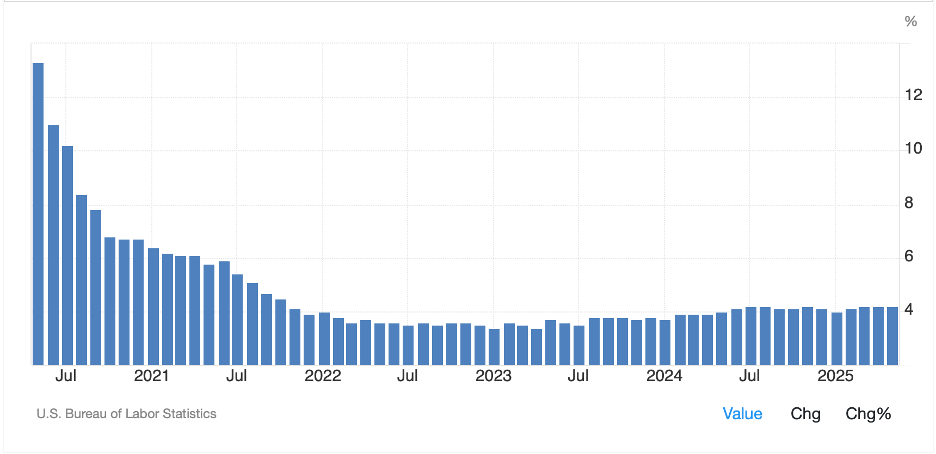
Perhaps of more concern is the Unemployment Rate, which is forecast to rise a tick to 4.3%, which would be its highest print since October 2021 and if I look at the chart below, it is not hard to see a very gradual trend rising higher here.  While markets really focus on NFP, I learned a long time ago from a very smart economist, Larry Kantor, that the Unemployment Rate was the best single indicator of economic activity in the US, and that when it is rising, that bodes ill for the future.  
Source: tradingeconomics.com

You may recall there was a great deal of discussion about a year ago regarding the Sahm Rule, which hypothesized that when the Unemployment Rate rose more than 0.5% above its cycle average within 12 months, the US was already in a recession.  The discussion centered on whether it had been triggered although the final claim was it hadn’t when extending the readings out to the second decimal place.  Now, for the past year, the Unemployment Rate has hovered between 3.9% and 4.2%, so there doesn’t seem to be any chance of a trigger here, although if it does rise, you can be sure you will hear about it.

And that’s what is on tap ahead of the long holiday weekend.  With that in mind, let’s look at the market action overnight. Excitement is clearly lacking in the equity markets these days as the summer doldrums are universal.  Yesterday’s new closing highs in the S&P 500 seem like they should be exciting but were anything but amid low volume.  As to Asia, Japan was flat, China (+0.6%) and Hong Kong (-0.6%) offset each other and in the rest of the region, other than Korea (+1.3%) which is starting to see a steady stream of foreign investment on the premise that the country is set to improve the regulatory structure for equities there, things were +/- a bit.

Meanwhile, in Europe, there is little net movement on the continent but the UK (+0.4%) is bouncing off recent lows after PM Starmer reiterated his support for Chancellor Reeves.  A story I missed yesterday was that when she was trying to make a case in parliament for spending cuts, the back bench liberals revolted, literally bringing her to tears.  The market response was that the UK would blow up its fiscal situation which saw Gilts tumble and yields rise 15bps yesterday at one point, while stocks fell.  But that problem has been addressed for now.  However, looking at the statement Starmer made, it reminded me of a baseball GM’s comments supporting his manager right before he fires him.

In the bond market, yields are declining, led by Gilts (-9bps) which are retracing yesterday’s gains on the above story.  But Treasury yields are down (-2bps) and European sovereigns are all seeing yields lower by between -4bps and -5bps.  In Japan, JGB yields are unchanged as PM Ishiba grapples with a trade deal where the US is keen to be able to export rice to the nation and Japan has a rice shortage with prices rising sharply but doesn’t want to accept imports.  Go figure.

In the commodity markets, oil (-0.2%) is slipping slightly after a solid rally over the past seven sessions where it rose over $3.50/bbl.  Gold (-0.3%) continues to trade around its pivot level of $3350/oz while silver (+1.0%) continues its longer run rally.

Finally, the dollar, which fell during yesterday’s session after I wrote, is effectively unchanged net this morning ahead of the data with very modest moves of +/-0.2% or less almost universal.  KRW (+0.4%) is the outlier here and based on equity inflows discussed above, that makes sense.

So, that’s where we stand heading into the payroll report and the long weekend.  If pressed on the NFP outcome, I expect a weak outcome, 50K or so, as the birth/death model continues to be revised.  But remember, the error bars on this number are huge.  However, if it is weak, look for the probability of a July rate cut (currently 25.3%) to rise and the equity market to follow that higher.  As to the dollar, I think for now, lower is still the trend.

Good luck and have a wonderful long weekend

Adf
A Trumpian Size

A question on analysts’ lips
Is whether Jay can come to grips
With job growth expanding
While he was demanding
A rate cut of fifty whole bips
 
Concerns are beginning to rise
That voters will soon recognize
Inflation’s returning
And they will be yearning
For change of a Trumpian size


By now, I am guessing you are aware that the payroll report on Friday was significantly better than expected.  Nonfarm Payrolls rose 254K, much higher than the 140K expected, and adding to the gains were revisions higher for the previous three months of 55K.  The Unemployment Rate fell to 4.051%, rounding to 4.1%, lower than expected and another encouraging sign for the economy.  You may remember the discussion of the Sahm Rule, which claims that if the 3-month average Unemployment Rate rises 0.5% from its low in the previous 12 months, history has shown the US is already in recession at that point.  Well, ostensibly that rule was triggered two months ago, and the Unemployment Rate has now fallen 0.25% since then with a gain of over 400K jobs since then.  Those are not recessionary sounding numbers.

The upshot is that the market got busy adjusting its views with the dollar continuing to rebound against most currencies, equity markets rejoicing in the renewed growth story and bond markets getting hammered with 10-year yields rising sharply in the US (10bps Friday and 4bps more this morning) with moves higher everywhere else in the world.  In fact, this morning, European sovereign yields are also higher by between 3bps and 5bps and we saw JGB yields jump 5bps overnight.  The end of inflation story is having a tough time.

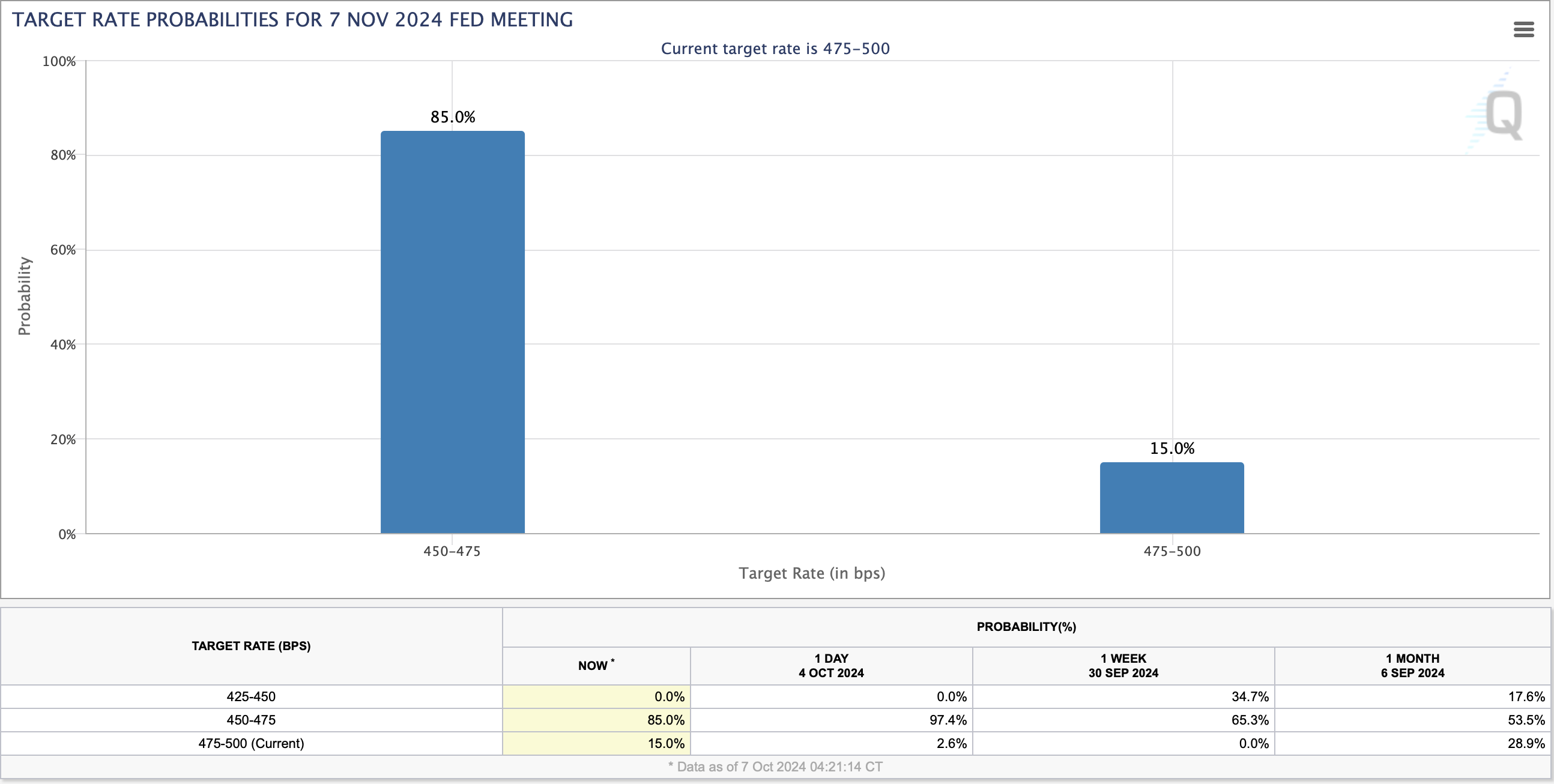
Perhaps the best depiction of things comes from the Fed funds futures markets where now there is only an 85% probability priced for a 25bp cut and a 15% probability of no cut at all.  Look at the table below the bar chart to show how much things have changed in the past week.  Jumbo rate cuts are no longer a consideration.  It will be very interesting to see how the Fed speakers adjust their tone going forward as there were many who seemed all-in on another 50bp cut as soon as next month.

Source: cmegroup.com

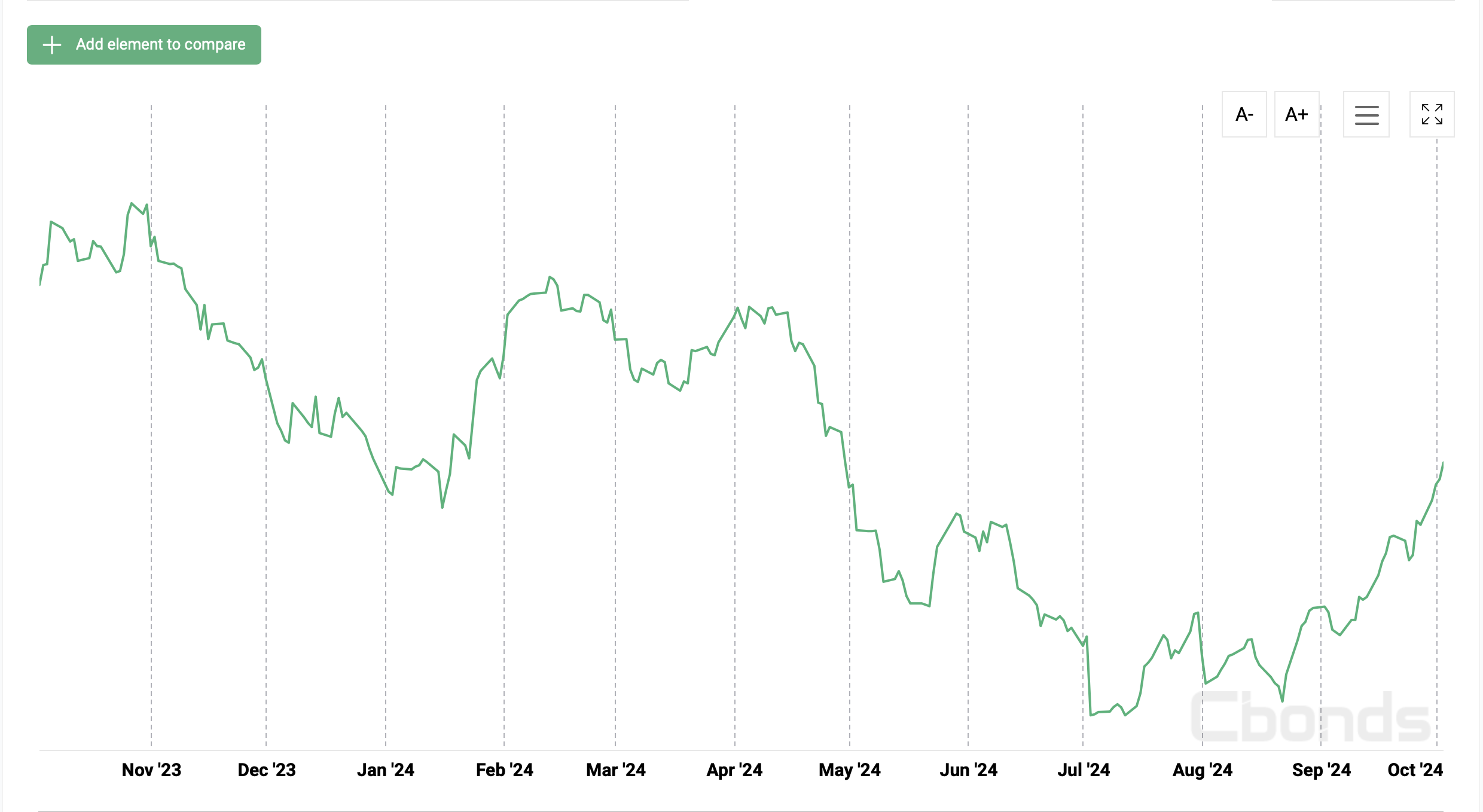
So, is this the new reality?  Recession is out and another up-cycle is with us?  Certainly, recent data has been quite positive as evidenced by the Citi Surprise Index, seen below courtesy of cbonds.com, which has shown a positive trend since early July.

This index is a measure of the actual data releases compared to consensus market forecasts ahead of the release.  When it is rising, the implication is that the economy is outperforming expectations and therefore is growing more rapidly than previously priced by markets.  Again, the point is the recessionistas are having a hard time making their case.  However, for the inflationistas, it is a different story.  With the employment situation improving greatly and last week’s Services ISM data showing real strength, the inflation narrative is regaining momentum.  Recall, the Fed’s rationale for cutting 50bps was that they had beaten inflation and were much more concerned about the employment situation where things seemed to be cooling.  That line of reasoning has now been called into question and the market is awaiting Powell’s answers.

Remember the time
The yen carry trade was dead?
Nobody else does!

While it may seem like this is ancient history, it was less than a month ago when the market was convinced that the yen carry trade (shorting yen to go long higher yielding assets) was dead, killed by the combination of a dovish Fed and a hawkish BOJ.  Oops!  It turns out that story may not have been completely accurate, although it was a wonderful discussion at the time.  As you can see from the chart below, the yen peaked two days ahead of the FOMC meeting, as those assumptions about both central banks reached their apex and has been steadily weakening ever since.  In fact, late last week I saw an article somewhere discussing how the carry trade was back!  The thing to understand is the carry trade never left.  It has been a popular hedge fund positioning strategy for a decade, made even more popular by the Fed’s aggressive rate hiking cycle.  While latecomers to the trade may have been forced out in the past several months, I am confident the position remains widely held.  And, based on the recent price action in USDJPY, it is growing again.

Source: tradingeconomics.com

And I believe those are the key drivers of markets this morning.  Fortunately, the Middle East situation does not appear to have gotten worse although oil (+2.6%) is trading like something is about to blow up.  The rest of the noteworthy news shows that Germany remains in a funk with Factory Orders falling sharply, -5.8%, just another indication that growth on the continent is going to struggle going forward.

Ok, let’s tour the markets we have not yet touched upon.  While Chinese markets remain closed (the holiday ended today and markets there reopen tomorrow), the Nikkei (+1.8%) continues to rebound alongside USDJPY and amid stories that new PM Ishiba has dramatically moderated his hawkish views ahead of the snap election called for the end of the month.  The Hang Seng (+1.6%) also had a strong session, with rumors of still more Chinese stimulus to be announced tonight. The combination of positive US growth news and the Chinese stimulus news helped virtually every market in Asia save India (-0.8%), which has been singing a different tune consistently.  In Europe, it should be no surprise the DAX (-0.3%) is softer, although there are some gainers on the continent (Spain +0.4%, Hungary (+0.4%) and other laggards (Norway -0.7%, Netherlands (-0.3%).  Overall, it is hard to get excited about the European scene this morning.  Alas, US futures are pointing lower this morning, down -0.5% at this hour (6:30).

We’ve already discussed the bond market and oil, but metals markets show a split this morning with gold (+0.2%) seeming to find haven support while both silver (-0.7%) and copper (-0.3%) are under modest pressure.  Remember, though, if the economic growth story is real, these metals should climb further.

Finally, the dollar is continuing its climb alongside US rates with the pound (-0.4%) the G10 laggard of note.  Most other G10 currencies are softer by a lesser amount although the yen (+0.1%) and NOK (+0.1%) are pushing slightly the other way, the former on a haven trade with the latter following oil.  The EMG bloc is more mixed with ZAR (+0.5%) actually the biggest mover as investors continue to flock toward the stock market there on the back of positivity of a change in the trajectory of the economy from the new government.

On the data front, the biggest number this week is CPI, but of real note are the 13(!) Fed speakers over 20 different venues this week.  I don’t know if I’ve ever seen that many on the calendar for such a short period.  It strikes me that they understand they need to tweak their message after the recent data.  It will be very interesting to see if they fight the data and stay the course for another cut in November or whether they walk it back completely. After all, they claim to be data dependent, and if the data points to growth, why cut?

Here is the rest of the data:

TodayConsumer Credit$12B
TuesdayNFIB Small Biz Optimism91.7
 Trade Balance-$70.4B
WednesdayFOMC Minutes 
ThursdayInitial Claims230K
 Continuing Claims1829K
 CPI0.1% (2.3% Y/Y)
 -ex food & energy0.2% (3.2% Y/Y)
FridayPPI0.1% (1.6% y/Y)
 -ex food & energy0.2% (2.7% Y/Y)
 Michigan Sentiment71.0

Source: tradingeconomics.com

And that’s how we start the week.  Whatever your personal view of the economy, the recent data certainly points to more strength than had been anticipated previously and markets are responding to that news.  For equities and the dollar, good news is good, but there seems to be a lot of time between now and Thursday’s CPI reading for attitudes to change.

Good luck

Adf

A New Pox

The interest rate doves are excited
That job growth in August was blighted
If that was the case
The Fed may embrace
Enough cuts to leave them delighted
 
But if they’re correct, what of stocks?
Will weak data be a new pox
On earnings and growth
And undermine both
With stocks falling onto the rocks?


As far as anyone can tell, there is only one thing that matters today, the payroll report.  Let’s set the table with the latest median forecasts:

Nonfarm Payrolls160K
Private Payrolls139K
Manufacturing Payrolls0K
Unemployment Rate4.2%
Average Hourly Earnings 0.3% (3.7% Y/Y)
Average Weekly Hours34.3
Participation Rate62.6%

Source: tradingeconomics.com

I’m sure you all remember that last month we got a surprising, and disappointing, reading of 114K for the headline number and then we subsequently got those massive revisions from the BLS which indicated that they had overstated job growth by more than 800K over the year from April 2023 through March 2024.  As well, yesterday’s ADP Employment data showed private job growth of a below expectations 99K with a revision lower to the previous month’s number.  Certainly, some of the data we have seen is pointing in the direction of a weaker outcome.  However, if one looks at the Initial and Continuing Claims data, neither of those series are pointing to a significant weakening in the labor market, although it has cooled somewhat since last year.

Since the last NFP report, 10-year Treasury yields have declined by 28bps and now sit at 3.70% this morning.  If you compare that to the current Fed funds rate of 5.375%, the implication is that rates are going to fall by at least 160 basis points over the next two years.  In fact, we are starting to see some analysts (Citi) call for nearly that many cuts by the end of 2024!  It strikes me that 150bps of cuts by December 2024 would only occur in response to a significant slowing of US economic activity, in other words, the long-awaited recession. Now, if the Fed were to cut that aggressively without a clear decline in the economy, it would certainly open the door to much higher inflation ahead.  After all, why add liquidity and ease policy if the economy continues to cruise along at a decent clip?

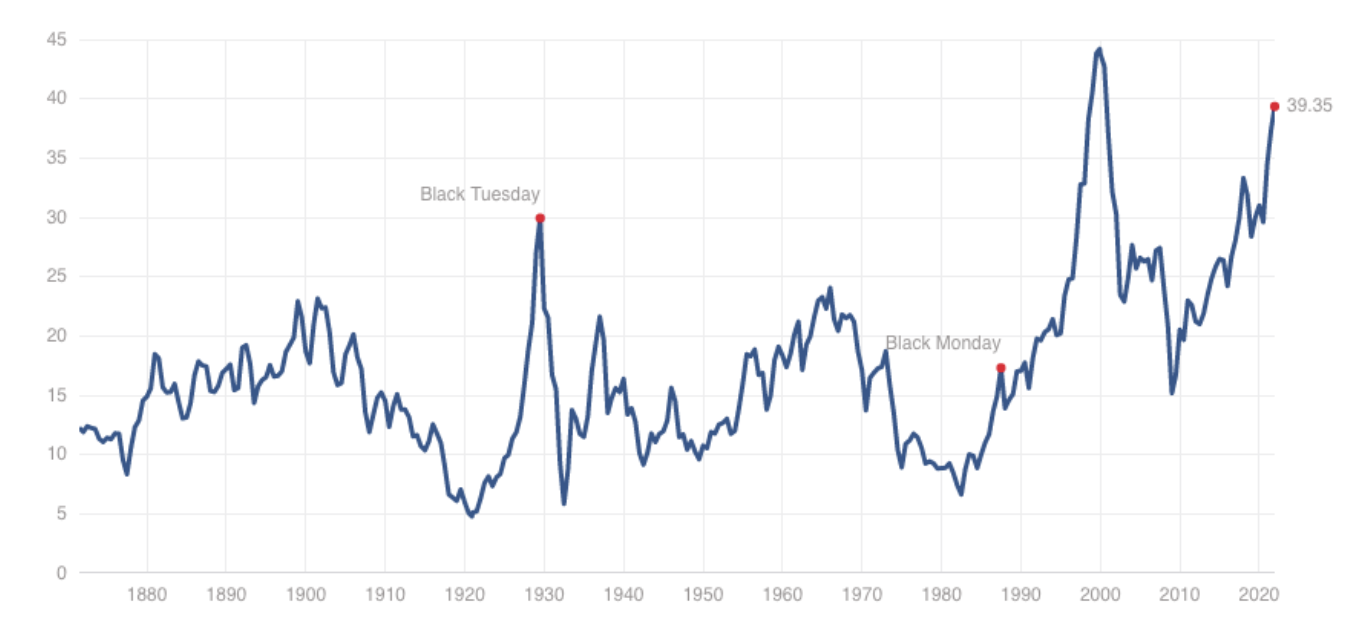
The upshot is that it appears, at least to this poet’s eyes, that the bond market is way ahead of itself with respect to potential Fed rate cuts.  Either that or the stock market is completely mispriced for the potential future earnings results of its components.  The one consistent outcome from all recessions is that corporate earnings growth slows dramatically.  Given that current equity prices embody P/E multiples near historically high levels (see chart below of Cyclically Adjusted Price Earnings for the S&P 500), if the E in that fraction declines, you better believe that so will the P.

Source: lesswrong.com

What will this mean for other asset classes, notably commodities and the dollar?  Here we need to consider the driver of the potential rate cuts in question.  If the US economy is clearly slowing dramatically and the Fed is responding by cutting rates aggressively, I would expect that the dollar will come under real pressure, at least initially, as the Fed is likely to be more aggressive than other central banks.  However, remember that the market is already pricing in significant rate cuts, so given the reality that if the US enters recession, most of the rest of the world is going to see much slower economic growth with their central banks easing policy as well, I would not look for a dollar decline of historic proportions.  Another 5%-8% seems viable but looking for the euro at 1.50 or the pound at 1.75 or the renminbi at 6.00 seems unrealistic.  The one outlier here is the yen, of course, where a situation with declining US equity prices, and correspondingly declining risk asset prices all over the world, could easily see Japanese investors run home with their money and USDJPY could well fall back to the 120 level or even lower in that scenario.

As to commodity prices, I expect the initial move would be lower as concerns about growth would imply falling demand for the key commodities oil and copper.  Gold, however, is a different animal and I imagine that we could see more uptake here as a weaker dollar and growing fear drive more retail buying of the barbarous relic.

Of course, if the data this morning is firmer than expected, all these bets are off.  In fact, that appears to be the biggest risk in markets today, a strong NFP number with a decline in the Unemployment Rate.  Market participants seem quite confident that the slowdown is coming and that the Fed is going to stick the soft landing.  That is the only explanation for the fact that equity markets, despite yesterday’s modest declines, continue to trade near all-time highs regardless of the indications that US economic activity is slowing somewhat.  The belief seems to be that the Fed will be able to cut rates the appropriate amount to prevent a collapse without triggering a renewed burst in inflation.  And maybe they will.  But given the fact that equity ownership is at record high levels already, the question becomes who is going to buy from here.  Any misstep by the Fed, where it becomes clear that the outcome will be worse than a soft landing (either a recession or higher inflation or both) is going to weigh heavily on equity and other risk markets.

So, as we await the big news, a quick review of the overnight session shows that most equity markets in Asia (Nikkei -0.7%, CSI 300 -0.8%) and Europe (DAX -0.4%, FTSE 100 -0.3%) are lower, following the US session.

In the bond markets, yields everywhere continue to decline with Treasury yields (-3bps) continuing their fall while European sovereign yields are all softer by between -4bps and -5bps this morning.  Even JGB yields (-3bps) are continuing lower as the global bond markets seem to be implying that economic activity is waning everywhere.

In the commodity markets, oil (+0.5%) is a touch firmer but remains below $70/bbl and has not shown any real strength despite a dramatic inventory drawdown reported by the EIA yesterday.  OPEC+ has explained they are not going to restart production next month and will wait until at least December before doing so, but based on the price action of oil, I will wager they will delay it again then.  Metals markets are little changed this morning after rallying yesterday during the US session, but like almost every market, all eyes are on the tape at 8:30 when NFP is released.

Finally, the dollar is a touch softer net, with traders seemingly preparing for a weak number.  But the movements are so small that the largest is JPY (+0.25%) which is the result of a combination of fear and the broader dollar weakness I think.    Here, too, we will learn much based on the data, so not much to do until then.

In addition to the payroll report we will hear from NY Fed President Williams and Governor Waller this morning as they will be the last to speak ahead of the Fed’s quiet period.  Williams is due at 8:45, so his speech is prepared, but Waller will have time to alter things if the data is a significant surprise given he doesn’t speak until 11:00.

And that’s really it for today.  It’s all NFP all the time.  While it is very easy to believe that a weak number is coming, it is also clear to me that the pain trade would be a strong number.  As such, I have a sneaking suspicion we could see something much firmer than forecast, maybe 200K with the Unemployment Rate ticking back down to 4.1%.  That would be the real surprise.

Good luck and good weekend

Adf

A Future, Austere

So, what if the payroll report
Was wrong, and job numbers fall short
When they are revised
And so, they disguised
The ‘conomy’s on life support
 
Will this mean recession is here
And Jay will get rate cuts in gear?
But if that’s the case
Are stocks the right place
To hide with a future, austere?


After last week’s remarkable rally that has reversed so much of the negativity inspired by the BOJ/yen carry trade unwind/end of the world scenarios from just two weeks ago, this week is starting off in a fairly muted manner.  Add to this the fact that the data stream this week is limited, and you have all the makings of a quiet, summer doldrums-like, period.  Except…Thursday begins the KC Fed’s Jackson Hole symposium and Friday morning at 10:00am EDT, Chairman Powell will be speaking.  This speech often has great significance as historically, Fed chairs will give strong clues about policy changes coming at this exact opportunity.  This is not to say Powell is going to give us a schedule of his planned rate cuts, but more that he has the chance to explain his (and by extension the Fed’s) reaction function to future data releases.

It is this topic that is critical for us to monitor as lately there have been several articles regarding the nature of the annual benchmark revisions to the payroll reports that will be coming early next year.  The punch line is that expectations are growing that much of the NFP growth seen thus far in 2024, currently totaling ~1.4 million new jobs, may be erased, with estimates of downward revisions rising to 1 million or more.  For instance, in California, the Legislative Analyst’s Office, which is a non-partisan (assuming such a thing exists) group under the auspices of the California state legislature, has revised down their job growth estimates for all of 2023 to just 9K from well in excess of 100K in the initial reporting.  Given California’s status as the largest state in the union and its general importance to the economy, this is quite concerning.  

The BLS revisions will not be released until March 2025, but there have been numerous concerns registered by economists and analysts of all stripes indicating that the BLS model, specifically the birth-death portion regarding new businesses, is wildly out of sync with the reality on the ground.  One of the things that has allowed the Fed to maintain their higher for longer stance is their belief, based on the BLS data, that the employment situation is still quite solid in the US.  Of course, the recent rise in the Unemployment Rate is beginning to raise some eyebrows, but those who believe there is no recession will point to the increase in job seekers in the latest report, essentially raising the numerator rather than reducing the denominator in that data point. And maybe that is true.  However, the vibe that appears to be growing around the country is that the job situation is not as robust as the numbers might indicate.

The implications of this are that it is entirely possible that the minority of analysts who claim we are already in a recession will turn out to have been correct, and the NBER will backdate the beginning of the recession to early this year.  As to the Fed, they will find themselves in a much different place and be forced to cut rates far more aggressively than what seems to be the current belief in the Eccles building.

Right now, the Fed funds futures market is pricing in a bit more than 200 basis points of cuts by September 2025.  While that seems like a lot, if the economy is actually in recession already, that is likely understating the case.  When it comes to the tradeoff between inflation and recession, while Powell was able to talk tough regarding recession when it didn’t seem to be coming, methinks he will have a different tone if these job numbers are revised as dramatically as some are contending.  And let’s face it, if the California government is explaining that is the case, along with some research by the Philly Fed, which is also indicating less job growth than initially reported, this could well be the 2025 story of note.

To summarize, questions regarding actual job growth vs. reported job growth are starting to be asked.  If the answers lean toward the negative end of the spectrum, the likelihood of more aggressive Fed easing rises. However, the specter of inflation looms large in the background as despite its seeming recent quiescence, it is not nearly back at the Fed’s target level.  Can the Fed cut aggressively if inflation remains above target?  Of course they can, and if the economic situation deteriorates rapidly, they almost certainly will.  But that will not solve the inflation problem.  If, and it is a big if, this is the case going forward, my longstanding contention of a significant decline in the dollar versus commodities will likely play out.  As well, I would not want to own duration in the bond market, and while stocks might start out ok, recession does not pad profit margins, it impairs them, so stocks will have trouble as well.

In the meantime, let’s look at what happened overnight.  Friday’s continuation rally in the US saw some follow through in Asia, but it was truly a mixed picture there.  Japan’s Nikkei 225 (-1.8%) fell sharply as the yen rallied more than 1%.  Remember, about 40% of the Nikkei’s profits come from international sales and activity, and as the yen strengthens, it impairs those earnings in local terms.  Elsewhere, China (+0.3%) and Hong Kong (+0.8%) fared well, but Korea (-0.85%) suffered.  The other markets showed marginal gains.  In Europe, though, Spain (+1.0%) is leading the way higher although the rest of the continent is seeing much more limited gains, on the order of +0.25%, as a lack of new data or commentary seems to be allowing for a follow-on from the US session Friday.  UK shares are unchanged and so are US futures as traders await the big Powell speech on Friday.

In the bond market, Treasury yields are lower by 1bp, and we are seeing slightly larger yield declines in Europe, with sovereign yields down by between -2bps and-4bps.  Again, a lack of data and commentary means this is trading inspired, and not based on new information.  JGB yields rose 1bp, perhaps in sync with the yen’s rise overnight.

In the commodity markets, oil (-0.9%) continues to suffer as the slow growth, slowing demand story is the driver with absolutely no concern over the potential for an increase in supply tensions based on the ongoing wars in Ukraine and Israel/Gaza.  Meanwhile, gold (-0.8%) which closed above $2500/oz on Friday for the first time ever, is consolidating a bit and dragging silver (-0.5%) with it.  Interestingly, copper (+0.5%) is holding its own despite the slowing growth story.  That seems to be much more of a technical trading story than a fundamental one, although the long-term fundamentals remain quite bullish in my view.

Finally, the dollar is under further pressure this morning, falling against all its G10 counterparts and many of its EMG counterparts as well.  it should be no surprise that CNY (+0.3%) is stronger alongside the yen, but we also saw KRW (+0.85%) really benefit and almost every EMG currency, save MXN (-0.3%), which is today’s ultimate laggard.  If the story is turning to more aggressive US rate cuts, the dollar will continue its decline.

On the data front this week, there is not much other than the Jackson Hole symposium, but here it is for you:

TodayLeading Indicators-0.3%
WednesdayFOMC Minutes 
ThursdayInitial Claims230K
 Continuing Claims1881K
 Flash Manufacturing PMI49.5
 Flash Services PMI54.0
 Existing Home Sales3.92M
FridayNew Home Sales630K

Source: tradingeconomics.com

So, as you can see, other than Powell on Friday, and three other Fed speakers (Waller, Bostic and Barr), earlier in the week, there is not much to see.  My take is the rate cut narrative is building momentum and that we are going to see further pressure on the dollar until either the data indicates no cuts are coming, or we have a more significant risk-off event where people run to dollars to hide.

Good luck

Adf

If Forecasts Ain’t True

Chair Powell repeated his views
That if Unemployment accrues
The time to cut rates
To meet their mandates
Could very well soon lead the news

Investors have taken this cue
And built up positions, beaucoup,
Designed for a peak
If CPI’s weak
Beware, though, if forecasts ain’t true

It is not clear to me why the punditry is more convinced this morning than they were yesterday morning that Chairman Powell and the Fed are now more focused on the Unemployment situation.  After all, Powell’s opening remarks in front of both the Senate on Tuesday and the House yesterday were identical, and everybody knew going in that would be the case.  But it seems, based on the commentary this morning, that suddenly things that were still blurry before became crystal clear.

Look, it can be no surprise that as the Unemployment Rate rises, the Fed is going to pay attention.  Not only is it part of their mandate, but it is also a touchpoint for politicians as they preen in front of their constituents.  But, in the end nothing has changed since Tuesday’s testimony when Powell highlighted that he and the FOMC were closely watching the evolution of the labor market as well as prices.

At least, nothing has changed on the policy front.  However, the market narrative, as is its wont, has suddenly turned to a far more bullish stance on fixed income in general, and on short-term rates in particular.  It appears that, not for the first time this year, there have been some very large options positions established in the SOFR market looking for a Fed funds rate cut sooner rather than later and a total of three cuts this year.  A quick look at the Fed funds futures market continues to show that the probability of a September cut remains just north of 71% with another cut likely by December.  As such, the fact that somebody is risking $2 million in premium on a third cut implies a great deal of conviction.  A key for this position’s success will be today’s CPI report as a benign outcome will very clearly drive more traders into the camp of more cuts this year.

So, let’s turn our attention to CPI.  Current median expectations are for a 0.1% M/M rise in the headline number, leading to a 3.1% Y/Y outcome and a 0.2% M/M rise in the core number leading to a 3.4% Y/Y outcome.  The broad story is the ongoing analyst belief that shelter costs are set to decline (although they have been incorrectly forecasting that for more than 2 years), along with the continued decline in used car prices and auto insurance, will more than offset any pesky things like food and energy costs rising.  This poet does not have an inflation model to tweak so I can only offer my lived experience, and that remains highly doubtful that prices have stopped rising.  But, the only thing that matters is the numbers, regardless of how we all feel about them, so we will be awaiting, with baited breath, to see if the BLS has determined if the pace of our cost of living has slowed.

As we turn our attention to the rest of the world, apparently everybody believes that to be the case, as risk assets are rising all over.  I cannot find an equity market anywhere that has sold off in the session with the Nikkei (+0.95%) rising to a new all-time high and the Hang Seng (+2.1%) rebounding smartly from yesterday’s levels.  The same is true throughout Asia with Chinese (+1.1%) and Australian (+0.9%) shares also having good days.  In Europe, the gains have been less impressive, on the order of +0.2% to 0.3%, but they are consistent as everybody followed yesterday’s strong US equity performance where all three major indices rose more than 1%.  While US futures this morning are tinged slightly red, the losses are tiny, less than -0.1%.  It seems that everybody is all-in on the idea that the Fed is cutting rates soon.

In the bond market, though, things are slightly different.  While Treasury yields have edged lower by 1bp this morning, all European sovereign yields are moving in the opposite direction, with rises of between 2bps and 3bps.  The inflation data that was released from the continent this morning certainly didn’t demonstrate a rebound, so this seems more akin to a trading response to recent yield declines.

In the commodity markets, oil prices (+0.3%) are continuing their rebound from yesterday after EIA data showed larger inventory draws than expected.  Precious metals markets are also benefitting this morning from the Fed story as the idea of rate cuts generally supports that sector.  The only laggards are industrial metals with both copper and aluminum under a bit of pressure today, but that is after a few solid sessions.

Finally, not surprisingly, the dollar is a touch softer on the idea that US yields may soon be declining.  While the bulk of the movement has been modest, it is fairly consistent with the euro and the pound both higher by 0.15% (the pound benefitting from somewhat stronger than expected GDP data this morning) while most of the rest of the G10 is little changed.  The one exception is NOK (-0.9%) which still seems to be suffering from yesterday’s softer than expected CPI data.  In the EMG bloc, the bulk of the movement has been for stronger currencies with the most notable, in my view, CNY (+0.2%) which has been steadily depreciating but has reversed course on the lower US rate narrative.  I maintain my view that if the Fed is prepping the market for cuts, the dollar has a good distance to fall.

In addition to the CPI data, we see the weekly Initial (exp 236K) and Continuing (1860K) Claims data at 8:30.  The Atlanta Fed’s Raphael Bostic speaks later this morning, but again, after Powell just opened the doors for easier policy based on the employment situation, I don’t foresee this having a big impact.

The risk today is that the CPI data is hotter than expected as everybody is lined up for a soft reading.  If the data is soft, look for the current trends to extend, so higher risk assets and lower yields.  But, if CPI prints higher than expected, there will be a very quick reversal of views, at least for the short run, and I expect we can see a pretty sharp correction, at least for today.

Good luck
Adf

Not Yet Sealed the Deal

Said Powell, the progress is real
And though there are many with zeal
To quickly cut rates
Our dual mandates
Explain we’ve not yet sealed the deal
 
Meanwhile, as the holiday nears
Investors, ‘bout some stuff, have fears
The UK will vote
And Labour will gloat
Then Payroll, on Friday appears
 
At this stage, the Payroll report
Is forecast to, last month, fall short
But if the U Rate
Once more does inflate
The doves, for rate cuts, will exhort

The Fed whisperer himself, the WSJ’s Nick Timiraos, did an excellent job covering the Chairman’s speech in Sintra, Portugal at a big ECB confab yesterday, so let me give it to you straight from him.  [emphasis added]

“We’ve made a lot of progress,” Powell said Tuesday on a panel with other central bankers at a conference in Portugal. After serious shortages two years ago that sent wages up sharply, the labor market has “seen a pretty substantial move toward better balance,” he said.

The Fed leader’s remarks underscored a sense of cautious optimism that had faded after disappointing inflation readings in April. He alternately said the economy had made “significant progress,” “real progress” and “quite a bit of progress” toward cooler inflation with stable growth.

Apparently, progress toward their stated goals has been substantial.  And while that is fantastic, he also mentioned, later in his speech, that they were now also looking far more carefully at the labor market, which is starting to slow down.  “You can see the labor market is cooling off, appropriately so, and we’re watching it very carefully.”  You may recall that SF Fed president Daly also focused on the labor market late last week and I am confident that it is on every FOMC members’ radar. 

Of course, that’s why Friday’s Payrolls report is going to be so important.  Arguably, while the NFP data gets all the press, the Unemployment Rate is really going to matter this time as it ticked up to 4.0% last month.  A rise from here will start to call into question just how strong the labor situation remains.  For instance, while yesterday’s JOLTS data showed a modest rise to just over 8M job openings, that is after the previous month’s data was revised down substantially, by nearly 240K jobs.  One of the things about the Unemployment Rate is that once it starts to move in one direction or the other, it tends to really build momentum for a while.  As you can see from the long-term chart below, once it starts to rise, it tends to go a lot higher. 

Source: tradingeconomics.com

I have maintained that the payrolls have been a key all along as it is quite easy for the Fed to parry complaints from Congress about ‘too high’ interest rates if the job market is tight.  But if it starts to loosen too quickly, Congress will be howling every day and night and make the Fed’s life quite miserable.  As such, my eye is on the Unemployment Rate rather than NFP come Friday.

Now, this is not the only story around, but from a market perspective, I believe it is the most important by far.  However, let’s touch on some others before highlighting the ongoing risk rally.  While most of the oxygen in US newsrooms is consumed by the debate on whether President Biden is fit to, and will, be the Democratic nominee, there are several other key elections coming this week.  

Tomorrow, the UK heads to the polls (was the July 4th date chosen to commemorate the last big English loss?) where the current Tory government, led by PM Rishi Sunak, is forecast to be decimated by the voters.  Apparently, the good folks of the UK are fed up with the same inflation and immigration issues that are apparent elsewhere in the Western world and are looking for a change.  Interestingly, a look at UK markets doesn’t really indicate that investors are greatly concerned over the change as Gilt yields, the FTSE 100 and the British pound have all been range trading for the past month.  Certainly, there is no indication a Labour government is going to be fiscally responsible, but they have promised to raise taxes to try to fund their spending.  In the end, I don’t see the change in government having an immediate impact on financial markets in the UK.  Rather, I expect that the US story on rates and economic activity is still going to be the main driver of things.

Come Sunday, the French head back to the polls for the second round of their parliamentary election and virtually every story you can read about it describes the lengths to which the coalition of left-wing parties and the current Macronist parties are going to try to prevent Marine Le Pen’s RN party from gaining a working majority.  I find it instructive that rather than considering why so many people were drawn to the RN message of restricting immigration and enhancing public safety, the other parties simply demonize the RN as a reincarnation of the Nazis.  (sounds familiar, no?).  The current market narrative seems to be that the RN will not be able to capture an absolute majority by themselves with the result that a caretaker government will be appointed with limited powers.  This has been seen as a great leap forward from the fear of an RN led government, and so we have seen French equity markets rebound from their worst levels last week, while French OAT yields have compressed vs. their German counterparts by about 15bps from the widest levels seen just before last Sunday’s first round votes.

In a related note, this morning I have seen several articles describing the recent rise in US yields as a response to the presidential debate last week, where suddenly there is concern that Mr Trump may win and spend trillions of dollars, rather than a Biden win where the government would spend trillions of dollars.  Frankly, there is no indication that either party is going to rein in spending, it is far more a question of their spending priorities.  But that is the story that is all over the press this morning.

Ok, a quick look at the overnight session shows that yesterday’s US equity rally was largely followed by shares in Asia (Nikkei +1.25%, Hang Seng +1.2%) although Chinese shares remain lackluster.  In Europe, as well, shares are higher across the board with the CAC (+1.55%) in Paris leading the way on this renewed narrative of a caretaker government.  I suppose if the RN does win a majority that come Monday, French shares, and most of Europe as well, will see sharp declines.  As to US futures, at this hour (7:30), they are edging very slightly higher, just 0.1%, ahead of this morning’s data dump.

In the bond market, Treasury yields are unchanged this morning, but Europe has seen virtually all sovereigns rally slightly vs. Bunds as the French narrative seems to have longer tails than one might imagine.  So, spreads are narrowing a bit.  The one consistency in bond markets, though, has been Japan which saw yields edge higher by another basis point overnight and are now 18bps higher in the past two weeks.  Remarkably, despite the rise in Japanese yields, the yen continues to get punished daily.

In the commodity markets, oil is little changed on the day, but has rallied more than 2% in the past week on rumors of a significant inventory drawdown to be reported later this morning, as well as the pending shut in of production in the Gulf of Mexico.  However, metals markets are rallying this morning with both precious (Ag +0.6%, Ag +1.8%) and base (Cu +1.6%, Al +0.7%) finding support amid the equity/risk rally and the dollar’s softer tone today.

Speaking of the dollar, other than the yen (-0.25%) which is now pushing to 162.00, the rest of the G10 bloc is modestly firmer, between 0.1% and 0.25%.  Meanwhile, in the EMG bloc, ZAR (+0.65%) is again the biggest mover, rallying on metals strength along with broad dollar weakness.  One must be impressed with the ongoing volatility in the rand, which seems to be the leading mover in one direction or the other every day.  However, away from that, while most EMG currencies are a bit firmer, the movement has been much less dramatic.

On the data front, it is a busy day as tomorrow’s holiday has forced much info onto today’s calendar.  As well, since there will be no poetry on Friday morning, I will include the current estimates of the payroll data as well

TodayADP Employment160K
 Trade Balance-$76.2B
 Initial Claims235K
 Continuing Claims1840K
 ISM Services52.5
 Factory Orders0.2%
 -ex Transport0.3%
 FOMC Minutes 
FridayNonfarm Payrolls190K
 Private Payrolls160K
 Manufacturing Payrolls5K
 Unemployment Rate4.0%
 Average Hourly Earnings0.3% (3.9% Y/Y)
 Average Weekly Hours34.3
 Participation Rate62.7%
Source: tradingeconomics.com

In addition to all this, we hear from NY Fed president Williams this morning, but given that Powell continued to highlight the lack of confidence that inflation was quickly going to reach their target, I doubt Williams will say anything different.  My concern is that we are going to see the Unemployment Rate rise to 4.1% or 4.2% and that will change the narrative greatly.  Suddenly, there will be a lot more pressure to allow inflation to stay at current levels or even go higher to address the employment side of the mandate.  As I have written in the past, any rate cuts before inflation is well and truly vanquished will likely result in a much weaker dollar and much higher commodity prices.  Be on the watch for Friday’s data to be the first step in that direction.

Good luck and have a good holiday weekend

Adf

Crushed

On Friday, the NFP showed
That job growth has not really slowed
And wages were hot
So, pundits all thought
That ‘flation just might well explode
 
But under the NFP’s hood
Some things didn’t look quite so good
The joblessness rate
Itself did inflate
Though household jobs fell, understood?
 
Meanwhile across Europe the vote
For Parliament seems to denote
Incumbents were crushed
And governments flushed
While media seeks a scapegoat


Remember the narrative that had everyone feeling so good?  Inflation was drifting lower, albeit not in a straight line, but central bankers around the world were quite confident that their collective 2.0% targets were coming into view, and pretty soon at that.  This would lead to lower bond yields, continued strong performance in risk assets and slowing, but still solid economic activity.  In other words, many were invested in the Goldilocks thesis of a soft landing.  

Now, the data that we had seen last week seemed to indicate that was a viable process as the ADP Employment number was a touch soft, the JOLTS Job Openings number was definitely soft and although the ISM Services data was a lot stronger than anticipated, the ISM Manufacturing number was soft as well.  In addition, if we go back to the previous week, the Chicago PMI print was abysmal at 35.4.

This was all a prelude to Friday’s NFP data which confirmed confused everything.  While the headline number was much stronger than expected at 272K, the Unemployment Rate rose to 4.0% for the first time in more than two years, and Average Hourly Earnings rose 0.4% with an annual increase of 4.1%.  But even more confusing was the fact that looking at the Household survey, the survey that is used to calculate the Unemployment Rate, showed the number of jobs FELL by 408K while 250K people exited the workforce.  Now, if things were truly running smoothly, as the NFP number indicated, we would expect to see that household number of jobs rise, not fall.  Something is amiss.

Having read far too much about this over the weekend, it appears that the BLS data and its models are not a very accurate representation of the current reality, at least for the monthly data.  The BLS also produces a quarterly survey called the Quarterly Census of Employment and Wages (QCEW) which is a census of 11 odd million businesses in the US, rather than a survey of some 600k businesses for the NFP.  If one looks at the growing discrepancy between the number of jobs shown in that data vs. the NFP data, the NFP data has been rising far faster with the gap widening severely.   This can be seen in the below graph from the mishtalk.com website (from Mike Shedlock, an excellent economist/analyst).

The upshot is that while that headline NFP number has looked very good, there appears to be something else happening in the underlying data.  Early next year, the BLS will revise its NFP data, and you cannot be surprised if they reduce the readings significantly.  But revisions don’t have the same cachet as headlines, and so this is our current world. 

The market response was as you would expect; bonds got crushed with the entire yield curve jumping 15bps, the dollar rallied sharply, up nearly 1% on the DXY with several currencies falling farther than that (e.g., MXN -2.85%, NOK -1.5%, BRL -1.6%), and equity markets falling although not nearly as much as you might expect, only about -0.15% on average across the big indices.  But the notable moves were in commodities with gold (-2.2%), silver (-3.9%) and copper (-3.0%) just in the wake of the NFP data, with larger declines overall on the day.  Energy was the only space that held in on the day, but of course, it has been under pressure for several weeks.

What’s next?  Well, this week brings a great deal of new information including CPI, PPI, the FOMC Meeting and the BOJ meeting.  My take is many traders are licking their wounds right now, so given today’s calendar is quite benign, I imagine things will be a bit choppy as positions get adjusted, but direction will be hard to discern.  Except…

The European Parliament elections were held starting last Thursday but running through Sunday, with all 27 nations in the EU voting for their parliamentary representatives.  The story is, as you will clearly have heard by now, that the left wing, center-left and centrist parties got decimated while everyone on the right side of the aisle massively outperformed.  The Belgian PM resigned and there will be elections there.  French President Macron dissolved parliament for a snap election as his party won just 15% of the vote while Marine Le Pen, the conservative candidate leading the National Rally, won more than 31% of the votes.  As well, German Chancellor Olaf Sholz has been decimated as have the Green parties across the continent.  Times, they are a-changin’.  It is no surprise that the euro continues to falter after Friday’s declines as the European part of the equation just added to the woes from the US implication of higher interest rates.

What will these elections mean for markets?  The clearest message that I see is that the climate agenda is likely to be altered such that demand for oil and gas may well increase.  Do not be surprised to see more European nations abandon the Net Zero concept, at least reaching it by 2050.  Ironically, while the first move was seen as a negative for the euro, this may well be a harbinger of future euro strength if the Eurozone economies waste less money on impossible dreams and spend more on actual economic activity that generates benefits and income for its citizens without government subsidies.  But that will take a bit more time.

Perhaps the most important thing is that this election may well be a harbinger of the US election in November as the European people have clearly rejected the current themes and are looking for a change.  Far left Green policies that have been promulgated by the Biden administration have found no favor in Europe and certainly the current polling indicates it is equally unpopular in the US.

OK, a quick tour of the overnight session shows that Japanese equity markets performed well after GDP data there last night showed a less negative outcome in Q1 than originally reported, while most of the rest of Asia was closed for various holidays.  European bourses, however, are under pressure across the board led by France (-2.2%) although most of the rest of the continent has seen declines on the order of -1.0%.  As to the US futures markets, at this hour (6:15), they are lower by -0.3%.

Bond yields continue to climb with Treasuries up another 2bps and European sovereigns rising between 2bps (Germany) and 8bps (France and Italy) as the combination of higher US yields and some concerns over the future direction in Europe have come to the fore.  Overnight, JGB yields also jumped 7bps and are back above 1.00%, with the Japanese data and US data the drivers.  The BOJ meets Friday this week, so there is much speculation as to the outcome, although a rate hike is not forecast.

In the commodity markets, after Friday’s rout in the metals space, the big ones are all firmer this morning, although this looks like a trading bounce rather than a change of views.  Oil markets are little changed this morning, trading at the lower end of their recent ranges but NatGas, something I haven’t discussed in a while, is rallying again.  It is higher by 3% this morning and 26% in the past month, rising to $3.00/MMBtu, its highest price since November and double the lows seen in March.  Consider that if there is continued pushback against the Green agenda, as evidenced by the European elections, demand for NatGas is likely to grow quite strongly.

Finally, the dollar is continuing to gain strength this morning, with the euro down -0.6% following Friday’s declines and the EEMEA currencies all falling more than that.  Given the holidays in Asia, there was limited trading in the onshore markets there, and other than MXN, which is unchanged this morning, the rest of LATAM hasn’t opened yet.  However, remember that the peso has fallen 10% in the past week, so there is likely going to be some more movement in that space going forward.  Markets typically don’t dislocate by 10% and then just stop.

As if last week didn’t bring enough surprises between the NFP and election results in India, Mexico and Europe, this week we have a lot more to look for, although today is a blank slate.

TuesdayNFIB Small Biz Optimism89.8
WednesdayCPI0.1% (3.4% Y/Y)
 -ex food & energy0.3% (3.5% Y/Y)
 FOMC Rate Decision5.5% (unchanged)
ThursdayInitial Claims224K
 Continuing Claims1800K
 PPI0.1% (2.5% Y/Y)
 -ex food & energy0.3% (2.5% Y/Y)
FridayBOJ Rate Decision0.10% (unchanged)
 Michigan Sentiment72.0
Source: tradingeconomics.com

As this is a quarterly meeting of the FOMC, we will get new projections and a new dot plot, and of course, Chairman Powell will be speaking afterwards.  As of now, the market is pricing about a 50:50 chance of the first cut coming in September and a total of one and one-half cuts for the rest of the year.  It remains very difficult to discern what is really happening in the economy with all the conflicting data.  However, whatever the growth stories, nothing has indicated that inflation is going to decline very far.  I maintain the Fed is going to be higher for longer for even longer.  It continues to be difficult to see the benefits of many other currencies, although I would not be surprised to see MXN regain much of its lost ground as I doubt Banxico will be easing policy anytime soon, and president-elect Sheinbaum is not going to change things there that much and doesn’t take office until October.

Good luck

Adf