Another Mistake

Said Janet, we need to watch out
‘Cause bank fraud is starting to sprout
So maybe I’ll make
Another mistake
And drive banking stocks to a rout


I absolutely agree with the premise — which is that fraud is becoming a huge problem.”  These sage wordsfrom our esteemed Treasury Secretary have made headlines and also raised some alarms.  After all, was not Madam Yellen in charge of bank regulation not that long ago?  Did she not receive millions of dollars in speaking fees from those same banks before being named Treasury Secretary?  It is difficult to listen to the recent change in tone without considering the fact that she is concerned if the election results in a Trump victory, her time at Treasury may come under deeper scrutiny so she is starting to spill a few beans to show she was on the ball.

But arguably, the biggest issue is not that fraud is rampant in banking, with action around government checks being the most fertile area, the biggest issue remains the nonstop borrowing that continues as the US government debt continues to grow aggressively each day.  There have been several recent commentaries by some very smart guys, Luke Gromen and Bob Elliott,  regarding the coincidence of rising interest rates in the US and almost every other G10 economy despite significant differences regarding the economic situation and borrowing patterns.  One conclusion is that owning government debt from any western government, at least debt with any significant duration, is losing its luster quickly.  This is a valid explanation of why yields continue to rise despite the Fed’s, and other central banks’, recent rate cuts.  

Of course, there is another popular explanation about the recent rise in yields; the prospects of a Trump victory and corresponding sweep in the House and Senate is seen as growing substantially.  The thesis is that if that is the outcome, the budget deficit will grow even larger as the tax cuts due to expire next year will very likely be rolled over, and there is no indication there will be a reduction in spending (the Republicans merely have different spending priorities).  Hence, deficits will continue to grow, Treasury debt will continue to increase, and yields will increase as well.  At least, that’s the thesis.

One thing which is undoubtedly true is that if there is an increase in volatility in government bond markets, the dollar is going to be one of the beneficiaries.  Keep that in mind going forward.

Though views about Europe were dire
Today, GDP printed higher
While Italy sank
They’ve Germans to thank
For being the major highflier

The other story of note this morning is the Eurozone GDP report alongside GDP readings from several key nations.  At the Eurozone level, GDP surprised everyone with a 0.4% Q/Q print and a 0.9% Y/Y print, higher than the 0.2%/0.8% expectations.  Now, in the big scheme of things, those numbers are not that great, but better than expected is certainly worth something.  Germany was the key driver as they avoided a technical recession by growing 0.2% in Q3.  What is little noted is that Q2’s data was revised lower from -0.1% to -0.3%, so it is fair to say that things have not been great there.  In fact, below is a chart of the past 5 years’ worth of quarterly results in Germany and you can see that the concept of a growth impulse there, at least since the beginning of 2022, has largely been absent.

Source: tradingeconomics.com

Another telling sign that the headline may not be a true reflection of the situation on the ground there is that the Eurozone also released a series of sentiment indicators, almost all of which were weaker than expected, notably Economic Sentiment (95.6 vs. 96.3 last month and expected) and Industrial Sentiment (-13.0 vs. -11.0 last month and -10.5 expected).  Apparently, the growth was the product of greater than expected government spending, not really the best way to grow your economy.  However, the market did respond by pushing the euro (+0.15%) a bit higher although the recent downtrend remains in place as evidenced by the below chart.  It remains difficult to get too excited about the single currency given the growing divergence in views on the Fed and ECB, with the former being questioned about its policy easing while the latter is being called on to do more.

Source: tradingeconomics.com

And that was really the macro news for the evening so let’s see how markets overall behaved.  Yesterday’s mixed US session was followed by similar price action in Asia with the Nikkei (+1.0%) continuing its recent rally as the market gets comfortable with PM Ishiba putting together a minority government while Chinese shares (CSI 300 -0.9%, Hang Seng -1.55%) suffered as hopes for the ‘bazooka’ stimulus faded, at least temporarily.  As to the rest of the region, almost all the stock markets declined on the evening.  That negative price action is evident in Europe as well this morning with every major market in the red (CAC -1.4%, DAX -0.8%, IBEX -0.6%) as the better than expected GDP figures don’t seem to have been that enticing for investors.  In the UK, too, stocks are softer (FTSE 100 -0.3%), although there has been no data released.  The big story there today is the budget release upcoming with most pundits looking for a lot of smoke and mirrors and no progress on spending stability.  Meanwhile, US futures are a bit firmer this morning after solid earnings from Google after the close yesterday.

In the bond market, yields have backed off from their recent highs with Treasuries (-4bps) falling after yesterday’s 4bp decline.  Yesterday’s US data was a bit softer than expected (Goods Trade Deficit fell to -$108.23B, much larger than expected while the JOLTS data (7.44M) fell to its lowest level since January 2021 and indicates a rough balance in the jobs market.  As discussed above, European yields are following Treasuries lower with declines on the order of -3bps across the major economies with only Italy (+1bp) the outlier on higher than expected CPI readings.  Meanwhile, UK Gilts (-10bps) are the real outlier as bond investors seem intrigued over the potential budget.

In the commodity space, oil (+1.3%) is bouncing a bit although remains well below the $70/bbl level.  It appears that the worst is over for now and a choppy market is in our immediate future pending the election outcome.  Consider that if Trump wins, given his ‘drill, baby, drill’ plank in the platform, it is likely that oil will slide on the news while a Harris win is likely to see prices rise on the fear of a fracking ban.  Gold (+0.2%) continues its steady march higher with investors abandoning bonds and looking for a haven, although the other metals (silver -1.1%, copper -0.6%) are suffering this morning on the softer economic data.

Finally, the dollar is under very modest pressure this morning but remains at the high end of its recent trading range.  JPY (+0.25%) has managed a modest rally ahead of tomorrow’s BOJ meeting but we have seen a mixed picture overall with some gainers (AUD, NZD, KRW) and some laggards (SEK, GBP, HUF).  Ahead of the election, I continue to expect choppiness and a lack of direction but once that is complete, as I have said before, market volatility in other markets is likely to lead to a stronger dollar.

On the data front today, we start with ADP Employment (exp 115K) and then see the first look at Q3 GDP (3.0%) along with a key subcomponent of Real Consumer Spending (3.0%).  We also see the Treasury Refunding Announcement, with not nearly as much press given to this as today as we had seen over the past several quarters.  Expectations are running for no large increases although given the budget deficit continues to widen, I’m not sure how that math works.  Lastly, we see oil inventories where a modest build is anticipated.

While the election continues to dominate the discussion, we cannot ignore this data or what is to come tomorrow and Friday, as the Fed will not be ignoring it.  We will need to see a spate of much weaker data to change my long-held view that the dollar has further to climb, so let’s watch and wait.

Good luck

Adf

Wages on Fire

The ECI data’s designed
To help understand what’s enshrined
In hiring workers,
Including the shirkers,
With numbers quite nicely streamlined
 
The problem for Jay and the Fed
Is yesterday’s data brought dread
It rocketed higher
With wages on fire
And showing that rate cuts are dead

It’s funny the way things work.  Historically, the number of people who paid attention to the Employment Cost Index (ECI), even in financial markets, could be counted on your fingers and toes.  It was just not a meaningful datapoint in the scheme of the macro conversation.  And yet, here we are in extraordinary times and suddenly it is a market mover!  I have updated yesterday’s 10-year graph with the most recent print of 1.2% and it is now very evident that wage pressures are not dissipating at all.  Rather, they seem to be accelerating and that is not going to help Jay achieve the 2.0% inflation goal.

Source: tradingeconomics.com

But in fairness, it wasn’t just the ECI.  Yesterday’s data releases were lousy across the board.  Case-Shiller Home prices rose more than expected, by 7.3% Y/Y.  Chicago PMI fell sharply to 37.9, far below expectations and I guess we cannot be surprised that, given all that, Consumer Confidence fell to 97.0, its lowest reading since immediately after the pandemic.  The upshot is rising prices and weakening growth, back to fears of stagflation.  With that as backdrop, the fact that risk assets got slaughtered across the board yesterday seems par for the course. 

And that is the setup for Jay and his merry band at the FOMC today.  At this point, much ink has already been spilled trying to anticipate what the statement will say and how hawkish/dovish Powell will be at the press conference so there is very little I can add that will be new.  I would contend the consensus is that the statement will be more hawkish, likely removing the line about “Inflation has eased over the past year but remains elevated,” or adjusting it.  However, one of the things that has been pointed out lately is that Powell’s press conferences seem to have consistently been more dovish than the statement.  Perhaps that happens again today, but I have to have some faith that Powell is actually trying to achieve the mandates and it is abundantly clear that right now the price side of the mandate is in jeopardy.  As there are no dots or ‘official’ forecasts coming, my take is a slightly more hawkish statement and Powell backing that up later.

I guess the biggest question, especially after yesterday’s data, is how he will respond to questions regarding hiking rates further.  If I were him, I would have that answer prepared to be as nondescript as possible. Because if he opens up that avenue of discussion, we are going to see a much more serious decline in risk assets.

One other thing of note yesterday was a comment by Secretary Yellen which was almost laughable when considering who is making the statement.  Apparently, she is,” concerned about where we’re going with [the] US deficit.”  Seriously?  She is the Treasury Secretary in charge of spending plans and after pitching for ever more money to spend she is now concerned about the budget deficit?  Then, apparently according to Axios, in a speech later today she is set to make a plea for the Fed’s independence!  Again, seriously?  The Fed is ostensibly already independent, yet I’m pretty certain she is bending Powell’s ear daily about what to do, i.e., commingling Treasury and the Fed.  But suddenly she is concerned about its independence?  It is things like this that make it so difficult to take certain players on the stage seriously.  It doesn’t speak well of the current administration’s efforts to fix the problems that exist, many of which they have initiated.

Ok, enough ranting on my part.  As it is May Day, much of Europe and some of Asia was closed last night but let’s recap the session as well as look ahead to the data before the FOMC.  I’m pretty sure you know how poorly the equity markets behaved yesterday with -1.5%- to -2.0% losses in the US.  In Asia, the markets that were open, Japan, Australia and New Zealand followed the same course, falling, albeit not quite as far, more on the order of -0.5% to -1.0%.  in Europe, only the FTSE 100 is trading today, and it is flat on the session while US futures are pointing lower again, down -0.3% or so at this hour (7:00).

In the bond market, after yesterday’s Treasury selloff with yields jumping 8bps across the curve, markets are quiet with Europe on holiday so no change ahead of the NY opening.  The rise in Treasury yields did drag European sovereign yields up as well, just not as far with most higher by 3bps-4bps yesterday and they are closed today.  As to JGB yields, despite all the huffing and puffing in the FX market, they are essentially unchanged so far this week.

But the real fun yesterday was in the commodity markets with significant declines across the board.  Oil prices fell on a combination of higher inventories according to the API as well as hopes of a ceasefire in Gaza helping to settle things down in the middle east.  And they are lower by another -1.5% this morning.  Meanwhile, metals markets, which had been exploding higher across the board until two days ago, had another wipeout yesterday with all the metals falling by 1% or more.  This morning, though, they seem to have found some support with gold (+0.1%) and silver (+0.5%) bouncing slightly while copper (-0.8%) and aluminum (-0.3%) are still under pressure given the weaker economic data.  Of course, underlying all this movement is concerns that interest rates are going to continue higher.

Which brings us to the dollar, which, not surprisingly given the rise in interest rates, rose sharply yesterday and is holding those gains this morning.  On average, I would say the dollar gained 0.5% yesterday and it was broad based, rising against both G10 and EMG currencies as well as against financial and commodity currencies.  For instance, CLP, which is closely linked to copper prices, fell -2.0% yesterday while ZAR was lower by -1.0%.  But the euro (-0.6%) and pound (-0.4%) were also under pressure as traders started to anticipate an even more hawkish Fed today.  I suspect things will be quiet until the FOMC this afternoon despite the data that is due.

Speaking of that data, first thing we get the ADP Employment report (exp 175K) then JOLTS Job Openings (8.69M) and ISM Manufacturing (50.0).  A little later comes the EIA oil inventory data and then, of course, the FOMC statement at 2:00 with the press conference at 2:30.  Since all eyes are focused on that, I would not expect much activity until it is released, and Powell speaks.

Good luck

Adf

‘Voiding a Crisis

There once was a fellow named Jay
Whose job, as it works out today
Is managing prices
And ‘voiding a crisis
A mandate from which he can’t stray
 
The problem he has, as it stands
Is others are tying his hands
So, prices keep rising
And he’s now realizing
He’s no longer giving commands

Friday’s PCE data was not as hot as some had feared, but certainly showed no signs of cooling.  To recap, the M/M numbers for both headline and core were 0.3%, as expected, although at the second decimal they must have been higher because both Y/Y numbers were higher than expected at 2.7% headline and 2.8% core.  As can be seen in the chart below from tradingeconomics.com, both the core (blue line) and headline (gray line) have the appearance of having bottomed.

While things certainly could have been worse, especially based on the price deflator data we saw in the GDP report, this cannot have helped Chair Powell’s attitude.  Remember, too, that 0.3% rises annualize to a bit more than 3.6%, far higher than the ostensible target.  The inflation fight has not yet been won by the Fed although I expect that we are going to hear a lot of commentary going forward that it has.  Wednesday brings the FOMC meeting, something on which we will touch tomorrow, and obviously a critical aspect of the discussion.  One other thing, given the data was not as hot as feared, it took until yesterday for the Fed whisperer to write his article, which was focused on the long-term neutral rate rather than inflation per se.

Did they sell or not?
Looking at charts, possibly
But they’ll never say

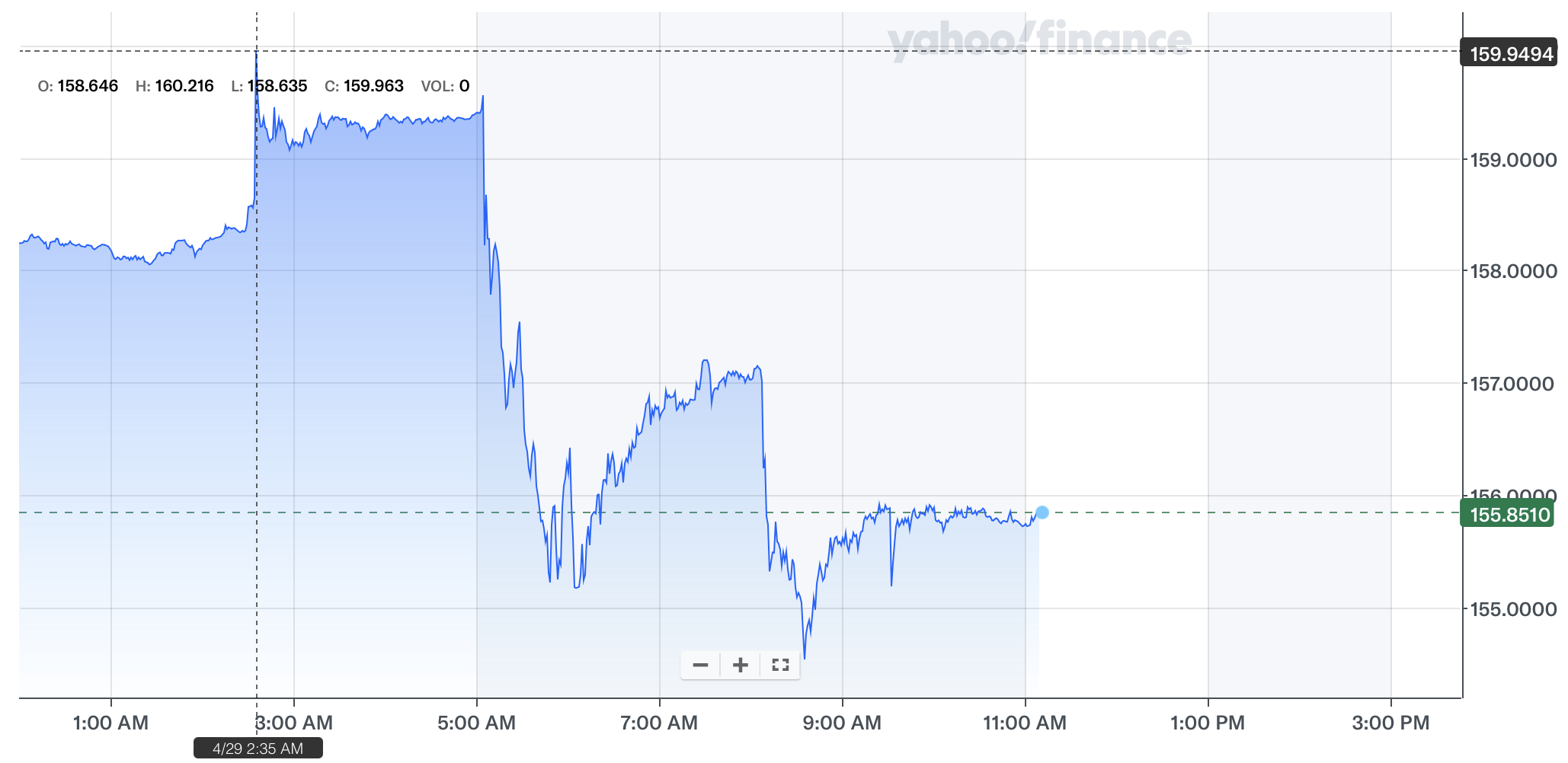
The next story of note was the fact that USDJPY trade above 160 last night, during the early hours of the session.  As can be seen from the below chart from yahoo finance, it seemed to have touched 160.216 before slipping back to the mid-159’s and then collapsing a few hours later, back to its current state just below 156.

Something to remember is that it is golden week in Japan, with the nation on holiday yesterday so banks were, at most, running skeleton staffs of junior traders and market liquidity was significantly impaired.  But the question today is, did the BOJ intervene on behalf of the MOF.  From what I have been able to glean, there was significant selling by the big three Japanese banks, certainly a sign that intervention was possible.  Of course, the chart shows how sudden the decline was, also an indication that it could have been intervention.  The best explanation I have heard for the initial move above 160 was it was some bank(s) running stop-losses at the level, as well as triggering barriers there in the options market.  At this hour (6:15), the yen has appreciated by 1.6% from Friday’s closing levels.  However, I sincerely doubt that we have seen the end of the weakness in the yen.  This is especially true if Chair Powell comes across as more hawkish on Wednesday, something that is clearly quite possible.

The last thing to note for today
Is Yellen and her QRA
How much will she borrow?
And Wednesday, not ’morrow
We’ll learn if more bonds are in play

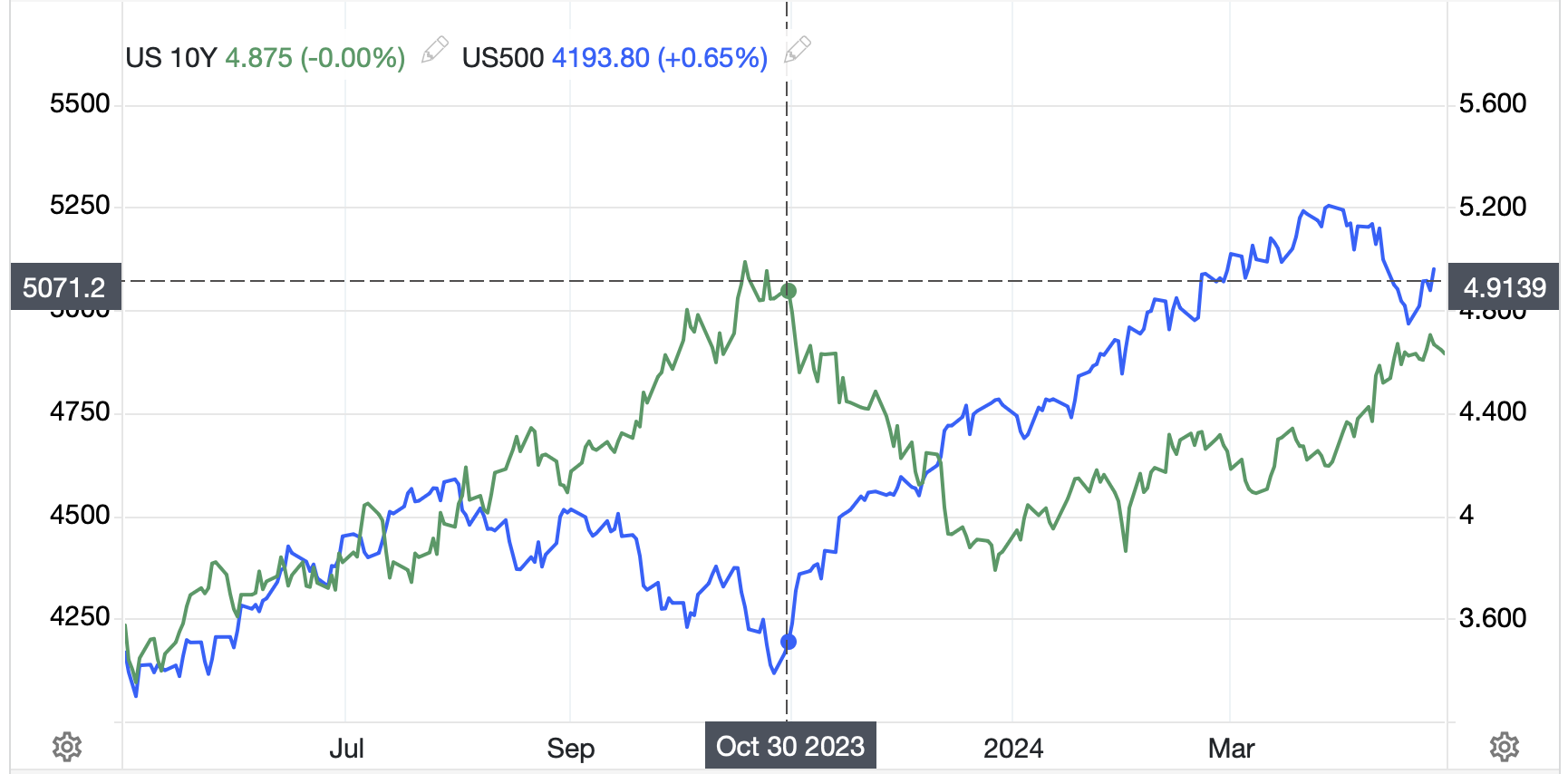
This brings us to the Quarterly Refunding Announcement (QRA) to be released at 3:00 this afternoon.  While historically, the only people who cared about this report were bond market geeks, it has gained a significant amount of status since the October 31st announcement where the Treasury indicated it would be issuing less debt than had been expected.  That led directly to the massive bond market rally at the end of last year as well as the concomitant stock market rally.  Looking at the below chart from tradingeconomics.com, it is pretty clear when things turned around, and it was right when the QRA came about.

Once we know the borrowing plans from this afternoon, we will learn on Wednesday the mix of borrowing that will be coming, and whether Secretary Yellen will continue to issue a more significant amount of debt in T-bills, or if she will try her hand at notes and bonds again.  Given that yields have been climbing lately, I suspect there will be more T-Bill issuance than is the historic norm, which has been about 20% of total borrowing, but perhaps not the 80% she issued last quarter.  Ultimately, the real concern today is that the estimated borrowing numbers could be larger than current forecasts, and perhaps just as importantly, the question of just how much was borrowed last quarter.  The sustainability of this process is starting to be called into question although I don’t expect anything to happen quite yet.  

Ok, that’s enough for one day!  A quick recap of the overnight session shows that Chinese shares rallied on the back of news from Beijing that the government was relaxing some regulations in the property sector.  In fact, that was sufficient to help all Asian equity markets higher on the order of 0.5% – 1.0%.  Meanwhile, European bourses are mixed this morning with both the DAX and CAC little changed, the FTSE 100 edging higher by 0.5%, but other continental exchanges under pressure.   As to US futures, they are very modestly higher this morning after Friday’s rally.

In the bond market, after modestly higher yields on Friday, this morning is seeing Treasury yields slip 4bps and European sovereigns fall between 5bps and 7bps.  Clearly, there is not much concern that the QRA is going to indicate massive new borrowing, but I guess we will know this afternoon.  

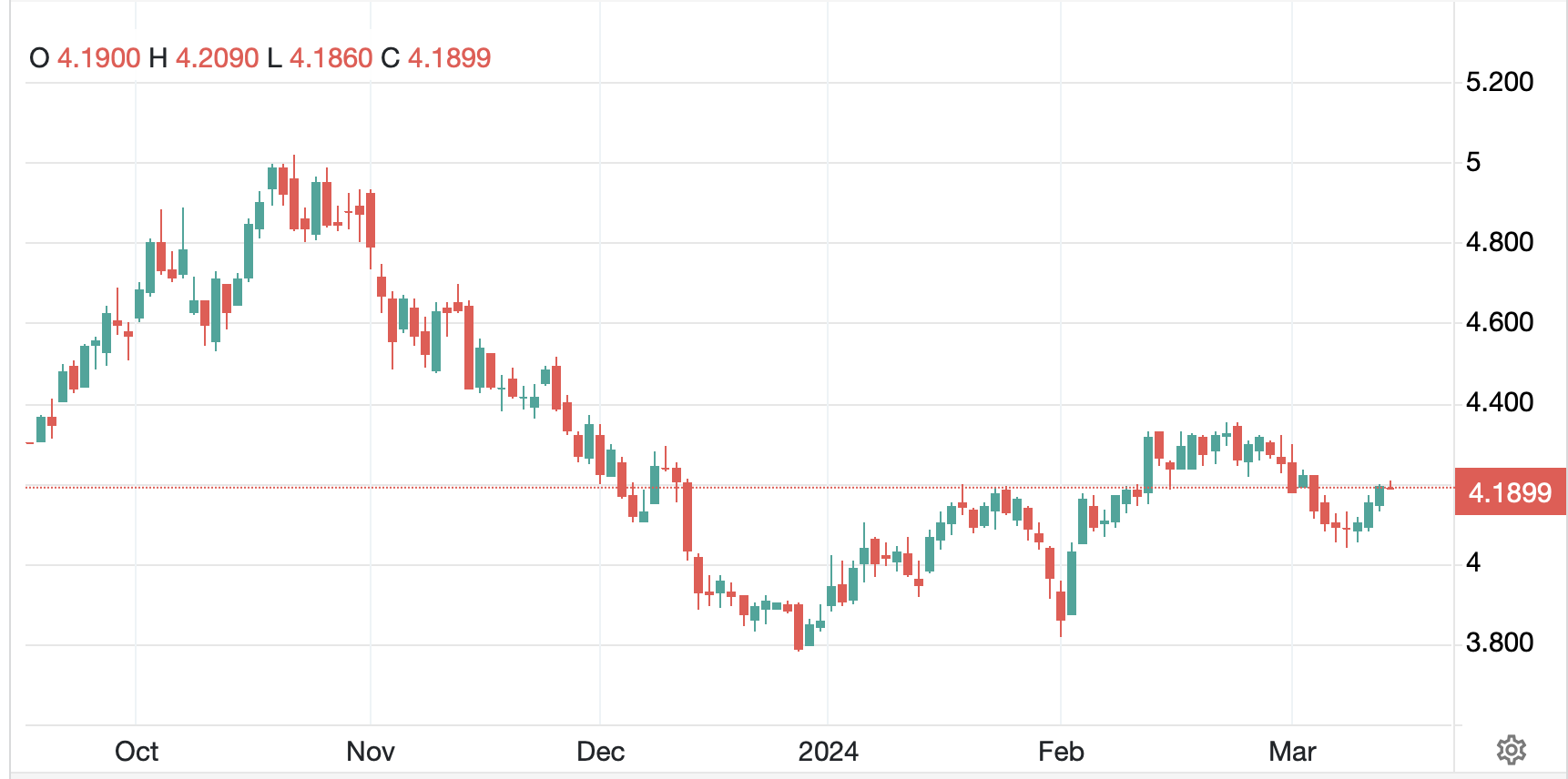
Commodity prices are on the quiet side this morning with oil basically unchanged, as is gold as both hold onto last week’s gains.  However, copper (+0.5%) continues to rally and is now just $0.30/pound below its all-time highs of $4.89.  There are many stories regarding the copper market with some discussing hoarding by the Chinese and others focused on the needs of the ongoing ‘energy transition’ which will need significant amounts of the red metal to electrify everything.  While it has run up quite quickly of late, I must admit the long-term view remains positive in my mind between the absence of new mines and the needs of the transition although a pullback would not be a surprise.

Finally, the dollar, aside from vs. the yen, is generally lower across the board.  While it remains in the upper end of its recent trading range, it appears the sharp decline in USDJPY has had knock-on effects elsewhere. The financial currencies, like EUR (+0.3%), GBP (+0.4%) and CHF (+0.3%) are all firmer as are the commodity bloc (NOK +0.3%, ZAR +0.45%, AUD+0.5%).  In fact, I am hard-pressed to find a currency that is underperforming the greenback.  Positioning in dollars has been quite long lately so ahead of this week’s FOMC meeting as well as the NFP on Friday, it is quite likely that we are seeing a little reduction in those positions.  However, we will need to see a change in the data to change the longer-term view.

Obviously, there is a ton of stuff coming out this week.

TodayQRA 
TuesdayEmployment Cost Index1.0%
 Case Shiller Home Prices6.7%
 Chicago PMI44.9
 Consumer Confidence104.0
WednesdayADP Employment 179K
 ISM Manufacturing50.1
 JOLTS Job Openings8.68M
 FOMC Rate Decision5.50% (unchanged)
ThursdayInitial Claims212K
 Continuing Claims1782K
 Nonfarm Productivity0.8%
 Unit Labor Costs3.2%
 Factory Orders1.6%
FridayNonfarm Payrolls243K
 Private Payrolls180K
 Manufacturing Payrolls7K
 Unemployment Rate3.8%
 Average Hourly Earnings0.3% (4.1% Y/Y)
 Average Weekly Hours34.4
 Participation Rate62.7%
 ISM Services52.0

Source: tradingeconomics.com

In addition to all this, on Friday we will hear from two Fed speakers, Williams and Goolsbee, and I imagine if they are unhappy with the market response to their messaging on Wednesday, we will hear from more.

Ultimately, this is an important week to help us understand how things are going in the economy and how the Fed is thinking about everything.  As long as payrolls continue to hang in there, any chance of Fed dovishness seems to diminish by the day.  But stranger things have happened.  As to the dollar, today’s position adjustments make sense and I suspect there will be a few more before the big news hits on Wednesday and Friday.  Til then, I think all we can do is watch and wait.

Good luck

Adf

Unchained

The data, on Friday, revealed
The job market’s mostly been healed
As such, any thought
The Fed really ought
Cut rates, simply must be repealed
 
In fact, two Fed speakers explained
That rate cuts were not yet ordained
Should prices keep rising
It won’t be surprising
If higher rates soon are unchained


Wow!  Once again, the NFP report was significantly hotter than any analysts forecast, with a top line number of 303K while the previous 2 months were revised higher as well.  The Unemployment Rate fell back a tick, to 3.8%, while wages continue to grow above 4%.  In other words, it seems quite difficult to make the case that the economy is in a state that requires rate cuts.  After all, if the Fed’s focus has turned from inflation specifically to employment now, and employment continues to rock, why cut?

However, the impression from the cacophony of Fedspeak we heard last week is that many members are still of a mind to cut the Fed funds rate, likely in June.  Just not all of them.  We heard from two more speakers Friday, Governor Michelle Bowman and Dallas Fed President Lorie Logan, and neither seemed in a cutting frame of mind.  [Emphasis added]

Bowman: “While it is not my baseline outlook, I continue to see the risk that at a future meeting we may need to increase the policy rate further should progress on inflation stall or even reverse.”

Logan: “In light of these risks, I believe it’s much too soon to think about cutting interest rates.  I will need to see more of the uncertainty resolved about which economic path we’re on.” She followed that with, “To be clear, the key risk is not that inflation might rise — though monetary policymakers must always remain on guard against that outcome — but rather that inflation will stall out and fail to follow the forecast path all the way back to 2 percent in a timely way.”

Now, it is very difficult for me to read these comments and think, damn, rate cuts are coming soon!  By now, you are all aware that I have been in the sticky inflation camp from the get-go and certainly Friday’s data did nothing to change my mind.  But my views don’t really matter. However, if we start seeing a majority of FOMC members talking about fewer cuts than expected/assumed in March, and even hikes, we need to pay attention. I don’t think it is yet a majority, and clearly Chair Powell is very keen to cut, but there is a long time between now and the June meeting, with much data to come.  Unless that data starts to really back off and hint at a substantial slowing of the economy, my sense is that June will morph into November or December, with the median dot pointing at just one cut this year.

A quick look at the Fed funds futures shows that traders are growing even less confident in those rate cuts being implemented.  As of this morning, the June probability has fallen slightly below 50% and there are a total of 61bps priced in by the December meeting, just over two cuts.  This is quite a contrast to the Eurozone, where the market has fully priced in a June cut and is beginning to consider a 50bp reduction to get things going there.  On the surface, this makes a great deal of sense as the Eurozone economy’s growth continues to lag that of the US and inflation has been ebbing more rapidly there than in the States.  And don’t forget, the ECB meets this Thursday, so at the very least we should have a better sense of what will happen in June, and we cannot rule out a cut this week, regardless of market pricing.

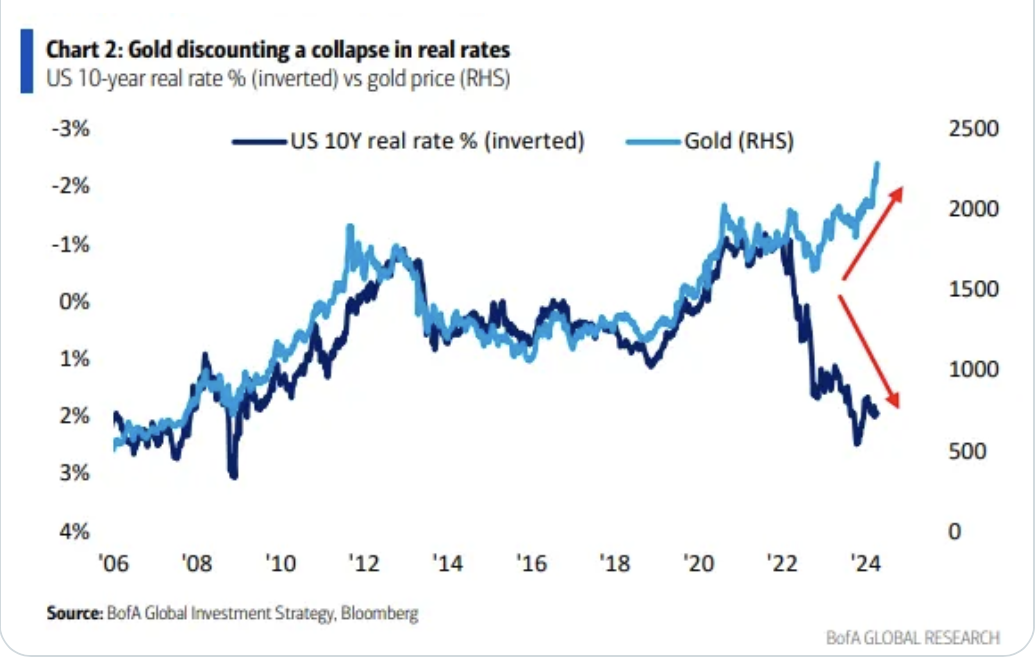
Trying to step back for a broader perspective on the economy and the future of policy rates as well as market movements, there continue to be several conundrums in markets compared to historical trends.  For instance, what is the meaning of the price of gold rising consistently alongside a rise in interest rates, both nominal and real?  Historically, there has been a strong negative correlation between the two, but something has changed in the past two years as evidenced by the BofA Research chart below.

Is this a signal that the market is getting indigestion over the amount of sovereign debt that is outstanding, led by Treasuries?  Is this an indication that investors are losing faith in fiat currencies and the current global monetary structure?  Or is this simply a temporary anomaly that will correct over the course of the next several years?  Unfortunately, there is no way for anyone to know the answer to these questions at this point in time.  Anyone who says otherwise is not being honest.  

However, my suspicion is that the consequences of monetary and fiscal policies around the world during the Pandemic and since has more and more people, and institutions, starting to hedge their bets on the future and its outcomes.  From a more benign view that the authorities will be able to kick the can down the road, this relationship seems to indicate more than a few folks think that the fiscal and monetary authorities are about to stub their collective toe on the next kick.  Ouch!

In many ways, I think that the change in this relationship is an excellent encapsulation of the problems currently faced by monetary and fiscal authorities.  As such, I will be watching it closely as a key indicator of market sentiment overall.

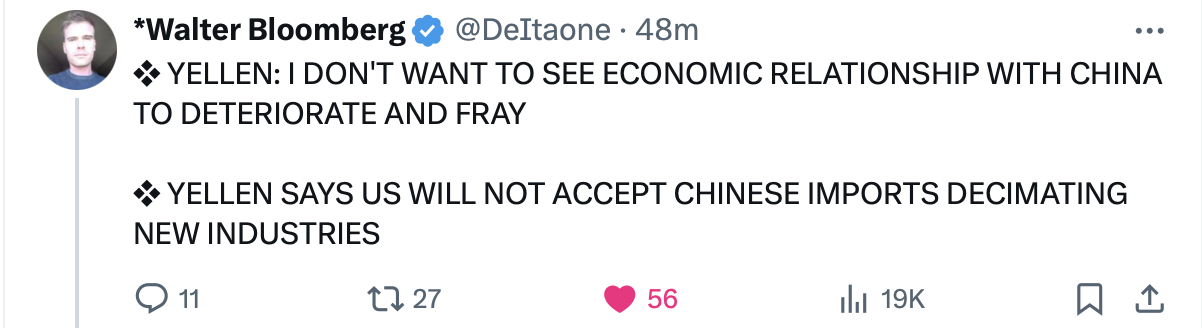
Ok, let’s look at the overnight session.  After Friday’s solid US equity performance, the picture elsewhere has been slightly less positive, although positive overall.  In Asia, the Nikkei (+0.9%) followed the US price action although Chinese shares had a less positive session, falling on the mainland with the HK market staying flat.  Treasury Secretary Yellen was in China trying to smooth things over, but the following two statements, I think, are a great description of how confused things are:

Talk about mixed messages!  Meanwhile, in Europe, most bourses are a bit higher this morning, but on the order of 0.5%, half what we saw in the US on Friday.  It seems that some traders are betting that the ECB, when it meets this Thursday, is going to cut rates.  Lastly, at this hour (7:20), US futures are essentially flat.

The bond market, though, has seen far more activity lately as it appears the bond vigilantes, last seen in the 1990’s are reawakening.  This morning, 10-year Treasury yields are back to 4.45%, their highest level since November when yields were falling in the wake of the Fed’s perceived pivot and the reduced amount of coupon issuance just announced at that time.  This is 13bps higher than the yield just before the NFP data was released, 8bps on Friday and another 5bps this morning.  Similarly, European sovereign yields hare higher by between 3bps and 5bps this morning, being dragged higher by Treasuries, but lagging as bets get made that the ECB acts sooner than the Fed.

In the commodity space, oil (-0.8%) is backing off its recent highs this morning as there appears to be an easing in some concerns over the Middle East, at least that is the story making the rounds.  Meanwhile, metals prices continue to flourish despite the rise in interest rates with both precious (Au +0.4%, Ag +0.9%) and base (Cu +0.7%, Al +0.3%) all continuing their recent climbs.  Another conundrum here is the fact that these metals prices are rising despite the dollar remaining reasonably well bid.

Turning to the dollar, it is little changed, on net, this morning although we have seen some strength against the CHF (-0.5%) and KRW (-0.4%).  The former is the only currency seemingly following the interest rate story as the recent SNB rate cut plus low inflation readings indicates that the policy divergence between Switzerland and the US is set to widen further.  The won, on the other hand, looks to be a proxy for China, which the PBOC refuses to allow to weaken despite many economic reasons it should.  On the flipside, ZAR (+0.4%) is rallying on the back of those metals’ prices.  One of the things that is confusing is the fact that the euro remains reasonably well bid despite the changing tone of the interest rate policies between the Fed and ECB.  While the single currency has generally been declining over the past month, in truth, since the beginning of April, it has rebounded about 1% and held strong since then.  Given the changing market perceptions, I would have anticipated the euro to continue its declining ways, but right now, that is not the case.

On the data front, the week starts out slowly, but we get the critical US CPI data on Wednesday.

TuesdayNFIB Small Biz Optimism89.5
WednesdayCPI0.3% (3.4% Y/Y)
 -ex food & energy0.3% (3.7% Y/Y)
 Bank of Canada Rate Decision5.0% (unchanged)
 FOMC Minutes 
ThursdayInitial Claims215K
 Continuing Claims1792K
 PPI0.3% (2.3% Y/Y)
 -ex food & energy0.2% (2.3% Y/Y)
 ECB Rate Decision4.5% (unchanged)
FridayMichigan Sentiment79.0
Source: tradingeconomics.com

In addition to the data and other central bank decisions, we hear from seven more Fed speakers this week, which given the recent more hawkish commentary, could well be quite interesting.  If Wednesday’s CPI data is hotter than expected again, I suspect it will become increasingly difficult for the doves to spread their wings.  As it happens, six of the seven speak after the CPI, so we could well see things evolve further.  In the meantime, relative to other currencies, I continue to look at the rate picture and believe the dollar should remain firm.  However, versus ‘stuff’ not so much.

Good luck

Adf

He’s Got Spine

The market’s now certain that June
Is when Jay, the funds rate, will prune
Inflation don’t matter
Despite all the chatter
They don’t want to cut rates too soon
 
But what if inflation keeps rising?
And data continues surprising?
Can he hold the line?
And show he’s got spine
Despite all the doves’ vocalizing?


It’s funny.  So much was made about the CPI number on Tuesday and the lines seemed to have been drawn quite clearly; soft or as expected data would cement a June cut while hot data would call that into question.  And yet, here we are two days later, with the only information in the interim showing that oil and product inventories have fallen further driving oil prices higher, and the probability of a June cut has risen above 90%.  In fact, amid a day with limited new information, and during the Fed’s quiet period, perhaps the most interesting comments came from Treasury Secretary Yellen.  Not only did she indicate she regretted her use of the word ‘transitory’ at the beginning of the inflation episode, but more importantly, it appears that Treasury is now assuming much higher interest rates in their forecasts than before.  In other words, she no longer believes that interest rates are going to head back down to 2%.  Personally, I think that is a huge step in the right direction.  Alas, that concept certainly did nothing to constrain their spending plans, so it is not clear it really matters.

But the reality as that even though we get some more Tier 1 data this morning, it has become quite clear, to me at least, that the market is uninterested in anything other than the FOMC statement, the dot plots and Powell’s press conference coming on Wednesday next week.  You can see this in the equity markets which are now trading in ranges after their recent sharp rises, and you can see this in the FX market given the dollar’s virtual complete lack of volatility.  In fact, the only place that is demonstrating some concern is the bond market, where yields continue to edge higher very slowly.

Let’s start by taking a quick look at this morning’s data.  Retail Sales (exp 0.8%, 0.5% ex-autos) is set to rebound from last month’s terrible -0.8% print.  Many have looked past that number as a combination of bad seasonal adjustments and heavy discounting and continue to see strength in the economy.  We also see PPI (0.3%, 1.1% Y/Y) and Core (0.2%, 1.9% Y/Y) which seems to have bottomed, not dissimilar to CPI, but which will be a problem for those who believe that inflation is still trending lower.  Finally, as it is Thursday, we see Initial (218K) and Continuing (1900K) Claims, both in line with recent outcomes signaling the labor market remains in solid shape.

Now, you all know my view that inflation is not dead and that the market will need to continue to adjust interest rates higher over time to account for that fact.  Since the beginning of the year, as you can see from the chart below courtesy of tradingeconomics.com, while there have been several cycles, it seems clear that the trend in yields remains higher.

I think this makes a lot of sense and expect it to continue.  In fact, the question I have is how can the Fed truly consider it will be appropriate to cut the Fed funds rate given the economic signals are showing continued solid growth, a solid labor market and indications that inflation is heading higher?  Many make the political argument that since they are hell-bent on cutting, they need to get started before it gets too close to the election.  But I am going to go out on a limb here and say that I think Powell has shown he is made of sterner stuff and if the data remains where it has been, let alone inflation ticks higher between now and June, there will be no rate cuts.  If I am correct, risk assets are going to rerate, trust me.  And that is really the only question that needs to be answered at this point.

And so, other than bonds which seem to be sussing out the potential for rates to continue at their higher-for-longer pace, a look at other asset class markets shows not much overall movement.  After yesterday’s mixed US session, Asia, too, was mixed with Japan slightly firmer while Chinese shares slid as there appears to be no real help in sight there.  European bourses are also mixed with the UK lagging and slightly softer on the day and the bulk of the movement higher quite modest.  The only exception is the CAC in Paris higher by 0.9%, on the back of continued strong performance of the luxury goods sector.  (As an aside, why would central bankers think that the economy is going to tank if luxury goods remain hot?). US futures, though, are firmer at this hour (7:30) with all three indices higher by 0.5%.

In the bond market, while US yields have been dragging the global structure higher, they are unchanged on the morning and European sovereigns are actually a touch softer, between 1bp and 2bps today.  That is likely on the back of comments by Greek ECB member Stournaras that they need to quickly make two rate cuts to manage things properly.  While that seems excessive, I maintain the ECB cuts before the Fed.  As to Japan, JGB yields have edged higher by one more basis point overnight, though remain at just 0.77%.  Ueda-san, when he speaks, sounds far less hawkish than many of the analysts in Tokyo, or the other members of the BOJ from whom we have recently heard.  I am still in the April camp for the first rate hike, and very few afterwards.

Oil is the big mover of the day, up 0.9% with WTI back over $80/bbl for the first time since early November.  Yesterday’s EIA Inventory data showed drawdowns in crude and gasoline stocks that were much greater than expected.  You may have noticed at the pump that gas prices are rising, and it seems the market is figuring that out as well.  Remember, though, that OPEC+ has reduced production so has significant spare capacity at this stage, probably 2mm – 3mm bbl/day that they can restart at any time, so I don’t expect prices here to skyrocket.  Gold, which rallied nicely yesterday, is slightly softer this morning, as is copper, although the red metal remains above $4.00/Lb.  It strikes me that the commodity markets are not anticipating a significant economic slowdown right now.

Lastly, the dollar is very little changed overall this morning, with the largest moves NZD (+0.25%) and PLN (-0.25%) and every other major currency seeing less movement than that.  USDJPY is pushing back toward 148.00 slowly and seems likely to be the next big mover based on Monday night’s BOJ meeting.  Otherwise, this space is dead.

And that’s really what we have for the day.  If the data is hot, look for yields to continue their recent climb and for the dollar to take on a bid tone.  As to stocks, demand remains strong regardless of the economics.  If the data is soft, then a weak dollar should accompany strength in both stocks and bond prices.

Good luck

Adf

There’ll Be No Crash

Said Janet, I know we’ve been spending
Too much, but you’re not comprehending
I’ve plenty of cash
So, there’ll be no crash
Instead, stocks will keep on ascending

Til Wednesday, we’ll keep the suspense
But really, it’s just common sense
Chair Powell and I
Will help the Big Guy
And policy ease will commence

Well, the first shoe dropped yesterday afternoon as the Treasury explained that they would “only” be borrowing $760 billion in Q1, a solid $56 billion less than had been expected by the market as of yesterday morning.  With that significant reduction in potential Treasury issuance, the bulls went nuts and both stocks (+0.75%) and bonds (-7bps) rallied.  A cynic might believe that Secretary Yellen was trying to manipulate the stock market higher, but we all know that could never be the case.  At any rate, this sets us up for Wednesday when first thing in the morning we will see the Quarterly Refunding Announcement (QRA), where Yellen will describe the ratio of short-dated T-bills to long-dated coupon issuance, and then at 2:00, the FOMC Statement will be released with Chairman Powell speaking at the press conference 30 minutes later.

Given the excitement over yesterday’s events, I suspect that at least one of the two events tomorrow will be dovish rates/bullish equities but have no idea which way it will play out.  In the end, though, it doesn’t really matter.  Ultimately what we have learned is that Yellen is running the show, and all Powell can do is respond.  The one thing I have to wonder is, what if the government spends more than the $760 billion in Q1?  Where will that money come from, and what will the impact be on the markets?  (Obviously, they will simply borrow more, but it will not be an issue as there is no limit these days, nor for an entire year going forward.)  However, for now, that is just a concern for grumpy old men like me.

In China, though they have announced
More stimulus and stocks first bounced
It seems traders feel
Xi ain’t got that zeal
So, sellers once more have all pounced

You may recall last week when the Chinese stock market rallied sharply after a series of announcements regarding government support.  First there was the story of CNY 2 trillion of cash that would be coming home and invested in equities and then the PBOC cut the RRR by 50 basis points, freeing up another CNY 1 trillion.  These moves were supposed to demonstrate that Xi was going to fix things.  And he did…for a week.  But now, equity markets in both Hong Kong (-2.7%) and on the mainland (-1.8%) are falling again as it seems market participants have come to believe that there are too many problems for a mere CNY 3 trillion to fix.  And they could well be correct.

After all, China has been inflating their economy for decades and the property bubble they have blown is not nearly popped yet.  While this could be a modest correction in the beginning of a trend higher, I have a feeling that the fundamentals have a long way to go before they make sense for international investors.  With the European economy having stagnated for the past 5 quarters and the US moving an increasing amount of business to Mexico from China, it will be tough sledding in China, I fear.  Ultimately, I continue to believe the renminbi will suffer as it will be the most likely outlet valve.  But for now, I guess they can stand the pain.

And those are today’s stories as the market braces itself for tomorrow’s QRA and FOMC, Thursday’s BOE and Friday’s NFP data.  In the meantime, let’s recap the rest of the overnight action.

Despite the robust performance in the US yesterday, only Japan and Australia managed to show any signs of life in Asia overnight as China dragged down all the other regional markets.  This cannot be too surprising given the importance of the Chinese economy there, and if it is lagging other nations are going to struggle as well.  Europe, however, is having a much better go of it, with gains across the board, led by Spain’s IBEX (+1.25%) after both real and nominal GDP rose more than expected with inflation ticking higher alongside economic activity.  That may not bode well for the inflation story in Europe, but for now, everyone’s happy and the ECB comments have all pointed to rate cuts by the middle of the year.  As to US futures, at this hour (7:45) they are just barely on the red side of unchanged, with no market even -0.1%.

You will not be surprised that European yields slipped yesterday after the US bond rally as the combination of a prospect of lower yields in the US alongside the slightly more dovish talk from the ECB speakers was plenty of catalyst for a bond rally there.  While yields have edged back higher by 2bps or 3 bps this morning, they remain below yesterday morning’s levels.  In the US, Treasury yields have continued their decline, down another 1bp overnight while JGB yields have edged down another 1bp as well.  One other market to note, China, saw yields slip 3bps overnight and they are now at their lowest level since the early 2000’s as the market anticipated further policy ease from the government and PBOC.

Oil prices (-0.65%) are off a bit this morning as they continue to consolidate last week’s gains.  Clearly there is still concern regarding the US response to the attacks on its base in Jordan over the weekend as the intensity of that response is still completely unknown.  Weakness in China is not helping the oil market and European GDP data has also worked against the demand story, so uncertainty remains the watchword.  As to gold, it is continuing to creep higher but remains in its recent 2020/2060 trading range.  Lastly, the base metals are a touch softer this morning, but only a touch.

Finally, the dollar is a bit softer this morning after a benign day yesterday.  In a way, this is surprising as I would have expected the greenback to slide alongside Treasury yields, but I guess given the broader dovishness from ECB and other central bankers, on a relative basis not much changed.  As well, traders are reluctant to take large positions ahead of tomorrow’s big QRA and FOMC announcements.  As such, I suspect that we are going to see a very quiet session here across the board, just like we had overnight.

On the data front, while not as exciting as tomorrow, we do see Case Shiller Home Prices (exp 5.8%), JOLTS Job Openings (8.75M) and Consumer Confidence (115.0) this morning.  I keep listening to all the people who are telling me that falling housing prices are going to drive inflation lower, and the only reason the CPI and PCE calculations aren’t already lower is because they both have them at a lag.  Then I look at Case Shiller and say, what falling housing prices?  Anecdotally, in my neighborhood, we continue to see bidding wars and homes selling above asking.  If rates are really going to come down further, I suspect that will only drive that process even further.  The deflation story just makes no sense to me.  But anyway, probably not much today and all eyes are on tomorrow.

Good luck
Adf

Not One Whit

Both headline and core PCE
Were softer, with both below three
But under the hood
It’s not quite as good
As housing and transport are key
 
The narrative, though, will not quit
Assuring us all this is it
Rate cuts will come soon
And stocks to the moon
But so far, for proof, not one whit.
 
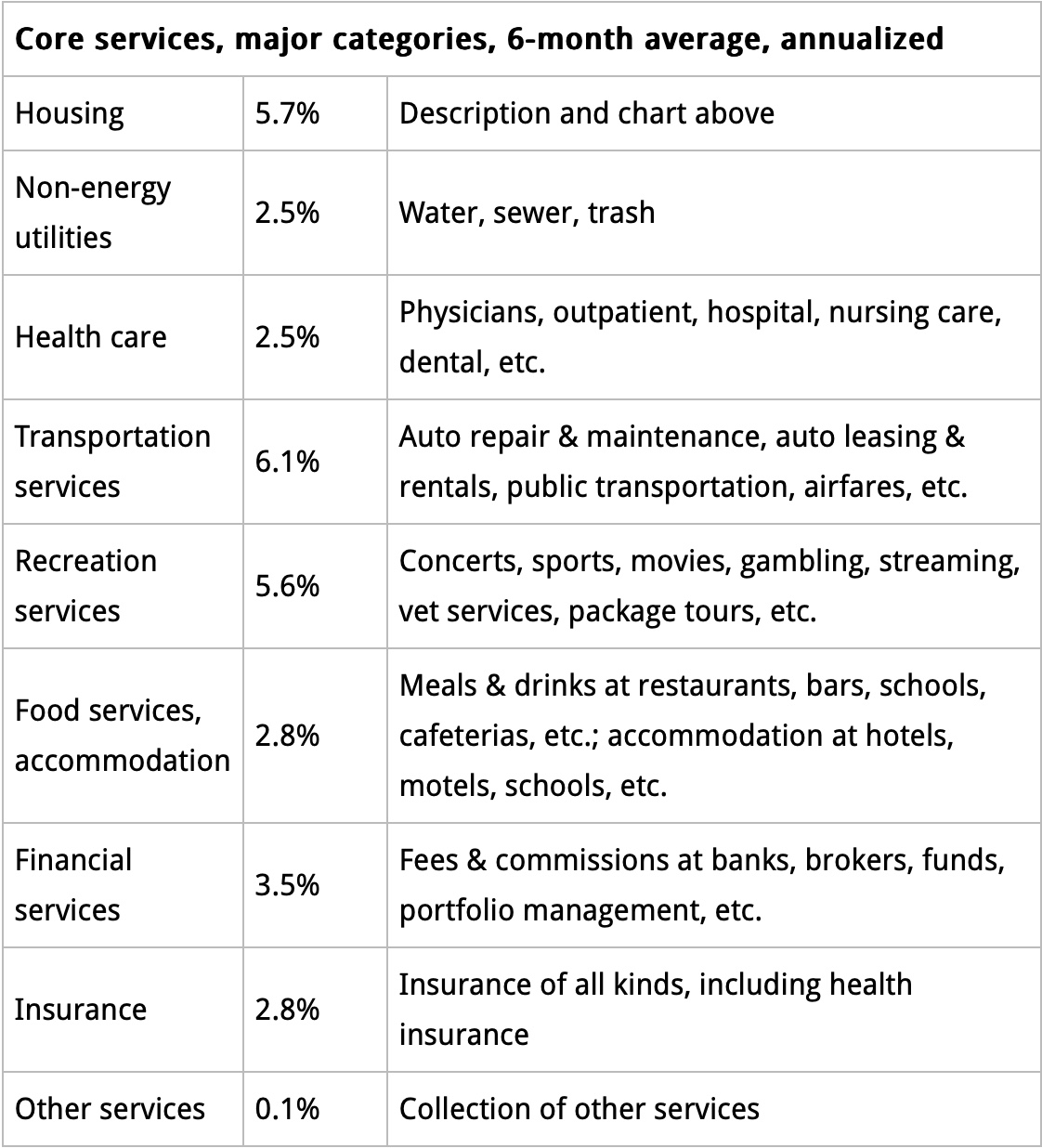
There is a very good analyst who writes regularly on the macroeconomic story named Wolf Richter.  In the wake of Friday’s PCE data release, he published an article that had the following table:

It is not hard to look at this table and see a bit of the reality we all face, rather than the widely touted headline numbers regarding inflation.  Housing continues to be sticky at much higher inflation rates than target, as well as transportation services, recreation services and financial services.  But even the other stuff, seems to be running above the elusive 2.0% level.  Now, this is the annualized rate of the past 6 months’ average readings.  But as I highlighted last week regarding CPI, this seems to be the new benchmark.  My point is that while the narrative is really working hard to convince us all that inflation is collapsing and the Fed is massively over-tight in its policy and needs to CUT RATES NOW, this breakdown doesn’t look quite the same.  My belief is the Fed remains on hold much longer than the market is expecting/hoping for, and that at some point, equity markets and risk assets are going to come to grips with that reality.  Just not quite yet.

Of course, maybe the narrative is spot on, and inflation is going to smoothly decline back to the 2% level while economic growth continues its recent above-trend course.  But personally, I have to fade that bet.  Based on the amount of continued fiscal stimulus, as well as the Fed’s discussion of slowing QT and their indication of rate cuts later this year, I believe that while the growth story is viable, it will be accompanied with much hotter inflation than is currently priced.  The fact that breakeven inflation rates are priced at 2.50% in the 10-year does not mean that is what is going to happen.  Just like the fact that the Fed funds futures market is currently pricing between 5 and 6 rate cuts in 2024 does not mean that is what is going to happen.  Let’s face it, nobody knows how the rest of the year is going to play out.  The one thing, however, of which we can be sure is that Treasury Secretary Yellen will spend as much money as possible in her effort to get President Biden re-elected.  That alone tells me that inflation is set to rebound.

And there is one other thing to remember, as things heat up in the Red Sea, and shipping avoids the area completely, the cost of transiting stuff from point A to point B continues to rise.  The cost is measured both in the dollars charged for the service and the extra 10-14 days it takes to complete the trip around the Cape of Good Hope in South Africa.  It seems that the Biden Administration’s foreign policy has unwittingly had a negative impact on its economic policy plans.  

In sum, when I look at both the data and the activities around the world, it remains very difficult to accept the narrative that inflation is collapsing so quickly that the Fed MUST cut rates and cut them soon.  The combination of still robust US growth on the back of excessive fiscal stimulus and the increased tensions in the oil market lead me to a very different conclusion.

With that in mind, let’s see what happened overnight.  Equity markets in Asia were mixed as Japan (Nikkei +0.8%) and Hong Kong (Hang Seng +0.8%) both rallied but mainland Chinese shares (CSI -0.9%) fell.  This was somewhat surprising as China, in their continuing efforts to prop up their stock markets, have restricted the lending of any securities for short sales while a HK court ruled Evergrande (remember them?) should be liquidated completely.  Perhaps the Chinese real estate situation is not quite fixed yet after all.  I suspect that we will see other liquidations as well before it is all over.  In the meantime, European bourses are mixed with the DAX (-0.4%) lagging while the FTSE 100 (+0.25%) is top dog today.  There’s been no news of which to speak so this seems like position adjustments ahead of the Fed’s activities later this week.  US futures, too, are mixed and little changed at this hour (7:15).

Bond markets, though, are really loving all the rate cut talk and are growing more confident that they will be coming soon as inflation collapses.  Treasury yields are lower by 3bps this morning and the entire European sovereign market has rallied with yields down an impressive 5bps-7bps today.  The only outlier is the JGB market, which saw the 10-year benchmark yield edge up 1bp.  It is much easier for me to believe that the ECB is going to cut as inflation in the Eurozone slows alongside the faltering growth story than to believe that the Fed is going to cut into an economy growing 3+%.  But that’s just me.

In the commodity markets, oil (+0.3%) continues to find support as the tensions in the Middle East expand after an attack in Jordan killed three US servicemen there.  Oil is higher by 5% in the past week and more than 11% in the past month.  It seems to me that will not help the inflation story.  At the same time, we are seeing demand for precious metals as gold (+0.5%) and sliver (+1.0%) are both rallying on the increased nervousness around the world.  Perhaps more interestingly is that copper is marginally higher this morning, something that would seem contra to the escalating tensions.

Finally, the dollar has rallied a bit this morning on net, although it is not a universal move by any stretch.  For instance, while European currencies are broadly weaker, in Asia and Oceania, we are seeing strength with AUD and NZD (both +0.4%) and JPY (+0.2%) fimer.  As to the rest of the world, it is a mixed session with minimal movement.  Feels like a wait and see situation given all the data and info coming this week.

Speaking of the data this week, there is much to absorb.

TodayTreasury Funding Amount$816B
 Dallas Fed Manufacturing-23
TuesdayCase Shiller Home Prices5.8%
 JOLTS Job Openings8.75M
 Consumer Confidence115
WednesdayADP Employment135K
 Treasury QRA 
 Employment Cost Index1.1%
 Chicago PMI48
 FOMC Meeting5.5% (unchanged)
ThursdayInitial Claims210K
 Continuing Claims1835K
 Nonfarm Productivity2.5%
 Unit Labor Costs1.7%
 ISM Manufacturing47.3
 Construction Spending0.5%
FridayNonfarm Payrolls173K
 Private Payrolls145K
 Manufacturing Payrolls2K
 Unemployment Rate3.8%
 Average Hourly Earnings0.3% (4.1% Y/Y)
 Average Weekly Hours34.3
 Participation Rate62.4%
 Factory Orders0.2%
 Michigan Confidence78.8

Source tradingeconomics.com

The first thing to understand is that this morning, the Treasury will be releasing how much funding they expect to need in Q1 of this year, currently expected at $816 billion, but Wednesday’s QRA will describe the mix of the borrowings.  Recall that last quarter, Secretary Yellen changed the mix of short-dated paper to long-dated coupons substantially and completely reversed the bond market rout that was ongoing at the time.  If she continues to issue far more bills than coupons, it should support the bond market and help continue to juice risk assets.  Any substantial increase in coupon issuance is likely to be met with a significant stock and bond market sell-off.  So, which do you think she will do?

Otherwise, looking at the other data, certainly there is no indication that housing prices are moderating.  The Fed will not change rates on Wednesday, but everyone is waiting to see if they will remove the line in their statement about potentially needing to raise rates going forward.  Perhaps there will be a little two-step where the QRA points to more bond issuance, but the Fed sounds more dovish to offset that news.  And of course, Friday’s NFP data will be keenly watched by all observers as any signs that the labor market is cracking will get the rate cut juices flowing even faster.

All in all, we have a lot of new information coming to our screens this week.  At this point, it is a mug’s game to try to guess how things will play out.  However, if we see dovishness from the Fed or the QRA (more bill issuance) then I expect risk assets to perform well and the dollar not so much.  The opposite should be true as well, a surprisingly hawkish Fed or more coupon issuance will not be welcomed by the bulls, at least not the equity bulls.  The dollar bulls will be happy.

Good luck

Adf

Too Clever by Half

Said Jay, “it would be premature”

To think we’ve arrived at a cure
For higher inflation
Though there’s a temptation
By some to claim that we are sure

Instead, if we think it’s correct
More rate hikes we will architect
Investors, however,
Think Jay is too clever
By half and this view did reject

As we start a new week that will culminate in the payroll report on Friday, I think it is appropriate to consider how last week finished, notably how Chairman Powell left things leading into the Fed’s quiet period ahead of their next FOMC meeting on the 13th of this month.  To my ears, the two most important comments were as follows: “The strong actions we have taken have moved our policy rate well into restrictive territory, meaning that tight monetary policy is putting downward pressure on economic activity and inflation.”  A little later he explained, “It would be premature to conclude with confidence that we have achieved a sufficiently restrictive stance, or to speculate on when policy might ease. We are prepared to tighten policy further if it becomes appropriate to do so.”  

Now, interpretation is a subjective idea already, but FWIW my interpretation is he clearly understands they have tightened policy quite substantially, perhaps enough to achieve their goal of 2% inflation, but in a nod to this nation’s history, and ostensibly his hero, Paul Volcker, he is not going to get fooled by a temporary respite in inflation.  I believe he has made perfectly clear in the past that the Fed, or at least Chairman Powell, is willing to push the economy into a recession if he believes it is necessary to truly end inflation.

Of course, the biggest problem that he has is that the Fed is losing its ability to manage the situation as the Treasury continues to issue extraordinary amounts of new debt to fund spending.  This fiscal dominance results in a situation where the Fed’s actions have a diminishing impact on the macroeconomic variables they are trying to manage.  In fact, as I consider this situation it is actually a viable explanation for the fact that the market is very clearly ‘fighting the Fed’.  

One of the most common refrains from the post GFC period, when the Fed first introduced QE and kept repeating the exercise, driving asset prices substantially higher, although having very limited impact on goods and services inflation, was that investors, ‘don’t fight the Fed.’  The idea was that if the Fed was going to continue to print money, whatever the macroeconomic story was had limited impact on risk asset prices.  The Fed was the dominant factor and would continue to be so going forward. 

And that proved to be sage advice right up until the end of 2022.  The huge rally was supported by their easy money, and the reversal in 2022 was a result of them tightening policy substantially.  However, since then, and especially since the debt ceiling law was suspended until 2025, the Treasury has been able to issue as much debt as they like, and the government has been spending as quickly as possible.  While the Fed’s policy tightening was dramatic throughout 2022, it has slowed dramatically this year, and now it is being eclipsed, at least in a market response sense, by the flood of money entering the economy.  The result is that despite the Fed’s effort to maintain tight monetary policy, they are being overwhelmed by the Treasury’s profligate ways.  Hence, fighting the Fed is making sense.  It has largely worked in 2023 and while higher for longer may be the Fed’s mantra, it is being trumped by Yellen’s mantra of ‘issue another $1 trillion in T-bills just in case.’  

Setting aside, for a moment, the potential negative implications of the surge of Treasury issuance, its ability to crowd out private funding and therefore slow economic activity, from the market’s perspective, all those Federal dollars are being spent somewhere, and between the subsidies for ‘green’ energy, and the reshoring efforts across numerous manufacturing sectors, that money is circulating in the economy quite rapidly.  Since the government doesn’t really care what interest rate they pay (they will just borrow more to pay that interest), there is no financial brake on this activity.  It needs to be political.  And given there is a presidential election next year, the incentive for the incumbent administration to slow spending is not merely zero, it is negative.  

Ultimately, I believe this means that the Fed’s importance with respect to market movements overall is diminishing, although they will still have some impact.  Rather, I think we need to watch the spending plans more carefully.  One other thing to remember, especially for all the dollar bears out there, is that historically, a nation that runs tight monetary and loose fiscal policy winds up with a stronger currency.  This alone implies that news of the dollar’s demise may be greatly exaggerated.

Ok, while last week was all about Fed speak, this week is much more data focused.  Leading into the data dump, a look at markets shows that despite Friday’s strength in US equity markets, the rest of the world has been a little more suspect of things.  Both Japan and China saw weakness even though a court in HK ruled that China Evergrande had another 2 months to try to work things out before liquidation, although some other markets in Asia, notably India’s Sensex, (+2.0%) performed far better.  In Europe this morning, markets are mixed but I would argue are leaning slightly lower as both the FTSE 100 and CAC lower although the DAX and Spain’s IBEX are a touch firmer.  Finally, US futures at this hour (7:30) are pointing lower by about -0.35% across the board.

In the bond market, Treasury yields have backed up 5bps this morning, but are still at just 4.25%.  European sovereigns are also higher, albeit not quite as aggressively as Treasuries with the movement between 1bp and 3bps.  UK gilts are the outlier, also higher by 5bps.  Looking at Asia, while that 5bp rise was the norm Down Under, JGB yields are unchanged at 0.68%.  All this discussion regarding Japanese yields normalizing certainly seems to be premature at this stage.

In the commodity markets, oil (-0.6%) is slipping again as the response to the OPEC+ meeting has been less than impressive.  While production cuts were mooted, there is no clarity on which members will be cutting and by how much and for how long.  As we have been observing for the past months, the commodity market is the one that is truly pricing in a recession.  Equity markets are clearly on a different page although bond markets, given the magnitude of last month’s move, have certainly taken notice that things are slowing down.  In the metals markets, gold is little changed from Friday’s levels this morning, although Friday saw a sharp 1.5% rally.  As well, I would be remiss if I didn’t mention that in the overnight session, gold exploded to a new all-time high of $2135/oz before retracing those gains.  There is a growing interest in the barbarous relic, especially with the market’s growing belief that the Fed and other central banks are going to be cutting rates soon.  The rest of the metals complex, though, is under pressure this morning, once again pointing to concerns over a recession in the near future.

Finally, the dollar, overall, is slightly higher although there has been a mix in the components.  Notably, the yen strengthened sharply on Friday after the Powell comments but the same cannot be said of either the euro or the pound.  In fact, both of those currencies, as well as the rest of the European bloc, are under pressure as there is a growing certainty that Europe is entering, or perhaps already in, a recession, and the central banks there are going to be cutting rates soon.  As to the EMG currencies, today is a broadly dollar strength day and we are seeing virtually all of them under pressure vs. the greenback.  As I mentioned above, tight monetary and loose fiscal policies are a recipe for a currency’s strength.

Ok, let’s turn to the data story.

TodayFactory Orders-2.8%
TuesdayISM Services52.0
 JOLTS Job Openings9.35M
WednesdayADP Employment128K
 Trade Balance-$64.1B
 Nonfarm Productivity1.9%
 Unit Labor Costs-0.9%
ThursdayInitial Claims2223K
 Continuing Claims1940K
 Consumer Credit$9.0B
FridayNonfarm Payrolls180K
 Private Payrolls155K
 Manufacturing Payrolls25K
 Unemployment Rate3.9%
 Average Hourly Earnings0.3% (4.0% Y/Y)
 Average Weekly Hours34.3
 Participation Rate62.7%
 Michigan Sentiment62.0

Source: Tradingeconomics.com

So, a huge amount of new data with ISM to start the week and NFP to finish.  Perhaps there will be a decisive trend that implies either recession is coming soon or not at all but based on everything we have seen over the last 6 months, at least, I imagine there will be both hot and cold data to absorb.  Fortunately, there are no Fed speakers although keep your eyes peeled for a WSJ article from the current Fed whisperer, Nick Timiraos, if things start to point to even more aggressive rate cuts by the Fed next year (5 cuts are already priced starting in March).  

For today, my take is the market seems likely to take a breather after a remarkable risk rally last month.  Absent any real new news today, look for a quiet one.  But we need to watch the data this week carefully for clues as to whether the goldilocks or recession narrative will dominate.  Funnily enough, in either case, I feel like the dollar is likely to hold its own.

Good luck

Adf

A Rate Hike Boycott

Said Yellen, the job market’s cooling
Not faltering, but it’s stopped fueling
Inflation, and so
You all need to know
More rainbows are coming, no fooling!

Meanwhile, from the EU, Herr Knot
Was strangely less hawkish than thought
Inflation’s plateaued
Which opens the road
To starting a rate hike boycott

As we await today’s US Retail Sales data, and far more importantly, next week’s FOMC and ECB meetings, it seems that there is a concerted effort to talk inflation down by both the US and European governments.  For instance, yesterday, Treasury Secretary Yellen was explaining how, “the intensity of hiring demands on the part of firms has subsided.  The labor market’s cooling without there being any real distress associated with it.”  Now, I have no doubt that Secretary Yellen would dearly love that to be the case, although her proof on the subject remains scant.  Perhaps she is correct and that is the situation but given her track record regarding forecasting economic activity (abysmal while at the Fed and in her current role), I remain skeptical.  Certainly, while last month’s NFP data was slightly softer than forecast, it did not speak to a significant change in the labor market situation.

She proceeded to add how inflation was clearly coming down, although was careful to warn against reading too much into one month’s numbers, kind of like she was doing.  One thing she was not discussing was how the ongoing surge in deficit spending by the government, which she was personally overseeing, was having any impact on inflation.  Alas, history shows that there is a strong link between large deficits and rising inflation.  Maybe this time is different, but I doubt it.

But as I said, there seems to be a concerted effort to start to talk down inflation, especially as the efforts to actually address it are increasingly politically painful.  The next example comes from the Eurozone, where Klaas Knot, Dutch central bank chief and number one hawk on the ECB Governing Council suddenly changed his tune regarding a rate hike in September.  It was just a month ago, in the wake of the ECB’s last rate hike, when Madame Lagarde essentially promised a July hike, that he was on the tape explaining that a September hike was also critical and certain.  But now, his tone has changed dramatically, with comments like “[it] looks like core inflation has plateaued,” and he’s “optimistic to see inflation hitting 2% in 2024.”  

Again, maybe that outlook is correct and inflation in the Eurozone is going to come crashing down (remember, it is currently 5.4% on a core basis, far above the 2% target), but this also seems unlikely.  For instance, this morning’s headline, FRANCE TO RASE REGULATED ELECTRCITY PRICES BY 10%, would seem to be working against the idea that inflation is going to fall sharply.  In fact, one of the key reasons inflation ‘only’ rose as high as it did in the Eurozone, peaking at 10.6% last year, was that virtually every government subsidized skyrocketing energy prices for their citizens much to their national fiscal detriment.  Now that energy prices have come off the boil, they are ending those subsidies and hence, prices are rising to reflect the current reality.  So, the inflation they prevented last year will simply bleed into the statistics this year.

Politically, what makes inflation so difficult for governments is the fact that regardless of how they try to spin the situation, the population sees rising prices in their everyday lives and are unlikely to believe the spin.  However, that will not stop governments from doing their best to change attitudes via words rather than deeds.  Of course, given the prevailing Keynesian view that there is a direct tradeoff between employment and inflation, that puts politicians in a very difficult spot.  No politician is going to encourage rising unemployment just to get inflation down hence the ongoing attempts to jawbone inflation lower.  Ultimately, nothing has changed my view that inflation, as measured by CPI or PCE, is going to find a base in the 3.5%-4% area and be extremely difficult to push past those levels absent a catastrophic event.  And I certainly don’t wish for that!

But let’s take a look at how markets are responding to the renewed attempts to talk inflation lower, rather than actually push it lower.  Certainly, yesterday’s US equity performance showed no concerns over mundane issues like inflation as all 3 major indices continued to rally to new highs for the year.  Alas, there is less joy elsewhere in the world as Chinese stocks suffered along with most of Asia, although the Nikkei did eke out a small gain.  In Europe this morning, while the screen is virtually all red, the movements have been infinitesimal, on the order of -0.1% across the board.  And US futures at this hour (7:45) are showing similarly sized tiny declines.

The real news is in the bond market, which has taken this new government push to heart, and we now see yields falling across the board, in some cases quite sharply.  Treasury yields are down -4.5bps, but that pales in comparison to European sovereigns, all of which are lower by at least 7bps with Italian yields tumbling 12.5bps.  This newfound ECB dovishness is clearly a welcome relief for European governments, French electricity prices be damned.

In the commodity space, the base metals continue to signal a recession is on its way as both copper and aluminum continue to slide, but oil seems to have found a base for now, and is still higher on the month.  As to gold, it should be no surprise that it is rallying this morning, pushing back above $1960/oz as the combination of lower yields and a lower dollar are both tail winds for the barbarous relic.

Turning to the dollar, excluding the Turkish lira, which has tumbled 2.5% in anticipation of another underwhelming monetary policy response this week when the central bank meets, the rest of the EMG bloc is firmer, led by THB (+1.2%) on the combination of a broadly weaker dollar and hopes that the political stalemate in the wake of the recent election there is soon to be solved with a new candidate coming forward.  But the strength is broad-based across all 3 regions.  In the G10, NZD (-0.7%) is the only real laggard as market participants position themselves for tonight’s CPI release there with growing concerns that the central bank is not doing enough to support the currency and economy.  Otherwise, the bloc is generally firmer, albeit not dramatically so.

On the data front, Retail Sales (exp 0.5%, 0.3% ex autos) leads the way followed by IP (0.0%) and Capacity Utilization (79.5%) at 9:15.  There are still no Fed speakers, so while a big miss in Retail Sales could have an impact, I continue to expect that the equity earnings schedule is going to be the driving force in markets until the Fed meets next week.  So far, the first sets of numbers have been positive, but there is a long way to go.  

For now, the dollar remains on its heels, and I suspect that is where it will stay until next Wednesday at least.

Good luck
Adf

Before Omicron

There once was a narrative told
Explaining the Fed still controlled
The market’s reaction
Preventing contraction
Thus, making sure stocks ne’er got sold

But that was before Omicron
Evolved and put more pressure on
The future success
Of Fed’ral largesse
With no real conclusion foregone

So, later this morning we’ll hear,
When Janet and Jay both appear,
In front of the Senate
If they’ve still the tenet
That all will be well by next year

Perhaps all is not right with the world.  At least that would be a conclusion easily drawn based on market activity this morning.  Once again, risk is being shed rapidly and across the board.  Not only that, but the market is completely rethinking the idea of tighter monetary policy by the Fed with the growing conclusion that it is just not going to happen, at least not on the timeline that had been assumed a few short days ago.

It seems that the Omicron variant of Covid is proving to be a bigger deal in investor’s eyes than had been originally assumed.  When this variant was first identified by South African scientists, the initial belief was it was more virulent but not as acute as the Delta variant.  So, while it was spreading quite rapidly, those who were infected displayed milder symptoms than previous variants.  (If you think about the biology of this, that makes perfect sense.  After all, every organism’s biologic goal is to continue to reproduce as much as possible.  If a virus is so severe that its host dies, then it cannot reproduce very effectively.  Thus, a more virulent, less severe strain is far more likely to remain in the world than a less virulent, more deadly strain, which by killing its hosts will die off as well.)

In the meantime, financial markets have been trying to determine just what type of impact this new strain is going to have on economies and whether it will induce another series of lockdowns slowing economic activity, or if it will be handled in a different manner.  And so far, there is no clear conclusion as evidenced by the fact that we saw a massive sell-off in risk assets Friday, a major rebound yesterday and another sell-off this morning.  If pressed, I would expect lockdowns to come back into vogue as despite questions over their overall efficacy, their imposition allows government officials to highlight they are ‘doing something’ to prevent the spread.  Additional bad news came from the CEO of Moderna, one of the vaccine manufacturers, when he indicated that the nature of this variant would likely evade the vaccines’ defense.

So, story number one today is Omicron and how this new Covid variant is going to impact the global economy.  Ironically, central bankers around the world must be secretly thrilled by this situation as the focus there takes the spotlight off their problem, rapidly rising inflation.

For instance, after yesterday’s higher than expected CPI prints in Spain and Germany, one cannot be surprised that the Eurozone’s CPI printed this morning at 4.9%, the highest level since the Eurozone was born in 1997, and far higher than any of the 40 economist forecasts published.  Madame Lagarde wasted no time explaining that this was all temporary and that by the middle of next year inflation would be back to its pre-pandemic levels, but it seems fewer and fewer people are willing to believe that story.  Do not mistake the run to the relative safety of sovereign bonds as a vote of confidence in the central bank community.  Rather that is simply seen as a less risky place to park funds than the equity market, which by virtually every measure, remains significantly overvalued.

This leads to the third major story of the day, the upcoming testimony by Chairman Powell and Treasury Secretary Yellen in front of the Senate Banking Committee.  The pre-released opening comments focus on Omicron and how it can be a risk for both growth and inflation thus once again trying to divert attention from Fed policies as a problem by blaming exogenous events beyond their control.  Of course, this story will resolve itself starting at 10:00, so we will all listen in then.

Ok, with all that as prelude, a quick tour of markets shows just how much risk is in disfavor this morning.  Overnight in Asia we saw broad weakness (Nikkei -1.6%, Hang Seng -1.6%) although once again Shanghai was flat.  Europe is completely in the red (DAX -1.45%, CAC -1.25%, FTSE 100 -1.0%) and US futures are also pointing lower (DOW -1.2%, SPX -1.0%, NASDAQ -0.5%).

Meanwhile, bond markets are ripping higher with Treasuries (-5.1bps) leading the way as yields fall back to levels last seen in early September.  In Europe, Bunds (-2.1bps), OATs (-2.2bps) and Gilts (-4.0bps) are all seeing demand pick up with the rest of the Continent all looking at lower yields despite rising inflation.  Fear is clearly a powerful motivator.  Even in Asia we saw JGB’s (-1.9bps) rally as did Australian and New Zealand paper.

Commodity markets are having quite a day with some really mixed outcomes.  Oil (-2.5%) is back in the red after yesterday’s early morning rebound faded during the day, and although oil did close higher, it was well of the early highs.  NatGas (-5.0%) is falling sharply, which at this time of year is typically weather related.  On the other hand, gold (+0.5%) is bouncing from yesterday and industrial metals (Cu +1.4%, Al +1.6%, Sn +2.7%) are in clear demand.  It seems odd that on a risk-off day, these metals would rally, but there you have it.

Finally, the dollar can only be described as mixed this morning, with commodity currencies under pressure (NOK -0.4%, CAD -0.25%) while financial currencies (EUR +0.5%, CHF +0.5%, JPY +0
4%) are benefitting on receding expectations for a tighter Fed.  PS, I’m sure the risk off scenario is not hurting the yen or Swiss franc either.

Emerging market currencies are demonstrating a broader based strength with TRY (-1.6%) really the only major loser as further turmoil engulfs the central bank there and expectations for lower interest rates and higher inflation drive locals to get rid of as much lira as possible.  Otherwise, PLN (+0.8%) is leading the way higher as expectations for the central bank to raise rates grow with talk now the rate hike will be greater than 50 basis points.  But MYR (+0.8%) and CZK (+0.75%) are also showing strength with the ringgit simply rebounding after a 10-day down move as bargain hunters stepped in, while the koruna has benefitted from hawkish comments from the central bank governor.  It appears that most EMG central banks are taking the inflation situation quite seriously and I would look for further rate hikes throughout the space.

Aside from the Powell/Yellen testimony, this morning brings Case Shiller House Prices (exp 19.3%), Chicago PMI (67.0) and Consumer Confidence (111.0).  As well, two other Fed speakers, Williams and Clarida, will be on the tape, but it is hard to believe they will get much notice with Powell front and center.

The dollar appears to be back following the interest rate story, which means that if expectations of Fed tightening dissipate, the dollar will likely fade as well, at least versus the financial currencies.  Commodities have a life of their own and will continue to dominate those currencies beholden to them.  The tension between potential slower growth and rising inflation has not been solved, and while my view is the Fed will allow inflation to burn still hotter, keep in mind that if they do act to tighten policy, the dollar should find immediate support.

Good luck and stay safe
Adf