Just Kidding

Remember Friday
When one percent was declared
The top?  Just kidding

Much has been written about the BOJ’s surprising change in policy at their meeting last Friday, when they ostensibly widened the cap on their Yield Curve Control to 1.00% while explaining that flexibility in operations was the watchword.  They did not touch their overnight rate, which remains at -0.10% and there is no apparent belief that they are going to adjust that anytime soon. 

Neither market pricing in the OIS market nor any commentary from any BOJ official has hinted at such a move.  So, the question is, did they really change their policy?

This matters a great deal for those amongst us who care about USDJPY and its potential future direction.  The prevailing narrative has been that once the BOJ altered policy and allowed Japanese interest rates to rise to a more normal setting, investment would flow into JGBs, and the yen would strengthen rapidly.  Remember, a big part of this process is that since the yen is the last remaining currency with negative interest rates in the front end of the curve, it remains the financing currency of choice amongst the speculative and hedge fund set.  Adding to this discussion was the fact that back in December of last year, when Kuroda-san truly surprised the market by raising the YCC cap from 0.25% to 0.50%, it took less than one day for the 10-year JGB yield to test the new cap.  Expectations recently had been that a similar move was likely to be seen this time around as well.

Alas, it is Monday, so some thirty-six market hours into the new policy and already the BOJ has stepped into the market to prevent a further rise in the 10-year yield once it touched 0.60%.  Last night they stepped in with a ¥300 billion program of additional QE.  One cannot be surprised that USDJPY (+0.9%) is higher on this news as it undermines the entire thesis about imminent JPY strength once they changed policy.  And if they didn’t really change policy, as evidenced by the fact that they have already stepped into the market, then THE key pillar of the stronger yen thesis has just been removed.  The other problem for the yen bulls is that the US data last week, especially the GDP and IP data, indicate that the Fed will be under no duress if they continue to tighten policy beyond current levels.  Despite all the arguments about the Fed making another policy error, and there are sound arguments there, in Jay Powell’s eyes, until NFP starts to fall sharply, or Unemployment starts to rise sharply, or both, there are no impediments to a continuation of the current tightening policy.

It is with this in mind that I foresee continued strength in USDJPY, and while it seems likely that a very rapid move higher will see further intervention by the BOJ/MOF like we saw last autumn, another test of 150 is in the cards.  A quick look at the chart below (from tradingeconomics.com) shows that the trend higher in the dollar remains intact with the decline in the first part of July already mostly undone.  For those of you who were looking for a reversion to the 120 or 130 level, I fear that is just not in the cards for a long time to come.

Last Thursday the ECB said
That policy, looking ahead
Need not be so tight
And so, they just might
Stop raising rates, pausing instead

Though their only mandate is prices
They’ve come to a bit of a crisis
Seems growth’s really weak
And so, they will seek
A policy, sans sacrifices

The good news in Europe is that Q2 GDP was positive, which followed a negative Q4 and a flat Q1.  Hooray! The bad news about the data, which showed a 0.3% rise, is that fully half that number comes from Ireland! Now, Ireland’s weight in the Eurozone economy is tiny, about 4%, so the fact that growth there represented half the entire EZ’s growth is remarkable.  However, if you consider that this growth is more illusion than economic activity, it is easier to understand.  The growth is a result of the large profitability of US tech companies that generate their profits, from an accounting perspective, in Ireland to take advantage of the extremely low Irish corporate tax rate of 12.5%.  So, US tech companies had a good quarter driving Irish GDP higher, and by extension Eurozone GDP higher.  But they didn’t really produce that much stuff.

At the same time, Core CPI in the Eurozone printed at 5.5% this morning in July’s preliminary reading, hardly indicative of a collapse and calling into question Lagarde’s seeming dovishness last week.  In the end, the dichotomy between the US economy, where the latest data continues to show a robust outcome, and Europe, where the only thing rising is prices with economic activity lackluster at best, remains the key reason why the dollar’s demise is still a theory and not reality.  

To summarize the information that we have received from around the world in the past several days, Japan is unwilling to allow interest rates to rise very far, European growth is staggering, US growth is accelerating, the ECB is inclined to stop hiking rates and the Fed continues with ‘higher for longer’.  All of this points to the dollar maintaining its value and likely rising further.  I have yet to see anything persuasive in the dollar bear case to address all these issues. 

Now, those are the big picture views, but let’s take a quick tour of the overnight session.  Equities rallied in Asia following the US performance on Friday, but Europe has been a bit more circumspect with a couple of markets showing gains, notably France and Italy, but the rest doing nothing at all.  At the same time, US futures are little changed at this hour (7:30).

Arguably, though, it is the bond market where things are really interesting as yields continue to rebound.  US Treasuries are higher by 1.5bps and pushing back to that all important 4.00% level this morning.  There is a growing belief that if 10-year yields push above 4.10%, that may signal a new framework, a breakout in technical terms, and we could see much higher yields from there.  The Fed is likely to welcome such an event as it will help tighten financial conditions, something that they have been unable to achieve thus far.  However, I do not believe the equity markets would take kindly to that type of movement, so beware.  As to European sovereigns, they are mostly higher by about 1bp-2bps this morning and of course, JGBs saw yields finish higher by 6bps, just below 0.60%.

Oil prices (+1.0%) continue to rise on an organic basis.  By this I mean there have been no announcements, no disruptions and no news of any sort that might indicate a change in the current situation.  In other words, there is just a lot of buying going on.  WTI is well above $81/bbl and we have seen a gain of more than 16% in the past month.  Headline inflation will not be sinking on this news.  We are also seeing a little strength in the metals space this morning with gold, copper and aluminum all firmer as the week begins.  The base metals are responding to continued indications that China is going to support their economy, although direct fiscal payments don’t yet seem likely.  Just wait a few months.

Finally, the dollar is net, little changed, although we have a wide array of gainers and losers today.  In the G10, AUD (+0.9%) and NZD (+0.75%) are the leaders, rallying alongside the commodity rally, while JPY (-0.8% now), is the laggard based on the discussion above.  As to the rest of the bloc, there are more gainers than losers, but the movement has been far less impactful.  In the EMG space, MYR (+1.1%) has been the leading gainer on significant (for Malaysia) equity market inflows of ~$40mm -$50mm last night.  After that, though, the gainers have mostly been EEMEA currencies, and they have not moved that much.  On the downside, ZAR (-0.7%) is the laggard on limited news, implying more of a trading action rather than a fundamental shift.  But on this side of the ledger as well, things haven’t moved that far and net, the space is little changed.

It is an important week for data in the US culminating in the payroll report on Friday.

TodayChicago PMI43.4
 Dallas Fed Mfg-22.5
TuesdayJOLTS Job Openings9600K
 ISM Manufacturing46.9
WednesdayADP Employment183K
ThursdayInitial Claims227K
 Continuing Claims1723K
 Unit Labor Costs2.5%
 Nonfarm Productivity2.2%
 Factory Orders2.1%
 ISM Services53.0
FridayNonfarm Payrolls200K
 Private Payrolls175K
 Manufacturing Payrolls5K
 Unemployment Rate3.6%
 Average Hourly Earnings0.3% (4.2% Y/Y)
 Average Weekly Hours34.4
 Participation Rate62.6%
Source: Bloomberg

In addition to this, we get the first post-FOMC Fedspeak with just two speakers, Goolsbee and Barkin, on the calendar this week although the pace picks up next week.  As long as the data remains strong, I see no reason for the Fed to change its tune nor any reason for the dollar to back off its recent net strength.

Good luck

Adf

A Suggestion

Nought point five percent
Is not a rigid limit
It’s a suggestion

At least that is the word we got last night from Kazuo Ueda, BOJ Governor when he announced some surprising policy changes.  No longer would 10-yr JGBs be targeted to yield 0.0% +/- 0.50%, which in practice had meant a 0.50% cap.  Going forward, the BOJ would buy an unlimited amount of JGBs at 1.0%, if necessary, as its new framework.  Perhaps the most humorous part of the concept was the suggestion that they always saw the 0.50% cap “as references, not as rigid limits, in its market operations.”  That’s right, after 7 years of a seemingly explicit cap on JGB yields, with the BOJ willing to buy unlimited amounts in order to prevent yields from climbing, now they mention it was merely a suggestion, a guideline rather than a hard limit.  It is commentary of this nature that tends to undermine investor trust in central bankers.

Given the surprising nature of the policy changes, although they left their O/N financing rate at -0.10%, it should be no surprise that the market had some large, short-term responses.  JGB yields jumped 10bps on the news, trading to a new 9-year high at 0.575% before slipping back a few bps to close the week.  The Nikkei, meanwhile, fell nearly 2.5% in the immediate aftermath of the decision, but rallied back all afternoon there to close lower by just -0.4%.  It turns out the financial sector benefitted greatly as higher rates really helps them.  As to the yen, it saw substantial short-term volatility, as ahead of the meeting it weakened nearly 1.75%, trading above 141.00, but very quickly reversed course and rallied > 2% as the dollar briefly fell to 138.00.  In the end, though, the yen is just a hair stronger on the day now, back near 139.50 where things started.

The lesson, I think, is that policy shifts tend to have very immediate consequences, but the longer term impacts, especially in the currency market where we have a lot of moving pieces between the Fed, ECB and BOJ, will take longer to play out.

In Europe, inflation remains
The issue that’s caused the most pains
But growth there is stalling
So, Christine is calling
For slowing the rate hike campaigns

“We have an open mind as to what decisions will be in September and subsequent meetings…We might hike, and we might hold. And what is decided in September is not definitive, it may vary from one meeting to another,” Lagarde said.It was with these words that Madame Lagarde informed us the rate hiking cycle in the Eurozone may have ended.  Despite the fact that core CPI remains above 5.0% while their deposit rate is now at 3.75%, seemingly not high enough to effectively combat the inflation situation, it is becoming ever clearer that the European growth story is starting to slide.  This is in direct contrast to the US growth story, which based on yesterday’s extremely robust data, shows no signs of fading.

But as I have written numerous times in the past, once the Fed is perceived to have stopped raising interest rates, it was clear the ECB would be right behind them.  The entire basis of my stronger dollar thesis has been that other central banks will find it very difficult to tighten policy aggressively to fight inflation if the Fed has stopped doing so.  

In the end, no country really wants a strong currency as the mercantilist tendencies of every country, seeking to increase exports at the expense of their domestic inflation situation, remains quite strong.  Faster growth with higher inflation is a much preferred economic outcome for essentially every government than slower growth with low inflation.  Inflation can always be blamed on someone else (greedy companies, Ukraine War, OPEC+, supply chain disruptions) while faster growth can be ‘owned’ by the government.

So, between the ECB and BOJ, we did see further policy tightening in line with the Fed’s actions on Wednesday.  Arguably, the difference is that the US economic data continues to be quite strong, at least on the surface.  Yesterday’s first look at Q2 GDP printed at 2.4%, much higher than expected and showing no signs of the ‘most widely anticipated recession in history.’  The strength was seen in Government spending (IRA and CHIPS Act), Private Domestic Investment (which is directly related to that as companies build out new plant infrastructure) and Services, i.e. travel and restaurants.  Once again, I will say that as long as the US economy continues to show growth of this nature, and especially as long as the Unemployment Rate doesn’t rise sharply, the Fed will have free rein to continue to raise rates going forward if inflation does not settle back to their 2% target.

One thing to consider regarding the central bank comments and guidance is that virtually every one of them has ended the strict forward guidance we had seen in the past.  Rather, data dependence is the new watchword as none of them want to be caught out doing the wrong thing.  Alas, the result is that, by definition, if they are looking at trailing data, they will always be doing the wrong thing.  I expect that one of the key features of the past 40 years, ever reducing volatility in markets, is going to be a victim of the current framework.  It is with this in mind that I suggest hedging financial exposures, whether FX, rates, or commodities, will be far more important to company balance sheets and bottom lines than they have been in the past.

Ok, let’s see how investors are behaving today as we head into the weekend.  We’ve already discussed the Japanese market, but Chinese shares, both onshore and in HK, had a very strong day as there was more talk of official policy support for the property market there.  Ultimately, it is very clear they are going to need to spend a lot more money to prevent an even larger calamity.  European shares, though, are generally little changed this morning with investors preparing to take the month of August off, as usual there.  Finally, US futures are higher this morning after what turned out to be a surprising fall in all three major indices yesterday.  The overall positive data plus indication that the Fed may be done seemed to be the right conditions for further gains.  But markets are perverse, that much we know.  We shall see if US markets can hold onto these premarket gains.  I would say that a lower close on the day would be quite a negative for the technicians.

In the bond market, yesterday saw US 10-year yields jump 15bps, its largest rise this year, although it is giving back about 4bps of that this morning.  European sovereigns, though, are little changed this morning and have not been subject to the same volatility as the Treasury market given the far less exciting economic picture there.  If the ECB is truly finished, my take is yields there could slide a little over time.

In the commodity markets, oil (-0.35%) is a touch lower this morning, but the uptrend continues.  This certainly seems to be more about reduced supply than increased demand, although with the US data, the demand picture looks better.  Interestingly, both gold (+0.6%) and copper (+1.0%) are higher this morning despite the dollar holding its own.  Yesterday saw a sharp decline in both and I think there is a realization that was overdone.

Speaking of the dollar, it is modestly softer today after a strong gain yesterday.  In the G10, GBP (+0.6%) is the leader followed by NOK (+0.5%) although AUD (-0.6%) and NZD (-0.3%) are taking the opposite tack.  The pound seems to be benefitting from anticipation of next weeks’ BOE meeting where 25bps is a given, but the probability of a 50bp hike seems to be creeping up.  Meanwhile, NOK is just following oil’s broad trend with WTI just below $80/bbl now.  Meanwhile, Aussie seems to be suffering some malaise from the BOJ actions, at least that’s what people are saying although I’m not sure I understand the connection.  Perhaps it is the idea that higher JPY yields will result in unwinding the large AUDJPY carry trades that are outstanding.  

However, the emerging markets have seen a much wider dispersion of performance with much of the APAC bloc under pressure last night on the back of the strong dollar performance yesterday, while we are seeing strength in LATAM and EEMEA currencies this morning, which really looks an awful lot like simple trading activity with positions getting reduced after yesterday’s dollar performance.

In addition to the GDP data yesterday, we saw a lower-than-expected Initial Claims print at 221K while Durable Goods orders blew out on the high side at 4.7%!  Again, lots to like about the US data right now.  Today we see Personal Income (exp 0.5%) and Spending (0.4%) along with the Core PCE Deflator (0.2% M/M, 4.2% Y/Y) and finally Michigan Sentiment (72.6).  based on yesterday’s results, I would expect the Income and Spending data to be strong along although PCE is probably finding a bottom here.

In the end, even if the Fed has stopped hiking, although with the economy still showing strength that is not a guaranty, I find it hard to believe that the ECB will go any further, and the tendency around the world will be to slow or stop tightening as well.  I still like the dollar in the medium term.

Good luck and good weekend

Adf

Resolutely

Said Jay to the world through the Press
We’ve certainly had some success
But patience is key
As resolutely
We stop any signs of regress

Does this mean that next time we meet
Our actions will be a repeat?
The answer is no
We’re not certain, though
We could if inflation shows heat

And what about Madame Lagarde
Have she and her minions been scarred
By Europe’s recession
Or will their suppression
Of growth lead to outcomes ill-starred

By this time, you are all almost certainly aware that the Fed raised the Fed funds rate by 25bps as widely expected.  You may not be aware that the FOMC statement was virtually identical, with only a change in the description of economic growth from ‘modest’ to ‘moderate’, apparently a slight upgrade.  This was made clear when Chair Powell, at the press conference, explained the Fed staff was no longer forecasting a recession in the US.  Perhaps the following Powell quote best exemplified the outcome of the meeting, “We can afford to be a little patient, as well as resolute, as we let this unfold,” he said. “We think we’re going to need to hold, certainly, policy at restrictive levels for some time, and we’d be prepared to raise further if we think that’s appropriate.”  

So, what have we learned?  I think we can sum it up by saying nothing has changed the Fed’s mindset right now.  They continue to focus on the fact that inflation remains above their target and will continue to implement policies that they believe will address that situation. 

The thing that makes this so interesting is everybody seems to have a different interpretation of what that implies.  The two broad camps are 1) this was the last hike as inflation continues to fall and they are already hugely restrictive compared to their historical activities; and 2) given the upgrade in economic forecast, and the fact that inflation seems set to remain higher than target for a long time yet, there are more hikes to come.Given the math that goes into the CPI data, it is quite easy to forecast Y/Y CPI if you assume a particular M/M figure for the next period of time.  BofA put out a very good chart showing the potential evolution of headline CPI going forward.

The implication here is that unless the M/M data falls to zero or negative, CPI is going to start climbing again.  The Fed clearly knows this as does the market.  The only disconnect is the question of how the Fed will respond in the various cases.  Remember, too, that oil and gasoline prices have risen 13.7% and 11.2% respectively in the past month.  The idea that the energy component of CPI will do anything but rise sharply this month seems absurd.  As such, I expect that the Fed will continue to lean toward another hike going forward.

The problem they have had is that the pass-through from Fed rate hikes to the economy has been greatly diminished by their previous policy of excessive ZIRP.  It is estimated that roughly 80% of US home mortgages have fixed rates below 4%, with half at 3% or less.  At the same time, the average duration of corporate debt has lengthened to 6.4 years as the refinancing activity that occurred during the ZIRP period saw extension of tenors widespread.  As such, other than the Federal government, who managed to shorten the duration of their outstanding debt during the period of ZIRP, most borrowers are in pretty good shape and not impacted by the Fed’s policies.  In fact, they are earning much more on their cash balances.  The point is, there is a case to be made that the Fed can maintain ‘higher for longer’ for quite a while without having a significantly deleterious impact on the economy.  Perhaps the soft landing is possible after all.

Now, if they continue to hike rates, and there are a number of analysts who believe we are heading to 6% or beyond, things may change.  We are already seeing a significant diminution of demand for bank loans, which while that may not bother large corporates, implies that the SME sector is going to break first.  Does the Fed care about them?  They will only care when the Unemployment Rate rises substantially.  This comes back to why I believe that NFP is still the most important data point, regardless of the inflation discussion.  Summing it up, the Fed will see two more CPI, PCE and NFP reports before they next meet on September 20th.  It is impossible, at this time, to estimate their actions with this much more data still to be digested.  However, if my inflation view is correct, that it will remain stickily higher, I see a very good chance of at least one more Fed funds rate hike.

A quick look across the pond shows that the ECB will be making their latest rate decision this morning with the market expecting a 25bp hike.  Unlike in the US, the OIS market is pricing in one further hike after today’s and then that will be the end of the cycle.  But…can Madame Lagarde continue to tighten policy if Europe is actually in a recession?  We already know that Germany is in a recession, and forecasts for Q2 GDP in Europe, to be released next week, are at 0.3%.  The Citi Economic Surprise Index remains mired at -136.7, a level only seen during Covid and the GFC, hardly the comparisons desired.  I believe it will be much tougher for an additional rate hike by the ECB unless the data story turns around quickly, and I just don’t see that happening.  Overall, it is this dichotomy in economic activity that underlies my bullish thesis on the dollar.

At any rate, the market response to the FOMC has been one of sheer joy.  Well, that and the fact that there are still some pretty good earnings results getting released, at least relative to recent expectations, if not on a sequential basis.  But it is the former that matters as that is what gets priced into the market.  So, equity markets, after yesterday’s breather in the US where they didn’t rise sharply, are mostly higher around the world.  Both the Hang Seng and Nikkei rallied nicely, and European bourses are quite robust this morning, with many exchanges higher by > 1%.  US futures, too, are in the green, with the NASDAQ showing great signs of strength.

Meanwhile, bond yields have edge a touch lower virtually everywhere with most of Europe seeing declines between 1bp and 2bps, although Treasury yields are less than 1bp lower this morning.  There appears to be little concern that Madame Lagarde is going to spoil the party and sound uber hawkish.  Even JGB’s are a touch softer, -0.4bps, as the market prepares for tonight’s BOJ announcement.  However, there is absolutely nothing expected out of that meeting.

In the commodity space, oil (+1.1%) is higher again this morning as are gold (+0.25%) and the base metals (CU +0.1%, Al +0.6%).  The soft(no) landing scenario seems to be gaining some traction here.  Either that, or the dollar’s weakness today, which is widespread, is simply being reflected as such.

Speaking of the dollar, it is definitely on its back foot as the market is essentially saying the Fed is done.  It is softer vs. the entire G10 bloc, with NOK (+1.05%) leading the way on the back of oil, but SEK (+0.9%) and NZD (+0.7%) also rising nicely alongside the commodity space.  Even the euro, which has no commodity benefit whatsoever, is firmer this morning by 0.5% as the market awaits Madame Lagarde.

In the emerging markets, the picture is similar with almost every currency firmer vs. the buck led by HUF (+1.1%) and ZAR (+0.8%).  The rand is clearly a commodity beneficiary, while the forint has gained after a story about the ECB being willing to consider Hungarian legislation that will avoid the need to recapitalize the central bank despite its recent losses.  Meanwhile, the laggard is KRW (-0.25%) which seems to have responded to the widening interest rate differential between the US and South Korea.

On the data front, we see Q2 GDP (exp 1.8%, down from 2.0% initially reported), Durable Goods (1.3%, 0.1% ex Transport), Initial Claims (235K) and Continuing Claims (1750K) along with several other tertiary figures.  There are no Fed speakers on the docket for the next week and I suppose that given the relative calm following yesterday’s meeting, there is not a great deal of near-term concern they need to change any views.  I suspect that if tomorrow’s PCE data surprises, we could start to hear more soon.

Today, the mood is risk on and sell dollars.  Barring a remarkable surprise from Lagarde, I would not fade the move.

Good luck

Adf

Baked in the Cake

A quarter is baked in the cake
Ere next time, when Jay takes a break
At least that’s the view
Of so many who
Get paid for, such statements, to make

The question, of course, is why Jay
Would wait, lest inflation’s at bay
The narrative, though,
Is all-in that low
Inflation is now here to stay

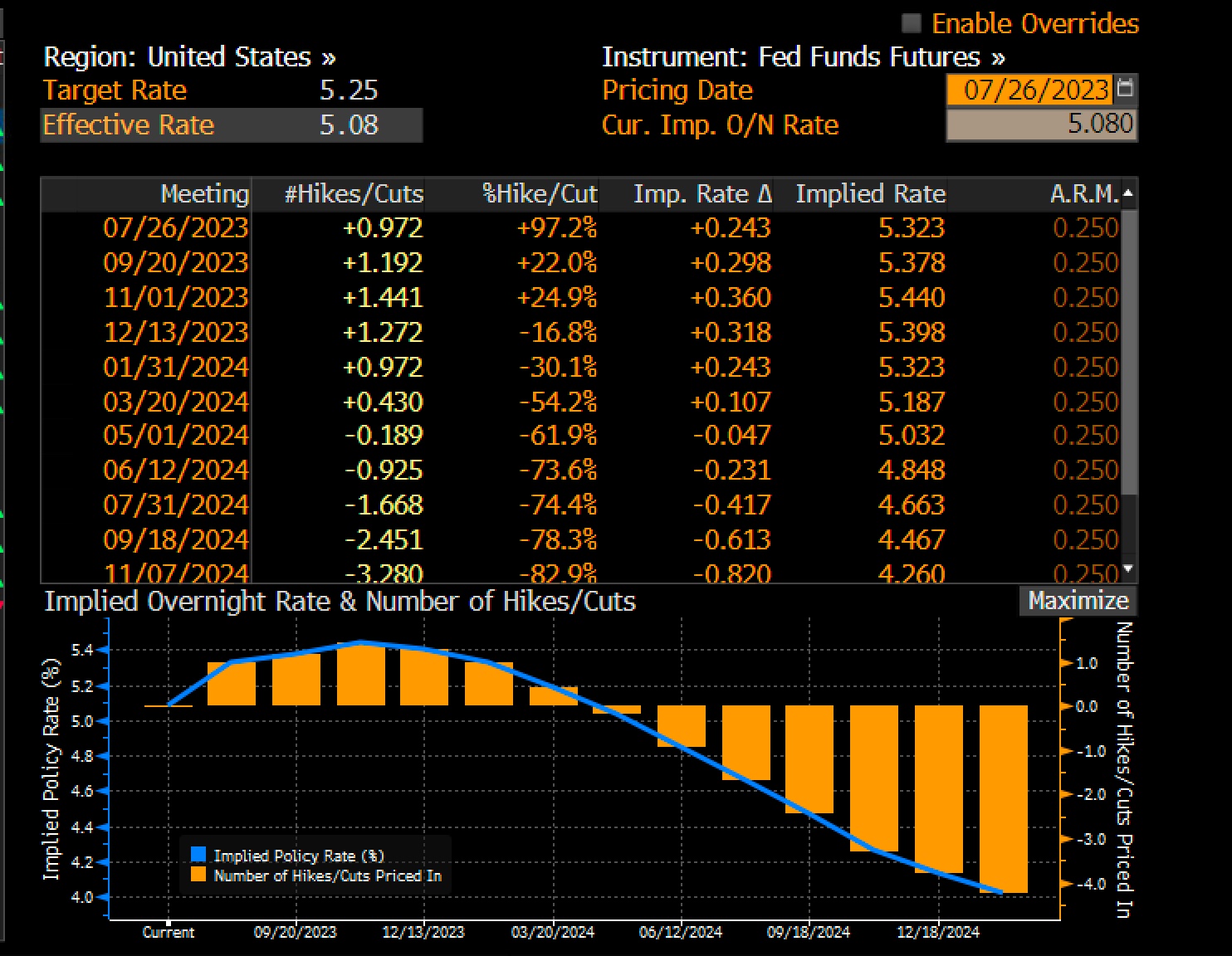
Well, it’s Fed Day so all focus will be there until this afternoon at 2:00 when the Statement is released and then, probably more importantly, at 2:30 when Chairman Powell begins his press conference.  Under the guise of a picture is worth a thousand words, I believe the next two charts, both unadulterated from Bloomberg are very effective at describing the current market expectations.  The first is a tabular and graphic depiction of the Fed funds futures market over the next year, which shows that today’s hike is fully priced in, and then there is a just under 50% probability of a hike either September or November.  After that, though, the market is convinced that Fed funds are going to fall, with more than 100 basis points of decline priced in through 2024.

Now, compare that to the second chart, the Dot Plot from the June FOMC meeting:

In truth, the two curves look pretty similar with perhaps the biggest difference the Fed’s current belief that they will absolutely hike twice before the end of 2023 rather than simply a 50% probability of such.  So, can we just assume this is the way things are going to be?  After all, if markets and the Fed agree on the same outcome, it seems likely to be realized, no?

Alas, this is where the narrative is based on crystal balls, not on data.  Whether it is the punditry or the Fed (or the FX Poet), nobody knows how things are actually going to play out.  One of the things that seems to be a throwaway line by every Fed speaker but is actually the most important part of the commentary is that their views are based on, ‘if the economy evolves as we expect it to.’  The problem is that the history of Fed prognostications is awful. 

Obviously, the most recent glaring error was the ‘inflation is transitory’ narrative that they peddled for a year while inflation was rising sharply for many very clear reasons.  Why we should think that their modelling prowess has improved since then is beyond me.  I have often opined that the problem for the Fed is that every one of their models is broken since they don’t accurately reflect the economy, not even a little bit.  Add to that the underlying premise which is that inflation is naturally at 2% and will head back there on its own, something with exactly zero empirical or theoretical support, and you have a recipe for policy errors.  

The latest policy error was the transitory delay, but perhaps the bigger problem for the Fed is the potential for a relatively unprecedented set of economic variables with higher than target inflation combined with slow economic activity yet low unemployment (due to the shrinkage of the labor force.). I don’t think their playbook has a play to address that problem and I fear that the politics of the outcome will have a disproportionate impact on any policies they implement.  If there is one thing of which we can be sure, it is that political solutions to economic problems are the worst kind with the longest-term negative impacts.  

It is for this reason that Powell’s press conference is so widely anticipated as that is where we will learn any new information.  But until then, I expect that markets will remain relatively benign.

A quick tour of the overnight session shows that there was no follow through to Monday night’s Chinese equity performance with the main exchanges in China and Japan all modestly lower.  Europe, however, is having a much tougher time this morning with the CAC (-2.0%) leading the way lower as concerns seem to be growing over the ongoing central bank tightening policies continuing into a recession.  There was vanishingly little data and no commentary of note, but we have seen some weaker than expected earnings numbers out of the continent, a sign that not all is well.  As to US futures, they are essentially unchanged at this hour (8:00) as investors await this afternoon’s Fed meeting.  I would be remiss, though, not to point out that there were several worse than expected earnings numbers, notably from Microsoft, which is a chink in the armor of the idea of infinite growth for AI.

Meanwhile, bond markets are under pressure in Europe with yields higher across the board there, on the order of 2.5bps to 3.5bps.  This appears to be a move based on expectations of continuing higher interest rates from the ECB.  Treasury yields, though, are unchanged on the day, and at 3.88%, currently sit right in the middle of the trading range we have seen for 2023.  As to JGB yields, they slipped 2bps last night with limited concern that Ueda-san is going to rock the boat tomorrow night.

Oil prices (-1.0%) are a bit softer, but this looks like a trading correction after a strong run higher rather than a fundamentally based story.  Base metals are also softer this morning as the Chinese inspired euphoria seems to have dissipated quickly while gold (+0.4%) is creeping higher despite rising yields and a modestly firmer dollar.  It appears to me there is an underlying bid to the yellow metal that will not go away regardless of the macro situation.

Finally, the dollar is slightly firmer this morning as risk aversion seems to be supporting the greenback.  JPY (+0.35%) is the G10 outlier on the plus side with the commodity bloc under the most pressure (AUD -0.7%, NOK -0.7%, SEK -0.5%).  In the emerging markets, THB (+0.7%) has been the best performer after a surprisingly positive Trade Balance with a large negative one anticipated.  However, the rest of the EMG space is mixed with some very weak currencies (HUF -1.0%, ZAR -0.9%) and some other modestly strong ones (BRL +0.4%, MYR +0.3%).  The forint story continues to revolve around central bank activity, with concerns they will ease policy with inflation still high, while the rand is simply suffering from its commodity basis.  Meanwhile, the real jumped after Fitch upgraded the country’s debt rating BB (stable) from BB-.

Ahead of the FOMC decision, we see New Home Sales (exp 725K) but that will be a nonevent given the afternoon’s agenda.  It is a fool’s errand to try to anticipate exactly how Powell will respond to the questions he receives, or even exactly how they will phrase their current views.  As such, today is one to watch and wait, then evaluate afterwards.

Good luck

Adf

Finding a Cure

Apparently President Xi
Is keen to continue to be
The story du jour
While finding a cure
For China and its ‘conomy

But elsewhere, the market’s fixation
Is central bank communication
Tomorrow, Chair Jay
Seems likely to say
They’ve not yet defeated inflation

The story in China continues to be one of weakening economic activity and a government that is increasingly desperate to address the situation while maintaining their iron grip on everything that occurs in the country.  Of course, the problem with this thesis is that economic activity works far better without government interference, but that is the bed they have made.  At any rate, the word out of the CCP’s Politburo is that more support is coming with expectations now for lower interest rates as well as still looser property investment policies.  While it seems they don’t want to make direct cash injections into the economy yet, that appears to be the next step.

However, the announcements last night were sufficient for a bullish slant on everything China along with positive knock-on effects for those nations that are heavily reliant on a strong China for their own economic progress.  The result is that we saw dramatic strength in Chinese equity markets with the Hang Seng (+4.1%) and CSI (+2.9%) both having their best days in months.  Even with these moves, though, the Hang Seng remains more than 37% below its 2021 highs while the CSI is about 34% off those levels.  The point is that while last night’s session was quite positive, belief in the Chinese economic story remains a bit suspect yet.

Elsewhere, however, the PBOC is doing its level best to prevent the renminbi from declining sharply as they set the fix nearly 1% stronger than expected based on analysts’ models, and ultimately, the currency closed 0.6% stronger on the session.  Now, it remains well above the 7.00 level, but it seems quite clear that Pan Gongsheng, the freshly appointed PBOC governor, is making a statement that the renminbi should not fall dramatically.  I suspect that if the Chinese economy continues to flounder, that attitude may change, but for now, that is the party line.  As such, it should be no surprise that the rest of the APAC currency bloc performed well last night, along with AUD (+0.3%) the best G10 performer.

But away from that story, the market’s attention is turning almost entirely to the trio of central bank meetings that are starting with announcements due tomorrow afternoon (Fed), Thursday morning (ECB), and Thursday night late (BOJ).  Let us begin with the Fed, where the meeting commences shortly, and they are set to discuss the current situation in the economy as well as how things have changed since their June meeting and what their forecasts for the future look like.  

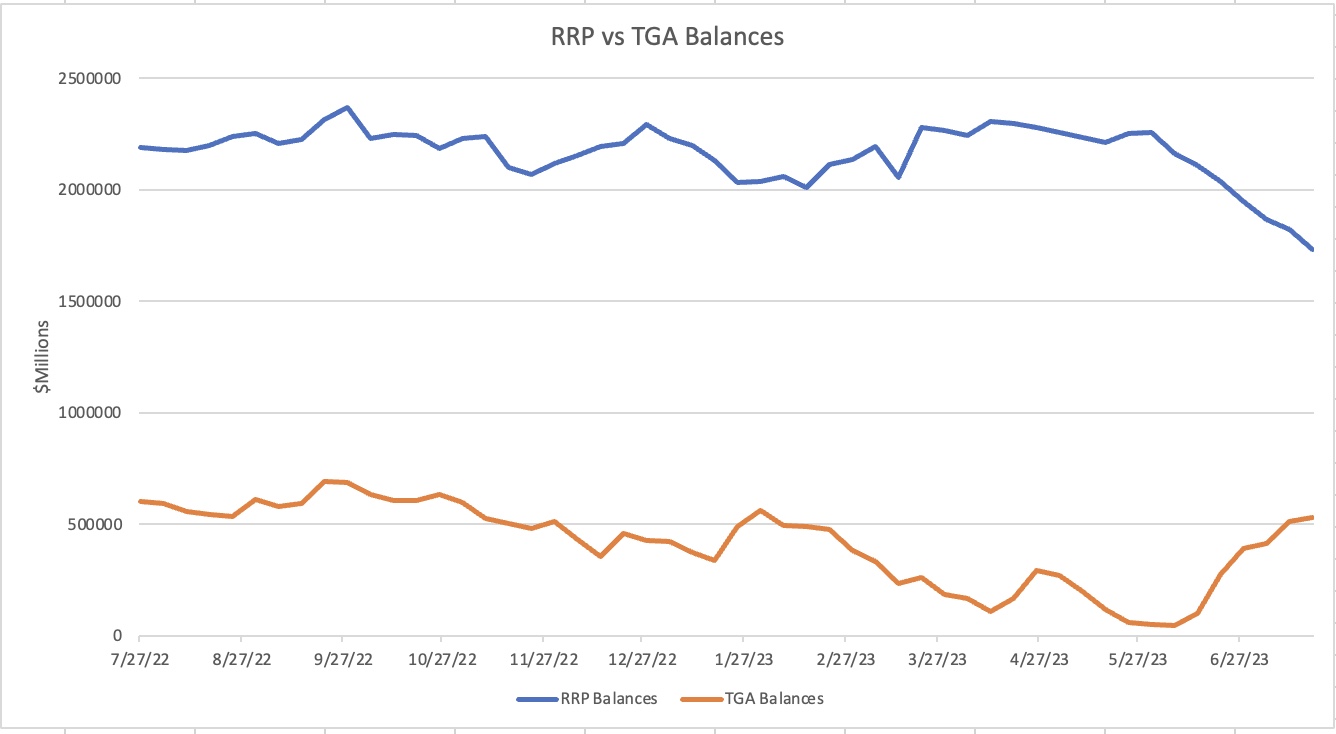
One area that is worth discussing is the Fed’s Reverse Repurchase Program (RRP or reverse repo) which serves as a low-risk investment outlet for excess funds in the system.  Prior to the debt ceiling crisis, there was a great deal of concern that when the Treasury started to issue T-bills to refill the Treasury General Account, the government’s checking account, the liquidity to buy those bills might come out of the stock market and undermine the stock market rally.  But there was another potential source, the RRP program, which prior to the debt deal had more than $2.3 trillion parked, mostly cash held by Money market funds.  However, since the TGA bottomed at the end of May, and the Treasury has been issuing T-bills at a record rate, it turns out that the entire TGA balance has been filled by a reduction in RRP.  In other words, there has been no liquidity drain from the markets, writ large, hence the equity markets continued ability to rally.  That amount has been approximately $500 Billion.  (See chart below with data from Bloomberg and the poet’s calculations)

Of course, there is a cost to this, and that is that the Treasury has been paying a higher yield on T-bills than those money market funds could get in the RRP market, and that, my friends, is adding to the already gargantuan budget deficit.  Since the start of this process, 3mo T-bill yields have risen 50bps, right alongside the Fed funds rate.  In essence, the Treasury is paying to keep the stock market higher.  

There is another short-dated money issue and that is Interest on Reserves, the rate the Fed pays banks for excess reserves that are held at the Fed.  That is currently set at 5.15%, between the Fed’s 5.00% to 5.25% band for Fed funds.  One subtle tweak the Fed could make is to alter that relative level when they raise rates tomorrow in an attempt to adjust the amount that is held there.  After all, other uses for those funds could be satisfying loan demand assuming that existed.  Arguably, a lowering of that rate would imply the Fed is seeking fewer excess reserves in the system, somewhat of a tightening exercise.  

At this stage, the 25bp rate hike is baked in the cake and is assumed by virtually every analyst with just 5 of the 108 analysts surveyed by Bloomberg calling for no hike.  Futures markets are pricing a 97% probability as well, so the reality is that all the action will be in the press conference as well as any new tweaks to the statement.  In my view, there has not yet been enough evidence of a considered slowing in inflation for the Fed to change its tune, but by the September meeting, we will have seen a lot more data and depending on how that plays out, things could be different.  But not this month.

Heading into this morning’s session, that Chinese stock rally was not really widely followed elsewhere as the Nikkei was unchanged and most of Europe is higher by just basis points.  That minimal movement is true in US futures as well.

Bond yields are a touch firmer, about 2bps across Treasuries and virtually the entire European space with only Italy (+4bps) an outlier.  The only data of note was the German IFO report, which was on the soft side, but not dramatically so.  I suspect that the yield move is in anticipation of the coming central bank activities.

In the commodity space, after another rally yesterday, oil is essentially unchanged and consolidating its recent gains.  However, the base metals have rallied sharply on the back of the China news with copper higher by almost 2% and aluminum by 1%.  Meanwhile, gold continues to trade in a very narrow range just below $2000/oz.

Finally, the dollar is slightly firmer this morning overall as the China story did not bleed over into any other areas and traders seem to be adjusting positions ahead of the Fed meeting.  Surprisingly, NOK (-0.6%) is the worst performer despite oil’s recent gains, but elsewhere, in both the G10 and EMG, it is modest dollar strength around.

This morning we see Case Shiller Home Prices (exp -2.35%) and then the Consumer Confidence reading (112.0) although typically, these do not move markets.  With no Fed speakers, the ongoing earnings calendar is likely to be the key driver of markets, although it is not until later this week when we hear from some of the Megacap names that people are getting excited.  I suspect there will be little net movement today ahead of tomorrow’s FOMC announcements.

Good luck

Adf

Quite a Surprise

While many are looking ahead
To Europe, Japan and the Fed
Today’s PMI’s
Were quite a surprise
As weakness was truly widespread

Meanwhile, from Beijing, what we heard
Was policies they now preferred
Included support
For housing to thwart
The story that weakness occurred

While most market participants are anxiously awaiting this week’s central bank meetings for the next steps in monetary policy by the big 3 (Fed, ECB & BOJ), we did see a bit of surprising news from two sources this morning which has led to some market reactions.  The first thing to note was that the Chinese remain very disappointed that they cannot will their economy to grow faster in isolation and so have announced yet another round of policies intended to foster economic growth.  

The key plank of this policy is to further relax property investment rules, the so-called three red lines from several years ago, in order to encourage people to start buying houses again.  The property slump in China was first recognized when China Evergrande, one of the largest property development companies in the country, started down its road to bankruptcy nearly 2 years ago.  Since then, it has been a slow-motion train wreck with many more firms needing to halt debt payments, restructure debt and even go out of business.  Naturally, this didn’t sit well with the Chinese government, especially since property was a key part of the social safety net.  (Chinese families bought property as a nest egg investment since price appreciation had been so strong for so long.  Price declines have scared new investment away at the same time that many families need to cash in on their investment, adding further downward pressure to the housing market.)

The other main plank of this policy change was a renewed effort to deal with local government debt.  Historically, local governments would issue debt to fund economic investment and would repay that debt by selling property to investors and home buyers.  But with the property market in such a slump, these local governments no longer have the cash flow available to stay current on the debt, let alone repay it.  As such, the Chinese government is going to step into the market and restructure the debt in some manner with simple restructuring on the table as well as debt-swaps, where I assume debt holders will wind up with equity ownership of some extremely illiquid assets.  Neither of these things points to economic strength in China so I would continue to look for further measures as well as more direct fiscal support as we go forward.  As well, although CNY is little changed today, do not be surprised to see it continue its weakening trend.

The other major news this morning came from the Flash PMI data across Europe, which was, in a word, putrid.  While the initial data overnight from Australia and Japan was a bit soft, the continent redefined weakness.  Manufacturing remains mired in a serious recession in Europe as evidenced by Germany’s 38.8 reading, far below expectations and the second lowest print in the series, exceeded only by the Covid lows in April 2020.  But the weakness was widespread with France (44.5) underperforming expectations and the Eurozone as a whole (42.7) even worse.  Services data, while better than Manufacturing is also softening, and the Composite readings show are sub 50 across the board.  UK data was also soft, just not quite as awful, but the general takeaway is growth is slowing in the Eurozone and the UK.

Later this morning we see the US numbers (exp 46.2 Mfg, 54.0 Sevices) as well as the Chicago Fed National Activity Index (exp -0.13), which will help flesh out the story of US economic activity as well.  But the big picture remains that economic activity around the world is suffering, of that we can be sure.

And yet, despite this weakening growth story, expectations for rate hikes by both the Fed and ECB remain a virtual lock although the BOJ seems likely to remain on hold for a while yet.  We will delve into the central banking story tomorrow though.  For today, markets continue to respond to the PMI data as well as the China story.

And how have they reacted you may ask?  Well, starting in Asia, Chinese shares did not seem to like the announcements coming from Beijing as both the Hang Seng (-2.1%) and CSI (-0.45%) suffered although the Nikkei (+1.25%) embraced the idea that the BOJ was going to continue to print as much money as possible.  It should be no surprise that European bourses are in the red after that data with a particular note for Spain (-0.8%) which is also dealing with an election outcome that seems destined to result in another hung parliament.  But don’t worry, US futures continue to point to modest gains at this hour (8:00) although that remains highly earnings dependent I believe.

In the bond market, yields are lower across the board with Treasuries (-3.3bps) that laggard as virtually all the European sovereigns have seen yields slide by 6bps or so.  Apparently, the European investment community is not willing to believe the ECB will continue to raise interest rates into a very obvious recession on the continent.  We shall see if they do so.  As to JGB’s, they saw yields rise 2.4bps, but are still not too close to the YCC cap.  I expect that we will see a little more volatility in the JGB market ahead of Friday’s BOJ announcement as speculators try to get ahead of any potential policy change.

In the commodity space, oil (+0.75%) continues its recent winning ways and is up more than 11% in the past month.  Given the economic news, this has to be a supply driven story.  I have written many times about the structural deficit in oil that we are likely to face given the ESG movement’s systematic underinvestment in oil production.  The problem is that even with a recession, oil demand continues to grow and even the IEA, a complete convert to ESG and net-zero ideas, admits that oil demand will grow to a new record this year in excess of 102 million bbl/day globally.  Rising demand and static or falling supply will drive prices higher, that much is clear.  The base metals are under a bit of pressure, though, this morning, responding as would be expected to the weaker economic story and gold (+0.3%) continues to find support, arguably today on the basis of lower yields around the world.

Finally, the dollar is mixed, although I would argue leaning slightly stronger today.  The worst performer is CZK (-0.8%) which is suffering from weakness in its largest export market, Germany, as well as continuing to respond to central bank comments from late last week about policy ease.  On the flip side, ZAR (+0.7%) as there is a growing influx of investment into rand bonds given the huge yield advantage.  In the G10, JPY (+0.45%) is today’s leader, although if the BOJ stands pat, I have to believe that further weakness is in the future.  Meanwhile, EUR (-0.3%) is the laggard on the back of that terrible PMI data.

There is a lot of data out there this week in addition to the 3 big central bank meetings.

Today	Chicago Fed National Activity	-0.13
Tuesday	Case Shiller Home Prices	-2.40%
	Consumer Confidence	112.0
	Richmond Fed	-10
Wednesday	New Home Sales	725K
	FOMC Decision	5.50% (current 5.25%)
Thursday	ECB Decision	3.75% (current 3.50%)
	Initial Claims	235K
	Continuing Claims	1750K
	GDP Q2 (2nd look)	1.8%
	Durable Goods	1.0%
	-ex Transport	0.1%
Friday	BOJ Decision	-0.1% (current -0.1%)
	Personal Income	0.5%
	Personal Spending	0.4%
	Core PCE Deflator	0.2% (4.2% Y/Y)
	Michigan Sentiment	72.6
Source: Bloomberg

Obviously, there is plenty of information to be gleaned this week, although there are no scheduled Fed speakers after the meeting and press conference on Wednesday.  I guess they are all going on vacation!  

My read on the current situation is that economic activity continues to slow, although perhaps not yet to a recessionary level.  As well, I fear that inflationary pressures will remain stickier than we would like and that for now, the Fed is not feeling any pressure to end their current higher for longer policy.  In fact, it will be next week’s NFP data that is the first really critical release, as a weak number there will start to give weight to the idea that the terminal rate has been reached.  However, if we see strength in job growth, pencil in at least one more hike past Wednesday.  As to the dollar, I am confident that if the US is ending their tightening cycle, the other major central banks will be ending theirs soon as well.  I see no dollar collapse, nor even significant weakness for quite a while yet.

Good luck
Adf


Truly Mind-Blowing

Officials see no
Urgency to rock the boat
YCC ‘s still law

As reported in numerous places overnight, the BOJ has let slip that they are not considering any changes to the current policy mix at their meeting next week.  You may recall that there has been an uptick in discussion about the ongoing review that began just last month and the idea that Ueda-san was preparing to tweak YCC or to end YCC or something else.  That has been a key driving force in the recent rise in JGB yields, which had climbed 10bps, to as high as 0.47%, during July.  Short JPY positions in the currency market were getting covered in waves and we saw the yen strengthen more than 5% in the first two weeks of July.

This was all part of the narrative of the dollar’s imminent decline and used in conjunction with the rising de-dollarization narrative as part of a new world order type of argument.  Nobody wanted to hold dollars, and this was the proof!  

Oops!  Maybe this narrative will need to be tweaked a bit as not only has the BOJ thrown a serious amount of cold water on the changing YCC story, with JGB yields slipping a further 2.5bps last night, but this morning we were also treated to a story about India’s Foreign Minister explaining the country will not support any common BRICS currency for trade.  There is no doubt that Russia and China would like to see the dollar lose its global hegemonic status, but wishes are just that.  Do not dismiss the dollar at any time in the near future, it is not going to lose its current status.  However, that doesn’t mean it will stop fluctuating in FX markets, those are two different things.

There once was a great big recession
Forecast by the ‘nomics profession
The Fed had raised rates
For thirteen straight dates
And so, growth seemed out of the question

But so far the data is showing
The ‘cononmy’s seems to be growing
With joblessness sinking
Quite many are thinking
No landing.  It’s truly mind-blowing

Aside from the yen news, the market continues to try to understand the current economic cycle, which is clearly not very similar to any cycle in recent memory.  Every day I read things from very accomplished analysts about the imminent decline in the US economy and how the Fed will be forced to eat crow soon enough.  As well, if I scroll a bit further down my Fintwit feed, I find different accomplished analysts who explain that the no landing scenario is the best estimate and that the economy is on solid footing with inflation declining smoothly and heading back to its “natural” spot of 2%.  

And in fairness, one can slice the data up in many different ways to draw both conclusions.  One of the most interesting features of this situation is how different asset classes are concluding very different things from the data.  Broadly speaking, the US equity market is all-in on the no-landing scenario, trading higher almost every day (yesterday’s NASDAQ performance excepted and due to some weaker than expected earnings numbers), while the commodity space is far more circumspect over continued growth with base metals, especially, under broad pressure for the past several months.  Given the importance of copper and aluminum in the industrial process for almost every manufactured item, the pricing certainly indicates anticipated weakness in demand.  We know this because there is no excess supply on the way.

As to the bond market, I fear that the signal-to-noise ratio from bond yields has greatly diminished during the period of QE.  I am not one to easily dismiss the recession signal from the inverted yield curve, and as we currently sit at -100bps for the 2yr-10yr curve and -160bps for the 3m-10yr, both extremely large inversions, it is easy to conclude that a recession is on its way.  

But consider, if you look at all the recessions that are used as the basis for the strength of this signal, only the Covid recession occurred after the Fed began its QE program in 2009.  Prior to the GFC, the Fed just never held very many long-term Treasury bonds and $0.00 of mortgage-backed securities on its balance sheet.  It is not hard to believe that the Fed has substantially distorted the yield curve for the past 14 years, driving long-term rates far lower than they otherwise would have been based on economic conditions.  What would 10-year Treasury yields look like if the Fed didn’t own the ~$7.25 trillion of long-dated paper that currently sits on the balance sheet?  I suggest 10-year yields would be A LOT higher.  100bps?  Maybe.  Maybe more, maybe less, but 10-year yields are not really telling us that investors believe the economy is going to slow down.  Rather, I might suggest they are telling us that many players are bidding for bonds because they must for regulatory reasons (banks and insurance companies) and that there isn’t as much supply available as the gross issuance would indicate.

But, keeping that in mind, the data that gets released regularly continues to confuse.  For instance, yesterday saw Initial Claims data fall further, back to 228K and below all forecasts.  The rising trend that we had seen a few months ago seems to be reversing.  At the same time, the Philly Fed data was weaker than expected at -13.5 and Existing Home Sales fell to 4.16M.  Finally, Leading Indicators printed at -0.7%, a tick worse than forecast and the 15th consecutive negative reading of this indicator.  So, which is it?  Employment strength means growth?  Or weakening manufacturing and housing points to weakness?  As I wrote earlier this week, we need a new term to describe the current economy, as recession in the traditional view doesn’t seem right, but growth remains lackluster at best with parts of the economy, notably manufacturing, seemingly in contraction.

Well, as we head into the weekend, that is a lot to consider, and perhaps inspiration will strike and we will all understand things on Monday.  Just don’t count on it!  Meanwhile, ending the week, equities are kind of unhappy, with the Nikkei not taking kindly to the BOJ talk and probably a few more losers than gainers in Asia.  That same sentiment prevails in Europe, with both gainers and losers but leaning toward negative while US futures are bouncing from yesterday’s declines.
Bond yields are drifting a bit lower this morning, but only on the order of 1bp-2bps in the US and Europe, although Gilt yields have risen 2bps on the back of much stronger than expected UK Retail Sales data released today.  We’ve already discussed JGB’s, and I expect those yields to grind lower from here along with the yen.

Oil, however, has continued its recent strong performance, up 1.2% this morning on supply concerns as there were larger than expected draws on inventories this week.  Meanwhile, gold (-0.2%) is edging lower as the dollar regains its footing.  Today, copper and aluminum are both a bit firmer, but their recent trend continues downward.

Finally, the dollar is definitely in fine fettle this morning, rallying against all its G10 counterparts except NOK (+0.4%) which is obviously benefitting from oil’s rally.  The yen (-1.15%) is the laggard, which given the BOJ news, is no surprise.  Meanwhile, in the EMG space, it is a sea of red with THB (-1.3%) the worst performer followed by KRW (-1.1%) and TWD (-0.5%).  The baht saw a setback with the ongoing political machinations as hopes for a new government have been delayed, if not dashed, while the won saw its exports fall sharply as Chinese economic activity slows.  Taiwan is feeling the same effects as South Korea in that regard.

And that’s really it for today.  There is no data nor any speakers on the calendar, so the dollar seems likely to simply follow today’s sentiment which, given its weakness over the past several sessions, is likely to see more short covering and potentially a bit more strength.

Good luck and good weekend
Adf


The Citizen’s Pain

Last night, t’was Australia that showed
Employment growth had not yet slowed
And so, please expect
The central bank sect
To keep on the rate hiking road

They’ll not be content til they’ve slain
Inflation, and end this campaign
Yet, if all along
Their thesis is wrong
They’ll ne’er feel the citizen’s pain

On a very slow day in the markets, the most noteworthy news came from Down Under, where the Unemployment Rate fell back to 3.5% in a bit of a surprise while job growth continued at a speedier pace than analysts forecasted.  The market response was immediate with the Aussie dollar jumping sharply and it is now higher by 1.0% on the session, the leading gainer across all currencies, G10 or EMG today.  The rationale for the move is quite straightforward as market participants simply expect the RBA to maintain tighter policy than previously expected.  In the OIS market, the probability of a rate hike at the next RBA meeting on August 1st rose to 48% from just 27% prior to the release.  And correspondingly, Australian government bond yields jumped more than 8bps on the news.

Ultimately, the question that must be addressed is, does strong employment growth lead to higher prices overall?  As my good friend @inflation_guy has said consistently, we should all be ecstatic to have a wage-price spiral as the implication is prices rise AFTER our wages rise, so we are always ahead of the curve.  But we all know, and it has been made abundantly clear in this cycle, that wages follow prices higher.  One need only look at how prices continue to rise on a much more continuous basis than your salaries to see this clearly.  

However, this is gospel in the central banking sect of economists, that tight labor markets drive the general price level higher.  You may have heard of the Phillips Curve, which was a study done in 1958 regarding the relationship between the price of labor (i.e. wages) and the unemployment rate in the UK from 1861-1957.  William Phillips was the New Zealand economist who performed the analysis and basically it confirmed what we all learned in Economics 101, reduced supply of labor drove up wages while an increased supply of labor pushed wages lower.  Nowhere in the study did it discuss the general price level.  That came later with a litany of big name economists, finally with Milton Friedman explaining that in the long-run, there was no relation between wages and inflation, although on a short-term basis, it could evolve.

As so often happens in today’s world, it was easier to take the short-cut view, and that had an intuitive appeal, hence the current central bank mantra of we must bring wage growth down.  (Will they ever get concerned over bringing money growth down?  I fear not.).  At any rate, this is the widely accepted view of the world and so whatever its structural merits, when employment data shows a tighter labor market, the market response is to expect higher policy interest rates.  This was the story last night, hence the Aussie’s rally along with yields Down Under, and this has been the story consistently since the beginning of 2022, when global central banks embarked on the current round of policy tightening.  This is also why we consistently hear Chairman Powell explain that in order for the Fed to reach its 2% inflation target, there will need to be some pain, i.e. people need to lose their jobs.

But away from that, there has been very little of note ongoing.  Equity markets in Asia were unable to match yesterday’s modest gains in the US, with the Nikkei (-1.25%) the laggard of the bunch.  European bourses, however, have had a better go of it, with most of them higher on the order of 0.4% although Sweden’s OMX is down nearly -1.0% on the session bucking the trend.  US futures this morning are softer as there were several weaker than expected earnings numbers overnight including Netflix and Tesla.

In the bond market, Treasury yields have moved higher by 3bps this morning in the 10-year space, but even more in the 2-year space as the yield curve inversion gets deeper, now back above -101bps.  However, European sovereign bonds are little changed on the day with no data of note and the market trying to determine just how hawkish/dovish the ECB will be one week from today.  As to JGBs, their yields have stopped rising and they remain 5bps below the cap.  Do not expect any BOJ action next week.

Oil prices are a touch higher after a lackluster session yesterday, but remain above the key $75/bbl level.  Meanwhile, gold (+0.25%) continues to edge higher and is once again closing in on $2000/oz despite obvious catalysts or lower US interest rates.  As to the base metals, both copper and aluminum are nicely higher this morning as the entire commodity comlex is feeling some love.

Finally, the dollar is under pressure as not only is AUD firmer, but also NOK (+1.1%) on the back of oil’s gains, and virtually the entire bloc except for the pound (-0.3%) which still seems to be suffering from yesterday’s inflation data.  In the EMG bloc, CNY (+0.8%) is the leading gainer, a surprising outcome given its generally managed low volatility, but the fact that the PBOC did NOT reduce the Loan Prime Rate last night, in either the 1-year of 5-year term, was a bit of a surprise to the market as there is a growing belief the Chinese government will be adding more stimulus to a clearly slowing economy there.    But in this bloc, there are also a number of laggards with MXN (-0.4%) the worst of the bunch on what appears to be some profit-taking as traders start to position for the first rate cut since October 2020.

On the data front, yesterday’s housing data in the US was soft, with downward revisions to the previous month’s numbers.  This morning we see Initial (exp 240K) and Continuing (1722K) Claims as well as Philly Fed (-10.0), Existing Home Sales (4.20M) and Leading Indicators (-0.6%), the last of which have been pointing to recession for nearly a year.  However, once again, I expect the dollar will be beholden to the equity markets as none of these data points are likely to move the needle ahead of the FOMC next week.

For now, I think choppy price action is the likely outcome until we get more clarity from Powell and the Fed, as well as Lagarde and the ECB next week.  Who will be the most hawkish?  That is the $64 billion question.

Good luck
Adf

A Bad Dream

The narrative’s gaining more steam
With landings, so soft, the new theme
In England today
They’re trying to say
Inflation was just a bad dream

The problem is that on the ground,
In Scotland and Wales and around,
Is incomes keep lagging
With purchases sagging
Which pressures the Great British pound

The biggest story of the morning has clearly been the UK inflation data which saw CPI fall back below 8.0% Y/Y for the first time in more than a year.  Granted, 7.9% is not that far below 8% and certainly still miles above the BOE target, but the decline was substantially more than had been expected by the analyst community as well as the market.  For instance, 10-year Gilt yields have tumbled -17.5bps and are now lower by 50bps since the peak two weeks’ ago and back to their lowest level since early June.  2-year Gilt yields have fallen even further, -25bps, so the market is really quite positive on this outcome.

It should be no surprise that UK equity markets have rallied as well, with the FTSE 100 the leading gainer in Europe, up 1.5%, nor should it be a surprise that the pound has fallen sharply, -1.0%, as traders re-evaluate the idea about just how much the BOE is going to raise rates going forward.  Prior to this release, the OIS market had been pricing in a terminal interest rate at 6.1%, implying at least 4 more rate hikes by the BOE.  But this morning, traders have removed one of those hikes from the curve and the excitement over further potential declines is palpable.

Now, the inflation news in Europe is not all rosy as the final release on the continent showed that core CPI turned out to be a tick higher at 5.5% in June, clearly an unwelcome result.  And remember, it was just yesterday that we heard from Klaas Knot implying that while a hike next week is a given, nothing is certain past that.  So, the question, currently, is will the ECB look through a revision to continue their more dovish stance?  I guess we’ll find out next week.  

But here’s an interesting tidbit regarding Europe, and something you need to consider when it comes to both investments and market outcomes there, electricity demand is falling there amid deindustrialization on the continent.  The IEA just issued their latest Electricity Market Report and the reading was not pleasant for Europe.  Consider that in the US, the combination of reshoring and the impact of the (ironically named) Inflation Reduction Act, as well as the CHIPS Act, has driven a marked increase in industrialization in the US.  Meanwhile, in Europe, the loss of their cheap energy from Russia combined with their climate goals has resulted in industry fleeing the continent.  For everyone who is long-term bearish the dollar, you better be far more bearish the euro given this new reality.  Remember, energy consumption is the mark of a growing and healthy economy.  When it is declining, absent extraordinary productivity/efficiency gains, it bodes ill.  If anything, the increasing reliance on less dense energy sources like wind and solar just reduces energy efficiency.  Be wary.

But, away from that news, things are a bit more confusing.  For instance, virtually all European bourses are higher this morning, albeit not as much as the FTSE 100, but in Asia, while the Nikkei (+1.25%) had a good session, Chinese equities were under pressure.  Yes, US markets yesterday continued their rally as earnings data has been able to beat the much-reduced estimates although futures this morning are essentially unchanged.  But arguably, we can describe the equity picture as risk-on.  

The same cannot be said for the bond market though, where yields have fallen everywhere, again, just not as much as in the UK.  Treasury yields are down another 2bps, and most European sovereigns are also seeing modest yield declines, not the typical risk-on behavior.  In fact, given the Eurozone CPI release, it would not have been surprising to see yields climb a bit.

As to the commodity space, oil is essentially unchanged on the day, but WTI is back above $75/bbl with Brent right at $80/bbl after several strong sessions.  There has definitely been a renewed focus on the bullish supply story in oil as opposed to the recession discussion of late.  At the same time, gold (-0.3%) which has rallied nicely during the past week, up nearly 2%, is holding the bulk of its gains.  Alas, the base metals continue to lag, with both copper and aluminum softer on the day.  Perhaps they didn’t get the bullish memo!

Finally, the dollar is quite robust this morning, which is not what one might expect given the equity and bond moves.  In fact, it is firmer vs. the entire G10, with the pound the laggard, as would be expected given the inflation data and falling UK rates.  But as well, the yen (-0.8%) is under pressure along with AUD (-0.7%) and the whole lot.  Regarding the yen, it has been rallying sharply of late, up more than 5% during July until yesterday.  That seems to be on an increasing belief that the BOJ, which meets next Friday, is going to tweak its policy in a tighter fashion, whether that involves YCC or rates or QE.  Now, these stories have not disappeared, I just think that we are seeing a bit of a breather for this move.  Remember, the yen has been the funding currency of choice for every asset all year as the BOJ remains the only central bank that hasn’t tightened policy at all.  This month appeared to be profit-taking ahead of potential BOJ activity, and last night appears to be a simple trading bounce.  FWIW, I do not believe the BOJ is ready to adjust its policy yet as the big review has just begun.  And as I have written before, it doesn’t appear that the rising inflation pressures in Japan have yet become a major political liability for PM Kishida, so there is only limited pressure to make a change.  For now, I would rather be short than long the yen.

Turning to the EMG bloc, only THB (+0.5%) is firmer this morning as the political machinations continue there in the wake of the recent election. In a nutshell, the winner of the election to replace the military junta is clearly not favored by the powers-that-be, and is being disqualified on a technicality, but another member of the coalition seems to be getting closer to taking the reins, with optimism building.  But aside from that story, the dollar is firmer vs. the entire bloc as we are seeing a solid trading bounce in the greenback after several days/weeks of weakness.

On the data front, yesterday’s Retail Sales data was disappointing, and the IP and Capacity Utilization data were awful.  Obviously, that didn’t hurt equities which remain disconnected from any macro data at this point.  This morning brings the Housing Starts (exp 1480K) and Building Permits (1500K) data, although if Retail Sales didn’t have an impact, it is hard to believe the housing data will.  

I remain uncomfortable with the equity market’s ongoing rally as I fail to see the underlying strength in the economy or earnings.  Certainly, recent dollar weakness has helped goose the stock market a bit, but I would not be surprised to see things start to turn around in the near term, meaning the dollar rebounding after its recent sell-off and the equity market seeing some profit-taking.

Good luck
Adf

A Rate Hike Boycott

Said Yellen, the job market’s cooling
Not faltering, but it’s stopped fueling
Inflation, and so
You all need to know
More rainbows are coming, no fooling!

Meanwhile, from the EU, Herr Knot
Was strangely less hawkish than thought
Inflation’s plateaued
Which opens the road
To starting a rate hike boycott

As we await today’s US Retail Sales data, and far more importantly, next week’s FOMC and ECB meetings, it seems that there is a concerted effort to talk inflation down by both the US and European governments.  For instance, yesterday, Treasury Secretary Yellen was explaining how, “the intensity of hiring demands on the part of firms has subsided.  The labor market’s cooling without there being any real distress associated with it.”  Now, I have no doubt that Secretary Yellen would dearly love that to be the case, although her proof on the subject remains scant.  Perhaps she is correct and that is the situation but given her track record regarding forecasting economic activity (abysmal while at the Fed and in her current role), I remain skeptical.  Certainly, while last month’s NFP data was slightly softer than forecast, it did not speak to a significant change in the labor market situation.

She proceeded to add how inflation was clearly coming down, although was careful to warn against reading too much into one month’s numbers, kind of like she was doing.  One thing she was not discussing was how the ongoing surge in deficit spending by the government, which she was personally overseeing, was having any impact on inflation.  Alas, history shows that there is a strong link between large deficits and rising inflation.  Maybe this time is different, but I doubt it.

But as I said, there seems to be a concerted effort to start to talk down inflation, especially as the efforts to actually address it are increasingly politically painful.  The next example comes from the Eurozone, where Klaas Knot, Dutch central bank chief and number one hawk on the ECB Governing Council suddenly changed his tune regarding a rate hike in September.  It was just a month ago, in the wake of the ECB’s last rate hike, when Madame Lagarde essentially promised a July hike, that he was on the tape explaining that a September hike was also critical and certain.  But now, his tone has changed dramatically, with comments like “[it] looks like core inflation has plateaued,” and he’s “optimistic to see inflation hitting 2% in 2024.”  

Again, maybe that outlook is correct and inflation in the Eurozone is going to come crashing down (remember, it is currently 5.4% on a core basis, far above the 2% target), but this also seems unlikely.  For instance, this morning’s headline, FRANCE TO RASE REGULATED ELECTRCITY PRICES BY 10%, would seem to be working against the idea that inflation is going to fall sharply.  In fact, one of the key reasons inflation ‘only’ rose as high as it did in the Eurozone, peaking at 10.6% last year, was that virtually every government subsidized skyrocketing energy prices for their citizens much to their national fiscal detriment.  Now that energy prices have come off the boil, they are ending those subsidies and hence, prices are rising to reflect the current reality.  So, the inflation they prevented last year will simply bleed into the statistics this year.

Politically, what makes inflation so difficult for governments is the fact that regardless of how they try to spin the situation, the population sees rising prices in their everyday lives and are unlikely to believe the spin.  However, that will not stop governments from doing their best to change attitudes via words rather than deeds.  Of course, given the prevailing Keynesian view that there is a direct tradeoff between employment and inflation, that puts politicians in a very difficult spot.  No politician is going to encourage rising unemployment just to get inflation down hence the ongoing attempts to jawbone inflation lower.  Ultimately, nothing has changed my view that inflation, as measured by CPI or PCE, is going to find a base in the 3.5%-4% area and be extremely difficult to push past those levels absent a catastrophic event.  And I certainly don’t wish for that!

But let’s take a look at how markets are responding to the renewed attempts to talk inflation lower, rather than actually push it lower.  Certainly, yesterday’s US equity performance showed no concerns over mundane issues like inflation as all 3 major indices continued to rally to new highs for the year.  Alas, there is less joy elsewhere in the world as Chinese stocks suffered along with most of Asia, although the Nikkei did eke out a small gain.  In Europe this morning, while the screen is virtually all red, the movements have been infinitesimal, on the order of -0.1% across the board.  And US futures at this hour (7:45) are showing similarly sized tiny declines.

The real news is in the bond market, which has taken this new government push to heart, and we now see yields falling across the board, in some cases quite sharply.  Treasury yields are down -4.5bps, but that pales in comparison to European sovereigns, all of which are lower by at least 7bps with Italian yields tumbling 12.5bps.  This newfound ECB dovishness is clearly a welcome relief for European governments, French electricity prices be damned.

In the commodity space, the base metals continue to signal a recession is on its way as both copper and aluminum continue to slide, but oil seems to have found a base for now, and is still higher on the month.  As to gold, it should be no surprise that it is rallying this morning, pushing back above $1960/oz as the combination of lower yields and a lower dollar are both tail winds for the barbarous relic.

Turning to the dollar, excluding the Turkish lira, which has tumbled 2.5% in anticipation of another underwhelming monetary policy response this week when the central bank meets, the rest of the EMG bloc is firmer, led by THB (+1.2%) on the combination of a broadly weaker dollar and hopes that the political stalemate in the wake of the recent election there is soon to be solved with a new candidate coming forward.  But the strength is broad-based across all 3 regions.  In the G10, NZD (-0.7%) is the only real laggard as market participants position themselves for tonight’s CPI release there with growing concerns that the central bank is not doing enough to support the currency and economy.  Otherwise, the bloc is generally firmer, albeit not dramatically so.

On the data front, Retail Sales (exp 0.5%, 0.3% ex autos) leads the way followed by IP (0.0%) and Capacity Utilization (79.5%) at 9:15.  There are still no Fed speakers, so while a big miss in Retail Sales could have an impact, I continue to expect that the equity earnings schedule is going to be the driving force in markets until the Fed meets next week.  So far, the first sets of numbers have been positive, but there is a long way to go.  

For now, the dollar remains on its heels, and I suspect that is where it will stay until next Wednesday at least.

Good luck
Adf