
Thought-Provoking

My sight is clearing
I now see the price target
Closer than you think

With monetary easing continuing, I believe we have reached a point where attainment of the 2% price stability target is finally in sight, despite uncertainty over the Japanese economy.  It is necessary to consider shifting gears from extremely powerful monetary easing … and how we should respond nimbly and flexibly toward an exit.”  So said BOJ member Hajime Takata last night at a meeting with business leaders in western Japan.  These are the strongest words we have heard, I would argue, and the market did respond with the yen strengthening (+0.5%) and now right on the 150.00 level, while 2yr JGB yields rose another basis point, up to 0.18%, and its highest level since 2011.  I always find the BOJ wording to be odd as they try to be nimble and flexible in something that doesn’t appear to offer opportunities to behave in that manner.

Regardless, this has encouraged a more hawkish take on Japan with the probability of their first rate hike occurring in March rising to 26% from a previous level in single digits.  But despite these comments, we must remember this is from a single BOJ speaker.  Unless and until we hear this tone from multiple BOJ board members, I maintain that while an April move to 0.00% is possible, movement much beyond that seems very premature.  After all, last night saw IP in Japan fall -7.5% in January which takes the Y/Y number to -1.5%.  Recall, too, that Japan is in the midst of a technical recession.  It just doesn’t seem like tightening monetary policy is the prescription for what ails that nation.

However, the Japanese story is for the future as we have already seen the initial knee-jerk reaction.  And that means that all eyes are going to be on the US data at 8:30.

So, what if Core PCE’s smoking?
It seems that might be thought-provoking
If that is the case
We’d all best embrace
The idea the bulls will start choking

The flipside’s a cool PCE
Which winds up at zero point three
If that’s the result
The stock-buying cult
Will take every offer they see

As the market awaits this morning’s PCE data, a quick recap of yesterday seems in order.  I think you can argue that the data indicated economic activity remains at quite a high pace.  While the second look at Q4 GDP was revised down a tick, it is still at 3.2%.  The sub-indices showed that prices rose a bit more than expected and that Real Consumer spending rose a better than expected 3.0%.  The other data point was the Goods Trade Balance which showed a larger than expected deficit, a sign that imports are growing faster than exports.  This is typically a growth scenario, not a recessionary one, so nothing about the data hinted at a slowdown in things.

As well, we heard from three different Fed speakers and to a (wo)man they all explained that they remain data dependent and that the total economic situation was what they were following, not simply the inflation rate.  My point is that there is no indication that they are anywhere near ready to cut rates.

Turning to this morning’s release, expectations are as follows: Headline (0.3%, 2.4% Y/Y) and Core (0.4%, 2.8% Y/Y).  As well, we do see some other important data with Personal Income (exp 0.4%), Personal Spending (0.2%), Initial Claims (210K), Continuing Claims (1874K) and Chicago PMI (48.0).  But really, it is all about PCE.

My take is things are quite binary for a miss from expectations.  A hot print, 0.5% or more, will result in a sharp risk-off session as market participants will reduce the probability of future rate cuts.  This should see both stocks and bonds sell off, while the dollar rallies.  In contrast, a 0.3% or lower print for Core PCE will see the opposite outcome with a massive equity rally along with a huge bond rally, especially the front of the curve, and I suspect that futures markets will juice the odds of a May cut again (March is off the table no matter what.)

Of course, the last choice is a release right at the consensus view.  In that case, both sides of this argument will continue to argue their points, but my take is, based on yesterday’s price action, that equities may have a bit further to correct on the downside absent some other news that encourages the idea of stronger real growth, or an increased probability of a Fed cut.  One other thing to remember is we get four more Fed speeches today and this evening, so regardless of the outcome, there will be a lot of opportunity to reinforce their views.

Heading into the data release, a quick look at the overnight session shows us that the Asian market was quite mixed with Japan very little changed, a small decline in Hong Kong, but mainland Chinese shares rose sharply (CS! 300 +1.9%) as traders are looking for the government to announce a new fiscal stimulus package after they meet next week and roll out their growth targets for the coming year.  it strikes me there is ample opportunity for disappointment here given how unwilling Xi has been to do just that.  The European picture is equally mixed with some gainers (UK and Germany) and some laggards (France and Spain) although not a huge amount of movement in either direction.  There was a lot of Eurozone data released this morning with weak German Retail Sales, slowing growth in Scandinavia, and inflation throughout the continent coming in just a touch hotter than forecasts, although still trending lower.  And, after a lackluster day yesterday, US futures are softer by -0.2% at this hour (7:00).

In the bond market, yields are rising this morning with Treasuries (+4bps) back above 4.30% and all European sovereigns rising by at least that much.  In fact, UK Gilts (+7bps) are leading the way after some slightly better than expected housing data.  10-year JGB yields also edged up by 1bp after the Takata comments, but remain far below the 1.00% level that is still seen as a YCC cap.

Oil prices are a touch softer this morning, -0.4%, after a modest gain yesterday.  The big story remains the rumors of OPEC+ continuing to restrict their production.  In the metals markets, precious metals are under modest pressure this morning, but base metals are holding their own, with aluminum leading the way higher by 0.6%.

Finally, the dollar, away from the yen, has really done very little overall.  Looking at my screen, the only currency that has moved more than 0.2% in either direction is NZD (-0.25%) which seems to be continuing yesterday’s price action after the less hawkish RBNZ meeting outcome.  Otherwise, nada.

As we await the PCE data, and the Fedspeak later in the day, the one thing to remember is that if we see a soft number and the equity market cannot hold its early gains, that would be quite a negative signal for risk assets in the near term.  There are many who believe we are in a bubble market, especially the tech sector, and certainly there are many frothy valuations there.  It would not be hard to imagine a correction happening just because.  But if a market falls on ostensibly bullish news, that correction could have a little more oomph than most would like to see.  I’m not saying this is my expectation, just that it is something to keep in mind.  As to the dollar, that remains beholden to the monetary policy choices and so far, they haven’t changed.

Good luck
Adf
Annoyed

Seems President Xi is annoyed
His stock market has been devoid
Of buyers, so he
Has banned, by decree
The strategies quant funds employed
 
But otherwise, markets are waiting
To see if inflation’s abating
The PCE print
Will give the next hint
If cuts, Jay will be advocating


Market activity remains on the quiet side of the spectrum as all eyes continue to focus on the Fed, and by extension all central banks.  As an indication, last night the RBNZ left their OCR rate on hold, as widely expected, but sounded less hawkish in their views, dramatically lowering the probability that they may need to hike rates again.  Prior to the meeting, there was a view hikes could be the case, but now, cuts are seen as the next step.  The upshot is the NZD fell -1.2% as all those bets were unwound.  One of the reasons this was so widely watched is there are some who believe that the RBNZ has actually led the cycle, not the Fed, so if hikes remained on the table there, then the Fed may follow suit.  However, at this stage, I would say all eyes are on tomorrow’s PCE print for the strongest clues of how things will evolve.

Before we discuss that, though, it is worth touching on China, where last night “unofficially” the Chinese government began explaining to hedge funds onshore that they could no longer run “Direct Market Access” (DMA) products for external clients.  This means preventing new inflows as well as winding down current portfolios.  In addition, the proprietary books using this strategy were told they could not use any leverage.  (DMA is the process by which non broker-dealers can trade directly with an exchange’s order book, bypassing the membership requirement, and in today’s world of algorithmic trading, cutting out a step in the transaction process, thus speeding things up.)  

Apparently, this was an important part of the volume of activity in China, but also had been identified as a key reason the shares in China have been declining so much lately.  Last night was no exception with the Hang Seng (-1.5%) and CSI 300 (-1.3%) both falling sharply and the small-cap CSI 1000 falling a more impressive -6.8%.  Once again, we need to ask why the CCP is so concerned about the most capitalist thing in China.  But clearly, they are.  I suppose that it has become a pride issue as how can Xi explain to the world how great China is if its stock market is collapsing and investment is flowing out of the country.  This is especially so given the opposite is happening in their greatest rival, the US. 

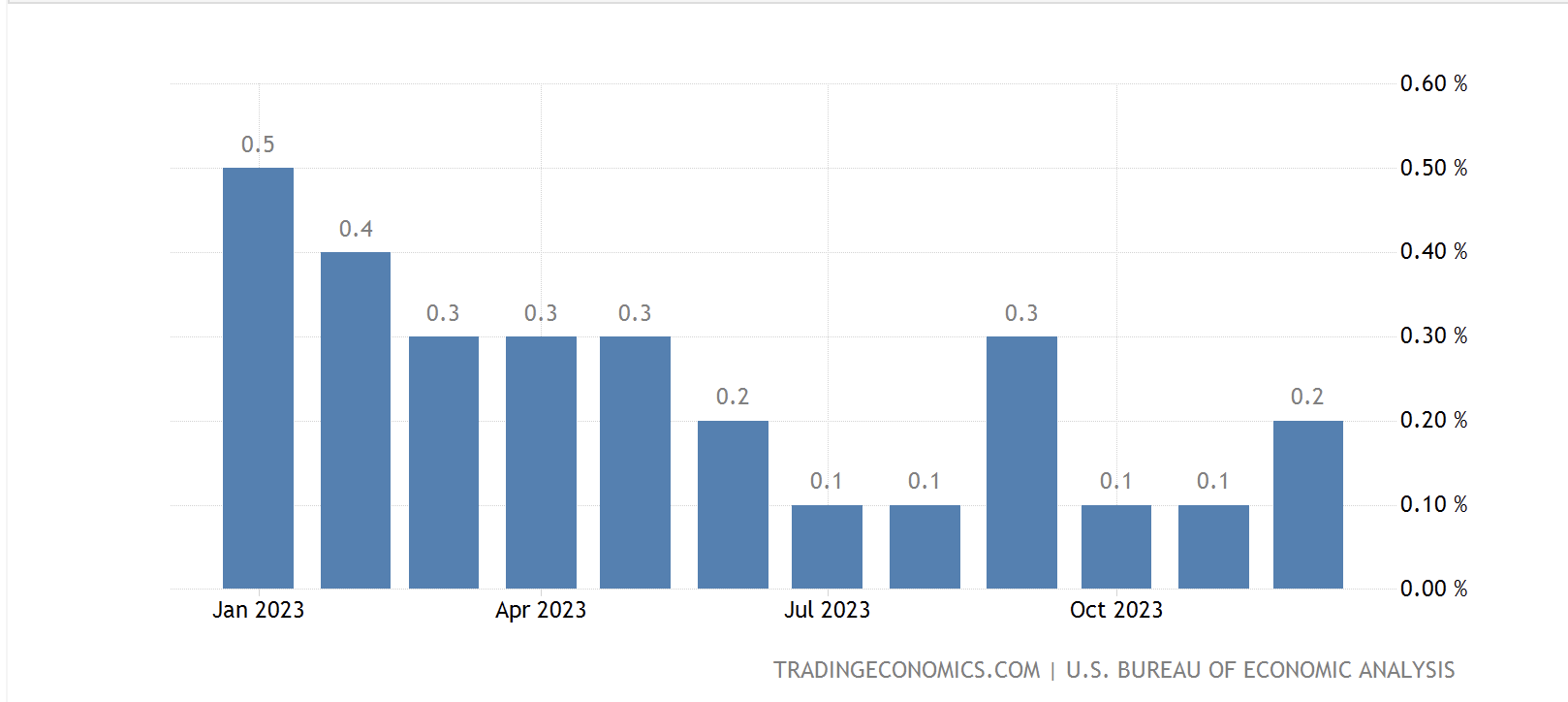
But back to PCE.  It appears that this PCE print has become pivotal to many macroeconomic views.  At least that is the case based on how much discussion surrounds it from both inflation hawks and doves.  As of now, and I don’t suppose it will change, the current consensus view of the M/M Core PCE print is 0.4% with a Y/Y of 2.8%.  As can be seen from the below chart from tradingeconomics.com, this will be the highest print in a year, and it would be easy to conclude that the trend here has turned upwards.

Of greater concern, though, is the idea that just like we saw the CPI data run hotter than expected earlier this month, what if this number prints at 0.5%?  Currently, the inflation doves are making the case that the trend is lower, and that if you look at the last 3 months or 6 months, the Fed has already achieved their target.  Their answer is the Fed should be cutting rates and soon.  For them, a 0.5% print would be much harder to explain and likely force a rethink of their thesis.

On the other side of the coin, the inflation hawks would feel right at home with that type of outcome and continue to point to the idea that the ‘last mile’ on the road back to 2.0% is extremely difficult and may not even be achievable without much tighter policy.  While housing is a much smaller part of the PCE data than the CPI data, remember, CPI saw strength throughout the services sector and that will be reflected.

One thing to consider here is the impact a hot number would have on the Treasury market.  Yields have already backed up from their euphoric lows at the beginning of the month by nearly 50bps.  Given the recent poor performance in Treasury auctions, where it seems buyers are demanding higher yields, if inflation is seen to be rising again, we could see much higher yields with the curve uninverting led by higher 10-year yields.  I’m not saying this is a given, just a risk on which few are focused.  In the end, tomorrow has the chance to be quite interesting and potentially change some longer-term views on the economy and the market’s direction.

But that is tomorrow.  Looking overnight, while Chinese stocks suffered, in Japan, equity markets were largely unchanged.  In Europe this morning, there is more weakness than strength with the FTSE 100 (-0.7%) and Spain’s IBEX (-0.7%) leading the way lower although other markets on the continent have seen far less movement.  As to US futures, at this hour (8:00), they are softer by about -0.3%.

In the bond market this morning, Treasury yields have fallen 2bps, while yield declines in Europe have generally been even smaller, mostly unchanged or just -1bp.  The biggest mover in this space was New Zealand, where their 10-year notes saw yields tumble 9bps after the aforementioned RBNZ meeting.

Oil prices (-0.3%) are giving back some of their gains yesterday, when the market rallied almost 2% on stories that OPEC+ was getting set to extend their production cuts into Q2.  It is very clear that they want to see Brent crude above $80/bbl these days.  In the metals markets, while precious metals are little changed, both copper and aluminum are softer by about -0.5% this morning.  I guess they are not feeling any positive economic vibes.

Finally, the dollar is much firmer this morning against pretty much all its counterparts.  While Kiwi is the laggard, AUD (-0.7%), NOK (-0.7%) and CAD (-0.4%) are all under pressure as well.  The same is true in the EMG bloc with EEMEA currencies really suffering (ZAR -0.5%, HUF -0.7%, CZK -0.4%) although there was weakness in APAC overnight as well (KRW -0.4%, PHP -0.6%).

On the data front, this morning brings the second look at Q4 GDP (exp unchanged at 3.3%), the Goods Trade Balance (-$88.46B) and then the EIA oil inventory data.  We also hear from Bostic, Collins and Williams from the Fed around lunchtime.  Yesterday’s data was generally not a good look for Powell and friends as Durable Goods tanked, even ex-transport, while Home Prices rose even more than expected to 6.1% and Consumer Confidence fell sharply to 106.7, well below the expected 115 reading.  

As we have been observing for a while now, the data continues to demonstrate limited consistency with respect to the economic direction.  Both bulls and bears can find data to support their theses, and I suspect this will continue.  With that in mind, to my eye, there are more things driving inflation higher rather than lower and that means that the Fed seems more likely to stand pat than anything else for quite a while.  Ultimately, I think we will see the ECB and BOE decide to ease policy sooner than the Fed and that will help the dollar.

Good luck

Adf

Not Even a Token

Like spring rains falling
So too, Japanese prices
Continue to slide


Once upon a time there was a tiny thought about Japan tightening monetary policy.  This thought, which had been seen lurking in the shadows of markets for the past thirty years, was largely ignored by all the ‘right’ people.  The illiterati economic gliteratti were all quite convinced that this would never happen as Japan was in a death spiral of rising debt and a shrinking population.  According to all the classical economic texts, interest rates could never rise again.

Then, one day there came along a virus that disrupted the world.  All the ‘important’ people in all the major nations determined that shutting down all economic activity while simultaneously printing trillions upon trillions of dollars, euros, pounds, and yen, and more importantly, giving that money to the people, was the best thing to do.  Not that surprisingly, with all that extra money chasing after fewer available goods and services, prices rose sharply almost everywhere.  Even in Japan, a nation that had suffered a generation-long deflationary bout, where companies literally apologized if they determined that a price rise was in order to cover rising expenses, prices started to go up more broadly.

This excited the policymakers in Japan as it was something they had been trying to achieve for the past 30 years.  It also excited the trading community as they became convinced that Japanese interest rates were set to explode higher.  And for a little while, Japanese inflation rates rose, surpassing the 2.0% target that had only been briefly brushed three times during that generation, the most recent being in the wake of the Covid actions.  Analysts were convinced that the new BOJ Governor, Kazuo Ueda, was getting set to raise the policy rate from its current level of -0.10%, its home for the past 8 years.  Traders positioned for JGB yields to rise and for the yen to strengthen against its currency counterparts.

Alas, so far this tale has not had that happy ending.  Instead, last night CPI in Japan printed at 2.2% headline, 2.0% core with both measures clearly trending lower for the past 18 months at least.  To be clear, in the very short term, these prints were marginally higher than market forecasts, which has resulted in a touch of strength in the yen (+0.3%), and a 1bp rise in 10-year JGB yields.  But bigger picture, this has further called into question the idea that Japanese inflation is going to remain stable at the BOJ’s 2% target.  In this situation, the idea the BOJ will tighten policy seems increasingly remote.  As such, all those delusions of tight money have been, once again, laid to rest.  The moral of this story is that; in Japan, the only money is easy money!

The newest Fed member has spoken
And Schmid said that things just ain’t broken
Thus, patience is needed
And so, he conceded
No rate cuts, not even a token
 
The Kansas City Fed’s new president, Jeffrey Schmid, made his first public comments yesterday but it could well have been his predecessor, uber-hawk Esther George, given that he hewed to the party line as follows:, “With inflation running above target, labor markets tight, and demand showing considerable momentum, my own view is that there is no need to preemptively adjust the stance of policy.  I believe that the best course of action is to be patient, continue to watch how the economy responds to the policy tightening that has occurred, and wait for convincing evidence that the inflation fight has been won.”  That’s pretty clear, and while he is not a current voter, it is simply another voice telling us that the Fed is not anxious to alter policy at all.  Even the market gets it now, with the March meeting down to a 0.5% probability of a cut, the May meeting down to a 16.3% probability and even the June meeting down to a 60% probability.  For all of 2024, the market is now pricing in just 3 ½ cuts, pretty darn close to the last dot plot.  Kudos to the Fed for getting their message across.
 
However, beyond those two stories, there is precious little to discuss this morning.  Data, beyond the Japanese CPI, has been sparse and the ECB speakers have also stayed true to their recent mantra of no reason to cut rates yet.  As such, it is not that surprising that markets remain mired in tight ranges overall.
 
Looking first at equity markets, after a lackluster session in the US yesterday, Japanese share prices were essentially unchanged although we did see some strength in Chinese shares with both the Hang Seng (+0.9%) and CSI 300 (+1.2%) rallying nicely on the back of increasing hopes for more Chinese stimulus coming in March at the annual plenary sessions.  As to the rest of Asia, activity was mixed with some countries seeing gains (India, Australia) and some losses (South Korea and Taiwan).  European bourses are also mixed with some gainers (Germany) and losers (Spain) while others have gone nowhere at all.  Finally, at this hour (6:45), US futures are ever so slightly firmer, just 0.1%.
 
In the bond market, both Treasuries and European sovereigns are seeing a bit of buying with yields lower by 1bp across the board.  Yesterday’s US 5-year auction was also somewhat unloved with a 0.8bp tail, quite large for that maturity.  It does appear that there is increasing pressure on the Treasury market as the pace of issuance picks up.  Over time, I believe this is going to matter a lot more to markets than it has thus far.
 
Oil prices, which rallied most of yesterday, are giving back some of those gains, down -0.4% this morning.  The rally was ostensibly based on further Red Sea concerns, but that really doesn’t make much sense given there were no new events there.  More likely, there was some short covering and analysts were looking for a story to tell.  Metals markets, though are in better shape this morning with gains in both precious (gold +0.3%) and base (copper +0.2%, aluminum +1.0%), largely on the back of the dollar’s modest weakness.
 
Which brings us to the dollar and the most confusing part of the session.  While it is true Treasury yields are lower by 1bp, that does not seem enough to weigh on the dollar, especially given the universal nature of yield declines.  The US curve actually inverted further, with the 2yr-10yr spread back to 42bps (it had been hanging around 25bps-30bps for several months), so that could be weighing on the greenback.  But whatever the cause, we are seeing pretty uniform weakness, although other than ZAR (+0.75%) which has clearly been helped by the metals rally, the rest of the movement is pretty modest, +/- 0.2% or less with more currencies gaining than losing.  I do not believe that the reaction function has changed here.  Rather, sometimes the FX market moves in funny ways.
 
On the data front, this morning brings Durable Goods (exp -4.5%, +0.2% ex transport) and Case-Shiller Home Prices (6.0%).  Yesterday saw a softer than expected New Home Sales and a weaker than expected Dallas Fed survey, although it was better than January’s print.  As well, we hear from Vice Chairman Barr, but there has been very little wavering from the message that patience is a virtue, and I don’t expect Mr Barr will change that tune.
 
The equity bulls took a rest yesterday but are clearly looking for more reasons to get back to buying.  To me, the potential problem will be home prices as, if they continue to rise, it will reduce hopes for any rate cuts at all, and there are still a number of pockets in the economy that are highly reliant on low interest rates to succeed.  Commercial real estate is simply the most frequently discussed, but consider much of the tech sector, where ideas that had been funded with free money that will not get the time of day if there is a cost of capital.  Ultimately, nothing has changed my idea of the dollar benefitting further as the market continues to understand that the Fed is not set to cut rates any time soon.  Of course, Thursday’s Core PCE could change a lot of views, mine included.
 
Good luck
Adf

Not Much Mystique

In looking ahead to this week
Eleven Fed members will speak
And Core PCE
On Thursday, we’ll see
But otherwise, not much mystique
 
And one other thing we will hear
Is maybe a shutdown is near
But history shows,
And everyone knows,
Investors, this problem, don’t fear


After a dull session on Friday across all markets, the weekend delivered exactly zero new information that might alter investor perspectives.  Hence, we are in the same place we left things before the weekend.  Of more concern for traders, although not for hedgers or investors, is that there are few potential catalysts on the horizon for at least the first part of the week.  Thursday’s Core PCE data is clearly the biggest data release, but there will be ample time to discuss that as we get closer.

In the meantime, based on everything we have seen of late; the entire narrative will remain focused on NVIDIA as well as AI in general in the stock market.  For bond junkies, there will be more questions about the sustainability of the current spending plans in the US and whether the market will absorb all the issuance that is coming.  Planned this week are auctions for $398 billion of T-bills, 2-year, 5-year, and 7-year notes.  That’s a lot of issuance, and there is no sign that it is going to slow down at any point in the near future.  Last week, the 20-year bond auction had its worst outcome in its history, with a 3.3bp tail, an indication that investors are getting full or at the very least concerned in some manner and need higher yields to be persuaded to continue investing. 

The issue here stems from the fact that interest payments are utilizing an increasing part of the Federal budget and as old debt matures and is rolled over at current yields, those payments will continue to grow.  While theoretically, the Treasury can simply continue to issue more debt in order to pay off whatever comes due, that means the stockpile of debt continues to grow, and with it, the interest needed to be paid each year.  Alternatively, the Fed can change their QT back to QE, purchase Treasury securities and cap rates or drive them lower.  However, if Powell goes down that road, the results are very likely to be a serious uptick in inflation and a serious decline in the dollar.  The point is the current pace of issuance is not sustainable in the long run.  Although, to be fair, people have been saying the same thing about Japan for the past twenty years, so it could still go on for a while.

I continue to believe that a bear-steepening outcome is the most likely, with bond yields rising above current the Fed funds target and the excessive supply of new bonds is one of the things driving that view.  However, that seems more like a late summer or autumnal issue, not something for right now.

But away from the bond discussion, there is little else to note.  A quick recap of the overnight session shows that Asian equity markets were on the sleepy side with Japan up a bit, 0.4% or so, while Chinese shares resumed their longer-term trend declines with the Hang Seng (-0.5%) and CSI 300 (-1.0%) both ceding ground, as there were no new stimulus programs announced.  It is seeming increasingly as though absent stimulus; Chinese shares are a sale.  In Europe, the action is mixed with both gainers and losers but nothing moving very far at all, 0.3% being the largest change on the day.  It is the same story in the US, with futures at this hour (7:30) basically unchanged from Friday’s closing levels.

In the bond market, Treasury yields (-1bp) are edging lower this morning, although we are seeing the opposite tendency in Europe with most sovereigns gaining 1bp in yields.  The outlier here is the UK, where 10-year Gilts have seen yields climb 6bps after a better-than-expected CBI Retail Sales print added to the Flash PMI data from last week and is pointing to a somewhat better economic outlook.  A quick look east shows that JGB yields slipped 3bps overnight as investors, looking ahead to tonight’s CPI data are expecting a soft print and less incentive for the BOJ to tighten policy.

Oil prices (-0.6%) continue to slide slowly as production continues apace but there are questions about demand given the weakness seen in Europe, the UK and China.  A stronger US economy is not enough, by itself, to drive oil prices higher.  In the metals markets, copper is the big loser, down -1.4%, as concerns over Chinese economic resurgence continue to dog the red metal.  It appears the relationship between copper and the CSI 300 is tightening up a bit.

Finally, the dollar is under modest pressure this morning as US yields continue to soften slightly after Friday’s decline.  But to indicate just how modest things are, the biggest mover today is the euro (+0.3%).  Literally every other major currency, whether G10 or EMG has had less movement than that.  In other words, there is no story here.  We need to see some monetary policy changes before this is going to heat up again.

On the data front, as indicated above, it is a pretty quiet week as follows:

TodayNew Home Sales680K
 Dallas Fed Manufacturing-8.0
TuesdayDurable Goods-4.5%
 -ex transport0.2%
 Case Shiller Home Prices6.0%
 Consumer Confidence115
WednesdayQ4 GDP3.3%
ThursdayInitial Claims210K
 Continuing Claims1874K
 Personal Income0.4%
 Personal Spending0.2%
 PCE0.3% (2.4% Y/Y)
 Core PCE0.4% (2.8% Y/Y)
 Chicago PMI48.0
FridayISM Manufacturing49.5
 ISM Prices Paid53.0
 Michigan Sentiment79.6
Source: tradingeconomics.com

Looking at everything, although there seems to be a lot of stuff, most of it is just not really that important.  I have to remark on the Case Shiller data as recall, a big piece of the disinflation theory is the decline in housing prices.  A 6.0% Y/Y print does not feel like it is declining to me, but then I am just an FX poet.  Obviously, all eyes will be on the PCE data Thursday morning.  In addition to this, we hear from eleven different Fed speakers including Waller and Williams, two of the more important voices, although Chairman Powell remains mum.

Nothing we have seen over the past weeks has changed my longer-term views and quite frankly, the first part of the week is shaping up as a sleeper.  Quiet markets are a boon to hedgers as executing is greatly eased, and banks will compete hard for your business.  In the end, the dollar continues to follow the yield story, so, if yields in the US slide from current levels, the dollar will likely follow.  The opposite is also true.

Good luck

Adf

What’s the Rush?

Said Waller, my god “what’s the rush?”
‘Cause things are OK at first blush
The ‘conomy’s roaring
The stock market’s soaring
And so, dreams of cuts, I must crush

But really, does anyone care
What Powell or Waller declare?
NVIDIA rallied
And gains have been tallied
So, rate cuts don’t have savoir faire

I am old enough to remember when the inherent strength of the US economy was based on its diversity of industry and geography as well as its bounty of abundant natural resources.  The governmental framework of property rights and the rule of law were critical aspects of what made this nation stand out.  But that is sooooo last week.  Instead, let me recount a famous scene from the movie, The Graduate, but updated for today:

Mr McGuire: I just want to say one word to you.  Just one word.
Benjamin: Yes, sir.
Mr McGuire: Are you listening?
Benjamin: Yes, I am.
Mr McGuire: Plastics NVIDIA

At this point, I might refute the idea of the Magnificent 7 stocks, first because Tesla hasn’t been following the script all year, but second because the reality is there is only one true god stock, NVIDIA.  It appears that the entire nation’s economy is reliant on that single company continuing to outperform analyst expectations and grow at 100% annually.  As long as it continues, the US will maintain its status as the world’s most important economy.  Seems pretty simple.  In fact, it is not clear to me why anyone would own any other stock than NVIDIA at this point, perhaps with a small percentage of assets in Bitcoin.  Only then will an investor be ready for the future!

Of course, this is not what I believe, nor would I ever suggest that someone consider this approach.  But, boy, if there is another piece of news that is remotely as important, I am still searching for it.  Every market seems to take its cues from the stock and government policies seem to be designed to either support its growth or inhibit its products from getting into the wrong hands.  Perhaps it is time to rename our nation to The United States of NVIDIA and be done with it.

Alas for this poet, equity markets are not my primary focus so I will try to look through the other scraps of information and see if there is anything interesting.  Top of the list were the assorted commentaries by four different Fed speakers yesterday, all of whom said essentially the same thing, while they expect rate cuts at some point this year, it is still too early as they are not yet confident that inflation will sustainably return to their 2% target.  That was the message from Wednesday’s FOMC Minutes, that was the message from Powell at the press conference and that has been the consistent message since the last meeting.

Happily, it appears that the markets are starting to understand this idea as a look at the Fed funds futures market shows the probabilities of rate cuts continues to decline, now 2.5% in March, 21% in May and just 66% in June.  In fact, for the full year, the market is now pricing just 85bps total, not much more than the last dot plot’s median outcome showed.

From my perspective, I remain uncertain as to why they are even considering cutting interest rates.  After all, GDP continues to power along, financial conditions continue to ease with a rising equity market, and inflation has many earmarks of remaining sticky.  Absent a collapse in the commercial real estate market that drags down a number of banks, or some other true black swan type event, it appears that the need to cut rates in the US is limited at best.  Do not be surprised to see the dot plot in March show just 2 rate cuts as the median end-2024 outcome as the hawks will have to reevaluate their stance given the economy’s strength since December.  And as I have said before, if inflation really does start to tick higher again, a rate hike seems possible, which is clearly not on very many bingo cards right now.

But really, the Fed discussion pales in comparison to the NVIDIA discussion and the impact on equity markets in general.  Since there has been very little other data even released, let’s recap the overnight session and head into the weekend.

After the massive rally in the US yesterday, with all 3 major indices setting new all-time highs, most markets in Asia were unable to follow through in any real manner, with very modest gains everywhere that was open (Japan was closed for a holiday).  In Europe, the picture is mixed with some gainers (CAC +0.6%), some losers (IBEX -0.5%) and some nothings (FTSE 100 and DAX unchanged). As there was limited data to drive things and the ECB speakers are trying to hew the line that they, too, will remain patient, nothing has changed there of late.  I continue to believe that the ECB will cut before the Fed because the Eurozone economy is in much worse shape than the US economy.  As to US futures, at this hour (7:30) they are basically unchanged.

In the bond market, after yields rising yesterday afternoon by some 6bps, Treasuries are unchanged this morning.  There are growing concerns that the supply question is going to begin to impact yields in the US, with more than $500 billion of new coupon issuance due over the rest of the year.  It is possible yields will need to rise to find buyers for all that.  As to Europe, yields there are higher by 3bps or so this morning as they missed most of the US move.

Commodity markets are under some pressure this morning with oil (-1.7%) giving up any recent strength and now lower on the week.  However, I believe it remains rangebound and need to see compelling evidence of something changing to see a real move here.  In the metals markets, gold, which slid a bit yesterday is edging higher this morning but both copper and aluminum are under pressure on demand concerns.

Finally, the dollar, which did recover yesterday to finish roughly flat on the session, is beginning to soften a bit as NY is walking in after an extremely quiet overnight session.  But overall, the movement here remains marginal with most currencies, both G10 and EMG, remaining within a +/-0.25% range from yesterday.  With monetary policies around the world seemingly on hold for now, it is unrealistic to look for large moves in the FX market.  We will need to see a change in central bank tunes to make this happen.  (either that or Jensen Huang, NVIDIA’s CEO, will need to explain that the dollar needs to move in one direction or another to boost earnings!)

There is no US data to be released and there are no Fed speakers on the calendar either.  With that in mind, equity markets are going to be the driver of note.  If the rally continues, and risk is embraced, I suspect the dollar can slide a bit further.  However, if there is any late week profit-taking, perhaps the dollar finds a bid.

Good luck and good weekend
Adf

Bears’ Great Dismay

Their confidence clearly was lacking
So, now on rate cuts they’re backtracking
As well, they’re concerned
Some banks have not learned
To manage their risk and need smacking
 
But really the news of the day
Is AI remains the key play
NVIDIA beat
And all of Wall Street
Is buying to bears’ great dismay
 
Starting with the FOMC Minutes, the two things that stood out to me were these two lines, “The staff provided an update on its assessment of the stability of the U.S. financial system and, on balance, characterized the system’s financial vulnerabilities as notable. The staff judged that asset valuation pressures remained notable, as valuations across a range of markets appeared high relative to fundamentals.”  Arguably, this was why the Fed removed the line from the statement about “The U.S. banking system is sound and resilient,” which had been included since the Silicon Valley Bank debacle.  Perhaps they see something amiss.  As well, there was discussion regarding the timing of the end of QT with July seeming to be the latest thinking for its initial reduction.  But otherwise, as evidenced by the fact that virtually every Fed speaker has indicated they lack confidence inflation is dead, and that while policy is currently restrictive, it is still too soon to think about cutting rates, was clearly the broad theme of the meeting.  Next week we see the PCE data so perhaps that can change some opinions, but right now, given what we have just seen from CPI/PPI, they cannot have gained confidence it is time to cut.
 
As to NVIDIA, huge results, beating expectations and the word from the CEO is that demand will outstrip supply at least through the end of the year.  The market response here has been as one would expect; a big rally in stocks, especially tech.  ‘Nuff said.
 
Nikkei all-time high
Thirty-four years in waiting
Has finally come

Under the heading a picture is worth 1000 words, behold the relationship between NVIDIA and Nikkei 225 (chart from Weston Nakamura’s Across the Spread substack):

Pretty tight correlation, no?  Arguably, the question is which is driving which?  Does a stronger Nikkei drive NVIDIA’s performance or the other way around?  The first thing to note is that breaking down the Nikkei’s performance, similar to the NASDAQ, there are a handful of AI related stocks that have been the drivers of the move.  If you read Nakamura-san’s take, he believes that it is the Nikkei which is driving things, but I would argue while the Nikkei’s move happens earlier in the global day, the reality is that everything is an echo of the current AI craze which NVIDIA started.  

The next question is, just how long can this continue?  Remember two things here; first, trees don’t grow to the sky, and neither will NVIDIA’s stock; and second, new technologies take MUCH longer to assimilate than the initial hype would have you believe.  We are already seeing issues with Google’s Gemini AI with respect to drawing remotely accurate historical images of US presidents, as an example.  We are still in the very early innings of the AI phenomenon and there will be more hiccups along the way.  One last thing regarding AI is its power consumption, which is off the charts high.  If the world is going to be run by AI, we need a lot more electricity than is currently being produced and that alone will slow its incorporation into things.

Ok, on to more macro views, last night and this morning saw the release of the Flash PMI data all around the world.  Of the seven major releases thus far, only India is in expansion with it continuing to motor along in the low 60’s.  Otherwise, everything else (Australia, Japan, Germany, France, the Eurozone and the UK) are all in contraction in manufacturing.  Services is more mixed with several slightly above the 50 boom/bust line, but overall, while things might be seen as slightly improving, they are still pointing to recessions in Europe, Japan and the UK.

Despite this weakening data, virtually every one of these nations’ currencies is stronger vs. the dollar this morning.  In fact, the dollar is having a pretty rough session, down between 0.3% and 0.5% against most G10 counterparts with a slightly smaller decline vs. its EMG counterparts.  One of the odd things about this is that US yields have not really fallen much (Treasuries -1bp) which is right in line with the price action in European sovereigns and what we saw overnight in Asia across the board.

Add to the bond story the message from the Fed of higher for longer and it doesn’t appear that interest rates are today’s driver of the markets.  We already have seen that equity markets are rocking with the Nikkei (+2.2%), Hang Seng (+1.5%), CSI 300 (+0.9%), and most of Europe higher by 0.9% or more.  US futures, of course, are really flying with the NASDAQ (+2.2%) leading the way, but everything in the green.  I grant that a typical risk-on reaction is a weaker dollar but given the amount of funds that are flowing into the US equity markets, it is very hard to understand why the dollar is under pressure.  Something seems amiss.

If we look at the commodity markets, energy is softer across the board with oil (-0.2%) edging lower and basically unchanged on the week, while NatGas (-2.7%) is suffering as well.  As to the metals markets, gold (+0.2%) is edging higher on the back of the weaker dollar but both copper and aluminum are little changed on the day, less than 0.1% different from yesterday’s closing levels.  

Perhaps this is the new risk-on look, strong equity markets, a weak dollar and nobody cares about bonds.  But bonds have been far too important a driver of market activity to suddenly be ignored.  Now, yesterday, the Treasury auctioned some 20-year bonds and it did not go well, with a tail of 3.3bps, implying demand for the long-end remains tepid.  Given my personal view on inflation, that makes perfect sense, but arguably, the longest duration assets around are tech stocks and the divergence between bonds and those stocks is hard to reconcile.  I guess we will learn more as time progresses, but for now, I would be at least a little wary.  Absent a change in the inflation narrative back to the Fed has won, it does feel like there is still some risk to be seen.

On the data front, this morning brings the Chicago Fed National Activity Index (exp -0.15) which is a comprehensive view of financial conditions around the country and closely followed by the Fed.  As well we get Initial (218K) and Continuing (1885K) Claims and the Flash PMI’s (50.5 Manufacturing, 52.0 Services).  We close with Existing Home Sales (3.97M) and the oil inventory data and throughout the day we hear from four different Fed speakers, Jefferson, Harker, Cook and Kashkari.  Will any of this data matter?  I doubt it.  Can we expect anything new from the Fed speakers?  I kind of doubt that as well as there has been exactly zero evidence that the economy is slowing and dragging inflation lower since last week’s CPI and PPI data.   So, look for that lack of confidence in the demise of inflation to be widespread.

As to the dollar, something doesn’t smell right today.  I feel like it should be better bid and expect that by the end of the day, it will see that type of movement.

Good luck

Adf

The NASDAQ in Tatters

The only thing that really matters
Is whether NVIDIA shatters
It’s forecasted earnings
And market bulls’ yearnings
Else watch for the NASDAQ in tatters
 
Of lesser importance we see
The thoughts from the FOMC
Since last they all met
Stock bulls have beset
The rate hawks with obvious glee


While I know this is a macro focused discussion, and that is what this poet understands best, unquestionably, the biggest market news for the day, for all markets, is the NVIDIA earnings release after the close this afternoon.  There has been more press about this particular number, and more commentary on Fintwit (FinX?) than any other single stock earnings number I can remember.  And let me be clear, I have no idea what is forecast, let alone what the whisper number is, nor do I really care.  But I am definitely in the minority.  My take is that there are many analysts who will consider adjusting their big picture view of the economy and markets based on one company’s earnings.  This might be a sign that things are somewhat unhinged in markets.  

Before then, absent any hard statistical data, we will see the FOMC Minutes from the January 31st meeting.  You may remember that as the one where Chairman Powell flopped back to hawkish after he flipped to a dovish pivot in December.  Since then, there has been a pretty steady drumbeat from all the FOMC members that they are still not confident they have beaten inflation and so want to wait further before they cut rates.  And it’s a good thing they have had that view as last week we all saw that inflation was not cooling quite like the doves had expected.  In fact, they look pretty smart right now because of their reluctance to join the rate cutting mania.

A review of the Fed funds futures this morning shows that the probability for a March cut has fallen to just 6.5% while May is down to a 37.3% probability.  As a demonstration of just how much things have changed in the past month, in the middle of January, March was priced for a 46% probability and May for an 85% probability of the first cut in the cycle.  As well, we have seen the number of cuts priced for the full year fall from 6 down to just under 4, not far from the dot plot guidance we received back in December.  So far, the Fed has been successful in getting its message across despite a great deal of wailing and gnashing of teeth that if they didn’t cut soon, the world would end.

This begs the question, why is everybody so keen to see the Fed cut rates at all?  Consider the issue from the perspective of the saver and retiree.  Things are much better when one’s money market account yields 5% than 0% so I expect that most retirees are pretty happy at the current state of affairs.  From the equity market’s perspective, the very fact that we have set 11 new S&P 500 all-time highs so far in 2024 indicates that the current level of interest rates is not that big a problem broadly speaking.  Yes, there are segments of the market that have underperformed but that is always the case.  

On the flipside, of course, Janet Yellen would like to see rates decline as it would cut her interest rate bill, and certainly all those commercial property holders with mortgages coming due this year, a number that has grown to ~$960 billion I understand, are desperate for lower rates, but that is a pretty small subset of the country.  All I’m saying is that if the current rate structure is benefitting savers and also putting downward pressure on the rate of inflation, it’s just not clear why so many are desperate for a change.  And what if, just for argument’s sake, PCE is hot as is the February CPI print which comes ahead of the next FOMC meeting?  Rate hikes are going to start to get discussed a lot more frequently.

One other thing to keep in mind is that the US economy is currently the only major one that is showing any real life.  Europe, the UK and Japan are all in recession and China’s growth is effectively stagnating.  Other nations are desperate to cut interest rates to help support their economies but are unwilling to do so for fear that their currencies will fall further and invite even more inflation (China excluded) onto their shores.  So, they really want the Fed to cut so they can follow along without the concomitant problem of a falling currency.  But is the Fed responsible for the problems in Europe or Japan?  I think not.

At any rate, we will not solve this dilemma today, and all we can do is observe how things play out over the coming weeks and months.  FWIW, which is probably not a huge amount, I have seen precious little evidence that inflation is going to collapse, and rather expect it to stay here or edge higher.  In that case, I think the Fed may maintain their current rates for far longer than even June.  Absent a banking crisis, perhaps started by more trouble in the commercial real estate sector, my view remains, at most, one token cut this year.  Of course, if we do see that banking crisis, then 300bps will be the minimum.

Ok, overnight, most markets remain in thrall to the NVIDIA earnings story with one exception, China, where the regulators there tightened things even further instituting a new rule that there can be no net selling by institutional accounts in the first 30 minutes of trading or the last 30 minutes of trading.  This was in response to an algorithmic hedge fund selling a huge chunk of shares Tuesday ($350mm) in just a one-minute window and pressuring the whole market lower.  Apparently, they have been fined and prevented from trading for the rest of the week.  The idea behind the rule seems to be that if there can be no net selling in the last 30 minutes, the Chinese plunge protection team can work its magic unimpeded and push things higher on command.  I continue to wonder why the Chinese Communist Party is so keen to support the very essence of capitalism, but there you have it.  

With this in mind, you will not be surprised to know that the CSI 300 rallied 1.4% and the Hang Seng 1.6% overnight.  But the rest of Asia was less positive with most markets following the US lead lower.  Europe, though, except for the UK’s -0.85% performance, is higher on the day despite an absence of any major data or news.  The scuttlebutt is that there is a positive vibe for NVIDIA earnings.  Seriously!  As to the US futures, at this hour (7:45), they are continuing yesterday’s decline with the NASDAQ leading the way lower by -0.65%.

In the bond market, Treasury yields are softer by 1bp this morning while most European yields are higher by 1bp, so in other words, not much movement overall.  Asia saw a similar lack of movement as traders are awaiting the Minutes, NVIDIA and the uptick in Fedspeak tomorrow.

Oil prices (-0.4%) are a bit lower this morning but are just giving up yesterday’s small gains.  In fact, they are essentially unchanged so far in February as concerns over weakening global growth have been offset by concerns over an uptick in the middle east anxiety.  Speaking of energy, what I haven’t mentioned is NatGas, which while higher today by 10%, given it has fallen to $1.75/MMBtu, the move is not that impressive.  Warmer than expected weather has really undermined the price action lately.  In the metals markets, gold (+0.3%) continues to creep higher and today copper (+0.3%) is following suit.  As to aluminum, it is much higher, +2.4%, as concerns over fresh US sanctions on Russian aluminum have raised the risk of overall market disruption.

Finally, the dollar is little changed against most of its counterparts, G10 and EMG.  The biggest mover I see is ZAR (+0.4%) after core CPI ticked higher than expected and raised thoughts of tighter monetary policy there.  In the G10, NZD (+0.25%) is also responding to a higher-than-expected PPI print bringing a rate hike more sharply into focus there.  Otherwise, nada.

Aside from the Minutes, there is nothing else of note on the data calendar.  We do hear from Atlanta’s Raphael Bostic and Governor Michelle Bowman today, but I don’t expect either to waver from the current lack of confidence story.  It feels like it is going to be a quiet session overall, with the real fireworks reserved for 4:15 or so when NVIDIA reports.

Good luck

Adf

More Dire Straits

Apparently, President Xi
Is worried that his ‘conomy
Has lost all its verve
So, throwing a curve,
Reached out to the PBOC
 
The central bank promptly cut rates
As things head toward more dire straits
Investors, though, said
Seems China’s still dead
As equity buying abates


After yesterday’s winter doldrums session, with virtually nothing going on in Europe with the US on holiday, last night we got a surprisingly large cut in the 5-year Loan Prime Rate from the PBOC.  The 25 basis point cut was the largest since this rate was created five years ago, and 10bps larger than anticipated.  This rate is the one on which mortgages in China are based, hence the effort to try to support the property market there.  The problem is, this will only be relevant for new mortgages and does not help the outstanding loans in any way.  Perhaps it will help spur some new property demand at the margin, but as evidenced by the tepid equity market response (CSI 300 +0.2%), it was hardly a panacea for the problems in China.

Ultimately, the issue there remains that decades of inflating a property bubble combined with the demographic impact of the one-child policy have led to a situation where a large proportion of China’s middle class relies almost entirely on their property investments for their retirement nest egg.  As those continue to deflate in value, the idea of increasing consumption continues to recede and the only way to deliver any economic growth is via continued reliance on production and exports.  Alas for the Chinese, the end of the globalization phase around the world has put a crimp in that plan as well.  

I suspect that this is not the last rate cut we will see from China as it remains clear more stimulus is needed to maintain their target growth rate of GDP.  At some point, I also suspect that we will see a large bout of fiscal stimulus, but clearly Xi is avoiding that over concerns regarding the net debt position in China.  Despite their efforts to eliminate the dollar as the global reserve currency, there are precious few people or nations willing to hold renminbi for that purpose, so China does not have the flexibility to be as irresponsible as the US in this case.  Ultimately, I continue to look for the renminbi to depreciate as it is the only natural outlet valve the Chinese have.  It is clear this move will take time, but that is the direction of travel in my view.

Away from that, though, there was nothing happening overnight of any consequence as will be evident when we review the overnight session.  Elsewhere in Asia, the Hang Seng. (+0.6%) had a decent session but Japanese shares were a bit softer, and the rest of the APAC nations showed no consistency with some gains (India and Taiwan) and some laggards (Korea and Australia).  Perhaps the Aussies suffered after the RBA Minutes showed they considered an additional rate hike last month and still have the thought in their minds.  In Europe, things are also quite dull with both gainers and losers with everything +/- 0.3% or less.  As to US futures, at this hour (7:30) they are softer by -0.4% or so across the board.

In the bond market, yields have edged lower with Treasuries down by 1bp and most of Europe lower by 2bps as investors await the next signals regarding central bank activity.  Interestingly, there was an article in Bloomberg News this morning that discussed the idea some traders were preparing for a potential rate hike in the US as the next move, rather than the still consensus rate cuts.  That would not surprise me greatly, but there is no doubt the equity markets are not pricing in that scenario.

Oil prices are slipping this morning, down -1.1%, but there is no obvious catalyst as the driver.  In truth, the oil market looks like it is simply trading within a range of $70-$90 and until it breaks out of that range, there is little to do but watch.  Metals markets are mixed this morning with gold (+0.5%) leading the way higher on a weaker dollar although copper (+0.5%) and aluminum (-0.75%) are showing no consistency.

Finally, the dollar is under pressure pretty much across the board with AUD and NZD leading the way higher in the G10, both advancing by 0.5%, with EUR and GBP (+0.2% each) in tow.  The only outlier is the yen which is unchanged today.  In the EMG bloc, the direction is consistent with almost all currencies a touch stronger, but the magnitude is just on the order of 0.2%.  This appears to be a dollar weakness story on the back of softening yields, rather than anything else.

On the data front, arguably the big statistic today is Canadian CPI which is expected to slip a tick from last month’s readings, but given the heat we have seen elsewhere lately, I would not be surprised to see a stronger reading.  We also see Leading Indicators (exp -0.3%), which if it remains negative, will be the 21st consecutive negative reading, traditionally a harbinger of a recession.

And that’s really it for the day.  No major data and no slated Fed speakers.  I expect things will remain quiet, with risk assets driving any FX moves. 

Good luck

Adf

A Narrative Flaw

At first it was just CPI
With heat like the fourth of July
But Friday we saw
A narrative flaw
As PPI jumped, oh so high
 
The narrative’s now in a bind
While working so hard to remind
Investors that prices
Are not in a crisis
And Goldilocks can’t be maligned


It must be very difficult to be a cheerleader for the immaculate disinflation* these days given we continue to see data showing inflation is no longer receding.  Friday’s PPI was the latest chink in the deflationists’ armor as both the headline and core numbers printed well above expectations.  Of course, this followed Tuesday’s hot CPI prints as well as some lesser data like the prices paid portion of the NFIB survey and the last ISM Services survey.  Energy prices, which had fallen throughout Q4 but have since bottomed and appear to be trending higher again, are no longer a cap on inflation.  But of greater consequence is the fact that services inflation remains higher on the back of continued wage gains and rises in the price of things like insurance.  

Market participants are slowly coming around to the idea that the Fed may not be cutting rates quite like they were hoping for praying for anticipating just a few weeks ago.  This has been made clear by a quick look at the Fed funds futures market in Chicago which is now pricing in just a 10% chance of a March cut, a 35% chance of a May cut and a 75% chance of a June cut.  In fact, the market is now pricing in barely more than the Fed’s last dot plot for 2024, just 81bps for the entire year.

Of course, there is one benefit to the recent data and that is we stopped hearing about the 3-month trend and the 6-month trend showing the Fed had reached their target and so should be cutting rates NOW!  Instead, the fact that those trends are now pointing higher insures that we won’t hear about that for quite a while…I hope.

Philosophically, I remain confused as to why there is so much ‘demand’ that the Fed cuts rates at all.  While I certainly understand why the administration would like to see it, given the budget deficits that need to be financed, arguably, if nominal GDP growth is between 6% and 7% and Fed funds are at 5.5%, things don’t seem out of place.  If anything is out of place it is the 10-year yield, which even after rising 6bps on Friday, remains at 4.30%.  Historically, a more normal level of 10-year yields would be the same as nominal GDP growth.  Currently, that tells me either 10-year yields have much further to rise, or GDP is going to fall A LOT.  I sure hope it is the former.

Now, looking past Friday’s activity, this morning has been extremely quiet overall with the prospects for action looking quite limited.  Today the US celebrates President’s Day, so banks are closed as is the stock market, although futures markets are trading.  Canada is also mostly on holiday which implies that once Europe goes home, things will really die out.

But quiet is the best description of everything overnight.  One surprise was that Chinese equity markets were far less bullish than many anticipated as they reopened after the extended Lunar New Year holiday.  While the CSI 300 managed to rise 1.2% on the session, the bulk of the move came at the close with a wave of buying by their plunge protection team.  The disappointment was based on the stories that holiday travel had risen substantially which had been pumping up the Hang Seng which reopened last Thursday.  Alas, that market fell -1.1%, a perfect encapsulation of the overall disappointment.  In the meantime, European bourses are trading either side of unchanged and at this hour (7:00), US futures are doing the same, basically unchanged on the day.

Basically unchanged is an excellent description of the bond markets as well, with virtually every major European sovereign market either unchanged or higher by 1bp this morning.  Overseas trading of Treasuries has also seen limited activity and no yield change, and you will not be surprised to learn that JGB yields were also unchanged.  

In the commodity space, oil, which had a solid week last week and now shows WTI at ~$79.00/bbl, is a touch softer this morning, but only just.  I have seen a number of stories about peak oil having been reached again, but as you may know, I am no longer convinced that is the case.  Of course, that is a very long-term discussion which will have nothing to do with the daily fluctuations.  And shocks to the system can have a big impact regardless of the long-term story.  In the metals markets, gold is edging higher again, +0.3%, but both copper and aluminum are softer this morning by about -0.4%.  As with every other market, there is a lot of conflicting data that has been preventing a more coherent directional view here.  I suspect that will resolve over time, but in commodities, over time can mean months or years.

Finally, the dollar is little changed net with a mixture of gainers and losers.  For instance, in the G10, we are seeing very modest strength in NZD (+0.25%) and JPY (+0.2%, and just below 150.00 as I type), while in the EMG space there is some weakness as evidenced by ZAR (-0.4%) and KRW (-0.3%).  As with all markets today, I don’t think we are going to learn very much new.

As it is a holiday, there is no data today and, in truth, there is very little to be released all week.

TuesdayLeading indicators-0.3%
WednesdayFOMC Minutes 
ThursdayChicago Fed National Activity-0.19
 Initial Claims217K
 Continuing Claims1900K
 Flash Manufacturing PMI50.2
 Flash Services PMI52.0
 Existing Home Sales3.97M
source: tradingeconomics.com

In addition to that short slate, we hear from seven different Fed speakers including Governor Waller who seems to be the most important voice after Powell and Williams.  As it happens, five of those come Thursday with Waller the last at 7:30 that evening.

For today, I would not expect much at all in the way of market movement.  Given the lack of obvious catalysts, a quiet week seems likely as well.  Perhaps the biggest news is NVDIA is releasing their earnings Wednesday after the close, although from an FX perspective, that doesn’t seem crucial.  Big picture tells me that the Fed is not going to be easing policy soon, and that as long as the US economy continues to outperform those of Europe, Japan, the UK and China, the dollar is likely to find continued support.  Realistically, I think you could make the case for the dollar to rally substantially over the course of the year, but right now, that doesn’t feel like the move.

Good luck

Adf

*Immaculate disinflation – the idea that inflation can decline without a slowdown in growth or recession, but rather because it’s previous rise was transitory, just taking a little longer than originally anticipated.

Good…or Bad

FinMin Suzuki
Noted that a weaker yen
Might be good…or bad

One of the great things about finance and central bank officials is their ability to twist language into pretzels while trying to make their case in any given situation.  Last night offered another great example from Japanese FinMin Shun’ichi Suzuki with this being the money quote, “From that standpoint, I’m closely watching market moves with a strong sense of urgency.”  It is not clear how you watch something with urgency, but if you are the MOF official in charge of explaining why your currency has been declining so rapidly, I guess you have to say something.  (As an aside, I might simply point out that the interest rate differential between the US and Japan is now 5.5%, having risen from 0.35% over the past two years and that might have something to do with the FX move.)

As previously mentioned, the MOF is moving up its ladder of pre-intervention activities as detailed on Wednesday, arguably now somewhere between numbers 2 and 3.  The biggest problem Japan has is that there is a quickly declining probability that the US is going to be easing policy as soon as had been previously thought, and so the incentive to own yen remains diminished.  The second biggest problem they have is their economy has slipped into recession and so the urgency for Ueda-san to tighten policy is also diminished.  While USDJPY has been hovering just above 150 for a few days, I expect that it is going to grind higher still and force Suzuki-san to continue to climb that numeric ladder.  The one saving grace for Suzuki is that as we approach fiscal year-end in Japan, there is likely to be a seasonal flow of funds back home for dressing up balance sheets.  That could well keep things in check until sometime in April, but all signs are that the market is going to test him again before too long.

On Tuesday, the data was hot
On Thursday, it really was not
So, which one describes
The ‘conomy’s vibes?
Or have, now, stagflation, they wrought?

The CPI data on Tuesday certainly opened a rift between the narrative of smoothly declining inflation leading to numerous Fed rate cuts this year and what appears to be a more realistic situation where any further decline in inflation comes in fits and starts if it comes at all.  The narrative explanation for the sticky inflation was that economic activity was so strong that it should be expected.  But if the economy is truly that strong, someone needs to explain how Retail Sales can decline -0.8% in January, why Industrial Production would decline -0.1% and why Capacity Utilization would fall back to 78.5% despite all the government support for reshoring activity.  In an ironic twist, the other two releases yesterday, Philly Fed and Empire State Manufacturing, were both better than forecast.  This is a complete reversal of the pattern we have seen for the past 2 years where survey data is lousy but hard numbers remained strong.

In the end, it appears that market participants have given up on the macro data and are back to buying any dip with abandon.  I will be the first to explain that the economic outlook remains very cloudy.  To date, it appears that the excessive deficit spending has been successful in maintaining steady GDP growth.  Of course, excessive deficit spending is not something that can continue forever.  As Herbert Stein explained in 1985, “if something can’t go on forever, it will stop.”

This leads to the question; how long until forever?  If we have learned nothing else in the past decades it is that when governments involve themselves directly in economic activity and financial markets, forever is delayed. Things take MUCH more time than we expect for them to play out.  Simply consider how long Japan has been running massive budget deficits, NIRP and QE without destroying their economy.  (30 years.)

Of course, forever in the economy and forever in the markets are two very different things and while the government may be able to delay a reckoning in economic activity, we must be very careful around how markets behave with the same catalysts and inputs.  My point is any risk-off outcome will be important for your investing and hedging decisions, but not necessarily change the trajectory of GDP.  After all, there is always more money to be printed.  In fact, it is this issue that drives my longer-term inflation thesis.  Every government will do whatever they think they need to prevent a serious economic contraction and high on the list of actions will be much easier monetary policy.  Watch closely for things like QT to end or another BTFP-like program to continue to force liquidity into markets.

Ok, let’s look at how things finished the week.  As I said, the market no longer cares about bad data and simply continued to add to risk assets.  Yesterday saw gains in the major indices in the US which was followed by gains throughout Asia and most of Europe, all of them pretty substantial.  In fact, the only red numbers on my screen are in Spain’s IBEX which is suffering on the back of Spanish central banker Pablo Hernandez de Cos explained that several Spanish banks may suffer due to the ongoing drought in Spain and its negative impact on the economy there.  US futures are basically pointing higher again this morning as well.

In the bond market, though, yields are edging higher around the world.  Treasury yields are up 4bps today and pushing back to that peak seen immediately following the CPI print on Tuesday.  European sovereign yields are all higher by between 3bps and 4bps although JGB yields are unchanged on the day.  Ultimately, I continue to see the case for yields to climb from these levels as there is no indication that inflation is truly ending.

Oil markets powered higher yesterday, rising nearly 2% despite the huge build in inventories as concerns over supply being unable to keep up with ever growing demand have reemerged.  As well, the fact that any cease fire in the Israel-Hamas war seems to be a distant memory has some on edge that things can get worse in the Middle East overall.  As to the metals markets, gold managed to regain the $2000/oz level yesterday and is hanging right there this morning.  On a brighter note, both copper (+1.5%) and aluminum (+0.5%) are firmer this morning, perhaps in anticipation of China’s reopening next week, or perhaps because the dollar has stopped rising.

Speaking of the dollar, it is mixed this morning with the yen (-0.3%) and KRW (-0.3%) the laggards while ZAR (+0.3%) seems to be benefitting from the metals price action.  Broadly speaking, I still like the greenback for as long as the US maintains the tightest policy around.

On the data front, to finish the week we see PPI (exp 0.6% headline, 1.6% ex food & energy) as well as housing data with Starts (1.46M) and Building Permits (1.509M).  Finally, at 10:00 we see Michigan Sentiment (80.0).  We also hear from two more Fed speakers, Governor Michael Barr and SF President Mary Daly.  Yesterday, Atlanta Fed president Bostic explained he was not worried by Tuesday’s CPI print, but not yet convinced they had beaten inflation.  I have a feeling we will hear a lot of that sentiment for the time being.

Heading into the weekend, despite Tuesday’s shocking data, risk assets have performed well overall, with the S&P 500 making its 11th new all-time high this year yesterday.  I don’t know what will derail this train, and for now, there is nothing obvious to do so.  As such, I would keep with the trend overall, that means modestly higher stocks, yields grinding higher and the dollar edging higher as well.  I know that doesn’t seem to make much sense, but that’s what we’ve got.

Good luck and good weekend
Adf