Smokin’

The CPI data was smokin’
So, Jay and the doves are now chokin’
He’s lost the debates
And they can’t cut rates
Without, higher prices, provokin’

As such, it should be no surprise
That traders, risk assets, despise
So, bond yields exploded
While stocks all eroded
And dollars made new five-month highs

Welp, the inflation data was not merely a little hot, it was a lot hot.  Measured prices rose 0.4% on both the headline and ex food & energy readings for the month of March with the annual rises ticking higher to 3.5% and 3.8% respectively.  Too, you will not likely hear the inflation doves and those who had been concerned with deflation talking about the trend for the past 3 months or 6 months, as both of those are now running well above 4%.

In truth, if the Fed was both data dependent and actually still fighting inflation, rate hikes would be on the table again as there is absolutely no indication that either wages or rental/housing prices are heading back to the levels necessary to see an overall inflation rate of 2.0%.  Alas, it is also clear that politics is a part of the decision process and the concept of fiscal dominance, where fiscal policy overwhelms monetary policy, remains the order of the day.

Fed funds futures adjusted their probabilities instantly with the idea of a June cut now down to just 16% while there are less than 40bps of cuts now priced in for the rest of 2024.  Given this price action, it is no surprise that bond yields rose dramatically, with the 10-year closing the session at 4.54%, up 18bps and the highest close since November 2023.  My sense is it has further to go.  Meanwhile, 2-year yields rose back to 4.97%, a more than 21bp rise to levels also last seen in November 2023.  One other aspect of the bond market was the worst 10-year auction in more than a year as the tail was 3.1bps, the third largest tail in history, with a lousy bid-to-cover ratio (2.33) and much less foreign interest (61.4%) than we have been seeing lately.  The last 5bps of the yield rally came after the auction result.

Adding to the general gloom, equity prices fell about -1.0% across the board, but closed above their session lows.  It is the dollar, though that really saw a big move with a greater than 1% move against most of its major counterparts.  USDJPY blasted through the 152.00 level that many had thought was a line in the sand for the MOF/BOJ and is a full big figure higher.  Meanwhile, European currencies all declined by more than -1.0% and Aussie (-1.8%) was the absolute laggard across both G10 and EMG blocs.

With this as backdrop, the ECB sits down this morning and must decide if it is too early to cut interest rates.  The economic data continues to underwhelm, and the inflation data is actually trending lower, rather than the situation in the US where it has turned back higher.  But the sharp decline in the euro yesterday has got to be a warning to Lagarde and her minions as a cut, especially since it is not priced at all, would likely see another sharp euro decline, something they are certainly keen to avoid.

One other thing, the Minutes of the March FOMC meeting were released in the afternoon, and it seems the committee is coming to an agreement that they are going to slow the roll-off of Treasury securities, likely cutting it in half to $30 billion/month although they are not going to touch the mortgage-backed part of the balance sheet since that is barely declining at all.  It appears that this may take place at the June or July meeting, but clearly before too long.

Enough about yesterday.  Overnight saw Chinese CPI data fall back to -1.0% M/M, reversing the previous month’s rise, as it becomes ever clearer that China will never be able to consume as much as it is able to produce.  That is the very crux of the trade issues that are becoming more heated as China ultimately dumps all its excess production overseas, or at least tries to.  This is an issue that is not going to disappear anytime soon, and one that will have major political and economic ramifications going forward.  I suspect that the tariff situation will only get worse, and I would not be surprised to see further absolute restrictions on Chinese trade regardless of who wins the US election in November.  As to the market impacts of this story, for now, I believe Xi is more fearful of a capital flight if he allows the yuan to weaken substantially, than he is of annoying the US and the rest of the world because the yuan is too weak.  But, given the clear difference in the trajectories of the US and Chinese economies and inflation stories, pressure for yuan weakness is going to continue.

Turning to this morning’s session, Madame Lagarde and her crew meet, and the market is not pricing in any movement.  June remains the odds-on favorite for the first rate cut, and given the fact that the Eurozone, as a whole, is stagnant from an economic growth perspective, and that price pressures there have been ebbing more quickly, that certainly makes sense.  Of course, after yesterday’s CPI, June is off the table in the US so the ECB will have to act without the ‘protection’ of the Fed.  As mentioned above, the euro declined by more than -1.0% yesterday and is edging lower this morning as well, down -0.1%.  Lagarde’s risk is she follows the path of lower rates, the euro declines more sharply, perhaps to parity or beyond, and that invites a resurgence in imported inflation.  Remember, energy is still priced in USD, so that a weak euro would raise the price of oil products across the continent.  Alas for Madame Lagarde, it’s not clear her political nous will allow her to solve this problem.

Recapping markets overnight, following the US declines yesterday, the Nikkei (-0.35%) also fell, but I think the yen weakness helped mitigate the declines.  Chinese shares were lackluster, slipping slightly both in HK and on the mainland and the rest of the time zone saw a mix of modest gains and losses.  Meanwhile, European bourses are all in the red this morning, with Spain (-0.9%) the laggard, but the average decline probably around -0.5%.  US futures, too, are softer at this hour (7:00), down about -0.3% across the board.  Clearly, there is grave concern that the Fed is not going to help ease global monetary policies.

As further proof that US yields drive global bond markets, yesterday’s CPI data pushed European sovereign yields higher by about 10bps across the board!  This despite the fact that inflation is going in the other direction in Europe.  This morning, those yields are continuing to grind higher, up between 2bps and 4bps across the board.  However, Treasury yields have stalled after yesterday’s dramatic rise.  Let me say that if the PPI data released this morning is hot, I fear things could move much further.

In the commodity space, oil rallied yesterday on stories that Iran was preparing for a more substantial retaliation against Israel and despite the fact that EIA inventory data showed surprising builds in crude and products.  However, this morning it is edging lower, -0.5%.  Perhaps more interesting is gold (+0.2%) which is a touch higher this morning but was able to rebound off its worst levels of the session after the CPI print to close nearly unchanged on the day.  In the end, the market remains quite concerned about inflation regardless of the Fed’s response, and gold continues to get love on that basis.  As to the base metals, yesterday’s rate induced declines were cut in half, but this morning both Cu and Al are drifting lower by about -0.2%.

It is the dollar, though that had the most impressive movement yesterday and this morning, it is holding onto most of those gains.  Absent a hawkish message from the ECB this morning, something which I believe is highly unlikely, the euro feels like it has further to decline.  The BOC left policy on hold and sounded fairly non-committal regarding its first rate cut there.  The Loonie suffered yesterday and has seen no rebound at all.  In fact, the only currencies showing any life this morning are AUD and NZD, both higher by 0.25%, which seems much more of a trading reaction after their dramatic declines yesterday, than a fundamental story.  As long as the Fed remains the most hawkish, the dollar should hold its bid.

Turning to the data today, PPI (exp 0.3% M/M, 2.2% Y/Y) and core PPI (0.2%, 2.3%) lead alongside Initial (215K) and Continuing (1792K) Claims.  Those numbers will arrive 15 minutes after the ECB policy decision is announced with no movement expected there.  Madame Lagarde has her press conference at 8:45 this morning.  We hear from Williams, Collins and Bostic over the course of the day, so it will be quite interesting to find out how far their thinking has changed.  I would be particularly concerned if there is further talk of rate hikes again.  Remember, Bowman intimated that might occur when she spoke last week, and Bostic has been in the one-cut camp so could turn as well.  Let me just say the market is not pricing in that eventuality at all!

At the beginning of the year, I opined that there would be at most one rate cut and rates would be higher by Christmas.  As of this morning, I see no cuts and a very real chance of hikes.  Keep that in mind for its impact on all asset classes going forward.

Good luck
Adf
Less Keen

While holding our breath has been fun
For CPI, soon we’ll be done
So far through this year
Each reading’s been dear
Can’t wait to see how today’s spun
 
A hot reading’s likely to mean
On rate cuts, Jay will be less keen
But if the print’s cool
It’s likely to fuel
A rally like we’ve never seen!


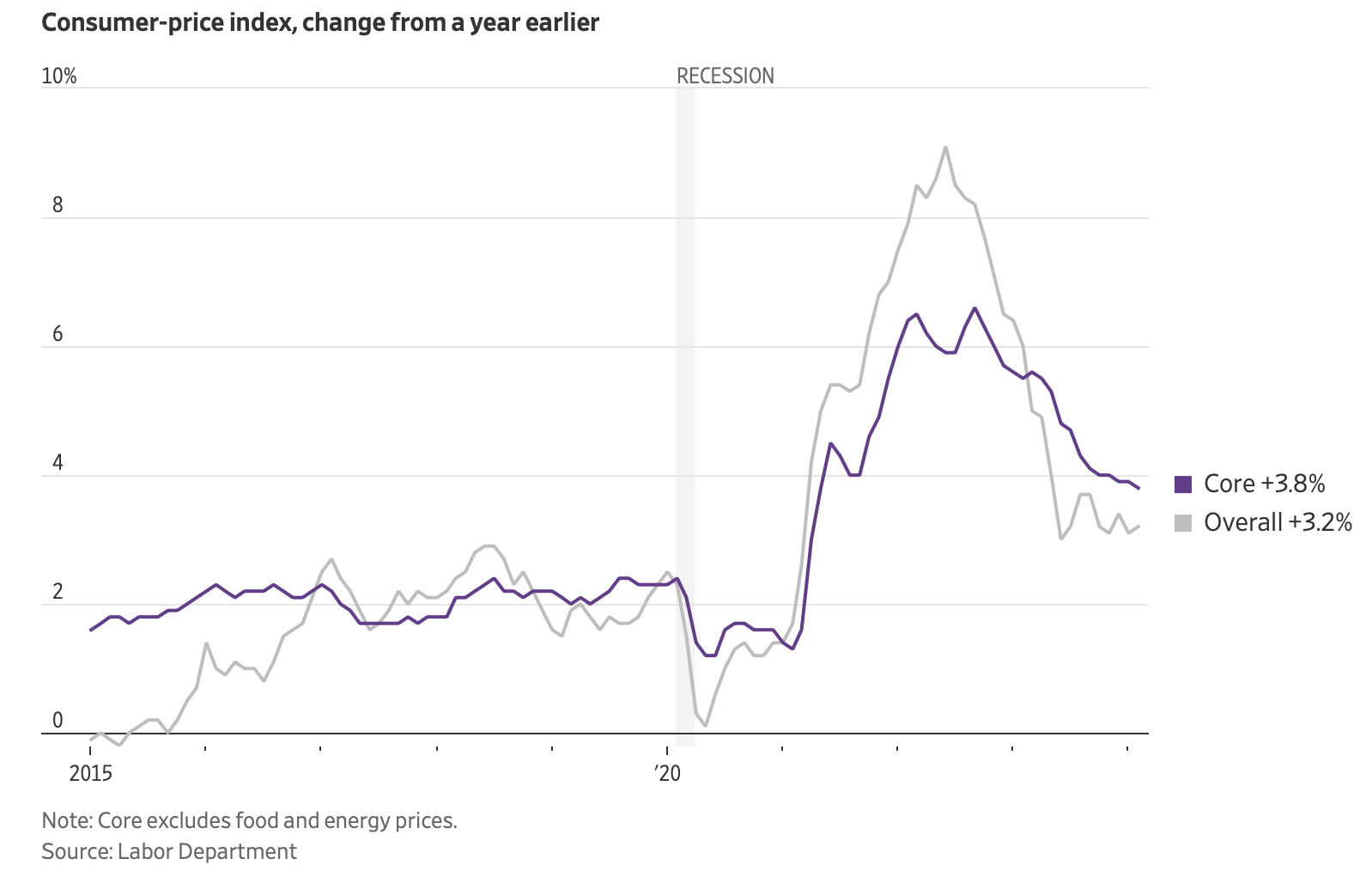
The number we have all been breathlessly awaiting is finally to arrive this morning at 8:30. The March CPI readings are expected as follows: Headline (0.3% M/M, 3.4% Y/Y) and core (0.3% M/M, 3.7% Y/Y).  As can be seen in the below chart from the WSJ, the question of whether inflation is continuing its slow decline or has bottomed is like a Rorschach Test.  Those who are all-in on the soft-landing thesis, notably every administration economist and spokesperson, see the ongoing decline of the core rate (the purple line) as the direction of travel.  However, those who are in the sticky inflation camp and who have made the case that the so-called last mile is going to take much longer than desired look at the headline rate (the gray line) and explain that the bottom seems to be in.

Source: WSJ

Perhaps the most frustrating part of this is that even after the release, neither side will be able to truly declare victory, although I’m sure one side will try to do so.  And to add insult to injury, the arguments are going to rely on the second decimal place, a level of precision that is meaningless in the context of economic data collection.  So, a 0.33% print will get the hawks all riled up while a 0.27% print will have the doves cooing that cuts are on their way soon.  But I challenge anyone to demonstrate that precision of that magnitude has any real meaning.  Clearly, the BLS can calculate numbers to whatever level of precision they desire but given the frequency or revisions to the big number, everything else is just narrative.

But this is where we are.  My take is that the market response will play out very much as expected, at least initially.  This means a hot print, even at the second decimal, will see bonds and equities sell off while the dollar rallies.  Funnily, my sense is that commodities will not suffer greatly on this as they are the current vogue for protecting against inflation.  Similarly, a cool number will lead to a risk asset rally and a dollar decline.  This will probably hurt commodities as well.

One of the interesting things is to observe positioning heading into big data points like this and there are two noteworthy items in the interest rate space.  First, yesterday there was a massive SOFR futures trade where one account bought 75,000 December contracts, the largest single trade ever in the contract according to the CME where it trades. (SOFR = Secured Overnight Funding Rate and is the replacement for LIBOR).  That is either a very large bet that the data is going to be soft, or somebody covered a very large short position, but either way, they are protecting against cooling inflation.  The other interesting thing has been the reduction in short bond positions.  There has been a significant decline in the number of short bond futures positions as well as short cash positions in the bond market, again an indication that many are looking for a benign reading this morning.

This poet has no formal inflation model and therefore can only estimate based on personal experience. Ultimately, nothing I have seen indicates that the rate of inflation is decreasing very rapidly at all.  As I remain in the sticky camp, my best guess is that we will lean toward the hot side this morning.

Turning to the overnight session, there was some interesting news to cover.  In Asia, Fitch put China on negative watch on its recent rise in debt.  Not surprisingly, Chinese shares suffered a bit on the news, but HK shares did not, as the Hang Seng (+1.9%) was the leading gainer in the time zone.  Elsewhere, the RBNZ left rates on hold, as expected, but the statement indicated zero rate cuts in 2024 and a continued hawkish bias.  Surprisingly, NZ equities rallied a bit on the news.  Finally, Ueda-san testified to the Diet again and the most interesting thing he said was that while they watch the FX rate, they will not adjust monetary policy simply to address any weakness in the yen.  Apparently, stock traders didn’t like that much as the Nikkei fell -0.5% on the session.

The story in Europe, though, is much better as all markets are firmer, somewhere between +0.4% and +0.7%. There was some data released, all of which pointed to slowing growth and inflation and therefore increasing the odds the ECB could act as soon as tomorrow, but certainly by June.  Norwegian CPI fell more than expected, Swedish GDP and IP were both quite weak as was Italian Retail Sales.  The point is the ongoing reduction in activity across the continent is going to allow (force?) Madame Lagarde to prove she isn’t waiting on the Fed.  After another limited movement day yesterday, US futures remain unchanged at this hour (7:00).

In the bond market, while Friday and Monday morning saw a sharp decline in prices and rise in yields, yesterday saw yields drift back further and this morning Treasuries are lower by -1bp with similar price action throughout Europe.  Thus far, the net retracement from the yield peak has been 10bps, with all eyes on this morning’s CPI print.  One other interesting tidbit is that the Treasury is auctioning $39 billion in 10-year notes today with the yield highly dependent on the CPI data.

Turning to the commodity market, oil (+0.6%) after a slight dip yesterday on a larger than expected inventory build, is rebounding.  The EIA released a report increasing expected supply and demand numbers for 2024 and 2025 as well.  Gold (-0.25%) is settling in just below its new highs although copper (+0.5%) and aluminum (+1.1%) continue to rally strongly on the rebounding manufacturing story as well as the structural supply shortages.

Finally, the dollar remains in the doldrums, little changed ahead of this morning’s data.  The biggest mover is MXN (+0.5%) which is a continuation of its yearlong price activity as Banxico maintains amongst the highest real interest rates around.  Surprisingly, NZD (+0.2%) is just barely higher despite the hawkish rhetoric from the central bank last night and after that, pretty much all the movement is +/- 0.1% or less.

In addition to the CPI data this morning, we get the Bank of Canada rate meeting where they are expected to leave policy on hold although given the slowing economy, they may set the table for a rate cut at the next meeting.  I would not be surprised to see them cut today, though, in an effort to get ahead of the curve.  The FOMC Minutes are also released this afternoon and we hear from Governor Bowman and Chicago Fed president Goolsbee, with both having been amongst the most hawkish Fed speakers lately.  Given all the talk from Fed speakers since the March meeting, it is hard to believe that the Minutes will matter that much.

And that’s what we have for today.  The CPI will set the tone and we will circle back tomorrow to see how things landed.

Good luck

Adf

A Kite in the Wind

One time on the FOMC
A guy was as ‘hawk’ as can be
But now that he’s gone
His view’s to call on
Chair Jay to cut, times, one, two, three
 
You may remember Jim Bullard as the president of the St Louis Fed for a very long time.  While in that role, he had become the most hawkish FOMC member on the committee, consistently decrying the rise in inflation and the Fed’s delayed response during the ‘transitory’ phase.  But he retired from that role last year to join Purdue University as president, and more power to him.  The interesting thing is that despite the fact he is no longer part of the discussion, he feels it necessary to get his opinions out there anyway.  Last night, at a conference in Hong Kong he explained that the Fed has stuck the landing, the soft landing that is, and that three cuts are appropriate. 
 
The first thing I will point out is this is proof positive that FOMC members speak far too frequently.  The fact that we know the names of ex-regional Fed presidents, as well as their monetary policy stances, seems crazy. We have already seen the damage that forward guidance has inflicted on the economy when after several years of ‘rates will never go up’, the Fed pivoted to hiking aggressively and blew up a number of regional banks while putting the commercial real estate market in dire straits.  My observation is that these members have become so conditioned to being in the spotlight, and have grown to like it so much, that they cannot stop even when their views have no bearing on the conversation.
 
The second thing is that these comments seem to run counter to the evolving views of both recent Fed speakers and market pricing.  A conspiracy theorist might think that the administration requested he add to the discussion because it seems like the Fed is moving away from that position, a position that the administration deems more beneficial to its reelection chances.
 
In the end, despite the headlines that drove this discussion, I don’t believe the market really cares very much what Jim Bullard has to say anymore.  Tomorrow’s CPI is so much more important which is likely why there has been no discernible movement in anything in the wake of this ‘news.’
 
Ueda remains
More like a kite in the wind
Than a solid rock

Last night, in testimony to the Japanese parliament, BOJ Governor Ueda once again tried to imply that tighter policy could be coming but was unwilling to commit.  He said, “We have to consider reducing the degree of monetary easing if the underlying price trend rises along with our outlook.  We will carefully consider this at every policy meeting as it depends on incoming data.”  So, does that mean they are going to tighten soon?  Who knows!  Funnily enough, I think that is a much better stance than the current Fed/ECB/BOE policy of trying to be so deterministic.  At least he has not promised anything at all.  Of course, in today’s zeitgeist, a central bank not promising is seen as quite the negative.  

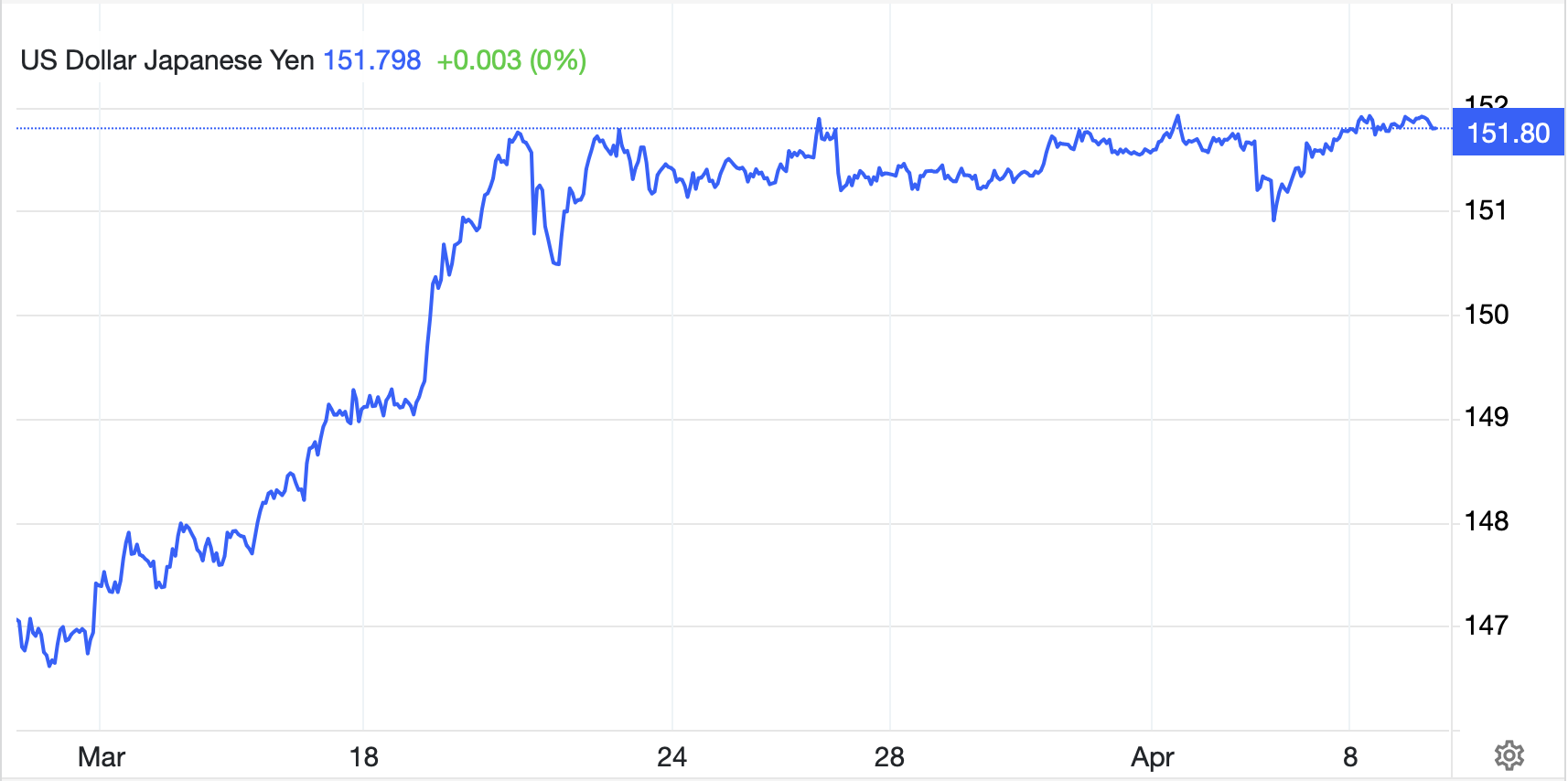
The upshot is that the lack of commitment for further policy tightening has focused attention on the fact that the yen, while unchanged this morning, remains just pips away from its 35-year lows (dollar highs) and the big round number of 152.00.  Many in the market believe that the MOF is going to intervene if the dollar touches that level, although that view is starting to lose some adherents, at least based on a recent assessment of options positioning.  Personally, I am inclined to believe FinMin Suzuki that their concern is not the level so much as it is the pace of decline and volatility.  Say what you will about the yen being weak, but since March 19, the range for USDJPY has been less than 1%, hardly a sign of volatility.

Source: tradingeconomics.com

But that is all the barrel scraping I am going to do this morning to find stories of note.  As we await tomorrow’s CPI data, markets are collectively holding their breath.  Well, equity and FX markets are anyway.  The inflation story is clearly impacting both bonds and commodities so let’s take a look.

After yesterday’s complete lack of movement in the US equity markets, the Nikkei (+1.1%) rallied, arguably on the idea that tighter policy is not a promise.  The rest of Asia, though, was far less upbeat with a mix of modest gainers and losers.  That also describes the European session, with some gainers and some laggards, although the laggards are a bit worse, down about -0.5% on average.  US futures, though, are still in the doldrums, trading either side of unchanged all evening.

Bonds are a bigger story as yesterday saw the 10-year Treasury yield touch 4.465% although it has since backed off a few bps and is now right at 4.40%.  However, the trend remains very much higher for US yields as market participants appear to be responding to several different concerns.  The first is that the US economy continues to outperform, as evidenced by Friday’s blowout payroll data, so the need for rate cuts is dissipating, but the second is a bigger issue, the idea that monetary policy activities since the pandemic alongside massive fiscal stimulus has impugned the longer-term value of all fiat currencies and securities denominated in those currencies.  This has investors looking elsewhere for effective stores of value like commodities and precious metals and is forcing a rethink of where interest rates are going to settle in the long-term.  The Fed’s way to describe this is that the long-term neutral rate is much higher than had previously been thought.  Recall, the last dot plot showed the long-term rate rising from 2.50% to 2.65%.  Look for that number to continue to rise going forward and that will not help the bond market.

Speaking of commodities, while oil started the day lower yesterday, it rebounded and closed higher on the session by a small amount.  This morning it is little changed, but one of the stories that had led to lower prices, a reduction in stress in the Middle East, seems to have faded this morning.  At this point, there is no evidence that we have seen the top in oil prices.  You won’t be surprised to hear that the metals markets are continuing their rally, with gold (+0.7%) making further new all-time highs while copper (+0.4%) continues its run and has crested $4.30/pound.  There is ample room for these to continue higher, especially gold given the growing question of the value of holding fiat currencies at all.

Finally, in the fiat realm, the dollar is a touch softer this morning, although that seems a response to the commodity price strength we are seeing.  Or perhaps, commodities are rallying because of the weak dollar although my sense is the commodities are driving things.  At any rate, ZAR (+0.8%) is the leader in the clubhouse but we are seeing strength in AUD (+0.3%) and NZD (+0.5%) as well.  Too, BRL (+0.3%) is showing a little strength after its slow decline all year.  As to the euro and pound, both are slightly firmer and the yen remains unchanged, as discussed above.

On the data front, we have already received the NFIB Small Business Optimism Index, printing at 88.5, its lowest level in more than 12 years and well below expectations.  The dichotomous economy continues to confound, with some aspects seeming to be doing well, while others are lagging badly.  There are no Fed speakers on the docket today, so I expect there will be a bit of toing and froing as we all look forward to tomorrow’s CPI print.

Good luck

Adf

Unchained

The data, on Friday, revealed
The job market’s mostly been healed
As such, any thought
The Fed really ought
Cut rates, simply must be repealed
 
In fact, two Fed speakers explained
That rate cuts were not yet ordained
Should prices keep rising
It won’t be surprising
If higher rates soon are unchained


Wow!  Once again, the NFP report was significantly hotter than any analysts forecast, with a top line number of 303K while the previous 2 months were revised higher as well.  The Unemployment Rate fell back a tick, to 3.8%, while wages continue to grow above 4%.  In other words, it seems quite difficult to make the case that the economy is in a state that requires rate cuts.  After all, if the Fed’s focus has turned from inflation specifically to employment now, and employment continues to rock, why cut?

However, the impression from the cacophony of Fedspeak we heard last week is that many members are still of a mind to cut the Fed funds rate, likely in June.  Just not all of them.  We heard from two more speakers Friday, Governor Michelle Bowman and Dallas Fed President Lorie Logan, and neither seemed in a cutting frame of mind.  [Emphasis added]

Bowman: “While it is not my baseline outlook, I continue to see the risk that at a future meeting we may need to increase the policy rate further should progress on inflation stall or even reverse.”

Logan: “In light of these risks, I believe it’s much too soon to think about cutting interest rates.  I will need to see more of the uncertainty resolved about which economic path we’re on.” She followed that with, “To be clear, the key risk is not that inflation might rise — though monetary policymakers must always remain on guard against that outcome — but rather that inflation will stall out and fail to follow the forecast path all the way back to 2 percent in a timely way.”

Now, it is very difficult for me to read these comments and think, damn, rate cuts are coming soon!  By now, you are all aware that I have been in the sticky inflation camp from the get-go and certainly Friday’s data did nothing to change my mind.  But my views don’t really matter. However, if we start seeing a majority of FOMC members talking about fewer cuts than expected/assumed in March, and even hikes, we need to pay attention. I don’t think it is yet a majority, and clearly Chair Powell is very keen to cut, but there is a long time between now and the June meeting, with much data to come.  Unless that data starts to really back off and hint at a substantial slowing of the economy, my sense is that June will morph into November or December, with the median dot pointing at just one cut this year.

A quick look at the Fed funds futures shows that traders are growing even less confident in those rate cuts being implemented.  As of this morning, the June probability has fallen slightly below 50% and there are a total of 61bps priced in by the December meeting, just over two cuts.  This is quite a contrast to the Eurozone, where the market has fully priced in a June cut and is beginning to consider a 50bp reduction to get things going there.  On the surface, this makes a great deal of sense as the Eurozone economy’s growth continues to lag that of the US and inflation has been ebbing more rapidly there than in the States.  And don’t forget, the ECB meets this Thursday, so at the very least we should have a better sense of what will happen in June, and we cannot rule out a cut this week, regardless of market pricing.

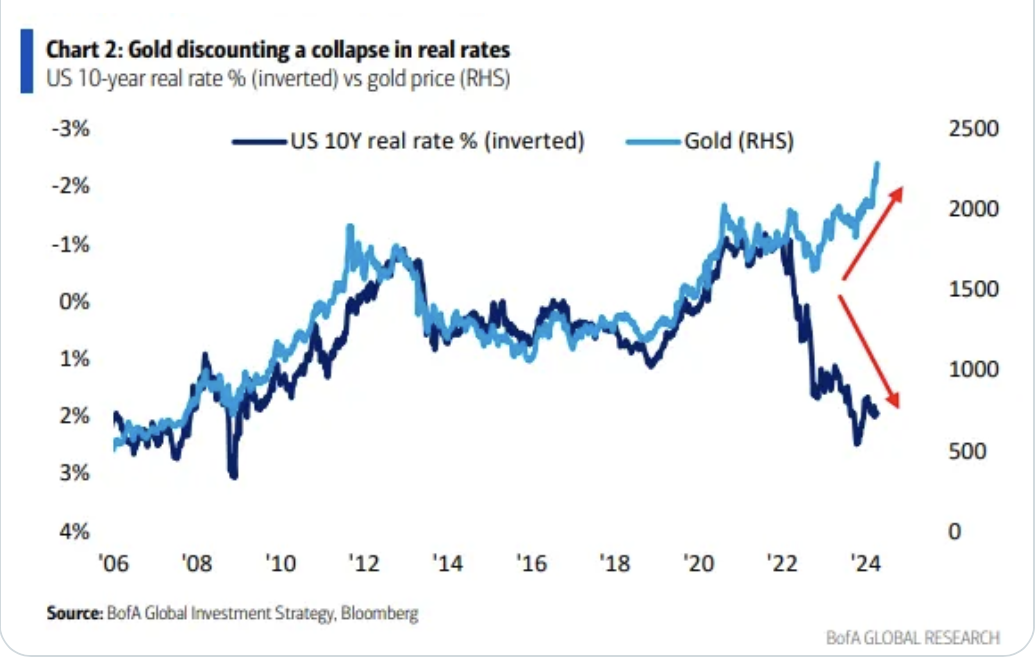
Trying to step back for a broader perspective on the economy and the future of policy rates as well as market movements, there continue to be several conundrums in markets compared to historical trends.  For instance, what is the meaning of the price of gold rising consistently alongside a rise in interest rates, both nominal and real?  Historically, there has been a strong negative correlation between the two, but something has changed in the past two years as evidenced by the BofA Research chart below.

Is this a signal that the market is getting indigestion over the amount of sovereign debt that is outstanding, led by Treasuries?  Is this an indication that investors are losing faith in fiat currencies and the current global monetary structure?  Or is this simply a temporary anomaly that will correct over the course of the next several years?  Unfortunately, there is no way for anyone to know the answer to these questions at this point in time.  Anyone who says otherwise is not being honest.  

However, my suspicion is that the consequences of monetary and fiscal policies around the world during the Pandemic and since has more and more people, and institutions, starting to hedge their bets on the future and its outcomes.  From a more benign view that the authorities will be able to kick the can down the road, this relationship seems to indicate more than a few folks think that the fiscal and monetary authorities are about to stub their collective toe on the next kick.  Ouch!

In many ways, I think that the change in this relationship is an excellent encapsulation of the problems currently faced by monetary and fiscal authorities.  As such, I will be watching it closely as a key indicator of market sentiment overall.

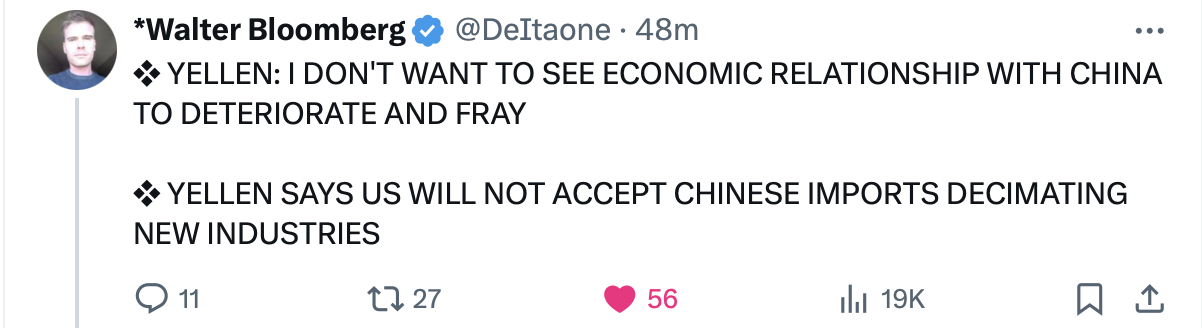
Ok, let’s look at the overnight session.  After Friday’s solid US equity performance, the picture elsewhere has been slightly less positive, although positive overall.  In Asia, the Nikkei (+0.9%) followed the US price action although Chinese shares had a less positive session, falling on the mainland with the HK market staying flat.  Treasury Secretary Yellen was in China trying to smooth things over, but the following two statements, I think, are a great description of how confused things are:

Talk about mixed messages!  Meanwhile, in Europe, most bourses are a bit higher this morning, but on the order of 0.5%, half what we saw in the US on Friday.  It seems that some traders are betting that the ECB, when it meets this Thursday, is going to cut rates.  Lastly, at this hour (7:20), US futures are essentially flat.

The bond market, though, has seen far more activity lately as it appears the bond vigilantes, last seen in the 1990’s are reawakening.  This morning, 10-year Treasury yields are back to 4.45%, their highest level since November when yields were falling in the wake of the Fed’s perceived pivot and the reduced amount of coupon issuance just announced at that time.  This is 13bps higher than the yield just before the NFP data was released, 8bps on Friday and another 5bps this morning.  Similarly, European sovereign yields hare higher by between 3bps and 5bps this morning, being dragged higher by Treasuries, but lagging as bets get made that the ECB acts sooner than the Fed.

In the commodity space, oil (-0.8%) is backing off its recent highs this morning as there appears to be an easing in some concerns over the Middle East, at least that is the story making the rounds.  Meanwhile, metals prices continue to flourish despite the rise in interest rates with both precious (Au +0.4%, Ag +0.9%) and base (Cu +0.7%, Al +0.3%) all continuing their recent climbs.  Another conundrum here is the fact that these metals prices are rising despite the dollar remaining reasonably well bid.

Turning to the dollar, it is little changed, on net, this morning although we have seen some strength against the CHF (-0.5%) and KRW (-0.4%).  The former is the only currency seemingly following the interest rate story as the recent SNB rate cut plus low inflation readings indicates that the policy divergence between Switzerland and the US is set to widen further.  The won, on the other hand, looks to be a proxy for China, which the PBOC refuses to allow to weaken despite many economic reasons it should.  On the flipside, ZAR (+0.4%) is rallying on the back of those metals’ prices.  One of the things that is confusing is the fact that the euro remains reasonably well bid despite the changing tone of the interest rate policies between the Fed and ECB.  While the single currency has generally been declining over the past month, in truth, since the beginning of April, it has rebounded about 1% and held strong since then.  Given the changing market perceptions, I would have anticipated the euro to continue its declining ways, but right now, that is not the case.

On the data front, the week starts out slowly, but we get the critical US CPI data on Wednesday.

TuesdayNFIB Small Biz Optimism89.5
WednesdayCPI0.3% (3.4% Y/Y)
 -ex food & energy0.3% (3.7% Y/Y)
 Bank of Canada Rate Decision5.0% (unchanged)
 FOMC Minutes 
ThursdayInitial Claims215K
 Continuing Claims1792K
 PPI0.3% (2.3% Y/Y)
 -ex food & energy0.2% (2.3% Y/Y)
 ECB Rate Decision4.5% (unchanged)
FridayMichigan Sentiment79.0
Source: tradingeconomics.com

In addition to the data and other central bank decisions, we hear from seven more Fed speakers this week, which given the recent more hawkish commentary, could well be quite interesting.  If Wednesday’s CPI data is hotter than expected again, I suspect it will become increasingly difficult for the doves to spread their wings.  As it happens, six of the seven speak after the CPI, so we could well see things evolve further.  In the meantime, relative to other currencies, I continue to look at the rate picture and believe the dollar should remain firm.  However, versus ‘stuff’ not so much.

Good luck

Adf

Hell or High Water

Though Jay was as clear as a bell
That rate cuts were coming through hell
Or high water, it seems
Not all the Fed’s teams
Are ready to cut rates as well
 
A group of the regional Feds
Seems at, with Chair Jay, loggerheads
They think maybe two,
Or one, cut could do
Now, traders are sh**ting their beds!


Yesterday morning, I claimed that it didn’t matter what the plethora of Fed speakers were going to say given that Chairman Powell had seemed to clear the decks for a rate cut by June.  He swept away concerns about ‘too hot’ inflation and was clearly ready to go forward.  It seems that I didn’t read the market zeitgeist that well after all.

It turns out during the day, we heard from four different Fed regional presidents, Chicago’s Goolsbee, Minneapolis’s Kashkari, Cleveland’s Mester and Richmond’s Barkin, and not one of them sounded like they were ready to cut rates anytime soon.  While only two, Barkin and Mester, are voters this year, the story we consistently hear is that everybody’s voice is heard during the meetings.  Listening to those voices yesterday, it certainly doesn’t sound like everybody is ready to move in June.

Mester: “I don’t think the pace of disinflation this year will match what we saw last year as we need to see a reduction in the demand side this year.  Although if the economy evolves as I envision, we should be able to lower the Fed funds rate later this year.”   

And that was the most dovish we heard.

Barkin: “It is smart for the Fed to take our time.  No one wants inflation to re-emerge.”

Kashkari: “If inflation continues to move sideways, that would make me question whether we needed to do those rate cuts at all.

Goolsbee: “I had been expecting it [inflation] to come down more quickly than it has.  The biggest danger to the inflation picture is continued high inflation in housing services.”

It is very hard to look at these comments and conclude that a June rate cut is a given.  And yet, the Fed funds futures market is now pricing a 64% probability of a June cut although is still pricing less than three full cuts for the rest of the year.

Risk assets were not enamored of these comments and the result was we saw a serious pullback in the equity markets in the US with all three major indices falling by between 1.25% and 1.40%.  Treasury yields fell as well, down 4bps, with its haven status making a comeback as did that status for both the yen (+0.4%) and Swiss franc (+0.6%).

Remember this, there are many different stories around the current market situation between the macroeconomics, the geopolitics of both Israel/Gaza and Russia/Ukraine and the central bank activities, not only with the Fed, but also the BOJ and ECB.  The point is markets are feeling many crosscurrents and it would not be surprising to see a more material breakout in one direction or the other on some seemingly less important piece of news.  In truth, when major moves begin, we rarely have a specific catalyst to which we can point.  I have a feeling the next big move will be confusing for a while.

While words have power
Policies ultimately
Matter much, much more
 
As summer passes
The transition to autumn
Should see prices rise


Adding to the cacophony of new information were comments from BOJ Governor Ueda that he believes the central bank may achieve its inflation target by late summer or early autumn as the impact of the recent wage negotiations begins to feed into the economy.  This story, Ueda’s first comments since the BOJ raised rates last month, has helped revive the yen bulls’ confidence that…this time it’s different!  Given the enormous size of the short yen positions outstanding, it is very possible that we see a sudden, sharp rise in the currency, but for the outcome to be more permanent, we will need to see much more aggressive BOJ tightening, or much more aggressive Fed easing.  Right now, I don’t believe either is in the cards, at least not until winter at the earliest.  This is especially true since when asked about the BOJ’s balance sheet, he indicated there was no reason for an immediate adjustment (sale) to ETF positions or their current, continued, ¥60 billion per month of JGB purchases.

Which brings us to this morning, when the monthly payroll report is set to be released at 8:30.  The latest consensus forecasts are as follows:

Nonfarm Payrolls200K
Private Payrolls160K
Manufacturing Payrolls5K
Unemployment Rate3.9%
Average Hourly Earnings0.3% (4.1% Y/Y)
Average Weekly Hours34.3
Participation Rate62.5%
Source: tradingeconomics.com

We have seen three consecutive reports above 200K, albeit replete with all types of revisions.  However, 200K new jobs per month is historically, a pretty good outcome.  It is certainly not indicative of a major decline in economic activity.  As well, yesterday’s Initial Claims data, at 221K, while a few thousand higher than expected, remains in a very comfortable place from the perspective of economic growth.  The point is the Fed’s concern over sticky inflation makes perfect sense when looking at these numbers.  After all, if people continue to work, they will continue to spend.

As it happens, my take today is we are setting up for a potential large ‘good news is bad’ type day and vice versa.  If the headline number is above 200K, and especially if the Unemployment Rate were to dip lower by a tick or two, I suspect that traders will quickly assume that the hawks are in control and any probability of a rate cut by June will dissipate.  Equity markets will not like this, nor will bond markets.  However, the dollar should continue to perform and, ironically, I see commodities doing the same thing.  We shall see how it plays out.

A quick recap of the overnight session shows that yesterday’s US selloff set the tone with declines throughout Asia (Nikkei -2.0%, China still closed) and Europe (DAX -1.45%, CAC -1.4%) as concerns grow regarding the future of monetary policy.  US futures, though, are modestly higher ahead of the data at this hour (7:00).

Ahead of the release, Treasury yields have reversed half of yesterday’s decline, currently higher by 2bps, and we are seeing similar movement across Europe with all markets seeing yields rise by between 1bp and 3bps.  Yesterday the ECB released their ‘minutes’ explaining they had seen further progress in their mission and the key elements, but that was before oil rebounded 10% from levels seen back then.  As has become the norm everywhere, there continues to be conflicting data and price movement clouding the picture for future policy actions.

Speaking of oil, this morning it is holding onto its gains from yesterday with WTI above $86/bbl and Brent crude at $91/bbl.  The ongoing tensions in the Middle East are clearly not helping things here as concerns grow that Iran is going to retaliate more directly to Israel’s actions earlier in the week, killing a senior Iranian general in Syria.  Of course, the entire combination of events continues to support gold prices, which are little changed this morning, but have absorbed all the selling pressure anyone can muster.  Copper and aluminum are also firmer this morning as the commodity sector seems on a mission right now.

Finally, the dollar is a touch higher this morning heading into the data.  While it has backed off its recent highs from Tuesday, the DXY remains above 104 and USDJPY remains above 151.  With that in mind, we must note ZAR (+0.65%) which continues to benefit from the rally across the entire metals complex and NOK (+0.3%) which is clearly benefitting from oil’s recent performance.  However, traders here are all anxiously awaiting this morning’s number alongside everyone else for more clarity on the next direction of travel.

Aside from the data this morning, we hear from three more Fed speakers to round out the week.  While Barkin is a repeat from yesterday, we also get some new perspectives from Boston’s Collins and Governor Bowman.  Yesterday’s market response to the hawkish views was quite surprising to me as I was very sure that Powell had set the tone.  If today’s data points to strength, do not be surprised to see equities sell off further alongside bonds.  However, a weak number is likely to signal the all-clear for the bulls to get back to business.

Good luck and good weekend

Adf

Debased

Said Powell, the path is still clear
For cutting three times all this year
Though data’s been hot
We’ve certainly not
Decided no rate cuts are near

This was, of course, warmly embraced
By traders who bought shares post-haste
But do not forget
The very real threat
The dollar will, thus, be debased

Chairman Powell regaled us once again and yesterday he sounded far more like the December Powell than the March Powell.  Notice in his comments that he has essentially dismissed the recent hotter than expected inflation data and instead insists they are on the right road to achieve their goal.  He explained [emphasis added], “The recent data do not…materially change the overall picture, which continues to be one of solid growth, a strong but rebalancing labor market, and inflation moving down to 2% on a sometimes bumpy path.” And maybe he is correct.  Maybe the January and February data points are the outliers, and the rate of inflation is going to reverse back lower.

But he has to know that when he coos like a dove, risk assets are going to rally sharply.  The difference today is that the bond market is beginning to ignore all the Fed talk as we see despite these dovish tones, yields remain at their highest level (4.36%) since November, with no downward movement at all.  In fact, perhaps the real concern that the Fed should have is that gold continues to rise strongly almost every day, trading to $2300/oz and showing no signs of slowing down.

I have been consistent in my view that if the Fed cuts despite the ongoing better than expected data the result would be a sharp decline in the dollar, a sharp decline in bond prices (rise in yields) and a sharp rise in commodity prices.  I have also indicated that, at least initially, I expected equities to rally, but their medium-term outlook was more suspect.  Well, yesterday, that was exactly how the market behaved with metals markets screaming higher, stocks trading well and bonds lacking any bids.

Yesterday’s data showed the ADP Employment number jumping 184K, well above expectations of 148K, but the ISM Services data was a bit soft at 51.4 (exp 52.7) and more importantly, the Prices sub-index fell to 53.4 down 5 points from last month.  That was the set-up for Powell’s comments, and he jumped on board.  It remains abundantly clear that the Fed is desperate to cut rates almost regardless of the economics.  My take is the reason has more to do with the debt situation than the presidential election although there is a third possible explanation as well, a too-strong dollar.

Consider the following: the dollar remains the world’s reserve currency and the currency most widely used in trade and financing activity.  Because of this, a large majority of the world’s total outstanding debt of approximately $350 trillion is denominated in dollars despite the fact that most companies and countries are not USD functional.  The result of this situation is that all those non-USD functional debtors need to buy dollars in order to service and repay that debt.  If you were looking for an underlying reason as to the dollar’s broad strength, this is another candidate in the mix.

As such, it is entirely realistic that Chairman Powell is feeling intense pressure from the international community to cut interest rates to weaken the dollar.  While I don’t expect that a Plaza Accord type agreement is in the offing, it is possible that Powell sees this as an achievable outcome and one that would not result in global chaos.  However, whatever the reason, as we watch commodities rally, while the dollar and bond market sell off, we are watching Fed credibility dissipate.

Ok, let’s peruse the overnight session to see how markets have responded to the dovish version of Powell. While US equities sold off late in the day yesterday, minimizing gains, the same was not true overseas.  Though Chinese markets were closed for the Ching Ming Festival, pretty much everywhere else in Asia saw equity rallies of substance with the Nikkei’s 0.8% rise a good proxy for all.  Meanwhile, in Europe the screens are all green as well, although not quite as impressively, more on the order of 0.25% – 0.5%.  This performance is in accord with Services PMI data that was released this morning showing broadly better than expected outcomes across all the major nations as well as the Eurozone as a whole.  Finally, US futures at this hour (6:45) are firmer across the board by 0.25%.

In the bond market, Treasury investors do not see the benefits of Powell’s dovish turn amid still high inflation.  The ADP data is certainly a concern as all eyes turn toward tomorrow’s NFP report.  In fact, what we are seeing is a bit of a curve steepening (less inversion) with the 10yr-2yr inversion now down to -31bps from its -40bp level that had been steady for the past several weeks.  However, European sovereign yields are all a touch lower this morning, down between 2bps (Germany) and 6bps (Italy) as comments from Robert Holtzmann, Austrian central bank chief and the most hawkish ECB member finally conceded that a cut in June could be appropriate.  Of course, now there is talk of a cut at the end of this month weighing on yields.  Meanwhile, JGB yields crept higher by 1bp, but remain at 0.75%, showing no signs of running away higher.

Oil prices (-0.3%) are consolidating this morning after yet another positive session yesterday with WTI now trading above $85/bbl and Brent crude just below $90/bbl.  OPEC reconfirmed that production would remain at current levels and two nations, Iraq and Kazakhstan have promised to cut back to bring their numbers back in line with quotas.  As well, EIA data showed a build in crude but a much larger draw in gasoline stocks (which is why prices are rising at the pump) adding support to the market.  Gold (-0.1%), too, is consolidating this morning but the trend remains strongly higher.  At the same time, copper (+0.5% today, +5.75% this week) is continuing its rapid rise and is back to levels last touched in January of last year.  It appears the broader growth story remains a driver here, especially with the idea that the Fed may be cutting rates and goosing it further.

Finally, the dollar is under a bit more pressure this morning after Powell’s dovish stance, sliding against most of its counterparts in both the G10 and EMG blocs.  AUD (+0.65%) and SEK (+0.65%) are the leaders in the G10 space with most of the rest of the bloc following higher.  One exception is CHF (-0.4%) which has fallen after CPI there fell to 1.0% Y/Y (0.0% M/M) and encouraged traders to bet on faster rate cuts from the SNB.  The yen (-0.1%) too, is not following suit, which perhaps indicates we are seeing a reversion to the classic risk-on stance (higher stocks and commodities, weaker dollar and havens), at least for today.  In the emerging markets, most currencies are firmer led by (CLP +0.6% on copper strength) and HUF (+0.4%) which is simply demonstrating its higher beta relative to the euro, although there are key currencies that are little changed like MXN, BRL and CNY.

On the data front, this morning brings the weekly Initial (exp 214K) and Continuing (1822K) Claims data as well as the Trade Balance (-$67.3B).  As well we hear from five more Fed speakers (Barkin, Goolsbee, Mester, Musalem, and Kugler) to add to yesterday’s comments.  The question I would ask is, even if some of them sound more hawkish, given what we just heard from Powell, will it matter?  For instance, yesterday, Atlanta’s Raphael Bostic reiterated his stance that one cut was likely all that was necessary this year and nobody heard him speak, effectively.  We would need to hear every one of them vociferously defend the current stance and call for zero cuts to have an impact.  And that ain’t happening!

With Powell showing his dovish feathers, the dollar is going to remain under pressure while asset prices perform.  I think that’s the most likely outcome ahead of tomorrow’s data, where a particularly hot number could change things.  But we will discuss that then.

Good luck
Adf

Wronger

The data was, once again, stronger
Reminding us higher for longer
Is still on the cards
Despite the diehards’
Beliefs that Chair Powell is wronger

As well, from two speakers we heard
And none of their signals were blurred
Said Daly and Mester
To every investor
All rate cuts are likely deferred

First, our thoughts are with the people of Taiwan which suffered a massive earthquake last night registering 7.4 on the Richter Scale.  The damage was substantial and while the early count of fatalities is relatively low, just seven so far, I fear there will be more.  From a business perspective, roads and rail lines were damaged and some of the semiconductor fabs were taken offline. The last issue matters greatly as it has the potential to drive up costs and thus prices of finished goods even further (remember what happened to auto prices during Covid when there was no availability of chips?).  It is still too early to determine what the ultimate impacts will be, but the risk is that this will add to inflationary pressures if anything.

However, away from that news, the market story from yesterday and overnight is that the data continues to point to stronger growth in the US (Factory Orders jumped 1.4%) and the latest Fed speakers we heard, Daly and Mester, explained that while three cuts are still possible this year, neither one yet has the confidence that inflation is truly heading back to their 2% goal.

And this is really the entire story for now.  It remains abundantly clear that the Fed is very keen to cut interest rates.  Their macroeconomic backgrounds look at all that has happened and given their underlying belief that the “proper” long-term interest rate is somewhere between 2.5% and 3.0%, they are concerned their current policy is too tight.  And yet, despite these views, virtually every data point that is released shows solid economic activity and no hint that things are slowing down, especially in the labor market.

So, despite that strong desire, they are wary of acting because they know, or at least Powell knows, that if they cut and inflation resurges, it is all on him.  Remember, Powell has made it clear multiple times that he wants to be Paul Volcker redux, not Arthur Burns redux.  The Fed funds futures market continues to price just 66bps of cuts by the December meeting, a telling statement about the difference between market beliefs and Fedspeak, at least yesterday’s Fedspeak.  Granted, we heard last week from two Fed speakers who thought either one or two cuts was the most likely outcome.

Today brings five more speakers including Chair Powell as well as both ADP Employment (exp 148K) and ISM Services (52.7), so there is ample opportunity for news to shake things up.  Based on everything we have seen regarding the US economic data; it seems the risks are for hotter data rather than softer data.  But of more importance, I believe, will be Powell’s comments.  If he accepts the idea that the economy continues to run fairly well with the current interest rate structure and says anything about less than three cuts being appropriate, watch out!

So, let’s look at what happened in markets overnight.  After a weak session in the US yesterday on the growing concern that monetary policy is going to remain tighter, Asia followed suit with declines across the sector.  The Nikkei (-1.0%) and Hang Seng (-1.2%) were both feeling the weight of this evolving narrative.  Surprisingly, mainland Chinese shares were also under pressure despite continued talk of more fiscal stimulus as well as a resurfacing of the idea that President Xi is willing to countenance some version of QE there.  It should be no surprise that virtually every regional market was in the red.

European bourses, though, are a different story this morning as they are higher after the initial read for Eurozone inflation fell to 2.4%, two ticks lower than expected while the Core reading fell to 2.9%, one tick lower than expected and the lowest since February 2022.  Equity investors saw this and decided that the ECB has far fewer impediments to cutting rates than the Fed.  In fact, the only market not behaving like this is the FTSE 100, which received no such news and is somewhat softer this morning.  As to US futures, they are essentially unchanged ahead of Powell’s speech today.

In the bond market, this dichotomy of policy views is also evident as Treasury yields continue to climb, edging up another basis point this morning while European sovereign yields are mostly lower, between 2bps (Spain) and 4bps (Germany) with one outlier, Italy (+2bps).  The Italian situation has to do with the European commission putting pressure on the nation regarding its budget situation which may fall afoul of the current regulations.

In the commodity markets, oil (+0.45%) continues to trade higher as the tensions in the Middle East show no sign of abating while Ukraine has been successful in interrupting Russian refinery production to some extent. Meanwhile. OPEC meets today and there is no indication that they will be changing their production restrictions.  Gold (-0.4%) which has been flying, is taking a breather today although the other metals continue to grind higher.  Nothing has really changed this story as the industrial metals continue to respond to brighter economic prospects while the precious sector continues to worry about the ultimate debasement of the fiat world.

Finally, in that fiat world, the picture is mixed this morning, although the best description is probably unchanged.  I’m hard pressed to look at my screen and see any exchange rate that is more than 0.1% different than yesterday’s levels.  Just like in the equity market, I believe traders are awaiting Chairman Powell’s comments today before taking any new positions.  Over the course of the past three weeks, the dollar has been quite strong, rallying about 3% on a DXY basis.  If the Fed continues to highlight that it is too soon to ease policy, and with today’s Eurozone inflation data, we start to hear more from ECB officials about the ability to cut, my sense is that we could see further strength in the greenback.

Overall, almost everything in markets continues to rely on Powell and the Fed.  Remember, Friday we will see the March payroll report.  If it continues the recent trend of >200K new jobs, it will be very difficult for any doves at the Fed to make their case effectively.  That could begin to weigh more heavily on the equity market but should support the dollar going forward.  Let’s listen to Chairman Jay today for our next clues.

Good luck
Adf

Dismay

The data continues to show
The US is able to grow
If this is the case
Seems foolish to chase
The idea rate cuts are a go
 
Instead, I expect Powell’s way
Is higher for longer will stay
If rates, thus, stay high
Can risk assets fly?
Or will those high rates cause dismay?


The case for the Fed to cut rates continues to fade as not only have Powell and his team been cautioning patience, the data continue to show that economic activity is not slowing down.  The latest exhibit comes from yesterday’s ISM Manufacturing data which printed at a much better-than-expected 50.3, its first print above 50 in 16 months.  Not only that, but the New Orders and Prices Paid sub-indices both printed much higher than last month indicating business is picking up and so are prices.  Certainly, the chart below from tradingeconomics.com indicates that a clear trend is forming for better growth ahead.

The Prices Paid chart looks almost identical.  It strikes me that the recession call continues to get harder to make.  Certainly, things can change, but as of right now, I cannot look at the menu of data and conclude growth is set to slow rapidly.  Given this as background, it becomes increasingly difficult to make the case that the Fed is going to cut rates at all, at least based on the data.  This is a big problem for Powell if he remains insistent on making those cuts because it will call into question the rationale and really push the politics front and center.

As it happens, I am not the only one concluding that rate cuts are less likely, the CME’s Fed funds futures contract is slowly pricing cuts out of the mix as well.  This morning not only has the probability of a June cut fallen slightly to 58.8%, but the market is now pricing in just 66bps of cuts by the December meeting, less than the three full 25bp moves that the median dot indicated.  There is a ton of Fedspeak this week, starting with 4 speeches today from Bowman, Williams Mester, and Daly.  Chairman Powell speaks tomorrow and there are a dozen more after that, so it will be very interesting to see if the tone has changed to even more caution and patience.  With this as a backdrop, perhaps longer duration assets, like bonds and high growth companies (i.e., tech) could well feel some pressure.  We shall see how things play out.

Cooperation
Is not what the market gives
Instead look for pain


While the US story continues to be about stronger economic activity and a reduced probability of lower rates, in Japan, the story remains entirely focused on the yen’s weakness and whether the MOF/BOJ are going to respond.  First, remember that in Japan, like here in the US, the MOF is responsible for the currency, not the BOJ, meaning any intervention is directed by the MOF although it is executed by the BOJ.  This is why we need to focus on the FinMin and his minions regarding any actions.  In this vein, last night as USDJPY once again approached 152.00, FinMin Suzuki was back in front of reporters explaining, “Language aside, we’re now watching markets with a strong sense of urgency.  We are carefully watching daily market moves.”  He added, “All we can say is that we will take appropriate action against excessive volatility, without ruling out any options.”  

So, the MOF continues to threaten intervention with their urgent watching of markets (I feel like that is a very poor translation of whatever he is actually saying, although I suppose it gets the message across.). In one way, it was surprising they didn’t take advantage of illiquid markets yesterday to push the dollar lower as every dollar spent would have been far more effective, but a look at the recent price activity shows that while the yen has weakened appreciably since the beginning of the year, thus far their words have been sufficient to prevent further damage as the currency hasn’t budged in two weeks.  

The problem they have is that the US seems less and less likely to begin easing monetary policy and so the underlying fundamental driver of the exchange rate, interest rate differentials, is going to continue to weigh on the yen (and every other currency).  I also see no reason for Secretary Yellen to consider that a weaker dollar is a help for the US right now, so concerted intervention, a redux of the Plaza Accord of 1985 seems highly unlikely.  While at some point I do expect the MOF to act on their own, as is always the case, it will only have a short-lived impact on markets and likely be used as an entry point for speculators to extend their short yen trade.  The only solution is a change in policies and the BOJ blew that last month.

Ok, now that markets are back open again, let’s see what’s happening.  In Asia, the big mover was the Hang Seng (+2.35%) which was catching up to the news that China seemed ready to implement further stimulus that we heard on Friday.  But there was no consistency throughout the rest of Asia with both gainers and losers around the continent.  Europe is a similar mixed bag, with some markets higher and others lower despite what I would characterize as mildly better than expected PMI data released this morning across the entire continent.  While it wasn’t showing growth, the data improved on the flash numbers of last week.  US futures, however, are softer this morning by about -0.5% after yesterday’s lackluster session.  Certainly, continued hopes for rate cuts are diminishing and that seems to be weighing on stocks at least a bit.

In the bond market, yesterday’s US data set the tone as Treasury yields jumped 12bps yesterday after the strong ISM data and are up another 5bps this morning.  This has dragged European yields higher across the board with gains between 9bps (Germany) and 14bps (Italy).  Of course, the mildly better PMI data in Europe is adding to that mix.  Even JGB yields managed to edge higher by 1bp overnight, although they remain below 0.75%.

Oil prices have been flying, up another 1.1% this morning and now nearly 9% in the past month.  It seems that the escalation of events in the Middle East is having an impact at the same time that OPEC+ is holding firm on their production cuts.  There are rumors of some big Middle East settlement deal to end the war as well as get Saudi Arabia to recognize Israel, but the market does not yet believe that, clearly.  Considering that growth is making a comeback, that China seems ready to stimulate further and that production is not growing, it seems there is a pretty good chance that oil prices continue to rally.  Meanwhile, metals remain the flavor of the day with gold (+0.3%), silver (+1.7%), copper (+0.6%) and aluminum (+1.6%) all in demand.  The industrial metals are responding to the growth story, while the precious set are simply on a roll with fears that fiat currencies are going to continue to be debased top of mind.

Speaking of fiat currencies, the dollar, which rallied nicely over the long weekend, is settling back a bit this morning, but with no consistency.  For instance, CHF (-0.5%) is lagging sharply while NOK (+0.5%) and SEK (+0.5%) are both powering ahead.  The rest of the G10 is modestly firmer, but the movements are within 10bps of yesterday’s closing levels.  In the EMG bloc, ZAR (+0.5%) continues to benefit from the metals rally while PLN (-0.4%) is under pressure after its PMI data disappointed relative to its peers.  My view continues to be that as long as the Fed remains the most hawkish central bank, the dollar will find support.

On the data front today we see JOLTS Job Openings (exp 8.75M) and Factory Orders (1.0%) and we have all those Fed speakers mentioned above.  German CPI fell to 2.2%, as expected, which implies to me that the chances remain greater the ECB will cut before the Fed.  And that is really the big question now, which major central bank acts first.  With all the Fed speakers on this week’s docket, I suspect by Friday we will have a much better idea as to whether a June cut is still on the table.  We will be watching closely.

Good luck

Adf

Limited Sellin’

After the data on Friday
Powell said, rushing’s not my way
Rates, we’ll still lower
If growth turns out slower
Least that’s what the punditry might say
 
Forget any thoughts about hikes
Old ideas that nobody likes
Other than Yellen
Limited sellin’
Suggests there will be no yield spikes


“The fact that the US economy is growing at such a solid pace, the fact that the labor market is still very, very strong, gives us the chance to just be a little more confident about inflation coming down before we take the important step of cutting rates.”

When Chairman Powell expressed this sentiment Friday morning, my take was he was seeking to give himself an out.  One way to read it is, since the economy remains strong, higher for longer isn’t killing us.  However, my first reading of the statement was that since the economy is strong, they can confidently cut rates.  Perhaps it is my confusion, or perhaps it is simply a badly constructed statement of the first view, but regardless, my confidence in the process has not been enhanced.

Friday’s PCE data was released pretty much in line with expectations but that is not as helpful as you might think given expectations were for a continued rebound in the numbers.  The fact that Powell is not more vociferously calling for a tougher stance is the most important piece of the puzzle.  This is what tells me that he has abandoned the 2% target.  While he will never officially admit that is the case, it has become increasingly clear that to achieve that goal, the Fed will need to push much harder on the economy and possibly drive a recession.  My read is that there are very few FOMC members who are willing to accept that tradeoff, especially in a presidential election year.

Right now, as Q2 begins, there is still time to see inflation data ebb closer to their target and allow that June rate cut that he seems to be promising.  But if the data between now and then, which includes three NFP reports, three CPI reports and two more PCE reports, does not cooperate and continues to show economic strength and sticky, if not building, price pressures, Powell and friends are going to have a very hard case to make with regards to any rate cuts.  And this really cuts to the chase as it is increasingly clear that the Fed’s true goal is not to reduce inflation, but to reduce interest rates so government borrowing becomes cheaper.  If the Treasury is going to continue to flood the market with T-bills rather than coupons (see chart below from BofA Global Research), the Fed has the ability to reduce their interest costs directly.  I expect that the pressure to do so is immense and growing.  The Fed remains in a precarious position given their credibility is on the line and so much of it is dependent on things outside their control.

There continues to be a yawning gap between views on the economy in the analyst community.  One camp remains firmly committed to the soft or no-landing scenario, expecting ongoing economic growth as inflation magically fades away (the so-called immaculate disinflation).  The other camp sees a recession on the horizon, if not already arrived, as when breaking down the data, they are able to find key aspects which indicate growth is slowing rapidly.  Right now, my guess is Powell is praying for the recession to appear more clearly, so he has a good reason to cut rates because otherwise, any rate cuts are going to be much more difficult to explain.

Beyond the Fed story, the news overnight was about China and Japan as PMI data from the former showed unexpected strength (Caixin Manufacturing PMI to 51.1) while the latter saw a mixed picture with the PMI data rising to 48.2, but still below the key 50.0 level, while the Quarterly Tankan data had some good news for large manufacturers and not-so-good news for small manufacturers.  With all of Europe still closed for the Easter holiday, a look at the markets open in Asia shows that the Nikkei (-1.4%) found no joy in the data and the index slipped back below the 40K level.  However, Chinese shares rose (+1.6%) on the data as it seems any read of recent commentary from the nation’s leaders indicates more fiscal support is on its way.

Bond markets, too, are closed throughout Europe and so the overnight saw only JGB yields edge up 1bp, Chinese yields follow suit, rising 1bp while Treasury yields are higher by 3bps this morning.  My take is there is limited information in these movements given the overall lack of market activity.

In the commodity markets, oil prices are unchanged to start the day, although they rose more than 6% in March, so there is clearly upside pressure there.  But once again, the star is gold (+0.75%) which is at another new all-time high as it seems an increasing number of investors and traders are becoming more concerned over the ongoing flood of liquidity entering the markets.  This strength is gold is mirrored today in silver, copper and aluminum as the desire to own ‘stuff’ rather than paper continues to grow.

Finally, the dollar continues to be in demand versus essentially all its major counterparts.  With Europe out of the office today, movement has been muted, but it is firmer against every one of its G10 counterparts with NOK (-0.55%) and SEK (-0.5%) the laggards, while it remains stronger vs. most of its EMG counterparts, although ZAR (+0.3%) is benefitting from the strong rally in gold and precious metals.  When looking at the macro situation around the world, right now, the US remains the proverbial cleanest shirt in the dirty laundry and so has the lowest case to cut interest rates.  I believe the ECB and BOE (and BOC and Riksbank, etc.) will all be cutting before the Fed and the dollar will benefit accordingly.  However, as I have maintained for a long time, if the Fed starts cutting with inflation remaining well above target, the dollar will decline sharply.

Looking at the data this week shows we have much to anticipate, culminating in Friday’s NFP report:

TodayISM Manufacturing48.4
 ISM Prices Paid52.6
 Construction Spending0.6%
TuesdayJOLTS Job Openings8.79M
 Factory Orders1.0%
WednesdayADP Employment130K
 ISM Services52.6
ThursdayInitial Claims214K
 Continuing Claims1822K
 Trade Balance-$67.0B
FridayNonfarm Payrolls200K
 Private Payrolls160K
 Manufacturing Payrolls5K
 Unemployment Rate3.9%
 Average Hourly Earnings 0.3% ((4.1% Y/Y)
 Average Weekly Hours34.3
 Participation Rate62.5%
 Consumer Credit$16.5B

Source: tradingeconomics.com

In addition to the data, we hear from 15 different FOMC members across 18 speeches this week.  This includes Chairman Powell on Wednesday as he discusses the Economic Outlook at the Stanford Business, Government and Society Forum.  By the time he speaks, we will have seen the ISM and ADP data, but my guess is that nothing is going to change his mind right now.  At this stage, hotter data is the Fed’s real problem as it will make cutting rates that much more difficult.  The Atlanta Fed’s latest GDPNow reading ticked up to 2.3% for Q1, certainly not indicating a slowdown is coming.  Sit back and get your popcorn out, it is going to be interesting to watch the Fed explain why rate cuts are needed if the data continues along its recent trend.

Good luck

Adf