More Than a Pen

Twas just about two months ago
When President Trump was laid low
As bullets were flying
With somebody trying
To end his campaign in one blow
 
And now, yesterday, once again
A shooter used more than a pen
To try to rewrite
The vote that’s so tight
Enthused to act by CNN
 
By now, you are all aware of the second assassination attempt on former president Donald Trump’s life, this time while he was playing golf at his course in Palm Beach.  The difference, this time, is the alleged shooter was caught alive, so it will be very interesting to hear what he says under questioning and as this situation progresses.  While this is obviously newsworthy, it did not have a major market impact as investors are far more focused on the Fed coming Wednesday and then the BOJ on Friday.  As such, as I write (6:20) US equity futures are mixed with modest movements of +/-0.2%.
 
In China, poor President Xi
Is finding that his ‘conomy
Is not really growing
In fact, it is slowing
Much faster than he’d like to see

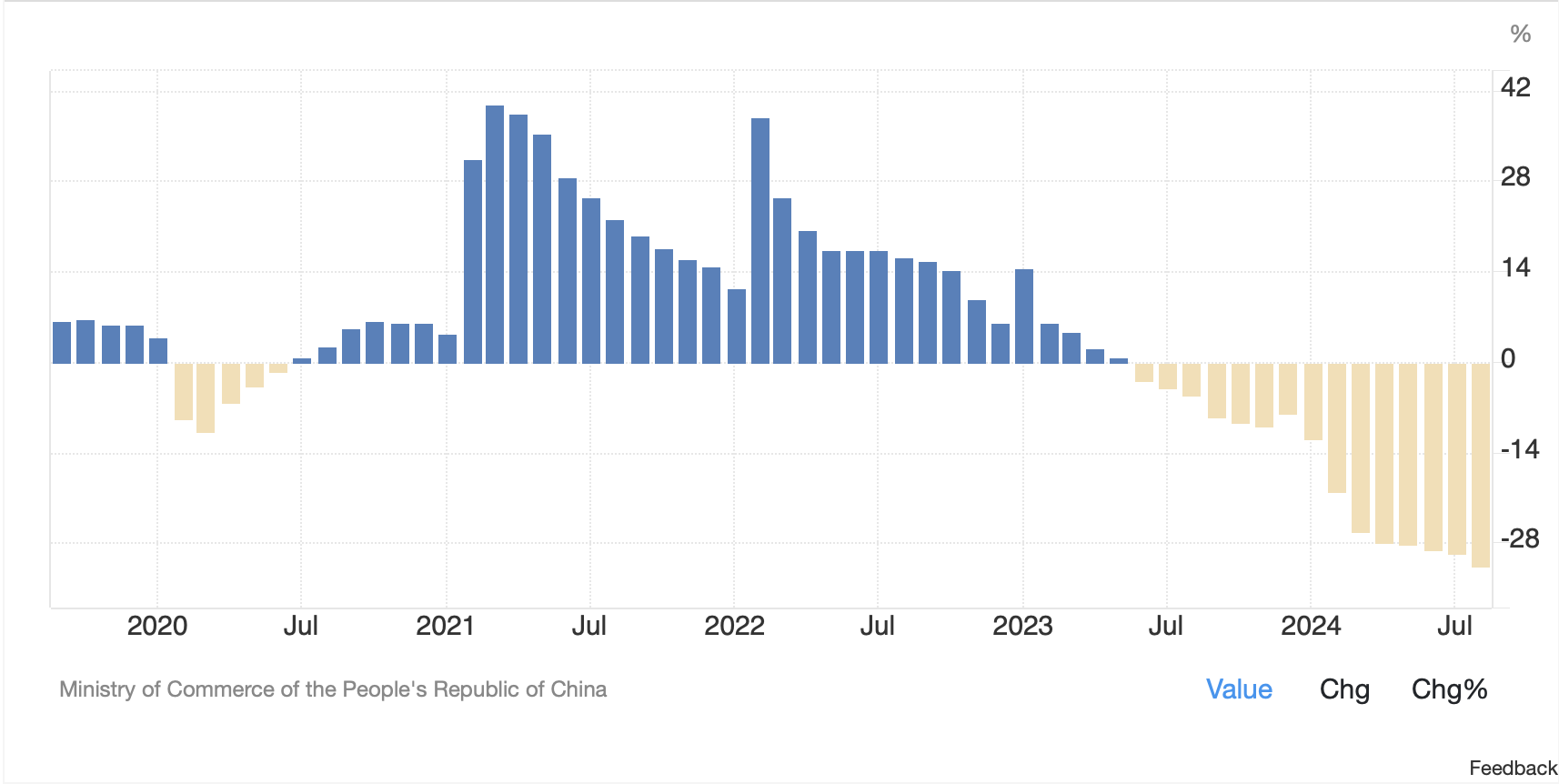
While last night there were different holidays in China, Japan and South Korea, causing all three markets to be closed, Saturday morning, the Chinese released their monthly data drop regarding IP (4.5%), Retail Sales (2.1%) and Fixed Asset Investment (3.4%) along with the Unemployment Rate (5.3%).  Then on Saturday evening here, they released their Foreign Direct Investment (-31.5%) with every one of those figures worse than the previous reading and worse than forecasts.  The evidence continues to show that the Chinese economy is slowing and seems to be slowing more quickly than previously anticipated.  In truth, from my perspective, the biggest concern Xi has is the FDI decline, which as can be seen below, has been falling (net, foreign investors are exiting China) for the past 15 months, and at an accelerating rate. 
Source: tradingeconomics.com

This bodes ill for President Xi’s 5.0% GDP growth target for 2024 and the working assumption amongst the market punditry is that he will soon announce fiscal stimulus in order to get things back on track.  Of course, one of the key problems is that not only are economies elsewhere in the world slowing down, thus reducing demand for Chinese exports, but as well, the expansion of tariffs on Chinese goods by the West continues apace, slowing that data even further.  I saw an estimate this morning that Chinese families have seen $18 trillion of wealth evaporate as the property market in China continues to decline which undoubtedly weighs on consumer sentiment and activity.  But Xi is going to have to do something to prevent a revolution, because remember, the basic Chinese Communist Party contract with the people is we will bring you economic betterment and you let us rule.  If they don’t achieve better economic growth, the population, especially the millions of unemployed young men, may get restless.  While I am not forecasting a revolution, this is typically a precursor to the process.

On Wednesday, the time will arrive
When Jay and his minions contrive
To try to explain
Their easing campaign
And hope stocks don’t take a swan dive

Now to the most important market story this week, will the Fed cut rates by 25bps or 50bps?  It’s funny, if you read independent economic analysis, both sides make their case, and not surprisingly, given the mixed data we have received over the past several months, each case makes some sense.  But…that is not the information you get when reading the press.  The WSJ, inparticular, is really banging the drum for a 50bp cut and many more to follow.  You will recall that Friday, the Fed whisperer was out with his latest piece discussing the merits of a 50bp cut.  Well, this morning there are two more articles, one by pundit Greg Ip basically begging for a 50bp cut, and one by a trio of authors laying out the case and coming down strongly on the side of 50bps.  

All this has helped push Fed funds futures to a 59% probability of a 50bp cut as of this morning.  As some have pointed out on X(fka Twitter), in the past, when there was uncertainty about a Fed move, they managed to get the word out as to what they wanted to do during the quiet period via articles like the ones above and sway markets to their preferred outcome.  As such, at this point I assume we are going to see a 50bp cut on Wednesday.

I guess the real question is what will the impact on markets be?  This morning, we are already seeing the impact in the FX market, with the dollar under pressure across the board.  Versus its G10 counterparts, it has declined by between 0.4% and 0.6% against all except CAD, which remains very tightly linked to the dollar and has gained just 0.1% this morning.  But this movement seems entirely a result of the belief that 50bps is coming.  In the EMG bloc, though, the picture is more mixed with some significant gainers (KRW +0.8%, CE4 +0.5%, ZAR +0.6%) but most other currencies little changed overall.  Nevertheless, the market is clearly pricing for 50bps across the board now and I expect that by Wednesday morning, the Fed funds futures market will reflect that as well.

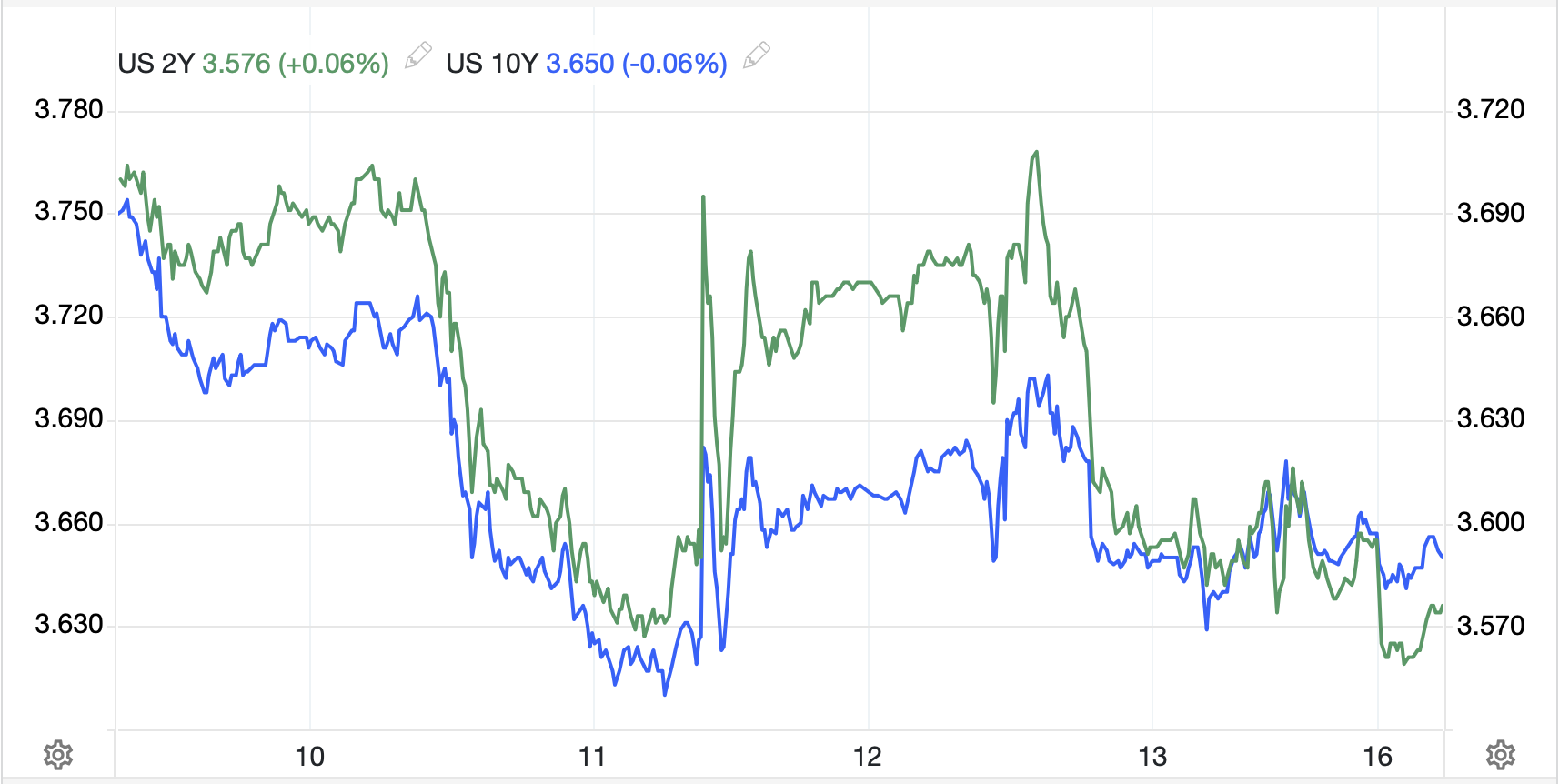
But a weaker dollar is probably not the Fed’s goal.  After all, dollar weakness can help reignite inflation, so they will be wary.  Of more interest to them is the bond market which also appears to be in agreement as the 2yr yield has now fallen to 3.56%, 10bps below the 10yr yield and a clearer sign that the two plus year inversion is behind us.  Of course, as I pointed out Friday, with 2yr yields nearly 200bps below Fed funds, it can be interpreted that the market is anticipating a recession, something I’m pretty sure the Fed wants to avoid if it can.  Perhaps you can see in the chart below how the 2yr yield (in green) fell sharply this morning, almost exactly when those WSJ articles were published.  Go figure!
Source: tradingeconomics.com

At any rate, that is the current zeitgeist, the Fed has leaked they want 50bps and are pushing the levers so when they cut 50bps on Wednesday afternoon, nobody is surprised.  The Fed hates surprises.  It will, however, be very interesting to hear Chairman Powell’s comments given that economic data remains pretty strong overall.

As to the other markets beyond bonds and FX, equity markets, after Friday’s US strength, were generally positive in those countries in Asia not celebrating a holiday (Hong Kong +0.3%, Australia +0.3%, Taiwan +0.4%).  In Europe, though, the picture is more mixed with the DAX (-0.3%) lagging while Spain’s IBEX (+0.3%) is higher although other major markets are virtually unchanged on the session.

Finally, in the commodity markets, oil prices (+0.4%) are edging higher this morning as Libya’s production has been completely shut in due to ongoing internal military conflict.  In the metals markets, gold (+0.2%) remains the biggest beneficiary of the global central bank rate cutting theme as it continues to trade at new all-time highs virtually every day.  Silver (+0.7%) is getting dragged along for the ride with many pundits calling for a much more substantial rally there and copper (+0.4%) is responding to a combination of lower rates and lower inventories in exchange warehouses raising the specter of supply shortages.

On the data front, this week is mostly about central banks, but we do get some other important numbers.

TodayEmpire State Manufacturing-3.9
TuesdayRetail Sales0.2%
 -ex autos0.3%
 IP0.0%
 Capacity Utilization77.9%
WednesdayHousing Starts1.25M
 Building Permits1.41M
 FOMC rate decision5.25% (-0.25% still median)
 Brazil interest rate decision10.75% (+0.25%!)
ThursdayBOE rate decision5.0% (no change)
 Initial Claims230K
 Continuing Claims1851K
 Philly Fed2.4
 Existing Home Sales3.85M
FridayBOJ rate decision0.25% (unchanged)

Source: tradingeconomics.com

Clearly Retail Sales will be closely scrutinized as evidence that the economy is still growing.  I would estimate that a weak number there would insure a 50bp cut, while a strong number may give some pause to those on the fence.  The other very interesting aspect of this week will be the BOJ’s communication in the wake of their meeting Friday.  They went from tough talk to just kidding in less than a week back in August.  What will Ueda-san try this time?  Japanese inflation data is released just hours before their announcement, and it remains well above the 2% target.  My sense here is they want to raise rates, they just need to prepare the market more effectively before doing so.

The dollar is already pricing a bunch of cuts as is the bond market.  If the Fed truly gets aggressive, I believe it can fall further, but if the Fed gets aggressive, you can be certain that so will the BOE, ECB and BOC at the very least.  When they start to catch up, the dollar’s decline will slow to a crawl at most.

Good luck

Adf

Powell’s Dream Team

The punditry’s dominant theme
Is whether Chair Powell’s dream team
Will cut twenty-five
And try to contrive
A reason a half’s a pipe dream
 
But there’s something getting no press
The balance sheet shrinking process
They’re still in QT
But what if QE
Is something they’ll now reassess?


With all the data of note now passed (PPI was largely in line although tending a bit higher than forecast) and the ECB having cut their deposit facility rate by 25bps, as widely expected, the market discussion is now on whether the Fed will cut by one-quarter or one-half percent next week.  The Fed funds futures market, which you may recall had been pricing as little as a 15% probability for that 50bp cut earlier this week, is currently a coin toss between the two outcomes.  In addition, the Fed whisperer, Nick Timiraos of the WSJ, had a front page article on the subject this morning, although he drew no conclusions.

But something that is getting virtually no airtime is the Fed’s balance sheet and its ongoing shrinkage.  You may recall that the current level of QT is $25 billion/month, which was reduced from the original amount of $60 billion/month back in June as the FOMC started to grow cautious regarding the appropriate amount of reserves and liquidity in the system.  

The issue is nobody knows what number constitutes the right amount of reserves.  Fed research is of the belief that somewhere between 10% and 12% of GDP (currently about $2.7 trillion to $3.3 trillion) should be sufficient to ensure that economic activity does not grind lower due to a lack of liquidity.  This has been the rationale behind the slow reduction in balance sheet assets.  But that research may not be accurate, and the underlying assumption was that the economy continued to grow at its trend rate.  In the event of a slowdown or recession, you can be sure that the Fed will add liquidity back as well as cut rates.

Now, working against my thesis is the Fed has not discussed this idea at all, at least publicly, and so a complete surprise is not their typical MO.  However, they have found themselves in a place where the market is pricing in more than 100 basis points of cuts over the next three meetings, including next week’s, which if they stick to their 25bp increments, means that one of these meetings needs a 50bp cut.  As I have written before, the bond market is pricing nearly 200bps of cuts in the next two years (see chart below), which would indicate that the likelihood of an economic slowdown is high.  

Source: tradingeconomics.com

At the same time, equity markets are trading near all-time highs with earnings estimates indicating that economic growth expectations remain quite robust.  Both of those scenarios cannot be true at the same time.

Source: LSEG

This is the landscape through which Chairman Powell must navigate the Fed’s policies as well as his communication of those policies.  In Jackson Hole, he virtually promised a rate cut was coming next week, and one is certainly on its way.  The magnitude of that cut, though, will offer the best clues as to the Fed’s thinking with respect to the future trajectory of the economy and which market, stocks or bonds, is right. 

There is one other thing to consider, though, as an investor. Given the bond market is pricing a significant slowdown, if that is your view, bonds will not offer much return if you are correct.  And if you are wrong, and growth is strong, it will be ugly.  Similarly, if you are of the view that there is no recession, but rather a soft- or no-landing is the likely outcome, then being long stocks, which have already priced for that outcome will likely have only a modest benefit.  However, in the event that the economy does fold and recession arrives, stocks are likely to sell-off sharply.  Arguably, the best positioning for a trader is to be short both stocks and bonds, as whichever outcome prevails, one asset will fall substantially while the other has limited upside, at least for a while.  For a hedger, this is the time that options make a lot of sense as the asymmetry they provide is what allows a hedger to prevent locking in the worst outcomes.

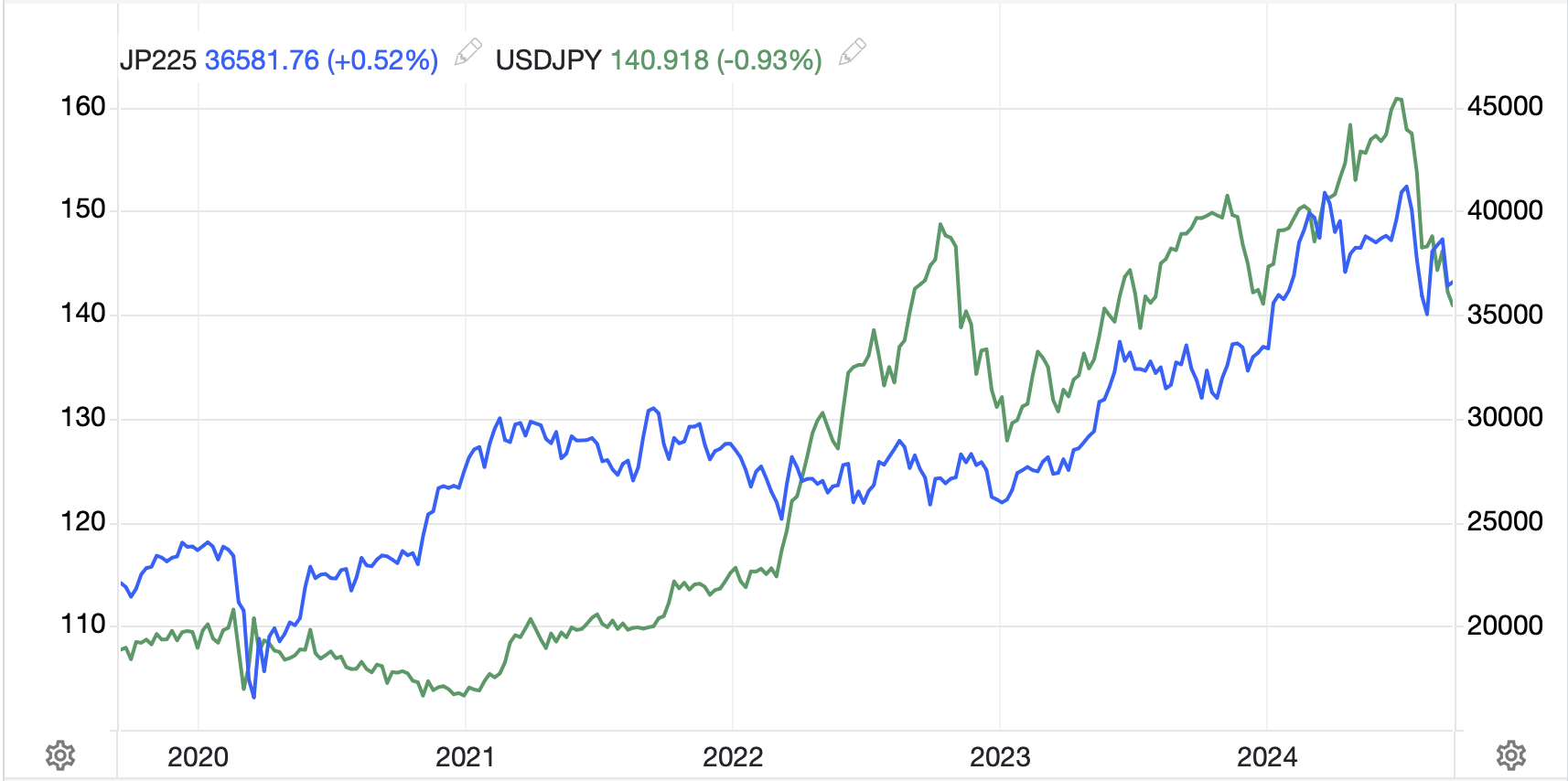
Ok, with that behind us, let’s look at the overnight session to see how things followed yesterday’s risk rally in the US.  In Asia, the Nikkei (-0.7%) has been struggling lately on the back of continued JPY strength.  As you can see from the below chart, that relationship has been pretty strong for a while, and last night, USDJPY traded to new lows for the year, erasing the entire gain (yen decline) that peaked at the end of June.

Source: tradingeconomics.com

As to the rest of Asia, mainland Chinese shares (CSI 300 -0.4%) continue to underperform although HK shares managed a rally (+0.75%) while most of the rest of the region showed very modest strength, certainly nothing like the US performance, but at least in the green.  In Europe, equity markets are all higher this morning with Spain’s IBEX (+0.8%) leading the way although solid gains of 0.3% – 0.5% prevalent elsewhere.  As to US futures, at this hour (7:45) they are creeping higher by about 0.1%.

In the bond market, Treasury yields are lower by 2bps this morning and European sovereign yields are generally little changed to lower by 2bps across the continent.  Yesterday’s ECB outcome was universally expected, and Madame Lagarde explained they remain data dependent and promised no timeline for potential further rate cuts, if they are even to come (they will).  As to JGB yields, they too fell 2bps last night, once again confusing those who are looking for policy tightening in Tokyo.

In the commodity markets, oil (+1.4%) is rallying for the third consecutive day as Hurricane Francine shut in about 40% of gulf production and the timing of its return is still uncertain.  Despite the US equity markets’ clear economic bullishness, the weak growth/demand story is still a major part of this discussion.  In the metals markets, gold (+0.3% overnight, +3.2% in the past week) continues to set new price records daily with a story making the rounds that SAMA, Saudi Arabia’s central bank, secretly bought 160 tons of gold last quarter, soaking up much supply.  This has helped drag silver back above $30/oz although copper (-0.5%) is stumbling a bit this morning.

Finally, it should be no surprise that the dollar is under some pressure this morning as the talk of more aggressive Fed easing grows.  While the euro and pound are little changed, JPY (+0.5%) is leading the way in the G10 with AUD (+0.45%), NZD (+0.4%), NOK (+0.2%) and SEK (+0.3%) all firmer on the back of commodity strength.  In the EMG bloc, the story is a bit more nuanced with ZAR (-0.15%) bucking the trend on domestic political concerns, although we saw strength in KRW (+0.5%) overnight and MXN (+0.35%) as the Fed rate cut story plays out across most currencies.

On the data front, only Michigan Sentiment (exp 68.0) is on the docket so once again, the dollar will be subject to the equity market behavior and the strength of narrative regarding just how dovish the Fed will wind up behaving next week.  I will say that a 50bp cut is likely to see some short-term dollar weakness, probably enough for it to fall to multi-year lows vs. its major counterparts.  But remember, if the Fed starts getting aggressive, other central banks will feel comfortable following that lead, so the dollar’s weakness may not be that long-lived.

Good luck and good weekend

Adf

The New Norm

The CPI data was warm
But not warm enough to deform
The view that the Fed
Was moving ahead
With rate cuts which are the new norm
 
While fifty seems out for next week
Investors, by year end, still seek
A full percent cut
Just when, though, is what
Defines why we need Jay to speak


It turns out that core CPI printed a tick higher than expected on the monthly result, although the Y/Y number was right in line with most forecasts.  In the broad scheme of things, it is not clear to me that a 0.1% difference in one month matters all that much, but markets are virtually designed to overreact to ‘surprising’ data.  At least, the algorithms that drive so much trading are designed to do so, or so it seems.  However, as can be seen by the chart below, it was a pretty short-lived dip and then the march higher in equity prices continued.

Source: tradingeconomics.com

While Fed funds futures pricing has adjusted the probability of a 50bp cut next week by the Fed down to just 15%, that market is still pricing in 100bps of cuts by the December meeting which means that there needs to be a 50bp cut in either November or December as they are the only two meetings left after next week.  As @inflation_guy highlighted in his always perceptive writeups on the CPI report, yesterday’s number ought not have changed the Fed’s thinking.  And perhaps that is exactly what we saw from the equity market, the realization that 50bps is still on the table for next week, especially since there is a growing feeling that’s what Powell wants to do.  I’m confident if Powell pushes for 50bps, he will have no trouble gaining quick acceptance around the table.

Ultimately, I think the problem with focusing on CPI is that the Fed doesn’t focus on CPI, even when they are worried about inflation.  However, especially now that they seem to believe they have achieved victory in that part of their mandate, it strikes me that the numbers about which they really care are the employment numbers.  Last week’s NFP report was mixed at best, although the actual NFP data was the weakest part of the report.  This morning, we get the weekly Claims data (exp Initial 230K, Continuing 1850K), but those numbers have been very stable of late, and not pointing to serious difficulties at all.  To my eye, from the perspective of the economic data that we continue to see, there is limited reason for the Fed to cut at all, especially with inflation still well above their target, but Powell promised a cut, and we have seen nothing since his Jackson Hole speech that could have changed view.  

A better question is, are they really going to cut 250bps by the end of 2025?  That would imply, at least to me, that the economy has slowed substantially, and likely headed into recession.  And, if the data turns recessionary, I can assure you that the Fed will have cut far more than 250bps by the end of next year, probably more like 350bps-400bps.  My point is I cannot look at the market pricing of interest rates and make it fit with the economic outlook at this time.  What I can do, however, is feel confident that if the Fed starts to cut rates aggressively with economic activity at current levels (remember, the GDPNow forecast is at 2.5% for Q3), inflation is likely to pick back up more quickly than people anticipate and the dollar, and bond market, will suffer while commodities and gold rise.

In the meantime, in a short while we will hear from Madame Lagarde as she follows up the almost certain 25bp rate cut they will declare today with her press conference.  I would argue the bigger news out of Europe is the ongoing discussion about increasing Eurozone debt issuance, as suggested by Mario (whatever it takes) Draghi in his report I discussed on Monday.  A look at the recent data from the continent shows that Unemployment is currently at historic lows for Europe, although that is still 6.4%, and inflation has fallen to 2.2%, just barely above their 2.0% target.  As such, here too it seems that the data is not screaming out for action.  Now, the punditry is looking for a so-called hawkish cut, one where the commentary does not discuss future cuts as a given, and I think that would be a sensible outcome.  But not dissimilar to the US situation, where a key driver of rate cut desires is the governments who are the biggest borrowers, there is intense political pressure to cut rates and reduce interest expense.  In fact, I believe that is a key reason behind Draghi’s report, to gain support and remove some of that direct interest rate expense from certain countries’ cost structure.  Thinking it through, net this should benefit the euro in the FX market as the Fed seems hell-bent on cutting and the ECB a bit less so.  We shall see,

Ok, so let’s turn to the overnight sessions to see where things are now.  After the US rebounded yesterday afternoon on the back of strength in the tech sector, we saw a huge rally in Tokyo (Nikkei +3.4%) on the same premise.  And while the Hang Seng (+0.8%) had a good session, once again, mainland Chinese shares (CSI 300 -0.4%) did not participate.  In fact, most of Asia was in the green, once again highlighting the weakness in the Chinese market, and the perception of that weakness in the Chinese economy.  As to Europe, it too has seen strength everywhere with gains between 0.8% (FTSE 100, CAC) and 1.20% (DAX).  This story is one of following the US, hopes for a bit more dovishness from the ECB, and a growing story about the potential for bank mergers in Europe with news that Italy’s UniCredit Bank has taken a stake in, and is considering buying, Germany’s Commezbank.  As to the US futures market, at this hour (7:20) they are all very modestly in the green.

In the bond markets, yields continue to back up slowly from the lows seen earlier this week with both Treasury (+2bps) and most European sovereign (Bunds +2bps, Gilts +2bps, OATs +1bp) slightly higher this morning.  Overnight, we saw JGB yields tick up only 1bp despite a relatively hawkish speech from BOJ member Naoki Tamura.  He indicated that rates should be raised to 1.0% by the end of their current forecast cycle, which sounds like a lot until you realize that is the end of 2027!  Maybe the 1bp move is appropriate after all.

In the commodity markets, oil (+1.7%) is continuing yesterday’s rally as questions about how quickly Gulf of Mexico production will restart in the wake of Hurricane Francine are driving markets.  While the weak demand story still has proponents, the reality is that oil prices have fallen more than 12% in the past month, a pretty large decline overall, so a bounce cannot be surprising.  In the metals markets, after a solid session yesterday, metals prices are higher in both the precious and industrial spaces.

Finally, the dollar is doing very little this morning, but if forced to define the move, it would be slightly softer.  While most currencies in both the G10 and EMG blocs are just a touch firmer, between 0.1% and 0.2%, the biggest mover, ironically is a decline, ZAR (-0.4%), although other than short term trading and positioning, there doesn’t seem to be a clear catalyst for the decline.

On the data front, in addition to the Claims data noted above, we see PPI (exp headline 0.1% M/M, 1.8% Y/Y; core 0.2% M/M, 2.5% Y/Y). Of course, there are no Fed speakers, but after the ECB announcement and press conference, we will hear from some ECB speakers as well.  Right now, the dichotomy between what the bond market is expecting (much lower rates anticipating weaker economic activity) and the stock market is expecting (ever higher earnings growth amid economic strength) remains wide.  While there are decent arguments on both sides, my sense is the bond market is more likely correct than the stock market.  And that is probably a dollar negative, at least at first.

Good luck

Adf

Feelings of Doubt

Two candidates took to the stage
But neither of them could assuage
The feelings of doubt
‘bout how things turn out
And how we can all turn the page
 
Meanwhile there’s news south of the border
Where AMLO, the courts, did reorder
This has raised some fears
That in coming years
The nation will lack law & order


Before I start, please take a moment to remember those 2,977 nnocent lives lost on this horrible day 23 years ago, this generation’s day of infamy.

Now, on to the market discussion.  I don’t know about you, if you watched the debate, but frankly I was pretty bored and disappointed by the whole thing.  I heard many platitudes from both sides, many accusations from both sides, and couldn’t help but notice how the moderators interjected themselves consistently in favor of Vice-president Harris via their “fact-checking”.  All in all, I don’t think we learned that much, although Harris is certainly more coherent than Biden was.  My guess is that very few undecided voters changed their minds.  As to the market’s reaction, perhaps the only notable result was that gold rallied slightly as no matter who wins the election, the idea that fiscal prudence is on the agenda remains anathema to both sides.  Equity futures were slightly lower when the debate started, and still slightly lower when it ended, as well as this morning.  It ought not be surprising as the impact of politics on equity markets has always been unclear in the short run.

The other political story of note was that in Mexico, AMLO, who remains president for a few more weeks, was able to finally get the change to the constitution he has been seeking his entire term, which now allows for judges, including supreme court justices there, to be elected rather than appointed.  The concern is that this will politicize the judicial system.  An independent judiciary is a key ingredient for international investors as they seek some comfort that business decisions can be fairly considered.  However, judicial elections may call that into question and that is likely to have a longer-term negative impact on the Mexican economy.  As you can see from the chart below, the peso has been massively underperforming since April, falling more than 22% and breaching the 20.00 peso level for the first time in more than 2 years, as concerns over this issue have grown.  Add to this the fact that inflation in Mexico has drifted slowly lower and expectations are rising for more aggressive rate cuts by Banxico, and you have the recipe for a weaker currency.  While the peso has bounced 0.9% this morning, this trend lower remains clear for now.

Source: tradingeconomics.com

With all that out of the way, it is time to turn to this morning’s big news, the August CPI report.  Current median expectations are for a 0.2% M/M, 2.6% Y/Y rise in the headline number and a 0.2% M/M, 3.2% Y/Y rise in the ex-food & energy reading.  However, I have seen estimates ranging from 0.0% M/M to 0.3% M/M based on various subcomponents like used cars, apparel and shelter.  Ahead of the release, I have no further information than that, but let’s consider what can happen in either situation.

First, we know that the Fed is going to cut rates next week, regardless of the number today.  Currently, the Fed funds futures market is pricing a 29% probability of a 50bp cut.  A quick look at the below table from the CME shows this is close to the lower end of the range of expectations over the past month, which back in August were at 51%.

source: cmegroup.com

The current working assumption seems to be that a soft number will virtually assure a 50bp cut regardless of any other economic data, while a 0.3% print will lock in a 25bp cut.  Once again, given the apparent resilience of the economy, the rationale for cutting rates aggressively remains elusive.  The cynic in me might point to the fact that Chairman Powell is a private equity guy, someone who made his fortune in that space, and he has been receiving pressure from all his old friends and colleagues to cut rates to help resurrect the sales activity in that market.   While that may seem glib, given the way things work in the corridors of power in Washington, it cannot be ruled out.  However, history has shown that when the Fed begins a cutting cycle with 50 bps, it is generally because they are behind the curve and recession is already here.  If that is the situation, while next week a 50bp cut may be well received by equity investors, the medium-term outlook is not nearly as bright.  At this point, the question is, how will markets respond to the data.

Let’s start with looking at how things behaved overnight.  Yesterday’s mixed US session, with the DJIA slipping while both the S&P and NASDAQ rallied was followed by uniform weakness in Asia.  Perhaps nobody there was enamored of the debate, which was taking place while those markets were open, but we saw the Nikkei (-1.5%) fall sharply with weakness also in the Hang Seng (-0.75%) and CSI 300 (-0.3%). In fact, only Singapore (+0.5%) managed any gains during the session with every other regional market declining.  But that is not the story in Europe, where all markets are higher, albeit not that much higher.  Spain’s IBEX (+0.65%) is the leader with other markets showing gains of between 0.1% (FTSE 100) to 0.3% (DAX).  For those who are concerned that a Trump victory may isolate Europe more than a Harris victory, perhaps there was more encouragement she could win after the debate.

In the bond market, after some significant declines in yields yesterday, where Treasury yields fell nearly 10bps, this morning they have fallen a further 2bps and are now back to their lowest level since June 2023.  At 3.6%, nearly 200bps below Fed funds, the bond market seems to be pricing in a recession.  Interestingly, neither stocks nor credit spreads are pricing that same outcome.  European sovereign yields also fell sharply yesterday, although not as much as Treasury yields, more like 5bps, and this morning they are a bit lower again, somewhere between -1bp and -3bps.  Perhaps the most interesting outcome is that JGB yields have slipped 4bps, once again delaying the idea that the BOJ is going to tighten policy soon.

In the commodity markets, oil (+2.6%) has rebounded sharply this morning as concerns over Hurricane Francine shutting in Gulf of Mexico production rise ahead of expected landfall later today.  However, the trend here remains lower as demand concerns remain front and center and supply continues to grow.  My sense is that the declining demand is a signal that economic activity is slowing, but it will return with a return to more robust global growth.  In the metals markets, everything is back in the green with gold (+0.2%) once again pushing toward its recent all-time highs, while both silver and copper show strength this morning.  I believe those moves are related to the anticipation of larger cuts by the Fed and other central banks coming soon.

Finally, the dollar is under pressure across the board this morning, also playing along with the theme of the Fed cutting rates more aggressively going forward.  In fact, literally every currency in both the G10 and EMG blocs are stronger today with most modestly so, on the order of 0.2%, although we have seen MXN (+0.85%) rebounding from its recent declines discussed above, and ZAR (+0.45%) benefitting from the strength in metals markets.

Aside from the CPI data, the only other news is the EIA oil inventories, where last week saw a large draw overall, and the only forecast I see is for a modest build of <1mm barrels.  However, CPI will determine today’s price action.  I think we are in a ‘good news is good’ scenario so a soft number should see a rally in stocks, bonds and commodities while the dollar suffers further.  On the flip side, a high print should see the opposite reaction.

As I reread my note, it appears to be an accurate description of the fact that there are features in the data pointing to further economic strength and other pointing to weakness.  Truly, nobody knows what lies ahead.

Good luck

Adf

Our Future’s Austere#debate,#china,

This evening there’ll be a debate
And markets are willing to wait
To see if the polls
Will change who controls
The future, and all of our fate
 
Until then, it seems pretty clear
Investors are waiting to hear
Amid all the lies
If taxes will rise
And whether our future’s austere


It seems that all eyes have begun to focus on this evening’s debate between former President Trump and Vice-president Harris, with both sides bombarding every source of information available to the average person with their own spin.  Within the market context, the debate is about which candidate’s policies will be better for the economy and by extension equity markets.  As I am just a poet, this is all far above my pay grade.  Trying to be somewhat objective (and I’m sure you have figured out I lean toward the traditional conservative view of less government is better), from what I have read, neither side paints a particularly enticing picture.  

Tariffs have never proven effective, but the concept of taxing unrealized capital gains is abhorrent, and if enacted would be extremely detrimental to the nation.  Ultimately, I think the phrase, energy is the economy, is one to keep in mind as understanding that idea leads to an understanding of how policy choices will impact economic activity over time.  One need only look at Germany’s economic suicide following their Energiewende policy that has raised the price of electricity dramatically (it is 3x US prices) and led to a slow-motion collapse of the nation’s once strong manufacturing sector, to get a glimpse of the future without cheap and abundant energy.

So, with the Fed in their quiet period, let’s turn our attention overseas for any other news of note.  Chinese trade data was released overnight and showed a further increase in their trade surplus ($91B), news which probably did not brighten President Xi’s day as imports remain incredibly weak, a strong signal that the domestic economy is still stumbling along poorly under the weight of the ongoing collapse in the property bubble there.  The problem was highlighted by Exports growing 8.7% while Imports grew just 0.5%.  Chinese markets were largely unimpressed with this as the CSI 300 rose just 0.1% (although that is better than many of its recent sessions) and the renminbi slipped 0.1% despite a broader trend of modest dollar weakness.

The other notable data was from the UK where the employment situation continues to improve, with the Unemployment Rate falling to 4.1% while wages keep growing at 5.1% and there was a significant uptick in Employment by 265K with all of that data at least as good as expectations with some exceeding them.  When combining the resilience of the employment situation with the fact that inflation remains well above target in the UK, it continues to be difficult to understand the near desperation that the BOE has to cut interest rates.

In fact, that last comment can be applied to the US as well.  A look at the data shows that the job market, while not as robust as it had been last year, remains pretty solid, at least according to the BLS and the recent NFP report, while inflation, no matter how it is measured, remains well above the Fed’s 2.0% target.  In fact, the Atlanta Fed’s GDPNow data moved higher after the NFP report and is now sitting at 2.5% for the current quarter, which would follow the 3.0% Q2 measure.  Again, other than Powell’s promise to cut rates at Jackson Hole, it is not clear the data is pointing to that, at least not the data on the surface.  In fact, Torsten Slok, a well-known economist at Apollo Group, has put out a very interesting compilation of very current data showing that the economy seems to be doing fine.  My point is from the Fed’s perspective, this incredible desire to cut rates seems odd.

But that is the reality, central banks everywhere really want to cut rates, and come Thursday, the ECB will be the next to do so.  The question of 25bps or 50bps for the Fed next week seems almost moot compared to the fact that the market is pricing in 250bps of cuts by the end of next year.  Here’s the problem with that pricing; if the Fed does stick the soft landing, that seems like far too much policy ease without driving a significant uptick in inflation screwing up the soft landing theme.  However, if the economy does fall into recession, they will cut a lot more than that, probably on the order of 350bps to 400bps (Fed funds falling to 1.50% – 2.00%).  And one more thing to remember, QT continues in the background as the Fed gradually reduces the size of its balance sheet.  But can they continue to remove that liquidity while cutting rates as much as the market anticipates?  That feels like a very tough task and in truth, if the Fed is cutting rates, I think we are more likely to see QT turn into QE than anything else.  

So, regardless of the lack of activity today, there is much still to come.  As to today, let’s survey the rest of the markets outside China.  After yesterday’s solid rallies across US equity indices, other than Japan (-0.2%) and Korea (-0.5%), the rest of Asia had solid performances with gains ranging between 0.2% (HK) and 0.75% (Indonesia).  Europe, too, is mixed this morning with some modest gains (CAC, IBEX) and some modest declines (DAX, FTSE 100) with the latter more surprising given the solid employment data.  Perhaps that is the market showing concern the BOE will not cut rates as much as previously expected.  As to US futures, they are little changed at this hour (7:50).

In the bond market, Treasury yields are higher by 1bp this morning and we have seen similar rises across the entire European sovereign market.  Of more interest is the fact that the US 2yr-10yr yield curve is now positively sloped by 3bps this morning, with the long inversion finally having ended.  At least at those maturities.  But if you look at the 3mo (4.98%) – 2yr (3.68%) spread of -130bps, that is dramatically inverted with the market pricing in a huge amount of Fed rate cuts coming ahead.  I cannot help but look at that and be confused about equity analysts’ collective view of significant profit growth going forward.  One of those seems wrong.

In the commodity markets, oil (-1.2%) which had a nice bounce yesterday on concerns over Hurricane Francine hitting the Gulf of Mexico tomorrow, has given it all back after the weaker Chinese consumption data.  Meanwhile, metals prices, which also rallied yesterday amid the general good feelings, are little changed overall this morning.

Finally, the dollar is little changed net this morning as the euro has edged down a few pips while the pound has rallied a similar amount.  In fact, in the G10, only NOK (+0.45%) is showing any movement of substance after lower-than-expected inflation data has reduced the probability of further rate cuts by the central bank there.  Amazingly, in the EMG bloc, movements have been even smaller with really nothing of note to discuss amid overall changes of +/-0.2% or less.

On the data front, the NFIB Small Business Optimism Index was released earlier this morning at 91.2, more than 2 points below last month and expectations and an indication that the small business community remains concerned about future economic activity.  There are no speakers and no other data this morning, so I expect the currency markets to do little until after the debate this evening.  If one candidate is particularly effective, we may see some movement, but otherwise, I sense that people are awaiting tomorrow’s CPI for the next catalyst to make a move.

Good luck

Adf

Harshly Depressed

The Payrolls report was a test
That Rorschach would clearly have blessed
The bears saw the data
As proof that the rate-a
Of growth would be harshly depressed
 
The bulls, though saw only the best
Of times and, their narrative, pressed
In their point of view
The Fed will come through
And stick the soft landing unstressed


With the Fed now in its quiet period, the market is trying to come to grips with what to expect going forward.  But before we look there, a quick recap of Friday’s NFP report, dubbed ‘the most important of all time’ by some hysterics, is in order.  By now you almost certainly know that the headline number was modestly weaker than expected, but that the revisions lower in the previous two months weighed on the report.  However, the Unemployment Rate ticked lower to 4.2% and wage growth edged higher by 0.1%.  Perhaps one of the worst pieces of the report was that the Manufacturing payrolls declined by -24K, the second worst outcome in the past 3 years, and hardly a sign of a strong economy.

The point is that depending on one’s underlying predispositions, it would be easy to come away with either a hopeful or dreary perspective after that report.  And, in fact, I would argue that the report changed exactly zero minds as to how the future is going to evolve, at least in the analyst community.  The biggest sentiment change came in the Fed funds futures markets where the probability of a 50bp cut next week fell to just 25%.  You may recall that particular probability has ranged from one-third up to one-half and now down to one-quarter just over the past week.  I think that is an excellent metaphor regarding both the uncertainty and the confidence in the economy’s growth and the Fed’s likely moves.  In other words, nobody has a clue (this poet included.)

One other observation is that reading headlines from various financial writers and publications shows that the world is still virtually split 50:50 on whether we are going to see a recession (with some calling for stagflation) or the Fed is going to stick the soft landing.  FWIW, which is probably not that much, my personal view is the recession is still going to arrive, but given how aggressively the government continues to spend money, we may need to redefine the concept of recession.  Consider if we look at only the private-sector and whether it is in recession and if that is enough to drag the overall economy, including the government spending, down with it.  In fact, given the 6+% deficits that the government is running, it may be realistic to consider this is exactly what is ongoing right now, although not to the extent that the totality of the economy is sinking.

Now that I’ve cleared that up 🤣, let’s look at how markets have been processing the NFP report and what we might expect going forward.  I’m sure you all know how poorly equity markets behaved on Friday, with US markets falling sharply led by the NASDAQ.  That negativity flowed into the Asian session with the Nikkei (-0.5%), Hang Seng (-1.4%) and CSI 300 (-1.2%) all under pressure.  While the Chinese data overnight, showing inflation rising slightly less than expected at 0.6% Y/Y while PPI there fell more than expected at -1.8%, continues to show that the Chinese economy is faltering and there is still no fiscal stimulus on the way, the Japanese data was generally solid with GDP growing 0.7% Q/Q, much higher than Q1 although a tick lower than the initial estimate.  The upshot is there is further slowing in China while Japan is rebounding.  I guess the question is why would both nations’ equity markets decline.  Arguably, the Chinese story is one of lost hope that the economy will be able to rebound in any timely fashion from an investor’s perspective while the Japanese story is that given the rebound in growth, the BOJ is far more likely to continue on the policy tightening path, thus undermining Japanese corporate earnings.

There once was a banker from Rome
Whose tenure preceded Jerome
“Whatever it takes”
Prevented the breaks
In Europe that would have hit home
 
But now he’s an eminence grise
Who answered the Eurozone’s pleas
To write a report
And help to exhort
Investment to beat the Chinese

But that was the Asian story.  In Europe, the story is far more optimistic with gains across the board on the order of 0.6% – 0.8% on all the major bourses.  The big news here is that Mario Draghi, he of “whatever it takes” fame from his time as President of the ECB and his famous comments that save the Eurozone and the euro back in 2012, was asked to evaluate the Eurozone and help come up with a plan to shake the economy from its current lethargy.  As a true technocrat, his view was that more government investment in key areas was critical.  On the positive side, he did suggest a reduction in regulations, although that really goes against the grain in Europe.  However, it appears that equity investors viewed the report positively as there has been no data or other commentary that might have catalyzed a rally there.  As to US futures, they are bouncing this morning after a rough week last week, with all three major indices higher by at least 0.6% at this hour (6:45).

In the bond market, after a week when yields fell around the world, we are seeing a bounce this morning everywhere.  Treasury yields (+4bps) are actually the laggard with European sovereigns all rising between 6pbs and 7bps and even JGB yields jumping 5bps overnight.  Of course, the Japan story is the solid growth numbers encouraging the belief that Ueda-san will raise rates again by December, while the European story is a combination of expectations of more European debt issuance (Draghi called for more European debt, rather than individual national debt) as well as the influence of Treasury yields.

In the commodity markets, oil (+0.8%) is bouncing this morning but remains well below $70/bbl and this looks far more like a trading bounce than a change in perspective.  The weak Chinese economic data continues to weigh on this market and if OPEC changes its stance and decides to restart production again later this year, it does appear that we could have a move much lower still.  As to the metals markets, they are firmer this morning although that is a bit surprising given the generally weak economic sentiment and the fact that the dollar is following yields higher.  Perhaps the biggest surprise is copper (+1.9%) which based on everything else, should be falling today.  Once again, markets are not mechanical and things occur, about which very few know, but have big consequences.

Finally, the dollar is much stronger this morning with the DXY (+0.5%) rejecting the push lower, at least for now.  This strength is broad-based with NOK (-1.1%) and JPY (-1.0%) the worst performers in the G10 despite the higher oil price and growing confidence that the BOJ will raise rates again.  But every G10 currency is weaker as are virtually every EMG currency with only MXN (+0.4%) bucking the trend, although that seems more of a trading response to the fact that the peso fell through 20.00 (dollar rose) for the first time in nearly two years on Friday.

As to the data this week, CPI is the biggest US number although we also hear from the ECB on Thursday.

WednesdayCPI0.2% M/M (2.6% Y/Y)
 -ex food & energy0.2% M/M (3.2% Y/Y)
ThursdayECB rate decision4.0% (current 4.25%)
 Initial Claims230K
 Continuing Claims1850K
 PPI0.1% (1.8% y/Y)
 -ex food & energy0.2% M/M (2.5% Y/Y)
FridayMichigan Sentiment68.0

Source: tradingeconomics.com

I guess the question is, does the CPI matter any more?  Given the Fed has essentially declared victory and turned its focus to employment, Wednesday’s number would have to be MUCH higher to matter.  With that in mind, I suspect that this week in FX will be far more focused on the equity market than on the macro situation.  If the equity rebound continues, I expect that the dollar will start to cede this morning’s gains, but if yields reverse their past two weeks’ sharp decline and the dollar continues this morning’s strength, then equity investors will feel some more pain.

Good luck

Adf

A New Pox

The interest rate doves are excited
That job growth in August was blighted
If that was the case
The Fed may embrace
Enough cuts to leave them delighted
 
But if they’re correct, what of stocks?
Will weak data be a new pox
On earnings and growth
And undermine both
With stocks falling onto the rocks?


As far as anyone can tell, there is only one thing that matters today, the payroll report.  Let’s set the table with the latest median forecasts:

Nonfarm Payrolls160K
Private Payrolls139K
Manufacturing Payrolls0K
Unemployment Rate4.2%
Average Hourly Earnings 0.3% (3.7% Y/Y)
Average Weekly Hours34.3
Participation Rate62.6%

Source: tradingeconomics.com

I’m sure you all remember that last month we got a surprising, and disappointing, reading of 114K for the headline number and then we subsequently got those massive revisions from the BLS which indicated that they had overstated job growth by more than 800K over the year from April 2023 through March 2024.  As well, yesterday’s ADP Employment data showed private job growth of a below expectations 99K with a revision lower to the previous month’s number.  Certainly, some of the data we have seen is pointing in the direction of a weaker outcome.  However, if one looks at the Initial and Continuing Claims data, neither of those series are pointing to a significant weakening in the labor market, although it has cooled somewhat since last year.

Since the last NFP report, 10-year Treasury yields have declined by 28bps and now sit at 3.70% this morning.  If you compare that to the current Fed funds rate of 5.375%, the implication is that rates are going to fall by at least 160 basis points over the next two years.  In fact, we are starting to see some analysts (Citi) call for nearly that many cuts by the end of 2024!  It strikes me that 150bps of cuts by December 2024 would only occur in response to a significant slowing of US economic activity, in other words, the long-awaited recession. Now, if the Fed were to cut that aggressively without a clear decline in the economy, it would certainly open the door to much higher inflation ahead.  After all, why add liquidity and ease policy if the economy continues to cruise along at a decent clip?

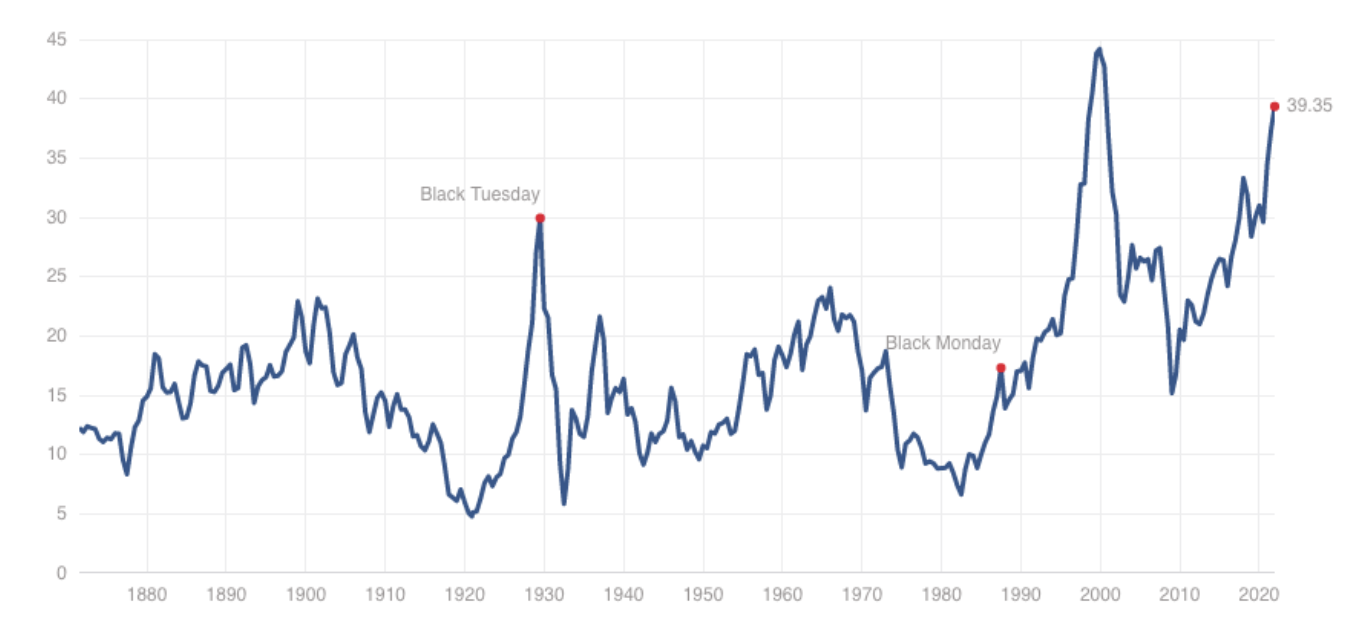
The upshot is that it appears, at least to this poet’s eyes, that the bond market is way ahead of itself with respect to potential Fed rate cuts.  Either that or the stock market is completely mispriced for the potential future earnings results of its components.  The one consistent outcome from all recessions is that corporate earnings growth slows dramatically.  Given that current equity prices embody P/E multiples near historically high levels (see chart below of Cyclically Adjusted Price Earnings for the S&P 500), if the E in that fraction declines, you better believe that so will the P.

Source: lesswrong.com

What will this mean for other asset classes, notably commodities and the dollar?  Here we need to consider the driver of the potential rate cuts in question.  If the US economy is clearly slowing dramatically and the Fed is responding by cutting rates aggressively, I would expect that the dollar will come under real pressure, at least initially, as the Fed is likely to be more aggressive than other central banks.  However, remember that the market is already pricing in significant rate cuts, so given the reality that if the US enters recession, most of the rest of the world is going to see much slower economic growth with their central banks easing policy as well, I would not look for a dollar decline of historic proportions.  Another 5%-8% seems viable but looking for the euro at 1.50 or the pound at 1.75 or the renminbi at 6.00 seems unrealistic.  The one outlier here is the yen, of course, where a situation with declining US equity prices, and correspondingly declining risk asset prices all over the world, could easily see Japanese investors run home with their money and USDJPY could well fall back to the 120 level or even lower in that scenario.

As to commodity prices, I expect the initial move would be lower as concerns about growth would imply falling demand for the key commodities oil and copper.  Gold, however, is a different animal and I imagine that we could see more uptake here as a weaker dollar and growing fear drive more retail buying of the barbarous relic.

Of course, if the data this morning is firmer than expected, all these bets are off.  In fact, that appears to be the biggest risk in markets today, a strong NFP number with a decline in the Unemployment Rate.  Market participants seem quite confident that the slowdown is coming and that the Fed is going to stick the soft landing.  That is the only explanation for the fact that equity markets, despite yesterday’s modest declines, continue to trade near all-time highs regardless of the indications that US economic activity is slowing somewhat.  The belief seems to be that the Fed will be able to cut rates the appropriate amount to prevent a collapse without triggering a renewed burst in inflation.  And maybe they will.  But given the fact that equity ownership is at record high levels already, the question becomes who is going to buy from here.  Any misstep by the Fed, where it becomes clear that the outcome will be worse than a soft landing (either a recession or higher inflation or both) is going to weigh heavily on equity and other risk markets.

So, as we await the big news, a quick review of the overnight session shows that most equity markets in Asia (Nikkei -0.7%, CSI 300 -0.8%) and Europe (DAX -0.4%, FTSE 100 -0.3%) are lower, following the US session.

In the bond markets, yields everywhere continue to decline with Treasury yields (-3bps) continuing their fall while European sovereign yields are all softer by between -4bps and -5bps this morning.  Even JGB yields (-3bps) are continuing lower as the global bond markets seem to be implying that economic activity is waning everywhere.

In the commodity markets, oil (+0.5%) is a touch firmer but remains below $70/bbl and has not shown any real strength despite a dramatic inventory drawdown reported by the EIA yesterday.  OPEC+ has explained they are not going to restart production next month and will wait until at least December before doing so, but based on the price action of oil, I will wager they will delay it again then.  Metals markets are little changed this morning after rallying yesterday during the US session, but like almost every market, all eyes are on the tape at 8:30 when NFP is released.

Finally, the dollar is a touch softer net, with traders seemingly preparing for a weak number.  But the movements are so small that the largest is JPY (+0.25%) which is the result of a combination of fear and the broader dollar weakness I think.    Here, too, we will learn much based on the data, so not much to do until then.

In addition to the payroll report we will hear from NY Fed President Williams and Governor Waller this morning as they will be the last to speak ahead of the Fed’s quiet period.  Williams is due at 8:45, so his speech is prepared, but Waller will have time to alter things if the data is a significant surprise given he doesn’t speak until 11:00.

And that’s really it for today.  It’s all NFP all the time.  While it is very easy to believe that a weak number is coming, it is also clear to me that the pain trade would be a strong number.  As such, I have a sneaking suspicion we could see something much firmer than forecast, maybe 200K with the Unemployment Rate ticking back down to 4.1%.  That would be the real surprise.

Good luck and good weekend

Adf

JOLTed

The market, on Wednesday, was JOLTed
By data, and traders revolted
The jobs situation
Has changed the narration
And helped Jay, his door be unbolted


What door you may ask?  Why, the door that leads to a 50bp rate cut at the FOMC meeting in two weeks.  Already, the Fed funds futures market is pricing in a 43% probability of a 50bp cut, up from a one-third probability on Tuesday morning.  Remember, everything now revolves around the labor market, and yesterday’s JOLTs data was not only worse than forecast, at 7.67M (forecast 8.1M), but last month’s was revised lower by nearly 200K jobs as well.  Remember, too, that tomorrow the NFP report is released with current forecasts centering on 160K, higher than last month but well down on what we have been seeing all year prior to the August report.

There are many analysts who have been calling out Powell and the Fed for making a policy error and holding rates too high for too long.  Perhaps they are correct.  But so much of the decision to cut rates relies on the idea that inflation is well and truly dead, or at least terminal, and if that assumption is incorrect, there will be hell to pay.  The last time the US saw inflation of the same magnitude that we have seen in the past two years, then Fed Chair, Arthur Burns, cut rates too early and inflation exploded higher, peaking at a higher rate than the first rise.  In fact, he did that twice, with inflation spiking three times throughout the 1970’s and early 1980’s.  

Source: FRED database

Powell has been very clear that he is trying to channel Paul Volcker and not Arthur Burns, but if he cuts rates, he opens himself up to a much less satisfactory outcome.  There have been many charts of the following nature showing the parallels of the 1970’s to recent price levels and it is entirely possible we see another wave higher if the Fed cuts.

Source: Real Investment Advice

As things currently stand, I would contend that the Fed’s focus is almost entirely on employment, hence the market response to yesterday’s weaker than forecast JOLTs data.  This implies that this morning’s ADP and Initial Claims data have the chance to really move things.  It also means that tomorrow’s NFP data remains a critical focus for all markets.

In the meantime, market activity overall could well be described as choppy.  While US equity markets opened lower yesterday, following the sharp declines on Tuesday, they closed mixed with limited overall movement. The fears in the semiconductor sector, which were fanned by a, since denied, report that Nvidia had been subpoenaed in an anti-trust investigation, has stopped falling and there are still numerous stories about how much Capex the big 4 tech companies are going to invest this year in all things AI.  Traders and investors are looking for the next big clue which is why I expect limited activity until tomorrow morning’s data release.

Asian equity markets were similarly mixed overnight with some gainers (Australia +0.4%, Taiwan +0.45%, CSI 300 +0.2%) and some laggards (Nikkei -1.05%, KOSPI -0.2%, Hang Seng -0.1%), as no clear direction presently exists.  Late last week, BOJ Governor Ueda sent a letter to the Diet explaining he still expected to raise interest rates if the economy progressed as expected, and that has a number of analysts calling for another leg down in USDJPY and further Nikkei weakness.  But it seems that is a big IF.  With economic activity clearly slowing around the world, it is not hard to believe that the same will be true in Japan and conditions for further rate hikes may not develop.  As to European bourses, the picture here is mixed as well with the CAC (-0.5%) lagging while Spain’s IBEX (+0.7%) is having a pretty good day.  Both the DAX (+0.2%) and FTSE 100 (+0.1%) are modestly higher despite weak Construction PMI data, perhaps both anticipating further policy ease.

In the bond markets, though, the direction of travel is clear for now with yields everywhere having fallen sharply yesterday and simply consolidating today.  After the JOLTs data, Treasury yields fell 9bps (2yr yields fell 12bps and the 2yr-10yr spread is now flat), although this morning it has bounced by a single basis point.  European sovereign yields slipped yesterday as well, between -3bps and -5bps, after the JOLTs data and this morning have backed up by 1bp across the board.  As to JGB yields, they edged lower by -1bp last night and remain a good distance from the 1.00% level despite the recirculated Ueda comments.

In the commodity markets, oil (+0.2%) which had bounced a bit yesterday morning, ceded those gains as the session wore on and is currently below $70/bbl.  While talk of OPEC+ starting up more production has faded, the weak economy / slowing demand story, especially the weak Chinese economy story, remains front and center and continues to weigh on the price.  Meanwhile, in the metals markets, gold (+0.7%) continues to shine overall as the growing sentiment for a 50bp Fed funds cut helps all commodities, but especially this one as concerns over the dollar’s ability to maintain its purchasing power remain rife.  But this morning we are seeing silver (+1.4%) and copper (+0.2%) higher as well, although the latter seem more trading than fundamentally based.

Finally, the dollar is under some modest pressure this morning, which given the movement in yields and rate cut expectations, should be no surprise.  In the G10, virtually all the movement has been less than 0.2% with CAD (-0.1%) the laggard after the BOC cut rates by 25bps yesterday as widely expected.  This morning the yen is also a touch softer, but that is after a sharp rally yesterday of more than 1%, so this morning feels like a trading bounce.  In the EMG bloc, the picture is a bit more mixed with ZAR (+0.5%) the leader this morning on both the gold price as well as economic data showing the Current Account deficit shrank dramatically in Q2 in a pleasant surprise.  On the flipside, MXN (-0.3%) is lagging as the market absorbs recent modestly weaker than expected economic data on Unemployment and Fixed Investment.

Which brings us to today’s data releases.  We start with ADP Employment (exp 145K), then Initial (229K) and Continuing (1870K) Claims.  As well, at 8:30 we see Nonfarm Productivity (2.4%) and Unit Labor Costs (0.8%).  Then, at 10:00 comes ISM Services (51.1) with the final set of data the EIA oil inventories at 11:00 with net further drawdowns forecast.  There are no Fed speakers on the docket today, but we are supposed to hear from two tomorrow after the NFP data.

Absent a big surprise in either ADP or Initial Claims, with the former more likely than the latter, I suspect that it will be another choppy day as all eyes focus on NFP tomorrow.  However, the one thing that seems likely is the dollar has further to decline within the current market narrative of more rate cuts sooner by Powell and the Fed.

Good luck

Adf

Quite Drear

The world is apparently ending
‘Cause stocks just will not stop descending
So, calls have increased
For fifty, at least
And government to up its spending
 
The cause of this rout is unclear
Though data of late’s been quite drear
If growth is much slower
Then stocks can go lower
And that, my good friends, triggers fear


The only topic on market practitioners’ lips this morning is the ongoing sell-off in equity markets around the world.  The US returned after the Labor Day holiday and sold equities aggressively with the NASDAQ falling more than 3.25% and the other major indices all declining at least -1.5%.  This led to a disastrous opening in Asia with the Nikkei (-4.25%) leading the way down as fears of a repeat of the early August rout were rampant.  While things never got to that point, we did see both Korea and Taiwan markets fall even more than Tokyo with declines between -4.5% and -5.0%.  This negative sentiment is alive and well in Europe with every market lower there, although the declines are less pronounced, between -0.7% and -1.1%, and US futures are lower this morning as well, down anywhere between -0.3% and -0.6% at this hour (6:30).

So, what’s happening?  Is there something new that was previously unknown?  The first place to look is the data which saw ISM manufacturing rise less than expected to 47.2, a number that historically represents recession, with the added problem of the ISM Prices Paid reading at 54.0, higher than expected and a potential harbinger that inflation may not be declining as quickly the Fed expects.  Add to that a weaker than expected Construction Spending result, -0.3%, and you have the makings of some potential dreariness on the economic front.  The problem with this thesis is that the equity market opened prior to the releases and was already down -1.0% by the time they hit the tape.

Perhaps it is simply the end of summer blues as historically, September seems to be the worst month for equity performance, although I don’t put much credence in the idea that just because something has happened at a particular time before in markets, it will happen again.  Seasonality is real, especially in things like commodities, but is technology really seasonal?  And tech was leading the way lower.

Of course, markets have a long history of simply moving up and down over time without any specific catalyst.  Positioning and changes in sentiment evolve over time and sometimes they combine to move markets more than would otherwise be expected.

From a macro perspective, I believe that this week will teach us a great deal as the ISM data along with the employment data will give further evidence of the potential for that widely hoped for soft-landing or whether things are declining more rapidly.  Certainly, we continue to read of problems arising elsewhere in the world with the VW news about potential plant closings and weakness in Chinese PMI data overnight indicating that President Xi may need to do more to support his economy.  The thing about sentiment is that it doesn’t necessarily need a clear catalyst to change.  

Source: Horace.org

In the end, I’m hard-pressed to define anything that has changed since Friday afternoon.  However, it appears that sentiment is clearly far more circumspect about the future of economic activity and how that will be able to support the current extremely high valuations of so many companies.  As Ace Greenberg, then Chairman of Bear Stearns said when asked about what happened in the wake of Black Monday in 1987, “markets move, next question.”  

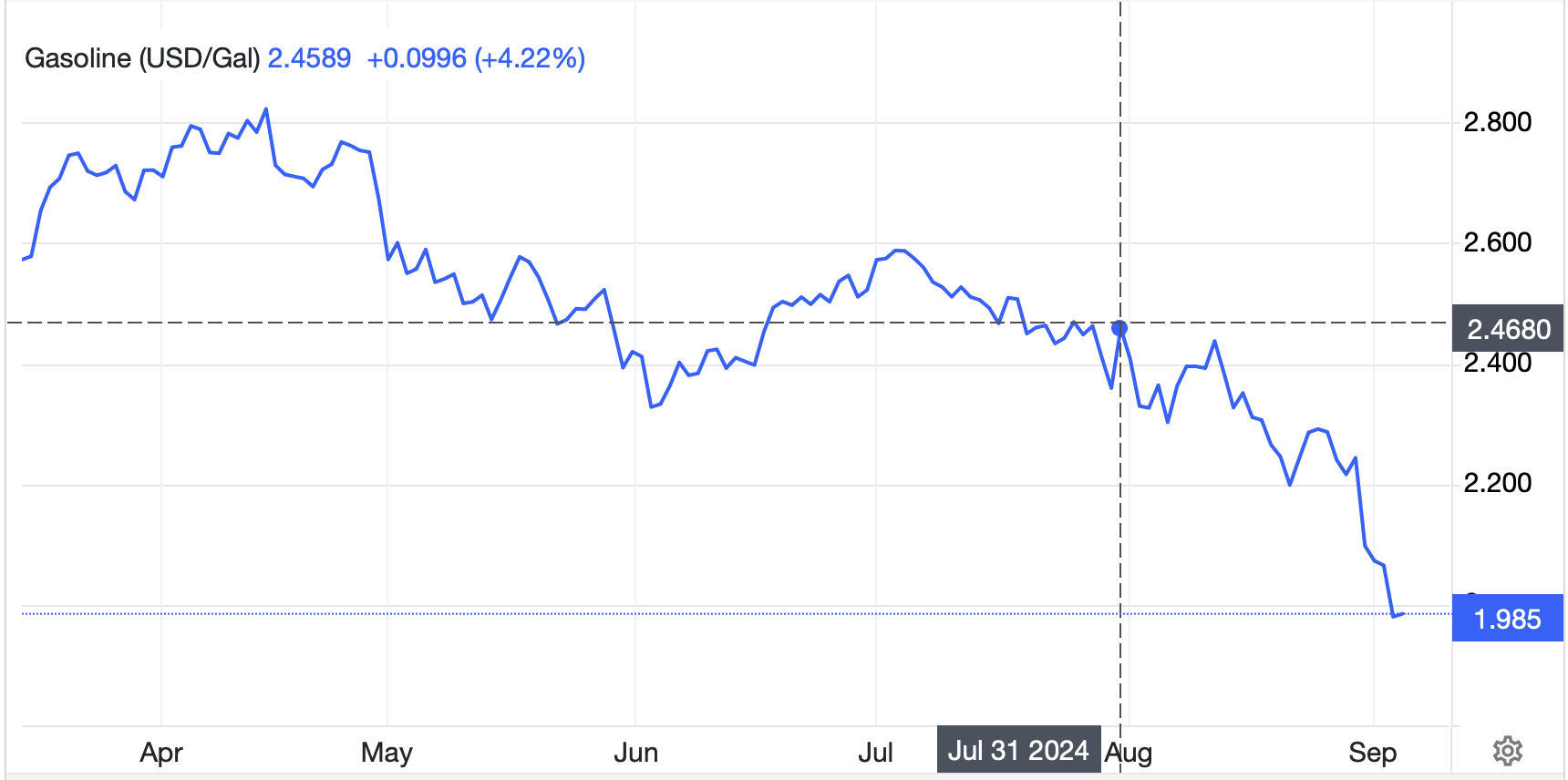
To this poet’s eyes, the big picture remains that economic activity is continuing to slow down around the world, and that price pressures in the US are lagging that decline.  It appears that China is flooding the global markets with manufactured goods as domestic consumption there remains lackluster, thus goods price inflation remains under control.  However, there is no sign that central banks or governments are reducing the amount of available liquidity which is finding its way into services pricing, and that is a much larger part of the economy, hence likely to sustain inflation readings going forward.  I’m confident the Fed will cut rates in 2 weeks’ time, but I’m also highly concerned that the result will be inflation remaining higher than ‘target’ going forward.  The one thing on Powell’s side right now is the decline in oil, and by extension gasoline (see chart below where gasoline futures fell >15% in August), prices, which will help push headline numbers lower.

Source: tradingeconomics.com

So, how did other markets behave while stocks were getting hammered?  Treasury yields fell 9bps yesterday after the data release and are lower by another 2bps this morning.  Clear risk-off behavior.  In Europe, sovereign bonds are all seeing declines this morning between -4bps and -5bps after declines yesterday as well and even JGB yields are lower by -4bps this morning.  investors are running for the relative safety of fixed income right now.

In the commodity markets, oil (+1.3%) is bouncing off the lows seen yesterday, when WTI traded down to $69.15/bbl briefly, as the recent decline has OPEC rethinking their decision to start increasing supply next month.  You may recall that when they cut production, they kept renewing that decision every few months but were set to slowly increase production again starting in October.  However, the sharp decline in the price of oil has them backtracking now.  The problem is that the evidence of slowing economic activity is weighing on the price here.  I suspect that until there is clear evidence that economic activity is rebounding, oil could remain under pressure.  In the metals markets, they were also sold off sharply yesterday, but have basically stopped declining for now, consolidating those losses.  Gold continues to be the best performer as the combination of risk-off and ongoing central bank purchases are supporting it well enough.  This is clearer if you look at the price of gold in other currencies, where it continues to make new highs.  But the industrial metals will have a difficult road ahead with slowing growth.

Finally, the dollar, after a strong rally yesterday, is little changed this morning.  In fact, most currencies are within a few basis points of their closing levels yesterday with only MXN (-0.35%) and SEK (-0.3%) showing any semblance of weakness while ZAR (+0.3%) and JPY (+0.3%) are the biggest gainers.  The yen story is clearly the haven aspect with Japanese investors bringing funds home.  Both the peso and krona are likely feeling a little pressure from the declines in commodity prices, while the rand has bucked that trend after reporting higher than expected GDP growth in Q2 and higher Business Confidence this morning.

Data today brings the Trade Balance (exp -$79.0B) at 8:30 and then the JOLTs Job Openings (8.10M) and Factory Orders (4.7$, -0.2% ex transport) at 10:00.  We also will see the BOC cut rates 25bps this morning, although nobody is paying much attention to Canada with all eyes on the Fed and ECB.

While a lower opening seems baked in, I wouldn’t be surprised to see a bounce of some sort by this afternoon as market participants seem to have a hard time allowing prices to fall for too long.  But there appears to be ample reason for further equity declines and further risk reduction, which historically has supported the dollar.

Good luck

Adf

Taboo’s Been Broken

The calendar’s now turned the page
So, summer has moved to backstage
Thus, risk is retreating
And people are treating
The autumn as though it’s a phage
 
Meanwhile, German voters have spoken
And fears are a new trend’s awoken
Political leaning
Is rightward, thus meaning
A longstanding taboo’s been broken


Arguably, the biggest story from the long weekend was the voting in two German states, Thuringia and Saxony, where the Alternative for Germany (AfD) won one-third of the vote in each state thus destroying the traditional political calculus.  AfD is the right-wing party that has been described as neo-nazi and fascist regularly by the media (of course, the Republican party in the US has also been described in those same words), but more importantly, represents a complete rejection of the current status quo in Germany.  But perhaps the bigger concern for the German political elite is that an entirely new party, the Sarah Wagenknecht Alliance (BSW) won 15.5% and 11.5% of the votes in those two states respectively.  The BSW is a far-left party that espouses some of the same opinions, notably on immigration, as the AfD.  In other words, nearly half the electorate voted against the traditional parties as apparently people in Germany are not very happy.

To complete this story, the issue is that AfD, with which all parties have sworn against working in the parliament, has enough votes for a blocking minority, meaning they can (and almost certainly will) prevent the appointment of new judges and any constitutional changes that they don’t like.  As I said, the political calculus in Germany has changed significantly.  In fact, the parties in the current federal coalition (SPD, FDP and the Greens) saw their share of the vote fall to just 10.3% and 12.4%, respectively, in the two states.

I highlight this issue because it is indicative of the ongoing changes in Europe that may well undermine the single currency’s potential, and assumed, future strength based on the dollar’s assumed future weakness.  After all, whether or not the Fed embarks on a long period of rate cutting, or simply implements a token cut or two, given the political upheaval in Europe, is that going to be a good place for industry to invest?  Their energy policies have been hugely counterproductive, and Europe has about the most expensive energy in the Western world.  In fact, Volkswagen AG, has indicated it may be closing plants in Germany for the first time in the company’s long history.  It has simply become too expensive a place to do business.

This is not to imply that the euro (-0.25%) is going to collapse imminently.  Germany is only one of twenty nations in the Eurozone, albeit the largest economy by far.  But the story in Germany is not isolated to that nation.  We have seen similarly poor energy decisions and similar voter responses in other nations (notably the Netherlands, France and Austria). Whatever you think about the dollar, it is very difficult to get excited about the euro in my view.  

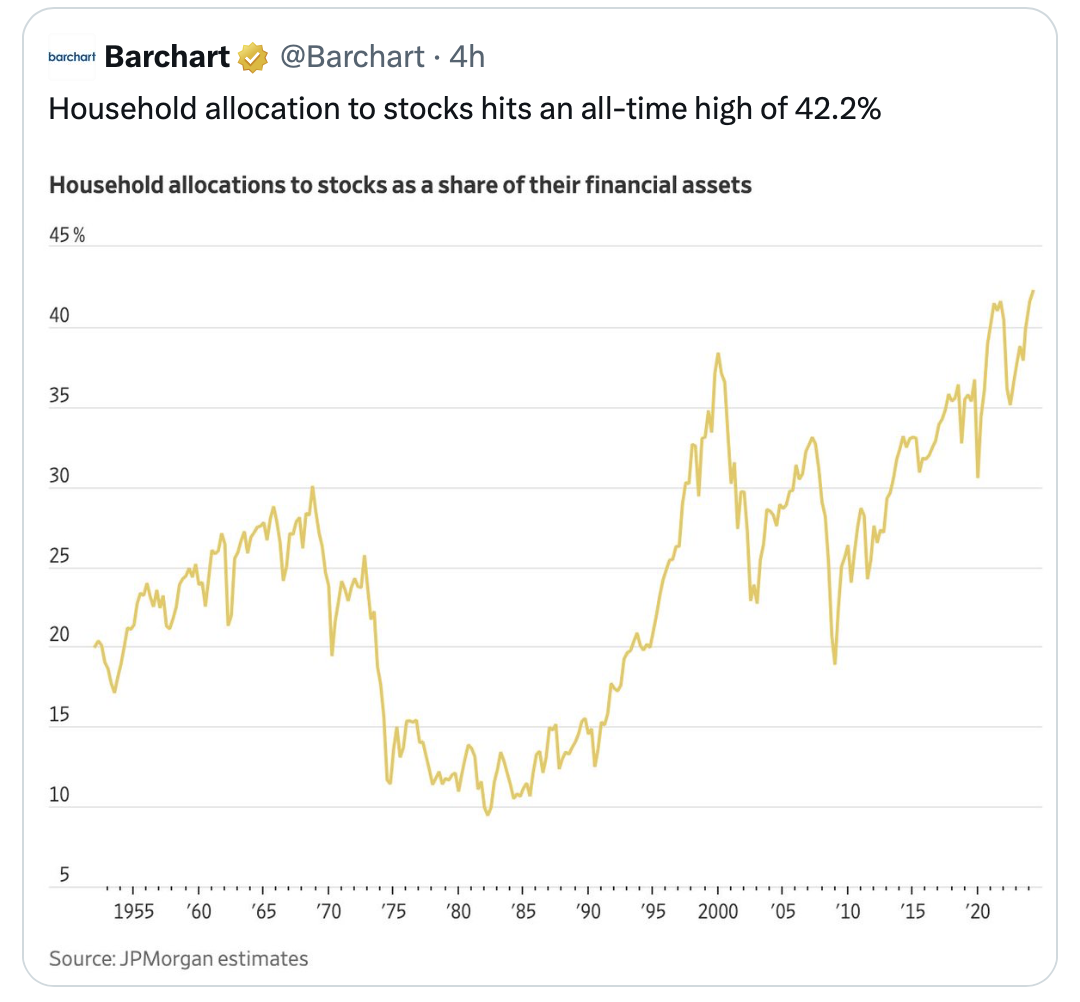
But let’s turn our attention to risk writ large.  I keep reading that September is historically the weakest month in the US equity markets and given the number of sources of strong repute that have written such, am willing to take that at face value.  As well, apparently, US households are the most bullish equities, or at least have the largest equity positions as a portion of their assets, in history (see chart below from @InvariantPersp1 on X).

It strikes me that the combination of extreme long positioning and a historical tendency for weakness may open up some downside in the equity markets, at least for a period.  Of course, if you are old enough to remember the yen carry trade debacle all the way back at the beginning of August, you know that even if we see a big downdraft, it can be reversed quite quickly.  And given both the Fed and ECB (and BOE) all meet later this month, it is not hard to believe that if equities were to decline sharply before their meetings, we could see larger than expected rate cuts across the board.  For now, the market continues to price a one-third probability of a 50bp cut by the Fed while expectations are for the ECB to cut in September and a 50% probability of an October cut.  

Net, do not be surprised if September has nearly as much volatility as August as the idea of max-long equity exposure into a slowing economy with still high inflation feels like a tenuous position.  We shall see.

Ok, let’s try to catch up to overnight activity, which has generally been of the risk-off variety.  Since Friday’s close, the story has been more negative than positive with Japanese (-1.1%) and Chinese (-1.5%) markets falling amid slightly softer than expected data and a more general malaise.  In Europe, too, things have been soft with today’s declines ranging from -0.2% (CAC) to -0.8% (Spain’s IBEX) and everything in between.  This is completely in sync with US futures markets which are all lower by at least -0.6% at this hour (7:20).  

Interestingly, while risk is under pressure, the traditional havens of government bonds are not seeing much benefit with Treasury yields edging higher by 1bp and similar moves throughout much of Europe although both Gilts and Bunds have seen yields edge lower by 1bp.  JGB yields have also edged higher by 1bp and are creeping, ever so slowly, back toward 1.00%.  This follows comments by BOJ Governor Ueda that he really means it when he says they BOJ will normalize policy.  The caveat is that will occur only if the economy meets their expectations with growth rising and inflation remaining high.  However, inflation continues to be fairly stable with services inflation actually declining there, thus undermining his message somewhat.

In the commodity markets, oil (-2.3%) has been taking it on the chin for the past week as the combination of the weaker demand story on a slowing global economy combines with growing confirmation that OPEC+ is going to end their production cuts starting next month, thus adding to supply, has weighed heavily on prices.  Back in January, I wrote a piece discussing my change of view on the long-term prospects for oil prices, which I flipped from bullish to bearish.  The essence of the piece was that there is plenty of oil around, it is political decisions that prevent its extraction.  As the politics of everything around the world continues to quickly change, I think this is an important baseline to keep in mind, although that doesn’t mean we won’t see short term spikes in oil’s price.  However, right now, it looks awful on the charts.

As to the metals markets, they have been under some pressure lately as well, notably copper and silver, with each of those falling more than 5% in the past week.  Gold, however, continues to find buyers as the bigger picture concerns of monetary debasement combine with still active central bank purchasers to support the barbarous relic.

Finally, the dollar is quite strong this morning, rallying against almost all its counterparts.  The commodity bloc are the laggards with AUD (-0.8%), NOK (-0.75%), NZD (-0.7%) and SEK (-0.5%) all suffering in the G10 with only JPY (+0.5%) rallying, arguably playing its haven role.  In the EMG bloc, ZAR (-0.8%), and the CE4 (-0.5% each) are under pressure along with KRW (-0.4%) and even CNY (-0.2%).  LATAM is the surprise with MXN (-0.1%) little changed at this hour.

On the data front, this is a big week that culminates in the payroll report on Friday.

TodayISM Manufacturing47.5
 Construction Spending0.0%
WednesdayTrade Balance-$78.9B
 JOLTs Job Openings8.10M
 Factory Orders4.6%
 -ex Transport-0.2%
ThursdayADP Employment145K
 Initial Claims230K
 Continuing Claims1870K
 Nonfarm Productivity2.4%
 Unit Labor Costs0.9%
 ISM Services51.1
FridayNonfarm Payrolls165K
 Private Payrolls138K
 Manufacturing Payrolls0K
 Unemployment Rate4.2%
 Average Hourly Earnings0.3% (3.7% Y/Y)
 Average Weekly Hours34.3
 Participation Rate62.6%

Source: tradingeconomics.com

Obviously, all eyes will be on NFP as the Fed has clearly turned its primary attention to the employment side of its mandate.  However, don’t fall asleep on the JOLTs data tomorrow, as that has also been part of Powell’s calculus. (seems there was a lot of calculus today, I hope you all managed to get through that in college 😂).  Remember, too, that CPI comes next week and then the FOMC meeting is the following week, so there is no respite.

This morning, risk feels unwanted.  With equity markets still within spitting distance of their all-time highs, it appears there is ample room for some down days ahead.  Of course, Friday will be key.  Regarding the dollar, for now, I believe the bounce continues.  But Friday will dictate the medium term, at least until the FOMC meeting.

Good luck

Adf