
What He’s Sought

On Monday, the market did naught
As traders were giving much thought
To how Jay explains
The work that remains
For him to achieve what he’s sought

And so, while no change is expected
In rates, look at what is projected
The June dot plot showed
The Fed’s preferred road
Was four cuts will soon be effected

Once again, the overnight activity remains fairly dull as traders and investors around the world await the results of tomorrow’s FOMC meeting.  At this point, it seems quite clear the Fed will remain on hold tomorrow leaving Fed funds in a 5.25%-5.50% range while continuing their QT program.  With this in mind, all the excitement will come from the new Summary of Economic Projections (SEP) which includes the dot plot.  The dot plot is the graphical representation of the FOMC members’ expectations for the path of Fed funds going forward.  Below is the most recent release from the June meeting (chart from Bloomberg).
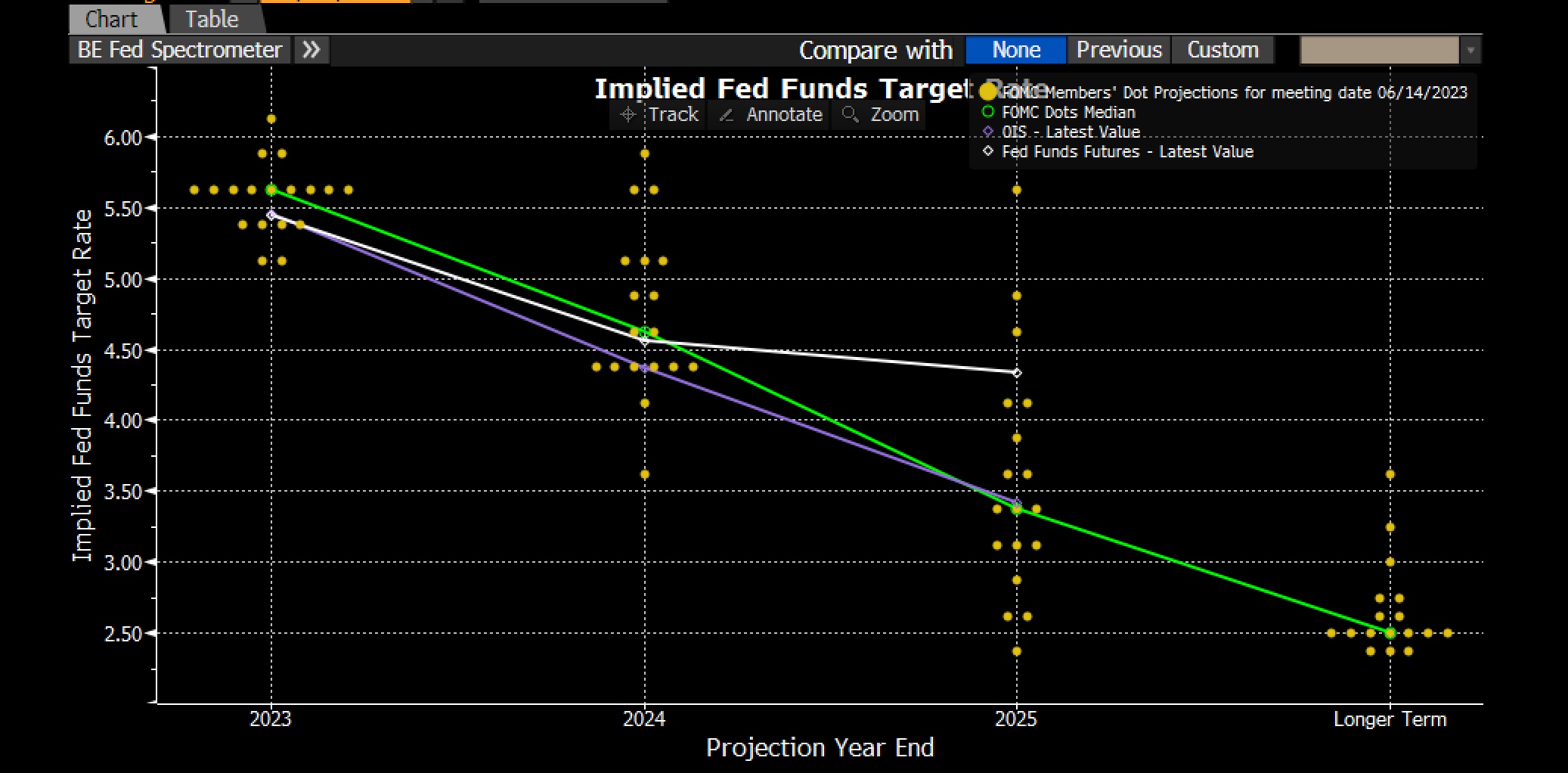
The chart shows each of the FOMC members’ forecasts for where Fed funds will be at the end of 2023, 2024, 2025 and over the long term.  The green line shows the median forecast which in June indicated a belief there will be one more rate hike in 2023 and then four rate cuts in 2024 with another five cuts in 2025 before eventually seeing Fed funds move back to the perceived ‘neutral’ rate of 2.5%.

However, let us consider how some alternative scenarios might evolve.  For instance, I continue to wonder why the Fed will be cutting rates by 100bps in 2024 if they no longer forecast a recession in the US.  After all, if the economy continues to chug along with rates at 5.5%, what purpose would be served by cutting rates?  And if the economy does enter a recession next year, something which seems realistic, then the Fed will be cutting far more than 100bps.  It’s funny, if you look at the dispersion of expectations for 2024, there is one member who feels certain a recession is coming, with an expected rate of 3.625%, and another one who sees higher for longer as lasting the entire year.  At least those two members are making some sense.  However, the idea that the Fed will cut just because, without a more severe economic shock, seems quite unlikely.  After all, Chairman Powell has invoked the ghost of Paul Volcker numerous times and explained they will not be fooled by a temporary decline in inflation.  Rather, they are in this for the long haul and will win the battle.

There are those who would argue that the Fed will cut rates, regardless of the economic situation, because the US cannot afford to continue to pay interest at the current level on their >$32 trillion in debt.  As such, Powell will feel enormous pressure from the administration to reduce rates to help the government.  Now, that is the exact opposite of central bank independence, but certainly not an impossible outcome.  But absent that type of situation, it strikes me that we remain a very long way from the Fed achieving their target inflation rate of 2.0%.  At this point, the one thing Powell has made abundantly clear is that he will not stop until they achieve that goal.  

Another fly in the rate cutting ointment is the price of oil.  Again, this morning it is higher, +0.8%, and now above $92/bbl and seemingly approaching the magical $100/bbl level.  In the wake of the Russian invasion of Ukraine, the Biden administration released some 300 million barrels from the US’s Strategic Petroleum Reserve (SPR) which helped moderate price increases at the time.  However, the ability to repeat that exercise does not exist as currently, the SPR only holds about 350 million barrels and there are actual physical constraints regarding the integrity of the salt domes in which the SPR is kept.  If too much is released, the domes could cave in.  When considering this alongside the ongoing production cuts from OPEC+ as well as the administration’s effective war on domestic oil production, it is reasonable to conclude that oil prices have higher to climb.  Working our way back to the Fed, the problem is that high energy prices ultimately become embedded in all prices, as even services require energy to be accomplished.  This underlying cost pressure is going to prevent any significant decline in the rate of inflation and, in turn, support the Fed’s higher for longer narrative for even longer.

Wrapping up the discussion, I would contend that absent a sharp recession, the Fed is not going to be pressured into cutting the Fed funds rate anytime soon.  Instead, I expect that we will continue to see longer end rates rise slowly as the combination of massive new issuance of Treasury debt and lingering inflation will require higher yields to find buyers.  Currently, the two largest non-Fed holders of Treasury securities are China and Japan, and both of them have been slowly liquidating their portfolios as they need dollars to sell in the FX markets in order to support their own currencies.  When push comes to shove, I expect that we will see US rates retain their advantage over other G10 currencies and that it will continue for a while to come.  As such, I continue to expect the dollar to outperform, at least until something really breaks.  However, what that something is remains open to debate.

Turning to the overnight session, which was quite uninteresting as mentioned above, we saw mixed to weaker performance in Asian equities, with only the Hang Seng managing to eke out any gains at all, while European bourses are mixed with the major exchanges all within 0.2% of yesterday’s closing levels.  Yesterday’s US performance was as close to unchanged as it could get while being open, and this morning’s futures market is showing tiny gains (<0.1%) at this hour (8:00).

Bond markets are somewhat mixed on the day, with Treasury yields backing up 2bps, while UK gilt yields are lower by 4bps and everything else is in between.  Eurozone final CPI for August was released with the headline ticking down 0.1% to 5.2%, but core unchanged at 5.3%, with both, obviously, still well above the ECB target.  Madame Lagarde must be praying quite hard for inflation to fall further as she made it clear she does not want to raise rates again.  In the end, the Eurozone has myriad problems with sticky high prices and slowing growth, an unenviable position.

Aside from oil’s gains, gold has been performing relatively well lately, which given the dollar’s resilience and higher interest rates seems somewhat odd.  One possible explanation is that there continues to be significant demand in Asia, where, for example, the Shanghai Gold exchange price is currently some $30/oz higher than on the COMEX, and this spread has been growing.  We have heard much about the record amount of gold buying by central banks this year, and this seems of a piece with that outcome.  However, looking at industrial metals, both copper and aluminum are softer this morning as the prospects for Chinese growth diminish and with them so do prospects for demand for those metals.

Finally, the dollar is a bit softer this morning vs. most of its G10 counterparts with NOK (+0.75%) leading the way higher on the back of oil’s continuing rally.  In fact, the entire commodity bloc is at the top of the charts today.  However, in the EMG bloc, we are seeing more of a mixed picture with an equal number of gainers and laggards and none showing exuberance in either direction.

On the data front today, we see Housing Starts (exp 1439K) and Building Permits (1440K) as well as Canadian CPI (3.8% headline, 3.7% core), with both measures rising and keeping pressure on the BOC.  There are still no speakers, so my take is that things will be dull until tomorrow’s FOMC announcement at 2:00pm.

Good luck

Adf

Some Dismay

While everyone’s certain that Jay
Will leave rates alone come Wednesday
The curve’s longer end
Is starting to trend
Toward rates that might cause some dismay

The problem remains his frustration
That he can do naught ‘bout inflation
As oil keeps rising
It’s demoralizing
For Jay and his rate formulation

The overnight session was quite dull overall with virtually no new data or information on the macroeconomic front and a limited amount of commentary from the central banking and financial poohbahs of the world.  Friday’s desultory US equity market performance was followed by a mixed session in Asia while European bourses are all in the red after the Bundesbank indicated that Germany would have negative growth in Q3.  As well, after last week’s ECB rate hike, we did hear from one of the more hawkish members that further hikes are possible, although listening to Madame Lagarde’s comments, that seems quite a high bar at this time.

So, given the limited amount of new information, it seems that it is time for central bank prognostications.  The first thing to note is that while the Fed is certainly the main act this week, there are no less than a dozen other major interest rate decisions due this week including the BOE, BOJ, PBOC, Swedish Riksbank, Norgesbank, SNB and Banco Central do Brazil.  

While much has been written about the FOMC on Wednesday, with the current market pricing just less than a 1% probability of a hike, the European banks that are meeting are all expected to follow the ECB and hike by 25bps.  Meanwhile, the PBOC remains caught between a rock (slowing economic growth) and a hard place (a weakening currency) and seems highly likely to follow the Fed’s lead and leave rates on hold.  

The BOJ is also very likely to leave their rate structure on hold, but questions keep arising regarding any other potential tweaks to the YCC framework.  However, given the relatively strong denials of anything like that from Ueda-san at the end of last week, I am inclined to believe they are comfortable where they are.  

Finally, a look down south shows that Brazil is forecast to cut the SELIC rate (their Fed funds equivalent) by 50bps to 12.75% with a handful of analysts calling for a 75bp cut.  Of course, inflation in Brazil has fallen from effectively 12% last summer to 4.65% now, so real rates are still remarkably high there which is the key reason the real has been such a great performer over the past twelve months, having risen ~8%.

The only market that is really showing much movement is oil, which is higher yet again this morning, by another 0.5% and now above $91/bbl.  It is becoming very clear that the OPEC+ production cuts are having the impact that MBS desired, with tightening supply meeting ongoing demand growth, despite slowing economic activity.  The one thing that should remain abundantly clear to all is that no amount of effort by Western governments to reduce demand for fossil fuels is going to have the desired impact as developing nations will not be denied their opportunities to improve their own economic situation and that generally takes access to energy.  To date, fossil fuels continue to prove to be the most cost-effective and efficient sources, so that demand will just not abate.  Oil prices are going to continue to head higher, mark my words.

And truthfully, on this rainy Monday morning in NY, that is pretty much all the excitement that we have ongoing.  The data this week is focused on Housing and expectations are as follows:

TuesdayHousing Starts1437K
 Building Permits1440K
WednesdayFOMC Rate Decision5.50% (current 5.50%)
ThursdayInitial Claims225K
 Continuing Claims1695K
 Philly Fed-1.0
 Existing Home Sales4.10M
 Leading Indicators-0.5%
FridayFlash PMI Manufacturing48.2
 Flash PMI Services50.6

Source: Bloomberg

A side note regarding the data is that the Leading Indicators Index is forecast to decline again, which will be the 17th consecutive decline, a very strong indication that future economic activity seems likely to suffer.  Of course, this is just one of the numerous signals of an impending recession (inverted yield curve, ISM/PMI sub 50.0, etc.) that have yet to play out as they have done historically.  Perhaps the UAW strikes will be enough to tip things over, especially if they widen in scope, but that seems premature. 

In addition, we are beginning to hear more about a potential government shutdown as the House has not yet completed its funding bills but my take here is that while the rhetoric may heat up, the reality is that a continuing resolution will be passed and that this is just another tempest in a teapot in Washington, SOP really.

When looking a little further ahead, I continue to see a far better chance that the Fed remains the most hawkish of the major central banks, and that higher for longer really means just that.  Economic activity elsewhere, notably in Europe and China, is suffering far more acutely than in the US, at least statistically, and that implies that this week’s rate hikes across the UK and the continent are very likely the end of the cycle.  I am not convinced that the Fed is done.  That combination leads me to continue to look for relative dollar strength over time.  For asset/receivables hedgers, keep that in mind.

Good luck

Adf

Dreamlike

The ECB hiked twenty-five
But Madame Lagarde tried to drive
The idea they’d hike
Again was dreamlike
And so, euro-dollar did dive

Then last night some Chinese reports
Showed there was some growth there, of sorts
The PBOC’s
Continuous squeeze
Of rates, too, has hammered yuan shorts

Starting with a quick recap of the ECB meeting, as I had believed, they hiked rates by 25bps which takes the Deposit rate to 4.00%, the highest level since the euro was created in 1999.  It seems Madame Lagarde’s rationale was similar to my own, which was essentially, this was the last chance to raise rates before the recession in Europe really gets going at which point further rate hikes will be incredibly difficult politically.  However, by essentially explaining they were done, with inflation running well above both the current interest rate structure as well as their 2.0% target, Lagarde undermined any support for the single currency which fell sharply yesterday after the announcement and has been unable to show any signs of life since then.  Current market pricing shows a 38% probability of another hike this year before an eventual reduction in the rate structure by the middle of 2024.  However, my take is that if the recession spreads further, the ECB will be quick to cut rates.  Ultimately, I continue to believe the euro is going to have a very difficult time going forward.

Turning our attention east, the Chinese monthly data dump was released last night and virtually every single measure beat expectations, even the property investment.  None of the beats were very large, but I guess the question has become are analysts and investors overly bearish on China (or perhaps the question is can we trust Chinese data)?  For instance, IP rose 4.5% Y/Y, vs. 3.9% expected; Retail Sales rose 4.6% Y/Y vs. 3.0% expected; Property Investment fell -8.8% Y/Y vs. -8.9% expected and the Unemployment Rate fell to 5.2% rather than remaining unchanged at 5.3%.  The only outlier was Fixed Asset Investments which rose 3.2% rather than the 3.3% expected.  The market response to this was quite interesting.  The yuan was little changed, although it remains well above its recent lows with USDCNY hovering around 7.2800.  The CFETS fixing continues to be pushed toward a lower dollar, although the spread between the fixing and the onshore market has narrowed slightly to 1.4% from its recent levels above 1.9%.

As I mentioned yesterday, the Chinese cut their RRR by 0.25% trying to inject more liquidity into the economy and they have also been pushing up offshore CNY interest rates which are now equal to USD interest rates so there is no carry benefit in shorting the CNY offshore.  This, too, will help eliminate some of the downward pressure on the yuan.  In fact, it appears that much of the recent policy focus has been to prevent the yuan from weakening much further.  I guess if you are trying to convince other countries that they can use the yuan for payments and holding it is safe, it really cannot be seen falling sharply.  I suspect that the PBOC will be doing everything they can to support the currency going forward.  In a bit of a surprise, Chinese shares were the worst performers overnight, with all the main indices there in the red while markets elsewhere in Asia (Nikkei +1.1%, Hang Seng +0.75%, ASX 200 +1.3%) and Europe (DAX +1.0%, CAC +1.6%, FTSE 100 +0.8%) are all higher.  As it happens, US futures are little changed this morning after a strong equity performance yesterday.  So, all in all, I would say risk is in favor today.

This risk attitude is evident in bond yields as well as they are rising with investors moving from bonds to stocks.  Treasury yields are higher by 3.5bps, while in Europe, yields are all higher at least 6bps with Italian BTPs seeing the most selling and a rise of 7.5bps.  Arguably, if the ECB has finished its tightening cycle, which it seems to have done, and inflation remains as high as it is, the value of bonds should decline.  This movement is logical based on what appears to be the new narrative. 

A quick aside on Japan, where you may recall that on Monday, the yen strengthened and JGB yields rose after comments from BOJ Governor Ueda regarding the possibility that they would have enough information to potentially end ZIRP there.  It turns out that was not Ueda-san’s intention, and rather he thought his comments were benign.  It seems there is no intention to adjust policy anytime soon.  The market response was seen in FX where the yen fell -0.3% and is now pressing to 148.  I suspect 150 is coming soon, although further intervention at that level cannot be ruled out.

Turning to commodities, oil (+0.5%) continues to rally and is now solidly above $90/bbl.  The other gainer today is gold (+0.4%) but base metals are softer.  A possible train of thought here is that rising oil prices will both force interest rates higher through the inflation channel as well as undermine economic growth, so the industrial sector is getting double-whammied in the short-term.  As with energy, the long-term prospects remain quite positive for base metals as production is just not going to be able to keep up with demand given the lack of investment in the sector since the ESG movement began a decade ago.  Even if it is recognized that this must change, it will take years before new production can come online which should continue to be supportive of the sector overall.

Finally, the dollar is mixed this morning, with the EMG bloc seeing half gainers and half laggards although the largest movement is less than 0.2%.  In other words, nothing is going on here.  Similarly, in the G10, other than the yen mentioned above, movement has been mixed with no real substance in either direction.  Given the FOMC meeting next week, it appears that traders are unwilling to position themselves too much in either direction.  Net, this week, the dollar did fall a bit, but remains well above its recent lows.

Yesterday’s Retail Sales data was once again quite hot, rising 0.6% for headline and ex-autos, which just goes to show that there is a lot of money still sloshing around the system.  As well, the Claims data was solid again with 220K Initial Claims, less than forecast and certainly not showing any weakness in the labor market.  Today brings a bunch of secondary data with Empire Manufacturing (exp -10.0), IP (0.1%), Capacity Utilization (79.3%) and Michigan Sentiment (69.0).  The Citi Surprise Index continues to push higher which continues to indicate that economic activity in the US remains solid.  While a recession is clearly going to arrive at some point, for now, it remains a distant prospect.  With that in mind, do not think that the Fed is going to go soft anytime soon and that ongoing higher for longer is very likely to help support the dollar overall.

Good luck and good weekend

Adf

Results May Be Dire

It turns out inflation was higher
Though no one would call it on fire
The problem, alas
Is food, rent and gas
Show future results may be dire

But CPI’s yesterday’s news
Today it’s Christine and her views
Will she hike once more
Though growth’s on the floor
Or will, all the hawks, she refuse?

Yesterday’s CPI report could be termed luke-warm, I think, as the headline number was a tick higher than expected at 3.7%, while the core M/M number was also a tick higher than expected at 0.3%, although the Y/Y core number was right at the 4.3% expectation.  This provided fodder for both sides of the inflation discussion, with the inflationistas all claiming that higher CPI is coming, and we have bottomed while the deflationistas claimed that the results were insignificantly different from expectations and, oh yeah, rental prices are still falling so they are certain CPI will follow lower.  My go-to on this subject is always @inflation_guy and he explained (here) that some areas were hot and some not so much but does agree that any further declines in the CPI are likely to be quite small if they come at all.  I am in the camp that the new inflation level is somewhere in the 3.5%-4.0% area and short of a drastic recession, it will be extremely difficult to change that.

The stock market was certainly confused by the data as it initially sold off 0.5%, rebounded through most of the day only to see another late day decline and finish up very slightly higher overall.  In other words, it certainly doesn’t seem as though opinions were changed.  Treasury yields did edge a bit lower, falling 3bps, although this morning they have backed up by 1bp.  And the dollar finished the day net stronger vs. the G10, but actually net weaker vs. the EMG bloc.  All in all, I would argue we didn’t learn that much.

This brings us to today’s key story, the ECB meeting.  After the leaked story about the newest ECB forecasts calling for CPI above 3.0% next year, the market priced a greater probability of a hike today, it is still 65%, but net, have only one more hike priced in before the ECB is finished.  Madame Lagarde’s problem is that inflation is running hotter than in the US while their interest rate structure is 150bps lower and growth is very clearly rolling over.  The stickiness of European inflation has been quite evident and shows no signs of changing.  So what will she do?

Given Lagarde’s political background, as opposed to any central banking background, I expect that she will see the writing on the wall with respect to economic activity in the Eurozone, and if the ECB is going to be able to raise rates at all, this is probably the last chance.  By the October meeting, the European recession will be quite evident and her ability to hike rates then will be heavily circumscribed.  As such, I see 25bps today and that is the end, regardless of what her comments afterwards are.  

Trying to consider how the markets will react to this leads me to believe that European equities will soften a bit, although ahead of the meeting they are higher by about 0.3% across the board.  It also implies to me that we could see European sovereign yields creep higher (although right now they are lower by about 1bp across the board) as the inflation fighting stance alters before inflation retreats, and ultimately, I think the euro suffers as investors decide that there are better places to put their money.  In fact, I expect this opens the door for the next leg lower in the single currency, perhaps down to 1.05 before it finds a new ‘home’.

But wait, there’s more!  In fact, we have a plethora of data being released today in the US as follows:

Retail Sales0.1%
-ex Autos0.4%
Initial Claims225K
Continuing Claims1693K
PPI0.4% (1.3% Y/Y)
-ex food & energy 0.2% (2.2% Y/Y)

Source: Bloomberg

For the market, and the Fed, I expect the Retail Sales number will be critical as last month we saw a very hot read, 0.7% while the market was looking for just 0.4%, and the ex Autos number was even hotter at 1.0%.  If we were to see another strong number here, especially if the Claims data continues to point to strength in the labor market, the Fed will certainly take note.  And while they may not hike next week, it would likely increase the odds of a November hike substantially.

Those are the key macro stories to watch today but there is one micro story that is worth noting and that is that the PBOC has been quite active recently in its efforts to prevent further renminbi weakness.  This morning they cut the reserve requirement ratio by a further 0.25% for banks in China and they also increased the issuance of bills offshore in Hong Kong thus pushing CNY rates higher there and pressuring those who would short the currency.  Finally, it appears that they have instructed several of the large state-owned banks to essentially intervene in the spot market at their direction, although the banks are the ones holding the risk.   So far, all their activity this week has pushed USDCNY lower by just 1.0%, so having some effect, but hardly reversing the longer-term trend weakness in the currency.  My take is, like the Japanese, they are more worried about the pace of any decline than the decline itself.  But in the end, unless we see some macro policy changes by either or both China and the US, the trend here remains for a weaker renminbi.

Ahead of the ECB meeting, markets have been quiet overall.  The dollar is mixed with an equal number of gainers and losers in both the G10 and EMG blocs and none of the movement more than 0.3%.  We have already discussed both stocks and bonds which leaves only commodities, which is the exception to the rule of limited movement today as oil (+1.5%) has jumped further with WTI pushing to just below $90/bbl.  While metals markets are mixed and little changed overall, the oil story is going to be a problem for both central bankers and politicians alike if the price continues to rise.  As we head into election season in the US, rising gasoline prices, and they are rising fast, will likely cause panic in the current administration.  Alas, they no longer have an SPR to offset the OPEC+ production cuts, they used that bullet, so the only hope for lower prices seems to be a dramatic decline in demand, and that will only occur if we have a deep recession, something else that politicians are desperate to avoid.  I remain bullish on oil overall, although we have seen a pretty big move over the past month, nearly 11%, so some consolidation wouldn’t be a big surprise.

And that’s really it for today.  At 8:15, the ECB releases its decision and statement.  At 8:30 the US data drops and then at 8:45 Madame Lagarde holds her press conference.  So, plenty to look forward to in the next hour or so.

Good luck

Adf

Having Some Fits

While all eyes are on CPI
Some other news may now apply
The Germans and Brits
Are having some fits
As they both, to growth, wave bye-bye

The other thing that we have heard
Is ECB forecasts have stirred
What was 3%
They’ve had to augment
So, Thursday, a hike is the wor

Clearly, the top story today will be the release of the August CPI data with the following expectations: Headline 0.6% M/M, 3.6% Y/Y and ex food & energy 0.2% M/M, 4.3% Y/Y.  The headline number has been boosted by the rise in energy prices, although it is important to understand that the bulk of the gains in oil’s price are not going to be in this number, but in next month’s release.  As well, oil prices continue to rise, up another 0.65% this morning and now above $89/bbl.  Too, gasoline prices, the place where we feel this rise most directly, continue to climb right alongside crude.  This release will have the chance to alter some views on the Fed meeting next week, but it will need to be a big miss one way or the other to really have an impact, I think.  While I am not modeling inflation directly, certainly my anecdotal evidence is that prices are continuing to rise at better than a 4% clip for ordinary purchases, whether in the supermarket or at a restaurant or retail store.

But perhaps, the more interesting things today have come from Europe and the UK, with three key, somewhat related stories.  The first was the release of the UK monthly GDP data which fell -0.5%, far worse than anticipated as IP (-0.7%), Services (-0.5%), and Construction (-0.5%) all were released with negative numbers for July.  What had been a seemingly improving outlook in the UK certainly took a hit today and has placed even more pressure on the BOE.  Despite the weaker than expected growth situation, there is, as yet no evidence that inflation is really slowing down very much leaving Bailey and company in a pickle.  Tightening further to fight inflation while the economy declines is a very tough thing to do.  But letting inflation run is no bowl of cherries either.  It should be no surprise that both the pound (-0.2%) and the FTSE 100 (-0.5%) are under pressure today.

The other two stories come from Frankfurt where, first, the German government is apparently set to downgrade its outlook for full-year 2023 GDP to -0.3% from its previous assessment of +0.4%, which was quite weak in its own right.  Apparently, poorly designed energy policy is coming back to haunt the nation as manufacturing activity continues to diminish under the pressure of the highest energy prices in Europe.  Unfortunately for Germany, and likely for Europe as a whole, unless they adjust their energy policies such that they can actually generate relatively cheap power and create a hospitable environment for manufacturing, I fear this could be just the beginning of a longer-term trend.

The other story here is not an official change, but a leak from ECB sources, which indicates that the ECB’s inflation estimate for 2024 will now be above 3.0%, from its last estimate right at 3.0%.  The implication is that the hawks continue to push for another rate hike at tomorrow’s council meeting.  In the OIS market, the probability of a hike tomorrow has risen to 67% from about 50% yesterday.  As a reminder, this is what Madame Lagarde told us back in July, We have an open mind as to what decisions will be in September and subsequent meetings…We might hike, and we might hold. And what is decided in September is not definitive, it may vary from one meeting to another.”  With this in mind, it appears that some members are trying to put their thumb on the scales and get a push toward one more hike.  Especially given weakness in German economic activity, if they don’t hike tomorrow, it will get increasingly difficult to justify more hikes later, so in the hawks’ minds, it’s now or never.

In truth, I think that is an accurate representation because if we continue to see slowing growth in Europe, Madame Lagarde, who is a dove by nature, will be quite unwilling to weigh on growth and push up unemployment even if inflation won’t go away.  With this in mind, I’m on board to see the final ECB rate hike tomorrow.

Not surprisingly, today’s news did not help risk appetites at all.  Equity markets, after yesterday’s US declines (especially in the tech sector) were lower throughout most of Asia and are currently lower across all of Europe.  In fact, the losses on the continent are worse than in the UK, with an average decline of about -0.9%.  Pending higher interest rates amid weakening growth are definitely not a positive for equities.

However, investors have not been running to bonds as a substitute.  Instead, bond yields are higher pretty much across the board, with Treasury yields up 2.5bps while European sovereigns have seen yields climb between 3.5bps (Bunds) and 7.0bps (BTPs).  This has all the feel of rising inflation fears that are not likely to be addressed in the near term.

I already touched upon oil prices leading the energy space higher, but given the sliding views of economic activity, it is no surprise to see metals prices softer this morning with both precious and base metals under pressure.  While the long-term prospects for commodities overall, I believe, remain quite bullish, if (when) we do go into recession, I expect a further price correction.

Finally, the dollar is a bit stronger against all its G10 counterparts and most EMG counterparts this morning.  Granted, the movement has been modest so far, which given the importance of today’s data release, should be no surprise.  But my take is that a hot CPI print, especially in the core, will see the dollar rise further as the market starts to price in at least one more rate hike by the Fed, probably in November.  At the same time, if the CPI number is cool, then look for the dollar to give back a bunch of its recent gains as market participants go all in on rate cuts in the near future.  It is that last part of the concept with which I strongly disagree.  While the Fed may have reached its terminal rate, there is no evidence that they are even thinking about thinking about cutting rates.  However, that is my sense of how today will play out.

Good luck

Adf

Higher For Longer is Key

As markets await CPI
Some folks have begun to ask why
The Fed needs to keep
Inversion so deep
Since ‘flation is no longer high

Instead, what these folks want to see
Is rates heading back down to three
But Jay’s been quite clear
Throughout this whole year
That higher for longer is key

It has been an extremely quiet evening session with very little in the way of new information for market participants as all eyes are on tomorrow morning’s CPI print in the US.  There were only two pieces of mildly noteworthy data, UK Unemployment rose one tick to 4.3%, as expected and the overall employment report was largely in line with expectations.  As well, the German ZEW Survey showed that while the current situation has actually deteriorated, falling to Covid-like levels, Expectations were marginally less awful than forecast.  But in the end, it is hard to make the case that either of these releases had much of an impact on the market.

On the geopolitical front, much is being made of North Korean leader Kim Jung-Un’s trip to Moscow to meet with President Putin, and ostensibly promise to sell him weapons and ammunition.  But again, this doesn’t appear to have any market impact.  Arguably, of much more importance to the market are two US tech firm stories; first Oracle giving disappointing guidance in their earnings last night indicating that perhaps AI is not actually going to rain money into every tech firm right away, and, second the anticipation of Apple’s release of the iPhone 15 today, as analysts try to determine if that company can continue to deserve its current valuation.  At this hour (7:30), Oracle stock is much lower, about -10%, and the entire US equity futures market is marginally under water as well, but just -0.2% or so.

If I had to characterize today’s market it would be stagnant with a flavor of risk-off.  Given the perceived importance of tomorrow’s data release, and the fact that its timing was well-known in advance, it appears that positions have already been established based on individual views.  The result has been lower volumes and less movement ahead of the release.  As well, absent any Fed speakers it is hard to come up with a reason to adjust any views at this point in time.  So, my sense is we are set for quite a dull session overall.

Perhaps this is a good time to recap the current narrative, at least as I see it.  I believe a majority of market participants believe the Fed is done hiking rates and it is only a matter of time before they start cutting them.  There is a strong belief that the Fed will achieve the much-vaunted soft landing despite the long odds of success on that front and a history that shows they have only ever been able to do so once.  The odd thing about this soft-landing belief is the idea that if the Fed is successful in achieving that outcome with interest rates at 5%, that they would suddenly cut rates afterwards.  I need someone to explain to me why the Fed would change the policy that achieved their goals.  A correlating narrative remains that AI is not merely the future, but the present and that tech stocks can grow to the sky.  And maybe they can, but I would bet the under there.  

And lastly, there is a conundrum in this narrative as the de-dollarization story continues to get a great deal of play.  However, if the Fed is successful and AI really is going to drive tech stocks higher forever, why would the dollar lose its luster?  It seems to me, especially given the fact that Europe and probably China are heading into recession, that the dollar will be in huge demand.  At any rate, my take is those are the underlying theses driving markets right now.

So, a tour of markets overnight shows that bond markets are essentially unchanged, stock markets were mixed in Asia, with Chinese shares under pressure but Japanese and Australian shares ok while European shares are under some pressure, and the dollar is rebounding a bit from yesterday’s sell-off.  Arguably, yesterday’s dollar move was a result of the news from Japan and China, both of whom were unhappy over their respective currency’s weakness, but that is, literally, yesterday’s news.  One last thing shows oil (+0.8%) rallying again with WTI above $88/bbl this morning, a new high for this move, which continues to support all energy prices.  In fact, it is this story, a continued lack of supply in the oil market relative to demand that, regardless of the much-hyped transition to renewables, continues to grow, is going to support the price for a long time to come.  And that is going to continue to pressure prices higher as energy is an input into everything we do, both manufacturing and services.

And that’s really it for today, a very quiet session ahead of the next big data drop tomorrow morning.  Before I end, though, I think it is important to understand the nature of economic forecasting and there is a perfect example right now.  I have frequently mentioned the Atlanta Fed’s GDPNow forecast as a potential harbinger of things to come.  Certainly, the market sees it that way.  Well, other regional Fed banks wanted to have their own versions of that GDP Nowcast and this is what we are currently seeing:

  • Atlanta Fed:     5.7%
  • NY Fed:            2.3%
  • St Louis Fed:    -0.3%

To me, that is a perfect picture of the current situation, proof that nobody has any idea what is going on in the economy.

Good luck

Adf

Goldilocks Dream

It seems many thought the word ‘could’
Was feeble when posed against ‘would’
The fact Chairman Jay
Had phrased things that way
Last month, for the bulls, is all good

And so, the new narrative theme
Is Jay is convincing his team
No more hikes are needed
And they have succeeded
In reaching the Goldilocks dream

The following quote from a weekend WSJ article by Fed whisperer Nick Timiraos is almost laughable in my mind.  

            This is apparent from how Fed Chair Jerome Powell recently described the risk that firmer-than-expected economic activity would slow recent progress on inflation. Last month, he twice used the word “could” instead of the more muscular “would” to describe whether the Fed would tighten again.Evidence of stronger growth “could put further progress at risk and could warrant further tightening of monetary policy,” he said in Jackson Hole, Wyo.

Talk about parsing language to the nth degree!  I bolded the line that I found the most ridiculous, but as we all know, my view does not drive the markets nor policy.  However, as I had written last week, we have definitely seen a shift amongst some of the FOMC members with respect to the idea of another rate hike this year.  Timiraos is widely believed to have the inside track to Chairman Powell, and now that the FOMC is in their quiet period ahead of the September 20th meeting, this will be the mode of communication.  

I guess the big risk of going all in on the Fed is done is we are still awaiting CPI Wednesday morning and with energy prices continuing to climb, I fear the opportunity for a high surprise is very real.  Literally every story that is written in the mainstream media these days tries to talk up the prospects of the economy and, correspondingly, for further equity market gains.  To me, there is a lot of whistling past the graveyard here, but so far, equities have held in despite some weaker data.  The one thing I would highlight is the market feels quite complacent with implied volatility across numerous markets, stocks, bonds, commodities and FX, all quite low.  Hedge protection is cheap here, if you need to hedge something, don’t wait for the move.

Ueda explained
We may soon understand if
Inflation is back

If we judge that Japan can achieve its inflation target even after ending negative rates, we’ll do so,” said Ueda.  This was the key sentence in a weekend interview published last night.  The market response was immediate with the yen jumping more than 1% in the early hours of Asian trading before ceding a large portion of those gains when Europe walked in the door.  However, regardless of today’s price action, there is a longer-term signal here that is important to understand.  It has become clear that the BOJ is becoming somewhat uncomfortable with the speed of the yen’s decline.  Prior to last night’s session, the yen had fallen 7.75% from July’s levels, which is a pretty big move for less than 2 months.  There is no secret to why the yen continues to decline, the vast policy differences between the US and Japan are sufficient reason.  While Ueda-san made no promises, this was very clearly a signal that a change is coming soon.  In the near-term, hedgers need to be very careful and those who are hedging JPY assets or revenues should really consider buying JPY puts outright or via collars as there is every reason to believe that further yen strength is coming by the end of the year.

Meanwhile, on the western edge of the Yellow Sea, the PBOC was quite vocal last night as well.  On the back of Chinese monetary data that showed a larger rebound than forecast in New Loan data as well as Aggregate Financing data, the PBOC issued the following statement, “Participants of the foreign exchange market should voluntarily maintain a stable market.  They should resolutely avoid behaviors that disturb market orders such as conducting speculative trades.”  That is very clear language that the PBOC is unhappy with the recent CNY performance.  In addition, the PBOC issued new regulations regarding large purchases of dollars telling banks that any corporate client that wants to purchase more than $50 million will need to get approval to do so, and that approval will take quite some time to be forthcoming.

It should be no surprise that the renminbi is stronger this morning, having rallied 0.65% and thus closing the gap with the CFETS fix for the first time in months.  Of course, given the double whammy of Japanese and Chinese policy implications, it should be no surprise that the dollar is softer overall.  Especially when considering the WSJ article explaining that the Fed may be finished hiking rates.  So, we have seen the dollar fall against all its counterparts in the G10 and most in the EMG blocs.  Aside from the yen (+0.65%), we have seen the most strength in AUD (+0.8%) which has benefitted from the overall Chinese story, both the currency issues and the better data, as well as the rise in commodity prices.  Kiwi (+0.55%) and SEK (+0.45%) are next on the list as there is broad-based dollar weakness today after an eight-week run higher.

In the emerging markets, ZAR (+1.1%) is actually the best performer on the commodity story as well as the general dollar weakness, but after that and CNY, HUF (+0.6%) is the only other currency in the bloc with substantial gains.  The story here is what appears to be a shift from zloty to forint as the market continues to punish PLN (-0.35%) after the surprisingly large rate cut last week by the central bank there.  Net, however, the dollar is clearly under pressure this morning.

If we turn to other markets, though, things don’t seem to make as much sense.  For instance, oil prices (-0.4%) are a bit softer while metals prices (AU +0.4%, CU +1.7%, AL +1.0%) are all firmer.  Now, the metals seem to be behaving well on the back of the dollar’s weakness, but oil’s decline is not consistent with that view.

In the equity markets, last night saw a mixed picture in Asia with the Nikkei (-0.4%) and Hang Seng (-0.6%) both under pressure while the CSI 300 (+0.75%) and ASX 200 (+0.5%) both responded well to the news.  For the Nikkei, the combination of prospects of higher rates and a stronger yen are both negative for Japanese stocks, while much of the rest of APAC benefitted from the Chinese story.  In Europe, the bourses are all green, averaging about +0.5% as investors continue to believe the ECB is done hiking rates with the market now pricing less than a 40% probability of a hike this week and not even one full hike priced into the curve over time.  US futures are also green as investors embrace the WSJ article’s hints that the Fed is done.

Finally, the big conundrum is the bond market, which is selling off across the board.  Or perhaps it is not such a conundrum.  If both the Fed and ECB are done hiking despite inflation continuing at a pace far above target, then the attractiveness of holding duration wanes dramatically.  Add to that the gargantuan amount of debt yet to be issued and the fact that the biggest buyers of the past decades, China and Japan, seem to be backing away from the market, and it will require much higher yields for these issues to clear.  Of course, one could also look at this as a risk-on session with stocks higher and bonds getting sold along with the dollar, so perhaps that is today’s explanation.  Just beware the movement here.  10-Year Treasury yields (+3bps) are back to 4.30%, and if the story is no more Fed tightening thus higher inflation, that is unlikely to be a long-term positive for equities.  At least that’s what history has shown.

On the data front, the back half of the week brings the interesting stuff.

TuesdayNFIB Small Biz Optimism91.5
WednesdayCPI0.6% (3.6% Y/Y)
 -ex food & energy0.2% (4.3% Y/Y)
ThursdayECB Rate Decision3.75% (current 3.75%)
 Initial Claims227K
 Continuing Claims1695K
 Retail Sales0.1%
 -ex autos0.4%
 PPI0.4% (1.3% Y/Y)
 -ex food & energy0.2% (2.2% Y/Y)
FridayEmpire Manufacturing-10.0
 IP0.1%
 Capacity Utilization79.3%
 Michigan Sentiment69.2

Source: Bloomberg

As we are in the Fed quiet period, there will be no Fedspeak, so it is all about the data this week.  Beware a hot CPI print as that will pressure the narrative of the soft landing.  This poet’s view is no soft landing is coming, rather a much harder one is in our future, but at this point, probably not until early next year.  Until then, and despite today’s news cycle, I still think the dollar is best placed to rally not fall.

Good luck

Adf

Weakness is Fate

The punditry’s all of a piece
That growth in the future will cease
But ‘flation still reigns
And Jay’s been at pains
To force prices, soon, to decrease

There is a website, Seeking Alpha, that publishes a great deal of macroeconomic and market commentary on a daily basis.  Yesterday morning’s top headlines under the Economy section included the following list.

  1. Is Recent GDP Data Overestimating U.S. Growth?
  2. U.S. Stagflation Risks Rise as Service Sector Falters Alongside Manufacturing Downturn
  3. Global PMI Shows Recovery Fading Further in August as Developed World Output Falls
  4. The Unemployment Rate Just Signaled that a Recession May Occur Within the Next 6 Months
  5. German Industrial Production Goes from Bad to Worse
  6. The Economy is Not ‘Running Hot’
  7. U.S Labor Market Activity: Slowing, Not Weakening

The authors ranged from Investment firms like Neuberger Berman and ING to individuals with decent reputations and large numbers of followers (for whatever that is worth.)  My point is there is a lot of negativity in the analyst community regarding the near-term future of economic activity.  My question is, are people really concerned about the growth trajectory?  Or are they just trying to make the case that the Fed will consider cutting interest rates sooner rather than later in an effort to support the equity market?  

While I understand the negativity based on anecdotal evidence, the headline data continues to print at better than expected levels.  For instance, yesterday’s Initial and Continuing Claims data both fell sharply during the most recent week, indicating that the labor market remains quite robust.  It remains very difficult for me to see a case for the Fed to even consider cutting anytime soon.  Rather, the case for another rate hike seems to be growing, and if next week’s CPI print is at all hot, look for that to be the market discussion going forward.  

Of course, my opinions don’t sway markets.  The important voices are those of the Fed members themselves and yesterday, we heard from several of them that a pause is in the offing.  Based on the comments from John Williams (voter), Lorrie Logan (voter), Raphael Bostic (non-voter) and Austan Goolsbee (voter), it seems that the market pricing of < 7% probability of a hike on September 20th is appropriate.  However, the views of Fed actions in the ensuing meetings are beginning to diverge.  There are those (Logan, Bowman and Waller) who have been clear that further rate hikes past September may still be appropriate depending on the totality of the data.  Meanwhile, there are others who are quite ready to call the top and one (Harker) who is already calling for cuts in 2024.  In the end, though, Chairman Powell’s views remain the most important and the last we heard from him was that higher for longer remains the story and more hikes are possible.

The pressure’s been simply too great
For Xi’s central bank to dictate
The yuan shouldn’t sink
Which led them to blink
And now further weakness is fate

The PBOC cried uncle last night when they fixed the renminbi at its weakest level since early July as the pressures had simply grown too great to withstand.  The onshore yuan fell further and the spread between the fix and the spot rate there remains just below 2%.  The offshore market shows an even weaker CNY and looks like it will soon be trading more than 2% weaker.  As well, the CNY lows (dollar highs) seen in October 2022 are in jeopardy of being breeched quite soon.  Clearly, there is a steady flow of capital out of China at the current time and given the lackluster economic performance there along with the structural problems in the property market, it is hard to make a case that China is a good spot for investment right now.  And just think, this is all happening while the market belief is the Fed is finished raising rates.  What happens if we do see hotter inflation data and the Fed decides another hike is appropriate?  As I have maintained for quite a while, I expect the renminbi to continue to slide and a move to 7.50 or beyond to occur over the rest of 2023.  In fact, today I saw the first analyst say 8.00 is in the cards before this move is over.  Hedgers beware.

So, what comes next?  Well, on a day with no noteworthy economic data and no Fed speakers scheduled, with the FOMC set to enter their quiet period, market participants will be forced to look elsewhere for catalysts.  My take on the current zeitgeist is that the negativity seen in those headlines listed above is seeping into risk attitudes overall.  Not only that, but that there is nothing in the near-term that will serve to change that viewpoint.  We will need to see a very cool CPI print next Wednesday to get people excited and given the combination of base effects and oil’s recent price trajectory, that seems unlikely.  Anyway, let’s look at the overnight sessions results.

Equities continue to perform poorly overall as yesterday’s broad weakness in the US was followed by weakness in Asia across the board while European bourses are also all in the red.  In fairness, the European session, while uniform in direction, has not seen significant declines.  Rather, markets are down by -0.25% or so on average.  Alas, US futures are still under pressure at this hour (7:30), but here, too, the losses are modest so far.

Bond markets are not doing very much this morning as yields in the US and Europe are within 1 basis point of yesterday’s closing levels.  Yesterday we did see 10yr Treasury yields slide 4bps, but we remain at 4.25%, a level that is not indicative of expectations of rapidly declining inflation.  The odd thing about this is that if you look at inflation expectation metrics, they almost all are looking at inflation heading back to the 2% level within a year or two.  Something seems amiss here although exactly what is not clear.

Oil prices are rebounding this morning as the recent uptrend resumes.  If we continue to see better than expected US data and the soft landing or no landing thesis remains in play, it is hard to accept the idea that oil demand will decline very much.  Add to that the very clear efforts by OPEC+ to push prices higher and it seems there is further room to rise here.  But once again, the rest of the commodity space is telling a different story with base metals softer along with agricultural prices in general.  That is much more of a recession story than a growth one.  This is just another of the many conundra in markets these days.

Lastly, the dollar is softer this morning overall, although not dramatically so, at least not against its major counterparts.  The biggest gainer today is MXN (+0.7%) which is benefitting from one thing, the highest real yields available for investment at 5.5%, while overcoming another, comments from the opposition presidential candidate, Xochitl Galvez, that the peso is too strong and is hurting exports.   (There is a presidential election next year in Mexico and AMLO is prohibited from running as they have a one-term limit in place there.)  Regarding the peso, unless Banxico starts to cut rates aggressively, of which there is no sign, I expect it will continue to perform well.  As to the rest of the EMG bloc, there are more gainers than losers, but the movements have not been substantial.  In the G10, it is no surprise that NOK (+0.4%) is higher on the back of the rise in oil prices, and we have also seen NZD (+0.5%) rally, although that looks more like a trading rebound than a fundamental move.  Given the dollar’s relative strength over the past several sessions, it is no surprise to see it drift back at the end of the week.

There is no data of consequence on the docket and no Fed speakers.  This implies that the FX market will be looking for its catalysts elsewhere and that usually means the stock market.  If we continue to see weakness in equities, I suspect the dollar will regain a little ground, but in truth, ahead of next week’s key CPI data, I don’t anticipate very much activity at all today.

Good luck and good weekend

Adf

On the Schneid

While data at home is robust
In Europe and China the thrust
Is weakness abounds
Which seems to be grounds
For traders, their risk, to adjust

So, equities are on the schneid
While bond yields have been amplified
The dollar’s on fire
Continuing higher
And oil’s climb won’t be denied

Another day, another wave of bad economic news from elsewhere in the world.  However, the US continues to surprise with better than expected results.  Yesterday’s ISM Services data was far better than forecast with a headline print of 54.5, 2 points above both last month and expectations for this month, while the sub-indices all showed significant strength, including the Prices Paid index.  The latter is clearly a concern for Chairman Powell and his crew as it is an indication that inflationary tendencies have not yet been snuffed out.  Ultimately, the market response was to sell stocks and bonds while increasing the probability of a November Fed funds rate hike a few points.  Interestingly, the market pricing for a September hike has fallen to just a 7% probability despite the hotter than expected data.  My sense is that the big market adjustment is going to come as traders come to understand that higher for longer means no cuts until 2025 on the current basis, especially if we continue to see data like the ISM print yesterday.

But the US storyline is clearly not the same as the storyline elsewhere in the world.  Last night, for example, Chinese trade data was released and both imports (-7.3%) and exports (-8.8%) fell sharply again, with the Trade Surplus falling to $68.3B.  Granted, the declines were not as bad as last month, nor quite as bad as expectations, but there is no way to spin the data as indicating a positive economic impulse in China right now.  While Chinese equity markets fell sharply (Hang Seng and CSI 300 both -1.4%) we also saw further weakness in the renminbi.  

The PBOC is still desperately trying to prevent the renminbi from weakening too quickly, but they are having a hard time at this stage.  The difference between the CFETS fixing and the onshore spot market is now 1.8%, dangerously close to the 2.0% boundary.  At the same time, the offshore renminbi, CNH, is pushing back to its highs from last October, now trading above 7.3400, which is 1.97% above the fixing.  This is a losing battle for the PBOC unless they change their monetary policy, but given the Chinese economy’s weakness, tighter money seems an unlikely step.  7.50 is still on the cards here.

China, though, is not the only problem.  European data this morning was uniformly lousy with German IP (-0.8%) and Eurozone GDP (Q2 revised lower to 0.1% Q/Q, 0.5% Y/Y) highlighting the problems facing the old world.  Alas, price pressures have not yet abated there, and stagflation is the new watchword on the continent.  

When the US was faced with stagflation in the 1970’s, Paul Volcker opted to fight inflation first, sending the country into a double dip recession in 1980 and 1981-82, before things turned around.  But that was a different time…and Christine Lagarde is no Paul Volcker!  Is it even possible for an “independent” central bank to knowingly create a recession to slay inflation these days?  I suspect inflation would need to be far higher, stable in double digits, before politicians would accept that it is a bigger problem than a recession, at least electorally.  The upshot of this scenario is that the ECB, despite ongoing higher than targeted inflation, is very likely at the end of its hiking cycle.  This, combined with the overall weak economy there, is going to continue to undermine support for the euro.  While the movement will be gradual, I expect that the single currency will slide below 1.05 and possibly get to parity by the end of the year.

And I would be remiss if I didn’t touch quickly on Japan, where they released their Leading Indicators at a weaker than expected 107.6, continuing the two-year downtrend.  Slowing growth in Japan and still extraordinarily loose monetary policy is going to continue to weigh on the yen.  While it has bounced slightly this morning, 0.2%, it continues to weaken steadily closer to the psychological 150.00 level.  

So, with all that happy news, let’s tour the overnight session to see the results.  The rest of the APAC equity markets also were under pressure overnight with Japan, Australia and South Korea all in the red as well.  In Europe this morning, the picture is more mixed with some gainers and some losers but no large movements overall, mostly +/- 0.2%.  US futures, after a lousy session yesterday, are all pointing lower at this hour (7:30) as well.

In the bond market, Treasury yields are essentially unchanged on the day, holding onto their gains for the past week and just below the 4.30% level.  European sovereigns, though, are seeing a bit of support as the weak economic data has engendered hope that inflation will stop rising and the ECB will be okay to pause.  The latter remains to be seen.  I cannot get over the idea that the uninversion of the yield curve is going to come because long rates are going to rise, not because short rates are going to be cut, and I’m pretty sure nobody is ready for that outcome.

Oil (-0.5%) is consolidating its recent gains with WTI north of $87/bbl and showing no signs of backing off.  If OPEC+ keeps a lid on production, you have to believe that prices will continue to rise.  In the metals markets, both copper and aluminum are soft today, responding to the weak Chinese and German data, while gold, after a selloff this week, is bouncing slightly.

Finally, the dollar remains king of the hill, stronger against virtually all its counterparts in both the G10 and EMG blocs.  I’m old enough to remember when the prevailing narrative was the dollar was dead and would be replaced by the euro, or the yuan, or a BRICS currency and yet, it continues to be subject to more demand than virtually every other currency around.  The broad story is the US economy continues to lead the global economy and the prospects for Fed rate cuts are diminished relative to other nations.  Tight monetary and loose fiscal policy combinations have historically been very supportive of a currency and clearly that is the current US state.

Two quick stories in the EMG bloc are from Poland (-0.7%), where yesterday’s surprising 75bp rate cut has undermined the zloty amid concerns that inflation is going to remain unhindered there, and MXN (+0.75%) where traders are unwinding some positions after a sharp decline over the past week.  The peso has been one of the few currencies that has outperformed the dollar this year as Banxico has been ahead of the curve on inflation and tight monetary policy.  However, with an election upcoming it appears there may be a change in attitude there.  If that is the case, then look for the dollar to regain some lost ground.

On the data front, Initial (exp 234K) and Continuing (1719K) Claims are released along with Nonfarm Productivity (3.4%) and Unit Labor Costs (1.9%).  As traders and investors bide their time ahead of next week’s CPI and the following week’s FOMC meeting, it is not clear that today’s numbers will have much impact.  As such, I see no reason for the dollar to cede its recent gains, especially if equities remain under pressure.

Good luck

Adf

Quickly Slowing

We will take action
Threatened Vice FinMin Kanda
If you speculate

If these moves continue, the government will deal with them appropriately without ruling out any options.”  So said Vice FinMin Masato Kanda, the current Mr Yen.  Based on these comments, one might conclude that ‘evil’ speculators were taking over the FX market and distorting the true value of the yen.  One would be wrong.  The below chart shows the yields for 10yr JGBs vs 10yr Treasuries.  You may be able to see that the most recent readings show a widening in that yield spread in the Treasury’s favor.  It cannot be a surprise that investors continue to seek the highest return and the yen most certainly does not offer that opportunity.

While I don’t doubt there is a place where the BOJ/MOF will intervene, they know full well that the yen’s weakness is a policy choice, not a speculative outcome.  They simply don’t want to admit it.  The upshot is that the yen edged a bit higher overnight, just 0.2%, as market realities are simply too much for words to overcome.  The yen has further to fall unless/until the BOJ changes its monetary policy and ends YCC while allowing yields in Japan to rise.  Until then, nothing they can say will prevent this move.

While ECB hawks keep on screeching
More rate hikes are not overreaching
The data keeps showing
That growth’s quickly slowing
So, comments from Knot are just preaching

I continue to think that hitting our inflation target of 2% at the end of 2025 is the bare minimum we have to deliver.  I would clearly be uncomfortable with any development that would shift that deadline even further out.  And I wouldn’t mind so much if it shifted forward a little bit.”   These are the words of Dutch central bank chief and ECB Governing Council member Klaas Knot.  As well, he intimated that the market might be underestimating the chance of a rate hike next week, which at the current time is showing a 33% probability. Another hawk, Slovak central bank chief Peter Kazimir also called for “one more step” next week on rates.  

The thing about these comments is they came in the wake of a German Factory Orders number that was the second worst of all time, -11.7%, which was only superseded by the Covid period in March 2020.  Otherwise, back to 1989, Factory Orders have never fallen so quickly in a month.  This is hardly indicative of an economy that is going to grow anytime soon.  Rather, it is indicative of an economy that has inflicted extraordinary harm to itself through terrible energy policies which have forced producers to leave the country.  

The key unknown is whether the slowing economic growth will also slow price growth.  Given oil’s continued recent strength, with no reason to think that process is going to change given the supply restrictions we have seen from the Saudis and Russia, I fear that Germany is setting up for a very long, cold winter in both meteorological and economic terms.  With the largest economy in the Eurozone set to decline further, it is very difficult to be excited at the prospect of a stronger euro at any point in time.  It feels to me like the late summer downtrend in the single currency has much further to go.  

This is especially true if the US economy is actually as resilient in Q3 as some economists are starting to say.  Yesterday, I mentioned the Atlanta Fed GDPNow number at 5.6%, but we are seeing mainstream economists start to raise their Q3 forecasts substantially at this point given the strength that was seen in July and August.  Not only will this weigh on the single currency, and support the dollar overall, but it may also put a crimp in the view that the Fed is done hiking rates.  Consider, if GDP in Q3 is 3.5% even, it will not encourage the Fed that inflation is going to slow naturally.  And while they may pause again this month, it seems highly likely they would hike again in November with that type of data.

Which takes us to the markets’ collective response to all this news.  Risk is definitely under some pressure as the combination of stickier inflation and slowing growth around the world is weighing on investors’ minds.  The only market to manage a gain overnight was the Nikkei (+0.6%) which continues to benefit from the weaker yen, ironically.  But China, which is also growing increasingly concerned over the renminbi’s slide, remains under pressure as do all the European bourses and US futures.  Good news is hard to find right now.

Meanwhile, bond investors are in a tough spot.  High inflation continues to weigh on prices, but softening growth, everywhere but in the US it seems, implies that yields should be softening with bond buyers more evident.  This morning, 10yr Treasury yields are lower by 2bp, but that is after rallying 16bps in the past 3 sessions, so it looks like a trading pullback, not a fundamental discussion.  But in Europe, sovereign yields are edging higher as concern grows the ECB will not be able to rein in inflation successfully.  As to JGB yields, they seem to have found a new home around 0.65%, certainly not high enough to encourage yen buying.

Oil prices (-0.1%) while consolidating this morning, continue to rally on the supply reduction story and WTI is back to its highest level since last November.  Truthfully, there is nothing that indicates oil prices are going to decline anytime soon, so keep that in mind for all needs.  At the same time, metals prices are mixed this morning with copper a bit softer and aluminum a bit firmer while gold is unchanged.  It seems like the base metals are torn between weak global economic activity and excess demand from the EV mandates that are proliferating around the world.  Lastly a word on uranium, which continues to trend higher as more and more countries recognize that if zero carbon emissions is the goal, nuclear power is the best, if not only, long term solution.  The price remains below the marginal cost of most production but is quickly climbing to a point where we may see new mining projects announced.  For now, though, it seems this price is going to continue to rise.

Finally, the dollar is mixed this morning, having fallen slightly vs. most G10 currencies, but rallied slightly vs. most EMG currencies.  This morning we will hear from the Bank of Canada, with expectations for another pause in their hiking cycle, but promises to hike again if needed.  Meanwhile, the outlier in the EMG bloc is MXN (-0.7%) which seems to be a victim of the overall risk situation as well as the belief that its remarkable strength over the past year might be a bit overdone.  In truth, this movement, five consecutive down days, looks corrective at this stage.

On the data front, we see the Trade Balance (exp -$68.0B) and ISM Services (52.5) ahead of the Beige Book this afternoon.  We also hear from two FOMC members, Boston’s Susan Collins and Dallas’s Lorrie Logan.  Yesterday, Fed Governor Waller indicated that while right now, the data doesn’t point to a compelling need to hike, he is also unwilling to say they have finished their task.  However, that is a far cry from the Harker comments about cutting in 2024 seems appropriate.  I suspect Harker is the outlier for now, at least until the data truly turns down.

Net, the big picture remains that the US economy is outperforming the rest of the world and the Fed is likely to retain the tightest monetary policy around, hence, the dollar still has legs in my view.

Good luck

Adf