This is the Vibe

In DC, the IMF tribe
Is meeting, and this is the vibe
Leave China alone
While they all bemoan
Das Trump to whom, problems, ascribe
 
Meanwhile in Beijing, Xi’s delayed
His policies as he’s afraid
If Trump wins the vote
More tariffs, he’ll float
Reducing Xi’s winnings in trade


With the US election fast approaching, it appears that virtually every aspect of life now hinges on the outcome.  This is even true in ostensibly neutral NGOs like the IMF.  As an example, the title of this Bloomberg article, Trump 2.0 Haunts World Economy Chiefs Gathering in Washington Before Vote is enough to make you question the neutrality of both Bloomberg and the ongoing activity at the IMF.  Briefly, in this article, the authors quote several meeting participants explaining that a Trump victory could disrupt the current global “stability” in trade.  (I’m not sure why they think the current situation is stable given the ongoing increases in tariffs already being implemented by the Eurozone as well as the US vs. Chinese manufactured goods, but they all are certain it will be a problem only if Trump is elected.)

In fact, earlier this week, the IMF explicitly said that a Trump victory would be negative for the global economy and that his policies would be worse for the US as well when compared to Harris’s policies.  My first thought is, how do they know Harris’s policies as she hasn’t been able to articulate any, but second, the idea that a supranational organization would express its electoral preferences leading up to a major national vote is remarkable.  Clearly the concept of neutrality no longer exists.

At any rate, as I explained yesterday, the US election remains THE topic on both investors’ and traders’ minds.  As well, it is THE topic on every other government’s mind around the world.  As such, arguably until the vote is complete and a victor declared, I suspect that all markets will see plenty of volatility with each change in the polls but limited additional secular movement.

One of the ongoing activities that passes for analysis these days is the forecasting of future bond yields or equity returns based on the winner.  This is generally explained as this market will rise if one wins and fall if the other does, or vice versa.  My take is this is simply another way for analysts to proffer their political views under the guise of economic analysis and as such, while I get a chuckle from these earnest descriptions of the future, I certainly don’t see them as rigorous analysis.  

But really, this week, that is all that is happening.  Next week, we do see a lot of data, including the NFP report as well as PCE readings and the BOJ’s interest rate decision, so perhaps there will be more market focused discussion.  But right now, virtually everything you read revolves around the election and the possible results.

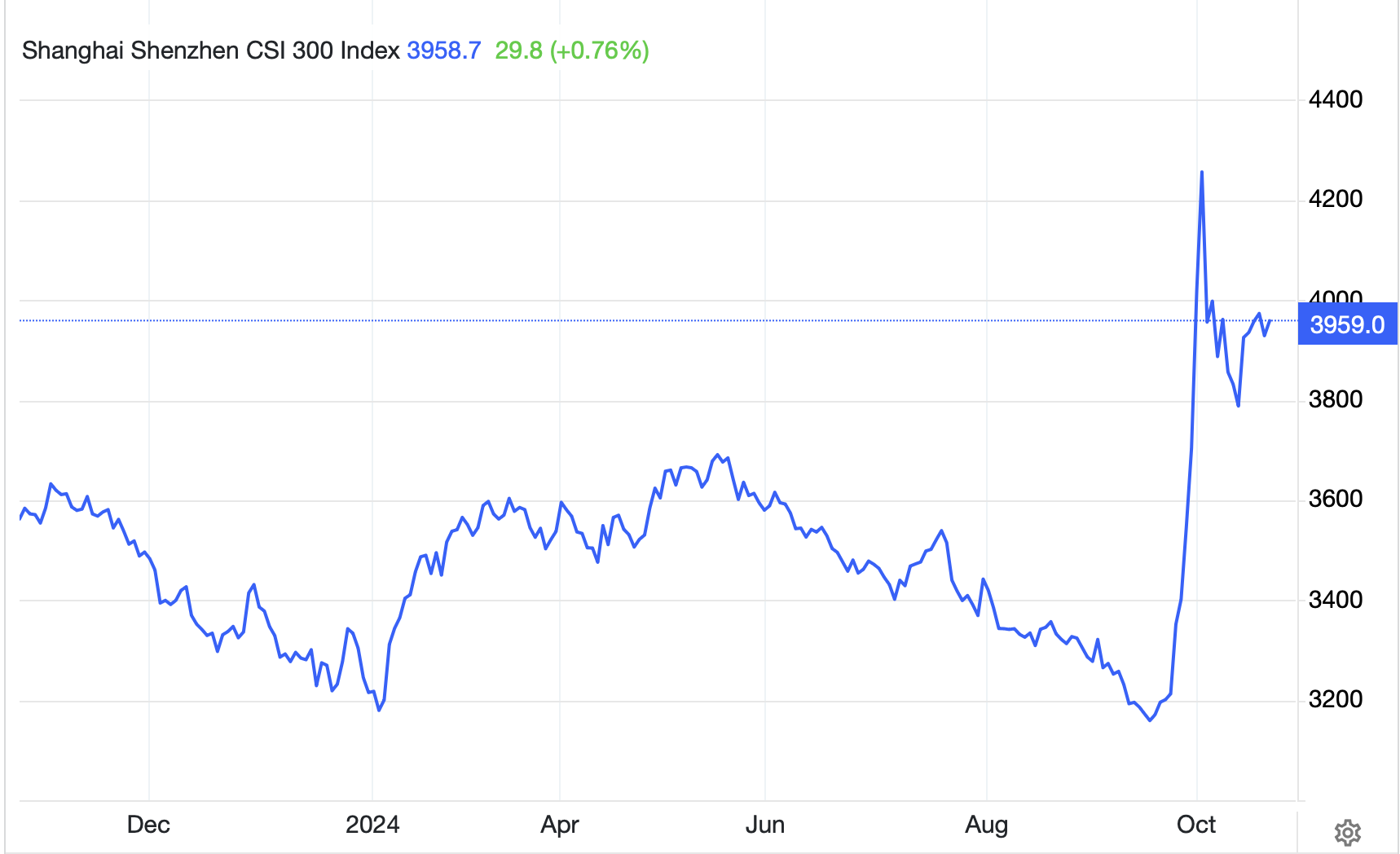
So, with that in mind, let’s take a look at what happened overnight.  Yesterday’s mixed US session, with the DJIA slipping while the other major indices rallied a bit, led to a mixed picture in Asia as well.  Japanese shares (-0.6%) suffered a bit as Japan, too, is heading toward a general election and questions about whether new PM Ishiba will be able to win a majority in the Diet are very real this time.  Apparently, even in a homogenous society like Japan, there are questions about the ruling party and how much it is focused on helping the population.  As to the rest of Asia, both China (+0.7%) and Hong Kong (+0.5%) managed modest gains, but there are still many questions as to exactly how much stimulus China is going to inject into the economy there.  In fact, you can see the market asking those questions by the chart below, where the spike was the initial euphoria that something was going to be done, and the retracement is the realization that it was hope and not policy that drove things.
Source: tradingeconomics.com

The numbers show that after a >30% rally in a few sessions, investors have unwound about one-third of the climb as they await the outcome of the National People’s Congress meeting to see if a new fiscal package will be approved.  (Cagily, they have set the dates for the meeting to be November 4-8 to make sure that they can encompass the outcome of the US election in their decisions.  The rest of Asia saw a mix of gainers (Taiwan, Philippines, Australia) and laggards (India, Singapore, Malaysia) with other markets barely moving.

Meanwhile, in Europe, this morning is a down day, although the losses are quite modest (CAC -0.3%, IBEX -0.4%, FTSE 100 -0.2%) as traders head into the weekend with limited confidence on how things will play out going forward.  As to the US, at this hour (7:30), futures are pointing slightly higher, 0.2% or so.

In the bond market, Treasury yields (-2bps) have backed off their highs from earlier in the week but remain far above the levels seen prior to the Fed’s rate cut in September.  A view growing in popularity is that the 10yr yield will rise above 5.0% if Trump is elected while it will decline to 3.5% in a Harris victory.  Personally, I cannot see any outcome that doesn’t boost yields as there seems to be scant evidence that either side will slow spending and the Fed has made it clear that higher inflation is ok, at least by their actions, if not yet by their words.  As an aside, I couldn’t help but notice comments from Secretary Yellen explaining that the budget deficit was getting out of hand and “something” needed to be done about it, as though she had no part in the situation!  Meanwhile, European sovereign yields are mostly edging higher this morning, but only by 1bp or 2bps, as they continue to hold onto the gains that came alongside the Treasury market.  In the end, Treasury yields remain the key global driver.

In the commodity markets, oil (+0.7%) is bouncing slightly this morning after yesteray’s decline.  The talk in the market is that the Saudis are considering opening a price war to regain market share after they have withheld so much production.  That would certainly be a different tack than their recent activities and I imagine that President Putin would not be pleased, but that is one rumor.  As to the metals markets, they are under pressure this morning with all the major metals somewhat softer (Au -0.2%, Ag -0.9%, Cu -0.2%) as we continue to see profit taking in the space after a very large run higher over the course of the entire year.

Finally, the dollar is little changed overall this morning with no G10 currency having moved even 0.2% since the close yesterday although we have seen a couple of EMG currencies (KRW -0.7%, ZAR +0.3%) with a little dynamism.  The won fell further after weaker than forecast GDP encouraged traders to look for further rate cuts by the BOK while the rand’s movement appears more trading than fundamentally focused as there was neither data nor commentary to drive things.

On the data front, this morning brings Durable Goods (exp -1.0%, ex Transport -0.1%) and Michigan Sentiment (69.0).  As explained above, the data doesn’t seem to matter right now with all eyes on the election.  There are no Fed speakers scheduled but it is not clear that all their chatter this week had any impact.  The market is still pricing a 25bp cut in November and a 75% probability of another one in December, which is what it has been doing for a while.

It is very difficult to observe recent market activity and come away with a strong directional view.  My take continues to be that the December rate cut will lose its support based on the data and the dollar will appreciate accordingly.  But right now, that is a minority view.

Good luck and good weekend

Adf
Pulling All-Nighters

As Harris and Trump try persuading
The voters, the markets keep trading
So, narrative writers
Are pulling all-nighters
To pump up the side that is fading
 
The latest attack is on Trump
Who’s blamed for the bond market slump
But what of the Fed
Whose rate cuts have spread
The fear that inflation will jump?


It appears we have reached the point in time when macroeconomic data is taking a backseat to the political situation.  Almost every story you can read in any of the mainstream media right now is about how the election is going to affect whatever subject an article is about.  The latest discussion, which I have seen across numerous sources like Bloomberg, the WSJ and Reuters, just to name a few, is that the bond markets recent decline is entirely Trump’s fault.  The logic is that as Trump’s election prospects improve, and those of fellow Republicans in both the House and Senate alongside him, the market is suddenly concerned that the government is going to spend a lot of money and run a large deficit.  You can’t make this up!

The federal government deficit under the current administration is pegged to be just shy of $2 trillion this fiscal year, and you have all heard about the fact that interest payments on the government’s nearly $36 trillion of debt have grown to be more than $1 trillion.  But that is not the driver according to the narrative.  The driver is the idea that the Republicans could sweep and that would mean large deficits because…Trump.

Now, I realize I am only an FX guy (FX poet I guess), but my rudimentary understanding of economics is that when economic activity is strong (like the current data implies) and the central bank then adds more liquidity to the system to goose demand, say by cutting interest rates in the front end of the curve, then demand can outstrip supply and prices will rise.  As such, bond investors, when they see a dovish Fed entering an easing cycle while economic activity continues to move along and the government is already running a large fiscal deficit, are concerned over higher inflation ahead and so demand higher yields to own Treasury securities.  Of course, that view doesn’t necessarily suit the narrative so desperately pushed by the mainstream media that Trump is the root of all evil, but it does seem to make more sense.

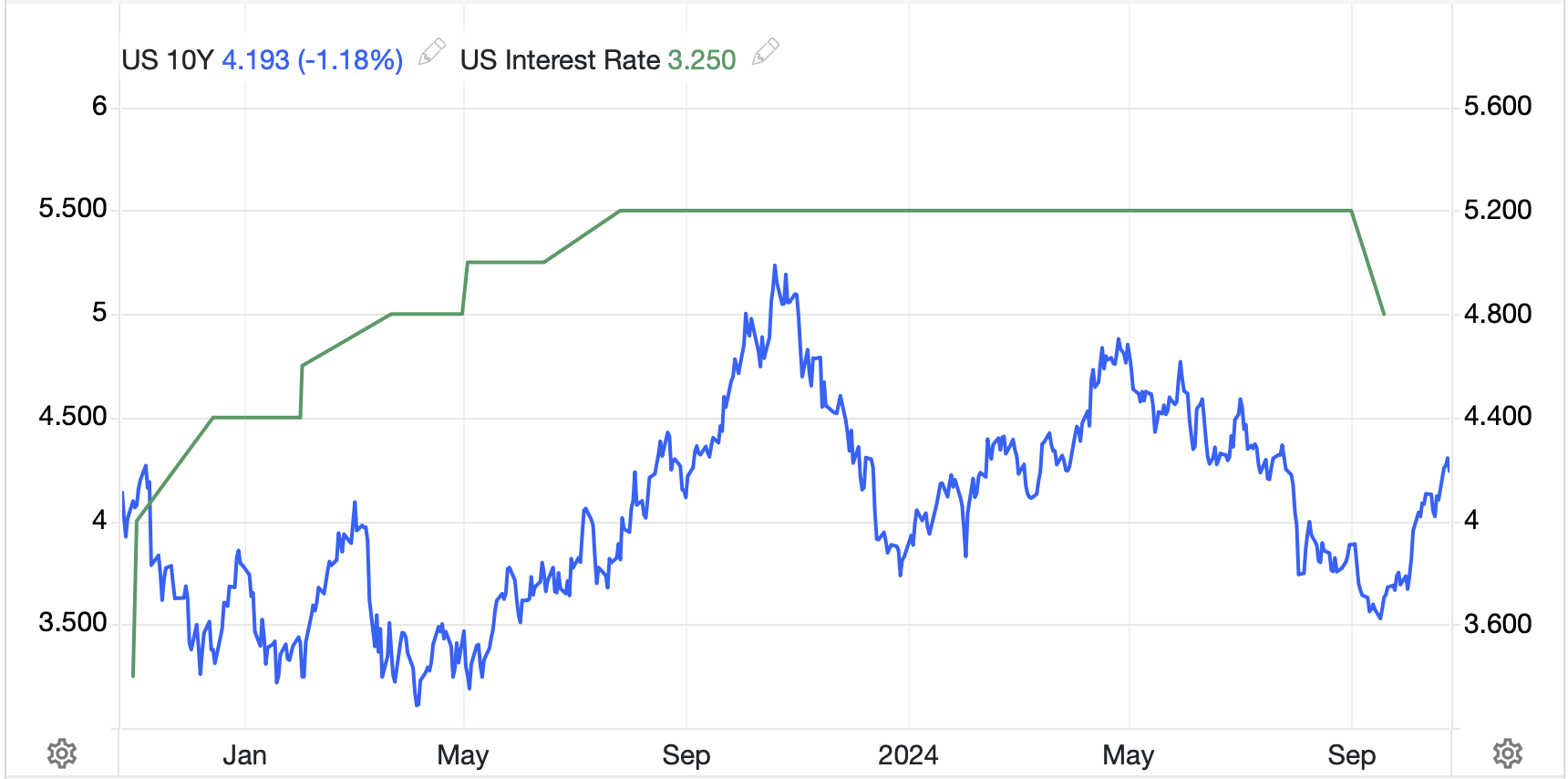
At any rate, for the next two weeks at least, and likely four years if Trump wins, I can assure you that every negative day in any financial market will be blamed on Trump and his policies, despite the fact that the Fed seems to be the one with far more direct impact on short-term economic outcomes.  A look at the below chart, showing 10yr Treasury yields and the Fed funds rate cannot help but show that it was the Fed’s rate cut that is coincident with the recent sharp rise in yields, and this took place long before the odds of a Trump victory improved.  Look through the narrative and instead at the data and Fed activities for the most important clues as to what is actually happening.  I would argue that this is a bond market that is concerned about returning inflation as the Fed’s policy prescription no longer matches the reality on the ground.

Source: tradingeconomics.com

One other thing.  If the Fed does continue to cut rates while US economic data continues to demonstrate solid growth, look for commodity prices to continue their ongoing rally, likely equity markets to continue to perform well, but the dollar is more nuanced as rising inflation ought to undermine the greenback, but given we are seeing more aggressive rate cuts elsewhere in the world (Bank of Canada just cut 50bps this week and the ECB and BOE are going to be cutting again next month), it is entirely possible the dollar holds its own despite macroeconomic fundamentals that should point to weakness.

Ok, let’s see what happened overnight.  Yesterday’s US sell-off, the third consecutive day of broad market weakness, seems to have been sufficient to wash out some of the froth in the market as US futures are pointing higher this morning, especially after Tesla’s better than expected earnings report.  But overnight, the trend from yesterday’s US session was intact with most Asian markets under pressure (Hang Seng -1.3%, CSI 300 -1.1%, KOSPI -0.7%) with only Japan (Nikkei +0.1%) bucking the trend.  In Europe, however, this morning’s color is green with all the major bourses showing life (CAC +0.75%, DAX +0.7%, FTSE 100 +0.5%). Now, there was data released in Europe with the Flash PMI readings out this morning.  The funny thing is that they did not paint a great picture, with continued softness almost everywhere.  My take is Europe is going through a ‘bad news is good’ phase where the weak PMI data implies there will be more aggressive rate cuts by the ECB going forward.  Certainly, Eurozone economic activity, led by Germany’s virtual stagnation, is lackluster at best.

In the bond markets, after several sessions of rising yields, Treasuries have seen yields slip back 5bps this morning with similar declines across the board in European sovereign markets.  Part of this is the weak PMI data I believe, but part of it is a simple trading response to a market that is likely somewhat oversold.  After all, for the past month, bonds have been under significant pressure so a bounce can be no surprise.

In the commodity markets, after yesterday’s rout, where there seemed to be a lot of profit taking of the recent rally, this morning the march higher continues.  Oil (+1.0%) is leading the energy complex higher and the entire metals complex (Au +0.5%, Ag +0.7%, Cu +0.5%, Al +0.9%) is back in gear as all the underlying drivers (rising inflation, solid demand, and for gold, ongoing geopolitical concerns) remain in place.

Finally, the dollar is a bit softer this morning, but this too seems like a response to what has been a strong rally.  Once again, using DXY as a proxy (see chart below) for the broad dollar, the rally over the past month has been quite strong, so a day of backing off is to be expected.  As I mentioned above, the future of the dollar is nuanced because while the macro indicators point to potential weakness, if the rest of the world eases monetary policy more aggressively, the dollar will still rally.

Source: tradingeconomics.com

As to today’s movement, currency gains have been between 0.2% and 0.5% with the commodity bloc the biggest beneficiary (ZAR +0.5%, NOK +0.4%, AUD +0.3%) and we have also seen the yen (+0.5%) regain a little of its footing amid declining US yields, although it remains far above the 150 level.  There are those who are looking for another bout of intervention, but I am not in that camp, at least not in the near-term.

On the data front, this morning brings the Chicago Fed National Activity Index (exp 0.2), Initial Claims (242K), Continuing Claims (1880K), Flash PMI (Mfg 47.5, Services 55.0) and New Home Sales (720K).  Yesterday’s Existing Home Sales data was weaker than expected at 3.84M, arguably a testament to the fact that mortgage rates have followed Treasury yields higher and are back above 7.0% again.  On the Fed front, we hear from new Cleveland Fed president Beth Hammack, but it feels like Fed speak is losing some momentum.  Nobody believes that they are going to stop cutting rates, and fewer and fewer analysts think they should continue amid strong growth.  The futures market is now pricing a 95% probability of a November cut but only a 71% probability of a December cut to follow.  I remain in the camp that they pause in December, especially in the event of a Trump victory.

While the dollar is under pressure today, I continue to believe it retains the ‘cleanest shirt in the dirty laundry’ appeal and will ultimately continue to rally.  

Good luck

Adf

Nothing But Fearporn

Said Logan, right now things are cool
With loads of reserves in the pool
And if I’m correct
The likely effect
Is rates will remain our key tool
 
As such, talk of balance sheet woes
Is nothing but fearporn, God knows
We’ll let bonds mature
Though we are unsure
Of how many we need dispose


“If the economy evolves as I currently expect, a strategy of gradually lowering the policy rate toward a more normal or neutral level can help manage the risks and achieve our goals,” explained Dallas Fed President Lorrie Logan on Monday. “However, any number of shocks could influence what that path to normal will look like, how fast policy should move and where rates should settle.”

In other words, we want to keep up appearances but we have no real idea how things are going to play out and so whatever we think our policies are going to be right now, they are subject to changes at any time.  It shouldn’t be surprising that the Fed doesn’t really know where things are going to go, after all, predicting the future is very hard.  But for some reason, many folks, both market focused and politicians, seem to believe they should be able to forecast well and control the outcomes.

Based on the market reaction to Logan’s comments, market participants, at least, are losing some of that confidence.  Treasury yields jumped 11bps in the 10-year dragging the entire yield curve higher along with all of Europe.  And perhaps more ominously for the Fed’s wish list, mortgage rates also rocketed to their highest level since July.  I might suggest market participants are losing their belief that the Fed is going to continue to cut interest rates as many had believed.  Fed funds futures have reduced their cut probabilities by nearly 10 points compared to yesterday as the latest example of this issue.  

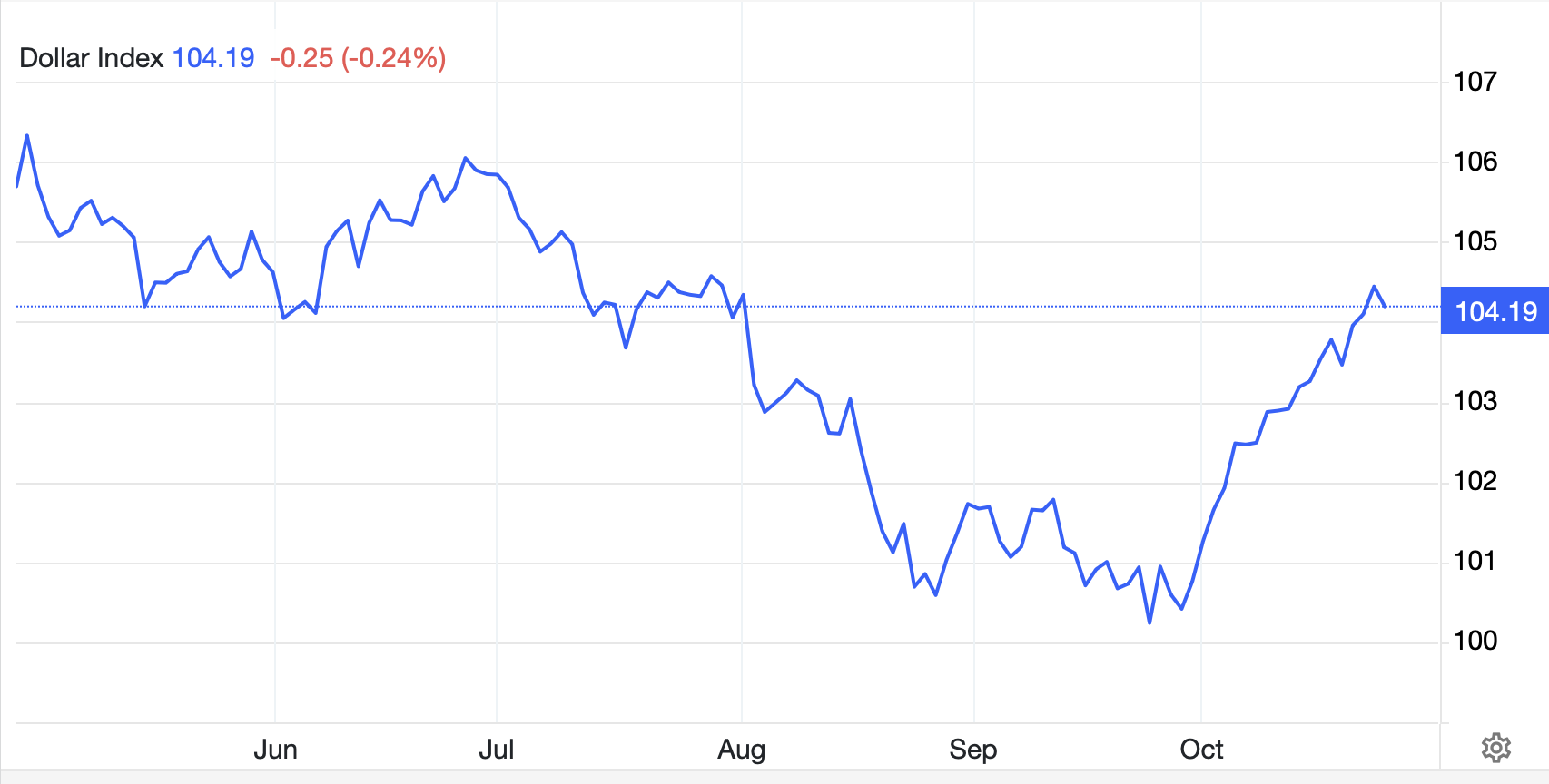
And you know what else continues to benefit as those interest rates refuse to decline?  That’s right, the dollar continues to rally steadily against all comers.  Using the DXY as a proxy, the greenback has rebounded 3% from its levels around the time of the last Fed meeting as per the below chart.  I assure you, if I am correct that the Fed cuts 25bps in November and then doesn’t cut in December, the dollar will be much higher still.  Something to watch for!  

Source: tradingeconomics.com

In fact, there were four Fed speakers yesterday and three of them, including Logan, sounded more cautionary in their view of the future path of rates.  However, uber dove Mary Daly from the SF Fed is still all-in for many more cuts to come.  And this is the current situation at the Fed, I believe.  There are FOMC members who remain in the “we must cut rates at all costs” camp, who despite the evidence of the data they supposedly track remaining stronger than expected want lower rates, and there are those who are willing to reduce the pace of cuts, but still want lower rates.  This tells me that the Fed is going to continue to cut rates regardless, and so the bond market is going to become the arbiter of financial conditions.  Recent bond market movements seem more likely to be a harbinger of the future than an aberration, at least unless/until the economy weakens substantially.  In fact, you can see that the relation between bond yields and the dollar is quite strong now, something I suspect will remain true for a while going forward.

And that was really all that we had as the overnight session brought us virtually nothing new.  So, a quick recap of the overnight shows that after a lackluster session in the US on low volumes, Asia had more laggards than leaders with Tokyo (-1.4%) and Australia (-1.7%) dominating the story although China (CSI 300 +0.6%, Hang Seng +0.1%) managed to buck the trend.  The latter two, though, seemed like reactionary bounces from recent declines.  In Europe, bourses are all red this morning led lower by Spain’s IBEX (-1.1%) but seeing weakness everywhere (CAC -0.7%, FTSE 100 -0.7%, DAX -0.25%).  And, at this hour (7:45), US futures are lower by -0.5% or so.

After yesterday’s dramatic rise in yields in the US, we are seeing a continuation this morning with Treasuries edging higher by 1bp but European sovereigns all higher b between 4bps and 5bps.  That seems to be catching up to the last of the afternoon Treasury move yesterday.  As I mention above, I see the trend for yields in the US to be higher, and that should impact yields everywhere.

In the commodity markets, once again, demand is increasing and we are seeing gains in oil (+1.1%), gold (+0.6% and new all-time highs), silver (+1.7%) and copper (+0.9%).  The financial narrative is turning more and more to inflation concerns and the fact that commodities remain an undervalued and important segment in which to have exposure.  I am personally long throughout this space and believe there is much further to run here.

Finally, after the dollar’s blockbuster day yesterday, it has paused for a rest with the noteworthy gainers today all in the commodity bloc (AUD +0.5%, NZD +0.55%, MXN +0.2%, ZAR +0.2%, NOK +0.4%) with most other currencies actually a bit softer vs. the buck.  Keep an eye on JPY (-0.2%) which is now firmly above the 150 level and is likely to begin to see more discussion about potential intervention soon.

There is no data of note this morning although we do hear from Philly Fed president Harker.  It will be interesting to hear if he is in the dovish or uber dovish camp, as there appear to be no hawks left on the FOMC. 

Until the election in two weeks, I suspect that volumes will remain low but trends will remain intact, so higher yields and a higher dollar seem most likely to be in our future.

Good luck

Adf

Not Persuaded

In China, Xi’s still not persuaded
The actions he’s taken have aided
The ‘conomy’s course
The outcome, perforce
Is access to money’s upgraded


In an otherwise very uninteresting session, the biggest news comes from China where the PBOC cut both the 1yr and 5yr Loan Prime Rates by a more than expected 25bps last night.  While PBOC chief Pan Gongsheng did indicate that more cuts were coming, the speed and size of this move are indicative of the fact that worries are growing about the nation’s ability to achieve their “around 5%” GDP growth target.  At least the people who will be blamed if they don’t achieve it are starting to get worried!

The interesting thing about this move is the singular lack of impact it had on Chinese markets with the CSI 300 rising a scant 0.25% for the session.  Although, perhaps it had more impact than that as the Hang Seng (-1.6%) seemed to express more concern over the need for the move than embrace any potential benefits.

Ultimately, the issue for Xi is that the breakdown of economic activity in China remains unbalanced in a manner that is no longer effective for current global politics.  China’s rapid growth since its accession to the WTO in 2001 has been based on, perhaps, the most remarkable mercantile effort in the world’s history.  But now, that mercantilist model is no longer politically acceptable to their main markets as the rest of the world has seen a significant political shift toward populism.  Populists tend not to be welcoming to foreign made goods (or people for that matter), and so Xi must now recalculate how to continue the growth miracle.

Economists have long explained that China needs to see domestic consumption, currently ~53%, rise closer to Western levels of 65% – 70% in order to stabilize their economy.  However, that has been too tall an order thus far.  It is far easier in a command economy to command businesses to produce certain amounts of stuff, than it is to command the citizens to consume a certain amount of stuff, especially if the citizens remain shell-shocked over the destruction of their personal wealth as a result of the imploding property bubble.  As much as Xi wants to change this equation, it seems clear he doesn’t feel he has the time to wait for the gradual adjustment required, as that might result in much weaker GDP growth.  Given that the most important promise he has made, at least tacitly, to his people is that by taking more power he will increase their prosperity, he cannot afford any indication that is not the path on which they are traveling.

My take is that we are going to continue to see more efforts by the Chinese to prop up the economy, but it remains unclear if the fiscal ‘bazooka’ that many in markets have anticipated will ever be fired.  History has shown the Chinese are much more comfortable with slow and steady progress, rather than massive changes in policy, at least absent an actual revolution!  Ultimately, nothing has changed my view that the ultimate relief valve is for the renminbi to depreciate over time.  Xi is fighting that for geopolitical reasons, not for economic ones, but unless or until the domestic situation there changes, I believe that will be the destiny.

Away from the China story, though, there is precious little else of note ongoing, at least in the financial markets.  As this is not a political discourse, I will not discuss the election until afterwards as only then will we have an idea of what will actually happen fiscally and economically.  Meanwhile, everything else seems status quo.  

So, let’s look at the overnight markets.  Aside from China and Hong Kong, and following Friday’s very modest rally in the US, the rest of Asia had no broad theme attached.  There were gainers (Korea, Australia, New Zealand) and laggards (India, Japan, Singapore) with movements of between 0.5% and 0.75% while the rest of the region saw much lesser activities.  In Europe, the mood is dourer with red the only color on the screen ranging from the UK (-0.2%) to virtually all the large continental bourses (CAC, DAX, IBEX) at -0.8%.  There has been no data of note to drive this decline except perhaps the fact that the dollar continues to rise, a situation typical of a risk-off environment.

In the bond markets, yields are climbing across the board this morning, a very risk-on perspective.  (This is simply more proof that the traditional views of asset performance for big picture risk on or off movements is no longer valid.)  At any rate, Treasury yields have risen 4bps while European sovereign bonds have all seen yields jump between 7bps and 8bps.  It appears that bond investors are growing somewhat concerned that central banks are going to allow inflation to run hotter than targeted over time as they are desperate to prevent any significant economic downturn.  As well, given the Treasury market leads all other bond markets, and US economic data continues to perform, that is a key global yield driver as well.

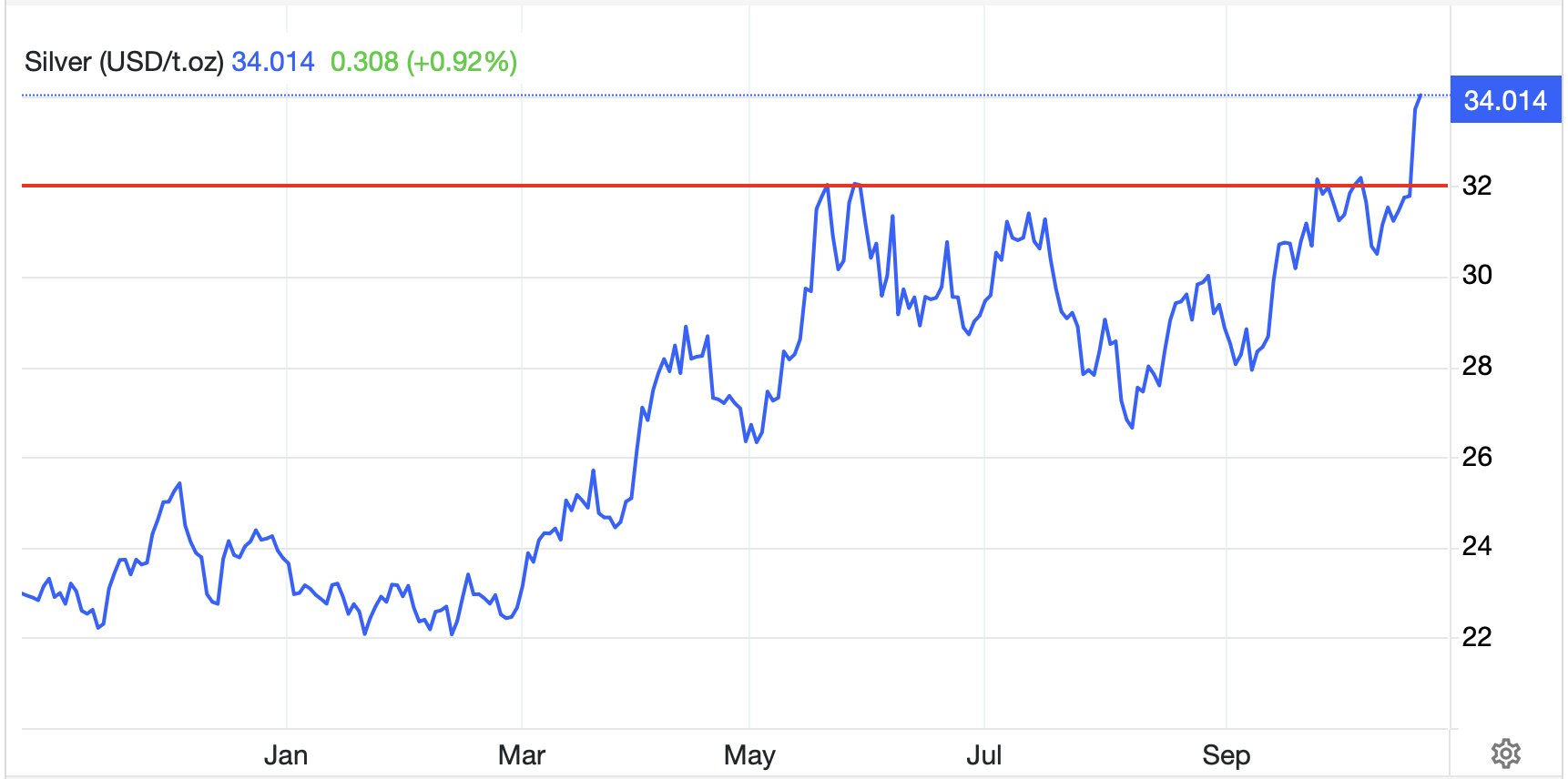
Arguably, the biggest story in markets continues to be the commodities space, specifically metals markets, as once again, and despite today’s dollar strength, we see gold (+0.5%), silver (+1.0%) and copper (+1.1%) rallying with the barbarous relic making yet another set of new all-time highs while silver has broken above a key technical resistance level at $32.00/oz as seen in the chart below.

Source: tradingeconomics.com

One of the reasons I focus on commodities so much is I believe they are telling an important story about the state of the global economy.  We have seen a decade of underinvestment in the production of stuff, especially metals, but also energy, as this has been sacrificed on the altar of ESG policies.  But the world marches on regardless, and that stuff is necessary to build all the things that people want and are willing to pay for.  As they say, the cure for high prices is high prices, meaning high prices are required to increase supply.  That is what we are witnessing, I believe, the beginning of high enough prices to encourage the investment required to increase the supply of these critical inputs to the economy.  However, given the often decade-long process to get from discovery to production of things like metals, look for these prices to continue to rise as a signal that demand is growing ahead of supply.  

As to oil prices, they too, have found legs this morning with a significant bounce (+2.2%) and back above $70/bbl.  On the energy front, we are also seeing NatGas rally sharply with gains in both the US and Europe of > 2%.

Finally, the dollar, as I mentioned, is stronger this morning with only NOK (+0.1%) outperforming the greenback in the G10 space as the dollar benefits from rising yields and continued strong growth, at least as measured by the major data points.  In the EMG bloc, it is universal with the dollar higher against all comers and the worst performers (KRW -0.75%, HUF -0.7%, MXN -0.3%) in each region continuing their recent trend declines.  Until we see a substantive change in the US economic situation, I see no reason for the dollar to fall very far at all.

On the data front, this week brings a lot more Fedspeak than hard data, but this is what we have.

TodayLeading Indicators-0.3%
WednesdayExisting Home Sales3.9M
ThursdayChicago Fed Nat’l Index0.2
 Initial Claims247K
 Continuing Claims1865K
 Flash PMI Manufacturing47.5
 Flash PMI Services55.0
 New Home Sales720K
FridayDurable Goods-0.9%
 -ex Transport-0.1%
 Michigan Sentiment69.3

 Source: tradingeconomics.com

None of this is all that exciting or likely market moving, but we will be regaled with speeches from seven more FOMC members, both governors and regional presidents.  While ordinarily I feel like these comments have limited impact, my take is the market is starting to adjust its views of future Fed actions.  After all, the rationale to cut rates is hard to understand if the economic data continues to rise alongside inflation.  As of this morning, the market is pricing in a 93% probability of a November cut and a 73% probability of a December one as well.  While I agree November is a necessity for them to save face, I think December is a much longer shot than that based on recent data.

With the last two weeks ahead of the election upon us, things are heating up further and most focus will be there.  Given the secondary nature of this week’s data, my suspicion is that absent a massive surprise, or a really consistent theme amongst the Fed speakers that rates are going to go a lot lower soon, the dollar is going to continue its recent rebound.

Good luck

Adf

Panic Attack

The FX Poet will be in Nashville at the AFP Conference October 21-22, speaking about effective ways to use FX options in a hedging program.  Please come to the presentation on Monday at 1:45 in Grand Ballroom C1 if you are there.  I would love to meet and speak.
 
Said Madame Lagarde, we’re “on track”
To make sure inflation gets back
Below two percent
So, we can prevent
A government panic attack
 
The subsequent news from the East
Is Chinese growth, once more, decreased
Their five-percent goal
Ain’t on cruise control
So, Xi needs more skids to be greased


See if you can find the conundrum in the ECB statement issued yesterday after they cut interest rates 25bps, as expected, taking the Deposit Rate down to 3.25%,. [emphasis added]

“The incoming information on inflation shows that the disinflationary process is well on track. The inflation outlook is also affected by recent downside surprises in indicators of economic activity. Meanwhile, financing conditions remain restrictive.

Inflation is expected to rise in the coming months, before declining to target in the course of next year. Domestic inflation remains high, as wages are still rising at an elevated pace. At the same time, labour cost pressures are set to continue easing gradually, with profits partially buffering their impact on inflation.”

While I realize that I am just an FX guy, and that my education at MIT was far more focused on numbers than words, I cannot help but read the highlighted phrases and be confused how the conclusion of high domestic inflation and expectations for it to rise means the disinflationary process is “well on track.”  Of course, it is important to remember that Madame Lagarde is a politician, not an economist nor banker nor any other background familiar with numbers, so perhaps she is the one that doesn’t understand.  Either that or as with every politician she is simply lying.

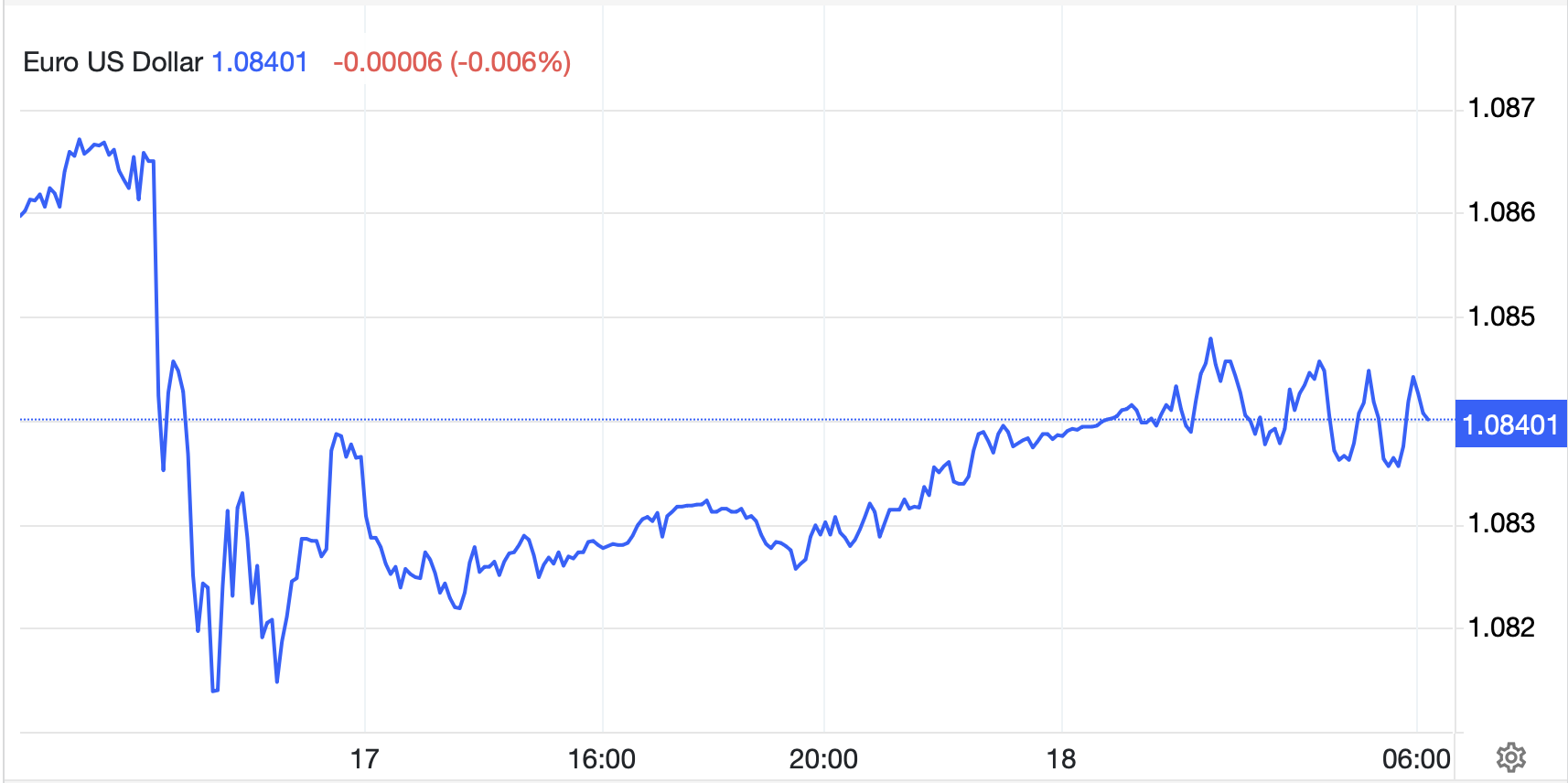
Regardless, as you can see in the chart below, the market response in the wake of the announcement was to sell the euro as interest rate traders priced in a December rate cut as well.

Source: tradingeconomics.com

The juxtaposition of US and Eurozone data remains the key here and as yesterday’s US numbers showed, the long-awaited recession continues to be postponed.  It becomes ever more difficult to see how the Fed will justify easing policy in any substantive manner if every economic print beats expectations.  (To clarify, Retail Sales printed at 0.4%, 0.5% ex-autos vs. expectations of 0.3% and 0.1% respectively. Philly Fed printed at 10.3 vs. expectations of 3.0 and Initial Claims fell to 241K despite the hurricanes, vs expectations of 260K). 

In the end, all this simply reinforces my view that the euro has further to decline going forward.  I still like the 1.05 – 1.06 level as a target by year end.

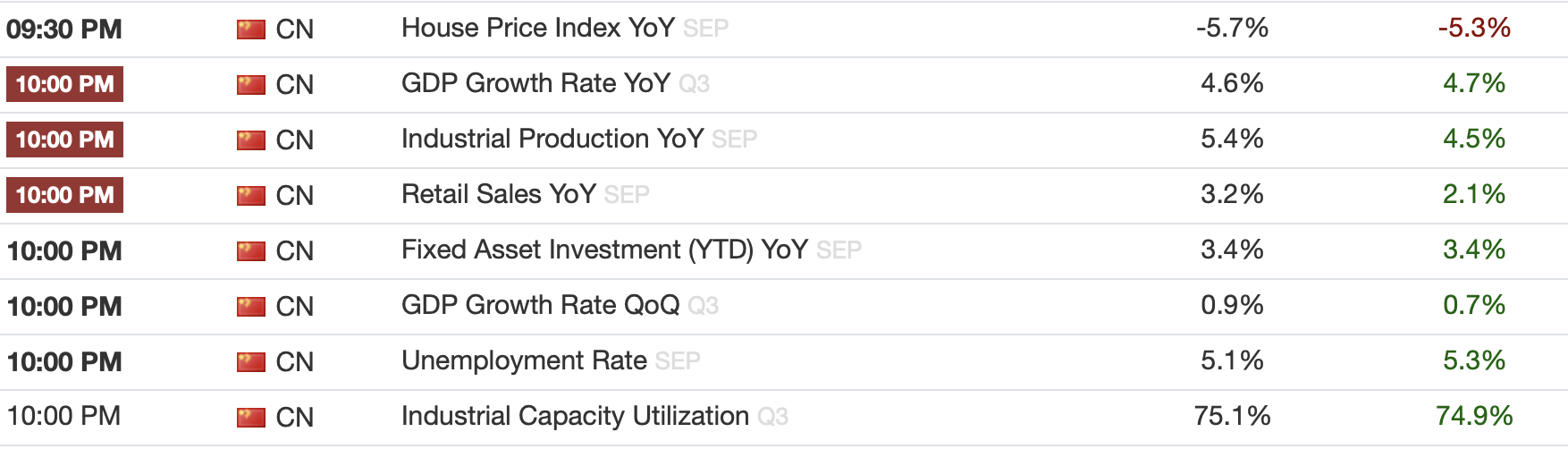
Turning to China, last night they had their monthly data dump and the numbers there continue to point to an economy struggling to gain momentum. (The first, black, number is the September data, the second, green or red, number is the August data.)

Source: tradingeconomics.com

Xi’s 5% target, or even if you use their recent “around 5%’ concept, is getting strained.  While Retail Sales there was a positive, the ongoing disintegration of the housing/property market is a major problem.  Now, all this data represents activity before the plethora of stimulus measures that have been announced.  However, recent equity market performance there, if using as an indicator of the belief that the stimulus was going to be effective, had shown a substantial decline from the early sugar highs back in September immediately following the first stimulus announcements.

With that in mind, PBOC Governor Pan Gongsheng strongly hinted that there would be another interest rate cut next week, as the government struggles to not only convince investors that they have things under control, but to also implement the measures already described.  Now, last night, after Pan hinted at the rate cuts, along with other comments regarding the funds allocated to help companies buy back shares, Chinese equity markets rose sharply in the afternoon session, as per the below chart, rising 3.6% on the day.

Source: Bloomberg.com

Once again, I will highlight the irony of the Chinese Communist Party focusing on the epitome of capitalism, the equity market, as a key means of economic improvement and a key signal that they are on the right track.

That was really all the big news since I last wrote.  Let’s look at the overall market activity.  After yesterday’ lackluster US session, Japanese shares (+0.2%) managed to edge a bit higher and Hong Kong (+3.6%) mirrored Chinese mainland shares.  The other beneficiary of the Chinese stimulus discussion was Taiwan (+1.9%) but Australia (-0.9%), Korea (-0.6%) and a host of other regional exchanges did not seem to appreciate the effort.  In Europe, only the UK (-0.3%) is really under any pressure although the gains on the continent are not terribly impressive with the CAC (+0.5%) the leader at this point.  Most other markets there are little changed to slightly higher.  As to US futures, at this hour (7:20), they are higher by about 0.25%.

In the bond market, after yesterday’s much stronger than expected US data, Treasury yields jumped 7bps and this morning have edged higher by another 1bp to get back to 4.10%.  However, on the continent, sovereign yields this morning are lower by between -2bps and -4bps after yesterday’s ECB action and comments.  The one exception here is the UK, where gilt yields are higher by 2bps after UK Retail Sales data printed much stronger than expected at +0.3% in September, vs. -0.3% expected.

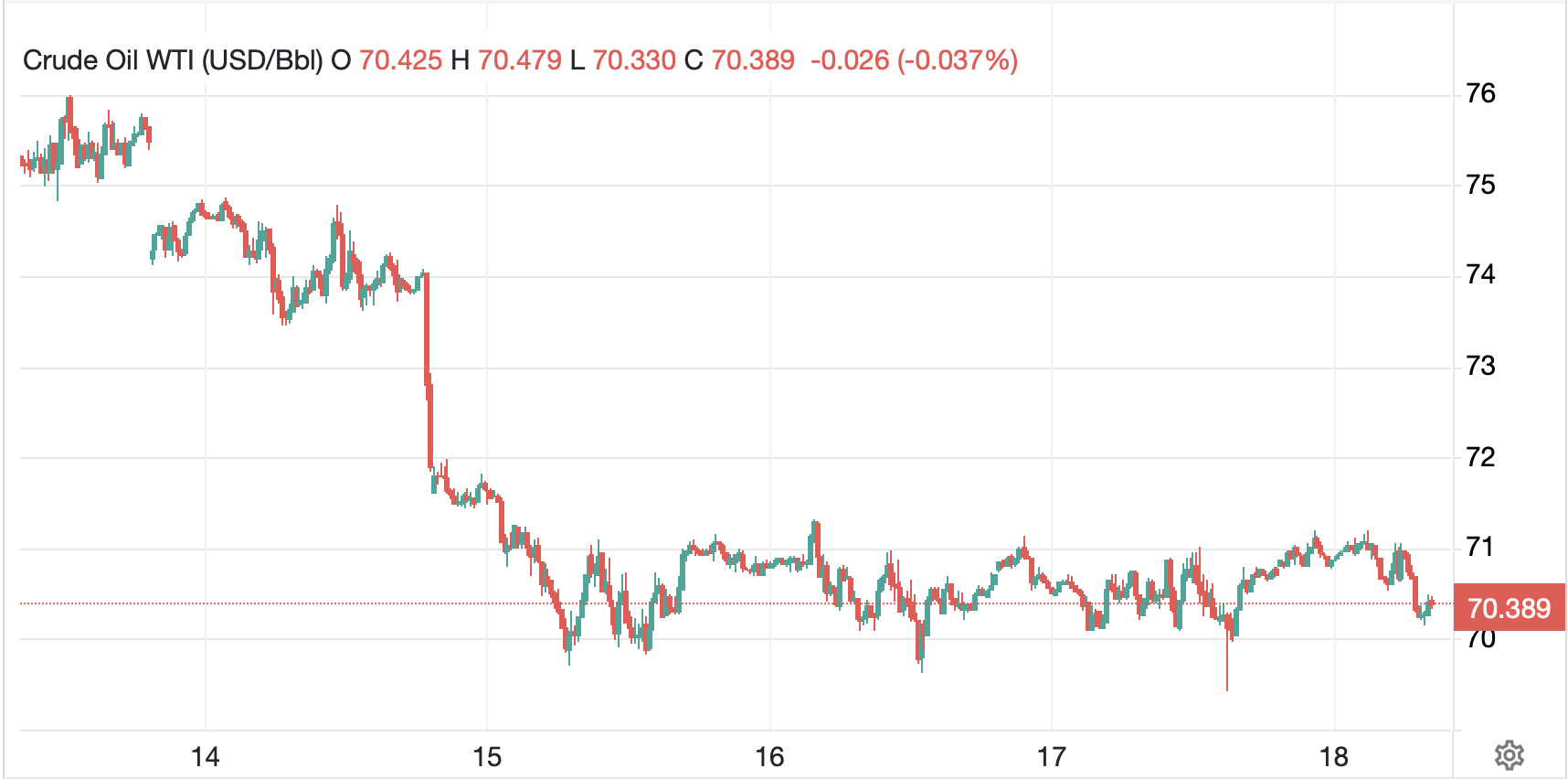
In the commodity markets, oil (-0.4%) is modestly lower this morning but really going nowhere for now as evidenced by the chart below.  Once the word had come that Israel was not going to target Iranian oil infrastructure and the price fell, it has basically been flat.

Source: tradingeconomics.com

As to the metals complex, gold (+0.6%) continues its ongoing rally and is at yet another new all-time high, above $2700/oz this morning, as demand continues to be present from all segments.  However, this morning, all the metals are rallying with silver (+1.0%) and copper (+1.5%) showing even better performance.  The combination of continued solid data from the US and hopes for a return to Chinese demand seem to be the drivers.

Finally, the dollar is closing the week on a down note, as traders reduce positions and take profits ahead of the weekend.  During the week, the dollar rose against virtually every one of its main counterparts in both the G10 and EMG blocs.  Again, the big picture here is that for the dollar, good US economic data is going to continue to benefit the greenback, and we will need to see not just one bad number, but a series of them before the dollar truly suffers.

On the data front, we see Housing Starts (exp 1.35M) and Building Permits (1.46M) at 8:30 this morning and then we hear from three more Fed speakers (Bostic, Kashkari and Waller) with Bostic making two appearances.  At this stage, despite the strong data, the Fed funds futures market is pricing in a 92% probability of a 25bp cut next month and then a 75% probability of another one in December.  I know that Powell seems desperate to cut rates, but if the data continues to show strength, the case to do so is going to be much harder to make.  That doesn’t mean he won’t do it, but if he continues down that path, it just means that inflation will return that much sooner.  

Good luck and good weekend and reach out if you are in Nashville at the AFP!

Adf

Turn Into Snails

The FX Poet will be in Nashville at the AFP Conference October 21-22, speaking about effective ways to use FX options in a hedging program.  Please come to the presentation on Monday at 1:45 in Grand Ballroom C1 if you are there.  I would love to meet and speak.
 
This morning the ECB’s meeting
And no doubt they will be repeating
The idea inflation
Is near its cessation
So, high rates will now be retreating
 
As well, we will learn the details
Of what’s occurred in Retail Sales
If strength’s what we see
The FOMC
Rate cutters may turn into snails


Yesterday was generally very quiet as investors appear to be turning their focus to the US presidential election and trying to determine the outcome and what it will mean for markets going forward.  (FWIW, this poet is not going to attempt to determine how things will play out at this stage given the fact that whatever claims or promises are made by either candidate, at least economically, they can only be accomplished through Congress, so are really just wishes right now).  The upshot is that the volume of activity is likely to remain modest until the election.  Of course, that doesn’t mean prices won’t move, just that there won’t be much conviction behind the moves.

In the meantime, central banks remain at the forefront of every market conversation and today is no different with Madame Lagarde set to regale us with the news of an ECB rate cut of 25bps later this morning.  Inflation data from the Eurozone this morning was revised down further with the headline falling to 1.7% Y/Y in September, the lowest print since April 2021.  However, the core rate, at 2.7%, remains well above their target.  Now, the ECB mandate targets headline inflation specifically, unlike the Fed which has determined by itself that core PCE is the proper metric, so a rate cut can easily be justified.  Adding to the story is the fact that Germany remains mired in recession and economic activity in the Eurozone overall remains desultory at best.  The problem the ECB has is that services inflation remains sticky, still printing near 4% and money supply is growing again which is a strong indicator that inflation is going to rise in the future.  But as we have learned over the past decades, the future is now when it comes to central banks, and they will respond to the moment.

One of the problems for the ECB, though, is that despite the Fed’s mistaken 50bp rate cut, the data in the US we have seen since indicates that the economy continues to motor along fairly well.  This means that although the Fed seems likely to cut 25bps in November, I think it will be doing so reluctantly.  After all, if they didn’t cut, it would basically be an admission that they made a mistake with the 50bp cut in September, and you know as well as I that they will never admit a mistake.  

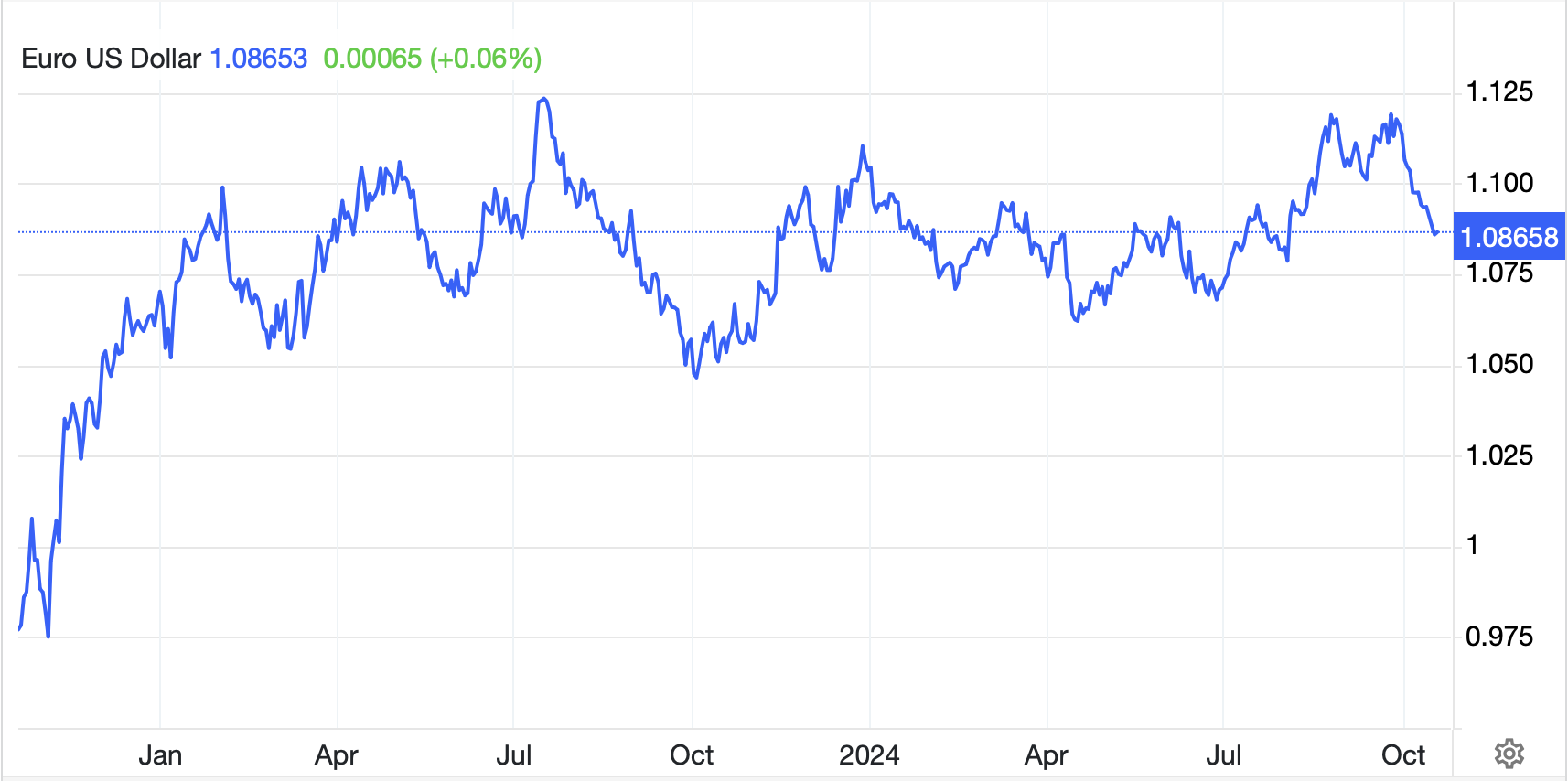
My point is that with the ECB feeling greater pressure to cut with their inflation reading below target and growth slowing, and the Fed likely to back away from an aggressive rate cutting path, the euro is likely to continue to suffer.  For instance, this morning, though it is unchanged, it sits below the 1.09 level (last seen in August) and certainly appears as though it is in a strong downtrend as per the below chart.  If I were to guess, I think a move toward 1.06 is in the cards as a measured move around that long-term 1.09 pivot level.

Source: tradingeconomics.com

The problem for the ECB is that a weakening currency is likely to add upward inflation pressures before it helps the exporters in Europe expand market share, and boosts growth.  Stagflation is such an ugly word, but one that may well come to describe the Eurozone.  As an aside, when the US was in stagflation in the late 1970’s, that is when the dollar was at its weakest point historically.

Of course, this also makes this morning’s Retail Sales (exp 0.3%, 0.1% ex autos) so important.  You may recall that last month, this number beat expectations and was another in the list of surprisingly strong US data releases.  Another strong print will really cement the difference between the US and the Eurozone, to the dollar’s advantage I believe.  

But will any of this really matter to markets?  Certainly, Lagarde’s comments can have an impact on Eurozone markets, but my take is we will not see major investment swings, regardless of the data, ahead of the election.

Ok, let’s see how things played out overnight.  Despite the rebound in the US yesterday, Asia was having none of it with most markets in the red.  Japan (-0.7%) fell despite the US strength and the yen’s weakness (JPY pushing back to 150 for the first time since August) and China continues to see the recent bubble of stimulus expectations deflate (CSI 300 -1.1%, Hang Seng -1.0%).  Elsewhere in the region, the results were mixed with some gainers (Australia, New Zealand, Singapore) and some laggards (India, Korea, Philippines).  In Europe, though, green is today’s theme with gains across the board, led by the CAC (+1.2%) but strength everywhere as investors are betting on a more dovish ECB.  In the US futures market, we are all green as well, with strong gains (+0.5% or more) at this hour (7:30).

In the bond markets, after dipping back to the 4.0% level yesterday, 10-year Treasuries are 2bps higher this morning and we are seeing similar price action across all the European sovereign markets.  This seems like a classic risk-on move.  In Japan, JGB yields edged higher by 1bp and are now at 0.95%, perhaps as the market anticipates the BOJ is set to get more aggressive with the yen steadily falling for the past several months.  I don’t believe 150 is a line in the sand, but it cannot be making Ueda-san feel any better about things.

Turning to commodities, the one truism is that gold (+0.5%) continues to rally.  The number of different storylines (central bank buying, reduced mining activity, western investors waking up, Asian investors accelerating) about the shiny metal continues to increase and every one of them is bullish.  This continues to help Silver, although copper (-0.6%) remains far more reliant on a positive economic story, something that remains in doubt.  As to oil (+0.25%) it is holding that $70/bbl level although its grip does seem tenuous at times.  However, I would contend there is virtually no war premium in the price at this point.

Finally, the dollar has net softened a bit this morning, but that is in the context of a more than 3-week long steady rally.  So, AUD (+0.5%) is the big winner this morning in the G10 and as I am typing, GBP (+0.2%) has recaptured the 1.30 level, but those trends remain lower.  In the EMG markets, KRW (-0.55%) is today’s laggard although we are seeing weakness in both ZAR (-0.3%) and MXN (-0.3%) despite that metals strength.  Remember, FX markets are perverse.

In addition to the Retail Sales data, we see Initial (exp 260K) and Continuing (1870K) Claims and Philly Fed (3.0) at 8:30 with IP (-0.2%) and Capacity Utilization (77.8%) at 9:15.  Also, because of the holiday Monday, we see EIA oil inventory data this morning as well with a slight draw expected.  Only one Fed speaker is on the docket (Goolsbee) who will undoubtedly explain that more cuts are coming.

While the dollar may be under modest pressure this morning, I see upward pressure overall for the time being until policies change.

Good luck

Adf

Nearly Obscene

The FX Poet will be in Nashville at the AFP Conference October 21-22, speaking about effective ways to use FX options in a hedging program.  Please come to the presentation on Monday at 1:45 in Grand Ballroom C1 if you are there.  I would love to meet and speak.
 
While here in the States we have seen
Inflation that’s nearly obscene
In Europe, inflation
In ‘bout every nation
Has fallen much more than foreseen
 
The narrative there has adjusted
As all of their models seem busted
So, cuts with more speed
We’ll soon see proceed
Though central banks still aren’t trusted

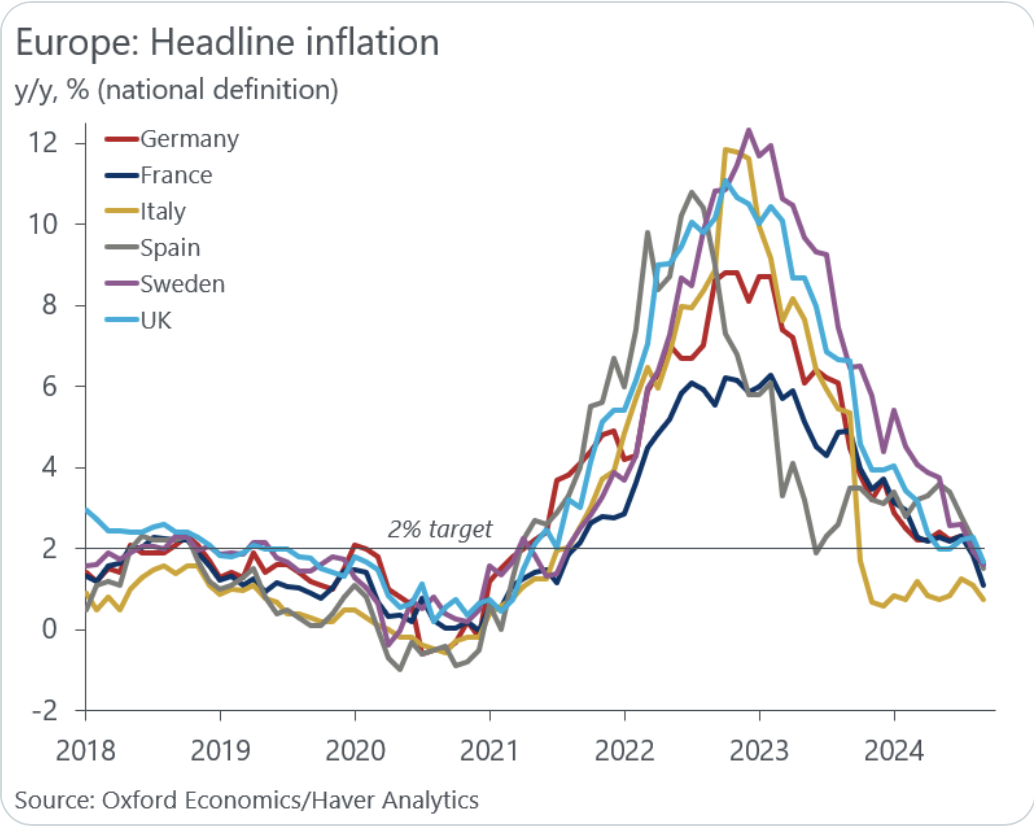
While Fed speakers are trying to claim victory over inflation, whether or not that is reality, the situation in Europe is a bit different.  In fact, headline inflation has fallen quite dramatically virtually across the board as evidenced by the below chart.

Now, a critical piece of this decline is the fact that energy prices have fallen dramatically in the past year with Brent Crude (-16.5%) and TTF NatGas (-18.9%) leading the way lower.  In fact, core inflation data, for the few nations that show it, remains above that 2% target with the UK (Core 3.2% Y/Y) the latest to report this morning.  One other thing to remember is that in the wake of the Covid pandemic, no nation printed and spent nearly as much money as the US on a relative basis, let alone an absolute basis, so there was less fiscal largesse elsewhere.

Yet, the fact remains that headline inflation throughout Europe and the UK has fallen below the 2% targets and so the narrative has now shifted to see more aggressive rate cuts by the central banks everywhere.  This will be part of the discussion tomorrow at the ECB, where most analysts are looking for a 25bp cut although some are calling for 50bps, and the market is pricing more than 40bps at this point.

You know what else is pricing a larger rate cut by the ECB?  The FX market.  Yesterday, the euro fell below the 1.09 level for the first time in more than two months (remember that chart of the double top formation from Monday?) and the single currency has fallen more than 2% in the past month.  Similarly, the pound, after today’s softer than expected CPI readings, has fallen -0.35% this morning, the worst performer in the G10, and is now lower by nearly -1.5% in the past month and looking like it has reversed the uptrend that existed through the summer and early autumn.

Ultimately, my point is that the narrative about rate cuts is shifting to a more accelerated mode in Europe and the UK (where talk of a 50bp cut is making the rounds as well) while here in the States, a 25bp cut is not fully priced in even after yesterdays’ much weaker than expected Empire State Manufacturing Index (-11.9 vs. exp 3.8 and last month’s +11.5).  If you want a reason to explain the dollar’s resilience, you could do worse than the fact that economies elsewhere in the world are lagging the performance here.

Speaking of the Fed, yesterday’s surprise Fedspeak came from Raphael Bostic, Atlanta Fed president, when he explained that he only foresees one more rate cut in 2024.  That is quite a different story than we have been hearing from the rest of the FOMC speakers, who seem completely on board with at least 50bps of cuts and seemingly could be persuaded to head toward 75bps.  There is still much to learn between now and the next FOMC meeting the day after the election here, but despite Bostic’s comments, I believe the minimum we will see before the end of the year will be 50bps.

Ok, that was really all the action overnight.  Yesterday’s disappointing US equity performance, with all three major indices lower by at least -0.75% (I thought that was outlawed 🤣) was followed by similarly weak performance in Asia with the Nikkei (-1.8%) leading the way lower as tech shares underperformed, but further weakness in China (-0.6%) as Godot seems more likely to arrive than the Chinese stimulus.  Throughout the region, only Thailand (+1.2%) managed any gains after the central bank there cut rates 25bps in a surprise move seeking to foster a better growth situation.  In Europe, only the UK (+0.6%) is rallying on the strength of the idea that lower inflation will encourage a 50bp cut from the BOE when they meet the day after the Fed. But otherwise, red is the color of the day in Europe with losses ranging from -0.1% (Spain) to -0.6% (France).  Meanwhile, US futures are a touch firmer at this hour (7:15), by just 0.2%.

In the bond market, yields are lower across the board after that weak Empire State number encouraged the slowing economy narrative and the lower inflation prints in Europe and the UK have weighed on yields there this morning.  So, Treasury yields (-2bps) are lagging most of Europe (Bunds -3bps, OATs -3bps) and UK Gilts (-8bps) are all about the data this morning.  Even JGB yields (-1bp) got into the act.

In the commodity space, oil (-0.5%) is continuing its recent decline, although yesterday it managed to bounce a bit and close above the $70/bbl level where it still sits, barely.  But the metals complex is having another good day with gold (+0.6%) pushing to new all-time highs as western investors are finally following Chinese and Indian investors as well as global central banks.  The lower interest rates certainly help here.  Similarly, we are seeing gains in the other metals (Ag +1.2%, Cu +1.1%) as stories regarding shortages for both metals in the long-term resurface given the lack of new mining activity and increased demand driven by the idea of increased solar and electricity needs respectively.

Finally, the dollar, overall, is little changed, holding onto its recent gains although with a mixed performance this morning.  ZAR (+0.5%) is this morning’s leader on the back of the metals market gains, and we have seen strength in KRW (+0.3%) as well.  However, elsewhere, movement is small and favoring the dollar (HUF -0.2%, CZK -0.2%) and we’ve already discussed the euro and pound.  Interestingly, the THB (+0.45%) rallied after the rate cut on the back of equity inflows.

There is no major data set to be released this morning and no Fed speakers on the current calendar, although as always, I suspect we will still hear from some of them.  Madame Lagarde speaks this afternoon, and given the ECB meeting tomorrow, there will be many interested listeners.

Overall, the themes seem to be that Eurozone inflation is sinking and rate cuts are coming.  That should keep some downward pressure on European currencies vs. the dollar, at least until we see or hear something that describes a more aggressively dovish Fed.  The one truly consistent feature of these markets has been the rally in gold which seems to benefit from fear, inflation and lower rates, all of which appear to be in our future.

Good luck

Adf

Fervent Dreams

The FX Poet will be in Nashville at the AFP Conference October 21-22, speaking about effective ways to use FX options in a hedging program.  Please come to the presentation on Monday at 1:45 in Grand Ballroom C2 if you are there.  I would love to meet and speak.
 
Said Governor Waller, inflation
Is falling and so there’s temptation
To cut really fast
And if our forecast
Is right, there will be celebration
 
The problem is, if we are wrong
And price rises we do prolong
We’ll get all the blame
At which point we’ll frame
Our mandate as “jobs must be strong”
 
Meanwhile, in China it seems
That President Xi’s fervent dreams
Of finding more growth
Is stuck cause he’s loath
To listen to Pan Gongsheng’s schemes


First, a mea culpa, as while banks and the bond market were closed yesterday, the equity market was open, and the rally continued.  Although, that doesn’t really change anything I wrote yesterday.  But the stories that got the press yesterday were about Fed Governor Chris Waller and his speech.  Waller is considered one of the key FOMC members as his policy research has been consistent and more accurate than most others, as well as because he doesn’t appear to be nearly as partisan as some other governors.

At any rate, he eloquently made the case that the Fed was going to continue to cut rates, albeit perhaps more slowly than previously expected, because even though economic activity remains strong and inflation is above our goals, we remain confident that we are still going to achieve our targets.  In fact, I think his words are worth reading directly [emphasis added]:

Whatever happens in the near term, my baseline still calls for reducing the policy rate gradually over the next year. The median rate for FOMC participants at the end of 2025 is 3.4 percent, so most of my colleagues likewise expect to reduce policy over the next year. There is less certainty about the final destination…While much attention is given to the size of cuts over the next meeting or two, I think the larger message of the SEP is that there is a considerable extent of policy restrictiveness to remove, and if the economy continues in its current sweet spot, this will happen gradually.”

On to the next story, China and the still-to-come stimulus package.  According to Bloomberg, there is a new plan to allow local governments to swap up to CNY 6 trillion (~$840B) of their outstanding “hidden” debt, which is in the name of special funding vehicles, to straight local government debt, which should carry lower interest rates.  The problem is that both the size of this program and its ultimate effect are seen as insufficient to address the issues.  Certainly, reducing interest payments will help a bit, but the debt problem, along with the property problems, are so much larger than this, at least 10X the proposed CNY 6 trillion, that this will barely make a dent. 

Ultimately, the only solution that seems viable is that the central government borrows more money (its current outstanding debt is at just 25% of GDP) and funds new projects, gives it out to citizens in a helicopter money drop, or something other than investing in more production for exports.  This seemed to be where PBOC Governor Pan Gongsheng was headed several weeks ago.  Alas, President Xi has spent a decade stripping power away from the private sector and amassing his own.  I find it highly unlikely he will willingly cede any of that power simply to help his citizens.  Recent analyst updates for Chinese GDP growth in 2024 have fallen back below his 5.0% target, and I imagine they are correct.

Which brings us to this morning, where the biggest market mover is oil (-5.1%) which is falling on a combination of several things.  First, news that President Biden has convinced Israeli PM Netanyahu to not strike Iran’s oil fields, thus removing a key supply issue and war premium.  Next, the fact that China’s stimulus efforts are so weak implies lower demand from the world’s largest oil importer, and finally, OPEC just cut its forecast for oil demand for 2024 and 2025 although they have not reduced their supply estimates.  The upshot is that oil has given back all its gains of the past month and is presently back at its longer-term technical support level of $70/bbl.  Where it goes from here is anybody’s guess, but absent a resurgence of the Middle East war premium, I suspect it has further to decline.

As to the metals complex, gold (+0.2%) continues to ignore all the signs that it should be falling and is holding within 1% of its recent all-time high prints amid stories that global central banks continue to acquire the barbarous relic.  However, both silver and copper are feeling some stress amid the weaker Chinese growth story.  

In fact, that weaker Chinese growth story hit equities there hard with the CSI 300 (-2.7%) and Hang Seng (-3.7%) both falling sharply on the disappointing fiscal plans.  However, the rest of Asia took their cues from the US rally, and we saw strength virtually across the board.  Interestingly, Taiwan’s TAIEX (+1.4%) completely ignored the China story, perhaps an indication its economy is not nearly so tightly linked as in the past.  In Europe, the picture is mixed with the DAX (+0.3%) rallying on a slightly better than expected German ZEW Economic Sentiment Index (13.1, up from 3.6), while Spain’s IBEX (+0.3%) rallied on better than expected inflation data.  However, weakness is evident in France (CAC -0.8%) on weakness in the luxury goods sector (the largest part of the index) suffering from weaker Chinese demand.  US futures are essentially unchanged at this hour (7:15) as we await Retail Sales later this week.

In the bond market, yields have fallen across the board (Treasuries -3bps, Bunds -4bps, OATs -5bps) as lower oil prices and concerns over slowing growth have investors thinking inflation will continue its downward trend.  Well, at least some investors.  One of the more interesting recent market conditions is the performance of inflation swaps, which have seen implicit inflation expectations rise more than 50bps in the past five weeks as per the chart below from @parrmenidies from X (fka Twitter).

This likely explains the sharp yield rally since the Fed cut rates, but does not bode well for future inflation declining.

Finally, the dollar is little changed net this morning.  Not surprisingly, given the ongoing disappointment of China’s stimulus ,CNY (-0.5%) is amongst the worst performers of the session.  But we have seen weakness in ZAR (-0.3%), CLP (-0.4%) and KRW (-0.4%) to show that EMG currencies are under pressure.  As to the G10, movement has been much smaller with JPY (+0.3%) the biggest mover overall and one of the few gainers.

On the data front, Empire State Manufacturing (exp 2.3) is the only number coming out and we hear from three more Fed speakers (Daly, Kugler and Bostic).  That cleanest shirt analogy remains the most apt these days with the US spending its way to better short-term results and adding long-term problems.  But the market is happy for now.  With that in mind, I don’t see a reason for the dollar to suffer much in the near term.

Good luck

Adf

Open and Shut

The FX Poet will be in Nashville at the AFP Conference October 21-22, speaking about effective ways to use FX options in a hedging program.  Please come to the presentation on Monday at 1:45 in Grand Ballroom C2 if you are there.  I would love to meet and speak.
 
The great thing about recent data
Is nobody thinks it will matta
It’s open and shut
The Fed’s gonna cut
As ‘flation ambitions they shatta
 
In Jay’s mind, the risk tradeoff’s clear
As stocks work to find a new gear
However, for debt
They’re making the bet
The problems won’t hit til next year

On this Columbus Day holiday, US cash markets are closed although futures are trading, so no stock or bond market activity today.  The FX market will be open, as always, although I suspect liquidity will be less than usual, especially once Europe goes home at noon so hopefully, you don’t have much to do today in the way of hedging.

As it happens, there was not a lot of news overnight to discuss, although China did manage to once again disappoint with respect to their fiscal support announcement on Saturday, not offering up even a big picture number, let alone specific programs, that they are considering.  Interestingly, this did not deter the new China stock bulls, with the CSI 300 (+1.9%) rallying sharply, but this is becoming a sentiment story, not a data driven one.  Someone on X asked the question about why Xi was not doing more, and my view has become that he recognizes to truly get the economy going again he will need to cede some of the power he has spent the past 10 years amassing.  I sincerely doubt he is willing to do that, and since his life won’t change regardless of the amount of stimulus, in the end, holding power is far more important to him.

But let’s go back to the data driven approach and its pluses and minuses.  This morning’s WSJ had an articleby James Mackintosh titled, “The Fed Has a Dependency Problem That Needs Fixing”, and it is his view that data dependence is the current Achilles Heel for Powell and friends.  Now, I won’t dispute that the market’s tendency to extrapolate one data point out to infinity can have market consequences, but I think the point Mr Mackintosh misses is that this is a problem entirely of the Fed’s own making.  Nobody instructed them to offer their views, other than the semi-annual testimony before Congress.  Nobody is forcing FOMC members to be out blathering virtually every day (in fact, two of them, Waller and Kashkari, will be speaking today despite markets being closed).  Forward Guidance was Benny the Beard’s brainstorm, it is not a Congressional mandate, it is not in the Fed’s charter, it is entirely their own.

So, if too much forward guidance is a problem, the Fed can simply stop it.  There is no doubt the recent data releases have been somewhat confusing, with more strength than most economists and analysts have forecast, and there is no doubt that any given month’s data point is subject to certain random fluctuations and revisions.  However, consider if the Fed was not trying to guide the market to whatever their preferred outcome may be.

If there was no Forward Guidance, then each individual investor would have to analyze the current situation themselves, get their best estimate of how they anticipated the future to evolve, and position themselves accordingly.  In today’s world, there is a lot of data pointing in different directions.  Absent the Fed trying to sway opinion, position sizes would be greatly reduced, and the large reversals in markets like we saw in the wake of the recent rate cut and subsequent NFP and CPI releases, would likely be far less significant.  

When the Fed explains that they are going to keep rates lower for longer (as they did in the wake of the GFC and again post covid) that is a clear signal to investors to load up on assets that perform well in a low-rate environment (i.e. stocks).  When they change that view…oops!  That is what we saw in 2022 when they flipped the script and went from transitory inflation to persistent inflation.  Everybody who was long both stocks and bonds suffered.  

But let’s run a thought experiment.  If the Fed gave no Forward Guidance, and merely adjusted rates as they saw fit, investors would have had significantly less confidence that regardless of what had clearly become an inflation problem, the Fed was going to maintain low interest rates.  There would have been a much more gradual move out of risk assets as investors determined inflation was a problem, and the Fed wouldn’t have had all that egg on their face when they had to admit they made a mistake about inflation.

In the end, I disagree with Mackintosh that the Fed should essentially ignore the data, but I agree that they shouldn’t talk about it at all.  In fact, I think we would all be far better off if none of them ever said a word!

Enough of my diatribe.  Let’s see how the rest of the world’s markets behaved overnight.  While mainland Chinese stocks performed well, Hong Kong (-0.75%) did not.  Japan was closed for National Sports Day, although the broad Asia look was that markets there followed Friday’s US rally as well.  However, this morning in Europe, the picture is mixed with some gainers (DAX, IBEX) and some laggards (CAC, FTSE 100) and none of the moves more than 0.3%.  The only data overnight was Chinese Trade (reduced Trade surplus of $81.7B) and Chinese financing which was modestly disappointing despite the recent efforts at goosing things there.  US futures are trading this morning and at this hour (7:00) they are mixed with modest gains and losses of ~0.25%.

With Japan closed along with the US, it should be no surprise that bond market activity is extremely limited with yields essentially unchanged this morning from where they were at Friday’s close.  However, remember that 10-year Treasury yields are higher by nearly 50bps since the day before the FOMC meeting.  This is an important signal that market participants are far more concerned about inflation than the Fed.  On this subject, I think the market is correct.

In the commodity markets, oil (-2.4%) continues its recent decline as the long awaited and feared Israeli response to Iran’s missile attacks seems to have been postponed further.  The absence of that supply concern alongside the lack of Chinese stimulus, and by extension demand, has weighed heavily on the market.  Gold is unchanged this morning although we are seeing some softness in the industrial metals with both silver and copper softer today.

Part of that metals weakness is due to the fact that the dollar continues to rise against all forecasts.  This weekend there was a meeting of the old Soviet nations, the CIS (absent Ukraine of course) and they pledged to stop using dollars in their trade.  This is in the lead-up to the BRICS conference to be held next week in Kazan, Russia, where once again many claim that this group of nations will create their own currency in their efforts to get away from the dollar’s hegemony.  Whether or not they formally do so, I have yet to see a path that includes a cogent rationale for anyone to use this currency, especially if it is backed by a series of nonconvertible currencies like the CNY, BRL and INR.  But it does generate clicks in the doomporn sphere.  

But back in the real world, the dollar is just grinding higher vs everything this morning with NOK (-0.8%) suffering on oil’s weakness and AUD (-0.5%) and NZD (-0.5%) under pressure because of metals weakness and lack of Chinese stimulus.  ZAR (-0.8%) is also feeling the metals weakness but JPY (-0.4%) and CNY (-0.35%) are all softer this morning.  In other words, it is business as usual.  In fact, for those of you with a market technical bias, a quick look at the euro chart seems to define the concept of a double top.

Source: tradingeconomics.com

On the data front, aside from loads more Fedspeak this week, and the ECB monetary meeting on Thursday, the big data print in the US is Retail Sales, also on Thursday.

TuesdayEmpire State Manufacturing2.3
ThursdayECB Rate Decision3.25% (current 3.5%)
 Initial Claims255K
 Continuing Claims1870K
 Retail Sales0.3%
 -ex Autos0.2%
 Philly Fed3.0
 IP-0.1%
 Capacity Utilization77.8%
FridayHousing Starts1.35M
 Building Permits1.45M

Source: tradingeconomics.com

Adding to today’s Fedspeak, we hear from eight more speakers this week. With the Fed funds futures market pricing a 14% probability of no cut at all in November, which would be remarkable given the 50bp cut they made last month, it strikes me that there will be very little new from the speakers.  Rather, if the data this week comes in hotter than forecast, that is going to be the market driver.  I think it is fair to say the Fed has made a hash of things lately.  As long as the data continues to look good, though, I have to believe that fears of renewed inflation and higher rates are going to support the dollar.

Good luck

Adf

Inflation’s Not Dead

It turns out inflation’s not dead
Despite what we’ve heard from the Fed
Will Jay now admit
His forecasts are sh*t
Or are there more rate cuts ahead?
 
To listen to some of his friends
They’re still focused on the big trends
Which they claim are lower
Though falling much slower
If viewed through the right type of lens


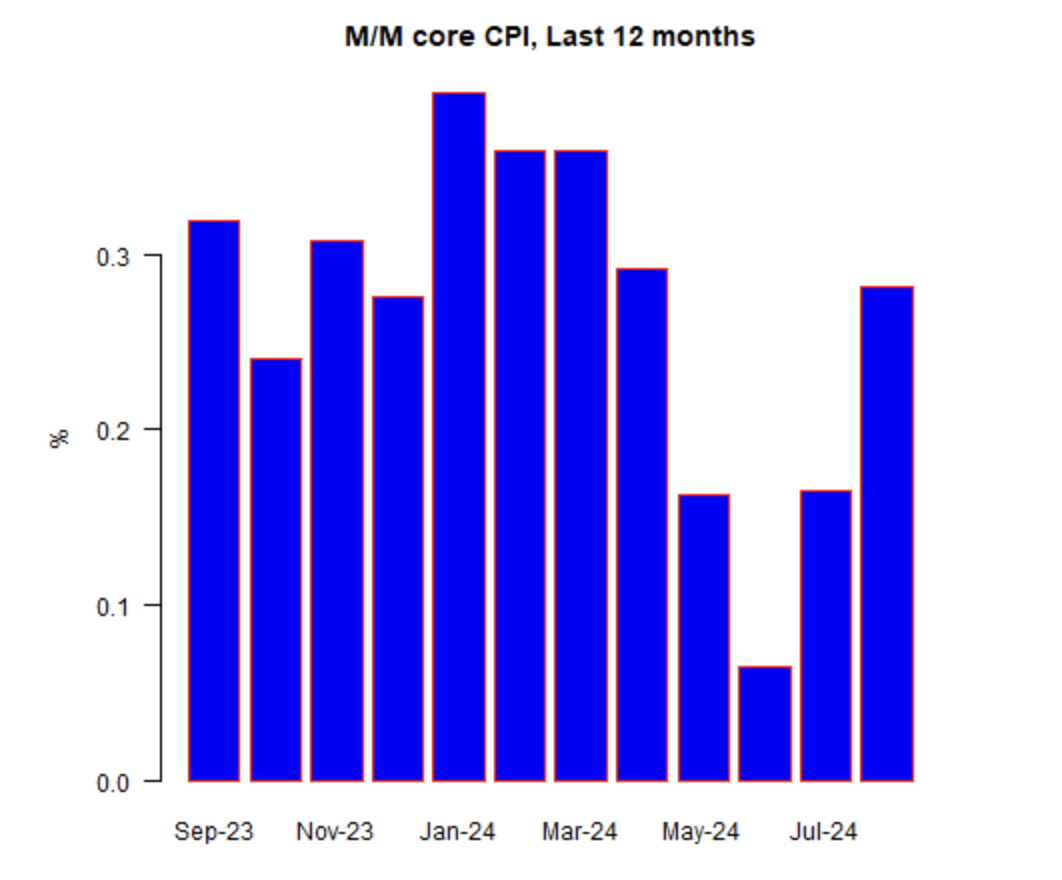
I guess if you squint just the right way, the trend in inflation remains lower.  I only guess that because that’s what we heard from three Fed speakers yesterday, Williams, Goolsbee and Barkin, but to my non-PhD trained eye, it doesn’t really look that way.  Borrowing the chart from my friend @inflation_guy, Mike Ashton, below are the monthly readings for the past twelve months for Core CPI.

As I said, and as he mentioned in his CPI report yesterday, it is much easier to believe that the outliers are May through July than the rest of the series.  But remember, I am not a trained PhD economist, so it is entirely possible that I simply don’t understand the situation.

At any rate, both the core and headline numbers printed higher than forecast which saw bonds sell off and the dollar rally while stocks edged lower.  Arguably, the big surprise was that commodity prices raced ahead with oil (+3.0% yesterday) and gold (+0.75% yesterday) both showing strength.  It seems that both of these markets, though, benefitted from rumors that Israel is getting set to finally retaliate against Iran for the missile bombardment last week, and fears of a significant disruption in oil markets, as well as a general rise in the level of uncertainty, has been sufficient to squeeze out a bunch of recent short positions.

In China, investors are waiting
For details on how stimulating
The plans Xi’s unveiled
Will truly be scaled
And if they’ll be growth generating

The other topic du jour is China, where tomorrow, FinMin Lan Fo’an is due to announce the details of the fiscal stimulus that was sketched out right before the Golden Week holiday, and which has been a key driver in the extraordinary rise in Chinese equities since then.  Alas, last night, as traders and investors prepared for these announcements, selling was the order of the day and the CSI 300 (-2.8%) fell sharply amid profit taking.  I find it telling that they are waiting to make these announcements while markets are not open, a sign, to me at least, that they are likely to be underwhelming.  Current expectations are for CNY 2 trillion (~$283 billion) of fiscal stimulus, which while a large number, is not that much relative to the size of the Chinese economy, currently measured at about $17 trillion.  And unless they address the elephant in the room, the decimated housing market, it seems unlikely to have a major positive impact over the long term. 

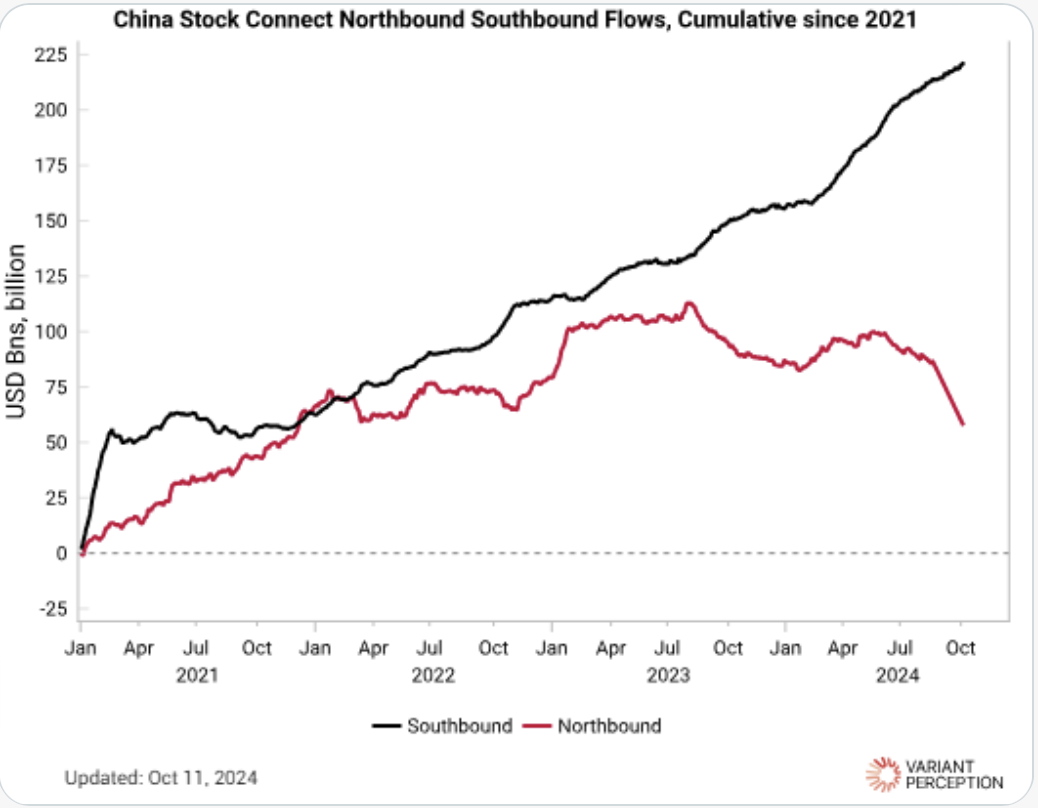
That said, Chinese stocks have become one of the hottest themes in the market with many analysts claiming they are vastly undervalued relative to US stocks.  However, I saw a telling chart this morning on X, showing that flows into Chinese stocks from outside the nation, the so-called northbound flows from Hong Kong, especially when compared to flows from the mainland to Hong Kong, have been awful, despite this recent rally.  As with many things regarding the Chinese economy and markets, the headlines can be deceiving at times in an effort to make things look better than they are.

While we did see the renminbi rally sharply after those initial stimulus announcements, it has since retraced most of those gains.  I cannot look at the situation there without seeing an economy that has serious structural imbalances and a terrible demographic future.  Meanwhile, the biggest problem is that President Xi has spent the past decade consolidating his power and eliminating much of the individual vibrancy that had helped the nation grow so rapidly.  Ultimately, I see CNY slowly depreciating as it remains the only relief valve the Chinese have on an international basis.

With that in mind, let’s take a look at how markets responded to the US CPI data and what other things may be having impacts.  Ultimately, US equity markets regained the bulk of their early losses yesterday to close marginally lower.  We’ve already mentioned China’s equity woes and Hong Kong was closed last night for a holiday.  Tokyo (+0.6%) managed a small gain, tracking the weakness in the yen (-0.25%) while the bulk of the region drifted modestly lower.  It seems many traders are awaiting this Chinese news to see how it will impact the rest of Asia.  As to European bourses, the movement here has also been di minimus with the FTSE 100 (-0.2%) the biggest mover after its data releases showing that GDP continues to trudge along slowly, growing only 1.0% Y/Y.  Continental exchanges are +/- 0.1% from yesterday, so no real movement there.  US futures, too, are essentially unchanged at this hour (7:00).

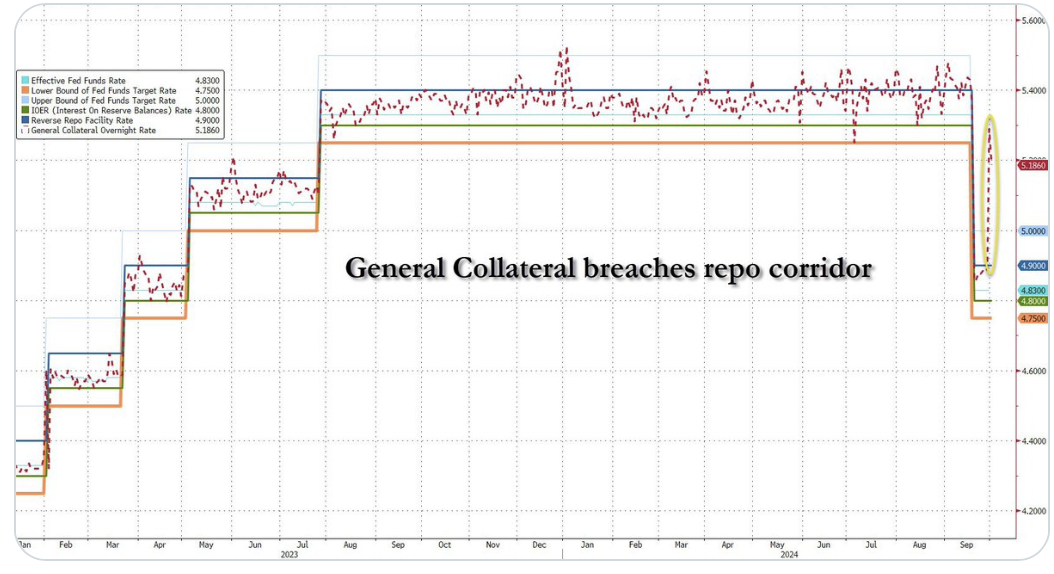
In the bond market, yields continue to edge higher with Treasuries gaining 3bps and European sovereigns all looking at gains of between 3bps and 5bps.  An interesting interest rate phenomenon that has not gotten much press is that the fact that at the end of September, the General Collateral Repo rate surged through the upper bound of the Fed funds rate, a condition that describes a potential dearth of liquidity in the markets.  

Source: zerohedge.com

The implication is that QT may well be ending soon in order for the Fed to be certain that there are sufficient bank reserves available for banks to meet their regulatory targets and not starve the economy of capital.  It has always been unclear how the Fed can start cutting rates while continuing to shrink the balance sheet as that was simultaneously tightening and easing policy, but it appears that we are much closer to universal policy ease, something else that will weigh on the dollar and support commodity prices over time.

Speaking of commodities, after yesterday’s rally, this morning, the metals complex is continuing modestly higher (Au +0.3%, cu +0.4%) but oil (-0.8%) is backing off a bit.  So much of the oil trade appears linked to the Middle East it is very difficult to discern the underlying supply/demand dynamics right now.

Finally, the dollar, after several days of strength, is consolidating and is little changed to slightly higher.  The DXY is trading right at 103 and the euro is hovering just above 1.09 with USDJPY at 149.00.  Several weeks ago, these numbers would have seemed ridiculous given the then current view of the Fed aggressively cutting rates.  But now, all that bearishness is fading, and it is true vs. almost every currency, G10 or EMG this morning.

On the data front, PPI leads the way this morning although given we already got the CPI data, it will have virtually no impact I would expect.  Estimates are for headline (0.1% M/M, 1.6% Y/Y) and core (0.2% M/M, 2.7% Y/Y).  As well, we get Michigan Sentiment (70.8) at 10:00 and we will hear from several more Fed speakers, including Governor Bowman, the dissenter at the FOMC meeting who looks quite prescient now.  One thing to note is yesterday’s Initial Claims data was much higher than expected at 258K, but that was attributed to the effects of Hurricane Helene, and now that Hurricane Milton has hit, I expect that those claims numbers will be a mess for a few more weeks before all the impact has passed through.

While Fedspeak remains far more dovish than the data, my take is if the data continues to show economic strength, especially if the next NFP release, which is just before the FOMC meeting, is strong again, the Fed will be hard pressed to cut even 25bps then.  For now, good economic news should support the dollar and weigh on bonds.

Good luck and good weekend

Adf