Heartburn

It seems bond investors are learning
That government spending’s concerning
As yields ‘cross the board
Have all really soared
While buyers become more discerning
 
Meanwhile, o’er the weekend we learned
That Tariff Man’s truly returned
More letters were sent
Designed to foment
Responses as well as heartburn


As we approach the middle of the summer, two things are becoming increasingly clear; the world today is very different from just a few years ago and it is getting harder and harder to pay for all the things that the world seems to want.  Taking the second point first, market headlines today have pointed to German 30-year yields which have traded to their highest level since October 2023, and appear set to breech that point and move to levels not seen since prior to the Eurozone bond crisis in 2011 (see MarketWatch chart below)

Similarly, we have seen 30-year yields rise in Japan, a story that gained legs back in late May, and yields overnight returned to those all-time highs from then.

Source: tradingeconomics.com

Not surprisingly, given the debt dynamics globally, US 30-year yields are also pushing back to the levels seen back in May, although have not quite reached those lofty levels and as I type this morning, are trading just below the 5.00% level.

Source: tradingeconomics.com

As Austin Powers might say, “What does it all mean, Basil?”  While I’m just a poet, so take it for what it’s worth, it seems pretty clear that the level of government borrowing is pushing the limits of what private sector investors are willing to absorb.  The below chart, created from FRED data tells an interesting tale.  Up through the GFC, government and private sector debt grew pretty much in step with each other, although after Black Monday in October 1987, government debt started to grow a bit more rapidly.  But the GFC completely changed the conversation and government debt took on a life of its own.  Essentially, the GFC took private losses and nationalized them and put them on the government’s balance sheet. (As an aside, this is why there is still so much anger at the fact that nobody was held accountable for that event, with the perpetrators getting larger bonuses after their banks were bailed out.). But in today’s context, the rise in yields is telling us, or me at least, that the market is losing its appetite for more government debt.

While this is the US graph, the situation is similar around the developed world.  This is why we are hearing more about Secretary Bessent’s sudden love of stablecoins as they will be a source of significant demand for Treasury paper that he needs to sell.  But in the end, do not be surprised if we see more than simply QE, whatever they call it, going forward, but outright financial repression and yield curve control.  While the US may be in the vanguard of this situation, the yields in Germany and Japan tell us that the same is happening there as well.  

As to the first point above, back in the day, it seemed that weekends were observed by one and all around the world with policy statements a weekday affair.  But no longer.  Over the weekend, President Trump sent letters to Mexico and the EU that 30% tariffs were on the way if they did not reach an agreement by August 1st.  For 80 years, most of the Western world operated on a genteel basis, with decorum more important than results.  It is not clear to me if this was because negotiations were more effective, or because most leaders didn’t have the stomach for confrontation.  But it is abundantly clear that President Trump is quite willing to be confrontational with other leaders in order to get his way.  The problem for other leaders is they are not used to dealing in this manner and find themselves uncertain as to how to proceed.  Thus far, whether they have been combative or conciliatory, it doesn’t seem to matter.  Remarkably, it is still just 6 months into this presidency, so things are going to continue to change, but the one thing that is unequivocally true is the world is a different place today than ever before.

Ok, let’s see how other markets are handling the latest tariff storms.  Equity markets are mostly unhappy with this new process as after Friday’s modest declines in the US, we saw more losers (Japan, India, Taiwan, Australia) than winners (Hong Kong, China, Korea) in Asia.  The salient news there was that the Chinese trade surplus grew to $114.8B, slightly more than expected as exports rose sharply while imports underperformed.  However, Chinese bank and lending data did show an increase in M2 and Loan Growth, so at least they are trying to add some monetary stimulus.  As to Europe, other than the UK (+0.4%) the continent is under pressure with Germany (-1.0%) the laggard of the bunch.  The UK story seems to be a single stock, AstraZeneca, which released strong trial results for a new drug.  But otherwise, the tariff story is weighing on the continent.  US futures are also softer at this hour (7:30), down around -0.3% across the board.

While my bond conversation was on the 30-year space, 10-year yields are only marginally higher, about 1bp, in the US and Europe although JGB yields did jump 6bps ahead of their Upper House elections this week. 

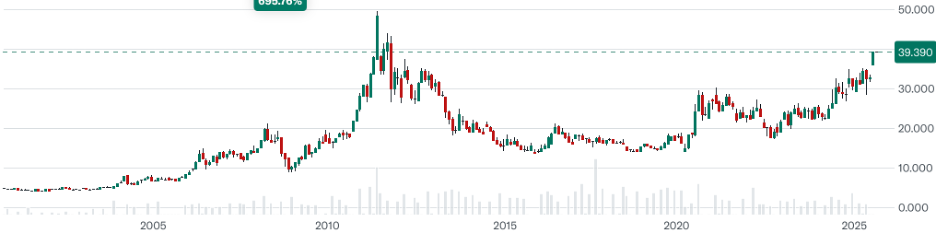
In commodities, oil (+1.2%) continues to find support despite the ongoing theme that the economy is soft and supply is growing significantly with OPEC increasing production and set to return even more to the market by the end of the summer.  As it happens, NatGas (+4.75%) is also higher this morning and continues to find substantial support as on a per BTU basis, it is desperately cheap vs. oil, something like one-seventh the price.  In the metals markets, while gold (+0.4%) continues to see support, the real action is in silver (+1.4%) which has rallied very consistently, gapping higher as you can see in the chart below, and has been the subject of much discussion as to how far it can rise.  Historically, silver lags the timing of gold rallies but far outperforms the gains in percentage terms.
Source: finance.yahoo.com

Finally, the dollar is little changed to a touch stronger this morning as traders cannot decide if tariffs are going to be a problem, or if deals are going to be struck.  However, in the dollar’s favor right now is the fact that most other countries are in a clear easing cycle while the Fed remains firmly on hold.  Fed funds futures are pricing less than a 7% chance of a cut this month and only a 61% chance of a September cut.  If US rates continue to run higher than the rest of the world, and there is limited belief they are going to fall, the dollar will find support.  However, given the pressure that President Trump continues to heap on Chairman Powell (there was a story this weekend that Powell is close to resigning, although my take is that is wishful thinking), it is hard to get excited about the dollar’s prospects.  Remember this, all the economists who tell us that an independent central bank is critical work for central banks.

On the data front, after virtually nothing last week, we do get some important numbers this week.

TuesdayCPI0.3% (2.7% Y/Y)
 -ex food & energy0.3% (3.0% Y/Y)
 Empire State Manufacturing-8.0
WednesdayPPI0.2% (2.5% Y/Y)
 -ex food & energy0.2% (2.7% Y/Y)
 IP0.1%
 Capacity Utilization77.4%
 Fed’s Beige Book 
ThursdayInitial Claims234K
 Continuing Claims1970K
 Retail Sales0.1%
 -ex autos0.3%
FridayHousing Starts1.30M
 Building Permits1.39M
 Michigan Sentiment61.4

Source: tradingeconomics.com

In addition to this, we hear from eight FOMC members, so it will be interesting to see if the erstwhile doves are willing to join Waller and Bowman in their call for a July rate cut.  If we start to see momentum build for a July cut, something which is not currently evident, look for the dollar to suffer substantially.  But absent that, I have a feeling we are going to range trade for the rest of the summer.

Good luck

Adf
Tripping Off Tongues

Recession is tripping off tongues
And pundits ain’t twiddling their thumbs
Political shades
Are driving tirades
And screams at the top of their lungs
 
But are we that likely to see
A minus in our ‘conomy?
We certainly could
And probably should
But life doesn’t always agree


The major discussion point over the weekend has been recession, and how likely we are to see one in the US in the coming months.  Of course, this matters to the punditry not because of any concern over the negative impacts a recession has on the population, but ‘more importantly’ because recessions tend to result in sharp declines in equity values.  And let’s face it, do you honestly believe that the editors of the New York Times or the Wall Street Journal are remotely interested in the condition of the majority of the population?  Me neither. 

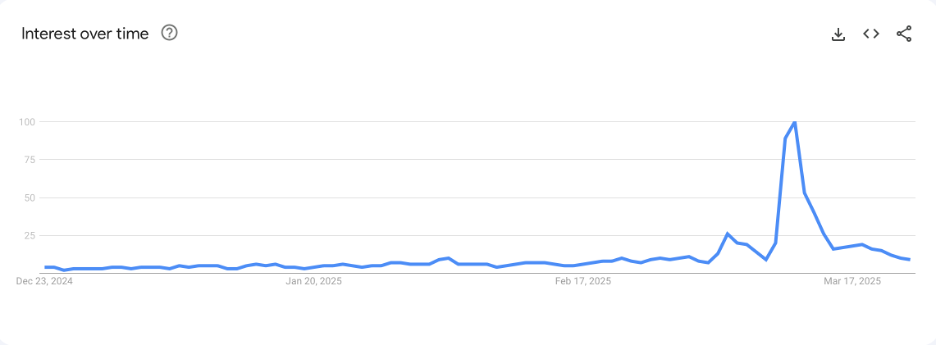
However, if they can call out something that they believe can impede President Trump, or detract from his current high ratings, they will play that over and over and over.  Funnily enough, when I went to Google Trends, I looked up “recession” over the past 90 days with the result below:

That peak was on March 11 although there was no data of note that day compared to a reading of 9 today. Looking at the news of that day, even CNN had a hard time finding bad news with the four top stories being 1) the Continuing Resolution vote in the House being passed, 2) the Department of Education announcing a 50% RIF, 3) 25% tariffs on steel and aluminum being imposed and 4) Ukraine accepting terms for a 30-day ceasefire.  From an economic perspective, the tariffs clearly will have an impact, but it seems a leap that the average American can go from 25% tariffs on imported steel and aluminum to recession in one step.  And based on the positive responses that continue to be seen regarding President Trump’s efforts to reduce the size of government, I doubt the DOE cuts were seen as the beginning of the end of the economy.  

And yet, recession was the talk of the punditry this weekend.  To try to better understand why this is the case, I created the following table of several major economic indicators and their evolution since December, prior to President Trump’s inauguration.

Key indicatorsDecJanFeb
NFP323125151
Unemployment Rate4.10%4.00%4.10%
CPI2.90%3.00%2.80%
Core CPI3.20%3.30%3.10%
PCE2.60%2.50% 
Core PCE2.90%2.60% 
IP1.10%0.30%0.70%
Capacity Utilization77.60%77.70%78.10%
ISM Mfg49.250.950.3
ISM Services5452.853.5
Retail Sales0.70%-1.20%0.20%

Source: tradingeconomics.com

Once again, while I am certainly no PhD economist, this table doesn’t strike me as one demonstrating a clear trend in worsening data, certainly not on an across-the-board basis.  Rather, while you might say January was soft, the February data has largely rebounded.  My point is that despite ABC, NBC, Bloomberg, the BBC and CNN all publishing articles or interviews on the topic this weekend, I’m not yet convinced that is the obvious outcome.

My good friend the Inflation Guy™, Mike Ashton, made an excellent point in a recent podcast of his that is very well worth remembering.   The breadth of the US economy is extraordinarily wide and covers areas from manufacturing to agriculture to finance to energy and technology along with the necessary housing markets as well as the entire population consuming both goods and services.  Added to the private sector, the government sector is also huge, although President Trump and Elon Musk are trying hard to shrink it.  But the point is that it is not merely possible, but likely, that while some areas of the economy may go through weak patches, that doesn’t mean the entire economy is going to sink into the abyss.

If we think back to the last two recessions, the most recent was Covid inspired, which resulted from the government literally shutting down the economy for a period of several months, while giving out money.  Net, things weakened, but even then, there were stronger parts and weaker parts.  Go back to the GFC and the housing bubble popped and dragged banks along with it.  That was the problem because banking weakness inhibits the free flow of money and that will impact everyone.

The question to be asked now, I would suggest is, are we likely to see another catalyst that will have such widespread impacts?  Higher tariffs are not going to do the trick.  Shrinking government, although I believe it is critical for a better long-term trajectory for the economy, will have a short-term impact, but it is not clear to me that it will negatively impact the economy writ large.  Certainly, the Washington DC area, but will it impact the Rocky Mountain area?  Or Texas and Florida?  

Now, a recession could well be on the way.  Running 7% budget deficits was capable of papering over many holes in the economy and pumping lots of liquidity into it as well.  If those deficits shrink, meaning spending shrinks, the pace of activity will slow.  But negative?  It seems a stretch to me, at least based on what we have seen so far.  One last thing here, is how might this potential weakening economic growth impact inflation? Now, we all ‘know’ that a recession causes inflation to decline, don’t we?  Hmmm. While that makes intuitive sense, and we hear it a lot, perhaps the Inflation Guy™ can help here as well.  Back in February he wrote a very good explanation about how that is not really the case at all, at least based on the macroeconomic data.  The truth is economic growth and inflation have very little correlation at all.

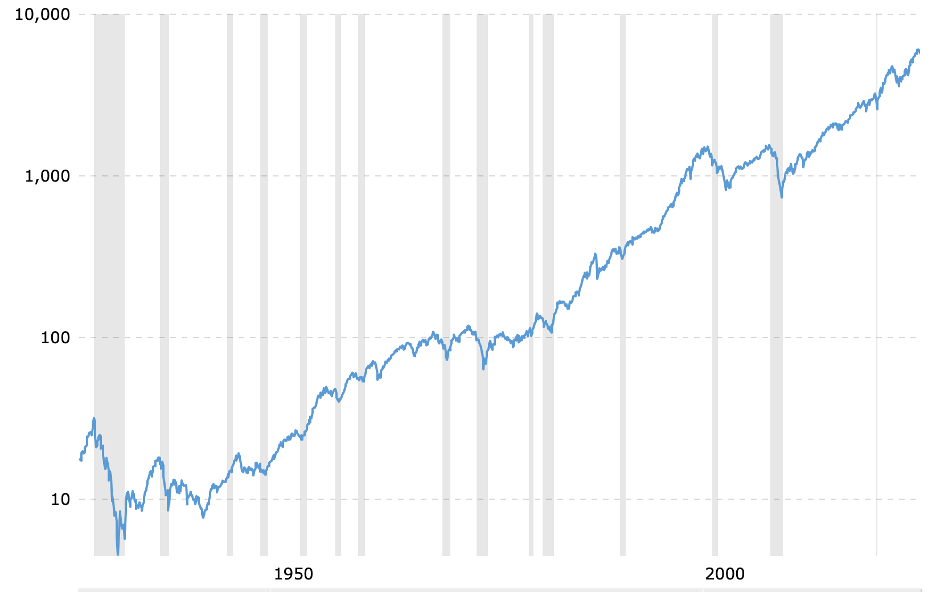
Of course, perhaps the most critical issue for the punditry is, will a recession drive stock prices lower?  Here the news is far less sanguine if you are a shareholder and believe there is going to be a recession.  As you can see from the below chart of the S&P 500, pretty much every recession for the last 100 years has resulted in a decline in stock market indices.

Source: macrotrends.net

This is a log chart so some of those dips don’t seem that large, but the average downturn during a recession is about 30%, although that number can vary widely.  To sum it up, while the data doesn’t scream recession to me, it cannot be ruled out.  As well, both President Trump and Secretary Bessent have indicated that weakness is likely going to be a result of their early actions, although the idea is to pave the way for a more stable economic performance ahead.  As I have written repeatedly, volatility is likely the only thing of which we can be certain as all these changes occur.  Hedge your exposures!

Ok, let’s look at the overnight activity.

The rumor is Trump may delay
His tariffs as he tries to weigh
How much he should charge
And how much, writ large,
These nations are going to pay

Equity futures in the US are higher this morning as the big story is that President Trump is considering narrowing the scope of nations who will have tariffs imposed on April 2nd.  Apparently, his administration has identified the “dirty fifteen” nations with the largest bilateral imbalances and they will be first addressed.  The telling comment in the WSJ article I read was when Trump said, “Once you give exemptions for one company, you have to do that for all. The word flexibility is an important word. Sometimes there’s flexibility, there’ll be flexibility.”  To my ear, the final plans are not in place, but my sense is he will impose then remove tariffs, rather than avoid them initially.  Interestingly, that story was written last night, yet Asian equity markets were not that ebullient.  Japan (-0.2%) saw no benefit although Chinese shares (HK +0.9%, CSI 300 +0.5%) fared better. Things elsewhere in the region were mixed with both gainers (India, Thailand) and laggards (Korea, Taiwan, Indonesia) with many bourses little changed overall.

In Europe, green is the predominant color this morning but movement is modest with Spain’s IBEX (+0.4%) the leader and lesser gains elsewhere.  While US futures are all higher by about 1% or more at this hour (6:45) apparently the Europeans aren’t as excited at the tariff delay process.

In the bond market, yields have backed up virtually across the board with Treasuries (+4bps) leading the way higher and most European sovereigns showing yields rising by 1bp or 2bps.  It’s interesting, while there has been much discussion regarding German yields having traded substantially higher in the wake of the effective end of the debt brake and anticipation of much further issuance, a look at the chart below tells me that after that gap higher on the news, concerns over German finances have not deteriorated at all.  And after all, the difference is about 25bps higher, hardly the end of the world.

Source: tradingeconomics.com

In the commodity markets, oil (+0.7%) is continuing its gradual rebound from the lows seen on, ironically, March 11th.  Arguably, what this tells us is that despite the weekend barrage of recession focused articles, the market doesn’t really see that outcome.  In the metals, strength is the word, again, with copper (+1.25%) making new all-time highs on the back of China’s stated goals of growing its strategic stockpile.  Not surprisingly, both gold (+0.2%) and silver (+0.6%) are also climbing this morning alongside copper as commodities remain in greater demand than a recession would indicate.

Finally, the dollar is a bit softer despite rising Treasury yields with both the euro (+0.3%) and pound (+0.4%) bouncing after last week’s modest declines.  And this is despite lackluster Flash PMI readings this morning out of Europe.  The biggest winner is NOK (+0.6%) which given the dollar’s broad weakness and oil’s rebound makes perfect sense.  Otherwise, while the dollar’s weakness is broad, it is no deeper than the aforementioned currencies.

Given the length of this note already (my apologies) and the dearth of data to be released, with only the Chicago Fed National Activity Index (exp +0.08), I will cover data tomorrow as we do end the week with GDP and PCE data.

Headline bingo remains the key concern for all market participants, but ultimately, my altered view of a softer dollar and higher commodities remains intact.

Good luck

Adf

Dynamited

Investors don’t seem that excited
‘Bout Germany’s now expedited
Designs to rearm
And that caused much harm
To Bunds, with their price dynamited


One of the biggest impacts of President Trump’s recent friction with Ukraine and its security is that European nations now realize that their previous ability to make butter, not guns, because the US had enough guns for everybody is no longer necessarily the case.  Mr Trump’s turn inward, which should be no surprise given his campaign rhetoric and America First goals, apparently was a surprise to most European leaders.  It seems they couldn’t believe the US would change course in this manner.  Regardless, the upshot is that Europe finds itself badly under armed and is now promising to change this.

The country best placed to start this process is Germany, where soon-to-be Chancellor, Friedrich Merz has promised a €500 billion spending spree on new defense items.  However, as the Germans don’t have this money laying around, they will need to borrow it.  The wrinkle in this plan is that enshrined in Germany’s constitution is a debt brake designed to prevent fiscal profligacy, kind of like this.  So, Merz has proposed waiving the debt brake for defense expenditures, but in order to do so, will need a two-thirds majority vote in the Bundestag (German parliament).  Now given AfD has been quite anti-war, it is not clear he will be able to obtain the requisite votes but for now, that is not the concern.

However, the German bund market clearly believes he will be successful as evidenced by the chart below. Overall, German 10-year yields rose 30bps yesterday, a dramatic move, and dragged most European sovereigns along for the ride as the new narrative is that all European nations will increase borrowing to spend on their defense.  It is worth noting, though, that the reason German yields have been so low is because the economy there has been exhibiting approximately 0% growth for more than a year as they continue to commit energy suicide seek to achieve their idealistic greenhouse gas emission goals.

Source: tradingeconomics.com

The trick, though, is that while Germany, with a debt/GDP ratio around 60%, has plenty of fiscal space to follow through, assuming they can alter their constitution, the rest of Europe is in a much more difficult spot with both France and Italy already under EU scrutiny for their budget deficits and debt/GDP ratios.  Recall, a key aspect of the Eurozone’s creation was the regulation designed to keep national budget deficits below 3% of GDP and drive the debt/GDP ratios to 60% or below.  Right now, Germany is the only nation that fits within those parameters. 

While I have no doubt that they will alter the rules as necessary elsewhere in Europe and certainly given the now perceived existential crisis for Europe, those limits are sure to be ignored, the story in Germany remains different because of the constitution.  Markets, though, clearly believe that a lot more debt is about to be issued by European nations, hence the dramatic decline in bond prices and jump in yields.  

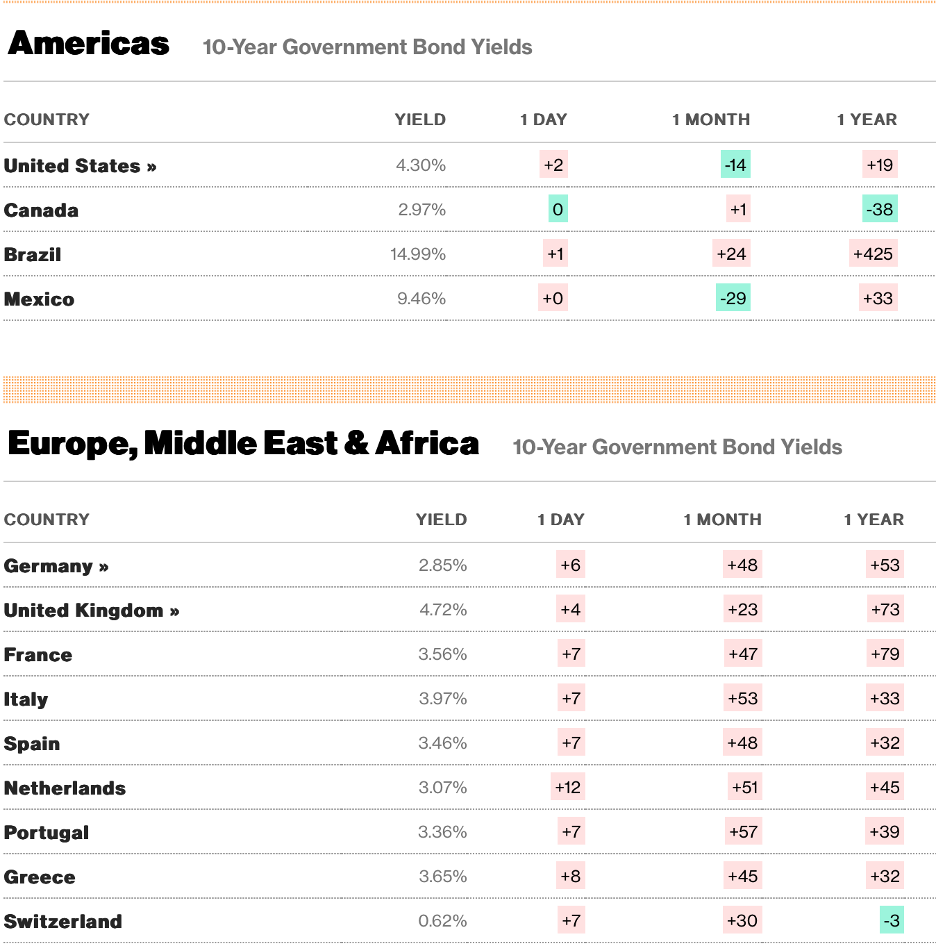
But there are other knock-on effects here as well, notably that the euro is climbing dramatically against the dollar, up nearly 4% in the past week, and far ahead of the pound and most G10 currencies with only the SEK (+1.0% overnight, +6.1% in past week) outperforming the single currency.  For a while I have suggested that short-term rates were losing their sway over the FX markets and traders were looking at 10-year yields.  Certainly, the recent price action indicates that remains the case as Treasury yields (+2bps) have bounced off their lows but have risen far less than their G10 counterparts.  In fact, a look at the movement in 10-year government bond yields over the past month and year reveals just how significant these changes have been.

Source: Bloomberg.com

I feel safe in saying that for the next several weeks, perhaps months, this story of European defensive revival and the knock-on effects is going to be top of mind for both investors and pundits.  Only history will determine if these dramatic changes in policy stances will have been effective in reducing the chance of war or not and if they will have been beneficial or detrimental to economies around the world. As much of the current narrative is driven by politics rather than economics, punditry on the latter is going to be worse than usual.  Once again, I harken back to the need for a robust hedging plan for all those with exposures.  As recent price action across all markets demonstrates, volatility is back, and I believe here to stay for a while.

Ok, let’s run down the rest of the markets not yet discussed.  Yesterday’s US equity bounce was widely appreciated by many although this morning, futures markets are all pointing lower by between -0.75% and -1.25%, enough to wipe out yesterday’s gains.  As to Asia overnight, Japan (+0.8%) followed the US and both Hong Kong (+3.3%) and China (+1.4%) are continuing to get positive vibes from the Chinese twin meetings of policymakers.  More stimulus continues to be the driving belief there although China’s history has shown their stimulus efforts have tended to fall short of initial expectations.  As to Europe, this morning only the DAX (+0.5%) is continuing yesterday’s gains as concerns begin to grow that while Germany can afford to spend more money on defense, the rest of Europe is not in the same situation, so government procurement contracts may be less prevalent than initially hoped.  This is evident in the -0.4% to -1.0% declines seen across both the UK and most of the rest of the continent.

We’ve already discussed bonds, although I should mention that JGB yields have risen 10bps as well, up to new highs for the move and finally above 1.50%

In the commodity space, oil (+0.65%) which has had a very rough week, falling more than -5% in the past seven days, seems to be finding a bit of support.  Recall yesterday’s chart showing the bimodal distribution and that we are now in supply destruction territory.  Ultimately, that should support the price, but the timing is unclear.  In the metals markets, this morning sees red across the board, although not dramatically so, with both precious and base metals sagging on the order of -0.5%.

And lastly the dollar continues to decline, albeit not as swiftly as yesterday.  However, while it is considerably weaker vs. its G10 counterparts, versus the EMG bloc, the story is far less clear.  For instance, the only notable EMG currency gaining ground this morning is CLP (+1.2%) while virtually every other major emerging market currency is actually slipping a bit.  Look at this list; CNY -0.2%, MXN -0.25%, PLN -0.3%, ZAR -0.15%, INR -0.3% and HUF -0.5%.  I have a feeling we are going to see more behavior like this going forward, where G10 currencies are now trading on a different basis than EMG currencies.

On the data front, this morning brings Initial (exp 235K) and Continuing (1880K) Claims as well as the Trade Balance (-$127.4B) and Nonfarm Productivity (1.2%) and Unit Labor Costs (3.0%) all at 8:30.  We also hear from two more Fed speakers, Waller and Bostic later in the day.  Yesterday’s ADP employment data was much weaker than expected, falling to 77K, while the ISM Services data held up well although the prices paid piece did rise.  In addition, there has been a change in tone from the Fed speakers as we are now hearing mention of the possibility of stagflation due to the Trump tariffs, although there was no indication as to which way they will lean if that is the economic path forward.

I continue to highlight volatility as the watchword for now and the near future at least.  As long as politics has become the key driver, and as long as President Trump is that driver, given his penchant to shake things up, the one thing of which I am sure is we have not seen the last dramatic change in perception.  With that in mind, my view is the dollar will remain under pressure for a while yet.

Good luck

Adf

Desperate Straits

When yield curve control was designed
Its goal was a rate be defined
Which can’t be exceeded
With bonds bought as needed
To help governments in a bind

Lagarde, though, when looking ahead
Must work at controlling the spread
So BTP rates
Don’t reach desperate straits
Vs. bunds, an outcome she would dread

Ahead of the inauguration of President Biden, the market has turned its focus to Europe and the ongoing situation in Italy.  Prime Minister Giuseppe Conte has been struggling to lead a fractious coalition from the left and was just subject to no-confidence votes in both houses of the Italian government.  (They have a House and Senate similar to the US.)  This occurred when one of his former allies, Matteo Renzi, split from the coalition triggering the vote.  Renzi leads the Viva Italia party, a center-left group focused on progressive reforms to the Italian government, and it appears Conte has become a little too status quo for his taste.  While Conte was able to cobble together a majority in the lower house, today’s vote in the Senate was less successful, with a majority of votes cast, but no majority in the Senate overall.  This means he has a minority government whose stability has now been called into question.  Estimates are that he has two weeks to develop a majority or the President may call for parliament to be dissolved and new elections held.

As this story has unfolded, investors have been focused on the bond market, specifically the spread between Italian BTP’s and German bunds.  This spread is seen as a key metric, by both the market and the ECB, as to the health of the European economy overall.  The narrower that spread, the healthier the situation.  This is based on the idea that investors are not demanding as great a yield premium to fund Italy’s debt as they are Germany’s.

A quick history shows that for the first eight years of the euro’s existence, that spread hovered between 25 and 45 basis points, with investors not particularly concerned by Italy’s profligate ways.  The GFC awakened many to the potential risks in Italy and the spread ballooned as high as 160 basis points at that time.  But that was nothing compared to the Eurozone bond crisis in 2012, when Greece was on the ropes and the term PIGS was invented.  At that time, Italian yields peaked at 5.525% higher than German yields.  The second time this level was reached, in July 2012, led to Mario Draghi’s famous words, “whatever it takes” regarding the ECB’s will to save the euro.  Since that time, the spread has only ever edged below 1.0% briefly, lately reaching a peak of 2.8% at the beginning of the Covid crisis and currently trading around 1.14%.

The point here is that the ECB watches this spread very carefully.  But now, it appears they are interested in more than merely watching the spread.  Rather, they want to control it.  Yield curve control (YCC) is currently ongoing in both Japan and Australia and has generated a good deal of discussion in the US.  But those three central banks have a single government rate to manage.  The ECB has no such luck, and so they need to find other ways to control things.  Hence, their newest idea is Yield spread control (YSC), where the ECB will buy whatever amount of bonds are necessary to prevent a particular spread from rising above a particular level.  Obviously, this means they will be looking at the bonds of the PIGS, as those are the nations with the biggest outstanding issues.  The problem Lagarde has is the ECB, by law, is not allowed to finance government spending, and QE in Europe was designed to be implemented along the lines of the ECB buying bonds in proportion to national economic size.  But this will require something completely different, as in order to prevent that spread from widening beyond whatever level they choose, the ECB will need to purchase an unlimited number of Italian BTP’s.  As such, this idea is not without controversy, but do not be surprised to hear about it tomorrow when the ECB meeting ends.  While it may not be implemented right away, it does appear they are actively considering the idea.

At this point you are likely asking yourself why you care about this esoteric concept.  And the answer is because it will have an impact on the value of the euro, and therefore the dollar, going forward.  Given the current draconian lockdowns throughout Europe and the significant negative impact they will have on the Eurozone economy, and combine that with a political morass in the 3rd largest economy in the Eurozone, and you have a recipe for a more severe downturn in a double dip recession in Europe.  As the ECB has already used up its basic toolkit of extraordinary measures, it needs to develop new ones if it is to keep the money flowing.  And that is the point.  Especially after yesterday’s testimony by Janet Yellen, where it is clear that the Treasury is not going to slow down spending and the Fed will be right there buying up those new bonds, the ECB is growing concerned that the dollar could fall much further.  They have recently been reminding us that they are paying attention to the exchange rate, and while intervention is not likely in the cards, a new easing policy that results in lower yields and a correspondingly weaker euro just might be.  One has to be impressed with central bank creativity when it comes to spending/printing more money.

But for now, investors remain sanguine to the risk inherent in this strategy and continue to add risk to their portfolios.  This can be seen in the continued rallies in equity markets around the world.  For instance, last night saw strength throughout Asia, except for the Nikkei (-0.4%).  Europe, this morning is showing far more green than red (DAX +0.5%, CC +0.3%. FTSE 100 -0.1%) and US futures, following yesterday’s tech inspired rally, are all higher again this morning.

Bond markets are under pressure generally, with Treasury yields backing up 1.4bps, although still unable to break the recent highs of 1.15%, Gilts are also softer with yields higher by 1.2bps while bunds and OATs are little changed. BTP’s, however, have fallen ¼ point with yields higher by 2.5bps, which means that spread has risen by the same amount.  Keep an eye on this.

Oil (WTI +1.3%) and gold (+0.5%) are both firmer this morning while the dollar is broadly under pressure.  However, the magnitude of that weakness is fairly minimal, with AUD (+0.35%) the biggest gainer in the G10 on the back of firmer commodity prices, while SEK (-0.35%) is the laggard on what appears to be position unwinding.  The euro (-0.15%) is definitely not following a classic risk-on pattern here, with some reason to believe traders are beginning to take the YSC into account.  In the EMG space, the moves are also limited, with TRY (+0.4%) and BRL (+0.25%) the leading gainers while CE4 currencies (CZK and PLN both -0.1%) are the laggards.  But overall, the risk theme does not appear to be having an impact in FX.

Once again there is no data released today and we are still in the quiet period, so no Fedspeak.  And we don’t even have Yellen to testify, so the FX market is going to be paying attention to equity movements and the bond market, probably in that order.  If risk continues to be acquired, I expect the dollar will have difficulty gaining any traction, but if we start to see a reversal, don’t be surprised to see some of the massive dollar short positions unwound.

Good luck and stay safe
Adf

Shocked and Surprised

Delivering just twenty-five
Did not satisfy Donald’s drive
To boost US growth
So he made an oath
That tariffs he’d quickly revive

Investors were shocked and surprised
As trade talks had seemed civilized
Thus stocks quickly fell
And yields did as well
Seems risk assets are now despised

Just when you thought it was safe to go back in the water…

Obviously, the big news yesterday was President Trump’s decision to impose a 10% tariff on the remaining $300 billion of Chinese imports starting September 1st. Arguably, this was driven by two things; first was the fact that he has been increasingly frustrated with the Chinese slow-walking the trade discussions and wants to push that along faster. Second is he realizes that if he escalates the trade threats, the Fed may be forced to cut rates further and more quickly. After all, one of their stated reasons for cutting rates Wednesday was the uncertainty over global growth and trade. That situation just got more uncertain. So in President Trump’s calculation, he addresses two key issues with one action.

Not surprisingly, given the shocking nature of the move, something that not a single analyst had been forecasting, there was a significant market reaction. Risk was quickly jettisoned as US equity markets turned around and fell 1% on the day after having been higher by a similar amount in the morning. Asian equity markets saw falls of between 1.5% and 2.0% and Europe is being hit even harder, with a number of markets (DAX, CAC) down more than 2.5%. But even more impressive was the decline in Treasury yields, which saw a 12bp fall in the 10-year and a 14bp fall in the 2-year. Those are the largest single day declines since May 2018, and the 10-year is now at its lowest level since October 2016. Of course, it wasn’t just Treasuries that rallied. Bund yields fell to a new record low of -0.498%, and we have seen similar declines throughout the developed markets. For example, Swiss 10-year yields are now -0.90%, having fallen 9bps and are the lowest in the world by far! In fact, the entire Swiss government yield curve is negative!

And in the FX market, haven number one, JPY rallied sharply. After weakening early in the session, it rebounded 1.7% yesterday and is stronger by a further 0.5% this morning. This has taken the yen back to its strongest level since April last year. Not surprisingly the Swiss franc saw similar price action and is now more than 1.0% stronger than yesterday. However, those are not the only currencies that saw movement, not by a long shot. For example, CNY has fallen 0.9% since the announcement and is now within spitting distance of the key 7.00 level. Significant concern remains in the market about that level as the last time the renminbi was that weak, it led to significant capital outflows and forced the PBOC to adjust policy and impose restrictions. However, there are many analysts who believe it is seen as less of a concern right now, and of course, a weaker renminbi will help offset the impact of US tariffs.

Commodity prices were also jolted, with oil tumbling 7% and oil related currencies feeling the brunt of that move. For example, RUB is lower by 1.2% this morning after a 0.5% fall yesterday. MXN is lower by a further 0.3% this morning after a 0.6% decline yesterday and even NOK, despite its G10 status, is lower by 1.0% since the tariff story hit the tape. In fact, looking at the broad dollar, it is actually little changed as there has been significant movement in both directions as traders and investors adjust their risk profiles.

With that as a prelude, we get one more key piece of data this morning, the payroll report. Current expectations are as follows:

Nonfarm Payrolls 164K
Private Payrolls 160K
Manufacturing Payrolls 5K
Unemployment Rate 3.6%
Average Hourly Earnings 0.2% (3.1% Y/Y)
Average Weekly Hours 34.4
Trade Balance -$54.6B
Michigan Sentiment 90.3

You can see the bind in which the Fed finds itself. The employment situation remains quite robust, with the Unemployment Rate expected to tick back to 50-year lows and steady growth in employment. This is hardly a classic set of statistics to drive a rate cut. But with the escalation of the trade situation, something they specifically highlighted on Wednesday, they are going to need to address that or lose even more credibility (although it’s not clear how much they have left to lose!) In a funny way, I would wager that Chairman Powell is secretly rooting for a weak number this morning which would allow further justification for rate cuts and correspondingly allow him to save some face.

In the end, the key to remember is that markets are beholden to many different forces with the data merely one of those, and increasingly a less and less important one. While historically, the US has generally allowed most market activity without interference, there has clearly been a change of heart since President Trump’s election. His increased focus on both the stock market and the dollar are something new, and we still don’t know the extent of the impact this will have over time. While volatility overall has been relatively low, it appears that is set to change with this increased focus. Hedgers keep that in mind as programs are implemented. All of this untested monetary policy is almost certainly building up problems for the future, and those problems will not be easily addressed by the central banks. So, my sense is that we could see a lot more volatility ahead.

In the meantime, today has the sense of a ‘bad news is good’ for stocks and vice versa as equity investors will be looking for confirmation that more rate cuts are on the way. As to the dollar, bad news will be bad!

Good luck and good weekend
Adf

Laden With Fears

When lending, a term of ten years
At one time was laden with fears
But not anymore
As bond prices soar
And bond bulls regale us with cheers

Another day, another record low for German bund yields, this time -0.396%, and there is no indication that this trend is going to stop anytime soon. While this morning’s PMI Composite data was released as expected (Germany 52.6, France 52.7, Eurozone 52.2), it continues at levels that show subdued growth. And given the ongoing weakness in the manufacturing sector, the major fear of both economists and investors is that we are heading into a global recession. Alas, I fear they are right about that, and when the dust settles, and the NBER looks back to determine when the recession began, don’t be surprised if June 2019 is the start date. At any rate, it’s not just bund yields that are falling, it is a universal reaction. Treasuries are now firmly below 2.00% (last at 1.95%), but also UK Gilts (0.69%), French OATs (-0.06%) and JGB’s (-0.15%). Even Italy, where the ongoing fight over their budget situation is getting nastier, has seen its yields fall 13bps today down to 1.71%. In other words, bond markets continue to forecast slowing growth and low inflation for some time to come. And of course, that implies further policy ease by the world’s central bankers.

Speaking of which:

In what was a mini bombshell
Said Mester, it’s too soon to tell
If rates should be lowered
Since, as I look forward
My models say things are just swell

Yesterday, Cleveland Fed president Loretta Mester, perhaps the most hawkish member of the Fed, commented that, “I believe it is too soon to make that determination, and I prefer to gather more information before considering a change in our monetary-policy stance.” In addition, she questioned whether lowering rates would even help address the current situation of too-low inflation. Needless to say, the equity markets did not appreciate her comments, and sold off when they hit the tape. But it was a minor reaction, and, in the end, the prevailing wisdom remains that the Fed is going to cut rates at the end of this month, and at least two more times this year. In truth, we will learn a great deal on Friday, when the payroll report is released, because another miss like last month, where the NFP number was just 75K, is likely to bring calls for an immediate cut, and also likely to see a knee-jerk reaction higher in stocks on the premise that lower rates are always good.

The IMF leader Lagarde
(Whom Greeks would like feathered and tarred)
Come later this year
The euro will steer
As ECB prez (and blowhard)

The other big news this morning concerns the changing of the guard at the ECB and the other EU institutions that have scheduled leadership changes. In a bit of a surprise, IMF Managing Director, Christine Lagarde, is to become the new ECB president, following Mario Draghi. Lagarde is a lawyer, not a central banker, and has no technocratic or central banking experience at all. Granted, she is head of a major supranational organization, and was French FinMin at the beginning of the decade. But all that reinforces is that she is a political hack animal, not that she is qualified to run the second most important policymaking institution in the world. Remember, the IMF, though impressive sounding, makes no policies, it simply hectors others to do what the IMF feels is correct. If you recall, when Chairman Powell was nominated, his lack of economics PhD was seen as a big issue. For some reason, that is not the case with Lagarde. I cannot tell if it’s because Powell has proven to be fine in the role, or if it would be seen as politically incorrect to complain about something like that since she ticks several other boxes deemed important. At any rate, now that politicians are running the two largest central banks (or at least will be as of November 1), perhaps we can dispel the fiction that central banks are independent of politics!

Away from the bond market, which we have seen rally, the market impact of this news has arguably been mixed. Equity markets in Asia were generally weak (Nikkei -0.5%, Shanghai -1.0%), but in Europe, investors are feeling fine, buying equities (DAX +0.6%, FTSE + 0.8%) alongside bonds. Arguably, the European view is that Madame Lagarde is going to follow in the footsteps of Signor Draghi and continue to ease policy aggressively going forward. And despite Mester’s comments, US equity futures are pointing higher as well, with both the DJIA and S&P looking at +0.3% gains right now.

Gold prices, too, are anticipating lower interest rates as after a short-term dip last Friday, with the shiny metal trading as low as $1384, it has rebounded sharply and after touching $1440, the highest print in six years, it is currently around $1420. I have to admit that the combination of fundamentals (lower global interest rates) and market technicals (a breakout above $1400 after three previous failed attempts) it does appear as though gold is heading much higher. Don’t be surprised to see it trade as high as $1700 before this rally is through.

Finally, the dollar continues to be the least interesting of markets with a mixed performance today, and an overall unchanged outcome. The pound continues to suffer as the Brexit situation meanders along and the uncertainty engendered hits economic activity. In fact, this morning’s PMI data was awful (50.2) and IHS/Markit is now calling for negative GDP growth in Q2 for the UK. Aussie data, however, was modestly better than expected helping both AUD and NZD higher, despite soft PMI data from China. EMG currencies are all over the map, with both gainers and losers, but the defining characteristic is that none of the movement has been more than 0.3%, confirming just how quiet things are.

As to the data story, this morning brings Initial Claims (exp 223K), the Trade Balance (-$54.0B), ISM Non-Manufacturing (55.9) and Factory Orders (-0.5%). While the ISM data may have importance, given the holiday tomorrow and the fact that payrolls are due Friday morning, it is hard to get too excited about significant FX movement today. However, that will not preclude the equity markets from continuing their rally on the basis of more central bank largesse.

Good luck
Adf


A New Plan

While all eyes are turned toward Japan
Most central banks made a new plan
If there’s no trade truce
They’ll quickly reduce
Their base rates, stock markets, to fan

As the week comes to a close, the G20 Summit, and more importantly, tomorrow’s meeting between President’s Trump and Xi are the primary focus of investors and traders everywhere. While there is still great uncertainty associated with the meeting, at this point I would characterize the broad sentiment as an expectation that the two leaders will agree to resurrect the talks that were abruptly ended last month, with neither side imposing additional tariffs at this time. And quite frankly, that does seem like a pretty reasonable expectation. However, that is not nearly the same thing as assuming that a deal will be forthcoming soon. The negotiations remain fraught based on the simple fact that both nations view the world in very different ways, and what is SOP in one is seen as outside the bounds in the other. But in the meantime, I expect that markets will take the news that the situation did not deteriorate as a massive bullish signal, if only because the market has taken virtually everything that does not guaranty an apocalypse as a massive bullish signal.

At the same time, it has become abundantly clear that the major central banks have prepared for the worst and are all standing by to ease policy further in the event the talks fall apart. Of course, the major central banks have all been pretty clear lately that they are becoming increasingly comfortable with the idea that interest rates can remain much lower than historical levels without stoking inflation. In fact, there are still several central bankers, notably Kuroda-san and Signor Draghi, who feel they are fighting deflation. In fairness, the latest data, released just last night, highlights that runaway inflation is hardly a cause for concern as Japan clocked in at 1.1%, with core at 0.9% and the Eurozone reported inflation at a rip roaring 1.2%, with core at 1.1%. It has been data of this nature that stokes the imagination for further policy ease, despite the fact that both these central banks are already working with negative interest rates.

Now, it must be remembered that there are 18 other national leaders attending the meeting, and many of them have their own concerns over their current relationship with the US. For example, the president has threatened 25% tariffs on imported autos, a move which would have a significantly negative impact on both Germany (and by extension the EU) and Japan. For now, those tariffs are on hold, but it is also clear that because of the intensity of the US-China trade situation, talks about that issue with both the EU and Japan have been relegated to lower level officials. The concern there is that the original six-month delay could simply run out without a serious effort to address the issue. If that were to be the case, the negative consequences on both economies would be significant, however, it is far too soon to make any judgements on the outcome there.

And quite frankly, that is pretty much the entire story for the day. Equity markets remain mixed, with Asia in the red, although the losses were relatively modest at between 0.25% and 0.50%. Europe, meanwhile, has taken a more positive view of the outcome, with markets there rising between 0.2% and 0.5%, which has left US futures pointing to modest, 0.2%, gains at the opening. Bond prices are actually slightly lower this morning (yields higher) but remain within scant basis points of the lows seen recently. For example, Bunds are trading at -0.319%, just 1.5bps from its recent historic low while Treasuries this morning are trading at 2.017%, just 4bps from its recent multi-year lows. Perhaps the most remarkable news from the sovereign bond market was yesterday’s issuance by Austria of 100-year bonds with a coupon of just 1.20%! To my mind, that does not seem like a reasonable return for the period involved, but then, that may be very backwards thinking.

Consider that the acceptance of two policy changes that have been mooted lately, although are still quite controversial, would result in the Austrian issue as being seen as a virtual high-yield bond. Those are the abolition of cash and the acceptance of MMT as the new monetary policy framework. I can assure you that if when cash is abolished, interest rates will turn permanently negative, thus making a yield of 1.20% seem quite attractive, despite the century tenor. As to MMT, it could play out in one of two ways, either government bonds issued as perpetual 0.0% coupons, or the end of issuing debt completely, since the central banks would merely need to print the currency and pay it as directed. In this case too, 1.20% would seem awfully good.

Finally, let’s look at the FX markets this morning, where the dollar is modestly softer against most of its counterparts. But when I say modestly, I am not kidding. Against G10 currencies, the largest movement overnight was NZD’s 0.14% appreciation, with everything else + or – 0.1% or less. In other words, the FX markets are looking at the Trump-Xi meeting and waiting for the outcome before taking a view. Positions remain longer, rather than shorter, USD, but as I have written recently, that view is beginning to change on the back of the idea that the Fed has much further to ease than other central banks. While I agree that is a short-term prospect, I see the losses as limited to the 3%-5% range overall before stability is found.

Turning to the data picture, yesterday saw GDP print as expected at 3.1%. This morning we get Personal Income (exp 0.3%), Personal Spending (0.4%), Core PCE (1.6%). Chicago PMI (53.1) and Michigan Sentiment (98.0). However, barring an outlandish miss in anything, it seems unlikely there will be too much movement ahead of tomorrow’s Trump-Xi meeting. Look for a quiet one.

Good luck and good weekend
Adf


Retreated

Rate cuts “may be warranted soon”
Said James yesterday afternoon
The bond market soared
Though stocks ‘cross the board
Retreated the third day of June

Will someone please explain to me how the Fed expects to be preemptive on economic movements by looking in the rearview mirror? Given that data is almost always backwards looking, (only the ISM surveys really try to look ahead) it seems it would be a far better process to simply explain the reaction function will follow the economy. It is abundantly clear that they have completely lost the ability to lead the economy. So now, following a spate of softer data leading to comments from St Louis Fed President James Bullard about cutting rates soon, Treasury yields have plumbed new depths for the move, touching as low as 2.07% on Monday, and although they have rebounded slightly this morning, there is no indication this movement is going to stop. Weaker ISM data, slower housing growth and ongoing trade uncertainty have certainly stacked the deck against the Fed standing pat. Chairman Powell speaks this morning and markets will be anxiously awaiting his wisdom on the subject. (Spoiler alert, his only choice will be to sound dovish as any hawkish tone will immediately reflect in an equity sell-off.)

Similarly, we continue to see German bund yields pressing to new lows, -0.21% this morning, and the pressure on the ECB to respond is growing stronger. Just this weekend there was a story in Bloomberg describing Eurozone inflation as starting to trend higher. Alas, this morning’s data printed weaker than expected with headline CPI at 1.2% and core at 0.8%. While the euro has barely reacted, interest rate markets are starting to price in even more easing by the ECB and analyst’s comments are moving towards the need for Signor Draghi to do something to show that the ECB is in control. The problem for Draghi is he only has a few more months in the seat and all eyes are looking toward his potential replacement. While there is no strong consensus pick, the view is developing that whoever takes the role will be more hawkish than Draghi, by default. At least initially. However, if Eurozone growth continues to falter and inflation remains around 1.0%, instead of nearer its target of “close to but below 2.0%”, that hawkishness is likely to fade. And one last thing, Eurozone inflation expectations, as measured by five year forward five-year swaps have fallen to near record lows of 1.28%. In other words, nobody thinks inflation is making a comeback soon.

Adding to the interest rate gloom was Australia, last night, cutting its base rate to 1.25%, as widely expected. RBA Governor Lowe made it clear that given the slowing picture in China and the overall slowdown in global growth, the door is open for further rate cuts there. Markets are pricing in at least two more by the end of the year.

How about Switzerland? The nation with the world’s lowest interest rates, the cash rate is -0.75%, is being forecast to cut them further. Given the haven status of the Swiss franc and its recent appreciation vs. the euro, analysts are now looking for another rate cut there. So is the futures market, with a 50% probability of a 25bp cut priced in for March 2020., and SNB President Thomas Jordan has done nothing to dissuade these ideas. If anything, I would expect a cut before the end of the year.

My point is that despite the recent turn in US markets regarding interest rates, where virtually every analyst has come around to the idea that the next move in rates will be lower, and clearly there are Fed members in that camp, none of this happens in isolation. As the above discussion highlights, more dovish policy is quickly becoming the baseline forecast for virtually every country that matters.

So, what does that do for the dollar? Yesterday’s price action showed the dollar’s worst performance since mid-March, when Chairman Powell surprised the market with an uber-dovish policy statement and press conference. Bullard’s comments were enough to turn views toward a rate cut happening much sooner than previously anticipated. And so, if the Fed has truly turned around their thought process, then it will be no surprise for the dollar to have a weak period. Of course, this will only last until we hear Draghi talk about the room for further easing and the need to maintain price stability near the ECB’s target. Once it is clear that the ECB is also going to ease further, the dollar will likely find a bottom. Remember, the ECB meets tomorrow and Thursday, with Draghi’s press conference at 8:30 Thursday morning. Given the recent data, and the overall trade situation, it is not impossible that the ECB turns far more dovish this week. However, my sense is they will focus on the terms of the new TLTRO’s and not on restarting QE. So, the dollar probably has a few weeks of underperformance ahead of it, but it is only a matter of time before the ECB (and correspondingly the BOJ, BOE and BOC) jump on the dovish bandwagon.

As an aside, I keep reading that the only way for the Fed to create a dovish surprise later this month is to cut immediately (the market is pricing in a 25bp cut at the July meeting) but I disagree. All they have to do is cut by more than 25bps when they cut. There is no rule that says 25bps is the proper amount to move rates. If the consensus view is turning to a sharper slowdown, it would be better to get ahead of the problem than to be seen as offering policy prescriptions that are ‘too little, too late.’ It appears to me that President Trump will get his way regarding the Fed, with easier money to come sooner rather than later. Alas, I fear that the stock market may not respond in the manner desired. At this point, cutting rates speaks to panic at the Fed that things are much worse than they have been describing. If that is the perception, equity markets have only one way to go…down.

On the data front, yesterday saw the weakest ISM print since October 2016, which is completely in line with what we are seeing around the world, slowing manufacturing growth. This morning, the only hard data is Factory Orders (exp -0.9%) but both Powell and NY Fed President Williams speak. The default expectation for them both is turning more dovish, and if they live up to that billing, the dollar is likely to continue its recent decline. But, if somehow they sound hawkish, look for the dollar to reverse higher quickly. Remember, FX is still a relative game and its recent weakness is predicated on a more dovish Fed. Changing that changes the market’s perception.

Good luck
Adf


Will Powell React?

The Treasury curve is implying
That growth as we knew it is dying
Will Powell react?
Or just be attacked
For stasis while claiming he’s trying?

Scanning markets this morning shows everything is a mess. Scanning headlines this morning shows that fear clearly outpolls greed as the driving force behind trading activity. The question at hand is, ‘Have things gone too far or is this just the beginning?’

Treasury and Bund yields are the best place to start when discussing the relative merits of fear and greed, and this morning, fear is in command. Yields on 10-year Treasuries have fallen to 2.23% and 10-year Bunds are down to -0.17%, both probing levels not seen in nearly two years. The proximate causes are numerous. First there is the continued concern over the trade war between the US and China with no sign that talks are ongoing and the market now focusing on a mooted meeting between President’s Trump and Xi at the G20 in June. While there is no chance the two of them will agree a deal, as we saw in December, it is entirely possible they can get the talks restarted, something that would help mitigate the current market stress.

However, this is not only about trade. Economic data around the world continues to drift broadly lower with the latest surprise being this morning’s German Unemployment rate rising to 5.0% as 60,000 more Germans than expected found themselves out of work. We have also been ‘treated’ to the news that layoffs by US companies (Ford and GE among others) are starting to increase. The auto sector looks like it is getting hit particularly hard as inventories build on dealer lots despite what appears to be robust consumer confidence. This dichotomy is also evident in the US housing market where despite strong employment, rising wages and declining mortgage rates, home prices are stagnant to falling, depending on the sector, and home sales have been declining for the past fourteen months in a row.

The point is that the economic fundamentals are no longer the reliable support for markets they had been in the recent past. Remember, the US is looking at its longest economic expansion in history, but its vigor is clearly waning.

Then there are the political ructions ongoing. Brexit is a well-worn story, yet one that has no end in sight. The pound remains under pressure (-0.1%, -3.0% in May) and UK stocks are falling sharply (-1.3%, -3.3% in May). As the Tory leadership contest takes shape, Boris Johnson remains the frontrunner, but Parliament will not easily cede any power to allow a no-deal Brexit if that is what Johnson wants. And to add to the mess, Scotland is aiming to hold a second independence referendum as they are very keen to remain within the EU. (Just think, the opportunity for another border issue could be coming our way soon!)

Then there is the aftermath of the EU elections where all the parties that currently are in power in EU nations did poorly, yet the current national leadership is tasked with finding new EU-wide leaders, including an ECB President as well as European Commission and European Council presidents. So, there is a great deal of horse-trading ongoing, with competence for the role seen as a distant fifth requirement compared to nationality, regional location (north vs. south), home country size (large vs. small) and gender. Meanwhile, Italy has been put on notice that its current financial plans for fiscal stimulus are outside the Eurozone stability framework but are not taking the news sitting down. It actually makes no sense that an economy crawling out of recession like Italy should be asked to tighten fiscal policy by raising taxes and cutting spending, rather than encouraged to reinvigorate growth. But hey, the Teutonic view of the world is austerity is always and everywhere the best policy! One cannot be surprised that Italian stocks are falling (-1.3%, -8.0% this month).

At any rate, the euro also remains under pressure, falling yesterday by 0.3%, a further 0.1% this morning and a little more than 1% this month. One point made by many is that whoever follows Signor Draghi in the ECB President’s chair is likely to be more hawkish, by default, than Draghi himself. With that in mind, later this year, when a new ECB leader is named, if not yet installed, the euro has the chance to rally. This is especially so if the Fed has begun to cut rates by then, something the futures market already has in its price.

Other mayhem can be seen in South Africa, where the rand has broken below its six-month trading range, having fallen nearly 3% this week as President Ramaphosa has yet to name a new cabinet, sowing concern in the market as to whether he will be able to pull the country out of its deep economic malaise (GDP -2.0% in Q1). And a last piece of news comes from Venezuela, where the central bank surprised one and all by publishing economic statistics showing that GDP shrank 19.2% in the first nine months of 2018 while inflation ran at 130,060% last year. That is not a misprint, that is the very definition of hyperinflation.

Turning to today’s session, there is no US data of note nor are any Fed members scheduled to speak. Given the overnight price action, with risk clearly being cast aside, it certainly appears that markets will open that way. Equity futures are pointing to losses of 0.6% in the US, and right now it appears things are going to remain in risk-off mode. Barring a surprise positive story (or Presidential tweet), it feels like investors are going to continue to pare back risk positions for now. As such, the dollar is likely to maintain its current bid, although I don’t see much cause for it to extend its gains at this time.

Finally, to answer the question I posed at the beginning, there is room for equity markets to continue to fall while haven bonds rally so things have not yet gone too far.

Good luck
Adf


Disconcerted

On Friday the yield curve inverted
With policymakers alerted
That risks have increased
And growth may have ceased
Both prospects have them disconcerted

While the weekend machinations over Brexit have certainly been intense, the big story this morning is the mild inversion of the US yield curve that occurred on Friday. For the first time since 2007, 10-year yields fell below 3-month yields, a signal that the market is anticipating rate cuts by the Fed in order to shore up weakening growth. In fact, according to the futures market, there is now a ~60% probability of a Fed rate CUT by the end of the year, with a 20% probability of two rate cuts! Following this train of thought, US equity markets had their worst performance in months on Friday, and overnight, Asian markets sold off sharply. However, early this morning, German Ifo data printed at a better than expected 99.6 level, which has helped stop the European equity decline in its tracks. Nonetheless, there is a decided undercurrent of concern over the future of the global economy, and risk positions are being pared back around the world.

This is being seen most clearly in government bond markets where, for example, both Australian and New Zealand 10-year yields have traded to historic low levels, with both now well below 2.0%. Japanese 10-year yields have fallen to -0.09%, pushing toward the bottom end of the BOJ’s yield curve control levels, and German bunds have also retreated to negative territory, currently trading at a yield of -0.01%. I have to admit that while my forecasts for 2019 included lower yields based on a weakening growth outlook, I did not expect these levels to materialize in Q1, but rather only by the end of the year. This price activity is an indication of two things; first that longstanding positions are being unwound as investors reassess the global growth situation; and second, that markets can move awfully fast.

Other indicators have also shown a decided move toward risk aversion with gold rallying nearly 3% in the past two weeks, while the dollar, despite declining interest rates, has rebounded sharply from its post-FOMC lows. As I have consistently maintained, while the Fed surprised one and all by turning so dovish last week, there is little possibility that the Fed will be dovish while other central banks continue their efforts at policy normalization. Certainly, while the odd smaller country may still be considering tighter monetary policy (Norway, Hungary or the Czech Republic), no major central bank can possibly consider tightening policy amid slowing global growth and a complete lack of inflationary pressure. And as I constantly maintain, FX is a relative game, where policy on both sides must be considered. In the current environment, the US not only has the highest rates, thus the most attractive investment landscape, but also retains its haven status in times of trouble. Dollar bears have a long road to hoe before seeing substantial weakness in the buck.

The PM is under the gun
While MP’s, her deal, still do shun
It’s Parliament’s turn
To try to discern
What people in England want done

Meanwhile, back in Merry Olde England, the Brexit situation has absolutely no more clarity than it did last week, in fact it may have less. While politicians on all sides of the argument claim they do not want a hard Brexit, there has been precious little movement in the direction of a solution. And remember, the law still states that the UK will leave the EU this Friday. Yes, the EU has offered a two-week extension, but that is not yet the law in the UK and must be approved in a bill. But in the end, is two weeks sufficient to change minds when two plus years has not been able to do so?

There are stories that a deal is being worked out where Parliament supports the deal and PM May resigns, although she has no obvious successor at this point. And while there is talk of either a second referendum or canceling Article 50, the first would require a significant delay, one that would go well past the EU elections due in late May, and that is a problem, while the second would require a complete backtracking of what the current government has been promising for the past two plus years, not the type of thing that endears politicians to their constituents. As it stands now, it appears that this week Parliament will debate a series of open bills that will try to build some support for a path forward, but even this idea is fraught as party whips may well seek to prevent MP’s from voting their conscience and try to maintain a party line. In other words, it is still a gigantic mess. The one thing that continues to be a very real risk, whether it is this Friday or April 12, is the reality of a hard Brexit. In my estimation, all markets are underpricing that probability, and there is a very real risk that the pound could fall much lower. Hedgers, while option prices are somewhat rich, I would contend they offer a great deal of value at this time. Please consider them.

So, looking at the FX market this morning, we see the dollar little changed overall, but some of the key currencies weaker, notably the euro (-0.2% and the pound (-0.3%). Earlier in the session, but were weaker still, but the release of the German Ifo data helped them as well as European equities.

As to data this week, there is a decent amount coming, as well as a lot of Fedspeak.

Tuesday Housing Starts 1.215M
  Building Permits 1.3M
  Case-Shiller Home Prices 4.0%
  Consumer Confidence 132.0
Wednesday Trade Balance -$57.0B
  Current Account -$130B
Thursday Initial Claims 225K
  Q4 GDP 1.8% (last est 2.6%)
Friday Personal Income 0.3%
  Personal Spending 0.3%
  PCE 0.0% (1.4% Y/Y)
  Core PCE 0.2% (1.9% Y/Y)
  Chicago PMI 61.0
  Michigan Sentiment 97.8
  New Home Sales 620K

On top of all this, we hear from ten different Fed speakers, several of them speaking more than once. This started last night when Chicago Fed President Charles Evans was speaking at an event in HK and said that policy is in a good place and the Fed is watching the data carefully. In other words, if further weakness shows up, they will definitely consider easing, while if the current malaise is short-lived, and growth rebounds, look for talk of another rate hike. At this time, it is abundantly clear that the market is turning quite pessimistic, pricing in rate cuts. But it does appear the Fed is not predisposed in either direction for now.

In the end, the global growth story remains the biggest question out there, and as that develops, so will go the dollar, and all markets with it.

Good luck
Adf