The Mantra Repeated

Inflation has now been defeated
At least that’s the mantra repeated
By equity bulls
Who’re buying bagfuls
Of stocks which last week had depleted
 
But what if the data today
Does not show inflation’s at bay?
Will pundits still call
For Fed funds to fall
Or will cooler heads get their way?


As last week fades into the mists of memory, the narrative writers have been hard at work reimposing the soft-landing thesis and how the Fed is going to ride to the rescue of what seems to be slackening data across most aspects of the economy. The latest piece of information was yesterday’s PPI numbers that indicated, at the producer level, price pressures were ebbing further.  In fact, the core PPI reading for July was 0.0%, a huge victory for the Fed as it continues to add to the story that their timely behavior and strength of will have been having the desired effects.  And maybe they have been doing just that, although there is reason to believe that other things are happening.

Regardless, with the much more important CPI data set to be released this morning, if those PPI numbers are “confirmed” with lower than forecast CPI numbers, there will be no stopping the equity rebound/rally and expectations for a 50bp cut at the September meeting will run rampant.  The current median forecasts, according to tradingeconomics.com are: 

  • Headline (0.2%, 3.0% Y/Y); and 
  • Core (0.2% (3.2% Y/Y).  

Almost by definition, at least half of the punditry is looking for a headline print with a 2 handle, substantially closer to the Fed’s target than we have seen since March 2021.  The basis of this view is that shelter costs are going to continue to trend lower and there is a growing expectation that used car prices are also destined to head lower.  Given the way that shelter costs are implemented in the CPI calculations, I have no opinion on how recent activity will impact the overall results.  However, the anecdata that comes from my neighborhood shows that homes continue to sell over asking prices in short order and that there is no sign of prices declining yet.  I know that what happens here is not necessarily occurring elsewhere in the country, but it is unlikely to be entirely unique.  I guess we’ll all see the answer at 8:30.

In the meantime, the market story has been twofold, equity bulls are basking in the glow of the rebound from last week’s dramatic declines and the interest rate doves are completely willing to ignore actual Fed commentary and are increasing their bets that the Fed starts this cutting cycle with a 50bp reduction.  

As can be seen in the graphic below from the cmegroup.com website, the 50bp cut story is slightly more than a coin flip at the moment.  

A screenshot of a computer

Description automatically generated

But the interesting thing is to see how this pricing has evolved over the past month.  Looking at the table at the bottom of the graphic shows that last week, in the wake of the Japanese market selloff, the belief was much stronger that a 50bp cut was on the way (in fact, on July 5th, that probability was >90%), but a month ago, it was a very low probability event.  Back then, it was only the true believers in an upcoming recession that were looking for 50bps.  But now, it is mainstream thinking, at least among the punditry.  Yesterday, Atlanta Fed president Raphael Bostic explained, “we want to be absolutely sure.  It would be really bad if we started cutting rates and then had to turn around and raise them again.”  However, he did acknowledge that he is likely to be ready to cut “by the end of the year.”  While I have never met Mr Bostic, this does not sound like a man who is desperate to cut interest rates soon, narrative be damned.

Ok, away from all the huffing and puffing on US CPI, we did get some other important news overnight.  The first thing was the RBNZ surprised many folks by cutting their Official Cash Rate by 25bps.  Apparently, they are concerned with slowing growth and gratified that inflation appears to be slowing.  The upshot was that the NZD (-1.0%) fell sharply and the local stock market rallied more than 2%.

Elsewhere, UK inflation was released at a lower than expected 2.2% for July.  While that was an uptick from the June level of 2.0%, the fact that it was lower than both the BOE and Street expectations, and that services inflation rose “only” 5.2%, down from the 5.7% reading in June, has traders increasing their bets for a rate cut in September.  The pound (-0.2%) did slip slightly on the report but remains modestly higher on the year.  As to the FTSE 100, its 0.3% gain pales in comparison to the type of movements we have been seeing in equity markets elsewhere.

The zephyrs of change
Are blowing throughout Japan
Kishida’s leaving

One last piece of news is that Japanese PM, Fumio Kishida, has announced that he will not be running for LDP party leadership, the critical post to become (or in his case remain) Prime Minister.  A series of fundraising scandals has dogged his entire administration, and his approval rating remains below 30%.  The market take is that his leaving will enable the BOJ to act more aggressively, at least according to some local analysts and all depending on who wins the election.  While several of the mooted candidates are on record as calling for more monetary policy normalization (i.e. rate hikes), they are not the leading candidates at this time.  It seems early to make that case in my mind.  In the meantime, while the BOJ may want to raise rates, I think they are going to wait for more rate cutting in the rest of the G10, specifically from the Fed, before considering their next move.  Net, the yen’s response to this story has been nil, although we did see Japanese equities rally (Nikkei + 0.6%).

Elsewhere in equity markets, both the Hang Seng (-0.35%) and CSI 300 (-0.75%) continue to languish relative to other markets around the world as the prospects for the Chinese economy, and by extension its companies, remains lackluster, at best.  The absence of any significant Chinese stimulus remains a weight on the economy and the markets there.  However, most other markets in Asia rallied nicely overnight, following the US price action yesterday.  As to European bourses, they are all green, but the movements have been modest, on the order of 0.3% or so, as Eurozone economic data continues to disappoint (IP -0.1% in June, exp +0.5%).  As to US futures, ahead of the CPI data, they are essentially unchanged.

In the bond market, Treasury yields continue to grind lower, falling 7bps after the PPI data yesterday and down another basis point ahead of the CPI today.  European sovereign yields, though, are slightly higher this morning, between 1bp and 2bps, which based on the data makes no sense.  But the moves are small enough to be irrelevant.  One outlier here is UK Gilt yields, which have declined 4bps on the softer inflation print.

Oil (-0.2%) which suffered yesterday has stopped falling for the moment as the market remains on tenterhooks regarding a possible Iranian attack on Israel.  In the meantime, expectations are for a further draw of oil inventories in the US, although the industry continues to pump an extraordinary 13.4 million bpd despite all the efforts of the current administration to stifle it.  As to the metals markets, gold (+0.4%) continues to find support and is pushing toward new highs yet again.  This morning it is taking the rest of the metals complex with it, although that could be a result of the dollar’s modest weakness.

Finally, the dollar is a bit softer overall this morning, but there are several idiosyncratic stories.  We’ve already mentioned NZD, GBP and JPY.  However, the euro (+0.25%) is now at its highest level of 2024 and back above 1.10.  Meanwhile, the commodity currencies are mostly firmer vs. the dollar this morning (ZAR +0.3%, MXN +0.3%, NOK +0.6%, SEK +0.5%) although Aussie (-0.2%) is bucking that trend.  One other noteworthy mover is CNY (+0.2%) which has been showing far more volatility than normal in the past two weeks.  It seems it is still coming to grips with the Japanese story as well.

And that’s really it for the day.  There are no Fed speakers on the calendar, but we must always be aware of some unscheduled interview.  Remember, they love to talk.  Right now, I would say the market is looking for softer inflation data and is pricing accordingly.  As such, if this data is even modestly warm, let alone hot, be ready for some quick reversals, at least early in the session.  So, stocks lower with bonds while the dollar climbs.  But based on the current zeitgeist, I have to believe that any dip will be bought with reckless abandon.

Good luck

Adf

Scuppered

There once was a time many thought
That equities had to be bought
Then, darn it, Japan
It scuppered the plan
And havoc is all that they wrought
 
So, last week, not greed, but fear, won
And risk assets ended their run
But now folks are sure
In fact, it’s de jure
That rate cuts, next month, are, deal, done


Congratulations everyone.  You made it through the end of the world!  I must admit, though, that on this side of that extraordinary event, things don’t really seem that different.  A quick recap reminds us that on July 31st, the BOJ surprised markets and raised interest rates by 15bps, taking their overnight funding rate to 0.25%, its highest level in 15 years.  Twelve hours later, the FOMC did not cut rates, as some had been advocating, but seemed to promise that a cut was coming in September.  Then, two days later, the US employment report showed substantially weaker jobs activity than expected.  Over the ensuing several sessions, USDJPY declined dramatically, falling nearly 10 big figures as can be seen in the first chart below.

A graph with numbers and a line

Description automatically generated

Source: tradingeconomics.com

After an initial reflexive trading bounce, it was starting to slide again when, on August 6th, BOJ vice-governor Ichida explained that the BOJ would not, in fact, be aggressively tightening policy immediately.  The result was a relief rally and now USDJPY sits about halfway between the level prior to the rate hike and the low’s plumbed afterwards.

Perhaps just as interesting is the fact that the Nikkei 225 showed virtually the identical trading pattern, with its decline last Monday, August 5th, as the second largest single-day decline in its history.

Source: tradingeconomics.com

And yet, it is not hard to see that the trading pattern for both the Nikkei 225 and USDJPY are virtually identical, with the same catalysts.  In fact, we can look at other markets, 10yr Treasury yields and the NASDAQ come to mind, and see extremely similar price action.  (Alas, I couldn’t get the BOJ and Unemployment rate points on the combined chart, but you can see it is the same pattern.)

A graph of stock market

Description automatically generated

Source: tradingeconomics.com

The one truism that holds is that during a time of stress, all correlations go to one!

But perhaps it’s time to consider, once again, the idea of recession.  As of now, there are still two camps:

  1. Recession is already here and started sometime in the late spring.  This is based on the declining trend in manufacturing activity, the rise in the unemployment rate (the Sahm Rule), the rising number of bankruptcies and increasing size of household debt along with delinquencies.  Constant downward revisions of previous data releases also weigh on the view, and of course, the yield curve continues to point to lower interest rates going forward, the implication being growth is slowing.  One last feature is the dramatic difference between GDP and GDI, two different measures of US economic activity that should show the same thing, however currently, GDI (Gross Domestic Income) is printing below 1% real growth.
  • Meanwhile, the soft/no-landing scenario remains popular amongst a different set of analysts.  Perhaps the most comprehensive discussion comes from Apollo Research’s Torsten Slok as he highlights the fact that real-time indicators like air travel, restaurant seatings, income tax withholdings and Retail Sales remain quite strong.  As well, the Atlanta Fed’s GDPNow is currently running at 2.9%, which certainly doesn’t appear to be pointing to a recession.

So, which is it?  Of course, that’s the $1 trillion question.  However, let us consider a few incontrovertible truths.  First, business cycles still exist.  Despite all the efforts by finance ministries and central banks to create an ever upward trajectory in economic activity, or more accurately because of those efforts, excesses are created and at some point, that growth is no longer sustainable.  In other words, governments and central banks blow bubbles and eventually they pop.  Second, not all parts of the economy grow at the same pace and respond to the same catalysts in a similar manner.  So, certain parts of the economy may be under pressure while others are doing fine.  Third, trees don’t grow to the sky.  There are no magic beans which grow that beanstalk ever higher.  Rather, at some point, gravity becomes a stronger force, and things return to earth. 

From this poet’s viewpoint, we are continuing to see sectoral weakness that has not yet tipped into general weakness.  We’ve all heard about commercial real estate and the problems ongoing in that sector.  As well, we’ve all heard the excitement about AI and the massive (over)investment that has been focused on that sector, supporting the companies at the heart of the story.  In between, there are many shades of grey with some areas holding up better than others.  But on an economy-wide basis, it seems likely that given the amount of ongoing fiscal stimulus that is still being pumped into the economy, overall, a recession will still be delayed further.

Perhaps the bigger problem for the economy is that inflation remains a very real phenomenon. As the WSJnoted this morning, it is the prices of things with which we cannot do without (e.g., food, shelter, insurance) that continue to rise, rather than the discretionary items, which seem to see prices ebbing.  Ultimately, the downturn will come, but you can be sure that the government, and the Fed, will do all they can to prevent it happening, at least before the election.

Ok, with that in mind, let’s look at markets overnight as well as what this week’s data releases will bring.  After modest gains in the US on Friday, with the early part of last week’s dramatic declines essentially elimiated, Asian equity markets were generally stronger (Korea, Taiwan, Australia) although Chinese shares continue to lag (CSI 300 -0.2%) as data showed that investment into China has turned to divestment from China for the second quarter of the past four. (see chart below).  This is obviously not a positive story for the Chinese economy or its equity markets.  As an aside, Japanese markets were closed for a holiday last night.

A graph of a graph showing the value of a stock market

Description automatically generated with medium confidence

Source: Bloomberg.com

Meanwhile, European bourses are generally little changed, +/-0.15% or less except for the UK, where the FTSE 100 is higher by 0.5% despite hawkish comments from BOE member Catherine Mann warning against complacency on inflation and pushing back against the idea of consistent interest rate cuts.  Lastly, US futures are edging higher at this hour (7:15), up about 0.2% across the board.

In the bond market, yields are edging back up this morning, with Treasuries higher by 2bps and similar gains across all of Europe.  To the extent that government bonds are serving as havens again, the idea that equity markets are rebounding would certainly imply less demand for them.  The one place where yields continue to decline is in China, where 10-year yields are trading near the historic lows seen at the end of July, and clearly still trending lower, an indication that growth expectations are falling.

A graph with a line graph

Description automatically generated

Source: tradingeconomics.com

In the commodity markets, oil (+1.25%) is gaining on the growing expectation that Iran is set to finally respond to Israel and launch a significant assault with fears this can grow into a wider conflagration and impact supply.  That fear seems to be bleeding into gold (+0.5%) as well, which is back toward its historic highs, and taking the entire metals complex (Ag +1.8%, Cu +1.1%) with it.

Finally, the dollar is mixed this morning, rising strongly against the yen (-0.7%) and CHF (-0.5%) but lagging the commodity currencies (AUD +0.5%, NZD +0.5%, ZAR +0.6%).  As to the more financial currencies, like EUR, GBP, CAD, they are little changed on the session.  Ultimately, the story remains driven by expectations of Fed activity with the market currently pricing a 50:50 chance of a 50bp rate cut come September.

On the data front, we do see important things this week as follows:

TodayNY Fed Inflation Expectations3.0%
TuesdayNFIB Small Biz Confidence91.7
 PPI0.1% (2.3% Y/Y)
 -ex food & energy0.2% (2.7% Y/Y)
WednesdayCPI0.2% (2.9% Y/Y)
 -ex food & energy0.2% (3.2% Y/Y)
ThursdayInitial Claims235K
 Continuing Claims1880K
 Retail Sales0.3%
 -ex autos0.1%
 Empire State Mfg Index-6.0
 Philly Fed7.0
 IP0.1%
 Capacity Utilization78.6%
FridayHousing Starts1.35M
 Building Permits1.44M
 Michigan Sentiment66.7

Source: tradingeconomics.com

In addition, we hear from several Fed speakers, with at least three on the docket, but I imagine we will get more than that.  Last week’s fears have been memory-holed.  The vibe this morning is that it was all the BOJ’s fault and that everything is going to be great.  Maybe that will be the case, but I remain a skeptic.  Just consider, if everything is great, why would the Fed cut rates?  And the one thing that seems clear to me is that a Fed rate cut is the base case for virtually everyone. I maintain if they cut, especially 50bps, the dollar will fall sharply.  But if that recession data doesn’t start to appear soon, some folks are going to need to change their views, and positions, regarding how things unfold.

Good luck

Adf

Unfair-ish

Well, Jay and the doves got their wish
As CPI data went squish
In fact, it’s not clear
Why cuts aren’t here
Already, it’s just unfair-ish
 
But something surprising occurred
‘Cause rallies in stocks weren’t spurred
But yields and the buck
Got hit by a truck
While gold was both shaken and stirred
 
Chairman Powell must be doing his happy dance this morning as the CPI data was the softest seen since May 2020 during the height of the Covid shutdowns.  Now, after four years of steadily rising prices, the Fed is undoubtedly feeling better.  One look at the chart below, though, shows that the inflation rate since the end of Covid was clearly much higher than that to which the population became accustomed prior to Covid.


Source: tradingeconomics.com

While the annualized data for both core and headline readings remains above 3.0%, there was certainly good news in that shelter and rental costs rose more slowly than they have in nearly three years.  However, for market participants, they are far less concerned over the whys of the soft reading than in the fact that the reading was soft and so they can now anticipate a rate cut even sooner than before.  As of this morning, the Fed funds futures market is now pricing a 92.5% probability that the Fed cuts in September and a total of 61bpsof cuts by the end of the year.  

In truth, I was only partially joking at my surprise they didn’t call an emergency meeting and cut yesterday. While the market is only pricing a 6% chance of a cut at the end of this month, I think that is a pretty good bet. Speaking of bets, the trader(s) who established that big SOFR options position earlier in the week is set to have a really good weekend!

To recap, we’ve had the softest inflation reading in 4 years and the market is anticipating the end of higher for longer.  As I have written consistently, my take is when the Fed starts cutting, the dollar will fall, commodity prices will rise, yields will start to decline, but if (when?) inflation reasserts itself, those yields will head higher.  And finally, stocks are likely to see support, but a very good point was made today that if prices stop rising, then so to do profit margins at companies and profits in concert.  Perhaps, slowing inflation is not so good for the stock market, even if it means that rates can be lowered.  Ultimately, there is still a lot to learn, and this was just one number, but boy, is everyone excited!

Did the BOJ
Take advantage of the news
And sell more dollars?

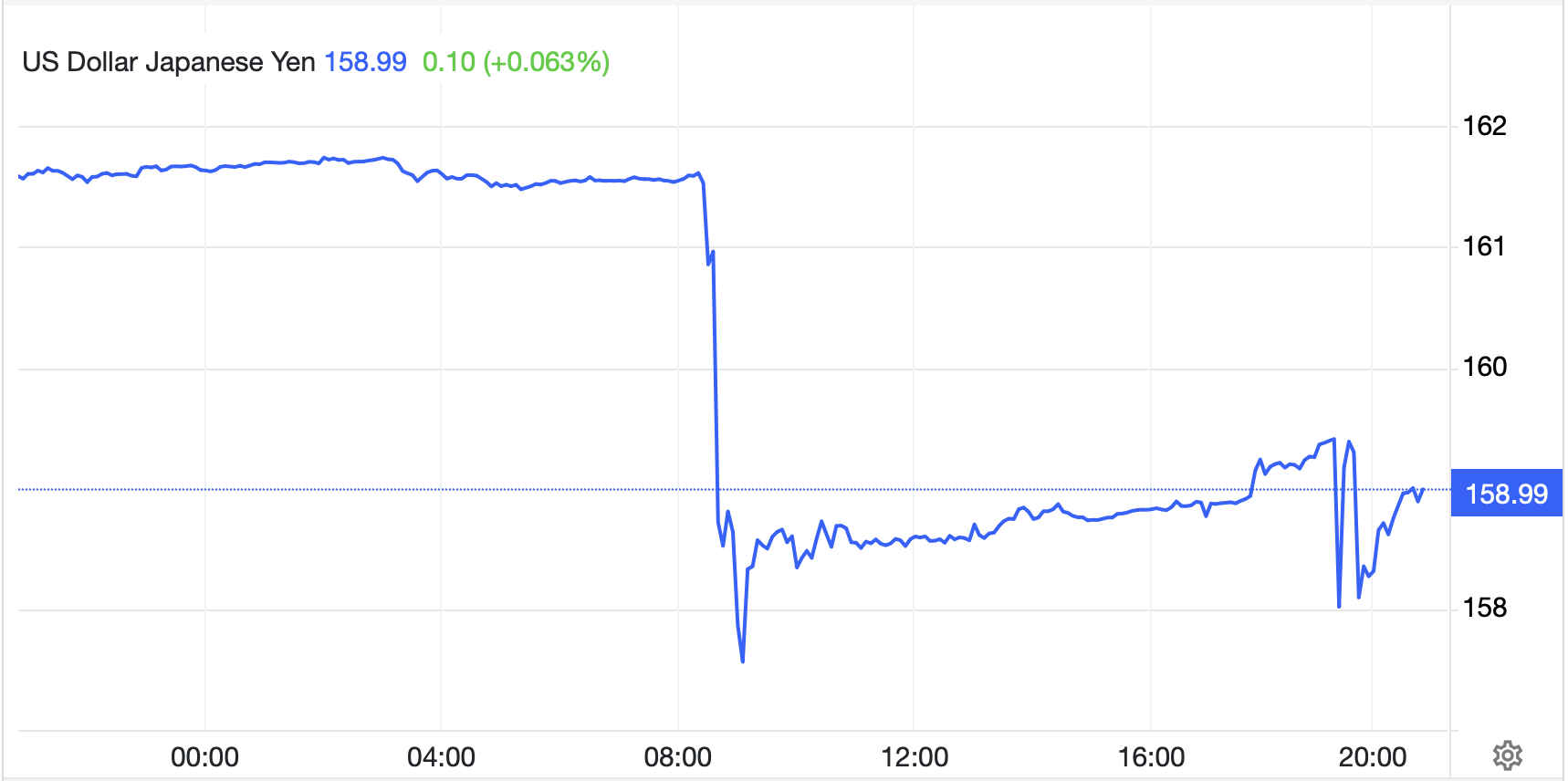
In the FX markets, the biggest mover, by far, was the yen, which at its high point of the session (dollar’s lows) had risen 4 full yen, or 2.5%.  The move was virtually instantaneous as can be seen in the chart below, and it is for that reason that I do not believe the BOJ/MOF was involved in the market.

Source: tradingeconomics.com

While I understand that the BOJ is pretty good at their jobs, it seems highly unlikely that the MOF made a decision in seconds and was able to convey that decision to Ueda-san’s team to sell dollars.  Rather, my sense is that since the short yen trade is so incredibly widespread as the yen has served as a funding currency for virtually every asset on the planet, the fact that the story about higher for longer may be ending led to instant algorithmic selling by hedge funds everywhere and a massive rally in the yen.  When the MOF was asked about intervention, Kanda-san, the current Mr Yen, gave no hint they were in and said only that people will find out when they release their accounts at the end of the month, by which time this episode will have been forgotten.  Remember, too, the yen has fallen, even after today’s rally, nearly 13% thus far in 2024.  It needs to rally a great deal further before it has any macroeconomic impact on Japan’s economy.  For my money, this was just a market that was caught long dollars and weak hands got stopped out, although Bloomberg is out with an article this morning claiming data showing it was intervention.  One thing in favor of the intervention story, though, is that this morning, USDJPY is higher by 0.6% and pushing 160.00 again.

And lastly, the story in China
Continues to give Xi angina
Domestic demand
Is stuck in quicksand
So, trade is his only lifeline-a
 
The other story that is on market minds this morning is about the Chinese data that was released last night.  The Trade Balance there expanded to $99B, much larger than last month and forecast.  A deeper look also shows that not only did exports grow more than expected but imports actually declined.  Declining imports are a sign of weak domestic demand, a harbinger of weak economic growth.  Later, they released their monetary data showing that loan growth, along with M2 growth, continue to slide as Chinese companies are reluctant to take on debt to expand.  While Xi’s government is pushing some money into the system, it is apparent that the collapsing property market remains a major obstacle to any sense of balanced economic activity in China.
 
Of course, this is a problem because of the international relation problems it continues to raise, notably with respect to charges of Chinese dumping of manufactured goods, and the proposed responses from both the US and EU on the subject.  While my crystal ball is somewhat cloudy, when viewing potential future outcomes of this situation it seems increasingly likely that both the US, regardless of the election outcomes in November, and the EU are going to impose tariffs and other restrictions on Chinese goods, if not outright bans.  Neither of these two can afford the social disruption that comes with domestic companies being forced out of business by subsidized Chinese competition.  While inflation looks better this morning than it did last month, its future is far less certain given this growing political attitude.
 
Ok, let’s see how markets have behaved in the wake of all the new information.  Arguably, the biggest surprise is that the US equity markets did not really have a good day with the NASDAQ tumbling -2.0% although the DJIA eked out a 0.1% gain.  Given the yen’s strength, it is no surprise that the Nikkei (-2.5%) fell sharply, and given the Chinese trade data, it is no surprise that the Hang Seng (+2.6%) rallied sharply.  But mainland shares were lackluster, and the rest of APAC was mixed with some gainers (Australia, India, New Zealand) and some laggards (South Korea, Taiwan, Malaysia).  European bourses, though, are all in the green as traders and investors there look to the increased odds of the US finally cutting rates, therefore allowing the ECB and other central banks to do the same, as distinct positives.  As to US futures, at this hour (7:00), they are unchanged to slightly higher.
 
In the bond market, after US yields fell sharply yesterday, with 10yr yields closing lower by 8bps, although they traded as low as 4.17%, a 12bp decline from the pre-data level, this morning, we are seeing a modest rebound with yields 1bp higher.  European sovereign yields are all firmer this morning as well as markets there closed before the US yields started to creep back up.  So, this morning’s 4bp-5bp moves are simply catching up to the US activity.  Lastly, JGB yields dipped 2bps last night as traders sought comfort in the decline in US yields.
 
In the commodity markets, yesterday saw a sharp rally immediately after the CPI print with gold jumping nearly $40/oz and back above $2400/oz, while oil had a more gradual rise, although is higher by nearly $1/bbl since the release.  This is all perfectly in line with the idea that the Fed is going to start to cut rates soon.  However, gold (-0.4%) is giving back some of those gains today.
 
Finally, the dollar, which fell sharply against all currencies after the CPI print, notably against the yen, but also against the rest of the G10 and most EMG currencies, is slightly softer overall this morning with both the euro (+0.15%) and pound (+0.3%) doing well and offsetting the yen’s weakness this morning.  Elsewhere throughout the G10 and EMG blocs the picture is far less consistent with CE4 currencies all following the euro higher although ZAR is unchanged as it suffers on gold’s weakness this morning. 
 
On the data front, this morning brings PPI (exp 0.1% M/M, 2.3% Y/Y) and its core (0.2% M/M, 2.5% Y/Y) although given yesterday’s surprisingly low CPI data and the ensuing market movements, it doesn’t feel like this number has the potential for much surprise.  After all, a soft reading would already be accounted for by the CPI and a strong one would be ignored.  We also see Michigan Sentiment (exp 68.5) at 10:00, but that, too, seems unlikely to shake things up.  There are no Fed speakers scheduled and really, the big thing today is likely to be the Q2 earnings releases from the big banks.
 
It has been an eventful week with Powell’s testimony being overshadowed by yesterday’s CPI data.  While the market is almost fully priced for a September cut, I think the best risk reward is to expect the Fed to act at the end of July.  Next week we hear from 10 Fed speakers, including Chairman Powell on Monday afternoon.  I would not be surprised to hear them start to guide markets to a July cut which would bring dollar weakness alongside commodity price strength.  As to bonds and equities, the former should do well to start, but as yesterday showed, and history has shown, equities tend to underperform when the Fed starts cutting rates.
 
Good luck and good weekend
Adf
 

If Forecasts Ain’t True

Chair Powell repeated his views
That if Unemployment accrues
The time to cut rates
To meet their mandates
Could very well soon lead the news

Investors have taken this cue
And built up positions, beaucoup,
Designed for a peak
If CPI’s weak
Beware, though, if forecasts ain’t true

It is not clear to me why the punditry is more convinced this morning than they were yesterday morning that Chairman Powell and the Fed are now more focused on the Unemployment situation.  After all, Powell’s opening remarks in front of both the Senate on Tuesday and the House yesterday were identical, and everybody knew going in that would be the case.  But it seems, based on the commentary this morning, that suddenly things that were still blurry before became crystal clear.

Look, it can be no surprise that as the Unemployment Rate rises, the Fed is going to pay attention.  Not only is it part of their mandate, but it is also a touchpoint for politicians as they preen in front of their constituents.  But, in the end nothing has changed since Tuesday’s testimony when Powell highlighted that he and the FOMC were closely watching the evolution of the labor market as well as prices.

At least, nothing has changed on the policy front.  However, the market narrative, as is its wont, has suddenly turned to a far more bullish stance on fixed income in general, and on short-term rates in particular.  It appears that, not for the first time this year, there have been some very large options positions established in the SOFR market looking for a Fed funds rate cut sooner rather than later and a total of three cuts this year.  A quick look at the Fed funds futures market continues to show that the probability of a September cut remains just north of 71% with another cut likely by December.  As such, the fact that somebody is risking $2 million in premium on a third cut implies a great deal of conviction.  A key for this position’s success will be today’s CPI report as a benign outcome will very clearly drive more traders into the camp of more cuts this year.

So, let’s turn our attention to CPI.  Current median expectations are for a 0.1% M/M rise in the headline number, leading to a 3.1% Y/Y outcome and a 0.2% M/M rise in the core number leading to a 3.4% Y/Y outcome.  The broad story is the ongoing analyst belief that shelter costs are set to decline (although they have been incorrectly forecasting that for more than 2 years), along with the continued decline in used car prices and auto insurance, will more than offset any pesky things like food and energy costs rising.  This poet does not have an inflation model to tweak so I can only offer my lived experience, and that remains highly doubtful that prices have stopped rising.  But, the only thing that matters is the numbers, regardless of how we all feel about them, so we will be awaiting, with baited breath, to see if the BLS has determined if the pace of our cost of living has slowed.

As we turn our attention to the rest of the world, apparently everybody believes that to be the case, as risk assets are rising all over.  I cannot find an equity market anywhere that has sold off in the session with the Nikkei (+0.95%) rising to a new all-time high and the Hang Seng (+2.1%) rebounding smartly from yesterday’s levels.  The same is true throughout Asia with Chinese (+1.1%) and Australian (+0.9%) shares also having good days.  In Europe, the gains have been less impressive, on the order of +0.2% to 0.3%, but they are consistent as everybody followed yesterday’s strong US equity performance where all three major indices rose more than 1%.  While US futures this morning are tinged slightly red, the losses are tiny, less than -0.1%.  It seems that everybody is all-in on the idea that the Fed is cutting rates soon.

In the bond market, though, things are slightly different.  While Treasury yields have edged lower by 1bp this morning, all European sovereign yields are moving in the opposite direction, with rises of between 2bps and 3bps.  The inflation data that was released from the continent this morning certainly didn’t demonstrate a rebound, so this seems more akin to a trading response to recent yield declines.

In the commodity markets, oil prices (+0.3%) are continuing their rebound from yesterday after EIA data showed larger inventory draws than expected.  Precious metals markets are also benefitting this morning from the Fed story as the idea of rate cuts generally supports that sector.  The only laggards are industrial metals with both copper and aluminum under a bit of pressure today, but that is after a few solid sessions.

Finally, not surprisingly, the dollar is a touch softer on the idea that US yields may soon be declining.  While the bulk of the movement has been modest, it is fairly consistent with the euro and the pound both higher by 0.15% (the pound benefitting from somewhat stronger than expected GDP data this morning) while most of the rest of the G10 is little changed.  The one exception is NOK (-0.9%) which still seems to be suffering from yesterday’s softer than expected CPI data.  In the EMG bloc, the bulk of the movement has been for stronger currencies with the most notable, in my view, CNY (+0.2%) which has been steadily depreciating but has reversed course on the lower US rate narrative.  I maintain my view that if the Fed is prepping the market for cuts, the dollar has a good distance to fall.

In addition to the CPI data, we see the weekly Initial (exp 236K) and Continuing (1860K) Claims data at 8:30.  The Atlanta Fed’s Raphael Bostic speaks later this morning, but again, after Powell just opened the doors for easier policy based on the employment situation, I don’t foresee this having a big impact.

The risk today is that the CPI data is hotter than expected as everybody is lined up for a soft reading.  If the data is soft, look for the current trends to extend, so higher risk assets and lower yields.  But, if CPI prints higher than expected, there will be a very quick reversal of views, at least for the short run, and I expect we can see a pretty sharp correction, at least for today.

Good luck
Adf

A Shocking Surprise

On Wednesday the data was dreck
On Friday, twas more of a wreck
The read’s now that growth
Is set for more slowth
Will this break the Fed’s bottleneck?
 
Meanwhile, in a shocking surprise
In France, tis the Left on the rise
But no party there
Is willing to share
Their power and reach compromise
 
And while day-to-day matters greatly
The populists, worldwide, are lately
Ascending to power
And ready to shower
Their voters with cash profligately


This morning, the world is a very different place than it was when I last wrote.  Broadly speaking there are three key stories of note; US data was much weaker than expected, the French election surprised one and all with the coalition of hard-left parties winning the most seats, although no group is even close to a majority of the French parliament, and the questions over President Biden’s capacity to remain on the job, let alone his ability to be president for the next four years, have been coming fast and furious from the mainstream media, many Democrats in Congress and the Democratic donor base.

So, let’s address them in order.  On the US data front, arguably the best release was the Trade Balance printing at a slightly smaller deficit than forecast by the Street.  Otherwise, ISM Services was miserable at 48.8, Factory Orders fell -0.5%, -0.7% ex Transport, and Initial and Continuing Claims both rose to new high levels for the cycle.  And that was just Wednesday.  On Friday, while the headline NFP number did beat forecasts, once again, there were major revisions lower to the past 3 months, -111K, the Unemployment Rate rose to a new high for the cycle at 4.1%, its highest level since November 2021 and a continuation of the recent uptrend in the data.  A look at the chart below seems to show a defined trend higher in the Unemployment Rate, and as I explained last week, this is a statistic that tends to have momentum once it gets going.  I would argue this number is going to continue to climb higher as the year progresses.

Source: tradingeconomics.com

As well, the biggest piece of the report was an increase of 70K Government jobs, compared to just 136K Private sector jobs and a loss of -8K in Manufacturing.  The one thing we know is that government jobs do not add to economic growth as they are the least productive of all.  

The upshot is that based on the data from Wednesday and Friday, the story of still strong growth in the US has clearly been called into question.  Will Powell, who testifies before Congress this week, pay homage to the weaker data and hint that perhaps higher for longer has reached its sell-by date?  While this is only one set of data, and he has been adamant that he needs to see several months of data, the market is becoming more convinced that a September rate cut is coming as the Fed funds futures probability of that cut has risen to 75%.  It should be an interesting week given both the CPI release and the Powell testimony.

On to the French and what was truly a shocking outcome, at least on one level.  After the first-round last week, the abject fear by the press in France, and all of Europe, of the idea that a right-wing government could come to power in a key European nation resulted in the numerous parties on the Left working with President Macron’s centrists to try to prevent any such thing from happening.  As such, they strategically pulled candidates from different seats in order to prevent splitting the vote and allowing Marine Le Pen’s RN party from achieving a majority.  And they were effective in that.  Alas, they now have a completely unworkable setup where no party has anywhere close to a majority and so passing any legislation will be nigh on impossible.  

Jean-Luc Melenchon, the Left’s most well-known proponent, and leader of a sect called France Unbowed, has declared that he wants his party’s agenda implemented full-on.  That means reducing the retirement age, raising wages and establishing price controls on power and energy as well as expanding wind and solar power.  Of course, the math on that won’t work, even if they raise taxes, but that certainly never stopped a populist once in office.  

Interestingly, while on the surface it would have been easy to conclude that French OATs would see yields rise vis-à-vis German Bunds as fears of larger government deficits build, that has not yet been the case.  In fact, this morning, yields across Europe are little changed as bond traders and investors seem to be ignoring the situation.  The rationale here is that given no group has a majority, the probability of having any party’s wish list implemented by parliament is vanishingly small.  The most likely outcome is a year of muddling through, with no decisions of any substance made and another election held next summer.  (By law, President Macron must wait one year after an election to call a second one.)  In fact, it will be very interesting to see how a prime minister will even be elected in parliament as it seems unlikely that any individual will have support of a majority of the chamber. 

As to the other potential impacts of this election, neither French equities nor the euro have shown any substantive movement as traders in both these spaces see the same situation, a very low probability of any substantive policy changes given the lack of parliamentary leadership.  Ultimately, while the political ramifications in France are large, the economic ones are not as obvious yet.

This is different than in the UK, where Keir Starmer and his Labour party swept to victory as widely expected.  In the UK, Labour runs the show now and so will be able to implement whatever policies they deem appropriate.  So far, there has been little in the way of concern demonstrated by market participants for UK assets either, but I fear the risk here is greater as the policy prescriptions that Starmer favors are likely to have a much larger negative economic toll.

Finally, in what must be THE most surprising aspect of the presidential election cycle in the US, former President Trump is NOT the major topic of conversation.  Rather, in the wake of the debate 10 days ago, the only topic is President Biden’s fitness for office now, and in the future.  This is certainly not a good look for the US, especially with a key NATO meeting this week in Washington D.C., but it is the current situation.  Thus far, US risk assets have ignored all this, arguably because the fiscal spending spigot has not been turned off.  But it is not hard to imagine that there are myriad problems ahead as Secretary Yellen tests just how many bonds the US can issue and still find buyers.

So, with all that remarkable news in our memory banks, let’s look at how markets are behaving this morning and what happened overnight.  Ironically, it seems Asian investors are the ones most upset by the European elections of last week as equity markets throughout the time zone fell.  The Hang Seng (-1.55%) was the laggard, although China (-0.85%) and Australia (-0.8%) also performed quite poorly and the Nikkei (-0.3%) was a star by comparison.  There was very little in the way of economic data to drive things here, so this seems merely to be part of the usual ebb and flow of markets.  The real surprise, though, is in Europe where equity markets are higher across the board.  Despite the pressures for more spending and higher taxes that will come from both France and the UK, the CAC (+0.45%) and the FTSE 100 (+0.3%) are nonplussed by the situation.  In the UK, as laws are implemented, I expect there will be a bigger reaction, but in France, perhaps the view that there is gridlock which will prevent any new legislation of note, means equities can run higher.  As to the US, futures markets at this hour (7:00) are basically unchanged.

As mentioned above, bond yields throughout Europe have been limited in their movement while Treasury yields have rebounded 2bps from last week’s declines.  While I was out, the weak data certainly encouraged bond investors to increase allocations as visions of a Fed rate cut grow.  For now, the bond markets are not signaling any concerns over the electoral outcomes.  My take is that may be appropriate for France and the continent, but I would be wary of UK Gilts given the likelihood of a downturn in the fiscal situation as more spending is implemented by parliament.

In the commodity markets, the end of last week saw sharp rallies in the metals markets, perhaps on those fears of a RN electoral victory in France, or perhaps on expectations of quicker Fed rate cuts, but this morning, commodities across the board are softer, with oil (-1.3%) leading the way, although WTI remains well above $82/bbl.  As to the metals, both precious (Au -0.7%, Ag -0.7%) and industrial (Cu -0.2%, al -0.1%) are giving back some of those gains.

Finally, the dollar is somewhat higher than it closed on Friday, although not very much.  In the G10, NOK (-0.5%) is suffering on oil’s decline which has dragged SEK (-0.4%) along with it.  The yen (-0.1%) which fell to near 162 vs. the dollar last Wednesday recouped some of those losses into the weekend but seems to have bounced with 160.00 now showing technical support in USDJPY.  In the EMG bloc, HUF (-0.8%) is the laggard as despite a lack of data, it seems markets are looking at the right-leaning politics of PM Orban and see continued friction between Hungary and the rest of the EU, specifically when it comes to subsidy payments.  KRW (-0.5%) is softer as the government’s efforts to expand trading hours in the currency have not yet borne fruit although it is still early days.  They are trying to improve onshore currency trading in order to allow more convertibility for equity investors and thus get Korean stock markets included in more global indices.

On the data front, while the calendar is not packed, it is impactful.

TodayConsumer Credit$10B
TuesdayNFIB Small Biz Optimism89.5
 Powell Testimony 
WednesdayPowell Testimony 
ThursdayInitial Claims240K
 Continuing Claims1860K
 CPI0.1% (3.1% Y/Y)
 -ex food & energy0.2% (3.4% Y/Y)
FridayPPI0.1% (2.3% Y/Y)
 -ex food & energy0.2% (2.5% Y/Y)
 Michigan Sentiment68.5
Source: tradingeconomics.com

In addition to Powell, 5 other Fed speakers are slated, but clearly all eyes will be on Powell.  And the CPI reading.  After last week’s soft data, there is a growing expectation that price pressures are going to fall back further and allow the Fed to cut rates.  Certainly, if CPI prints soft, I expect to see a rally in risk assets, but we must wait to hear Powell’s spin ahead of those numbers.

Net, the market is seemingly turning toward a more dovish approach with visions of rate cuts coming fast and furious once they get started.  That seems excessive to me, but for now, it is hard to like the dollar’s status as rate cut expectations build, especially given the market has ignored potential problems elsewhere.

Good luck

Adf

Indigestion

The answer to yesterday’s question
Is CPI’s seem some regression
Both stocks and bonds soared
The dollar was floored
But Powell now has indigestion
 
To no one’s surprise he left rates
Unchanged, while the dot plot translates
To higher for longer
Though pressure’s grown stronger
To cut to achieve his mandates


Unequivocally, the CPI data was cooler than market forecasts.  Month over month prices were unchanged at the headline level and grew only 0.16% on a core basis, with the year-on-year numbers each coming in one tick below expectations.  It took absolutely no time for markets to run with this data as the following charts from tradingeconomics.com for the NASDAQ 100, 10-year Treasury yields and EURUSD demonstrate.  See if you can determine when the CPI data was released.

Now, as I explained, and has become abundantly clear to anyone watching, the equity market is in a world of its own.  While yields backed up and the dollar rebounded (euro fell) after the somewhat more hawkish than expected FOMC statement, dot plot and Powell press conference, the NASDAQ ignored everything and kept on rallying.  While that is remarkably impressive, I remain of the opinion that trees still don’t grow to the sky, although apparently, they can get really tall!

At any rate, a quick look under the hood at the CPI shows that core goods prices continue to fall, which was largely why today’s data looked so good, but primary rents and OER continue to climb at about 0.4% monthly despite many assurances by many pundits, analysts and economists that rental inflation was sure to begin declining soon.  It has been rising at this pace or faster for more than two years, and while the actual pace has backed off from the rate a year ago, if you annualize 0.4% you come up with just under 5.0% inflation.  It remains hard to believe that shelter costs can rise at that pace and the general price level is going to get back to 2.0%.  Yesterday’s data was good, but we are not out of the woods yet.

Turning to the FOMC, the statement was virtually unchanged from the May statement, which makes sense since the mix of data that we have seen in the interim shows some hot and some cold numbers and no clear line of sight to the end game.  As such, it is not surprising that Chairman Powell tried to veer hawkish at the press conference in what appears to have been an attempt to offset the (over)reaction to the CPI data.  In fact, a look at the dot plot shows that, as I suggested, the median expectation for rate moves in 2024 is down to a single cut, although they are more confident that inflation will continue to fall next year with the median expectation for an additional 4 cuts.  However, as I also suggested, the longer-term outlook continues to rise with the median there now up to 2.80% from 2.60% in March, and 2.5% or below for the 3 years prior to that.

Interestingly, in their Summary of Economic Projections they expect PCE inflation to be 2.6% this year, up from 2.4% in March, with core PCE to be at 2.8% this year, up from 2.6% in March.  They did, however, maintain their views of GDP growth (2.1%) and Unemployment (4.0%).  At least, unlike Madame Lagarde who cut rates despite raising inflation forecasts, the Fed’s inaction made far more sense.

But pressure is building on Powell and the Fed to cut rates.  Today, several senators wrote (and released) a letter to Powell exhorting him to cut rates because everybody else is doing it.  They claim that his intransigence is hurting the economy, although the whole point of higher for longer is that there is scant evidence that the economy, as a whole, is in trouble despite rates where they are, although certainly some sectors are feeling a pinch.  As an aside, given the extreme degree of financial and economic ignorance that is routinely demonstrated by virtually every member of the House and Senate, this letter is simply political grandstanding.  But pressure is pressure, and Powell will certainly feel it, although I don’t think he is too concerned by this group overall.

While this morning brings PPI (exp 0.1%/2.5% headline and 0.3%/2.4% Core) as well as the weekly Initial (225K) and Continuing (1800K) Claims data, it is hard to believe that either of those data points are going to have any substantive impact given everything we learned yesterday.  So, let’s look elsewhere to see what is happening.

One of the interesting stories right now is the ongoing situation in France with the snap elections called by President Macron.  Apparently, the quick timing has resulted in significant confusion on both the left and right of the spectrum as to who will be allying with whom, and what they stand for.  While this is amusing in its own right (see this Twitter thread), the ramifications are greater for the impact on the French OAT market and the euro.

Briefly, the issue is that France has been slowly sliding from the figurative north of Europe to the South, meaning that it used to be considered a country with almost Germanic fiscal sensibilities and now it is much more akin to the PIGS than Germany.  The WSJ had an interesting article this morning describing the situation.  Ultimately, the market response has been for French yields to rise compared to German yields, adding pressure to the country as it needs to continue to finance its 5%+ budget deficit.  Now add to that the absolute trainwreck that is the current government leadership (as evidenced by that Twitter thread) and investors have decided that there are better places to invest with less credit risk.  After all, S&P Global downgraded French debt last month due to their profligate spending and I assure you, whatever the election outcome, there will be more spending not less.  

If we view this through a FX lens, the combination of clear dysfunction in Europe, lower interest rates in Europe and a Fed still committed to seeing the whites of 2%’s eyes before cutting rates here, it is very easy to anticipate the euro will be biased downwards over time.  While I know there are many who continue to write the dollar’s obituary, the fact remains that it is still standing with no competitors of note.  In fact, part of the raison d’etre of the euro was to be able to replace the dollar as a reserve currency.  It seems that hasn’t worked out all that well.

Ok, let’s see how global markets responded to the US data yesterday.  Perhaps the most interesting thing was that even in the US, the DJIA fell slightly, despite the conviction that rates are heading lower.  In Asia, the picture was mixed with Japan (-0.4%) and China (-0.5%) sliding while Hong Kong (+1.0%) rallied on the tech rally.  Many consider the Hang Seng to be China’s NASDAQ with respect to the weight of tech companies in the index.  As to European bourses, they are all in the red this morning by more than -1.0% with France (-1.4%) leading the way lower.  Of course, based on the above discussion, that can be no surprise.  Lastly, in the US, futures at this hour (6:45) are mixed with NASDAQ higher by 0.6% while DJIA futures are -0.4%.  Apparently, the prospect of lower rates doesn’t help more mature companies.

In the bond market, after yesterday’s wild ride (see above chart), Treasury yields have edged lower by -1bp, but in Europe, yields are continuing higher from their closing levels, catching up to the Treasury yield rebound in the wake of the FOMC meeting.  Not surprisingly, French OATs are leading the way with yields higher by 4bps while Germany has seen only a 2bp rise.

This morning, commodities are uniformly under pressure with oil (-0.8%) sliding after a solid weekly performance while metals markets are also slipping (Au -0.1%, Ag -0.8%, Cu -0.6%) as traders try to come to grips with the next interest rate moves and adjust their positions.  An interesting story this morning is that a shipment of copper from Russia to China for 2000 tons apparently never arrived in China.  This is simply the latest quirk in the metals markets where confirmation of what is being traded is limited.  You may recall the story last year about nickel inventories at the LME actually being bags of painted rocks.  In this space, the broad trend remains that there is excess demand for metals, especially copper, silver and aluminum, as all three are critical to electrification of systems and grids, but it is going to be a bumpy ride higher!

Finally, the dollar, which was decimated in the immediate wake of the CPI data yesterday, managed to claw back some of those losses in the afternoon thanks to the more hawkish Fed and this morning, that slow rebound continues with the greenback higher vs. almost all its counterparts in both the G10 and EMG blocs.  However, nothing really stands out as having moved significantly, with a general trend of about 0.2% or so across the board.

And that is really all we have today.  The first post-FOMC speaker is NY Fed president Williams at noon, although I suspect his message will be identical to Powell’s yesterday.  As to the rest of things, the BOJ meets tonight and while there is no expectation of a policy change, Ueda-san’s comments will be carefully parsed for any clues to when a change may be coming.  

Since nothing seems to matter to the NASDAQ and everyone wants to own it, I suspect that the dollar will maintain its gradual strength until further notice.

Good luck

Adf

Thoroughly Schooled

Has CPI actually cooled?
Or did April have us all fooled?
Both Tiff and Lagarde
Have played their first card
Has Jay now been thoroughly schooled?
 
First, if CPI comes in hot
The Chairman will certainly not
Decide to cut rates
And leave the debates
Til things show the damage he’s wrought
 
But if the inflation report
Is nothing at all of that sort
Then many have said
This summer, the Fed
‘Round rate cuts will gather support


A quick look at yesterday’s 10-year Treasury auction shows it was far better than the 3-year on Monday with a strong bid/cover ratio of 2.67, its highest since February 2022, and a result where the auction cleared 2bps lower than the pricing ahead of the announcement, a sort of negative tail.  Indirect bidders represented nearly 75% of the bids, so there was real demand for this paper.  Certainly, Janet and Jay are feeling better, and yields fell 6bps on the day.  

As I explained yesterday, the auctions are just one tiny signal in a large body of information, and just like almost everything else, it seems there is no consistency there either.  However, one auction does not a trend make.  One last thing, the strength of the auction ahead of today’s CPI report and FOMC meeting seems somewhat odd given the potential risks attached to both those events.  Generally, investors would prefer to reduce exposure ahead of a big event, not increase it.  This has awakened some conspiracy theorists as to who actually bought the paper.  There is no evidence that there was any behind the scenes Fed activity, but many are trying to figure out the incentive to aggressively bid for bonds ahead of key data.  We need to stay vigilant.  

Ok, on to the CPI this morning.  The current consensus forecasts are for the headline (0.1% M/M and 3.4% Y/Y) and the core (0.3% M/m and 3.5% Y/Y).  During the month of May, wholesale gasoline prices fell nearly 6% which is clearly weighing on the headline monthly outcome.  Of course, that is not a seasonally adjusted number, that is the raw result.  Last month, despite gasoline prices rising a similar amount, in the CPI data, the seasonally adjusted number showed a decline, and that is what is in the report.  That is just one of the many unusual features of the way CPI is calculated, and why it must be carefully considered.  

However, beyond gasoline prices, the indications of rising prices continue to come from things like the ISM Prices paid index for both Manufacturing and Services, as well as the robust wage growth from the NFP report last week.  And certainly, I am hard-pressed to have seen prices do anything but rise in the past month and year based on my personal consumption basket.  But I do not have an econometric model that I use to estimate these things like my good friend the @inflation_guy, who you all should be following on X(Twitter) or at his inflationguy blog.  However, based on the other pricing data we have seen, I expect that the risks to the consensus are on the high side, not the low side.  We shall find out at 8:30.

In this case, I think it is clear that a hot number will result in a sharp decline in bond prices (jump in yields), a rise in the dollar and, at least initially, a decline in equity markets.  Of course, the latter clearly have a life of their own.  A lower-than-expected print should see the opposite, with stocks ripping higher.

And lastly, we turn to this afternoon’s FOMC meeting.  At this point, the only thing that anyone is discussing is the dot plot.  Below is the March edition where the median indicated 3 rate cuts in 2024, but it was very close, a 10-9 outcome with 9 members seeing 2 cuts or less.

Source: federalreserve.gov

As I recall, I was far more interested in the idea that the Longer run rate, which is often defined as R* or the neutral rate, started to creep higher than its recent estimates of 2.5%.  Since the March meeting, there has been an uptick in discussion as to what the longer run rate should be, with every estimate rising some amount.  

As to the immediate situation, given there is a vanishingly small chance they adjust rates today, there are only four meetings left in 2024 so it would seem likely that the maximum number of cuts the updated version of the dot plot will indicate is two.  Personally, I think it will come in at one unless this morning’s CPI is much lower than expectations, although given the ECB managed to cut rates while raising their inflation forecasts, anything is possible in the convoluted world of central banking.  Funnily, the strength of yesterday’s 10-year auction may give them enough confidence that their current policy is not a problem resulting in an estimate of fewer cuts rather than more.

However, the real interest will be Powell’s press conference.  Based on everything we heard from Powell and all his acolytes prior to the quiet period, there certainly seemed to be no rush to cut rates as they still lacked confidence that inflation was going to head back to target.  And, of course, the biggest piece of data we have seen in the interim, last Friday’s NFP number, was much hotter than expected as was the wage data, so it doesn’t seem that he would change that tune.  Thus, much relies on this morning’s CPI and how that may change any opinions on the committee.  While I believe that his underlying desire is to cut rates, there does not yet seem to be an opening to do so.  In the end, my take is that the risk to the market is he is more hawkish than dovish with the corresponding risk-off results.  That’s what makes markets.

Ok, I’ve rambled on a lot already so suffice to say that the overnight price action was generally pretty benign as everyone around the world has been awaiting today’s CPI and FOMC.  Yesterday’s mixed US session was followed by a mixed Asian session with some gainers and some laggards although European bourses are feeling chipper this morning, with all higher by about 0.5%.  As to US futures, they are ever so slightly firmer at this hour (7:00), just 0.1%.

Bond yields around the world have followed Treasuries lower, with the US 10-yr falling one more basis point while all of Europe is down 2bps, except for Italy (-5bps) where the spread to bunds is narrowing on hopes of broader interest rate declines.  Even JGB yields (-4bps) softened last night.  As I have repeatedly explained, as goes the Treasury market, so goes the rest of the global bond market.

Oil prices (+1.1%) are climbing again after inventory data yesterday showed larger draws than expected while metals prices are little changed this morning after another weak session yesterday.

Finally, the dollar is on its back foot, down about -0.15% vs. most of its G10 counterparts save the yen (-0.2%) which continues to drift back toward that 160 level which catalyzed the BOJ’s intervention.  I think the dollar’s movement is the easiest to forecast ahead of the CPI and FOMC as hot CPI will see the dollar rally, as will a hawkish Fed, with the opposite also true in the event that things are cool and/or dovish.

And that’s really all today.  So, buckle up for the 8:30 data and then after that flurry, you can relax until 2:00pm.

Good luck

Adf

Losing His Doubt

The jury is no longer out
And Jay may be losing his doubt
That ‘flation is slowing
So, bulls are now crowing
Let’s end, soon, this rate-cutting drought!

I am old enough to remember when Chairman Powell explained that he did not have confidence inflation was falling back to the target level and so maintaining the current, somewhat restrictive, policy stance would be appropriate for longer than had been originally anticipated.  In other words, higher for longer was still the operating thesis.  That is soooo two days ago!  Apparently, when CPI prints at 0.3% M/M for both headline and core with the Y/Y readings at 3.4% and 3.6% respectively, that means the inflation fight is won.  Now, I will grant that the headline monthly number was 0.1% below expectations, but everything else was right on the money.  On the surface, it is not clear to me that this signaled the all-clear for the end of inflation.  As my good friend Mike Ashton (@inflation_guy) said in his write-up yesterday, “the sticky stuff is not yet unstuck.”  But the market saw this news and combined with a clearly weaker than expected Retail Sales print (0.0%) and weaker than expected Empire State Manufacturing print (-15.6) and was off to the races.

So, risk is back in vogue and bond yields are tumbling.  Hooray!  This is the perfect encapsulation of how the actual data may not mean very much per se, but the framework of how investors and traders were positioned and anticipating the data is the key driving force.  So, not only did equity markets in the US rally 1% or more, but Treasury yields fell 10bps in the 10yr and 8bps in the 2yr.  Meanwhile, September is now the odds-on favorite for the first interest rate cut, politics be damned.

At this point, the question becomes will the Fed respond to this small sample of data in the same way the market has?  The first comments from Fed speakers seemed more circumspect than the market opinions.  Chicago Fed president Goolsbee, who was not on the calendar, said the following in an interview, “[inflation showed] some improvement from last time, pretty much what we expected, but still higher than we were running for the second half of last year, so there’s still room for improvement.”  Meanwhile, Minneapolis Fed president Kashkari explained, “The biggest uncertainty in my mind is how much downward pressure is monetary policy putting on the economy? That’s an unknown. And that tells me we probably need to sit here for a while longer until we figure out where underlying inflation is headed before we jump to any conclusions.”

To my eye, there is no indication that the Fed has changed their tune, at least not yet.  If we continue to see data that indicates the long-awaited recession is actually closing in, I expect that we will begin to hear more of a consensus view regarding the initial rate cuts other than the current higher for longer stance.  Of course, if a recession is making an appearance, my sense is that will not be a huge benefit for risk assets either, but what do I know, I’m just a poet. Ok, I don’t think we need to spend any more time on that subject for today so let’s see what is happening elsewhere. 

In Japan, the economic news remains less positive than the Kishida administration would like to see.  Last night, Q1 GDP was released at a worse than expected -0.5%, its second negative print in the past three quarters with Q4 a ‘robust’ 0.0% in between.  While not technically a recession, the situation there certainly does not have a positive feel.  Making things even worse, of course, is the fact that inflation remains higher than their target of 2%, although it has been slowly drifting lower over the past year. 

The interesting thing about this situation is that the BOJ does not have a dual mandate regarding prices and employment; but is focused only on price stability.  However, if economic activity continues to slow there, can Ueda-san really tighten policy further?  And what of the yen?  It has drifted higher (dollar lower) alongside the dollar’s broad down move on the back of the recent decline in US yields.  However, it feels to me like Ueda’s path to tighter policy just got a lot narrower if economic activity in Japan is going to remain so lackluster.  Many pundits have decided that the yen’s weakness reached its peak ahead of the recent bout of intervention two weeks ago.  I am not so sure.  Absent a significant slowdown in the US, I’m sensing that the policy divergence may even widen going forward, not narrow, and the yen would not respond well to that outcome.

With all that in mind, let’s survey the overnight session to see what else is happening.  Asian equity markets followed the US rally with solid gains across the board.  Clearly, the prospect of lower US rates was seen as a positive.  However, the same is not true in Europe, where bourses are all lower this morning albeit not dramatically so.  Declines of between -0.25% and -0.5% are universal.  My take is that this is a bout of profit-taking as to much less fanfare than US markets, many European bourses have just touched all-time high levels, so a little pullback should be no surprise.  This is especially true given there was neither data nor commentary that would indicate something in Europe has changed.  The situation remains slow growth, slowing inflation and rate cuts next month.  Lastly, US futures are essentially unchanged at this hour (6:45) as traders await more data and, perhaps more importantly, 4 more Fed speakers.  I think the trading community is looking for Fed confirmation of their response to the CPI data yesterday which, as mentioned above, was not forthcoming.

Bond markets, which all rallied yesterday following the Treasury move, are little changed this morning with virtually no movement in the US or Europe.  Overnight, JGB yields slipped 3bps in the wake of the US data, but this market is entirely focused on the US economy and the Treasury marker for its lead.

In the commodity markets, oil is a touch softer this morning, but remains firmly toward the middle of its recent trading range as conflicting reports regarding expected demand continue to confuse practitioners.  FWIW any report that indicates demand for oil is going to decrease makes no sense to me given how many people on this earth are energy poor and will do as much as they can to get hold of energy.  But that’s just my view.  The IEA continues to forecast reductions in demand because they are desperately pushing their transition thesis because their models are old and unreliable.  As to metals markets, yesterday saw a major rally in gold and silver, with the latter making a push for $30/oz for the first time since 2013.  Copper, however, may have seen a blow-off top yesterday as it has fallen back sharply from its peak and is now back below $5.00/lb.  In truth, the demand story here remains attractive, but the price action did seem to get out of hand there.

Finally, the dollar, which sold off hard yesterday on the CPI and Retail Sales news is bouncing slightly this morning.  Those sharply lower yields in the US, even though they were matched by Europe, were a signal to sell dollars across the board.  Thus, this morning’s 0.2% ish bounce should not be that surprising.  It is in this segment of the market that I believe the opportunity for the biggest structural changes exist.  After all, the dollar’s strength over the past 3 ½ years has been built on the Fed being the most hawkish central bank around as they belatedly fought inflation.  While they have made clear they want to start to cut interest rates, the data has not been supportive of that move.  If yesterday’s data is the beginning of a more consistent slowdown in the US, those rate cuts may be coming sooner than currently priced and regardless of what happens to risk assets, the dollar would suffer.  We shall see.

On the calendar today we have a bunch more data and four more Fed speakers (Barr, Harker, Mester and Bostic).  The data brings the weekly Initial (exp 220K) and Continuing (1780K) Claims, Housing Starts (1.42M), Building Permits (1.48M) and Philly Fed (8.0) all at 8:30 then IP (0.1%) and Capacity Utilization (78.4%) at 9:15.  As Chairman Powell has repeatedly explained, he and his colleagues look at the totality of the data, so another wave of soft numbers here would likely get risk asset markets excited.  However, listening to what they have all continued to say informs me that the Fed is not nearly ready to cut rates.  September remains the odds-on favorite for the first cut, but I still suspect that they could be here all year long.  If I am right about that, the dollar will retain its bid overall.

Good luck

Adf

Missing in Action

The PPI data was shocking
Though previous months took a knocking
So, what now to think
Will CPI sink?
Or will, rate cuts, it still be blocking?

One of the features of the world these days is that the difference between a conspiracy theory and the truth has shortened to a matter of months.  I raise this issue as yesterday’s PPI data was remarkably surprising in both the released April numbers, with both headline and core printing at MUCH higher than expected 0.5%, while the revisions to the March numbers were suspiciously uniform to -0.1% for both readings.  The result was that despite the seeming hot print, the Y/Y numbers for both core and headline were exactly as forecast!

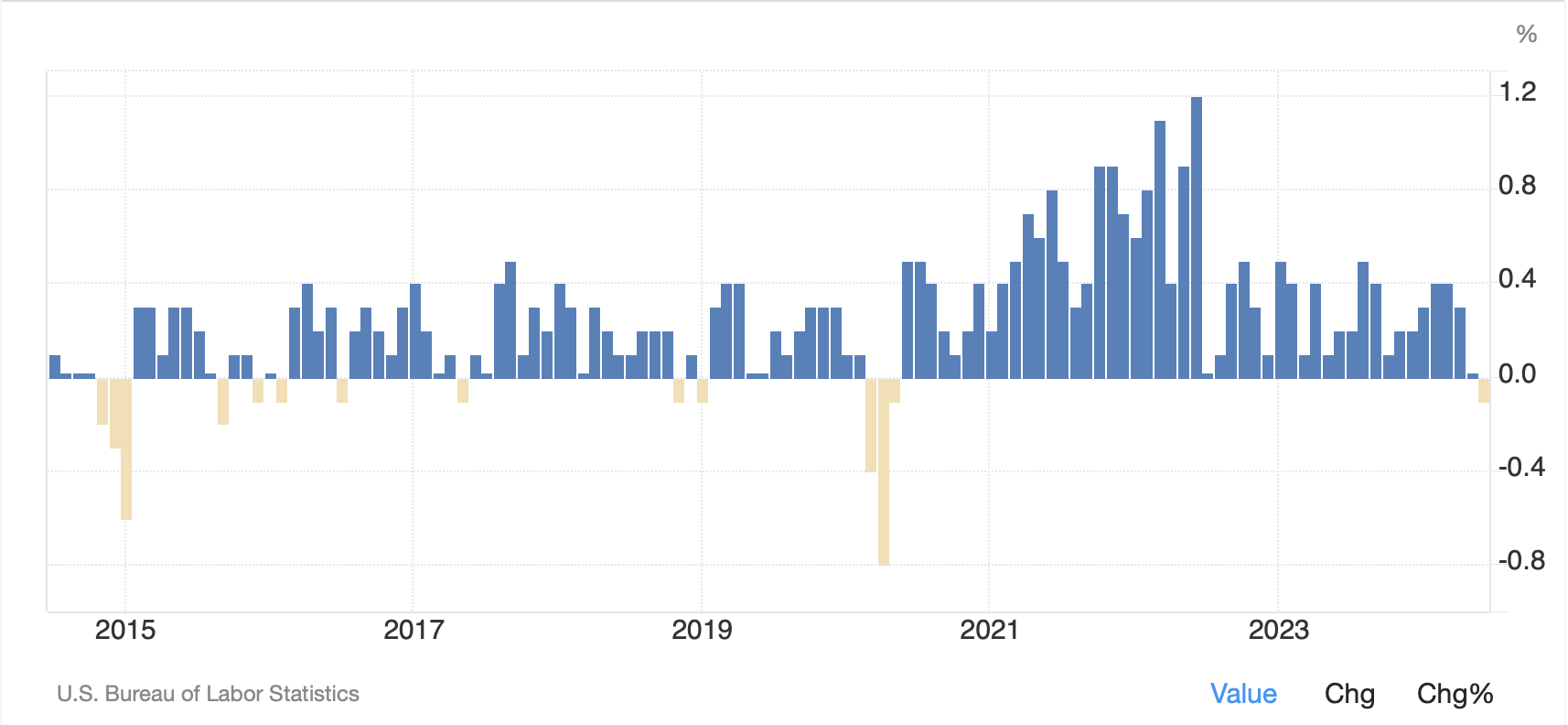
One of the things we know about data like PPI and CPI is that they are calculated from a sampling of data of the overall economy and there are fairly large error bars for any given reading.  In that sense, it cannot be surprising that the data misses forecasts regularly.  As well, given the sampling methodology, the fact that there are revisions is also no surprise.  But…it would not be hard for someone to suggest that the Bureau of Labor Statistics, when it saw the results of the monthly readings, manipulated the data to achieve a more comforting (for the current administration, i.e., their bosses) result.  I am not saying that is what happened, but you can see how a committed conspiracy theorist might get there. Now, in fairness, a look at the headline reading, on a monthly basis, for the past year, as per the below chart, shows that this is the 4th month in 12 that there was a negative reading.

Source: tradingeconomics.com

So, the fact that the revision fell to a negative number cannot be that surprising.  But it certainly got tongues wagging!  FWIW, I continue to believe that the process is where the flaws lie and that the BLS workers are trying to do their job in the best way they can.  In the end, though, much more attention will be paid to this morning’s CPI than to yesterday’s PPI.

For Jay and his friends at the Fed
His confidence ‘flation is dead
Is missing in action
Henceforth the attraction
That higher for longer’s ahead

Which brings us to Chairman Powell and his comments at the Foreign Bankers’ Association in Amsterdam yesterday.  In essence, he didn’t change a single thing regarding his views expressed at the last FOMC meeting, explaining he still lacked confidence that inflation would be reaching their 2.0% target soon.  As such, there is no reason to believe that the Fed is going to cut rates anytime soon.  As of this morning, the Fed funds futures market has a 9% probability of a rate cut priced for June, up from 3% yesterday, and a total of 45bps of cuts priced for the year.  There is obviously still a strong belief that the Fed will be able to act, although I am not sure why that is the case.  Interestingly, on the same panel, Dutch Central Bank president Klaas Knot essentially guaranteed an ECB cut in June.  As well, yesterday morning we heard Huw Pill, the chief economist at the BOE also talk up the probability of a June cut.  From a market response perspective, though, given these cuts are largely assumed, it will take new information to drive any substantive movement in the FX markets.

Here’s one thing to consider for everyone pining for that rate cut.  Given the history of the Fed always being behind the curve when it comes to policy shifts, if they realize they need to cut it is probably an indication that things in the US economy have turned down rather rapidly.  We may not want to see that either.  Just sayin!

In China, a new idea’s floated
Though not yet officially quoted
In thinking, quite bold
All houses, unsold,
Will soon be, for homeless, devoted

Ok, let’s move on from yesterday to the overnight session and then this morning’s CPI and Retail Sales reports.  The first thing to note was the story from Beijing that in an effort to deal with the ongoing property crisis in China, the government, via regional special funding vehicles that borrow more money, is considering buying all the unsold homes from developers, at a steep discount, and then converting them into low-cost affordable housing.  In truth, I think this is an inspired idea on one level, as it would allocate a wasted resource to a better use.  On the other hand, the idea that the government would issue yet more debt seems like a potential future problem will grow larger.  As of now, this is not official policy, but the leak was clearly designed as a trial balloon to gauge the market’s response.  Not surprisingly, the response was that the Shanghai property index rose sharply, but the rest of the Chinese share complex was in the red.  At the same time, the PBOC left rates on hold last night, as expected, but the CNY (+0.3%) managed to rally nicely on the combination of events.

But away from that China story, very little of note happened as all eyes await the CPI later this morning.  After yesterday’s somewhat surprising rally in the US, Asia beyond China had a mixed performance with some gainers (Australia, Taiwan, South Korea) and some laggards (Hong Kong, New Zealand, Singapore) as investors adjusted positions ahead of the big report.  In Europe, too, the picture is mixed although there are far more gainers than laggards.  In the end, none of the movement is that large overall, so also indicative of waiting for the data.  Finally, it will be no surprise that US futures are basically flat at this hour (6:30).

In the bond market, traders decided that the hot April number was to be ignored and instead have accepted the idea that inflation is not really that hot after all.  At least that is what we might glean from the price action yesterday and overnight where yields initially jumped a few basis points before grinding down over the session and closing lower by 4bps.  This morning, that decline has continued with a further 2bp drop in Treasuries.  In Europe this morning, sovereign yields are seeming to catch up to the Treasury price action with declines across the board of between 6bps and 8bps.  Part of that is also a result of changing expectations for Eurozone growth and inflation with a growing belief that inflation is headed lower and the ECB is set to cut and continue to do so going forward. 

In the commodity markets, the big story has been copper (+2.4%), which has rallied parabolically and is currently above $5.00/lb, a new all-time high.  This takes the movement this week to more than 10% and more than 36% in the past year.  The electrification story is gaining traction again, and I guess the fact that nobody is digging new mines may finally be dawning on traders.  Precious metals are coming along for the ride with gold rebounding (+0.4%) on this story as well as the dollar’s recent weakness.  As to the oil market, it is little changed this morning in the middle of its recent trading range.  Perhaps today’s EIA inventory data will drive some movement.

Finally, the dollar is under modest pressure this morning after slipping a bit during yesterday’s session as well.  The combination of the Powell comments being seen as dovish and the interpretation of the PPI data in the same manner (which seems harder for me to understand) weighed on the greenback against virtually all its counterparts.  It should be no surprise that CLP (+0.9%) is the biggest winner given the move in copper.  But JPY (+0.5%) has also performed well with no new obvious catalysts.  In fact, the movement has been quite broad with the worst performers merely remaining unchanged vs. the dollar rather than gaining.  However, this morning’s data is going to be critical to the near-term views, so we need to wait and see.

As to the data, here are the current forecasts: CPI (0.4% M/M, 3.4% Y/Y), core CPI (0.3% M/M, 3.6% Y/Y), Retail Sales (0.4%, 0.2% ex autos) and Empire State Manufacturing (-10.0).  In addition, we hear from two Fed speakers, Minneapolis Fed president Kashkari and Governor Bowman.  However, on the Fed speaker part, especially since Powell just reinforced his post-FOMC press conference message, it seems hard to believe that there will be any changes of note.

And that’s all she wrote (well he).  A hot print will likely be met with an initial risk-off take with both equity and bond markets suffering, but I suspect that it will need to be really, really bad to change the current narrative.  However, a cool print seems likely to result in a major rally in both stocks and bonds and a much sharper sell-off in the dollar.

Good luck

adf

Less Stout

Suzuki-san and
Ueda-san are clearly
Flocking together

Events continue to unfold in Japan that appear to point to a more concerted effort to address the still weakening yen.  The problem, thus far, is that it hasn’t yet really worked, absent the direct intervention we saw at the beginning of the month.  For instance, last night, 10-yr JGB yields rose to their highest level since June 2012, trading up to 0.969% and finally looking like they are going to breech that 1.00% level that had so much focus back in October.  At the same time, the two key players in this drama, FinMin Suzuki and BOJ Governor Ueda are actively speaking to each other as they try to coordinate policy.  The problem for Suzuki-san is that Q1 GDP fell back into negative territory again, thus bringing two of the past three quarters down below zero.  While that is not the technical definition of a recession, it certainly doesn’t look very good.

And yet, the yen remains under pressure, slipping another 0.1% last night, and as can be seen from the chart below, continuing its steady decline (dollar rise) from the levels seen immediately in the wake of the intervention.

Source: tradingeconomics.com

Another interesting thing is that our esteemed Treasury Secretary, Janet Yellen, seems to be concerned over any intervention carried out by the Japanese, at least based on comments she recently made in a Bloomberg interview, “It’s possible for countries to intervene.  It doesn’t always work without more fundamental changes in policy, but we believe that it should happen very rarely and be communicated to trade partners if it does.” 

There have been several analysts of late who have made the case that Yellen’s trip to Asia last month included a ‘secret’ Plaza Accord II type arrangement, where there was widespread agreement that the dollar needed to come down in value.  First off, secrets like that are extremely difficult to keep secret, and history shows that doesn’t happen very frequently.  But more importantly, based on the fact that inflation is one of the biggest problems that her boss has leading up to the election, a weaker dollar is the last thing she would want.  I suspect if we continue to see the yen decline, the BOJ/MOF will be back at the intervention game again, but the US will not be helping.  Keep in mind, though, Japanese yields.  If the BOJ is truly going to allow yields to rise in Japan, that would have a significant impact on the yen’s value in the FX markets.  While 1.00% is a big round number, I think we will need to see the BOJ demonstrate a more aggressive stance overall…or we need to see the data turn softer in the US to allow the Fed to get on with their much-desired rate cuts.  We will need to watch this closely going forward.

While everyone’s waiting to see
How high CPI just might be
One cannot rule out
An outcome less stout
Where bond and stock bulls are set free

Which brings us to the inflation story.  By this time, everyone is aware that tomorrow’s CPI data is seen as a critical piece of the puzzle.  I continue to read coherent arguments on both sides of the debate regarding the trend going forward.  (Let’s face it, the error bars are far too wide to be confident in a specific forecast.)  For the inflationistas, they continue to look at things like the housing market, which while frequently expected to see declining price pressures, has maintained an upward trend for the past several years.  As well, things like the dramatic rise in certain commodity prices (coffee comes to mind) and the substantial rise in the price of insurance (something of which I speak from personal experience!), there is ample evidence that prices continue to climb. 

Part of this puzzle may be the result of the fact that companies continue to successfully raise prices, or at least had been doing so for the past two years, as evidenced by the continued strong earnings, and more importantly, still high gross margins they are able to achieve.  So, as input prices have risen, they have passed those costs along to the consumer quite successfully.  Now, the comments from Starbucks and McDonalds at their earnings reports indicating business is slowing down and attributing that slowdown to rising prices may well be a harbinger that companies have lost the ability to keep this up.  But two companies, even large ones, are not nearly the whole economy.  As well, much has been made, lately, of the K-shaped economy, where the haves continue to benefit from the rise in asset prices and are far less impacted by rising prices as they can afford them.  This has led to continued strong demand for luxury goods, which while a smaller sector of the economy, remain highly visible. Meanwhile, the less fortunate lower 90% of the population find themselves struggling to make ends meet as real wages remain stagnant and there continues to be a switch from full-time to part-time employment ongoing as companies adjust their staffing needs.  PS, those part time jobs don’t pay as well and generally don’t have benefits, so any price increases are very tough to swallow.  In the end, it appears that housing, insurance services and food remain in upward price trends.

On the flipside, there are many who see that while Q1’s inflation data was sticky on the high side, things should begin to improve going forward.  They point to things like M2, which has fallen dramatically over the past two years, although has recently inflected higher again.  However, the argument is that the lag between the movement in M2 and inflation is somewhere in the 16-24-month period, and we are now due to see prices decline.  In addition, they point to things like loan impairments and credit card delinquencies rising as signs that companies have lost their pricing power and prices will reflect that by slowing their ascent.

Now, today we see the PPI, which may give clues as to tomorrow’s outcome and the following are the median expectations:  headline 0.3% M/M, 2.2% Y/Y; core 0.2% M/M, 2.4% Y/Y.  Looking at the chart, it certainly appears that this statistic has bottomed out just like CPI.

Source: tradingeconomics.com

But here’s the thing…I have a feeling that regardless of the outcome, the market is going to rally in both stocks and bonds.  Certainly, if it is a softer than forecast number, the rate cut narrative is going to be going gangbusters and stocks will rocket while yields fall.  If it is on the money, my sense is the market is still in the camp that despite what we continue to hear, especially with Powell having removed the possibility of a rate hike, that the view will turn to rate cuts are coming as the Fed’s underlying dovishness will prevail.  But if the numbers are hot, while the initial reaction will almost certainly be a decline in risk asset prices, I have a feeling it will be short-lived.  Positioning is not overly long here, at least according to the fear/greed indicators, and the theme that the administration will do all it can to get re-elected, meaning lots more fiscal support, is going to work in favor of risk assets.  One other thing, if there is some trouble in the bond market, the one thing we know for sure is that Powell will come to the rescue and support the whole structure.

Net, while the timing of each outcome may differ, I sense the end result will be the same.  As to the dollar, I remain in the camp that international investors will continue to buy dollars to buy the S&P.  As well, given it seems very clear that both the ECB and BOE are going to cut rates in June while the Fed remains a much lower probability to do so, that should prevent any sharp dollar decline, although it may not push it any higher.

Overnight, basically nothing happened as everybody is holding their collective breath for tomorrow.  Maybe today will be a harbinger, but I expect a generally slow session overall absent a HUGE surprise in PPI.

Good luck

adf