Magical Stuff

A critical piece of inflation’s
Aligned with the broad expectations
Of where it will be
In one year and three
As this feeds Jay’s model’s foundations
 
So, yesterday’s data release
That showed expectations decrease
Is magical stuff
And could be enough
To make sure all tight’ning will cease


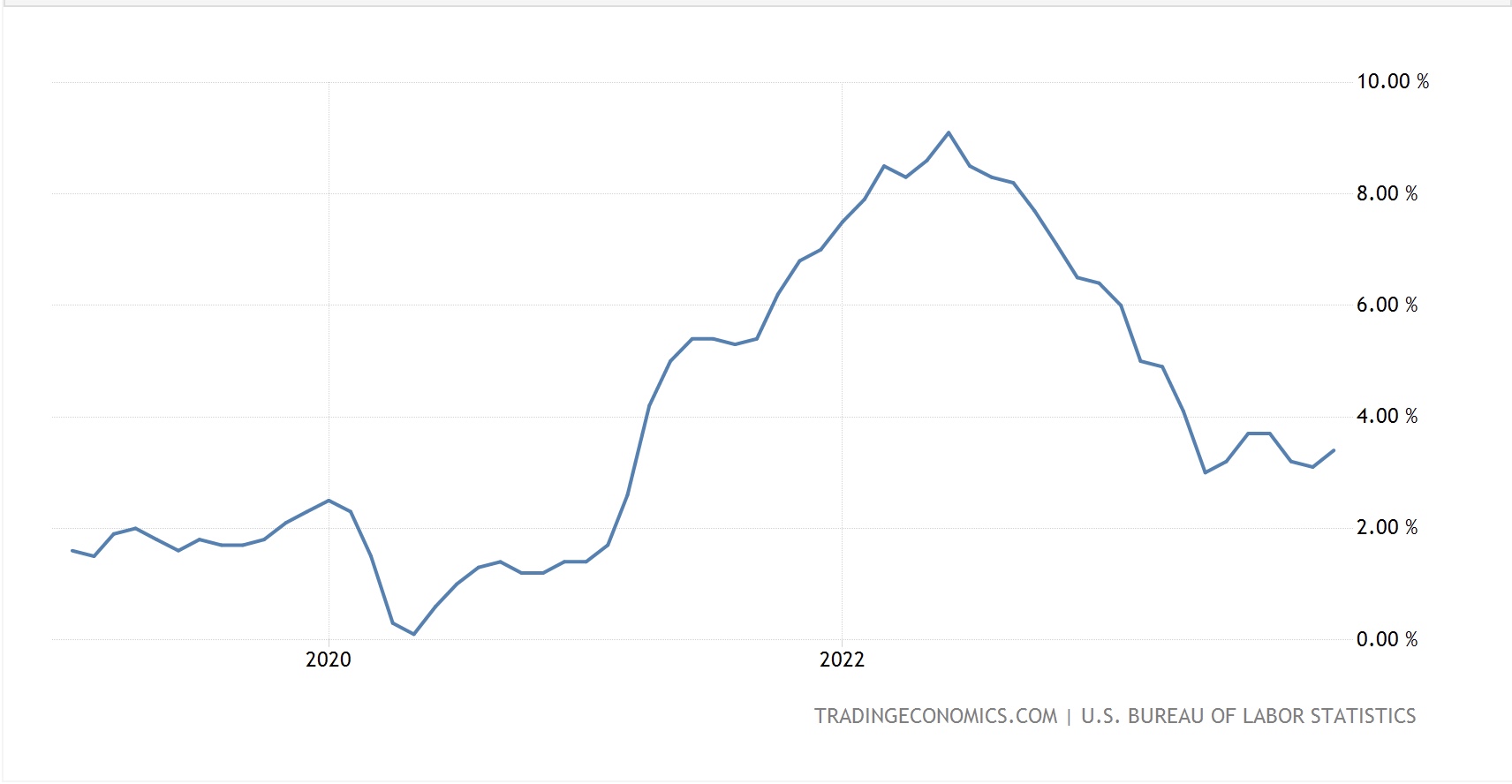
While Thursday’s CPI report remains the key data point this week, there are plenty of other data points that get released on a regular basis that can give clues to how the economy is behaving, and perhaps more importantly to how the Fed’s reaction function may respond.  One of the lesser-known inflation readings is published by the NY Fed each month and shows Consumer Inflation Expectations one year ahead.  As can be seen in the below chart from tradingeconomics.com, the trend has been very positive (lower inflation expectations) for the past two years.

This must warm Powell’s heart as it appears his efforts at anchoring inflation expectations continue to work.  When combining this data with comments from two Fed speakers, Bostic and Bowman, who both indicated some satisfaction with the recent trajectory of inflation and were comfortable with the idea of rate cuts later this year, it is easy to see why yesterday was such a bullish one for risk assets.

Perhaps of more interest, at least to me, was the Consumer Credit Change report which showed that in November, consumer credit rose by a very large $23.75B!  This was the largest increase in twelve months and plays to the idea that people are using their credit cards to purchase consumer staples because they cannot afford them anymore.  On the flip side, given the way economic growth is measured, this will be a positive for Q4 as it implies more ‘stuff’ is being bought.  To my eye, this seems to be a short-term positive, but offers the chance of being a medium-term negative as delinquency in loans is typically not seen in a beneficial light and there are already many stories of people being overextended on their credit cards.

As well, Tokyo CPI was released overnight at 2.4%, 2.1% Core, which was right on expectations, but more importantly, indicative of the fact that inflation pressures in Japan are quickly ebbing.  Perhaps the BOJ’s view that they did not see sustainable price inflation despite almost 2 years of CPI prints above their 2.0% target, is turning out to be correct.  This has huge implications as it means there is little reason for the BOJ to consider exiting its current monetary policy combination of NIRP and QE combined.  As an aside, 10-year JGB yields fell 2bps last night and are currently at 0.58%.  This does not seem like a panicky level, nor one that is necessarily going to attract a lot of internationally invested Japanese money back home.  For all the JPY bulls out there, this is not a good sign.

Away from that news, European data continues to show Germany in a world of hurt, with IP falling -0.7% in November, far worse than expected and the 6th consecutive decline in the series.  However, Eurozone unemployment fell a tick, back to 6.4% and the lowest in the history of the series.  Meanwhile, the ECB just published a report indicating that the inflation suffered by the Eurozone was due almost entirely to supply chain disruptions with a small dose of energy price spike.  It had nothing to do with their policies!  To an outsider like me, this sounds like they are preparing to cut rates as soon as they can.  I wouldn’t be surprised if Madame Lagarde was on the phone with Chairman Powell right now!

And that’s really all we have seen overnight.  After yesterday’s strong rebound in the US, the overnight equity picture was somewhat mixed with Japan having a good session on the weak inflation data although the Hang Seng continues to slide.  Overall, there was no unifed trend in Asia with gainers and losers both.  European shares, though, are in the red this morning led by Spain’s IBEX (-1.75%) although that is the outlier worst performer.  (It seems that a single stock, Grifols, a pharma name, is down -28% on some recent reports about manipulated accounting and that is dragging the whole index lower.). However, US futures are also softer, down about -0.4% at this hour (8:00).  There is still much discussion if last week’s sell-off was just a reaction to a huge late 2023 rally, or the beginning of something much bigger.

In the bond market, Treasury yields have edged up 1bp this morning but remain either side of 4.0% for now.  European yields, though, are higher across the board once again, by between another 5bps and 6bps.  Now, this move is based on yesterday’s close, which saw a drop in yields at the end of the session there.  While the trend in European yields looks higher, they are little changed from this time yesterday.

Oil prices (+3.1%) are rebounding nicely from yesterday’s sharp decline.  You may recall that Saudi Arabia cut its selling price yesterday and the market read that as a sign of weak demand.  However, this morning, that story has faded and continuing tensions in the middle east seem to be having a bigger impact.  This is confirmed by the fact that gold (+0.35%) is rebounding as well although the base metals are mixed this morning with copper slightly higher and aluminum slightly lower.

Finally, the dollar is a touch stronger this morning, but not really by much.  Versus the G10, I see gains of about 0.15% or so with NOK (+0.25%) the exception as it is responding to the rebound in oil.  Versus the EMG bloc, the picture is clearer with almost all these currencies a bit softer, albeit between -0.2% and -0.4% generally.  The dollar continues to be the least interesting asset bloc around for now and is likely to remain so until the Fed starts to actually change policy rather than simply hint at it.

On the data front, we see the Trade Balance (exp -$65.0B) and we have already seen NFIB Small Business Optimism print at a better than expected 91.9.  But, while that is a nice outcome, recall that the index is back at levels below Covid and only above those seen in 2008 and 1980!  Fed Vice-Chair for regulation, Michael Barr speaks at noon, but my guess is he will be right in line with the recent commentary that things look good, but they are not done yet.

As I wrote yesterday, with the bulk of the focus on Thursday’s CPI print, I expect that while markets might be choppy, there will not be much directional information overall.  

Good luck

Adf

Ending QT

The lady from Dallas explained
The balance sheet might be constrained
So, ending QT
Is likely to be
The way the Fed’s goals are attained
 
However, investors ain’t sure
That ending QT is the cure
So, worries abound
As traders have found
Most stocks have now lost their allure

Over the weekend, Dallas Fed President Lorie Logan, whose previous role was head of markets at the NY Fed and so knows a thing or two about the monetary plumbing, explained in a speech that QT, at its current pace, is likely going to be too restrictive going forward.  While she threw in the obligatory line about the idea the Fed may still need to raise the Fed funds rate if inflation remains too robust, I would contend that this is another sign the Fed is coming to the end of its tightening regime.  She explained that the swift decline in the Reverse Repo (RRP) facility indicated there may be a significant decline in liquidity in markets and that could have a detrimental impact on equity prices the economy’s future path and derail the widely assumed soft-landing scenario.

For some context, the RRP facility peaked almost exactly one year ago, touching about $2.55 trillion as the Fed was paying more on excess reserves than was available in short-term paper and Treasury bills.  But as the government has flooded the market with T-bills of late, and there is no indication that pace is going to slow down, the yield on bills rose above the IOER rate the Fed was paying.  As such, money market funds have pushed funds from the RRP into purchasing bills and the RRP facility now has “just” $694 billion as of Friday.  A look at the chart below from the FRED database of the St Louis Fed shows the sharp downward trajectory of the facility’s balances.  But also notice that prior to March 2021, this facility basically was at $0 for its entire history.  My point is that this facility does not have a long history of supporting market activities or liquidity, rather it is a recent construct designed to help smooth out temporary fluctuations.  It’s just that the concept of temporary here seems akin to the Fed’s concept of transitory when it comes to inflation.

At any rate, the FOMC Minutes also mentioned the idea that QT would likely need to slow down, and the committee needed to discuss the proper timing of these things.  Logan’s comments were exactly in this vein as the Fed seem like they are working very hard to prepare market participants for the beginning of an easing cycle.  It’s kind of funny that throughout November and December, the Fed seemed a bit concerned that markets were overexuberant, but after a modest equity market sell-off to start the year, much of which can probably be put down to profit-taking on a tax advantaged* basis, they seem suddenly concerned that things are falling apart.

Logan’s comments were in the wake of Friday’s data which showed NFP stronger than expected, although another month of downward revisions for previous readings, and showed wages gaining a bit more than expected.  The initial move here was that further tightening was on the way, or certainly that easing was delayed, but then the ISM Services index was released at 10:00am and it was much worse than expected, 50.6, with the Employment sub-index printing at a horrible 43.7, its lowest level excluding the Covid months, and indicative that perhaps the job market is not quite so robust.  This helped unwind the tightening discussion and Friday’s markets ultimately closed little changed.

Which brings us to this morning, where the most noteworthy price action is in the commodity space with oil (-2.8%) sharply lower after Saudi Arabia cut its pricing indicating that demand is slow, and gold (-1.25%) falling sharply although a rationale there is far harder to find given the dollar is essentially unchanged on the day and it certainly doesn’t appear that peace is breaking out in either Israel/Gaza or in Ukraine.

While there has been a bit of data released from Europe, none of it was substantially different from expectations and it showed that the status quo remains there, overall, a weak Eurozone economy with prices still on the sticky side.  As well, there have been no speakers this morning which just leaves us all unsure of the next big thing.

Now, in fairness, we do have the next big data point coming on Thursday, CPI in the US, which I am assured by so many analysts is THE critical data point.  I was also confident that NFP was critical, so perhaps CPI will be less exciting than forecast.  In the meantime, a look at the rest of the overnight session shows that Japan was on holiday so there was no market activity, but Chinese shares have continued their weak ways, falling more than -1.3% across all the indices there.  It seems to me that despite some very real efforts to inculcate fear of China by certain politicians, President Xi has an awful lot of domestic issues to address.  European shares, though, are little changed with a few very modest gainers (DAX +0.15%) and a few very modest decliners (FTSE 100 -0.2%) and everything else in between.  US futures are softer this morning as the weekend story regarding Boeing’s 737 Max being grounded is weighing on the stock and the market as a whole.

In the bond market, Treasuries are unchanged on the day while European sovereigns are all seeing yields climb between 4bps and 5bps.  This move seems like a catch-up to Friday’s US price action, which if you remember saw a sharp decline in yields early and a rebound later on.  Ultimately, this space will continue to be driven by the central banks with the Fed funds futures market still pricing in a > 60% probability of a 25bp cut in March with Europe seen likely to follow shortly thereafter.

Having already touched on commodities, a look at the dollar shows that while the euro, pound and yen are all little changed, there is a bit more movement in the dollar’s favor amongst some less liquid currencies with AUD (-0.4%), NOK (-0.85% on weak oil prices) and KRW (-0.4%) leading the way.  I continue to see the FX markets as an afterthought to the broad economic picture right now but have not changed my view that if the Fed does lead the way in easing policy, the dollar is likely to slide.

On the data front, here is what this week brings:

TodayConsumer Credit$9B
TuesdayNFIB Small Biz Optimism91.0
 Trade Balance-$65.0B
ThursdayInitial Claims210K
 Continuing Claims1853K
 CPI0.2% (3.2% Y/Y)
 -ex food & energy0.2% (3.8% Y/Y)
FridayPPI0.1% (1.3% Y/Y)
 -ex food & energy0.2% (1.9% y/Y)

Source: tradingeconomics.com

As well, we do hear from several Fed speakers this week starting with Bostic today and then Williams and Kashkari as the week progresses.  At this stage, I expect that we are likely to see less volatility as my guess is most profit adjustments have been made and all eyes are turned to CPI on Thursday.  Until then, it is likely to be a dull week (famous last words!)

Good luck

Adf

*This tax advantage is simply that taxes will not be due until April 2025, so perhaps tax deferred is a better description.

No Matter What

The story that’s got the most press

Is CPI’s sure to regress
So, Jay and the Fed
Without any dread
Can start cutting rates with success

But what if instead of a nought
The data is higher than thought?
Will markets adjust?
Or will folks still trust
That rate cuts come no matter what?

While all eyes truly remain on the FOMC meeting announcement tomorrow afternoon, and of course, the ensuing press conference by Chairman Powell, this morning brings the November CPI report, which could well have an impact on tomorrow’s outcome.  Current median expectations are for a M/M headline release of 0.0% leading to a Y/Y result of 3.1%.  As to the core (ex food & energy) result, M/M is forecast to be 0.3% with the Y/Y result being unchanged at 4.0%.

Lately, the inflation bulls, aka the deflationistas, have been harping on the fact that if you annualize the past 3 months’ worth of data or the past 6 months’ worth of data, the annualized outcome is 2.5% or lower, and so the Fed has basically done their job and returned inflation back to their target.  In the very next breath, they explain that with inflation back at target, they can start to cut rates because otherwise they will choke off the economy.

Even if I grant the first part of this thesis, of which I am suspect, it is the corollary rate cuts that make no sense at all.  Thus far, the bulk of the data that we have been observing has shown that the economy has held up extremely well despite 525 basis points of rate hikes over the course of less than two years.  This was made evident by Friday’s payroll report as well as the Q3 GDP report and much of the hard data that abounds.  Given the economy’s clear resilience to this higher rate structure, I can see no good case for the Fed to cut.

In fact, I think the key for the entire macroeconomic outlook revolves around just how long the US economy can maintain its growth trajectory with interest rates at their current levels.  The one thing of which we can be certain is that the Fed is not going to pre-emptively cut rates because they think a recession might show up, at least not now while inflation remains well above their target.  If the US economy continues to perform, meaning grow at 2%-2.5% over time while the Unemployment Rate stays below 4.5%, I would argue there is no incentive for the Fed to cut, at least not on a macro basis.  (There may be political reasons for them to cut, but that’s a different story.)  Now, if growth continues apace, will that be bullish or bearish for stocks?  For bonds?  For the dollar?  For commodities?  I would say that these are the questions we need to answer and are why the Fed remains such an important part of the discussion.  Do not discount a world where 10-year yields are 5.5%, Fed funds are 5.25% and GDP is 2.0% while inflation runs at 3.0%.  This could well be the near future.  It would also likely be quite a negative for risk assets.

My point is there continues to be a great dichotomy of thought as to how the future will unfold as we all are looking for the next clue to support our thesis.  While I continue to believe that a slowdown is coming, to date, there has been no clear evidence that is the case.  In fact, Friday’s Michigan Sentiment data was substantially better than anticipated while inflation expectations fell alongside the price of gasoline.  In fact, a marginally stronger than anticipated print this morning will simply be more proof that the market’s current anticipation for rate cuts in 2024, which sit between 4 and 5 cuts, will need to be repriced.  If risk assets have rallied on the basis of future Fed rate cuts, that could be a problem.  Just sayin’!

Ok, ahead of the data, this is what we have seen.  Yesterday’s modest US equity rally was followed by generally modest strength in Asia with the best performer being the Hang Seng (+1.1%).  Last night, China’s government made a series of announcements describing all the sectors of the economy that they would be supporting going forward with fiscal policy, although there were no numbers attached to any of it, it was all cheerleading.  Saturday night, Chinese CPI data was released at -0.5% both M/M and Y/Y, while PPI there fell to -3.0%.  The implication is that economic activity is not going very well.  In fact, it might be appropriate to define it as a recession, although I’m sure that won’t be the case.  However, looking for China to be the world’s growth engine may be a bad call for the time being.  As to Europe, it is a mixed picture there, with both modest gainers and modest laggards and no real direction overall.  US futures are higher by 0.2% at this hour (7:30) but are obviously keenly focused on the data release.

Yesterday’s bond market price action, where yields backed up, has been completely reversed this morning with 10-year Treasury yields lower by 5bps and European sovereign yields lower by even more, 6bps-7bps while UK gilts have really rallied, with yields there down by 12bps after the employment data showed wage pressures declining far more than anticipated.

On the commodity front, oil is drifting lower again this morning, down -0.6%, although the metals complex is showing strength with gains in gold (0.4%) and copper (0.3%), which seem to be rising on the back of a weaker dollar and lower US rates.  But a quick aside on oil and the commodities space in general.  I have made the point that the commodity markets are the only ones that are pricing in a recession.  And I would contend that is still the case.  Perhaps, though, I have been looking in the wrong place for that economic weakness.  Consider that China is the largest consumer of raw commodities in the world, by a wide margin.  Consider also that the Chinese economy is having all kinds of difficulty as the dash for growth seems to have reached its apex and is now sliding lower.  As I mentioned above, the idea that China is in a recession may not be absurd, and perhaps the fact that the commodity markets, in general, have been so soft is simply a recognition of that fact.  If this is the case, we need to watch Chinese economic activity closely in order to get a sense of the trend in commodities.  Or perhaps, we need to watch the trend in commodities to better understand the Chinese economy.  When base metals turn higher, look for Chinese stocks to do the same.

Finally, the dollar, as mentioned above, is under pressure this morning, down -0.3% when measured by the DXY.  The biggest mover is JPY (+0.7%) but we are seeing all the G10 bloc as well as the bulk of the EMG bloc rallying against the greenback.  Speaking of Japan, last night there was further commentary pushing back on the idea of any movement by the BOJ next Monday regarding the normalization of monetary policy in the near future.  I maintain that nothing will happen before they see the wage negotiation outcomes in March and, in the meantime, they are praying quite hard for the recent global inflation trend to remain downward as this will allow them to maintain their QE and fund the government.

And that’s really it for the day, as the CPI is the only news to be released.  Unless it is significantly different than the current expectations, I suspect that things will be quiet today, modest continued equity and bond rally as everybody places their bets that the Fed is getting ready to start to cut rates.  I’m not holding my breath.

Good luck

Adf

The New Allegory

On Friday, the data surprised

With job growth more than advertised
So, bonds took a bath
And stocks strode a path
Where growth is what’s now emphasized

But what of the soft landing story?
Will rate cuts now be dilatory?
If Jay just stands pat
Will stocks all go splat?
Or is this the new allegory?

Well, this poet was clearly wrong-footed by Friday’s employment report where not only were non-farm payrolls stronger than anticipated at 199K, but hours worked rose and the Unemployment Rate fell 2 ticks to 3.7%.  While revisions to previous reports were lower, as they have been all year, the report did not point to an imminent slowing of the economy nor a recession in the near-term.  Arguably, the soft-landing crowd made out best, as equity markets, which initially plunged on the report following Treasury prices, rebounded as investors decided that growth is a better outcome than not.  Yields jumped higher, as would be expected, rising 8bps in the US with larger gains throughout Europe before they went home for the weekend.  And finally, the dollar flexed its muscles again, rallying universally with gains against 9 of the G10 currencies, averaging 0.4% (only CAD (+0.1%) managed to hold its own) and against most of the EMG bloc with a notable decline by ZAR (-1.1%), although MXN (+0.6%) bucked the trend.

Does this mean the soft landing is coming?  As we start the last real data intensive week of 2023, it remains the favored narrative, but is by no means assured.  After all, before the end of this week we will have seen the latest CPI reading in the US (exp 3.1% headline, 4.0% core) and we will have heard from the FOMC, ECB and BOE as well as several smaller central banks like the Norgesbank and the SNB.  And let us not forget that the BOJ meets next Monday.  So, there is plenty of new, important information that is coming soon and will almost certainly drive potential narrative changes.

Perhaps an important part of the discussion is to define what we mean by a soft landing, or at least what the ‘market’ means by the concept.  My best understanding is as follows: GDP slides to 1% or so, but never goes negative.  Unemployment may edge higher than 4.0%, but only just, with a cap at the 4.2% or 4.3% area, and inflation, as measured by Core PCE finds a home between 2.0% and 2.5%.  This result, measured inflation falling back close to target while the growth and employment story just wobbled a bit, would be nirvana for Powell and friends.  

How likely is this outcome?  Ultimately, history is not on their side as arguably the only time the Fed ‘engineered’ a soft landing was in 1995, and on an analogous basis they had already started cutting rates by this time in the cycle.  The fact that we are still discussing higher for longer implies that there is much more pain likely to come than the optimists believe.  We have already seen the first signs of trouble as the number of bankruptcies soar and stories about non-investment grade companies needing to refinance their debt at much higher interest rates than the previous round fill the news.  Certainly, Friday’s employment data is encouraging for the economic situation, but the chink in the armor was the wage data which showed more resilience (+0.4%) than expected.  Given the Fed’s focus on wages and their impact on inflation, the fact that wage growth remains well above the levels the Fed deems appropriate to meet their inflation target is not a sign that policy ease is coming soon.

And ultimately, I believe that is the critical feature here.  The economy has held in remarkably well considering the pace and size of the interest rate changes we have already seen.  The big unknown is how much of that interest rate change has really been felt by the economy.  Obviously, the housing market has felt the impact, and to some extent the auto industry, but otherwise, it is not as clear.  Do not be surprised if this period of slow economic activity extends for a much longer time than in the past as the drip of companies that find themselves unable to refinance at affordable rates slowly grows.  By 2025, about $1 trillion of corporate debt that was issued at much lower interest rates will need to be refinanced.  I’m not worried about Apple refinancing their debt, but all the high-yield debt that was snapped up with a 4% or 5% handle during the period of ZIRP will now be at 10% or so and it is an open question if those business models will be functional with financing that expensive.  

So, perhaps, the story will be as follows:  economic activity is going to muddle along at low rates for an extended period, another 2 or 3 quarters, until such time as the debt ‘time-bomb’ explodes with refinancing rates high enough to force many more bankruptcies and start a more aggressive recessionary cycle with layoffs leading to rapidly rising Unemployment rates and economic activity falling more sharply.  In this timeline, we are talking about the recession becoming clear in Q3 of 2024, a time when most of that $1 trillion of corporate debt will be current.    While interest rates will certainly be slashed at some point, this does not bode well for risk assets in the second half of 2024.  For now, though, it certainly seems like the current narrative is going to continue.

There’s no urgency

To change policy quite yet
But…some day we will

A quick story about the BOJ which last night pushed back firmly against the growing narrative that they were about to start normalizing interest rate policy with a rate hike in either December or January.  Instead, several stories were released that described the recent decline in both GDP and inflation as critical and the fact that they still don’t have enough information with respect to wages in Japan, given the big spring wage negotiation has not yet happened, to make a decision.  In other words, the BOJ was successful at convincing markets to behave as the BOJ wants, not as the rest of the world wants.  The upshot was that the yen weakened sharply (-0.9%) while the Nikkei rose 1.5% and JGB yields were unchanged.  The BOJ pivot remains one of the biggest themes in the macro community, mostly because it is seen as the place where the largest profits can be made by traders.  But my experience (4 years working for a Japanese bank) helps inform my view that whatever they do will take MUCH longer to happen than the optimists believe.

Ok, let’s try a quick trip around markets here for today.  Aside from Japan, most of Asia had a good equity session with Hong Kong (-0.8%) the only real laggard.  Remember, a key story there remains the Chinese property sector as many of those firms are listed in HK.  Meanwhile, European bourses are mixed although movements haven’t been very large in either direction.  The worst situation is the UK (FTSE 100 -0.5%), while we are seeing some gains in the CAC and DAX, albeit small gains.  Finally, US futures are pointing a bit lower, -0.2%, at this hour (7:45).

In the bond market, after Friday’s dramatic price action, Treasury yields are continuing to rise, up 5bps this morning, although European sovereign yields are little changed on the day, with the bulk of them slipping about 1bp.  Given most saw quite large moves on Friday, and given the imminent policy decisions by the big 3 central banks, I suspect traders are going to be quiet for now.  

Oil prices (-0.3%) are slipping slightly this morning but are mostly consolidating Friday’s gains.  On the metals front, though, everything is red with gold, silver, copper and aluminum all under pressure.  Again, this is the one market that has been pricing a recession consistently for the past several months while certainly equity markets have a completely different view.

Finally, the dollar is continuing to rebound on the strength of rising Treasury yields.  While the euro is little changed on the day, the yen is driving price action in Asia with weakness also seen in CNY, KRW and TWD.  As well, ZAR (-0.8%) continues to suffer on weaker commodity pricing and both MXN and BRL are under pressure leading the LATAM bloc lower.  At this point, I would say the FX market has more faith in Powell’s higher for longer mantra than some other markets.

As mentioned, there is a lot of data this week:

TodayNY Fed Inflation Expectations3.8%
TuesdayNFIB Small Biz Optimism90.9
 CPI0.0% (3.1% Y/Y)
 -ex food & energy0.3% (4.0% Y/Y)
WednesdayPPI0.1% (1.0% Y/Y)
 -ex food & energy0.2% (2.3% Y/Y)
 FOMC Rate Decision5.5% (unchanged)
ThursdayECB Rate Decision4.5% (unchanged)
 BOE Rate Decision5.25% (unchanged)
 Retail Sales-0.1%
 -ex autos-0.1%
 Initial Claims221K
 Continuing Claims1891K
FridayEmpire State Manufacturing2.0
 IP0.3%
 Capacity Utilization79.2%
 Flash PMI Manufacturing49.1
 Flash PMI Services50.5

Source tradingeconomics.com

Thursday also has the Norges Bank and SNB, both of whom are expected to leave rates on hold.  For today, it strikes me that the discussion will continue as pundits try to anticipate what the FOMC statement will say and how Powell sounds in the press conference.  As such, it is hard to get excited that there is going to be a big move in either direction.  With all that in mind, my overall read on the economy is that while we may muddle along in the US for a while yet, it will be better than many other places in the world, notably the EU, the UK and China, and so the dollar is likely to hold up far better than most expect…at least until Powell changes his tune.

Good luck

Adf

Inflation is Dead

For anyone who’s ever doubted
Inflation is falling and touted
The price of their food
Or Natgas and crude
The market has recently shouted

Inflation is dead, can’t you see?
The CPI’s back down to three
Soon Jay and the Fed
Will clearly have said
It’s time to cut rates, we agree

Another day, another soft inflation reading, two of them, actually.  First, the UK reported that CPI there fell to 4.6% in October, its lowest point in two years and a bit below expectations.  While that was quite a sharp decline from the September print of 6.7%, things there are still a bit problematic as the core rate remains much higher, at 5.7%, and is not declining at anywhere near the same rate as the headline.  What this tells us is that the energy component is a big driver as the price of oil is down about 10% in the past month.

Then, US PPI printed with the M/M number at -0.5%, much softer than expected which took the Y/Y down to 1.3%.  Core PPI is a bit higher, 2.4% Y/Y, but obviously, at a level that is not seen as a major problem.  Meanwhile, Retail Sales was released at a slightly less negative than expected -0.1% and last month’s print was revised up to 0.9%, the indication being that economic activity is not collapsing yet.  For the optimists, this has all the earmarks of a soft landing, declining inflation, modest growth, and still relatively strong employment.  As well for the optimists, they are all in on the idea that not only has the Fed, and every other central bank, finished their rate hiking cycle, but that rate cuts are coming soon!

In fact, that is the clear narrative this morning, rate hikes are dead, long live rate cuts.  There are numerous takes on this particular subject, but the general view is that now that inflation is finally heading back toward target, the central bank community will need to cut rates to prevent destruction in economic activity.  Europe is already teetering on the edge, if not currently in recession, and though GDP in Q3 here in the US printed at a robust 4.7%, Q4 appears to be slowing down somewhat with the latest GDPNow estimate at 2.2%.  However, given that growth in the US remains far better than many anticipated considering the speed and magnitude of the Fed’s rate hikes, my question is, why would the Fed cut?  At this point, there is limited evidence in the data that the economy is going to fall into recession, and based on their models, strong growth is likely to be inflationary, so maintaining the current levels should be fine.

At any rate, that is the crux of the bull/bear argument these days, and for now, the bulls are leading the dialog.  Equity markets continue to buy into that narrative as evidenced not just by Tuesday’s powerful rally, but the fact that yesterday saw a continuation of those gains, albeit at a much more muted pace.  Now, Asian markets didn’t really participate last night, with Japanese shares modestly lower but Chinese shares, especially the Hang Seng (-1.4%) suffering more broadly.  The data from China continues to show that the property market is crumbling, with home prices reported declining further last month despite Xi’s government pumping more money into the sector.  That is a bubble that is going to haunt President Xi for a very long time.  As to European bourses, they are mixed this morning with some (Germany and Spain) modestly firmer while others (UK and France) are modestly softer.  It is hard to get a read from this, especially given there has been no data released this morning.  Finally, US futures are ever so slightly softer at this hour (7:10), maybe on the order of -0.2%.  However, this seems a lot like a consolidation rather than a major retracement.

The bond market story, though, is probably more inciteful with regard to the overall narrative.  Given the softer inflation data, and the fact that futures and swaps markets are now pricing in the first interest rate cuts by May and 100bps of cuts over 2024, interest rates are still the key focus.  You will remember that in the wake of the CPI number, 10yr yields crashed 20bps.  Yesterday they did rebound a bit, rising 10bps at one point in the day before closing higher by about 7bp at 4.54%.  this morning, though, they are slipping back again, lower by 5bps as that 4.50% level remains the market’s trading pivot.  We are seeing similar yield declines throughout Europe as well, with investors there embracing the slowing inflation story.  In fact, UK yields are down 8bps this morning continuing the positive inflation story there.

Interestingly, the oil market is not embracing the goldilocks narrative as oil prices are softer again this morning, -0.75%, and have no real life in them.  Yesterday we did see EIA data describe a much larger than expected inventory build, and the US continues to pump out record amounts of oil, 13mm bbl/day, so in the short run, there is clearly ample supply.  Do not be surprised to see other OPEC members discuss voluntary production cuts in the near future.  On the other hand, gold and silver continue to rally, taking their cue from lower interest rates and the weaker dollar while this morning, the base metals are little changed.  One thing to remember is that if we truly are in a new, declining interest rate regime, look for the dollar to fall, and all the metals to rally.

Speaking of the dollar, it is very slightly firmer overall this morning, but remains well below levels seen prior to the CPI print on Tuesday.  In the G10, AUD (-0.4%) and NZD (-0.8%) are the laggards with the rest of the bloc seeing much smaller price action.  But, to demonstrate that things seem to be heading back to pre-CPI levels, USDJPY is back firmly above 151, although has not yet threatened the apparent line in the sand at 152.  In the EMG bloc, the story is far more mixed with KRW (+0.7%) seemingly benefitting from the warmer tone between Presidents Biden and Xi at yesterday’s APEC meeting, while ZAR (-0.7%) is suffering on the back of signs the economy there is slowing more rapidly based on construction activity reports.  The big picture remains that the dollar should continue to follow US yields broadly.  This means that if the Fed really is done and that cuts are coming, the dollar is going to fall further.  This is especially true if they start cutting before inflation is truly under control.  This is the key risk which we will need to watch going forward.

On the data front, today brings the weekly Initial (exp 220K) and Continuing (1847K) Claims data as well as the Philly Fed Manufacturing Index (-9.0).  Later we will see IP (-0.3%) and Capacity Utilization (79.4%) and we hear from four more Fed speakers before the day is through.  So far, the cacophony of Fedspeak has not wavered from the Powell idea that higher for longer is the game plan and that they will not hesitate to raise rates if they feel it is necessary.  Not one of them has cracked and acknowledged that rate cuts may happen next year, so keep an eye for that.

However, absent a Fed slip of the tongue, I suspect that today will be relatively quiet although this bullish equity/bullish bond/bearish dollar move does seem to have legs.  With the big data now behind us, until GDP and PCE at the end of the month, my take is the bulls are going to push as hard as they can.  Be prepared.

Good luck

Adf

Markets No Longer Have Fear

The CPI data made clear
That markets no longer have fear
But Jay and his team
Will still push the theme
That cuts in Fed funds just ain’t near

As such markets have been persuaded
It’s time for the Fed to be faded
The bulls are on top
And they just won’t stop
Til new record highs have been traded

By now, you are all well aware that yesterday’s CPI data came in a bit softer than the forecasts with the headline printing at 3.2% Y/Y while the core printed at 4.0% Y/Y.  Both of these were 0.1% lower which doesn’t seem to be that big a difference.  But the bulls are stampeding on the idea that if you look at the recent trend, the annualized rate for the past 6 months is lower still (3.0% and 3.1% respectively) and the implication is that inflation is dead and the Fed has achieved the impossible, reducing inflation without causing a recession.  And maybe they have, but boy, that is a lot to take away from a single data point that printed a smidge lower than expectations.

Two weeks ago, in the wake of the last FOMC meeting, I wrote (Bulls’ Fondest Dreams) that the Fed changed their tune and despite all the pushback we have received from Fed speakers in the interim, they definitely saw the end of the hiking path coming into view.  Yesterday’s data seemed to confirm this view, at least in the markets’ eyes.  As such, we saw a massive rally in both stocks and bonds, with 10-year yields falling 20 basis points at one point in the day before closing lower by about 17bps.  They are 2bps higher this morning on the bounce.  Interestingly, European sovereign yields also fell quite sharply despite the lack of local news as the price action once again proved that the 10yr Treasury yield is the only bond price that really matters in the world.

So, to me the question is now, is this view correct?  Has the Fed actually threaded the needle and successfully reduced inflationary pressures without causing a meaningful economic slowdown?  If so, Chairman Powell will rightly be hailed as a brilliant central banker, even if there was some luck involved.  How can we know, and more importantly, when will we be certain this is the case?

I think it is important to try to separate the markets and the economy as the two are really quite different.  The economy is where we all live.  From an individual perspective, I would contend it is a combination of one’s employment situation(and whether there is concern over losing one’s job or finding a new one), the true cost of living, meaning the ability to afford the mortgage/rent as well as put food on the table, and then to see if there is any additional money left to either save or spend on desires rather than necessities.  It seems abundantly clear that from this perspective, there is a large segment of the population that doesn’t feel great about things.  This was made clear in an FT survey that showed just 14% of those surveyed thought things had gotten better economically under the Biden Administration’s policies.

However, if this poet has learned nothing else in his time trading in, and observing, financial markets, it is that policymakers do not care one whit about those issues.  Despite periodic attempts to seem down-to-earth, the reality is they all exist within a policy bubble with no concerns about the rent or their next meal.  In this bubble exist only numbers like yesterday’s CPI or today’s Retail Sales (exp -0.3% headline, 0.0% ex autos).  GDP, to them, is not a measure of people’s confidence or belief in the state of the current world, it is a policy variable that they are trying to manage or manipulate so they can make positive pronouncements.

There is obviously quite a gulf between those two views of the world and the markets are the connection, trying to interpret the reality on the ground through the lens of the data.  Well, the policymakers must be thrilled today because the extraordinary bullishness that is now evident across all risk markets, in their minds, means that their jobs are secure.  When things are going well, reelection/reappointment are the expected outcomes.  However, that FT survey was clearly a warning shot across the bow of their Good Ship Lollipop that everything was going to be great going forward.

So, what’s it going to be?  As I wrote after the FOMC meeting, I believe the market is prepped to rally through the rest of the year.  After yesterday’s data, that seems even clearer.  But do not forget that one of the key rationales for the Fed’s change of heart was that the market was doing the Fed’s work for them, tightening policy by raising rates and watching risk assets drift lower, thus tightening financial conditions.  Let me tell you, financial conditions loosened a lot yesterday, and if this rally continues, you can be certain that Powell and friends will grow more concerned about a rebound in inflation.  The market has completely removed any probability of a December rate hike, or any further rate hikes by the Fed as of yesterday with the first cut now priced for May 2024.  At this stage, it seems probable that the October PCE data will be on the soft side so much will depend on the next NFP and CPI readings, both of which are released before the next FOMC meeting.

And there is one more thing that must be remembered when it comes to the bond market.  The US is still going to issue an enormous amount of debt going forward between refinancing ($8.3 trillion though 2024) the current debt and the new $2 trillion budget deficit that needs to be funded for next year.  Can bonds continue to rally in the face of that much supply?  Maybe they can, but it would seem to require a reengagement of foreign buyers rather than relying entirely on domestic savers.  Either that or the Fed will need to end QT and possibly even restart QE.  In the latter case, inflation would almost certainly become a major issue again.  The point is, while everyone is feeling great this morning, there are still numerous perils to be navigated in order to maintain economic growth with a low inflation regime.  I hope Jay and all the central bankers are up to the task, but a little skepticism seems in order.

Ok, the overnight session can be summed up in one word: BUY!  Equity markets everywhere rallied with strong gains in Asia (Hang Seng +3.9%) and Europe, after rallying yesterday, continuing higher by nearly 1% this morning.  US futures are also all green this morning, generally +0.5% at this hour (7:30).

Bond markets have mostly held onto yesterday’s impressive gains with some trading activity, but movements all within a basis point or two from yesterday’s close.  The exception was Asian government bond markets, where prices rallied sharply, and yields tumbled there as well, following the US lead.

Metals prices are ripping higher again this morning, with gold, silver, and copper all up nicely after strong gains yesterday.  The outlier here is oil, which is a touch lower (-0.4%) this morning after a very lackluster session yesterday.  Now, in fairness, it has been creeping higher for the past several sessions, but compared to other markets, oil is remarkably quiet right now.

Finally, the dollar got smoked yesterday, with the euro rallying 1.5% and similar moves across the other European currencies.  Meanwhile, AUD rallied more than 2% yesterday as the combination of rocketing metals prices and a broadly weaker dollar were just the ticket for the currency.  In the EMG bloc, ZAR (+3.0%) and MXN (+1.5%) were the big winners yesterday although, interestingly, most of the APAC currencies had much more muted runs, on the order of 0.5%-1.0% gains.  This morning, price activity is much more subdued as FX traders are trying to get their bearings again.  It was, however, a 3-sigma day, a rare occurrence.

On the data front, as well as Retail Sales, we also see PPI (exp 2.2% headline, 2.7% ex food & energy) and the Empire Manufacturing Survey (-2.8) along with EIA oil information where inventory builds are forecast.  There is only one Fed speaker, vice chairman of supervision Michael Barr, and I don’t expect he will be able to sway any views today.

For now, the die is cast, and the bulls are in the ascendancy.  We will need to see some very big changes in the data trajectory for the current momentum to stall, and quite frankly, I don’t see what that will be for now.  So, go with the flow here, higher stocks, lower yields and a softer dollar seem to be the trend for now.  There will be some trading back and forth, but you can’t fight City Hall.

Good luck

Adf

Price Rise Regimes

Ahead of today’s CPI
Investors would not really buy
But neither would they
Sell short, as they weigh
If Jay is a foe or ally

Meanwhile, amongst pundits it seems
The world is split into extremes
Some see prices falling
And for cuts, are calling
While others fear price rise regimes

Market activity has been subdued overnight as we all await this morning’s big CPI report.  Currently the consensus views are for a 0.1% rise in the headline, leading to a 3.3% Y/Y number, down substantially from last month’s 3.7% reading, and a 0.3% rise in the core, leading to an unchanged Y/Y reading of 4.1%.  Here’s the thing, as can be seen in the below chart of core CPI, although it is clear inflation appears to be trending lower, it is still a LONG way from where anybody is comfortable.

Something else to remember is the different ways in which we all experience, and think about, inflation.  When writing about inflation, all analysts look at the rate of change of a percentage move as an indicator of what is happening.  But when you go to the grocery store, or your favorite restaurant, or when you order stuff on-line, especially things that you regularly buy, the price changes over the past two years have been so substantial, and taken place in such a short time, that we all remember the pre-covid prices.  The fact that prices may not be rising as fast as they did last year does not make the stuff any cheaper this year.  I would contend that is why virtually all of us consider the inflation data to be suspect, because the package of toilet paper that used to cost $4.99 now costs $8.99, and while it may not go higher anytime soon, it is still nearly double what we remember.  This perception is critical, in my mind, to understanding the national mood, and it is one that nobody in the Fed, or likely the administration, considers.  We know this because there are so many articles in the mainstream media about how things are really great, and people just don’t understand how good a job those two groups are doing.  

At any rate, if pressed, I would say that there are more deflationistas these days, who believe that inflation is going to quickly head back to 2% and that the Fed is going to be cutting rates early next year to prevent overtightening of policy.  The crux of their argument is that M2 is declining at a record pace (as can be seen in the below chart), and therefore is highly deflationary.  

I would counter that argument, though, with the fact that the velocity of money (see chart below) is rising at a record pace, offsetting those declines, and supporting ongoing inflationary tendencies.  

As some of us may remember from our macroeconomics classes, the identity to describe growth and inflation is:

                                                MV = PQ

The argument that a decline in M2 money supply (the “M”) will lead to lower prices assumes the velocity of money (the “V”) remains stable.  But as you can clearly see from the second chart, the velocity of money is rising sharply.  I would contend there is little chance that deflation is coming to a screen near you at any point in the next several years absent a depression brought on by a collapse in the bond market.  And ultimately, that means that the price of all those things we buy regularly is not going to retreat to pre-covid levels.

Away from the CPI drama, there were two things of note overnight.  First, Japanese FinMin Suzuki was on the tape explaining the government would take all possible steps necessary to respond to currency moves.  The market response was a very short-term rise in the yen, with the currency popping 0.35%, but giving back most of those gains within the hour and currently, it sits largely unchanged on the session.  There has been no evidence that the BOJ has intervened since October 2022, but it appears that 152.00 may be a sensitive spot right now.  The other thing he said was they were preparing a package to help citizens cope with the weakening yen which is driving inflation there.  That said, there is no indication yet they are going to raise the deposit rate from its current -0.10% level.  Net, I still think the yen has further to decline, at least until policy changes in Tokyo.

The other noteworthy occurrence was word from China that they were considering an additional CNY 1 trillion of support for the housing market as things on the mainland continue to slow despite Xi’s best efforts.  It seems when you blow a 20-year property bubble of such enormous proportions, such that the property sector consumes > 25% of your growing economy, slowing that down without collapsing the economy is a tough job.  I continue to think of King Canute and his command that the tide recedes every time I think about KingPresident Xi trying to stop the property market collapse.  At any rate, as can be seen by the fact that equity markets in China and Hong Kong did virtually nothing last night, the market is not excited by the prospects of more Chinese money sloshing around.

As to the rest of the equity markets, yesterday’s trading in the US was pretty limited with modest gains and losses in the indices while the Nikkei managed to gain 0.3% overnight.  European bourses are also mixed, with the continent a bit firmer while the UK is under some pressure.  Perhaps the marginally better than forecast German ZEW reading of 9.8 vs 5.0 expected and -1.1 last month is the driver on the continent, while UK employment data was arguably a bit better than forecast, with the Unemployment Rate remaining unchanged at 4.2% rather than ticking higher as expected, and so hopes for a quick BOE rate cut have faded a bit.

Too, in the bond market, activity has been extremely subdued with Treasury yields 2bps softer this morning while European sovereign yields are essentially unchanged across the board.  Last night in Asia, we saw little movement as well, with JGB yields slipping just 1bp and hanging around their new home at 0.85%.

While commodity prices managed to rally a bit yesterday, this morning, what little movement there is across energy and metals markets is ever so slightly lower.  Yesterday saw the EIA raise its forecast for oil demand slightly, and there is word that the administration is bidding for 1.2 million barrels of oil to start to refill the SPR, but sentiment in this space is clearly negative with the recession fears the driving force across all these markets.

Finally, the dollar, too, is very little changed this morning which should be no surprise given the lack of movement elsewhere.  If anything, it is trending a bit softer, but only just, as the deflationistas seem to be preparing themselves for a soft CPI print and want to get on board for that first Fed rate cut.  As we currently stand, at least according to the Fed funds futures market, the first cut is priced in for the June meeting, although the first hints of a cut show up in March.  That said, the probability of a rate hike in December has edged higher to 15% from below 10% last week.  There is still a great deal of confusion as to how market participants believe this is going to play out over time.

Aside from the CPI data, we hear from 3 more Fed speakers today, Barr, Mester and Goolsbee, while Governor Jefferson, in a speech in Zurich early this morning, didn’t really touch on current monetary policy, rather he was discussing uncertainty in a broad manner.  I suspect that the 3 speakers will generally reiterate Powell’s message from last week that the future is uncertain but higher for longer is the way forward.  As such, it is all about the data.  A hot print, certainly a M/M of 0.2% headline or 0.4% core will likely see bonds sell off along with stocks while the dollar rallies.  However, anything else, meaning a soft print or even an as expected print, will likely encourage risk buying and dollar selling.  We shall see,

Good luck

Adf

Somewhat Queasy

Though markets appeared somewhat queasy
Said Janet, it’s really quite easy
To fund wars times two
But Moody’s said ooh
Your credit is now a bit wheezy

The combo of deficit growth
As well as a Congress that’s loath
To pass any bills
Has given us chills
So downgrading debt’s due to both

Under cover of night last Friday, Moody’s put US Treasury debt on Negative watch, citing, “…the risk that successive governments will not be able to reach consensus on a fiscal plan to slow the decline in debt affordability.”  Ultimately, they criticized the combination of rising interest rates and a concern that the current polarization in Congress will prevent anything from being done about constantly growing deficits and calls into question the ultimate value of the debt.  Moody’s is the last ratings agency to maintain the Aaa rating for the world’s risk-free asset, so this is quite a blow.  

Not surprisingly, the administration disagreed with the decision as Deputy Treasury Secretary Wally Adeyemo explained,” we disagree with the shift to a negative outlook.  The American economy remains strong, and Treasury securities are the world’s preeminent safe and liquid asset.”  I don’t believe anyone is concerned that repayment in full is in question, this is simply another shot across the bow of the idea that the value of the nominal dollars that are repaid will be anywhere near what they were when originally invested.

But that was just one of the many crosscurrents that have been afflicting the macro scene and markets of late.  For instance, in the past month, we have seen better than expected data from Retail Sales, IP, Capacity Utilization, New Home Sales, GDP, Durable Goods, Personal Spending, Nonfarm Productivity and Unit Labor Costs.  That’s quite an impressive listing of reports, and the characteristic they all share is they are ‘hard’ data.  In other words, this is not survey data, but rather these are measured statistics.

Meanwhile, the prognosis for the future continues to be far less optimistic with worse than expected outcomes in Empire State Manufacturing, ISM Manufacturing and Services, Leading Indicators and Michigan Sentiment.  The common thread here is these are all surveys and subject to the whims of the person answering the question.  In fact, the only ‘hard’ data points that were worse than expected were the Nonfarm Payrolls and Unemployment Rate.  I guess we can add the Moody’s downgrade to the list of worse than expected data, but it too is subjective rather than a hard data point.

Given the widely diverging data story, it should be no surprise that there are widely divergent views on how things are going to progress from here.  In fact, I read this morning that the two best known Investment Banks, Goldman Sachs and Morgan Stanley, have pretty divergent views on what the future holds.

The bullish argument remains that despite the gnashing of teeth and clutching of pearls by the faint-hearted, the data continues to perform well and that is the best measurement of the economy.  Certainly, the Fed is using this as their crutch to maintain their higher for longer stance and fight back against anyone who claims they have overtightened policy and need to cut rates.

However, all the hard data is backward looking, so describing what has already passed.  The bulls claim that there is autocorrelation in the data, so the past is prolog.  My observation is this is generally true in a trending market, but at inflection points, things become much murkier.

Meanwhile, the bears point to the ongoing weakness in all the survey data, which shows a dour view of the future with ISM in contraction, Michigan Sentiment falling to levels only surpassed during Covid, and inflation expectations continuing to rise.  

Another perfect analogy of this dichotomy is the S&P 500, where the median stock is -36% this year while the index is +14% given the extreme narrowness of breadth.  Absent the so-called Magnificent 7*, the index is actually lower on the year.  Now, those seven stocks are part of the index and so the reality is the S&P remains higher, but if looking for a signal on the economy, the case can certainly be made that broadly speaking, things are not great.

There is one potential reason for this dichotomy of survey vs. hard data, and that is the outside world.  After all, through the lens of the ordinary American, we see two hot wars ongoing, both of which we are spending money in supporting as well as a growing divide in the country along political party lines and sides in each conflict.  Perhaps Moody’s is onto something after all.  But with all that negativity in the press, it is easy to understand why surveys look so dismal.  However, people continue to spend money for things they need and want and given there is still so much money floating around in the wake of the pandemic stimulus efforts, business continues to get done.

There is, of course, one other thing that is part of the equation and that is the presidential election that is coming in one year’s time.  If history is a guide, you can be sure that the administration will be seeking to spend as much money as possible to support reelection, although with the House in opposition, it won’t be as much as they would like.  Nonetheless, at the margin, I expect that it will be substantial enough to continue to pressure yields higher which ought to weigh on equities and support the dollar, at least ceteris paribus.

Ok, so let’s look at how markets have behaved overnight as we start the week.  In the equity space, after a massive rebound rally on Friday in the US, only the Hang Seng in Hong Kong managed any love, rising 1.3%, but the rest of the space was flat to marginally lower on the day.  However, European bourses are all firmer this morning, about 0.5% or so.  As to US futures, they are pointing slightly lower, -0.25%, at this hour (7:20).

Turning to the bond market, Treasury yields are softer by 2bps this morning, but still well off the lows seen last week ahead of the lousy 30-year auction.  I still see higher yields in the future, but I am increasingly in the minority on this view.  European sovereigns are all bid today with yields declining between -3bps and -6bps despite a dearth of new data.  In fact, if anything, from the periphery we have seen firmer inflation data from Sweden and Norway and the market is now looking for both those central banks to hike again later this month.  That does not sound like a reason to buy bonds but it’s all I’ve seen.

Turning to the commodity markets, oil (+0.3%) is edging higher this morning but is just consolidating after a terrible week last week.  Gold, too, is in consolidation, unchanged this morning but having lost some of its recent luster.  Interestingly, both copper and aluminum are firmer this morning, arguably on discussion of further Chinese stimulus that may be coming soon.

Finally, the dollar is little changed this morning, with G10 currencies all within +/-0.2% of Friday’s levels while EMG currencies are showing a similar mixed picture, although with slightly wider ranges of +/-0.4%.  It appears traders are awaiting the next key piece of information, perhaps tomorrow’s CPI.

Speaking of which, after a week that was dominated by Fed speeches (18 of them I think), we are back to some hard data with CPI tomorrow and Retail Sales on Wednesday.  

TuesdayNFIB Small Biz Optimism89.8
 CPI0.1% (3.3% Y/Y)
 -ex food & energy0.3% (4.1% Y/Y)
WednesdayPPI0.1% (1.9% Y/Y)
 -ex food & energy0.3% (2.7% Y/Y)
 Retail Sales-0.3%
 -ex autos-0.1%
ThursdayInitial Claims220K
 Continuing Claims1848K
 Philly Fed-10
 IP-0.3%
 Capacity Utilization79.4%
FridayHousing Starts1.347M
 Building Permits1.45M

Source: tradingeconomics.com

As well as all the data, we hear from eight more Fed speakers across 14 different speeches, and that doesn’t include any off-the-cuff interviews.  Waller and Williams arguably highlight the schedule, and it will be quite interesting to see if anyone is going to try to adjust Powell’s themes from last week.  I kind of doubt it.

Putting it all together tells me that today is likely to see limited activity as everyone awaits both the CPI and Retail Sales data to see if the hard data is going to start to follow the surveys or not.  As such, I see little reason for the dollar to decline very far absent a big surprise lower in the data.

Good luck

Adf

*Magnificent 7 stocks = Apple, Amazon, Alphabet, Meta, Microsoft, Nvidia, Tesla,

Results May Be Dire

It turns out inflation was higher
Though no one would call it on fire
The problem, alas
Is food, rent and gas
Show future results may be dire

But CPI’s yesterday’s news
Today it’s Christine and her views
Will she hike once more
Though growth’s on the floor
Or will, all the hawks, she refuse?

Yesterday’s CPI report could be termed luke-warm, I think, as the headline number was a tick higher than expected at 3.7%, while the core M/M number was also a tick higher than expected at 0.3%, although the Y/Y core number was right at the 4.3% expectation.  This provided fodder for both sides of the inflation discussion, with the inflationistas all claiming that higher CPI is coming, and we have bottomed while the deflationistas claimed that the results were insignificantly different from expectations and, oh yeah, rental prices are still falling so they are certain CPI will follow lower.  My go-to on this subject is always @inflation_guy and he explained (here) that some areas were hot and some not so much but does agree that any further declines in the CPI are likely to be quite small if they come at all.  I am in the camp that the new inflation level is somewhere in the 3.5%-4.0% area and short of a drastic recession, it will be extremely difficult to change that.

The stock market was certainly confused by the data as it initially sold off 0.5%, rebounded through most of the day only to see another late day decline and finish up very slightly higher overall.  In other words, it certainly doesn’t seem as though opinions were changed.  Treasury yields did edge a bit lower, falling 3bps, although this morning they have backed up by 1bp.  And the dollar finished the day net stronger vs. the G10, but actually net weaker vs. the EMG bloc.  All in all, I would argue we didn’t learn that much.

This brings us to today’s key story, the ECB meeting.  After the leaked story about the newest ECB forecasts calling for CPI above 3.0% next year, the market priced a greater probability of a hike today, it is still 65%, but net, have only one more hike priced in before the ECB is finished.  Madame Lagarde’s problem is that inflation is running hotter than in the US while their interest rate structure is 150bps lower and growth is very clearly rolling over.  The stickiness of European inflation has been quite evident and shows no signs of changing.  So what will she do?

Given Lagarde’s political background, as opposed to any central banking background, I expect that she will see the writing on the wall with respect to economic activity in the Eurozone, and if the ECB is going to be able to raise rates at all, this is probably the last chance.  By the October meeting, the European recession will be quite evident and her ability to hike rates then will be heavily circumscribed.  As such, I see 25bps today and that is the end, regardless of what her comments afterwards are.  

Trying to consider how the markets will react to this leads me to believe that European equities will soften a bit, although ahead of the meeting they are higher by about 0.3% across the board.  It also implies to me that we could see European sovereign yields creep higher (although right now they are lower by about 1bp across the board) as the inflation fighting stance alters before inflation retreats, and ultimately, I think the euro suffers as investors decide that there are better places to put their money.  In fact, I expect this opens the door for the next leg lower in the single currency, perhaps down to 1.05 before it finds a new ‘home’.

But wait, there’s more!  In fact, we have a plethora of data being released today in the US as follows:

Retail Sales0.1%
-ex Autos0.4%
Initial Claims225K
Continuing Claims1693K
PPI0.4% (1.3% Y/Y)
-ex food & energy 0.2% (2.2% Y/Y)

Source: Bloomberg

For the market, and the Fed, I expect the Retail Sales number will be critical as last month we saw a very hot read, 0.7% while the market was looking for just 0.4%, and the ex Autos number was even hotter at 1.0%.  If we were to see another strong number here, especially if the Claims data continues to point to strength in the labor market, the Fed will certainly take note.  And while they may not hike next week, it would likely increase the odds of a November hike substantially.

Those are the key macro stories to watch today but there is one micro story that is worth noting and that is that the PBOC has been quite active recently in its efforts to prevent further renminbi weakness.  This morning they cut the reserve requirement ratio by a further 0.25% for banks in China and they also increased the issuance of bills offshore in Hong Kong thus pushing CNY rates higher there and pressuring those who would short the currency.  Finally, it appears that they have instructed several of the large state-owned banks to essentially intervene in the spot market at their direction, although the banks are the ones holding the risk.   So far, all their activity this week has pushed USDCNY lower by just 1.0%, so having some effect, but hardly reversing the longer-term trend weakness in the currency.  My take is, like the Japanese, they are more worried about the pace of any decline than the decline itself.  But in the end, unless we see some macro policy changes by either or both China and the US, the trend here remains for a weaker renminbi.

Ahead of the ECB meeting, markets have been quiet overall.  The dollar is mixed with an equal number of gainers and losers in both the G10 and EMG blocs and none of the movement more than 0.3%.  We have already discussed both stocks and bonds which leaves only commodities, which is the exception to the rule of limited movement today as oil (+1.5%) has jumped further with WTI pushing to just below $90/bbl.  While metals markets are mixed and little changed overall, the oil story is going to be a problem for both central bankers and politicians alike if the price continues to rise.  As we head into election season in the US, rising gasoline prices, and they are rising fast, will likely cause panic in the current administration.  Alas, they no longer have an SPR to offset the OPEC+ production cuts, they used that bullet, so the only hope for lower prices seems to be a dramatic decline in demand, and that will only occur if we have a deep recession, something else that politicians are desperate to avoid.  I remain bullish on oil overall, although we have seen a pretty big move over the past month, nearly 11%, so some consolidation wouldn’t be a big surprise.

And that’s really it for today.  At 8:15, the ECB releases its decision and statement.  At 8:30 the US data drops and then at 8:45 Madame Lagarde holds her press conference.  So, plenty to look forward to in the next hour or so.

Good luck

Adf

Having Some Fits

While all eyes are on CPI
Some other news may now apply
The Germans and Brits
Are having some fits
As they both, to growth, wave bye-bye

The other thing that we have heard
Is ECB forecasts have stirred
What was 3%
They’ve had to augment
So, Thursday, a hike is the wor

Clearly, the top story today will be the release of the August CPI data with the following expectations: Headline 0.6% M/M, 3.6% Y/Y and ex food & energy 0.2% M/M, 4.3% Y/Y.  The headline number has been boosted by the rise in energy prices, although it is important to understand that the bulk of the gains in oil’s price are not going to be in this number, but in next month’s release.  As well, oil prices continue to rise, up another 0.65% this morning and now above $89/bbl.  Too, gasoline prices, the place where we feel this rise most directly, continue to climb right alongside crude.  This release will have the chance to alter some views on the Fed meeting next week, but it will need to be a big miss one way or the other to really have an impact, I think.  While I am not modeling inflation directly, certainly my anecdotal evidence is that prices are continuing to rise at better than a 4% clip for ordinary purchases, whether in the supermarket or at a restaurant or retail store.

But perhaps, the more interesting things today have come from Europe and the UK, with three key, somewhat related stories.  The first was the release of the UK monthly GDP data which fell -0.5%, far worse than anticipated as IP (-0.7%), Services (-0.5%), and Construction (-0.5%) all were released with negative numbers for July.  What had been a seemingly improving outlook in the UK certainly took a hit today and has placed even more pressure on the BOE.  Despite the weaker than expected growth situation, there is, as yet no evidence that inflation is really slowing down very much leaving Bailey and company in a pickle.  Tightening further to fight inflation while the economy declines is a very tough thing to do.  But letting inflation run is no bowl of cherries either.  It should be no surprise that both the pound (-0.2%) and the FTSE 100 (-0.5%) are under pressure today.

The other two stories come from Frankfurt where, first, the German government is apparently set to downgrade its outlook for full-year 2023 GDP to -0.3% from its previous assessment of +0.4%, which was quite weak in its own right.  Apparently, poorly designed energy policy is coming back to haunt the nation as manufacturing activity continues to diminish under the pressure of the highest energy prices in Europe.  Unfortunately for Germany, and likely for Europe as a whole, unless they adjust their energy policies such that they can actually generate relatively cheap power and create a hospitable environment for manufacturing, I fear this could be just the beginning of a longer-term trend.

The other story here is not an official change, but a leak from ECB sources, which indicates that the ECB’s inflation estimate for 2024 will now be above 3.0%, from its last estimate right at 3.0%.  The implication is that the hawks continue to push for another rate hike at tomorrow’s council meeting.  In the OIS market, the probability of a hike tomorrow has risen to 67% from about 50% yesterday.  As a reminder, this is what Madame Lagarde told us back in July, We have an open mind as to what decisions will be in September and subsequent meetings…We might hike, and we might hold. And what is decided in September is not definitive, it may vary from one meeting to another.”  With this in mind, it appears that some members are trying to put their thumb on the scales and get a push toward one more hike.  Especially given weakness in German economic activity, if they don’t hike tomorrow, it will get increasingly difficult to justify more hikes later, so in the hawks’ minds, it’s now or never.

In truth, I think that is an accurate representation because if we continue to see slowing growth in Europe, Madame Lagarde, who is a dove by nature, will be quite unwilling to weigh on growth and push up unemployment even if inflation won’t go away.  With this in mind, I’m on board to see the final ECB rate hike tomorrow.

Not surprisingly, today’s news did not help risk appetites at all.  Equity markets, after yesterday’s US declines (especially in the tech sector) were lower throughout most of Asia and are currently lower across all of Europe.  In fact, the losses on the continent are worse than in the UK, with an average decline of about -0.9%.  Pending higher interest rates amid weakening growth are definitely not a positive for equities.

However, investors have not been running to bonds as a substitute.  Instead, bond yields are higher pretty much across the board, with Treasury yields up 2.5bps while European sovereigns have seen yields climb between 3.5bps (Bunds) and 7.0bps (BTPs).  This has all the feel of rising inflation fears that are not likely to be addressed in the near term.

I already touched upon oil prices leading the energy space higher, but given the sliding views of economic activity, it is no surprise to see metals prices softer this morning with both precious and base metals under pressure.  While the long-term prospects for commodities overall, I believe, remain quite bullish, if (when) we do go into recession, I expect a further price correction.

Finally, the dollar is a bit stronger against all its G10 counterparts and most EMG counterparts this morning.  Granted, the movement has been modest so far, which given the importance of today’s data release, should be no surprise.  But my take is that a hot CPI print, especially in the core, will see the dollar rise further as the market starts to price in at least one more rate hike by the Fed, probably in November.  At the same time, if the CPI number is cool, then look for the dollar to give back a bunch of its recent gains as market participants go all in on rate cuts in the near future.  It is that last part of the concept with which I strongly disagree.  While the Fed may have reached its terminal rate, there is no evidence that they are even thinking about thinking about cutting rates.  However, that is my sense of how today will play out.

Good luck

Adf