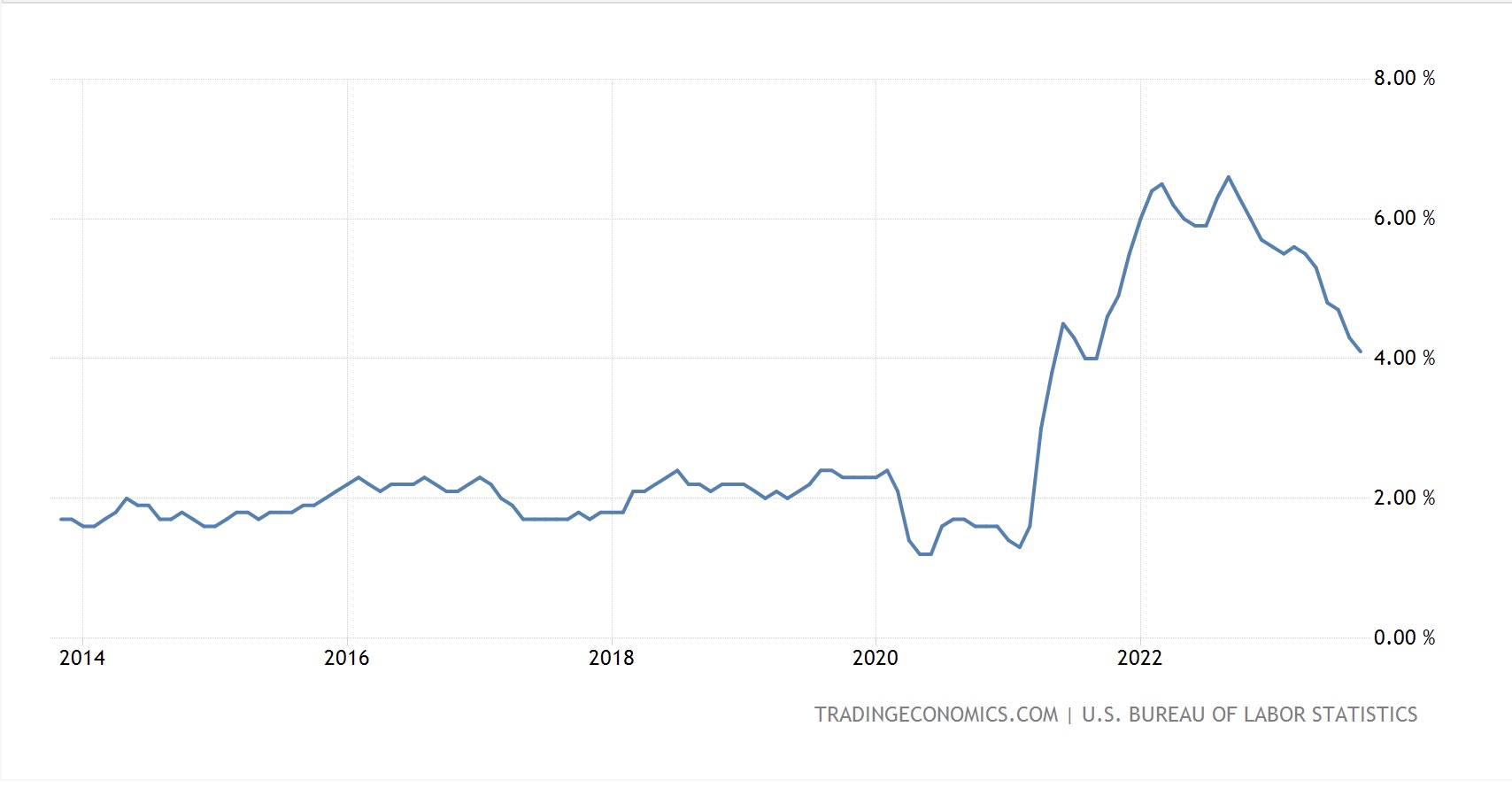
Higher For Longer is Key

As markets await CPI
Some folks have begun to ask why
The Fed needs to keep
Inversion so deep
Since ‘flation is no longer high

Instead, what these folks want to see
Is rates heading back down to three
But Jay’s been quite clear
Throughout this whole year
That higher for longer is key

It has been an extremely quiet evening session with very little in the way of new information for market participants as all eyes are on tomorrow morning’s CPI print in the US.  There were only two pieces of mildly noteworthy data, UK Unemployment rose one tick to 4.3%, as expected and the overall employment report was largely in line with expectations.  As well, the German ZEW Survey showed that while the current situation has actually deteriorated, falling to Covid-like levels, Expectations were marginally less awful than forecast.  But in the end, it is hard to make the case that either of these releases had much of an impact on the market.

On the geopolitical front, much is being made of North Korean leader Kim Jung-Un’s trip to Moscow to meet with President Putin, and ostensibly promise to sell him weapons and ammunition.  But again, this doesn’t appear to have any market impact.  Arguably, of much more importance to the market are two US tech firm stories; first Oracle giving disappointing guidance in their earnings last night indicating that perhaps AI is not actually going to rain money into every tech firm right away, and, second the anticipation of Apple’s release of the iPhone 15 today, as analysts try to determine if that company can continue to deserve its current valuation.  At this hour (7:30), Oracle stock is much lower, about -10%, and the entire US equity futures market is marginally under water as well, but just -0.2% or so.

If I had to characterize today’s market it would be stagnant with a flavor of risk-off.  Given the perceived importance of tomorrow’s data release, and the fact that its timing was well-known in advance, it appears that positions have already been established based on individual views.  The result has been lower volumes and less movement ahead of the release.  As well, absent any Fed speakers it is hard to come up with a reason to adjust any views at this point in time.  So, my sense is we are set for quite a dull session overall.

Perhaps this is a good time to recap the current narrative, at least as I see it.  I believe a majority of market participants believe the Fed is done hiking rates and it is only a matter of time before they start cutting them.  There is a strong belief that the Fed will achieve the much-vaunted soft landing despite the long odds of success on that front and a history that shows they have only ever been able to do so once.  The odd thing about this soft-landing belief is the idea that if the Fed is successful in achieving that outcome with interest rates at 5%, that they would suddenly cut rates afterwards.  I need someone to explain to me why the Fed would change the policy that achieved their goals.  A correlating narrative remains that AI is not merely the future, but the present and that tech stocks can grow to the sky.  And maybe they can, but I would bet the under there.  

And lastly, there is a conundrum in this narrative as the de-dollarization story continues to get a great deal of play.  However, if the Fed is successful and AI really is going to drive tech stocks higher forever, why would the dollar lose its luster?  It seems to me, especially given the fact that Europe and probably China are heading into recession, that the dollar will be in huge demand.  At any rate, my take is those are the underlying theses driving markets right now.

So, a tour of markets overnight shows that bond markets are essentially unchanged, stock markets were mixed in Asia, with Chinese shares under pressure but Japanese and Australian shares ok while European shares are under some pressure, and the dollar is rebounding a bit from yesterday’s sell-off.  Arguably, yesterday’s dollar move was a result of the news from Japan and China, both of whom were unhappy over their respective currency’s weakness, but that is, literally, yesterday’s news.  One last thing shows oil (+0.8%) rallying again with WTI above $88/bbl this morning, a new high for this move, which continues to support all energy prices.  In fact, it is this story, a continued lack of supply in the oil market relative to demand that, regardless of the much-hyped transition to renewables, continues to grow, is going to support the price for a long time to come.  And that is going to continue to pressure prices higher as energy is an input into everything we do, both manufacturing and services.

And that’s really it for today, a very quiet session ahead of the next big data drop tomorrow morning.  Before I end, though, I think it is important to understand the nature of economic forecasting and there is a perfect example right now.  I have frequently mentioned the Atlanta Fed’s GDPNow forecast as a potential harbinger of things to come.  Certainly, the market sees it that way.  Well, other regional Fed banks wanted to have their own versions of that GDP Nowcast and this is what we are currently seeing:

  • Atlanta Fed:     5.7%
  • NY Fed:            2.3%
  • St Louis Fed:    -0.3%

To me, that is a perfect picture of the current situation, proof that nobody has any idea what is going on in the economy.

Good luck

Adf

Selling will be THE New Sport

Last Friday the payroll report
Inspired some bears to sell short
As job growth starts shrinking
It seems that their thinking
Is selling will be THE new sport

But bulls will all argue the Fed
Will act if there’s weakness ahead
Rate cuts will come soon
And yields will then swoon
As stocks rise to green from the red

A brief recap of Friday’s payrolls data shows a mixed picture overall.  The positives were the NFP was higher than forecast, as were manufacturing jobs, and hours worked rose along with the participation rate.  The negatives were that the revisions to previous data were once again lower, the seventh time in the past eight months, and the Unemployment Rate jumped 0.3% to 3.8%.  Not surprisingly, the market response was as confusing as the data with equity markets in the US closing ever so slightly higher on the day while bond yields rose pretty sharply.  The latter was a bit of a surprise as there seemed to have been a growing consensus that we have seen the peak in yields.  I guess, though, if the idea is now there is no recession coming, then higher yields would be appropriate.  And that idea is gaining traction everywhere as evidenced by this morning’s report from the “great vampire squid wrapped around the face of humanity” as described by Rolling Stone Magazine in 2010, aka Goldman Sachs, that they now believe the probability of a recession has fallen to just 15%.

This poet’s view is that Friday’s data was hardly conclusive in either direction for the Fed which will be looking closely at the CPI data to be released next week, as well as myriad other signals on the economy and its prospects ahead of their next meeting in a few weeks’ time.  For instance, the Atlanta Fed’s GDPNow forecast is still at 5.6%, a crazy high number in my view, but one that is likely to have credence with those in the Eccles Building as evidence the economy is still quite strong.

Perhaps the more interesting thing about today’s market activity is that bond yields around the world are higher despite a run of pretty awful Services PMI data across Europe and Asia.  The most notable Asian casualty was China, where the Caixin PMI Servies was released at 51.8, more than 2 points below last month and nearly 2 points below expectations.  Then, we got to see weak prints from Spain, Italy, France, Germany and the UK, all in recession territory below 50.0 and most failing to meet weakened expectations.  Net, the situation doesn’t look that good for the Eurozone as the economy appears to be sliding into a full-blown recession across all nations, while price pressures remain stickily high.  After today’s weak PMI data, the probability of an ECB rate hike in September has fallen to just 25% from 50% last week.  And yet, sovereign yields continue to climb.  They got issues over there!

So, we’ve seen weakness in China and weakness in Europe.  What about the US?  While recent data has begun to disappoint slightly, it is not nearly in the same camp as the rest of the world.  Tomorrow’s ISM Services index is forecast to be 52.5, not huge, but clearly not recessionary.  And, in fact, while the jobs report was mixed, it was not a disaster.  While there is still good reason to believe a recession is coming to the US, perhaps by the end of this year, the US remains well ahead of the rest of the world in terms of growth at this stage.

With that in mind, it can be no surprise that the dollar is soaring today higher against every one of its major counterparts in both the G10 and EMG blocs.  While the particular drivers are different, they are all of a piece in the sense that problems elsewhere are greater than in the US.  In the G10, AUD (-1.45%) and NZD (-1.2%) are the worst performers having fallen immediately after the weak Chinese data.  But the best performer is CAD (-0.4%) to give an idea of just how strong the dollar is today.  In the EMG bloc, HUF (-1.4%) is the laggard after a ruling that the central bank’s losses would not be paid for by the government, but just deferred until they start to make money again.  Meanwhile, they have significant budget issues as well, so both fiscal and monetary concerns there.  But the entire bloc is under pressure, with APAC currencies suffering on the China news while EEMEA currencies feel the pain of a weakening Eurozone.  Today is not indicative of the looming end of dollar hegemony, that’s for sure.

As to yields, as mentioned above they are firmer across the board, with 10yr Treasuries up 4bps and all European sovereigns seeing yields higher by between 2.5bps and 4.0bps.  while I’m no market technician, looking at the below chart (source Bloomberg) of 10yr Treasury yields, it is not hard to see the strong trend higher at this point.

In the equity markets, it is no surprise that Chinese shares were softer, nor most of the APAC markets, although the Nikkei (+0.3%) managed to close higher as the weaker yen improves profit performance for many large Japanese companies.  European bourses are mixed at this hour, with net, little movement and US futures are also mixed, with the NASDAQ a bit softer but the DOW up a touch at this hour (8:00).

Finally, in the commodity space, oil (-0.5%) is under some pressure this morning, although given the magnitude of the dollar’s strength, I would have thought we would see much more pressure on the commodity markets.  It seems that the Saudi production cuts are having their desired impact and are likely to continue to push prices there higher.  Of more interest is the fact that gold (-0.4%) is retaining most of its recent gains despite a strong dollar, indicating that there is buying interest all over the place for the barbarous relic.  Base metals this morning are somewhat softer, which is to be expected given the PMI data.

Speaking of data, because the payroll data was so early this month, this week is pretty quiet with CPI not released until next week.  However, here is what is on the calendar:

TodayFactory Orders-2.5%
 -ex Transports0.1%
WednesdayTrade Balance-$68.0B
 ISM Services52.5
 Fed Beige Book 
ThursdayInitial Claims234K
 Continuing Claims1715K
 Nonfarm Productivity3.4%
 Unit Labor Costs1.9%
FridayConsumer Credit$17.0B

Source: Bloomberg

On the Fed front, we hear from 7 speakers plus retired St Louis Fed President Bullard over 10 events this week.  As we approach the quiet period starting Saturday, the most noteworthy comments since Powell’s Jackson Hole speech have been from Harker who thought that enough has been done and cuts next year made sense.  It will be key if we hear other Fed speakers reiterate that sentiment or continue to push back.  This week, NY Fed President Williams is probably the most impactful speaker on the docket. 

In the end, while I definitely see signs of macroeconomic weakness in the US, they are much less concerning than those elsewhere in the world and so nothing has changed my view of dollar strength for the time being.

Good luck

Adf

Xi Jinping’s Dreams

The 30-year bond was a flop
Which helped cause an interest rate pop
Though CPI rose
A bit less than pros
Expected, risk prices did drop

Then early this morning we learned
That lending in China’s been spurned
It certainly seems
That Xi Jinping’s dreams
Of rebounds might soon be o’erturned

For all the bulls out there, yesterday must be just a bit disconcerting.  First, the highly anticipated July CPI data was released at a slightly lower than expected 3.2% headline number with core falling 0.1% to 4.7%, as expected.  As always when it comes to CPI data, there were two immediate takes on the result.  On one side, inflationistas pointed out that the future will be filled with higher numbers going forward as base effects for the rest of 2024 kick in with very low comparables in 2022.  They also point to the medical care issue, a detail I have not discussed, but which has to do with a change made by the BLS that has been indicating medical care prices have fallen all year, but which will fall out of the mix starting in September, thus reversing one of the drags we have seen on CPI.  And finally, the rebound in energy prices is continuing (oil +0.4% today) and will be a much bigger part of future readings.  This story was underpinned today by the IEA reporting a new record demand for oil in July of 103 million bbl/day.  Demand continues to support prices here.

Meanwhile, the deflationistas point to the recent trend in prices, which shows that on a 3-month basis, or a 6-month basis, if annualized, CPI is really only running at 2.4% or 2.9% or something like that.  The implication is because we have seen a reduction in the monthly number lately, that will continue.  As well, they make the case that China’s deflation is a precursor to lower US inflation with, I believe, a roughly 6-month lag.  Perhaps the most interesting take I saw was that the Fed has now achieved their goal of an average PCE of 2% if you take the last 14 years of data.  The idea is that Average Inflation Targeting was designed to have the economy run hot for a while to make up for the ‘too low’ inflation that has been published since the GFC.  And now, that average is 2.07% for the past 14 years.  (To me, the last idea is a chart crime, but I digress.)

The problem, though, for the bulls, is that the market’s behavior was not very bullish.  Although the initial move in Treasury yields was lower, with the 10-year yield falling 6bps right after the release, the 30-year Treasury auction that came later in the day was not nearly as well-received as the shorter dated paper seen earlier in the week.  The bid/cover ratio was only 2.42 and it seems that the market may be feeling a little indigestion from all the new paper just issued, as well as the prospects for the additional nearly $1.5 trillion left to come in 2023.  It is not hard to believe that longer end yields could rise further as the year progresses.  The upshot was 10-year yields rose 10bps on the day and are unchanged from there this morning.

Similarly, in the equity markets, the initial surge on the back of the slightly softer CPI was unwound throughout the day and though all three major indices ended the day in the green, the gains were on the order of 0.1% or less, so effectively unchanged.  Looking at futures there today, all three indices are unchanged from the close as investors and traders look for their next inspiration.  Meanwhile, I cannot ignore that overnight, Asian equity markets all fell, with the CSI 300, China’s main index, down -2.30%.  As well, European bourses are all lower this morning, mostly on the order of -1.0%.  Overall, this is not a positive risk day.

One of the things adding to the gloom is the financing data from China released early this morning.  New CNY Loans fell to CNY 345.9 billion, less than half the expected amount and down from >CNY 3 trillion in June.  M2 Money Supply there also grew more slowly than expected at just 10.7% as it seems that China’s debt woes are increasing.  China Evergrande was the first Chinese property company that gained notoriety for its problems, but Country Garden was actually the largest property company in China and now that looks to be heading toward bankruptcy.  

A quick tour of China shows it has a number of very big problems with which to contend.  Probably the biggest problem is demographics as the population begins to shrink.  However, two other critical issues are the massive amount of debt that is outstanding there (not dissimilar to the US situation) but much of it is more opaque sitting on the balance sheet of local government funding vehicles.  Just like in the West, this debt will not be repaid in full.  The question is, who is going to take the losses?  In China, the central government is trying to foist those losses on the local governments, but that will be a long-term power struggle despite President Xi’s ostensible powers.  Finally, the massive youth unemployment situation is simply dry tinder added to a very flammable mixture already.  This is not a forecast that China is going to implode, just that the claims that it is set to ascend to global superpower status may be a bit premature.

(By the way, for all of you who think a BRICS gold backed currency is on the way, ask yourself this question.  Why would India and Brazil want to link up with a nation with awful demographics and a gargantuan debt problem and link their currency to that?)

Finishing up, we have a bit more data this morning led by PPI (exp 0.7% Y/Y, 2.3% Y/Y ex food & energy) and then Michigan Sentiment (71.3) at 10:00.  With CPI already released, PPI would need to be dramatically different from expectations to have much of an impact at all.  There are no Fed speakers today, but yesterday we heard that there is still more to do by the Fed from both Daly and Bostic, and Harker did not repeat his idea that cuts were coming soon.

The dollar is mixed today, with Asian currencies under pressure, EEMEA and LATAM currencies performing well and the G10 all seeming in pretty good shape, although NOK (-0.7%) is under pressure after a much softer than expected CPI number yesterday has traders unwinding some future interest rate hikes.

Speaking of future interest rate hikes, the Fed funds futures market is down to a 10% chance of a September rate hike by the Fed, although there is still a ton of data yet to come, so that is likely to change a lot going forward.  My sense is that a little bit of fear is building in risk assets as despite some ostensible good news, with lower inflation and less chance of a Fed rate hike, risk is under pressure.  One truism is if a market cannot rally on good news, then it is likely to fall, especially if something negative shows up.  In that case, I suspect that we could see weakness in equities today, weakness in bonds and strength in the dollar before it is all over for the week.

Good luck and good weekend

Adf

Small Beer

The market has made it quite clear
That over the course of next year
The interest rate Jay
Is willing to pay
On Fed funds will soon be small beer

The key to this view is the thought
Inflation will soon fall to naught
But if that is wrong
It will not be long
Ere stocks will be sold and not bought

As the market braces for today’s CPI data, investors and traders continue to home in on the view that the soft-landing scenario is the most likely.  While US equity markets sold off yesterday afternoon, futures this morning are higher across the board by about 0.5% and European bourses are also all higher.  In other words, fear is not in today’s lexicon as concerns over continuing gains in inflation quickly dissipate and the narrative focuses on said soft-landing.

A quick look at today’s data expectations shows the following according to Bloomberg:

Initial Claims230K
Continuing Claims1707K
CPI0.2% (3.3% Y/Y)
-ex food & energy0.2% (4.7% Y/Y)

I’m sure you all remember that last month’s CPI reading was 3.0%, which was widely touted as a sign the Fed has been successful in their efforts to slow price increases.  Of course, the reason the headline number fell so far was the base effect as in 2022, June’s monthly reading was +1.2% which drove the Y/Y number then to the cyclical high of 9.1%.  With that data point falling out of the mix, the comparison changed dramatically.  Here’s the thing, July 2022’s monthly print was 0.0%, so those same base effects are going to push the headline number higher. 

Now, if you annualize 0.2% it comes to a bit more than 2.4% inflation, so if the monthly number can maintain this level, the Fed will truly have achieved their goal.  Alas, oil (+15.8%) and gasoline (+11.2%) both rose sharply in the month of July and so that headline number seems likely to be higher.  The Cleveland Fed’s CPI Nowcast (similar to the Atlanta Fed’s GDP Nowcast) is pointing to a monthly CPI increase of 0.41%.  My suspicion is that we are going to see a hotter CPI number today and that is likely to be met with a little bit of concern, especially by risk assets that are counting on that soft-landing.

As long as the narrative continues to look for that soft-landing success, it opens up the risk of a significant repricing.  While Philly Fed president Harker was the first to talk about rate cuts next year, the futures market has been all-in on that view for quite a while.  A firm number today will bolster Powell’s ‘higher for longer’ narrative at the expense of those rosy views.  Be prepared for some market volatility today, especially in the bond market.

Speaking of the bond market, yesterday’s 10-year auction went pretty well as the clearing yield was (barely) below 4.00% at 3.999%.  The bid/cover ratio was a healthy 2.56, meaning there were bids for slightly more than $97 billion for the auction of $38 billion in new paper.  Today brings the final leg of the quarterly refunding with $23 billion of 30-year bonds to be auctioned.  At this hour (7:00) the 30yr yield is 4.17% with the 10yr yield at 4.00%.  A high CPI print could wind up costing the US government a bit more if yields move higher on the news, just another reason this CPI print will be so closely watched.  Meanwhile, European sovereigns are all softer this morning with yields edging higher by roughly 2.5 basis points across the board, and we saw higher yields across Asia as well, with JGBs rising 2bps, although still below the 0.6% level.  So far, Ueda-san has not had too much difficulty managing the yield there.

Turning back to the commodity markets, oil is little changed this morning, consolidating its recent gains, but certainly not showing any signs of reversing course.  Despite China’s lackluster economic performance, the supply situation continues to underpin oil prices.  Remarkably, despite all the focus on the need to reduce the use of fossil fuels, and the weaker than forecast Chinese economy, demand for oil continues to increase with the IEA raising its forecast for the next several years.  At the same time, oil companies are feeling only modest pressure to drill more, and instead are enjoying the fruits of their current production by repurchasing shares and paying large dividends to their shareholders.  In other words, it seems that supply is unlikely to ramp up to meet this increased demand and that can only lead to even higher oil prices over time.  $100/bbl seems quite realistic within the next 12 months, and that doesn’t assume any additional price shocks like we saw in the Russian invasion of Ukraine.  But while oil is on hold today, the metals markets are feeling a bit better with both precious and base metals rising nicely on the session.

Finally, the dollar is softer pretty much across the board this morning with AUD (+0.6%) the leading G10 gainer although virtually the entire bloc is higher by between 0.3% and 0.5%.  The exception to this is JPY, which is unchanged on the day.  The yen continues to chart its own course lately as uncertainty about the ultimate outcome in the JGB market and any further monetary policy changes has traders and investors treading fearfully.  It remains the favored funding currency given its still lowest rates in the world, but the prospect of that changing has many traders on constant edge.

As to the emerging markets, they too are seeing strength virtually across the board with HUF (+1.3%) and ZAR (+1.2%) the leaders as both are benefitting from their high nominal interest rate carry.  After that there is a long list of currencies that are firmer by between 0.25% and 0.5% and only one laggard, THB (-0.5%) which continues to suffer from political uncertainties over the ability to establish a government there after the recent election.

And that is really the story today.  We hear from three more Fed speakers; Daly, Bostic, and Harker, so it will be interesting to see if either of Daly or Bostic hint at rate cuts next year.  All three are scheduled to speak after the CPI release, which if firm is likely to quash any hopes for that.  My take is that a hot CPI number will help to reverse some of the dollar’s losses, but a soft number could easily see the dollar slide further.

Good luck

Adf

Weakness is Fleeting

Two narratives are now competing
Recession, the first, is retreating
No-landing is rising
As those analyzing
The data claim weakness is fleeting

But what of the curse of inflation
Which for two years has gripped the nation
Is it really past
Or are we too fast
To follow that interpretation?

Friday’s employment data was, for a second consecutive month, a bit lower than the median forecast of economists.  However, it was still reasonable at 187K new jobs.  One of the positive aspects was the decline in the Unemployment Rate to 3.5% although from an inflation perspective, Average Hourly Earnings (AHE) rose more than forecast.  In a way, there was something for everyone in the report with the recessionistas highlighting the decline in average weekly hours and the fact that last month’s data was revised down for the 6th consecutive month, typically a very negative signal.  However, the no-landing crowd points to the AHE data as well as the Unemployment Rate and claim all is well.

Of course, ultimately, the opinion that matters the most is that of Chairman Powell and his acolytes at the Fed.  Are they glass half full or glass half empty folks?  I have been highlighting the importance of the NFP data as I believe it remains the fig leaf necessary for the Fed to continue to raise interest rates if they want to in their ongoing efforts to rein inflation back to their target level.  My sense is that Friday’s data will not dissuade them from hiking rates in September if they decide it is still appropriate, but it could also be argued as a reason for another pause.  Certainly, there is nothing about the data that would indicate a rate cut is on the table anytime soon.  And remember, we will see the August report shortly after Labor Day, which comes before the next FOMC meeting, so still plenty of information yet to come.

Which brings us to this week’s numbers on Thursday and Friday when CPI and PPI are set to be released respectively.  While we all understand that the Fed’s models use core PCE as their key inflation input, we also know that CPI, especially core -ex housing, has been a recent focus for Powell and that is the number that gets the press.  You may recall that last month, the headline CPI number printed at 3.0%, it’s lowest since early 2021, and was widely touted as proof positive that the Fed was close to achieving their objective.  Alas, energy prices have done nothing but rise in the ensuing month and given the ongoing reductions in production by OPEC+, it seems unlikely that we are done with this move.  In fact, ironically for the no-landing crowd, if there is no landing and supply continues to shrink, energy prices, both oil and gasoline, will likely continue to rise as well, putting significant upward pressure on headline CPI.  If CPI is rising it will be extremely difficult for Powell to consider anything but more rate hikes.

Currently, the market is pricing a very low probability of a September rate hike by the Fed, just 16%, so there is ample room for repricing if the data comes in hot.  Surprisingly, the market is pricing in a higher probability of an ECB hike, 38% in September, despite the fact that Madame Lagarde essentially told us at the last meeting they were done.  My suspicion is that there is room for a more negative outcome in the interest rate space going forward.  One other tidbit this morning is the Cleveland Fed has an CPI Nowcast, similar to the Atlanta Fed’s GDPNow but for inflation, and that number is currently 0.41% for July, well above the market median forecast of 0.2%.  The point is there is room for a negative inflation surprise and the knock-on effects of such a result would likely be risk negative.  Just sayin’.

Meanwhile, Friday’s equity market reversal in the US has mostly been followed around the world with red the dominant color on screens in the major markets.  In Asia, while the Nikkei managed to eke out a small gain, China and South Korea both saw renewed selling.  As to Europe, all markets are lower on the order of -0.25% to -0.5% at this hour (7:30).  However, US futures are currently edging higher on what seems to be a reflexive bounce rather than a fundamental opinion.

Bond markets, though, are reversing much of Friday’s rally with 10-yr Treasury yields higher by 7bps this morning and most European sovereign yields up a similar amount.  Friday saw a sharp rally on the headline NFP number which served to force the hand of many short sellers in the Treasury market.  Recall, heading into the release, there was a growing consensus, especially after a particularly strong ADP Employment number, that the no-landing scenario was the most likely and that would mean higher yields for longer.  In addition, the market was informed of the extra $1.9 trillion in Treasury issuance that was coming the rest of the year, with the bulk of that coming out the curve, rather than in the T-bills that have been the focus to date.  It feels like the short-selling crowd is getting back on board and the weight on prices of excessive issuance and the Fed’s ongoing QT program means higher yields should be expected.  

As to oil prices, while they are lower this morning by -0.7%, they remain well above $80//bbl and appear to be consolidating ahead of the next attempt to break above key technical resistance at $85/bbl.  Absent a very severe recession, which has not yet shown up, it is hard to make the case for a large decline in this sector of the market.  Metals markets are far more benign this morning with tiny gains and losses as traders continue to try to figure out if there is a recession coming.

Lastly, the dollar’s demise, which is touted on a weekly basis by pundits everywhere, will have to wait at least one more day as the greenback is stronger vs. essentially every one of its major counterparts.  There is still a strong relationship between US Treasury yields and the dollar, and with higher yields, it is no surprise the dollar is higher.  Consider, too, the fact that the market is pricing such a small probability of a Fed funds hike next month.  If (when?) that pricing changes, I expect the dollar to benefit greatly.

On the data front, there is a bit more than CPI and PPI, but not much:

TodayConsumer Credit$13.55B
TuesdayNFIB Small Biz Optimism90.5
 Trade Balance-$65.0B
ThursdayInitial Claims230K
 Continuing Claims1710K
 CPI0.2% (3.3% Y/Y)
 -ex food & energy0.2% (4.8% Y/Y)
FridayPPI0.2% (0.7% Y/Y)
 -ex food & energy0.2% (2.3% Y/Y)
 Michigan Sentiment71.5

Source: Bloomberg

In addition to the data, we have three Fed speakers, Bostic, Bowman and Harker, each speaking twice this week.  Ultimately, my take is that Friday’s NFP data did nothing to change the current Fed calculus and higher for longer remains the operative thought process.  As to the dollar, if we continue to see Treasury yields rise, which I think is the most likely scenario, then I suspect the dollar will find buyers.  For those of you awaiting a sharp dollar pullback to establish hedges, you may be waiting quite a while.

Good luck

Adf

Demimonde

There once was a government bond
About which investors were fond
Regardless of yield
Their safety appealed
But lately, they’ve turned demimonde

So, as we await Payroll data
Demand has just started to crate-a
As yield keeps on rising
More folks are downsizing
Positions today and not late-a

It’s Payrolls Day and market participants are all anxiously awaiting the news at 8:30. Recall, last month, for the first time in more than a year, the NFP number printed slightly lower than the median forecast and that was seen as proof positive that the soft landing was on its way.  Subsequently, headline CPI fell to its lowest in two years as a confirmation of that process, and market participants decided, as one, that risk was the thing to own.  Equities rallied, bond yields fell and there was joy around the world markets. 

But lately, that story is having a rougher go of things as 10-year Treasury yields have jumped 43bps from their levels following the CPI release even though the PCE data was similarly soft.  What gives?  Arguably, part of this is because energy prices have rebounded sharply since last month, so it is increasingly clear that next week’s CPI data is going to higher than last month’s number.  As well, the growing confidence in the soft-landing scenario, which is touted across mainstream media constantly, implies that rate cuts may not be necessary.  After all, if Fed funds are at 5.5% and GDP is growing at 2.5% and Unemployment remains below 4.0%, why would the Fed change its policy rate?  The answer is, they wouldn’t.  At the same time, in the event the economy is clearly growing with positive future prospects, it is very likely that the yield curve will steepen back to a ‘normal’ shape with longer dated yields higher than short-dated yields.  If the Fed is not going to cut, that means the back end of the curve must see yields rise.  The current 2yr-10yr inversion is down to -74bps, so another 100bp rise in 10-year yields would seem realistic.

Of course, the question is, how would risk assets behave in that scenario?  And the answer there is likely to be far less positive.  After all, if risk free returns for 10 years were at 5+%, equities would need to offer a very good return opportunity to attract investors.  While there will be some companies that offer that, I suspect there are many more that would be shunned and need to reprice substantially lower to become attractive.  In other words, investors will want much lower entry prices to get involved and that could see a pretty big sell-off in the equity markets.  Just one possible scenario, but one with a decent probability of occurring, I think.

But that is all future prognostication.  In the meantime, let’s look at what the current consensus forecasts are for today:

Nonfarm Payrolls200K
Private Payrolls180K
Manufacturing Payrolls5K
Unemployment Rate3.6%
Average Hourly Earnings0.3% (4.2% Y/Y)
Average Weekly Hours34.4
Participation Rate62.6%

Source: Bloomberg

Wednesday’s ADP number was much higher than expected at 324K although the prior blowout number, 497K in June, was revised lower by 42K.  Still, 455K was much larger than the BLS report so there are many questions as to whether we will see a similar outcome today, a softer NFP number despite a very strong ADP number.  Looking at other indicators, the Initial Claims data continues to improve, hovering around 225K.  The JOLTS data was slightly softer than expected, but still right around 9.6 million and well above levels prior to the pandemic.  And finally, if you look at the employment subsets of the ISM data, they were soft in manufacturing, but solid in services, and services is a much larger part of the economy.

My take is the market is going to behave very clearly based on the actual outcome.  A strong number, anything over 225K, is likely to see the bond market sell off further and I wouldn’t be surprised to see 10-year yields, which have edged up another basis point this morning to 4.19%, trade back above the levels seen last October at 4.25% or more.  That will not be a positive for the stock markets as it will reintroduce the idea the Fed is going to continue to raise rates, something the market has completely priced out at this point.  Similarly, a soft number will open the door to a sharp equity rally and bond rally, with yields likely to even test the 4.0% level if the NFP number is soft enough.  I think we need a 100K or less number for a reaction like that.

Ahead of the data, there seems to be a growing concern over the outcome.  While Asian markets rebounded a bit, European bourses have started to fall across the board from earlier levels and are now all down by between -0.2% and -0.5%.  US futures, too, are now back to unchanged having spent the bulk of the evening higher on the back of a strong earnings report from Amazon.  

Bond markets are under pressure as energy prices around the world are rising, as are food prices, and so inflation prospects seem to be worsening.  This is despite the very earnest efforts of central banks around the world to convince us all that inflation has peaked, and they are near the end of their hiking cycles.  After the BOE raised rates by 25bps yesterday, the market has reduced the expected UK terminal rate down to 5.75%, two more hikes despite CPI running at 7.9% with Core at 6.9%.  In the Eurozone, the ECB has released a new report claiming that inflation has peaked as well, and the market has priced out any further rate hikes.  This all smacks of whistling past the graveyard in my view.

For instance, oil (+0.35%) is higher again, up more than 14% in the past month, and shows no signs of slowing down.  Not only did Saudi Arabia extend their one million bbl/day production cut for another month, but Russia now claims it will cut production by 300K bbl/day in September as well.  I haven’t discussed food prices in a while as they had eased off from the immediate post invasion highs, but the FAO Food price index rebounded last month and despite a sharp decline from its highest levels last year, is still at levels that have caused riots in the streets of African nations in the past.  Metals prices are also under pressure today, but that seems more to do with the strong dollar than anything else.  

Turning to the dollar, it is once again seeing demand as only NOK (+0.2%) has managed to gain on the greenback in the G10 space, although the other currencies’ losses are not large.  The same cannot be said for the EMG space where the APAC bloc is under real pressure led by KRW (-0.8%) and THB (-0.4%) on the dual concern of a slower growing China and broad risk-off sentiment.  One thing that seems likely is the dollar will benefit from a strong NFP print and suffer from a weak one.

And that’s really it for the day.  No Fed speakers are on the docket, but do not be surprised to hear some interviews if the number is very different from the forecasts.  In the end, nothing has changed my view that inflation will remain stickier than forecast and the Fed will hold tight thus supporting the dollar.  Remember, the combination of tight monetary and loose fiscal policy is the recipe for a strong currency.  And the US is running that in spades!

Good luck and good weekend

Adf

Resolutely

Said Jay to the world through the Press
We’ve certainly had some success
But patience is key
As resolutely
We stop any signs of regress

Does this mean that next time we meet
Our actions will be a repeat?
The answer is no
We’re not certain, though
We could if inflation shows heat

And what about Madame Lagarde
Have she and her minions been scarred
By Europe’s recession
Or will their suppression
Of growth lead to outcomes ill-starred

By this time, you are all almost certainly aware that the Fed raised the Fed funds rate by 25bps as widely expected.  You may not be aware that the FOMC statement was virtually identical, with only a change in the description of economic growth from ‘modest’ to ‘moderate’, apparently a slight upgrade.  This was made clear when Chair Powell, at the press conference, explained the Fed staff was no longer forecasting a recession in the US.  Perhaps the following Powell quote best exemplified the outcome of the meeting, “We can afford to be a little patient, as well as resolute, as we let this unfold,” he said. “We think we’re going to need to hold, certainly, policy at restrictive levels for some time, and we’d be prepared to raise further if we think that’s appropriate.”  

So, what have we learned?  I think we can sum it up by saying nothing has changed the Fed’s mindset right now.  They continue to focus on the fact that inflation remains above their target and will continue to implement policies that they believe will address that situation. 

The thing that makes this so interesting is everybody seems to have a different interpretation of what that implies.  The two broad camps are 1) this was the last hike as inflation continues to fall and they are already hugely restrictive compared to their historical activities; and 2) given the upgrade in economic forecast, and the fact that inflation seems set to remain higher than target for a long time yet, there are more hikes to come.Given the math that goes into the CPI data, it is quite easy to forecast Y/Y CPI if you assume a particular M/M figure for the next period of time.  BofA put out a very good chart showing the potential evolution of headline CPI going forward.

The implication here is that unless the M/M data falls to zero or negative, CPI is going to start climbing again.  The Fed clearly knows this as does the market.  The only disconnect is the question of how the Fed will respond in the various cases.  Remember, too, that oil and gasoline prices have risen 13.7% and 11.2% respectively in the past month.  The idea that the energy component of CPI will do anything but rise sharply this month seems absurd.  As such, I expect that the Fed will continue to lean toward another hike going forward.

The problem they have had is that the pass-through from Fed rate hikes to the economy has been greatly diminished by their previous policy of excessive ZIRP.  It is estimated that roughly 80% of US home mortgages have fixed rates below 4%, with half at 3% or less.  At the same time, the average duration of corporate debt has lengthened to 6.4 years as the refinancing activity that occurred during the ZIRP period saw extension of tenors widespread.  As such, other than the Federal government, who managed to shorten the duration of their outstanding debt during the period of ZIRP, most borrowers are in pretty good shape and not impacted by the Fed’s policies.  In fact, they are earning much more on their cash balances.  The point is, there is a case to be made that the Fed can maintain ‘higher for longer’ for quite a while without having a significantly deleterious impact on the economy.  Perhaps the soft landing is possible after all.

Now, if they continue to hike rates, and there are a number of analysts who believe we are heading to 6% or beyond, things may change.  We are already seeing a significant diminution of demand for bank loans, which while that may not bother large corporates, implies that the SME sector is going to break first.  Does the Fed care about them?  They will only care when the Unemployment Rate rises substantially.  This comes back to why I believe that NFP is still the most important data point, regardless of the inflation discussion.  Summing it up, the Fed will see two more CPI, PCE and NFP reports before they next meet on September 20th.  It is impossible, at this time, to estimate their actions with this much more data still to be digested.  However, if my inflation view is correct, that it will remain stickily higher, I see a very good chance of at least one more Fed funds rate hike.

A quick look across the pond shows that the ECB will be making their latest rate decision this morning with the market expecting a 25bp hike.  Unlike in the US, the OIS market is pricing in one further hike after today’s and then that will be the end of the cycle.  But…can Madame Lagarde continue to tighten policy if Europe is actually in a recession?  We already know that Germany is in a recession, and forecasts for Q2 GDP in Europe, to be released next week, are at 0.3%.  The Citi Economic Surprise Index remains mired at -136.7, a level only seen during Covid and the GFC, hardly the comparisons desired.  I believe it will be much tougher for an additional rate hike by the ECB unless the data story turns around quickly, and I just don’t see that happening.  Overall, it is this dichotomy in economic activity that underlies my bullish thesis on the dollar.

At any rate, the market response to the FOMC has been one of sheer joy.  Well, that and the fact that there are still some pretty good earnings results getting released, at least relative to recent expectations, if not on a sequential basis.  But it is the former that matters as that is what gets priced into the market.  So, equity markets, after yesterday’s breather in the US where they didn’t rise sharply, are mostly higher around the world.  Both the Hang Seng and Nikkei rallied nicely, and European bourses are quite robust this morning, with many exchanges higher by > 1%.  US futures, too, are in the green, with the NASDAQ showing great signs of strength.

Meanwhile, bond yields have edge a touch lower virtually everywhere with most of Europe seeing declines between 1bp and 2bps, although Treasury yields are less than 1bp lower this morning.  There appears to be little concern that Madame Lagarde is going to spoil the party and sound uber hawkish.  Even JGB’s are a touch softer, -0.4bps, as the market prepares for tonight’s BOJ announcement.  However, there is absolutely nothing expected out of that meeting.

In the commodity space, oil (+1.1%) is higher again this morning as are gold (+0.25%) and the base metals (CU +0.1%, Al +0.6%).  The soft(no) landing scenario seems to be gaining some traction here.  Either that, or the dollar’s weakness today, which is widespread, is simply being reflected as such.

Speaking of the dollar, it is definitely on its back foot as the market is essentially saying the Fed is done.  It is softer vs. the entire G10 bloc, with NOK (+1.05%) leading the way on the back of oil, but SEK (+0.9%) and NZD (+0.7%) also rising nicely alongside the commodity space.  Even the euro, which has no commodity benefit whatsoever, is firmer this morning by 0.5% as the market awaits Madame Lagarde.

In the emerging markets, the picture is similar with almost every currency firmer vs. the buck led by HUF (+1.1%) and ZAR (+0.8%).  The rand is clearly a commodity beneficiary, while the forint has gained after a story about the ECB being willing to consider Hungarian legislation that will avoid the need to recapitalize the central bank despite its recent losses.  Meanwhile, the laggard is KRW (-0.25%) which seems to have responded to the widening interest rate differential between the US and South Korea.

On the data front, we see Q2 GDP (exp 1.8%, down from 2.0% initially reported), Durable Goods (1.3%, 0.1% ex Transport), Initial Claims (235K) and Continuing Claims (1750K) along with several other tertiary figures.  There are no Fed speakers on the docket for the next week and I suppose that given the relative calm following yesterday’s meeting, there is not a great deal of near-term concern they need to change any views.  I suspect that if tomorrow’s PCE data surprises, we could start to hear more soon.

Today, the mood is risk on and sell dollars.  Barring a remarkable surprise from Lagarde, I would not fade the move.

Good luck

Adf

A Bad Dream

The narrative’s gaining more steam
With landings, so soft, the new theme
In England today
They’re trying to say
Inflation was just a bad dream

The problem is that on the ground,
In Scotland and Wales and around,
Is incomes keep lagging
With purchases sagging
Which pressures the Great British pound

The biggest story of the morning has clearly been the UK inflation data which saw CPI fall back below 8.0% Y/Y for the first time in more than a year.  Granted, 7.9% is not that far below 8% and certainly still miles above the BOE target, but the decline was substantially more than had been expected by the analyst community as well as the market.  For instance, 10-year Gilt yields have tumbled -17.5bps and are now lower by 50bps since the peak two weeks’ ago and back to their lowest level since early June.  2-year Gilt yields have fallen even further, -25bps, so the market is really quite positive on this outcome.

It should be no surprise that UK equity markets have rallied as well, with the FTSE 100 the leading gainer in Europe, up 1.5%, nor should it be a surprise that the pound has fallen sharply, -1.0%, as traders re-evaluate the idea about just how much the BOE is going to raise rates going forward.  Prior to this release, the OIS market had been pricing in a terminal interest rate at 6.1%, implying at least 4 more rate hikes by the BOE.  But this morning, traders have removed one of those hikes from the curve and the excitement over further potential declines is palpable.

Now, the inflation news in Europe is not all rosy as the final release on the continent showed that core CPI turned out to be a tick higher at 5.5% in June, clearly an unwelcome result.  And remember, it was just yesterday that we heard from Klaas Knot implying that while a hike next week is a given, nothing is certain past that.  So, the question, currently, is will the ECB look through a revision to continue their more dovish stance?  I guess we’ll find out next week.  

But here’s an interesting tidbit regarding Europe, and something you need to consider when it comes to both investments and market outcomes there, electricity demand is falling there amid deindustrialization on the continent.  The IEA just issued their latest Electricity Market Report and the reading was not pleasant for Europe.  Consider that in the US, the combination of reshoring and the impact of the (ironically named) Inflation Reduction Act, as well as the CHIPS Act, has driven a marked increase in industrialization in the US.  Meanwhile, in Europe, the loss of their cheap energy from Russia combined with their climate goals has resulted in industry fleeing the continent.  For everyone who is long-term bearish the dollar, you better be far more bearish the euro given this new reality.  Remember, energy consumption is the mark of a growing and healthy economy.  When it is declining, absent extraordinary productivity/efficiency gains, it bodes ill.  If anything, the increasing reliance on less dense energy sources like wind and solar just reduces energy efficiency.  Be wary.

But, away from that news, things are a bit more confusing.  For instance, virtually all European bourses are higher this morning, albeit not as much as the FTSE 100, but in Asia, while the Nikkei (+1.25%) had a good session, Chinese equities were under pressure.  Yes, US markets yesterday continued their rally as earnings data has been able to beat the much-reduced estimates although futures this morning are essentially unchanged.  But arguably, we can describe the equity picture as risk-on.  

The same cannot be said for the bond market though, where yields have fallen everywhere, again, just not as much as in the UK.  Treasury yields are down another 2bps, and most European sovereigns are also seeing modest yield declines, not the typical risk-on behavior.  In fact, given the Eurozone CPI release, it would not have been surprising to see yields climb a bit.

As to the commodity space, oil is essentially unchanged on the day, but WTI is back above $75/bbl with Brent right at $80/bbl after several strong sessions.  There has definitely been a renewed focus on the bullish supply story in oil as opposed to the recession discussion of late.  At the same time, gold (-0.3%) which has rallied nicely during the past week, up nearly 2%, is holding the bulk of its gains.  Alas, the base metals continue to lag, with both copper and aluminum softer on the day.  Perhaps they didn’t get the bullish memo!

Finally, the dollar is quite robust this morning, which is not what one might expect given the equity and bond moves.  In fact, it is firmer vs. the entire G10, with the pound the laggard, as would be expected given the inflation data and falling UK rates.  But as well, the yen (-0.8%) is under pressure along with AUD (-0.7%) and the whole lot.  Regarding the yen, it has been rallying sharply of late, up more than 5% during July until yesterday.  That seems to be on an increasing belief that the BOJ, which meets next Friday, is going to tweak its policy in a tighter fashion, whether that involves YCC or rates or QE.  Now, these stories have not disappeared, I just think that we are seeing a bit of a breather for this move.  Remember, the yen has been the funding currency of choice for every asset all year as the BOJ remains the only central bank that hasn’t tightened policy at all.  This month appeared to be profit-taking ahead of potential BOJ activity, and last night appears to be a simple trading bounce.  FWIW, I do not believe the BOJ is ready to adjust its policy yet as the big review has just begun.  And as I have written before, it doesn’t appear that the rising inflation pressures in Japan have yet become a major political liability for PM Kishida, so there is only limited pressure to make a change.  For now, I would rather be short than long the yen.

Turning to the EMG bloc, only THB (+0.5%) is firmer this morning as the political machinations continue there in the wake of the recent election. In a nutshell, the winner of the election to replace the military junta is clearly not favored by the powers-that-be, and is being disqualified on a technicality, but another member of the coalition seems to be getting closer to taking the reins, with optimism building.  But aside from that story, the dollar is firmer vs. the entire bloc as we are seeing a solid trading bounce in the greenback after several days/weeks of weakness.

On the data front, yesterday’s Retail Sales data was disappointing, and the IP and Capacity Utilization data were awful.  Obviously, that didn’t hurt equities which remain disconnected from any macro data at this point.  This morning brings the Housing Starts (exp 1480K) and Building Permits (1500K) data, although if Retail Sales didn’t have an impact, it is hard to believe the housing data will.  

I remain uncomfortable with the equity market’s ongoing rally as I fail to see the underlying strength in the economy or earnings.  Certainly, recent dollar weakness has helped goose the stock market a bit, but I would not be surprised to see things start to turn around in the near term, meaning the dollar rebounding after its recent sell-off and the equity market seeing some profit-taking.

Good luck
Adf

A Series of Fails

The narrative that we’ve been fed
Explains a soft landing’s ahead
With CPI falling
And job growth enthralling
The equity bulls lack all dread

But part of this thesis entails
That Chinese expansion prevails
Alas for that view
The data that’s new
Shows Xi’s had a series of fails

Pop quiz: what do you call an economy that demonstrates anemic economic output with relatively high inflation yet relatively low unemployment?  The future.  In truth, I don’t think economists have come up with a new descriptor for the situation to where we are headed.  Stagflation may be appropriate, but the key outlier in this scenario is the low unemployment situation.  To help better understand how a recession is defined in the US (as opposed to the shorthand view of 2 consecutive quarters of negative real GDP growth), here is an excerpt directly from the NBER’s website describing the things they consider [emphasis added]:

“Because a recession must influence the economy broadly and not be confined to one sector, the committee emphasizes economy-wide measures of economic activity. The determination of the months of peaks and troughs is based on a range of monthly measures of aggregate real economic activity published by the federal statistical agencies. These include real personal income less transfers, nonfarm payroll employment, employment as measured by the household survey, real personal consumption expenditures, wholesale-retail sales adjusted for price changes, and industrial production. There is no fixed rule about what measures contribute information to the process or how they are weighted in our decisions. In recent decades, the two measures we have put the most weight on are real personal income less transfers and nonfarm payroll employment.”

Based on this description, if the unemployment rate remains low, recession is not on the cards.  Now, politically, the current administration will spend a lot of time during the current election cycle touting their achievements, but will this situation, where inflation continues to plague the economy amid very slow growth, really feel like times are good?  The employment situation appears to be a structural change with a large reduction in the workforce in the wake of the pandemic and related policies.  While this seems likely to keep unemployment low, it will also keep upward pressure on inflation.  This will be good for the nation’s fiscal stance, as high nominal activity along with high inflation (exactly the situation I foresee) will do wonders for reducing the real value of the outstanding debt.  However, it is not clear it will do much for the nation’s psyche.  

One of the key features of the soft landing scenario is that economic activity will be widespread.  Now, we know that Europe and the UK are both struggling, but of equal, if not greater importance, is the stituaiton in China.  There has been a near universal view that the post zero-Covid economy in China would revive quickly and that growth there would be sufficient to support the entire world.  Last night, though, we got some bad news on that front as Chinese data was generally weaker than expected, specifically the GDP result where growth rose just 0.8% on the quarter (5.5% Y/Y) far below economists’ forecasts.  It seems that the China reopening is not nearly as impressive as previously expected.  Property investment continues to fall (-7.9%), Retail Sales continue to slide (3.1%) and IP remains far below historic levels.  Oh yeah, while the Surveyed Jobless Rate remained unchanged at 5.2%, youth unemployment (people between ages 16-24) rose still further to 21.3%!  This is not the sign of an expanding economy.

It seems that the combination of slowing world activity and ongoing trade wars is starting to really take a toll.  Exports fell last month, and apparently, the Chinese consumer is not picking up the slack.  Now, the latter should be no surprise as there was precious little fiscal policy support for the Chinese people by the Xi government during covid, and their largest source of savings, housing, has been collapsing for at least 2 years, so it is not clear why anyone should expect an uptick in activity.  The Chinese people just don’t have the money for it.  Despite Xi’s earnest desire to have the economy pivot away from export-led growth to consumption led growth, it just ain’t gonna happen real soon.  And if Chinese economic activity remains in the doldrums, we could be in for a longer period of overall slow growth around the world.  That will not help the soft-landing scenario at all.  

Maybe things will be much better, but I cannot get over the view that the worst of this economic cycle is yet to come.  Beware.

How are markets responding to the latest news?  Pretty much as you might expect with risk assets under pressure and bond markets rallying.  For instance, after Friday’s mixed picture in the US, Chinese equity markets were under pressure, although the rest of Asia was pretty benign.  European bourses, though, are all in the red led by the CAC (-1.25%).  As to US futures, at this hour (7:30) they are all slightly softer as the market awaits earnings, this week’s Retail Sales data and, of course, next week’s FOMC.

Bond markets, though, are unambiguous in their views with yields falling sharply across the board.  Treasury yields are down 5bps, as are virtually all European sovereigns and UK gilts.  The decline in US CPI last week is clearly spilling over, as is the weaker Chinese growth data.  While central banks have insisted that they are not done fighting inflation by raising interest rates, markets are pretty clearly expressing the view that yes another hike may be coming soon, but that by early next year, they will be cutting rates quickly.  

As to the commodity markets, oil, which had really rallied nicely over the past week or so, has fallen again this morning, down -1.20%, and we are seeing weakness in the base metals as well with both copper and aluminum lower by about -2.0%.  Only gold is managing to maintain a little bid as the dollar remains under some pressure this morning.

Finally, the dollar is mixed this morning, with about half its counterparts in both the G10 and EMG blocs higher and the other half lower.  Given the Chinese data, it is no surprise CNY and several other Asian currencies are weaker this morning.  Perhaps a little more surprising is that the ZAR is stronger despite softer metals prices.  But given that there has been a broad-based theme of dollar weakness in the wake of the CPI data last week, my sense is traders are simply adjusting positions ahead of the Fed next week.  This idea is bolstered by the fact that the yen remains one of the best performing currencies of late as the yen continues to be the favored funding currency for short positions given its still negative interest rate structure, but as the long dollar idea fades, traders are forced to cover those short yen positions.  I suspect that there is further to go in this trade.

On the data front, Retail Sales is the highlight of the week, although there is a decent amount of stuff, as follows:

Today	Empire Manufacturing	-3.5
Tuesday	Retail Sales	0.5%
	-ex autos	0.4%
	IP	0.0%
	Capacity Utilization	79.5%
Wednesday	Housing Starts	1475K
	Building Permits	1490K
Thursday	Initial Claims	241K
	Continuing Claims	1730K
	Phily Fed	-10.0
	Existing Home Sales	4.21M
Source: Bloomberg

With no Fed speakers, I expect that the market will be focused on the Retail Sales data from an economic perspective, but we are also entering the earning period, so it is likely that is going to have a bigger impact on all markets without any Fed narrative.  Barring extreme results in either data or earnings, I suspect a quiet week as all eyes focus not only on the 25bp hike coming next week from Powell and company, but more importantly, the tone of the statement and the press conference.  

Good luck
Adf

More Woe

It wasn’t all that long ago
When everyone forecast more woe
As long as the Fed
Kept moving ahead
And, higher rates, still did bestow

But now that is all in the past
As CPI fell, at long last
Below current rates
So everyone waits
For Jay’s monetary recast

I am old enough to remember when the market was pricing in two more Fed funds rate hikes and an extended period of time at those higher interest rates as the default position.  After all, the Fed has been harping on about higher for longer quite a while and at their June meeting, they explicitly published their collective forecasts that showed a median expectation of an additional 50bps of tightening and then no real decline for at least a year.  That view, however, is so 24 hours old!  The new theme is…BUY STONKS!  This was a remarkably fast turn of opinions, even for markets that produce whiplash on a regular basis.

By now, you are certainly aware that the CPI data printed a bit lower than the median forecasts with the headline at 3.0% and the core at 4.8%.  These are the lowest levels since March 2021 and October 2021 respectively and are certainly encouraging news.  However, we all knew that the base effects were a key part of the puzzle as to why the year over year numbers fell so much.  But, in fairness to the bulls, the monthly increases were also quite low, 0.2% in both cases, and it remains to be seen if that monthly trend can continue.

As I suggested yesterday, the lower-than-expected readings led to an immediate explosion higher in risk appetite with equity markets in the US having a great day which was followed by strength throughout Asia and Europe this morning.  And Europe had a good day yesterday as well.  Meanwhile, US futures continue to bathe in the glow of declining inflation, rising further as I type (7:00am) with NASDAQ futures up more than 1.2% at this hour.  Risk is back, baby!

Perhaps a better indicator of the market’s renewed vigor is the bond market, where 10-year Treasury yields are lower today by a further 4.3bps and have fallen 25bps since Friday’s close.  All those fears that a 4.0% 10-year yield could lead to further economic breakage are now merely bad dreams, with no seeming basis in the new, current reality.  As to European sovereigns, they have fallen even further since yesterday, with declines on the order of 10bps nearly across the board on the continent and 7bps in the UK.  Granted, part of the European movement seems to be on the back of comments by uberdove Yannis Stournaras, the Greek central bank head and ECB council member, who explained this morning that they never promised a July rate hike and now that the data is softening, a pause may well be appropriate.  

As to yesterday’s Fed speakers, Barkin was first up and his comments, right at 8:30 when the CPI data was released, got lost in the news.  So, the fact that he said inflation remains too high and they still need to do more was completely ignored.  Governor Barr was entirely focused on bank capital plans, indicating that the Fed would look to tighten capital requirements going forward as the best way to improve bank solidity.  In other words, nobody cared what they said from a market’s perspective.

Overnight we saw some Chinese data that also spoke to slowing overall demand and economic activity, thus implying slowing inflationary pressures, as the Chinese trade data, while growing their surplus to $70.6B, exposed a much weaker export performance, with exports there falling -12.4% Y/Y.  That is a strong indication of slowing global growth, hence a view that also bodes well for future inflation declines.

Alas, there is one area that might have a detrimental impact on all this falling inflation euphoria, oil prices.  The black sticky stuff rallied again yesterday and is higher yet again this morning, albeit just by 0.3% right now, but has risen >4% in just the pat 3 days with WTI firmly above $75/bbl while Brent crude is now above >$80/bbl.  While I am no market technician, I do know that there is a huge amount of focus on the 200-day moving average and a potential break above that level which currently sits at $77.34/bbl.  If one looks at the ongoing production cuts by the Saudis as the short-term impetus and combines that with the structural shortage from the lack of drilling and exploration over the past decade due to ESG focused policies, it is easy to understand the bullish case.  One other thing that has not seemed to have received much press is that the Biden administration is apparently trying to refill the SPR to some extent, and so are a bid in the market as well.  

The one thing that we all know well is that higher oil prices tend to lead to higher gasoline prices which are a critical part of both inflation and inflation expectations.  This could well throw a spanner in the works for the collapsing inflation story, as well as the Fed is finished story.  It is certainly too early to draw that conclusion, but if WTI pushes above that moving average and to $80/bbl or more, just watch how quickly opinions shift.    

Ironically, despite concerns over slowing growth, both base and precious metals have been rallying as well, almost entirely on the back of a weaker dollar.  Now, it is a chicken and egg question here as to whether the weaker dollar is driving commodity (and stock) prices higher, or whether the rally in those markets is driving the dollar down, but whichever way the causality runs, that is the current price action.

Actually, it makes sense.  If the declining inflation story is taken at face value, and the market has removed further rate hikes by the Fed and is actually bringing the first rate cuts closer in time, then the dollar’s attractiveness as an asset is going to be reduced.  And that is exactly what has happened.  The buck is down against virtually all its counterparts, both G10 and EMG and the only thing that is likely to change that trajectory is data showing inflation is rebounding in the US and the Fed will be called on for more aggressive tightening.  Today’s PPI data seems highly unlikely to provide any information of that sort, so while the market continues to price in a strong likelihood of a 25bp rate hike in a few weeks, the strong belief is that will be the last.

Yesterday I posited that the one scenario that was not getting much love was that a recession was imminent, rather than either being delayed into 2024 or not even showing up.  But even the inflation data is somewhat indicative of reduced demand.  A little mentioned outcome regarding Consumer Credit on Monday showed growth of ‘just’ $7.24B, the lowest number since coming out of the pandemic in October 2020, and, perhaps, an indication that things are not as rosy as some would have us believe.  And while confirmation of weaker US economic activity is likely to weigh on the dollar and US yields, it is also likely to weigh on US equity prices, so do not forget that connection.

While I don’t believe today’s PPI data will be that impactful, keep an eye on the Claims data (exp 250K Initial, 1720K Continuing) as if those numbers keep edging higher, that too will play into the Fed’s thinking.  I have maintained for many months that employment is the key, not inflation per se.  Rising unemployment will lead to a quick reversal of Fed policy but will also be a harbinger of much weaker economic activity and just maybe that most anticipated recession in history will finally arrive.

Lastly, we have two more Fed speakers today, Daly and Waller, which are the last before the quiet period begins.  Given the sudden shift in narrative and the softer CPI data, it will be very interesting to hear if they are going to fight the new narrative or adjust their tone.  Daly is first at 11:10 this morning on CNBC, so all eyes will be there.

I would not fight this current trend for a lower dollar and frankly, with the euro back above 1.11 for the first time since March 2022, and the pound back above 1.30, the dollar bears are firmly in control.  If this dollar weakness persists for another 1%-2% I believe it could open up a much further decline, so consider what it takes to manage that kind of movement.  An additional 10% is quite easy to believe on that break.

Good luck
Adf