In Vogue

The cutting of rates is in vogue
And Madame Lagarde won’t go rogue
She’ll cut twenty-five
And keep hopes alive
That with Chair Jay, she did collogue
 
The stock market clearly believes
That soon they’ll be getting reprieves
In higher for longer
So, markets are stronger
As everyone, rate cuts, conceives


First it was Switzerland in March with a surprise 25bp rate cut.  Then Sweden cut 25bps in early May, although that was more widely touted ahead of the move.  Yesterday, the Bank of Canada joined the fray with a 25bp cut with Governor Tiff Macklem explaining that they are “not close to the limits” of the difference between US and Canadian interest rates and that with both inflation and growth receding, “markets have a very good idea of what’s on our minds” with respect to the value of CAD.  I think the last comment was an indication that they are comfortable if CAD were to weaken further, although after a very short-term dip of about -0.5% yesterday in the wake of the announcement, it is right back to where it was before and unchanged this morning.

With this as background, we turn now to the ECB which has virtually promised us a 25bp rate cut this morning and will almost certainly deliver it.  While many will remember that just last week, Eurozone CPI was released at a higher than expected 2.6% with core CPI also rising, up to 2.8%, at least those numbers have the same big figure as the ECB’s target.  But, as per the CPI chart below from tradingeconomics.com, it is not hard to make the case that the decline in inflation has bottomed above their target.

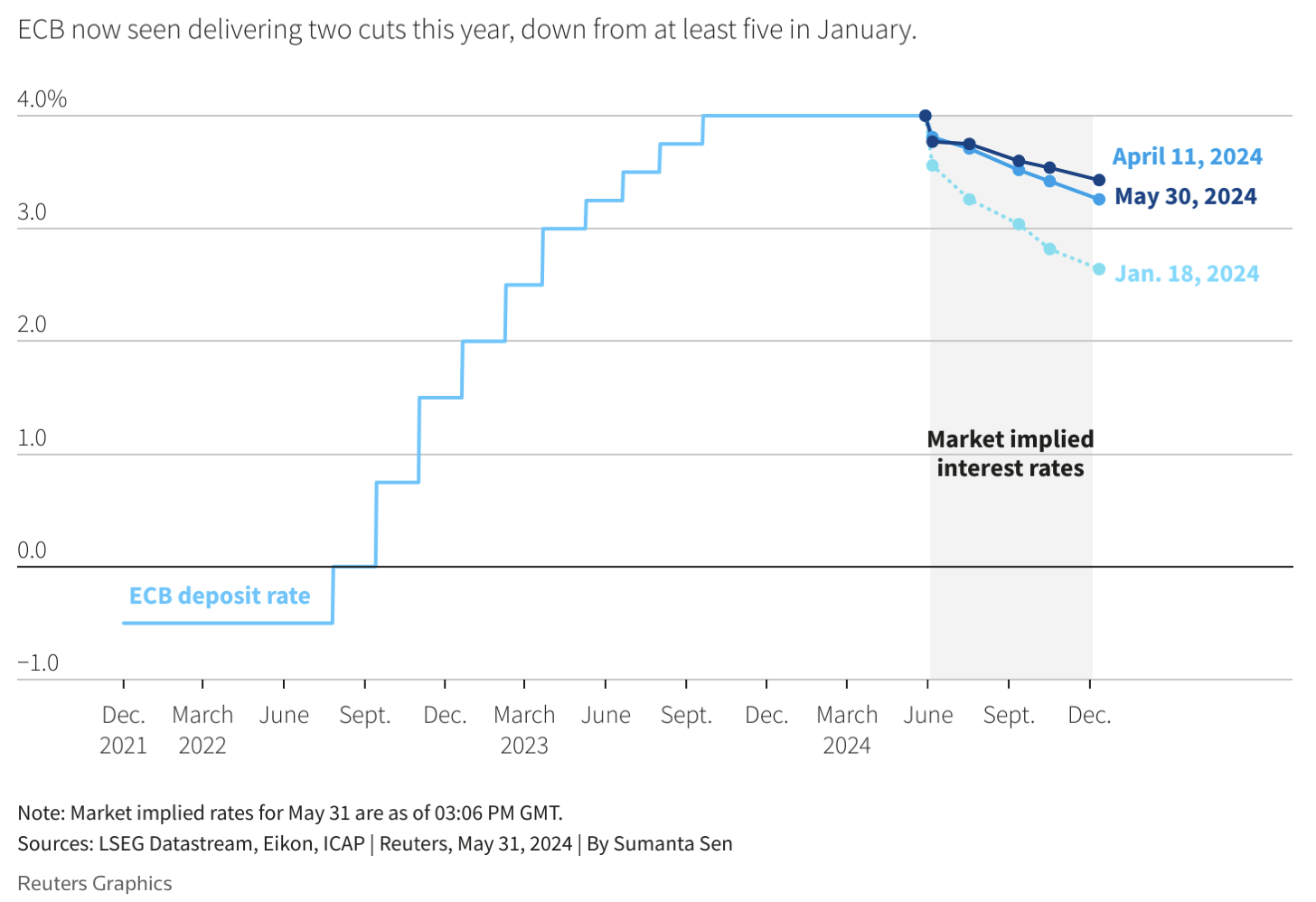
That could be awkward for their future actions but is also very likely why virtually every ECB speaker has been adamant that a July cut is not a given and they will continue to be data dependent.  Many analysts believe that there will be a total of three cuts this year, June, September and December, as the ECB will roll out their latest forecasts at those meetings, but beyond June, it is a bit less certain.  Market pricing shows that there are about 60bps total priced in at this stage, including today’s cut, as per the chart below.

Source: Reuters.com

Perhaps the most important question is, why do we care?  Well, certainly in the FX markets, given the importance of interest rate differentials, the relative speed of policy rate changes by the ECB and the FOMC can have an impact on the EURUSD exchange rate.  However, absent a surprise, something most central bankers try strenuously to avoid, the movement has already occurred ahead of the announcement.  Arguably, the more important part of this whole charade is the signal it gives for official views of future economic activity.  

When central banks are cutting interest rates, there is obviously concern that prospects for future economic activity to support the government in power are dimmer than they had been previously, hence the need to act.  As such, the very fact that a rate cutting cycle has begun in so many nations is indicative of the fact that expectations for future economic growth are diminishing.  It remains very difficult for me to understand that concept and expect that equity prices should rally substantially on the news.  But clearly, I am very old-fashioned in my thinking as evidenced by the fact that yet again, the S&P 500 and NASDAQ 100 have made new all-time highs on the strength of Nvidia’s non-stop rally.  While the Dow and NASDAQ Composite are still lagging, as are small cap stocks, euphoria remains the theme. (PS, my dour view from last Friday has been damaged, but I remain quite concerned with long-term prospects.)

However, this is where we are today.  The ECB will soon be the fourth major central bank to cut their policy rate and the pressure on the Fed to begin their cutting cycle will increase further.  Alas for the Fed, they continue to receive mixed signals from the data and rate cuts are not necessarily the proper prescription for what ails the US economy.  Just yesterday we received two contradictory signals with the ADP Employment report showing a weaker than expected 152K jobs created after a downwardly revised April number.  A few hours later, the ISM Services indicator was released at a much stronger than expected 53.8 reading, its highest since last August, and certainly not indicating that growth is ebbing.  As well, the Prices Paid subindex was a still hot 58.1, again not screaming out for a rate cut.

As of now, the market is pricing in virtually a zero probability of any rate move next week, but there has been a pickup in chatter about a cut at the July meeting with the probability of a cut then rising to 18.5% as of this morning, according to the Fed funds futures market.  If the Fed were to cut later this summer, nothing has changed my view that it will result in a significant decline in the dollar, and a significant rally in commodities. And, while the first move in both stocks and bonds might be higher, the specter of rising inflation will ultimately squash those moves.  But that is not today’s story, rather it is a story for the future.

Today, after those record highs in the US, we saw strength throughout most of Asia although Mainland Chinese shares did not participate in the fun.  That said, the gains were modest, between 0.25% and 0.5% overall.  In Europe this morning, the screens are all green with gains ranging from 0.3% in the UK to 0.7% in Germany as investors seem to believe in the goldilocks scenario there.  As to the US, futures at this hour (7:00) are unchanged as investors await tomorrow’s NFP data.

In the bond markets, after further declines yesterday, with 10-year Treasury yields touching their lowest level (4.27%) since the end of March, yields have bounced slightly this morning, higher by 2bps.  We are seeing similar price action throughout Europe, yield rallies of 2bps, except for the UK, which has seen a further 2bp decline despite the only data point, Construction PMI, rising the most in 2 years.  One last thing is that JGB yields, the ones that were supposed to be breaking out and running much higher now that the BOJ is leaving them alone, fell 5bps and are at 0.96%, below the 1.00% dotted line in the sand.

Commodity prices are rising this morning, continuing to rebound from the sharp declines earlier in the week, as oil (+0.6%) and NatGas (+0.4%) show there is still demand for energy regardless of the economic situation.  In the metals space, all the big four precious and industrial metals are higher this morning as it appears more and more like the weakness at the beginning of the week was a trading event, not a fundamental one.

Finally, the dollar is little changed overall this morning with the biggest mover being PLN (-0.3%), an indication that there is nothing ongoing.  While some currencies have managed small gains vs. the dollar and others have lagged, my sense is everyone is awaiting tomorrow’s NFP before deciding the next move, given the certitude of the ECB move later today.

We do, however, get some data this morning as follows: Initial Claims (exp 220K), Continuing Claims (1790K), Trade Balance (-$76.1B), Nonfarm Productivity (0.1%), and Unit Labor Costs (4.9%).  While we already know that the growth in the Trade Balance has been the key driver in the decline in the GDPNow figures (net exports are a subtraction from the calculation), I think the Fed may be more focused on the productivity numbers which are hardly inspiring and when combined with rising Labor Costs imply that inflation will have a tough time declining further.

So, the ECB will act first thing and then Madame Lagarde will very likely tell us that they remain data dependent, so nothing is promised for July or anytime the rest of the year.  As to today’s US data, I don’t believe it will be market moving.  This means that the equity bulls will continue to make their case and will need to be strongly disabused of the notion that the world is a great place right now.  When that time comes, beware, but it doesn’t seem likely today.

Good luck

Adf

Likely Passé

The markets continue to snooze
Although today we’ll get some news
But Home Sales don’t spark
A narrative arc
About which most folks would enthuse
 
As well, given all that they’ve said
Those dozens of folks from the Fed
The Minutes today
Are likely passé
So, markets will head back to bed


Another very lackluster session yesterday resulting in marginal equity gains in the US as the dearth of new information continues to weigh on trading volumes and overall activity.  Of course, the one thing we did get yesterday was another tsunami of Fedspeak but all of it was the same as what we have already heard.  There is no need to go into details but suffice to say that the theme remains, April’s CPI reading was encouraging, but not nearly enough to consider rate cuts soon.  Instead, while they all believe that inflation will continue to head back to their 2% goal (although none of them have explained why they believe that) it appears that the first cut is not likely to be warranted before the fourth quarter.  In fact, it seems that several FOMC members are lining up with a December cut in mind although the Fed funds futures market continues to price a 60% probability of that first cut coming in September.

But here’s the thing I don’t understand; why are they so keen to cut rates at all?  This is the actual language in the Federal Reserve Act as amended in 1977 [emphasis added]:

“The Board of Governors of the Federal Reserve System and the Federal Open Market Committee shall maintain long run growth of the monetary and credit aggregates commensurate with the economy’s long run potential to increase production, so as to promote effectively the goals of maximum employment, stable prices and moderate long-term interest rates.”

As is typical with legislation, there is no specificity as to what each of these terms mean and thus, they are open to interpretation by each Fed chair.  For instance, prior to 2012, the concept of stable prices did not have a numeric attachment, and, in fact, when Alan Greenspan was Fed chair, he explicitly mentioned that 0% inflation was indicated.  However, Ben Bernanke determined that in the wake of the GFC, a numeric definition would be appropriate and that is how we got the 2% target.

On the employment question, the economic concept of NAIRU (non-accelerating inflation rate of unemployment) had been the north star for the Fed for decades and that number had typically been estimated at 5% +/- a bit.  The concept is that there is a theoretical unemployment rate below which wage pressures will rise and drive inflation higher and above which the opposite will occur.  However, just like the Fed’s other imaginary friend, R*, NAIRU is not observable, and nobody knows where it is.  Recent indications are that it is at a much lower level than previously thought as evidenced by the fact that Unemployment (ignoring the pandemic activity) was able to hover below 4% without any inflationary pressures of note.  At least that was true until the pandemic response flooded the economy with massive amounts of liquidity and funding directly to the population via stimulus checks.  But, as I said, nobody really knows what that level is, and so the concept of maximum employment is extremely nebulous.

Finally, moderate long-term interest rates are another bridge too far for the Fed given its ordinary operations.  While the Fed clearly controls the short end of the curve via the Fed funds markets and its interest payments on reserves, the long end of the interest rate curve is a completely different story.  Certainly, QE was a direct effort to impact long-term interest rates and was quite successful at lowering them, although the definition of moderate remains missing in action.  For instance, a look at the below chart with data from the FRED database shows that the long-term average 10-year yield (my definition of long-term interest rates in this context) is 5.56%.

Source: data FRED database; calculations @fx_poet

With this in mind, the current level of 4.45% or so remains relatively low, not high, and so the idea that rate cuts are necessary to meet the Fed’s mandate seems disingenuous at best.  This is especially true given that inflation is still well above their target of 2%.  Unless there has been a complete sea change of economic theories at the Fed where suddenly higher interest rates are inflationary*, not deflationary, it seems that there is something else at play here.

In the end, my point is that Fedspeak, which is widely followed, usually highlights that there is no guiding star as to what they want to achieve.  As well, their definitions are apt to change quickly if there is a perceived political expedient.  However, I will say that at the current moment, it certainly appears the entire committee is on the same page and wants to cut rates but cannot come up with an excuse they believe the market will accept as real.

Essentially, this was all a preamble to today’s FOMC Minutes release, which given just how much Fedspeak there has been between the meeting and today indicates there is very little new information likely to be revealed.  In the meantime, markets overall remain quiet and rangebound with commodities the lone exception.

Equity markets overnight were mixed in Asia while European bourses are marginally lower (albeit still near all-time highs) and US futures are essentially unchanged yet again.  Bond yields are rising a bit with Treasuries higher by 3bps and European yields higher by 4bps with an outlier UK rise of 10bps after a much hotter than expected inflation reading this morning (3.9% vs. 3.6% expected) reduced the chance of a rate cut next month.  And finally, 10-year JGB yields broke through the 1.00% level last night although the JPY (-0.15%) is actually weaker on the news.

Commodities, though, continue to be the most interesting story around with oil (-0.7%) slipping further after a bigger than expected inventory build from the API data as well as news that the Biden administration is looking to release a portion of gasoline inventories into the market to lower prices ahead of the election.  In the metals markets, the big three are softer again this morning (Au -0.4%, Ag -085%, Cu -2.3%) although on the charts, all remain above key support levels.  It can be no surprise that they are consolidating after their massive runs of the past week or two.

Finally, the dollar is tracking Treasury yields higher with strength almost across the board.  The notable exception is NZD (+0.4%) which has rallied after the RBNZ, while maintaining interest rates unchanged, was far more hawkish in their commentary and indicated they discussed further rate hikes given inflation’s stubbornness overall.  But otherwise, ZAR (-0.8%) is the worst performer, which given the metals market moves should be no surprise, but the dollar’s strength is otherwise universal.

On the data front, as well as the Minutes this afternoon, we see Existing Home Sales (exp 4.21M) at 10:00 and then the EIA oil inventory data at 10:30.  Mercifully, there are no Fed speakers scheduled today, although I wouldn’t be surprised if one gets interviewed somewhere.

Rumors of the dollar’s demise seem badly overblown, and it remains tightly linked to the move in US yields.  Unless we see yields take a serious step lower, I suspect the dollar is likely to remain well bid overall.

Good luck

Adf

*As an aside, several years ago Turkish President Erdogan made this case and kept firing central bankers who wanted to raise interest rates in Turkey to fight their significant inflation problems.  At that time, the economics profession ridiculed the idea completely.  However, lately, there have been a number of articles published that have made the case Erdogan was correct.  Of course, that seems to be an effort to encourage the Fed to cut rates despite high inflation.  As of yet, this brainworm has not infected Chairman Powell, but who knows what will happen as the election approaches.

Soothsay

On Monday, we heard the first five
Fed speakers, as all of them strive
To make a clear case
As why there’s no place
For cuts, lest they see a crash-dive
 
Amazingly, later today
We’ll hear seven others soothsay
Inflation’s still falling
Although it was stalling
Last quarter, much to our dismay


As Queen Gertrude noted in Shakespeare’s Hamlet, “The lady doth protest too much, methinks.” This is the first thing that comes to mind as we face yet another seven Fed speakers today (at eight venues, Mr Bostic will speak twice) in their effort to effectively communicate their current strategy, whatever that may be.  The very fact that we will have heard from a dozen of the nineteen FOMC members in the first two days of the week implies to me that the FOMC has absolutely no confidence that market participants are on the same page as they are.

My first observation is they really don’t have any idea what to do to achieve their goals.  Whatever their models are telling them, it is not aligned with the reality on the ground around the nation.  This is the most benign explanation I can see for their actions.  History has shown that the Fed PhD’s all believe very strongly in their models and when the models don’t accurately describe the economy, their first instinct is that the economy is wrong and that the people who make up the economy are not behaving properly because they don’t understand the beauty of the models and why the model should be correct.  This is akin to the government complaining that things are great and those who say otherwise just don’t understand things well enough.  Not surprisingly, this leads to overcommunication as the in-house view is the messaging is the problem, not the reality.

A less benign view is that they are politicking quite hard to ensure that the current administration is re-elected because they have a significant fear of a change of control at the White House.  As such, they believe that a constant drumbeat of ‘things are going to get better, and we are doing a great job’ will allay any fears that the current administration’s policies have resulted in the inflation that has been the main feature of the nation’s very clear unhappiness.

Perhaps the thing I understand less, though, is why any market participants even care about what Fed speakers say right now.  After all, yesterday’s comments were so closely aligned that a single speech would have sufficed.  I am quite certain that today’s messages will be similarly aligned both amongst themselves and with yesterday’s message.  The one thing that is very clear is that Chairman Powell has them all singing from the same hymnal.

And for those of you who have not been paying close attention, the message, in a nutshell, is that Q1 inflation was disappointingly high and so while April’s data was a bit better, they still do not have confidence that inflation is going to quickly head back to their 2% target so will maintain the current, restrictive, policy for as long as necessary.  It strikes me as unnecessary to have a dozen FOMC members repeat this message in a short period of time.

At any rate, given the remarkable lack of new information, other than the Fedspeak, which as I explain above is hardly new, let’s look at the markets overnight.  Yesterday’s US equity markets mixed performance was followed by weakness throughout Asia with Japan (-0.3%) slightly lower and Hong Kong (-2.1%) sharply lower and a lot more red than green throughout the region.  Of course, given the recent rally we have seen, it is not that surprising to see some consolidation.  European bourses are all lower this morning with losses ranging from Spain (-0.25%) to France (-1.0%) and everything in between.  There has been precious little new information here either, so again, given most of these indices are near record highs, some consolidation is inevitable.  Finally, US futures are little changed at this hour (7:30) as the market awaits idiosyncratic news for individual stocks as well as Nvidia earnings later this week.

In the bond market, quiet is the name of the game with Treasury yields edging lower by 2bps this morning, but really, just back to where they were yesterday morning.  Across Europe, the sovereign market is mixed with Switzerland (+3bps) the worst performer and the UK (-2bps) the best but most markets unchanged on the day.  Unchanged also describes the Asian session as JGB yields didn’t budge.

In the commodity markets, oil (-1.5%) is under pressure this morning, following yesterday’s modest declines as clearly there are no concerns over the situation in Iran regarding the death of the president there yesterday.  As to the metals markets, which in fairness have been FAR more exciting, more record highs yesterday are seeing a bit of consolidation this morning, although the declines in precious, (both Au and Ag -0.25%) are modest.  However, copper (+0.7%) knows no top as it continues to rally on the growing understanding that there is a long-term supply/demand mismatch, and it will be a sellers’ market going forward.

Finally, the dollar is basically unchanged this morning as while it has fallen from the recent highs at the beginning of the month (DXY at 106.40), there is very little follow through selling of the dollar now that US yields have stopped declining.  Recall, Treasury yields are lower by about 25bps in the same period but have stopped their decline as well.  The largest movers overnight have been KRW (-0.3%), which suffered after a weaker than expected Consumer Confidence reading and NOK (+0.3%) which is odd given oil’s recent weakness but absent any other related news.  Sometimes, markets simply move.

And that’s all there is today.  The Fedspeak starts at 9:00 with Richmond’s Thomas Barkin and Governor Chris Waller at separate venues, and last all day into the evening when Bostic, Collins and Mester speak at 7:00pm.  My money is on the idea that there will be nothing new learned from any of them.

As such, we remain in a holding pattern, I think.  US rates are finding a home around 4.4% and the dollar index at 104.50 seems pretty comfortable as well.  While later in the week we start to see some new information, I fear that until next week’s PCE data, we could well be stuck in a pretty narrow range.

Good luck

Adf

Losing His Doubt

The jury is no longer out
And Jay may be losing his doubt
That ‘flation is slowing
So, bulls are now crowing
Let’s end, soon, this rate-cutting drought!

I am old enough to remember when Chairman Powell explained that he did not have confidence inflation was falling back to the target level and so maintaining the current, somewhat restrictive, policy stance would be appropriate for longer than had been originally anticipated.  In other words, higher for longer was still the operating thesis.  That is soooo two days ago!  Apparently, when CPI prints at 0.3% M/M for both headline and core with the Y/Y readings at 3.4% and 3.6% respectively, that means the inflation fight is won.  Now, I will grant that the headline monthly number was 0.1% below expectations, but everything else was right on the money.  On the surface, it is not clear to me that this signaled the all-clear for the end of inflation.  As my good friend Mike Ashton (@inflation_guy) said in his write-up yesterday, “the sticky stuff is not yet unstuck.”  But the market saw this news and combined with a clearly weaker than expected Retail Sales print (0.0%) and weaker than expected Empire State Manufacturing print (-15.6) and was off to the races.

So, risk is back in vogue and bond yields are tumbling.  Hooray!  This is the perfect encapsulation of how the actual data may not mean very much per se, but the framework of how investors and traders were positioned and anticipating the data is the key driving force.  So, not only did equity markets in the US rally 1% or more, but Treasury yields fell 10bps in the 10yr and 8bps in the 2yr.  Meanwhile, September is now the odds-on favorite for the first interest rate cut, politics be damned.

At this point, the question becomes will the Fed respond to this small sample of data in the same way the market has?  The first comments from Fed speakers seemed more circumspect than the market opinions.  Chicago Fed president Goolsbee, who was not on the calendar, said the following in an interview, “[inflation showed] some improvement from last time, pretty much what we expected, but still higher than we were running for the second half of last year, so there’s still room for improvement.”  Meanwhile, Minneapolis Fed president Kashkari explained, “The biggest uncertainty in my mind is how much downward pressure is monetary policy putting on the economy? That’s an unknown. And that tells me we probably need to sit here for a while longer until we figure out where underlying inflation is headed before we jump to any conclusions.”

To my eye, there is no indication that the Fed has changed their tune, at least not yet.  If we continue to see data that indicates the long-awaited recession is actually closing in, I expect that we will begin to hear more of a consensus view regarding the initial rate cuts other than the current higher for longer stance.  Of course, if a recession is making an appearance, my sense is that will not be a huge benefit for risk assets either, but what do I know, I’m just a poet. Ok, I don’t think we need to spend any more time on that subject for today so let’s see what is happening elsewhere. 

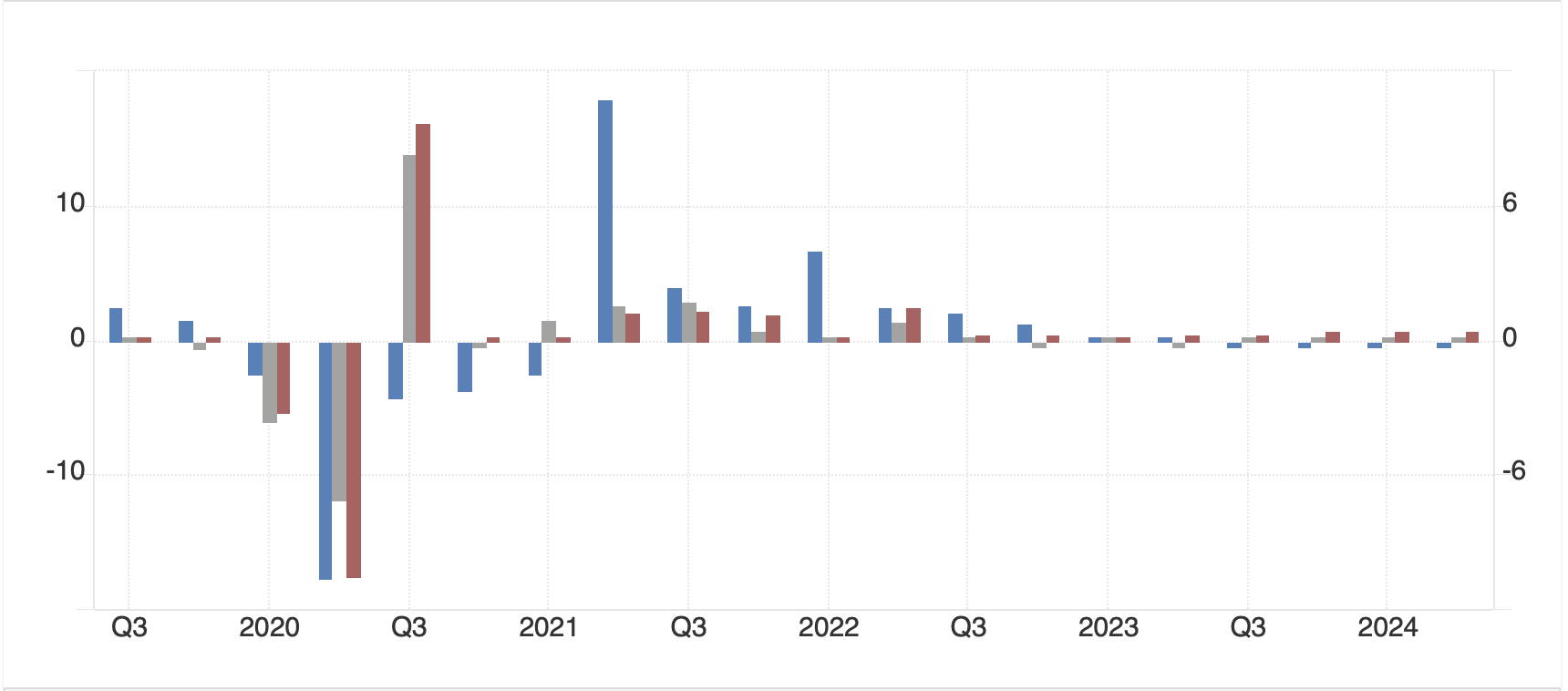
In Japan, the economic news remains less positive than the Kishida administration would like to see.  Last night, Q1 GDP was released at a worse than expected -0.5%, its second negative print in the past three quarters with Q4 a ‘robust’ 0.0% in between.  While not technically a recession, the situation there certainly does not have a positive feel.  Making things even worse, of course, is the fact that inflation remains higher than their target of 2%, although it has been slowly drifting lower over the past year. 

The interesting thing about this situation is that the BOJ does not have a dual mandate regarding prices and employment; but is focused only on price stability.  However, if economic activity continues to slow there, can Ueda-san really tighten policy further?  And what of the yen?  It has drifted higher (dollar lower) alongside the dollar’s broad down move on the back of the recent decline in US yields.  However, it feels to me like Ueda’s path to tighter policy just got a lot narrower if economic activity in Japan is going to remain so lackluster.  Many pundits have decided that the yen’s weakness reached its peak ahead of the recent bout of intervention two weeks ago.  I am not so sure.  Absent a significant slowdown in the US, I’m sensing that the policy divergence may even widen going forward, not narrow, and the yen would not respond well to that outcome.

With all that in mind, let’s survey the overnight session to see what else is happening.  Asian equity markets followed the US rally with solid gains across the board.  Clearly, the prospect of lower US rates was seen as a positive.  However, the same is not true in Europe, where bourses are all lower this morning albeit not dramatically so.  Declines of between -0.25% and -0.5% are universal.  My take is that this is a bout of profit-taking as to much less fanfare than US markets, many European bourses have just touched all-time high levels, so a little pullback should be no surprise.  This is especially true given there was neither data nor commentary that would indicate something in Europe has changed.  The situation remains slow growth, slowing inflation and rate cuts next month.  Lastly, US futures are essentially unchanged at this hour (6:45) as traders await more data and, perhaps more importantly, 4 more Fed speakers.  I think the trading community is looking for Fed confirmation of their response to the CPI data yesterday which, as mentioned above, was not forthcoming.

Bond markets, which all rallied yesterday following the Treasury move, are little changed this morning with virtually no movement in the US or Europe.  Overnight, JGB yields slipped 3bps in the wake of the US data, but this market is entirely focused on the US economy and the Treasury marker for its lead.

In the commodity markets, oil is a touch softer this morning, but remains firmly toward the middle of its recent trading range as conflicting reports regarding expected demand continue to confuse practitioners.  FWIW any report that indicates demand for oil is going to decrease makes no sense to me given how many people on this earth are energy poor and will do as much as they can to get hold of energy.  But that’s just my view.  The IEA continues to forecast reductions in demand because they are desperately pushing their transition thesis because their models are old and unreliable.  As to metals markets, yesterday saw a major rally in gold and silver, with the latter making a push for $30/oz for the first time since 2013.  Copper, however, may have seen a blow-off top yesterday as it has fallen back sharply from its peak and is now back below $5.00/lb.  In truth, the demand story here remains attractive, but the price action did seem to get out of hand there.

Finally, the dollar, which sold off hard yesterday on the CPI and Retail Sales news is bouncing slightly this morning.  Those sharply lower yields in the US, even though they were matched by Europe, were a signal to sell dollars across the board.  Thus, this morning’s 0.2% ish bounce should not be that surprising.  It is in this segment of the market that I believe the opportunity for the biggest structural changes exist.  After all, the dollar’s strength over the past 3 ½ years has been built on the Fed being the most hawkish central bank around as they belatedly fought inflation.  While they have made clear they want to start to cut interest rates, the data has not been supportive of that move.  If yesterday’s data is the beginning of a more consistent slowdown in the US, those rate cuts may be coming sooner than currently priced and regardless of what happens to risk assets, the dollar would suffer.  We shall see.

On the calendar today we have a bunch more data and four more Fed speakers (Barr, Harker, Mester and Bostic).  The data brings the weekly Initial (exp 220K) and Continuing (1780K) Claims, Housing Starts (1.42M), Building Permits (1.48M) and Philly Fed (8.0) all at 8:30 then IP (0.1%) and Capacity Utilization (78.4%) at 9:15.  As Chairman Powell has repeatedly explained, he and his colleagues look at the totality of the data, so another wave of soft numbers here would likely get risk asset markets excited.  However, listening to what they have all continued to say informs me that the Fed is not nearly ready to cut rates.  September remains the odds-on favorite for the first cut, but I still suspect that they could be here all year long.  If I am right about that, the dollar will retain its bid overall.

Good luck

Adf

Hell or High Water

Though Jay was as clear as a bell
That rate cuts were coming through hell
Or high water, it seems
Not all the Fed’s teams
Are ready to cut rates as well
 
A group of the regional Feds
Seems at, with Chair Jay, loggerheads
They think maybe two,
Or one, cut could do
Now, traders are sh**ting their beds!


Yesterday morning, I claimed that it didn’t matter what the plethora of Fed speakers were going to say given that Chairman Powell had seemed to clear the decks for a rate cut by June.  He swept away concerns about ‘too hot’ inflation and was clearly ready to go forward.  It seems that I didn’t read the market zeitgeist that well after all.

It turns out during the day, we heard from four different Fed regional presidents, Chicago’s Goolsbee, Minneapolis’s Kashkari, Cleveland’s Mester and Richmond’s Barkin, and not one of them sounded like they were ready to cut rates anytime soon.  While only two, Barkin and Mester, are voters this year, the story we consistently hear is that everybody’s voice is heard during the meetings.  Listening to those voices yesterday, it certainly doesn’t sound like everybody is ready to move in June.

Mester: “I don’t think the pace of disinflation this year will match what we saw last year as we need to see a reduction in the demand side this year.  Although if the economy evolves as I envision, we should be able to lower the Fed funds rate later this year.”   

And that was the most dovish we heard.

Barkin: “It is smart for the Fed to take our time.  No one wants inflation to re-emerge.”

Kashkari: “If inflation continues to move sideways, that would make me question whether we needed to do those rate cuts at all.

Goolsbee: “I had been expecting it [inflation] to come down more quickly than it has.  The biggest danger to the inflation picture is continued high inflation in housing services.”

It is very hard to look at these comments and conclude that a June rate cut is a given.  And yet, the Fed funds futures market is now pricing a 64% probability of a June cut although is still pricing less than three full cuts for the rest of the year.

Risk assets were not enamored of these comments and the result was we saw a serious pullback in the equity markets in the US with all three major indices falling by between 1.25% and 1.40%.  Treasury yields fell as well, down 4bps, with its haven status making a comeback as did that status for both the yen (+0.4%) and Swiss franc (+0.6%).

Remember this, there are many different stories around the current market situation between the macroeconomics, the geopolitics of both Israel/Gaza and Russia/Ukraine and the central bank activities, not only with the Fed, but also the BOJ and ECB.  The point is markets are feeling many crosscurrents and it would not be surprising to see a more material breakout in one direction or the other on some seemingly less important piece of news.  In truth, when major moves begin, we rarely have a specific catalyst to which we can point.  I have a feeling the next big move will be confusing for a while.

While words have power
Policies ultimately
Matter much, much more
 
As summer passes
The transition to autumn
Should see prices rise


Adding to the cacophony of new information were comments from BOJ Governor Ueda that he believes the central bank may achieve its inflation target by late summer or early autumn as the impact of the recent wage negotiations begins to feed into the economy.  This story, Ueda’s first comments since the BOJ raised rates last month, has helped revive the yen bulls’ confidence that…this time it’s different!  Given the enormous size of the short yen positions outstanding, it is very possible that we see a sudden, sharp rise in the currency, but for the outcome to be more permanent, we will need to see much more aggressive BOJ tightening, or much more aggressive Fed easing.  Right now, I don’t believe either is in the cards, at least not until winter at the earliest.  This is especially true since when asked about the BOJ’s balance sheet, he indicated there was no reason for an immediate adjustment (sale) to ETF positions or their current, continued, ¥60 billion per month of JGB purchases.

Which brings us to this morning, when the monthly payroll report is set to be released at 8:30.  The latest consensus forecasts are as follows:

Nonfarm Payrolls200K
Private Payrolls160K
Manufacturing Payrolls5K
Unemployment Rate3.9%
Average Hourly Earnings0.3% (4.1% Y/Y)
Average Weekly Hours34.3
Participation Rate62.5%
Source: tradingeconomics.com

We have seen three consecutive reports above 200K, albeit replete with all types of revisions.  However, 200K new jobs per month is historically, a pretty good outcome.  It is certainly not indicative of a major decline in economic activity.  As well, yesterday’s Initial Claims data, at 221K, while a few thousand higher than expected, remains in a very comfortable place from the perspective of economic growth.  The point is the Fed’s concern over sticky inflation makes perfect sense when looking at these numbers.  After all, if people continue to work, they will continue to spend.

As it happens, my take today is we are setting up for a potential large ‘good news is bad’ type day and vice versa.  If the headline number is above 200K, and especially if the Unemployment Rate were to dip lower by a tick or two, I suspect that traders will quickly assume that the hawks are in control and any probability of a rate cut by June will dissipate.  Equity markets will not like this, nor will bond markets.  However, the dollar should continue to perform and, ironically, I see commodities doing the same thing.  We shall see how it plays out.

A quick recap of the overnight session shows that yesterday’s US selloff set the tone with declines throughout Asia (Nikkei -2.0%, China still closed) and Europe (DAX -1.45%, CAC -1.4%) as concerns grow regarding the future of monetary policy.  US futures, though, are modestly higher ahead of the data at this hour (7:00).

Ahead of the release, Treasury yields have reversed half of yesterday’s decline, currently higher by 2bps, and we are seeing similar movement across Europe with all markets seeing yields rise by between 1bp and 3bps.  Yesterday the ECB released their ‘minutes’ explaining they had seen further progress in their mission and the key elements, but that was before oil rebounded 10% from levels seen back then.  As has become the norm everywhere, there continues to be conflicting data and price movement clouding the picture for future policy actions.

Speaking of oil, this morning it is holding onto its gains from yesterday with WTI above $86/bbl and Brent crude at $91/bbl.  The ongoing tensions in the Middle East are clearly not helping things here as concerns grow that Iran is going to retaliate more directly to Israel’s actions earlier in the week, killing a senior Iranian general in Syria.  Of course, the entire combination of events continues to support gold prices, which are little changed this morning, but have absorbed all the selling pressure anyone can muster.  Copper and aluminum are also firmer this morning as the commodity sector seems on a mission right now.

Finally, the dollar is a touch higher this morning heading into the data.  While it has backed off its recent highs from Tuesday, the DXY remains above 104 and USDJPY remains above 151.  With that in mind, we must note ZAR (+0.65%) which continues to benefit from the rally across the entire metals complex and NOK (+0.3%) which is clearly benefitting from oil’s recent performance.  However, traders here are all anxiously awaiting this morning’s number alongside everyone else for more clarity on the next direction of travel.

Aside from the data this morning, we hear from three more Fed speakers to round out the week.  While Barkin is a repeat from yesterday, we also get some new perspectives from Boston’s Collins and Governor Bowman.  Yesterday’s market response to the hawkish views was quite surprising to me as I was very sure that Powell had set the tone.  If today’s data points to strength, do not be surprised to see equities sell off further alongside bonds.  However, a weak number is likely to signal the all-clear for the bulls to get back to business.

Good luck and good weekend

Adf

One, Two, Three

On Monday, no one could agree
So, Powell unleashed; one, two, three
At least with respect
To how they dissect
The prospect for rate cuts they see
 
For Bostic, he sees only one
Before the committee is done
While Cook thinks that two
Are likely to do
And Goolsbee said three need be spun


During a session with very little new news, and ultimately, very little in the way of net market movement, it was quite interesting to hear from three different Fed speakers with somewhat different views of what the future holds.

In order of their views, as opposed to the timing of their comments, Atlanta Fed President Raphael Bostic reiterated his view from Friday in a different venue.  He explained that given the resilience of the economy, he sees little reason for any rate cuts in the near term and that his ‘dot’ was for just one cut this year, later in the year.  The thing about Bostic is he has proven to be flexible, arguably adhering to the Keynesian concept of, when the facts change, he changes his mind.  While it is not clear to me that the facts have actually changed, his perception of them certainly has.  At this point, it appears that he has become one of the more hawkish FOMC members and he is a current voter on the FOMC.

One step further toward the median we found Governor Lisa Cook, who explained that “the path of disinflation, as expected, has been bumpy and uneven, but a careful approach to further policy adjustments can ensure that inflation will return sustainably to 2% while striving to maintain the strong labor market.”  In other words, we have been surprised by the two consecutive hotter than expected CPI reports and so despite our fervent desire to cut rates as quickly as possible, if we were to do so, whatever credibility we still have would be thrown away.  At least, that is how I read her comments as she is a clear dove and desperate to cut.  To her credit, as a governor, she is making the effort to be a bit more restrained.

Lastly, we heard from Chicago Fed President, Austan Goolsbee, who during his interview (at Yahoo! Finance) quickly highlighted that his ‘dot’ was for three cuts this year.  He further explained that housing was the problem, at least with respect to their forecasts, and why they had expected inflation to decline more rapidly. Now, based on the housing data we continue to see, at least the price data, inflation is unlikely to decline much further at all.  Add in the fact that commodity prices, notably energy prices, have been rebounding for the past month and any hopes for another leg lower in either CPI or PCE are slipping away.  Also, Goolsbee is not a current voter, so many take his views a bit less seriously.

Now, let me ask, do you feel more enlightened?  Me neither.  If I were to assess the current situation, my read is that the majority of the FOMC really does want to cut rates as they believe they have done enough regarding inflation.  Frighteningly, there was an article in the FT this morning from Mohamed El-Erian, claiming that the time is ripe for allowing inflation to run hotter in order to support nominal growth.  We know that is every FinMin’s wet dream, but historically central bankers pushed back on that thesis.  However, El-Arian now claims that the central banks are on board as well.  If this is true, the only conclusion is that all fiat currencies are going to decline in value vs. stuff.  The relative pace of these declines will ebb and flow based on interest rate differentials and other circumstances, but it is not a net positive for the ordinary consumer.

Ok, let’s turn our attention to the overnight session and how markets are behaving.  The bulls have to be disappointed that the recent Fed speakers have not been more dovish, and we have seen that in another lackluster equity session in the US yesterday, with all three major indices lower by about -0.3%.  In Asia, while Japanese shares were essentially unchanged, we saw some strength in China and Hong Kong with the noteworthy story being President Xi’s invitation to keep several US CEOs currently visiting there, in country with the promise of a meeting with him.  The read is he is open to deeper business relationships.  As to the rest of the region, equity markets were mixed with some gainers and some laggards and no large movers.  As to Europe this morning, the color on the screen is green, with a few gains of 0.5% (Germany and Spain) and the rest much more subdued.  US futures are pointing higher at this hour (7:00), by about 0.5%, so the bulls are back.

In the bond market, yields have backed off a bit with Treasuries lower by 2bps and European sovereigns falling between 3bps (Germany) and 6bps (Italy) as the ECB speak continues to point to rate cuts clearly coming, with more hope for April making its way into the market, at least according to Italy’s Panetta.  In what cannot be a huge surprise, 10-year JGB yields remain unchanged as the idea of a tightening cycle there is slowly ebbing from traders’ minds.

In the commodity markets, oil (+0.2%) is creeping higher again as Russia has indicated it is going to restrict production alongside the lost output from refinery damage caused by Ukraine.  As well, after the UN Security Council vote yesterday, it appears that concerns are rising that there is no chance of a ceasefire anytime soon.  Meanwhile, gold (+1.2%) is screaming higher this morning and once again approaching $2200 as what appears to be a combination of growing geopolitical jitters combines with the growing awareness by market participants that inflation is not going to be addressed has investors seeking alternatives to fiat currencies.  Base metals, though, are not seeing the same boost, although are a touch higher overall.

Finally, the dollar is under some pressure this morning with most G10 currencies firmer, although the Swiss franc (-0.2%) is suffering a bit.  In fact, the biggest winner is NZD (+0.45%) but there is precious little to explain this movement.  One currency that is not gaining is the yen, which is unchanged on the session while the dollar remains just below its multi-decade highs set back in October 2022.  In the EMG bloc, the story is more mixed with some gainers (CZK +0.2%, HUF +0.3%) and some laggards (ZAR -0.3%, TWD -0.2%), but as you can see, the movement has been muted.

On the data front, this morning brings Durable Goods (exp 1.1%, 0.4% ex-transport) and Case Shiller Home Prices (6.7%). We also see Consumer Confidence (107.0) at 10:00.  There are no Fed speakers scheduled, but do not be surprised if there is an interview or two from a news source as they continue to try to tweak their message.

To me, the big picture is that there has been a clear relaxation by the Fed, and other central banks, in their attitude toward inflation.  As such, I expect to see risk assets perform and bonds lag.  However, regarding FX, it is all about the timing of the changes that are announced, or guided, rather than the absolute destruction in their value over time.  For now, though, the Fed remains the tightest policy around and the dollar should benefit because of that.

Good luck

Adf

Threw in the Towel

There once was a banker named Powell
Who fought, prices, high with a growl
Then going got tough
So he said, “enough”
And basically, threw in the towel
 
His problem’s inflation’s alive
And truthfully, starting to thrive
The worry is he
Will soon say that three
Percent’s the rate for which he’ll strive


With several days to digest the latest FOMC meeting results, and more importantly, the Powell press conference, my take is the Chairman recognizes that to get to 2.0% is going to be extremely painful, too painful politically during this fraught election cycle.  And so, while he tried very hard to convince us all that the Fed was going to get to 2.0%, he stressed it will “take time”.  The subtext of that is, it’s not going to happen in the next several years, at least, and this poet’s view is it may not happen again for decades.  The key to recognizing this subtle shift is to understand that despite increased forecasts for both growth and inflation, the Fed remains hell-bent on cutting interest rates.  Even the neo-Keynesian views which the Fed follows would not prescribe rate cuts in the current economic situation.  But rate cuts are clearly on the table, at least for now.

This begs the question, why is he so determined to cut interest rates with the economy growing above trend?  At this stage, the explanation that makes the most sense to me is…too much debt that needs to be refinanced in the coming years.

Consider, current estimates for total debt around the world are on the order of $350 trillion.  That compares to global GDP of just under $100 trillion.  Many estimates indicate that the average maturity of that debt is about 5 years which means that something on the order of $70 trillion of debt needs to be refinanced each year.  Now, the US portion of that debt is estimated at about $100 trillion, of which ~$34.5 trillion is Treasury debt, and the rest is made up of corporate, mortgage, municipal and private debt.  Remember, too, that total US GDP is currently about $28 trillion as of the end of February (according to the FRED database from the St Louis Fed), so the ratio here is similar to the global ratio.  [Note, this does not include unfunded mandates like Social Security and Medicare, just loans and bonds outstanding.]

Here’s the problem, we have all heard about the fact that the US debt service has climbed above $1 trillion per annum and given the underlying principle is growing, that debt service is growing as well.  In addition, on the private side, there is a huge proportion of corporate debt that has become a serious problem for banks and investors, notably the loans made for commercial real estate, but personal and credit card debt as well.  The Fed cannot look at this situation and conclude that higher rates, or even higher for longer, is going to help all the debtors.  And if the debtors default…that is going to be an economic disaster of epic proportions.Add it up and the only logical answer is Powell is going to gaslight everyone with the idea that the Fed is going to remain vigilant regarding inflation.  And they will right up until the time when the pain becomes too great, or too imminent and they cut.  I think that we are seeing the first signals from markets this is going to be the case from both gold and bitcoin.  But if I am correct, and the Fed cuts despite still elevated inflation readings, look for the dollar to decline sharply, at least initially until other central banks cut as well, look for bonds to fall sharply and look for hard assets to rally.  As to stocks, I expect that initially it will be seen as a positive and juice the rally, but that over time, stocks will begin to lag hard assets.  Quite frankly, this looks like it is a 2024 event, so perhaps if that first cut really comes in June, the summer is going to be far more interesting than anybody at the Fed would like to see.

Kanda told us all
“We are always prepared” to
Prevent yen weakness
 
Meanwhile in Beijing
The central bank responded
Nothing to see here


“The current weakening of the yen is not in line with fundamentals and is clearly driven by speculation. We will take appropriate action against excessive fluctuations, without ruling out any options.”  So said Masato Kanda, the current Mr Yen at the MOF.  It seems possible, if not likely, the yen’s decline in the wake of the BOJ move last week came as a bit of a surprise.  This morning, the yen (+0.1%) has edged away from its lows from last week, but USDJPY remains above the 151 level and very close to the level when the MOF/BOJ intervened in October 2022.  Adding to the pressure was Friday’s very surprising sharp decline in the CNY, which many in the market took to mean the PBOC was comfortable with a weaker yuan. 

Economically, a weaker yuan seems to make sense, but the PBOC’s concern is that it could lead to increased capital outflows, something which they are desperate to prevent.  As such, last night, the CNY fixing was nearly 1200 points stronger than expected, with the dollar rate below 7.10, and we saw significant dollar selling by the large Chinese banks.  Apparently, Friday’s movement was a bit too much.  I suspect that these two currencies will continue to track each other at this point with both currently at levels which, in the past, have been demarcation lines for intervention.   

Here’s a conspiratorial thought, perhaps the Fed’s dovishness is a response to the weakness in the yen and Powell’s best effort to help the BOJ avoid having to intervene again.  The thing about intervention is it, by definition, represents a failure of monetary policy, at least in the market’s eyes.  And in the end, all G10 central banks are in constant communication.

Ok, let’s survey the markets overnight.  All the currency activity seemed to put a damper on equity investors as Asia saw weakness across the board with Japan (Nikkei -1.2%) falling, although still above 40K, and both Hong Kong and mainland shares in the red.  In Europe this morning, red is also the predominant color, although the declines are more muted, ranging from -0.1% (DAX) to -0.4% (CAC).  Finally, US futures, at this hour (7:00) are also slipping lower, down 0.25% on average.

In the bond market, Treasury yields are backing up 3bps this morning, bouncing off the critical 4.20% technical level again.  As well, in Europe, sovereign yields are rising between 2bps and 3bps across the board.  There has been no data of note, but we have heard a bit more from ECB bankers with a surprising comment from Austria’s Holtzmann that he saw no reason for rate cuts at all.  That is an outlier view!  And despite what is happening in the FX markets, JGB yields remain unchanged yet again.

Turning to commodities, oil (+0.3%) is edging higher this morning as, after a strong rally early in the month and a small correction, it appears that $80/bbl is a new floor for the price.  In the metals markets, after last week’s pressure lower, this morning both precious (gold +0.3%) and base (copper +0.1%) metals are edging higher.  There has not been much in the way of news driving things in this session.

Finally, the dollar is a touch softer this morning, but that is after a strong week last week.  We’ve already touched on the Asian currencies, and it is true the entire bloc, which had been under pressure, is a bit stronger this morning.  But we are seeing strength across the board with G10 currencies higher on the order of 0.2% and most EMG currencies firmer by between 0.1% and 0.2%.  So, while the movement is broad, it is not very deep.  I maintain this is all about US yields and the fact that despite Powell’s newfound dovishness, the Fed remains the tightest of the bunch.

On the data front, there is a lot of information to be released, but I suspect all eyes will be on Friday’s PCE data.  

TodayChicago Fed Nat’l Activity-0.9
 New Home Sales680K
TuesDurable Goods1.0%
 -ex Transport0.4%
 Case Shiller Home Prices6.8%
 Consumer Confidence106.7
ThursdayInitial Claims215K
 Continuing Claims1808K
 Q4 GDP3.2%
 Chicago PMI46.0
 Michigan Sentiment76.5
FridayPersonal Income0.4%
 Personal Spending0.4%
 PCE0.4% (2.4% Y/Y)
 Core PCE0.3% (2.8% Y/Y)
Source: tradingeconomics.com

In addition to that menu, Fed speakers will be about with five scheduled including Chairman Powell on Friday morning.  Remember, too, that Friday is a holiday, Good Friday, with market liquidity likely to be somewhat impaired as Europe will be skeleton staffed.  As well, it is month end, so my take is if Powell veers from the script, or perhaps reinforces the dovish theme, we could see an outsized move.  Just beware.

Recent activities by the BOJ and PBOC indicate that the market has found a sore spot for the central banks.  If the data this week doesn’t cooperate, meaning it remains stronger than forecast, it will be very interesting to hear what Chairman Powell has to say on Friday.  Cagily, he speaks after the PCE data, so he will be able to respond.  But especially if that data comes in hot, we are likely to see more volatile markets going forward.  However, today, it is hard to get too excited.

Good luck

Adf

Jejune

Come Wednesday through Friday this week
It’s payrolls and Powell to speak
Let’s take time today
To hear people say
What’s driving the year-to-date streak
 
The first key is so many think
That Powell and friends need to blink
And cut rates quite soon
Else markets will swoon
And ‘flation will not rise, but sink
 
The other idea that’s around
Is AI and Bitcoin are bound
To fly to the moon
An idea, jejune,
For OG’s, though elsewhere profound


Once again, lackluster was an apt description of the market activity yesterday, although given the plethora of information that is on the horizon, we cannot be surprised by this result.  As such, I thought it might be worthwhile to review the themes that seem to be driving markets these days, as well as how expectations are built into pricing.

Clearly, the biggest story remains the Fed and its potential timeline for the mooted rate cuts necessary to achieve the much-vaunted soft landing.  As of this morning, the probability of a May cut remains near 24% with June the odds-on favorite for the first action.  While there has been some back and forth with respect to the actual probabilities, there has been no major change in that view for several weeks.  My question continues to be, why are so many people of the opinion that the Fed must cut rates?  

So far, at least based on both the GDP and payroll data, the economy is chugging along quite well with the current monetary policy settings while inflation remains well above the Fed’s target.  Arguably, a great deal of that is due to the fiscal impulse that has been ongoing, but there is no sign that is going to end anytime soon.  In fact, it strikes me that easing monetary policy amid a period of fiscal excess may juice the inflation data substantially.  Literally every Fed speaker has made this exact point, that things are going well, inflation seems to be trending lower, but there is more certainty needed before a cut would be appropriate.

Adjacent stories here are related to the election in the US, with many assuming the Fed will cut rates to help support the Biden administration (I think this is extremely unlikely).  The other key story has to do with the other G7 central banks, and their ability/willingness to change policy prior to the Fed.  Considering that Japan, Canada, the UK and Europe are all basically in recession, or right on the cusp, there is a far greater need to ease monetary policy in those places.  However, they have a serious concern that if they cut before the Fed, the dollar will rally sharply and negatively impact both economic activity and market activity, as well as undermine their currencies.  In the end, everybody is waiting for Godot Powell, and it is not clear he is going to come through.

The second key story is the remarkable performance of both Bitcoin and the tech sector.  There have been many stories comparing the current move in the NASDAQ to various times in the late 1990’s and the runup to the Tech bubble then.  We all know that eventually, despite the internet having an amazingly profound impact on all our lives, the tech sector corrected more than 80% from its early 2000 peak and it took 15 years to regain those levels.  I don’t think anybody is willing to say that the current tech leaders are bad companies with problems, but the price one pays for a company’s shares is THE key to long-term investment performance.  AI can be transformative in many ways and that doesn’t mean these shares will not decline and decline sharply.

Speaking of AI’s impact, my good friend the @inflation_guy, Mike Ashton, wrote a terrific piece about the potential impact on the economy overall, comparing it to the internet, the last significantly transformative technological revolution.  This is a must read!  Ultimately, while the impact of the internet was significant, it was not nearly as productivity enhancing as many had forecast at the initial stages of the mania.  Just keep that in mind with respect to AI as well.

As to Bitcoin, it is pushing to new all-time highs as flows into the spot ETF’s are quite substantial and driving the move.  However, it strikes me that the rationale for buying Bitcoin is very different than the rationale for buying NVIDIA.  Bitcoin believers are concerned over the integrity of the entire concept of money and its future.  They look at the dramatic increase in Treasury issuance and ask, is that debt really risk-free?  They are seeking to own alternative assets, outside the current monetary framework.  Meanwhile, buying the AI craze is as mainstream as you can get, counting on the equity values to rise substantially from here and protect your wealth, even if it is denominated in a currency that is subject to inflation and devaluation.  But for now, the two are linked at the proverbial hip.  

I would not look to short either process at this point, but having seen numerous bull markets in my time, the one thing I know is that trees don’t grow to the sky.  At some point, there will be a significant correction in both these asset classes, and we are sure to hear a great deal of screaming about how the Fed needs to come in and stop it.

In China, last night Premier Li
Revealed what their growth ought to be
Though clearly well-meant
To reach five percent
Is certainly no guarantee


One other key story overnight was Premier Li Qiang’s speech in which he declared the GDP growth target for China this year is “around 5%” with inflation to run at 3% and a budget deficit also at 3%.  While this all sounds great, there is reason for some skepticism.  Perhaps the biggest issue is that domestic demand for products is not growing and is unlikely to start doing so until the property crisis is behind them.  However, given President Xi’s unwillingness to face that music, the drawn-out process to address the situation will likely weigh on overall economic activity for a few more years yet.  

There is a potential knock-on effect of this, though, and something that I have not really considered in the past but need to investigate further.  We all know that there is a concerted effort by G10 nations to reshore and friendshore manufacturing capacity, and that has been a key driver of US economic activity.  Recall, that was the entire goal of the Inflation Reduction Act.  It has also been clear that there is currently a boom in factory construction in the US, something else supporting GDP data.  Now, if the US, and much of the G10, is adding to manufacturing capacity while China maintains its own manufacturing capacity, that is a LOT of capacity to build stuff.  It is not unreasonable to expect that the prices of manufactured goods will decline given what could well be significant excess supply.

In the US, regardless of who wins the presidential election, it is very easy to foresee another increase in import tariffs on Chinese goods (Trump has proposed a 60% tariff on all Chinese imports).  We have heard similar rumblings from Europe as well.  The point is that absent a substantial change in trade policy, goods inflation is likely to be well-contained.  Services inflation is a different issue, and given services represents a much larger proportion of the US economy, seems likely to keep price pressures pushing higher.  But rampant price rises are far less likely if we wind up with duplicate production sources for various goods.  Of course, tariffs will feed directly into inflation data, and the Fed cannot address that at all.

My point is that the economy is a highly interconnected and complex system and tracking all the potential outcomes is extremely difficult, if not impossible.  This is just one that I hadn’t considered in the past but may have some legs.  To be continued…

Ok, I have gone on too long so here’s the recap for overnight.  The Hang Seng sold off (-2.6%) but otherwise in Asia and Europe shares are little changed.  Yields are broadly lower (Treasuries -3bps, Europe -5bps on average) while oil prices have slipped a bit.  Gold (+0.5% and new all-time highs) is the commodity outlier.  Finally, the dollar remains little changed and is likely to stay that way until we see the next monetary policy adjustments.

ISM Services (exp 53.0) is the only data release today and only Michael Barr is speaking. I see no reason for things to move very far until tomorrow, when both ADP Employment is released, and Chairman Powell testifies.  Equity futures are pointing a bit lower this morning after a soft session yesterday.  That drift feels like it can continue as we await the rest of the week’s news.

Good luck

Adf

Finally Dead

It’s been, now, two weeks since the Fed
Said rate cuts were not straight ahead
Their confidence lacked
Support to abstract
Inflation was finally dead
 
Which brings us now to CPI
Where analysts identify
Used cars and soft gas
As just ‘nuff to pass
The test and wave ‘flation bye-bye


Finally, the CPI report will be released this morning so we will be able to collectively exhale!  The current consensus forecasts are for a 0.2% M/M rise in the headline, leading to a 2.9% Y/Y outcome and a 0.3% M/M rise in the ex-food & energy reading leading to a 3.7% Y/Y increase.  Those annual numbers would be down from 3.4% and 3.9% respectively.

A key part of the thesis for the ongoing decline is that Used Car prices will continue to fall as well as gasoline prices, which fell about 30 cents/gallon on the NYMEX exchange.  However, rent increases remain stubbornly high and any declines in foodstuffs seem to have ended.  There was a ‘brilliant’ article by a UC Berkeley economist, Ulrike Malmendier, that determined most people’s view of inflation was skewed by the prices of things they bought most frequently, rather than the ‘proper’ economists’ view of the totality of prices.  Who would have thunk it?  Honestly, it is hard to believe that some of these people have degrees at all.

At any rate, the market is highly fixated on the number and there is no doubt that many are looking for a soft outcome and, perhaps, sufficient proof for the Fed to gain enough confidence to cut rates in March.  As it stands, right now the Fed funds futures market is pricing a 15.5% probability of a March cut and a 57.5% probability of a May cut.  But the pining for this cut is palpable.  I will reiterate my view that based on the current trajectory of economic data, there is no reason for the Fed to cut at all absent a major downturn.  Clearly, given the government’s ongoing fiscal largesse, economic activity continues to move along.  While price rises have been slowing over time, I would contend there is no risk of a major deflationary event.  

The flip side of this argument is that the Federal government cannot afford to continue with interest rates this high.  Much has been made of the fact that interest payments on the Federal debt are now in excess of $1 trillion per annum, more than either defense spending or Medicare, and trending inexorably higher.  While they remain <5% of GDP, the fact that the government is running a budget deficit of >7% of GDP and slated to do so for the foreseeable future, there will come a time when this process will be unsustainable.  However, as Japan has proven over the past twenty years, things previously thought impossible are not necessarily so if the population tolerates them.  Right now, the major financial problem for the government is not the deficit, but inflation.  So that is where the attention is focused.  Eventually, something will have to give, but it is not clear that will occur within the next several political cycles, and ultimately, that’s the only time things like this will be addressed.  So, look for more of the same for now.

Turning back to markets, ahead of the CPI report, most markets around the world have remained quiet, with one notable exception, Japanese equities which have continued their impressive rally.  After a mixed and lackluster session yesterday in the US, the Nikkei rose nearly 3.0% overnight as the ongoing yen weakness and a growing suspicion that the BOJ is not going to act anytime soon continues to support things there. Chinese markets remain closed all week for the New Year holiday but the rest of the APAC markets had solid sessions.  European bourses, however, are under some pressure this morning with all of them lower by between -0.3% and -0.6%.  The data from the UK showed that the employment situation was better than expected, with lower Unemployment and firmer wage growth.  This will not encourage the BOE to consider cutting rates anytime soon.  As to US futures, at this hour (7:45) they are somewhat lower with the NASDAQ (-0.75%) leading the way down.

Meanwhile, in the bond market, yields have edged lower everywhere except the UK (+2bps and see employment data for explanation) as Treasuries (-2bps) show the way and most of Europe has followed directly in its footsteps with similar yield declines.  Interestingly, JGB yields were unchanged overnight despite the equity rally and yen weakness.

Oil prices (+0.75%) are bouncing this morning as any hopes of a ceasefire in the Middle East have faded for now but we are also seeing broad-based strength across the metals markets with gold (+0.4%), copper (+0.75%) and aluminum (+0.3%) all finding support this morning.  Perhaps this is on the back of dollar weakness in anticipation of a cool CPI print.

Speaking of the dollar, it is broadly softer, albeit not dramatically so.  GBP (+0.4%) is the leading G10 currency although CHF (-0.4%) has fallen on the back of a much lower than expected CPI reading there, just 1.3% Y/Y, with market participants now looking for rate cuts sooner rather than later.  In the EMG bloc, things are mixed although there are more gainers than laggards with ZAR (+0.5%) the leader of the pack on those strong metals prices.

Looking at this week’s data beyond today shows the following:

ThursdayInitial Claims220K
 Continuing Claims1880K
 Retail Sales-0.1%
 -ex autos0.2%
 Empire State Manufacturing-15
 Philly Fed-8
 IP0.3%
 Capacity Utilization78.8%
 Business Inventories0.4%
FridayPPI0.1% (0.6% Y/Y)
 Ex Food & energy0.1% (1.6% Y/Y)
 Housing Starts1.46M
 Building Permits1.509M
 Michigan Sentiment80.0

Source: tradingeconomics.com

As well, today we already saw the NFIB Small Business Optimism Index show a little less optimism printing at 89.9, down 2 points from last month.  Of course, things would not be complete without a bit more Fedspeak, with 6 more on the calendar including Governor Waller, perhaps the 3rd most important voice there.

Overall, while I don’t think the rate of inflation has much further to fall, and in fact, I expect it to rise again as the spring and summer progress, today’s number feels like it could be soft.  Here’s the thing, the market is anticipating that soft number so it is not clear to me how much further they can drive risk assets higher on this news.  They need something new.  However, if it is hot, look for a sharp down day in risk assets and higher yields and a higher dollar.

Good luck

Adf

Singing the Blues

Here’s what’s underlying most views
Inflation is yesterday’s news
But what if it’s not
And starts to turn hot?
Those bulls will be singing the blues
 
So, care must be taken, I think
As in the bulls’ armor, a chink
Is wages keep rising
While homes are surprising
Be careful, the Kool-Aid, you drink


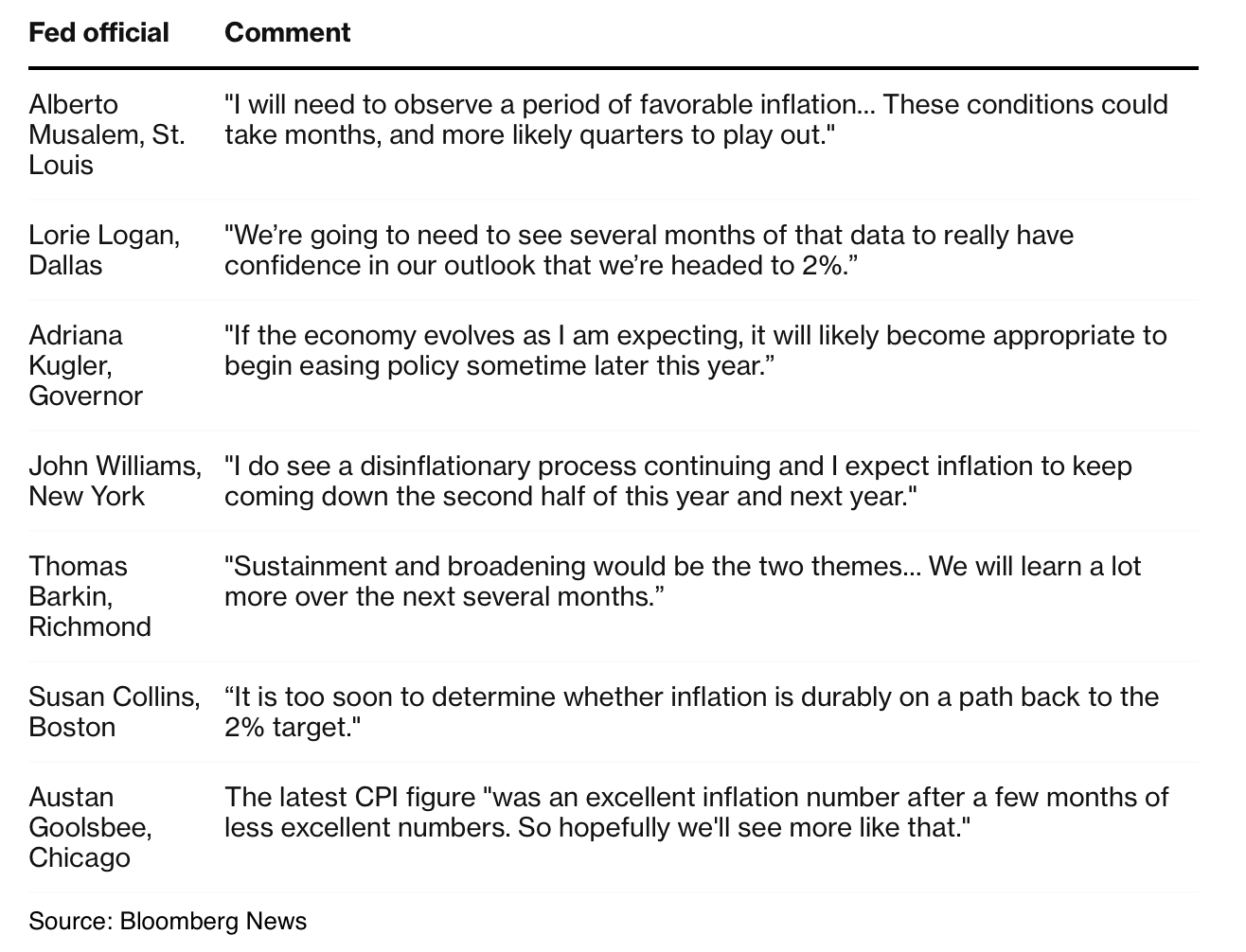
Market activity has generally been benign as investors and traders await the next big news.  Arguably, that is next Tuesday’s US CPI data given the dearth of new information otherwise due to be released this week.  The one thing we have in spades this week is central bank speakers, with three from the Fed yesterday and four more today, including the first comments I have seen from the newest Governor, Adriana Kugler.  As well we have been regaled by ECB, BOE and BOC speakers and they will continue all week as well.

Thus far, the message has been pretty consistent with the general theme that inflation has fallen nicely and is expected to continue to do so.  However, in a great sign of some humility, they are unwilling to accept that because price levels have fallen for the past 3 months that their job is done.  Obviously, the recent NFP and ISM data have shown no indication that the economy is even teetering on the brink of a slowdown, let alone desperate for rate cuts for support.  And for this, I applaud them.

But in this case, the central bank community seems to be in a small minority of economic observers who are not all-in on the idea that rate cuts are necessary right now.  Because, damn, virtually every other analyst seems to be on that train.  

There is a very good analyst group that calls themselves Doomberg, which mostly write about energy policy and its impacts on everything else, but in this morning’s article, I want to highlight a more general comment they made which I think is really important:

“How can you tell the difference between an analyst and an advocate? It is all in the handling of data that runs counter to assertion. To an analyst, being wrong is disappointing, but it is primarily an opportunity to learn—an expected element in a feedback loop of continuous improvement. When knowledge is your only objective, there is no such thing as a bad fact, only one which you do not yet understand. Not so for the advocate. The advocate has tied their hopes (and often their livelihoods) to a specific outcome and feels compelled, whether consciously or not, to rationalize away or attack inconvenient realities. It is advocacy when every perturbation in the weather is tagged as evidence of climate change, each squiggle of unfavorable price action is declared market manipulation, and no act or utterance from a favored politician is disqualifying.”

First, I cannot recommend their writings highly enough as they are consistently thoughtful, well-researched and important.  But second, I think this point is exactly in tune with the Goldilocks welcoming committee as they will ignore every piece of data that runs counter to their narrative and double down by saying the Fed is overtightening because inflation is collapsing, and deflation is going to be the economic problem soon.

While I am often quite critical of the Fed and their comments, and still think they speak far too much, right now, I am very happy to see them maintain a reluctance to cut rates just because the market is pricing in those cuts.  Certainly, to my eye, looking at the totality of the data (as Chairman Powell likes to say) there is little indication that prices are collapsing.  In fact, the super-core data, which was all the rage last year, has turned higher.  I understand why Wall Street analysts are better described as Wall Street advocates, but for the independent analysts out there, and over the past several years those numbers have exploded higher, it is remarkable to me that more of them are not suspect on the idea that rates need to be cut and cut soon.  In fact, at this point, one month into the year, I continue to like my 2024 forecasts of perhaps one cut in the first half of the year, but a reversal as inflation reignites.

Yes, the futures market is now only pricing five cuts into 2024, but nothing has changed my view that the pricing is bimodal, either 0 or 10 cuts will be the outcome, with the former if the economy continues along its recent pace and the latter if the recession finally arrives.  Given that interest rates, led by Treasury yields, are the clear driver of global market movements, and given that inflation is going to play a critical role in their movement going forward, I have altered my view as to the most important piece of data.  Whereas I used to believe it was NFP, it is now entirely CPI/PCE.  As I wrote yesterday, if next week’s print is at 0.4% M/M, watch out for a significant repricing.

But now, let’s turn to today.  President Xi continues to have problems with his stock market and is seemingly getting a bit more desperate aggressive in his efforts to prevent a complete implosion.  Last night, the head of the CSRC (China’s SEC analog) was replaced as blame needs to be placed on others for Xi’s policy errors.  It ought not be surprising that Chinese shares, after a weak start, rebounded on the news and closed higher by about 1%.  However, the Hang Seng could not manage any gains and the Nikkei edged lower as well.  All in all, it was not a great session overnight.  In Europe this morning, the markets are lower by between -0.25% and -0.5% as once again we saw weak German data (IP -1.6%) continuing to point to a recession on the continent.  Finally, US futures are basically flat at this hour (7:30).

In the bond market, yields, which all slid a bit yesterday on what seemed to be a profit-taking move after that massive runup following the NFP and ISM data, are a bit higher this morning, with Treasury yields up by 3bps and most of Europe seeing similar movements, between 2bps and 4bps.  As I wrote above, this story remains all about inflation’s future, and as data comes in to add to the conversation, I suspect that will be the key mover going forward.

Oil prices (+1.0%) are continuing their modest recent rebound with WTI touching $74/bbl this morning and Brent above $79/bbl.  Comments by the Biden administration that they would continue to attack Iranian proxy groups seems to have traders worried about an escalation.  But a more concerning story is that Ukraine has been targeting Russian refineries in an effort to degrade Putin’s cash flow.  They have already hit several and reduced capacity by 4%-5%.  If that continues successfully, then oil prices are going to go much higher.  This doesn’t seem to be in the bigger narrative right now, so beware.  As to the metals markets, they are all slightly softer this morning, but movement has been tiny.

Finally, the dollar is under a modest amount of pressure this morning, which given the rising yields and softer commodities, seems out of character.  Granted, the movements are small, with most currencies just 0.1% – 0.2% firmer vs. the dollar.  And this could also be profit-taking given the dollar’s recent rally.  After all, the euro remains below 1.08 and USDJPY above 148.00 so this is hardly a collapse.

Turning to the data today, the Trade Balance (exp -$62.2B) is this morning’s release and then after oil inventories, at 3:00 we get Consumer Credit ($16.0B).  As mentioned above, we have many more Fed speakers as well, and I sense that will be of far more interest to market participants.  I don’t anticipate anybody straying from the current theme of inflation has been falling nicely but they are not yet convinced.  If someone strays, that could move markets, but again, I see little to drive things today, or this week.

Good luck

Adf