Erring

Excitement does not quite portray
The thirst for risk shown yesterday
Though media cried
Investors took pride
In Trump, sure that he’ll save the day
 
So, next Chairman Jay and the Fed
Will try to explain that instead
Of further rate paring
They might soon be erring
On side that Fed rate cuts are dead


Wow!  That is pretty much all one can say about yesterday’s equity market response to the confirmation that Donald Trump will be the next president of the United States.  The DJIA rose 3.6%, far outpacing both the S&P 500 (+2.5%) and the NASDAQ (+3.0%) but even that paled in comparison to the Russell 2000 small-cap index which jumped nearly 6% on the day!  Investors are all-in on the idea that Trump will seek to bring home as much manufacturing and economic activity as possible via tariff policies and small caps and old-line companies are the ones likely to benefit.

But boy, bonds had a tough day with yields across the curve rising between 10bps (2yr) and 20bps (30yr) with the 10yr gaining 15bps on the day.  It is all part of the same mindset, higher economic activity and no slowdown in spending leading to rising inflation and, correspondingly, rising yields.

The other area that really suffered were the metals markets, with gold (-3.3% or $90/oz), silver (-4.7%) and copper (-5.0%) all getting hammered.  The best explanation for the gold price’s decline I have heard is the idea that with Trump coming into office, the prospects for a nuclear war have greatly diminished.  Certainly, based on the fact that there were no new wars during his last term and one of his promises is to end the Russia/Ukraine war on the first day, perhaps that is correct.  As well, consider that the dollar exploded higher, something which had lately been a benefit for metals, but historically has been a negative, and at least we can make some sense of things here.

So, where do we go from here?  That, of course, is the $64 billion question.  Reactions around the world are still coming in and I would characterize them as a mix of stoicism and fear.  Perhaps a good place to start is Germany where the governing coalition just collapsed as Chancellor Sholz fired the FinMin who was the head of the FDP, one of his coalition’s groups.  Their problem is that the German economic model is crumbling, and the population is unhappy with the current situation.  The former can be demonstrated by today’s data showing the Trade Surplus fell more than expected while IP fell back into negative territory again, an all-too-common occurrence over the past three years as can be seen below, and hardly the best way to improve the productivity of your economy.

Source: tradingeconomics.com

Meanwhile, politically, the country is seeing a widening of views across the spectrum with the combination of the anti-immigration parties, AfD on the right and BSW on the left, garnering support of about 25% of the population and preventing any meaningful coalitions from being formed.  

If Germany continues to lag economically, it will negatively impact the whole of the Eurozone.  The divergence between the US economy, which has all the hallmarks of faster growth ahead, especially under a new administration, and the European economy, which continues to struggle under a suicidal energy policy that undermines any chance of industrial resurgence, and therefore a significant rebound in economic activity could not be greater.  While much ink has been spilled regarding the prospects that the dollar is going to collapse because of the debt situation and the BRICS are going to create something to replace it, the reality is the euro is in far more dire straits.  The ECB is going to be much more aggressive cutting rates than the Fed and the market is starting to price that in.  The below chart from Bloomberg this morning does an excellent job showing the change in market pricing over the past month.  

I find it hard to see how the euro can benefit in this environment regardless of the dollar’s performance against other currencies given the more limited economic prospects on the continent.  They are dealing with an existential crisis because of Russia’s more aggressive stance since the invasion of Ukraine combined with an undermining of their economic model which was based on exporting high value items to China and the rest of the world.  The problem with the latter is China has become a huge competitor and a shrinking market for their wares, and they have limited other markets.  If Trump holds to his word and imposes 20% tariffs on European imports to the US, the euro is likely to fall even further.

That is just a microcosm of one area and its response to the US election, but one that may well be a harbinger for many others.  The US stance in the world is changing and other nations are not really prepared.  Expect more financial market volatility, in both directions, as these changes become more evident and play out over time.

Ok, let’s see how other markets behaved with confirmation of the Trump victory.  In Asia, the Nikkei (-0.25%) slid but other indices rallied indicating a mixed picture.  Meanwhile Chinese shares rallied sharply (CSI 300 +3.0%, Hang Seng +2.0%) as expectations grow that the Standing Committee will expand the stimulus measures in the wake of the election.  Remember, the Chinese had delayed this annual meeting by a week to capture the results of the US election and now traders are betting on a bigger response.  As well, the Chinese Trade Surplus expanded far more than forecast, to its third highest monthly reading of all time at $95.3B.  As to the rest of the region, the picture was very mixed with some gainers (Singapore +1.9%, Taiwan +0.8%) helped by the China story and some laggards (India-1.0%, Philippines -2.1%) with the latter suffering from a much weaker than expected GDP report.

In Europe, interestingly, most markets are performing well this morning led by the DAX (+1.3%) although the rest of the continent’s bourses are only higher by around 0.5% or so.  The laggard here is the FTSE 100 which is unchanged on the day in the wake of the BOE’s widely expected 25bp rate cut.  Although, there were apparently some looking for a 50bp cut as stocks fell a bit in the wake of the news and the pound jumped 0.3%, a clear sign of a minor surprise.

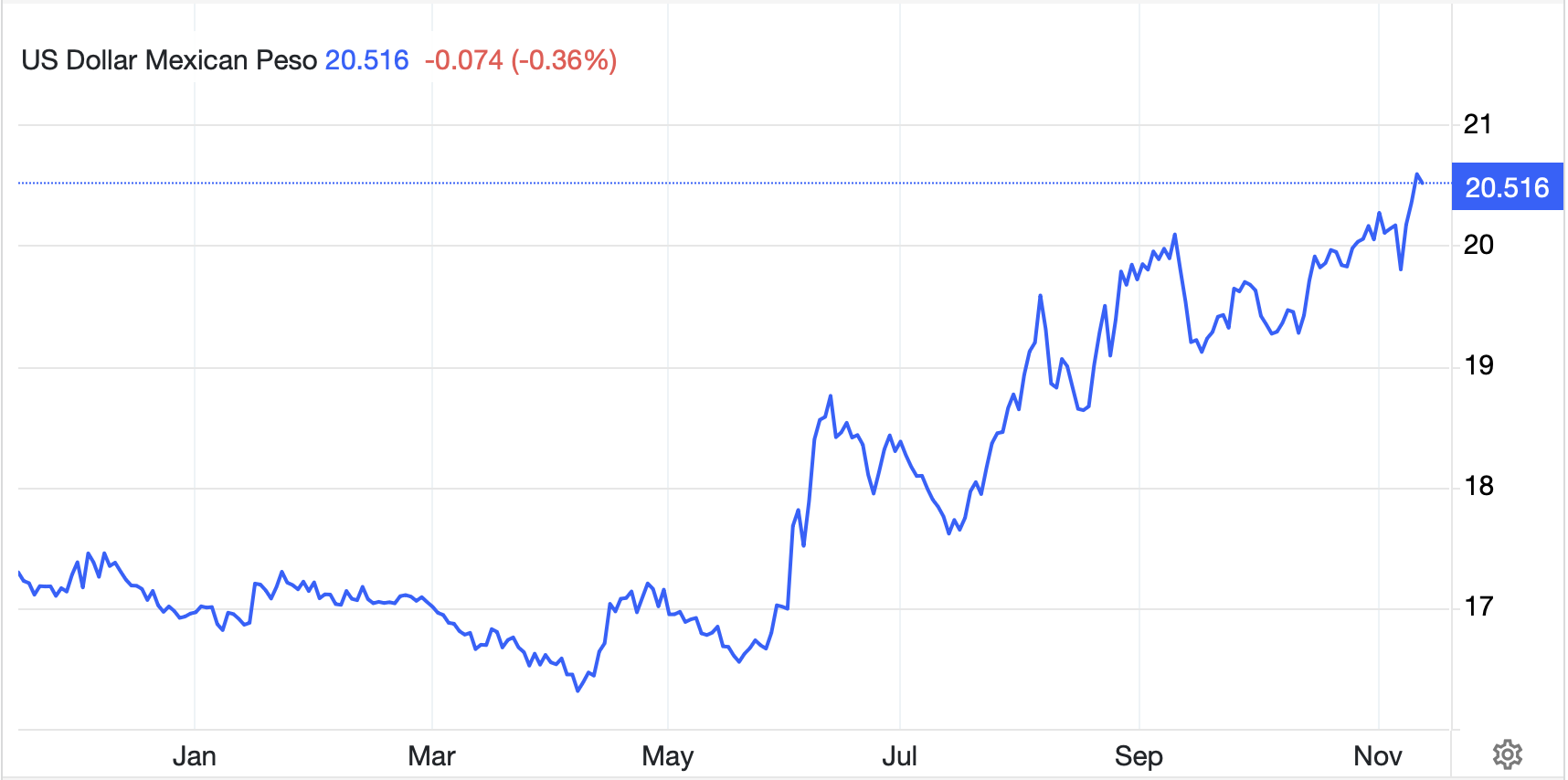
Speaking of currencies, the dollar which has had quite a run in the past two sessions is backing off overall this morning although remains well above the pre-election levels.  In the G10, NOK (+1.3%) is the leader as the Norgesbank left rates on hold and indicated that was likely their stance going forward, while AUD (+1.0%) seems to be benefitting from both the rebound in metals prices and the potential Chinese stimulus.  Otherwise, currencies have rallied between 0.3% and 0.5% in this bloc.  In the EMG space, ZAR (+1.4%) is the biggest gainer, also on the precious metals rebound, while MXN (+1.2%) is next, although that is simply a continuation of the retracement from the post-election decline.  Bigger picture, I think the dollar remains well bid, but not today.

In the bond market, Treasury yields are unchanged this morning, consolidating their gains from the past week and waiting for the Fed this afternoon.  However, European sovereign yields have all rallied substantially, between 6bps and 9bps, which looks, for all intents and purposes, like the continent’s catch-up trade to yesterday’s US movement.  Nothing has changed the view that Treasury yields lead bond market moves in the G10.

Finally, in the commodity space, oil (-1.0%) is a bit lower this morning although yesterday it recouped most of its early losses and closed lower only minimally.  Yesterday also saw a surprising inventory build in the US which would be expected to weigh on prices.  In the metals markets, after a virtual collapse yesterday, this morning is seeing stabilization in precious metals and a sharp rebound in copper (+2.3%) as hopes for that Chinese stimulus spread to this market as well.

In addition to the FOMC meeting this afternoon, we see regular Thursday morning data of Initial (exp 221K) and Continuing (1880K) Claims as well as Nonfarm Productivity (2.3%) and Unit Labor Costs (1.0%).  However, despite all the recent activity, and the fact that a 25bp cut is a virtual certainty, Chairman Powell’s press conference will still have the trading community riveted to see how he describes any potential future paths in the wake of the election results.  Given the recent data and the estimate prospects of a Trump administration’s efforts to goose growth further, it is hard to see how the Fed can really discuss cutting rates much further.  In fact, I will go out on a limb and say I expect forecasts of the neutral rate are going to consistently climb higher and reach 4% before the end of 2025.  And that means, as is evident by both the economy and the stock market, the Fed has not tightened financial conditions very much at all.

Good luck

Adf

Pulling All-Nighters

As Harris and Trump try persuading
The voters, the markets keep trading
So, narrative writers
Are pulling all-nighters
To pump up the side that is fading
 
The latest attack is on Trump
Who’s blamed for the bond market slump
But what of the Fed
Whose rate cuts have spread
The fear that inflation will jump?


It appears we have reached the point in time when macroeconomic data is taking a backseat to the political situation.  Almost every story you can read in any of the mainstream media right now is about how the election is going to affect whatever subject an article is about.  The latest discussion, which I have seen across numerous sources like Bloomberg, the WSJ and Reuters, just to name a few, is that the bond markets recent decline is entirely Trump’s fault.  The logic is that as Trump’s election prospects improve, and those of fellow Republicans in both the House and Senate alongside him, the market is suddenly concerned that the government is going to spend a lot of money and run a large deficit.  You can’t make this up!

The federal government deficit under the current administration is pegged to be just shy of $2 trillion this fiscal year, and you have all heard about the fact that interest payments on the government’s nearly $36 trillion of debt have grown to be more than $1 trillion.  But that is not the driver according to the narrative.  The driver is the idea that the Republicans could sweep and that would mean large deficits because…Trump.

Now, I realize I am only an FX guy (FX poet I guess), but my rudimentary understanding of economics is that when economic activity is strong (like the current data implies) and the central bank then adds more liquidity to the system to goose demand, say by cutting interest rates in the front end of the curve, then demand can outstrip supply and prices will rise.  As such, bond investors, when they see a dovish Fed entering an easing cycle while economic activity continues to move along and the government is already running a large fiscal deficit, are concerned over higher inflation ahead and so demand higher yields to own Treasury securities.  Of course, that view doesn’t necessarily suit the narrative so desperately pushed by the mainstream media that Trump is the root of all evil, but it does seem to make more sense.

At any rate, for the next two weeks at least, and likely four years if Trump wins, I can assure you that every negative day in any financial market will be blamed on Trump and his policies, despite the fact that the Fed seems to be the one with far more direct impact on short-term economic outcomes.  A look at the below chart, showing 10yr Treasury yields and the Fed funds rate cannot help but show that it was the Fed’s rate cut that is coincident with the recent sharp rise in yields, and this took place long before the odds of a Trump victory improved.  Look through the narrative and instead at the data and Fed activities for the most important clues as to what is actually happening.  I would argue that this is a bond market that is concerned about returning inflation as the Fed’s policy prescription no longer matches the reality on the ground.

Source: tradingeconomics.com

One other thing.  If the Fed does continue to cut rates while US economic data continues to demonstrate solid growth, look for commodity prices to continue their ongoing rally, likely equity markets to continue to perform well, but the dollar is more nuanced as rising inflation ought to undermine the greenback, but given we are seeing more aggressive rate cuts elsewhere in the world (Bank of Canada just cut 50bps this week and the ECB and BOE are going to be cutting again next month), it is entirely possible the dollar holds its own despite macroeconomic fundamentals that should point to weakness.

Ok, let’s see what happened overnight.  Yesterday’s US sell-off, the third consecutive day of broad market weakness, seems to have been sufficient to wash out some of the froth in the market as US futures are pointing higher this morning, especially after Tesla’s better than expected earnings report.  But overnight, the trend from yesterday’s US session was intact with most Asian markets under pressure (Hang Seng -1.3%, CSI 300 -1.1%, KOSPI -0.7%) with only Japan (Nikkei +0.1%) bucking the trend.  In Europe, however, this morning’s color is green with all the major bourses showing life (CAC +0.75%, DAX +0.7%, FTSE 100 +0.5%). Now, there was data released in Europe with the Flash PMI readings out this morning.  The funny thing is that they did not paint a great picture, with continued softness almost everywhere.  My take is Europe is going through a ‘bad news is good’ phase where the weak PMI data implies there will be more aggressive rate cuts by the ECB going forward.  Certainly, Eurozone economic activity, led by Germany’s virtual stagnation, is lackluster at best.

In the bond markets, after several sessions of rising yields, Treasuries have seen yields slip back 5bps this morning with similar declines across the board in European sovereign markets.  Part of this is the weak PMI data I believe, but part of it is a simple trading response to a market that is likely somewhat oversold.  After all, for the past month, bonds have been under significant pressure so a bounce can be no surprise.

In the commodity markets, after yesterday’s rout, where there seemed to be a lot of profit taking of the recent rally, this morning the march higher continues.  Oil (+1.0%) is leading the energy complex higher and the entire metals complex (Au +0.5%, Ag +0.7%, Cu +0.5%, Al +0.9%) is back in gear as all the underlying drivers (rising inflation, solid demand, and for gold, ongoing geopolitical concerns) remain in place.

Finally, the dollar is a bit softer this morning, but this too seems like a response to what has been a strong rally.  Once again, using DXY as a proxy (see chart below) for the broad dollar, the rally over the past month has been quite strong, so a day of backing off is to be expected.  As I mentioned above, the future of the dollar is nuanced because while the macro indicators point to potential weakness, if the rest of the world eases monetary policy more aggressively, the dollar will still rally.

Source: tradingeconomics.com

As to today’s movement, currency gains have been between 0.2% and 0.5% with the commodity bloc the biggest beneficiary (ZAR +0.5%, NOK +0.4%, AUD +0.3%) and we have also seen the yen (+0.5%) regain a little of its footing amid declining US yields, although it remains far above the 150 level.  There are those who are looking for another bout of intervention, but I am not in that camp, at least not in the near-term.

On the data front, this morning brings the Chicago Fed National Activity Index (exp 0.2), Initial Claims (242K), Continuing Claims (1880K), Flash PMI (Mfg 47.5, Services 55.0) and New Home Sales (720K).  Yesterday’s Existing Home Sales data was weaker than expected at 3.84M, arguably a testament to the fact that mortgage rates have followed Treasury yields higher and are back above 7.0% again.  On the Fed front, we hear from new Cleveland Fed president Beth Hammack, but it feels like Fed speak is losing some momentum.  Nobody believes that they are going to stop cutting rates, and fewer and fewer analysts think they should continue amid strong growth.  The futures market is now pricing a 95% probability of a November cut but only a 71% probability of a December cut to follow.  I remain in the camp that they pause in December, especially in the event of a Trump victory.

While the dollar is under pressure today, I continue to believe it retains the ‘cleanest shirt in the dirty laundry’ appeal and will ultimately continue to rally.  

Good luck

Adf

Nothing But Fearporn

Said Logan, right now things are cool
With loads of reserves in the pool
And if I’m correct
The likely effect
Is rates will remain our key tool
 
As such, talk of balance sheet woes
Is nothing but fearporn, God knows
We’ll let bonds mature
Though we are unsure
Of how many we need dispose


“If the economy evolves as I currently expect, a strategy of gradually lowering the policy rate toward a more normal or neutral level can help manage the risks and achieve our goals,” explained Dallas Fed President Lorrie Logan on Monday. “However, any number of shocks could influence what that path to normal will look like, how fast policy should move and where rates should settle.”

In other words, we want to keep up appearances but we have no real idea how things are going to play out and so whatever we think our policies are going to be right now, they are subject to changes at any time.  It shouldn’t be surprising that the Fed doesn’t really know where things are going to go, after all, predicting the future is very hard.  But for some reason, many folks, both market focused and politicians, seem to believe they should be able to forecast well and control the outcomes.

Based on the market reaction to Logan’s comments, market participants, at least, are losing some of that confidence.  Treasury yields jumped 11bps in the 10-year dragging the entire yield curve higher along with all of Europe.  And perhaps more ominously for the Fed’s wish list, mortgage rates also rocketed to their highest level since July.  I might suggest market participants are losing their belief that the Fed is going to continue to cut interest rates as many had believed.  Fed funds futures have reduced their cut probabilities by nearly 10 points compared to yesterday as the latest example of this issue.  

And you know what else continues to benefit as those interest rates refuse to decline?  That’s right, the dollar continues to rally steadily against all comers.  Using the DXY as a proxy, the greenback has rebounded 3% from its levels around the time of the last Fed meeting as per the below chart.  I assure you, if I am correct that the Fed cuts 25bps in November and then doesn’t cut in December, the dollar will be much higher still.  Something to watch for!  

Source: tradingeconomics.com

In fact, there were four Fed speakers yesterday and three of them, including Logan, sounded more cautionary in their view of the future path of rates.  However, uber dove Mary Daly from the SF Fed is still all-in for many more cuts to come.  And this is the current situation at the Fed, I believe.  There are FOMC members who remain in the “we must cut rates at all costs” camp, who despite the evidence of the data they supposedly track remaining stronger than expected want lower rates, and there are those who are willing to reduce the pace of cuts, but still want lower rates.  This tells me that the Fed is going to continue to cut rates regardless, and so the bond market is going to become the arbiter of financial conditions.  Recent bond market movements seem more likely to be a harbinger of the future than an aberration, at least unless/until the economy weakens substantially.  In fact, you can see that the relation between bond yields and the dollar is quite strong now, something I suspect will remain true for a while going forward.

And that was really all that we had as the overnight session brought us virtually nothing new.  So, a quick recap of the overnight shows that after a lackluster session in the US on low volumes, Asia had more laggards than leaders with Tokyo (-1.4%) and Australia (-1.7%) dominating the story although China (CSI 300 +0.6%, Hang Seng +0.1%) managed to buck the trend.  The latter two, though, seemed like reactionary bounces from recent declines.  In Europe, bourses are all red this morning led lower by Spain’s IBEX (-1.1%) but seeing weakness everywhere (CAC -0.7%, FTSE 100 -0.7%, DAX -0.25%).  And, at this hour (7:45), US futures are lower by -0.5% or so.

After yesterday’s dramatic rise in yields in the US, we are seeing a continuation this morning with Treasuries edging higher by 1bp but European sovereigns all higher b between 4bps and 5bps.  That seems to be catching up to the last of the afternoon Treasury move yesterday.  As I mention above, I see the trend for yields in the US to be higher, and that should impact yields everywhere.

In the commodity markets, once again, demand is increasing and we are seeing gains in oil (+1.1%), gold (+0.6% and new all-time highs), silver (+1.7%) and copper (+0.9%).  The financial narrative is turning more and more to inflation concerns and the fact that commodities remain an undervalued and important segment in which to have exposure.  I am personally long throughout this space and believe there is much further to run here.

Finally, after the dollar’s blockbuster day yesterday, it has paused for a rest with the noteworthy gainers today all in the commodity bloc (AUD +0.5%, NZD +0.55%, MXN +0.2%, ZAR +0.2%, NOK +0.4%) with most other currencies actually a bit softer vs. the buck.  Keep an eye on JPY (-0.2%) which is now firmly above the 150 level and is likely to begin to see more discussion about potential intervention soon.

There is no data of note this morning although we do hear from Philly Fed president Harker.  It will be interesting to hear if he is in the dovish or uber dovish camp, as there appear to be no hawks left on the FOMC. 

Until the election in two weeks, I suspect that volumes will remain low but trends will remain intact, so higher yields and a higher dollar seem most likely to be in our future.

Good luck

Adf

Turn Into Snails

The FX Poet will be in Nashville at the AFP Conference October 21-22, speaking about effective ways to use FX options in a hedging program.  Please come to the presentation on Monday at 1:45 in Grand Ballroom C1 if you are there.  I would love to meet and speak.
 
This morning the ECB’s meeting
And no doubt they will be repeating
The idea inflation
Is near its cessation
So, high rates will now be retreating
 
As well, we will learn the details
Of what’s occurred in Retail Sales
If strength’s what we see
The FOMC
Rate cutters may turn into snails


Yesterday was generally very quiet as investors appear to be turning their focus to the US presidential election and trying to determine the outcome and what it will mean for markets going forward.  (FWIW, this poet is not going to attempt to determine how things will play out at this stage given the fact that whatever claims or promises are made by either candidate, at least economically, they can only be accomplished through Congress, so are really just wishes right now).  The upshot is that the volume of activity is likely to remain modest until the election.  Of course, that doesn’t mean prices won’t move, just that there won’t be much conviction behind the moves.

In the meantime, central banks remain at the forefront of every market conversation and today is no different with Madame Lagarde set to regale us with the news of an ECB rate cut of 25bps later this morning.  Inflation data from the Eurozone this morning was revised down further with the headline falling to 1.7% Y/Y in September, the lowest print since April 2021.  However, the core rate, at 2.7%, remains well above their target.  Now, the ECB mandate targets headline inflation specifically, unlike the Fed which has determined by itself that core PCE is the proper metric, so a rate cut can easily be justified.  Adding to the story is the fact that Germany remains mired in recession and economic activity in the Eurozone overall remains desultory at best.  The problem the ECB has is that services inflation remains sticky, still printing near 4% and money supply is growing again which is a strong indicator that inflation is going to rise in the future.  But as we have learned over the past decades, the future is now when it comes to central banks, and they will respond to the moment.

One of the problems for the ECB, though, is that despite the Fed’s mistaken 50bp rate cut, the data in the US we have seen since indicates that the economy continues to motor along fairly well.  This means that although the Fed seems likely to cut 25bps in November, I think it will be doing so reluctantly.  After all, if they didn’t cut, it would basically be an admission that they made a mistake with the 50bp cut in September, and you know as well as I that they will never admit a mistake.  

My point is that with the ECB feeling greater pressure to cut with their inflation reading below target and growth slowing, and the Fed likely to back away from an aggressive rate cutting path, the euro is likely to continue to suffer.  For instance, this morning, though it is unchanged, it sits below the 1.09 level (last seen in August) and certainly appears as though it is in a strong downtrend as per the below chart.  If I were to guess, I think a move toward 1.06 is in the cards as a measured move around that long-term 1.09 pivot level.

Source: tradingeconomics.com

The problem for the ECB is that a weakening currency is likely to add upward inflation pressures before it helps the exporters in Europe expand market share, and boosts growth.  Stagflation is such an ugly word, but one that may well come to describe the Eurozone.  As an aside, when the US was in stagflation in the late 1970’s, that is when the dollar was at its weakest point historically.

Of course, this also makes this morning’s Retail Sales (exp 0.3%, 0.1% ex autos) so important.  You may recall that last month, this number beat expectations and was another in the list of surprisingly strong US data releases.  Another strong print will really cement the difference between the US and the Eurozone, to the dollar’s advantage I believe.  

But will any of this really matter to markets?  Certainly, Lagarde’s comments can have an impact on Eurozone markets, but my take is we will not see major investment swings, regardless of the data, ahead of the election.

Ok, let’s see how things played out overnight.  Despite the rebound in the US yesterday, Asia was having none of it with most markets in the red.  Japan (-0.7%) fell despite the US strength and the yen’s weakness (JPY pushing back to 150 for the first time since August) and China continues to see the recent bubble of stimulus expectations deflate (CSI 300 -1.1%, Hang Seng -1.0%).  Elsewhere in the region, the results were mixed with some gainers (Australia, New Zealand, Singapore) and some laggards (India, Korea, Philippines).  In Europe, though, green is today’s theme with gains across the board, led by the CAC (+1.2%) but strength everywhere as investors are betting on a more dovish ECB.  In the US futures market, we are all green as well, with strong gains (+0.5% or more) at this hour (7:30).

In the bond markets, after dipping back to the 4.0% level yesterday, 10-year Treasuries are 2bps higher this morning and we are seeing similar price action across all the European sovereign markets.  This seems like a classic risk-on move.  In Japan, JGB yields edged higher by 1bp and are now at 0.95%, perhaps as the market anticipates the BOJ is set to get more aggressive with the yen steadily falling for the past several months.  I don’t believe 150 is a line in the sand, but it cannot be making Ueda-san feel any better about things.

Turning to commodities, the one truism is that gold (+0.5%) continues to rally.  The number of different storylines (central bank buying, reduced mining activity, western investors waking up, Asian investors accelerating) about the shiny metal continues to increase and every one of them is bullish.  This continues to help Silver, although copper (-0.6%) remains far more reliant on a positive economic story, something that remains in doubt.  As to oil (+0.25%) it is holding that $70/bbl level although its grip does seem tenuous at times.  However, I would contend there is virtually no war premium in the price at this point.

Finally, the dollar has net softened a bit this morning, but that is in the context of a more than 3-week long steady rally.  So, AUD (+0.5%) is the big winner this morning in the G10 and as I am typing, GBP (+0.2%) has recaptured the 1.30 level, but those trends remain lower.  In the EMG markets, KRW (-0.55%) is today’s laggard although we are seeing weakness in both ZAR (-0.3%) and MXN (-0.3%) despite that metals strength.  Remember, FX markets are perverse.

In addition to the Retail Sales data, we see Initial (exp 260K) and Continuing (1870K) Claims and Philly Fed (3.0) at 8:30 with IP (-0.2%) and Capacity Utilization (77.8%) at 9:15.  Also, because of the holiday Monday, we see EIA oil inventory data this morning as well with a slight draw expected.  Only one Fed speaker is on the docket (Goolsbee) who will undoubtedly explain that more cuts are coming.

While the dollar may be under modest pressure this morning, I see upward pressure overall for the time being until policies change.

Good luck

Adf

Nearly Obscene

The FX Poet will be in Nashville at the AFP Conference October 21-22, speaking about effective ways to use FX options in a hedging program.  Please come to the presentation on Monday at 1:45 in Grand Ballroom C1 if you are there.  I would love to meet and speak.
 
While here in the States we have seen
Inflation that’s nearly obscene
In Europe, inflation
In ‘bout every nation
Has fallen much more than foreseen
 
The narrative there has adjusted
As all of their models seem busted
So, cuts with more speed
We’ll soon see proceed
Though central banks still aren’t trusted

While Fed speakers are trying to claim victory over inflation, whether or not that is reality, the situation in Europe is a bit different.  In fact, headline inflation has fallen quite dramatically virtually across the board as evidenced by the below chart.

Now, a critical piece of this decline is the fact that energy prices have fallen dramatically in the past year with Brent Crude (-16.5%) and TTF NatGas (-18.9%) leading the way lower.  In fact, core inflation data, for the few nations that show it, remains above that 2% target with the UK (Core 3.2% Y/Y) the latest to report this morning.  One other thing to remember is that in the wake of the Covid pandemic, no nation printed and spent nearly as much money as the US on a relative basis, let alone an absolute basis, so there was less fiscal largesse elsewhere.

Yet, the fact remains that headline inflation throughout Europe and the UK has fallen below the 2% targets and so the narrative has now shifted to see more aggressive rate cuts by the central banks everywhere.  This will be part of the discussion tomorrow at the ECB, where most analysts are looking for a 25bp cut although some are calling for 50bps, and the market is pricing more than 40bps at this point.

You know what else is pricing a larger rate cut by the ECB?  The FX market.  Yesterday, the euro fell below the 1.09 level for the first time in more than two months (remember that chart of the double top formation from Monday?) and the single currency has fallen more than 2% in the past month.  Similarly, the pound, after today’s softer than expected CPI readings, has fallen -0.35% this morning, the worst performer in the G10, and is now lower by nearly -1.5% in the past month and looking like it has reversed the uptrend that existed through the summer and early autumn.

Ultimately, my point is that the narrative about rate cuts is shifting to a more accelerated mode in Europe and the UK (where talk of a 50bp cut is making the rounds as well) while here in the States, a 25bp cut is not fully priced in even after yesterdays’ much weaker than expected Empire State Manufacturing Index (-11.9 vs. exp 3.8 and last month’s +11.5).  If you want a reason to explain the dollar’s resilience, you could do worse than the fact that economies elsewhere in the world are lagging the performance here.

Speaking of the Fed, yesterday’s surprise Fedspeak came from Raphael Bostic, Atlanta Fed president, when he explained that he only foresees one more rate cut in 2024.  That is quite a different story than we have been hearing from the rest of the FOMC speakers, who seem completely on board with at least 50bps of cuts and seemingly could be persuaded to head toward 75bps.  There is still much to learn between now and the next FOMC meeting the day after the election here, but despite Bostic’s comments, I believe the minimum we will see before the end of the year will be 50bps.

Ok, that was really all the action overnight.  Yesterday’s disappointing US equity performance, with all three major indices lower by at least -0.75% (I thought that was outlawed 🤣) was followed by similarly weak performance in Asia with the Nikkei (-1.8%) leading the way lower as tech shares underperformed, but further weakness in China (-0.6%) as Godot seems more likely to arrive than the Chinese stimulus.  Throughout the region, only Thailand (+1.2%) managed any gains after the central bank there cut rates 25bps in a surprise move seeking to foster a better growth situation.  In Europe, only the UK (+0.6%) is rallying on the strength of the idea that lower inflation will encourage a 50bp cut from the BOE when they meet the day after the Fed. But otherwise, red is the color of the day in Europe with losses ranging from -0.1% (Spain) to -0.6% (France).  Meanwhile, US futures are a touch firmer at this hour (7:15), by just 0.2%.

In the bond market, yields are lower across the board after that weak Empire State number encouraged the slowing economy narrative and the lower inflation prints in Europe and the UK have weighed on yields there this morning.  So, Treasury yields (-2bps) are lagging most of Europe (Bunds -3bps, OATs -3bps) and UK Gilts (-8bps) are all about the data this morning.  Even JGB yields (-1bp) got into the act.

In the commodity space, oil (-0.5%) is continuing its recent decline, although yesterday it managed to bounce a bit and close above the $70/bbl level where it still sits, barely.  But the metals complex is having another good day with gold (+0.6%) pushing to new all-time highs as western investors are finally following Chinese and Indian investors as well as global central banks.  The lower interest rates certainly help here.  Similarly, we are seeing gains in the other metals (Ag +1.2%, Cu +1.1%) as stories regarding shortages for both metals in the long-term resurface given the lack of new mining activity and increased demand driven by the idea of increased solar and electricity needs respectively.

Finally, the dollar, overall, is little changed, holding onto its recent gains although with a mixed performance this morning.  ZAR (+0.5%) is this morning’s leader on the back of the metals market gains, and we have seen strength in KRW (+0.3%) as well.  However, elsewhere, movement is small and favoring the dollar (HUF -0.2%, CZK -0.2%) and we’ve already discussed the euro and pound.  Interestingly, the THB (+0.45%) rallied after the rate cut on the back of equity inflows.

There is no major data set to be released this morning and no Fed speakers on the current calendar, although as always, I suspect we will still hear from some of them.  Madame Lagarde speaks this afternoon, and given the ECB meeting tomorrow, there will be many interested listeners.

Overall, the themes seem to be that Eurozone inflation is sinking and rate cuts are coming.  That should keep some downward pressure on European currencies vs. the dollar, at least until we see or hear something that describes a more aggressively dovish Fed.  The one truly consistent feature of these markets has been the rally in gold which seems to benefit from fear, inflation and lower rates, all of which appear to be in our future.

Good luck

Adf

Open and Shut

The FX Poet will be in Nashville at the AFP Conference October 21-22, speaking about effective ways to use FX options in a hedging program.  Please come to the presentation on Monday at 1:45 in Grand Ballroom C2 if you are there.  I would love to meet and speak.
 
The great thing about recent data
Is nobody thinks it will matta
It’s open and shut
The Fed’s gonna cut
As ‘flation ambitions they shatta
 
In Jay’s mind, the risk tradeoff’s clear
As stocks work to find a new gear
However, for debt
They’re making the bet
The problems won’t hit til next year

On this Columbus Day holiday, US cash markets are closed although futures are trading, so no stock or bond market activity today.  The FX market will be open, as always, although I suspect liquidity will be less than usual, especially once Europe goes home at noon so hopefully, you don’t have much to do today in the way of hedging.

As it happens, there was not a lot of news overnight to discuss, although China did manage to once again disappoint with respect to their fiscal support announcement on Saturday, not offering up even a big picture number, let alone specific programs, that they are considering.  Interestingly, this did not deter the new China stock bulls, with the CSI 300 (+1.9%) rallying sharply, but this is becoming a sentiment story, not a data driven one.  Someone on X asked the question about why Xi was not doing more, and my view has become that he recognizes to truly get the economy going again he will need to cede some of the power he has spent the past 10 years amassing.  I sincerely doubt he is willing to do that, and since his life won’t change regardless of the amount of stimulus, in the end, holding power is far more important to him.

But let’s go back to the data driven approach and its pluses and minuses.  This morning’s WSJ had an articleby James Mackintosh titled, “The Fed Has a Dependency Problem That Needs Fixing”, and it is his view that data dependence is the current Achilles Heel for Powell and friends.  Now, I won’t dispute that the market’s tendency to extrapolate one data point out to infinity can have market consequences, but I think the point Mr Mackintosh misses is that this is a problem entirely of the Fed’s own making.  Nobody instructed them to offer their views, other than the semi-annual testimony before Congress.  Nobody is forcing FOMC members to be out blathering virtually every day (in fact, two of them, Waller and Kashkari, will be speaking today despite markets being closed).  Forward Guidance was Benny the Beard’s brainstorm, it is not a Congressional mandate, it is not in the Fed’s charter, it is entirely their own.

So, if too much forward guidance is a problem, the Fed can simply stop it.  There is no doubt the recent data releases have been somewhat confusing, with more strength than most economists and analysts have forecast, and there is no doubt that any given month’s data point is subject to certain random fluctuations and revisions.  However, consider if the Fed was not trying to guide the market to whatever their preferred outcome may be.

If there was no Forward Guidance, then each individual investor would have to analyze the current situation themselves, get their best estimate of how they anticipated the future to evolve, and position themselves accordingly.  In today’s world, there is a lot of data pointing in different directions.  Absent the Fed trying to sway opinion, position sizes would be greatly reduced, and the large reversals in markets like we saw in the wake of the recent rate cut and subsequent NFP and CPI releases, would likely be far less significant.  

When the Fed explains that they are going to keep rates lower for longer (as they did in the wake of the GFC and again post covid) that is a clear signal to investors to load up on assets that perform well in a low-rate environment (i.e. stocks).  When they change that view…oops!  That is what we saw in 2022 when they flipped the script and went from transitory inflation to persistent inflation.  Everybody who was long both stocks and bonds suffered.  

But let’s run a thought experiment.  If the Fed gave no Forward Guidance, and merely adjusted rates as they saw fit, investors would have had significantly less confidence that regardless of what had clearly become an inflation problem, the Fed was going to maintain low interest rates.  There would have been a much more gradual move out of risk assets as investors determined inflation was a problem, and the Fed wouldn’t have had all that egg on their face when they had to admit they made a mistake about inflation.

In the end, I disagree with Mackintosh that the Fed should essentially ignore the data, but I agree that they shouldn’t talk about it at all.  In fact, I think we would all be far better off if none of them ever said a word!

Enough of my diatribe.  Let’s see how the rest of the world’s markets behaved overnight.  While mainland Chinese stocks performed well, Hong Kong (-0.75%) did not.  Japan was closed for National Sports Day, although the broad Asia look was that markets there followed Friday’s US rally as well.  However, this morning in Europe, the picture is mixed with some gainers (DAX, IBEX) and some laggards (CAC, FTSE 100) and none of the moves more than 0.3%.  The only data overnight was Chinese Trade (reduced Trade surplus of $81.7B) and Chinese financing which was modestly disappointing despite the recent efforts at goosing things there.  US futures are trading this morning and at this hour (7:00) they are mixed with modest gains and losses of ~0.25%.

With Japan closed along with the US, it should be no surprise that bond market activity is extremely limited with yields essentially unchanged this morning from where they were at Friday’s close.  However, remember that 10-year Treasury yields are higher by nearly 50bps since the day before the FOMC meeting.  This is an important signal that market participants are far more concerned about inflation than the Fed.  On this subject, I think the market is correct.

In the commodity markets, oil (-2.4%) continues its recent decline as the long awaited and feared Israeli response to Iran’s missile attacks seems to have been postponed further.  The absence of that supply concern alongside the lack of Chinese stimulus, and by extension demand, has weighed heavily on the market.  Gold is unchanged this morning although we are seeing some softness in the industrial metals with both silver and copper softer today.

Part of that metals weakness is due to the fact that the dollar continues to rise against all forecasts.  This weekend there was a meeting of the old Soviet nations, the CIS (absent Ukraine of course) and they pledged to stop using dollars in their trade.  This is in the lead-up to the BRICS conference to be held next week in Kazan, Russia, where once again many claim that this group of nations will create their own currency in their efforts to get away from the dollar’s hegemony.  Whether or not they formally do so, I have yet to see a path that includes a cogent rationale for anyone to use this currency, especially if it is backed by a series of nonconvertible currencies like the CNY, BRL and INR.  But it does generate clicks in the doomporn sphere.  

But back in the real world, the dollar is just grinding higher vs everything this morning with NOK (-0.8%) suffering on oil’s weakness and AUD (-0.5%) and NZD (-0.5%) under pressure because of metals weakness and lack of Chinese stimulus.  ZAR (-0.8%) is also feeling the metals weakness but JPY (-0.4%) and CNY (-0.35%) are all softer this morning.  In other words, it is business as usual.  In fact, for those of you with a market technical bias, a quick look at the euro chart seems to define the concept of a double top.

Source: tradingeconomics.com

On the data front, aside from loads more Fedspeak this week, and the ECB monetary meeting on Thursday, the big data print in the US is Retail Sales, also on Thursday.

TuesdayEmpire State Manufacturing2.3
ThursdayECB Rate Decision3.25% (current 3.5%)
 Initial Claims255K
 Continuing Claims1870K
 Retail Sales0.3%
 -ex Autos0.2%
 Philly Fed3.0
 IP-0.1%
 Capacity Utilization77.8%
FridayHousing Starts1.35M
 Building Permits1.45M

Source: tradingeconomics.com

Adding to today’s Fedspeak, we hear from eight more speakers this week. With the Fed funds futures market pricing a 14% probability of no cut at all in November, which would be remarkable given the 50bp cut they made last month, it strikes me that there will be very little new from the speakers.  Rather, if the data this week comes in hotter than forecast, that is going to be the market driver.  I think it is fair to say the Fed has made a hash of things lately.  As long as the data continues to look good, though, I have to believe that fears of renewed inflation and higher rates are going to support the dollar.

Good luck

Adf

Condemned to Damnation

The Chinese returned from vacation
But hopes for more subsidization
Were rapidly dashed
With early gains trashed
And Hong Kong condemned to damnation
 
Meanwhile, what we heard from the Fed
Was further rate cuts are ahead
They all still believe
That they will achieve
Their goal and inflation is dead


Talk about buzzkill.  The Chinese Golden Week holiday is over and all the hopes that the National Development and Reform Commission Briefing would highlight new stimulus as well as further details of the programs announced prior to the holiday week were dashed.  Instead, this group simply confirmed that they were going to implement the previously announced plans and insisted that it would be enough to get the economy back to its target growth rate of 5.0%.  You may recall that the government had promised funds to support the stock market and some efforts to support the housing market, but there was little in the way of direct support for consumers.  While the initial market response to the stimulus measures was quite positive, there is a rapidly growing concern that those measures will now fall short.  In the end, much of the joy attached to the stimulus story has evaporated.  

The market response was telling as while onshore stocks rallied (CSI 300 +5.9%) they closed far below their early session highs and the Hang Seng (-9.4%) in Hong Kong, which had been open all during the Golden Week holiday and rallied steadily through that time, retraced sharply, giving back all those gains and then some (see below). 

Source: Bloomberg.com

In the end, it is difficult to look at the Chinese story and feel confident that the currently announced stimulus packages are going to be sufficient to make a major dent in the problems there.  It appears that the limits of a command economy may have been reached, a situation that will not benefit anyone.

Turning to the first batch of Fed speakers, yesterday we heard from Governor Adriana Kugler, St Louis Fed president Alberto Musalem and Chicago Fed president Austan Goolsbee.  While Mr Goolsbee explained, “I am not seeing signs of resurgent inflation,” it does not appear he is really looking.  As to Ms Kugler, she “strongly supported” the 50bp cut and when asked about the strong NFP report explained that looking through the data, “several metrics point toward labor-market cooling”, despite the strong report.  Finally, Mr Musalem, although he supported the 50bp cut, remarked, “Given where the economy is today, I view the costs of easing too much too soon as greater than the costs of easing too little too late.”

Net, it appears that recent data upticks have not had any impact on their views that they must cut rates further and are prepared to do so every meeting going forward.  The Fed funds futures market has now priced 25bp rate cuts into both the November and December meetings, although that is reduced significantly from the nearly 100bps that was priced prior to the NFP report.

Away from those stories, though, there was not much other news of note overnight.  Russia/Ukraine has moved to page 32 of the newspapers and is not even discussed anymore.  Israel/Hamas/Hezbollah/Iran has more tongues wagging but at this point, it has become a waiting game for Israel to respond to the missile barrage from Iran last week.  Given we are between Rosh Hashanah and Yom Kippur, it seems unlikely to me that we will see anything prior to the weekend.  China fizzled after vacation.  The US election remains a tight race at this point with no clear outcome.  Hurricane Helene and the aftermath is being superseded by Hurricane Milton, due to hit the Tampa area shortly, but again, the latter two, while horrific tragedies, or potential tragedies, are not really market stories.

So, what’s driving things?  Arguably, interest rate policies and bond markets are having the biggest impact on financial markets right now.  With that in mind, the fact that 10-year Treasury yields are now back above 4.0% for the first time since August seems to be the main event.  Why, you may ask, would bond yields have backed up so far so fast?  Ultimately, it appears that bond investors are losing confidence in the central bank inflation story, the idea that they have it under control.  First off, oil prices, though lower today by -1.9%, have still gained more than 8.3% in the past week with gasoline prices higher by nearly 7% in the same period.  This does not bode well for lower inflation prints going forward.  Second, the combination of the much stronger than expected NFP report and the Fed’s willful ignorance of the implications is also tipping the marginal investor toward seeing more inflation going forward.

Ok, so how have these things impacted markets?  Well, aside from China/HK and following yesterday’s US declines, there were far more laggards (Japan, Singapore, Korea, Australia) than leaders (India) across Asia with Tokyo (-1.0%) the next worst performer.  In Europe, all the screens are red this morning led by the UK (-1.1%) but with losses between -0.2% in Germany after a much better than expected IP reading, to -0.6% in France.  Oftentimes, it seems like Europe is trading on yesterday’s US news, and that is the case today as US futures are pointing higher by about 0.4% at this hour (7:40).

Bond yields, which have been climbing for the past week, are little changed this morning, with neither Treasuries nor European sovereigns showing any movement of note.  However, one need only look at the chart below to see the trend over the past month.

Source: tradingeconomics.com

Aside from the oil retreat mentioned above, which seems to be a response to the absence of that Israeli action so widely expected, copper (-2.6%) is the laggard as disappointment over the Chinese stimulus dud pushed down demand expectations.  Gold (+0.3%) though, remains in demand and is hovering just below its recent all-time highs.

Finally, the dollar is backing off a bit this morning, although as evidenced by the chart below of the DXY, it has been on a bit of a tear for the past week, so consolidation should not be a surprise.

Source: tradingeconomics.com

However, overall, today’s price activity has been relatively muted with all G10 currencies within 0.2% of yesterday’s closing levels and the biggest movers in the EMG bloc (PLN +0.4%, ZAR -0.4%) hardly showing much more motion.  One exception is IDR, where the central bank intervened overnight after six consecutive days of rupiah weakness which saw the currency decline -4.5%.

On the data front this morning, the NFIB Small Business Optimism Index was released at a slightly softer than expected 91.5 although the Uncertainty sub index it a record high of 103 indicating small businesses are in a tough spot.  Otherwise, the only number is the Trade Balance (exp -$70.6B) and then a bunch more Fed speakers, all different ones than yesterday.  We also see the 3-year Note auction, so that may give us some clues as to the demand story for Treasuries ahead of the CPI data on Thursday.

The ongoing conflicting data has many, if not most, investors confused.  I believe that people will be seeking more clarity on Thursday and so until then, absent another geopolitical shock, we are likely to see modest market movements overall.  However, with the Fed hell-bent on cutting, I continue to fear inflation starting to reaccelerate and the dollar starting a more substantive decline.

Good luck

Adf

Impuissance

The world now awaits the response
Of Israel, which at the nonce
Has traders concerned
Restraint will be spurned
While mullahs pray for impuissance

Thus, oil continues to rise
And it oughtn’t be a surprise
The talk that inflation
Achieved its cessation
Has slowed while concerns crystalize

The most important market story this morning, I would contend, is the potential response by Israel after Iran’s missile attacks yesterday.  While only a handful of the approximately 180 missiles breached the Israeli aerial defenses, some damage was inflicted.  Israel has promised a response at their leisure and history has shown they have been effective in inflicting greater damage than they receive.

The major market concern is that Israel will attack Iran’s oil production capability, something which would certainly drive oil prices, which have spiked more than 8% in the past two sessions, higher still.  Currently, Iran is producing about 3.27 mm barrels/day, a solid 3% of global production and consumption.  Given the highly inelastic nature of the oil price, any attack there would have a substantial impact, at least in the short term.  Remember, though, that the Saudis have something along the lines of 3mm barrels/day of production shut in as OPEC+ has tried to support the price.  I expect that they would be able to bring that online quite quickly, so any price move would be short-lived.  The downside, though, is that it would use up the available spare capacity so any other event, say another hurricane which shuts in Gulf of Mexico production, would have an outsized impact.  Net, a response of that nature may only have a short-term impact on the price but would lead to more fragility overall.

As well, I am confident that the Biden administration is really working to convince Israel to leave the oil assets alone as during the campaign, a spike in oil, and by extension gasoline, prices will not be a welcome turn of events.  However, from Israel’s point of view, the destruction of Iran’s oil production capacity would result in a much weaker Iran, one that would have far more difficulty promoting their attacks on Israel.  At this point, we can only wait and see.

Away from that news, yesterday saw the PMI and ISM data releases which simply confirmed that global manufacturing activity remains in a slump.  The US report, printing at a weaker than expected 47.2, the 22ndmonth in the last 23 that the reading has been below the boom/bust line of 50.0, continues to drive concerns about economic weakness in the US.  Of course, manufacturing represents less than 25% of the economy directly, although many service jobs are dependent on the manufacturing sector.

Arguably, the perception of economic weakness that remains prevalent in the US stems from this situation, where manufacturing remains weak, and the ancillary activity typically driven by it remains weak as well.  These are the traditional blue-collar jobs, and it is those people who seem to be feeling the current economic malaise most severely.  In fact, this is as good an explanation as I can find for why despite some decent top line economic data, there are still so many people in the US who are highly stressed and living paycheck to paycheck.  While this is a macroeconomic discussion, it is also a key political discussion as it will highly likely be an important driver of voters come November.

As to the other topic that has traders engaged, central bank policy, the plethora of Fed speakers yesterday did nothing to alter any views on their next steps.  Currently, the Fed funds futures market is pricing a 35% probability of a 50bp cut in November, but still pricing an 85% probability that there will be 75bps of cuts by year end.  Now, this is less cutting than had been priced just a week ago, but that move was driven by Powell on Monday.  Given the amount of data that we will be receiving between now and the November meeting, including two NFP reports as well as a CPI and PCE report this month, and the first look at Q3 GDP, many views can change.

And that’s kind of it this morning.  Last night’s VP debate had no market impact, nor would I have expected it to do so.  Worries about the Middle East and questions about central bank policy are the current market drivers.

With that in mind, let’s see how things played out overnight after yesterday’s weak showing in US markets.  In Japan, the Nikkei (-2.2%) gave back Tuesday’s gains as the market tries to determine exactly how new PM Ishiba is viewing the economy and central bank.  In a statement, he indicated the government would work with the BOJ to achieve joint goals, and his initial hawkish perception has been walked back.  In fact, it is odd that Japanese stocks fell given JGB yields (-2bps) also declined alongside the yen (-0.7%) on those comments.  As to the rest of Asia, the Hang Seng (+6.2%) rocketed higher on the Chinese stimulus story (mainland markets are still closed for their holiday), but the other Asian markets that were open, including Korea, Malaysia and Indonesia, all saw selling pressure with declines on the order of -1.0%.

In Europe, continental bourses are all lower led by the DAX (-0.6%) and IBEX (-0.6%) although the FTSE 100 (+0.2%) has managed a small gain.  The UK move has been driven by energy stocks rallying on the Middle East story while the lack of energy stocks on the continent seems to be the key to losses as investors turn cautious.  As to US futures, at this hour (7:30), they are lower by between -0.2% and -0.4%.

Bond yields are lower this morning with Treasuries down -2bps while European sovereign yields have all fallen between -5bps and -6bps.  The weak PMI data there has increased the discussion about more aggressive policy ease from the central bank and the likelihood that inflation stays quiescent.

We have already discussed oil but a look at the metals markets shows that after a 1% rally yesterday, gold (-0.3%) is consolidating near its all-time highs, while both silver (+0.3%) and copper (+0.8%) continue to move higher.  For the latter two, everything I read is about how both metals are critical for building out the energy transition infrastructure and both metals are in structural shortage with stockpiles being utilized as mining output lags demand and getting new mines up and running is a decade long affair.  My take is both have further to rise.

Finally, the dollar is net little changed this morning after a very solid two-day rally.  Remember it was just Monday that I was discussing key technical levels in the DXY (100.00), EUR (1.1200) and GBP (1.3500).  Well, we have moved well away from all those levels as the dollar weakness story takes a break.  When Chairman Powell explained he was in no hurry to cut rates rapidly, that part of the narrative needed to change quickly…and it did.  So, this morning, aside from the yen’s weakness mentioned above, the other large mover is NOK (+0.7%) which is simply responding to the oil rally.  In fact, the commodity currencies are doing exactly what they are supposed to be doing with CLP (+0.5%) tracking copper and MXN (+0.4%) tracking both silver and oil.  ZAR (unchanged) is actually the surprise here although it has been rallying steadily since April on a combination of the strong metals markets and continued belief in a better economic situation based on the new government’s business friendly policies.

On the data front, this morning brings only ADP Employment (exp 120K) and the EIA oil inventories where further inventory drawdowns are anticipated.  We also hear from four more Fed speakers although given Powell’s lack of concern regarding the speed of cuts, it will be hard for these speakers to change the market perception in my view.  This leaves us with the big picture.  Right now, employment remains the most important data for the Fed and their policy views.  As such, this morning’s ADP is likely to have more importance than it ordinarily would, despite the limited correlation between this data and the NFP to be released on Friday.

It seems that there are some subtle changes in central bank views with market perceptions of FX moves impacted.  The Fed is now seen as not quite as dovish, while the BOJ and ECB are seen as a touch more dovish, hence the dollar’s gains against both the yen and euro.  However, I think the central bankers realize they are still feeling their way in the dark and will be slow to respond to outlier data, so this vibe seems likely to hold in the near term.

Good luck
Adf

The New Norm

The CPI data was warm
But not warm enough to deform
The view that the Fed
Was moving ahead
With rate cuts which are the new norm
 
While fifty seems out for next week
Investors, by year end, still seek
A full percent cut
Just when, though, is what
Defines why we need Jay to speak


It turns out that core CPI printed a tick higher than expected on the monthly result, although the Y/Y number was right in line with most forecasts.  In the broad scheme of things, it is not clear to me that a 0.1% difference in one month matters all that much, but markets are virtually designed to overreact to ‘surprising’ data.  At least, the algorithms that drive so much trading are designed to do so, or so it seems.  However, as can be seen by the chart below, it was a pretty short-lived dip and then the march higher in equity prices continued.

Source: tradingeconomics.com

While Fed funds futures pricing has adjusted the probability of a 50bp cut next week by the Fed down to just 15%, that market is still pricing in 100bps of cuts by the December meeting which means that there needs to be a 50bp cut in either November or December as they are the only two meetings left after next week.  As @inflation_guy highlighted in his always perceptive writeups on the CPI report, yesterday’s number ought not have changed the Fed’s thinking.  And perhaps that is exactly what we saw from the equity market, the realization that 50bps is still on the table for next week, especially since there is a growing feeling that’s what Powell wants to do.  I’m confident if Powell pushes for 50bps, he will have no trouble gaining quick acceptance around the table.

Ultimately, I think the problem with focusing on CPI is that the Fed doesn’t focus on CPI, even when they are worried about inflation.  However, especially now that they seem to believe they have achieved victory in that part of their mandate, it strikes me that the numbers about which they really care are the employment numbers.  Last week’s NFP report was mixed at best, although the actual NFP data was the weakest part of the report.  This morning, we get the weekly Claims data (exp Initial 230K, Continuing 1850K), but those numbers have been very stable of late, and not pointing to serious difficulties at all.  To my eye, from the perspective of the economic data that we continue to see, there is limited reason for the Fed to cut at all, especially with inflation still well above their target, but Powell promised a cut, and we have seen nothing since his Jackson Hole speech that could have changed view.  

A better question is, are they really going to cut 250bps by the end of 2025?  That would imply, at least to me, that the economy has slowed substantially, and likely headed into recession.  And, if the data turns recessionary, I can assure you that the Fed will have cut far more than 250bps by the end of next year, probably more like 350bps-400bps.  My point is I cannot look at the market pricing of interest rates and make it fit with the economic outlook at this time.  What I can do, however, is feel confident that if the Fed starts to cut rates aggressively with economic activity at current levels (remember, the GDPNow forecast is at 2.5% for Q3), inflation is likely to pick back up more quickly than people anticipate and the dollar, and bond market, will suffer while commodities and gold rise.

In the meantime, in a short while we will hear from Madame Lagarde as she follows up the almost certain 25bp rate cut they will declare today with her press conference.  I would argue the bigger news out of Europe is the ongoing discussion about increasing Eurozone debt issuance, as suggested by Mario (whatever it takes) Draghi in his report I discussed on Monday.  A look at the recent data from the continent shows that Unemployment is currently at historic lows for Europe, although that is still 6.4%, and inflation has fallen to 2.2%, just barely above their 2.0% target.  As such, here too it seems that the data is not screaming out for action.  Now, the punditry is looking for a so-called hawkish cut, one where the commentary does not discuss future cuts as a given, and I think that would be a sensible outcome.  But not dissimilar to the US situation, where a key driver of rate cut desires is the governments who are the biggest borrowers, there is intense political pressure to cut rates and reduce interest expense.  In fact, I believe that is a key reason behind Draghi’s report, to gain support and remove some of that direct interest rate expense from certain countries’ cost structure.  Thinking it through, net this should benefit the euro in the FX market as the Fed seems hell-bent on cutting and the ECB a bit less so.  We shall see,

Ok, so let’s turn to the overnight sessions to see where things are now.  After the US rebounded yesterday afternoon on the back of strength in the tech sector, we saw a huge rally in Tokyo (Nikkei +3.4%) on the same premise.  And while the Hang Seng (+0.8%) had a good session, once again, mainland Chinese shares (CSI 300 -0.4%) did not participate.  In fact, most of Asia was in the green, once again highlighting the weakness in the Chinese market, and the perception of that weakness in the Chinese economy.  As to Europe, it too has seen strength everywhere with gains between 0.8% (FTSE 100, CAC) and 1.20% (DAX).  This story is one of following the US, hopes for a bit more dovishness from the ECB, and a growing story about the potential for bank mergers in Europe with news that Italy’s UniCredit Bank has taken a stake in, and is considering buying, Germany’s Commezbank.  As to the US futures market, at this hour (7:20) they are all very modestly in the green.

In the bond markets, yields continue to back up slowly from the lows seen earlier this week with both Treasury (+2bps) and most European sovereign (Bunds +2bps, Gilts +2bps, OATs +1bp) slightly higher this morning.  Overnight, we saw JGB yields tick up only 1bp despite a relatively hawkish speech from BOJ member Naoki Tamura.  He indicated that rates should be raised to 1.0% by the end of their current forecast cycle, which sounds like a lot until you realize that is the end of 2027!  Maybe the 1bp move is appropriate after all.

In the commodity markets, oil (+1.7%) is continuing yesterday’s rally as questions about how quickly Gulf of Mexico production will restart in the wake of Hurricane Francine are driving markets.  While the weak demand story still has proponents, the reality is that oil prices have fallen more than 12% in the past month, a pretty large decline overall, so a bounce cannot be surprising.  In the metals markets, after a solid session yesterday, metals prices are higher in both the precious and industrial spaces.

Finally, the dollar is doing very little this morning, but if forced to define the move, it would be slightly softer.  While most currencies in both the G10 and EMG blocs are just a touch firmer, between 0.1% and 0.2%, the biggest mover, ironically is a decline, ZAR (-0.4%), although other than short term trading and positioning, there doesn’t seem to be a clear catalyst for the decline.

On the data front, in addition to the Claims data noted above, we see PPI (exp headline 0.1% M/M, 1.8% Y/Y; core 0.2% M/M, 2.5% Y/Y). Of course, there are no Fed speakers, but after the ECB announcement and press conference, we will hear from some ECB speakers as well.  Right now, the dichotomy between what the bond market is expecting (much lower rates anticipating weaker economic activity) and the stock market is expecting (ever higher earnings growth amid economic strength) remains wide.  While there are decent arguments on both sides, my sense is the bond market is more likely correct than the stock market.  And that is probably a dollar negative, at least at first.

Good luck

Adf

Like a Stone

When Ueda-san
Raised rates, stocks responded by
Falling like a stone
 
Now Ueda-san
Is treading lightly, lest an
Avalanche begins


I’m sure we all remember the day, just three weeks ago, when the Nikkei Index fell more than 12% leading to a global rout in stocks.  At that time, the proximate cause was claimed to be the combination of a more hawkish BOJ and a less dovish FOMC leading to a massive unwinding of the yen carry trade.  It was a great story, and almost certainly contained much truth.  But was it really the only thing going on?

It seems quite plausible that the dramatic market reactions at that time may have been sparked by that combination of central bank events, but the sole reason the moves were so dramatic was the fact that leverage in the markets has become a key driving force in everything that occurs.  This is the reason that central banks around the world, which continue to try to reduce their balance sheets, are forced to move so slowly.  There have already been two noteworthy accidents in balance sheet reduction processes; the September 2019 repo problem in the US and the October 2022 UK pension problem, both of which were exacerbated, if not specifically driven, by excess leverage.

With this in mind, the most recent market dislocation was the main topic of discussion last night in Tokyo when BOJ Governor Ueda was called on the carpet in a special session of the Diet to explain what he’s doing.  (As an aside, the underlying premise that cannot be forgotten is that despite all the alleged focus on economic outcomes, the only thing that gets governments exorcised is when stock markets fall sharply.  At that point, inquiries are opened!)

At any rate, last night, Ueda-san explained the following: “If we are able to confirm a rising certainty that the economy and prices will stay in line with forecasts, there’s no change to our stance that we’ll continue to adjust the degree of easing.” He followed that with, “We will watch financial markets with an extremely high sense of urgency for the time being.”  In other words, the BOJ is still set on tightening monetary policy but will continue with their major goal, which is to prevent significant market dislocation (read declines).  

The upshot here is that nothing has really changed, at least at the BOJ.  Given the pace with which the BOJ acts on a regular basis, it is not surprising that they expect to continue to tighten policy very gradually and will adjust the pace to prevent major financial market moves.  The market response to these comments was for the yen to rally initially, with the dollar falling nearly one full yen, but then reversing course as Ueda backed away from excessive hawkishness.

A graph with lines and numbers

Description automatically generated

Source: tradingeconomics.com

Which takes us to Chairman Powell and his speech this morning.

There once was a banker named Jay
Whose goal was for both sides to play
When joblessness rose
The question he’d pose
Was, see how inflation’s at bay?

It is somewhat ironic to me that the most recent market ructions were a response to the combined efforts of the BOJ on a Tuesday night and the Fed on a Wednesday morning, less than 12 hours apart.  And here we are this morning with Ueda-san having spoken on a Thursday night with Chair Powell slated to speak Friday morning, although this time a bit more like 15 hours apart.  Should we be concerned that more ructions are coming?
 
As per the above, it seems as though the BOJ is going to make every effort to tighten policy, albeit slowly, given that the inflation picture in Japan is not improving in the manner they would like to see.  In fact, last night, the latest figures were released showing that headline inflation remained at 2.8% and core rose a tick to 2.7%, although that was the expected outcome.  The one bright spot was their “super-core” reading fell to 1.9%.  In the past, I was given to understand that super-core was the number that mattered the most to the BOJ, but given Ueda seems keen to continue to tighten policy, I suspect it will not be the focus for now.
 
Which takes us to the other side of this equation, the Fed.  What will Chairman Powell tell us today?  Well, yesterday we heard both sides of the argument from FOMC members with Boston’s Susan Collins and Philadelphia’s Patrick Harker both explaining that the time for cutting rates was coming soon and that the process would be gradual.  On the other side, the host of the Jackson Hole shindig, newly named KC Fed president Jeffrey Schmid, explained, “It makes sense for me to really look at some of the data that comes in the next few weeks. Before we act — at least before I act, or recommend acting — I think we need to see a little bit more.”  
 
Based on the Minutes released on Wednesday, it certainly appears that the committee is ready to cut rates next month.  The real question is at what pace will they continue once they start.  Despite all the hubbub about the NFP revisions in the Twitterverse, none of the FOMC members interviewed explained that it altered their opinions about the economy.  As I type, three hours before Powell speaks, the Fed funds futures market is pricing a 26.5% probability of a 50bp hike with a 25bp hike fully priced in.  I have read arguments by some analysts that they need to start with 50bps because the payroll revisions paint a less positive picture of the economy.  But it is hard for me to believe that Powell will want to act more than gradually absent a major dislocation in the data still due between now and the next meeting.  If NFP is <50K or the Unemployment Rate jumps to 4.5% or 4.6%, that could see a 50bp cut, but otherwise, I believe Powell will be measured and not really give us anything new today.
 
Ok, let’s look at how markets have behaved ahead of his speech.  After yesterday’s disappointing US session, the Nikkei shook off any initial concerns about Ueda’s hawkishness and rallied 0.4% on the session.  But most of the rest of the region was in the red, with Hong Kong, Korea and Australia all sliding although the CSI 300 managed a 0.4% gain.  In Europe, though, green is the theme with every major market firmer this morning led by Spain’s IBEX (+0.7%) and Germany’s DAX (+0.65%).  There was no notable data, so it is not clear the driver here.  Of course, US futures are rallying at this hour as well, with the NASDAQ futures higher by 1.0% leading the way.  Based on these markets, there is clearly a belief that Powell will be dovish.
 
In the bond markets, Treasury yields have slipped 1bp this morning but have been hanging around the 3.85% level for several sessions.  There was a dip on Wednesday after the Minutes seemed dovish, but that reversed course before the day ended and we have done nothing since.  In Europe, investors and traders are also biding their time with virtually no change in yields there.  Finally, JGB yields did rise by 3bps in response to Ueda’s marginal hawkishness.
 
In the commodity markets, oil (+1.3%) is continuing to rebound from its recent lows in what looks like a technical trading bounce although the EIA data on Wednesday did show more inventory draws than expected.  In the metals markets, while yesterday was a terrible day in the space, with metals selling off hard during the NY session, this morning they have rebounded and are higher across the board.  Nothing has changed my view that if the Fed turns dovish, metals markets, and commodities in general, will rally sharply.
 
Finally, the dollar is under pressure this morning, slipping broadly, but not deeply.  The euro is unchanged, while the pound (+0.2%) and AUD (+0.4%) pace the gainers in the G10.  In the EMG bloc, ZAR (+0.4%), MXN (+0.3%) and KRW (+0.3%) all showed modest strength as it appears traders are looking for a somewhat dovish Powell speech as well.  The dollar will be quite reactive to Powell, I believe, so watch closely.
 
In addition to Powell, and any other FOMC members that are interviewed at the symposium, we only see New Home Sales (exp 630K).  Yesterday, Existing Home Sales stopped their declines and printed as expected at 3.95M.  Claims data was also as expected although the Chicago Fed National Activity Index printed at a much lower than expected -0.34 after a revision lower to the previous month.  That is a negative economic indicator.
 
This poet’s view is Powell will try to be as middle of the road as possible, acknowledging the likelihood of a cut in September but not promising anything beyond that.  That said, I believe the market is looking for a much more dovish speech.  If he does not provide that, I expect that we could see some market negativity overall with the dollar rebounding.
 
Good luck and good weekend
Adf