Political War

In Washington, Cook feels the heat
As Trump wants a change in her seat
In Paris, the sitch
For Macron’s a bitch
As confidence there’s in retreat
 
These two stories plus so much more
Explain that we’re in, Turning, Four
So, all that we knew
Seems no longer true
Instead, there’s political war


The dichotomy between the general lack of price volatility in markets and the increase in political volatility over policy choices and requirements around the world is truly remarkable.  However, just like so much else that many have assumed as a baseline process for so long, this relationship appears to be changing as well.  These changes have historical precedence, as documented by Neil Howe and William Strauss back in 1997 in their seminal book, The Fourth Turning.  

Perhaps this is the best definition of what the Fourth Turning is all about [emphaisis added]:

“In the recurring loop of modern history, a final, perilous era arrives once each lifetime.  It is marked by civic upheaval and national mobilization, both traumatic and transformative.  That era, reshaping the social and political landscape, is unfolding now.

Now, read that and tell me it is not a perfect description of what we are seeing daily, not just in the US, but around the world.  If you wondered why all the models that had been built about many things, whether financial, economic or governmental are no longer offering accurate forecasts, I would point to this as the underlying premises are going through the throes of change.

For instance, consider President Trump and his relationship with the Fed.  We already know that he and Chairman Powell are at odds and have been so for months over Powell’s reluctance to cut rates.  But his attacks on the Fed are unceasing, and last night he ‘fired’ Governor Lisa Cook for cause.  That cause being the allegations that she committed mortgage fraud, which if true is certainly a concern for a Federal Reserve Board Governor.  But this has never been attempted before so will involve legal wrangling which we will watch over the next many months.

Now, some of you may remember the last time there was a scandal at the FOMC, where two different regional Fed presidents, Dallas’s Robert Kaplan and Boston’s Eric Rosengren, were trading S&P 500 futures in their personal accounts prior to FOMC announcements of which they had inside knowledge.  Both did step down and allegedly the Fed has tightened its controls on that issue as they tried to sweep it under the rug, but let’s face it, Fed members are no angels.

I have no idea how this will play out, although I suspect that Governor Cook will eventually resign as the one thing at which President Trump excels is applying public pressure.  While Powell is an experienced public figure, Ms Cook was a professor at Michigan State, not exactly a spot where you feel the withering heat of a Trumpian attack on a regular basis.  Of course, if she did lie on her mortgage applications, that is a tough look for someone charged with overseeing the financial system.

But that is just the latest issue in the US, at least involving financial markets.  This Fourth Turning is coming alive all around the Western World, perhaps no place more than Paris this morning.  There, PM Bayrou has called for a confidence vote in order to gain the power to pass an austerity budget that cuts €44 billion from spending.  While at this point, it seems long ago, his predecessor PM, Michel Barnier, lasted just 99 days with his minority government and was ousted last December.  While Bayrou has made it for 9 months, it appears his odds of making it for a full year are greatly diminished now as all the opposition parties have promised to vote against him.  Recall, he leads a minority government and if he loses the vote, there will be yet another set of elections in France.

Again, this is emblematic of a Fourth Turning, where systems and institutions that have been operating for decades are suddenly coming apart.  From our perspective, the impact is more direct here with French equity markets (CAC -1.5%) falling sharply (see below) while French government bond yields soar.
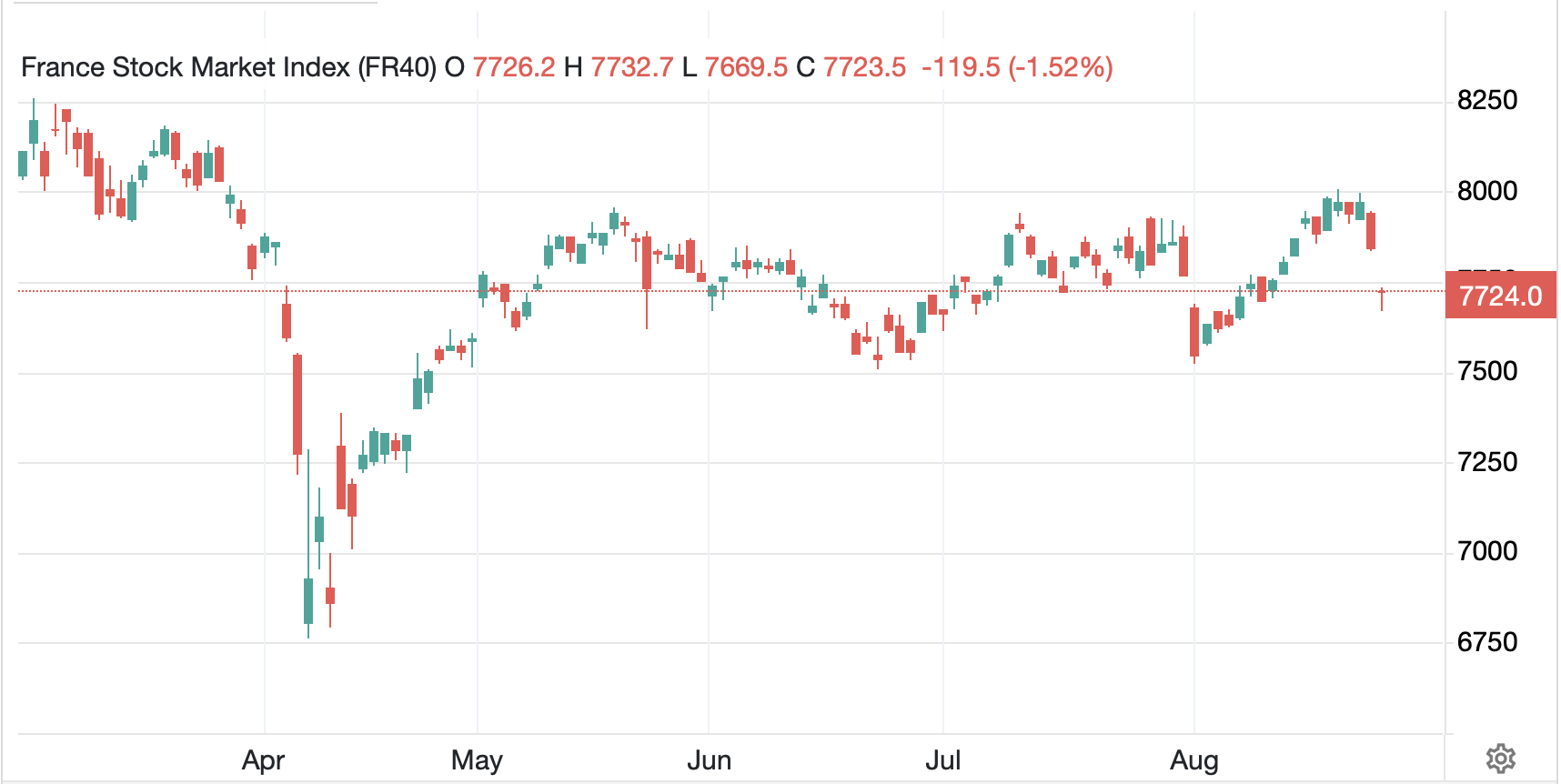
Source: tradingeconomics.com

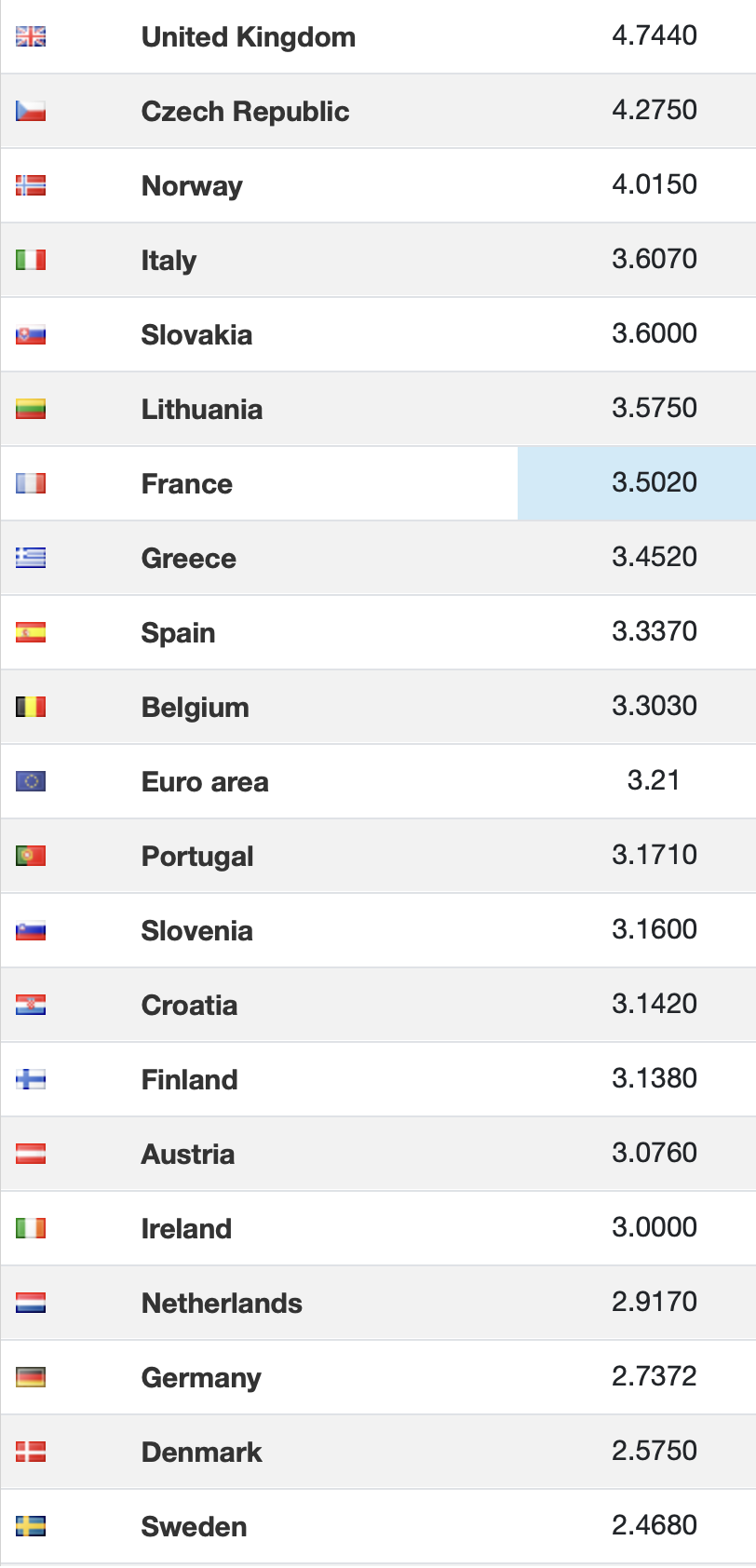
In fact, French 10-year yields now trade above almost all other EU nations including Greece and Spain, although Italian yields are still a touch higher.  Consider that during the European bond crisis of 2011-12, France was considered one of the stronger nations.  Oh, how the mighty have fallen!
Source: tradingeconomics.com

Again, my point is that much of what we thought we understood about how markets behave on both an absolute and relative basis is changing because the institutions underlying the Western economy are undergoing massive changes.  This is not merely a US phenomenon with President Trump, but we are seeing a growing nationalist fervor throughout the West as populations throughout Europe, and even Japan, increasingly reject the culmination of what has been described as the globalist agenda.  As John Steinbeck has been widely quoted, things can change gradually…and then suddenly.

So, let’s look at how other markets behaved overnight following the weakness in US equity markets yesterday.  Asian markets followed suit lower (Tokyo -1.0%, Hong Kong -1.2%, China -0.4%, Korea -1.0%, India -1.0%) with essentially the entire region in the red.  Europe, too, is under pressure this morning and while France leads the way, Germany (-0.4%), Spain (-0.8%) and the UK (-0.6%) are all declining in sync.  However, at this hour (7:10) US futures are essentially unchanged, so perhaps things will stabilize.

Those yields I picture above represent modest declines from yesterday’s levels, although that is only because European yields yesterday mostly climbed between 5bps and 7bps across the board.  As to Treasury yields, they are higher by 2bps this morning, but remain below 4.30%, so are showing no signs of a problem.

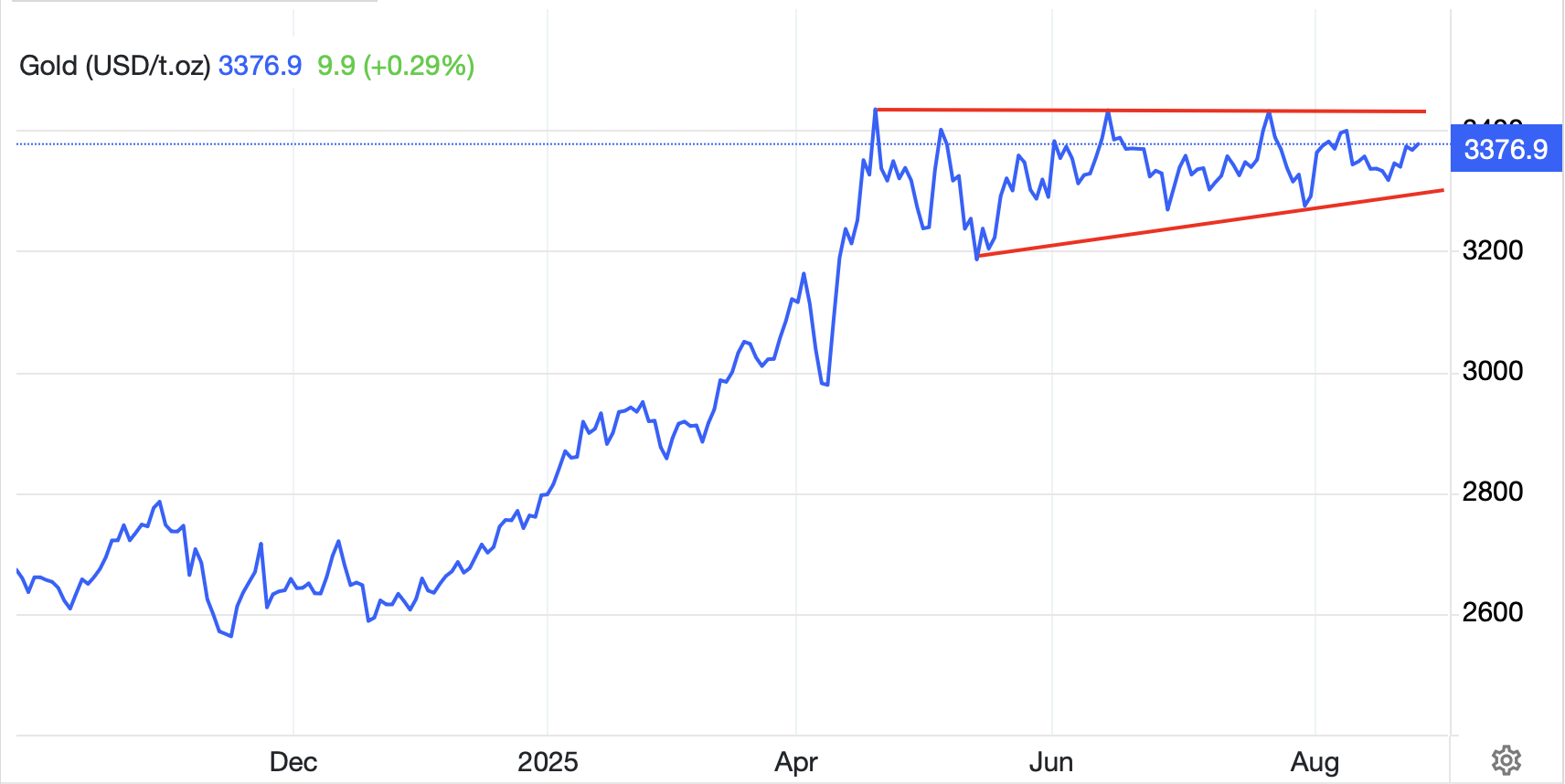
In the commodity markets, oil (-1.8%) is giving back all its gains from yesterday and a little bit more, but in the broad scheme of things, continues to trade in its recent range.  The one thing to watch here is Ukraine’s increasing ability to interrupt Russian production and shipment of oil via long-range drone strikes, as if they continue to be successful, it may well start to push prices above their recent cap at $70/bbl.  That is, however, a big if.  It is getting pretty boring describing metals markets as gold (+0.3%) has been trading in an increasingly narrow range as per the below chart.  This has been ongoing since April and feels like it could last another 5 months without a problem.  Silver’s chart is similar, albeit not quite as narrow a range.
Source: tradingeconomics.com

Finally, the dollar is a touch softer this morning, slipping against the euro (+0.3%), pound (+0.2%), and yen (+0.2%) with most of the rest of the G10 having moved less than that.  NOK (-0.3%) is the outlier following oil lower.  In the EMG bloc, +/- 0.3% is the range for the entire bloc today, so it appears that traders like other G10 currencies today for some reason I cannot fathom.

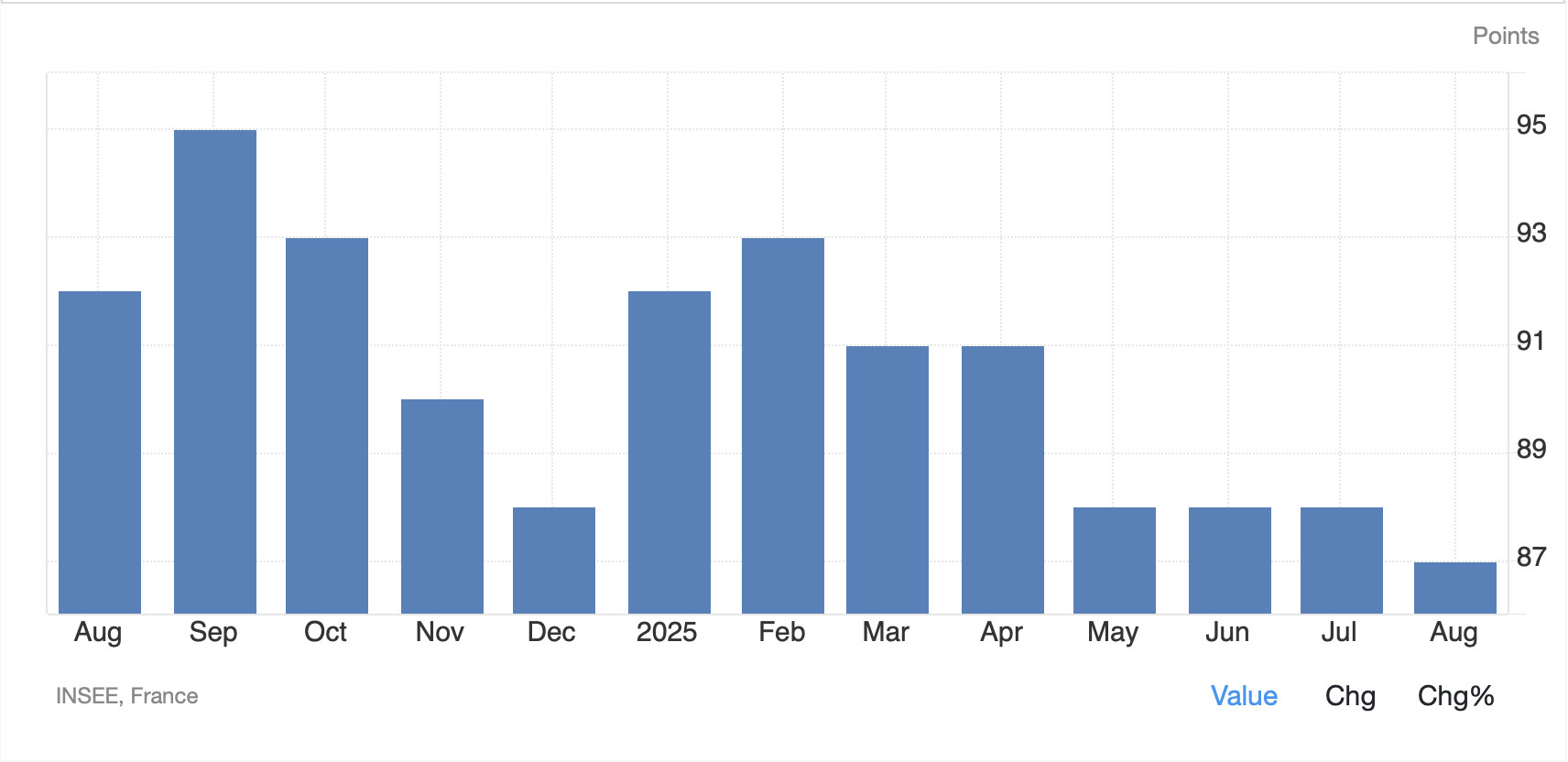
On the data front, we see Durable Goods (exp -4.0%, +0.2% ex Transport) as well as Case Shiller Home Prices (2.1%) and then Consumer Confidence (96.2).  Speaking of Consumer Confidence, in France this morning the latest reading was released at 87.0, three points lower than forecast and clearly trending down.  Perhaps the government’s problems are feeding into the national psyche.
Source: tradingeconomics.com

It is difficult to get excited by markets during the last week of August, and if we add the time of year, when vacations are rife, to the ongoing White House bingo outcomes, the best position seems to be no position at all.  As to the dollar, if the Fed does start to ease policy at this time, with inflation still sticky, I do foresee a decline.  However, it is very difficult to look around the world and think, damn, I want to own THAT currency, whatever currency that might be.  Perhaps the one exception would be the Swiss franc, where they really do work to have sane monetary policies.

Good luck

Adf
All Goes to Hell

The Turning is coming much faster
Than forecast by every forecaster
Now Syria’s fallen
And pundits are all in
Iran will soon be a disaster
 
However, the impact on trading
Is naught, with no pundits persuading
Investors to sell
As all goes to hell
Is narrative power now fading?


The suddenness of the collapse of Bashar Al-Assad’s control of Syria was stunning, essentially happening in on week, maybe less.  But it has happened, and it appears that there are going to be long-running ramifications from this event.  At the very least, the Middle East power structure has changed dramatically as Russia and Iran both abandoned someone who had been a key ally in their networks.  Russia is clearly otherwise occupied and did not have the wherewithal to help Assad, but it is certainly more interesting that Iran did not step up.  Rumors are that the government there is growing concerned that an uprising is coming that may change the Middle East even more dramatically.

I have previously discussed the idea of the Fourth Turning when events arise that shake up the status quo, and this is proof positive that Messrs. Howe and Strauss were onto something when they published their book back in 1997.  The thing is, even those who believed the idea and did their homework on the timing of events have been caught out by the speed of recent activities.  Most of the punditry in this camp, present poet included, didn’t expect things to become unruly until much closer to the end of the decade.  And maybe it will be the case that the collapse of Syria is just an appetizer to a much larger conflagration.  (I sincerely hope not!). But my take is these events were not on many bingo cards, certainly not in the financial punditry world.

Now, the humanitarian situation in Syria has been a disaster for the past 13 years, ever since the civil war there really took shape and fomented the European migration crisis.  Alas, it seems likely to worsen for the unfortunate souls who still live there.  But for our purposes, the question at hand is will this have an impact on markets?

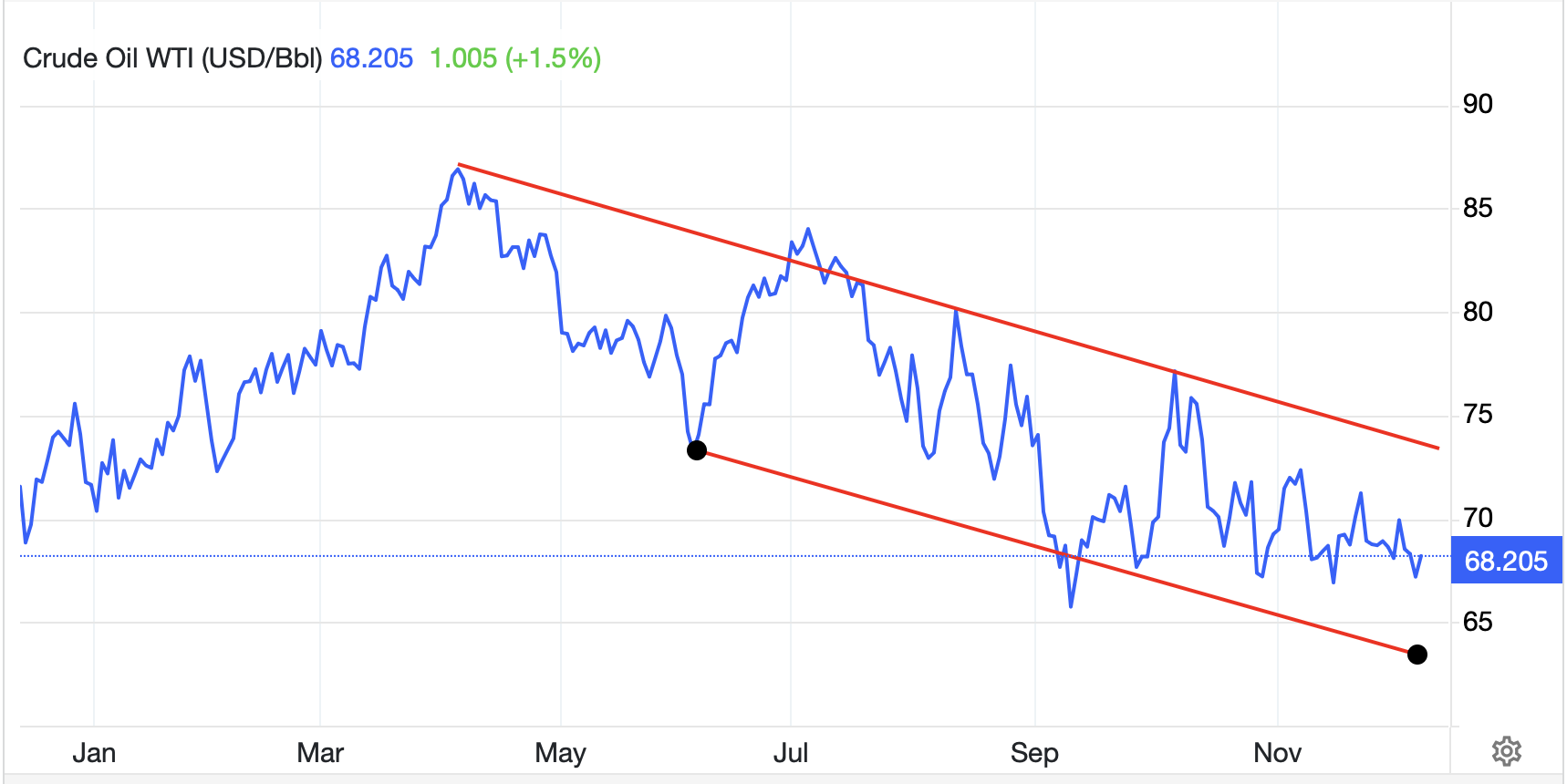
Interestingly, the answer, so far, is none whatsoever.  The obvious first concern would be in oil markets given the proximity to the major oil producing regions in that part of the world.  However, while oil (+1.4%) is a bit higher this morning, it remains well below $70/bbl and while I am no technical analyst, certainly appears to be well within a downtrend as per the below chart.

Source: tradingeconomics.com

Next on our list would be the FX markets, perhaps with expectations that haven currencies would be in demand.  Yet, the dollar is sliding against most of its counterparts this morning, with the notable exception of the yen (-0.3%) which is the one currency under more pressure.  That is the exact opposite behavior of a market that is demonstrating concern over future disruptions.  As to securities markets, they are much further removed from the situation and while US futures are edging lower at this hour (6:20), slipping about -0.15%, overnight activity showed no major concerns and European bourses are mixed, but all within 0.3% of Friday’s closing levels.  

Finally, bond markets are essentially unchanged this morning, with Treasury yields higher by 1bp and European sovereigns almost all unchanged on the day.  We did see yields slip a few bps in Asia, likely on the back of the weaker than forecast Chinese inflation data, but the bond market is certainly showing no signs of concern over the geopolitics of the moment.

On Sunday the Chinese did meet
And promised they’d finally complete
Their stimulus drive
And therefore revive
The growth that has been in retreat

A story that has had an impact on markets this morning is the Chinese Politburo’s comments that they are going to implement a “more proactive” fiscal policy in the upcoming year along with “moderately loose” monetary policy as President Xi scrambles to both improve the growth impulse and prepare for whatever President-elect Trump has in store for China once he is inaugurated.  Now, we have heard these words before and to date, each effort has been, at the very least, disappointing, if not irrelevant.  But hope is a trader’s constant companion and so once again we saw specific markets respond to the news.

Interestingly, mainland Chinese shares did not respond as enthusiastically as one might have expected with the CSI 300 actually slipping -0.2%.  But the Hang Seng (+2.75%) embraced the news warmly.  In the FX markets, early weakness in CNY was reversed although the renminbi closed the onshore session essentially unchanged on the day.  The big winners were AUD (+0.9%) and NZD (+0.5%) as traders bid up the currencies of the two nations likely to benefit most given their export profiles of commodities to China.  But beyond those market moves; it is hard to make a case that anyone was listening.

Ok, let’s look at the rest of the overnight session and see what we can anticipate in the week ahead. Japanese shares (Nikkei +0.2%) were little changed overnight while the big mover in Asia was Korea (-2.8%) as the ructions from the brief interlude of martial law last week continue to weigh on the short-term future of the government and economy there.  However, away from those markets, the rest of Asia saw movement of just +/- 0.3% or less, hardly newsworthy.  In Europe, the story is also mixed with the CAC (+0.5%) leading the way higher, perhaps on the back of the successful reopening of the Notre Dame cathedral, or more likely on the back of hopes that the luxury goods sector would improve based on Chinese stimulus supporting that economy.  As to the rest of the continent, more laggards than winners but movement has been small, 0.2% or less, although the FTSE 100 (+0.4%) is also higher this morning led by the mining shares in the index, also related to Chinese stimulus.

We have already discussed the bond market, which has been extremely quiet ahead of this week’s CPI and next week’s FOMC meeting so let’s turn to the commodity markets, where not only is oil rallying, perhaps more related to China than the Middle East, but we are seeing metals markets rally as well with both precious (Au +0.9%, Ag +2.2%) and industrial (Cu +1.6%, Zn +2.0%) performing well.  Surprisingly, aluminum (-0.25%) is not playing along this morning but if the China story is real, it should follow suit.

Finally, the rest of the currency story shows KRW (-0.5%) continuing to feel the pain, along with its stock market, from the politics last week.  At the same time, we are seeing solid gains in ZAR (+1.1%) on the metals moves and NOK (+0.4%) on the back of oil’s rally.  Elsewhere, while the dollar is broadly softer, it is of a much lesser magnitude, maybe 0.2% or so.

On the data front, this week brings two central banks (BOC and ECB) and a bunch of stuff, although CPI on Wednesday will be the most impactful.

TuesdayNFIB Small Biz Optimism94.2
 Nonfarm Productivity2.2%
 Unit Labor Costs1.9%
WednesdayCPI0.2% (2.7% Y/Y)
 -ex food & energy0.3% (3.3% Y/Y)
 BOC Meeting3.25% (current 3.75%)
ThursdayECB meeting3.0% (current 3.25%)
 Initial Claims220K
 Continuing Claims1870K
 PPI0.3% (2.6% Y/Y)
 -ex food & energy0.2% (3.3% Y/Y)

Source: tradingeconomics.com

Last week saw what appeared to be stronger payroll data on the surface, with the NFP rising 227K and upward revisions, while the Unemployment Rate rose the expected 1 tick to 4.2%.  As well, Average Hourly Earnings rose more than expected, to 4.0%.  And yet, the Fed funds futures market raised the probability of a rate cut next week to 87% (it was over 90% for a while in the session).  Now, there has been a group of analysts who have been claiming that the headline payroll data is very misleading and actually the jobs market is much weaker than the administration is portraying, and it seems they got a bit more traction in their case last week.  Nonetheless, it is hard for me to look at the data and justify another rate cut by the Fed, at least if their objective is to push inflation back to 2.0%.  Of course, that is another question entirely!

Mercifully, the Fed is in their quiet period so we will not hear from them until they pronounce things at the FOMC meeting a week from Wednesday.  Until then, I expect that the China story, as well as assorted Trump related stories, will drive things although keep a wary eye on the Middle East for anything more explosive.  As to the dollar, I have consistently explained that if the Fed eases in the face of rising inflation, that will undermine the greenback.  It will be very interesting to see how things play out this week and next as a set-up for 2025.  For now, I don’t see a good reason for a large move, but if I were a hedger, I would make sure that I am as hedged as I am allowed to be.

Good luck

Adf

Chaos is Spreading

Around the world, chaos is spreading
As government norms get a shredding
Korea’s the latest
But not near the greatest
Seems to the Fourth Turning we’re heading

While Russia/Ukraine knows no end
And Israel seeks to defend
The French are about
To toss Michel out
And all this ere Trump does ascend


If you view markets through a macro lens, the current environment can only be described as insane.  Niel Howe and William Strauss wrote a book back in 1997 called The Fourth Turning (which I cannot recommend highly enough) that described a generational cycle structure that has played out for hundreds of years.  If you have ever heard the saying 

  • Hard times make strong men (1st Turning)
  • Strong men make good times (2nd Turning)
  • Good times make soft men (3rd Turning)
  • Soft men make hard times (4th Turning)

Or anything in the same vein, this book basically describes the process and how it evolves.  The essence is that about every 20-25 years, a new generation, raised by its parents whose formative years were in the previous Turning, falls into one of these scenarios.  Howe and Strauss explained that at the time they wrote the book, we were in the middle of the 3rd Turning, and that the 4th Turning would be upon us through the 2020’s.  One of the features they highlighted was that every 4th Turning was highlighted by major conflict (WWII, Civil War, Revolutionary War, etc.) with the implication that we could well be heading toward one now.

Of course, we already have a few minor wars with Russia/Ukraine (although that seems to have the potential to be more problematic) and Israel/Hezbollah/Hamas, with Iran hanging around the edges there.  In a funny way, we have to hope this is the worst we get, but there are still more than 5 years left in the decade for things to deteriorate, so we are not nearly out of the woods yet.  

But turmoil comes in many forms and political turmoil is also rampant these days.  This is evident by the number of sitting governments that have been ejected in the most recent elections as well as the increasingly strident blaming of others for a nation’s current problems.  In this vein, the latest situation will happen shortly when the French parliament votes on a no-confidence motion against the current PM, Michel Barnier.  As it is, he is merely a caretaker PM put in place by President Macron after Macron’s election gamble in June failed miserably.  Adding to France’s problems, and one way this comes back to the markets, is that the French fiscal situation is dire, with a current budget deficit exceeding 6% of GDP and no good way to shrink it.  In fact, Barnier’s efforts to do so are what led to the current vote.  I have already discussed French yields rising relative to their European peers and the underperformance of the CAC as well. 

On the one hand, today’s vote, which is tipped to eject Barnier, may well be the peak (or nadir) of the situation and things will only improve from the current worst case.  However, it strikes me this is not likely to be the case.  Rather, there are such a multitude of problems regarding immigration, culture, economic activity and government responsiveness, that we have not nearly found the end.  My fear is we will need to see things deteriorate far more than they have before populations come together and agree that ending the mess is the most important outcome.  Right now, there are two sides dug in on most issues and the split feels pretty even.  As such, neither side is going to give up what they believe for the greater good, at least not yet.

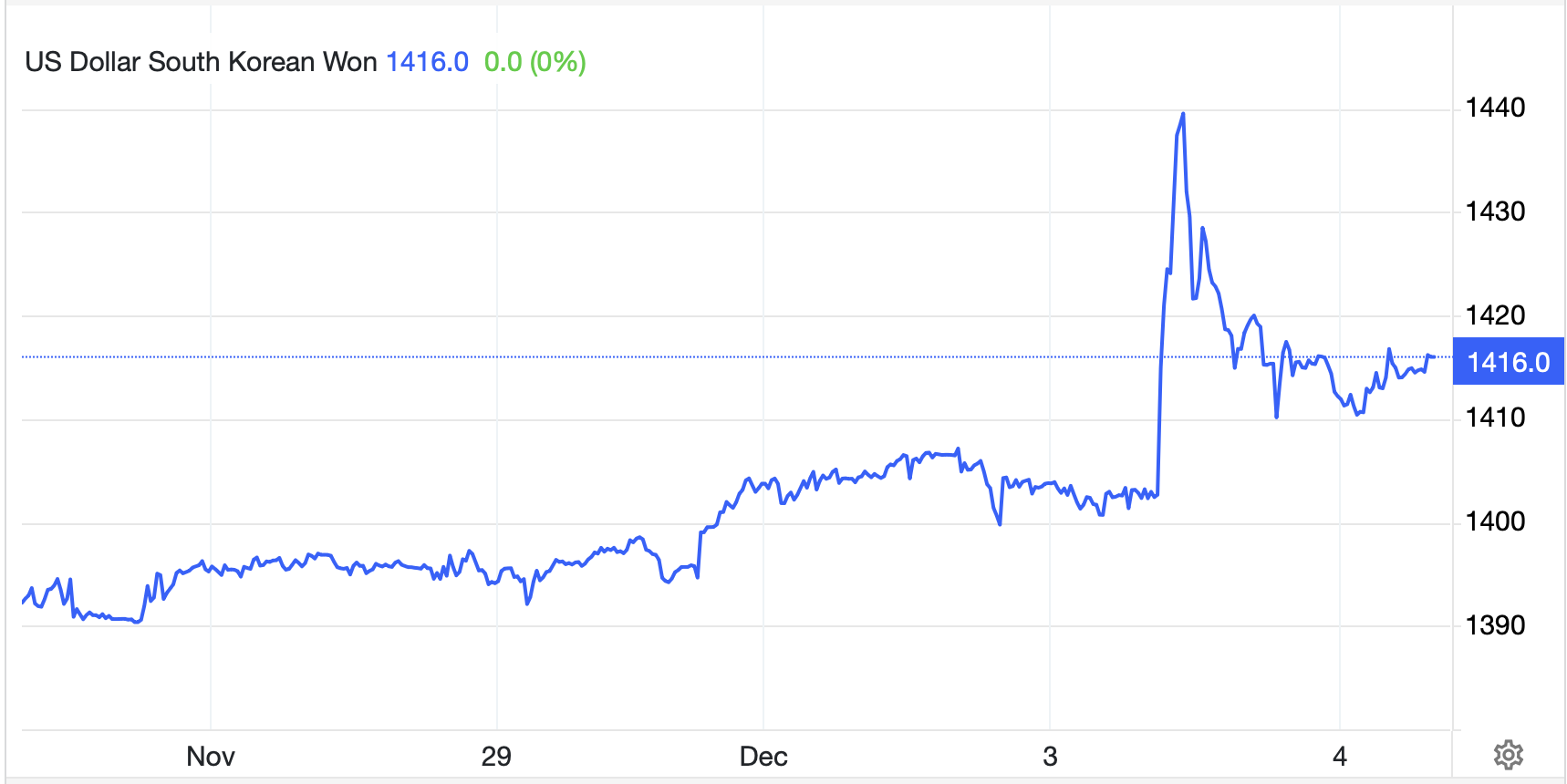
And before I move on to the markets, I cannot ignore the remarkable events in South Korea yesterday, where President Yoon Suk Yeol declared martial law in the early hours on the basis of the opposition’s efforts to paralyze the government (I guess that means they didn’t agree with him).  In the end, the Korean Parliament voted to rescind the order, and the military has since stood down with all eyes on the next steps including likely impeachment hearings for the President.  Not surprisingly, Korean assets suffered during this situation with the won tumbling briefly, more than 2.6%, before retracing the bulk of those losses once the order was rescinded.  

Source: tradingeconomics.com

Too, the KOSPI (-1.5%) suffered although that was off the worst levels of the day after things settled down.  The point to keep in mind here is that markets are subsidiaries of economies.  They may give indications of expectations for the future, or sentiments of the current situation, but if we continue to see geopolitical flare ups, markets are going to respond as investors seek havens.  In this case, the dollar, despite all its flaws, remains the safest choice in many investors’ eyes, so should remain well bid overall.

Ok, let’s look at how markets have been behaving through this current turmoil.  In Asia, given the events in Korea, it ought not be surprising that equities had little traction.  Japanese shares were unchanged as were Hong Kong although mainland Chinese (-0.5%) and Australian (-0.4%) shares were under some pressure.  That said, Australia suffered on weaker than forecast GDP data which puts more pressure on the RBA to cut rates despite inflation remaining sticky.  Australia dragged down New Zealand (-1.5%) shares as well with really the only notable winner overnight being Taiwan (+1.0%).  In Europe, investors seem to be betting on a more aggressive ECB as somewhat weaker than expected PMI Services data has led to gains on the continent (DAX +0.85%, CAC +0.5%, IBEX +0.7%) although UK shares (-0.2%) are not enjoying the same boost.  I guess the French market has already priced in the lack of a working government, hence the market’s underperformance all year.  US futures, at this hour (8:00) are pointing higher by between 0.3% and 0.6%.

In the bond market, yields are rising, with Treasuries (+4bps) leading the way although most of Europe are higher by between 3bps and 4bps.  It has the feel that bond markets are starting to decouple from central banks as they see inflationary pressures building and central banks still in active cutting mode.  I fear this will get messier as time goes on.

In the commodity markets, oil is unchanged this morning, right at $70/bbl, having continued its rally for the week on news that OPEC+ will maintain its production cuts through March 2025.  NatGas (-2.0%) has been sliding since the spike seen 2 weeks ago ahead of the current cold spell as warmer weather is forecast for next week.  In the metals market, gold (-0.2%) seems stuck in the mud right now while silver (-1.3%) and copper (-0.6%) appear to be victims of the dollar’s strength.

Turning to the dollar, it is stronger across the board with AUD (-1.3%) the laggard after that GDP data and it dragged NZD (-1.0%) down with it.  JPY (-1.1%) is also under pressure as hopes for that BOJ rate hike dissipate.  Away from those, the euro (-0.2%) and pound (-0.1%) are softer, but much less so.  In the EMG bloc, ZAR (-0.5%) is feeling the weight of the weaker metals prices and we are seeing BRL (-0.3%) and CLP (-0.1%) also sliding slightly although both are stabilizing after more pronounced weakness earlier in the week.

On the data front, this morning brings ADP Employment. (exp 150K) along with ISM Services (55.5) and then the Fed’s Beige Book.  Perhaps of more importance, at 12:45, Chairman Powell will be speaking and taking questions, so all eyes will be there looking for clues as to how the Fed will be viewing things going forward.  Fed funds futures have been increasing the probability of that rate cut, now up to 74%, which implies we are going to see one, regardless of the inflation story.

Central banks around the world are in a bind as inflation refuses to fall like they want but many nations are seeing slowing economic activity.  In the end, I expect that the rate cutting cycle has not ended, but the dollar is likely to remain well bid given both its haven status and the fact that the US economy is outperforming everywhere else.

Good luck

Adf

Capitalism is Spurned

When looking through history’s pages

It seems there are only two stages

At times capital

Has markets in thrall

At others, it’s all about wages

Four decades past Maggie and Ron

Convinced us, for things to move on

T’was capital needed

For growth unimpeded

But seemingly those days are gone

Instead, now the cycle has turned

As two generations have learned

That labor should take

The bulk of the cake

While capitalism is spurned

The upshot is that now inflation

Will percolate throughout the nation

While central banks claim

That prices are tame

Your costs will increase sans cessation

With markets fairly quiet this morning I thought it would be an interesting idea to step back to a more macro view of the current financial and economic framework as I strongly believe it is important to understand the very big picture in order to understand short term market activities.

A number of prominent historians and economists contend that both history and the economy are cyclical in nature although long-term trends underlie the process.  One might envision a sine wave overlaying an upward sloping line as a description.  Now the period and amplitude of the sine wave are open to question, but I would offer that a full cycle occurs in the timeframe of 80-100 years.  As per Neil Howe’s excellent book, The Fourth Turning, this encompasses four generations over which time each generation’s response to their upbringing and the events that occurred during those formative years result in fairly similar outcomes every fourth generation.

Ultimately, I believe it is valid to consider the cyclical nature in terms of the importance of the two key inputs to economic activity; capital and labor.  It is the combination of these two inputs that creates all the economic wealth that exists.  However, depending on the government regulatory situation and the societal zeitgeist, one will always dominate the other.

If we look back 100 years to the Roaring Twenties, it was clear capital had the upper hand as the administrations of Warren Harding and Calvin Coolidge maintained a very laissez faire attitude to the economy and watched as large companies grew to dominate the economy.  Of course, the Great Depression ended that theme and resulted in FDR’s New Deal and ultimately the ensuing 40 years of government intervention in the economy alongside labor’s growing power.  Forty years on from the Depression saw the height of government interventionism with the ‘guns and butter’ strategy of LBJ, the Vietnam War, the Great Society and also, the seeds of the next change, the Summer of Love.  At that point, the economic effects of the government’s heavy hand were starting to have a negative impact, restricting growth and driving inflation higher.

Like day follows night, this led to a change in the zeitgeist and a change in the relationship between capital and labor.  The Reagan/Thatcher revolution arose at a time when people saw only the negatives of government and led to a reduction of government control and activity (on a relative basis), as well as the beginnings of the financialization of the economy.  Arguably, that peaked in the dot com bubble in 2001, or perhaps in the GFC in 2008, but certainly, ever since the latter, we have seen a significant adjustment in the relationship of the government and the governed.

My contention is that we are entering into a new period of labor’s ascendancy versus capital and increased government involvement in every facet of life.  While this has manifest itself in numerous ways, from the perspective of markets, what this means is that the heavy hand of central banks is going to weigh even more greatly on events than it has until now. The myth of the independent central bank is no longer even discussed.  Rather, central banks and finance ministries are now working hand in hand as partners in trying to manage their respective economies.  And ultimately, what that means is that QE has become a permanent part of the financial landscape as debt monetization is required in order to fund every new government initiative.  If this thesis is correct, the idea that the Fed may begin to taper its QE purchases starting next year seems highly unlikely.  Instead, as I have written before, it seems more likely they will increase those purchases as the latest ‘sugar high’ of fiscal stimulus wanes and the economy once again slows down.

Interestingly, the most salient comments made today appear to back up this thesis.  Madame Lagarde was interviewed on Bloomberg TV this morning and explained that a new policy shift would be forthcoming in the near future from the ECB.  Recognizing that the PEPP was due to expire come March and recognizing that the Eurozone economy was not growing anywhere near its desired rate, the ECB is already preparing for the PEPP’s successor.  In other words, QE will not end at its originally appointed time.  In addition, she explained that they would be adjusting their forward guidance as the previous model clearly did not achieve their goals.  (Might I suggest, QE Forever?  It’s catchy and sums things up perfectly!)

So, to recap; the broad cycles of history are turning through an inflection point and we are very likely to see capital’s importance diminish relative to labor going forward.  This means that profit margins will shrink amid higher wages and greater regulatory burdens.  Equity returns will suffer accordingly, especially on a real basis as price pressures will continue to rise.  However, debt monetization will prevent yields from rising, so negative real yields are also likely here to stay for a while.  As to currencies, their value will depend on the relative speed with which different countries adapt to the new realities, so it is not yet clear how things will turn out.  It is also largely why currencies have range-traded for so long, the outcome is not yet clear.

With that to consider as a background, I would offer that market activity remains fairly unexciting.  For now, the ongoing themes remain in place, so, central bank liquidity continues to be broadly supportive of asset markets and arguably will continue to be so for the time being.

Turning to today’s session shows that Asian equity markets followed Friday’s US lead by rallying nicely (Nikkei +2.2%, Hang Seng and Shanghai +0.6%) as markets continue to respond to the PBOC’s modest policy ease announced last week regarding the RRR reduction.  Europe, though, is a bit less bubbly this morning (DAX -0.1%, CAC -0.3%, FTSE 100 -0.6%).  Finally, US futures are mixed with the NASDAQ continuing its run higher (+0.2%) but the other two markets less happy with modest declines.

Bond markets, after selling off Friday in what was clearly a short-term profit taking act, have rallied back a bit this morning with yields declining in Treasuries (-1.5bps), Bunds (-1.5bps), OATs (-2.0bps) and Gilts (-2.0bps).

Commodity prices are under pressure, with oil (-1.4%) leading the way lower, but weakness across both precious (Au -0.45%) and base (Cu –1.4%) metals and most ags.  In other words, the morning is shaping up as a risk-off session.

This is true in the FX market as well with the dollar broadly firmer in both the G10 and EMG blocs.  Commodity currencies are the biggest laggards (NOK -0.6%, CAD -0.45%, AUD -0.4%) but the dollar is higher universally in the G10.  As to the EMG bloc, ZAR (-1.8%) is by far the worst performer as a combination of increased Covid spread and local violence after the imprisonment of former president Jacob Zuma has seen capital flee the nation.  However, here too, the bulk of the bloc is softer with the commodity currencies (MXN -0.5%, RUB -0.45%) next worse off.

While there is no data today, this week does bring some important news, including the latest CPI reading tomorrow:

Tuesday NFIB Small Biz Optimism 99.5
CPI 0.5% (4.9% Y/Y)
-ex food & energy 0.4% (4.0% Y/Y)
Wednesday PPI 0.5% (6.7% Y/Y)
-ex food & energy 0.5% (5.0% Y/Y)
Fed’s Beige Book
Thursday Initial Claims 350K
Continuing Claims 3.5M
Philly Fed 28.0
Empire Manufacturing 18.0
IP 0.6%
Capacity Utilization 75.6%
Friday Retail Sales -0.4%
-ex autos 0.4%
Michigan Sentiment 86.5

Source: Bloomberg

On the Fed front, the highlight will be Chairman Powell testifying before the House on Tuesday and the Senate on Wednesday, with only a few other speakers slated for the week.

At this point, the market question is; will the dollar rally that has been quite impressive for the past weeks, albeit halted on Friday, continue, or have we seen the top?  Given the breakdown in the treasury yield – dollar relationship, my gut tells me the dollar has a bit further to go.

Good luck and stay safe

Adf