A Trumpian Size

A question on analysts’ lips
Is whether Jay can come to grips
With job growth expanding
While he was demanding
A rate cut of fifty whole bips
 
Concerns are beginning to rise
That voters will soon recognize
Inflation’s returning
And they will be yearning
For change of a Trumpian size


By now, I am guessing you are aware that the payroll report on Friday was significantly better than expected.  Nonfarm Payrolls rose 254K, much higher than the 140K expected, and adding to the gains were revisions higher for the previous three months of 55K.  The Unemployment Rate fell to 4.051%, rounding to 4.1%, lower than expected and another encouraging sign for the economy.  You may remember the discussion of the Sahm Rule, which claims that if the 3-month average Unemployment Rate rises 0.5% from its low in the previous 12 months, history has shown the US is already in recession at that point.  Well, ostensibly that rule was triggered two months ago, and the Unemployment Rate has now fallen 0.25% since then with a gain of over 400K jobs since then.  Those are not recessionary sounding numbers.

The upshot is that the market got busy adjusting its views with the dollar continuing to rebound against most currencies, equity markets rejoicing in the renewed growth story and bond markets getting hammered with 10-year yields rising sharply in the US (10bps Friday and 4bps more this morning) with moves higher everywhere else in the world.  In fact, this morning, European sovereign yields are also higher by between 3bps and 5bps and we saw JGB yields jump 5bps overnight.  The end of inflation story is having a tough time.

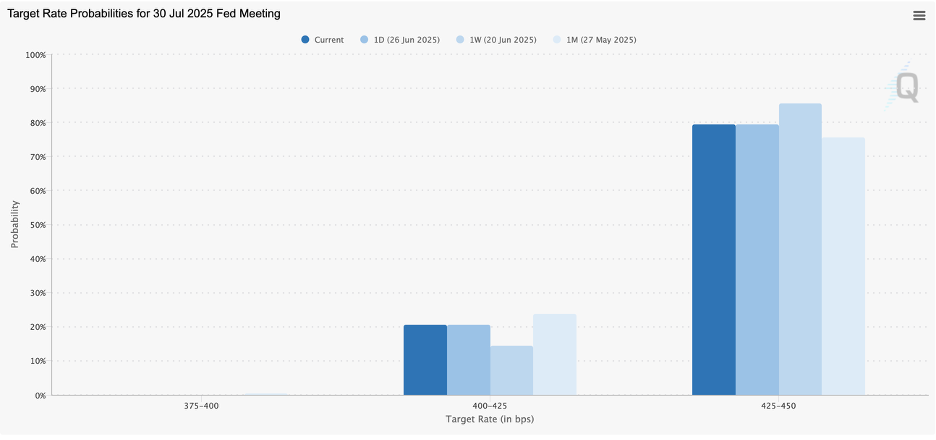
Perhaps the best depiction of things comes from the Fed funds futures markets where now there is only an 85% probability priced for a 25bp cut and a 15% probability of no cut at all.  Look at the table below the bar chart to show how much things have changed in the past week.  Jumbo rate cuts are no longer a consideration.  It will be very interesting to see how the Fed speakers adjust their tone going forward as there were many who seemed all-in on another 50bp cut as soon as next month.

Source: cmegroup.com

So, is this the new reality?  Recession is out and another up-cycle is with us?  Certainly, recent data has been quite positive as evidenced by the Citi Surprise Index, seen below courtesy of cbonds.com, which has shown a positive trend since early July.

This index is a measure of the actual data releases compared to consensus market forecasts ahead of the release.  When it is rising, the implication is that the economy is outperforming expectations and therefore is growing more rapidly than previously priced by markets.  Again, the point is the recessionistas are having a hard time making their case.  However, for the inflationistas, it is a different story.  With the employment situation improving greatly and last week’s Services ISM data showing real strength, the inflation narrative is regaining momentum.  Recall, the Fed’s rationale for cutting 50bps was that they had beaten inflation and were much more concerned about the employment situation where things seemed to be cooling.  That line of reasoning has now been called into question and the market is awaiting Powell’s answers.

Remember the time
The yen carry trade was dead?
Nobody else does!

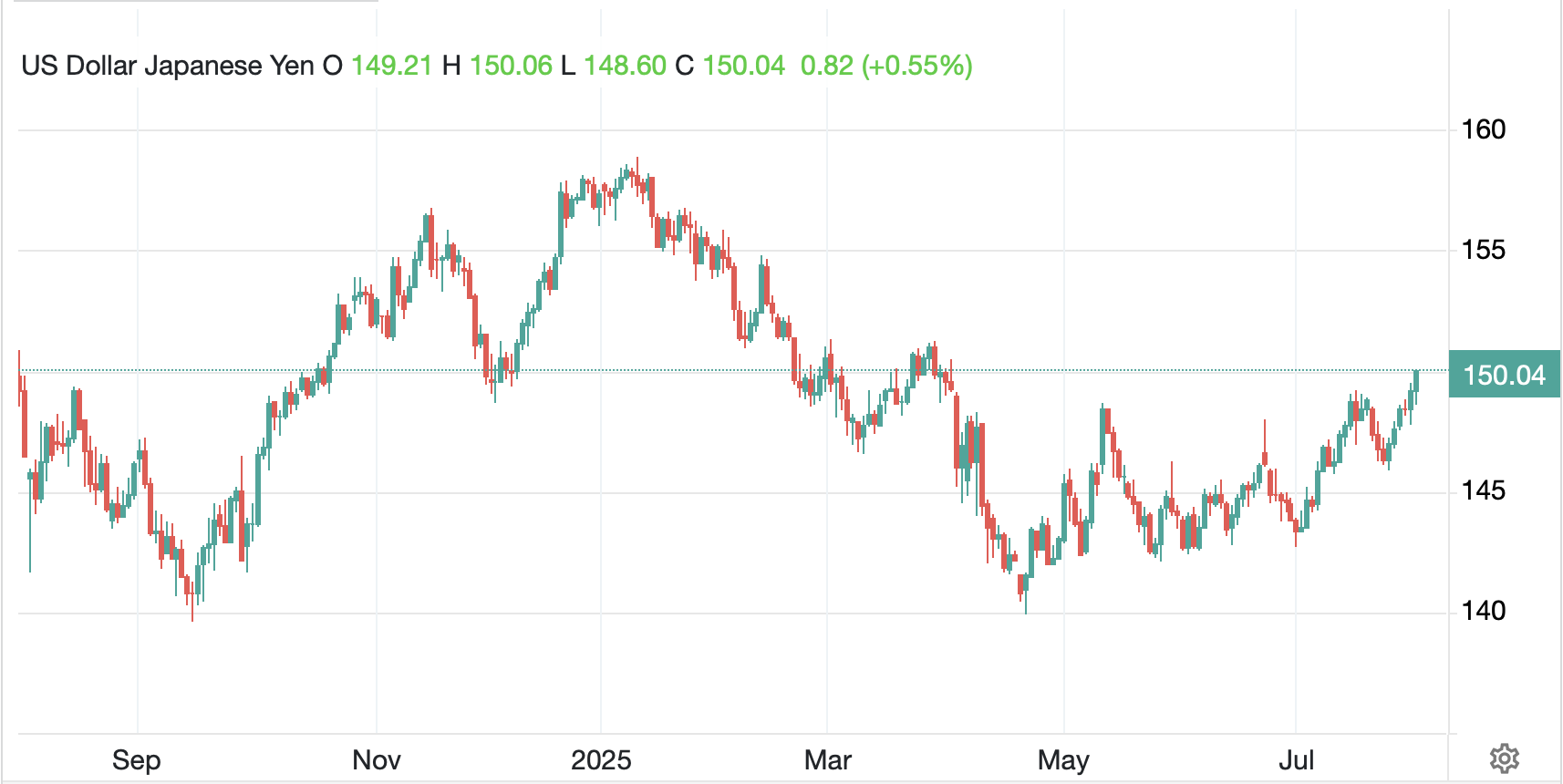
While it may seem like this is ancient history, it was less than a month ago when the market was convinced that the yen carry trade (shorting yen to go long higher yielding assets) was dead, killed by the combination of a dovish Fed and a hawkish BOJ.  Oops!  It turns out that story may not have been completely accurate, although it was a wonderful discussion at the time.  As you can see from the chart below, the yen peaked two days ahead of the FOMC meeting, as those assumptions about both central banks reached their apex and has been steadily weakening ever since.  In fact, late last week I saw an article somewhere discussing how the carry trade was back!  The thing to understand is the carry trade never left.  It has been a popular hedge fund positioning strategy for a decade, made even more popular by the Fed’s aggressive rate hiking cycle.  While latecomers to the trade may have been forced out in the past several months, I am confident the position remains widely held.  And, based on the recent price action in USDJPY, it is growing again.

Source: tradingeconomics.com

And I believe those are the key drivers of markets this morning.  Fortunately, the Middle East situation does not appear to have gotten worse although oil (+2.6%) is trading like something is about to blow up.  The rest of the noteworthy news shows that Germany remains in a funk with Factory Orders falling sharply, -5.8%, just another indication that growth on the continent is going to struggle going forward.

Ok, let’s tour the markets we have not yet touched upon.  While Chinese markets remain closed (the holiday ended today and markets there reopen tomorrow), the Nikkei (+1.8%) continues to rebound alongside USDJPY and amid stories that new PM Ishiba has dramatically moderated his hawkish views ahead of the snap election called for the end of the month.  The Hang Seng (+1.6%) also had a strong session, with rumors of still more Chinese stimulus to be announced tonight. The combination of positive US growth news and the Chinese stimulus news helped virtually every market in Asia save India (-0.8%), which has been singing a different tune consistently.  In Europe, it should be no surprise the DAX (-0.3%) is softer, although there are some gainers on the continent (Spain +0.4%, Hungary (+0.4%) and other laggards (Norway -0.7%, Netherlands (-0.3%).  Overall, it is hard to get excited about the European scene this morning.  Alas, US futures are pointing lower this morning, down -0.5% at this hour (6:30).

We’ve already discussed the bond market and oil, but metals markets show a split this morning with gold (+0.2%) seeming to find haven support while both silver (-0.7%) and copper (-0.3%) are under modest pressure.  Remember, though, if the economic growth story is real, these metals should climb further.

Finally, the dollar is continuing its climb alongside US rates with the pound (-0.4%) the G10 laggard of note.  Most other G10 currencies are softer by a lesser amount although the yen (+0.1%) and NOK (+0.1%) are pushing slightly the other way, the former on a haven trade with the latter following oil.  The EMG bloc is more mixed with ZAR (+0.5%) actually the biggest mover as investors continue to flock toward the stock market there on the back of positivity of a change in the trajectory of the economy from the new government.

On the data front, the biggest number this week is CPI, but of real note are the 13(!) Fed speakers over 20 different venues this week.  I don’t know if I’ve ever seen that many on the calendar for such a short period.  It strikes me that they understand they need to tweak their message after the recent data.  It will be very interesting to see if they fight the data and stay the course for another cut in November or whether they walk it back completely. After all, they claim to be data dependent, and if the data points to growth, why cut?

Here is the rest of the data:

TodayConsumer Credit$12B
TuesdayNFIB Small Biz Optimism91.7
 Trade Balance-$70.4B
WednesdayFOMC Minutes 
ThursdayInitial Claims230K
 Continuing Claims1829K
 CPI0.1% (2.3% Y/Y)
 -ex food & energy0.2% (3.2% Y/Y)
FridayPPI0.1% (1.6% y/Y)
 -ex food & energy0.2% (2.7% Y/Y)
 Michigan Sentiment71.0

Source: tradingeconomics.com

And that’s how we start the week.  Whatever your personal view of the economy, the recent data certainly points to more strength than had been anticipated previously and markets are responding to that news.  For equities and the dollar, good news is good, but there seems to be a lot of time between now and Thursday’s CPI reading for attitudes to change.

Good luck

Adf

Awakened the Beast

The longshoreman’s union conceded
And ports will now work unimpeded
But is that enough
To make sure that stuff
Gets everywhere that it is needed?


Arguably, one of the biggest stories this morning is that the fears over the longshoreman’s union strike dramatically weakening the US economy while pushing up inflation have passed as there has been a temporary agreement to raise workers’ pay by 62% over the next six years although it seems that the questions over automation remain.  However, the agreement will last until January 15th, so the 3-day work stoppage is unlikely to have a major impact on the US economy, although I’m sure there will be a few hiccups around.  But hey, at least one problem is off the docket.
 
Meanwhile, problems in the Mideast
Continuously have increased
Iran took their shot
And all that it wrought
Was fear they’ve awakened the beast

Which takes us to the next major story, the nature of Israel’s response to Iran’s missile attack from earlier this week.  From what I have read, the US is trying very hard to persuade PM Netanyahu to leave Iran’s nuclear facilities and oil production capabilities alone.  While I understand the latter, given an attack there would likely drive oil prices far higher and not help VP Harris’s election prospects, I cannot understand why the US would be so adamant that Israel not seek to destroy Iran’s nuclear capabilities.  At any rate, the headline in this morning’s WSJ, “Biden Sidelined as Israel Reshapes Middle East”, seems to say it all.  At this point, we can only watch and wait.  

However, consider the benefits of either of those targets.  As it remains unclear whether Iran has achieved the capability to create nuclear weapons, an attack on those facilities, which are hardened and underground, may or may not be effective at preventing a future nuclear Iran.  But an attack on the oil production facilities, which are wide open and not nearly as well-defended, would immediately limit Iran’s income despite the certain rise in oil prices, as they would not be able to sell any.  Starving Iran of capital to continue to run its military and fund its proxies would likely be extremely effective at dramatically reducing threats to Israel.  As well, I’m pretty confident the Saudis would not be unhappy if oil rose to $90 or $100 per barrel.  My point is the latter strategy is likely to be effective at reducing Iranian activities while being quite achievable.  We shall see.

And finally, early today
The payrolls report will hold sway
O’er markets worldwide
As traders decide
If more cuts are soon on their way

Which takes us to the big economic story today, the monthly payroll report.  Wednesday’s ADP Employment data was much better than expected, showing job growth of 143K.  Current expectations are as follows:

Nonfarm Payrolls140K
Private Payrolls125K
Manufacturing Payrolls-5K
Unemployment Rate4.2%
Average Hourly Earnings0.3% (3.8% Y/Y)
Average Weekly Hours34.3
Participation Rate62.9%

Source: tradingeconomics.com

One thing to keep in mind is this is going to be the last meaningful payroll report before the next FOMC meeting because the October report, scheduled to be released on November 1st, is going to be a complete wreck with virtually no information because of the impact of Hurricane Helene.  In fact, it will likely take several months before economic data gets back to whatever its underlying trend may be given the disruption over such a wide swath of the nation.

The question of the economy’s strength continues to be a hotly contested disagreement between those who believe that a recession is coming soon, or has already started, vs. those who believe that there is no recession coming in the near future.  The first group tends to look through the headline data and sees decreasing quit rates and reduced hiring offsetting reduced firing with the lack of hiring seen as an indication business activity is slowing.  They look at high household credit card debt and growing delinquencies and see analogies to past recessions.  Meanwhile, the bulls look at the headline data and say, GDP continues to grow, inflation continues to slide and while manufacturing has been weak for nearly two years, this is a services economy and that has been strong (yesterday’s ISM Services print was a much stronger than expected 54.9).

Now, the very fact that Powell cut rates two weeks ago is indicative of the fact that there is real concern at the FOMC that growth is slowing.  I will not discuss the political question here.  But data like TSA travel clearances and restaurant seatings and the crowds at events show that at least some portion of the economy is still doing well.  Yesterday’s Claims data was 225K, a few thousand more than expected but still nowhere near a level that would indicate there is an employment glut.  

I believe the idea of the K-shaped recovery is the best description of things around.  The top quartile of income earners is doing just fine while the rest of the economy is struggling.  But that top quartile represents an outsized amount of economic activity, so the data continues to be positive.  In fact, if you are looking for a reason that there is so much angst in the electorate, this is it.  With all that in mind, though, my take is this morning’s number is going to be better than expected, somewhere on the 175K – 200K level.

Ok, let’s quickly run through market activity overnight.  Yesterday’s modest decline in US markets did not really give much direction to the overnight session as the Nikkei (+0.2%) managed to continue its recent modest rally and the Hang Seng (+2.8%) continues to benefit from a belief that Chinese stimulus is coming to the rescue.  But the rest of Asia couldn’t make up its mind (China is still closed) with gainers (Korea, New Zealand, Singapore) and laggards (India, Australia , Taiwan).  In Europe, the picture is also mixed ahead of the US data with modest gainers (CAC, DAX) and laggards (FTSE 100, IBEX) as the US data is still the key driver.  One story here is that the EU decided to impose tariffs of as much as 45% on Chinese BEV’s, something that is likely to become problematic for European exporters going forward.  As to US futures, just ahead of the data (8:00) markets are edging higher by 0.2%.

In the bond market, yields are continuing to rise around the world with Treasuries higher by 2bps this morning after a 5bp climb yesterday afternoon.  European sovereign yields are also much firmer, between 3bps and 6bps across the continent as concerns over inflation reignite.  Both the price of oil and the Chinese tariff story are driving this bond move.  As to JGB’s, they jumped 6bps last night, but that was more on the back of the US rise than any domestic news.

Oil (+1.4%) is continuing to rally as fears over an Israeli attack on Iranian assets builds.  This has helped the entire commodities complex with metals markets also firmer this morning, albeit only on the order of +0.25%. Nonetheless, the commodity higher story remains a fundamental one in my world view, especially as food prices are picking back up again around the world.  The UN’s FAO Food price index rose to its highest level in more than a year and looks for all the world like it has based and is now going to trend higher again.

Finally, the dollar is mixed this morning, with no defining theme here.  The pound (+0.35%) and MXN (+0.4%) have rallied while KRW (-0.5%) and AUD (-0.25%) have declined with the euro virtually unchanged.  My point is there is nothing specific to explain the movement.

And that’s really it.  We hear from a couple of more Fed speakers but since Powell on Monday cooled the idea of another quick 50bp cut, they have not given us much new guidance.  If I am correct and the data is strong, I expect bonds to suffer along with commodities while the dollar should gain.  Stocks are a little less clear.  However, if it is a soft number, you can be sure that the 50bp talk will dramatically increase and stocks and commodities will soar as the dollar slides.

Good luck and good weekend

Adf

Impuissance

The world now awaits the response
Of Israel, which at the nonce
Has traders concerned
Restraint will be spurned
While mullahs pray for impuissance

Thus, oil continues to rise
And it oughtn’t be a surprise
The talk that inflation
Achieved its cessation
Has slowed while concerns crystalize

The most important market story this morning, I would contend, is the potential response by Israel after Iran’s missile attacks yesterday.  While only a handful of the approximately 180 missiles breached the Israeli aerial defenses, some damage was inflicted.  Israel has promised a response at their leisure and history has shown they have been effective in inflicting greater damage than they receive.

The major market concern is that Israel will attack Iran’s oil production capability, something which would certainly drive oil prices, which have spiked more than 8% in the past two sessions, higher still.  Currently, Iran is producing about 3.27 mm barrels/day, a solid 3% of global production and consumption.  Given the highly inelastic nature of the oil price, any attack there would have a substantial impact, at least in the short term.  Remember, though, that the Saudis have something along the lines of 3mm barrels/day of production shut in as OPEC+ has tried to support the price.  I expect that they would be able to bring that online quite quickly, so any price move would be short-lived.  The downside, though, is that it would use up the available spare capacity so any other event, say another hurricane which shuts in Gulf of Mexico production, would have an outsized impact.  Net, a response of that nature may only have a short-term impact on the price but would lead to more fragility overall.

As well, I am confident that the Biden administration is really working to convince Israel to leave the oil assets alone as during the campaign, a spike in oil, and by extension gasoline, prices will not be a welcome turn of events.  However, from Israel’s point of view, the destruction of Iran’s oil production capacity would result in a much weaker Iran, one that would have far more difficulty promoting their attacks on Israel.  At this point, we can only wait and see.

Away from that news, yesterday saw the PMI and ISM data releases which simply confirmed that global manufacturing activity remains in a slump.  The US report, printing at a weaker than expected 47.2, the 22ndmonth in the last 23 that the reading has been below the boom/bust line of 50.0, continues to drive concerns about economic weakness in the US.  Of course, manufacturing represents less than 25% of the economy directly, although many service jobs are dependent on the manufacturing sector.

Arguably, the perception of economic weakness that remains prevalent in the US stems from this situation, where manufacturing remains weak, and the ancillary activity typically driven by it remains weak as well.  These are the traditional blue-collar jobs, and it is those people who seem to be feeling the current economic malaise most severely.  In fact, this is as good an explanation as I can find for why despite some decent top line economic data, there are still so many people in the US who are highly stressed and living paycheck to paycheck.  While this is a macroeconomic discussion, it is also a key political discussion as it will highly likely be an important driver of voters come November.

As to the other topic that has traders engaged, central bank policy, the plethora of Fed speakers yesterday did nothing to alter any views on their next steps.  Currently, the Fed funds futures market is pricing a 35% probability of a 50bp cut in November, but still pricing an 85% probability that there will be 75bps of cuts by year end.  Now, this is less cutting than had been priced just a week ago, but that move was driven by Powell on Monday.  Given the amount of data that we will be receiving between now and the November meeting, including two NFP reports as well as a CPI and PCE report this month, and the first look at Q3 GDP, many views can change.

And that’s kind of it this morning.  Last night’s VP debate had no market impact, nor would I have expected it to do so.  Worries about the Middle East and questions about central bank policy are the current market drivers.

With that in mind, let’s see how things played out overnight after yesterday’s weak showing in US markets.  In Japan, the Nikkei (-2.2%) gave back Tuesday’s gains as the market tries to determine exactly how new PM Ishiba is viewing the economy and central bank.  In a statement, he indicated the government would work with the BOJ to achieve joint goals, and his initial hawkish perception has been walked back.  In fact, it is odd that Japanese stocks fell given JGB yields (-2bps) also declined alongside the yen (-0.7%) on those comments.  As to the rest of Asia, the Hang Seng (+6.2%) rocketed higher on the Chinese stimulus story (mainland markets are still closed for their holiday), but the other Asian markets that were open, including Korea, Malaysia and Indonesia, all saw selling pressure with declines on the order of -1.0%.

In Europe, continental bourses are all lower led by the DAX (-0.6%) and IBEX (-0.6%) although the FTSE 100 (+0.2%) has managed a small gain.  The UK move has been driven by energy stocks rallying on the Middle East story while the lack of energy stocks on the continent seems to be the key to losses as investors turn cautious.  As to US futures, at this hour (7:30), they are lower by between -0.2% and -0.4%.

Bond yields are lower this morning with Treasuries down -2bps while European sovereign yields have all fallen between -5bps and -6bps.  The weak PMI data there has increased the discussion about more aggressive policy ease from the central bank and the likelihood that inflation stays quiescent.

We have already discussed oil but a look at the metals markets shows that after a 1% rally yesterday, gold (-0.3%) is consolidating near its all-time highs, while both silver (+0.3%) and copper (+0.8%) continue to move higher.  For the latter two, everything I read is about how both metals are critical for building out the energy transition infrastructure and both metals are in structural shortage with stockpiles being utilized as mining output lags demand and getting new mines up and running is a decade long affair.  My take is both have further to rise.

Finally, the dollar is net little changed this morning after a very solid two-day rally.  Remember it was just Monday that I was discussing key technical levels in the DXY (100.00), EUR (1.1200) and GBP (1.3500).  Well, we have moved well away from all those levels as the dollar weakness story takes a break.  When Chairman Powell explained he was in no hurry to cut rates rapidly, that part of the narrative needed to change quickly…and it did.  So, this morning, aside from the yen’s weakness mentioned above, the other large mover is NOK (+0.7%) which is simply responding to the oil rally.  In fact, the commodity currencies are doing exactly what they are supposed to be doing with CLP (+0.5%) tracking copper and MXN (+0.4%) tracking both silver and oil.  ZAR (unchanged) is actually the surprise here although it has been rallying steadily since April on a combination of the strong metals markets and continued belief in a better economic situation based on the new government’s business friendly policies.

On the data front, this morning brings only ADP Employment (exp 120K) and the EIA oil inventories where further inventory drawdowns are anticipated.  We also hear from four more Fed speakers although given Powell’s lack of concern regarding the speed of cuts, it will be hard for these speakers to change the market perception in my view.  This leaves us with the big picture.  Right now, employment remains the most important data for the Fed and their policy views.  As such, this morning’s ADP is likely to have more importance than it ordinarily would, despite the limited correlation between this data and the NFP to be released on Friday.

It seems that there are some subtle changes in central bank views with market perceptions of FX moves impacted.  The Fed is now seen as not quite as dovish, while the BOJ and ECB are seen as a touch more dovish, hence the dollar’s gains against both the yen and euro.  However, I think the central bankers realize they are still feeling their way in the dark and will be slow to respond to outlier data, so this vibe seems likely to hold in the near term.

Good luck
Adf

More Money to Mint

As an eagle soars
So too did the yen after
Ishiba-san won


Political change in Japan is far less bombastic and exciting than here in the US as evidenced by the election of Shigeru Ishiba as the new leader of the Liberal Democratic Party (LDP) last night.  Given the LDP’s large majority in the Diet (Japan’s parliament), as the new leader, Ishiba-san is now all but certain to be the new Prime Minister. This will likely be confirmed by a vote as early as next Tuesday, but sometime very soon regardless.

Ishiba’s background, a party veteran and former defense minister, seems to have been the right focus at the right time as strains with China have recently increased and the electorate (LDP members, not the general population) are clearly hearing about security concerns more than other issues.  The implication is that economic issues were not the driving force here, but in that vein, Ishiba’s views appear to be to allow the BOJ and Governor Ueda to continue their normalization process, finally ending the decade plus of Abenomics that worked to raise inflation.  

Now, as it happens, last night Tokyo inflation was released with the headline falling to 2.2% and the core falling to 2.0%, as expected.  It also appears that one of his key opponents, Sanae Takaichi, had been an advocate of pressuring the BOJ to slow its policy normalization, so with the results, market participants reacted swiftly, and the yen rallied sharply on the news as per the below chart while the Nikkei after an initial sharp decline, rebounded and closed higher by 2.3%.

Source: tradingeconomics.com

Going forward, it seems unlikely that the yen is going to be a focus of the new Ishiba administration.  Rather, he is clearly focused on defense strategy so Ueda-san will be able to continue his normalization efforts at his own pace.  As evidence, JGB yields stopped their recent slide and backed up 2bps overnight.  I suspect that we will see a very gradual move higher here with key drivers to be purely economic issues rather than political ones, at least for a while.

This morning, the PCE print
Will help give another key hint
To whether the Fed
When looking ahead
Will soon start, more money, to mint

The other story for the day is the PCE report to be released at 8:30. Current expectations are for a 0.1% M/M, 2.3% Y/Y rise in the headline number and a 0.2% M/M, 2.7% Y/Y rise in the ex-food & energy reading.  If these are the realized outcomes, the trend lower in inflation will remain on track and all the Fed speakers will feel vindicated that the 50bp cut last week was appropriate.  But I think it is worthwhile to take a quick look at a chart of how this number (core PCE) has evolved over time to help us better understand where things are in relation to the pre-pandemic economy. 

Source: tradingeconomics.com

Now, while there is no doubt that we are well below the highest levels seen two years ago, it is not difficult to look at this chart and see a potential basing formation, well above the pre-pandemic levels.  In fact, today’s expectations on the core reading are for a bounce higher of 0.1% which would only reinforce the idea that we have seen the bottom in this reading.  Of course, any one month’s data is not definitive as everything is subject to revisions, and simply looking at the chart, it is easy to see both ebbs and flows in the data well before the pandemic.  But I continue to be concerned that the Fed’s very clear ‘mission accomplished’ attitude on inflation is a big mistake that will come back to haunt us all sooner than you think.

Ahead of the data, a look at the overnight session shows that the ongoing rally in risk assets that started with the Fed and has been goosed by China’s efforts this week, remains the dominant theme.  In fact, Chinese shares had another gargantuan session last night (CSI 300 +4.5%, Hang Seng +3.6%) as hedge funds who had been quite short the Chinese stock market prior to the announcements this week continue to scramble to cover those shorts as well as get long for the rest of the expected ride.  But away from China and Japan, the rest of Asia was far less excited with declines seen in India, Korea and Australia leading most indices lower there.  As to European bourses, they are firmer this morning led by the DAX (+0.8%) but green everywhere after preliminary inflation data for September from France and Spain saw declines well below expectations to 1.5% and investors increased the probability of an October ECB rate cut substantially.  While some ECB members remain concerned over the stickiness of services prices, which continue to hover above 4%, if the headline numbers are falling below 2%, I think it will be very difficult for Madame Lagarde to push back against another cut next month.  Meanwhile, ahead of the data, US futures are unchanged.

In the bond market, Treasury yields have edged lower by 1bp while European sovereign yields have moved a similar amount except for French OATs which have slipped 3bps.  The story about French debt yielding more than Spain, one of the original PIGS has gotten a lot of press and it seems deeper thinkers disagree with the idea and are buying ‘undervalued’ French OATs.  

In the commodity markets, oil (+0.15%) has finally stopped falling, at least for the moment, although the recent trend is anything but encouraging for oil bulls.  Crude is lower by -4.5% in the past week and -9.0% in the past month, clearly helping the headline inflation readings.  As to the metals markets, after another strong day yesterday, they are consolidating with very modest declines (Au -0.2%, Ag -0.1%, Cu -0.4%) although the trend in all three remains firmly higher.

Finally, the dollar, after several sessions under a lot of pressure, is also bouncing slightly, at least against most of its counterparts.  We have already discussed the yen’s gains, but vs. the rest of the G10, it is firmer by roughly 0.15% or so while vs. its EMG counterparts some are seeing losses  (CE4 -0.3% to -0.4%) while there are others with modest gains (ZAR +0.3%, MXN +0.4%).  For now, the trend remains for a lower dollar, and if we see a soft PCE reading this morning, I expect that to reassert itself as thus far, today’s price action appears more like a trading response to the recent weakness.

In addition to the PCE data, we also see Personal Income (exp 0.4%), Personal Spending (0.3%), the Goods Trade Balance (-$99.4B) and Michigan Sentiment (69.3).  Mercifully, on the Fed front, only Governor Bowman speaks, she of the dissent at the last meeting, although yesterday’s plethora of Fed speakers taught us nothing new at all.  

I don’t have a strong opinion as to how this data will play out, but I would caution that if PCE is firmer than expected, look for a hiccup in the recent euphoria over stocks and bonds, while the dollar consolidates its support.  However, if we see a softer print than forecast, watch out for a much bigger rally in stocks and a much weaker dollar.

Good luck and good weekend

Adf