All Its Sophists

The art of the deal
Tokyo and Washington
Birds of a feather


Seemingly, the biggest news story of the evening was the trade agreement between the US and Japan, where reciprocal tariffs have been set at 15%, including on Japanese autos, and Japan has pledged to invest $550 billion in the US, which I assume is from private corporations although that was not specified.  However, they did explain that one of the investments would be Alaskan North Slope natural gas liquification, a project that has been on the boards for more than 20 years.  Thus far, this seems like a big win and major milestone in President Trump’s trade strategy as it also opened Japanese markets to American products, including rice which had been a key sticking point.

The market response was as might be expected with the Nikkei (+3.5%) rallying sharply and taking virtually every regional Asian market higher for the ride as the conclusion of a deal in the preferred timeline was seen as a precursor to others falling in line.  It is quite interesting that this happened so shortly after PM Ishiba’s election disaster on Sunday, but perhaps that was his motivation.  He needed a big win and conceding on some points to get a deal was much preferred to holding out and getting nothing.  However, JGB markets saw things differently as a very weak 40-year JGB auction (lowest bid-to-cover ratio of 2.127 since 2011) led to long-dated yields rising between 8bps and 10bps last night, with the 10-year yield trading back to the highs seen in late March.

Source: tradingeconomics.com

While the stock market was giddy, apparently the only discussion in the bond market was whether Ishiba-san would be forced to resign, leaving Japan with a leadership vacuum.  Meanwhile, the yen (+0.3%) did very little overnight although it has been creeping higher since the election results.  My sense is Japanese investors are cautiously heading home, but I would not look for a major move lower in USDJPY, rather the current gradual pace makes sense.

A juxtaposition exists
Twixt Europe with all its sophists
And stolid Japan
Who finished their plan
On trade despite recent vote twists

As trade continues to be the topic du jour, it is no surprise that the chatter out of European capitals is that they will fight to get the best trade deal possible.  (I cannot help but laugh at Friedrich Merz saying, if they [the US] want war, we will give them a war).  However, it is also no surprise that markets have looked at the Japanese deal and increased the pressure on EU negotiators to achieve a solution by the end of the month.  First off, every European official wants to go on holiday in August, so they will want to have completed things.  But secondly, equity investors have taken the fact that deals with major counterparties can be accomplished as a sign that the EU is next.  And if they do not agree terms, it will be a double whammy of political and financial problems as you can be certain that the equity gains we are seeing today and have been steady so far this year (see below), will likely reverse on a failure to agree.

                                                                                     Today        1 Week        1 Month          YTD

Source: tradingeconomics.com

But, away from the trade story, and various political stories in the US that are unlikely to have any immediate impact on markets, that’s kind of all there is to discuss.  The Fed meets next week and there is no expectation of a rate move.  The ECB meets tomorrow and there is no expectation of a rate move.  Important data is scarce on the ground and the focus on crypto and meme stocks continues.  In fact, this is likely the best descriptor of a market that has abundant liquidity and shoots down the case for cutting rates at all.  In the meantime, let’s look at how other markets behaved overnight.

You will not be surprised that US equity futures are all pointing higher this morning, and we have already discussed the rest of the equity markets around the globe.  In the bond markets, after declining yesterday, yields have stabilized this morning (Treasuries +1bp, Bunds +1bp, OATs +1bp) although UK Gilt yields (+5bps) have underperformed as there continue to be concerns over the fiscal picture in the UK as well as questions about PM Starmer’s ability to stay in his seat.  In fact, UK 10-year yields are the highest in the developed world right now, and while they have been knocking back and forth for a few months, show no sign of falling regardless of the BOE’s future actions.

In the commodity space, oil (-0.7%) has been slipping back to the bottom of its post 12-day war range amid lackluster overall activity.  Just as there didn’t seem to be an obvious driver when oil rallied to $68/bbl, too there is no clear driver of the recent decline.  I continue to believe this is market internals rather than macro fundamentals.  In the metals markets, after a major rally yesterday across the board, gold (-0.25%) is consolidating but silver (+0.1%) is pushing within spitting distance of a major milestone, $40/oz, while copper (+1.2%) sees the benefits of the trade deal and is rallying nicely.

Finally, the dollar is mixed this morning.  While the yen is firming and the effects of the trade deal seem to be helping Aussie (+0.6) and Kiwi (+0.75%), the euro and pound are both little changed.  in fact, the rest of the G10 is +/- 0.1% on the day, so nothing at all happening.  In the EMG bloc, KRW (+0.3%) is the biggest mover with every other currency across regions +/- 0.15% or less and showing no signs of a trend right now.  Broadly, the dollar appears to be in a downtrend, but short dollars is one of the most crowded trades in the hedge fund and CTA communities, and that gets expensive given US funding costs are higher than pretty much everybody else’s right now.  Depending on how you draw your trend line (and I am no market technician), it appears that the dollar broke above that line and is now getting set to retest it.  I would not be surprised to see a more substantial bounce on the next move.

Source: tradingeconomics.com

And that is really all there is today.  This morning’s data consists of Existing Home Sales (exp 4.01M) and EIA oil inventories with a small draw expected.  The Fed is in their quiet period so no speakers which means that all eyes will, once again, turn toward the White House to see who has the right squares on their bingo card.

Good luck

Adf
Flat On His Face

Poor Ishiba-san
Started with so much promise
Fell flat on his face


In what cannot be a major surprise in the current political zeitgeist, a fringe party that focused all its attention on inflation and immigration (where have we heard that before?) called Sanseito, captured 12 seats, enough to prevent Ishiba-san’s coalition of the LDP and Komeito from maintaining control of the Upper House of Parliament there.  The electoral loss has increased pressure on PM Ishiba with many questioning his ability to maintain his status for any extended length of time.  While he is adamant that he is going to continue in the role, and that he is fighting the good fight for Japan with respect to trade talks with the US, it appears that the population has been far more focused on the cost of living, which continues to rise, and the increase in foreign visitors in the nation.  Sanseito describe themselves as a “Japan First” party.

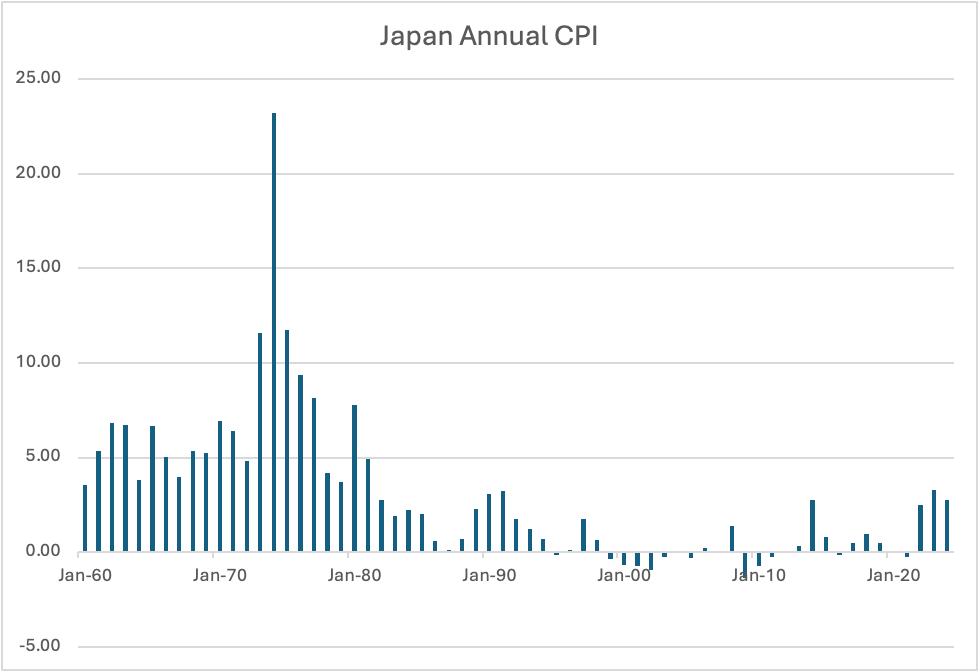
Consider, for a moment, the cost of living in Japan.  For the 30 years up until 2022, as you can see from the chart below taken from FRED data, the average annual CPI was 0.44%.  

In fact, the imperative for Japanese monetary policy was to end the decades of deflation as it was deemed a tremendous drag on the economy.  This was the genesis of their Negative Interest rate policy as well as their massive QE program, which went far beyond JGBs into equities and ETFs.  Now, while the economists and politicians hated deflation, it wasn’t such a bad thing for the folks who lived there.  Think of your life if prices for stuff that you consume rose less than 1% a year for 20-30 years.  

But now, under the guise of, be careful what you wish for, you just may get it, the Japanese government has been successful in raising the nation’s inflation rate to their 2.0% target and beyond and have shown no ability to halt the process.  After all, the Japanese overnight rate remains at 0.50% leaving real rates significantly negative, which is no way to fight inflation.   So, while Ishiba-san explained to the electorate that he was defending Japan’s pride and industry, the voters said, we want prices to stop rising.  

The biggest problem for Japan is that they now have less than 2 weeks to conclude a trade deal with the US based on the latest timeline, and their government is weak with no mandate on trade.  It is not impossible that Japan caves on most issues because if they fight, given the government’s current status, it could be a lot worse.

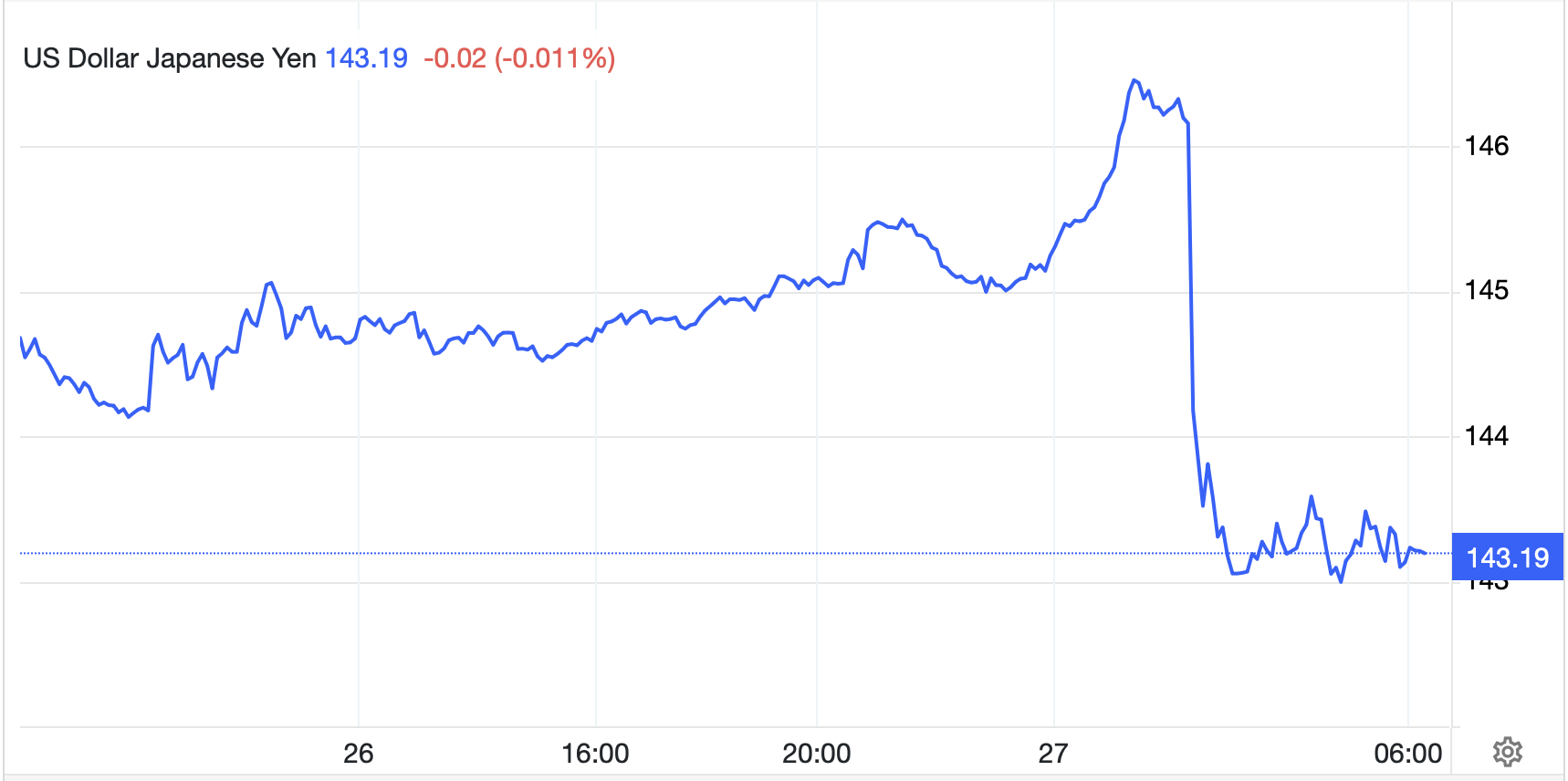
Now, Friday, when I discussed this possibility, I made that case that if the LDP lost the Upper House majority, it would be a distinct negative for both the yen and the JGB market.  Well, as you can see in the chart below, the first call has thus far been wrong with the USDJPY falling a full yen right away, and after an initial bounce, it has resumed that downtrend.  Like the dollar’s strength when the GFC exploded in 2008, despite the fact that the US was the epicenter of the problem, it appears that Japanese investors are bringing more money home as concern over the future increases.  Over time, I expect that the yen is likely to weaken, but I guess not yet.

Source: tradingeconomics.com

As to JGBs, Japan was on holiday last night, celebrating Sea Day, so there was no market in Tokyo.  While there is a JGB futures market, there was very little activity, and we will need to wait until this evening to learn their fate. 

The deadline for trade talks is looming
And Europe, responses, are grooming
If talks fall apart
And cut to the heart
Of what people there are consuming

The other story that is getting discussed this morning is the fast-approaching trade talk deadline of August 1st.  The EU has been actively negotiating to achieve a deal and there appears to be a decent chance that something will be concluded.  However, this morning’s stories are all about how Europe is preparing a dramatic response (“if they want war, they’ll get war” according to German Chancellor Merz) if they cannot reach a deal and the US imposes much higher tariffs on EU exports.  It is actually quite amusing to see the framing of Europe as the righteous entity being unfairly treated and forced to create a response to the American bullies.  But, that is the message from the WSJ and Bloomberg, and I’m sure from the other news sources that I don’t follow.

Every time I consider the trade situation, and the speed with which President Trump is working to conclude deals, I am amazed at how quickly this is all coming about.  Consider that the Doha Development Round of trade talks was launched in 2001 and IS STILL ONGOING with no resolution yet.  The previous framework, the Uruguay Round took 8 years to complete.  Thus, perhaps the question should be, why have trade talks taken so long in the past.  Much has been made of how President Trump blinked when the original 90-day window closed and so extended the timeline for a few weeks.  Apparently, the use of more sticks and fewer carrots is what has been needed to get these things moving along.  Otherwise, trade negotiators had cushy jobs with no accountability and no responsibility, so no incentive to come to an agreement.

Many analysts have explained that the US will suffer from these deals as inflation will rise because of tariffs and growth will slow.  Of course, these were the same analysts who explained that tariffs by the US would result in other nations’ currencies weakening to offset the tariff.  Once again, I would highlight that old analyst models are not fit for purpose in the current world situation.  I have no idea if there will be a successful conclusion of these deals, but I won’t bet against that outcome.  In the end, as I have repeatedly explained, the US has been the consumer of last resort for nations around the world, and loss of access to the US market is a major problem for everybody else.  That is a very large incentive to agree to deals.

Ok, enough, let’s see how things look this morning.  Tokyo was closed last night but we saw gains in Hong Kong (+0.7%) and China (+0.7%) as the PBOC maintained its policy ease supporting the economy.  In fact, Chinese money supply has been growing recently which should help the economy there, although it is still struggling a bit.  The rest of the region was a mixed bag with some gainers (Korea, India, Indonesia) and some laggards (Taiwan, Australia, Malaysia).  In Europe this morning, equities are under some pressure with the CAC (-0.5%) the laggard, although all bourses are lower.  This appears to be trade related with some concerns things won’t work out.  As to US futures, at this hour (7:05), they are pointing higher by about 0.25%.

In the bond market, yields are falling everywhere with Treasuries (-4bps) lagging the continent where European sovereigns have all seen 10-year yields decline by -6bps to -7bps.  It seems that there is growing hope the ECB will cut rates this Thursday, although according to the ECB’s own Watch Tool, the probability is just 2.7% of that happening.  

In the commodity space, oil is unchanged this morning as the variety of stories around leave no clear directional driver.  However, remember, it has bounced off recent lows despite production increases, and if confidence in economic growth is returning, which it seems to be, then I suspect the demand story will improve.  Meanwhile, metals markets (Au +0.65%, Ag +0.89%, Cu +1.1%, Pt +1.2%) are all having a good morning as a combination of dollar weakness and better economic sentiment are supporting the space.

As to the dollar, it is broadly lower against all its major counterparties apart from NOK (-0.2%) and INR (-0.2%) as NY walks in the door.  While the yen has been the biggest mover, the rest of the world has seen gains on the order of 0.35% or so uniformly.  The INR story apparently revolves around the trade talks with the US and concerns they may not be completed on time, but looking at the krone, after a strong rally last week following oil’s recovery, this morning looks like a bit of profit-taking there.

On the data front, there is very little coming out this week amid the summer holidays.

TodayLeading Indicators-0.2%
WednesdayExisting Home Sales4.01M
ThursdayECB Rate Decision2.00% (no change)
 Initial Claims228K
 Continuing Claims1952K
 Flash PMI Manufacturing52.5
 Flash PMI Services53.0
 New Home Sales650K
FridayDurable Goods-10.5%
 -ex Transport0.1%

Source: tradingeconomics.com

In addition to this limited calendar, it appears the FOMC is on vacation with only two speakers, Chairman Powell tomorrow morning and Governor Bowman tomorrow afternoon.  It is hard to get too excited about much in the way of market movement today.  As has been the case for the past six months, we are all awaiting the next White House Bingo call, as that is what is driving things for now.

Good luck

Adf

More Money to Mint

As an eagle soars
So too did the yen after
Ishiba-san won


Political change in Japan is far less bombastic and exciting than here in the US as evidenced by the election of Shigeru Ishiba as the new leader of the Liberal Democratic Party (LDP) last night.  Given the LDP’s large majority in the Diet (Japan’s parliament), as the new leader, Ishiba-san is now all but certain to be the new Prime Minister. This will likely be confirmed by a vote as early as next Tuesday, but sometime very soon regardless.

Ishiba’s background, a party veteran and former defense minister, seems to have been the right focus at the right time as strains with China have recently increased and the electorate (LDP members, not the general population) are clearly hearing about security concerns more than other issues.  The implication is that economic issues were not the driving force here, but in that vein, Ishiba’s views appear to be to allow the BOJ and Governor Ueda to continue their normalization process, finally ending the decade plus of Abenomics that worked to raise inflation.  

Now, as it happens, last night Tokyo inflation was released with the headline falling to 2.2% and the core falling to 2.0%, as expected.  It also appears that one of his key opponents, Sanae Takaichi, had been an advocate of pressuring the BOJ to slow its policy normalization, so with the results, market participants reacted swiftly, and the yen rallied sharply on the news as per the below chart while the Nikkei after an initial sharp decline, rebounded and closed higher by 2.3%.

Source: tradingeconomics.com

Going forward, it seems unlikely that the yen is going to be a focus of the new Ishiba administration.  Rather, he is clearly focused on defense strategy so Ueda-san will be able to continue his normalization efforts at his own pace.  As evidence, JGB yields stopped their recent slide and backed up 2bps overnight.  I suspect that we will see a very gradual move higher here with key drivers to be purely economic issues rather than political ones, at least for a while.

This morning, the PCE print
Will help give another key hint
To whether the Fed
When looking ahead
Will soon start, more money, to mint

The other story for the day is the PCE report to be released at 8:30. Current expectations are for a 0.1% M/M, 2.3% Y/Y rise in the headline number and a 0.2% M/M, 2.7% Y/Y rise in the ex-food & energy reading.  If these are the realized outcomes, the trend lower in inflation will remain on track and all the Fed speakers will feel vindicated that the 50bp cut last week was appropriate.  But I think it is worthwhile to take a quick look at a chart of how this number (core PCE) has evolved over time to help us better understand where things are in relation to the pre-pandemic economy. 

Source: tradingeconomics.com

Now, while there is no doubt that we are well below the highest levels seen two years ago, it is not difficult to look at this chart and see a potential basing formation, well above the pre-pandemic levels.  In fact, today’s expectations on the core reading are for a bounce higher of 0.1% which would only reinforce the idea that we have seen the bottom in this reading.  Of course, any one month’s data is not definitive as everything is subject to revisions, and simply looking at the chart, it is easy to see both ebbs and flows in the data well before the pandemic.  But I continue to be concerned that the Fed’s very clear ‘mission accomplished’ attitude on inflation is a big mistake that will come back to haunt us all sooner than you think.

Ahead of the data, a look at the overnight session shows that the ongoing rally in risk assets that started with the Fed and has been goosed by China’s efforts this week, remains the dominant theme.  In fact, Chinese shares had another gargantuan session last night (CSI 300 +4.5%, Hang Seng +3.6%) as hedge funds who had been quite short the Chinese stock market prior to the announcements this week continue to scramble to cover those shorts as well as get long for the rest of the expected ride.  But away from China and Japan, the rest of Asia was far less excited with declines seen in India, Korea and Australia leading most indices lower there.  As to European bourses, they are firmer this morning led by the DAX (+0.8%) but green everywhere after preliminary inflation data for September from France and Spain saw declines well below expectations to 1.5% and investors increased the probability of an October ECB rate cut substantially.  While some ECB members remain concerned over the stickiness of services prices, which continue to hover above 4%, if the headline numbers are falling below 2%, I think it will be very difficult for Madame Lagarde to push back against another cut next month.  Meanwhile, ahead of the data, US futures are unchanged.

In the bond market, Treasury yields have edged lower by 1bp while European sovereign yields have moved a similar amount except for French OATs which have slipped 3bps.  The story about French debt yielding more than Spain, one of the original PIGS has gotten a lot of press and it seems deeper thinkers disagree with the idea and are buying ‘undervalued’ French OATs.  

In the commodity markets, oil (+0.15%) has finally stopped falling, at least for the moment, although the recent trend is anything but encouraging for oil bulls.  Crude is lower by -4.5% in the past week and -9.0% in the past month, clearly helping the headline inflation readings.  As to the metals markets, after another strong day yesterday, they are consolidating with very modest declines (Au -0.2%, Ag -0.1%, Cu -0.4%) although the trend in all three remains firmly higher.

Finally, the dollar, after several sessions under a lot of pressure, is also bouncing slightly, at least against most of its counterparts.  We have already discussed the yen’s gains, but vs. the rest of the G10, it is firmer by roughly 0.15% or so while vs. its EMG counterparts some are seeing losses  (CE4 -0.3% to -0.4%) while there are others with modest gains (ZAR +0.3%, MXN +0.4%).  For now, the trend remains for a lower dollar, and if we see a soft PCE reading this morning, I expect that to reassert itself as thus far, today’s price action appears more like a trading response to the recent weakness.

In addition to the PCE data, we also see Personal Income (exp 0.4%), Personal Spending (0.3%), the Goods Trade Balance (-$99.4B) and Michigan Sentiment (69.3).  Mercifully, on the Fed front, only Governor Bowman speaks, she of the dissent at the last meeting, although yesterday’s plethora of Fed speakers taught us nothing new at all.  

I don’t have a strong opinion as to how this data will play out, but I would caution that if PCE is firmer than expected, look for a hiccup in the recent euphoria over stocks and bonds, while the dollar consolidates its support.  However, if we see a softer print than forecast, watch out for a much bigger rally in stocks and a much weaker dollar.

Good luck and good weekend

Adf