Theses All Wrecked

There once was a fire that ceased
Which many hoped would lead to peace
But recent attacks
On ships did climax
In poking the milit’ry beast

The market’s response was direct
With oil bears’ theses all wrecked
The dollar, it rose
While risk takers chose
Their stocks and bonds, now, to reject

While we had all become accustomed to the gradual decline in the price of oil as it appeared there was a solid chance that an agreement would be reached between Iran and the US, that all came a cropper yesterday after Iran attacked 3 different ships exiting the Strait and the US responded with attacks on more than 80 targets, including (according to the WSJ) “air-defense systems, command and control networks, antiship missile sites and more than 60 Iranian small boats near the waterway.”  This was a significant uptick in the nature of the response from previous skirmishes and according to President Trump, the ceasefire is over.

“To me, I think it’s over, I don’t want to deal with them anymore,” Trump told reporters at a NATO summit in Ankara on Wednesday. “They’re liars, they’re cheats, they’re sick people.” 

Given the sudden change in the status in the Gulf, we cannot be surprised by the market response.  WTI (+6.0%) rocketed higher as you can see in the chart below.

Source: tradingeconomics.com

And while that is clearly a significant move, and has changed attitudes in the market, I think it is worth stepping back slightly and looking at the price action over the past month, just to remind ourselves that though things may be changing, we have still seen a dramatic decline in price.

Source: tradingeconomics.com

Here’s the thing, right now there is no way to know if we are going back to the situation in early March, where there was substantial fighting, or at least bombing and missile attacks, each day, or if this, too, is going to pass like the previous minor skirmishes.  Certainly, President Trump appears tired of the current situation, but it is not clear what type of further response is in the offing.

In the meantime, given the new military action and the limited prognosis for a quick return to the previous status of ships moving through the Strait, it can be no surprise that investors decided to dump a lot of risk.  So, let’s take a look at how things behaved overnight.

You will not be surprised that equity markets are broadly lower this morning.  Yesterday’s US session was soft on concerns over the tech sector and that was before the resumption of hostilities in Iran.  So, Tokyo (-2.1%), China (-0.8%), Korea (-5.4%) and India (-2.2%) all fell sharply amongst major markets in Asia with most of the smaller exchanges under pressure as well.  The outliers here were HK (+3.0%) and Taiwan (+0.6%) as both saw continued demand for semiconductor and tech shares.  It feels to me that these two markets will have difficulty maintaining this positivity under the current circumstances.

In Europe, it is a bloodbath with all major bourses lower led by Germany (-2.4%) and Spain (-2.7%) while France (-2.2% and the UK (-1.6%) are not far behind.  The NATO meeting ongoing in Ankara is not helping anybody’s views as President Trump continues to add pressure to NATO to pay their own way.  Ultimately, the NATO transition continues, and it is anybody’s guess as to how involved the US will be going forward.  As to US futures, at this hour (6:35) all the major markets are lower by -1.0% or more.

In the bond market, yesterday saw Treasury yields rise 6bps during the session as yields tracked the oil move pretty closely.
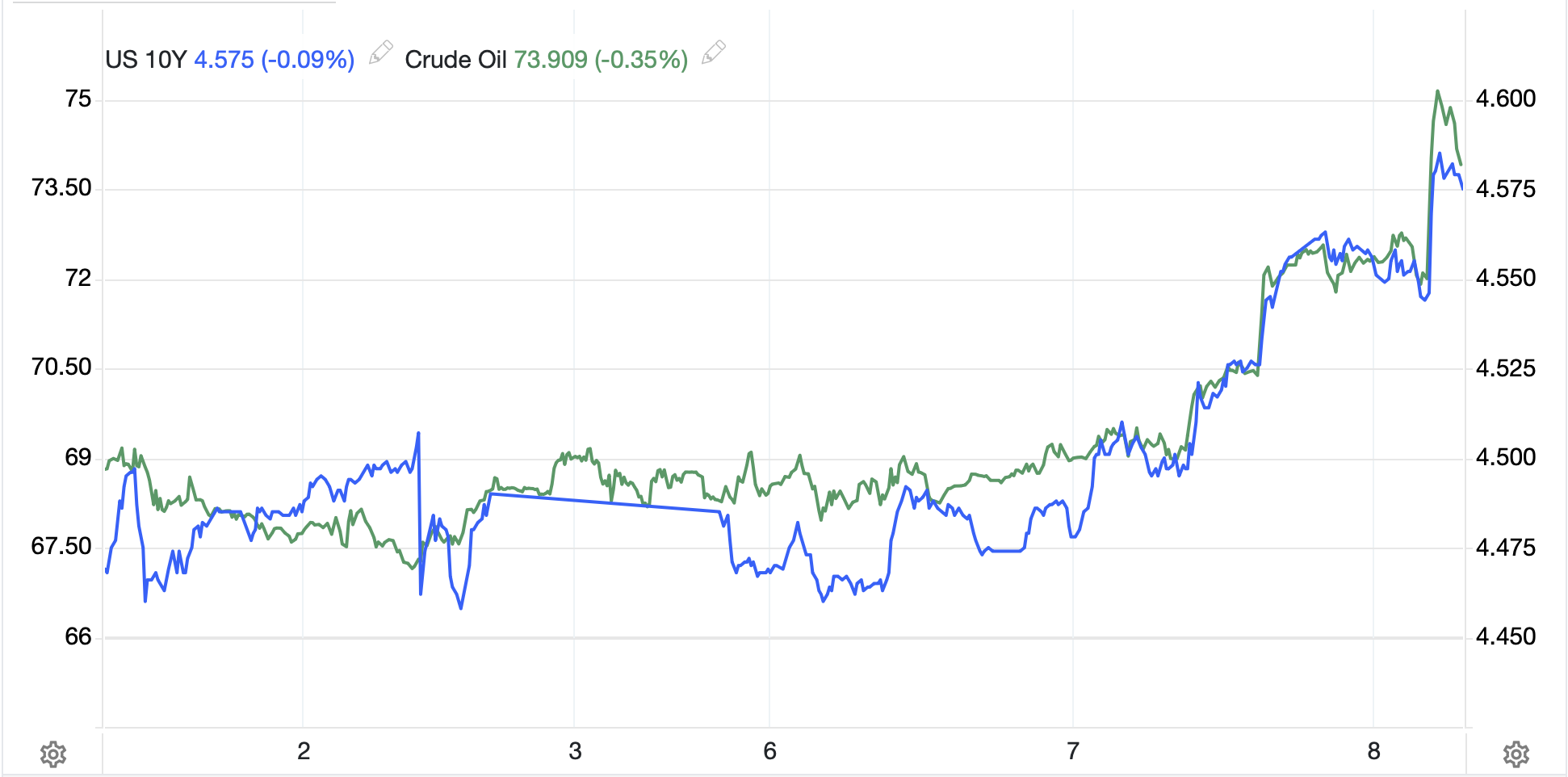
Source: tradingeconomics.com

This morning, Treasury yields are higher by 2bps more but that is nothing compared to the European sovereign markets, which as you can see from the below Bloomberg.com screenshot are substantially higher this morning.
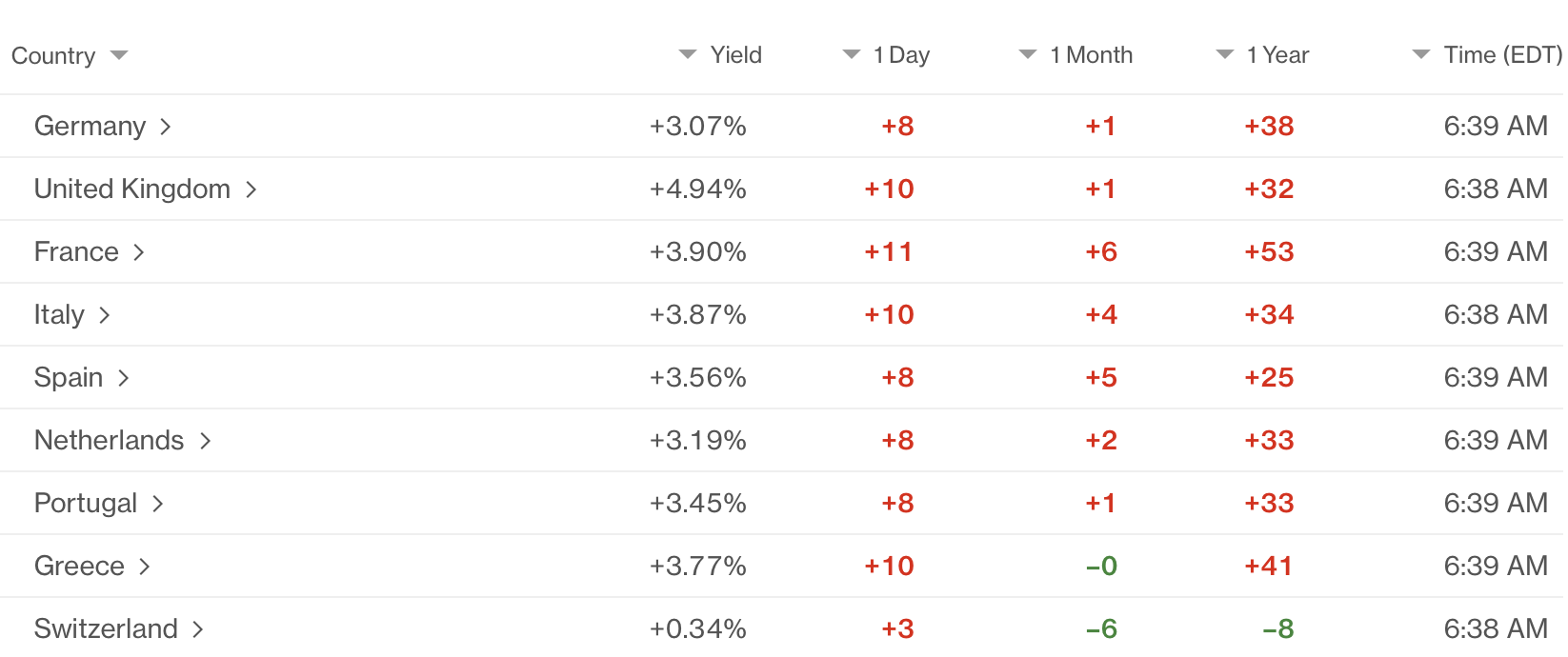
All those visions of inflation finally starting to decline were abruptly altered after the renewed activities in the Gulf.  Adding to the pressure on bonds is the concern over the increased spending promises from governments around the world which has seen traders increase short positions in the bond market to near record levels.

We cannot be surprised that gold (-1.2%), silver (-2.2%) and copper (-2.2%) are lower in response to the renewed fighting and rise in oil prices as that relationship has been very consistent.  We also cannot be surprised that the dollar is a bit firmer this morning, although not universally so.  For instance, JPY (-0.2%) is now pushing back to its recent lows (dollar highs) although the pace of movement remains quite modest.  As well ZAR (-0.6%) is also under pressure amid the decline in gold prices and rising oil prices (they are an importer of oil).  On the flip side, though, NOK (+0.4%) is benefitting from oil’s rally as is CAD (+0.25%) while KRW (+0.6%) seems to be benefitting from money flowing home after the recent equity rout there (covering margin calls?).  NZD (+0.4%) strengthened on the back of the RBNZ raising their base rate by 25bps as they continue to have some concern over inflation, but that only takes it back to 2.50%, hardly tight money.  As to the other main currencies, they have not really done that much, although lean slightly lower this morning.

On the data front, we see the EIA oil inventory data with draws still expected, as well as a 10-year Treasury auction, where it will be quite interesting to see if investors are keen on the extra yield now available.  And we get the FOMC Minutes, which despite the Iran situation, will still be keenly watched and read as the analyst community tries to get a better understanding of the way the Fed will be behaving going forward.  What is the new reaction function?  

Looking at the Fed funds futures market, pricing for that first rate hike has moved to September from the previous October timeframe, and a second hike is back in the cards as well.
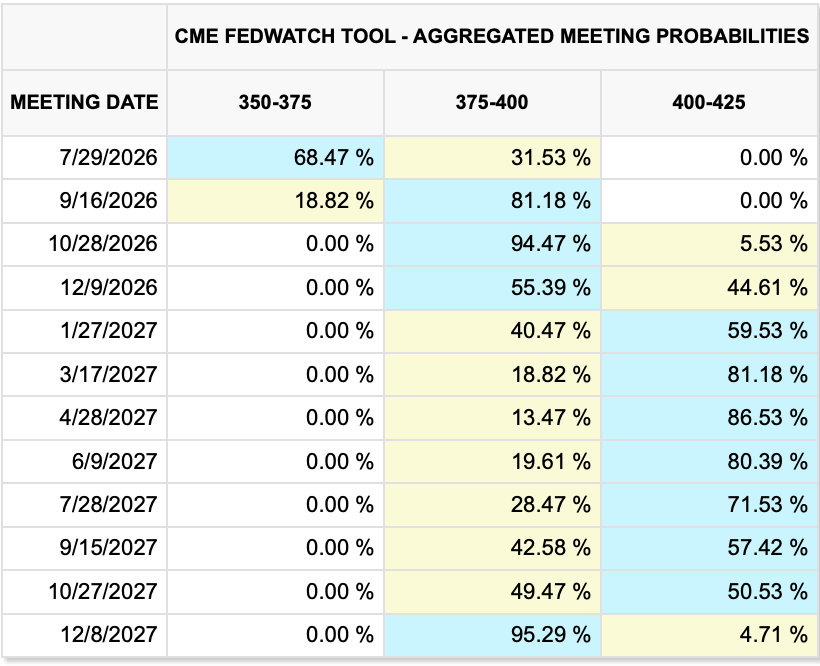
However, nothing has changed my view about the way things will evolve.  Certainly, the increased hostilities are a negative for markets, but I suspect that this will be a short-lived episode and things will calm down again sooner rather than later.  With that in mind, I have not changed my view about no rate hikes this year with a potential cut.  However, if this fighting does increase and the oil price creeps higher over the next weeks and months, I will be rethinking this stance.

Right now, we are back to being hostage to events on the other side of the world.  All we can do is watch and respond.  

Good luck

Adf

He’s the Worst

The talking points have been disbursed
With narrative writers well-versed
The dollar is falling
‘Cause Trump is now calling
For Powell to leave, “He’s the worst!”
 
The idea is Trump will soon name
The next Fed Chair, turning Jay lame
This shadow Fed Chair
Will have to beware
Since he’ll, for bad outcomes, get blame


The dollar is weaker this morning and if we use the Dollar Index as a proxy, it has fallen to its lowest level since February 2022.  

Source: tradingeconomics.com

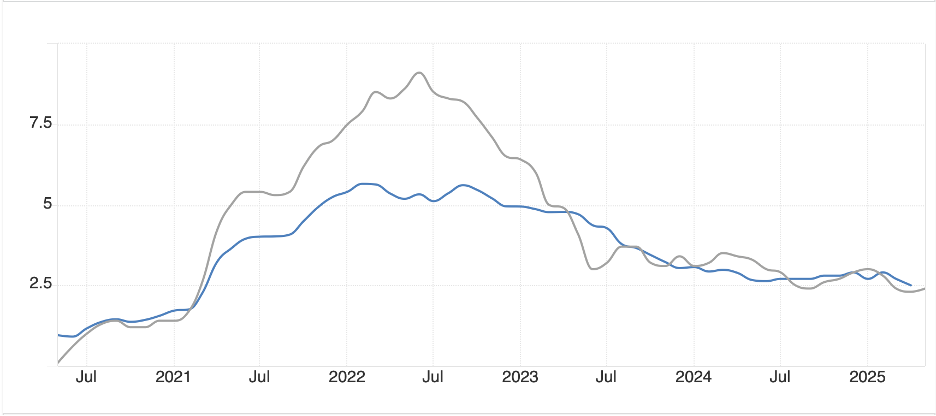
While certainly a part of this movement has been the fact that US yields continue to slide lately, it also seems there is a new narrative that has been distributed to journalists, the dollar is falling because President Trump is considering naming a new Fed Chair much earlier than usual in an effort to undermine Chairman Powell.  We have all heard about the rants the President has had regarding Powell’s unwillingness to cut rates even though inflation readings have been declining for the past two months, and are, on a Y/Y basis back to their lowest level since March 2021 whether measured as CPI (grey line) or Core PCE (blue line).

Source: tradingeconomics.com

But in an exclusive (!) article in the WSJ, which was repeated in Bloomberg, that is the story du jour.  While Bloomberg’s take cannot be a surprise given Mayor Mike’s intense hatred of Trump (after all Trump is the NY billionaire that became president, not Bloomberg), and editorial direction clearly comes from the top, it is more interesting that the Journal is pushing this theme.  Of course, given the Fed whisperer is the article’s writer, it is more than possible that he is simply airing Powell’s views and trying to explain how any move like this would result in chaos, so it’s not Powell’s fault if things go pear-shaped.

Nonetheless, that is today’s story.  In concert with this story, though is another, somewhat more interesting feature, where a really smart analyst, Marko Papic, has broken down the dollar’s movements across different time zones during 2025.  The chart below shows that the dollar selling has been emanating from Asia mostly with Europe having a lesser impact and no substantive change in the NY session.  The implication is that Asian holders of dollars, which tend to be sovereigns rather than other users like investors or corporates, are the ones bailing out.

This activity first became noticeable in early April, right around “Liberation Day” and does fit with the idea that higher US tariffs will result in a smaller US trade deficit.  But as I consider that concept, it strikes me that a smaller US trade deficit will result in fewer dollars around the rest of the world, a reduction in supply, and that would arguably increase the dollar’s value ceteris paribus.  Perhaps this reflects investors selling US assets and converting them to Europe, which has been another theme this year as European companies are set to benefit from a major increase in defense spending by NATO.  However, that doesn’t really sync with the fact that US equities continue to trade near all-time highs.  At this point, I think this is an interesting observation, but am not sure of its meaning.  I’m open to suggestions.

Ok, while that is the narrative this morning, let’s look at how markets are behaving.  Yesterday’s lackluster activity in the US, with the S&P 500 almost exactly unchanged and the other two main indices +/- 0.3% was followed by a burst higher in Tokyo (Nikkei +1.6%) but lagging activity in HK (-0.6%) and China (-0.4%).  The rest of the region couldn’t decide on much with a couple of solid performances (India, Indonesia) and one laggard of note (South Korea).  In Europe, Germany (+0.6%) is leading the way higher across the board, as NATO countries have promised to spend upward of 5% of GDP on total defense (including nonlethal investments), with as much as possible going to European based companies.  That is a lot of money, well over $1.5 trillion.  Meanwhile, US futures are all higher at this hour (7:15), up by about 0.4% or so.

In the bond market, Treasury yields (-2bps) continue to slip and are now back to their lowest level since early May.  Perhaps more interestingly, European sovereign yields are sliding today as well, led by Italian BTPs (-4bps) but lower across the board.  This is interesting given the promises of more borrowing based on the NATO announcement.  But net, bond yields have not really done very much lately at all.

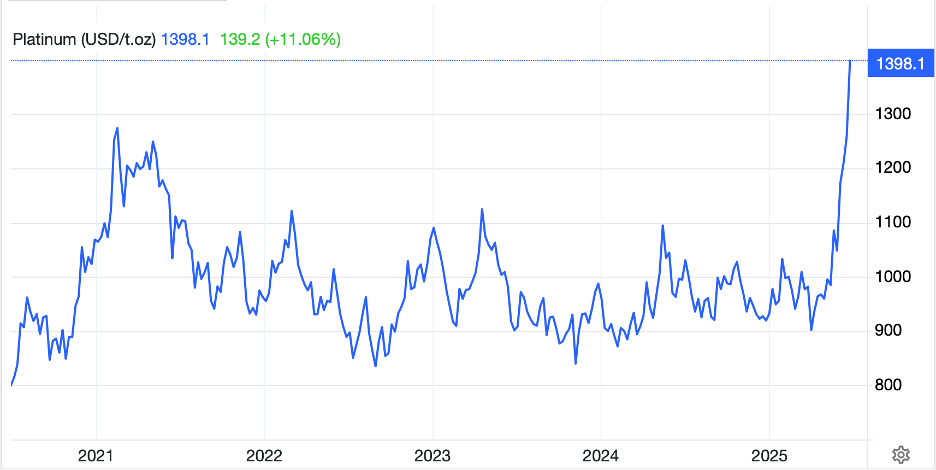
In the commodity markets, oil (+0.5%) is continuing to slowly bounce from the initial lows in the wake of the Iran/Israel ceasefire.  This market still feels quite heavy to me and absent a major change on the ground in the Middle East, if war were to resume and oil facilities be attacked, I still think lower is the way.  In the metals markets, gold (+0.25%) which tried to sell off yesterday continues to find bids below the market, likely central bank support.  But silver (+0.9%) and copper (+2.3% and above $5.00/lb) are looking good although nowhere near as impressive as platinum (+3.4%) which has now risen above $!400/oz and is going parabolic here.  There is much talk here about a supply shortage (it is used for catalytic converters) and significant Chinese demand.

Source: tradingeconomics.com

Finally, the dollar, as mentioned, is under pressure across the board, although the magnitude of this morning’s movement has not been that large.  The largest movement has been in Asia with IDR (+0.6%), JPY (+0.4%) and KRW (+0.35%) while European and LATAM movements have been generally 0.2% or less.  So, the direction is clear, but it has not been impressive.

On the data front, there is plenty today starting with the weekly Initial (exp 245K) and Continuing (1950K) Claims, the Chicago Fed National Activity Index (-0.1), the last look at Q1 GDP (-0.2%), and Durable Goods (8.5%, 0.0% ex-Transports).  We also hear from four more Fed speakers, but Powell just repeated yesterday that they are happy where they are and unlikely to move soon unless something really changes rapidly.  However, despite Powell’s claims of nothing to come, the Fed funds futures market is pricing a 25% probability of a cut at the July 30 meeting.  There is a lot of time between now and then for that to change.

I keep trying to figure out what actually matters to markets anymore as responses to different potential catalysts seem confused.  People do seem to be coalescing around the dollar is falling theme, something I have believed for a while, and if the Fed does lean to a cut next month, I do believe there is further for it to fall.  One thing to remember, though, is with Mr Trump as president, things are still a tweet away from a dramatic change.  If I were in charge of hedging risk, I would adhere to guidelines closely.  There is too great an opportunity for a sudden major reversal in the current environment.

Good luck

Adf

The World is Aghast

At one time, not long in the past
New York was a finance dynast
But yesterday’s vote
Does naught to promote
Its future. The world is aghast
 
As well, yesterday, Chairman Jay
Had nothing of note new to say
He’s watching quite keenly
And somewhat serenely
But rate cuts are not on the way


I must start this morning on the results from the NYC mayoral primary election where Zohran Kwame Mamdani won the Democratic primary and is now favored to win the general election.  His main rival was former NY state governor, Andrew Cuomo, a flawed man in his own right, but one with the usual political peccadillos (greed, grift and sexual misconduct).  Mamdani, however, is a confirmed socialist whose platform includes rent freezes, city owned grocery stores (to keep costs down) a $30/hour minimum wage (not sure how that will keep grocery prices down) and a much higher tax rate, especially on millionaires.  In addition, he wants to defund the police.  Apparently, his support was from the younger generations which is a testament to the failures of the education system in the US, or at least in NYC.

I mention this because if he does, in fact, become the mayor of NYC, and can enact much of his agenda, the financial markets are going to be interrupted in a far more dire manner than even Covid or 9/11 impacted things.  I expect that we will see a larger and swifter exodus from NYC of both successful people and companies as they seek other places that are friendlier to their needs.

Now, even though he is running as a Democrat, it is not a guarantee that he will win.  Current mayor, Eric Adams is running as an independent, and while many in the city dislike him, he may seem to be a much better choice for those somewhere in the middle of the spectrum.  As well, even if he wins, his ability to enact his agenda is not clear given his inexperience and lack of connections within the city’s power centers. Nonetheless, it is a real risk and one that needs to be monitored closely.  

As to Chairman Powell, as well as the other six FOMC members who spoke yesterday, the generic view is that while policy may currently be slightly tight, claimed to be 25bps to 50bps above neutral across all of them, they are in no hurry to adjust things until they have more clarity regarding the impact of tariffs on inflation and the economy.  They paid lip service to the employment situation, explaining that if things took a turn for the worse there, it would change the calculus, but right now, they’re pretty happy.  It can be no surprise that there were zero deep questions from the Senate committee members, and I expect the same situation this morning when he sits down in front of the House.  

Since the cease fire between Iran and Israel seems to be holding, market participants are now searching for the next catalyst for market movement.  In the meantime, let’s look at how things are behaving.  The “peace’ in the Middle East saw the bulls return with a vengeance yesterday in the US, with solid gains across all major indices, but the follow through was less robust.  While Chinese shares (Hang Seng +1.2%, CSI 300 +1.4%) both fared well, the Nikkei (+0.4%) was less excited and the rest of the region was more in line with Japan than China, mostly modest gains.  From Japan, we heard from BOJ member Naoki Tamura, considered the most hawkish, that raising interest rates was necessary…but not right away.  That message was not very well received.

However, Europe this morning is on the wrong side of the ledger with Spain’s IBEX (-1.25%) leading the way lower although other major bourses are not quite as poorly off with the DAX (-0.4%) and CAC (-0.2%) just drifting down.  NATO is meeting in The Hague, and it appears that they are finalizing a program to spend 5% of respective national GDP’s on defense, a complete turnaround from previous views.  This is, of course, one reason that European bond markets have been under pressure, but I expect it would help at least portions of the equity markets there given more government spending typically ends up in that bucket eventually.  As to US futures, at this hour (7:10) they are little changed to slightly higher.

In the bond market, US Treasury yields continue to slide, down another -1bp this morning and now under 4.30%.  Despite President Trump’s hectoring of Chairman Powell to lower Fed funds, perhaps the fact that Powell has remained firm has encouraged bond investors that he really is fighting inflation.  It’s a theory anyway, although one I’m not sure I believe.  European sovereigns have seen yields edge higher this morning, between 1bp and 2bps as the spending promises continue to weigh on sentiment.  However, even keeping that in mind, after the spike in yields seen in early March when the German’s threw away their debt brake, European yields have essentially gone nowhere.

Source: tradingeconomics.com

While this is the bund chart, all the major European bond markets have tracked one another closely.  Inflation in Europe has fallen more rapidly than in the US and the ECB’s base rate is sitting 200bps below Fed funds, so I suppose this is to be expected.  However, if Europe actually goes through with this massive military spend (Spain has already opted out) I expect yields on the continent to rise.  €1 trillion is a quite significant ask and will have an impact.

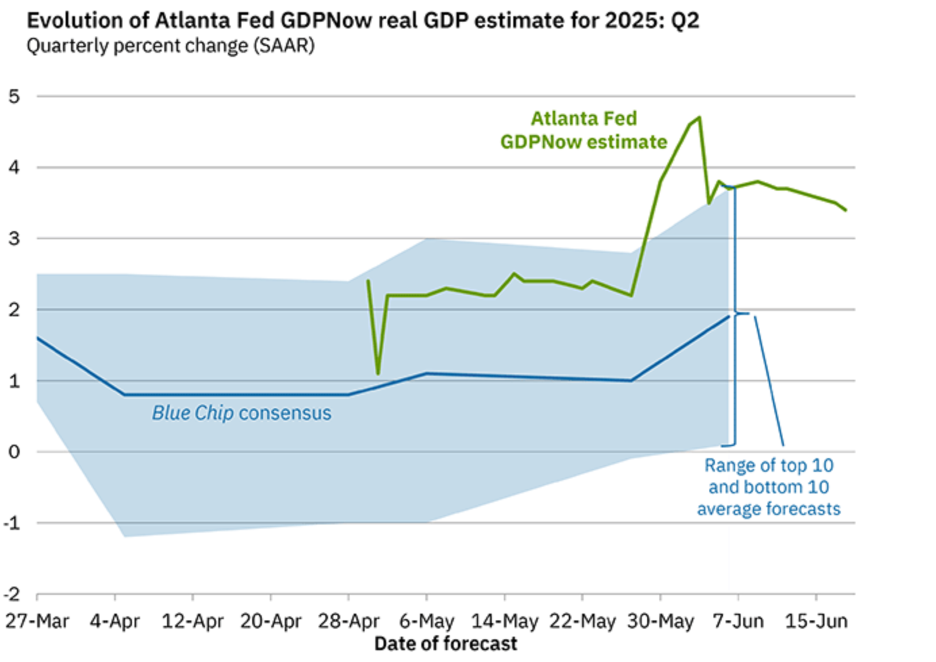
Moving to commodity markets, after its dramatic decline yesterday, oil (+0.8%) is bouncing somewhat, but that is only to be expected on a trading basis.  Again, absent the closure of the Strait of Hormuz, I suspect that the supply/demand dynamics are pointing to lower prices going forward, at least from these levels.  In the metals markets, gold (+0.15%) which sold off yesterday as fear abated, is finding its footing while silver (-0.5%) is slipping and copper is unchanged.  It feels like metals markets are looking for more macroeconomic data to help decide if demand is going to grow in the near term or not.  A quick look at the Atlanta Fed’s GDPNow estimates for Q2 show that growth remains quite solid.

Source: atlantafed.org

However, another indicator, the Citi Economic Surprise Index, looks far less promising as it has moved back into negative territory and has been trending lower for the past 9 months.

Source: cbonds.com

At this point, my take is a great deal depends on the outcome of the BBB in Congress and if it can get agreed between the House and Senate and onto President Trump’s desk in a timely manner.  If that does happen, I think we are likely to see sentiment increase, at least in the short term.  That should help all economically sensitive items like commodities.

Finally, the dollar is modestly firmer this morning, rebounding from yesterday’s declines although still trending lower.  The price action this morning is broad based with modest moves everywhere.  The biggest adjustment is in JPY (-0.6%) but otherwise, 0.2% pretty much caps the movement.  Right now, the dollar is not that interesting, although I continue to read a lot about how it is losing its luster as the global reserve currency.  There is an article this morning in Bloomberg explaining how China is trying to take advantage of the current situation to globalize the yuan, but until they open their capital markets, and not just for $50K equivalents, but in toto, it will never be the case.

On the data front, aside from Chair Powell’s House testimony, we see New Home Sales (exp 690K) and then EIA oil inventories with a modest draw expected there.  There are no other Fed speakers and certainly Powell is not going to change his tune.  To my eyes, it is setting up as a very quiet session overall.

Good luck

Adf