Gamesmanship

Iran has implied they will skip
The coming Islamabad trip
But if they don’t show
The risks of war grow
For them it’s high stakes gamesmanship

Meanwhile markets blithely ignore
The likely resumption of war
But can it be true
That conflict, part two
Will open the next rally’s door?

Ostensibly, a second round of peace talks are due to get underway today in Islamabad, Pakistan, but whether they will remains an open question, at least as of right now at 6:20am in NY.  As always, it is difficult to know what comments are true or were even made by the players involved as propaganda remains Iran’s largest current export.  I have seen comments allegedly from Iranian sources that claim they both will not attend, and that they will attend.  I guess we will know before the day ends as none of the negotiators is named Schrödinger.

As well, President Trump has indicated he is uninterested in extending the cease-fire even one more day if they do not attend.  At this point, it appears that the hardest line members of the IRGC that have survived are the ones in charge over there, and my take is they are not very interested in negotiating as any result would likely end their grip on power.  After all, if they are prevented from having nuclear weapons capability to destroy their sworn enemies of Israel and the US, what exactly is their raison d’etre?  

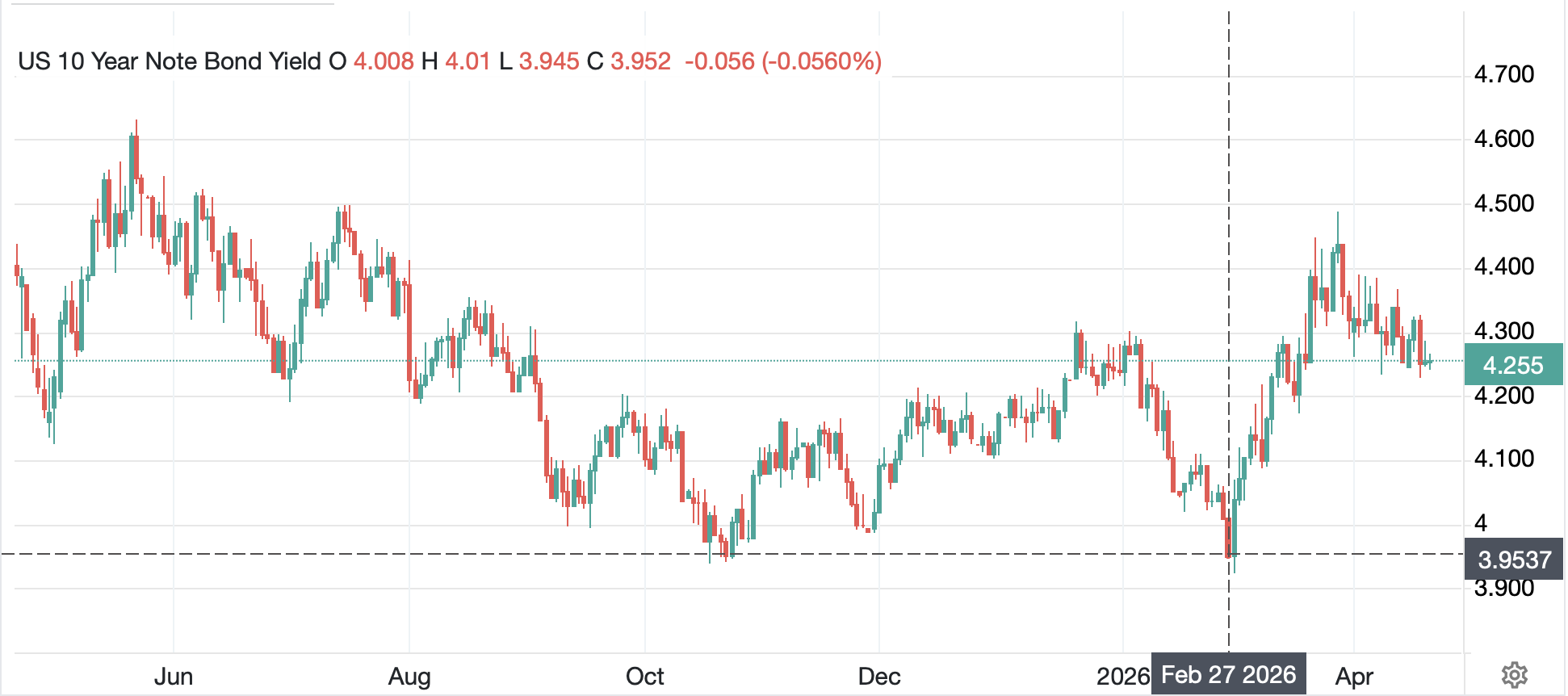
Thus, my fear is that fairly soon, the second stage of this conflict is going to ignite.  If this is the case, the recent market insouciance over the situation seems likely to change dramatically, at least for a little while.  This implies that oil prices will spike higher again along with the dollar, while equities and gold will slump.  I assume bond yields, too, will rise somewhat.  Looking at a chart of yields, though, the current level is right in line with where they were for much of 2025 and at the beginning of 2026, and I am left to wonder if the move lower in yields in January and February, was the anomaly, not the return to current levels.
Source: tradingeconomics.com

I remain suspect of the thesis that inflation is going to decline dramatically because of AI implementation and have felt that way since far before the war began.  Over a long period of time, as AI utilization increases, I do believe it will improve productivity significantly (I see what it has done for me with just limited uses, none of which involve the wordsmithing this note!), but it is difficult for me to foresee a significant deflationary impulse absent a significant reduction of money in the system, and I don’t see that on the horizon any time soon.  The point is, yields don’t seem to be wrong overall in my eyes.

Now, Kevin’s about to sit down
In front of each Senate assclown
They’ll ask him ‘bout rates
But whate’er he states
The Dems will vote no with a frown

The other noteworthy story is that Fed Chair nominee, Kevin Warsh, is having his hearings at the Senate Finance Committee today.  There is a great deal of discussion in the press regarding whether he will simply be a Trump puppet, or become a Trump whisperer, or be an independent voice.  As well, there has been a recent conversion from Fed chair worship amongst the mainstream media, to encouragement for FOMC dissent to anything he wants to do, simply because he was appointed by Trump, so they seek his failure.  It is really quite tiresome.  Frankly, whatever he says is likely to be irrelevant as we already know that every Senate democrat will vote against because…Trump, and most Senate republicans will vote for and when it comes to the floor, he will be confirmed.  

That said, it is a tough job to take right now, regardless of the president, given the goals he has stated, the current situation with respect to the Fed’s monetary stance, and the potential for dramatic changes in economic outcomes because of the war.  I know I wouldn’t want the job!

Ok, let’s analyze that insouciance from overnight.  While yesterday started off with a negative tone, by the end of the day, US equity markets were little changed with the NASDAQ and S&P slipping just -0.25% while the DJIA was unchanged.  Futures this morning are pointing higher by 0.5% at 7:20am.  Overnight, Asian markets were mostly higher, some by a significant amount (Korea +2.7%, Taiwan +1.75%) which continues to baffle me given the impending energy crisis that is about to hit the region.  The larger markets were also firmer (Tokyo +0.9%, HK +0.5%, China +0.2%) with the rest of the region +/- 0.3% or so.  Fear is not evident here.

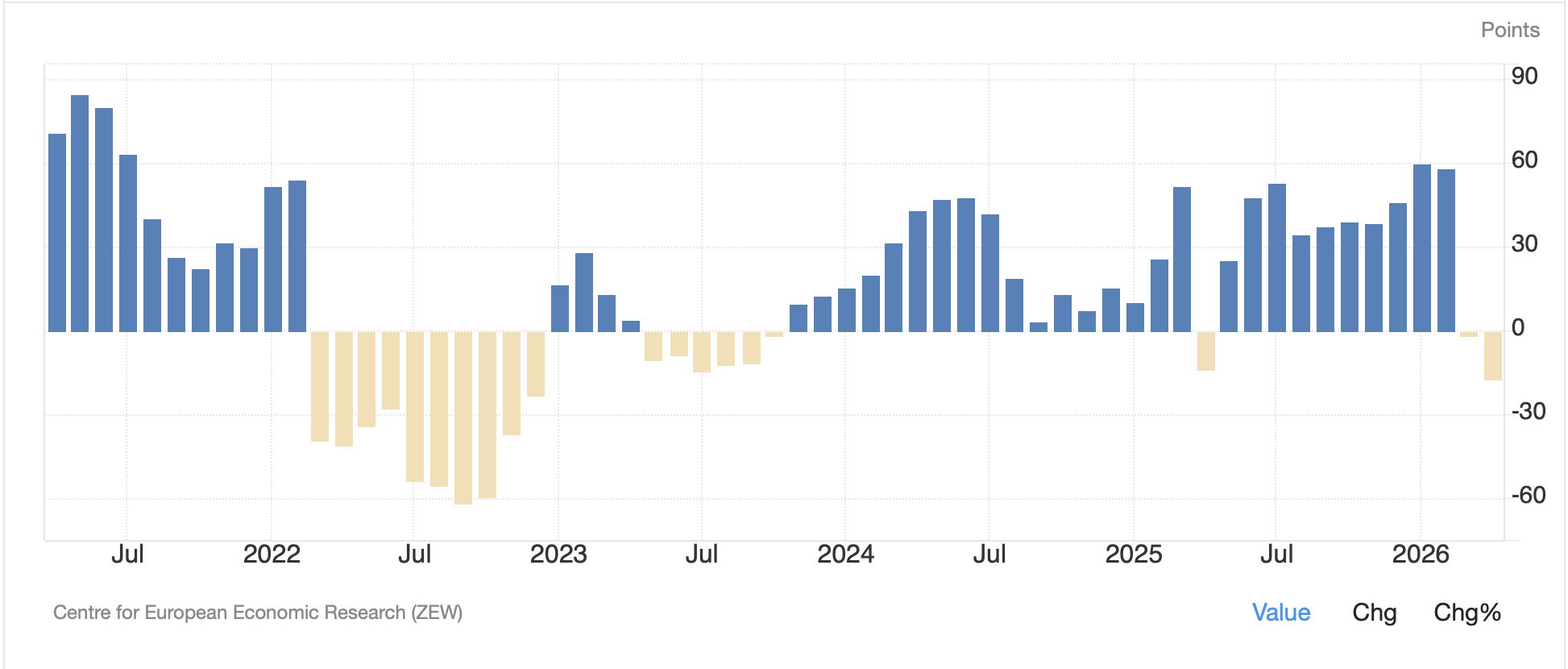
As to Europe, there is also no fear with Germany (+0.7%) leading the way higher despite the worst ZEW Expectations result since December 2022.
Source: tradingeconomics.com

But Spain (+0.6%), France (+0.3%) and the UK (+0.15%) are also higher this morning.  Fear is not an option.

In the bond market, yields this morning are basically unchanged across the board and nobody is paying attention to this market right now.  The only remotely interesting news is that Nikkei News reported the BOJ is not going to raise rates at their meeting next week, and they apparently have a 100% accurate track record in this situation.  Nobody cares about this right now.

Oil (-0.2%) is hanging around awaiting the next story from the Persian Gulf and Strait of Hormuz, sitting between the level seen when it was declared the Strait was reopened and the level it touched when that was denied.  As you can see from the chart below, not only has oil been hanging around, but trading volumes (the light grey bars below the price chart) also appear to be sinking.  Everybody is holding their breath for the next thing here.
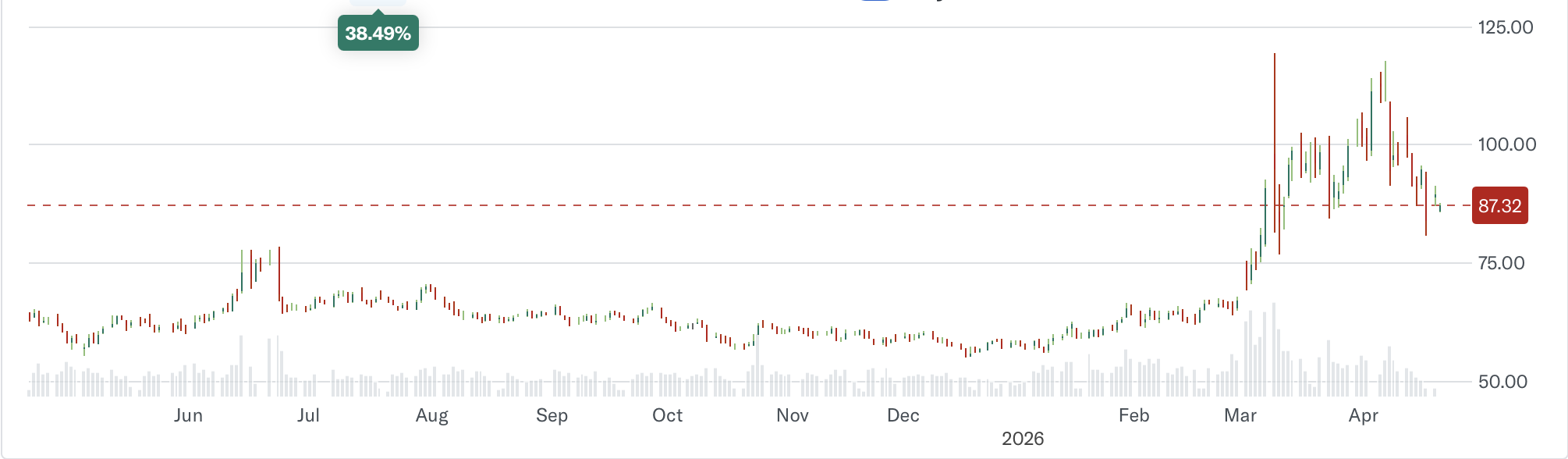
Source: finance.yahoo.com

Meanwhile, metals are under some pressure this morning (Au -0.7%, Ag -0.9%, Pt -0.2%, Cu 0.0%) but volumes here are also muted.  It’s not just the oil market waiting for the next steps, that’s for sure.

Finally, the dollar is a bit firmer this morning, with DXY (+0.1%) pretty representative of the entire space.  One outlier is NZD (+0.3%) after inflation data released last night was higher than expected and market participants started pricing in another rate hike there.  But otherwise, this market is also bored and boring.  There was a Bloomberg article this morning explaining that hedge funds are starting to layer in bets on a rising euro given how low implied volatility is in the options market, but the very fact that implied volatility is so low, around 6%, tells me that nobody really cares.

On the data front, Retail Sales (exp 1.4%, 1.4% ex-autos, 0.2% control group) is due.  The big jump is because the data measured is nominal terms, so the dramatic jump in gasoline prices will have raised Retail Sales a lot, hence the focus on the control group that doesn’t include gas.  

And that’s really it.  The Warsh hearings will get headlines right up until something happens in either Pakistan from the talks, or Iran because there were no talks.  There are many known unknowns right now, and that explains the lack of trading volume.  But real price movement in every market will rely on unknown unknowns, which by definition are opaque, at best.  Once again, my advice remains, play things close to the vest.

Good luck

Adf
Humbling

The ceasefire seemed to be crumbling
And stocks all around started tumbling
Then late in the morning
Trump issued a warning
To Bibi that clearly was humbling

So, Lebanese fighting decreased
Though, so far, it has not yet ceased
The door’s now ajar
For peace near Qatar
Thus, risk appetite rose like yeast

Which takes us to data today
With March CPI on the way
It surely will show
That prices did grow
But how long will increases stay?

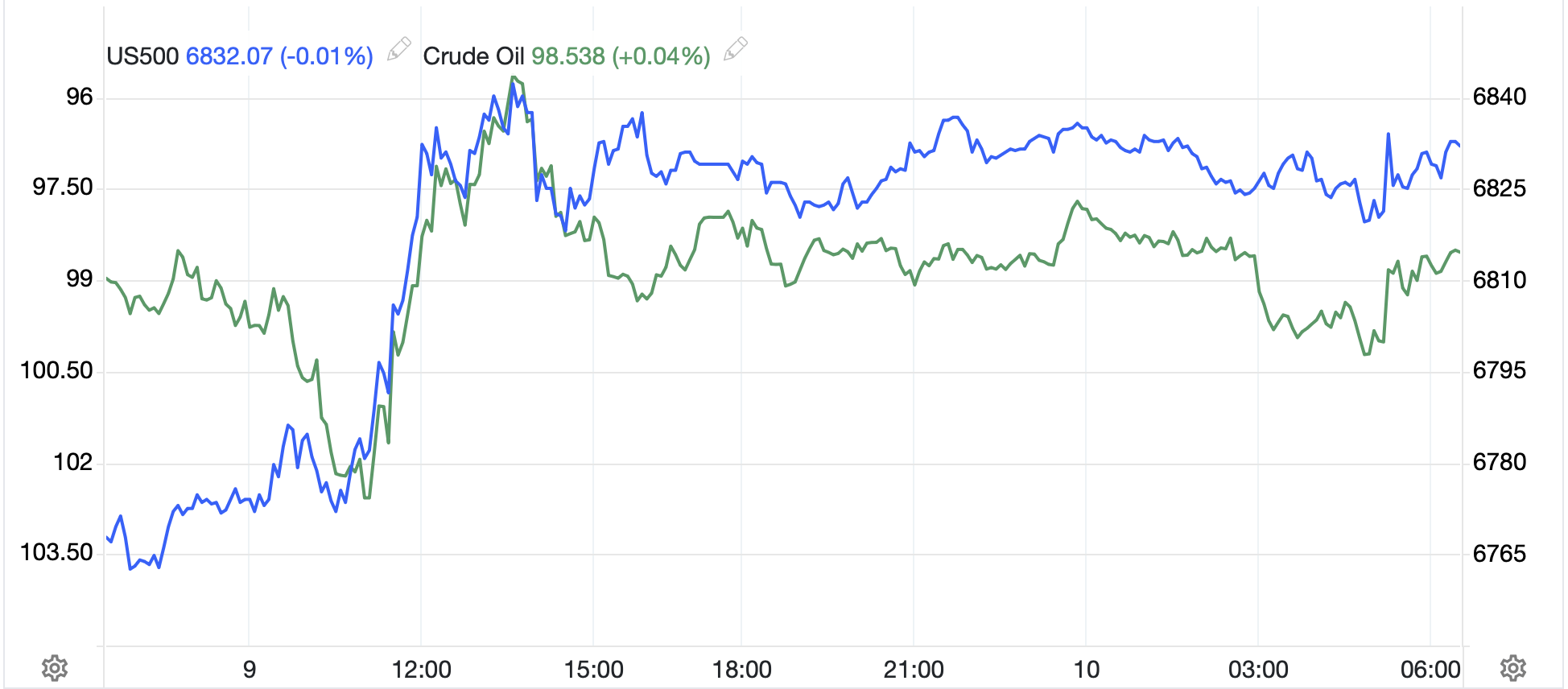
As you can see from the below chart showing oil (inverted) and the S&P 500, about 11:00 yesterday morning, the news hit that Israel was going to stop its ongoing fighting against Hezbollah in Lebanon, which the Iranians claimed was a violation of the ceasefire and had undermined general, and market, belief that the ceasefire would hold at all.  The impact was instant with a substantial rally in the S&P, 1% within an hour, while oil prices tumbled about 6% in the same span (given oil’s volatility is so much higher, that discrepancy is not surprising at all.)

Source: tradingeconomics.com

This is the lead-in to the first face-to-face talks between the US and Iran that are due to occur today in Karachi, Pakistan.  Hopefully, they will lead to a lasting peace with the upshot that Iran will no longer be a sponsor of terrorism, but I must admit, I’m not holding my breath for that outcome.  The overnight market reaction was pretty much exactly what you would have expected with a generally positive view of risk almost everywhere in the world.  Obviously, if the talks lead to a peace and a reopening of the Strait of Hormuz, the strong belief is that things will eventually revert to the prewar stance, at least from an energy and economic perspective.  We shall see.

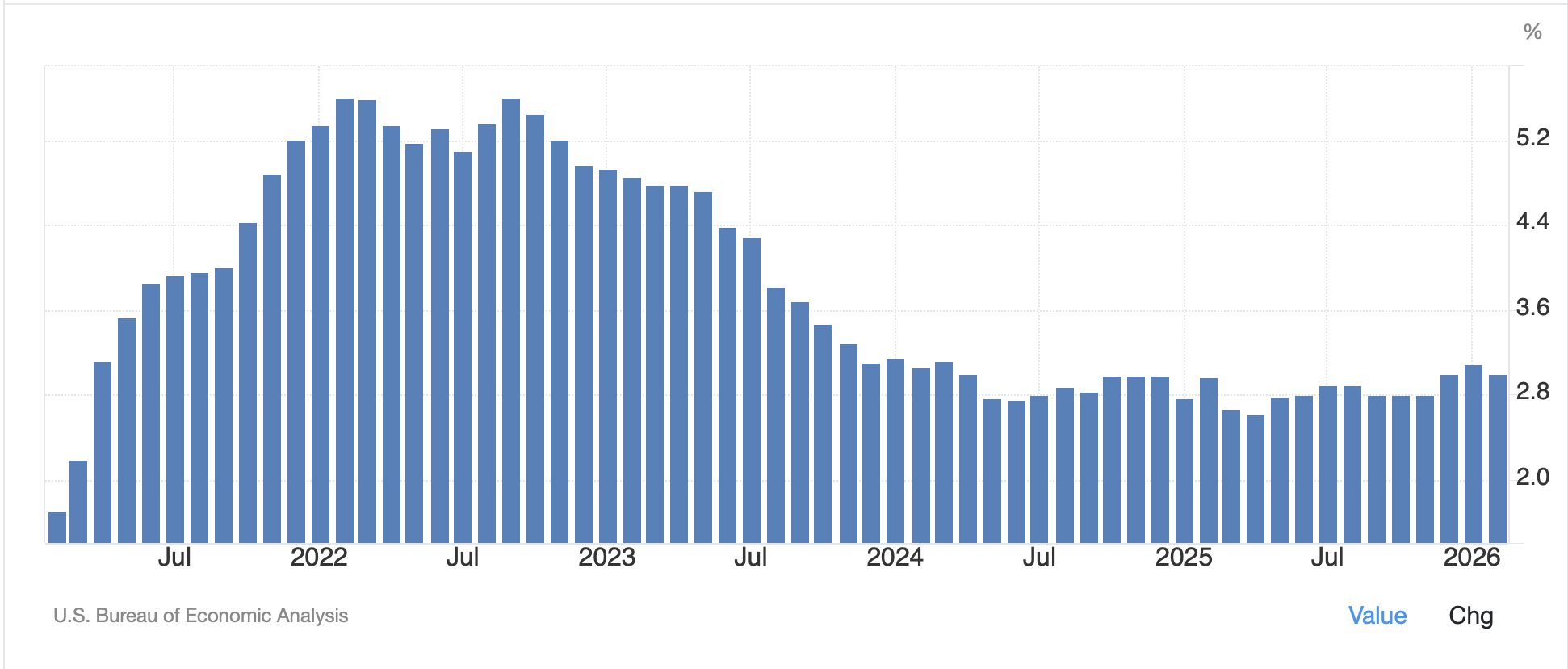
Which takes us to the other piece of news that markets are going to need to absorb this morning, the March CPI data.  Yesterday we saw the February PCE data and while it was released at expected levels, those levels (2.8% Headline, 3.0% Core) are already far above the Fed’s 2.0% target.  In fact, as you can see from the chart below, it has been a full five years since Core PCE was at or below their target.

Source: tradingeconomics.com

And now, we get March CPI this morning which will include a substantial rise in oil prices as the average in February was $64.51/bbl vs. March’s $93.58/bbl.  Obviously, that is going to have a major impact on headline CPI, but the question is just how much of an impact will it have on core?  Expectations are for Headline to rise 0.9% M/M and 3.3% Y/Y, while the Core rises just 0.3% M/M and 2.7% Y/Y.  Now, we are coming halfway through April and oil prices have not retreated yet, so we are likely going to see continued upward pressure on core prices going forward as those high oil prices feed their way into other things.  But that is for the future.  For today, all eyes are on the data to see if it will be enough to concern central bankers.

In fact, next week is World Bank / IMF week in Washington DC and Kristalina Georgieva, the IMF’s Managing Director, expressed concern that the global economy is going to slow down because of the impact of higher oil prices, but implored central bankers around the world to be patient and not hike rates right away, while asking governments not to subsidize fuels and increase demand.  It is, of course, much easier for her to make these comments as she doesn’t face an electorate that is angry about rising prices.

At any rate, other than the virtually infinite number of takes on the Iran war and the CPI data, there’s not much else to discuss, so let’s see how markets have responded to the latest and where they sit ahead of the data.

Yesterday’s early declines in the US were reversed, as per the chart at the top with all three major indices rallying more than 0.6%.  in Asia, weirdly just Australia (-0.15%) and New Zealand (-0.7%) were the outliers on the downside with the rest of the region all in the green, some substantially so.  Tokyo (+1.8%), China (+1.5%), Korea (+1.4%), Taiwan (+1.6%) and India (+1.2%) all had very strong sessions.  Arguably, the weakness Down Under may be a reflection of their energy policies heading into the Iran war as neither nation has a substantial reserve (fossil fuels were deemed bad so their governments didn’t want to buy them) and both economies could suffer far worse than anyone else because of those decisions.  

In Europe, markets are higher across the board although the gains are far more muted with France (+0.5%) the leader followed by Germany (+0.4%) and Italy (+0.4%) then the UK (+0.2%).  While, certainly better than losses, they are hardly inspirational.  As to US futures, at this hour (7:15), they are also pointing slightly higher, about 0.2% or so.

In the bond market, yields are backing up this morning with Treasuries (+2bps) the least impacted while European sovereign yields are higher between 5bps (Germany) and 8bps (Italy) with the rest of the continent somewhere in between.  It is difficult to ascribe a particular story here other than rising concerns about general inflation being higher due to elevated energy costs.  The market is pricing about 59bps of rate hikes by the ECB this year, perhaps a sign that investors don’t believe energy prices in Europe are going to decline as much as they will elsewhere.  Given the continent-wide energy policies they have in place, I believe they are correct.

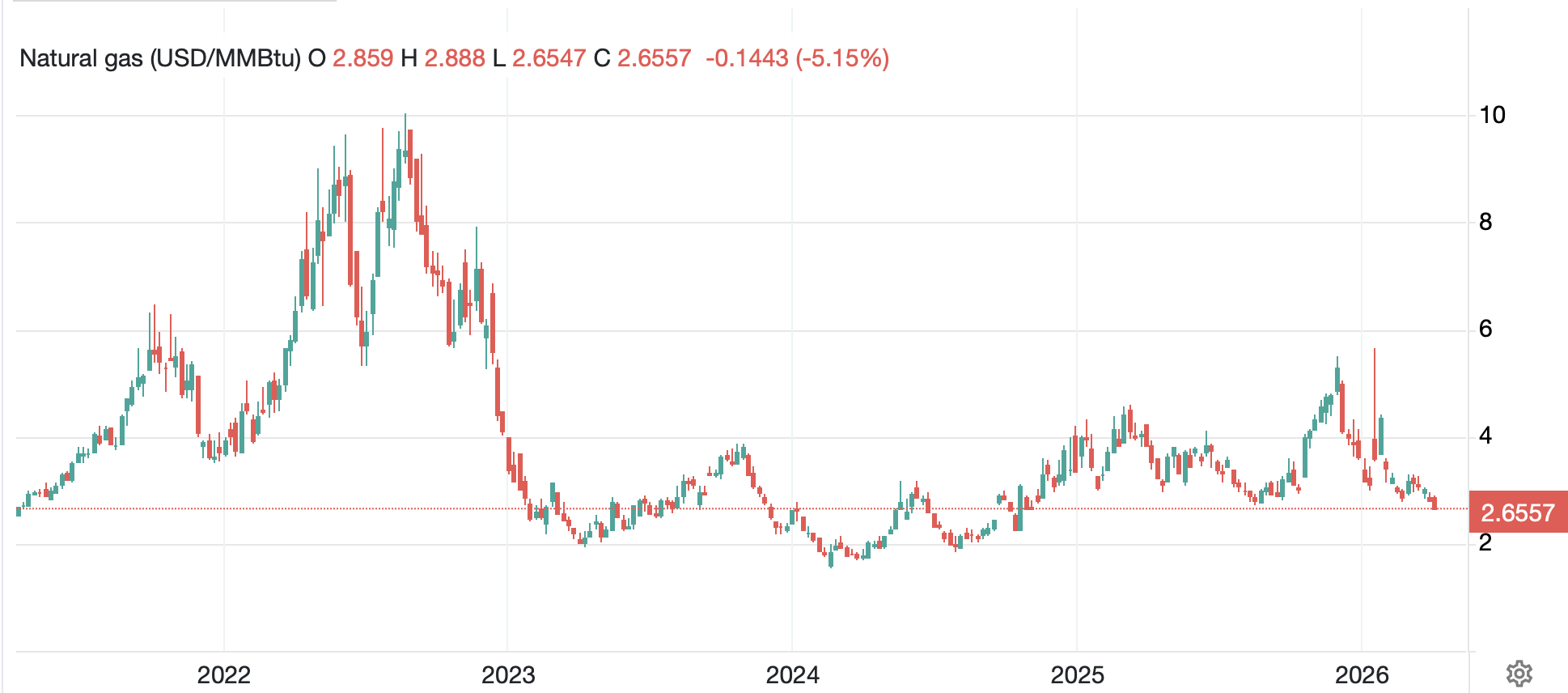
Turning to commodities, oil (0.0%) is unchanged this morning after sliding on the Lebanon news yesterday morning.  The truly interesting thing is to watch NatGas (-0.6%) which continues to slide. Back toward its multi-year lows as it continues to be produced as an associated product alongside all the oil drilling that is ongoing.  

Source: tradingeconomics.com

I cannot look at the above chart and reconcile the massive energy advantage the US has with basically the rest of the world and conclude that the US economy is going to be at any disadvantage with other economies going forward, and hence the dollar seems very likely to remain in good stead going forward.  Meanwhile, metals, too, are little changed this morning (gold 0.0%, silver +0.4%, copper +1.3%) with the latter a bit of a surprise after Argentina just passed legislation that will allow for more drilling in the Andes where Chile’s major copper deposits lie.  That is a long-term prospect though, I must admit.

Finally, the dollar is mixed this morning, with very few significant movers in either direction.  In the G10, +/-0.2% is the name of the game with the most noteworthy thing, I think, the yen (-0.25%) which is back above 159 this morning, although not yet threatening the perceived line in the sand of 160.  In the EMG bloc, KRW (-0.6%) and ZAR (-0.4%) are the laggards although it is hard to ascribe specific news to either move.  Rather, looking at the recent trading action, where both currencies have been rebounding sharply, these moves look like position squaring ahead of the weekend.

In addition to CPI, we also see Michigan Sentiment (exp 52.0) and Factory Orders (-0.2%) at 10:00.  There are no Fed speakers so today is shaping up to be data dependent unless we hear something from the talks in Pakistan.  However, it seems far too early for anything of substance there.  I imagine if core CPI is firm, that could be an equity negative as that would encourage more thought of the Fed hiking, but I have a feeling that despite the broader importance of the number, markets are not going to do much today.

Good luck

Adf

A Slippery Slope

For one day, at least, there was hope
The war might be shrinking in scope
But as of this morning
The markets are warning
That there’s still a slippery slope

The Strait is still under duress
Though some ships have found an egress
The truce is still frail
And much can still fail
Beware, we’re not past all the stress

The most interesting story, to me, about the cease fire is that Pakistan gave each side different terms so they both agreed to something different.  This might explain the confusion over whether the Israeli attacks in Lebanon were part of the deal, and the question about Iran’s collection of tolls for passing through the Strait of Hormuz.  On the one hand, that very duplicity calls into question the help that Pakistan actually offered in this process.  Of course, the other side is, if that subterfuge is what got the two sides talking directly, and apparently VP Vance is on his way to do that, then it was very worthwhile.  It is still far too early to determine if the fighting is going to stop and if the Strait is going to fully reopen soon, but talks are better than no talks, at least in my view.  

As to who ‘won’ the war, that question will take a long time to answer.  After all, whatever the short-term impacts, if Iran is dramatically weakened and its sponsorship of terrorism is eliminated, the world will have won the war, certainly the Middle East as a whole, as it will make for a much safer place.  However, if the radical wing of the regime there remains in charge and continues to press its global ambitions, then nobody will have won the war, not the rest of the Gulf nations and not the Iranian people themselves.  

In the meantime, since I am not going to bring about world peace, let’s see how markets are behaving.  After all, they really do offer some insight into global affairs as price information is some of the best information available.

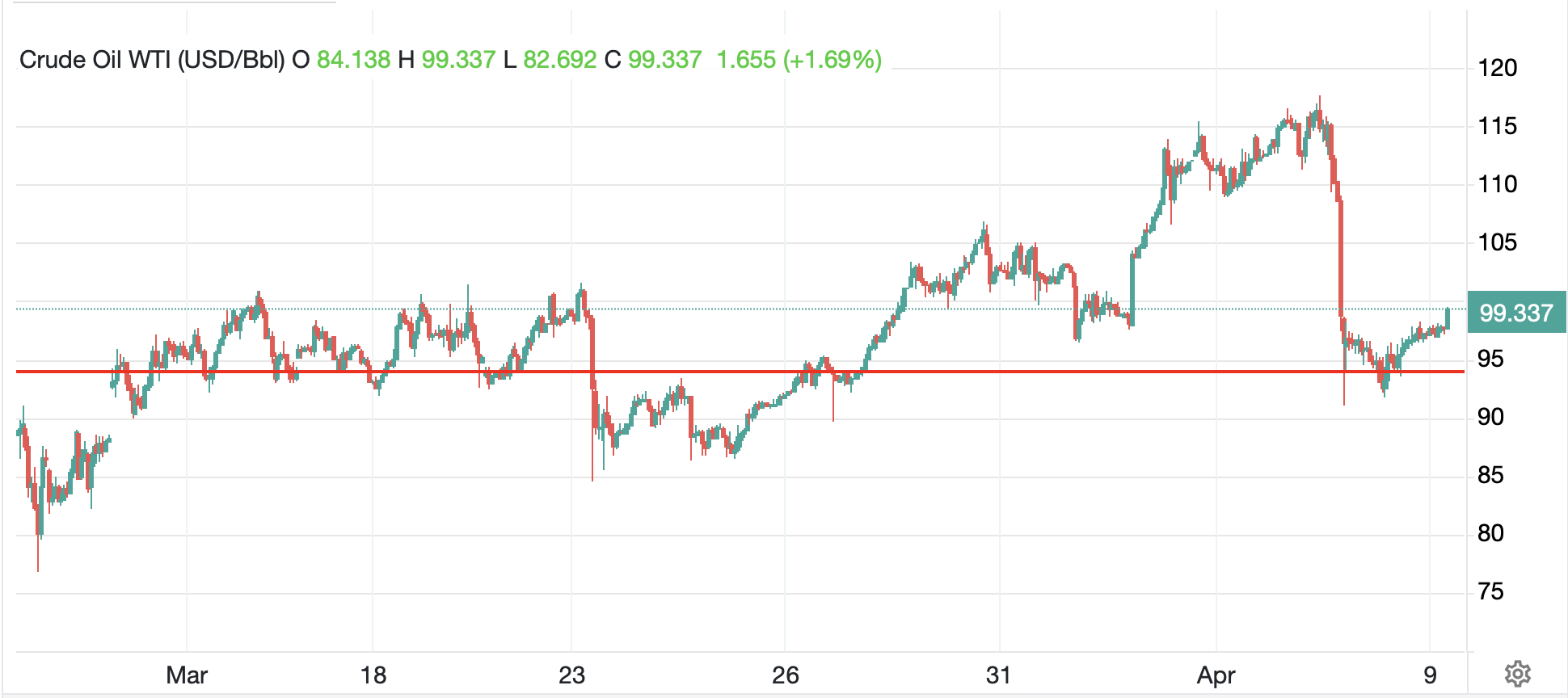
After yesterday’s sharp decline in oil prices, we have seen a bounce this morning (+5.0%) although as I type at 6:50, it remains just below $100/bbl.  You can see from the chart below of the past month that we’re kind of in the middle of the range.  Alyosha (read Market Vibes on Substack) explains the Point of Control as the place where a market trades most frequently during a given period of time.  His records show that $94/bbl is that number in WTI, a level we touched and have since bounced from.  Headlines continue to be the driver, and I suppose that the next key headlines will be comments regarding the peace talks.

Source: tradingeconomics.com

NatGas prices (+0.3% in US, +2.0% in Europe) are also rebounding, but not nearly as dramatically.  In a way that is surprising as the Iranian attack on Ras Laffan, Qatar’s main LNG facility has inflicted significant damage, sufficient to cause multiple years of reduced production, yet gas has not been nearly as impacted despite its critical importance to the global economy. 

As to metals markets, gold (+0.4%) continues to find support, but is still far below the highs seen in January, and silver (0.0%) is at a loss for its next move.  On the one hand, silver, especially given its multiple industrial uses, seems likely to have significant long-term support, but right now, along with gold, it feels like owners are still liquidating as they need cash, and speculators aren’t interested yet. I still like both in the long run.

Turning to equities, yesterday’s huge rallies culminated with every major US market gaining 2.5% or more. But that seemed to be the peak, for now at least.  Overnight, Tokyo (-0.7%), China (-0.6%) and HK (-0.5%) all slipped a bit and that was emblematic of most of Asia with Korea (-1.6%), India (-1.2%) and most other markets slipping.  The few gainers (Australia, Taiwan, Indonesia) all managed gains on the order of just 0.2% or so, hardly inspiring.

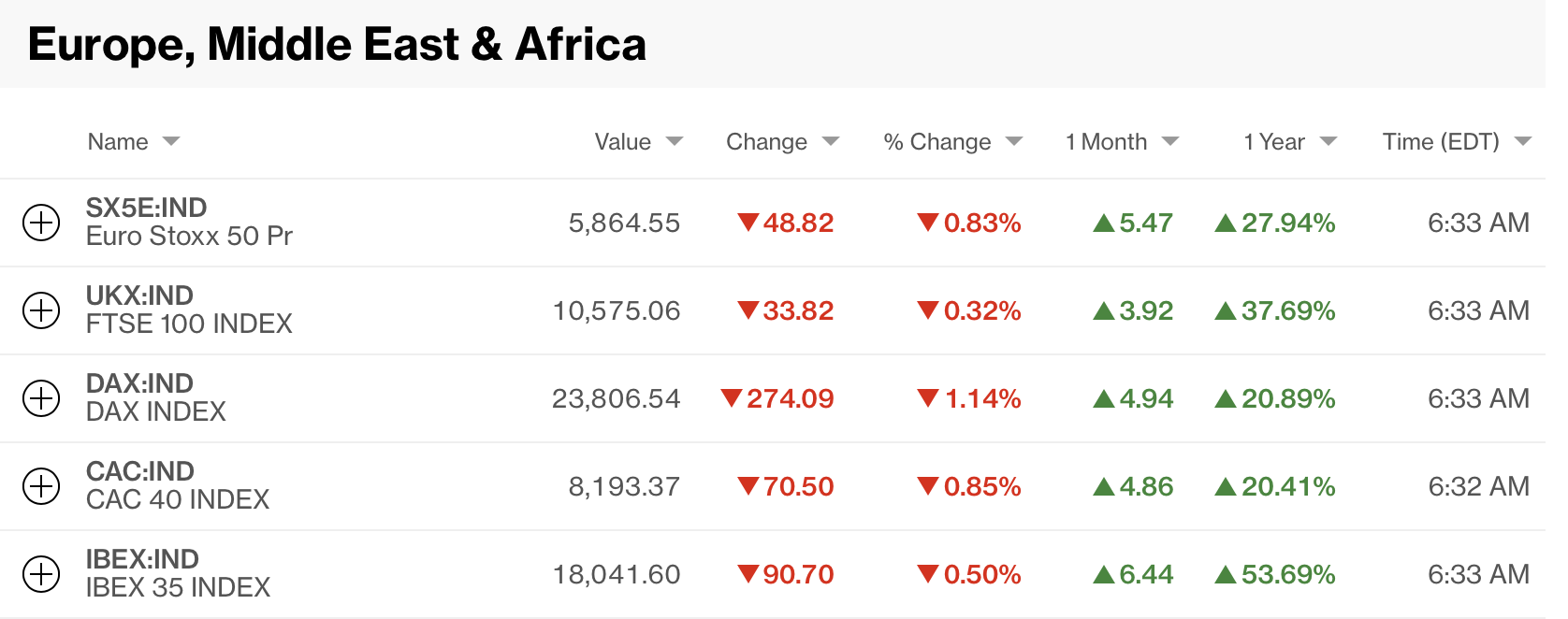
In Europe, the Bloomberg screenshot explains things well, as yesterday’s euphoria gives way to more circumspection this morning, at least for now.  However, as you can see, equities remain far closer to their highs, than lows based on the gains over the past year.

There was some data this morning showing German IP far weaker than expected at -0.3% after a revised 0.0% print in January.  With this in mind, it is understandable that the DAX is lagging, and it seems ever more likely that Germany is going to have yet another quarter with no economic growth.  Looking at US futures, at this hour (7:10) they are all sitting lower by -0.3% or so.

In the bond market, Treasuries (-1bp) are the outlier this morning as all European sovereign yield are higher between 4bps and 6bps.  Yesterday’s euphoria over the potential end of the fighting and the decline in energy prices is being rethought as, undoubtedly, even if a peace treaty is agreed and signed over the next two weeks, there are going to be major impediments to the resumption of the pre-war status quo, if it ever returns.  I also suspect that investors here are growing concerned that after the European response to this military action, fears the US is going to exit NATO (NATO General Secretary Mark Rutte spent 3 hours behind closed doors in the White House yesterday with no comments afterwards) means that Europe is going to have to borrow and spend even more on their own defense.  This will, of course, strain the budgets as the turn from butter to guns may be a difficult one politically.

Finally, the dollar this morning is mixed.  It should be no surprise that NOK (+0.6%) is leading the way as oil rebounds, although three other major oil producers, CAD, MXN and BRL are essentially unchanged in the session.  The euro (+0.15%) has continued a touch higher from yesterday while the yen (-0.25%) is slipping a bit.  As I said, it is a mixed session overall with no direction of which to speak.

Turning to the data, this morning we get the regular Initial (exp 210K) and Continuing (1840K) Claims as well as the final look at Q4 GDP (0.7%).  But in addition, we get the February PCE data suite, which typically comes at the end of the following month, but given the ongoing issues from the shutdown, seem to be behind.  Expectations are for Personal Income (+0.3%), Personal Spending (+0.5%), PCE (0.4%, 2.8% Y/Y) and core PCE (0.4%, 3.0% Y/Y).  And those numbers are from before the war.  Arguably, of much more importance is tomorrow’s March CPI data, which we can discuss tomorrow.

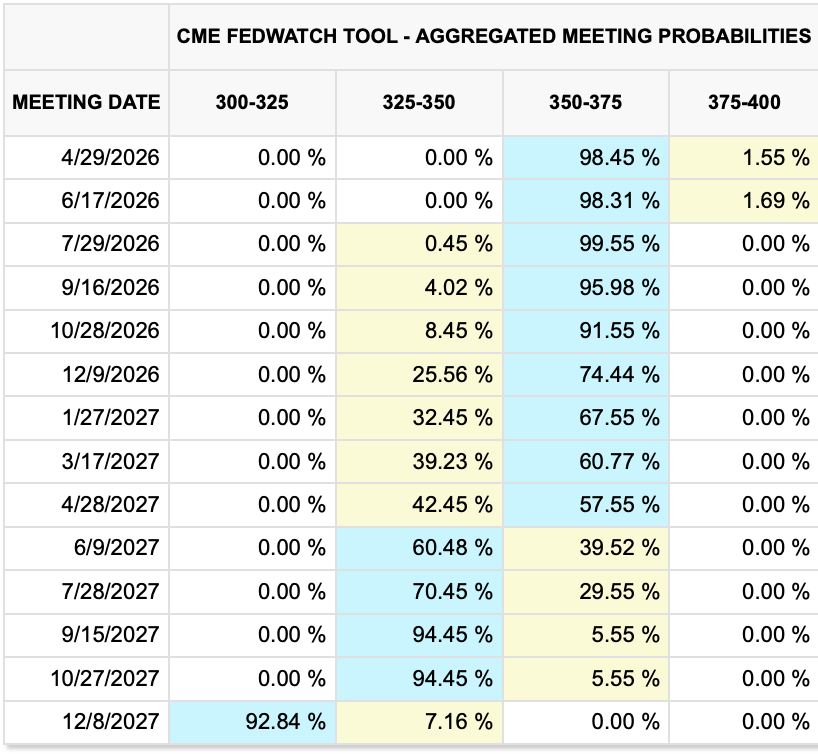
Yesterday saw yet another build in oil inventories in the US, something which will eventually lead to lower prices, and the FOMC Minutes explaining that they were concerned about both inflation and employment.  In the meantime, a look at the Fed funds futures market shows that the market is pricing even less chance of a rate cut in 2026 with the first one now not assumed until June 2027.

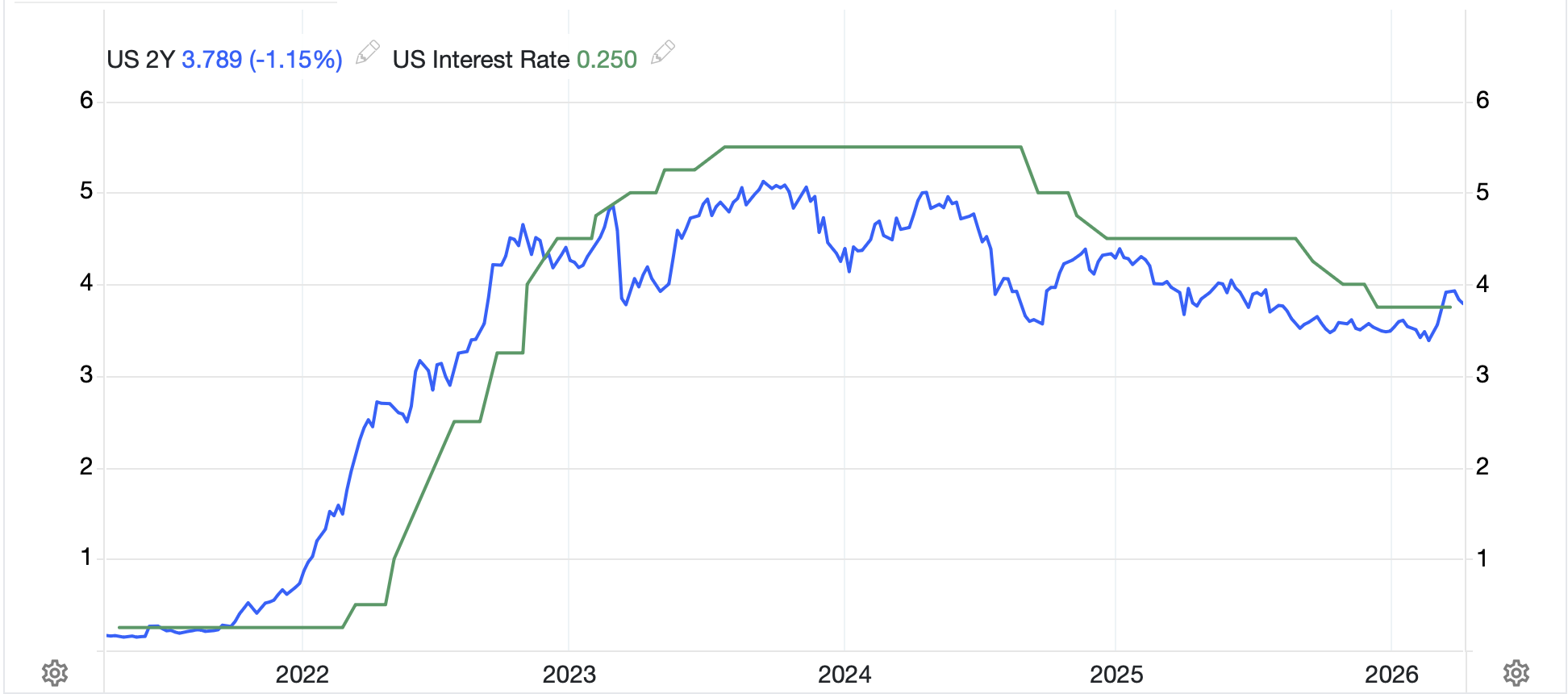
The thing about futures pricing, though, is that while it does give a good sense of sentiment, it is subject to change quickly on new news.  There is much to be said about watching the 2yr Treasury note as the best predictor of Fed funds going forward and you can see how tight that relationship is in the chart below.

Source: tradingeconomics.com

My view on inflation is not that sanguine, and I fear it is going to remain far higher than the Fed’s 2.0% target for Core PCE for a long time to come.  Ultimately, that plays into my views on owning things that hurt when they fall on your foot, or shares in companies that generate profits.  (This is where I also mention USDi, for those of you inclined in the crypto space, as the only inflation-tracking currency around.  Learn more at http://www.usdicoin.com)

As to today, this is the rebound and since nobody knows what will play out in the talks, I would look for a choppy, but inconclusive session in pretty much everything.

Good luck

Adf