The Mantra Repeated

Inflation has now been defeated
At least that’s the mantra repeated
By equity bulls
Who’re buying bagfuls
Of stocks which last week had depleted
 
But what if the data today
Does not show inflation’s at bay?
Will pundits still call
For Fed funds to fall
Or will cooler heads get their way?


As last week fades into the mists of memory, the narrative writers have been hard at work reimposing the soft-landing thesis and how the Fed is going to ride to the rescue of what seems to be slackening data across most aspects of the economy. The latest piece of information was yesterday’s PPI numbers that indicated, at the producer level, price pressures were ebbing further.  In fact, the core PPI reading for July was 0.0%, a huge victory for the Fed as it continues to add to the story that their timely behavior and strength of will have been having the desired effects.  And maybe they have been doing just that, although there is reason to believe that other things are happening.

Regardless, with the much more important CPI data set to be released this morning, if those PPI numbers are “confirmed” with lower than forecast CPI numbers, there will be no stopping the equity rebound/rally and expectations for a 50bp cut at the September meeting will run rampant.  The current median forecasts, according to tradingeconomics.com are: 

  • Headline (0.2%, 3.0% Y/Y); and 
  • Core (0.2% (3.2% Y/Y).  

Almost by definition, at least half of the punditry is looking for a headline print with a 2 handle, substantially closer to the Fed’s target than we have seen since March 2021.  The basis of this view is that shelter costs are going to continue to trend lower and there is a growing expectation that used car prices are also destined to head lower.  Given the way that shelter costs are implemented in the CPI calculations, I have no opinion on how recent activity will impact the overall results.  However, the anecdata that comes from my neighborhood shows that homes continue to sell over asking prices in short order and that there is no sign of prices declining yet.  I know that what happens here is not necessarily occurring elsewhere in the country, but it is unlikely to be entirely unique.  I guess we’ll all see the answer at 8:30.

In the meantime, the market story has been twofold, equity bulls are basking in the glow of the rebound from last week’s dramatic declines and the interest rate doves are completely willing to ignore actual Fed commentary and are increasing their bets that the Fed starts this cutting cycle with a 50bp reduction.  

As can be seen in the graphic below from the cmegroup.com website, the 50bp cut story is slightly more than a coin flip at the moment.  

A screenshot of a computer

Description automatically generated

But the interesting thing is to see how this pricing has evolved over the past month.  Looking at the table at the bottom of the graphic shows that last week, in the wake of the Japanese market selloff, the belief was much stronger that a 50bp cut was on the way (in fact, on July 5th, that probability was >90%), but a month ago, it was a very low probability event.  Back then, it was only the true believers in an upcoming recession that were looking for 50bps.  But now, it is mainstream thinking, at least among the punditry.  Yesterday, Atlanta Fed president Raphael Bostic explained, “we want to be absolutely sure.  It would be really bad if we started cutting rates and then had to turn around and raise them again.”  However, he did acknowledge that he is likely to be ready to cut “by the end of the year.”  While I have never met Mr Bostic, this does not sound like a man who is desperate to cut interest rates soon, narrative be damned.

Ok, away from all the huffing and puffing on US CPI, we did get some other important news overnight.  The first thing was the RBNZ surprised many folks by cutting their Official Cash Rate by 25bps.  Apparently, they are concerned with slowing growth and gratified that inflation appears to be slowing.  The upshot was that the NZD (-1.0%) fell sharply and the local stock market rallied more than 2%.

Elsewhere, UK inflation was released at a lower than expected 2.2% for July.  While that was an uptick from the June level of 2.0%, the fact that it was lower than both the BOE and Street expectations, and that services inflation rose “only” 5.2%, down from the 5.7% reading in June, has traders increasing their bets for a rate cut in September.  The pound (-0.2%) did slip slightly on the report but remains modestly higher on the year.  As to the FTSE 100, its 0.3% gain pales in comparison to the type of movements we have been seeing in equity markets elsewhere.

The zephyrs of change
Are blowing throughout Japan
Kishida’s leaving

One last piece of news is that Japanese PM, Fumio Kishida, has announced that he will not be running for LDP party leadership, the critical post to become (or in his case remain) Prime Minister.  A series of fundraising scandals has dogged his entire administration, and his approval rating remains below 30%.  The market take is that his leaving will enable the BOJ to act more aggressively, at least according to some local analysts and all depending on who wins the election.  While several of the mooted candidates are on record as calling for more monetary policy normalization (i.e. rate hikes), they are not the leading candidates at this time.  It seems early to make that case in my mind.  In the meantime, while the BOJ may want to raise rates, I think they are going to wait for more rate cutting in the rest of the G10, specifically from the Fed, before considering their next move.  Net, the yen’s response to this story has been nil, although we did see Japanese equities rally (Nikkei + 0.6%).

Elsewhere in equity markets, both the Hang Seng (-0.35%) and CSI 300 (-0.75%) continue to languish relative to other markets around the world as the prospects for the Chinese economy, and by extension its companies, remains lackluster, at best.  The absence of any significant Chinese stimulus remains a weight on the economy and the markets there.  However, most other markets in Asia rallied nicely overnight, following the US price action yesterday.  As to European bourses, they are all green, but the movements have been modest, on the order of 0.3% or so, as Eurozone economic data continues to disappoint (IP -0.1% in June, exp +0.5%).  As to US futures, ahead of the CPI data, they are essentially unchanged.

In the bond market, Treasury yields continue to grind lower, falling 7bps after the PPI data yesterday and down another basis point ahead of the CPI today.  European sovereign yields, though, are slightly higher this morning, between 1bp and 2bps, which based on the data makes no sense.  But the moves are small enough to be irrelevant.  One outlier here is UK Gilt yields, which have declined 4bps on the softer inflation print.

Oil (-0.2%) which suffered yesterday has stopped falling for the moment as the market remains on tenterhooks regarding a possible Iranian attack on Israel.  In the meantime, expectations are for a further draw of oil inventories in the US, although the industry continues to pump an extraordinary 13.4 million bpd despite all the efforts of the current administration to stifle it.  As to the metals markets, gold (+0.4%) continues to find support and is pushing toward new highs yet again.  This morning it is taking the rest of the metals complex with it, although that could be a result of the dollar’s modest weakness.

Finally, the dollar is a bit softer overall this morning, but there are several idiosyncratic stories.  We’ve already mentioned NZD, GBP and JPY.  However, the euro (+0.25%) is now at its highest level of 2024 and back above 1.10.  Meanwhile, the commodity currencies are mostly firmer vs. the dollar this morning (ZAR +0.3%, MXN +0.3%, NOK +0.6%, SEK +0.5%) although Aussie (-0.2%) is bucking that trend.  One other noteworthy mover is CNY (+0.2%) which has been showing far more volatility than normal in the past two weeks.  It seems it is still coming to grips with the Japanese story as well.

And that’s really it for the day.  There are no Fed speakers on the calendar, but we must always be aware of some unscheduled interview.  Remember, they love to talk.  Right now, I would say the market is looking for softer inflation data and is pricing accordingly.  As such, if this data is even modestly warm, let alone hot, be ready for some quick reversals, at least early in the session.  So, stocks lower with bonds while the dollar climbs.  But based on the current zeitgeist, I have to believe that any dip will be bought with reckless abandon.

Good luck

Adf

Data Confusion

The ongoing data confusion
Is certainly not an illusion
Some numbers are solid
While others are squalid
And each begs a different conclusion
 
Last night, Chinese data revealed
The ‘conomy there hasn’t healed
And Germany’s ZEW
Showed weakness, beaucoup
More rate cuts will soon be, out, wheeled
 
But here in the US we learned
The NFIB, up, had turned
And yesterday showed
Inflation has slowed
Investors, though, still are concerned


As we await today’s US PPI data, and more importantly, tomorrow’s US CPI data, the one consistency we have observed is that the data remains all over the map.  Or does it?  The below chart (data from NY Fed, chart from @fx_poet) shows the median readings of 1-year ahead and 3-year ahead inflation expectations, based on a survey of 1300 households.  While the 1-year ahead expectations are unchanged at 3.0%, the 3-year ahead expectations fell to 2.3%, the lowest in the series’ history since the NY Fed began the survey in June 2013.

If you’re Jay Powell, that certainly must be good news as the Fed puts great stock into the idea that inflation expectations lead inflation outcomes. While this is not a universally held belief amongst economists and analysts, it is certainly the majority view.  However, given that the Fed is a strong believer in this theory, the fact that inflation expectations, as measured here, are declining will help inform their decisions going forward.  Based on this, it is easy to believe that September will bring a 50 basis point cut.

Of course, one might ask, why are inflation expectations declining?  And that is not part of the data that is collected, or at least not reported.  If the expectation is that the economy is headed into recession, that implies there is still great concern amongst households going forward.  However, if this result is due to a strong belief in the Fed’s policies, then economic optimism should abound.  As such, we need to see other data to help interpret things.

Perhaps the first piece we can observe is this morning’s NFIB Small Business Optimism Index, which printed at 93.7, its highest level since March 2022.  That is certainly encouraging as given the importance of small businesses to the overall economy, if things there are starting to look up, it should translate into stronger growth going forward.  On the flip side, in the anecdata department, earnings calls from Expedia, Marriott, Airbnb and Hilton indicated that there is real weakness in the travel economy.  This WSJ report indicates that perhaps things are not as strong as might be indicated by other data.

Now, if we look overseas, the data is also mixed, but there is more negative than positive.  For instance, Chinese money and lending data was released at substantially lower levels than last month and well below expectations.  As well, the PBOC is becoming very concerned about the Chinese bond market inflating a bubble.  Last week, ostensibly, they told several banks to renege on deals to buy Chinese government bonds because they are trying to prevent the back end of the yield curve from declining too far.  It seems they are worried (and probably rightly so) that regional Chinese banks don’t have the capability to manage interest rate risks effectively.  But slowing loan growth and a weak equity market continue to indicate that the Chinese economy is lagging.

As to Europe, the German ZEW data was released and it was, in a word, putrid.  The Economic Sentiment Index fell from 41.8 to 19.2, far below expectations while the Current Conditions index fell to -77.3.  Granted, these surveys were taken the week after the weak NFP data in the US when people were screaming for an emergency 75bp rate cut, so perhaps they are not reflective of the ongoing situation.  But this highlights the problems with survey data, if you are asked about something on a day when the world seems to be ending, your response is likely to be more negative than not.  In fact, this is a caution for all survey data.

So, what are we to make of all this mixed information?  Well, we are right where we started, with no clearer picture of the current situation, let alone how the future may unfold.  In fact, this is why unfettered markets are so important.  Markets are excellent indicators of both future activity and sentiment, and when they are manipulated for political outcomes, investors lose a great deal of information.

But let’s see what the markets are telling us today.  Yesterday’s US session was mixed with modest gains and losses across the board.  But I’ll tell you what, last night Tokyo took the bull by the horns and continued its strong rebound from the previous week’s collapse with the Nikkei rallying 3.5%.  it seems that not only was this move a continuation after the Monday holiday of last week’s rebound, but a former BOJ official, Makoto Sakurai, explained, “they [the BOJ] won’t be able to hike again, at least for the rest of the year.  it’s a toss-up whether they can do one hike by next March.”  You will not be surprised that traders and algorithms jumped on those comments to buy more stocks.  As to the rest of the major markets in Asia, they mostly edged slightly higher, but only about 0.2% or so.  In Europe, there are more laggards than gainers, with the CAC (-0.3%) the worst of the bunch, but as you can see by the relatively small decline, markets here are also quiet.  Finally, US futures are up 0.4% at this hour (8:15).

In the bond market, yields are edging lower this morning with Treasuries down -1bp while European sovereigns are lower by between -2bps and -3bps.  Given the tenor of the economic data, this should be no surprise.  Interestingly, JGB yields remain unchanged at 0.83%, well below that 1.00% critical level and hardly indicative that the BOJ is going to tighten further.

In the commodity space, oil (-0.5%) after touching $80/bbl for WTI yesterday, is slipping a bit as traders await the apparently imminent Iranian attack on Israel to see if a wider war starts.  Meanwhile, the metals complex is lower across the board with gold (-0.4%) giving back some of yesterday’s gains while copper (-1.0%) is also under pressure, arguably on the weak economic story.

Lastly, the dollar is firmer this morning, notably against the yen (-0.3%) and CHF (-0.4%) although there are exceptions to this rule.  I find it quite interesting that the yen carry trade unwind story has basically ended with several large banks explaining that the alleged $20 trillion that was outstanding has been unwound.  Personally, I think that is ridiculous and that there is plenty left in place.  Remember, this trade has been building since the Fed began raising interest rates in 2022 and there are many investors whose entry points are far, far below the current spot level.   A quick look at USDJPY over the past 5 years shows that while the latest batch of entrants may have left the building, there is likely still a lot of borrowed yen funding other positions.

A graph with a line drawn on it

Description automatically generated

Source: tradingeconomics.com

When the Fed started raising interest rates, USDJPY was about 115.  I assure you the carry trade has not ended.

Turning to the data, this morning brings PPI (exp headline 0.2%, 2.3% Y/Y) and (core 0.2%, 2.7% Y/Y), although I believe the data will need to be very different for traders and investors to change their view that inflation is continuing to decline.  And later this afternoon, Atlanta Fed President Bostic speaks.

I believe the narrative remains that the soft-landing is still in play and that the Fed’s cut in September will be adequately timed to prevent a recession.  As of this morning, the futures market is still pricing in a 50:50 chance of either a 25bp or 50bp cut.  Right now, my money is on 25bps, but there is a lot to learn between now and then.  In the meantime, it is hard to turn too negative on the dollar as everybody else is cutting rates as well, and growth elsewhere seems anemic at best.

Good luck

Adf

Missing in Action

The PPI data was shocking
Though previous months took a knocking
So, what now to think
Will CPI sink?
Or will, rate cuts, it still be blocking?

One of the features of the world these days is that the difference between a conspiracy theory and the truth has shortened to a matter of months.  I raise this issue as yesterday’s PPI data was remarkably surprising in both the released April numbers, with both headline and core printing at MUCH higher than expected 0.5%, while the revisions to the March numbers were suspiciously uniform to -0.1% for both readings.  The result was that despite the seeming hot print, the Y/Y numbers for both core and headline were exactly as forecast!

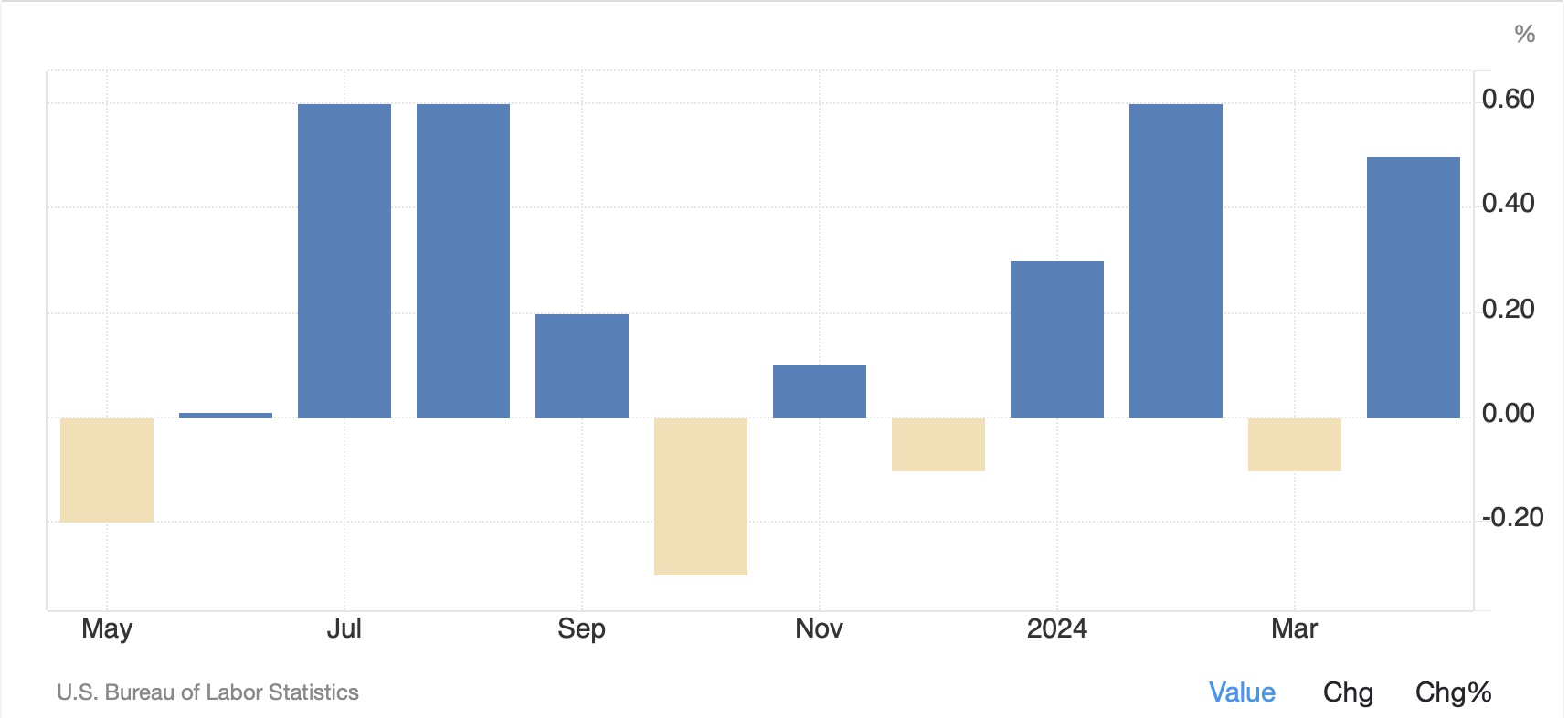
One of the things we know about data like PPI and CPI is that they are calculated from a sampling of data of the overall economy and there are fairly large error bars for any given reading.  In that sense, it cannot be surprising that the data misses forecasts regularly.  As well, given the sampling methodology, the fact that there are revisions is also no surprise.  But…it would not be hard for someone to suggest that the Bureau of Labor Statistics, when it saw the results of the monthly readings, manipulated the data to achieve a more comforting (for the current administration, i.e., their bosses) result.  I am not saying that is what happened, but you can see how a committed conspiracy theorist might get there. Now, in fairness, a look at the headline reading, on a monthly basis, for the past year, as per the below chart, shows that this is the 4th month in 12 that there was a negative reading.

Source: tradingeconomics.com

So, the fact that the revision fell to a negative number cannot be that surprising.  But it certainly got tongues wagging!  FWIW, I continue to believe that the process is where the flaws lie and that the BLS workers are trying to do their job in the best way they can.  In the end, though, much more attention will be paid to this morning’s CPI than to yesterday’s PPI.

For Jay and his friends at the Fed
His confidence ‘flation is dead
Is missing in action
Henceforth the attraction
That higher for longer’s ahead

Which brings us to Chairman Powell and his comments at the Foreign Bankers’ Association in Amsterdam yesterday.  In essence, he didn’t change a single thing regarding his views expressed at the last FOMC meeting, explaining he still lacked confidence that inflation would be reaching their 2.0% target soon.  As such, there is no reason to believe that the Fed is going to cut rates anytime soon.  As of this morning, the Fed funds futures market has a 9% probability of a rate cut priced for June, up from 3% yesterday, and a total of 45bps of cuts priced for the year.  There is obviously still a strong belief that the Fed will be able to act, although I am not sure why that is the case.  Interestingly, on the same panel, Dutch Central Bank president Klaas Knot essentially guaranteed an ECB cut in June.  As well, yesterday morning we heard Huw Pill, the chief economist at the BOE also talk up the probability of a June cut.  From a market response perspective, though, given these cuts are largely assumed, it will take new information to drive any substantive movement in the FX markets.

Here’s one thing to consider for everyone pining for that rate cut.  Given the history of the Fed always being behind the curve when it comes to policy shifts, if they realize they need to cut it is probably an indication that things in the US economy have turned down rather rapidly.  We may not want to see that either.  Just sayin!

In China, a new idea’s floated
Though not yet officially quoted
In thinking, quite bold
All houses, unsold,
Will soon be, for homeless, devoted

Ok, let’s move on from yesterday to the overnight session and then this morning’s CPI and Retail Sales reports.  The first thing to note was the story from Beijing that in an effort to deal with the ongoing property crisis in China, the government, via regional special funding vehicles that borrow more money, is considering buying all the unsold homes from developers, at a steep discount, and then converting them into low-cost affordable housing.  In truth, I think this is an inspired idea on one level, as it would allocate a wasted resource to a better use.  On the other hand, the idea that the government would issue yet more debt seems like a potential future problem will grow larger.  As of now, this is not official policy, but the leak was clearly designed as a trial balloon to gauge the market’s response.  Not surprisingly, the response was that the Shanghai property index rose sharply, but the rest of the Chinese share complex was in the red.  At the same time, the PBOC left rates on hold last night, as expected, but the CNY (+0.3%) managed to rally nicely on the combination of events.

But away from that China story, very little of note happened as all eyes await the CPI later this morning.  After yesterday’s somewhat surprising rally in the US, Asia beyond China had a mixed performance with some gainers (Australia, Taiwan, South Korea) and some laggards (Hong Kong, New Zealand, Singapore) as investors adjusted positions ahead of the big report.  In Europe, too, the picture is mixed although there are far more gainers than laggards.  In the end, none of the movement is that large overall, so also indicative of waiting for the data.  Finally, it will be no surprise that US futures are basically flat at this hour (6:30).

In the bond market, traders decided that the hot April number was to be ignored and instead have accepted the idea that inflation is not really that hot after all.  At least that is what we might glean from the price action yesterday and overnight where yields initially jumped a few basis points before grinding down over the session and closing lower by 4bps.  This morning, that decline has continued with a further 2bp drop in Treasuries.  In Europe this morning, sovereign yields are seeming to catch up to the Treasury price action with declines across the board of between 6bps and 8bps.  Part of that is also a result of changing expectations for Eurozone growth and inflation with a growing belief that inflation is headed lower and the ECB is set to cut and continue to do so going forward. 

In the commodity markets, the big story has been copper (+2.4%), which has rallied parabolically and is currently above $5.00/lb, a new all-time high.  This takes the movement this week to more than 10% and more than 36% in the past year.  The electrification story is gaining traction again, and I guess the fact that nobody is digging new mines may finally be dawning on traders.  Precious metals are coming along for the ride with gold rebounding (+0.4%) on this story as well as the dollar’s recent weakness.  As to the oil market, it is little changed this morning in the middle of its recent trading range.  Perhaps today’s EIA inventory data will drive some movement.

Finally, the dollar is under modest pressure this morning after slipping a bit during yesterday’s session as well.  The combination of the Powell comments being seen as dovish and the interpretation of the PPI data in the same manner (which seems harder for me to understand) weighed on the greenback against virtually all its counterparts.  It should be no surprise that CLP (+0.9%) is the biggest winner given the move in copper.  But JPY (+0.5%) has also performed well with no new obvious catalysts.  In fact, the movement has been quite broad with the worst performers merely remaining unchanged vs. the dollar rather than gaining.  However, this morning’s data is going to be critical to the near-term views, so we need to wait and see.

As to the data, here are the current forecasts: CPI (0.4% M/M, 3.4% Y/Y), core CPI (0.3% M/M, 3.6% Y/Y), Retail Sales (0.4%, 0.2% ex autos) and Empire State Manufacturing (-10.0).  In addition, we hear from two Fed speakers, Minneapolis Fed president Kashkari and Governor Bowman.  However, on the Fed speaker part, especially since Powell just reinforced his post-FOMC press conference message, it seems hard to believe that there will be any changes of note.

And that’s all she wrote (well he).  A hot print will likely be met with an initial risk-off take with both equity and bond markets suffering, but I suspect that it will need to be really, really bad to change the current narrative.  However, a cool print seems likely to result in a major rally in both stocks and bonds and a much sharper sell-off in the dollar.

Good luck

adf

Less Stout

Suzuki-san and
Ueda-san are clearly
Flocking together

Events continue to unfold in Japan that appear to point to a more concerted effort to address the still weakening yen.  The problem, thus far, is that it hasn’t yet really worked, absent the direct intervention we saw at the beginning of the month.  For instance, last night, 10-yr JGB yields rose to their highest level since June 2012, trading up to 0.969% and finally looking like they are going to breech that 1.00% level that had so much focus back in October.  At the same time, the two key players in this drama, FinMin Suzuki and BOJ Governor Ueda are actively speaking to each other as they try to coordinate policy.  The problem for Suzuki-san is that Q1 GDP fell back into negative territory again, thus bringing two of the past three quarters down below zero.  While that is not the technical definition of a recession, it certainly doesn’t look very good.

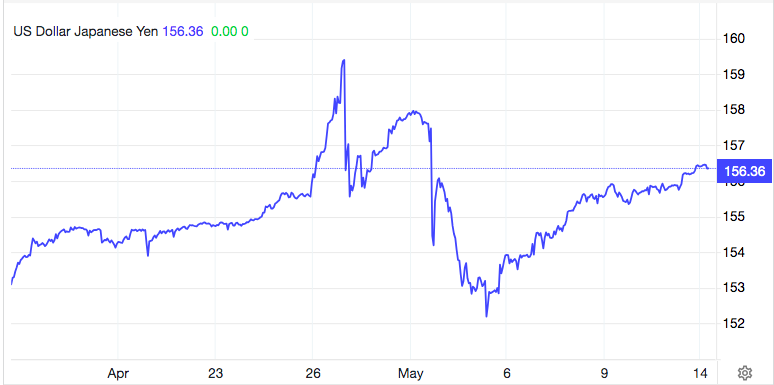
And yet, the yen remains under pressure, slipping another 0.1% last night, and as can be seen from the chart below, continuing its steady decline (dollar rise) from the levels seen immediately in the wake of the intervention.

Source: tradingeconomics.com

Another interesting thing is that our esteemed Treasury Secretary, Janet Yellen, seems to be concerned over any intervention carried out by the Japanese, at least based on comments she recently made in a Bloomberg interview, “It’s possible for countries to intervene.  It doesn’t always work without more fundamental changes in policy, but we believe that it should happen very rarely and be communicated to trade partners if it does.” 

There have been several analysts of late who have made the case that Yellen’s trip to Asia last month included a ‘secret’ Plaza Accord II type arrangement, where there was widespread agreement that the dollar needed to come down in value.  First off, secrets like that are extremely difficult to keep secret, and history shows that doesn’t happen very frequently.  But more importantly, based on the fact that inflation is one of the biggest problems that her boss has leading up to the election, a weaker dollar is the last thing she would want.  I suspect if we continue to see the yen decline, the BOJ/MOF will be back at the intervention game again, but the US will not be helping.  Keep in mind, though, Japanese yields.  If the BOJ is truly going to allow yields to rise in Japan, that would have a significant impact on the yen’s value in the FX markets.  While 1.00% is a big round number, I think we will need to see the BOJ demonstrate a more aggressive stance overall…or we need to see the data turn softer in the US to allow the Fed to get on with their much-desired rate cuts.  We will need to watch this closely going forward.

While everyone’s waiting to see
How high CPI just might be
One cannot rule out
An outcome less stout
Where bond and stock bulls are set free

Which brings us to the inflation story.  By this time, everyone is aware that tomorrow’s CPI data is seen as a critical piece of the puzzle.  I continue to read coherent arguments on both sides of the debate regarding the trend going forward.  (Let’s face it, the error bars are far too wide to be confident in a specific forecast.)  For the inflationistas, they continue to look at things like the housing market, which while frequently expected to see declining price pressures, has maintained an upward trend for the past several years.  As well, things like the dramatic rise in certain commodity prices (coffee comes to mind) and the substantial rise in the price of insurance (something of which I speak from personal experience!), there is ample evidence that prices continue to climb. 

Part of this puzzle may be the result of the fact that companies continue to successfully raise prices, or at least had been doing so for the past two years, as evidenced by the continued strong earnings, and more importantly, still high gross margins they are able to achieve.  So, as input prices have risen, they have passed those costs along to the consumer quite successfully.  Now, the comments from Starbucks and McDonalds at their earnings reports indicating business is slowing down and attributing that slowdown to rising prices may well be a harbinger that companies have lost the ability to keep this up.  But two companies, even large ones, are not nearly the whole economy.  As well, much has been made, lately, of the K-shaped economy, where the haves continue to benefit from the rise in asset prices and are far less impacted by rising prices as they can afford them.  This has led to continued strong demand for luxury goods, which while a smaller sector of the economy, remain highly visible. Meanwhile, the less fortunate lower 90% of the population find themselves struggling to make ends meet as real wages remain stagnant and there continues to be a switch from full-time to part-time employment ongoing as companies adjust their staffing needs.  PS, those part time jobs don’t pay as well and generally don’t have benefits, so any price increases are very tough to swallow.  In the end, it appears that housing, insurance services and food remain in upward price trends.

On the flipside, there are many who see that while Q1’s inflation data was sticky on the high side, things should begin to improve going forward.  They point to things like M2, which has fallen dramatically over the past two years, although has recently inflected higher again.  However, the argument is that the lag between the movement in M2 and inflation is somewhere in the 16-24-month period, and we are now due to see prices decline.  In addition, they point to things like loan impairments and credit card delinquencies rising as signs that companies have lost their pricing power and prices will reflect that by slowing their ascent.

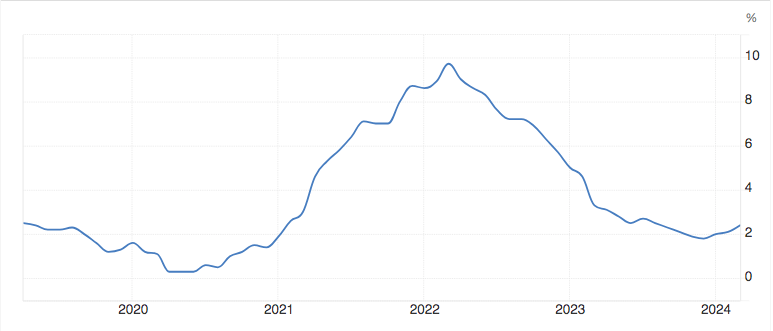
Now, today we see the PPI, which may give clues as to tomorrow’s outcome and the following are the median expectations:  headline 0.3% M/M, 2.2% Y/Y; core 0.2% M/M, 2.4% Y/Y.  Looking at the chart, it certainly appears that this statistic has bottomed out just like CPI.

Source: tradingeconomics.com

But here’s the thing…I have a feeling that regardless of the outcome, the market is going to rally in both stocks and bonds.  Certainly, if it is a softer than forecast number, the rate cut narrative is going to be going gangbusters and stocks will rocket while yields fall.  If it is on the money, my sense is the market is still in the camp that despite what we continue to hear, especially with Powell having removed the possibility of a rate hike, that the view will turn to rate cuts are coming as the Fed’s underlying dovishness will prevail.  But if the numbers are hot, while the initial reaction will almost certainly be a decline in risk asset prices, I have a feeling it will be short-lived.  Positioning is not overly long here, at least according to the fear/greed indicators, and the theme that the administration will do all it can to get re-elected, meaning lots more fiscal support, is going to work in favor of risk assets.  One other thing, if there is some trouble in the bond market, the one thing we know for sure is that Powell will come to the rescue and support the whole structure.

Net, while the timing of each outcome may differ, I sense the end result will be the same.  As to the dollar, I remain in the camp that international investors will continue to buy dollars to buy the S&P.  As well, given it seems very clear that both the ECB and BOE are going to cut rates in June while the Fed remains a much lower probability to do so, that should prevent any sharp dollar decline, although it may not push it any higher.

Overnight, basically nothing happened as everybody is holding their collective breath for tomorrow.  Maybe today will be a harbinger, but I expect a generally slow session overall absent a HUGE surprise in PPI.

Good luck

adf

Offsides

The PPI data revealed
Inflation has clearly not healed
Will Jay and the Fed,
When looking ahead
Now tell us one cut’s been repealed?

So, now here we are at the Ides
Of March, as opinion divides
Some still say a cut
Will come in June, but
Some others think, no that’s offsides

Once again, the inflation data did nothing to help the case for a rate cut anytime soon in the US.  This time the PPI data showed that prices rose far more than expected in February, 0.6% at the headline level and 0.3% at the core level.  The rises, when broken down, were across the spectrum of goods and services.  The point is despite what appears to be an overriding desire to cut rates by June, the data is not cooperating for Jay and his friends.  Will this be enough to dissuade them?  We still have 3 more months before the critical time and the market, despite itself, is now putting all its eggs in the June basket, having reduced the May probability to just 7%.  Clearly, it remains highly dependent on how the data progresses, and not just the inflation data, but also the employment data, but for now, I find it hard to make the case that the Fed should be cutting rates anytime soon.

Of course, there remains a large contingent of analysts, economists and pundits who believe that the Fed should cut next week, or May at the latest, as they are already doing grave damage to the economy.  You may recall the immediate response by the Nick Timiraos article to the hotter than expected CPI data.  Well, this morning, we have Bloomberg with an article that claims a solid majority of the forty-nine economists they surveyed continue to look for the first cut in June and three cuts this year.  It certainly appears there is a great effort to convince us that those rate cuts are coming, although as I have maintained, if the Fed is truly data dependent, the data is not pointing to cutting rates as the appropriate move at this time.  This argument discussion will continue for the foreseeable future, that is the only certainty.

Wages have blossomed
Will Ueda-san enjoy
The view, and end NIRP?

The preliminary indication from the Shunto wage negotiations shows that the average wage increases in Japan this year will be 5.28%, the largest rise in decades.  Apparently, Toyota accepted the union’s demands fully and didn’t even offer a counter!  When comparing this outcome to the most recent CPI readings in Japan, which showed a headline rate of 2.2% and a Core of 2.0%, it certainly appears that there could be some wage driven price increases upcoming.  As has been mentioned repeatedly, this was seen as a key issue for the BOJ ahead of their meeting this coming Monday night (Tuesday in Japan) in terms of being a sufficient catalyst for the BOJ to finally raise their overnight interest rate from its current -0.10%.

Now, while Ueda-san’s own words have seemed more circumspect, the growing consensus amongst the analyst community in Tokyo is that the move will happen next week with no need to wait until the April meeting.  But a funny thing has been ongoing in markets while this consensus has been building, the yen has been falling.  While there was essentially no movement overnight, since Monday, when the discussion began to heat up, the yen has declined more than 1.5% in value, almost as though the market is selling the news ahead of the news.  Perhaps of more interest is the fact that 2-year JGB yields have fallen this week by 2bps, which while not a great deal overall, represents a reversal of the gradual increase that has ostensibly been driven by the upcoming BOJ policy tightening.  I have a funny feeling that while NIRP may well turn into ZIRP next week, as the market looks ahead, there is much less tightening perceived in the future.  I have maintained that a move beyond +0.2% would be highly unlikely this year, and possibly next year.  As such, when considering the FX rate, USDJPY remains far more beholden to the Fed and US interest rates than to whatever the BOJ does at the margins.  Let’s face it, if the BOJ hikes rates to 0.2% by December, but Fed funds remains at 5.5%, it is still a very difficult case to buy yen.

And those have been the key stories driving things since I last wrote.  A look at the overnight session shows that Asian equity markets were mixed with the Nikkei sliding a bit, while the Hang Seng fell sharply (-1.4%), perhaps on fears of increased tech stress between China and the US.  However, the CSI 300 managed a small gain despite weak Loan data and the rest of the bloc saw a lot of red on the screen, following the US session losses yesterday.  In Europe this morning, it is the opposite reaction with green across the screen led by Spain (+1.1%) but modest strength everywhere as inflation data from Italy and France seemed to show more moderation.  Meanwhile, at this hour (7:30), US futures are edging higher by 0.3%, essentially unwinding yesterday’s losses.

In the bond market, yesterday’s PPI data saw bonds sell off aggressively in the US with yields across the entire curve rising 10bps.  This morning, Treasury yields have backed off 2bps, but remain at 4.27%, above what is perceived to be a trading pivot level of 4.20%.   European yields also rose yesterday, albeit not quite as aggressively as US yields, and this morning they are essentially unchanged.

In the commodity markets, oil (-0.5%) is giving back a bit of its recent gains but WTI remains above $80/bbl and Brent crude above $85/bbl.  Apparently, the IEA has revised its global oil demand figures higher by more than 1 million bbl/day and despite the fact that there is ample spare capacity in OPEC, the market is tightening right now.  Gold, which sold off yesterday on the rising rates / higher dollar situation, is rebounding a bit this morning, +0.3%.  Interestingly, copper (+1.3%) did not sell off on the interest rate or dollar story and is now back at its highest levels in nearly a year and firmly above $4.00/Lb.  Something is going on here which seems to be a positive hint for growth.

Finally, the dollar, which rocked yesterday, rising almost 0.65% across the board with some significant gains vs. specific currencies, is essentially unchanged overall this morning, holding onto those gains.  In fact, there are a few currencies that are still feeling pressure like KRW (-0.5%) and NZD (-0.5%) but there has been a modest bounce in ZAR (+0.4%) on the back of the strong metals complex.  Net, the DXY is unchanged on the day, back above the 103 level.

We finish the week with some more secondary data as follows:  Empire State Manufacturing (exp -7.0), IP (0.0%), Capacity Utilization (78.5%) and Michigan Sentiment (76.9).  Now, we have seen secondary data have an impact recently, and given the quiet period prevents any Fedspeak, market participants are looking for any clues they can find.  It will be very interesting to see if today’s data indicates that the economy is continuing at its above trend growth rate or implies things are fading.  My observation is manufacturing continues to struggle overall, and sentiment on the economy isn’t great, so I would look for weakness rather than strength.  In that case, perhaps bonds rally further, and the dollar unwinds some of yesterday’s gains.

Good luck and good weekend
Adf

He’s Got Spine

The market’s now certain that June
Is when Jay, the funds rate, will prune
Inflation don’t matter
Despite all the chatter
They don’t want to cut rates too soon
 
But what if inflation keeps rising?
And data continues surprising?
Can he hold the line?
And show he’s got spine
Despite all the doves’ vocalizing?


It’s funny.  So much was made about the CPI number on Tuesday and the lines seemed to have been drawn quite clearly; soft or as expected data would cement a June cut while hot data would call that into question.  And yet, here we are two days later, with the only information in the interim showing that oil and product inventories have fallen further driving oil prices higher, and the probability of a June cut has risen above 90%.  In fact, amid a day with limited new information, and during the Fed’s quiet period, perhaps the most interesting comments came from Treasury Secretary Yellen.  Not only did she indicate she regretted her use of the word ‘transitory’ at the beginning of the inflation episode, but more importantly, it appears that Treasury is now assuming much higher interest rates in their forecasts than before.  In other words, she no longer believes that interest rates are going to head back down to 2%.  Personally, I think that is a huge step in the right direction.  Alas, that concept certainly did nothing to constrain their spending plans, so it is not clear it really matters.

But the reality as that even though we get some more Tier 1 data this morning, it has become quite clear, to me at least, that the market is uninterested in anything other than the FOMC statement, the dot plots and Powell’s press conference coming on Wednesday next week.  You can see this in the equity markets which are now trading in ranges after their recent sharp rises, and you can see this in the FX market given the dollar’s virtual complete lack of volatility.  In fact, the only place that is demonstrating some concern is the bond market, where yields continue to edge higher very slowly.

Let’s start by taking a quick look at this morning’s data.  Retail Sales (exp 0.8%, 0.5% ex-autos) is set to rebound from last month’s terrible -0.8% print.  Many have looked past that number as a combination of bad seasonal adjustments and heavy discounting and continue to see strength in the economy.  We also see PPI (0.3%, 1.1% Y/Y) and Core (0.2%, 1.9% Y/Y) which seems to have bottomed, not dissimilar to CPI, but which will be a problem for those who believe that inflation is still trending lower.  Finally, as it is Thursday, we see Initial (218K) and Continuing (1900K) Claims, both in line with recent outcomes signaling the labor market remains in solid shape.

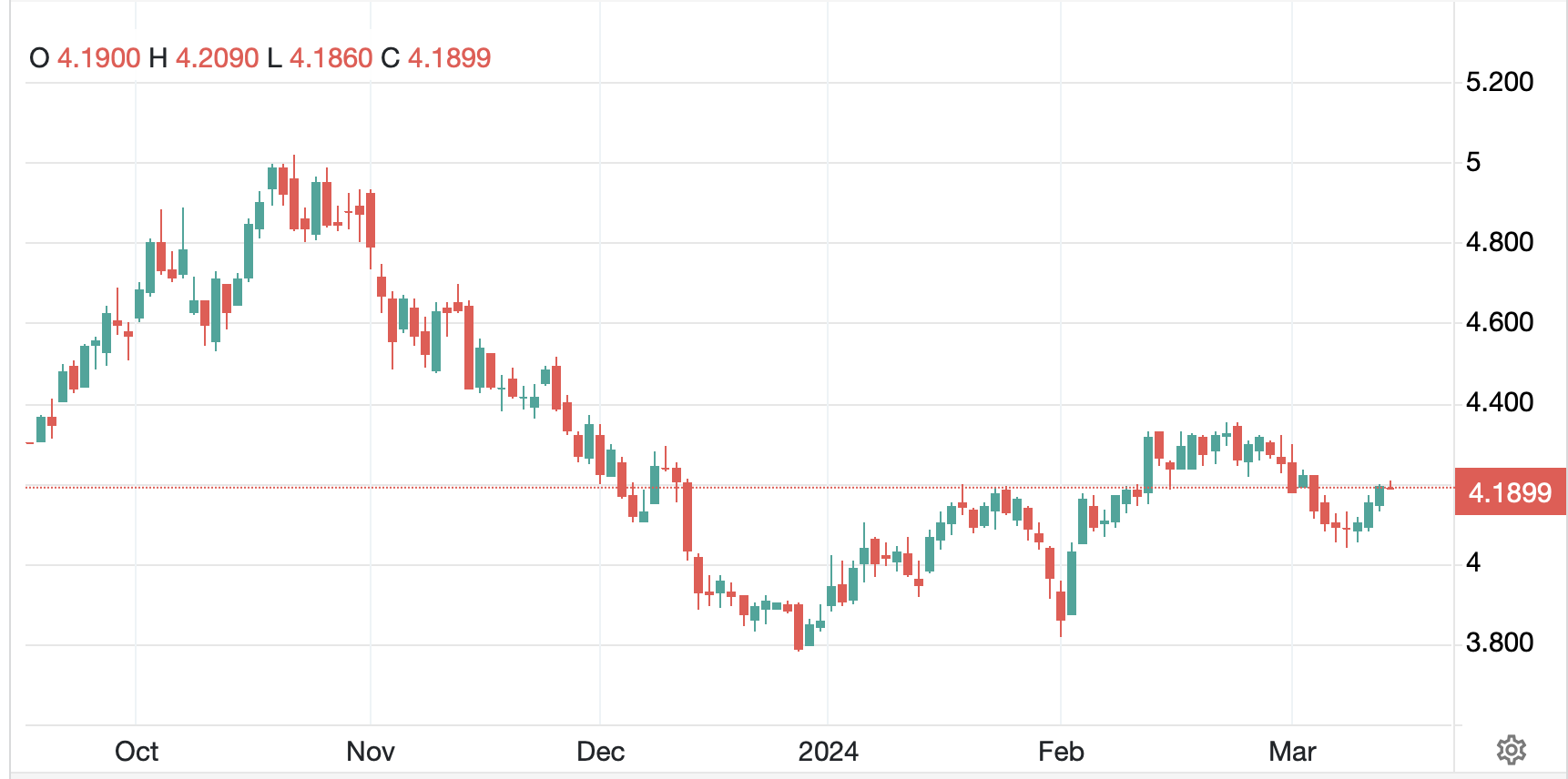
Now, you all know my view that inflation is not dead and that the market will need to continue to adjust interest rates higher over time to account for that fact.  Since the beginning of the year, as you can see from the chart below courtesy of tradingeconomics.com, while there have been several cycles, it seems clear that the trend in yields remains higher.

I think this makes a lot of sense and expect it to continue.  In fact, the question I have is how can the Fed truly consider it will be appropriate to cut the Fed funds rate given the economic signals are showing continued solid growth, a solid labor market and indications that inflation is heading higher?  Many make the political argument that since they are hell-bent on cutting, they need to get started before it gets too close to the election.  But I am going to go out on a limb here and say that I think Powell has shown he is made of sterner stuff and if the data remains where it has been, let alone inflation ticks higher between now and June, there will be no rate cuts.  If I am correct, risk assets are going to rerate, trust me.  And that is really the only question that needs to be answered at this point.

And so, other than bonds which seem to be sussing out the potential for rates to continue at their higher-for-longer pace, a look at other asset class markets shows not much overall movement.  After yesterday’s mixed US session, Asia, too, was mixed with Japan slightly firmer while Chinese shares slid as there appears to be no real help in sight there.  European bourses are also mixed with the UK lagging and slightly softer on the day and the bulk of the movement higher quite modest.  The only exception is the CAC in Paris higher by 0.9%, on the back of continued strong performance of the luxury goods sector.  (As an aside, why would central bankers think that the economy is going to tank if luxury goods remain hot?). US futures, though, are firmer at this hour (7:30) with all three indices higher by 0.5%.

In the bond market, while US yields have been dragging the global structure higher, they are unchanged on the morning and European sovereigns are actually a touch softer, between 1bp and 2bps today.  That is likely on the back of comments by Greek ECB member Stournaras that they need to quickly make two rate cuts to manage things properly.  While that seems excessive, I maintain the ECB cuts before the Fed.  As to Japan, JGB yields have edged higher by one more basis point overnight, though remain at just 0.77%.  Ueda-san, when he speaks, sounds far less hawkish than many of the analysts in Tokyo, or the other members of the BOJ from whom we have recently heard.  I am still in the April camp for the first rate hike, and very few afterwards.

Oil is the big mover of the day, up 0.9% with WTI back over $80/bbl for the first time since early November.  Yesterday’s EIA Inventory data showed drawdowns in crude and gasoline stocks that were much greater than expected.  You may have noticed at the pump that gas prices are rising, and it seems the market is figuring that out as well.  Remember, though, that OPEC+ has reduced production so has significant spare capacity at this stage, probably 2mm – 3mm bbl/day that they can restart at any time, so I don’t expect prices here to skyrocket.  Gold, which rallied nicely yesterday, is slightly softer this morning, as is copper, although the red metal remains above $4.00/Lb.  It strikes me that the commodity markets are not anticipating a significant economic slowdown right now.

Lastly, the dollar is very little changed overall this morning, with the largest moves NZD (+0.25%) and PLN (-0.25%) and every other major currency seeing less movement than that.  USDJPY is pushing back toward 148.00 slowly and seems likely to be the next big mover based on Monday night’s BOJ meeting.  Otherwise, this space is dead.

And that’s really what we have for the day.  If the data is hot, look for yields to continue their recent climb and for the dollar to take on a bid tone.  As to stocks, demand remains strong regardless of the economics.  If the data is soft, then a weak dollar should accompany strength in both stocks and bond prices.

Good luck

Adf

A Narrative Flaw

At first it was just CPI
With heat like the fourth of July
But Friday we saw
A narrative flaw
As PPI jumped, oh so high
 
The narrative’s now in a bind
While working so hard to remind
Investors that prices
Are not in a crisis
And Goldilocks can’t be maligned


It must be very difficult to be a cheerleader for the immaculate disinflation* these days given we continue to see data showing inflation is no longer receding.  Friday’s PPI was the latest chink in the deflationists’ armor as both the headline and core numbers printed well above expectations.  Of course, this followed Tuesday’s hot CPI prints as well as some lesser data like the prices paid portion of the NFIB survey and the last ISM Services survey.  Energy prices, which had fallen throughout Q4 but have since bottomed and appear to be trending higher again, are no longer a cap on inflation.  But of greater consequence is the fact that services inflation remains higher on the back of continued wage gains and rises in the price of things like insurance.  

Market participants are slowly coming around to the idea that the Fed may not be cutting rates quite like they were hoping for praying for anticipating just a few weeks ago.  This has been made clear by a quick look at the Fed funds futures market in Chicago which is now pricing in just a 10% chance of a March cut, a 35% chance of a May cut and a 75% chance of a June cut.  In fact, the market is now pricing in barely more than the Fed’s last dot plot for 2024, just 81bps for the entire year.

Of course, there is one benefit to the recent data and that is we stopped hearing about the 3-month trend and the 6-month trend showing the Fed had reached their target and so should be cutting rates NOW!  Instead, the fact that those trends are now pointing higher insures that we won’t hear about that for quite a while…I hope.

Philosophically, I remain confused as to why there is so much ‘demand’ that the Fed cuts rates at all.  While I certainly understand why the administration would like to see it, given the budget deficits that need to be financed, arguably, if nominal GDP growth is between 6% and 7% and Fed funds are at 5.5%, things don’t seem out of place.  If anything is out of place it is the 10-year yield, which even after rising 6bps on Friday, remains at 4.30%.  Historically, a more normal level of 10-year yields would be the same as nominal GDP growth.  Currently, that tells me either 10-year yields have much further to rise, or GDP is going to fall A LOT.  I sure hope it is the former.

Now, looking past Friday’s activity, this morning has been extremely quiet overall with the prospects for action looking quite limited.  Today the US celebrates President’s Day, so banks are closed as is the stock market, although futures markets are trading.  Canada is also mostly on holiday which implies that once Europe goes home, things will really die out.

But quiet is the best description of everything overnight.  One surprise was that Chinese equity markets were far less bullish than many anticipated as they reopened after the extended Lunar New Year holiday.  While the CSI 300 managed to rise 1.2% on the session, the bulk of the move came at the close with a wave of buying by their plunge protection team.  The disappointment was based on the stories that holiday travel had risen substantially which had been pumping up the Hang Seng which reopened last Thursday.  Alas, that market fell -1.1%, a perfect encapsulation of the overall disappointment.  In the meantime, European bourses are trading either side of unchanged and at this hour (7:00), US futures are doing the same, basically unchanged on the day.

Basically unchanged is an excellent description of the bond markets as well, with virtually every major European sovereign market either unchanged or higher by 1bp this morning.  Overseas trading of Treasuries has also seen limited activity and no yield change, and you will not be surprised to learn that JGB yields were also unchanged.  

In the commodity space, oil, which had a solid week last week and now shows WTI at ~$79.00/bbl, is a touch softer this morning, but only just.  I have seen a number of stories about peak oil having been reached again, but as you may know, I am no longer convinced that is the case.  Of course, that is a very long-term discussion which will have nothing to do with the daily fluctuations.  And shocks to the system can have a big impact regardless of the long-term story.  In the metals markets, gold is edging higher again, +0.3%, but both copper and aluminum are softer this morning by about -0.4%.  As with every other market, there is a lot of conflicting data that has been preventing a more coherent directional view here.  I suspect that will resolve over time, but in commodities, over time can mean months or years.

Finally, the dollar is little changed net with a mixture of gainers and losers.  For instance, in the G10, we are seeing very modest strength in NZD (+0.25%) and JPY (+0.2%, and just below 150.00 as I type), while in the EMG space there is some weakness as evidenced by ZAR (-0.4%) and KRW (-0.3%).  As with all markets today, I don’t think we are going to learn very much new.

As it is a holiday, there is no data today and, in truth, there is very little to be released all week.

TuesdayLeading indicators-0.3%
WednesdayFOMC Minutes 
ThursdayChicago Fed National Activity-0.19
 Initial Claims217K
 Continuing Claims1900K
 Flash Manufacturing PMI50.2
 Flash Services PMI52.0
 Existing Home Sales3.97M
source: tradingeconomics.com

In addition to that short slate, we hear from seven different Fed speakers including Governor Waller who seems to be the most important voice after Powell and Williams.  As it happens, five of those come Thursday with Waller the last at 7:30 that evening.

For today, I would not expect much at all in the way of market movement.  Given the lack of obvious catalysts, a quiet week seems likely as well.  Perhaps the biggest news is NVDIA is releasing their earnings Wednesday after the close, although from an FX perspective, that doesn’t seem crucial.  Big picture tells me that the Fed is not going to be easing policy soon, and that as long as the US economy continues to outperform those of Europe, Japan, the UK and China, the dollar is likely to find continued support.  Realistically, I think you could make the case for the dollar to rally substantially over the course of the year, but right now, that doesn’t feel like the move.

Good luck

Adf

*Immaculate disinflation – the idea that inflation can decline without a slowdown in growth or recession, but rather because it’s previous rise was transitory, just taking a little longer than originally anticipated.

Xi Jinping’s Dreams

The 30-year bond was a flop
Which helped cause an interest rate pop
Though CPI rose
A bit less than pros
Expected, risk prices did drop

Then early this morning we learned
That lending in China’s been spurned
It certainly seems
That Xi Jinping’s dreams
Of rebounds might soon be o’erturned

For all the bulls out there, yesterday must be just a bit disconcerting.  First, the highly anticipated July CPI data was released at a slightly lower than expected 3.2% headline number with core falling 0.1% to 4.7%, as expected.  As always when it comes to CPI data, there were two immediate takes on the result.  On one side, inflationistas pointed out that the future will be filled with higher numbers going forward as base effects for the rest of 2024 kick in with very low comparables in 2022.  They also point to the medical care issue, a detail I have not discussed, but which has to do with a change made by the BLS that has been indicating medical care prices have fallen all year, but which will fall out of the mix starting in September, thus reversing one of the drags we have seen on CPI.  And finally, the rebound in energy prices is continuing (oil +0.4% today) and will be a much bigger part of future readings.  This story was underpinned today by the IEA reporting a new record demand for oil in July of 103 million bbl/day.  Demand continues to support prices here.

Meanwhile, the deflationistas point to the recent trend in prices, which shows that on a 3-month basis, or a 6-month basis, if annualized, CPI is really only running at 2.4% or 2.9% or something like that.  The implication is because we have seen a reduction in the monthly number lately, that will continue.  As well, they make the case that China’s deflation is a precursor to lower US inflation with, I believe, a roughly 6-month lag.  Perhaps the most interesting take I saw was that the Fed has now achieved their goal of an average PCE of 2% if you take the last 14 years of data.  The idea is that Average Inflation Targeting was designed to have the economy run hot for a while to make up for the ‘too low’ inflation that has been published since the GFC.  And now, that average is 2.07% for the past 14 years.  (To me, the last idea is a chart crime, but I digress.)

The problem, though, for the bulls, is that the market’s behavior was not very bullish.  Although the initial move in Treasury yields was lower, with the 10-year yield falling 6bps right after the release, the 30-year Treasury auction that came later in the day was not nearly as well-received as the shorter dated paper seen earlier in the week.  The bid/cover ratio was only 2.42 and it seems that the market may be feeling a little indigestion from all the new paper just issued, as well as the prospects for the additional nearly $1.5 trillion left to come in 2023.  It is not hard to believe that longer end yields could rise further as the year progresses.  The upshot was 10-year yields rose 10bps on the day and are unchanged from there this morning.

Similarly, in the equity markets, the initial surge on the back of the slightly softer CPI was unwound throughout the day and though all three major indices ended the day in the green, the gains were on the order of 0.1% or less, so effectively unchanged.  Looking at futures there today, all three indices are unchanged from the close as investors and traders look for their next inspiration.  Meanwhile, I cannot ignore that overnight, Asian equity markets all fell, with the CSI 300, China’s main index, down -2.30%.  As well, European bourses are all lower this morning, mostly on the order of -1.0%.  Overall, this is not a positive risk day.

One of the things adding to the gloom is the financing data from China released early this morning.  New CNY Loans fell to CNY 345.9 billion, less than half the expected amount and down from >CNY 3 trillion in June.  M2 Money Supply there also grew more slowly than expected at just 10.7% as it seems that China’s debt woes are increasing.  China Evergrande was the first Chinese property company that gained notoriety for its problems, but Country Garden was actually the largest property company in China and now that looks to be heading toward bankruptcy.  

A quick tour of China shows it has a number of very big problems with which to contend.  Probably the biggest problem is demographics as the population begins to shrink.  However, two other critical issues are the massive amount of debt that is outstanding there (not dissimilar to the US situation) but much of it is more opaque sitting on the balance sheet of local government funding vehicles.  Just like in the West, this debt will not be repaid in full.  The question is, who is going to take the losses?  In China, the central government is trying to foist those losses on the local governments, but that will be a long-term power struggle despite President Xi’s ostensible powers.  Finally, the massive youth unemployment situation is simply dry tinder added to a very flammable mixture already.  This is not a forecast that China is going to implode, just that the claims that it is set to ascend to global superpower status may be a bit premature.

(By the way, for all of you who think a BRICS gold backed currency is on the way, ask yourself this question.  Why would India and Brazil want to link up with a nation with awful demographics and a gargantuan debt problem and link their currency to that?)

Finishing up, we have a bit more data this morning led by PPI (exp 0.7% Y/Y, 2.3% Y/Y ex food & energy) and then Michigan Sentiment (71.3) at 10:00.  With CPI already released, PPI would need to be dramatically different from expectations to have much of an impact at all.  There are no Fed speakers today, but yesterday we heard that there is still more to do by the Fed from both Daly and Bostic, and Harker did not repeat his idea that cuts were coming soon.

The dollar is mixed today, with Asian currencies under pressure, EEMEA and LATAM currencies performing well and the G10 all seeming in pretty good shape, although NOK (-0.7%) is under pressure after a much softer than expected CPI number yesterday has traders unwinding some future interest rate hikes.

Speaking of future interest rate hikes, the Fed funds futures market is down to a 10% chance of a September rate hike by the Fed, although there is still a ton of data yet to come, so that is likely to change a lot going forward.  My sense is that a little bit of fear is building in risk assets as despite some ostensible good news, with lower inflation and less chance of a Fed rate hike, risk is under pressure.  One truism is if a market cannot rally on good news, then it is likely to fall, especially if something negative shows up.  In that case, I suspect that we could see weakness in equities today, weakness in bonds and strength in the dollar before it is all over for the week.

Good luck and good weekend

Adf

Weakness is Fleeting

Two narratives are now competing
Recession, the first, is retreating
No-landing is rising
As those analyzing
The data claim weakness is fleeting

But what of the curse of inflation
Which for two years has gripped the nation
Is it really past
Or are we too fast
To follow that interpretation?

Friday’s employment data was, for a second consecutive month, a bit lower than the median forecast of economists.  However, it was still reasonable at 187K new jobs.  One of the positive aspects was the decline in the Unemployment Rate to 3.5% although from an inflation perspective, Average Hourly Earnings (AHE) rose more than forecast.  In a way, there was something for everyone in the report with the recessionistas highlighting the decline in average weekly hours and the fact that last month’s data was revised down for the 6th consecutive month, typically a very negative signal.  However, the no-landing crowd points to the AHE data as well as the Unemployment Rate and claim all is well.

Of course, ultimately, the opinion that matters the most is that of Chairman Powell and his acolytes at the Fed.  Are they glass half full or glass half empty folks?  I have been highlighting the importance of the NFP data as I believe it remains the fig leaf necessary for the Fed to continue to raise interest rates if they want to in their ongoing efforts to rein inflation back to their target level.  My sense is that Friday’s data will not dissuade them from hiking rates in September if they decide it is still appropriate, but it could also be argued as a reason for another pause.  Certainly, there is nothing about the data that would indicate a rate cut is on the table anytime soon.  And remember, we will see the August report shortly after Labor Day, which comes before the next FOMC meeting, so still plenty of information yet to come.

Which brings us to this week’s numbers on Thursday and Friday when CPI and PPI are set to be released respectively.  While we all understand that the Fed’s models use core PCE as their key inflation input, we also know that CPI, especially core -ex housing, has been a recent focus for Powell and that is the number that gets the press.  You may recall that last month, the headline CPI number printed at 3.0%, it’s lowest since early 2021, and was widely touted as proof positive that the Fed was close to achieving their objective.  Alas, energy prices have done nothing but rise in the ensuing month and given the ongoing reductions in production by OPEC+, it seems unlikely that we are done with this move.  In fact, ironically for the no-landing crowd, if there is no landing and supply continues to shrink, energy prices, both oil and gasoline, will likely continue to rise as well, putting significant upward pressure on headline CPI.  If CPI is rising it will be extremely difficult for Powell to consider anything but more rate hikes.

Currently, the market is pricing a very low probability of a September rate hike by the Fed, just 16%, so there is ample room for repricing if the data comes in hot.  Surprisingly, the market is pricing in a higher probability of an ECB hike, 38% in September, despite the fact that Madame Lagarde essentially told us at the last meeting they were done.  My suspicion is that there is room for a more negative outcome in the interest rate space going forward.  One other tidbit this morning is the Cleveland Fed has an CPI Nowcast, similar to the Atlanta Fed’s GDPNow but for inflation, and that number is currently 0.41% for July, well above the market median forecast of 0.2%.  The point is there is room for a negative inflation surprise and the knock-on effects of such a result would likely be risk negative.  Just sayin’.

Meanwhile, Friday’s equity market reversal in the US has mostly been followed around the world with red the dominant color on screens in the major markets.  In Asia, while the Nikkei managed to eke out a small gain, China and South Korea both saw renewed selling.  As to Europe, all markets are lower on the order of -0.25% to -0.5% at this hour (7:30).  However, US futures are currently edging higher on what seems to be a reflexive bounce rather than a fundamental opinion.

Bond markets, though, are reversing much of Friday’s rally with 10-yr Treasury yields higher by 7bps this morning and most European sovereign yields up a similar amount.  Friday saw a sharp rally on the headline NFP number which served to force the hand of many short sellers in the Treasury market.  Recall, heading into the release, there was a growing consensus, especially after a particularly strong ADP Employment number, that the no-landing scenario was the most likely and that would mean higher yields for longer.  In addition, the market was informed of the extra $1.9 trillion in Treasury issuance that was coming the rest of the year, with the bulk of that coming out the curve, rather than in the T-bills that have been the focus to date.  It feels like the short-selling crowd is getting back on board and the weight on prices of excessive issuance and the Fed’s ongoing QT program means higher yields should be expected.  

As to oil prices, while they are lower this morning by -0.7%, they remain well above $80//bbl and appear to be consolidating ahead of the next attempt to break above key technical resistance at $85/bbl.  Absent a very severe recession, which has not yet shown up, it is hard to make the case for a large decline in this sector of the market.  Metals markets are far more benign this morning with tiny gains and losses as traders continue to try to figure out if there is a recession coming.

Lastly, the dollar’s demise, which is touted on a weekly basis by pundits everywhere, will have to wait at least one more day as the greenback is stronger vs. essentially every one of its major counterparts.  There is still a strong relationship between US Treasury yields and the dollar, and with higher yields, it is no surprise the dollar is higher.  Consider, too, the fact that the market is pricing such a small probability of a Fed funds hike next month.  If (when?) that pricing changes, I expect the dollar to benefit greatly.

On the data front, there is a bit more than CPI and PPI, but not much:

TodayConsumer Credit$13.55B
TuesdayNFIB Small Biz Optimism90.5
 Trade Balance-$65.0B
ThursdayInitial Claims230K
 Continuing Claims1710K
 CPI0.2% (3.3% Y/Y)
 -ex food & energy0.2% (4.8% Y/Y)
FridayPPI0.2% (0.7% Y/Y)
 -ex food & energy0.2% (2.3% Y/Y)
 Michigan Sentiment71.5

Source: Bloomberg

In addition to the data, we have three Fed speakers, Bostic, Bowman and Harker, each speaking twice this week.  Ultimately, my take is that Friday’s NFP data did nothing to change the current Fed calculus and higher for longer remains the operative thought process.  As to the dollar, if we continue to see Treasury yields rise, which I think is the most likely scenario, then I suspect the dollar will find buyers.  For those of you awaiting a sharp dollar pullback to establish hedges, you may be waiting quite a while.

Good luck

Adf

Just a Dream

Inflation is clearly passé
As traders and markets display
Remarkable trust
The Fed will adjust
The path of rate hikes come what may

The upshot is there’s a new meme
A landing so soft it would seem
No jobs will be lost
And there is no cost
Alas I fear it’s just a dream

I’m not sure if you saw the announcement yesterday, but everything is beautiful!  Inflation is a thing of the past, the economy continues to tick over quite nicely with employment remaining robust and the idea of recession is just a figment of the permabears’ imagination.  At least that’s what it seems like based on market movements of late.

Yes, PPI printed lower than forecast, which after the somewhat softer CPI and the known base effects, was not hugely surprising.  Perhaps a bit more surprising was that the Claims data, both on an Initial and Continuing basis, printed lower than expected.  The implication here is that the labor market remains quite robust with those folks who have been laid off able to find new employment quite rapidly.  While there is still plenty of data pointing to a manufacturing recession (ISM, IP, Factory Orders), the Services situation remains far better with increased activity and rising wages still apparent.  So, perhaps the optimists have it nailed, and believe Chairman Powell has managed to create a soft landing, where inflation comes back to target without having to cause a recession.

However, it feels like it is still a little early to take that victory lap.  After all, the inflation data was literally one data point driven largely by base effects and regardless of your view, one data point does not a trend make.  Certainly, the equity market is all-in on the soft-landing scenario.  The Treasury market, at least since the CPI print on Wednesday has rallied dramatically (another 10bps yesterday) and is now 29bps lower over the past week.  In fact, the 2yr Treasury has rallied even further, with yields there falling by 35bps over the same period.  To say that the market has adjusted its views on the Fed’s future activities would be an understatement.   There is still a 91% probability priced into a 25bp rate hike this month, but there are no more hikes after that priced at this stage and the first cut is seen in either March or May next year, at least according to the Fed funds futures market.

And what of the dollar?  While it is bouncing a little today, that is clearly modest position adjustment amid profit-taking as it is sharply lower on the week against all its G10 counterparts and almost all its EMG brethren.  

There is, of course, one fly in the ointment, oil prices, and commodities in general.  One of the key features of markets over time is that they tend to be self-correcting.  The saying, the solution to high prices is high prices is trying to explain the idea that high prices result in additional supply coming to market (to take advantage of those high prices) which results in prices falling back to earlier, lower levels.  The same process occurs with low prices as well, where low prices inspire increased demand and reduced supply thus driving prices higher again.  

Well, oil is exhibit A for this process.  Since oil continues to be priced and traded largely in dollars, when the dollar is strong, non-dollar countries (basically everybody else) finds that oil is expensive and so demand wanes a bit resulting in softening oil prices.  However, when the dollar declines, as we have seen in the past week, that opens the door for oil, and most commodities which are priced in dollars, to rally sharply.  Of course, if you are the Fed and continue to try to dampen price pressures, the last thing you want is a weak dollar and high commodity prices as both lead directly to rising inflation.  In fact, one reason that US inflation did not reach the levels seen in Europe and the UK is that the dollar remained quite strong throughout this period thus reducing inflationary pressures.  But right now, that dynamic is reversing with the dollar under pressure and commodity prices rising.  That bodes ill for continued declines in CPI and PPI which is certainly not part of the new narrative.  

(As an aside, it is this very feature that drives the de-dollarization narrative as you can easily understand why China, who is the largest importer of oil in the world, would like to see the dollar dethroned so they can pay for their imports with their own currency (printed as necessary) rather than have to earn dollars elsewhere to pay for their oil and other commodity imports.)

At any rate, I feel it is very important for everyone to remember that it is never the case when all signals point in the same direction.  It is only the case that the market responds to a group of signals that reinforce their underlying view, happily ignoring the rest.  As another saying accurately makes clear, nothing matters until it matters.

Ok, as we head into the weekend with a week’s worth of euphoria behind us, what is today shaping up to be?  Well, equity markets are muddling about with most ever so slightly higher but some sliding after the previous two days’ strong rallies.  US futures are also lackluster at this hour (8:00) barely higher as traders prepare for another summer weekend.  

Bond markets, too, are quiet after a raucous week, with yields little changed on the day in the US and throughout Europe and in Japan.  One cannot be surprised by the market response to the CPI data and now that this new narrative of rainbows, unicorns and lollipops is making its way around to every corner of the market, there is no reason to think that much will change in the near term.  Arguably, even if inflation is beaten and is heading back to 2%, a big IF, there is precious little reason for 10-year yields to fall very far as they would currently be offering a 1.75% real yield, a very normal situation throughout history.  Although, there would certainly be cause to believe the 2yr is set to see yields decline further and the yield curve normalize.  But again, I believe it is very early to take that as gospel.

Commodity markets are following the same pattern here, consolidation after a week of strong rallies in all the major commodities so the question is, will those rallies continue next week?  Or have we reached the end.  This story is true of the dollar as well, which is intimately linked to the commodity story.

Will today’s Michigan Sentiment (exp 65.5) change any views?  I doubt it although if the reading is quite strong, and given the growing bullish zeitgeist, it could certainly pump risk assets further.  However, a soft reading seems unlikely to derail the current risk attitude at this point.  With the Fed commentary under wraps until the FOMC meeting, today is likely to be entirely equity focused.  To that end, the big banks have been reporting Q2 earnings this morning and so far, they have all beaten (dramatically reduced) forecasts.  I expect that is all that is needed for risk to retain its luster, so do not be surprised to see the dollar continue its recent slide and stocks and commodities finish higher on the day.

Good luck and good weekend
adf