Much Hotter

This weekend both wars got much hotter
Iran attacked ships on the water
Ukraine sent its drones
Across three time zones
And struck inside Vlad’s magna mater

Thus, oil has risen a bit
While gold and stocks both trade like sh*t
And soon, CPI
Will prove or deny
That views at the Fed are now split

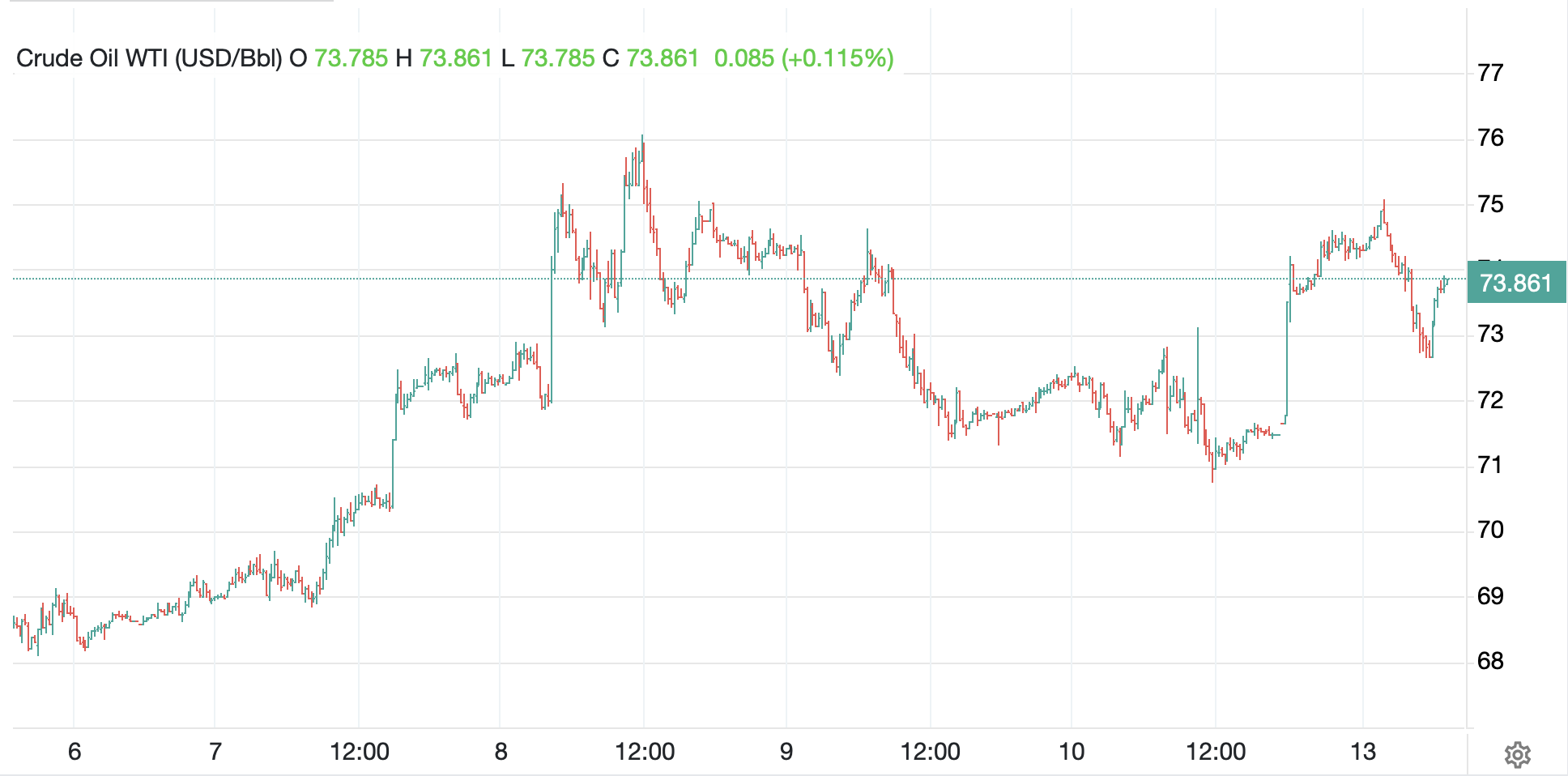
By now, of course, you know that there has been more military activity in the Strait of Hormuz with the IRGC attacking commercial ships and the US retaliating with significant strikes of military sites along the Strait.  From what I can see, there are factions within the IRGC that do not want to end the conflict and whatever government exists within Iran has no control over them.  As such, it is no surprise that the price of oil (+3.5%) has risen, but even in this scenario, it is well off its overnight highs.
Source: tradingeconomics.com

At this point, I believe the trading community will need far greater proof that there is a shortage of oil before responding with significantly higher prices.  Of course, one way that could come about is if Ukraine continues its success with attacks on Russian oil infrastructure as there has been an uptick in that activity with several refineries having been hit in the past several days and Russia imposing an export ban on diesel.  Net, things in the oil space remain precarious, but for all the analysts who continue to promulgate the idea that the end is nigh, markets continue to disagree.  As always, I vote with markets here.

And, not surprisingly, other markets have responded in a similar fashion to their recent trends with higher oil prices leading to pressure on both stocks and bonds, as well as precious metals while the dollar finds some support.  The thing is, my take is the strength of these correlations has been waning somewhat.  Frankly, and remarkably, it appears as though an increase in military activity in the Strait of Hormuz has become somewhat normalized to traders and they are looking for other, fresher signals as to their next move.

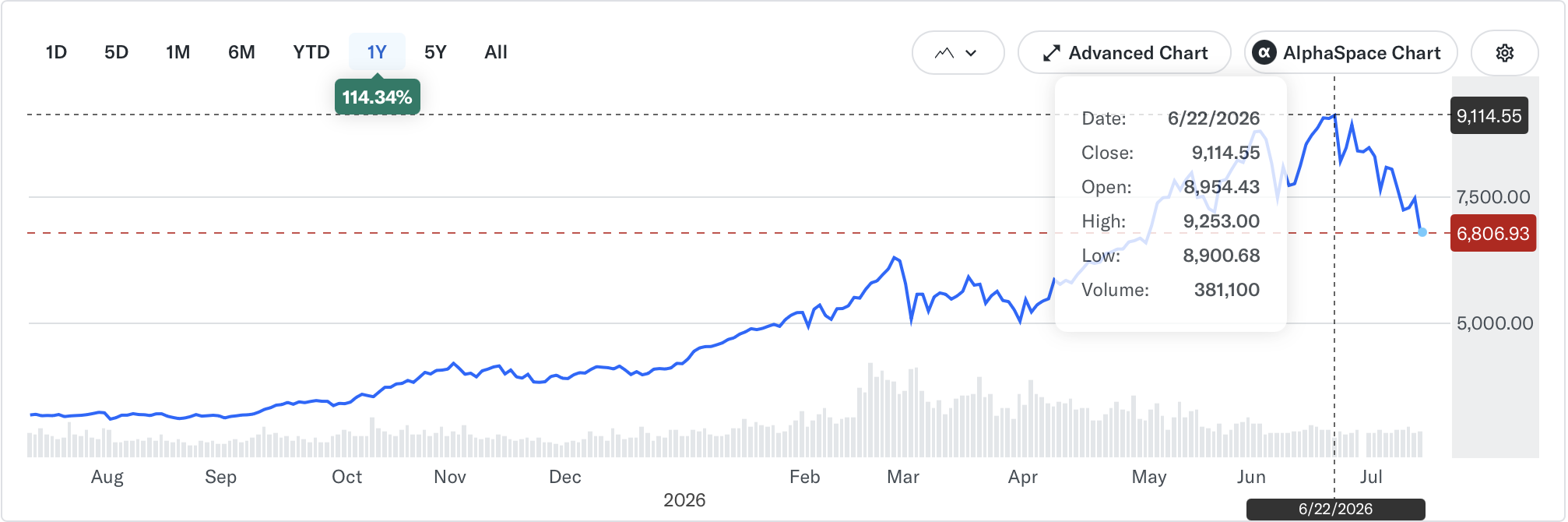
What might those other signals be?  Well, much was made of SK Hynix’s IPO in the US on Friday, which many pundits are now calling the top as the stock fell sharply in Korea overnight, down -15.4% dragging the KOSPI down -9.0% and tech stocks, in general much lower.  Of course, the KOSPI had risen dramatically over the past year, as you can see below, and is still higher by more than 100%  in the past year despite the recent decline of more than 25% since its peak on June 22.
Source: finance.yahoo.com

The problem with calling the top in stocks is that the earnings data, which starts in earnest this week, has been pretty good so far.  If companies continue to earn real profits, investors will continue to purchase stocks.

So, where else can we turn for new information?  Tomorrow brings the latest CPI report (exp 3.8% headline, 2.9% core), and you know that will be heavily scrutinized as the punditry tries to determine the FOMC’s reaction function and if it has changed with the new Chairman.  At this point, I do believe the Fed’s reaction function has changed, and more importantly, I don’t think anybody knows what it will be like, the Fed included.  The previous Fed whisperer, Nick Timiraos at the WSJ put out an article overnight discussing the idea that Chairman Warsh needs to decide whether to undo the most recent rate cuts.  However, there is no evidence that Warsh speaks to Timiraos and based on everything Warsh has said, he is not likely to tip his hand.  Chairman Warsh does testify to Congress this week, but I expect he will deflect all questions about the future path of monetary policy, and let’s face it, with the likes of Maxine Waters on the House committee, they won’t understand anything he says anyway.

And really, those are the only things that I think matter for now, so let’s review the overnight activity in markets.  As mentioned above, stocks are generally under pressure, but not universally so.  For instance, in Asia, Tokyo (-1.9%), China (-1.8%) and the aforementioned South Korea all had rough sessions, but HK, Taiwan, India and Australia were all basically flat on the day.  The big surprise is Taiwan as given the semiconductor weakness; I would have thought that market would have been significantly impacted.  But I guess not.  Meanwhile, European investors appear to be completely focused on tomorrow’s France-Spain World Cup semifinal as equity indices there are virtually unchanged this morning.  As to US futures, at this hour (7:30) NASDAQ futures are weaker by -1.2%, but the other markets are little changed.

Bond yields are higher this morning, but not hugely so.  Treasury yields have edged up by 1bp, and European sovereign yields are higher by 2bps across the board with UK Gilts (+4bps) the real laggard there.  Overnight, JGB yields backed up 4bps as well, but that story has more to do with the GPIF than anything else.

Remember Friday?
Japan was bringing home yen
They were just kidding

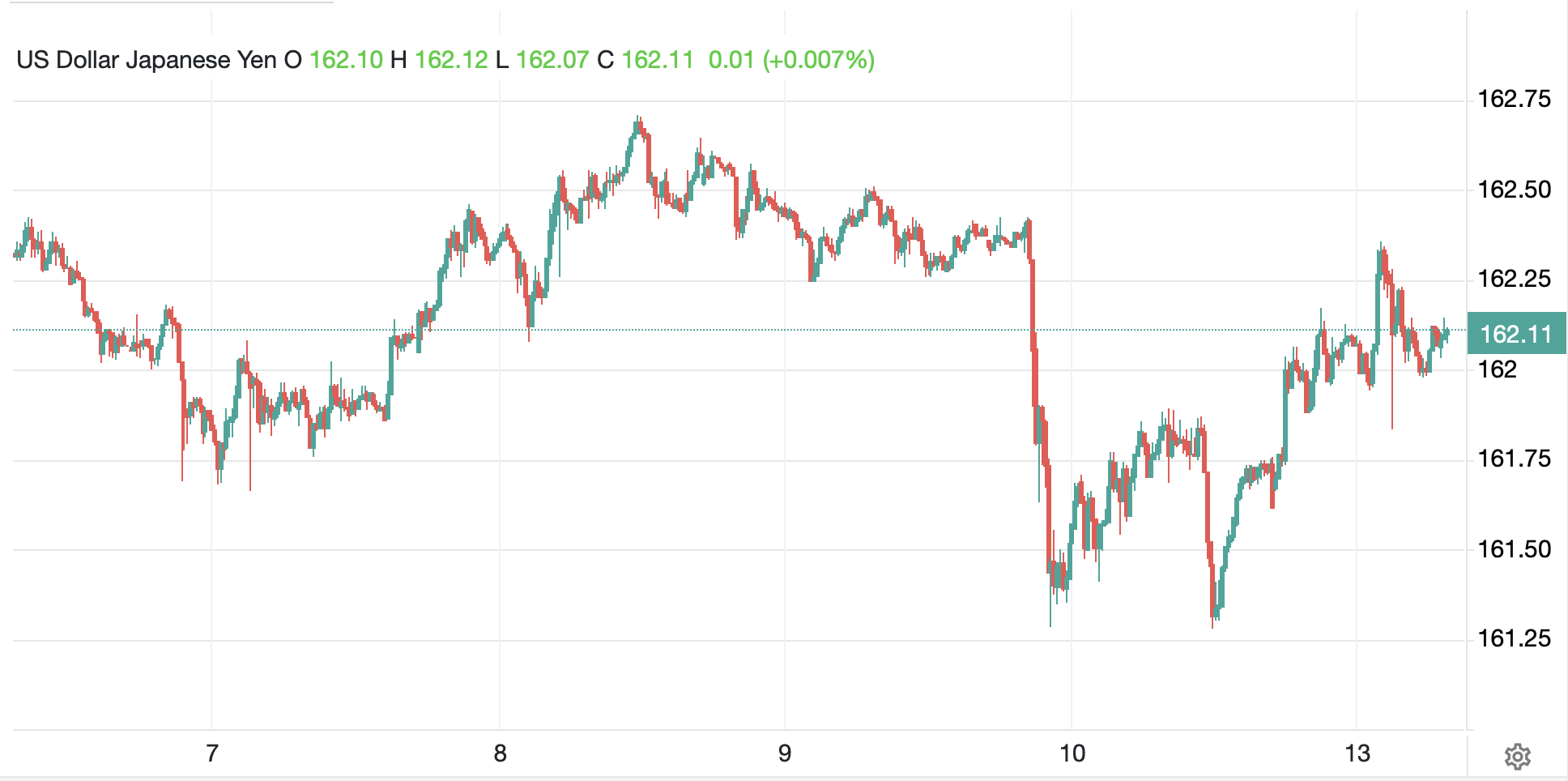
Think back to Friday.  Japanese FinMin Katayama mentioned that the GPIF and other Japanese pension funds ought to consider investing more money in Japan and less abroad.  That got tongues wagging about a major policy change coming that would serve to support the yen, and the JGB market while undermining Treasuries as the idea was the GPIF would sell their US Treasuries and buy JGBs instead.  Well, it turns out that is not actually the case.  The GPIF reevaluates its policy annually but has expressed no urgency to change things now despite the FinMin’s comments, at least according to Reuters.  The upshot is that JGBs sold off as did the yen (-0.3%) as per the below chart.
Source: tradingeconomics.com

Perhaps more surprisingly, though, the dollar is mixed on the day, not higher across the board as might have been expected given the uptick in oil and military activity.  So, we have seen weakness in GBP (-0.1%), AUD (-0.2%) and INR (-0.5%) while EUR (+0.1%), NZD (+0.2%), NOK (+0.3%) and KRW (+0.4%) have all had decent sessions.  Net, the DXY is essentially unchanged this morning.

Finally, and quickly, both gold (-1.5%) and silver (-2.0%) are under pressure with the higher oil price although copper (+0.6%) continues to find support and remains well above $6.00/lb.

In addition to the CPI data, it is a pretty busy week as follows:

TuesdayNFIB Small Biz Optimism95.6
 CPI-0.1% (3.8% y/Y)
 -ex food & energy0.2% (2.9% Y/Y)
 Warsh Testimony 
WednesdayPPI-0.1% (6.2% Y/Y)
 -ex food & energy0.3% (5.2% Y/Y)
 Empire State Mfg8.9
 Warsh Testimony 
 Fed’s Beige Book 
ThursdayInitial Claims218K
 Continuing Claims1811K
 Retail Sales0.2%
 -ex Autos-0.1%
 Philly Fed13.5
FridayHousing Starts1.30M
 Building Permits1.40M
 IP0.2%
 Capacity Utilization76.2%
 Michigan Sentiment51.5

Source: tradingeconomics.com

We also hear from 9 other Fed speakers (it almost seems like they didn’t get the memo about reducing communication) but with Warsh on the stand both Tuesday and Wednesday, I don’t think the others will matter that much.  Of course, it will be interesting to hear the other speeches if CPI comes in softer than expected as it may put a crimp in the hawks’ views.

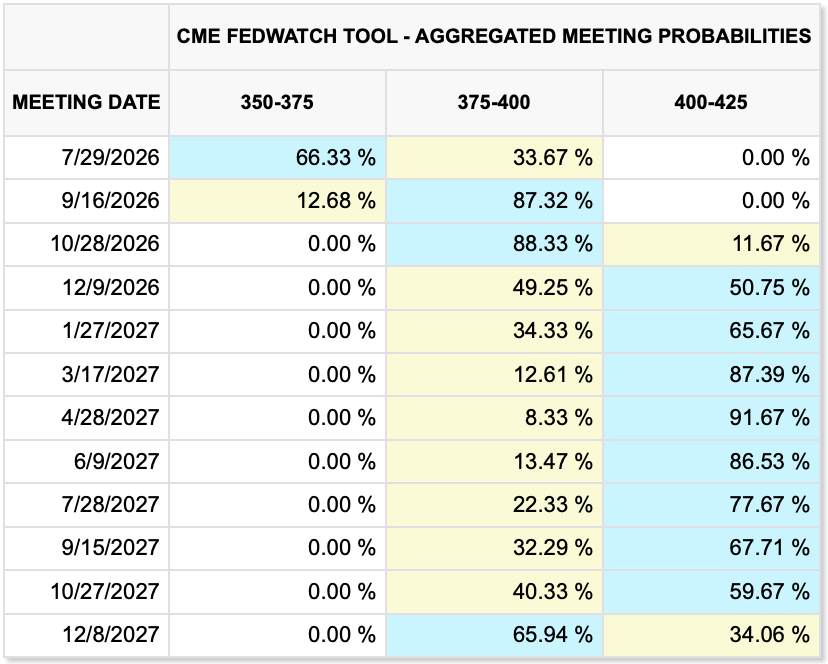
In the end, not that much has really changed I would argue.  The war is an exogenous variable, and the market has learned to largely ignore it.  The Fed is still too uncertain in its new construction for many views to have changed, but I think the one thing we can conclude is that the old models of their reaction function are no longer viable.  My take is the beauty of the task forces for Chairman Warsh is they won’t report for at least 3 months, and probably more like 6 months, so until they report, absent a massive spike in measured inflation, the Fed is not going to do anything.  The Fed funds futures market is now pricing a one-third probability of a hike at the end of this month and certainty of one and 50% probability of two by the end of the year.  I would fade those trades.
Good luck

Adf
The Narrative’s Turned

Last Friday it certainly seemed
The bears had achieved what they’d dreamed
Most bulls were in hell
As stock markets fell
While bears felt that they’d been redeemed
 
But since then, the narrative’s turned
And short-sellers all have been burned
In fact, round our sphere
Investors all cheer
For Jay to cut rates, Fed hawks spurned


The holiday spirit is alive and well this morning, and in truth has been all week.  And not just in the US, but around the world.  Literally, I am hard-pressed to find a stock market that has declined in the past twenty-four hours, with most on multi-day rallies.  And so, I must wonder, has everything really gotten that much better in the world?

A quick tour around the world of problems extant includes:

  • Russia/Ukraine war
  • Chinese property deflation
  • Net zero insanity
  • TDS
  • K-shaped economies
  • Rise of Socialism
  • Excessive global debt/leverage
  • Cost of living

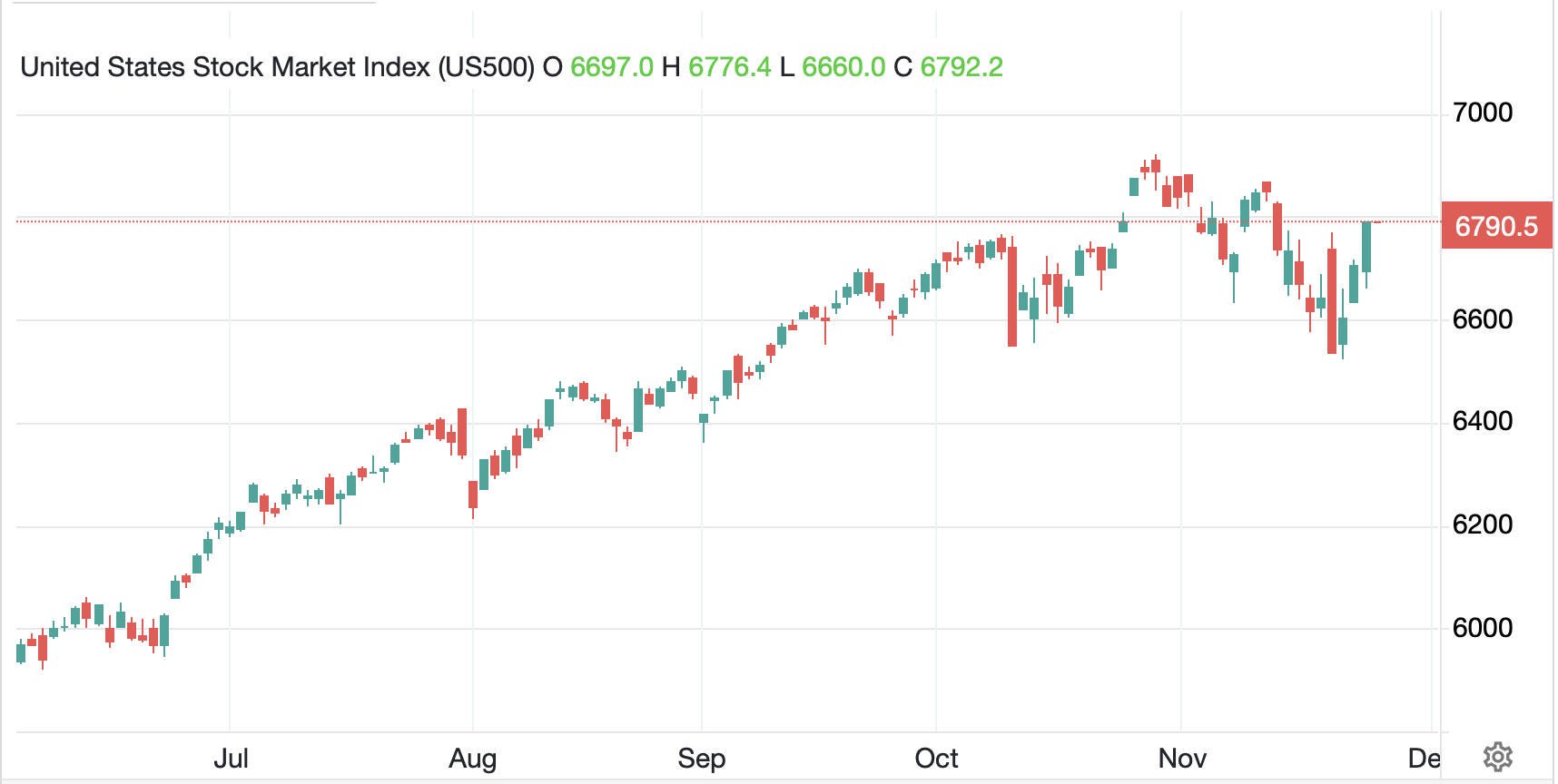
I’m sure there are others, but I just wanted to touch on a few and try to figure out why investors have turned so positive.  After all, a look at the S&P 500 chart below shows that we are less than 2% from the historic highs set back on October 29th.

Source: tradingeconomics.com

So, let’s run through the list.

  • The war in Ukraine continues apace, although we cannot ignore the uptick in ostensible peace talks that have been occurring in the past week.  I’m game to accept those talks as a positive.
  • The Chinese economy continues to overproduce amid weakening domestic demand as property prices show no signs of bottoming.  This is one of the major reasons for the massive global imbalances we have experienced over the past two decades and President Xi has basically proven that they only model he understands is mercantilism.  With President Trump addressing that directly, this will continue to generate uncertainty and volatility, so there will be up days, but also plenty of down ones.
  • The ongoing waste of resources in this Quixotic effort, especially by the Europeans will serve only to further depress their economies while adding debt to pay for their ill-advised policies.  As long as this continues, Europe will be poorer in the future and that doesn’t bode well for their equity markets.
  • Nothing will change TDS but its bifurcation of the population, and not just the US but globally, is likely to be a net negative for everything.
  • The K-shaped economy is a major problem, and not one restricted to the US.  As long as this remains the case, it will breed social unrest, as we continue to see, and have encouraged policies that have proven time and again to be disastrous, but sound good to those in the bottom leg of the K, i.e. Socialism.  I assure you, Socialism will not enhance market capitalization.
  • See above
  • The global debt problem continues to hang over the global economy like the Sword of Damocles, ready to decimate economies with just the right (wrong?) catalyst.  Of course, this is why rate cuts are so favored, and QE more so, but while those may be solutions for government accounts, they will simply exacerbate the last on this list
  • I specifically point to the cost of living since the economists’ concept of inflation, the rate of change of prices, is irrelevant to most people.  The price level is the key, and there is no world where the price level will decline absent a major depression, which is why run it hot is the favored plan.  If growth can be raised sufficiently so that people believe life is affordable again, it will alleviate the K-shaped problem as well as the socialism problem.  But that is a big IF.

And yet, as you can see from this screenshot from Bloomberg.com, as I type, every market is in the green.

My conclusion is that either investors have grown to believe that the key short-term problems, like Russia/Ukraine will be effectively addressed, or under the guise of YOLO, they are all in on AI and the stock market and see it as the only way forward.  I wish I could be so sanguine, but then I am just an old misanthrope.  I hope they are right!

Ok, well, absent any real new news, and leading up to the Thanksgiving holiday here in the US, market signals are telling me everything is right with the world.  You see the equity markets above, and US futures are higher as well at this hour (7:30), albeit only about 0.2%.  

In the meantime, with risk in such demand, it is no surprise that bond yields are edging higher with Treasuries +2bps, after trading below 4.0% during yesterday’s session on a weak ADP weekly employment report (-13.5K) as well as PPI data that seemed less concerning.  European sovereign yields have all edged higher by 1bp this morning, again synchronous with risk on, and JGB yields also edged higher by 1bp after the government there explained they would be borrowing ¥11.5 trillion (~$73.5 billion) in extra debt to fund Takaichi-san’s supplementary budget.  The big outlier is Australia, where AGBs rose 10bps after CPI rose a hotter than expected 3.8% in October, not only putting paid any thoughts of a further rate cut but bringing rate hikes back into view.

In the commodity markets, oil (-0.2%) continues to slide lower, now below $58/bbl, and following its recent trend as per the below tradingeconomics.com chart.

Javier Blas, the widely respected Bloomberg oil analyst, put out an op-ed this morning explaining that he saw higher oil prices in the future.  That is at odds with my view, but I have linked it here so you can help determine if his reasons make sense.  I believe he underestimates both the impact of technology making it ever cheaper to get oil, and the political incentives to drill for more of the stuff by those nations that have it.  Net zero will not survive much longer in my view.

In the metals markets, prospects for lower interest rates have helped encourage further buying and this morning we see the entire complex higher (Au +0.7%, Ag +1.5%, Cu +1.3%, Pt +1.0%).  To the extent that the leverage story remains, and governments are going to continue to print money to pay their debts, metals prices across both precious and base, should continue to appreciate in price.

Finally, the dollar, which slipped a bit yesterday, is mixed this morning.  the yen (-0.3%) is sliding along with KRW (-0.6%), but really, there seem to be more gainers than that.  The biggest mover was NZD (+0.8%) after the RBNZ cut its base rate, as expected, but indicated the cutting cycle is over.  AUD (+0.3%) has also rallied on that inflation report.  I haven’t focused much on the renminbi (+0.1%) lately, largely because the daily movement is typically small, but if you look at the chart below, you can see that the trend has been steady all year, with CNY appreciating nearly 4% since the beginning of the year.  There are many analyses that indicate the renminbi is massively undervalued, so perhaps this is part of the trade deal with the US.  But it will be difficult for Xi to countenance too much strength as it will negatively impact his mercantilist policies.

Source: tradingeconomics.com

Lastly, the pound is gyrating this morning as Chancellor Rachel Reeves offers her budget.  The highlights are a larger than expected fiscal buffer of £22 billion achieved by raising taxes by more than £29.8 billion on gambling and real estate.  However, the recent history of tax hikes in the UK, as they try to tax the wealthy, is that the wealthy simply leave and the result is tax deficits.  Maybe it really is different this time!

And that’s what we have going into the weekend.  Data today brings September Durable Goods (exp 0.3%, 0.2% ex transport), Initial Claims (225K), Continuing Claims (1975K) and Chicago PMI (44.3).  I see no reason for this recent rebound to end as clearly everybody is feeling good into the holiday.  As I highlighted above, there remain myriad problems around, none of which will be solved soon, but apparently, that doesn’t matter.  So go with it!

There will be no poetry tomorrow or Friday so Monday, we will see how things have evolved.

Good luck and have a great holiday weekend

Adf

Decidedly Glum

The mood is decidedly glum
In markets, as traders succumb
To views that the world
Is coming unfurled
And fears that the game’s zero-sum
 
So, stories ‘bout regional banks
With problems are joining the ranks
Of reasons to sell
Ere things go to hell
And why folks are buying Swiss francs


It doesn’t seem that long ago when equity markets were trading at all-time highs, arguably a sign of significant positive attitudes, and yet here we are this morning with equity markets around the world under significant pressure.  Of course, the reason it doesn’t feel like it was that long ago is BECAUSE IT WASN’T.  In fact, as you can see from the chart below, it was just last week!

Source: tradingeconomics.com

And understand, that even with futures pointing lower by -1.0% this morning, the S&P 500 is only 3% off its highs.  That hardly seems like a collapse, but the vibe I am getting is decidedly negative.  Certainly, haven assets are in demand this morning with both the yen (+0.5%) and the Swiss franc (+0.45%) rising sharply after bottoming on the same day as the S&P’s top, with both currencies back to their levels from a month ago.

Source: tradingeconomics.com

Is the world ending?  Probably not today but that doesn’t make it feel any better.  After all, we have been living through an unprecedented growth in leverage, with margin debt growing to new record highs every week, despite a backdrop of massive global uncertainty regarding trade, economic activity and kinetic conflict.  It is hard to believe that the fact that the FOMC is likely to cut rates by 25bps at the end of the month and again in December was enough to convince investors that future earnings were going to rise dramatically.

But that is where things stand this morning.  I must admit I have seen and read more stories about the idea that the AI hype train has run too far and needs to correct, and while that has probably been the case for a while, it is only in the past few days that those stances are becoming public.  There has also been an uptick in chatter about bad debt and more insidiously, fraud, that has been underlying some of the recent hype.  The First Brands bankruptcy is reverberating and now two regional banks, Zion and Western Alliance, have indicated that some recent loan losses may be tied to fraud.  While the amounts in question for the latter two are not enough to be a real problem for either institution, numbering in the $10’s of millions, history has shown that fraud tends to arise when money/lending standards are just too easy, and a sign that the end of good times may be nigh.

Again, it is a big leap to say that because some fraud was uncovered that signals the top.  But history has also shown that there is never just one cockroach, and if the lights are coming on, we are likely to see others.  While big bank earnings were solid, that was for last quarter.  And that’s just the market internal story for one industry.

If we add things like concerns over a potential conflict between the US and Venezuela, which is the top article in the WSJthis morning, or the idea that the US may send Tomahawk missiles, with ranges of up to 1500 miles, to Ukraine, it is unlikely to calm any fears.  And adding to that we continue to have the government shut down, although I personally tend to think of that as a benefit and since it doesn’t seem to be helping the Democrat party, the MSM stopped covering it, and we have the escalating trade conflict with China.  Looking at all the potential problems, it cannot be that surprising that some investors are a bit concerned about things and lightening their exposures.  Too, it is a Friday in October, and we have seen some particularly bad outcomes over weekends in October, notably in 1987!

I’m not forecasting anything like that, believe me, just reminding everyone that while history may not repeat, it often rhymes.  So, let’s look at the overnight session, which had a decidedly risk-off tone.  While the declines in the US markets weren’t that large, they left a bad taste everywhere in Asia with only India (+0.6%) managing to rise on the session.  Otherwise, Japan (-1.4%), China (-2.25%), HK (-2.5%), Taiwan (-1.25%), Australia (-0.8%) and virtually all the rest of the markets declined with Korea managing to close unchanged.  Fear was rampant, especially in China on the ongoing trade concerns.

In Europe, it should be no surprise that equity markets are also sharply lower led by the DAX (-2.1%) and FTSE 100 (-1.2%) with Paris (-0.7%) and Madrid (-0.95%) also under pressure.  The causes here are the same as everywhere, worries that things have gotten ahead of themselves while fears over escalations in both the trade and kinetic conflicts grow.  As well, the banking sector here is under pressure as credit concerns grow globally.  As to US futures, at this hour (7:15), they have bounced off their worst levels and are lower by just -0.25% to -0.5%.

Bond markets have been a major beneficiary of the growing fear with Treasury yields bouncing just 1bp this morning and sitting just below 4.00% after a -7bp decline yesterday.  European sovereign yields also fell sharply yesterday and are finding a near-term bottom as they retrace between 1bp and 2bps higher on the session.  If fear is growing, despite all the budget deficits, the default process is to buy bonds!

In the commodity markets, oil (-0.3%) has bounced off its lowest levels of the session which coincide with the lows seen back in April, post Liberation Day.  (see tradingeconomics.com chart below). It seems that not only are there economic concerns, but API inventory data showed a surprising build there.

Turning to the metals markets, gold (-0.2%) had a remarkable day yesterday, rising $100/oz, more than 2%, so a little consolidation here can be no surprise.  In fact, all the metals saw gains yesterday and are backing off a bit this morning in very volatile, and what appear to be illiquid markets.  Looking at the screen, the price is rising and falling $5/oz on a tick.  This 5-minute chart shows just how choppy things are.

Source: tradingeconomics.com

Finally, the dollar is softer, which on the one hand is surprising given its traditional haven status, but on the other hand, given the ongoing decline in yields and the fear pervading markets, is probably not that surprising.  Remember, one of the drivers for the dollar is capital flows and if US equity markets decline, we are going to see foreign investors sell, and then likely sell those dollars as well.  However, I would take exception with the Bloomberg headline explaining that the dollar is weakening because of Fed rate cut expectations given those expectations have been with us for several weeks.  At any rate, the weakness this morning is broad-based, but shallow with the two havens mentioned above the exception and most other currencies gaining 0.1% or 0.2% at most.  It seems President Trump has also made a comment about the trade war indicating that the current tariffs are unsustainable and he confirmed he would be meeting President Xi in a few weeks.

And that’s really all there is to end the week.  There is no data at all, and the only Fed speaker is KC Fed president Musalem.  The general takeaway from the Fedspeak this week is that they are prepared to cut rates but given the lack of data, will not be aggressive.

The world is a messy place.  No matter your political views, when viewing markets, it is important to focus on the reality of what is happening.  We know that leverage has been growing and helping to drive stock market indices to record highs.  We know that gold and other precious metals have been rallying on a combination of central bank (price insensitive) and growing retail buying as fears grow of impending inflation.  We have seen several instances of what appears to be lax lending standards, something that historically has led to substantial chaos in markets.  The advice I can offer here is maintain position hedges, especially those of you who are corporate risk managers.  Yes, volatility has risen a bit, but I assure you, if things really come undone, that will be insignificant compared to the benefit of the hedge.

And with those cheery words, I wish you all 

Good luck and a good weekend

Adf