
A Reprieve

Some nations have gained a reprieve
About a month left to achieve
A deal to prevent
The extra percent
Of tariffs that Trump can conceive


The news cycle continues to be bereft of new stories regarding finance and markets as there is continued focus on the tragedy in Texas after the flash floods that were responsible for over 100 deaths.  But in our little corner of the world, tariff redux is all we have.  So, to rehash, today marks 90 days since President Trump delayed the imposition of his Liberation Day tariffs back in April with the idea of negotiating many new trade deals.  Thus far, only two have been agreed, the UK and Vietnam, while there has clearly been progress made on several key deals including Japan, South Korea, the EU, India and Australia.  As such, the president has delayed the imposition of these tariffs now to August 1st, but we shall see what happens then.

It is worth noting that trade negotiations historically have taken a very long time, years if not decades, as evidenced by the fact that any time an agreement is reached, it is met with dramatic fanfare on both sides of the deal.  Consider, for a moment, that the EU and MERCOSUR finally agreed terms in 2024, after 25 years of negotiations, although the deal has not yet been ratified by both sides.  With this in mind, it is remarkable that as much ground has been covered in this short period of time as it has.

However, if I understand correctly, many other nations will be subject to tariffs starting today.  Of course, along with these tariffs are the resumed calls for a catastrophic outcome for the US with inflation now set to advance sharply while growth stagnates.  At least the naysayers are consistent.

Away from this story, though, the market is the very picture of the summer doldrums.  After all, nothing else has really changed.  The BBB solved the debt ceiling issue, with another $5 trillion added to the mix, so funding the government should not be a problem for several years at least.  Of course, this means the monetary hawks will re-emerge and complain that the government is spending too much (which it clearly is) and that the economy will collapse under the weight of all that debt.  After all, one needs a calamity to get one’s views aired these days, and doomporn is all the rage with President Trump in office.

So, I won’t waste any more time before heading into the market recap.  Yesterday’s US equity decline, catalyzed by the display of letters written to Japan and South Korea about the imposition of 25% tariffs, was halted after the delay was announced, but the markets still closed lower.  Overnight, Asian markets managed to rally a bit with the Nikkei (+0.3%) the laggard while Korea (+1.8%) really benefitted from that delay.  Meanwhile, China (+0.8%) and Hong Kong (+1.1%) were also solid as was most of the region although Thailand (-0.7%) which did not receive a reprieve, did suffer.

In Europe, the picture is somewhat mixed with the DAX (+0.45%) rising after a slightly wider than expected trade surplus was reported this morning while the CAC (-0.1%) has been under modest pressure after the French trade deficit rose slightly.  But the bulk of the market here is modestly higher on the reprieve concept, although only about 0.2%.  As to US futures, at this hour (7:05), they are basically unchanged to slightly higher.

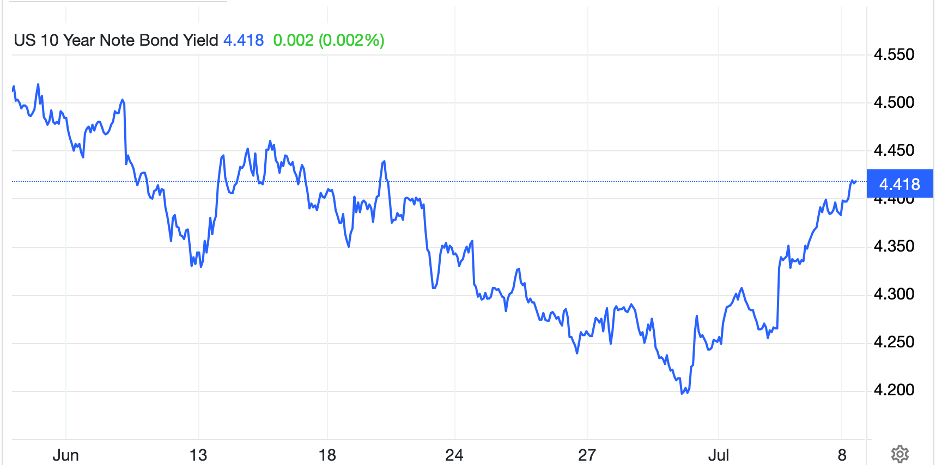
In the bond market, though, yields continue to rise around the world this morning as it appears investors are growing somewhat concerned that all the government spending that is being enacted around the world is becoming a concern.  Treasury yields have risen 3bps and European sovereigns are higher by between 4bps and 5bps.  JGB yields, too, are higher by 4bps and in Australia, an 8bp rise was seen after the RBA failed to cut their base rate last night as widely expected.  Since the beginning of the month, 10-year Treasury yields have risen by more than 20 basis points (as per the chart below) a sign that there may be concern over excess supply…or that the BBB is going to encourage faster growth.  I’m not willing to opine yet.
Source: tradingeconomics.com

In the commodity markets, oil (-0.3%) has been trading in a $4/bbl range since the end of the 12-Day War and the US destruction of Iranian nuclear facilities removed the war premium from the market.  In truth, this is surprising given the ongoing increases in production from OPEC+ and the widespread belief that the economy is suffering and heading into a recession.  But it is difficult to look at the below chart and be confident of the next move in either direction.

Source: tradingeconomics.com

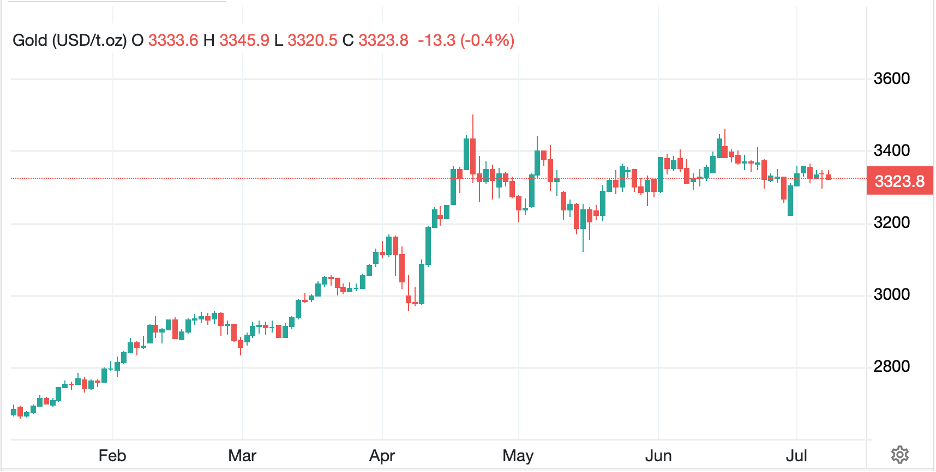
Meanwhile, metals markets this morning show gold (-0.35%) giving back some of its late day gains yesterday while silver and copper remain little changed.  Again, range trading defines the price action as gold has basically gone nowhere since late April.
Source: tradingeconomics.com

Finally, the dollar is mixed this morning with AUD (+0.6%) the leading gainer after the RBA no-action outcome, although ZAR (+0.6%) has gained a similar amount which appears to have been driven by Trump rescinding his threat to add a 10% additional tariff on all BRICS nations (the S is South Africa) that seek to avoid using the dollar for trade.  On the other side of the coin, the pound (-0.3%) and yen (-0.4%) are both slipping this morning with the former suffering from domestic finance problems as the Starmer government continues to flail in its efforts to pay for its promised spending.  In Japan, the Upper House elections, which are to be held July 20th, are a problem for PM Ishiba and his minority government.  One of the key issues is despite the fact that rice prices there have risen more than 100% in the past year, and the US is keen to export rice to Japan to help mitigate the problem, the farmers bloc in Japanese politics has outsized influence and is vehemently against the proposal.  If the government falls due to election losses, agreeing a trade deal will be impossible.  Perhaps this time, the yen will weaken in the wake of tariffs.  (As an aside, are any of you old enough to remember the death of the carry trade and how the yen was going to explode higher?  I seem to recall that was a strong narrative just a few months ago, but it is certainly not evident now.)

On the data front, the NFIB Survey was released this morning at 98.6, a tick lower than expected and 2 ticks lower than last month, but basically little changed.  I don’t think it provides much new information.  Later this afternoon we see Consumer Credit (exp $11.0B), potentially a harbinger of future spending outcomes.  But really, that’s it.

Headline bingo continues to drive markets with the narratives locked in place.  The dollar’s trend is clearly lower, but it remains to be seen if the oft-predicted collapse is on the cards.  Personally, while a bit further weakness seems reasonable, getting short here, with the market already significantly positioned that way, does not feel like the right trade.

Good luck

Adf
Chaos is Spreading

Around the world, chaos is spreading
As government norms get a shredding
Korea’s the latest
But not near the greatest
Seems to the Fourth Turning we’re heading

While Russia/Ukraine knows no end
And Israel seeks to defend
The French are about
To toss Michel out
And all this ere Trump does ascend


If you view markets through a macro lens, the current environment can only be described as insane.  Niel Howe and William Strauss wrote a book back in 1997 called The Fourth Turning (which I cannot recommend highly enough) that described a generational cycle structure that has played out for hundreds of years.  If you have ever heard the saying 

  • Hard times make strong men (1st Turning)
  • Strong men make good times (2nd Turning)
  • Good times make soft men (3rd Turning)
  • Soft men make hard times (4th Turning)

Or anything in the same vein, this book basically describes the process and how it evolves.  The essence is that about every 20-25 years, a new generation, raised by its parents whose formative years were in the previous Turning, falls into one of these scenarios.  Howe and Strauss explained that at the time they wrote the book, we were in the middle of the 3rd Turning, and that the 4th Turning would be upon us through the 2020’s.  One of the features they highlighted was that every 4th Turning was highlighted by major conflict (WWII, Civil War, Revolutionary War, etc.) with the implication that we could well be heading toward one now.

Of course, we already have a few minor wars with Russia/Ukraine (although that seems to have the potential to be more problematic) and Israel/Hezbollah/Hamas, with Iran hanging around the edges there.  In a funny way, we have to hope this is the worst we get, but there are still more than 5 years left in the decade for things to deteriorate, so we are not nearly out of the woods yet.  

But turmoil comes in many forms and political turmoil is also rampant these days.  This is evident by the number of sitting governments that have been ejected in the most recent elections as well as the increasingly strident blaming of others for a nation’s current problems.  In this vein, the latest situation will happen shortly when the French parliament votes on a no-confidence motion against the current PM, Michel Barnier.  As it is, he is merely a caretaker PM put in place by President Macron after Macron’s election gamble in June failed miserably.  Adding to France’s problems, and one way this comes back to the markets, is that the French fiscal situation is dire, with a current budget deficit exceeding 6% of GDP and no good way to shrink it.  In fact, Barnier’s efforts to do so are what led to the current vote.  I have already discussed French yields rising relative to their European peers and the underperformance of the CAC as well. 

On the one hand, today’s vote, which is tipped to eject Barnier, may well be the peak (or nadir) of the situation and things will only improve from the current worst case.  However, it strikes me this is not likely to be the case.  Rather, there are such a multitude of problems regarding immigration, culture, economic activity and government responsiveness, that we have not nearly found the end.  My fear is we will need to see things deteriorate far more than they have before populations come together and agree that ending the mess is the most important outcome.  Right now, there are two sides dug in on most issues and the split feels pretty even.  As such, neither side is going to give up what they believe for the greater good, at least not yet.

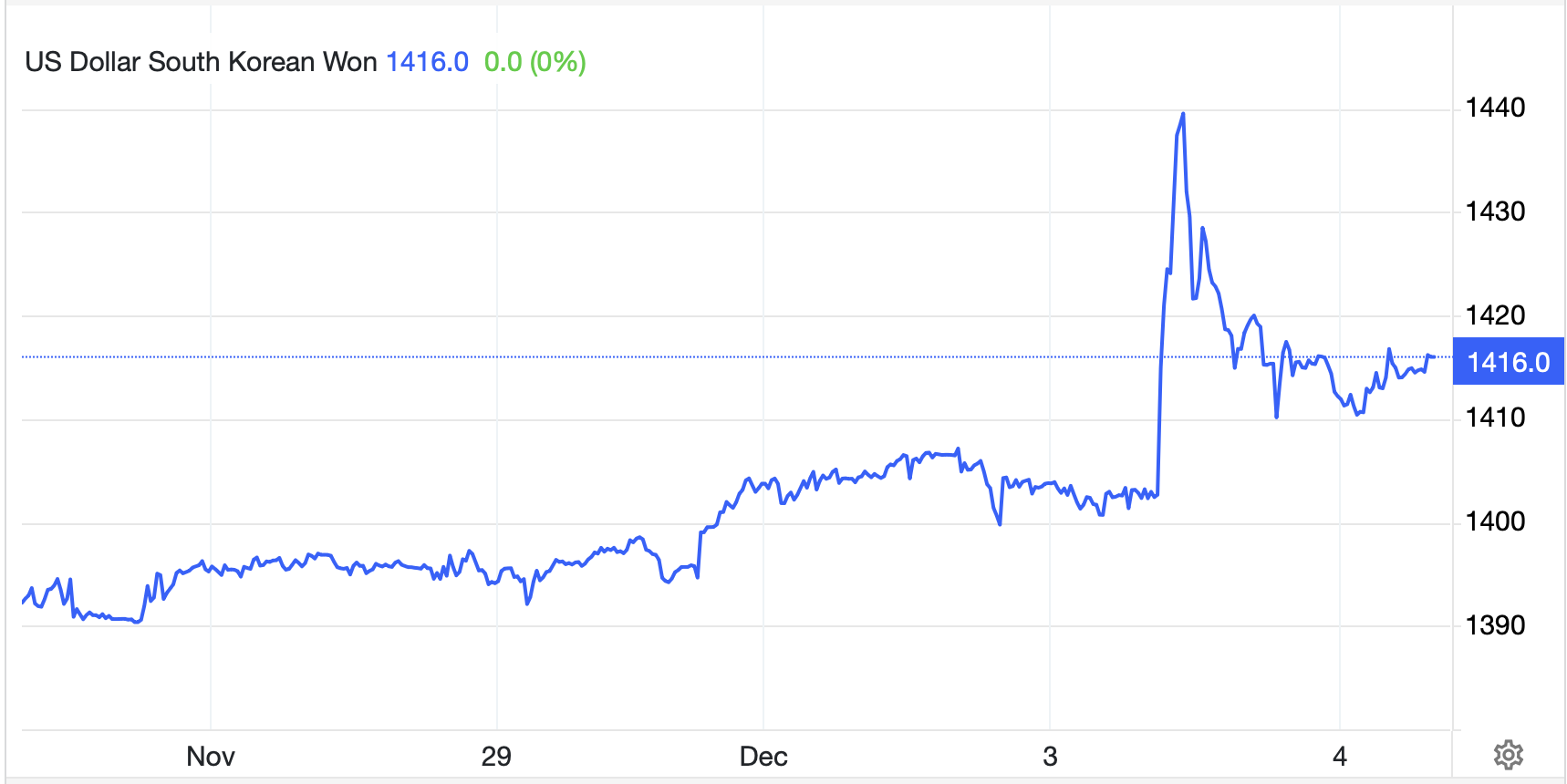
And before I move on to the markets, I cannot ignore the remarkable events in South Korea yesterday, where President Yoon Suk Yeol declared martial law in the early hours on the basis of the opposition’s efforts to paralyze the government (I guess that means they didn’t agree with him).  In the end, the Korean Parliament voted to rescind the order, and the military has since stood down with all eyes on the next steps including likely impeachment hearings for the President.  Not surprisingly, Korean assets suffered during this situation with the won tumbling briefly, more than 2.6%, before retracing the bulk of those losses once the order was rescinded.  

Source: tradingeconomics.com

Too, the KOSPI (-1.5%) suffered although that was off the worst levels of the day after things settled down.  The point to keep in mind here is that markets are subsidiaries of economies.  They may give indications of expectations for the future, or sentiments of the current situation, but if we continue to see geopolitical flare ups, markets are going to respond as investors seek havens.  In this case, the dollar, despite all its flaws, remains the safest choice in many investors’ eyes, so should remain well bid overall.

Ok, let’s look at how markets have been behaving through this current turmoil.  In Asia, given the events in Korea, it ought not be surprising that equities had little traction.  Japanese shares were unchanged as were Hong Kong although mainland Chinese (-0.5%) and Australian (-0.4%) shares were under some pressure.  That said, Australia suffered on weaker than forecast GDP data which puts more pressure on the RBA to cut rates despite inflation remaining sticky.  Australia dragged down New Zealand (-1.5%) shares as well with really the only notable winner overnight being Taiwan (+1.0%).  In Europe, investors seem to be betting on a more aggressive ECB as somewhat weaker than expected PMI Services data has led to gains on the continent (DAX +0.85%, CAC +0.5%, IBEX +0.7%) although UK shares (-0.2%) are not enjoying the same boost.  I guess the French market has already priced in the lack of a working government, hence the market’s underperformance all year.  US futures, at this hour (8:00) are pointing higher by between 0.3% and 0.6%.

In the bond market, yields are rising, with Treasuries (+4bps) leading the way although most of Europe are higher by between 3bps and 4bps.  It has the feel that bond markets are starting to decouple from central banks as they see inflationary pressures building and central banks still in active cutting mode.  I fear this will get messier as time goes on.

In the commodity markets, oil is unchanged this morning, right at $70/bbl, having continued its rally for the week on news that OPEC+ will maintain its production cuts through March 2025.  NatGas (-2.0%) has been sliding since the spike seen 2 weeks ago ahead of the current cold spell as warmer weather is forecast for next week.  In the metals market, gold (-0.2%) seems stuck in the mud right now while silver (-1.3%) and copper (-0.6%) appear to be victims of the dollar’s strength.

Turning to the dollar, it is stronger across the board with AUD (-1.3%) the laggard after that GDP data and it dragged NZD (-1.0%) down with it.  JPY (-1.1%) is also under pressure as hopes for that BOJ rate hike dissipate.  Away from those, the euro (-0.2%) and pound (-0.1%) are softer, but much less so.  In the EMG bloc, ZAR (-0.5%) is feeling the weight of the weaker metals prices and we are seeing BRL (-0.3%) and CLP (-0.1%) also sliding slightly although both are stabilizing after more pronounced weakness earlier in the week.

On the data front, this morning brings ADP Employment. (exp 150K) along with ISM Services (55.5) and then the Fed’s Beige Book.  Perhaps of more importance, at 12:45, Chairman Powell will be speaking and taking questions, so all eyes will be there looking for clues as to how the Fed will be viewing things going forward.  Fed funds futures have been increasing the probability of that rate cut, now up to 74%, which implies we are going to see one, regardless of the inflation story.

Central banks around the world are in a bind as inflation refuses to fall like they want but many nations are seeing slowing economic activity.  In the end, I expect that the rate cutting cycle has not ended, but the dollar is likely to remain well bid given both its haven status and the fact that the US economy is outperforming everywhere else.

Good luck

Adf

Truly Displeasing

Down Under the story’s that rates
May soon fall, which just demonstrates
That growth there is easing
Thus truly displeasing
The central bank head and his mates

The RBA Minutes were released last evening and the central bank in the lucky country is not feeling very good. Governor Lowe and his team painted two, arguably similar, scenarios under which the RBA would need to cut rates; a worsening of the employment situation or a continued lack of inflation (driven by a worsening of the employment situation). We have been hearing this tune from Lowe for the past several months and the market is already pricing in more than one full 25bp cut before the end of 2019. However, as is often the case, when these theories are confirmed the market adjusts further. And so, it should be no surprise that AUD is lower again this morning, falling 0.35% and now trading back to the lows last seen in January 2016. For a bit more perspective, the last time Aussie was trading below these levels was during the financial crisis in Q1 2009 amidst a full-on risk blowout. But the combination of slowing Chinese growth, and generic dollar strength is taking a toll on the Aussie dollar. The trend here is lower and appears to have further room to run. Hedgers take note!

In England, meanwhile, it appears
The outcome that everyone fears
A no-deal decision
Might soon be the vision
And Sterling might weaken for years

Turning to the UK, the odds of a hard Brexit seem to be increasing by the day. As the EU elections, scheduled for later this week, approach, the hardline Tories are in the ascendancy. Nigel Farage, one of the most vocal anti-EU voices, is leading his new Brexit party into the elections and they are set to do quite well. At the same time, Boris Johnson, the former Foreign Minister in PM May’s government, as well as former Mayor of London, and also a strong anti-EU voice, is now the leading candidate to replace May in the ongoing leadership struggle. The PM is still trying to push water uphill find support for her thrice defeated bill, but it should be no surprise that, so far, that support has yet to materialize. After all, it was hated three times already and not a single word in the bill has changed. At this point, her only hope is that the increasingly real threat of a PM Johnson, who has stated he will simply exit the EU quickly, may be enough to get those wavering to come to her side. Based on the FX market price action over the past three weeks, however, it is becoming clearer that her bill is going to fail yet again.

Since the beginning of the month, the pound has fallen 3.6% (-0.25% today) and is trading at levels last seen in early January. As this trend progresses, it looks increasingly likely that the market will test the post-Brexit lows of 1.1906. And, of course, if Johnson is the next PM and he does pull out of the EU without a deal, an initial move to 1.10 seems quite viable. Once again, hedgers beware. As an aside, do not think for a moment that the euro will go unscathed in a hard Brexit. It would be quite easy to see a 2%-3% decline immediately, although I suspect that would moderate far more quickly than the damage to the pound.

Turning our eyes eastward, we see that the ongoing trade war (it has clearly escalated past a spat) between the US and China continues to have ramifications in the FX markets. Not only is the yuan continuing to weaken (-0.2% today) but other currencies are starting to feel the brunt. The most obvious loser has been the Korean won (-0.15% overnight) which has fallen 5.4% in the past month. While the central bank there is clearly concerned, given the cause of the movement and the strong trend, there is very little they can do to halt the slide other than raising interest rates aggressively. However, that would be devastating for the South Korean economy, so it appears that there is further room for this to decline as well. All eyes are on the 1200 level, which last traded in the major dollar rally in the beginning of 2017.

Do you see the trend yet? The dollar is continuing its strengthening tendencies across the board this morning. Other news adding fuel to the fire was the latest revision of OECD growth forecasts, where the US data was upgraded to 2.6% for 2019 while virtually every other area (UK, China, Eurozone, Japan, etc.) was downgraded by 0.1%-0.2%. It should be no surprise that the dollar remains well-bid in this environment.

Turning to the data this week, it is quite sparse as follows:

Today Existing Home Sales 5.35M
Wednesday FOMC Minutes  
Thursday Initial Claims 215K
  New Home Sales 675K
Friday Durable Goods -2.0%
  -ex transport 0.2%

Obviously, all eyes will be on the Minutes tomorrow, but the data set is not very enticing. That said, we do hear from eight more Fed speakers across a total of ten speeches (Atlanta’s Rafael Bostic is up three times this week). Yesterday, Chairman Powell explained that while corporate debt levels are high, this is no repeat of the mortgage crisis from 2008. Of course, Chairman Bernanke was quite clear, at the time, that the mortgage situation was “contained” just before the bottom fell out. I’m not implying the end is nigh, simply that the track record of Fed Chairs regarding forecasting market and economic dislocations is pretty dismal. At this time, there is no evidence that the Fed is going to do anything on the interest rate front although the futures market continues to price for nearly 50bps of rate cuts this year. And when it comes to forecasting, the futures market has a much better track record. Just sayin’.

All told, at this point there is no reason to think the dollar is going to reverse any of its recent strength, and in fact, seems likely to add to it going forward.

Good luck
Adf

Spring Next Year

Interest rates shan’t
Rise ere spring next year. But might
They possibly fall?

This morning’s market theme is that things look bad everywhere, except perhaps in the US. Starting in Tokyo, the BOJ met last night and, to no one’s surprise, left their policy rate unchanged at -0.10%. They maintained their yield curve control target of 0.00% +/- 0.20% for 10-year JGB’s and they indicated they would continue to purchase JGB’s at a clip of ¥80 trillion per year. But there were two things they did change, one surprising and one confusing.

First the surprise; instead of claiming rates would remain low for an “extended period”, the new language gave a specific date, “at least through around spring 2020”. Of course, this gives them the flexibility to extend that date specifically, implying an even more dovish stance going forward. Market participants were not expecting any change to the language, but interestingly, the yen actually rallied after the report. Part of that could be because there was significant weakness in Asian equity markets and a bit of a risk-off scenario, but I also read that some analysts see this as a prelude to tighter policy. I don’t buy the latter idea, but it does have adherents. The second thing they did, the confusing one, was they indicated they would create a lending facility for their ETF portfolio. The unusual thing here is that generally, lending securities is a way to encourage short-selling, although they did couch the idea in terms of added liquidity to the market. Given they own more than 70% of the ETF market, it is clear that liquidity must be suffering, but I wouldn’t have thought bringing short-sellers to the party would be their goal.

In South Korea, Q1 GDP shrank -0.3%, a much worse outcome than the expected 0.3% growth, and largely caused by a sharp decline in exports and IP. This is an ominous sign for the global economy, and also calls into question the accuracy of the Chinese data last week. Given the tight relationship between Korean exports and Chinese growth, something seems out of place here. The market impact was a decline in the KOSPI (-0.5%), falling Korean yields and a decline in the KRW, which fell a further 0.6% and is now at its weakest point in two years. Look for the Bank of Korea to ease policy going forward.

Turning to Europe, the Swedish Riksbank left policy rates unchanged at -0.25%, as expected, but their statement indicated that there would be no rate hike later this year, as previously expected, given the slowing growth and lack of inflation in Sweden. While I foreshadowed this earlier this week, the market response was severe, with SEK falling 1.4%, although the Swedish OMX (stock market) rallied 1% on the news. You know, bad news is good because rates remain low.

One last central bank note, the Bank of Canada has thrown in the towel on normalizing policy, dropping any reference to higher rates in the future from their statement yesterday. Upon the release of the statement, the Loonie fell a quick 1%. Although it has since recovered a bit of that, it is still lower by 0.6% from before the meeting. It seems concerns over slowing growth now outweigh concerns over excess leverage in the private sector.

The other market note was the sharp decline in Chinese stocks with the Shanghai Composite falling 2.4% as traders and investors there lose faith that the PBOC is going to continue to support the economy, especially after the better than expected GDP data last week. Even the renminbi fell, -0.3%, although it has been especially stable for the past two months as the US-China trade talks continue. Speaking of which, the next round of face-to-face talks are set to get under way shortly, but there has been little in the way of news, either positive or negative, for the past two weeks.

One other thing about which we have not heard much lately is Brexit, where the internal political machinations continue in Parliament, but as yet, there has been no willingness to compromise on either side of the aisle. Of note is that the pound continues to fall, down a further 0.2% this morning and now firmly below 1.29. While there is no doubt that the dollar is strong across the board, it also strikes that some market participants are beginning to price in a chance of a no-deal Brexit again, despite Parliament’s stated aim of preventing that. As yet, there is no better alternative.

Finally, the euro is still under pressure this morning as well, down a further 0.2% this morning, which makes 1.5% in the past week. This morning’s only data point showed Unemployment in Spain rose unexpectedly to 14.7%, another sign of slowing growth throughout the Eurozone. At this point, the ECB is unwilling to commit to easing policy much further, but with the data misses piling up, at some point they are going to concede the point. Easier money is coming to the Eurozone as well.

This morning brings Initial Claims data (exp 200K) and Durable Goods (0.8%, 0.2% ex Transport). It doesn’t seem that either of these will change any views, and as we have seen all week, I expect that Q1 earnings will be the market’s overall focus. A bullish spin will continue to highlight the different trajectories of the US and the rest of the world, and ultimately, continue to support the dollar.

Good luck
Adf