A Reprieve

Some nations have gained a reprieve
About a month left to achieve
A deal to prevent
The extra percent
Of tariffs that Trump can conceive


The news cycle continues to be bereft of new stories regarding finance and markets as there is continued focus on the tragedy in Texas after the flash floods that were responsible for over 100 deaths.  But in our little corner of the world, tariff redux is all we have.  So, to rehash, today marks 90 days since President Trump delayed the imposition of his Liberation Day tariffs back in April with the idea of negotiating many new trade deals.  Thus far, only two have been agreed, the UK and Vietnam, while there has clearly been progress made on several key deals including Japan, South Korea, the EU, India and Australia.  As such, the president has delayed the imposition of these tariffs now to August 1st, but we shall see what happens then.

It is worth noting that trade negotiations historically have taken a very long time, years if not decades, as evidenced by the fact that any time an agreement is reached, it is met with dramatic fanfare on both sides of the deal.  Consider, for a moment, that the EU and MERCOSUR finally agreed terms in 2024, after 25 years of negotiations, although the deal has not yet been ratified by both sides.  With this in mind, it is remarkable that as much ground has been covered in this short period of time as it has.

However, if I understand correctly, many other nations will be subject to tariffs starting today.  Of course, along with these tariffs are the resumed calls for a catastrophic outcome for the US with inflation now set to advance sharply while growth stagnates.  At least the naysayers are consistent.

Away from this story, though, the market is the very picture of the summer doldrums.  After all, nothing else has really changed.  The BBB solved the debt ceiling issue, with another $5 trillion added to the mix, so funding the government should not be a problem for several years at least.  Of course, this means the monetary hawks will re-emerge and complain that the government is spending too much (which it clearly is) and that the economy will collapse under the weight of all that debt.  After all, one needs a calamity to get one’s views aired these days, and doomporn is all the rage with President Trump in office.

So, I won’t waste any more time before heading into the market recap.  Yesterday’s US equity decline, catalyzed by the display of letters written to Japan and South Korea about the imposition of 25% tariffs, was halted after the delay was announced, but the markets still closed lower.  Overnight, Asian markets managed to rally a bit with the Nikkei (+0.3%) the laggard while Korea (+1.8%) really benefitted from that delay.  Meanwhile, China (+0.8%) and Hong Kong (+1.1%) were also solid as was most of the region although Thailand (-0.7%) which did not receive a reprieve, did suffer.

In Europe, the picture is somewhat mixed with the DAX (+0.45%) rising after a slightly wider than expected trade surplus was reported this morning while the CAC (-0.1%) has been under modest pressure after the French trade deficit rose slightly.  But the bulk of the market here is modestly higher on the reprieve concept, although only about 0.2%.  As to US futures, at this hour (7:05), they are basically unchanged to slightly higher.

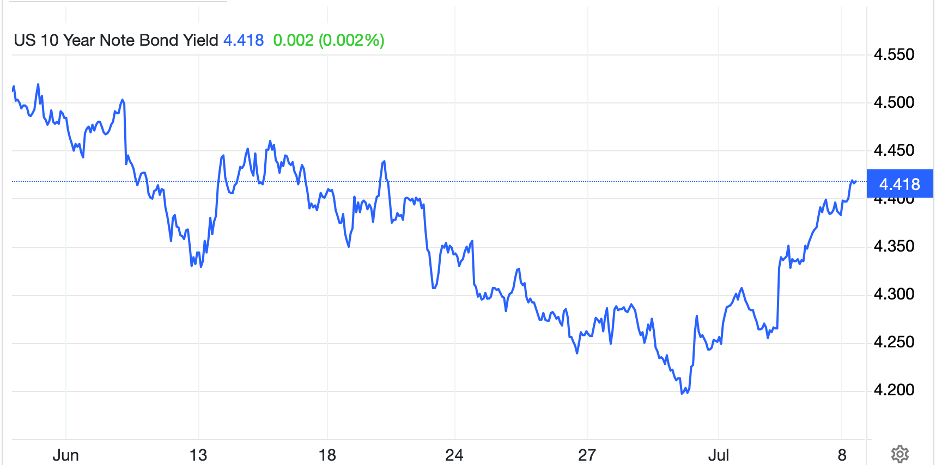
In the bond market, though, yields continue to rise around the world this morning as it appears investors are growing somewhat concerned that all the government spending that is being enacted around the world is becoming a concern.  Treasury yields have risen 3bps and European sovereigns are higher by between 4bps and 5bps.  JGB yields, too, are higher by 4bps and in Australia, an 8bp rise was seen after the RBA failed to cut their base rate last night as widely expected.  Since the beginning of the month, 10-year Treasury yields have risen by more than 20 basis points (as per the chart below) a sign that there may be concern over excess supply…or that the BBB is going to encourage faster growth.  I’m not willing to opine yet.

Source: tradingeconomics.com

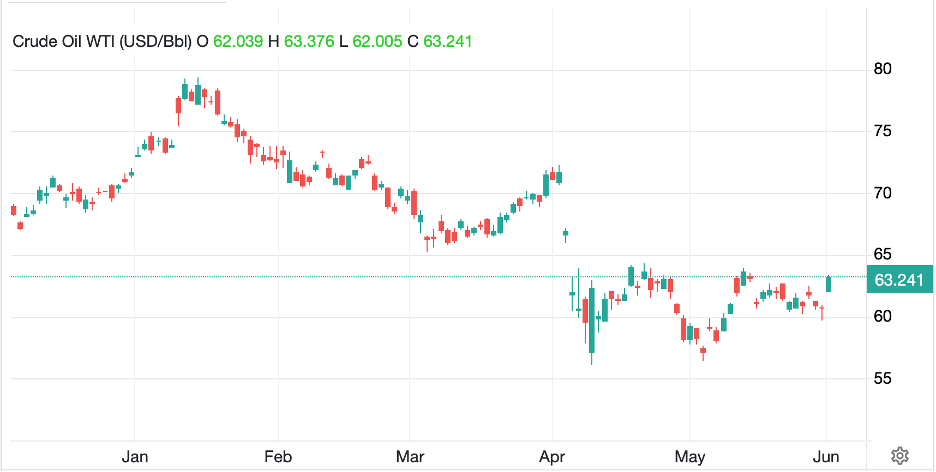
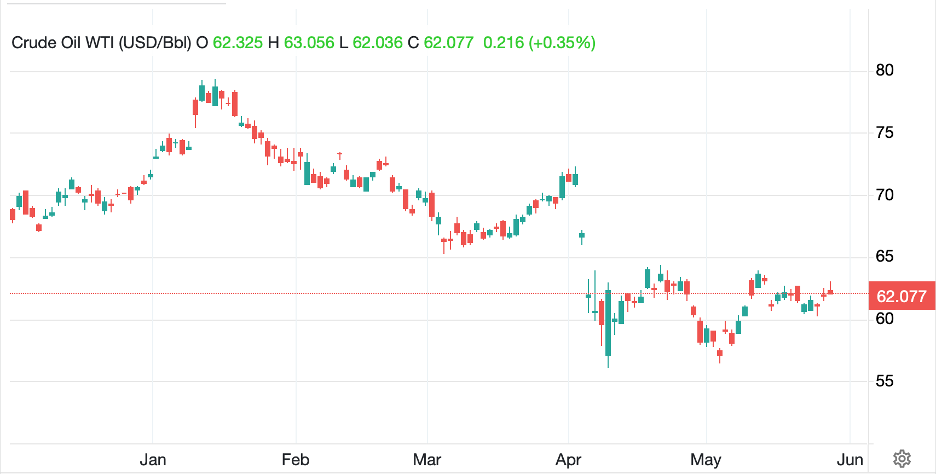
In the commodity markets, oil (-0.3%) has been trading in a $4/bbl range since the end of the 12-Day War and the US destruction of Iranian nuclear facilities removed the war premium from the market.  In truth, this is surprising given the ongoing increases in production from OPEC+ and the widespread belief that the economy is suffering and heading into a recession.  But it is difficult to look at the below chart and be confident of the next move in either direction.

Source: tradingeconomics.com

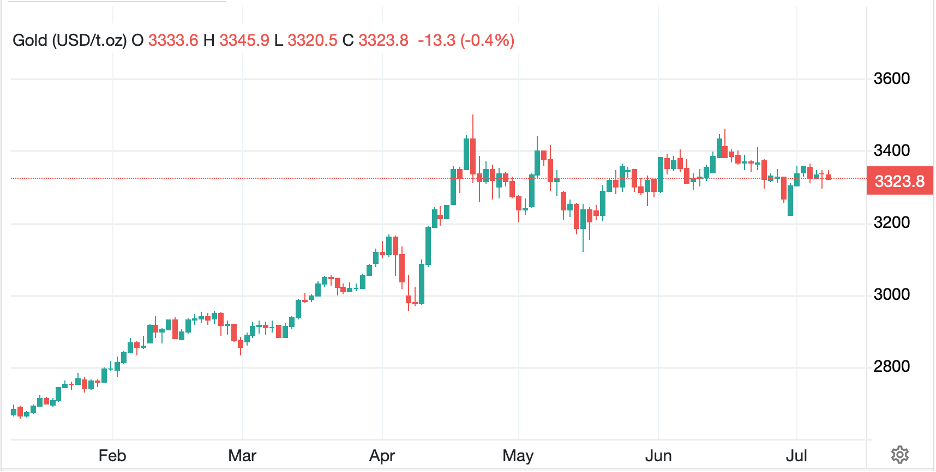
Meanwhile, metals markets this morning show gold (-0.35%) giving back some of its late day gains yesterday while silver and copper remain little changed.  Again, range trading defines the price action as gold has basically gone nowhere since late April.

Source: tradingeconomics.com

Finally, the dollar is mixed this morning with AUD (+0.6%) the leading gainer after the RBA no-action outcome, although ZAR (+0.6%) has gained a similar amount which appears to have been driven by Trump rescinding his threat to add a 10% additional tariff on all BRICS nations (the S is South Africa) that seek to avoid using the dollar for trade.  On the other side of the coin, the pound (-0.3%) and yen (-0.4%) are both slipping this morning with the former suffering from domestic finance problems as the Starmer government continues to flail in its efforts to pay for its promised spending.  In Japan, the Upper House elections, which are to be held July 20th, are a problem for PM Ishiba and his minority government.  One of the key issues is despite the fact that rice prices there have risen more than 100% in the past year, and the US is keen to export rice to Japan to help mitigate the problem, the farmers bloc in Japanese politics has outsized influence and is vehemently against the proposal.  If the government falls due to election losses, agreeing a trade deal will be impossible.  Perhaps this time, the yen will weaken in the wake of tariffs.  (As an aside, are any of you old enough to remember the death of the carry trade and how the yen was going to explode higher?  I seem to recall that was a strong narrative just a few months ago, but it is certainly not evident now.)

On the data front, the NFIB Survey was released this morning at 98.6, a tick lower than expected and 2 ticks lower than last month, but basically little changed.  I don’t think it provides much new information.  Later this afternoon we see Consumer Credit (exp $11.0B), potentially a harbinger of future spending outcomes.  But really, that’s it.

Headline bingo continues to drive markets with the narratives locked in place.  The dollar’s trend is clearly lower, but it remains to be seen if the oft-predicted collapse is on the cards.  Personally, while a bit further weakness seems reasonable, getting short here, with the market already significantly positioned that way, does not feel like the right trade.

Good luck

Adf

Too Extreme

The year is now halfway completed
While narrative writers repeated
The story, same old,
The dollar’s been sold
‘Cause global investors retreated
 
As well, they continue to scream
Trump’s policies are too extreme
His tariffs will drive
Inflation to thrive
While growth will soon start to lose steam


I don’t know about you, but this poet is tired of reading the same stories over and over from different pundits when it comes to the current macroeconomic situation.  And so, I thought I might take a look at what the current narrative seems to be and, perhaps, analyze some of the reasons it will be wrong.  I have full confidence it will be wrong because…it always is.  Add to that the fact that the narratives continue to try to build on expectations of what President Trump wants to do and let’s face it, there is no more unpredictable political leader on the planet right now.

In fact, we can look at one of the key narratives that had been making the rounds right up until Thursday night when the House and Senate agreed the terms of the BBB which has since been signed into law.  Serious pundits were convinced that the president could never get this done and yet there it is.

But let’s discuss another popular narrative, the end of American exceptionalism.  First, I’d like to define the term American exceptionalism because I believe that the equity analysts borrowed the term from the Ronald Reagan.  For the longest time, I would contend the term referred to the American experiment, writ large, with the dynamic market economy that was created by the legal framework in the US.  After all, no other nation, certainly not these days, has anything like this framework.  The combination of the 1st and 2nd Amendments to the Constitution have been critical in not only creating this framework but keeping it from getting too far out of hand. 

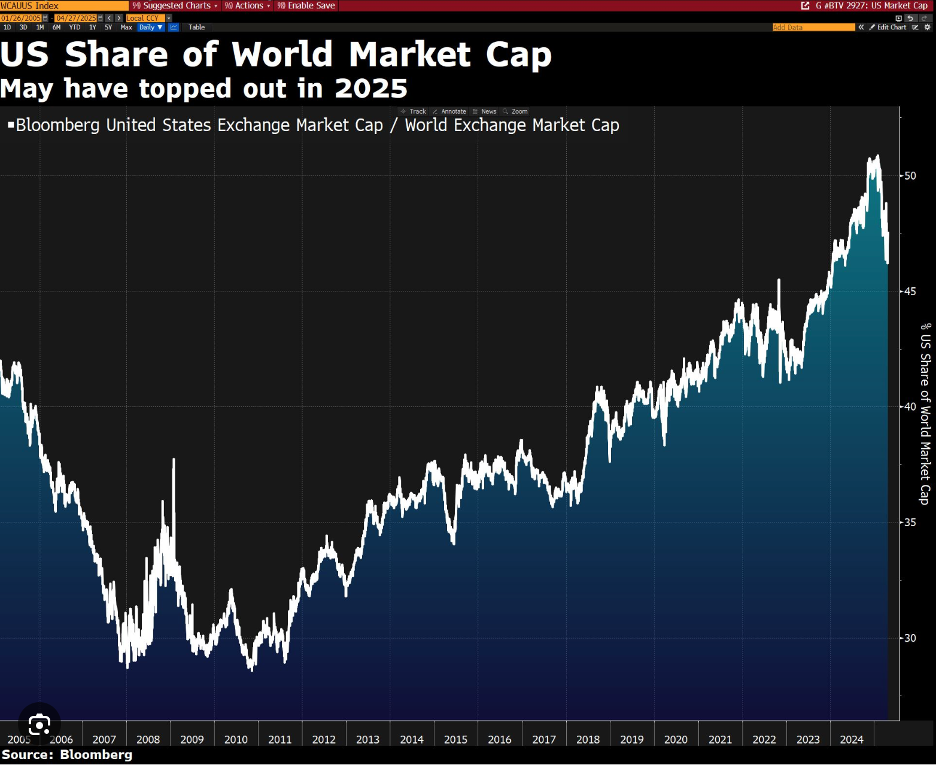
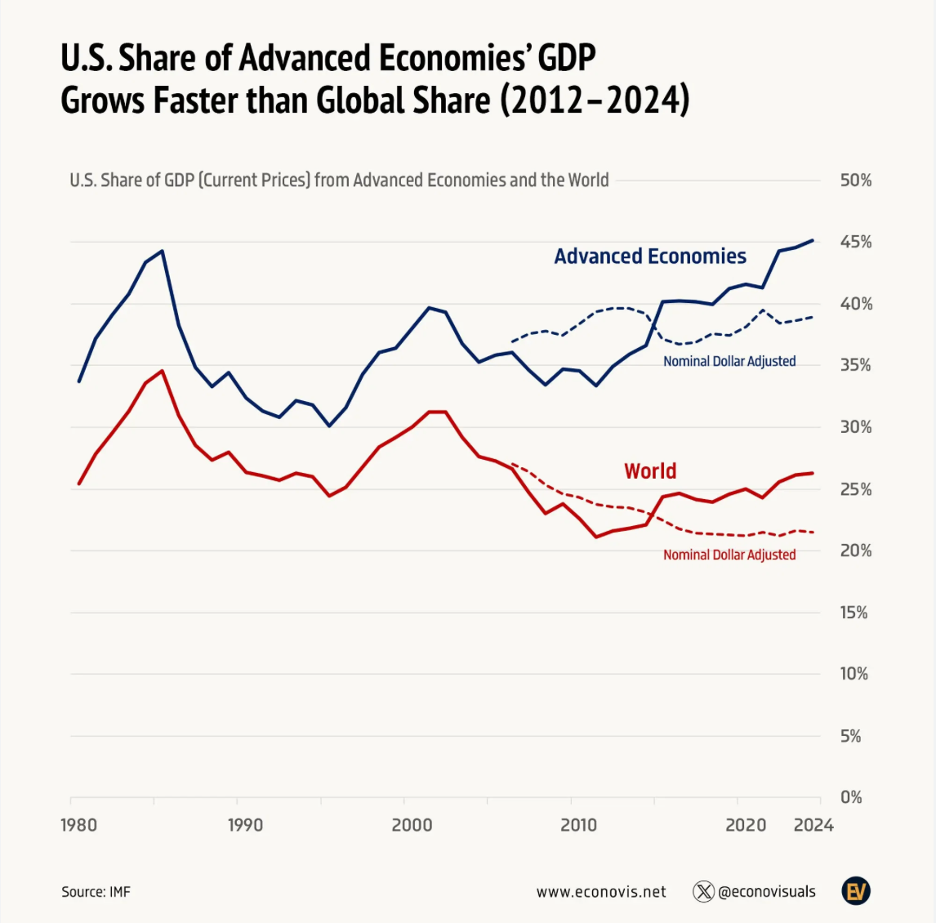
However, in the market context, American exceptionalism refers to the fact that the relative strength of the US economy drew investors from around the world into US equity markets, driving the value of US equities relative to both total global equities and the US proportion of global GDP to extreme heights.  While the chart below shows a peak just above 50% of global market cap and that number is declining right now, I have seen estimates that the number could be as high as 70% of global market cap.  I suppose it depends on how you define global market cap, but MSCI’s readings tend to be well respected.

In addition to the significant portion of equity market capitalization compared to the rest of the world is the fact that US GDP is a significantly smaller percentage, somewhere in the 23% – 26% range depending on how one calculates things with FX rates.  

The upshot is that heading into 2025, US equity valuation was at least twice the size of the US economy compared to the entire world.  Certainly, that is exceptional, and the term American exceptionalism seemed warranted.  But as you can see from the first chart, other markets have been outperforming the US thus far this year with the result that the US no longer represents quite as large a percentage of the world’s equity market capitalization.  So, is this the end of that form of American exceptionalism?  The pundits are nearly unanimous this is the case.

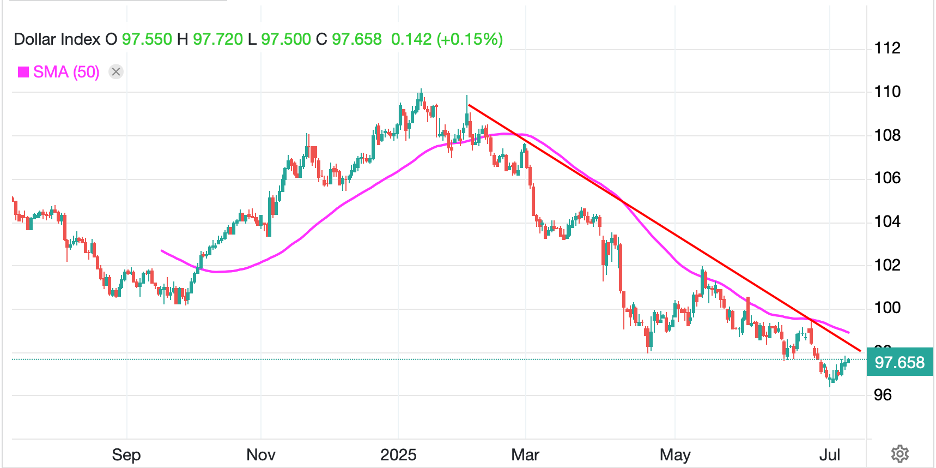
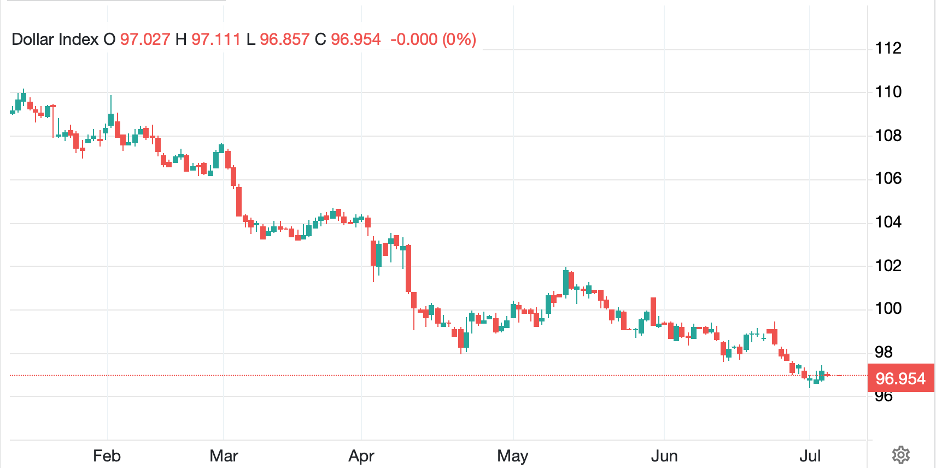
A knock-on effect of this is that the dollar has been under pressure all year, having declined more than 10% vs. the DXY and 13% vs. the euro.  In fact, a key factor in the weaker dollar thesis is that international investors are either selling their US stocks or hedging the FX exposure with either of those weighing on the dollar.

Source: tradingeconomics.com

Now, so far, that seems a logical conclusion and I cannot argue with it.  However, as we look forward, is it reasonable to expect that to continue?  In this instance, I think we need to head back to the BBB, which is undoubtedly going to provide significant economic stimulus to many parts of the economy (sorry green tech), and seems likely to help energy, tech and industrial companies continue to perform well.  Much has been made of the idea that American exceptionalism has peaked but I wouldn’t be so sure.  Net, I am not convinced the US ride is over, at least not for the economy, although segments of the equity market could well be in for a fall.

The other narrative that I continue to hear is that Trump’s policy mix, of tariffs and deportations is going to drive inflation much higher.  In fact, Dr Torsten Sløk, who does excellent work, explained this weekend that tariffs would raise US CPI a very precise 0.3% this year.  Of course, the problem with this story is that, thus far, inflation readings have been quite tame, falling since Liberation Day.  It is certainly early in the game, but it is not at all clear to me that tariffs are going to be a major driver of inflation.  First, many companies have decided to eat the cost themselves, notably Japanese car manufacturers.  Second, M2 in the US has basically flatlined since April 2022 (see chart below), and if money supply is not growing, inflation will be hard-pressed to rise too quickly.

Now, it is certainly possible that the Fed increases the supply of money, although given the antagonism between Powell and Trump, I sense that the Fed will remain tighter for longer as they will make no effort to help the president if the economy starts to visibly slow down.  

But, if I were to try to estimate what Trump’s end game is, I think the following chart is the most important.

This chart is the reason Donald Trump is our president, and it is one that the punditry does not understand.  It is also the reason that US equities have performed so well.  Corporate profit margins in the US have grown unabated since Covid.

Now, let’s put these two thoughts together.  Corporate profit margins have exploded higher, currently at an all-time high of 10.23%.  Meanwhile, the share of GDP that has gone toward labor has fallen dramatically since China entered the WTO.  The result has been workers in the US have seen their incomes decline relative to corporate income.  While it is true that, technically, the punditry is part of the work force, they are asset owners as opposed to Main Street who have far less invested in the equity markets.  Ask yourself, how did corporates improve their margins so significantly?  The combination of immigrant labor and moving production offshore weighed heavily on US wage growth.  If you want to understand why President Trump is speaking to Main Street and using tariffs with reckless abandon it is because he is trying to adjust this process.  

If he is successful, I expect that equity markets will lag other investments as those profit margins are likely to decline. If they just go back to pre-Covid levels of 6%, that represents a huge amount of money in the pockets of consumers.  Do not be surprised if the result is solid economic growth with lagging profits and lagging equity prices.  Too, a weaker dollar plays right into this game as it helps the competitiveness of US manufacturers both for domestic consumption and exports.

This is not the narrative, however.  The narrative continues to be that Trump’s tariffs are going to generate significant inflation and drive the economy into a recession.  In fact, just this morning I read that Professor Steven Hanke (a very smart fellow) now has a recession estimated at 80% to 90% probability.  All the uncertainty is preventing activity as corporate managers hold back on making decisions, allegedly.  Of course, now that the BBB is law, the tax situation is settled, and I will not be surprised to see investment return with clarity on that issue.

The narratives have been uniformly negative for a while.  Part of that is because many of the narrative writers objectively despise President Trump and cannot abide anything he does.  But part of that is because I believe the president is not focusing on the issues that market pundits have done for many years and instead is focusing on helping Main Street, not Wall Street.  Perhaps that is why Wall Street political donations were heavily biased toward VP Harris and every other Democrat.

I hope this made some sense to you all, as I try to keep things in context.  In addition, as it is Sunday evening, I expect tomorrow morning’s note to be quite brief.  Love him or hate him, President Trump clearly hears the sounds of a different drummer than the rest of the political class and has proven that he can get what he wants.  Do not ignore that fact.

Good luck

adf

Hard to Resolve

The OECD has declared
That growth this year will be impaired
By tariffs, as trade
Continues to fade
And no one worldwide will be spared
 
The funny thing is, the US
This quarter is showing no stress
But how things evolve
Is hard to resolve
‘Cause basically it’s just a guess


The OECD published their latest economic outlook and warned that global economic growth is likely to slow down because of the changes in tariff policies initiated by the Trump administration.  Alas for the OECD, the only people who listen to what they have to say are academics with no policymaking experience or authority.  It is largely a talking shop for the pointy-head set.  Ultimately, their biggest problem is that they continue to utilize econometric models that are based on the last 25-30 years of activity and if we’ve learned nothing else this year, it is that the world today is different than it has been for at least a generation or two.

At the same time, a quick look at the Atlanta Fed’s GDPNow forecast for Q2 indicates the US is in the midst of a very strong economic quarter.

Now, while the US does not represent the entire OECD, it remains the largest economy in the world and continues to be the driver of most economic activity elsewhere.  As the consumer of last resort, if another nation loses access to the US market, they will see real impairment in their own economy.  I would argue this has been the underlying thesis of the Trump administration’s tariff negotiations, change your ways or lose access, and that is a powerful message for many nations that rely on selling to the US.

Of course, it can be true that the US performs well while other nations suffer but that is not the OECD call.  Rather, they forecast US GDP growth will fall to 1.6% this year, down from 2.4% last year and previous forecasts of 2.2%.

But perhaps now is a good time to ask about the validity of GDP as a marker for everyone.  You may recall that in Q1, US GDP fell -0.2% (based on the most recent update received last Thursday) and that the media was positively gleeful that President Trump’s policies appeared to be failing.  Now, if Q2 GDP growth is 4.6% (the current reading), do you believe the media will trumpet the success?  Obviously, that is a rhetorical question.  But a better question might be, does the current calculation of GDP measure what we think it means?

If you dust off your old macroeconomics textbook, you will see that GDP is calculated as follows:

Y = C + I + G + (X – M)

Where:

Y = GDP

C = Consumption

I = Investment

G = Government Spending

X = Exports

M = Imports

In the past I have raised the question of the inclusion of G in the calculation, as there could well be a double counting issue there, although I suppose that deficit spending should count.  But the huge disparity between Q1 and Q2 this year is based entirely on Net Exports (X -M) as in Q1, companies rushed to over order imports ahead of the tariffs and in Q2, thus far, imports have fallen dramatically.  But all this begs the question, is Q2 really demonstrating better growth than Q1?  Remember, the GDP calculation was created by John Maynard Keynes back in the 1930’s as a policy tool for England after WWI.  The world today is a far different place than it was nearly 100 years ago, and it seems plausible that different tools might be appropriate to measure how things are done.  

All this is to remind you that while the economic data matters a little, it is not likely to be the key driver of market activity.  Instead, capital flows typically have a much larger impact on market movements which is why central bank policies are so closely watched.  For now, capital continues to flow into the US, although one of the best arguments against President Trump’s policy mix (and goals really) is that they could discourage those flows and that would have a very serious negative impact on financial markets.  Of course, he will trumpet the real investment flows, with current pledges of between $4 trillion and $6 trillion (according to Grok) as offsetting any financial outflows.  And in fairness, I believe the economy will be better served if the “I” term above is real foreign investment rather than portfolio flows into the S&P 500 or NASDAQ.

There is much yet to be written about the way the economy will evolve in 2025.  I remain hopeful but many negative things can still occur to prevent progress.

Ok, let’s take a look at how markets are absorbing the latest data and forecasts.

The barbarous relic and oil
Spent yesterday high on the boil
While bond yields are tame
These rallies may frame
A future where risk may recoil

I’ll start with commodities this morning where we saw massive rallies in both the metals and energy complexes yesterday as gold (-0.8% this morning) rallied nearly 2% during yesterday’s session and both silver (-1.4%) and copper (-1.7%), while also slipping this morning, saw even bigger gains with silver touching its highest level since 2012.  Copper, too, continues to trade near all-time highs as there is an underlying bid for real assets as opposed to fiat currencies.  Meanwhile, oil (+0.3%) rallied nearly 4% yesterday and is still trending higher, although remains in the midst of its trading range.  Given the bearish backdrop of declining growth expectations and OPEC increasing production, something isn’t making much sense.  Lower oil prices have been a key driver of declining inflation readings around the world.  If this reverses, watch out.

Turning to equities, yesterday’s weak US start turned into a modest up day although the follow through elsewhere in the world has been less consistent.  Tokyo was basically flat while Hong Kong (+1.5%) was the leader in Asia on the back of the story that Presidents Trump and Xi will be speaking this week as well as some solid local news.  But elsewhere in Asia, the picture was more mixed with modest gains and losses in various nations.  In Europe, despite a softer than expected inflation reading this morning, with headline falling to 1.9%, equity indices have been unable to gain much traction in either direction.  This basically cements a 25bp cut by the ECB on Thursday, but clearly the trade situation has investors nervous.  Meanwhile, US futures are pointing slightly lower at this hour (7:25), but only on the order of -0.2%.

Bond yields, which backed up yesterday, are sliding this morning with -2bps the standard move in Treasuries, European sovereigns and JGBs overnight.  We did hear from Ueda-san last night and he promised to adjust monetary policy only when necessary, although given base rates there are 0.5% and CPI is running at 3.5%, I’m not sure what he is looking at.  The very big picture remains there is too much debt in the world and the big question is how it will be resolved.  But my take is that won’t happen anytime soon.

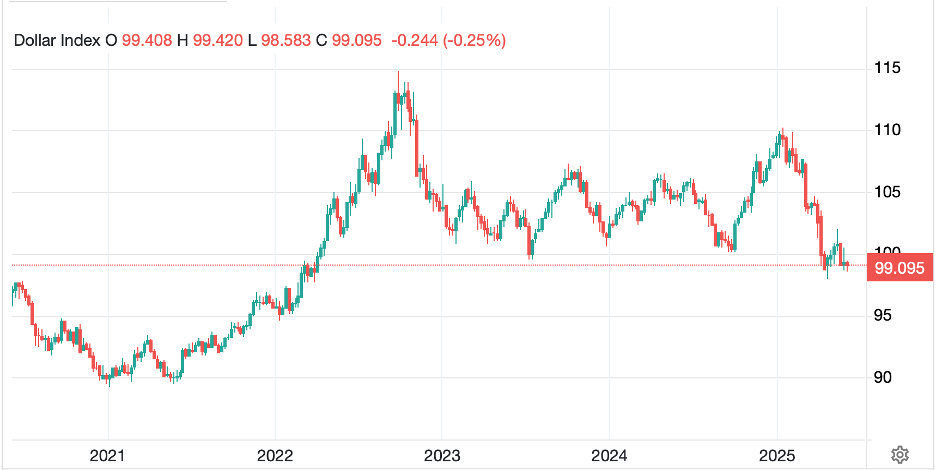
Finally, the dollar, which had been under pressure yesterday has rebounded this morning, regaining much of the losses seen Monday.  The euro (-0.5%) and pound (-0.4%) are good proxies for the magnitude of movement we are seeing although SEK (-0.7%) is having a little tougher time.  In fairness, though, SEK has been the best performing G10 currency so far this year, gaining more than 13%.  In the EMG bloc, PLN (-1.0%) is the laggard, perhaps on the election results with the right-wing candidate winning and now calling into question the current government there and its ability to continue to move closer to the EU policy mix.  It should also be noted that the Dutch government fell this morning as Geert Wilders, the right-wing party leader, and leading vote getter in the last election, pulled out of the government over immigration and asylum issues.  (and you thought that was just a US thing!). In the meantime, I will leave you with the following 5-year chart of the DXY to allay any concerns that the dollar is about to collapse.  While we are at the bottom of the range of the past 3 years, we have traded far below here pretty recently, let alone throughout history.

Source: tradingeconomics.com

On the data front, JOLTs Job Openings (exp 7.1M) and Factory Orders (-3.0%, 0.2% ex Transport) are on the docket and we hear from 3 more Fed speakers.  But again, Fed comments just don’t have the same impact as they did even last year.  In the end, I do like the dollar lower, but don’t be looking for a collapse.

Good luck

Adf
Gnashing and Wailing

The narrative writers are failing
To keep their perspectives prevailing
They want to blame Trump
But if there’s no slump
They’ll find themselves gnashing and wailing
 
Economists have the same trouble
‘Cause most of their models are rubble
The change that’s been wrought
Requires more thought
Than counting on one more Fed bubble


Investors seem to be growing unhappier by the day as so many traditional signals regarding market movement no longer appear to work.  Nothing describes this better, I think, than the fact that forecasts for 10-year Treasury yields by major banks are so widely disparate.  While JPMorgan is calling for 5.00% by the end of the year, Morgan Stanley sees 2.75% by then.  What’s the right position to take advantage of that type of knowledge and foresight?

One of the most confusing things over the past months, has been the growing dichotomy between soft, survey data and hard numbers.  But even here, it is worth calling into question what we are learning.  For instance, this week we will see the NFP data along with the overall employment report.  That data comes from the establishment survey.  It seems that just 10 years ago, more than 60% of companies reported their hiring data.  Now, that is down to ~43%.  Does that number have the same predictive or explanatory power that it once did?  It doesn’t seem so.

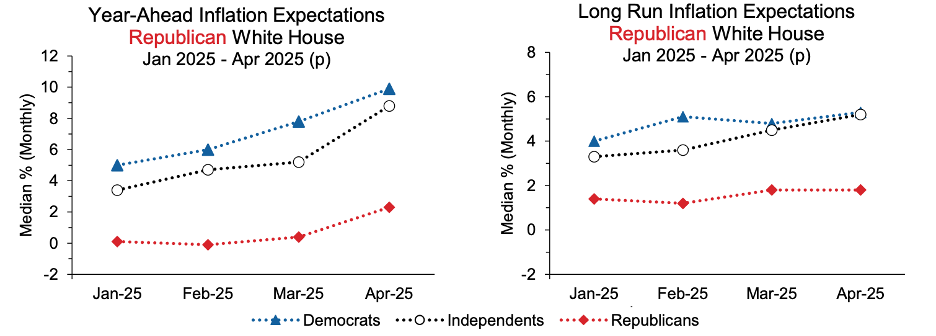
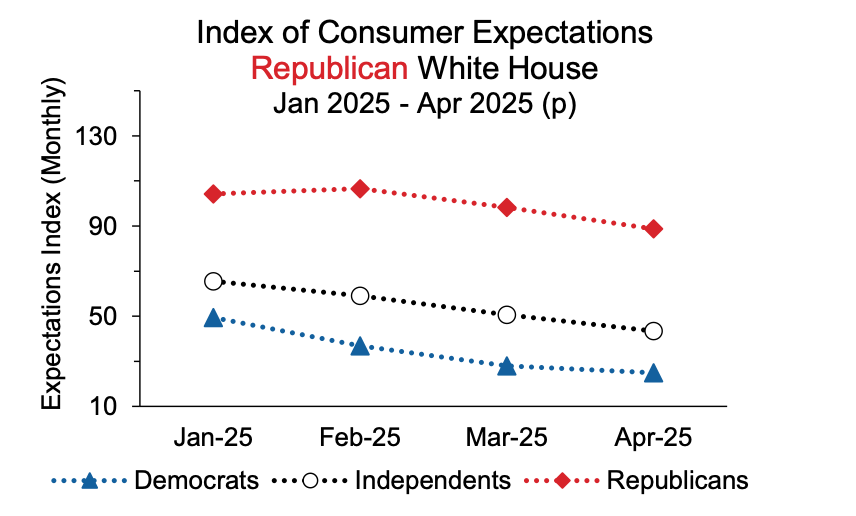
Too, if we consider the Michigan Sentiment data, it has become completely corrupted by the political angle, with the current situation being Democrats answering the survey anticipate high inflation and weak growth while Republicans see the opposite.  Is that actually telling us anything useful from an economic perspective let alone a market perspective?  (see charts below from sca.isr.unmich.edu)

But this phenomenon is not merely a survey issue, it is an analysis issue.  At this point, I would contend there are essentially zero analysts of the US economy (poets included) who do not have a political bias built into their analysis and forecasts.  Consider that if you are in a good mood generally, then your own perspective on things tends to be brighter than if you are in a bad mood.  Well, expand that on a political basis to, if you are a Democrat, President Trump has been defined as the essence of evil and therefore your viewpoint will see all potential outcomes as bad.  If you’re a Republican, you will see much better potential.  It is who we are and has always been the case, but it appears a combination of President Trump and social media has pushed this issue to heretofore unseen extremes.

There are two problems with this.  First, for most consumers of financial information, the decision matrix is opaque.  Who should you believe?  But perhaps more concerningly, as evidenced by the decline in the response rate to hard data, for policymakers like the Fed and Treasury, what should they believe?  Are they receiving accurate readings of the economic realities on the ground?  Is the job market as strong (or weak) as currently portrayed?  Is the uncertainty in ISM data a result of political bias?  And if politics is an issue in these situations, who is to say that answers to questions will be fact-based rather than crafted to present a political viewpoint?

I would contend that the reason the narrative is breaking down everywhere is that the willingness of investors, as well as the proverbial man on the street, to listen to pronouncements from on high has diminished greatly.  After all, the mainstream media, which had always been the purveyor of the narrative, or at least its main amplifier, has lost its luster.  Or perhaps, they have lost all their credibility.  Independent media, whether on X, Substack or simply blogs that are posted all over the internet, have demonstrated far more clarity and accuracy of situations than anything coming from the NYT, WSJ, BBG or WaPo, let alone the TV “news” programs.

We are on our own to determine what is actually happening in the world, and that is true of how markets will perform going forward.  I have frequently written that volatility is going to be higher going forward across all markets.  President Trump is the avatar of volatility.  As someone whose formative years in trading were in the mid 80’s, when inflation was high, and Paul Volcker never said a word to anyone about what the Fed was doing (and even better, nobody even knew who the other FOMC members were), the best way to thrive is to maintain modest positions with limited leverage.  The time of ZIRP and NIRP will be seen as the aberration it was.  As it fades, so, too, will the ability to maintain highly levered positions because any large move can be existential.

With that cheery opening, let’s take a look at what has happened overnight.  Friday’s US session was not very noteworthy with mixed data leading to mixed results but no real movement.  Alas, things have taken a turn lower since then.  Asian markets were weaker overnight (Nikkei -1.3%, Hang Seng -0.6%, CSI 300 -0.5%) with most other regional markets having a rough go of things as well.  Concerns over further tariffs by the US (steel tariffs have been raised to 50%) and claims by both sides of the US – China trade debate claiming the other side has already breached the temporary truce have weighed on sentiment overall.  Meanwhile, PMI data from the region was less than inspiring with China, Korea, Japan and Indonesia all showing sub 50 readings for Manufacturing surveys.

In Europe, equity markets are also generally softer (DAX -0.5%, CAC -0.7%) although the FTSE 100 (0.0%) has managed to buck the trend after data this morning showed Housing Prices firmed along side Credit growth.  As investors await the US ISM/PMI data, futures are pointing lower across the board, currently down around -0.4% at 7:15.

In the bond market, yields all around the world are backing up with Treasuries (+3bps) bouncing off the lows seen on Friday, although remaining below 4.50%, while European sovereigns have climbed between 3bps and 4bps across the board.  JGB’s overnight (+2bps) also rose, although the back end of that curve saw yields slip a few bps.  It seems the world isn’t ending quite yet, although there does not seem to be any cure for government spending and debt issuance anywhere in the world.

Commodity prices, though, are on the move as it appears investors are interested in acquiring stuff that hurts if you drop it on your foot.  Gold (+1.85%), silver (+0.9%) and copper (+3.6%) are all in demand this morning, the latter ostensibly benefitting from fears that the US will impose more tariffs on other metals thus driving prices higher.  But the real beneficiary overnight has been oil (+4.0%) which rose on the back of an intensification of the Russia – Ukraine war as well as the idea that OPEC+ ‘only’ raised production by 411K barrels/day, less than the whisper numbers of twice that amount.  As I watch the situation in Ukraine, it appears to have the hallmarks of an imminent peace process as both sides are pulling out all the stops to gain whatever advantage they can ahead of the ceasefire and both recognizing that the ceasefire is going to come soon.  But despite the big jump in the price of WTI, you cannot look at the chart below and expect a breakout in either direction.  If I were trading this, I would be more likely to fade the rally than jump on board the rise.

Source: tradingeconomics.com

Finally, the dollar is under the gun this morning, falling against pretty much all its major counterparts.  Both the euro (+0.7%) and pound (+0.6%) are having strong sessions although JPY (+1.0%) and NOK (+1.3%) are leading the way in the G10.  NOK is obviously benefitting from oil’s rally, while there remains an underlying belief that Japanese investors are slowing their international investments and bringing money home.  Now, the ECB meets this week and is widely anticipated to be cutting rates 25bps, but my take is, today is a dollar hatred day, not a euro love day.  As to the EMG bloc, gains are evident across regions with CZK and HUF (both +1.0%) demonstrating their beta to the euro although PLN (+0.5%) is lagging after the presidential election there disappointed the elites with the Right leaning candidate winning the job and likely frustrating Brussels in their attempts to widen the war in Ukraine.  In Asia, CNY (+0.1%) was relatively quiet but KRW (+0.5%), IDR (+0.8%) and THB (+0.9%) all benefitted from that broad dollar weakness.  So, too, did MXN (+0.65%) although BRL has not participated.

There is plenty of data this week culminating in the payroll report on Friday.

TodayISM Manufacturing49.5
 ISM Prices Paid70.2
 Construction Spending0.3%
TuesdayJOLTS Job Openings7.1M
 Factory Orders-3.0%
 -ex Transport0.2%
WednesdayADP Employment115K
 BOC Rate Decision2.75% (current 2.75%)
 ISM Services52.0
 Fed’s Beige Book 
ThursdayECB Rate Decision2.00% (current -2.25%)
 Initial Claims235K
 Continuing Claims1910K
 Trade Balance-$94.0B
 Nonfarm Productivity-0.7%
 Unit Labor Costs5.7%
FridayNonfarm Payrolls130K
 Private Payrolls120K
 Manufacturing Payrolls-1K
 Unemployment Rate4.2%
 Average Hourly Earnings0.3% (3.7% Y/Y)
 Average Weekly Hours34.3
 Participation Rate62.6%
 Consumer Credit$10.85B

Source: tradingeconomics.com

In addition, we hear from four more Fed speakers over five venues.  The thing about this is they continue to discuss patience as the driving force, except for Governor Waller, who explained overnight that he could see rate cuts if inflation stays low almost regardless of the other data.

The trade story remains the topic of most importance in most eyes it seems, although it remains a mystery where things will wind up.  The narrative is lost for all the reasons above, but I will say that it appears risk aversion is today’s theme.  The new part is that the dollar is considered a risk asset.  

Good luck

Adf
A New Paradigm

No matter the asset you trade
For weeks, every move’s been a fade
As headlines decry
Each thing Trump does try
Investors are feeling betrayed
 
They want to go back to the time
When markets did, every day, climb
But that time has passed
And I would forecast
We’ve entered a new paradigm


The following onslaught of charts from tradingeconomics.com are meant to highlight that for the past several weeks, basically nothing has gone on in markets.  Every day is like every other, and the only trend is a horizontal line.

Now, this is not to say that each movement is identical, just that any longer-term trends that may exist are not evident lately.  For traders, this can be terrific because there has been volatility which can be captured.  Of course, since much of the volatility has been headline bingo, that reduces the appeal.  But for longer term investors, it is a more difficult situation as those same headlines can call into question the underlying thesis of any or every trade.

Are the tariffs here to stay?  Or will they be overruled?  Is the “Big Beautiful Bill” going to be a benefit?  Or are there too many things hidden within that will impact the economy, markets and investor behaviors?  Is there going to be a Russia/Ukraine peace?  Is Iran going to sign a deal?  Will the US and China agree a trade deal?  Obviously, there are many very large issues currently outstanding with no clear resolutions in any of them as of now.  When you consider not only that the future is uncertain (which is always true) but the potential outcomes are diametrically opposed, it is easier to realize why markets are stuck in the mud.  But hey, nobody ever said trading was supposed to be easy!

There is, however, one issue I think worth highlighting that has seen an increase in discussion, and that is Section 899 of the reconciliation bill.  It is titled, “Enforcement of Remedies Against Unfair Foreign Taxes” and Bloomberg has a solid description here.  The essence of this clause is it increases taxes on nations, and individuals in those nations, who discriminate against US companies.  The idea is that Europe, especially, is busy enacting “Digital Services Taxes” which are designed to extract revenue from the large US tech companies that dominate particular spaces, like Meta, Google and Microsoft.  But these tax laws have thresholds such that essentially no other companies will be impacted.  This is the US response.  

Much of the discussion thus far has focused on the idea that this will discourage investment in US financial assets, potentially reducing the market for Treasury bonds and adding to the destruction of American exceptionalism in financial markets.  And it may well do that.  However, the thing to consider is that one of the reasons that the US has drawn so much investment is that there are so many investable securities here in the US, and that property rights remain sacrosanct.  Yes, taxation matters, but if you are a sovereign wealth fund with $100 billion in assets or more, where are you going to invest that money if not in the US, at least in some part?  And remember, this is only to be focused on nations with discriminatory taxes vs. US companies.  So, the Saudis, for example, or the Japanese need not worry.  It strikes me that at the margin, this could have a modest impact on prices, perhaps softening the dollar some and reducing future gains, but this is unlikely to end investment into the US.

Ok, let’s quickly run through the lack of overall movement last night.  Yesterday’s early US equity gains (triggered by the tariff ruling) faded all day and markets here closed very modestly higher.  In Asia, gains from yesterday were largely reversed as an appeals court stayed the ruling, so the tariffs remain in place as of now.  Thus Japan (-1.2%), Hong Kong (-1.2%) and China (-0.5%) basically reversed yesterday’s closings.  In Europe, though, things are a bit brighter. With gains across the board as inflation data released showed that it continues to drift lower across the continent.  This has encouraged traders to believe that more ECB rate cuts are coming, which was confirmed by the Bank of Italy’s Fabio Panetta, an ECB Governing Council Member, who exclaimed that inflation is nearly beaten.  Meanwhile, bank economists are now warning that further rate cuts need to come more quickly.  All this, of course, is music to equity investors’ ears.  As such, gains range from +0.3% (France) to 1.0% (Germany) and everywhere in between.  As to US futures, they are unchanged at this hour (7:30).

In the bond market, Treasury yields are unchanged this morning after sliding 8bps yesterday.  Interestingly, European sovereign yields, which also fell yesterday, have rebounded 3bps this morning despite the happy talk of more ECB rate cuts and the imminent death of inflation.  Too, last night saw yields decline in Japan (-3bps) and Australia (-11bps), following in the footsteps of yesterday’s Treasury market.

In the commodity markets, oil (+1.3%) is higher after EIA data yesterday showed modest inventory draws while gold (-0.75%) is giving back yesterday’s gains which came on the back of a weak dollar.  But as mentioned at the beginning of this piece, in the end, trends in both directions are on hold for now.

Finally, the dollar is firmer this morning, unwinding some of yesterday’s declines which grew throughout the day.  Right now, in the G10, the euro (-0.3%) is a pretty good proxy for the entire bloc, although JPY (+0.15%) is sticking out like a sore thumb.  In the EMG bloc, we see declines on the order of -0.5% (KRW, PLN, ZAR) although MXN (+0.2%) is also an aberration this morning.  Alas, I see no particular reason for this move.  However, as mentioned above, the recent trend is flat, although I cannot get over the idea that the dollar has further to decline going forward.

On the data front, this morning brings Personal Income (exp 0.3%), Personal Spending (+0.2%), PCE (0.1%, 2.2% Y/Y), and Core PCE (0.1%, 2.5% Y/Y) as well as the Goods Trade Balance (-$141.5B) all at 8:30.  Then we see Chicago PMI (45.0) and Michigan Consumer Sentiment (51.0) at 10:00.  There is one final Fed speaker this week, Atlanta’s Bostic this afternoon.  However, when it comes to the Fed, again yesterday we heard that patience is the watchword with no hurry to adjust policy right now.  As well, we learned that Chairman Powell had lunch with President Trump yesterday, where Trump asked him to lower rates, and Powell said they are following their long-proscribed tasks of responding to economic outcomes. 

There is nothing that seems likely to excite anyone today, so I look for a quiet session overall.  It seems unlikely that anything of note will be resolved, whether on a political or international relations basis, so look for a quiet session and a relatively early close as traders and investors head out for a summer weekend.

Good luck and good weekend

Adf

Bond Market blues

The story today is the court
And how it was able to thwart
The president’s aim
To alter the frame
Of trade, local firms, to support
 
Investors, though, cheered at the news
As tariffs had caused them to lose
Their faith that the Fed
Would cut rates ahead
Thus, ending the Bond Market Blues


I’m no attorney and so I have no opinion as to the legality of President Trump’s tariff impositions and whether they fit within the International Emergency Economic Power Act.  However, the Court of International Trade ruled that his tariffs were illegal and must be voided.  It was immediately appealed by the administration, so this fight is far from over.  You can be sure it will head to the Supreme Court.

However, within the extraordinary mass of US legislation on the books, there is at least one other way for President Trump to achieve his aims.  Within the still operational Trade Act of 1930, more commonly known as the Smoot-Hawley tariffs, is a key section, 338, with very clear presidential authority.  As per Law360, the below describes the law and the president’s powers accordingly:

Section 338 permits the president to impose “new or additional duties” of countries that have discriminated against commerce of the United States. Section 338 authority is triggered when the president finds that a foreign country has either (1) imposed an “unreasonable charge, exaction, regulation, or limitation” on U.S. products which is “not equally enforced upon the like articles of every foreign country”; or (2) “[d]iscriminate[d] in fact” against U.S. commerce “in respect to customs, tonnage, or port duty, fee, charge, exaction, classification, regulation, condition, restriction or prohibition” so as to “disadvantage” U.S. commerce as compared to the commerce of any foreign country.

Whenever the president finds such discrimination, Section 338 authorizes him to impose additional duties of up to 50 percent of the product’s value. If a country continues to discriminate against U.S. goods, the president may then move to block imports from that country.

It would be a great irony if President Trump’s invocation of old laws that remain on the books, like the Alien Enemies Act of 1798 with respect to deporting illegal aliens, or perhaps Smoot-Hawley as per the above, was the catalyst needed by Congress to address the fact that there is a lot of stale legislation on the books that no longer serves the nation’s current needs.  Of course, that would take a lot of work, and that is not Congress’s strong suit.

At any rate, for our purposes, the ruling last night had a pretty clear impact on US equity futures as per the below chart from tradingeconomics.com and has helped propel US futures higher by 1% or more across the board.

You won’t be surprised that the response to this ruling throughout Asia was mostly quite positive, (Nikkei +1.95, Hang Seng +1.35%, CSI 300 +0.6%, KOSPI +1.9%, India’s Sensex +0.5%) although there were some laggards in the region.  And, of course, we cannot ignore the fact that Nvidia reported better than expected earnings last night at ~4:45pm (the first move higher on the chart above) and explained that the future remained very bright for the company with ever higher growth expected.  Risk is on, baby!

So, the chattering classes are going to spend the day discussing how they ‘knew’ that Trump’s actions were illegal and that this ruling opens the door for ever higher stock prices and valuations.  But I wonder how this is going to impact other markets, bonds for instance.  This morning, we are seeing yields back up with Treasuries (+5bps) leading the way while European sovereigns are all higher by between 2bps and 3bps.  Too, JGB’s edged higher overnight as there is a growing feeling that absent Trump’s tariff onslaught, global economic activity is going to pick up dramatically.  And maybe that is what will happen.  

Certainly, metals prices are rallying across the board (Au +0.3%, Ag +1.1%, Cu +0.6%), an indication that demand for economically sensitive factors is anticipated to rise.  Oil (+0.3%), too, is rallying modestly although is showing no inclination to break from its recent trading range as per the below:

Source: tradingecomomics.com

There is an OPEC+ Group of 8 meeting this weekend at which they are expected to announce another increase in monthly production of 411K barrels/day.  A number of analysts have explained that these increases are in name only, and that members have been overproducing their quotas, so the quotas are now catching up.  Meanwhile, are we closer to a Ukraine/Russia peace treaty with the possibility of Russian oil sanctions being lifted?  It doesn’t seem that way, but things in that world move in mysterious ways.  However, if you look at the chart above, it strikes me that oil has found a relatively stable equilibrium value for now.

Finally, the dollar’s response to the court ruling on tariffs has been remarkably muted.  On the one hand, this ought not be a surprise.  After all, economists and analysts assured us all before the tariff announcements, that other currencies would decline sufficiently to offset the impact of the tariffs and they were completely wrong.  As well, we continue to hear that the dollar is losing its status as the global reserve currency and that international investors are fleeing Treasuries, and with that fleeing the dollar.  That, too, has been completely off base.

It is interesting that the dollar is little changed given the commodity market price moves, but with US equities leading the global markets higher, perhaps US exceptionalism, at least when it comes to stocks, is not dead yet.  Today’s biggest mover in the currency space is ZAR (+0.4%) which may be attributed to the rally in precious metals although the SARB is meeting today with a policy announcement (a rate cut of 25bps is expected) to come later this morning.  But beyond the rand, virtually every currency is +/- 0.1% or less today.  This is despite South Korea cutting rates last night by 25bps and indicating that future cuts are on the way.  Perhaps oil is not the only thing that has found an equilibrium.

On the data front, this morning brings a raft of data starting with the weekly Initial (exp 230K) and Continuing (1890K) Claims, the second look at Q1 GDP (-0.3%), with its version of PCE (3.7%, core 3.5%) and Real Consumer Spending (1.8%).  As well, because of the Memorial Day holiday, EIA inventory data is released a day late with a small build expected.  We have 4 different Fed speakers, but yesterday’s Minutes explained they were going to remain patient which has been the message since the Powell press conference, and actually before that, as the uncertainties from tariffs have given them no reason to act right now.

The one thing of which I am certain is that we have not heard the last of tariffs at this point.  As mentioned above, there are numerous ways to skin that cat, and you can be sure that President Trump’s legal staff is going to use them all.  As to the market impact, right now, euphoria is the vibe with hopes that tariffs will go away and Nvidia will lead the NASDAQ up another 10,000 points in the coming weeks.  It is hard to see the dollar coming under pressure if foreign investors are going to keep funds flowing in this direction, at least until the next surprising outcome with President Trump’s policies.

Good luck

Adf

Eighty-Sixed

The data remains rather mixed
But traders are still all transfixed
By tariffs and trade
As JGBs fade
And new ideas get eighty-sixed
 
Despite signs that peace in Ukraine
Is further away and hopes wane
It seems all that matters
Is whether Huang flatters
Investors, so stock markets gain


Apparently, at least based on yesterday’s equity market performance, concerns over the eventual outcome of the current global fiscal and monetary regimes remains far down everyone’s list of worries.  Rising inflation?  Bah, doesn’t matter.  Increasing tensions between Presidents Trump and Putin as Russia continues, and arguably increases its aggression?  No big deal.  But you know what has tongues wagging this morning?  Nvidia earnings are to be released after the close, and as we all know, if they are strong (everyone is counting on Jensen Huang, the CEO), then every other concern pales in significance.  After all, a global conflagration is no match in the imagination compared to your stock portfolio increasing in value!

Once upon a time, investors in the stock market sought companies that had good business models and good management who were able to grow their businesses.  These investors were buying a piece of a business in which they believed.  Analysts looked at metrics like P/E ratios and book value to determine if the price paid offered future opportunities as an investment, but the underlying company was the focus.  Of course, that is simply a quaint relic of times long ago, pre GFC.  Today, there is only one metric that matters, ‘NUMBER GO UP’!  While this concept was originally ascribed to Bitcoin and the crypto universe, it has spread across virtually all financial markets.  Nobody cares what a ticker symbol represents, they only care if the number next to the ticker symbol rises, and how rapidly it does so.  Welcome to the future.

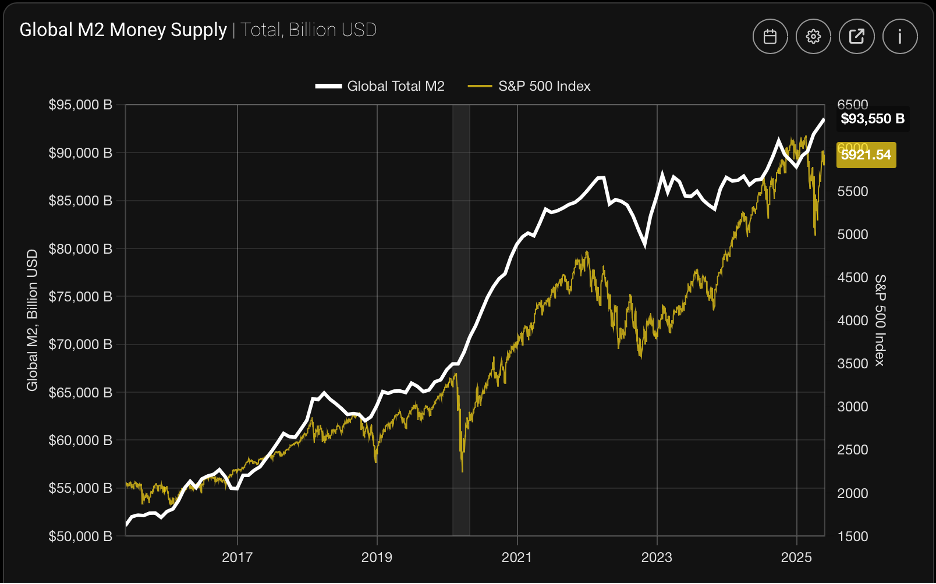
I highlight this because it has become increasingly clear that the macroeconomic landscape is an anachronism for analyzing financial markets.  At this point, whether or not a recession is on the horizon, or inflation is rising, or unemployment is rising or falling seems to have only a fleeting impact on market movements.  Rather, the true driver appears to be the flow of all that money that has entered the global financial system since the GFC.  The below chart from streetstats.finance shows the last 10 years of the growth in the global money supply and the corresponding move in the S&P 500.  You may not be surprised at the tight correlation.

My point is that all the news items that draw our attention may not matter at all in the broad scheme of things.  As long as money continues to be printed and injected into the financial system, while some assets will outperform others, the trend remains sharply from the lower left to the upper right.  Going back to my discussion yesterday, since the overriding goal of every global central bank is to ensure that their governments can issue bonds to finance their spending, I see no end to this trend.  While the speed of the increase may ebb and flow slightly, the direction will only change under the most egregious circumstances, something like the aftermath of WWIII.

In a funny way, this highlights that FX markets have the opportunity to be the most interesting trading markets going forward given the relativity of their underlying basis.  Assets, whether debt, equity or commodity, are all priced on demand functions while FX is priced on relative demand for each side of the cross.  Perhaps FX will be the last bastion of macroeconomic analysis.

But not today!  Starting with FX, the dollar is little changed to slightly higher this morning, consolidating yesterday’s gains but things are quiet.  In fact, across the main markets, the largest movement in either direction is NZD (+0.25%) after the RBNZ cut rates as expected by 25bps, but the market reduced the probability of another rate cut in July.  But away from that move, +/-0.1% is the norm today.  Discussion about tariffs continues to be the major talking point, but as of now, it appears nobody has a clue as to how things will evolve, so everybody is just hunkering down.  

Turning to equities, while yesterday saw a very large rally in the US, that sentiment was absent overnight with Asian markets generally drifting slightly lower although New Zealand (-1.7%) was clearly unhappy with the RBNZ mild hawkish view.  But elsewhere, movement was far less than 1.0%.  In Europe, it is a similar tale, very modest declines across the board as data showed German Unemployment rising slightly, Eurozone Consumer Inflation Expectations also rising slightly while French GDP disappointed on the downside, just 0.6% Y/Y.  You can appreciate the lack of enthusiasm there, although the story that Madame Lagarde is considering stepping down from the ECB to take over WEF should put a spring in the step of European investors as perhaps the next ECB president will understand economics and central banking.  As to US futures, they are little changed at this hour (7:35).

In the bond market, after a session where yields slid across the board yesterday, this morning brings a modest reversal with Treasuries (+2bps) right in line with most of Europe (+1bp across the board) although JGB’s (+5bps) suffered after another lousy long-dated auction last night where 40-year JGBs saw pretty weak demand overall.  The Japanese bond market remains a serious issue for many and a potential signal for the timing of next big move.  While risk assets rallied yesterday, nothing changed my description of the problems that exist globally.

Finally, in the commodity markets, oil (+0.7%) is modestly higher this morning but continues to trade within its range and shows no sign of breaking out in the near term.  Metals markets, which sold off aggressively yesterday have stopped falling, but are hardly rebounding, at least as of now.  

Let’s look at the data for the rest of the week though.

TodayFOMC Minutes 
ThursdayInitial Claims230K
 Continuing Claims1900K
 Q1 GDP (2nd estimate)-0.3%
FridayPersonal Income0.3%
 Personal Spending0.2%
 PCE0.1% (2.2% Y/Y)
 Core PCE0.1% (2.5% Y/Y)
 Goods Trade Balance-$141.5B
 Chicago PMI45.0
 Michigan Sentiment51.0

Source: tradingeconomics.com

In addition to the data, with all eyes really on Friday’s numbers, we hear from six more Fed speakers, although, again, will they really change their tune about patience in watching what the impact of tariffs are going to be on the economy?  I think not.  In the Fed funds futures market, the probability of a cut in June has fallen to just 2% while the market is now pricing just 47bps of cuts this year, the lowest amount in forever.  Unless the data completely fall off the map, I don’t see why they would cut at all, and that has just not happened yet.

The summer is upon us (although you wouldn’t know by the weather in the Northeast) and that typically leads to a bit less activity overall.  At this point, much depends on Congress and its ability to complete the budget bill to move the legislative process along.  Then the hard part of spending bills will be the next topic and you can expect a lot of screaming then.  In the meantime, though, I expect that we will hear of a number of other trade deals getting completed and a good portion of the trade anxiety ebbing from market views.  Alas, the peace/war equation is far more difficult to handicap as so many in power clearly benefit from war.

The prevailing view in the market is that the dollar has further to decline going forward as I think a majority of players are anticipating a recession in the US and the Fed to respond.  Under that scenario, a softer dollar feels right.  But is that the right scenario?

Good luck

Adf

Much More Desirous

The world that we knew ere the virus
Was different, and much more desirous
‘Cause we got to ease
Whenever we’d please
And ‘flation was rare as papyrus


A few disparate thoughts this morning as there doesn’t seem to be a real theme in markets.  

Starting with Chairman Powell’s comments yesterday regarding the Fed’s policy framework and how they were reviewing the current framework established in 2020, to see if it was still appropriate.  It was during that policy discussion that the Fed came up with the idea of average inflation targeting, rather than maintaining a stable rate.  However, Chairman Powell was candid yesterday when he explained, “The idea of an intentional, moderate overshoot proved irrelevant to our policy discussions and has remained so through today.”  Ya think?

Of course, being the consummate central banker, he made sure to explain that their future failures would not be their fault.  As explained in the WSJ by the Fed whisperer himself, Nick Timiraos, Powell explained that higher real interest rates might “reflect the possibility that inflation could be more volatile going forward than in the intercrisis period of the 2010sWe may be entering a period of more frequent, and potentially more persistent, supply shocks—a difficult challenge for the economy and for central banks.” 

However, unlike the pre-Trump era, it’s not clear the market paid much attention to Mr Powell.  Going forward, I do expect the Fed to have more market sway again, but it may be a little while before that is the case.  But I think it is worthwhile for us to understand how they are thinking.

While pundits expressed they were certain
The US is who would be hurtin’
From tariffs and Trump
It turns out the slump
Is elsewhere, as he’d been assertin’

One of the themes following President Trump’s “Liberation Day” tariff announcements amongst much of the punditry was that the US was shooting itself in the foot and the US economy would be the loser in the end.  My thesis had been that the US, as the consumer of last resort, was far more important to other nations’ economic growth than vice versa.  Now, we know that the first look at Q1 GDP in the US was a negative number, but we also know that was entirely the result of the uptick in imports that came ahead of the tariffs.  Meanwhile, private economic activity in the US grew and government activity shrank, both distinct economic positives.

Well, it turns out that the rest of the world is finding that when the US market is not as welcoming of their exports as previously seen, those economies find themselves under pressure.  Yesterday we saw weaker Eurozone GDP and last night Japanese GDP declined much more than expected, -0.2% in Q1 leading to a -0.7% Y/Y result.  The change in trade relations and weaker exports were the driver.  Now, this is just one quarter, and not necessarily a trend, especially if trade negotiations conclude on a timely basis.  But Japanese inflation remains sticky on the high side while growth is ebbing.  The BOJ is unlikely to change policy anytime soon as they, like most central banks, try to figure out the underlying trends. 

My take is this is going to be the scenario through the summer, and likely into the early autumn as trade deals get concluded but their impacts will take time to feel.  I suspect that central banks will be reluctant to be too aggressive in either direction given the propensity of President Trump to upset the applecart of policy decisions.  Ultimately, I see this as the backdrop that will result in more market volatility in both directions in response to the currently unknown policy announcements that are sure to come.  If you are a hedger, maintain those hedge ratios, even if they are a little pricey, the alternative could be far worse.  If you are a speculator, keep your positions smaller than you might think.  Wrong is only a Trump tweet away.

And finally, let’s talk of peace
Which most folks would like to increase
Could we really see
A Trump policy
That gets global fighting to cease?

I’m going to don my tinfoil hat for a paragraph or two here, but I think we must consider the possibilities that Mr Trump has far larger plans for a geopolitical realignment than most are aware.  I discussed the remarkable Iranian proposal to re-enter the brotherhood of nations yesterday.  The recent history of war shows that it is a) hugely profitable for a select number of companies and b) generally inflationary.  Mr Trump’s overtures throughout the Middle East this week, as he seems to be cementing relationships with the leadership there could well have a motive beyond lower oil prices.  I read a remarkable piece from Dr Pippa Malmgrenyesterday that pulled together many threads as to potential motivations for Trump’s activities and they were framed as the enemy is not necessarily Russia or China or Iran, but rather the deep-state in the US (I told you it was tinfoil hat territory).  There is a group in government who profits immensely from the ongoing war footing and who are not interested in seeing peace break out all over.  

I have no idea if Mr Trump can be successful in this endeavor, but if he is, the implications for markets will be significant.  Oil prices will be far lower, as will commodity prices generally given the result could easily see more access granted for mining/drilling/growing.  Inflation will remain under control which would reduce interest rates, and by extension remove some pressure from the US budget situation.  As well, reduced defense requirements would also help the budget.  The dollar would maintain its status as the global reserve currency and focus would return to economic growth rather than geopolitical mischief.  And this feels like a pretty good state for equities, at least those that are not defense focused.  Maybe crazy…but maybe not.

Ok, really quick around the world.  In equities, mixed is the best description of the US yesterday and Asia overnight with no real outstanding movers in either direction.  Europe is all green this morning, with gains on the order of 0.6%, but I think that is based on the idea the ECB is going to continue to cut rates going forward given inflation there remains low and growth is declining.  US futures, at this hour (7:15) are pointing slightly higher, 0.25%.

Bond markets rallied yesterday with Treasury yields sliding 10bps and falling another -3bps this morning.  European sovereign yields tracked Treasuries yesterday and are actually leading the way today with yield declines on the order of -4bps to -6bps across the entire continent and the UK.  Even JGB yields fell -2bps overnight.

In the commodity space, oil (+0.25%) bounced from its worst levels of the morning during the session yesterday but has created a new gap above the price to add to the really big gap from the beginning of April.

Source: tradingeconomics.com

My take is the market sees the possibility of lower oil prices going forward as supply is set to increase further.  There has been some discussion about how low oil prices will reduce capex in the space, and that is probably true, but what are oil companies going to do if they don’t drill for oil?  My view is they will still drill.  Meanwhile, gold is under pressure again as fear seems to be abating around the world.  This morning the barbarous relic is lower by -2.0% and that is taking both copper and silver along with similar declines.

Finally, the dollar is a bit softer this morning, with NZD (+0.5%) the biggest mover in either the G10 or EMG blocs.  JPY, EUR, MXN, ZAR are all just basis points different this morning than yesterday with a few gainers and a few laggards but no real trend to note here.  I think it is very clear Mr Trump would like to see the dollar’s value decline in the FX markets for competitiveness reasons, but right now, uncertainty is the driving force.

On the data front, yesterday’s big surprise in PPI (-0.5%) seemed to be the driving force behind the bond market rally.  But there was also a huge surprise in the Philly Fed New Orders sub-index, which jumped 41.7 points, a 4.3SD move and the largest in the history of the series.  Perhaps things aren’t as negative as some would have us believe.  As to this morning, we get Housing Starts (exp 1.37M) and Building Permits (1.45M) at 8:30 followed by Michigan Consumer Sentiment (53.4) at 10:00.  

It is very difficult to determine if the recent equity rally is just a bear market rally, or if things are going to be fine.  Given the still uncertain policy outcomes both domestically and globally, there are still many possible paths forward.  I wonder if gold, which had been a harbinger of concerns about the future is now telling us that the worst has passed.  Certainly, a movement toward peace in the Middle East is going to be a net positive for risk appetite, which when I translate that back to the dollar, implies my view of weakness going forward remains intact.

Good luck and good weekend

Adf

No Longer Concern

Seems tariffs no longer concern
The markets, as mostly they yearn
For Jay and the Fed,
When looking ahead
To cut rates when next they adjourn
 
Alas, there’s no hint that’s the case
As prices keep rising apace
In fact, come this morning
There could be a warning
If CPI starts to retrace


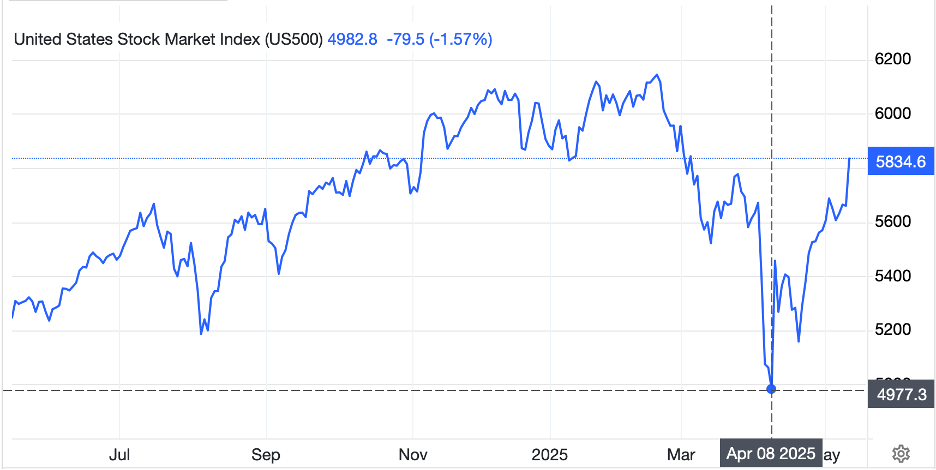
I am old enough to remember when President Trump’s actions on tariffs combined with DOGE was set to collapse the US economy.  I’m sure that was the case because it was headline news every day.  Equity markets fell sharply, the dollar fell sharply, gold rallied, and the clear consensus was the “end of American exceptionalism” in finance.  That was the description of how investors around the world flocked to the US equity markets as they held the best opportunities.  But the punditry was certain President Trump had killed that idea and were virtually licking their lips writing the obits for the US economy and President Trump’s plans.  In fact, I suspect all of you are old enough to remember that as well.  The chart below highlights the timing.

Source: tradingeconomics.com

But that is such old news it seems a mistake to even mention it.  The headlines this morning are all about how the stock market is now set to make new highs!  Bloomberg led with, Traders Model Bullish Moves for S&P 500 With Tariff Tensions Easing, although it is the theme everywhere.  So, is the world that much better today than a month ago?  Well, certainly the tariff situation continues to evolve, and we have moved away from the worst outcomes there it seems.  But recession probabilities remain elevated in all these econometric models, with current forecasts of 35%-50% quite common.  

Is a recession coming?  Well, the same people who have been telling us for the past 3 years that a recession was right around the corner, and some have even said we are currently living through one, are telling us that one is right around the corner.  Their track record isn’t inspiring.  In fact, these are the same people who are telling us that store shelves will be empty by the summer.  Personally, I take solace in the fact that the underlying numbers from the Q1 GDP data showed that despite a negative outcome, the positives of a huge increase in private investment and a reduction in government spending, were far more important to the economy than the fact that the trade deficit grew as companies rushed to stock up before the threatened tariffs.  Less government spending and more private investment are a much better mix for the economy’s performance going forward.  Let’s hope it stays that way.

But what about prices?  This morning’s CPI data (exp 0.3%, 2.4% Y/Y Headline, 0.3%, 2.8% Y/Y Core) will give us further hints about how the Fed will behave going forward.  As of now, there is no indication that the Fed is concerned about a growth slowdown of such magnitude that they need to cut rates.  In fact, Fed funds futures have reduced the probability of a June cut to just 8% and have reduced the total cuts for 2025 to just 2 now, down from 3 just a week ago.  Yesterday, Fed Governor Adriana Kugler reiterated the old view that tariffs could raise prices and reduce growth although gave no indication that cutting rates was the appropriate solution.  Arguably of more importance to the market will be Chairman Powell’s comments when he speaks Thursday morning.  My take here, though, is that the rate of inflation has bottomed and that the Fed is going to remain on hold all year long.  In fact, as I wrote back in the beginning of the year, I would not be surprised to ultimately see a rate hike before the year is over.  A rebound in growth and inflation remaining firm will change the narrative before too long, probably by the end of summer.  Of course, remember, I am just a poet and not nearly as smart as all those pundits, so take my views with at least a grain of salt.

Ok, let’s look at how markets have behaved in the new world order.  Yesterday’s massive US equity rally did not really see much follow through elsewhere although the Nikkei (+1.4%) had a solid session.  In fact, the Hang Seng (-1.9%) saw a reversal after a string of 8 straight gains as both profit-taking and some concerns about slowing growth in China seemed to be the main talking points there.  Elsewhere in the region, Malaysia and the Philippines had strong sessions while India lagged.  

In Europe, other than Spain’s IBEX (+0.8%), which has rallied purely on market internals, the rest of the continent and the UK are virtually unchanged this morning.  The most interesting comment I saw was from Treasury Secretary Bessent who dismissed the idea that a trade deal with the EU would be coming soon, “My personal belief is Europe may have a collective action problem; that the Italians want something that’s different than the French. But I’m sure at the end of the day, we will reach a satisfactory conclusion.”  That sounds to me like Europe is not high on the list of nations with whom the US is seeking to complete a deal quickly.  Finally, US futures are a touch softer this morning, although after the huge rallies yesterday, a little pullback is no surprise.

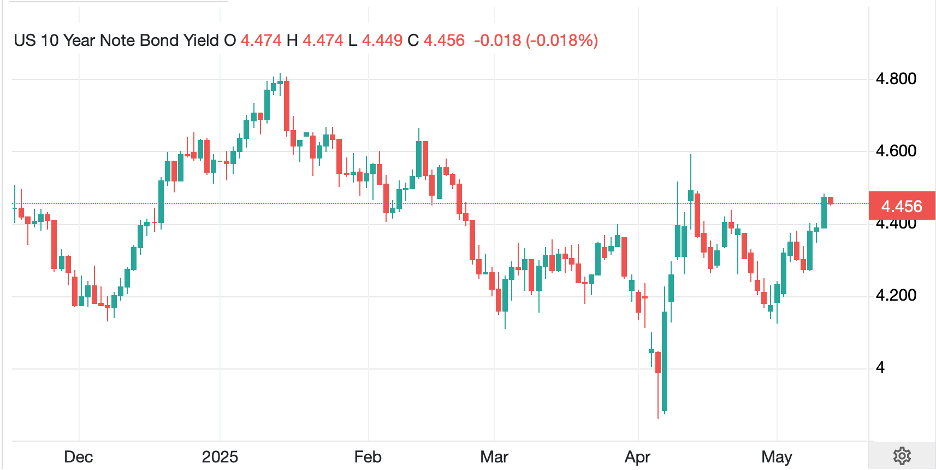
In the bond market, Treasury yields have backed off 2bps this morning, but in reality, they are higher by nearly 30bps so far this month as you can see below.

Source: tradingeconomics.com

This cannot please either Trump or Bessent but ultimately the question is, what is driving this price action?  If this is a consequence of investors anticipating faster US growth with inflation pressures building, that may be an acceptable outcome, especially if the administration can slow government spending.  But if this is the result of concern over the full faith and credit of the US government, or a liquidation by reserve holders around the world, that is a very different situation and one that I presume would be addressed directly by the Trump administration.  As to European sovereign yields, today has seen very modest rises, 1bp or 2bps across the board.  The biggest news there was the German ZEW survey which, while the Current Conditions Index fell to -82, saw the Economic Sentiment Index jump 39 points to +25.2, far better than expected.  It seems there is a lot of hope for the rearmament of Germany and the economic knock-on effects that will may bring.

In the commodity markets, oil (+0.6%) continues to grind higher as it looks set to test the recent highs near $64/bbl and from a technical perspective, may have put in a double bottom just above $56/bbl.  There is still a huge gap above the market that would need to be filled (trading above $70/bbl) in order to break this downtrend, at least in my mind.  But that doesn’t mean we can’t chop back and forth between $60 and $65 for a long time.  As to gold (+0.7%) after a sharp decline yesterday as the world was no longer scared about the future, it is bouncing back.  Whether this is merely technical, and we are heading lower, or yesterday’s price action was the aberration is yet to be determined.  Meanwhile, silver (+1.3%) and copper (+1.0%) are both having solid sessions as well.

Finally, the dollar is giving back a tiny bit of yesterday’s massive gains.  The euro (+0.2%) and pound (+0.25%) are emblematic of the overall movement although we have seen a few currencies with slightly stronger profiles this morning (SEK +0.8%, AUD +0.6%, CHF +0.5%).  In the EMG bloc, the movement has actually been far less impressive with ZAR (-0.45%) and KRW (-0.4%) bucking the trend of dollar softness but gains in MXN (+0.4%) and CZK (+0.4%) the best the bloc can do.  

One thing I will say about this administration is they have the ability to really change the tone of the discussion in a hurry.  If they are ultimately successful in reordering US economic activity away from the government and to the private sector, that is going to destroy my dollar weakness thesis.  I freely admit I didn’t expect anything like this to happen, but the early evidence points in that direction.  We will know more when Q2 GDP comes out and we find out if private sector activity is really increasing like the hints from Q1.  If that is the case, then the idea of American exceptionalism is going to make a major comeback in the punditry, although I suspect markets will have figured it out before then.

Other than the CPI, there is no other data and there are no Fed speakers on the docket.  While the dollar is soft this morning, I expect that any surprises in CPI will be the driver.  Otherwise, as I just mentioned, I am becoming concerned about my dollar weakness view.

Good luck

adf

Huge Fluctuations

There once was a war between nations
That led to some huge fluctuations
In markets worldwide
As pundits all cried
The world’s shaken to its foundations
 
In secret, though, pundits all cheered
‘Cause they all hate Trump, and thus steered
The narrative toward
This Damocles’ sword
That hung o’er the world and was feared
 
But now, twixt the US and China
There is just a bit less angina
Both sides, tariffs, slashed
And quite unabashed
These pundits said things were just fine-a


The wonderful thing about controlling the narrative is that it doesn’t matter if you are right or wrong at any particular time, because if you are wrong, you simply change the narrative.  At least that’s my impression looking here from the cheap seats.  At any rate, the news this weekend brought the end to the trade war, or at least a 90-day cease fire, as both the US and China slashed their announced tariffs dramatically, with US tariffs falling to 30% on Chinese goods and Chinese tariffs falling to 10% on US goods.  Between now and August, Treasury Secretary Bessent will be leading trade talks with Chinese Vice Premier He to try to come up with a more permanent solution.

In the interim, it will be interesting to see how the narrative evolves.  Certainly, I got tired of the different articles I saw explaining that there were no ships crossing the Pacific from China to the US and that store shelves would be empty by summer.  I wonder if we will see any of those claims retracted. (I’m not holding my breath).  I also wonder why that is the case simply from a mathematic perspective.  After all, annual US GDP is ~$28 trillion and imports from China in the twelve months from April 2024 through March 2025 were ~$444 billion, according to the FRED database.  So, does that mean that the other $27.56 trillion in economic activity was all services?  A look at the charts below created from FRED data shows that not only has the amount of imports from China not been growing lately, as a percentage of GDP, they have been shrinking.  I am not saying Chinese activity is unimportant to the US, just that the reduction in relative trade has been happening far longer than President Trump has been in office this time.

While certainly, low priced items could become a bit scarcer, it strikes me that there was more than a bit of hyperbole involved in those claims.  Of course, the next question is, will those ships start sailing again?  I guess we shall find out soon enough.

But stepping back a bit, I think it is critical to remember that prior to President Trump’s “Liberation Day” tariff announcements, it’s not as though the world trade system was all peaches and cream.  In fact, this weekend I listened to an excellent Monetarymatters podcast with guest George Magnus discussing the trade situation and why it was untenable in its current form before President Trump tried to change things.  He is far more eloquent and knowledgeable than a mere poet like me, and it is worth listening.  In the end, as others have also said, the status quo was unsustainable as both US government spending needs to be cut and the US reliance on China (or any other nation) for things of national security importance could not continue without grave results for our nation.  

I contend there is no easy way to change a system that has evolved over 80 years with goals changing during that period.  I also contend that the idea that a proverbial scalpel would have been a better method to do things, as it would not have created the market ructions we have all felt for the past few months, would never have worked.  Just like in changing the way the federal government works, the inertia in the trade system is far too great to be adjusted by tweaks here and there.  To make a lasting change, major disruptions are needed and that is what President Trump has been doing, disrupting things majorly.  Whether or not he will ultimately be successful is hard to say, but the odds of a change are greater now than before he started.  And almost everybody agreed that things were unsustainable.

One last thing you are sure to hear, especially now that the negotiations have begun is that the only reason is because President Trump “blinked” and couldn’t stand the pain of the market and the slings and arrows of the punditry.  However, it remains very difficult for me to look at the data that has been released of late, with Chinese growth slowing rapidly and Chinese stimulus unable to solve the problem and believe that President Xi hasn’t felt enormous pressure to speed up the economy.  It is clearly in both sides interest to come to a resolution, and that is what we should focus on going forward.

So, how did markets take the news?  Well, it should be no surprise that Chinese (+1.2%) and Hong Kong (+3.0%) shares both rallied sharply given they are the direct beneficiaries of the story.  Taiwan (+1.0%) and Korea (+1.2%) also fared well in the euphoria, but perhaps the biggest news in Asia was the ceasefire between India and Pakistan that was brokered by the US.  That saw Indian shares (+3.8%) and Pakistani shares (+9.0%) both explode higher.  It is certainly better that the explosions are in the relevant stock markets than on the ground!  As to the rest of Asia, markets were generally higher but not nearly as ebullient. Meanwhile, in Europe, screens are green (Germany +0.9%, France +1.35%, UK +0.4%) but the gains pale compared to some of the Asian price action.  US futures, though, are soaring at this hour (6:50) with gains between 2.4% (DJIA) and 4.0% (NASDAQ).

In the bond market, yields are soaring everywhere with Treasuries (+7bps) rising a similar amount to all European sovereigns (Bunds +7bps, OATs +6bps, Gilts +8bps) and JGBs (+8bps).  It appears that with money flowing rapidly back into the equity markets now that the trade war has ended RISK IS ON baby!!!  Either that or the only way to generate this new growth is by spending lots of government money which will require even more issuance.  I’ll take the first for now.

But that risk on trade is clear in commodities with oil (+3.6%) soaring higher to its highest level in three weeks and despite the idea that OPEC+ is going to increase production.  In fact, there are many things ongoing in the oil market that are far too detailed for this commentary, but in a nutshell, from what I understand, OPEC’s changes are simply catching up to the reality of what members have already been pumping and the market is now focusing on the renewed growth enthusiasm with the trade war on hold.  As well, if risk is no longer a concern, you don’t need to hold gold, and the barbarous relic is under huge pressure this morning, tumbling -3.5% and taking silver (-2.1%) with it.  Copper (+0.4%), however, is higher on the growth story.

Finally, the dollar is flying this morning.  on the one hand, given risk is in such demand, that doesn’t make much sense as historically, risk on markets tend to see the dollar weaken.  But my take is that all the stories about the end of American exceptionalism, with respect to US equity markets, got destroyed by the truce in the trade war, and now folks are buying dollars to buy US equities.  So, the euro (-1.4%) is under major pressure along with the pound (-1.1%) and the yen (-2.0%) is in more dire straits, as is CHF (-1.8%).  Other G10 currencies have also fallen, albeit not as far.  In the Emerging markets, only two currencies are rallying this morning, both benefitting from truces; INR (+0.7%) which is obviously benefitting from the military ceasefire and CNY (+0.6%) which is benefitting from the trade ceasefire.  As to the rest of the bloc, all currencies are lower between -0.6% and -1.6%.

On the data front, we see the following this week:

TuesdayCPI0.3% (2.4% Y/Y)
 -ex food & energy0.3% (2.8% Y/Y)
ThursdayInitial Claims230K
 Continuing Claims1890K
 Retail Sales0.0%
 -ex autos0.3%
 PPI0.2% (2.5% Y/Y)
 -ex food & energy0.3% (3.1% Y/Y)
 Empire State Manufacturing-10.0
 Philly Fed Manufacturing-12.5
 IP0.2%
 Capacity Utilization77.9%
FridayHousing Starts1.37M
 Building Permits1.45M
 Michigan Sentiment53.1

Source: tradingeconomics.com

As well as all the data, we hear from six Fed speakers, including Chairman Powell on Thursday morning.  I cannot help but think that things are a bit overdone this morning but perhaps not.  It is certainly positive that the US and China are speaking about trade, but it remains to be seen what can be agreed.  In the end, while this week is starting off well, I suggest not getting too excited yet.  As to the dollar, certainly this is positive news, but I have not changed my view that eventually it will slide.

Good luck

Adf