Fast or Slow Death?

As markets all take a deep breath
Concerns are that, just like Macbeth
The President will
The ‘conomy kill
The question is, fast or slow death?


Personally, I am hopeful that we can stop discussing tariffs after today.  It’s not that they will decrease in importance, but they will no longer be the primary topic.  Instead, they will be a secondary explanation for anything that anybody decides is wrong with the economy, or the country or the world.  Recession? Tariffs are the cause.  Inflation? Tariffs are the cause.  War? Tariffs are the cause.  Duke loses in the semis?  Tariffs are the cause.  

FWIW, which is probably not that much, my view is the market has absorbed this conversation and the correction we have seen over the past weeks in the equity market is the result of growing expectations of much slower growth or a recession.  Arguably, the biggest concern should be that US equity markets continue to trade at historically rich valuations and any negative catalyst can serve to both depress future expectations and compress multiples, and that’s how you get large equity market declines.

The thing about the tariff story is that while later today we will all find out the details, the actual impacts will take months, at least, to be determined.  For instance, the story that Israel has just decided to drop all tariffs on US made products, thus avoiding them on Israeli products is something I suspect we may see more frequently than now assumed.  Perhaps there would be no greater irony for all the naysayers than if this ‘end of free trade’ moment actually inspired a significant reduction in tariffs around the world as nations seek to retain access to the US.  I’m not saying this will be the case, but given the US is the consumer of last resort, running a nearly $1 trillion trade deficit, pretty much every other nation relies on the US as a market for some portion of their production.

Along these lines, I must ask, why is it that other nations, who apply tariffs and other non-tariff barriers like quotas or regulatory restrictions, to US products do so if tariffs are such a great evil?  Apparently when the French, for example, seek to protect their industries and farmers, it is healthy for the economy, but when the US does, it is world-ending.  Just sayin’

So, is the dip now to be bought?
Or are things still overly fraught?
The overnight session
Did naught for that question
As no one knows what Trump has wrought

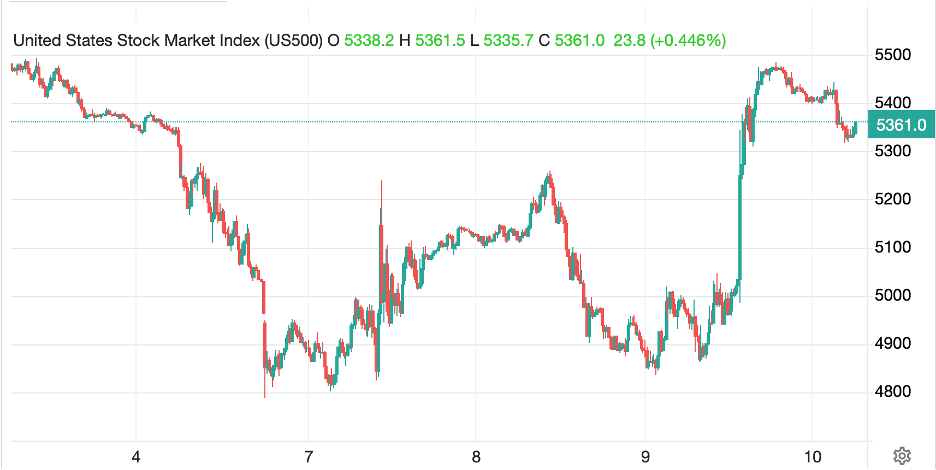
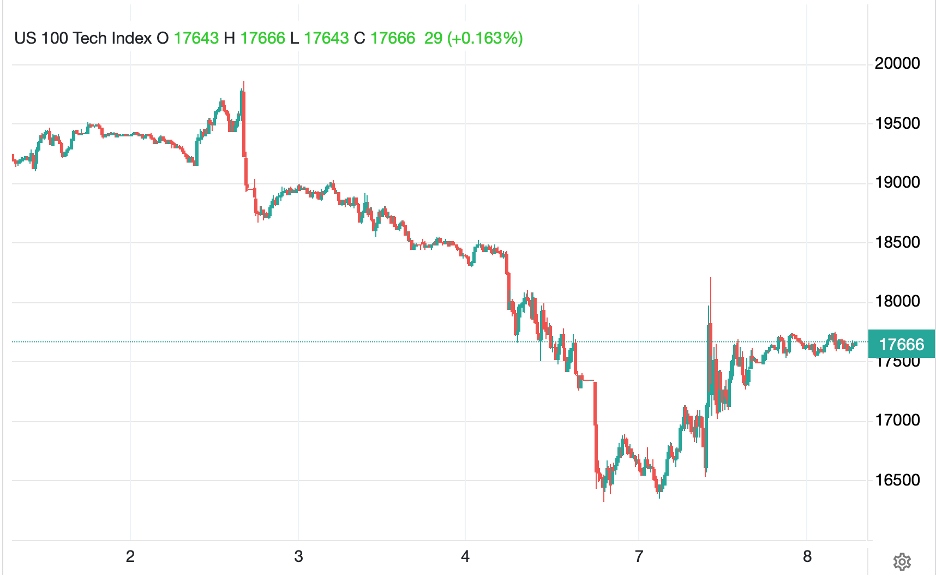
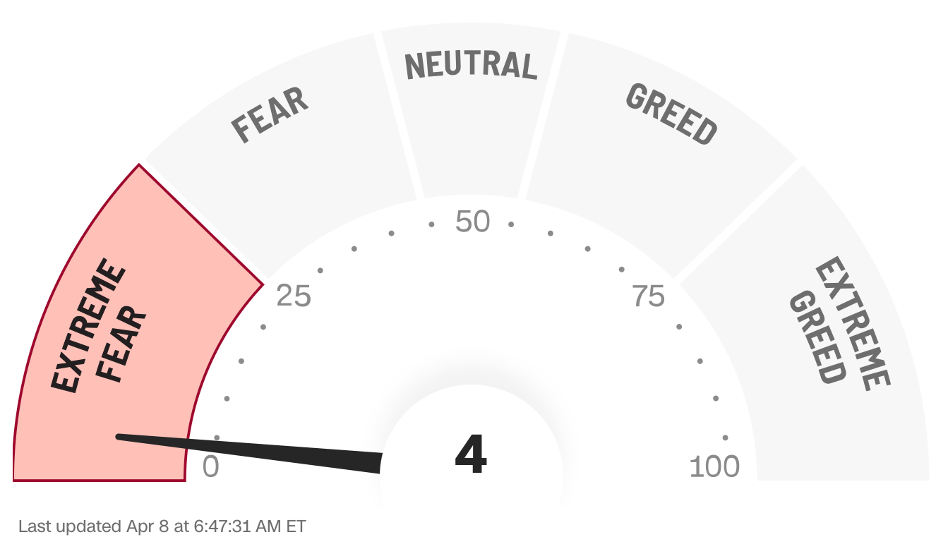
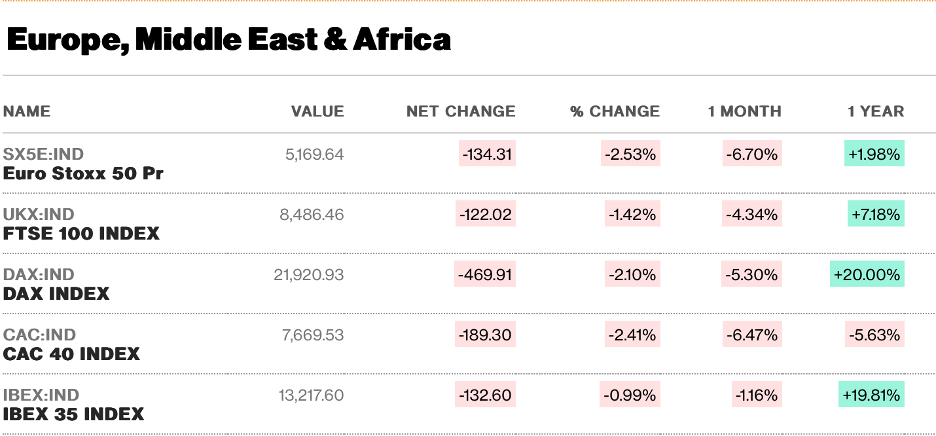
Since there are literally no other stories to discuss regarding finance and markets right now, let’s turn to the overnight and see how markets are behaving in the runup to the Liberation Day announcement.  Yesterday’s mixed, but mildly positive, session in the US led to a mixed session in Asia with no real trend.  Even within a nation (Nikkei +0.3%, TOPIX -0.4%) there was no clarity.  Chinese shares were basically flat, Korea and Singapore fell while India and Malaysia rallied.  No movements approached even 1.0% so it is probably fair to say we didn’t learn anything.  However, European bourses are under pressure across the board this morning led by the DAX (-1.3%) and FTSE 100 (-0.9%).  Clearly, there is significant concern that the US tariffs, which are set to come into force immediately upon their announcement, will have a significant negative impact on European companies.  Certainly, German auto makers, who rely greatly on the US market, are likely to be negatively impacted, but as I said, it remains to be seen what actually occurs.  I guess considering that European shares have been performing well of late, with gains on the order of 10% or more YTD, some investors have decided to take their money and run.  

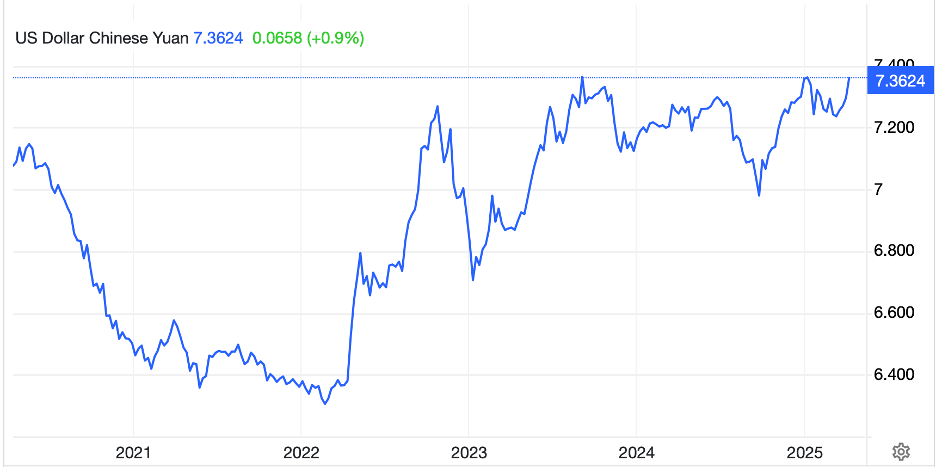
source: tradingeconomics.com

Meanwhile, US futures are pointing lower at this hour (7:10) down about -0.5% across the board.

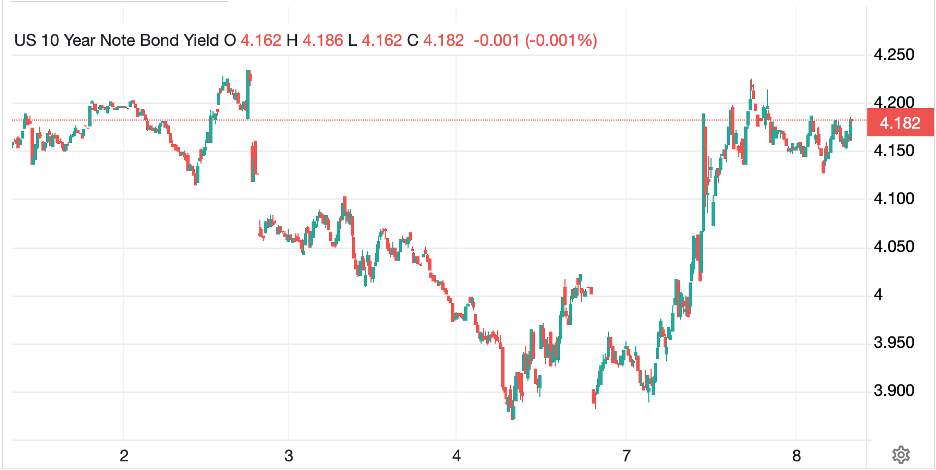
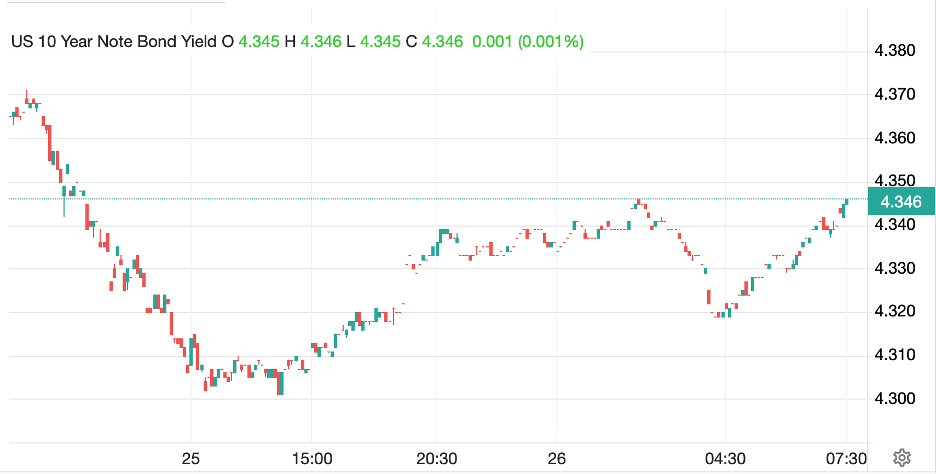
In the bond market, while there is a lot of huffing and puffing that tariffs will be inflationary, yields are sliding this morning with Treasury yields (-2bps) declining to their lowest levels since last October, and a similar amount to most European sovereigns.  I suppose bond investors are more concerned over the mooted recession than the inflationary impact of tariffs.  Too, JGB yields slid -3bps, back to their lowest level in a month as questions remain about the BOJ’s future path as well as Japanese growth prospects in the new trade regime.

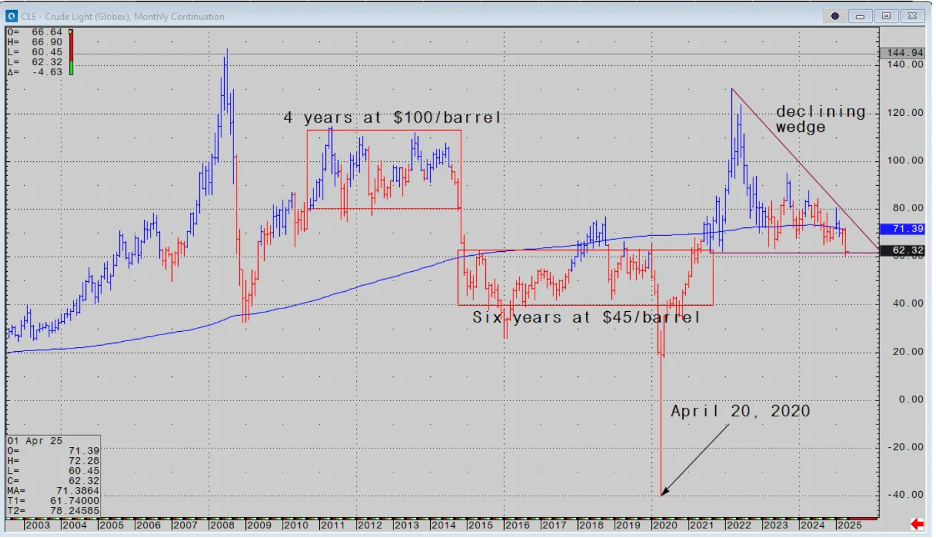
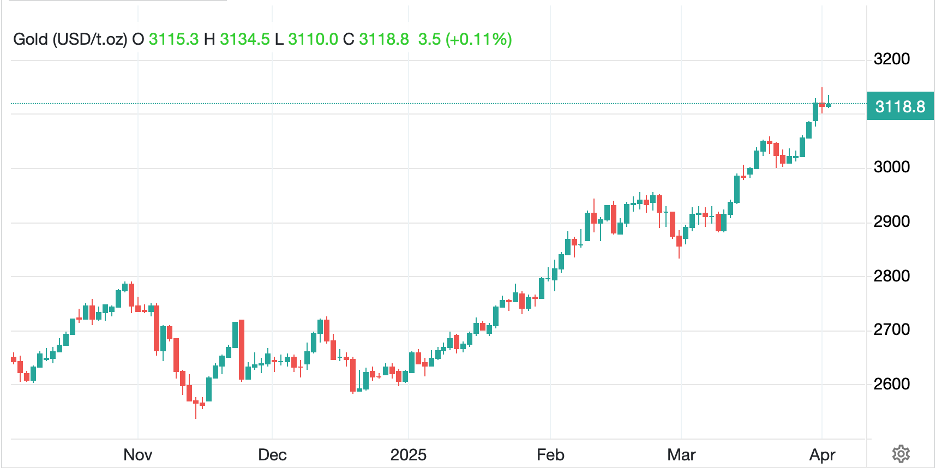
Turning to commodities, oil (-0.35%) has slipped a bit further but remains well up on the week as a story regarding the US moving more military assets toward the Middle East from Asia makes the rounds.  We cannot forget that President Trump has already initiated secondary sanctions on Venezuelan crude, and threatened to do so on Russian crude if Putin doesn’t agree to the ceasefire.  Meanwhile, Iran is always in Trump’s crosshairs while they remain a perceived threat to go nuclear.  As to the metals markets, gold (+0.1%) continues to edge higher with any pullbacks both short term and modest.  One look at the chart below shows how many more green days there have been than red ones over the past 6 months.  I see nothing to stop this trend.  As to the other metals, they are higher this morning and continue to trade well overall.  I believe the case can be made that going forward, commodity markets, and the shares of companies in the space, are set for some real outperformance in the new world order.

Source: tradingeconomics.com

Finally, the dollar is mixed as well, with some widely disparate movements seen.  For instance, NZD (+0.9%) is having a good day, perhaps because direct trade with the US is di minimus, or perhaps because it has been weakening so much for the past 6 months, down nearly 10% even after today’s rally, over that period, that it is a simple bounce.  At the same time, ZAR (-1.0%) is sliding despite the ongoing gold rally, although there are growing concerns over the outcome of the budget there and how it will be funded and impact the economy.  But in truth, as I look across the board, there are probably more currency gainers than losers this morning, which ironically is exactly the opposite of the forecast impact of tariffs by the US.  Just remember, as Yogi Berra allegedly explained, “in theory, there is no difference between theory and practice, in practice there is.” Detailed market outcomes based on economic theories rarely hold up.

On the data front, this morning brings ADP Employment (exp 105K) and Factory Orders (0.5%, 0.7% ex-Transport) as well as the EIA oil inventories.  Yesterday afternoon’s API inventories showed a large build, but expectations are for draws today.  We also hear from Adriana Kugler, Fed governor, but ironically, all the Fed talk is now about tariffs and not about monetary policy.

Today is a crapshoot, with no way to even guess how things will evolve.  Also, beware the initial reaction as it may not represent a new view, but rather the unwinding of current positions.  Until further notice, though, I still think the dollar has a slow decline in its future.

Good luck

Adf

Stress and Dismay

The only discussion today
Is how badly tariffs will weigh
On stocks and on growth
As certainly both
Will feel some more stress and dismay
 
But hopefully, once they’re in force
It will change the pundits’ discourse
‘Cause I’m sick and tired
That it’s now required
We all, tariffs, hate or endorse


A funny thing happened on the way to the market collapsing yesterday, especially given the early morning portents, and that is the market didn’t collapse at all.  Equities opened lower and rallied all day with the Dow even having a quite respectable 1% gain when all was said and done.  I think the lesson that needs to be taken from this is markets have a tendency to get ahead of the news and reversals are pretty frequent.  In fact, this is a perfect example of ordinary market behavior, a sharp move in one direction is suddenly reversed for no obvious reason.  Certainly, there was nothing said or done yesterday that seemed a specific catalyst for a short-term rebound.  That, my friends, is simply how markets work.

However, for now, with tomorrow being President Trump’s “liberation day” when tariffs will be announced, they remain the major story across both financial markets and political narratives.  As I sit here in the cheap seats, observing the back and forth, what has become abundantly clear is that the politicization of economic actions is the true reality.  Yesterday I highlighted the difference between Democrat and Republican views on future inflation.  Reading through the commentary on X, as well as stories in Bloomberg and the WSJ, I think this is the same situation, with Democrats certain tariffs will be the downfall of the economy and lead to rampant inflation, while Republicans believe they will help the nation recapture lost manufacturing capacity.  Personally, I’m just looking forward to moving on to a different story as we have been discussing tariffs for more than two months straight and it is tiresome.

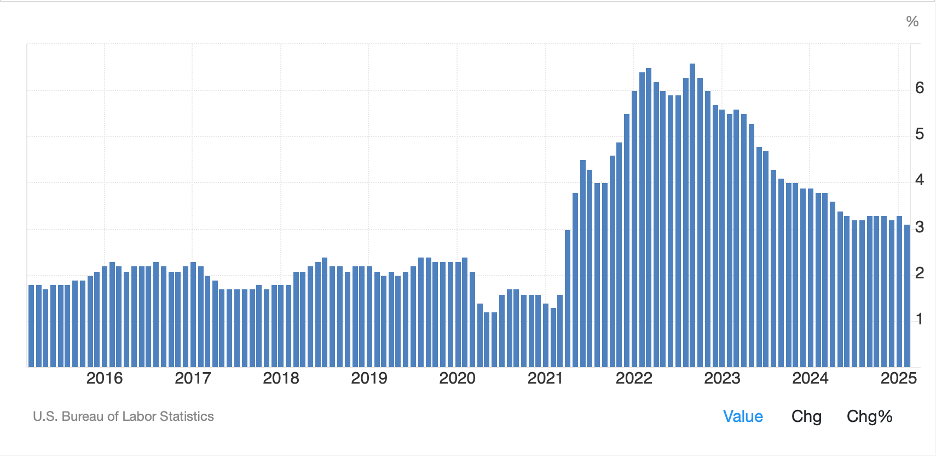
Here’s the one thing of which I am confident, however, and that is nobody has any idea what the impacts will ultimately be on either markets or the economy.  I maintain that pretty much every model that has been in use for the past two decades, all of which were developed based on data during a period of low inflation and declining interest rates as well as significant increases in central bank provided liquidity, no longer work.  After all, those underlying conditions no longer exist.  Inflation remains much higher than during the pre-pandemic decades;

Source: tradingeconomics.com

Interest rates are much higher;

Source: fred.stlouisfed.org

And central banks have been reducing net liquidity for some time now (think QT). 

Source: tradingeconomics.com

So, if all the underlying conditions have changed, it seems unlikely that the models based on those conditions will add much value.  After all, nobody really knows how elastic prices are for any given goods directly, nor how willing companies will be to sacrifice margin to maintain sales.  As such, forecasting short-term movements is a mugs’ game here.  In fact, yesterday’s price action is a perfect example of how things are not necessarily how they appear.

With that in mind, let’s see how yesterday’s risk reversal in US equity markets fed into the rest of the world.  Asian equities saw a wide range of price action overnight.  While Japan, Hong Kong and China were all tantamount to unchanged, Korea (+1.6%) and Taiwan (+2.8%) saw significant bounces while India (-1.8%) fell after concerns that President Trump’s mooted additional sanctions on any nation that buys Russian oil hit home as India buys, I read, 44% of their oil from Russia.  Meanwhile, in Europe, screens are green this morning with gains across the board of between 0.7% and 1.0%.  This is despite weaker PMI data, with every nation in Europe reporting a sub 50 manufacturing number.  However, inflation fell a tick more than expected with Core falling to 2.4% and headline down to 2.2% and this has encouraged traders to believe that the ECB will be cutting again later this month despite some commentary to the contrary from several ECB members.  As to US futures, at this hour (7:15) they are pointing lower by about -0.4% across the board.  

In the bond market, 10-year yields continue to slide around the world with Treasuries (-5bps) falling back to their lowest level in a month and prior to that since early December.  Too, European sovereigns are seeing yields fall sharply, with declines of between -6bps and -10bps as the combination of slowing inflation and weak PMI data has overwhelmed the previous concerns about German defense spending.  In fact, that is a story we have not heard in a while, eh?  Last week, that was the end of European bond markets, today it is ancient history!

Turning to commodities, oil (+0.1%) is consolidating after a sharp $2/bbl rise yesterday that was fomented by Trump’s threats to both Russia and Iran (he threatened to bomb them if they didn’t renounce their nuclear ambitions).  The thing about oil’s price action is since late 2022, it has remained in a trading range of $65/$80 more or less, so despite the large move yesterday, I would argue no new ground has been covered.  Certainly Trump’s efforts to open up more area for drilling is likely to weigh on prices over time, but over what timeframe remains to be seen.  As it is a day ending in “y”, gold is higher again, this morning by 0.3%, but there is no indication this trend is running out of steam.  The remarkable thing is the steadiness of the move.  However, the other two major metals, silver (-0.35%) and copper (-0.3%) have slipped a bit this morning.

Finally, the dollar remains confused.  Versus the euro (-0.25%) it is stronger, but versus the CHF (+0.25%) and JPY (+0.5%) it is weaker.  Now, you might say that is a sign of a risk-off trade, but equity markets are rallying in Europe along with bonds.  So, is this a move to havens or risk?  The biggest mover this morning is CLP (-0.9%) but it has been one of the biggest gainers YTD, so with copper soft, this looks a lot like some profit taking.  Otherwise, movements of +/- 0.2% are the order of the day.

Here’s a crazy theory, perhaps President Trump is seeking to drive the economy weaker in order to force the Fed to cut rates.  After all, that appears to be the Fed’s bias, but recent inflation data has made them uncomfortable to do so.  If Trump can drive up Unemployment, maybe it does the trick!

Ok, let’s see the data the rest of the week as yesterday’s Chicago PMI (47.6) while modestly better than expected really didn’t seem to matter that much.

TodayISM Manufacturing49.5
 ISM Prices Paid65.0
 JOLTS Job Openings7.63M
WednesdayADP Employment105K
 Factory Orders0.5%
 -ex Transport0.7%
ThursdayInitial Claims225K
 Continuing Claims1860K
 Trade Balance-$123.0B
 ISM Services53.0
FridayNonfarm Payrolls128K
 Private Payrolls110K
 Manufacturing Payrolls1K
 Unemployment Rate4.2%
 Average Hourly Earnings0.3% (3.9% Y/Y)
 Average Weekly Hours34.2
 Participation Rate62.4%

Source: tradingeconomics.com

In addition to all this, we hear from six Fed speakers including Chairman Powell Friday morning at 11:30am.  For today and tomorrow, tariffs will be the primary story, although it is not clear it is the primary driver.  However, once they are announced, I expect we will move onto the next big thing, although I have no idea what that will be.  But the one thing on which we can count regarding President Trump is there will be another big thing.  Stay hedged is all the advice I can give because uncertainty is extremely high.

Good luck

Adf

Nobody Knows

The punditry’s now out in force
As they hope, their views, we’ll endorse
When tariffs arrive
On Wednesday they’ll strive
To claim they were right, but of course
 
The problem is nobody knows
Exactly what Trump will propose
So, models will fail
While Trump haters wail
More chaos is all that he sows


Well, folks, it’s month and quarter end today and many are decrying that President Trump’s policies have derailed the bull market in risk assets.  And they are almost certainly correct.  Yet, at the same time, there has been a broad recognition across a wide spectrum of analysts and politicians that the situation he inherited was unsustainable.  Whether the 7% budget deficits, the $36+ trillion in government debt or the ongoing inflationary pressures, the only people who were happy were those who saw their equity portfolios rise against all odds.  (I guess the gold holders have been pretty happy too, in fairness.)

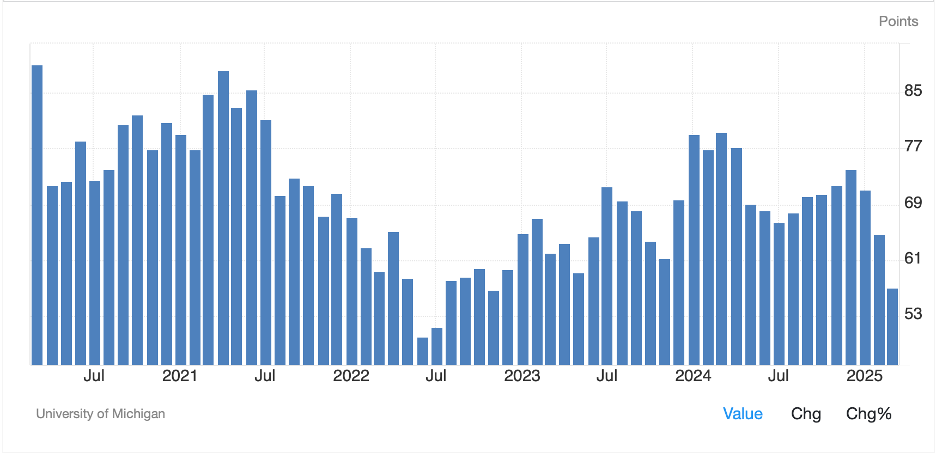
However, the underlying reality of a situation is rarely enough to alter a good story, or a story that somebody wants to tell.  For instance, the Michigan Consumer Survey was released on Friday, and it fell more than expected to a reading of 57.0, its lowest reading since July 2022, when inflation was peaking.

Source: tradingeconomics.com

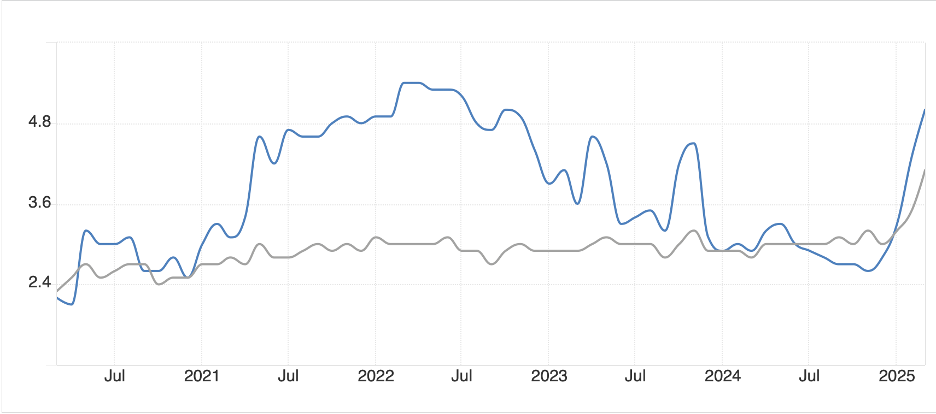
But the story that has been getting all the press is the extraordinary rise in inflation expectations.  As you can see below, both 1-year (blue line) and 5-year (grey line) have risen sharply in 2025.  Conveniently for the mainstream media this has been blamed on President Trump’s policies given their efforts to discredit everything the president does.

However, the Michigan Survey, while having a long pedigree, isn’t that large a survey.  As such, it is possible that non-economic factors may be impacting the results.  For instance, when the survey is taken, the respondents’ political leanings are asked as well.  Now, take a look at the data when split by political views as per the below.  Perhaps, we need to take this survey with a grain or two of salt as it appears the question may be seen as a way to express one’s opinion about the current administration rather than unbiased views of future inflation.

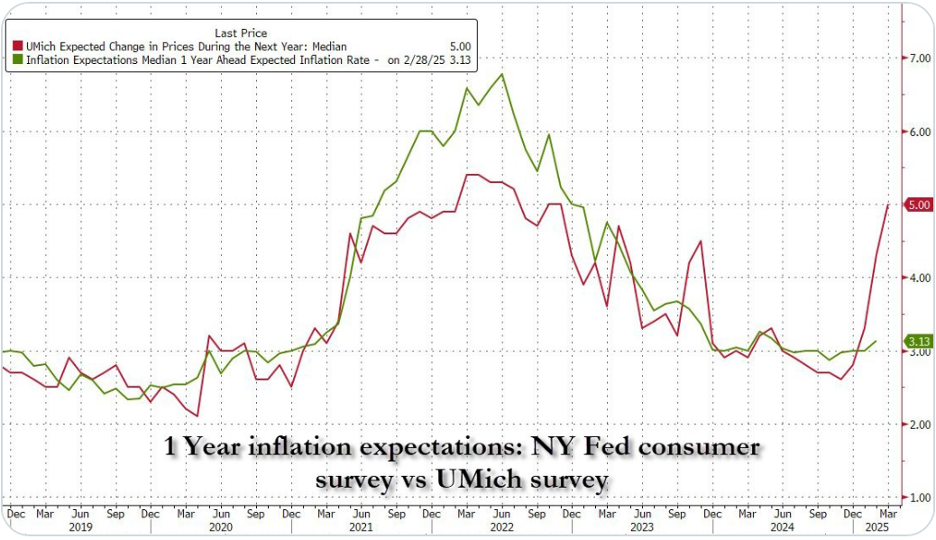
This is especially true when we look at other measures of expected inflation, like the NY Fed’s Consumer inflation survey shown below with the green line compared to that Michigan survey in red.

Source: zerohedge.com

My point is, we need to be careful to notice the non-economic factors that enter into things like expectations surveys.  As well, the idea that inflation expectations are a critical driver of future inflation, although a staple of current central bank thinking, does not have much empirical backing.  For instance, my friend Mike Ashton, the Inflation Guy™, explained in this article way back in 2015, that inflation expectations do not have much empirical proof of effectively forecasting future inflation.  But perhaps, if you don’t believe him, you will consider a scholarly paper by a Fed economist, Jeremy Rudd, written in 2021 that is pretty damning with respect to the idea that the Fed relies on this data as part of their policy toolkit.  

In the end, the one truism of which I am highly confident is that pretty much all the models that have been utilized for the past twenty plus years are no longer reflective of the reality on the ground today.  Not just for inflation, but for growth and trade and every other aspect.  President Trump has not merely upset the applecart; he has broken it into pieces and burned them all to cinders.  All the fiscal problems mentioned above are still extant, but President Trump appears set on changing them in the direction desired by almost all mainstream economists.  They don’t like his methods, but it’s not clear how changes of this magnitude can be made smoothly.  So, perhaps the proper question is just how rough things are going to be.  If the overnight session is any indication, they could get pretty rough.

The dominant feature today
Is fear is what’s now holding sway
As markets decline
More pundits consign
The blame on Trumps tariff pathway

Investors have risk indigestion this morning, as their appetite to own equities anywhere in the world has significantly diminished.  After a rough week ending session on Friday in the US, equity markets in Asia have almost universally declined led by Tokyo (-4.05%) but with sharp declines seen in Korea (-3.0%), Taiwan (-4.2%), Australia (-1.75%), Malaysia (-1.45%) and Thailand (-1.5%).  Chinese (-0.7%) and Hong Kong (-1.3%) shares also fell, although perhaps not quite as far as others.  The entire conversation today is about President trump’s promise to impose tariffs around the world on Wednesday, with many analysts trying to estimate what damage will occur despite no clarity on the size and breadth of the tariffs.  But investors have decided that havens are a better place to hide for now.

European bourses are also sharply lower, although more in the -1.7% to -2.0% range, with every major index in Germany, France, Spain and Italy down by those amounts.  There continues to be a great deal of discussion amongst the European leadership about how they will respond to the mooted tariffs, but of course, like everybody else, they have no idea exactly what they will be.  As to US futures, at this hour (6:45) the picture is grim with declines between -0.6% (DJIA) and -1.3% (NASDAQ).  Right now, the only people who are happy are those holding puts.

Of course, in this risk-off environment, it should be no surprise that bond yields have slipped a bit as, at the margin, investors are flocking to own Treasuries (-5bps) and European sovereigns (Bunds -3bps, OATs -2bps, Gilts -4bps).  Even JGBs (-5bps) saw yields decline last night with any thoughts of the BOJ hiking rates in the near term fading away completely.  

On the other hand, commodities are finding a lot more interest this morning with gold (+1.15%) leading the way higher and proving itself to continue to be one of the most consistent safe havens available.  Interestingly, oil (+0.5%) is rallying this morning despite a number of Wall Street analysts upping their estimate of the probability of a US recession.  However, offsetting the potential future demand weakness is the news that President Trump is “pissed off” at Vladimir Putin for his ongoing aggression in Ukraine and seeming unwillingness to move to a ceasefire.  This has raised the specter of further sanctions on Russian oil output, potentially reducing supply.  As well, the Trump administration continues to tighten the noose on both Iranian and Venezuelan oil sales, so potentially reducing supply even further.  I guess this morning, the supply story is bigger than the demand story.

Finally, as we turn to the currency markets, the dollar is generally firmer this morning, although by widely varying amounts depending on the currency.  For instance, in the G10, NOK (-0.75%) is the laggard despite oil’s gains, followed by AUD (-0.6%) and NZD (-0.55%), with all three of these being major commodity producers at a time when commodities are doing well.  As to the rest of this bloc, JPY (+0.35%) is off its best levels, but behaving as a haven, and the others are just marginally changed from Friday’s closing levels.  In the EMG bloc, ZAR (+0.25%) is the exception this morning, clearly benefitting from gold’s ongoing run to new all-time high prices, but otherwise, most of these currencies are modestly softer (MXN -0.2%, PLN -0.2%, KRW -0.25%).

Speaking of currencies, though, there is an article on this morning’s Bloomberg website that is worth reading, I believe, for everyone involved in the FX market.  The gist of the article is something that I have been discussing for the past several years, the fact that market liquidity here, despite the extraordinary volumes that trade on average each day (currently estimated by the BIS at $7.5 trillion across all FX products) is not nearly as deep as might be anticipated.  

My observation from my time on bank desks was that while there was a great deal of electronic flow, likely driven by HFT firms seeking to extract the last tenth of a pip out of thousands of transactions, when a real client, generally a corporate, had a need to do something specific to address a business need, and that amounted to more than $100 million equivalent, the liquidity situation was far more suspect. 

My personal theory was as follows: bank consolidation reduced the net amount of risk-taking appetite as larger banks did not increase their risk-taking commensurate with the reduction that occurred by small banks being gobbled up.  Combining this with the introduction of high-frequency trading firms in the business, who had no underlying client base to whom they owed a price, and therefore, could turn off their machines in a difficult market, further reducing liquidity, led to a situation where liquidity was a mile wide and an inch deep.  My point is for all the corporates out there who have significant transactions to execute, you must carefully consider the best way to approach the situation to avoid a potentially significant increase in execution costs.

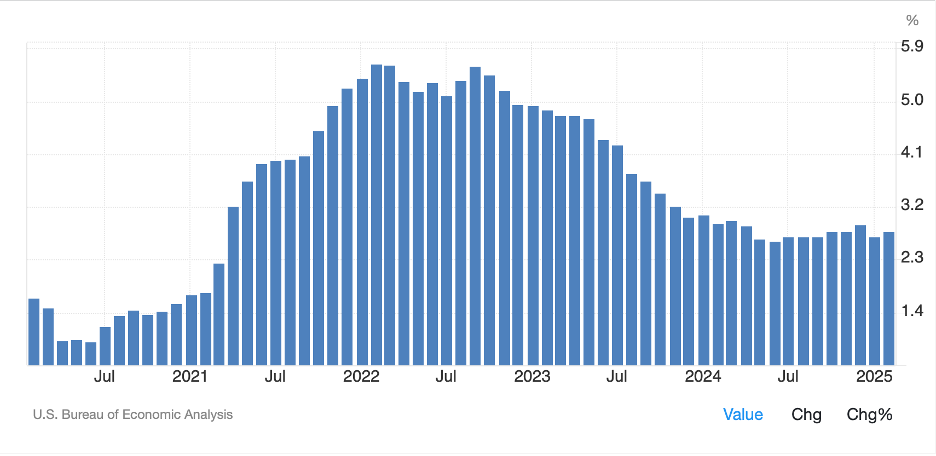
Turning to the data, before we look at this week, which ends with NFP, a quick word on Friday’s core PCE data, which came in at a hotter than expected 0.4% taking the YY number to 2.8%.  The Fed cannot be happy with this outcome as a quick look at the recent readings makes it hard to accept inflation is continuing its decline from the 2022 highs.  Rather a look at the below chart, at least to my eye, shows me a stability in Core PCE of somewhere between 2.5% and 3.0%, well above the Fed’s target range, and hardly a cause to cut rates further.

Source: tradingeconomics.com

As this note has already gotten a bit longer than I like, I will list the week’s data tomorrow but note that Chicago PMI (exp 45.4) is the only noteworthy data point to be released today.  

Absent a complete reversal of Trump’s tariff plans, I see nothing positive on the horizon for risk assets, and expect that equities will maintain, and probably extend the overnight losses while gold and bonds both rally, at least for now.  As to the dollar, my take is it will not benefit universally in this risk-off scenario, although there are currencies that will clearly suffer.  Remarkably, despite the performance of Aussie and Kiwi overnight, I do believe the commodity bloc has the best prospects for now.

Good luck

Adf

The Fools

In April, it starts with the Fools
But two days thereafter the rules
For importing cars
To where Stars and Bars
Fly will change with tariffs as tools
 
For Europe, the pain will be keen
At least that’s what most have foreseen
And poor crypto bros
Will find their Lambos
May soon cost a price quite obscene


While the political set continues to harp on the “Signal” story, markets really don’t care about political infighting between the parties.  Rather, their focus is keenly attuned to President Trump’s confirmation that starting on April 3rd, there will be a 25% tariff imposed on all imported autos from everywhere in the world.  This is particularly difficult for European auto manufacturers as they produce a far smaller proportion (VW 21%, BMW 36%, Mercedes 41%) of their vehicles in the US than do the Japanese (Honda 73%, Toyota 50%, Nissan 52%), although the Koreans will be impacted as well (Hyundai/Kia 33%).  Ironically, according to Grok, where I got all this information, GM only produces about 54% of their vehicles sold in the US, in the US, with the rest coming from Canada and Mexico.  As an aside, Tesla produces all their vehicles in the US.

Particularly hard hit are the specialty manufacturers like Porsche, Ferrari and Lamborghini, which produce none of their vehicles in the US.  Of course, given the price points of these vehicles, my sense is it may not really hurt their sales as if you are spending $250k on a car, you can likely afford to spend $312.5k as well.  In fact, in a funny way, these tariffs may enhance the Veblen effect where people will brag about paying the higher price as it puts it out of reach of more people.

Nonetheless, the action merely confirms that President Trump is very serious with respect to changing the world’s trading model.  I saw something interesting this morning in that Paul Krugman, who made his name, and won his Nobel Prize, based on work regarding international trade and was the prototypical free trader, has adjusted his views after recognizing that nations need to maintain some manufacturing capabilities for security reasons.  I assure you, if Krugman, who has been a vocal liberal critic of every Republican idea for the past twenty years, agrees with this policy, it will be very difficult for anyone to reject it.

In a perfect world (globo economicus?) free trade accrues benefits to all.  But we don’t live in that world and national priorities often supersede these issues.  The pandemic highlighted the weaknesses that the US had developed in its ability to manufacture key items necessary for its continued economic and defense survival. And remember this, for the world at large, their idea of free trade is they should be able to sell whatever they grow/manufacture into the US with no barriers, but US manufacturers need to be subject to barriers in order to protect other nations’ favored industries and companies.  That world is now history with new rules being written every day and most of them by Donald Trump.

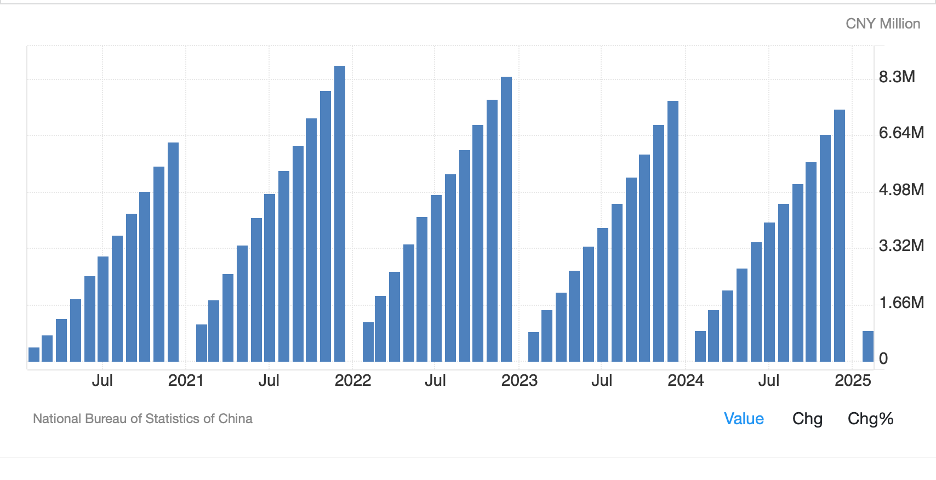
So how have markets responded to this tariff confirmation?  Not terribly well.  Yesterday’s US equity selloff was pretty significant led by the NASDAQ’s -2.0% decline.  In Asia, the Nikkei (-0.6%) also sold off as did Korea (-1.4%), Taiwan (-1.4%) and Australia (-0.4%).  On the other hand, both China (+0.3%) and Hong Kong (+0.4%) managed a better session, seemingly as a rebound against declines in the previous session with the only news showing that Chinese industrial profits fell by -0.3% compared to a Y/Y decline of -3.3% in December.  However, a quick look at a chart of this data for the past five years tells me they need to seasonally adjust it in order to get something meaningful, so I don’t think it really impacted markets.

Source: tradingeconomics.com

As to European shares, it should be no surprise that the tariff announcements have negatively impacted shares there with declines of between -0.2% (Spain) and -0.7% (Germany).  US futures though, at this hour (7:00) are little changed on the session.

In the bond market, Treasury yields continue to creep higher, up another 3bps this morning and back to levels last seen a month ago.  This cannot be helping Secretary Bessent’s blood pressure, although he very clearly has a plan in mind.  There is much stagflation discussion in the markets by the punditry as they assume tariffs will slow growth and raise prices and bonds are not the favored investment in that scenario.  Meanwhile, European sovereign yields are all sliding this morning, largely down -2bps, amid growth concerns on the back of the tariff announcements.  The one exception here is UK Gilts (+7bps) as the UK Budget announcement indicated slightly more gilt issuance would be necessary to fund the government’s spending plans.  However, there is a growing concern over the financial management of the Starmer government overall.

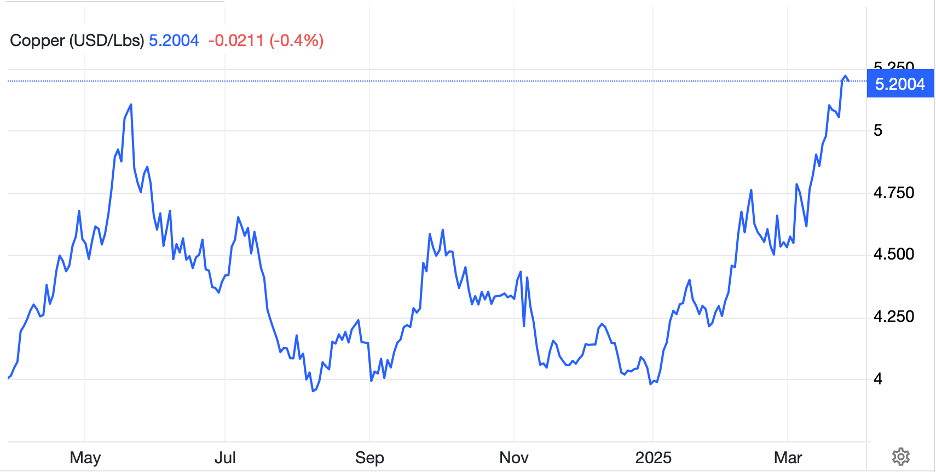
In the commodity markets, oil (-0.35%) is slipping from yesterday’s closing levels and continues to flirt with the $70/bbl level but has not been able to breech it since late February.  Apparently, there are questions as to whether the auto tariffs will reduce demand.  Personally, I would think it is the opposite as more older, less fuel efficient cars will remain on the road here.  As to gold (+1.0%) after a several day pause, it appears that it is resuming its very strong trend higher.  You know what we haven’t heard about lately?  Ft Knox auditing.  I wonder if that is getting arranged or is now so old a story nobody cares.  Silver (+1.0%) is along for the ride although copper (-0.4%) is taking a breather after a breathtaking run to new all-time highs this year.  Look at the slope of the copper chart and you can see why it is pausing, at the very least.

Source: tradingeconomics.com’

Finally, the dollar is broadly softer this morning, with the euro, pound and Aussie all gaining on the order of 0.3%.  As well, NOK (+0.3%) is firmer after the Norgesbank surprised some and left rates on hold with a relatively hawkish message about the future.  But there is weakness vs. the greenback around with JPY (-0.3%), MXN (-0.3%) and INR (-0.2%) all leaning the other way.  Another tariff related story is that India is planning to cut its tariffs in half for the US, a very clear victory for President Trump. 

On the data front, this morning brings the weekly Initial (exp 225K) and Continuing (1890K) Claims data as well as the third and final look at Q4 GDP (2.3%).  Part of the GDP data is Real Final Sales (4.2%) which is a key indicator for what happens here given consumption represents ~70% of the economy.  We do hear from Richmond Fed president Barkin this afternoon, but right now, Fed speakers are speaking into the void.

International statecraft continues to be the underlying thesis of global relations and President Trump’s goals of reshoring significant amounts of manufacturing and jobs along with it is still the primary driver.  There has been far less talk of the Mar-a-Lago Accord as that seems to be losing its luster.  If countries adjust their trade policies, Trump will continue in this direction.  While that may include short-term economic weakness and some pain, for both the economy and the stock markets, there is no indication, yet, he is anywhere near blinking.  One thing to keep in mind is that an overvalued stock market can correct by prices falling sharply, but also by prices stagnating for a long time while earnings catch up and multiples compress.  We may very well be looking at the latter scenario, so no large gains nor losses, just choppy markets going forward.  As to the dollar, lower still seems the direction of travel overall from current levels, but probably in a very gradual manner.

Good luck

Adf

Demoralizing

Complaints among traders are rising
That markets are demoralizing
Liquidity’s shrinking
And now they are thinking
They might need to alter trade sizing
 
But can anyone be surprised
That markets are not immunized
From ongoing impacts
Of tariffs and new tax
Which President Trump advertised?


While headlines around the world have focused on the ongoing trade war negotiations, and peace talks between Russia and Ukraine and all of the political machinations in the US as President Trump continues to fight both the courts and Democrats to implement his agenda, markets are generally at a loss as to what to do.  Is the news bullish for stocks?  Bearish? What about bonds or the dollar or oil?  I cannot remember a time when there was so little clarity on expected future outcomes.  Well, I can actually, but it was a very long time ago.  Prior to the Black Monday stock market crash in the US in October 1987, the reality was there were many views fighting to be heard, but rarely consensus as to what would happen in markets.  Successful traders were those with trading intuition and positions were sized much smaller because you never knew when you might need to reverse course.

Since then, however, we have seen a steady diet of central bank intervention every time there is an indication that growth may be slowing, or markets may be having a bad day.  This process went into overdrive in the wake of the GFC (which, BTW, was a product of that central bank intervention warping markets) when QE was implemented in the US and then elsewhere throughout the G10.  In fact, then Chairman Bernanke was explicit that this was his goal.  He called it the portfolio rebalance channel and the idea was the Fed would buy all the Treasuries, driving yields lower and promise to keep rates very low for a long time thus forcing encouraging investors to move up the risk scale to corporate debt, high-yield debt and equities.  As well, QE pumped enormous amounts of liquidity into the financial system.  This combination of actions led to a huge expansion of risk taking and the creation of strategies like risk parity which were designed to lever up assets to increase returns.

It was all great as long as the Fed and other central banks kept expanding the available liquidity.  Alas, trees don’t grow to the sky and when the Fed, in 2018/19 tried to finally reduce the balance sheet and initiated their first QT program, things got hairy in September and halted them in their tracks.  It turns out that markets had become addicted to liquidity continually increasing and like any addict, responded negatively to the loss of its fix.

Of course, Covid ensued and the next gusher of liquidity, this time both fiscal and monetary, was initiated by governments and central banks around the world, so any idea that investors and traders were chastised by the events of 2019 were quickly forgotten and position sizes ramped up again along with market performance.

But there is a new sheriff in town, as has been mentioned by many in the Trump administration, and the old rules are not likely to work in the new environment.  As the US government has taken hold of virtually all the market’s bandwidth, relegating the Fed to a sideshow, traders and investors are suddenly finding that the old ways of doing things, buy the dip and lever up, are no longer the best way to get along.  With the ongoing efforts by the Trump administration to shrink the government and reduce flows to financial markets, the lessons of the post-GFC financial market are losing their validity.  

This was perfectly expressed in a Bloomberg article this morning where traders were complaining that when they wanted to adjust a position they had to “wait longer to execute an order until there’s better liquidity in certain instances.”  Of course, we all know how difficult it is to wait so I’m sure that you are just as sympathetic towards these traders as I am.  There was an interesting chart in the article (below) showing that futures liquidity in S&P 500 contracts had fallen to the lowest in two years and was clearly at the lower end of the recent spectrum.  Doesn’t your heart just bleed?

I have been clear that President Trump is the virtual avatar of volatility and one of the key characteristics of a volatile market is that liquidity dries up.  While prices may not move much on a particular day, trends disappear and when moves occur, they tend to be large, and often discontinuous.  This is true in all markets, so be prepared as we go forward.

As it happens, yesterday was a day with very little net movement, although some decent gyrations intraday in some markets.  For instance, in the bond market, yields, which opened the day much higher fell sharply after weaker than anticipated data then rebounded throughout the day finishing little changed from Monday’s levels.  The chart below shows the 7bp range resulting in zero movement net.

Source: tradingeconomics.com

Too, US equity markets traded both sides of unchanged all day, with some choppiness but no net directional movement.

Source: tradingeconomics.com

My point is that this is likely a portent of the future.  There are too many known unknowns for traders and investors to have confidence in taking a side.  Now, we are only two months into the new administration, and they have been working hard to get things done quickly.  It is possible that the fight drags on for the rest of the year or longer, with no clear outcomes on key issues regarding extending the tax cuts and a finalized tariff policy.  In this case, I would anticipate market activity to continue to be lower volumes and choppy price action with a lack of direction.  Or perhaps, lower risk asset prices as investors get scared.  The lesson is the processes that had become normalized in the post GFC world are clearly no longer in play.  Hedge accordingly.

So, as we look at overnight activity, yesterday’s US market activity didn’t inspire much movement in Asia where we saw some gainers (Nikkei +0.65%, Hang Seng +0.6%) and laggards (CSI 300 -0.3%, India -0.9%) but no consistency at all.  The PBOC is subtly altering their monetary policy toolkit which some are seeing as a modest ease, but clearly equity markets didn’t get that message.  Meanwhile, comments from the newest BOJ member, Koeda, explained she was not sure her previous analysis of the economy leaving the zero-rate world is valid now that rates are all the way up to 0.50%!

European shares are softer on the continent, down about -0.5% in most places but UK shares have gained slightly, +0.2%, after inflation data was released a tick lower than expected across both headline and core measures.  While the BOE stood pat last week, as expected, this has encouraged some traders to believe that a cut could come sooner than previously thought.  As to US futures, at this hour (7:45), they are basically unchanged.

Treasury yields, after yesterday’s choppiness, are creeping higher today (+3bps) but that is not following through in Europe, where sovereign yields are all flat to slightly lower today.  It seems difficult for investors to get excited about Germany’s rearming plan if the overall economy remains in the doldrums.  As well, tariff tensions have investors uncertain what to do, so doing nothing is the default.

In the commodity markets, oil (+0.9%) is higher from the close yesterday, but yesterday’s close was slightly softer than when I last wrote.  As such, we have still not quite made it to $70/bbl.  There are many crosscurrents in this market between tariffs, sanctions, potential Ukraine peace and Trump’s goal of drill, baby, drill.  As to metals, the star of the show continues to be copper (+1.5% today, +15% in the past month) which is now trading at all-time highs across the entire curve.  This has helped support both gold (+0.3%) and silver (+0.3%) although the former doesn’t need that much help, I think.

Finally, the dollar is mixed this morning, with the pound (-0.3%) lagging on the idea that the BOE may ease again sooner than previously thought, while AUD (+0.3%), CAD (+0.2%) and CLP (+0.3%) are all firmer on the commodity market strength.  Here, too, I expect that liquidity will diminish and trends will be hard to find until there is more clarity on policy outcomes in the US.

On the data front, this morning brings Durable Goods (exp -1.0%, +0.2% ex Transport) and then the EIA oil inventory data with a small build expected.  We also hear from two more Fed speakers, but they are just not driving markets right now.  Choppiness is the rule here, with short-term direction very difficult to discern.  I am still on board my ultimate lower dollar, higher commodity train, but that is subject to change if policies change as well.

Good luck

Adf

Another Broadside

Investors don’t know where to hide
As Trump lands another broadside
Last night he did roil
All those who buy oil
From Vene, with tariffs applied
 
But yesterday, too, he amended
How tariffs would soon be extended
The lesson to learn
Is you’ll ne’er discern
His methods, so don’t be offended


Once again, the tariff game changed yesterday, although this time in two directions.  The first, and newest idea is that the US will impose “secondary” tariffs on all nations that buy oil from Venezuela.  The idea is to pressure Venezuela to concede to US demands by reducing the market for their one exportable commodity, at least the only one in demand (Tren de Aragua gang members, while a key export, have limited demand it seems).  This decision is being described as a new tool of statecraft, but it strikes me this is no different than previous international efforts like the apartheid movement, by isolating a nation for its behaviors.  Regardless, this was seen as bullish for oil prices.  The reason, as eloquently explained by Ole Hanson, Saxo Bank’s Head of Commodity Strategy, as per the below, is that Venezuelan and Iranian oil production has risen significantly over the past 4 years, offsetting the production cuts of the rest of OPEC+.  Take that oil out, and the demand/supply balance tips toward more demand.

It remains to be seen how this impacts specific countries, but apparently, China is the largest importer of sanctioned crude, so obviously, not a positive for President Xi.  Alas for Chevron, the deal they cut with the Biden administration to restart activity in Venezuela is looking shakier by the day.

But that is only one of the tariff stories.  The other was that there may be changes to previously expected actions come April 2nd, with imposition of tariffs being a bit more gradual nor as widespread as initially feared.  Recall, the idea of the reciprocal tariffs was almost every other nation charges higher tariffs on US goods than the US charges on their goods, so simply raising US tariffs to their levels would be effective.  The next step was focusing on the so-called “Dirty 15” nations that run the major trade surpluses with the US, but now he has indicated that some nations will get breaks.  I particularly loved this comment, “I may give a lot of countries breaks. They’ve charged us so much that I’m embarrassed to charge them what they’ve charged us, but it’ll be substantial, and you’ll be hearing about that on April 2.”

In any event, Trump’s specialty is his ability to think outside the box, or perhaps more accurately, break the box and move to a different container.  There is much consternation amongst business managers, and understandably, since planning is much more difficult in this environment.  However, as I have repeatedly written, the one thing on which we can count is continued higher volatility across all markets.  That condition requires a robust hedging plan for all those who have exposures, that is your only realistic protection.

Other than the tariff story, though, we have not seen much new information so let’s take a look at how markets have handled the latest tariff saga.  Yesterday’s broad US equity rally, on the back of a reduced tariff outlook, was followed by less positive price action in Asia.  While the Nikkei (+0.5%) rallied, potentially on the yen’s recent weakness, Hong Kong (-2.4%) was under great pressure on a weaker tech sector as earnings there were disappointing last quarter.  However, the CSI 300 (0.0%) which has far less tech in its makeup, didn’t budge.  As to the rest of the region, there were more gainers (Taiwan, Malaysia, New Zealand, Indonesia) than losers (Korea, Philippines, Thailand), so arguably the US rally and tariff story helped a bit.

In Europe, though, things are looking solid this morning with green everywhere on the screen and generally substantially so.  The DAX (+0.9%), CAC (+1.2%) and IBEX (+1.1%) are all having solid sessions after German Ifo Expectations data was released a touch better than expected at 87.7, but as importantly, 2 points better than last month.  However, a look at the history of this index shows that while recent data has turned mildly positive, compared to its long-term history, things in Germany remain in lousy shape.

Source: tradingeconomics.com

As to US futures, at this hour (7:10), they are little changed on the day as traders await the next pronouncements with great uncertainty.

In the bond market, though, yields have been climbing everywhere with Treasury yields higher by 2bps this morning after jumping 5bps yesterday.  In fact, we are back at the highest levels in a month, although still well below the peaks seen in early January or last spring.  But this move has dragged European sovereign yields along for the ride with across-the-board gains of 4bps-5bps and similar movement in JGBs overnight.  One of the alleged reasons for this bond weakness were hawkish comments from two ECB members, Slovakia’s Kazimir and Estonia’s Müller.  However, dovish comments from Greece’s Stournaras and Italy’s Cipollone would have seemed to offset that, and did so in the FX markets, but not in the bond market.

Turning to commodities, oil (+0.4%) continues to climb and is once again approaching $70/bbl.  In fact, since that fateful day, March 11th, it has rallied consistently as can be seen below.  I still don’t understand why that date seemed to offer a change of view, but there you go.

Source: tradingeconomics.com

In the metals markets, this morning is once again seeing a bullish tone with both precious and industrial metals in demand.  Gold (+0.5%) continues to be one of the best performing assets around, although so far this year silver (+1.5%) and copper (+1.15%) have been amongst the few things to beat it.  I believe this trend has legs.

Finally, the dollar is softer this morning, falling against both its G10 and EMG counterparts almost universally.  SEK (+0.9%) is the leader in the clubhouse, although we have seen solid gains from AUD (+0.5%) and NZD (+0.6%) with both the euro (+0.2%) and pound (+0.2%) lagging the pace but in the same direction.  JPY (+0.4%) which has suffered a bit lately, is following the broad dollar move this morning.  in the EMG bloc, the CE4 (+0.4% across all of them) is setting the tone with ZAR (+0.4%) right there.  Otherwise, the movement has been a bit more modest (MXN +0.2%, KRW +0.15%), but still putting pressure on the dollar.

Turning to the data, as I never got to show the week ahead, here we go:

TodayCase-Shiller Home Prices4.8%
 Consumer Confidence94
 New Home Sales680K
WednesdayDurable Goods-1.0%
 -ex Transport0.2%
ThursdayInitial Claims225K
 Continuing Claims1890K
 GDP Q4 Final2.3%
 GDP Final Sales Q43.2%
 Goods Trade Balance-$134.6B
FridayPersonal Income0.4%
 Personal Spending0.5%
 PCE0.3% (2.5% Y/Y)
 Core PCE0.3% (2.7% Y/Y)
 Michigan Sentiment57.9

Source: tradingeconomics.com

Obviously, the PCE data Friday will be the most interesting piece of data released, although we cannot ignore Case-Shiller today.  I keep looking at prices rising there at nearly 5% and wondering why economists expect inflation to fall.  If home prices are rising 5% per year, and they represent one-third of the CPI, it doesn’t leave much room for other prices to rise to achieve 2.0%.  Just sayin’.  In addition, we hear from seven different Fed speakers this week.  Now, I have been making a big deal about how Fedspeak doesn’t seem to matter as much anymore.  Perhaps this week, given the overall uncertainty across markets, it will matter.  However, the Fed funds futures market continues to price a bit more than two rate cuts for the rest of the year, which has not changed very much at all in the past month.  I still don’t think the Fed speakers matter right now.

Markets are highly attuned to whatever Trump says about tariffs.  Absent a new war, and maybe even if one starts, I suspect traders (or algos) will focus on that exclusively.  But despite all this, nothing has altered my longer-term view that the dollar will weaken, and commodities remain strong going forward.

Good luck

Adf

Tripping Off Tongues

Recession is tripping off tongues
And pundits ain’t twiddling their thumbs
Political shades
Are driving tirades
And screams at the top of their lungs
 
But are we that likely to see
A minus in our ‘conomy?
We certainly could
And probably should
But life doesn’t always agree


The major discussion point over the weekend has been recession, and how likely we are to see one in the US in the coming months.  Of course, this matters to the punditry not because of any concern over the negative impacts a recession has on the population, but ‘more importantly’ because recessions tend to result in sharp declines in equity values.  And let’s face it, do you honestly believe that the editors of the New York Times or the Wall Street Journal are remotely interested in the condition of the majority of the population?  Me neither. 

However, if they can call out something that they believe can impede President Trump, or detract from his current high ratings, they will play that over and over and over.  Funnily enough, when I went to Google Trends, I looked up “recession” over the past 90 days with the result below:

That peak was on March 11 although there was no data of note that day compared to a reading of 9 today. Looking at the news of that day, even CNN had a hard time finding bad news with the four top stories being 1) the Continuing Resolution vote in the House being passed, 2) the Department of Education announcing a 50% RIF, 3) 25% tariffs on steel and aluminum being imposed and 4) Ukraine accepting terms for a 30-day ceasefire.  From an economic perspective, the tariffs clearly will have an impact, but it seems a leap that the average American can go from 25% tariffs on imported steel and aluminum to recession in one step.  And based on the positive responses that continue to be seen regarding President Trump’s efforts to reduce the size of government, I doubt the DOE cuts were seen as the beginning of the end of the economy.  

And yet, recession was the talk of the punditry this weekend.  To try to better understand why this is the case, I created the following table of several major economic indicators and their evolution since December, prior to President Trump’s inauguration.

Key indicatorsDecJanFeb
NFP323125151
Unemployment Rate4.10%4.00%4.10%
CPI2.90%3.00%2.80%
Core CPI3.20%3.30%3.10%
PCE2.60%2.50% 
Core PCE2.90%2.60% 
IP1.10%0.30%0.70%
Capacity Utilization77.60%77.70%78.10%
ISM Mfg49.250.950.3
ISM Services5452.853.5
Retail Sales0.70%-1.20%0.20%

Source: tradingeconomics.com

Once again, while I am certainly no PhD economist, this table doesn’t strike me as one demonstrating a clear trend in worsening data, certainly not on an across-the-board basis.  Rather, while you might say January was soft, the February data has largely rebounded.  My point is that despite ABC, NBC, Bloomberg, the BBC and CNN all publishing articles or interviews on the topic this weekend, I’m not yet convinced that is the obvious outcome.

My good friend the Inflation Guy™, Mike Ashton, made an excellent point in a recent podcast of his that is very well worth remembering.   The breadth of the US economy is extraordinarily wide and covers areas from manufacturing to agriculture to finance to energy and technology along with the necessary housing markets as well as the entire population consuming both goods and services.  Added to the private sector, the government sector is also huge, although President Trump and Elon Musk are trying hard to shrink it.  But the point is that it is not merely possible, but likely, that while some areas of the economy may go through weak patches, that doesn’t mean the entire economy is going to sink into the abyss.

If we think back to the last two recessions, the most recent was Covid inspired, which resulted from the government literally shutting down the economy for a period of several months, while giving out money.  Net, things weakened, but even then, there were stronger parts and weaker parts.  Go back to the GFC and the housing bubble popped and dragged banks along with it.  That was the problem because banking weakness inhibits the free flow of money and that will impact everyone.

The question to be asked now, I would suggest is, are we likely to see another catalyst that will have such widespread impacts?  Higher tariffs are not going to do the trick.  Shrinking government, although I believe it is critical for a better long-term trajectory for the economy, will have a short-term impact, but it is not clear to me that it will negatively impact the economy writ large.  Certainly, the Washington DC area, but will it impact the Rocky Mountain area?  Or Texas and Florida?  

Now, a recession could well be on the way.  Running 7% budget deficits was capable of papering over many holes in the economy and pumping lots of liquidity into it as well.  If those deficits shrink, meaning spending shrinks, the pace of activity will slow.  But negative?  It seems a stretch to me, at least based on what we have seen so far.  One last thing here, is how might this potential weakening economic growth impact inflation? Now, we all ‘know’ that a recession causes inflation to decline, don’t we?  Hmmm. While that makes intuitive sense, and we hear it a lot, perhaps the Inflation Guy™ can help here as well.  Back in February he wrote a very good explanation about how that is not really the case at all, at least based on the macroeconomic data.  The truth is economic growth and inflation have very little correlation at all.

Of course, perhaps the most critical issue for the punditry is, will a recession drive stock prices lower?  Here the news is far less sanguine if you are a shareholder and believe there is going to be a recession.  As you can see from the below chart of the S&P 500, pretty much every recession for the last 100 years has resulted in a decline in stock market indices.

Source: macrotrends.net

This is a log chart so some of those dips don’t seem that large, but the average downturn during a recession is about 30%, although that number can vary widely.  To sum it up, while the data doesn’t scream recession to me, it cannot be ruled out.  As well, both President Trump and Secretary Bessent have indicated that weakness is likely going to be a result of their early actions, although the idea is to pave the way for a more stable economic performance ahead.  As I have written repeatedly, volatility is likely the only thing of which we can be certain as all these changes occur.  Hedge your exposures!

Ok, let’s look at the overnight activity.

The rumor is Trump may delay
His tariffs as he tries to weigh
How much he should charge
And how much, writ large,
These nations are going to pay

Equity futures in the US are higher this morning as the big story is that President Trump is considering narrowing the scope of nations who will have tariffs imposed on April 2nd.  Apparently, his administration has identified the “dirty fifteen” nations with the largest bilateral imbalances and they will be first addressed.  The telling comment in the WSJ article I read was when Trump said, “Once you give exemptions for one company, you have to do that for all. The word flexibility is an important word. Sometimes there’s flexibility, there’ll be flexibility.”  To my ear, the final plans are not in place, but my sense is he will impose then remove tariffs, rather than avoid them initially.  Interestingly, that story was written last night, yet Asian equity markets were not that ebullient.  Japan (-0.2%) saw no benefit although Chinese shares (HK +0.9%, CSI 300 +0.5%) fared better. Things elsewhere in the region were mixed with both gainers (India, Thailand) and laggards (Korea, Taiwan, Indonesia) with many bourses little changed overall.

In Europe, green is the predominant color this morning but movement is modest with Spain’s IBEX (+0.4%) the leader and lesser gains elsewhere.  While US futures are all higher by about 1% or more at this hour (6:45) apparently the Europeans aren’t as excited at the tariff delay process.

In the bond market, yields have backed up virtually across the board with Treasuries (+4bps) leading the way higher and most European sovereigns showing yields rising by 1bp or 2bps.  It’s interesting, while there has been much discussion regarding German yields having traded substantially higher in the wake of the effective end of the debt brake and anticipation of much further issuance, a look at the chart below tells me that after that gap higher on the news, concerns over German finances have not deteriorated at all.  And after all, the difference is about 25bps higher, hardly the end of the world.

Source: tradingeconomics.com

In the commodity markets, oil (+0.7%) is continuing its gradual rebound from the lows seen on, ironically, March 11th.  Arguably, what this tells us is that despite the weekend barrage of recession focused articles, the market doesn’t really see that outcome.  In the metals, strength is the word, again, with copper (+1.25%) making new all-time highs on the back of China’s stated goals of growing its strategic stockpile.  Not surprisingly, both gold (+0.2%) and silver (+0.6%) are also climbing this morning alongside copper as commodities remain in greater demand than a recession would indicate.

Finally, the dollar is a bit softer despite rising Treasury yields with both the euro (+0.3%) and pound (+0.4%) bouncing after last week’s modest declines.  And this is despite lackluster Flash PMI readings this morning out of Europe.  The biggest winner is NOK (+0.6%) which given the dollar’s broad weakness and oil’s rebound makes perfect sense.  Otherwise, while the dollar’s weakness is broad, it is no deeper than the aforementioned currencies.

Given the length of this note already (my apologies) and the dearth of data to be released, with only the Chicago Fed National Activity Index (exp +0.08), I will cover data tomorrow as we do end the week with GDP and PCE data.

Headline bingo remains the key concern for all market participants, but ultimately, my altered view of a softer dollar and higher commodities remains intact.

Good luck

Adf

Just a Mistake

It wasn’t all that long ago
That folks really wanted to know
What Jay and the Fed
Implied was ahead
And if more cuts were apropos
 
But later today when they break
Their words are unlikely to shake
The narrative theme
That whate’er they deem
Important, is just a mistake


Presidents Trump and Putin spoke at length yesterday, but no solution was achieved so the Ukraine War will continue unabated for now. While talks are better than not, certainly this is a disappointment to some.  As well, the astronauts who have been stranded in space for the past 8 months are safely back on earth.  I mention these things because they are seemingly far more important than central banks these days, and today, that is all we have to discuss regarding financial markets.

To begin, last night the BOJ left rates on hold as universally anticipated.  The initial market response was for the yen to weaken through 150 briefly, but then Ueda-san spoke and discussed the expected wage increases and how the economy was doing fine, and the new market assessment is that the BOJ will hike rates by 25bps in May at their next meeting.  The market response was to buy back the yen, at least for a little while, although right now, USDJPY seems to be attracted to the 150 level overall.  

Source: tradingeconomics.com

It is worth understanding, though, that the last time short-term interest rates were that high in Japan was back in July 2008.  And they have not been above that level since August 1995.  The below chart from FRED database speaks volumes about just how low interest rates have been in Japan over time, and as an adjunct, just how long the opportunity for shorting JPY on the carry trade has been around.  That dotted line is the Fed funds rate compared to the Japanese overnight rate.  

Along the central bank thesis, Bank Indonesia, too, met last night and left policy on hold with their policy rate at 5.75%.  Governor Warjiyo explained that he felt falling inflation and improving growth would help prevent rupiah weakness despite the fact that the currency has been the worst performing Asian currency this year and is trading at historic lows.

But on to the FOMC meeting which will conclude at 2:00 this afternoon with the policy statement (no change expected although some tweaking of the verbiage is likely) and the release of the latest dot plot.  You have probably forgotten that at the December meeting, the FOMC reduced the median expectation of rate cuts for 2025 from 4 prior to the election to just 2.  In the interim we have seen Fed funds futures trade to where barely one rate cut was priced in, although we are now back to three cuts, seemingly on the idea that tariffs will cause significant economic weakness, and the Fed will need to respond.  At least that’s what the punditry maintains.

Here is the last dot plot for information purposes and it will be interesting to see just how much things have changed.  will longer run rates continue to move higher?  Will 2 rate cuts still be the median outcome for 2025?  All this we get to learn at 2:00.

Source: federalreserve.gov

But arguably, of far more import will be Chairman Powell’s press conference beginning at 2:30.  Prior to the Fed’s quiet period, the broad assessment was that patience in future rate moves was appropriate and they were happy with the current situation.  However, I am confident there will be numerous questions regarding the potential impact of tariffs on monetary policy responses, as well as other things like DOGE and an audit of the Fed.  Will any of it matter?  Maybe at the margin, but for most markets, I suspect that fiscal issues will remain dominant.  The one exception is the FX market, where unalloyed hawkishness could change views on the dollar’s recent weakness (although it is firmer this morning) while a dovish tone will almost certainly undermine the greenback.  So, with no other data of note to be released beforehand, it is clearly the day’s major event.

Ahead of that event, let’s see how markets have behaved overnight.  Following a weak session in the US, where all three major indices were lower by about -1.0% on average, Asia had a mixed picture.  The Nikkei (-0.25%) found no love from Ueda-san and drifted lower.  Both Hong Kong (+0.1%) and China (+0.1%) edged higher but continue to doubt the benefits of the mooted Chinese stimulus program while the rest of the region was mixed with some gainers (Indonesia, Korea, India) and some laggards (Taiwan, Australia, Malaysia).  In Europe, too, the picture is mixed with the DAX (-0.4%) lagging while the CAC (+0.5%) is gaining.  In Germany, the historic breech of the debt brake is not having the positive impact anticipated, or perhaps this is just selling the news.  Overall, though, shares in Europe seem to be awaiting the Fed’s actions, or comments, rather than focusing on anything else.  As to US futures, at this hour (7:30), they are pointing slightly higher, about 0.25% across the board.

In the bond market, Treasury yields have edged up 1bp this morning but continue to hang around 4.30%.  European sovereign debt has seen yields slip -1bp to -2bps, arguably on the Eurozone inflation data released 0.1% lower than forecast at 2.3%.  This continues the idea that the ECB will be cutting rates again at their next meeting.  As to JGBs, they are unchanged yet again, seemingly affixed at 1.50%.

Commodity prices show oil (-0.2%) continuing yesterday’s decline.  From the time I wrote to the end of the session, WTI fell $2/bbl, perhaps on the idea that the Putin/Trump phone call was bringing the war closer to an end.  Regardless, if economic activity is slowing, that will lessen demand everywhere, a clear price negative.  As to gold (+0.25%) it continues to trade higher undaunted by any news on any front.  While silver is little changed this morning, copper (+0.7%) has now crested $5.00/lb and is pushing to the all-time highs seen back in May 2024.

Finally, the dollar is rallying this morning, higher against all its G10 counterparts by between 0.2% and 0.4%.  This looks to me like a trading correction, not a new trend.  The same price action is true in the EMG bloc with one real outlier, TRY (-4.2%) which actually traded down by as much as -10% earlier in the session (see chart below) on the news that President Erdogan had his key political rival, Istanbul mayor Ekrem Imamoglu, arrested on charges of fraud and terror, while his university diploma was revoked, seemingly in an effort to prevent him from running for president in the future.  Thank goodness we never have things like that happen in this country!

Source: tradingeconomics.com

There is no data released today other than EIA oil inventories where a modest net build across products is currently expected.  So, until the Fed, I would anticipate very little net movement.  After that, it all depends.  However, Powell will need to by extremely hawkish to shake any of my view that the dollar is headed lower overall.

Good luck

Adf

Not Fraught

The Retail Sales data did nought
To clarify anyone’s thought
‘Bout growth or inflation
While anticipation
Of Jay, for a change, is not fraught
 
Meanwhile, tariffs are, once again
A question of how much, not when
Just two weeks from now
The president’s vow
For more, has disturbed market zen


In a remarkable situation, at least these days, there is precious little new news impacting financial markets.  Perhaps that is why equities around the world are rallying, the absence of bad news is seen as good.  Here in the States, the biggest story continues to be the controversy over the deportation of several hundred Venezuelan and Salvadorean gang members that some claim ignored a judge’s order.  I’m confident this will get top billing for at least another day, but after that, we will move on.  However, market related stories are sparser.

For instance, we can look at yesterday’s Retail Sales data, which was not terrible, but not great, as the headline number rose a less than expected 0.2%, but that still translated into 3.1% growth Y/Y.  One of the things weighing on the data was the fact that gasoline prices fell, thus despite modest growth in volume, total dollar sales declined.  The same was true with autos, where allegedly prices declined though volumes remained solid.  (Remember, Retail Sales measures the dollar value of sales, not the quantity of items sold.). At any rate, investors absorbed the data and decided that the recent market declines, to the extent they are a reflection of concerns over rapidly slowing economic activity, were overdone.  The result, happily, is that equities rallied most of the day yesterday and that has followed through around the world overnight.

Alas, the other string of stories in headlines today is the Trump administration’s efforts to determine exactly how they want to implement the promised reciprocal tariffs which are due to be put in place on April 2.  It seems the fact the US trades with over 180 nations, each with their own tariff schedules, makes the details of the proposal difficult to shape and implement.  However, my take is, absent some major shifts by other nations, these tariffs will be imposed.

Ultimately, given the US is the ‘buyer of last resort’ for pretty much every other nation on earth with regards to any of their exports, I expect that there will be a number of nations that choose to adjust their own schedules rather than have diminished access to the US market.  But ex ante, there is no way to determine which nations will blink.

As a testament to just how much things have changed in the market, and just as importantly, the market narrative, the fact that three major central banks are meeting this week with the potential to adjust policy, is basically a footnote.  The FOMC starts their meeting today and tomorrow afternoon they will announce rates are unchanged.  Some attention will be paid to the dot plot, to try to see if the recent discussions of patience translate into higher long-term rate expectations, but quite frankly, it is not clear to me that Chairman Powell can say anything that is going to move markets absent a surprise rate adjustment.  The Fed funds futures market continues to price in basically one rate cut each quarter for the rest of the year at this point.

But before that, this evening the BOJ will announce their latest policy updates and, not surprisingly, there is no anticipation of a move there either.  While there has been much discussion in Japan of how companies will be, on average, increasing pay by 5.46% this year, that has not resulted in any expectations for the BOJ to adjust policy in response.  And in fairness to Ueda-san and his crew, the fact that the yen (-0.3% today) has been relatively stable of late, having rebounded from its dramatic lows last summer and held a good portion of those gains, concerns over a much weaker yen have diminished.

Source: tradingeconomics.com

Looking at the chart above, while I am no market technician, there seem to be several overhead resistance levels starting with that recent trend line.  The absence of concern over a declining yen (rising dollar) will leave the BOJ on hold for a while I think.

And let us not forget Thursday morning, where the BOE will convene, also with no policy changes expected. While GDP remains desultory there, printing at 1.0% Y/Y last week for Q4, inflation refuses to fall to their 2% target and so Governor Bailey is caught between that proverbial rock and hard place.  In such a scenario, no action is the most likely outcome.

Ok, let’s turn to the overnight market activity, which has all investors excited given the fact that markets everywhere are embracing risk today.  A solid day in the US was followed by strong gains throughout Asia (Nikkei +1.2%, Hang Seng +2.5%, CSI 300 +0.3%) with the mainland a little disappointing.  There has been more discussion recently that despite some splashy headlines about more Chinese stimulus, it is less than meets the eye.  That is a view with which I agree.  The exception to this rule was Indonesia (-3.9%) which fell after concerns over slowing growth and a widening budget deficit spooked foreign investors.  In Europe, things are also bright with all markets firmly higher led by Germany (+1.2%) as continued belief in the end of the debt brake has investors anxious to take advantage of all the government spending set to come.  We shall see how that works out, but if the US is the template, it probably has some room to run.  However, all these bourses are higher this morning in a general risk-on mood.  The crimp in the story is US indices are all slightly softer this morning ahead of Housing data.

In the bond market, yields are climbing with Treasury yields up by 1bp and European sovereign yields all higher by 3bps.  Again, this seems to be focused on the mooted extra government spending which is coming down the pike, although yields have backed off the levels seen after the initial announcements as per the below.  In fact, I read a forecast this morning about German bund yields rising to 4% by the end of next year after all the borrowing.

Source: tradingeconomics.com

In the commodity bloc, gold (+0.9%) is unstoppable for now, and taking silver (+1.1%) and copper (+0.4%) along for the ride.  Whatever else is ongoing, it appears that more and more investors have decided that having some portion of their portfolios in the barbarous relic is the right trade. After all, it is higher by more than 15% just since the beginning of the year and more than 40% over the past twelve months.  Oil (+1.1%) is also managing to hold above its recent lows but continues to run into resistance below $70/bbl.  The biggest news today is that Saudi Aramco has seen its stock price falling to 5-year lows, down 50% from its highs of 2022 after cutting dividends earlier this month.

Finally, the dollar is little changed at this hour (7:45), rebounding from modest weakness earlier in the session.  The euro and pound are unchanged, and the yen remains slightly softer.  However, MXN (-0.5%) and KRW (-0.5%) are both feeling the heat of the tariff story.  In the opposite camp, CL (+0.6%) continues to benefit from the rally in copper prices.  The big picture here remains unchanged, with the dollar likely to remain on its back foot as capital flows toward Europe’s government spending bonanza and away from the US, which appears to be pushing for fiscal tightness. 

On the data front, this morning we see Housing Starts (exp 1.38M) and Building Permits (1.45M) at 8:30 then at 9:15 we get IP (0.2%) and Capacity Utilization (77.8%).  With the Fed meeting ongoing, the only headlines will come from the White House, and those are virtually random these days.  Tight fiscal and loose monetary policy tends to weaken a currency and given that is the best description of the US these days, it remains my default position.

Good luck

Adf

Starting to Fret

In DC, they’re starting to fret
That Trump will make good on his threat
If government closes
The risk that it poses
Is markets become quite upset


There is yet another budget showdown in Washington as the Biden administration never passed the bills necessary to fund the government for the rest of this fiscal year ending on September 30th.  The previous continuing resolution (CR) expires at midnight on Saturday and if a new funding law is not enacted, then a government “shutdown” occurs.  Now, a government shutdown is not like a company that runs out of money shutting down.  Rather roles the President deems essential continue to operate, along with the military, but other roles see the people furloughed until new legislation is passed.  Everybody gets paid back wages when things go back to normal.

The situation is that the House of Representatives did pass a CR to fund the government at almost the exact same levels as last year and sent it to the Senate.  However, in the Senate, it needs to beat a filibuster, so needs 60 votes to pass and get to President Trump’s desk.  However, last night, Senate Minority Leader Shumer declared the Democrats would not support the bill, so would rather have the government shut down.  This is a big change from the previous 3 times that there were government shutdowns, because each of those was blamed on Republican intransigence.  

In the end, whatever the politics, the market impact has been negative for stocks while bonds held up, even rallied.  Of course, previous shutdowns all were amidst very different economic environments as inflation was quiescent and bull markets in both stocks and bonds were extant.  As such, arguably, the momentum behind the market was sufficient to offset any concern over the shutdown.  But this time markets are already under pressure going into the potential shutdown.  I fear that market dislocation, at least in the equity markets, could be far more severe if this one occurs.  Something to keep in mind.

The history shows the US
Has long done all things to excess
But now, as they try
With less, to get by
The pundits complain of regress

Reading the WSJ this morning, I couldn’t help but think of the George Costanza opposite day episode of Seinfeld when reading the Heard on the Street column decrying the fact that the Trump administration is seeking to rein in fiscal excess.  Of course, this is an issue that has been fodder for the punditry for a long time, how the US was living beyond its means and borrowing too much money.  But now, this article is concerned about the opposite.  The key concern is that if the US government doesn’t continue to run massive deficits, the economy will slow and corporate profits will fall dramatically, resulting in falling equity prices.

Arguably, this would always be the case if a change of this nature were to be made.  And remember, the punditry was all in on making these changes.  However, now, they point to Germany and the DAX, which has outperformed US markets over the past several weeks as the model.  (chart below from WSJ)

And what is Germany doing so well?  Why, they are talking about borrowing an extra €500 billion, eliminating their debt brake that ensures budget deficits remain below 0.35% of GDP, and funding a huge buildup in defense spending.  Germany, which has long been seen as the only source of fiscal rectitude is now being lionized for getting rid of that trait.  As I said, opposite day!

The lesson, if you haven’t learned it yet, is that the ascendance of Donald Trump to the presidency is going to continuously change many long-held beliefs in governments around the world, as well as in the punditry, who may find that things which seemed great in theory may have consequences previously unconsidered.  From a market perspective, this means volatility will continue to be the best estimate for the future.

Ok, let’s turn our attention to markets and see how things performed overnight.  After yesterday’s mixed session in the US, where the DJIA could not manage a gain despite cooler than expected CPI readings, overnight saw a mixed picture as well.  Japan was either side of unchanged while both Hong Kong (-0.6%) and China (-0.4%) slipped as did most other Asian markets with Malaysia (+1.7%) the true exception.  In Europe, though, screens are green as excess government spending is rewarded, although the gains are modest, 0.3% or so.  

On the topic of excess spending regarding Germany, I read yesterday that the plan to alter the constitution may have serious problems (meaning that spending may not materialize) because about 50 Bundestag members in the old parliament lost their seats in the election, so it is not clear they will be willing to vote to overturn the constitution during the current lame duck session and allow the debt brake to be set aside for defense purposes.  As I said when the story first arose, we are still a long way from Germany paying their own way defensively.  US futures, meanwhile, are slightly softer at this hour (7:15).

In the bond market, yesterday saw yields climb a few bps and this morning those trends remain with Treasury yields (+2bps) not climbing as much as European sovereigns (+3bps to 4bps) as there appears to still be a level of confidence that all the extra defense spending will happen.  One story that should have Europeans concerned is that the European Commission, in their effort to find funding for their newly found defensive aggressiveness, have spied the €10 trillion in savings that European citizens hold.  Frau von der Leyen, the European Commission President was quoted as saying, ”we’ll turn private savings into much needed investment.” 

Call me crazy but my economics classes taught me the identity that Savings º Investment, so I am not sure why those savings aren’t already being invested.  Perhaps European citizens are not investing where Frau von der Leyen wants and that is the problem.  At any rate, I suppose even if Germany fails to overcome its constitutional debt brake, the EU will get there anyway.

In the commodity markets, oil (-0.3%) is edging lower after a nice run for the past several days as it bounced off the bottom of its trading range.  Yesterday’s EIA data showed a large draw in gasoline, but I am given to understand that is a seasonal thing (H/T Alyosha).  Meanwhile, nothing has dissuaded investors that gold (+0.25%) is a good thing to hold as it rallied further after yesterday’s gains, although both silver (-0.3%) and copper (-0.4%) are a touch softer this morning.

Finally, the dollar is somewhat firmer this morning, albeit not dramatically so.  Of course, it has been under significant pressure during the past week+, so this trading response ought be no surprise.  SEK (-0.8%) is the laggard in the G10, but you must remember that it has been the leading gainer over the past month.  Meanwhile, AUD (-0.5%) and NZD (-0.45%) are also under a bit of pressure this morning, but the rest of this bloc has seen far less movement.  In the emerging markets, HUF (-0.6%) is the laggard with the rest of the bloc seeing declines on the order of -0.3% or less.  As I said, nothing dramatic here to see.

Yes, yesterday’s CPI data was a bit cooler than anticipated, but as my friend The Inflation Guy™, Mike Ashton, explained here, I wouldn’t get too excited that inflation is collapsing back to the Fed’s 2% target.  This morning brings the weekly Initial (exp 225K) and Continuing (1900K) Claims data as well as PPI (headline 0.3%, 3.3% Y/Y; core 0.3%, 3.5% Y/Y). However, given CPI is already out, I don’t think it will have much impact.  Rather, as we have observed lately, politics remains the key driver of all market reactions.  The unfolding government shutdown in the US and the German debt drama are the two most noteworthy issues right now, but Ukraine and the Middle East are still out there to offer surprises.

Once again, volatility is the only thing about which we can be sure.  That said, my confidence is growing that the dollar will decline over time.

Good luck

Adf