Deep-Rooted

We have now a president, Biden
Who lately, has taken much chidin’
Last night he debated
A man who he hated
Alas, polls against him did widen
 
The market response, though, was muted
With not many trades prosecuted
Instead, we await-a
The PCE data
To learn if inflation’s deep-rooted


While it was painful to watch, I did last through most of the debate.  Unfortunately, it didn’t help me sleep any better!  Clearly the top story around the Western world today is the performance of President Biden and the concerns it raised over his abilities to not merely execute the responsibilities of the President if he is re-elected, but to complete his current term.  There have been numerous calls by high profile Democratic strategists and pundits for him to step down from the ticket.  We shall see what happens, but my personal take is he will not willingly step aside regardless of the situation and that those closest to him will not force him to do so.

The upshot is that in the betting markets, Mr Trump is now a 60% favorite with Mr Biden at 22% and a host of other Democrats making up the difference, at least according to electionbettingodds.com.  Arguably, though, the question that most concerns all of us is how will this outcome impact markets going forward.  And remember, there is a very big election this weekend in France that is also going to have a major impact, not just in France, but in all of Europe.

Perhaps the most surprising thing to me is the non-plussed manner that markets have behaved in the wake of the debate.  Equity markets around the world have traded higher as have US futures.  Bond yields have traded modestly higher and so has oil, metals markets and the dollar.  Clearly, investors do not appear to be concerned that the leader of the free world is in such dire physical condition.  While I would not have expected a collapse, it doesn’t seem hard to foresee a chain of events that results in less positive economic outcomes.  

Or…perhaps the market has absorbed this outcome and determined that central banks, and especially the Fed, are going to be starting to err on the side of easy money to ensure that economies don’t fall into disarray, so all that rate cutting that has been discussed, hypothesized and, frankly, dreamed about may be coming sooner than the hawkish central bankers themselves had considered previously.  I understand that political events typically don’t have a big market response, but the depth and breadth of the damage that last night’s debate had on ideas about President Biden’s mental competence and acuity are stunningly large.  That cannot inspire confidence in investors.  

Of course, of far more importance to the market, obviously, is today’s PCE data release and the corresponding Personal Income and Spending figures.  So, let’s take a look at expectations there.

PCE0.0% (2.6% Y/Y)
Core PCE0.1% (2.6% Y/Y)
Personal Income0.4%
Personal Spending0.3%
Chicago PMI40.0
Michigan Final Sentiment65.8

Source: tradingeconomics.com

Of this grouping of data, the Core PCE reading is the most important as it represents the Fed’s North Star on inflation.  (While we all live in a CPI world, the Fed apparently found out that their models worked better with core PCE and so that became the benchmark.)  At any rate, forecasts are that prices, ex food & energy, did not rise in May.  That was not my lived experience, and I will wager not many of yours either, but we don’t really matter in this context.  However, the Bureau of Economic Analysis, when they are calculating GDP also calculate their own PCE figure for the quarter.  That was released yesterday with the Core PCE printing at 3.7% while GDP was raised to 1.4%.  In total, that implies nominal GDP was at 5.1% in Q1, a slight decline from Q4’s reading of 5.4%.  It should not be surprising that both these PCE measures track one another well, and as per the chart below, that seems to be the case.

Source: tradingeconomics.com

However, I cannot help but look at this chart and see that the blue line (the quarterly BEA data, RHS numbers) is not trending lower at all.  Perhaps it turns around, but perhaps the forecasts for this morning’s numbers are a bit too optimistic.  After all, we saw higher inflation in Canada and Australia this month.  As well, we have seen a continuation in the rise in the price of housing and energy.  None of those are perfect analogs for the PCE data this morning, but I sense that we may have found the lows in inflation.

Ahead of the data, as I discussed briefly above, markets are in fine fettle.  After a modestly positive session in the US yesterday, virtually every market in Asia was in the green as well, with the Nikkei (+0.6%) leading the way and smaller gains, on the order of 0.1% – 0.2% across the rest of the major markets in the region.  In Europe, the CAC (-0.3%) is bucking the trend as investors continue to leave the market ahead of the elections this weekend, but the rest of the bourses are all decently firmer, on the order of 0.35% – 0.55%.  I suppose the reason French investors are concerned is the possibility of a hung Parliament, where no party has a majority and therefore no new legislation will be able to be enacted under a caretaker government for at least a year.  Of course, there are also those who are concerned that a ‘cohabitation’ between President Macron and the RN might have trouble governing as well.  As to US markets, they continue to rally with futures higher across all three major indices this morning, roughly by 0.35%.

In the bond market, yields are higher across the board after they traded up yesterday as well.  This morning, Treasury yields are +2bps while European yields have risen between 3bps (Germany, Netherlands) and 9bps (Spain) with French and Italian yields 6bps higher.  This is the most straightforward explanation as investors demonstrate their concern with a further split between Germany and the rest of Europe regarding fiscal policies.  As to JGB’s they have slipped 2bps lower overnight, despite Tokyo CPI data printing a tick higher than expected at 2.3% headline, 2.1% core.

Oil prices (+0.75%) continue to rally as summer driving demand is now the story of the market despite the large inventory builds seen this week.  In a bit of a conundrum, metals markets are also firmer across the board despite the higher yields, although in the past hour or so, the dollar has reversed some of its earlier gains, so that is giving some support.  However, I suspect that these markets will be subject to a dislocation in the event that we see a surprising PCE report.

Finally, the dollar has edged a bit lower this morning with modest declines vs. the G10 bloc, on the order of 0.1% – 0.2%, and a few outliers vs. EMG currencies like ZAR (+1.4%) and KRW (+0.6%).  The won has benefitted from the upcoming increase in onshore trading hours as the country attempts to increase trading volumes and get more activity and more market participants to help the currency’s international standing.  As to the rand, it appears that the sharp rally today in the Johannesburg stock exchange has drawn in outside investors and supported the currency.

In addition to the data, we hear from both Governor Bowman, again, and SF Fed president Daly this afternoon.  Bowman has already explained, twice, that she would be amenable to raising rates if inflation rebounded, while you may recall Daly exhibited concern over the labor market and what to do if it deteriorates.  Well, labor is a discussion for next week when the NFP report is released.  Today is all about PCE.  My sense is it will be higher than forecast which will probably undermine equities to some extent and keep pressure on bonds while supporting the dollar.  In that situation, I see commodities suffering as well.

Good luck and good weekend

Adf

The Fat Lady

Is the fat lady
Starting to sing?  Listen for
More threats to be sure


Tell me if you’ve heard this one before, “It’s desirable for exchange rates to move stably. Rapid, one-sided moves are undesirable. In particular, we’re deeply concerned about the effect on the economy.”

Or this one, “We are watching moves with a high sense of urgency, analyzing the factors behind the moves, and will take necessary actions.”

Of course, the answer is yes, these are essentially verbatim of what Shunichi Suzuki, Japanese FinMin, said earlier this week, as well as several times back in April prior to their last bout of intervention.  It is probably step 3 on the 7-step program that leads to eventual intervention by the MOF/BOJ.   And those are his direct comments from last night in the wake of USDJPY trading to yet another new high (160.88) for the move.  The last time the currency was that weak vs. the dollar was in 1986.  

Now, perhaps I can help him analyze the factors behind the moves.  Why look, the entire interest rate complex in Japan remains significantly below the same metrics anywhere else in the world, but from a G10 perspective, specifically vs. the US.  As well, the commentary from the various Fed speakers we have heard just this week continues to indicate higher for longer remains the play.  Recall, Governor Bowman even suggested the possibility of raising rates if circumstances dictated.  I might suggest to Suzuki-san, that as long as the BOJ maintains ZIRP, and continues to hold 50% of the JGB market, the yen will remain under pressure. 

The question remains, just how high can USDJPY go?  And the answer remains much higher.  I continue to believe that we will need to see a quick move to 163, at least, before the MOF tries to slow things down again, meaning by Monday latest.  If, instead, the market simply hangs around at this new level, I expect more jawboning but no action.  The one caveat is that next Thursday is July 4th, when all banks in NY will be closed and market liquidity will be extremely suspect.  It would not be a surprise if they were to take advantage of those thin markets and aggressively sell dollars then.  It would certainly have an outsized impact.  We shall see.

Today’s likely to be at peace
As folks eye tomorrow’s release
Of PCE data
And so, options’ theta
Is vanishing like Credit Suisse

The truth is, away from the yen story, there is very little of consequence ongoing as the market sets its sights on tomorrow’s PCE data.   This evening’s Presidential debate will certainly be interesting and likely be entertaining, but it is not clear it will impact markets.  And while we continue to see gyrations in various markets, the big themes remain stable.  The Fed is not about to change its stripes as we have heard repeatedly since the FOMC meeting, the economy continues to move along, albeit at a somewhat slower pace than Q1, but not showing any hint of recession at this stage, and the geopolitical situation is constant with Russia/Ukraine and Israel/Gaza continuing to wreak havoc and destruction mostly in the background.  As such, I expect that we are going to be subject to more idiosyncratic movements in markets for now.
 
So, let’s look at what happened overnight.  After yesterday’s very limited equity moves in the US, most of Asia was in the red led by the Hang Seng (-2.1%) as tech shares were under pressure.  But the Nikkei (-0.8%) and Shanghai (-0.75%) also fell with the former a bit surprising given both the weaker yen and the surprisingly better than expected Retail Sales data released, while the latter seemed to respond to declining Industrial Profit data that was released.  As it happens, Australia shares were also softer as inflation data there continues to show stubborn strength squashing any ideas of an RBA rate cut soon.  In Europe, red is also the most common color with the CAC (-0.5%) and IBEX in Spain (-0.5%) leading the way lower.  Most other markets are softer although the DAX (+0.1%) is bucking the trend, despite lacking an obvious catalyst for the move.  And let’s face it, 0.1% is not really relevant to anything.  At this hour (7:00), US futures are pointing slightly lower ahead of the weekly Claims data.
 
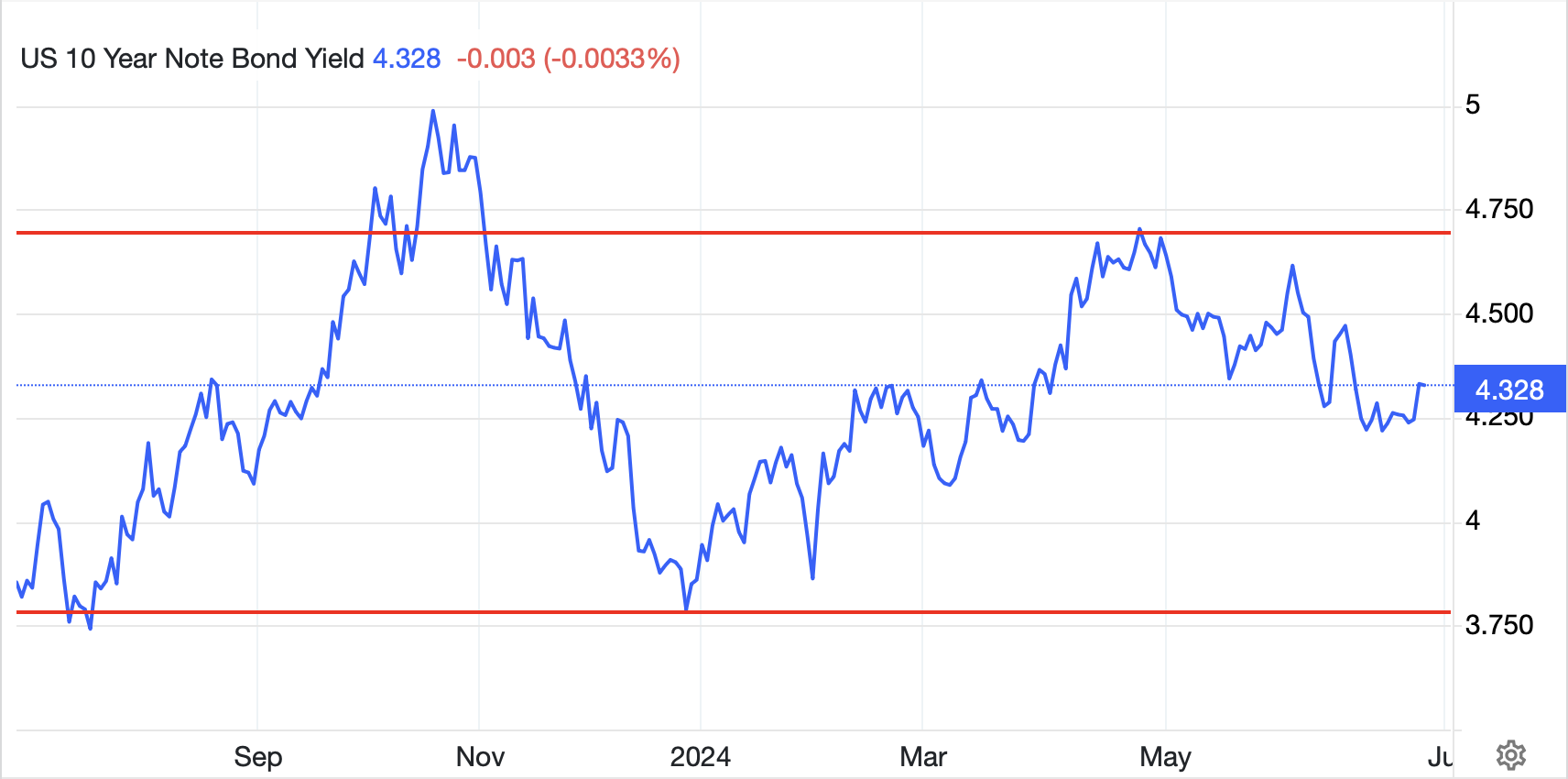
In the bond markets, yields in the US backed up by 5bps and have stayed there this morning.  in Europe, the markets closed before the US move finished, so this morning, yields across the continent are higher by 3bps or so as they catch up to the US.  In Asia, the movement was stronger with JGBs +5bps and Australian bonds +10bps on the back of the US move as well as Australia’s growing inflation concerns (Consumer Inflation Expectations rose to 4.4%).  It strikes me, looking at the chart below, that yields have been in a wide range, about 90 basis points, for the past year and that we are currently pretty much in the middle of that range.  It is hard to get too excited about things until we break this range in my view.

Source: tradingeconomics.com

In the commodity space, oil (+0.35%) is rebounding slightly this morning after weakness in the wake of larger than expected inventory data released yesterday, with an over 6-million-barrel increase compared to expectations of a 5.5-million-barrel drawdown.  As to the metals markets, gold (+0.7%), which suffered on the back of the strong dollar yesterday, is rebounding and taking silver with it, although the industrial metals remain under pressure.

Finally, the dollar, which was king of the hill yesterday, with the Dollar Index trading back above 106 for a while, is softening a touch this morning, probably about 0.2% or so against its major counterparts.  However, while that is the general result today, there is one outlier, ZAR (-1.15%) which continues to demonstrate remarkable volatility amidst the political situation with no cabinet yet named.  Perhaps the driver this morning was the softening inflation picture enticing traders to believe that SARB may be considering rate cuts soon.

On the data front, this morning brings the weekly Initial (exp 236K) and Continuing (1820K) Claims data along with Durable Goods (-0.1%, +0.2% ex Transport), final Q1 GDP (1.4%) and its components of note like Final Sales (1.7%) and its Price Index (3.3%).  Remarkably, there are no Fed speakers due today either.  I think we need to keep a close eye on the employment situation as it has been slowly worsening overall.  It wasn’t that long ago when Initial Claims were pegged at 212K every week.  Now they have grown by more than 20K and any lurch higher will be noticed.  Next week’s NFP is going to be critical with the potential for a significant impact as it will be released the day after the July 4th holiday, a day when trading desks will be very lightly staffed.

For today, it is hard to get excited about anything, but if we continue to see the slow deterioration of US data, that will eventually feed into the rate picture and the dollar’s value as well.

Good luck

Adf

To Oblivion

The yen continues
To grind ever so slowly
To oblivion


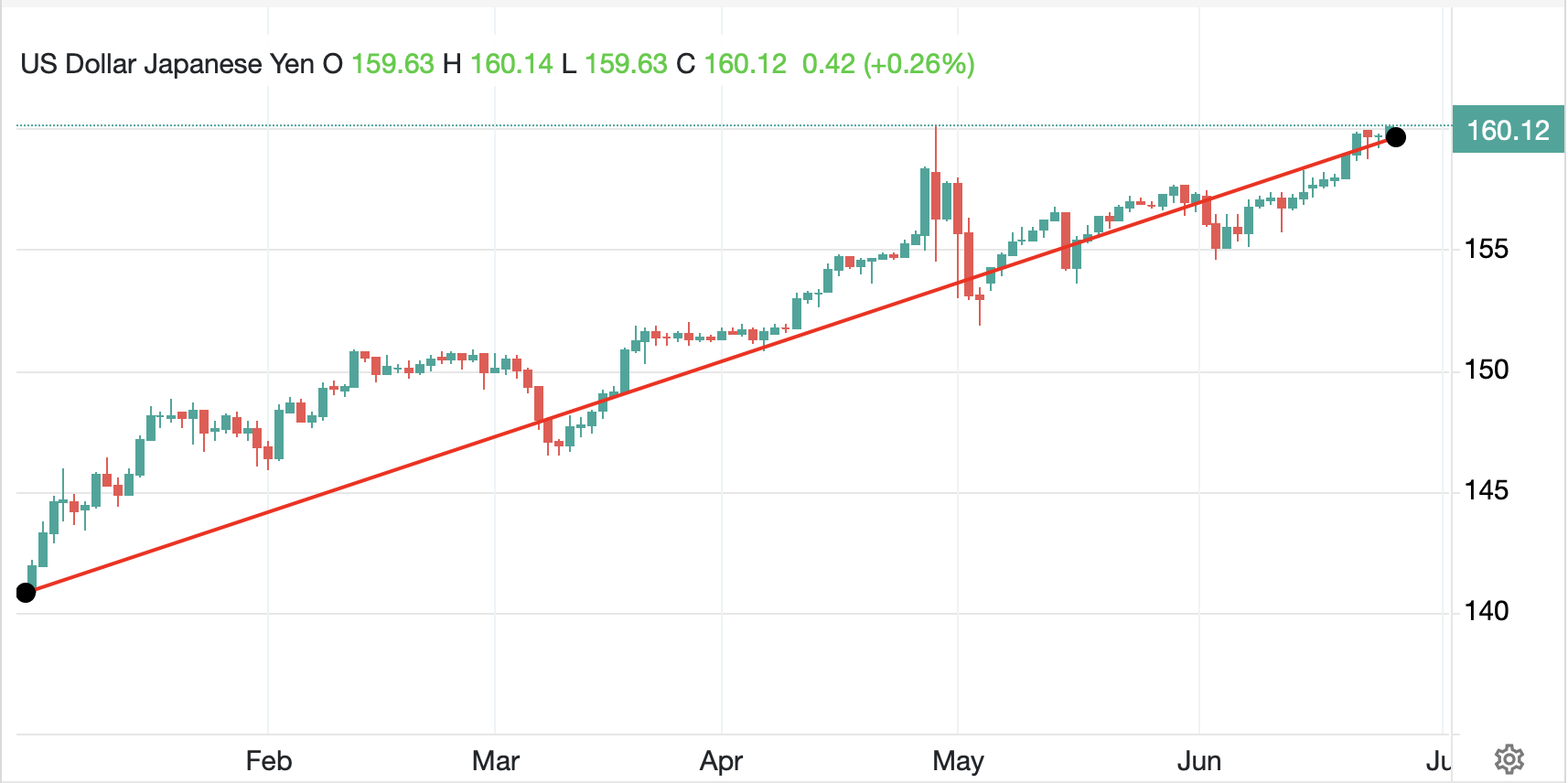
Well, for all those who were either concerned or anxiously awaiting USDJPY’s move to and above 160, we got there early this morning, and the world has not ended.  Not only that, but there is no sign of the BOJ/MOF, nor do I believe will there be for a while yet.  As I explained on Monday, history has shown, and the MOF has been explicit, that they are far more concerned with the pace of any movement in the currency, rather than the specific level at which it trades.  So this much more gradual decline in the yen, while potentially somewhat uncomfortable given its possible impact on inflation going forward, is just not alarming.  You can expect to hear Kanda-san or Suzuki-san reply when asked about the currency that they are watching it closely and prefer a stable currency, but I believe they are fairly relaxed about the situation this morning.

A look at the chart below from tradingeconomics.com shows the trend has been steady all year (which given the interest rate differential between the two currencies makes perfect sense) and that only when things accelerated back at the end of April did it generate enough concern for the MOF to act.  If we see another sharp movement like that, you can look for another round of intervention.  But, at the current pace, likely all we will get is some commentary about stable movement and vigilance.

Source: tradingeconomics.com

While many worldwide want to think
Inflation is starting to shrink
The data released
Shows it has increased
Down Under with Quebec in sync

With all eyes on Friday’s PCE data as a harbinger of the next Fed activity, it is worthwhile, I think, to mention what we have just seen from two other G10 nations regarding their inflation situation.  Starting north of the border, you may recall that earlier this month the Bank of Canada cut their base rate by 25bps in anticipation of achieving their 2% target given the prior direction of travel of their CPI statistics.  Oops!  Yesterday revealed that both the headline and core readings rose a much higher than forecast 0.6% in May, bringing the annual readings to 2.9% and 1.8% respectively.  As well, they focus on the Trimmed-Mean annual number, which also surprisingly rose to 2.9%.  now, one month does not a trend make, but Governor Macklem may have some ‘splainin’ to do the next time he speaks.  It is possible that inflation has not turned the corner after all.

Meanwhile, Down Under, the RBA must be feeling a bit better as they have maintained a more hawkish stance overall, arguably the most hawkish of any G10 member, and last night’s CPI reading of 4.0%, a 0.4% rise from the April data and 0.2% higher than forecast, is a reminder that inflation can be difficult to conquer for all central banks.  Since December, the readings Down Under had been in the low 3’s and many pundits were anticipating that the next leg was lower there as well.  Oops again!

With this in mind, it can be no surprise that the two Fed speakers yesterday, Bowman and Cook were both leaning toward the hawkish end of the spectrum.  In fact, Bowman even raised the possibility of future rate hikes as follows [emphasis added], “Reducing our policy rate too soon or too quickly could result in a rebound in inflation, requiring further future policy rate increases to return inflation to 2% over the longer run.”  At the same time (well actually, 2 hours earlier) Governor Cook did explain she sees rate cuts coming, just not the timing.  To wit, “With significant progress on inflation and the labor market cooling gradually, at some point it will be appropriate to reduce the level of policy restriction to maintain a healthy balance in the economy.  The timing of any such adjustment will depend on how economic data evolve and what they imply for the economic outlook and balance of risks.” 

It strikes me that no matter how you parse these comments, right now, there is no indication that pretty much anybody on the FOMC is considering rate cuts soon.  Futures markets have not really changed their pricing lately with a 10% probability of a July move and a 64% probability of a September cut.  However, one interesting tidbit is that in the SOFR futures options market, there has been a very substantial position building in March 2025 97.75 SOFR calls.  For these to pay off, Fed funds would need to fall about 300bps between now and March, far more than is discussed or priced right now.  While this could certainly be a position hedge of some sort, it does have many tongues wagging.

Ok, a review of the overnight session shows that we are still amid the summer doldrums overall, with some movement in markets, but nothing very dramatic and no real trends developing.  In Asia, the Nikkei (+1.25%) rallied on the back of the weak yen and is back approaching the 40K level, although a look at the chart shows simply choppy price action with no direction.  Hong Kong was flat, Shanghai (+0.65%) rose and Australia (-0.7%) fell on the back of that inflation data and the realization that the RBA is not cutting rates anytime soon.  In Europe, the movement has been weaker, rather than stronger, with French (-0.55%) and Spanish (-0.4%) shares both softer although German and UK shares are essentially unchanged today.  Finally, US futures are mixed with small gains for the NASDAQ and S&P while DJIA futures are following through on yesterday’s index declines.

In the bond markets, higher yields are the order of the day with Treasuries and virtually all of Europe higher by 3bps.  Overnight, JGBs saw a similar rise in yields which has now taken the 10yr yield there back above that 1.00% pivot.  The outlier here is Australia, which given the CPI data there, not surprisingly saw yields jump more, in this case by 11bps.

In the commodity markets, oil (+0.6%) is rebounding from yesterday’s modest declines which came about after API inventory data showed a modest build instead of the expected decline.  Gold (-0.4%) is under pressure along with most metals on the back of the dollar’s strength today.  In fact, my sense is the dollar is the driver right now.

So, speaking of the greenback, the only G10 currency to make a gain this morning is AUD (+0.15%) based on the higher yields Down Under.  Otherwise, the rest of the space is weaker between -0.2% and -0.5% with SEK the laggard.  In the EMG space, there is only one currency managing to hold its own, ZAR (+0.5%), which looks more like a trading bounce than a fundamental shift as there has been no data and no news yet on the political front regarding President Ramaphosa’s cabinet appointments.  Otherwise, the noteworthy move is that USDCNY has breached 7.30 for the first time since November as the pressure of higher US rates and an overall stronger dollar are too much to prevent continued weakness in the renminbi.

The only data this morning is New Home Sales (exp 640K) and the EIA oil inventories, which while important for the price of oil generally don’t have a macro impact otherwise.  As well, there are no Fed speakers on the calendar, but I cannot believe that at least one of them will want to hit the airways somehow.

So, the dollar has legs this morning and unless we get pushback that inflation is falling more clearly, I suspect that yields and the dollar will remain well bid.  It doesn’t feel like there is something that can change opinions due today.  Tomorrow and Friday, though, have that opportunity, so we shall see.

Good luck

Adf

Things Went to Hell

There once was a company, strong
Whose shares, everyone had gone long
But things went to hell
Nvidia fell
And folks wonder now, were they wrong?
 
The narrative hasn’t adjusted
Though certainly some are disgusted
AI, after all
To which they’re in thrall
Is perfect, so why’s it seem busted?


Times are tough for macro pundits and analysts, like this poet, as there is so little ongoing at the moment.  Data releases are sparse, and generally of a secondary nature and even commentary has been less active.  Truly, the summer doldrums have arrived.

With this in mind, perhaps it is a good time to consider what the broad risk asset narrative looks like these days, especially since the most recent version was exceedingly clear; Nvidia is the only company that matters in the world and its stock price should go to 10,000.  While there had been pushback on this idea, with the naysayers comparing the stock to Cisco and Qualcomm during the dot com bubble in 2000, the true believers countered with the fact that Nvidia was wildly profitable and given the race by companies all over the world to embrace AI, would continue to grow at its extraordinary recent pace.  But consider…

Back in the 1970’s, there was a group of companies described as the Nifty Fifty that represented the growth companies of the time.  And they were great companies, with most of them still around today including American Express, Coca-Cola, IBM and Walt Disney, to name just a few.  The thesis at the time was that these companies represented the future, and that if an investor didn’t own them, they were missing out.  The thing that was ignored at the time (and in truth is ignored in every bubble) is there is a difference between the company and its share price.  Overpaying for a good company can result in poor investment performance even if the underlying company continues to have magnificent results.

I mention this era as there are certainly parallels to the current mania for the Supremes (Nvidia, Apple, Microsoft) and the narrative at that time.  There is nothing inconsistent with understanding that these companies, and especially Nvidia, have created something special, but that they cannot possibly sustain their current valuations and so their share prices may fall.  And they can fall a lot.  After all, Nvidia has retraced 13% in just 3 sessions.  As much momentum as these shares have had on the way up, they can have that much and more on the way back down.  I’m not saying this is what is going to happen today, simply highlighting that trees don’t grow to the sky.  Perhaps we have now seen how tall they can grow.  

One thing I sense is that if this correction continues, it is likely to broaden out.  Perceptions are funny things, and if the zeitgeist changes, even if the companies continue to put up terrific numbers, the share prices can go a lot lower.  Consider that if the Supremes each fall 50%, they will still have market caps of $1.5 trillion and be amongst the largest companies in the world.  In fact, if they fall 50%, I’m pretty confident so would most of the rest of the market, so they would likely maintain their relative crowns of size, just at a smaller number. 

At any rate, this is an important discussion as the equity markets have been key drivers of all markets, and a change there will naturally result in some different opinions elsewhere.  Arguably, the biggest question is, if the stock market falls sharply, but the economic data don’t respond in the same way, will the Fed really cut rates?  There are many who remain firmly in the camp that the ‘Fed put’ is still intact, and they will come to the rescue.  Personally, my take is if there is a Fed put, the strike price is a lot lower, maybe S&P 3500, not S&P 5000.  Chairman Powell has enough other problems to address so that the value of the S&P is probably not job one.  In fact, it could become quite a political problem for him if the Fed is seen as rescuing Wall Street again while so many on Main Street struggle.

Ok, it’s time to look at the freshly painted wall and watch it dry overnight session.  Yesterday’s US session was unusual for its composition as the DJIA had a solid day, gaining 0.7%, while the NASDAQ suffered, falling -1.0%.  Asia, too, had an interesting session with the Nikkei (+1.0%) and Australia (+1.3%) both rallying while the Hang Seng was little changed and China (-0.5%) fell.  One possible explanation is that the tech sectors are getting unwound while money flows into less exciting areas like natural resources and manufacturing.  Of course, given there are no tech shares of which to speak in Europe, the fact that every bourse on the continent, and the UK as well, is lower, led by the DAX’s -1.0% decline, I am searching for another explanation.  At this hour (7:20) US futures are a touch firmer, 0.3%, but I don’t put much stock in this given the past several sessions.

In concert with the risk-off theme, bond markets are seeing a bid with corresponding yield declines.  Treasury yields are lower by 1bp with European sovereigns lower by between -2bps and -4bps.  There is still a great deal of anxiety, at least according to the press, about the French elections, but given the political bias of most mainstream media, which is decidedly against the idea that Marine Le Pen’s RN should win, it is possible that the actual situation is far less concerning.  The fact that the Bund-OAT spread continues to narrow at the margins tells me that there are fewer concerns than immediately following Macron’s call for the snap election.

Oil prices (-0.6%) are retracing yesterday’s modest gains as there continues to be uncertainty over the demand situation and whether economic activity is slowing offset by what appears to be a modest escalation in the Russia/Ukraine war with concerns that could impact supply.  As to the metals markets, prices there are little changed this morning after having edged higher yesterday.  My take here is that traders are keenly focused on Friday’s PCE data as an indication to whether the Fed will be cutting sooner rather than later.  The sooner the cut, the better metals prices should perform.

Finally, the dollar is almost unchanged this morning after having fallen modestly yesterday.  All eyes continue to focus on USDJPY, although it has slipped back this morning to 159.50.  Right now, my sense is there are many ‘tourists’ in the FX market trying to play for the next intervention, but as I said yesterday, I do not believe the MOF is going to be as concerned as they were in April/May given the pace of the move has been so much more modest.  For instance, last night FinMin Suzuki explained, “[the MOF] will continue to respond appropriately to excessive FX moves.  It is desirable for FX to move stably.”  Now, aside from the oxymoron of stable movement, this type of commentary is typically not indicative of any immediate concerns.  As to the rest of the G10, modest gains and losses define the day although we have seen both MXN (-0.65%) and ZAR (-0.4%) slide this morning, although given the amount of money involved in the carry trade for both these currencies, this is likely just positions adjusting rather than a fundamental change.

This morning brings more tertiary data with the Chicago Fed National Activity Index (exp -0.4), Case Shiller Home Prices (6.9%) and Consumer Confidence (100).  We also hear from two speakers, Governors Cook and Bowman.  Perhaps the most interesting thing yesterday was that SF Fed President Daly specifically touched on Unemployment in her comments, explaining that though there was still insufficient confidence that inflation was declining to target, she was paying close attention to the Unemployment rate, “so far, the labor market has adjusted slowly, and the unemployment rate has only edged up. But we are getting nearer to a point where that benign outcome could be less likely.”  I have a feeling that the employment report a week from Friday is going to have a lot more riding on it than in the recent past.  Any weakness there could really change the tone of the market regarding the economy and the Fed’s actions.

It is difficult to get too excited about today although if the recent correction in Nvidia continues and widens to some other names (a distinct possibility) do not be surprised if there are some fireworks later on.  In that case, I would look for a traditional risk-off session with the dollar higher while bond yields and stocks fall.

Good luck

Adf

Will They Return?

One-Sixty is so
Close, you can almost touch it
But, will they return?


The current Mr Yen, Masato Kanda, was on the tape last night as USDJPY creeps ever closer to the 160 level that triggered the most recent bout of inflation at the end of April. He explained, “If there are excessive currency fluctuations, it has a negative impact on the national economy.  In the event of excessive moves based on speculation, we are prepared to take appropriate action.”  At this point, the overnight high of 159.89 is just 28 pips from the peak seen prior to the last bout of intervention, although the price action this time is far more muted than what we saw then.  While the yen’s decline has been steady, as can be seen in the below chart, it hasn’t been so swift it appears out of control.

Source: tradingeconomics.com

One of the key rationales for the previous bout of intervention was that the weakening of the yen occurred too rapidly, with a 10-yen decline seen over a short six-week period.  That has not been the case this time, so I do not anticipate any MOF/BOJ action at 160, but rather somewhere closer to 165 if we see that during the summer.  Remember, the BOJ meets again at the end of July at which point they are expected to present their new bond buying program with reduced amounts of JGBs, their version of QT.  Remember, too, that there is still a huge interest rate differential between the US and Japan, and until that narrows, and is expected to narrow further, it is very difficult to see the yen showing any substantive strength.  While caution is merited here, as the BOJ can certainly enter the market at any time, based on the summary of opinions from the last BOJ meeting, which were released last night, there is no clear consensus on the pace of either QT or rate hikes.  The yen seems to have further to fall this summer.

In China, the powers that be
Are scared that their own renminbi
May fall and expose
The emperor’s clothes
Are missing, and that all might see


As things in the West are awaiting two key events at the end of the week, the PCE data in the US on Friday and the French elections on Sunday, we shall continue our look at Asia.  The CNY market onshore is frozen as it is pegged at the 2% maximum movement from the daily CFETS fixing.  Last night’s fixing of 7.1201 indicates that the highest the dollar can trade on shore is 7.2625, the level at which it is currently pegged.  In fact, given the interest rate differentials between the US and China, funding of traders’ books is becoming impossible because the one-day forward points will result in a price above the band.

While the offshore renminbi is slowly grinding lower, the pressure on the PBOC to adjust its daily fixing more rapidly grows.  This issue is a result of the following incompatible goals as defined by President Xi; support the collapsing local property markets by easing monetary policy while maintaining a stable and strong renminbi to demonstrate to the world that CNY should be a global currency (despite the capital controls in place!).  Alas for President Xi, these two ideas do not work in concert with the result that onshore FX markets are likely to remain frozen until things change.  A look at President Xi’s history tells me, at least, that like the Red Queen, he can believe multiple impossible things at the same time.  Ultimately, the great irony here is that despite Xi’s desires to demonstrate the importance of the renminbi to the world, he is entirely reliant on the Fed to cut rates in order to break this deadlock, and I strongly suspect that Chairman Powell cares not one whit about Xi Jinping and his problems.

Looking ahead, I anticipate the renminbi will grind lower over time as it remains the only outlet for the still lackluster growth in the economy with the property market problems forcing interest rates lower than otherwise would be desired.  Arguably, this is why the Chinese, in their current bout of trade talks with the EU, is demanding that Europe removes its tariffs on Chinese EVs.  Since they can’t weaken the currency further, they need to get the other side to effectively cut prices for them.

Ok, let’s review the overnight activity.  After Friday’s lackluster equity markets in the US (the NASDAQ actually fell, which I thought was illegal), the picture in Asia was mixed with the Nikkei (+0.5%) rallying a bit as the weak yen continues to support their exporters, while mainland Chinese shares (-0.5%) suffered as the ongoing weak economic data (Friday night showed Foreign direct investment fell -28.2% YTD, the weakest performance since 2009, and another indication that the renminbi is too strong).  As to the rest of the region, there were more laggards (Korea, Taiwan, Australia, New Zealand), than gainers (India, Singapore, Thailand).  However, in Europe this morning, the screens are all green as the limited data, German Ifo, indicated continued weakness raising hopes for a July rate cut by the ECB.  As to the US futures market, at this hour (7:15), they have edged slightly higher, about 0.15%.

Treasury yields have moved higher by 1bp but remain far closer to recent lows than the highs seen a month ago.  But the story in Europe is interesting as the Bund-OAT spread has narrowed by 5bps after comments by the RN party’s Jordan Bardella, the leading candidate as new PM, that were far more muted and accepting of Europe as a whole, and less populist financial goals.  This has played itself out across the entire continent with the perceived weaker countries seeing their yields slide slightly while Germany and the Netherlands have seen yields edge higher.  In Asia, JGB yields backed up 2bps to 0.98%, arguably in response to the summary statements from the BOJ.

Oil prices are continuing to show strength, up another 0.5% this morning, as the inventory draw from last week continues to support the market.  Meanwhile, after a very difficult session on Friday, metals prices are stabilizing with gold and silver both up 0.15%, although copper, which was higher earlier in the session, has now reversed course and is down -0.6%.

Lastly, the dollar is broadly, though not universally, under pressure this morning, with the euro (+0.35%) the driver in the G10 market which is also dragging the CE4 higher (PLN +0.9%, HUF +0.5%).  Bucking the trend is the rand (-1.0%) as market participants start to wonder who President Ramaphosa will be appointing to his cabinet now that he must share power.  One must be impressed with the volatility in the rand of late, that is for sure.

On the data front, while we get several indicators earlier in the week, all eyes will be on Friday’s PCE data.

TodayDallas Fed Manufacturing-13
TuesdayChicago Fed National Activity-0.4
 Case-Shiller Home Prices6.9%
 Consumer Confidence100.0
WednesdayNew Home Sales640K
ThursdayInitial Claims236K
 Continuing Claims1820K
 Durable Goods0.0%
 -ex Transports0.1%
 Q1 GDP (Final)1.3%
FridayPersonal Income0.4%
 Personal Spending0.3%
 PCE0.0% (2.6% Y/Y)
 Core PCE0.1% (2.6% Y/Y)
 Chicago PMI40.0
 Michigan Sentiment65.7

Source: tradingeconomics.com

As well as the data, we hear from five more Fed speakers with Governor Michelle Bowman speaking at three separate events this week.  However, thus far, there has been no substantive change from the Powell mantra that they need to see more evidence that inflation is slowing, several months’ worth, before considering easing policy.  Of course, if next week’s Unemployment rate were to tick up to 4.2%, I imagine that mantra might change.

On the central bank front, only Sweden’s Riksbank meets this week, and no policy change is expected.  If you recall last week, the bulk of the data was soft in the US, although the PMI data surprised to the high side.  However, if the data set is beginning to show more weakness, I suspect the Fed will begin to hint that cuts are possible sooner, rather than later.  Right now, the market is pricing about a 10% probability for the July meeting, but more than a two-thirds probability for September.  A little more weak data and I will likely adjust my views of rate cuts coming.  At that point, I think the dollar will suffer significantly.  But until we get a lot more evidence that is on the way, I think the default is the dollar is still the best bet.

Good luck

Adf

A Quagmire?

For those who believe a recession
Is coming, the data’s digression
From strength’s getting clearer
And rate cuts are nearer
Though maybe that begs a new question
 
Can equity markets go higher
If profits fall in a quagmire?
Though many agree
Rate cuts will bring glee
The past has shown they can be dire


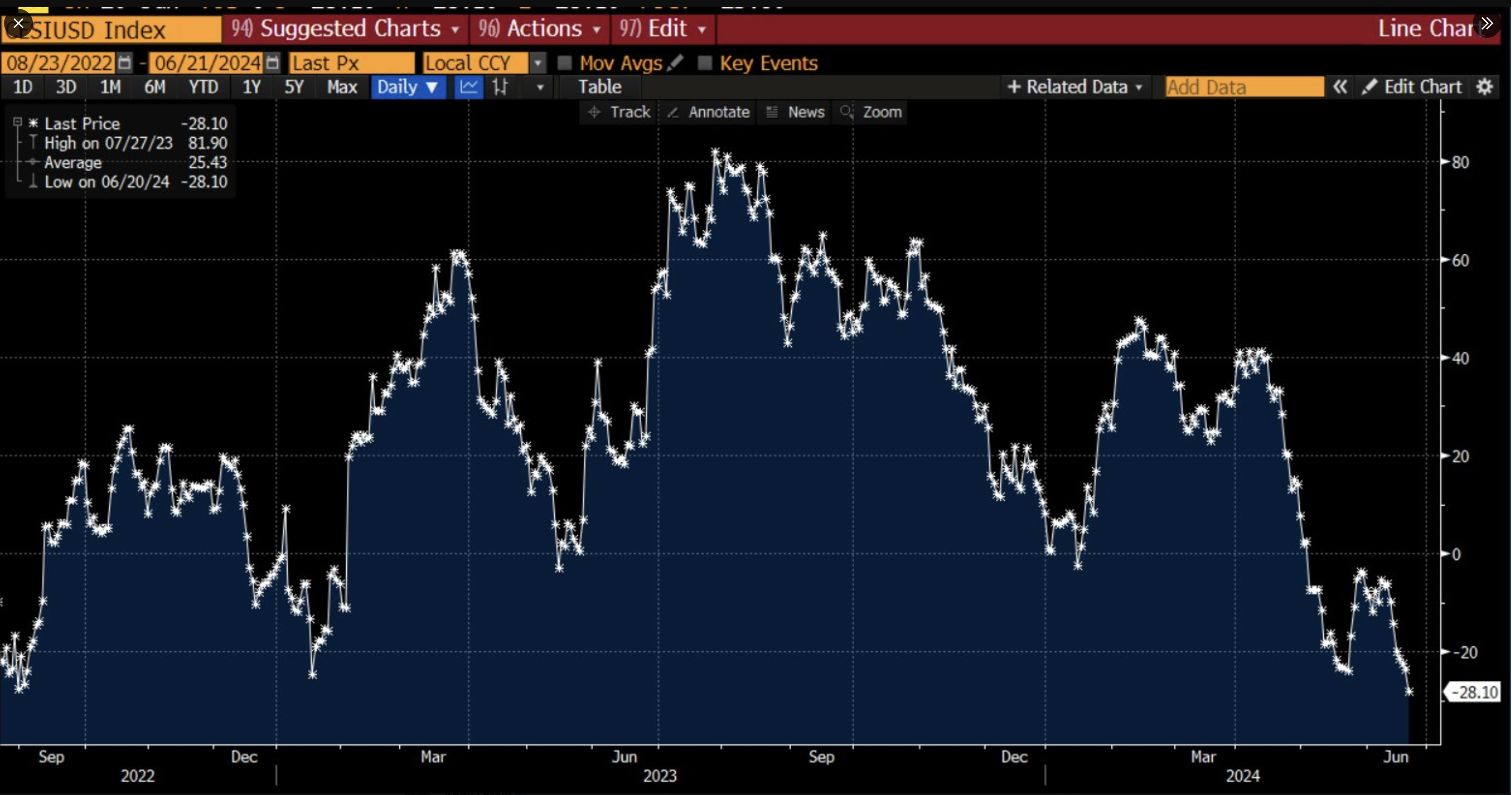
The data of late have not been positive.  Interestingly, this is not simply a US phenomenon, but appears to be spreading elsewhere in the world as evidenced by this morning’s much weaker than expected Flash PMI data out of Australia (Mfg 47.5 vs. 49.7), Japan (50.1 vs. 50.6) and Europe (Germany 43.4/46.4, France 45.3/46.8, Eurozone 45.6/47.9).  This follows the US trend where yesterday we saw the weakest Building Permits and Housing Starts data since the pandemic in June 2020 as well as a weaker than forecast Philly Fed result and higher than forecast Initial Claims data.  Prior to the Juneteenth holiday, Retail Sales were also quite soft, and another harbinger is the Citi Surprise Index, which Citibank created to measure actual data vs. the forecasts ahead of the release.  Typically, as it declines, it indicates weakening growth and vice versa.  As you can see from the below chart, this indicator has fallen to its lowest level in two years.

Source: Bloomberg

Summing it up, the strength of the economy is clearly being called into question by the data releases. However, as we have seen for the past several years, this is not a universal phenomenon.  For instance, who can forget the recent NFP print which beat expectations handily.  As well, the Atlanta Fed’s GDPNow indicator remains at 3.0% after yesterday’s housing data, still far above the forecasts by most economists, and an outcome that would be welcomed by almost everyone.

(As an aside and related to yesterday’s discussion about how politics intrudes on, or at least colors, so much of the financial market commentary, there have been numerous articles ‘blaming’ the weak PMI data on the results of the European Parliament elections and the ensuing call by French President Macron for next week’s snap election.  While one can make the case that is the situation in France, given the inherent uncertainty of the outcome, it seems a stretch to say that is why Germany’s data suffered.  After all, it is possible that all the talk of Eurozone tariffs on Chinese goods and the demonstrated incompetence of the current German government are sufficient to dissuade businesses there from investment and growth.)

So, what are we to believe?  The first thing I would highlight is that the idea of two separate economies seems to gain validity by the day.  For the haves, however you want to describe them but arguably the top 10% of income and wealth, the current situation has been fine.  While inflation is annoying, they can afford the higher prices given their asset portfolios, whether real estate or equities, have risen so dramatically.  The wealth effect for them is quite real.  

However, for the rest of the nation, things are far less positive.  The Retail Sales data tell a tale of reduced purchases of stuff (remember, that data is not inflation adjusted, so higher sales and higher inflation could well indicate less stuff sold but more money paid for it).  Additionally, the employment data is also a mixed bag as although NFP was strong, the household survey indicated less people were working and the trend in the Unemployment Rate is clearly up and to the right as per the chart below.

Source: tradingeconomics.com

Adding to this mix we have the Fed, who continue to look at the inflation data, and while they were pleasantly surprised by the slightly softer tone of the CPI data earlier this month as well as the PCE data last month, are still not prepared to address potential weakness in the economy.  This was made evident again yesterday when Richmond Fed President Barkin said, “my personal view is let’s get more conviction before moving.”  In other words, as we have heard consistently, patience remains a virtue at the Eccles Building.

If pressed, my personal view is that the economy has peaked for this cycle and we are going to start to see more data show weakness going forward, not strength.  The bigger problem with this is that while inflation has ebbed from its highest levels, it appears to me that the idea it will reach, and remain at, the 2.0% target is extremely unlikely.  Rather, I remain in the camp that the new level of inflation is somewhere between 3% and 4% as defined by CPI, and that over time, the Fed is going to bless that as an appropriate description of stable prices.  Given the Fed’s clear desire to cut rates, I fear that they are going to act earlier than would otherwise be prudent and that while economic activity will decline, prices will rebound.  Absent a massive recession, something like we saw in 2008-09, I do not see prices falling back to the current target.

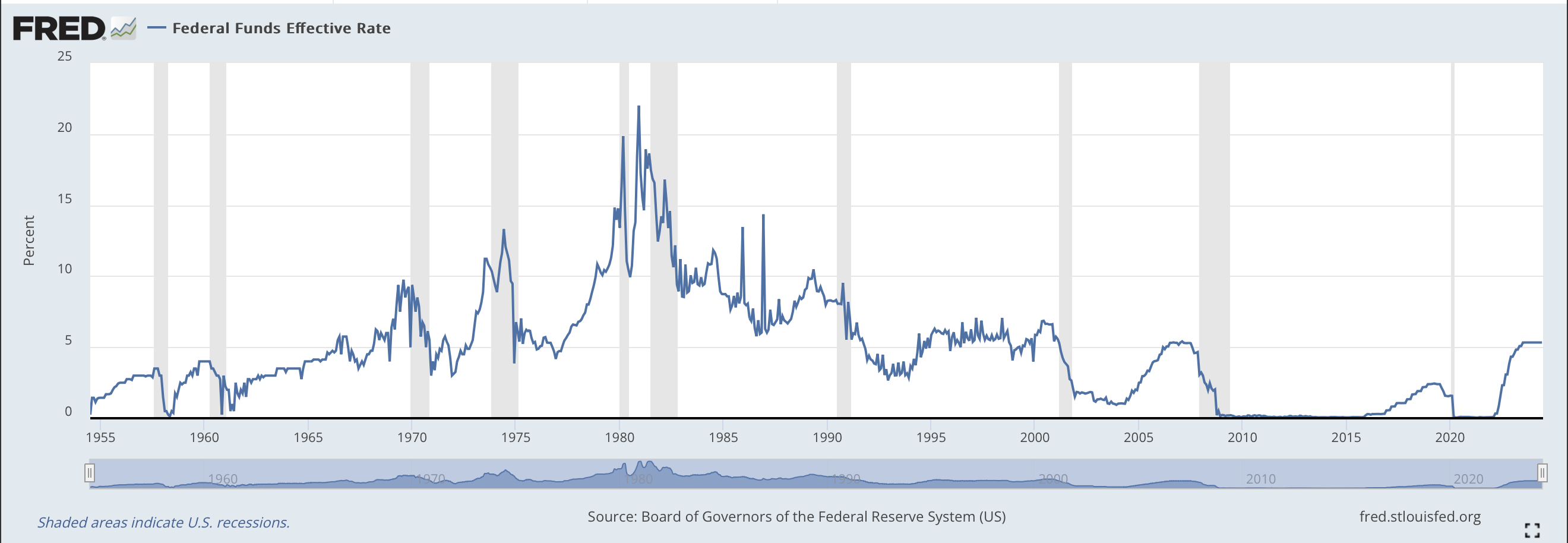
And here’s the problem with that view from a market’s perspective, if the recession comes, the Fed will cut rates and cut them relatively quickly.  This can be seen in the chart below showing Fed funds behavior relative to recessions.

Source FRED data base

Alas, for equity markets, during a recession, equity markets tend to fall, with declines of 30%-50% quite common and much greater as well (NASDAQ fell 88% during 2001-02 recession).  The road ahead appears to be filled with difficulty, so keep that in mind as you go forward.

Ok, sorry that ran on so long, but sometimes it is important to dig a little deeper I feel.  Let’s do a really quick turn of the overnight session.  Japanese equities were little changed but Hong Kong fell sharply (-1.7%) and the mainland drifted lower.  The rest of Asia was broadly under pressure although Australia (+0.35%) managed to eke out small gains.  In Europe, following the weak PMI data red is the color of the day with every market lower on the session, including the UK which released surprisingly positive Retail Sales data, although their PMI data was also soft.  At this hour, US futures are little changed awaiting the Triple Witching Day of expiries of futures, options and options on futures.

In the bond market, yields are lower across the board led by Treasuries (-3bps) and all of Europe as those PMI data are a harbinger of slower growth and will likely be an encouragement for more rate cuts by the ECB.  In fact, Klaas Knot, one of the more hawkish ECB members indicated he could see three more cuts this year, which is even more dovish than the market is pricing.

In the commodity markets, oil is essentially unchanged this morning, maintaining its recent gains as inventory data showed more draws than expected.  In the metals markets, gold (+0.2%) is holding onto its recent rebound, but given the weaker economic data story, both silver and copper are under pressure.

Finally, the dollar is gaining this morning as European currencies suffer from weak data and rate cut dreams, although there are two real outliers, MXN (+0.45%) on the back of surprising strength in recent economic data (Retail Sales and IP) and ZAR (+0.55%) as it appears more investors are turning to the rand as the pre-eminent carry trade earner vs. the yen and reducing their MXN exposures after the recent elections.

On the data front, the Flash PMI’s are due at 9:45 (exp 51.0 Mfg, 53.7 Services) and then at 10:00 we see both Existing Home Sales (4.10M) and Leading Indicators (-0.3%).  While there are no Fed speakers on the calendar, I fully expect to hear from someone before the end of the day as they simply cannot shut up.

Overall, risk is off, and I suspect that we could see some equity selling during today’s session, following yesterday’s moves.  With that, bonds are likely to perform as well as the dollar, and I think gold holds on, though the rest of the commodity complex is likely to suffer further losses.

Good luck and good weekend

Adf

Constitutional Repercussions

This is a story I wrote sometime in 2005 or 2006, i’m not sure exactly, but was inspired by the excitement over Arnold Schwarzenegger’s recent election as California governor. While there is no poetry, I hope you enjoy it. And let’s face it, it could be an awfully good way for the world to move forward!

Constitutional Repercussions 

 Foreigners Can Be President!  So screamed the headlines following the news that the 28th Amendment had been ratified.  The punditry was immediate in naming it the Arnold Amendment, enacted so as to allow persons born on foreign soil, who have been citizens of the US for at least 20 years, to become President of the United States.  The debate centered on the rationale of the founding fathers to include, in the constitution, the clause that only native-born citizens could be president.   

On one side were the strict traditionalists, decrying the change in the law, and declaring that if it was good enough for Washington and Jefferson, it should be good enough for us.  They conveniently forgot the fact that the clause was designed to prevent what was then perceived as the threat of an Englishman becoming president and trying to convert the great experiment known as the United States of America back to a British colony.  Their mantra was “As it is written, so it must be.”  In many ways, they resembled the creationists, who see the Bible as literally true, and believe the earth was created 6000 years ago.  In fact, many of them were the same people. 

On the other side were the more liberal modernists.  Their argument was that being born in the US didn’t necessarily make you a good person or uniquely qualify you for the job.  In fact, most naturalized citizens are far more patriotic. They are familiar with other countries and the lack of freedoms and opportunities that exist elsewhere.  

They revere rights that most native-born Americans take for granted. 

In the end, the liberals won the war.  The battle took place so that the erstwhile governor of California, Arnold Schwarzenegger, former movie star and real estate mogul, could run for the White House.  Of course, things are never that simple.  What was so intriguing was the reaction of other nations around the world.  Strange things were about to take place on the third planet from the sun. 

Many of us remember the schoolyard taunt, “my dad can beat up your dad.”  In college some even expounded on the idea that, rather than nations going to war, countries should have their leaders fight for what they believe is right.  This would save lives and solve problems far more quickly and in a far less costly manner.  Of course, nobody ever believed that anything like that would happen.  Leaders of countries are serious men and women, with a vision for the future and political skills to persuade their countrymen to follow that vision.  Why put someone in that role whose qualifications are merely strength of body, not mind?  Well, let me tell you the story of what went on after Ah-nold was elected president of the United States in 2012. 

 After a landslide victory, the Austrian bodybuilder turned American success story, started to use the bully pulpit more effectively than any president since Teddy Roosevelt.  Arnold was a man who had a finely tuned ear for the public’s feelings.  He was a man who preached common sense rather than political ideology.  In short, he was a man who could look you in the eye, describe his beliefs and persuade you of their merit because of the sincerity in his story.  He was born to lead, and now he was in the role of a lifetime. 

At a staff meeting in the early days of his presidency, Arnold realized that the budget situation was getting out of hand.  His advisors, to a man, focused only on the non-defense aspects of the budget, but he realized that defense spending represented nearly 20% of the total, and that a major reduction there could solve many great problems in a single act.  This was exactly the sort of thing Arnold had become famous for during his governorship of California. 

 And so he floated the suggestion… “What if I offered to fight the leader of a foreign country when we had a fundamental disagreement?  No guns, no knives, no armies, just me and him in the ring until there was just one of us left standing!” 

 His aides were shocked at the idea, but Arnold was on a roll.  “Think of what we could accomplish.  We could end war as we know it, disband the armed forces around the world and address grievances quickly.  Think of the ratings on TV!!  It would be the biggest draw in history.”  Arnold was starting to get excited now.  “What a spectacle this could be.  I would take on Rafarrin, or the Ayatollah in Iran, or anybody.” 

 His staff was adamantly opposed to the whole thing, but once again it was Arnold who had his finger on the pulse of the nation, and really of the whole world.  He recognized that ordinary citizens everywhere were tired of the state of war that had existed around the world for the past decade or more.  He was the first to truly understand that the vast majority of the Earth’s population was far more concerned with their individual security and ability to lead a productive life rather than the geopolitical issues that were constantly in the news.  Most Americans couldn’t care less about what was going on in Russia or Saudi Arabia or the Ivory Coast.  And most Russians and Saudis couldn’t care less about what went on in the United States.  All they heard was partisan bickering on TV and in the newspapers, and an increasing stream of bad news from some far corner of the globe.  American soldiers dying, a health epidemic or revolution or civil war beginning.  These seemed to be the only thing on the news recently.  Arnold, it turned out, had hit upon the key to move the global political situation to the next level.  Two months later, June 15, 2013, to be exact, Arnold Schwarzenegger stood in front of a special joint session of Congress and on global TV made the following announcement: 

 “My fellow Americans and good citizens of the world.  I come to you this evening with an idea.  It’s a simple idea, yet one so profound as to change the way the United States will handle conflict in the future.  I believe it can change the way that mankind handles all conflicts in the future. 

 I think we can all agree that given our choice, the vast majority of us would seek a peaceful life, and that if I presented an idea that was able to solve two seemingly intractable problems simultaneously, that you would give it serious thought.  In fact, the idea that I will present can do just that, I believe.  If, after hearing this, you agree, I want you all to contact your local representation and urge them to join in and embrace this idea.  For those of you watching who are not American, it will apply equally to each one of your nations and I believe you, too, will see its beauty and effectiveness. 

 The modern world has become a place where individuals all seek what’s best for themselves, without regard to what’s best for the nation as a whole.  In fact, this attitude has mutated into ‘I want what’s best for me and if I don’t get it, it must be somebody else’s fault.’  What has been the result of this attitude?  We have reached a time in society where entitlements have become the driving force behind many people’s lives.  There seems to be a belief that merely being born an American, or Englishman or Frenchman or any nationality, means that you are automatically deserving of a certain, cushy lifestyle.  And if something happens so that you do not get everything you want, you sue, or cause trouble.  This has led to several serious consequences.  First, government spending is out of control, and not just in America, but all around the world.  Taxes are rising, spending is rising special interests are happy because they are getting more money, but the average citizen is being worn down with nothing to show for it.  Demands for energy and commodities has resulted in a transfer of power to nations that have little or no experience in working effectively within the global nation-state system.  This leads to the second consequence…war.  It’s been more than 10 years since there was a semblance of peace in the world.  It’s been more than 10 years since a full month has passed without American soldiers dying in some far-off land; Iraq, Afghanistan, Korea, Zimbabwe, or some other place.  You name it and we’ve lost our brave young men and women there.  And for what? I ask.  So that the complainers in this country get their way?  More oil, cheap imports, export markets?  It seems that if you complain long enough and loud enough, that in this country we will send in a brigade on your behalf! 

 Well, no more!!  That stops right now if you listen to my idea, and we make it the law of the land. 

 I propose that disagreements between nations be settled in a manner that requires no armies, no navies, no air forces, nothing but this.  It requires merely that the leader of the aggrieved nations meet in an arena and join in combat until one concedes the issue.  These matches would be televised globally and would have no referees.  The only rule would be no weapons of any kind, just man against man.  Each issue would be decided in a single match and the outcome would be final and binding for at least 10 years.  But the key is that the leaders of nations must fight.  There would be no nomination of a champion in his or her stead. 

 Think about this.  Armed forces currently utilize upwards of 40% of some nations’ budgets.  How much better off would we all be if we spent that money on other, more peaceful things?  How much better off would we all be if we allowed you, the citizens of the world, to keep a larger proportion of earnings to save or spend as you saw fit as an individual?  This would not only save money and lives, but it would promote that other key for successful society, responsibility.  No more would people be rewarded for complaining loudly, for complaining often or both.   

You, the citizens of all nations, would need to learn to handle adversity.  You, the citizens of all nations, would learn that there is no birthright to material items, merely to the opportunity to obtain those things by lawful means.  I will not fight the King of Saudi Arabia just so that you can drive a bigger car.  It is not worth it.  You must learn to accept that gasoline could cost more or change your driving habits accordingly.   

But here is what I will do.  I will defend the right of this nation and its people to continue to practice business in accordance with the current laws.  I will defend the right of this nation to allow its citizens to worship any god of their choosing.  In short, I will defend the Constitutional rights of all citizens as deemed necessary in the global order.” 

It was truly a once in a lifetime experience.  Arnold was proposing to change the very fabric of international diplomacy, through this simple yet compelling idea.  Sides were quickly taken with the old school dismissing this concept as mere claptrap, something to be expected from an uneducated man like Arnold.  But the citizens of the world had a different idea.  They grabbed hold of the idea tightly, and within months there were referendums held in every remotely democratic country on the planet.  Of the 146 referendums held, every one passed on the first vote, most by a landslide. There was no ambiguity, the global population had spoken, and it had done so with a single clear voice.  Arnold became a hero to not only his fans in the United States, but to the subsistence farmers in Zambia and Eritrea as well.  And life, as we know it, changed forever. 

The first situation addressed by President Schwarzenegger under the new code of defense was the war on terror.  The firebrands of the Middle East, those Imams who preached not just Islam but death to the Infidels, found themselves on the wrong side of world opinion.  Even the French, who resisted American power at every turn could think of no excuse to prevent Arnold from facing off against the current head of Iran, Ayatollah ShahyAr Farshid, who for the past several years had done nothing but encourage violence against all things Western.  But the people of Iran, tired of isolation from the community of nations, and wanting the opportunity to partake in the fruits of their own labor, rose up and forced ShahyAr to take on Arnold.  The Iranian stakes were the end of terrorist support, to be proven by the dismantling, under UN supervision by UN personnel, of the weapons systems that Iran had either built or obtained.  The US risked the dismantling of the CIA, and the surveillance that went with clandestine operations.  The stage was the coliseum in Rome, with a worldwide audience.   

It was just before midnight when Arnold entered the arena to a wildly enthusiastic crowd.  After all, here was the man who had single-handedly changed the political equation on the planet.  Here was the man who had initiated the first truly new idea for achieving world peace since Jesus.  He was dressed, as one would expect, in the garb of an ancient Roman gladiator, a simple white toga, a brown belt and sandals.  He radiated confidence.  Despite recently celebrating his 66th birthday, he didn’t look a day over 45.  His muscles were bulging, and his skin glistened with sweat.  Moments later, ShahyAr entered the arena from the opposite side.  Dressed in the traditional Bisht of the Arab street, he was a wiry man, just 42 years old, with a medium length beard and long hair beneath his Ghutra.  Sweat was visible on his brow and upper lip.  His eyes betrayed his fear.  As a leader of a militant mosque, he was used to having his underlings do his dirty work. ShahyAr had never been in a position where he had to fend for himself.  There had always been someone else to support him, and now he was scared.   

At the stroke of midnight, there was a loud chime and the two men started to circle warily.  Despite Arnold’s obvious physical advantage, he recognized that his opponent was a much younger man and may be concealing something beneath his robe.  The crowd began to chant, at least two-thirds screaming for Arnold and the balance chanting ShahyAr’s name.  The intensity increased as the two warriors edged closer and closer to one another.  As the screaming reached a fevered pitch, Arnold made his move.  He was deceptively quick for one his age, and before ShahyAr knew what happened, he was on his back with Schwarzenegger’s massive hand around his throat, and his arms pinned beneath Schwarzenegger’s knees.  ShahyAr struggled to reach the knife illegally concealed beneath his robes, but Arnold’s grip was akin to a vice.  There was no escape from this position, and ShahyAr knew it.  He was about to lose, in moments, what he had worked the past 20 years to achieve, a position of power and respect amongst his followers.  But there would be no respect after losing, and his life’s aims would be dashed.  Certainly, the people of Iran would opt for another in his stead, someone who could defend the country’s honor and way of life.   

ShahyAr was having difficulty concentrating as the airflow to his brain was restricted by Schwarzenegger’s death grip.  He was sure he would meet Allah now, especially as he will have died fighting the Infidel, and he would be a martyr for his people.  They would rise against this ridiculous idea of leaders fighting leaders, and things would return to normal, leaders sending armies to fight their battles.  As he lost consciousness, ShahyAr prepared to meet Allah. 

But Arnold was smarter than that.  He had no intention of creating a martyr during the first attempt at a new world order.  As ShahyAr passed out, Arnold released his grip and let him live.  In fact, this would be a much better solution.  ShahyAr was now disgraced by his loss but had no opportunity to achieve martyrdom.  He was merely a weak leader of a country about to get weaker through the loss of key weapons systems.   ShahyAr was the laughingstock of the Arab world, losing a battle to a much older man, and letting down his people. 

In fact, the impact was much greater than just that in Iran.  Leaders around the world took stock in the situation and had to weigh the possibility of having to literally fight for what they believed in, versus the very real risk of losing the fight and being killed, or worse, like ShahyAr, disgraced.  The change in attitude around the world was remarkably rapid.  Oppressed people everywhere were clamouring for someone to fight their oppressors.  Oppressors everywhere were looking for a place to hide from the global media’s spotlight.  The subjugation of ethnic groups became a very dangerous practice for erstwhile dictators.  Now they could get called on the carpet and must answer for their crimes directly.  Less power suddenly seemed a better option than total control.  

Total control was likely to be challenged.  Power sharing was not. 

And so it came to pass, that a man, born in Austria, emigrated to the United States with nothing but a dream and the determination to see it through, became the single most powerful force in the world.  He affected more lives positively than Christ, Muhammed and the Buddha combined.  He caused the creation of a new geopolitical order, and fostered peace on earth.  All because the 28th Amendment was passed into law. Stranger things may have happened, but I dare you to show me one. 

Fearmongers Now Say

A question that’s going around
Is where will the buyers be found
For all the new debt
That nations are set
To issue as budgets compound
 
As well, the fearmongers now say
A crisis is coming our way
If voters elect
The folks who reject
The status quo finance cliché


As markets return from yesterday’s US holiday, activity remains somewhere between muted and ordinary in most markets.  At times like these, it is interesting to take note of the tone of the articles in financial journals, whether the WSJ, Bloomberg or the New York Times, as they are the place where I find politics is inserted into the discussion.  

For instance, there have been several articles regarding the pending French election and the market’s concern about a victory by Marine Le Pen on the right.  The thesis seems to be if her RN party wins and takes over parliament, that her plans will result in a collapse in French finances based on the promises she has made throughout the campaign.  There are many analogies to what occurred in October 2022 in the UK, when the newly elected PM, Liz Truss, put forth a program of unfunded spending and the Gilt market fell sharply.  You may recall the result was that the BOE had to step in to buy Gilts even though at that time, they had just begun to sell them to reduce the size of their balance sheet. 

Of course, what gets far less press is the fact that UK insurance companies had levered up their balance sheets because of ZIRP as they tried to earn a sufficient return to match their pension liabilities and when the BOE started tightening policy, those companies were already in trouble.  Certainly, the market response accelerated the problem, but even without Truss, as the BOE kept raising rates, the outcome would likely have been the same.  However, it was politically expedient for the press to blame Truss and the Tories.

Now consider the US, where government profligacy is truly breathtaking as the current government is borrowing $1 trillion every 100 days or so.  Certainly, this topic has been reported, although it is difficult to find a discussion from the mainstream media that makes the leap that spending as much as is currently happening is the underlying cause.  (Yes, there are many stories of this from conservative media as well as on Twitter, but not on the CBS Nightly News.)  However, those same mainstream sources threaten everyone that in the event Donald Trump is elected, it will spell the end of the bond market and the US economy because of his policy proposals of tax cuts and supporting energy growth.

It is commentary of this nature that, in my opinion, has reduced the value of mainstream media via the constant politicization of every subject.  This is also why alternate media sources, like the numerous excellent articles on Substack, have become so popular and widely read.  Analysts who are not beholden to a corporate policy and politics are able to give much more accurate and politically unbiased views.

At any rate, there was much concern ahead of this morning’s French bond auctions (they issued €10.5 billion across various maturities from 3-8 years) as this was the first attempt to sell debt since President Macron called his snap election after his European Parliament electoral disaster.  However, happily for all involved (except the doom mongers) things went just fine with a solid bid-to-cover ratio and a modest decline in market spreads.  All told, while nobody knows the future, it is difficult to expect that a Le Pen government will be any worse financially than the current Macron led government.  After all, France has just been warned by the European Commission that it must reduce its budget deficit from the current 5.5% to 3.0% as per the Maastricht Treaty, and there is no “far-right” influence on the current government.

Enough politics, let’s recap the overnight markets.  Asian markets were mixed as the Nikkei edged higher (+0.15%) but the Hang Seng (-0.5%) gave back some of yesterday’s spectacular rally.  The laggard, though, was mainland China (-0.7%).  In Europe this morning, despite the fears of a Le Pen victory, the CAC (+1.0%) is the leading gainer as either we are seeing a trading bounce after a terrible week last week, or maybe the initial hysteria is being seen for what it was, unfounded hysteria.  Meanwhile, as the BOE just left rates on hold, as widely expected, the FTSE 100 has bounced about 0.3% in the first 15 minutes since the announcement and is up 0.5% on the day.  Overall, Europe is having a good day with the DAX and virtually all markets ahead.  US futures, too, are firmer this morning, with both the NASDAQ and S&P higher by 0.5% or more although the Dow continues to lag.

In the bond market, Treasury yields have backed up 2bps this morning but the picture in Europe is much more mixed.  German yields are higher by 3bps, but UK yields have slipped a similar amount.  In fact, looking at all the nations there, it appears that there is slightly less concern over Europe as a whole as French yields are only higher by 1bp and Italian yields have slipped 1bp, thus narrowing the spread with Germany overall.  Turning to Asia, JGB yields rose 2bps, following USDJPY higher, or perhaps anticipating a higher inflation reading tonight.

In the commodity markets, crude oil (+0.15%) is edging higher this morning, although it slipped in futures trading yesterday (the only market open).  This morning brings the inventory data which is anticipating a draw of 2M barrels.  Metals markets are solid again with gold (+0.4%), silver (+1.7
%) and copper (+0.2%) all continuing their rebound from the dramatic decline two weeks ago.

Finally, the dollar is stronger this morning against most of its counterparts, notably the JPY (-0.3%) and CNY (-0.1%).  I highlight these because the yen story remains critical to the global financial markets, and it appears that Japanese investors are beginning to turn back toward Treasuries and away from JGBs supporting the moves in those markets and USDJPY.  

Regarding China, last night the PBOC fixing was at 7.1192, its highest level since November 2023 and the largest move (33 pips) in weeks.  It appears that there are numerous changes being considered and ongoing in China regarding its domestic bond market (the PBOC is looking to become more involved to support liquidity) as well as the overall monetary structure (there is talk that they will be adjusting the framework of three different rates to something more akin to what Western central banks use with a single policy rate).  In the end, given the ongoing lackluster performance of the Chinese economy, a weaker CNY remains my base case and while it may be gradual, it seems it is the PBOC’s view as well.  The onshore market continues to trade at the edge of the 2% allowable band and the offshore market is a further 35bps higher (weaker CNY) than that.  

Elsewhere, ZAR (-0.85%) which has had a good run on the back of the ultimate electoral outcome, seems to be afflicted with some profit-taking and then most of the rest of the currencies are softer vs. the dollar by about 0.2%.  One last exception is CHF (-0.65%) which has slipped after the SNB cut their policy rate by 25bps, as expected, to 1.25%.

On the data calendar today, we see Initial (exp 235K) and Continuing (1810K) Claims, Philly Fed (5.0), Housing Starts (1.37M) and Building Permits (1.45M), all at 8:30.  Then, later this afternoon, Thomas Barkin of the Richmond Fed will undoubtedly remind us that things are moving in the right direction, but patience is required.

Summing it all up, while I didn’t specifically mention it, the key thing in financial markets continues to be Nvidia, which is much higher in pre-market trading again, and apparently is the driver of everything.  However, traditional relationships have been under strain as although it appears to be a risk-on day, both the dollar and precious metals are firmer.  Overall, nothing has changed my view that the Fed is going to remain firm for now, and that (too) much credence will be assigned to next Friday’s PCE data.  But such is the state of the world.

Good luck

Adf

Just Simply Don’t Care

On Tuesday, six Fed members spoke
And none of them, from the pack, broke
While May’s CPI
Caught everyone’s eye
No ideas of cuts did it stoke
 
But markets just simply don’t care
Instead, all is well, traders swear
Nvidia rose
And at Tuesday’s close
No other firm could quite compare


Another day, another new all-time high for the S&P 500 and the NASDAQ (boy, my call from two weeks ago didn’t age well!).  And so it goes, the Fed imagines it is maintaining tight financial conditions and is trying to rein in spending and price pressures, and equity investors simply buy more NVDA every day.  Yesterday, the chipmaker became the most valuable company in the world, or at least the one with the largest market capitalization, cresting Microsoft and Apple, although all three are now worth about $3.3 trillion each.  I raise the point because it is such a perfect description of market sentiment.  It seems that everyone has placed their hopes (and potentially future wealth) on the back of a single company.  I’m sure it will work out well 😱.

In fact, as the investing community narrows its focus to an ever-smaller number of companies, and news elsewhere appears to show cracks in the façade of a solid economy, I suspect that problems may be coming our way.  For instance, remember Battery Electric Vehicles, and how they were the future?  Not just Tesla, but all these companies like Lucid, Polestar, Nikola, VinFast and Fisker?  Well, every name on this list has either gone bankrupt or is on the edge with Fisker being the latest to file Chapter 11.  The point is that in an environment where liquidity is abundant, or overly so, investment decisions tend to be less well thought out.  While the Fed has certainly tightened policy dramatically and been resolute in its efforts to maintain that tighter policy while inflation still percolates, the federal government’s excessive largesse (the CBO just announced they now expect a budget deficit this fiscal year of $1.9 trillion, up from the $1.5 trillion estimate last quarter) is too much for the Fed to stop.

One other thing to note about Nvidia, and AI in general, is that in China, Ali Baba has reduced the charge for using its AI function and it appears that AI, rather than being a new revenue stream for companies may simply become increased overhead of doing business.  In that world, as margins of the Apples and Microsofts and Googles compress, perhaps there will be more discernment before the next order of Nvidia chips.  There are many imbalances in this market, and it appears most of them are a result of the mania for AI.  When this passes, and it will pass, be prepared for some repricing of risk.

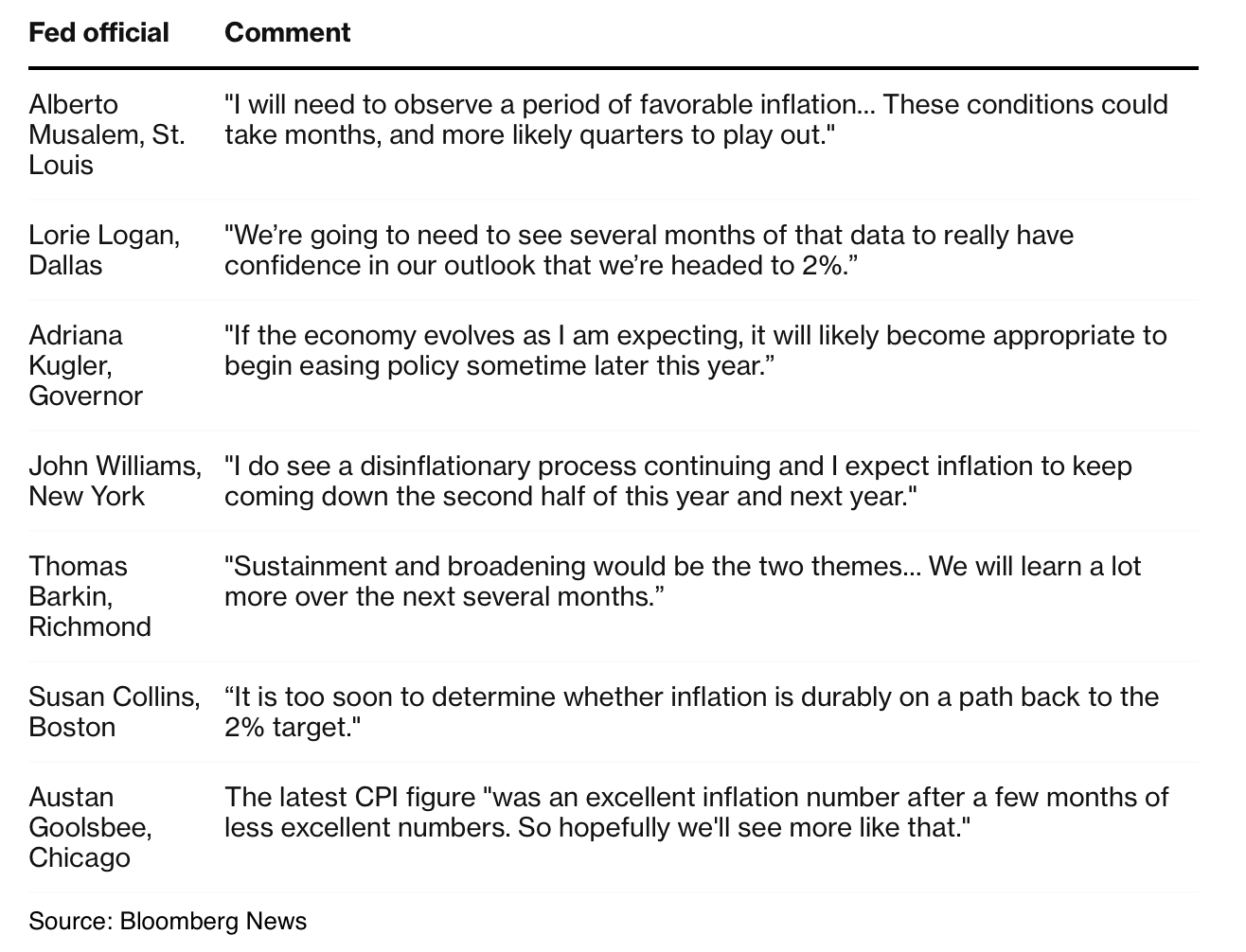
Ok, but back to the other stuff, namely the overwhelming amount of Fedspeak that keeps coming from all these FOMC members.  Yesterday, we actually had seven members speak, NY’s John Williams was not on the calendar ahead of time, and to a (wo)man, they explained that patience remains a virtue.  Happily, Bloomberg News put together the following list of key comments from the entire group:

Despite the modestly softer than expected CPI data last week, and even yesterday’s somewhat softer than expected Retail Sales data, it is hard to look at this grouping of comments and expect a rate cut is coming anytime soon.  Now, the one thing we can never forget is that markets can move incredibly quickly when it comes to readjusting its views on a subject.  In addition, history has shown that when the Fed figures out they are behind the curve and the economy is beginning to slow, they have the ability to cut rates very quickly as well.  But right now, I just don’t see the roadmap for a rate cut before the end of the year.  If this is the case, the one thing that seems most evident is that the dollar will maintain its overall bid.  Despite all the talk that the dollar is losing its reserve status, and that too much debt is going to destroy it, the reality remains there is no viable alternative as a means to store wealth and for governments to store reserves.  I don’t doubt the day will come when a substitute is found, but I do doubt I will be around to see it.

Ok, let’s see how the rest of the world celebrated the new leader in the market cap sweepstakes.  In Asia, the Nikkei (+0.25%) edged higher but the Hang Seng (+2.9%) had a fantastic run as the tech stocks resident there seemed to follow Nvidia.  Not surprisingly, Taiwan and Korea had good days, but elsewhere in the region, there was far more red than green as tech stocks are not the basis of those markets.  As to Europe, it is a mixed picture there but probably more red than green.  UK (+0.15%) stocks have edged higher after the UK inflation report showed that the headline number touched 2.0% for the first time in three years, but it doesn’t appear that will be enough to get the Tories re-elected next month.  However, we have seen most of the continent bleed lower after the European Commission warned a series of nations (including France and Italy) that they needed to address their budget deficits which are far above the 3% “limit” that was embedded in the entire Eurozone project.  Meanwhile, despite the fact that the US equity markets will be closed today for the Juneteenth holiday, futures are trading although they are little changed at this hour (7:45).

It is also a bank holiday here, so there will be no bond trading in the US, but in Europe, yields are a bit higher this morning, between 2bps and 4bps, bucking the trend from yesterday’s Treasury market and seeming to demonstrate a little concern over the ongoing political ructions on the continent.  However, there is one place where yields are having difficulty finding a base, Japan.  Despite all the talk that the BOJ was going to allow yields to rise more aggressively, or that there was no cap at 1.00%, JGBs fell 1bp overnight and have shown no inkling of moving higher in any substantial amount.  With this in mind, look for the yen to remain under pressure.

In the commodity markets, the early part of the month, which saw oil prices slide is just a memory now as once again, WTI (+0.1%) is holding onto its gains from yesterday and is now firmly above $81/bbl.  It appears that demand figures are starting to improve and inventory draws are being seen now.  Watch at the pump.  In the metals markets, after rallies yesterday, the precious set are holding the gains, up just 0.1% each, but copper has rebounded a further 1.5%, again an indication that economic activity seems better than feared.

Finally, the dollar is slightly softer this morning, slipping a touch against most of its G10 and EMG counterparts, but the noteworthy thing is that no currency has moved more than 0.25% in either direction.  In other words, nobody seems to care this morning here.

There is no data and no Fed speakers given the holiday so not only will things slow quickly by 11:00am, it seems a safe bet that movement will be di minimus.  Tomorrow brings a reawakening, but for today, enjoy the sunshine.

Good luck

Adf

Ne’er Have Nightmares

Said Harker, it’s likely one cut
Is all that we’ll need this year, but
Depending on data
My current schemata
Might wind up by changing somewhat
 
However, in truth no one cares
‘Bout Harker and views that he shares
As long as, stocks, tech
Don’t suddenly wreck
Investors will ne’er have nightmares


“If all of it happens to be as forecasted, I think one rate cut would be appropriate by year’s end.  Indeed, I see two cuts, or none, for this year as quite possible if the data break one way or another.  So, again, we will remain data dependent.”  These sage words from Philadelphia Fed president Patrick Harker are exactly in line with the message from Chairman Powell last week, as well as the dot plot release.  In other words, there was nothing new disclosed.  Now, today, we will hear from six more Fed speakers (Barkin, Collins, Kugler, Logan, Musalem, and Goolsbee) and I will wager that none of them will offer a substantially different take.  

At this point, market participants seem to feel quite confident they understand the Fed’s current reaction function and so will respond to data that they believe will drive different Fed actions than those defined by Harker above.  But if the trend of data remains stable, the Fed will not be the driving force in the market going forward.

In fact, there appears to be just one thing (or maybe two) that matters to every market, the share prices of Nvidia and Apple.  As long as they continue to rise, everything will be alright.  At least that’s what a growing share of investors and analysts have come to believe.  Alas, this poet has been in the market far too long to accept this gospel as truth.  I assure you there are other issues extant; they are simply hidden by the current Nvidia-led zeitgeist.

For example, Europe remains on tenterhooks for several reasons, only one of which is likely to be settled very quickly, the upcoming French election.  But remember, there is still a war in Ukraine and NATO and European nations have just upped the ante by allowing their weapons to be used to attack into Russia in addition to supplying F-14 fighter jets as part of the package.  In an almost unbelievable outcome so far, while Russian piped natural gas to Europe has fallen to essentially nil, Russia has become Europe’s largest supplier of LNG, surpassing cargoes from both the US and UAE.  I’m not sure I understand the idea behind sanctioning Russian oil and buying their gas, but then I am not a European politician, so perhaps there are nuances that escape me.  But the point is that Russia can cut that off as well, and once again disrupt the already weak Eurozone economy.

At the same time, Germany, still the largest economy in Europe, remains in economic purgatory as evidenced by today’s ZEW data (Sentiment 47.5, exp 50.0; Current Conditions -73.8, exp -65) as well as the fact that Germany’s largest union, IG Metall, is now demanding a 7% wage increase for this year, far above the inflation rate and exactly the sort of thing that, if agreed, will delay further rate cuts by the ECB.  Productivity growth throughout Europe remains lackluster and combining that with the structurally high cost of energy due to European energy policies like Germany’s Energiewend, is certain to keep the continent and its finances under pressure.  Right now, equity markets in Europe are following US markets higher, but they lack a champion like Nvidia or Apple, and are likely to be subject to a few hiccups going forward.

Or perhaps we can gaze eastward to China, where economic activity remains lackluster, at best as evidenced by the slowdown in Fixed Asset Investment and IP, as well as by the fact that the PBOC continues to try to create support for the still declining property sector without cutting rates further and inflating a bubble elsewhere.  The onshore renminbi continues to trade at the limit of the 2% band as the PBOC adjusts the currencies level weaker by, literally, one pip a day, and the offshore version is trading 0.25% through the band and has been there for the past month.  The economic pressure for the Chinese to weaken their currency is great, but obviously, the political goal is to maintain stability, hence the incremental movements.

My point is that Nvidia is not the only thing in the world and while its stock price performance has been extraordinary, I would contend it is not emblematic of the current global situation.  Rather, it is an extreme outlier.  Not only that, but when other things break, they will have deleterious impacts on many financial markets, probably including the NASDAQ.  Just sayin’!

However, despite my warnings that things will not always be so bright, so far in this session, they have been.  Overnight, Japanese stocks (+1.0%) followed the US higher as did Australia (+1.0%) and much of Asia other than Hong Kong (-0.1%) which slipped a bit.  Meanwhile, as all sides in the French election try to pivot toward the center to gather votes, European bourses are all in the green as well, somewhere between 0.25% and 0.5%.  As to US futures, at this hour (7:30), they are little changed.

Bond yields have continued to rebound from the lows seen Friday, with Treasury yields edging up another basis point this morning.  However, European sovereigns have seen demand with yields slipping a few bps, perhaps on the idea that growth remains lackluster as evidenced by the ZEW report, or perhaps on the idea that the French election may not be as terrible as first discussed.  Meanwhile, JGB yields edged up 1bp but remain below the 1.00% level despite Ueda-san explaining that a rate hike was on the table for July and that QT and rate hikes were different processes and independent decisions.

In the commodity markets, oil is unchanged this morning but that is after a strong rally yesterday in NY with WTI closing above $80/bbl for the first time since the end of April, as suddenly, the story is oil demand is improving while supply will remain tight on the back of OPEC+ measures.  I’m not sure how that jives with the IEA’s recent comments that there would be a “massive”oil supply glut going forward, (which I find ridiculous), and perhaps market participants have turned to my view.  Metals, though, remain in the doghouse falling yet again across the board.  Something else I don’t understand is how the demand story for metals can be weak while the demand story for oil can be improving given both are critical to economic activity.  

Finally, the dollar continues to find support, despite its oft-expected demise, as it gains vs. virtually all of its counterparts both G10 and EMG.  The biggest laggards this morning are NZD (-0.6%) and NOK (-0.4%) in the G10 while we have seen weakness in the CE4 (HUF -0.5%, CZK -0.55%, PLN -0.5%) as well as most Asian currencies.  The outliers here are ZAR (+0.5%) which continues to benefit from the re-election of President Ramaphosa and his coalition with centrist parties, and MXN (+0.4%) which seems to be finding a floor after its extraordinary decline in the wake of the election there two weeks ago.

On the data front, this morning we see Retail Sales (exp 0.2%, 0.2% ex autos), IP (0.3%) and Capacity Utilization (78.6%) in addition to all those Fed speakers.  While Retail Sales can be impactful, it would need to be extraordinary, in my view, to alter the current Fed viewpoint of wait for lots more data.  

My take is it will be a quiet session today, and likely for the rest of the week, as the next important data point is not until PCE on June 28th.  Til then, trading ranges seem the most likely outcome, although if I had to choose a side, I would be looking for the dollar to continue to grind higher.

Good luck

Adf