No Real Distaste

The rally in stocks was amazing
And bonds, they as well, came out blazing
The dollar was smoked
As oil bulls choked
While metals are now upward gazing

Does this mean the markets embraced
The outcome with no real distaste?
Or were traders short
And forced to abort
Those views in a manner posthaste?

My sense is t’was more of the latter
Though there is a fair bit of chatter
That gridlock implies
New lawmaking dies
As Congress, the Prez, wants to shatter

We do live in interesting times as the discrepancy between what the data implies and how the population responds is the widest I can ever remember.  In the past, this level of popular angst was only really visible during serious recessions, going back to the 1970’s, and certainly the twin recessions of 1981 and 82.  But more recently, the GFC was a major blow to both the economy and the markets and everybody was miserable and scared together.  However, since then, things have changed.  I guess I should have seen Tuesday’s outcome because ahead of the 2016 election, my thesis was that the recovery from the GFC was only felt by the political insiders with the rest of the country feeling left behind, and that was evidence of the change that was coming.  And all the discussion of the K-shaped economy should have been the clue that this was also going to be a change election, and it certainly was.  I guess the question is, where do we go from here?

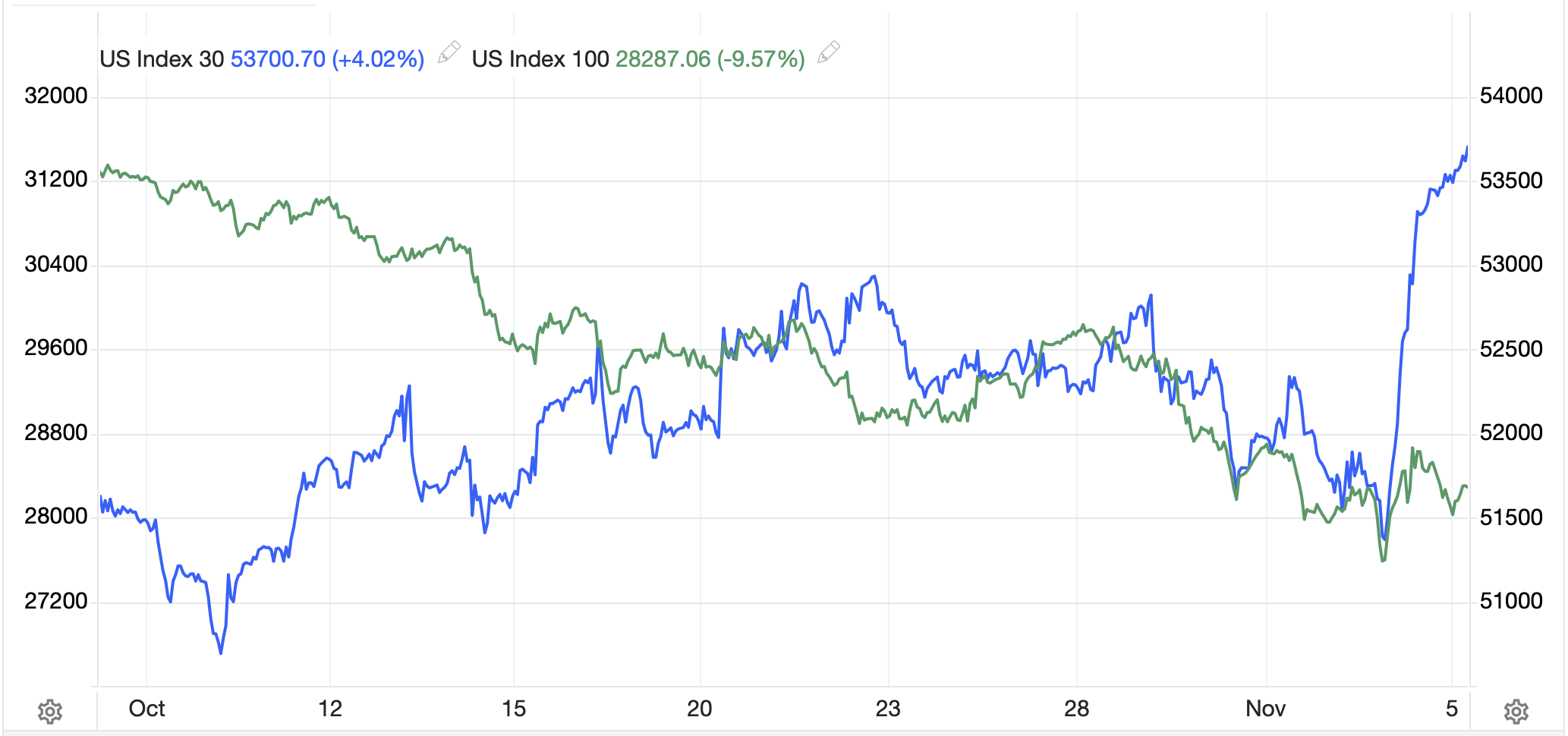
Perhaps no chart better describes the change in tone than the below of the DJIA (blue line) and the NASDAQ (green line).
Source: tradingeconomics.com

This is the very embodiment of the rotation trade as blue chip companies have benefitted from the perception of what the Democratic majority is going to do compared to the previous leaders, the AI and semiconductor sectors.  This effect has also been seen internationally as in Asia, Tokyo (-1.8%), Korea (-5.3%) and Taiwan (-3.2%) all suffered greatly last night while the rest of the region saw solid gains (India +2.6%, Australia +2.6%, New Zealand +2.2%). You will have noticed I left out China (+0.3%) and HK (+3.7%) as their performance was more a result of official Chinese support than a sentiment indicator, with the plunge protection team actively buying a series of ETFs in the session.

In Europe, the Bloomberg screenshot below tells the story eloquently.  As there are vanishingly few tech firms on the continent, when tech is under pressure and other companies are performing well, you can bet Europe will shine.
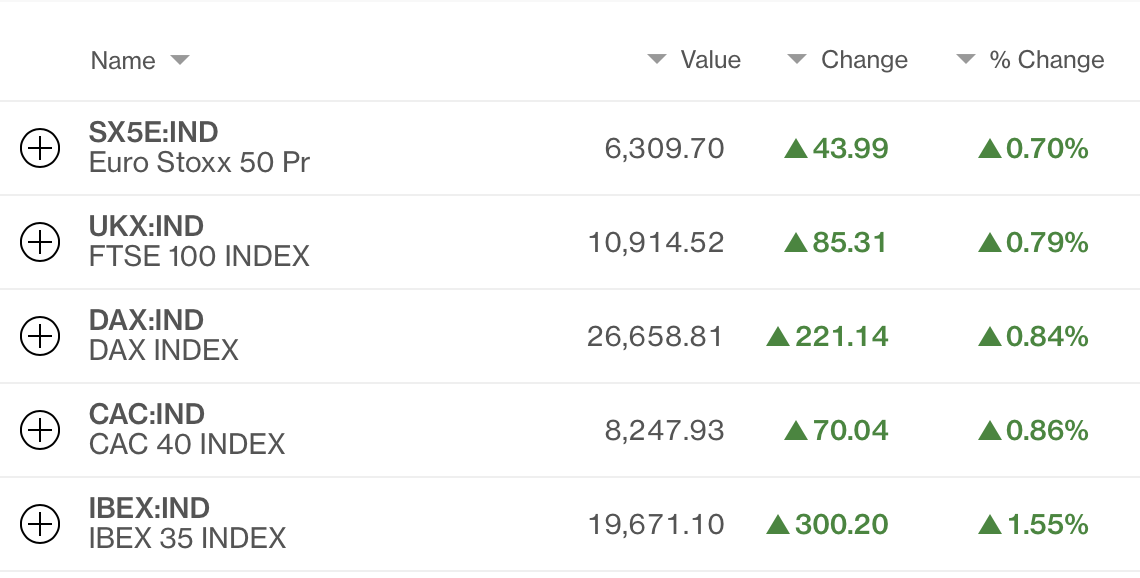
As to the US this morning, the thesis continues to play out with NASDAQ futures -0.6% while DJIA futures are +0.6% at this hour (6:45).

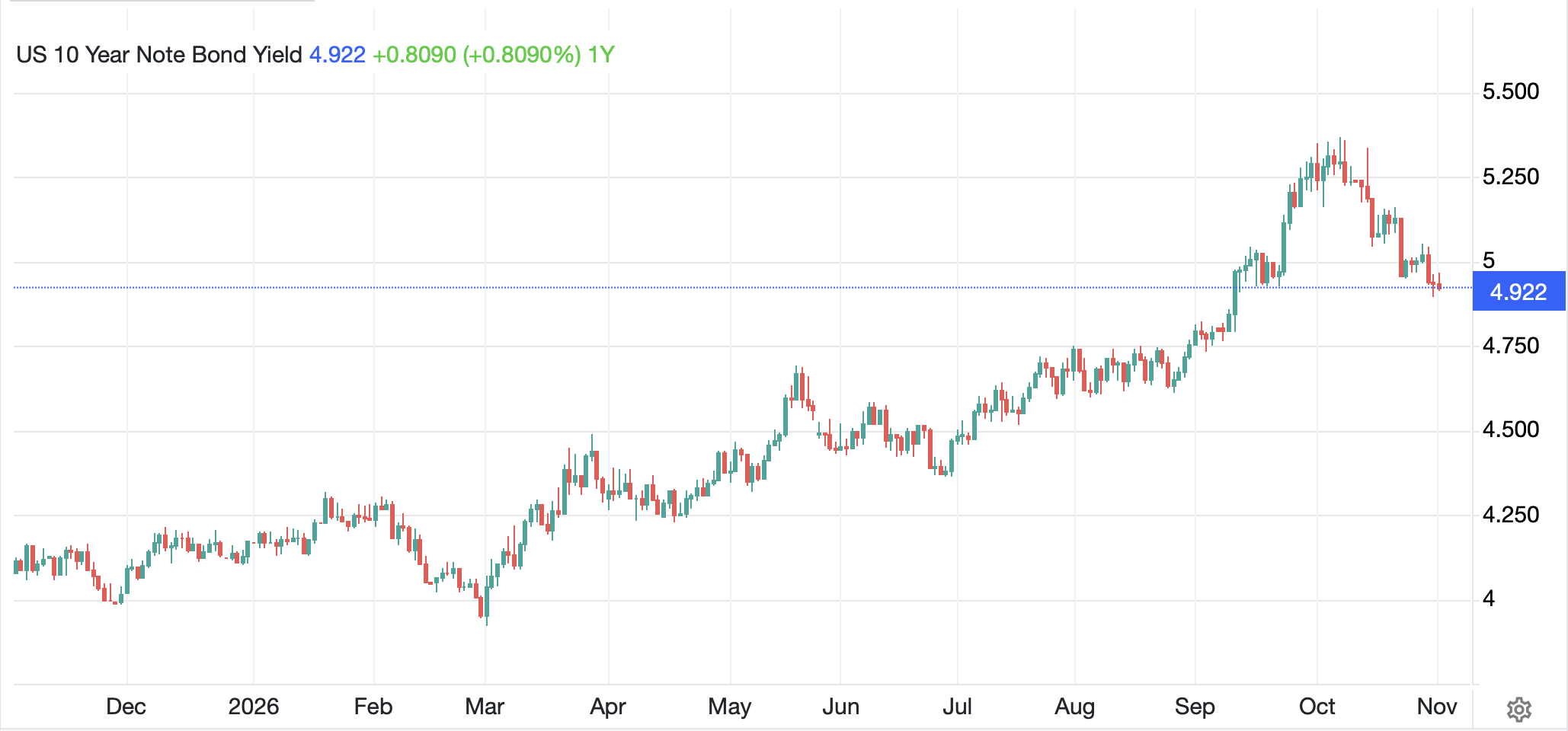
Bond markets are a bit more confusing to me as they are supposed to be the ‘smart’ money and yet they appear to be simply responding to lower oil prices with no thoughts of the future.  Certainly, oil prices have declined a bunch, although they rebounded 1.0% this morning, but are still under $90/bbl.  However, it seems that the strong belief is that oil prices are going to remain lower, and drag product prices with them, as suddenly, peace in Iran (and Ukraine?) are becoming an assumption.  However, if we think through the Democratic platform, with their ongoing efforts to kill the oil and gas industry and support wind and solar as the future of energy, it is virtually designed to raise prices, and by extension, feed into inflation.  But for now, the strong belief that lower energy prices are coming is the narrative.  So, yields continue to slide.  As you can see in the below Bloomberg screenshot, over the past month there is just one market that has seen higher yields, Brazil, which is election related.  But otherwise, although yields remain higher than one year ago, they are lower everywhere else in the world over the past month.
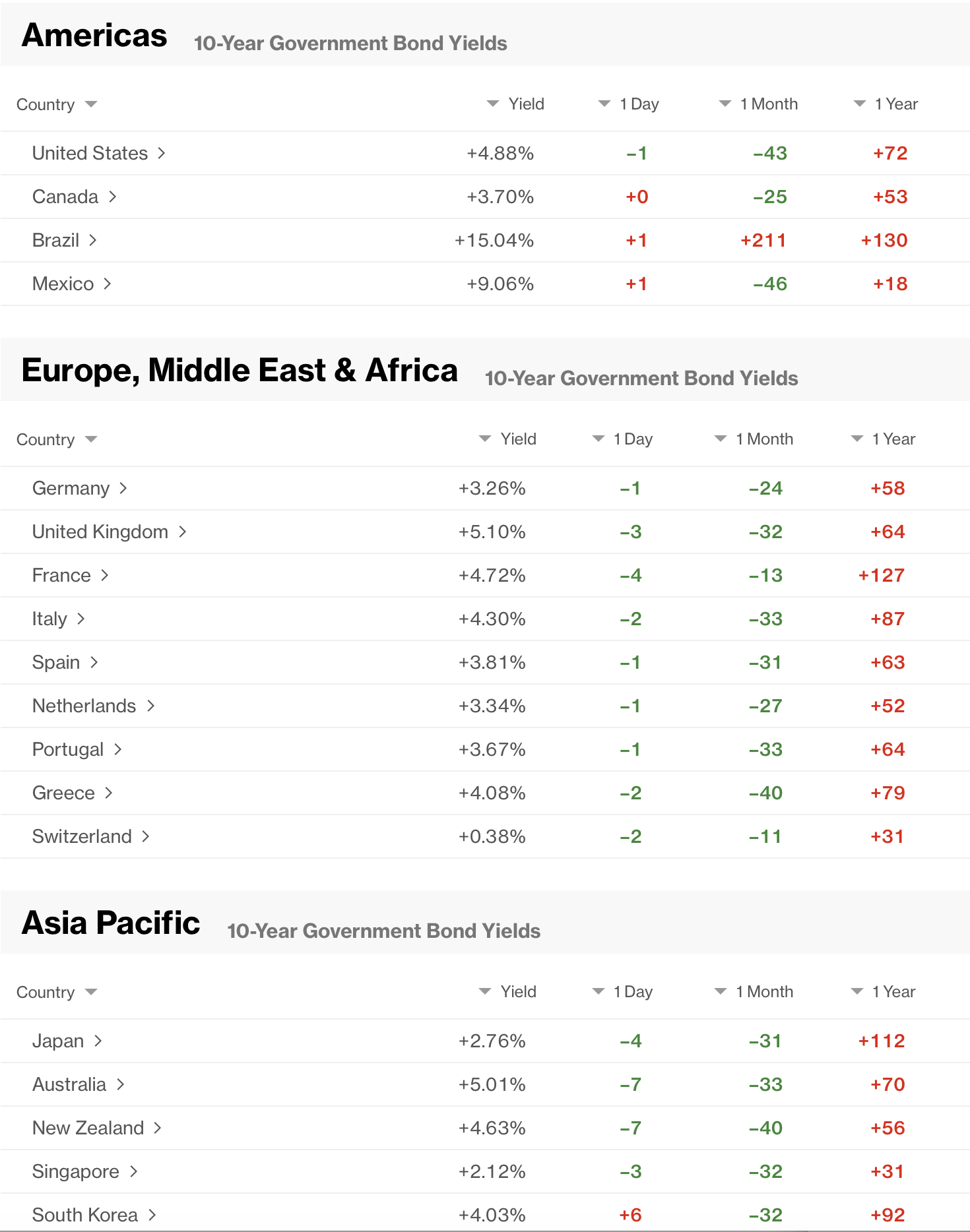
In fact, it was just one month ago when the peak concern over Treasury yields was reached with forecasts for 6% and 7% 10-year yields becoming common.  I wonder where those guys are now.

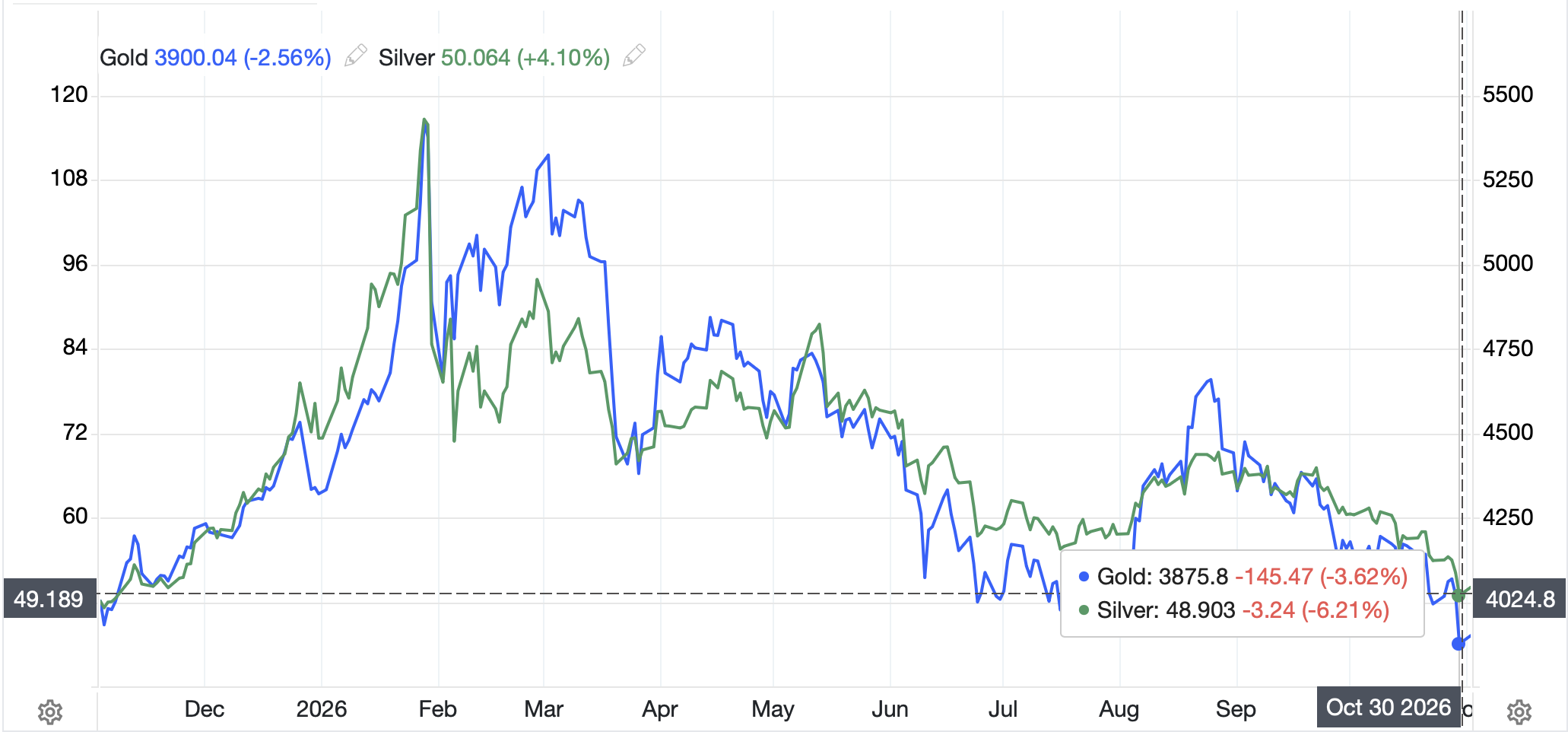
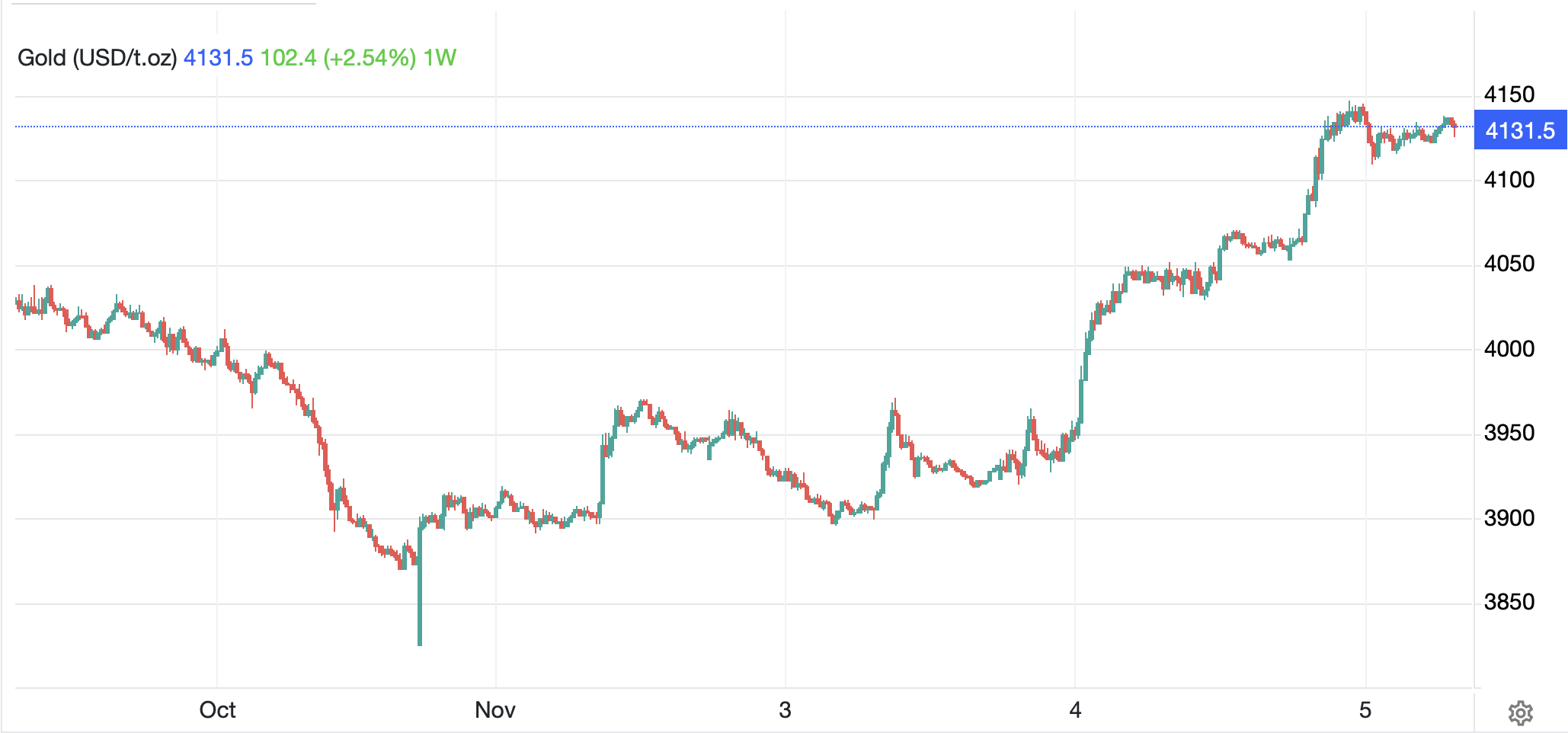
We discussed oil already, but the precious metals markets have been amongst the biggest beneficiaries of this new thesis with gold (+1.7%) having rallied $238/oz since its month-end spike low, a more than 6% rise.
Source: tradingeconomics.com

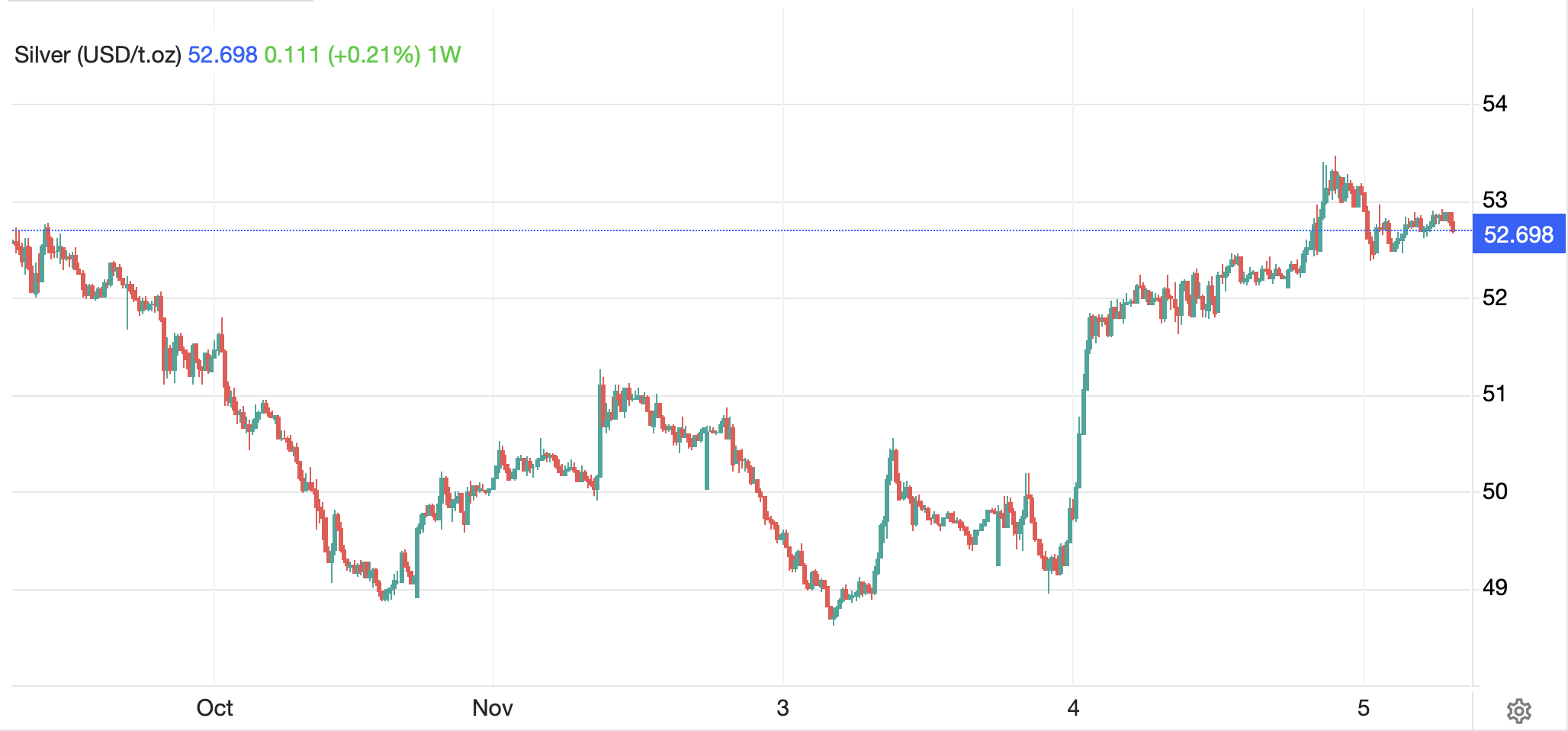
Silver, too, has seen a massive bounce off those month end lows, as per the below, more than $4.00/oz or more than 8%.
Source: tradingeconomics.com

Now, the story here is all about lower oil prices leading to lower yields along with a lower dollar and thus a benefit for metals prices.  And that is certainly true.  But I wonder, is there something else driving this movement?  There had been a significant amount of short-selling in these markets as traders who were all-in on the higher yields play were sure metals had lost their luster.  Clearly, some part of this recent jump is short covering.  And what of the long-term thesis that the debasement of all fiat currencies will result in higher metals, and all commodities, prices?  I haven’t heard about the debasement trade lately at all, but do not be surprised if that starts to come back into vogue going forward.  After all, as I wrote yesterday, there is zero indication that a Democratic congress is going to consider austerity.

And lastly, the dollar, which fell sharply yesterday, is little changed this morning, or maybe slightly higher on net.  The BOE hiked rates by 25bps as universally expected and the pound has not responded although there was a Bloomberg article this morning describing how on a trade weighted basis, the pound is back to its highest level in a decade on the back of resilient growth and expectations for more rate hikes going forward.

Here’s the thing about the FX markets, they are relative plays pitting one currency vs. another.  Now, if you look at the yield table above, with a couple of exceptions, Brazil, France and Switzerland, yields have slipped between 30bps and 40bps across the board.  Is a 10bp differential really enough to get traders excited?  I don’t think so.  Rather, the dollar remains a flow driven product and the biggest risk to the dollar, in my view, is if the inward investment that we have been seeing for the past two years, declines, let alone reverses.

Regardless of the government, the US remains the most dynamic economy in the world, and investment is going to come this way, but any slowdown will certainly weigh on the greenback.  It remains to be seen how this plays out going forward once the new Congress is in place in January.  Interestingly, I think the best thing about this is my suspicion that the new majorities are going to spend all their time trying to ‘get’ Trump and his administration and ignore legislation of consequence.  A perfect example of gridlock being a benefit.

Remember, tomorrow we see the payroll report, but ahead of that we have a bunch of stuff this morning including: Initial Claims (exp 196K), Continuing Claims (1710K), Nonfarm Productivity (2.8%) and Unit Labor Costs (0.6%).  We also hear from three Fed speakers, Hammack the hawk, Logan the hawk and Barkin, a moderate.  Yesterday’s ADP Employment number was stronger than expected at 86K while the Trade Deficit was slightly smaller at -$105.0B.  ISM Services was a touch light at a, still strong, 54.5 and there was a small net draw in EIA inventories.  Net, if you look at the data, there is no evidence the economy is doing poorly.  But that is certainly the zeitgeist.

Investors are comfortable with the new rotation narrative and the idea that oil prices are going to fall and bring inflation lower.  Along with that idea is the dollar will retreat.  Maybe, but I am not that confident that is the way things play out for very long.

Good luck

Adf
A Plus or a Mess?

This poet was totally wrong
Expecting a ‘publican throng
At polls yesterday
But one can’t downplay
The message delivered was strong

The question we now must address
Is, is this a plus or a mess?
The early returns
Show few new concerns
And nothing approaching distress

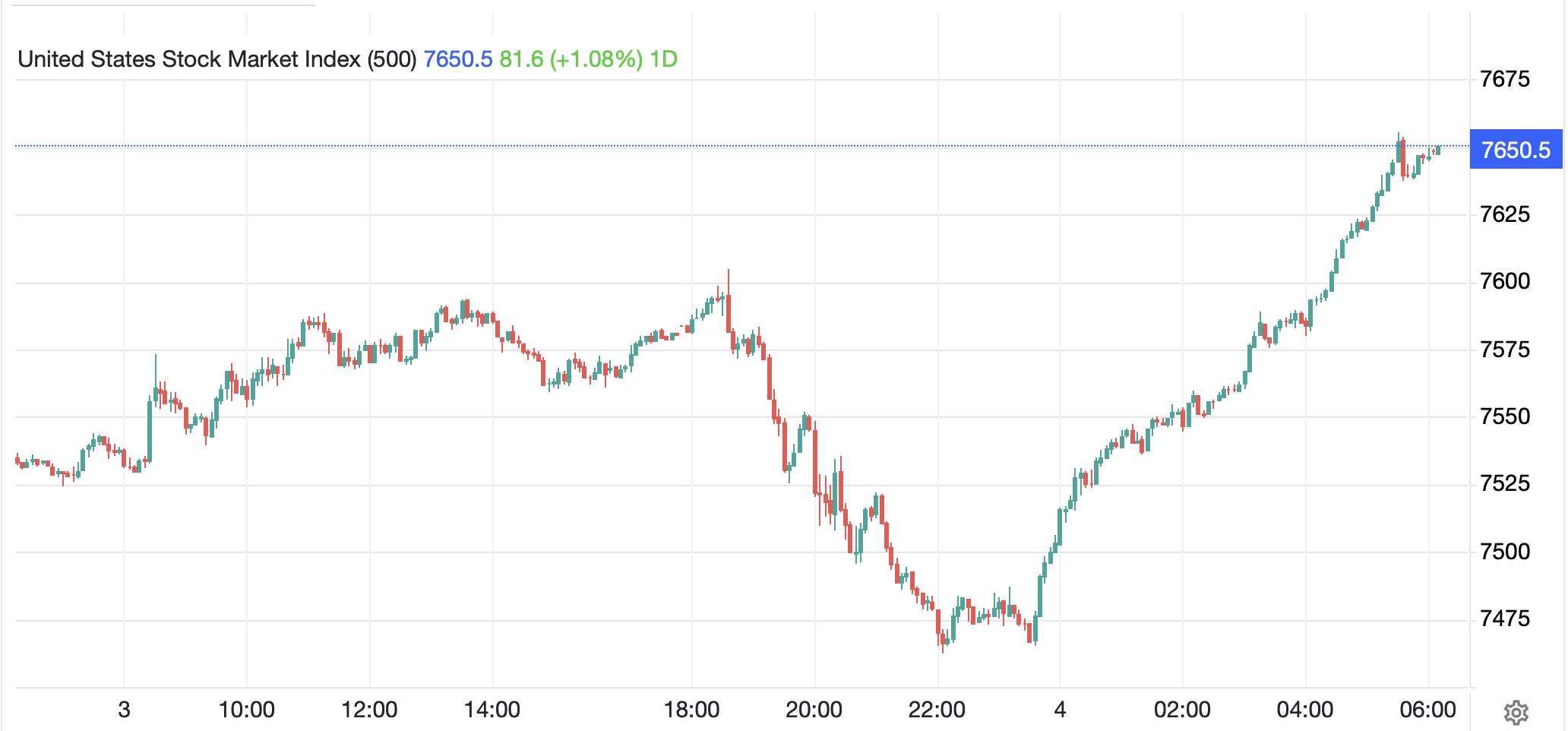
The election results are very clear and now we move on to the more difficult stage, governing.  Certainly, this was a rejection of President Trump’s agenda, or at least some of his actions, with the Iran war resulting in much higher energy costs a significant issue for the electorate.  However, in many ways, this is the best possible outcome for markets as political gridlock has historically been a net positive for the economy.  If Congress cannot pass new laws, that is generally a good thing.  And this was made clear last night as you can see in the chart below of the S&P 500, which saw losses early in the evening and then a complete reversal to where futures are now higher by 1.1% as of 6:10 this morning.

Source: tradingeconomics.com

The other statistic I keep reading is that in the year following a midterm election, equities have been higher for the past 18 midterms.  Of course, the breakdown of which industries and market sectors improve is unclear, and the past is not prolog, but it has certainly been a highlight amongst the early commentators.

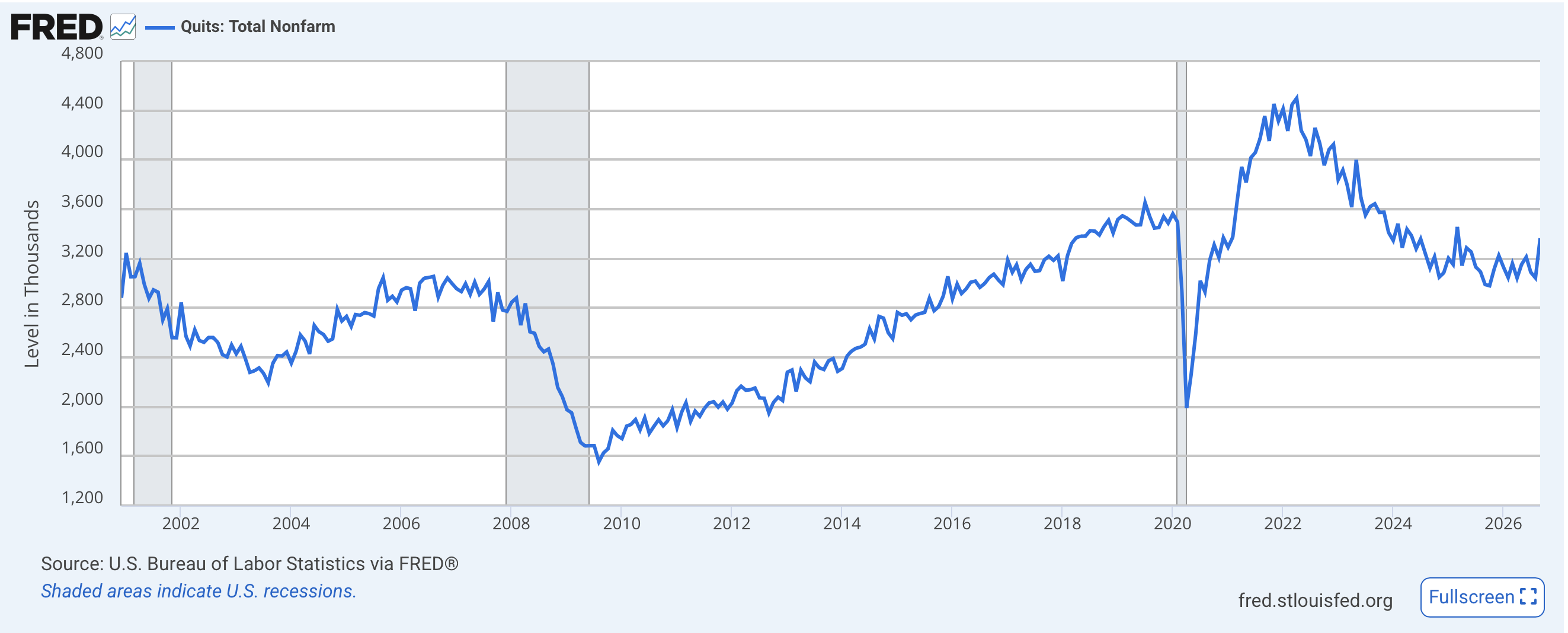
At any rate, as this is not a political discussion, let’s turn our focus to things economic and financial.  On the economy, the US data continues to be solid as per yesterday’s JOLTs data which showed more job openings, but perhaps just as importantly, more Quits, which implies that there is a greater willingness for people to leave their job as they believe their prospects of finding a new, better one are improving.  That has historically been a sign of a strong labor market.  If we look at the below chart from FRED of the Quits data this century, it is not hard to make the case that we have bottomed after the Covid induced market disruptions and beginning to trend back higher.  Given the slowing population growth and the ongoing illegal immigration crackdown, it is easy to believe that job prospects are improving for those in the workforce.

This morning we get the ADP Employment number (exp 69K) and, of course, Friday brings the latest NFP data.  Again, the US data continues to demonstrate an economy that is growing in many areas.  When I compare this with the economic data elsewhere in the world, I continue to have difficulty seeing the appeal elsewhere.  With that in mind, though, it will be interesting to see just how much of the inward investment promised over the past two years will pan out given the changes in Washington.

So, let’s see how the rest of the world responded to the US elections, assuming that was the driver.  In equity markets, Europe is virtually giddy over the outcome with all the major bourses much higher led by Spain (+2.8%) but with large gains across the board (France +1.5%, Germany +1.5%, UK +1.25%).  And US futures, as mentioned above are stronger with both the NASDAQ (+0.9%) and DJIA (+1.5%) also doing well.  Asia, though, saw things a little less positively.  Japan (-1.4%) slipped along with Taiwan (-0.8%) and Australia (-0.6%) although there were positives as well.  For instance, the Chinese plunge protection team was active last night increasing both loans and direct support as the CSI 300 rose 2.3% dragging the Hang Seng (+1.7%) along for the ride.  Too, Korea (+0.6%) benefitted from yesterday’s relief in the tech space.  But overall, equity markets are nonplussed this morning, if not genuinely happy.

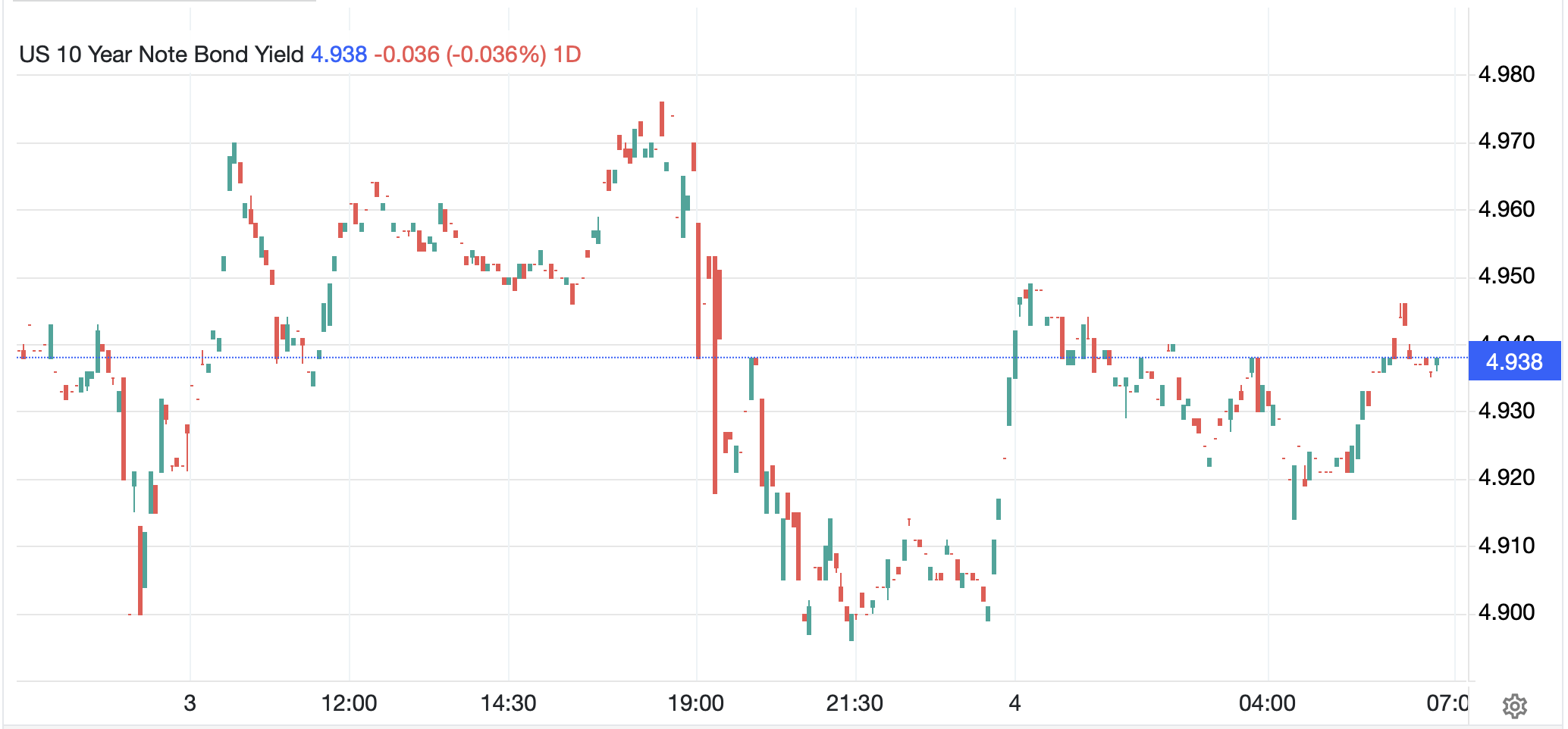
In the bond market, yields are lower this morning and I must admit, I don’t understand the logic.  Now, if you look at the chart below of the past 24 hours, you can see that this has not been a straight-line process, but here we are with 10-year yields lower by -3bps as I write.

Source: tradingeconomics.com

I read one blurb explaining the market was anticipating lower deficits going forward but I fail to understand how that will work.  There is zero evidence that a Democrat led congress will pass an austerity budget, and I expect that President Trump would veto any bills that raise taxes, so I am at a loss as to the source of that deficit reduction, at least on the surface.  Perhaps the ongoing crackdown on fraud will be sufficient to reduce the deficit, but that seems a stretch.  And if everything becomes a continuing resolution, that is not going to reduce expenditures.  However, yields around the world are largely lower with Europe benefitting from the Treasury market’s lead as the weaker European credits (France, Italy, Spain, UK, Greece) all enjoy bond rallies with yields slipping -4bps or so across the board.  As it happens, German bund yields are unchanged this morning.

In the commodity space, oil (-1.0%) continues to slide although I have seen nothing indicating that a deal to end the war in Iran was imminent.  In fact, the WSJ this morning had an article about how Iran was desperately trying to stop the flow of oil and using guerilla tactics but having limited success doing so.  Iran’s bigger problem is now that the election is past, President Trump has a pretty free hand in doing what he wants there, and the evidence continues to show that the blockade is really hurting the Iranians.  As I said yesterday, my sense is this is going to end before long.

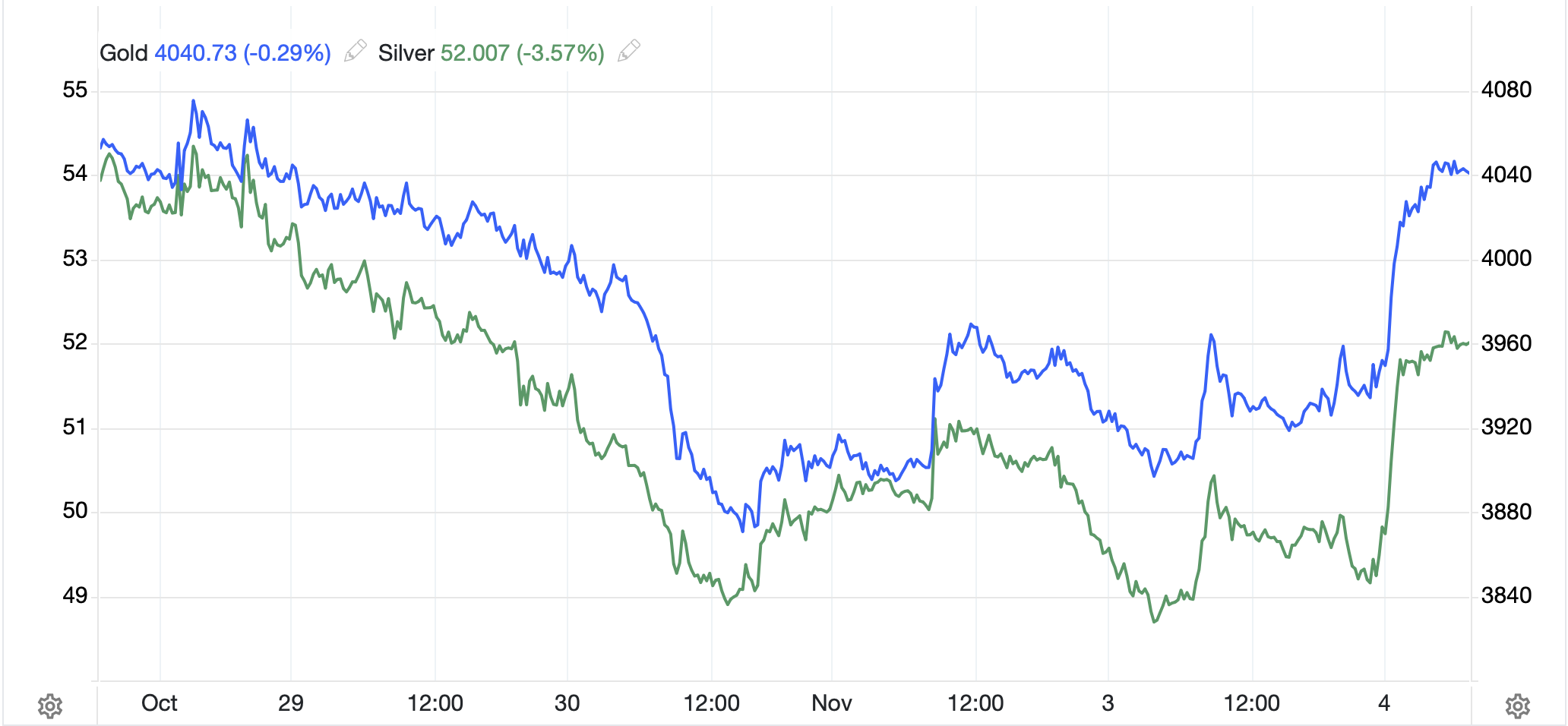
With oil continuing its recent decline, and yields lower, it should be no surprise that metals markets have benefitted, but the magnitude is surprising.  Gold (+2.8%) and silver (+4.4%) have recouped all of their declines of the past week, as per the below chart.

Source: tradingeconomics.com

Will this rally hold going forward?  Much depends on the dollar’s performance, which today is much lower, and how the interest rate structure evolves.  If lower yields are on the horizon, perhaps this is just the beginning.

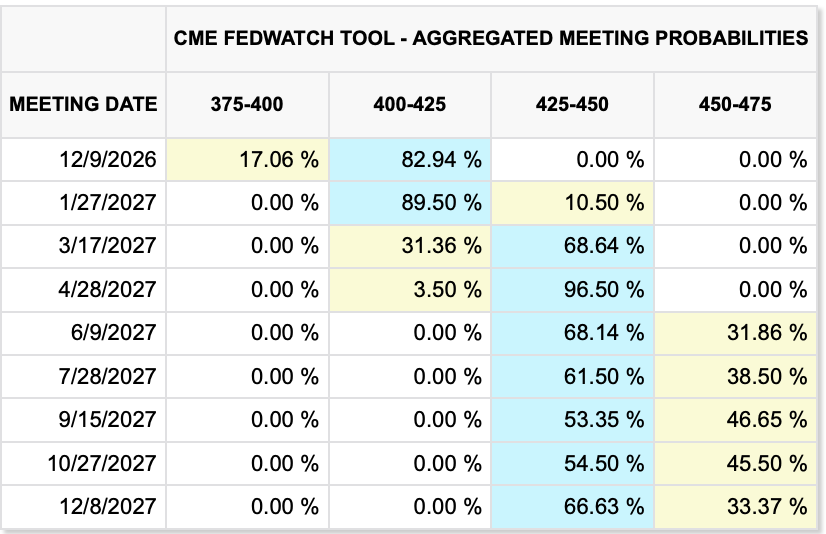
And yet, if we look at the CME Fed funds futures market, the probability of a hike in December rose in the wake of the election, which seems at odds with that narrative.

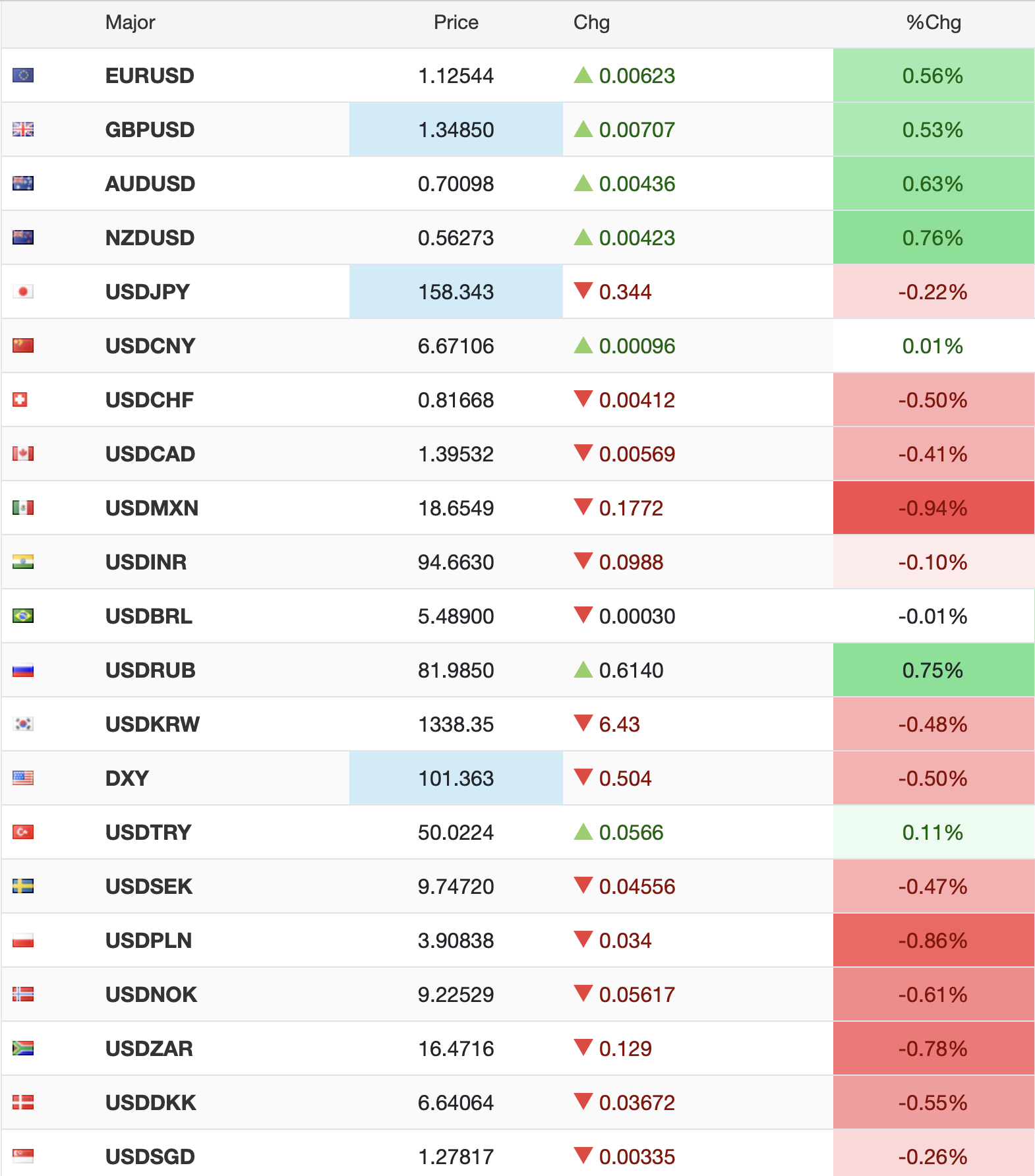
So, let’s look at the dollar this morning.  It is lower across the board, and by a decent amount virtually everywhere.  if you look at the table below from tradingeconomics.com, you can see that the only exceptions are RUB, which isn’t really a tradable currency, CNY, which didn’t move and BRL, which despite the dollar weakness can find no strength as investors continue to exit the economy there.  Otherwise, it’s pretty unanimous, nobody wants dollars today.

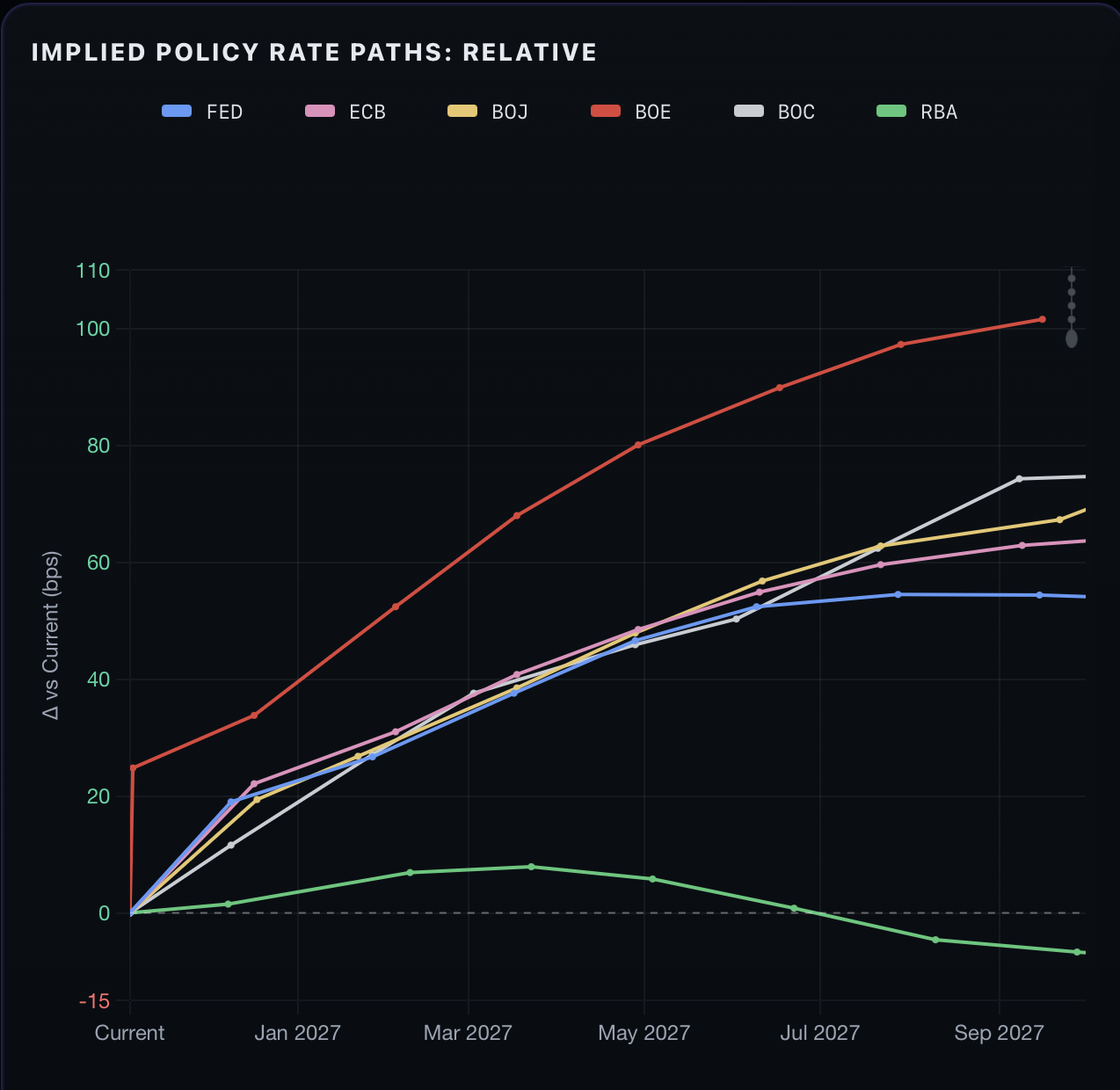
Will this continue?  Positioning in the dollar heading into the election was net long, so I expect much of this movement is simply the beginnings of unwinding those positions.  But as I frequently highlight, the dollar is merely in the middle of its long-term range, neither especially rich nor cheap here, so its future will depend on the fundamentals.  Perhaps today’s Eurozone inflation data, which printed at 4.0%, has traders looking for a more hawkish ECB but there is no evidence of that based on implied probabilities from futures and swaps markets as you can see below in the chart from rateprobability.com.

While the BOE is set to hike rates tomorrow, other than the RBA, which looks like it is done, the trajectory of future rate hikes appears pretty similar across the board.

I see no reason for the dollar to collapse, although it is possible that inward investment will diminish, which will slow any significant rise in the greenback.

On the data front, along with ADP Employment mentioned above, we see the Trade Balance (exp -$108B) and ISM Services (54.8) as well as the EIA oil inventories with a small build expected.  I expect that we are setting up for more range trading in the dollar with the chance of a strong trend in either direction vanishingly small right now.

Good luck

Adf

A Sneak Peek

As awful as things seemed last week
On Monday we got a sneak peek
Of how things might play
When we see the day
The mullahs and Trump finally speak

At this point, it’s not very clear
If talks have brought settlement near
But I have a sense
That there’s no pretense
And things will be settled this year

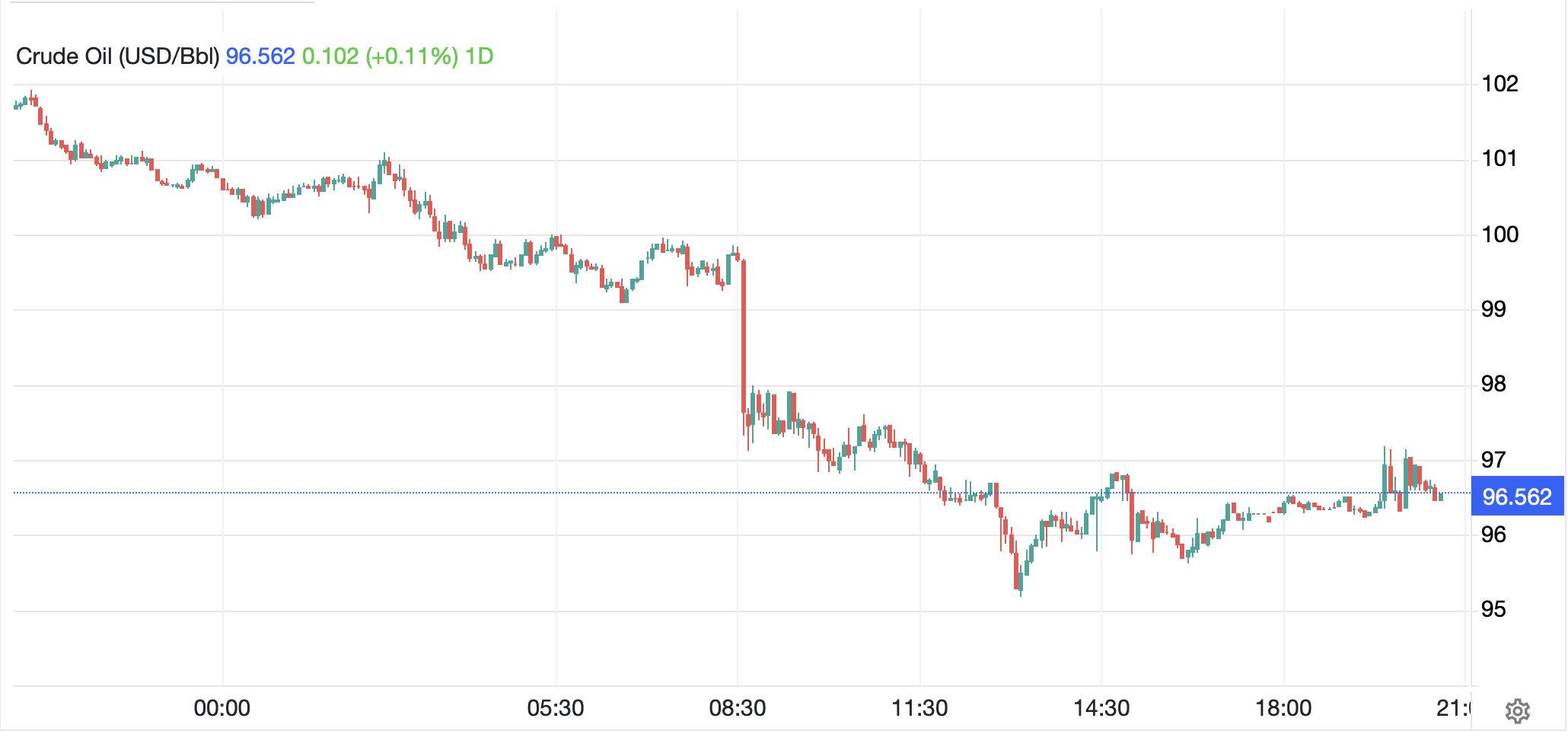
When I wrote yesterday morning, oil had only moved half of its ultimate decline as stories about more successful peace talks regarding Iran made the rounds as per the below chart.

Source: tradingeconomics.com

You can see the large red candle shortly after 8:30 yesterday morning when positive news about the Ayatollah expanding negotiating room for the civilian government came out.  One of the noteworthy market moves was the fact that prompt prices for physical delivery, which had been trading as much as $30/bbl above the futures prices we see, collapsed back to a di minimis premium.  That indicates a belief that oil is going to flow again through the Strait, and soon.  Word is Iran has offered to reopen the Strait if the US ends the blockade.  This tells me the blockade has been extremely effective and that Iran is really running out of cash.  After all, why would they consider a deal ahead of the election?  Of course, they may believe their heartfelt endorsement for Democrats has done its job and they will win today.  The only thing I know about today is I cannot wait for the political ads to end on TV!

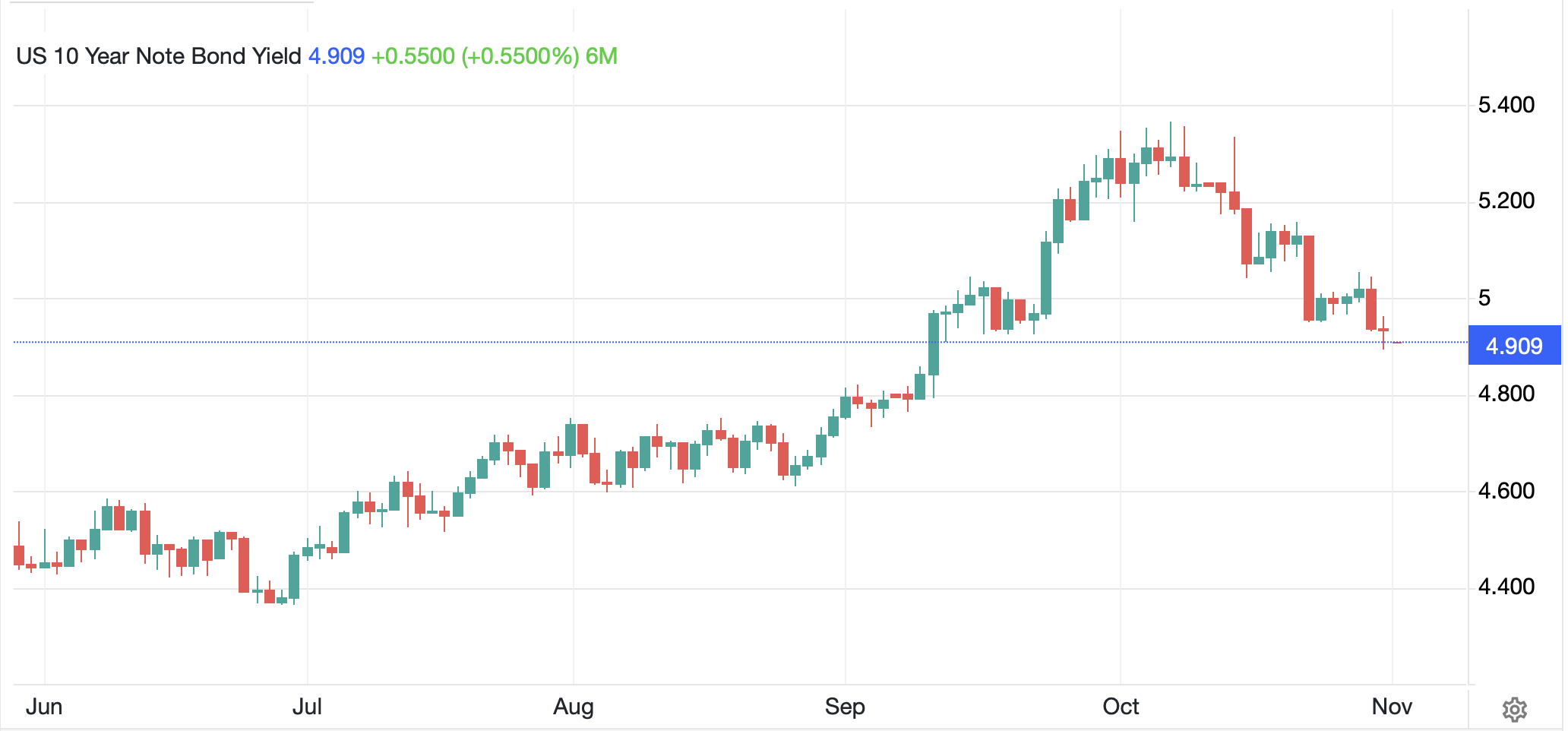
But it was not just oil that moved, we saw bond yields slip another -2bps yesterday, now down to their lowest level since mid-September.

Source: tradingeconomics.com

The Treasury’s borrowing estimates were within effective pennies of expectations, and I don’t think will have a major impact.  Of more importance is the refunding estimates to see how much Secretary Bessent will be borrowing in longer dates going forward.  There is talk of eliminating the 20-year bond, which never seemed to find a home, and a reduction in 30-year bond issuance, both of which would serve to reduce supply and support prices/reduce yields.  We shall see on Wednesday.

Precious metals soared on the decline in yields, the slipping of the probability of a Fed hike in December, now down to 73%, and the slipping dollar.  But stocks, which started the morning in a great mood, did give back a bunch on the tech side.  And that was yesterday.

The booths open early this morning
And both sides, the other, are scorning
Meanwhile, China tweaks
And wartime still wreaks
More havoc, it should be a warning

Which brings us to this morning and the beginning of Election Day.  You already know my views and that I am well outside the mainstream of opinion.  We shall learn more this evening and I suspect that the question of control of both Houses will be determined before we go to bed, certainly that will be the case in the Senate.

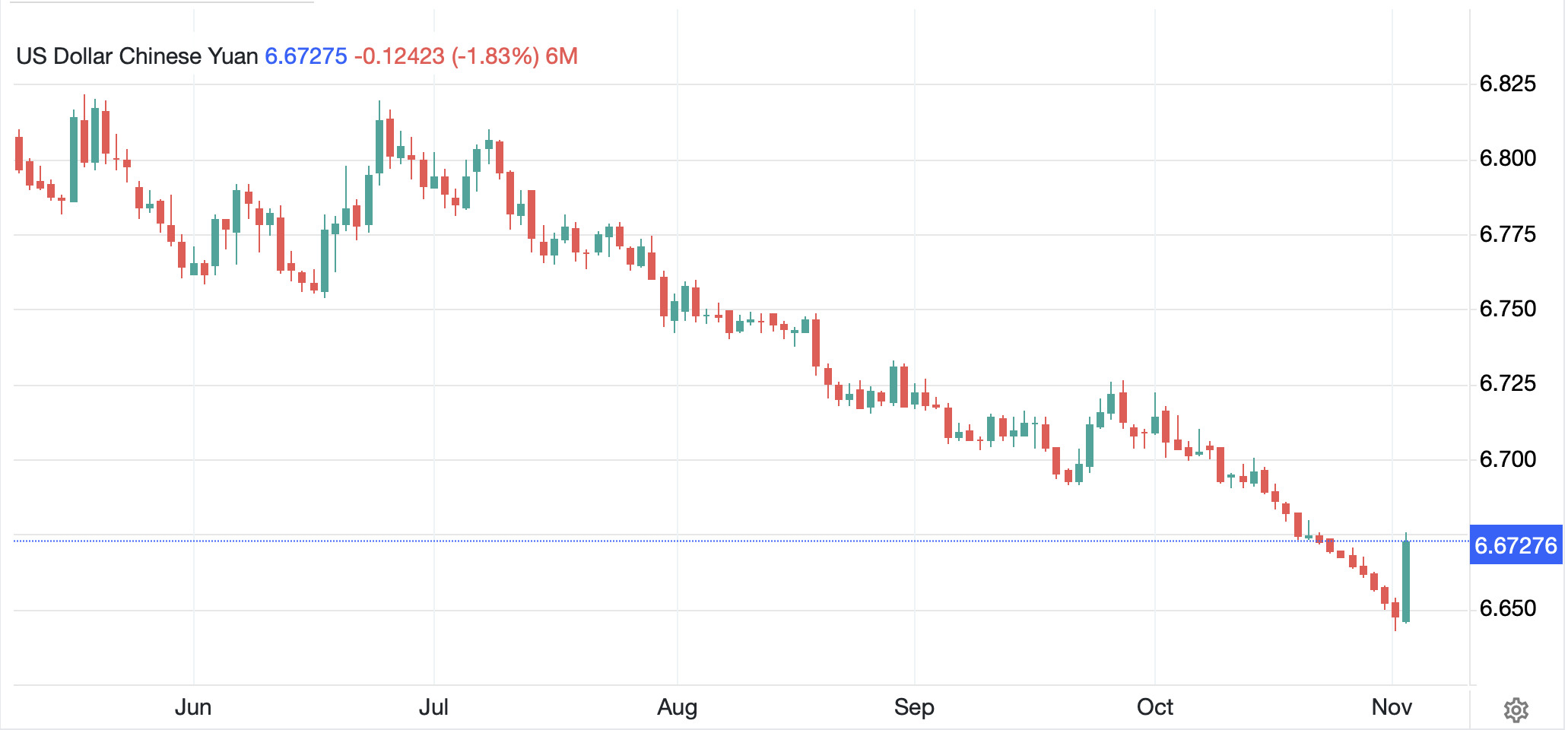
Elsewhere, the PBOC adjusted the RRR for foreign exchange at local banks, increasing the ratio from 4% to 6% to slow the too rapid strengthening of the renminbi.  We have discussed here before that CNY remains significantly weaker than its fundamentals and that is a policy stance China maintains to support its export-led mercantilist economy.  But under significant pressure from around the world, the renminbi had been appreciating steadily.  However, it seems that the PBOC decided the pace was too quick, which is odd given they were the ones in charge, but nonetheless, the change yesterday resulted in a sharp reversal in CNY (-0.4%) which while not extreme, counts as sharp in that currency.

Source: tradingeconomics.com

I am confident that CNY will resume its appreciation over time, but perhaps at a much slower pace.

The other noteworthy news item this morning was the report that there was limited military activity on Qeshm Island in the mouth of the Strait of Hormuz.  The report is the Iranians fired a surface-to-air missile at a US fighter jet and the US responded by attacking the missile installation.  Ostensibly this has not derailed the alleged ongoing negotiations although oil (+2.1%) has rebounded off the lows seen yesterday.  A not surprising consequence of the move in oil is that metals prices have sold off aggressively again (Au -1.0%, Ag -3.2%, Cu -3.0%) as that relationship remains fully intact.  Reading about the metals markets, the best explanation I have seen regarding their recent price declines has been a discussion of the reduction in overall liquidity that is available amid ongoing expansion of debt issuance by both public and private sectors.  Consider, the more debt that is sold to investors, the less they have to buy other things, with commodities being the first thing tossed aside.

In this vein, the most likely event to change this ongoing situation will be the resumption of QE as central banks will eventually be forced to, once again, buy sovereign debt to support their own debt markets.  I know this is diametrically opposed to what Chairman Warsh has indicated he would like to do, but I struggle to find an alternative solution to a lack of funds available for investors.  We are already seeing specific sectors of the economy feel that strain, notably the worst credits as CCC credit spreads have exploded relative to the rest of the risk curve.  Rotation in the equity markets does not solve this problem, so metals, which have had a tremendous run over the past several years, remain the current asset to unload.

As to the rest of the markets, Treasury yields have backed up 2bps this morning while European sovereign yields are higher by between 4bps (Germany, Netherlands) and 7bps (Italy) amid growing concern over both the rebound in oil prices and the ongoing fiscal profligacy that is evident throughout Europe.  While US yields have fallen back sharply from their October highs, European yields remain much closer to those levels as debt/GDP ratios remain a major concern for investors there.

In the stock market, Asian markets were mixed as the Nikkei (-2.2%), China (-1.4%) and HK (-0.7%) all suffered on the ongoing angst over tech stocks and the rotation out of that sector although Korea (+4.6%) which is the poster child for tech stock dominance, had a remarkably strong session.  Taiwan (-2.5%) was in the gutter as was Indonesia (-2.0%), which continues to suffer from concerns over transparency and its potential removal from the MSCI frontier markets category.  Other regional bourses moved far less, with a mix of gainers and laggards.

European markets, though, are all under pressure this morning, with all but Paris (-0.25%) down by -0.6% or more.  There has been no data released this morning here except Swiss Inflation which rose to 1.5%!  Maybe that’s why there is rioting in Zurich.  As to US futures, they are mixed this morning with the DJIA (-0.9%) suffering while the other two major markets are either side of unchanged at this hour (7:15).

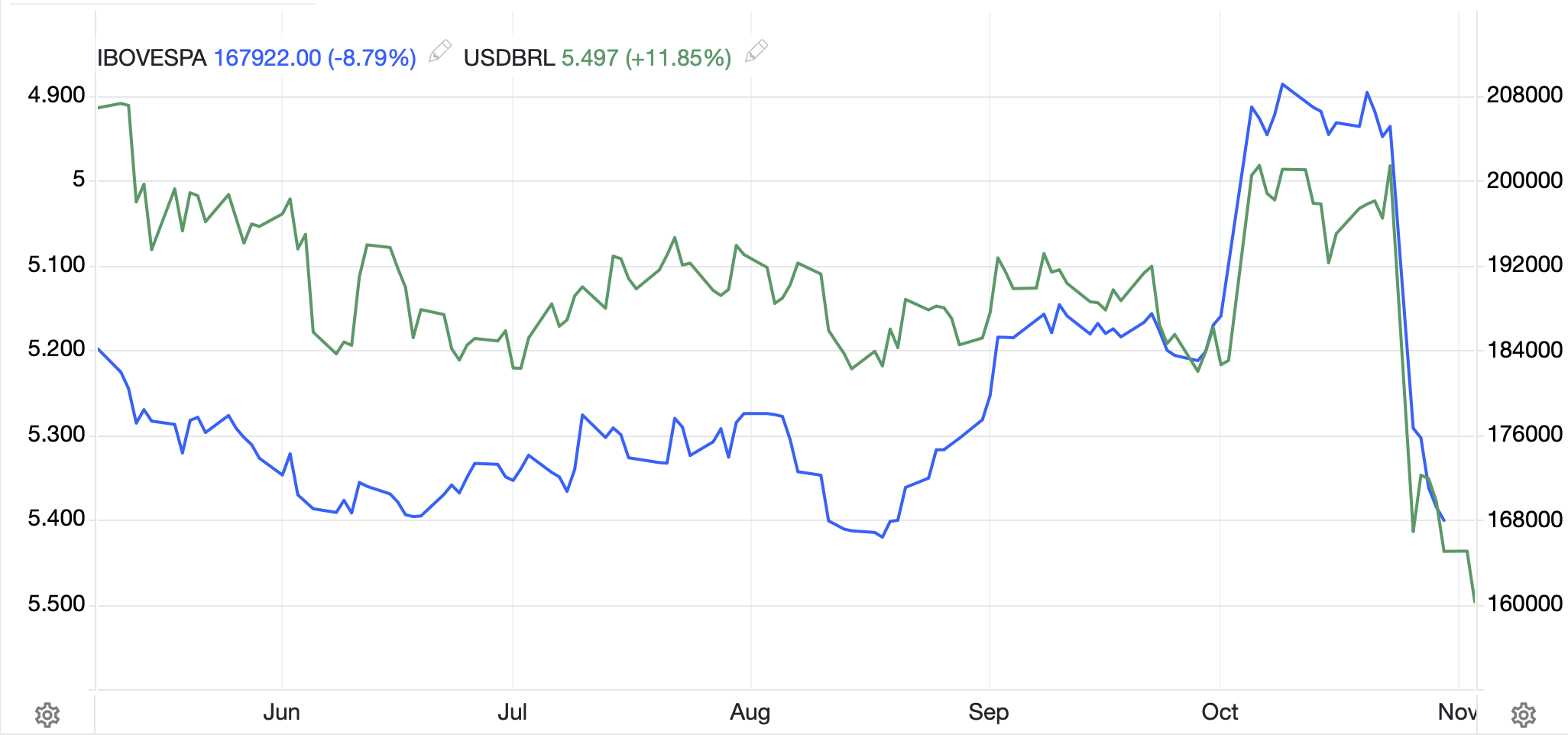
Finally, the dollar is broadly firmer this morning with one glaring exception, NOK (+0.8%) which is obviously responding to the bounce in oil prices.  BRL (-1.1%) is a currency we haven’t discussed much lately but as you can see from the below chart, there has been no recovery, whatsoever, from the electoral surprise last weekend.  Too, you can see the BOVESPA stock market also remains under pressure.

Source: tradingeconomics.com

But the major currencies aren’t doing much today, perhaps biding their time for election results.  In fact, I suspect that will be much of the story during today’s session although I would be careful of early announcements from exit polls declaring victories on either side.

On the data front, yesterday’s ISM data was strong, 55.5, with Prices Paid softer than expected at 75.2.  This morning we see the JOLTs Job Openings data (exp 7.10M) and Factory Orders (1.2%) but neither will matter to markets today.  Last night, the RBA hiked their base rate by 25bps, as expected, although the decision was split and AUD (-0.3%) lost a little luster as expectations of future hikes were reduced.

Unless the Iran situation comes completely unstuck today, it is all about the elections and for that, we need to wait until this evening at the earliest.  Hedged and close to the vest remains the way, I believe.

Good luck

Adf

Still Burning

On Friday, it certainly seemed,
As equity markets got creamed,
The end of the world
Had slowly unfurled
Just like the bears worldwide had dreamed

This morning, though, screens are all green
‘Cept crude whose price has lost its sheen
But Europe’s still burning
And that’s quite concerning
So, what, from this mess, can we glean?

I am going to stop listening to podcasts on my weekend morning walks with Marvel as they have become increasingly apocalyptic and, frankly, if the world is going to end, perhaps it’s better not to know ahead of time, it will save so much angst!  One of the podcasts that I periodically listen to is Palisades Radio, which this week had an interview with Simon Hunt, a pretty well-known macroeconomist and analyst.  I have the link above, but I can only recommend listening if you are seeking a reason to commit suicide as he basically explained that the world we know is over, specifically that the House of Saud was going to collapse, the US was going to lose in Iran and with that China and Russia would become the new global hegemons.  Now, maybe that is exactly what is going to happen, I certainly don’t know.  But that feels like an outlier position to me.  Of course, Simon sounds so intellectual with his gravelly British accent, that it gets a great deal of respect.

However, I constantly go back to the idea that predictions are hard, especially about the future.  The other thing about pronouncements like this are they are impossible to verify given his timeline is measured in years, so in 2032 or 2034, if what he forecasts doesn’t pan out, nobody will remember, but if it does, he will be screaming it from the hills.  Of course, if it does pan out, no matter how loud he screams, nobody will be listening as the new global hegemons will not be interested in economic analysis.

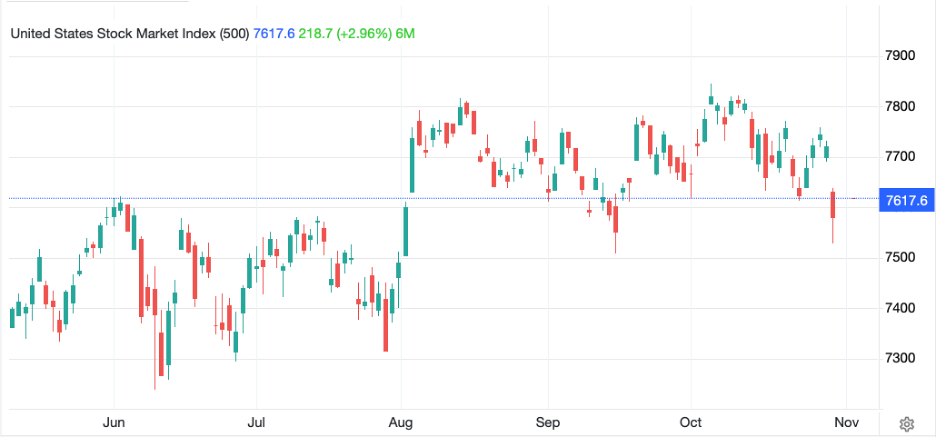
My weekend perambulations aside, Friday certainly had an apocalyptic tone to it as earnings releases during the week mostly failed to meet expectations and equity markets fell sharply.  Meanwhile, the number of articles discussing the increasing likelihood that the US was going to resume its military campaign in Iran when the election was over, egged on by President Trump himself, grew and there was an overall negative vibe.  This was clearly expressed in the equity markets as you can see in the below chart with Friday’s large red candle portending doom and gloom.

Source: tradingeconomics.com

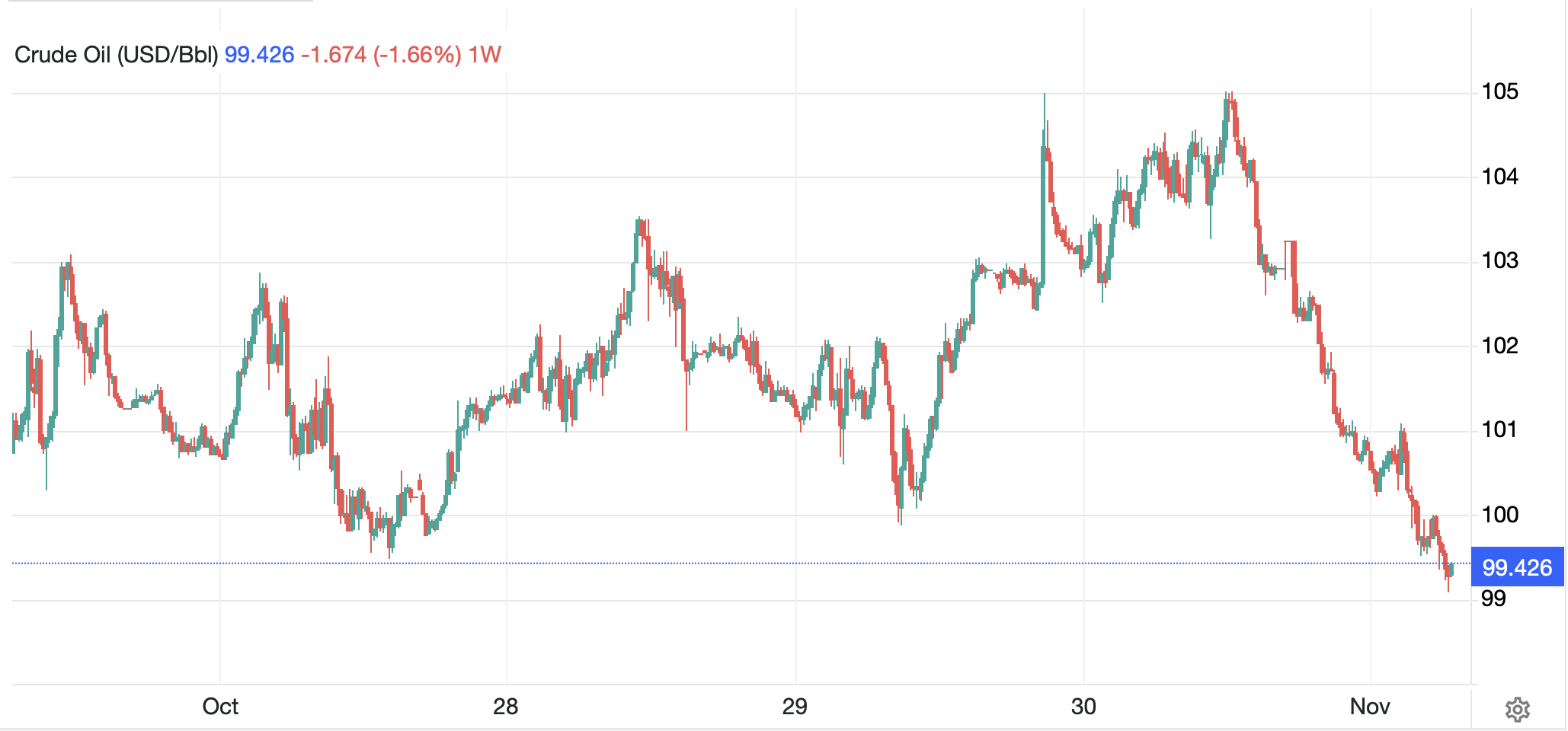
Of course, there is another potential explanation for Friday’s price action, it was month end, and there could well have been rebalancing flows driving the trade.  And this morning, the entire vibe in the US, at least, has changed.  It starts with oil, as most markets do these days, and as you can see in the below chart, WTI has fallen sharply today, down -4.5% on news that a diplomatic solution to Iran may be coming together.

Source: tradingeconomics.com

Now, I have no idea if that is true or not, and I suspect neither does anybody else, but it does appear that there has been an increase in diplomatic efforts by the Qataris, Turks and Omanis as the election comes near.  And despite Iran’s claims they are prepared for anything and will inflict significant damage if they are attacked, I imagine they really don’t want to sustain another intense wave of bombing.

But it’s not just the Iran situation that is on the markets’ collective mind, but US elections.  Now, I am on record as forecasting the Republicans maintain both houses of Congress, but I am in the minority.  However, the surprise endorsement of Republican Mike Rogers by Democrat Haley Stevens, the woman who lost the Democratic primary to Abdul El-Sayed, has certainly gotten tongues wagging and it appears there is a growing sentiment that some of the Senate Races that the MSM had confidently called for Democratic victories may not be so sure after all, notably Texas and Michigan.  If I am correct in my political prognostications, I believe much equity market angst will dissipate quickly.

Turning to Europe, there was a coup in Poland, or not, I am not sure what is going on, and based on the articles I have read, I don’t think anybody is sure.  Perhaps the most surprising thing I saw was that there are riots in Zurich and Basel.  Of all the places on the planet, perhaps only Antarctica would be a less likely spot for a riot than Zurich.  But one must question what would cause the people of Zurich to riot.  The idea that Europe is burning spontaneously is suspect.

If we sum it all up, what do we know?  The universal truth in media is, if it bleeds, it leads.  Given that as well as the fact that media has evolved into a 24/7/365 festival (nightmare?) on social media, perhaps we should not be surprised that every terrible event is highlighted and anything positive is dismissed because it doesn’t get enough engagement.  My experience over time, though, is that rarely do we see either the best or worst cases come about, but some middle ground instead.  I expect that is what we are going to see ahead as well.  Companies are still doing business and earning profits, people are still going to work, earning and spending money and living their lives, and that is the majority of activity.  We need to be careful as to how much of the news we consume as gospel given the potential for excessive pessimism, mostly, to become entrenched.

Enough life lessons.  Let’s review markets.  As I said, equities are having a better day than Friday with more strength (China +0.8%, HK +0.4%, Korea +2.2%, India +1.7%) than weakness (Tokyo -0.3%, Australia -0.6%, Taiwan -0.6%) in Asia as word from China was that they would be increasing their support for stock markets there as per this X summary.  As to Europe, while Spain (+0.9%) is having a solid session, the rest of the major bourses are +/-0.2% or less after PMI Manufacturing data was pretty decent (weak in France and Italy, not surprisingly) but Retail sales data was soft in both Germany and Switzerland. (I guess if the rioters are going to steal stuff, they won’t be buying much.) US futures, though, are firmer at this hour (7:30), up by 0.5% or so across the board.

In the bond market, Treasury yields (-2bps) continue to slide and are dragging European sovereign yields down as well.  I think it is worth remembering that less than a month ago, 10-year yields were 45bps higher than today and the consensus view was that owning bonds was a disastrous idea as the government would never close the deficit and other central banks would stop buying Treasuries.  But markets are funny like that, and the chart below shows just how big this reversal has been.  Are yields low?  Absolutely not, but for now, at least, fears of the bond market collapsing have gone away.

Source: tradingeconomics.com

This week also brings the Treasury refunding announcement for next quarter and there is some intrigue over how Secretary Bessent is going to present things and his strategy to reduce yields.  Of course, you remember when he talked about repurchasing off-the-run bonds at a discount it was all poo-poohed as a waste of time with no impact, and yet here we are 45bps lower.  Maybe he really is ‘The House’!

We cannot be surprised that metals markets have rebounded with the sharp decline in oil, so gold (+0.6%), silver (+2.3%) and copper (+0.4%) are all higher on the day.  However, that said, Friday’s declines were sharp enough to take gold below $4000/oz and silver below $50/oz, levels that had been seen as key supports for the long-term bulls.

Source: tradingeconomics.com

Finally, the dollar is softer this morning, notably against the euro (+0.5%) and Swiss franc (+0.7%) although given the ongoing rioting in both places I am a bit confused by the price action.  Too, the economic data was not encouraging, but the best I can distill is traders are forecasting a Democratic sweep in tomorrow’s elections.  The yen (-0.2%) is not partaking, neither is Aussie (-0.3%) although we have seen real strength in CZK (+1.0%) and HUF (+1.0).  Weirdly, PLN (+0.1%) is not doing very much despite both the wide range of today’s trading and the news about the coup/not coup.

As this is the first week of the month, there is a lot to see.

TodayISM Manufacturing54.6
 ISM Prices Paid77.0
 RBA Interest Rate Decision4.85% (+25bps)
TuesdayJOLTs Job Openings7.13M
 Factory Orders1.2%
WednesdayADP Employment65K
 Trade Balance-$108.0B
 ISM Services54.8
ThursdayBOE Interest Rate Decision4.0% (+25bps)
 Initial Claims195K
 Continuing Claims1710K
 Unit Labor Costs0.6%
FridayNonfarm Payrolls65K
 Private Payrolls58K
 Manufacturing Payrolls4K
 Unemployment Rate4.2%
 Average Hourly Earnings0.3% (2.9% Y/Y)
 Average Weekly Hours34.4
 Participation Rate61.9%
 Michigan Sentiment48.2
 Consumer Credit$11.8B

Source: tradingeconomics.com

So, plenty to digest along with the election results.  Certainly, too much to describe at once.  As I have been saying, I think the elections are the fulcrum and once we see how they play out, we will have a better chance to make sense of other things as depending on who wins, different things may be important.  In the meantime, close to the vest and hedged remains the best thing you can be.

Good luck

Adf