Not Very Far

Said Jay, we are not very far
From when we can all wave au revoir
To higher for longer
With confidence, stronger,
Inflation will reach our lodestar
 
“We’re waiting to become more confident that inflation is moving sustainably at 2%.  When we do get that confidence — and we’re not far from it — it’ll be appropriate to begin to dial back the level of restriction.”  So said Chairman Powell yesterday in front of the Senate Banking Committee in response to some of the questions he received.  Nuff said!  Regardless of the fact that there has been limited indication of slowing economic activity (although this morning’s payroll report will be critical), it seems quite clear that Powell is under a great deal of pressure to reduce rates.  One must assume this pressure comes from the White House as in last night’s SOTU speech, President Biden even mentioned that mortgage rates were too high, and he was going to push them down.  Clearly, the only tool that Biden has is to lean on Powell to cut rates.
 
But despite what had appeared to be a concerted effort by every Fed speaker to push back against the proximity of the first interest rate cut for this cycle, it appears that Powell is blinking.  Interestingly, while the Fed funds futures markets didn’t really adjust very much, we did see the 2yr Treasury yield fall back 5bps and this morning it sits slightly below 4.50%, its first time back to this level since the surprising CPI print last month.  Of course, equity markets love the message, and we continue to see new highs on a daily basis.  But we are also continuing to see new highs in the anti-fiat monies, gold and bitcoin.  The world is not without risk.
 
An angry old fella named Joe
Last night tried explaining our woe
Was not his, to blame
Though he wouldn’t name
The culprit, throughout the whole show
 
While I try to leave politics out of this missive, the status of the SOTU is such that I don’t believe it can be completely ignored.  My takeaway from last night’s speech was that President Biden, in an attempt to show vigor, came across as the angry old man shaking his fist and yelling at the clouds.  He had a laundry list of things he claims to want to accomplish, all of which will cost trillions of dollars, and none of which are likely to be enacted before the election.  Many pundits pointed out this seemed more like a campaign speech than a SOTU and I think there is merit in that view.  In the end, while we understand where the pressure on Powell is coming from, I don’t believe this is going to change anything, certainly not from a market perspective.
 
And finally, it’s time to turn
To data for which we all yearn
The Payroll report
Which, if it falls short
Will likely give hawks great heartburn

Looking ahead, this morning brings the monthly payroll report.  Current median expectations are as follows:

Nonfarm Payrolls200K
Private Payrolls160K
Manufacturing Payrolls10K
Unemployment Rate3.7%
Average Hourly Earnings0.3% (4.4% Y/Y)
Average Weekly Hours34.3
Participation Rate62.6%

Source: tradingeconomics.com

Recall, last month’s number was massively higher than anticipated at 353K and had higher revisions as well.  The revisions were almost more surprising than the headline number as the trend for the entire previous year had been for revisions to be to softer data.  There will certainly be revisions to the January data as well, so there is a great deal of uncertainty.  My sense is, though, that the market really wants to see a softer number with downward revisions as that will work toward cementing the case for the Fed to cut rates even sooner.  Sub 150K and look for a bond and stock rally.  Above 250K and bonds will sell off, although stocks have a life of their own.  At least that’s one man’s view.

Ok, let’s look at how things played out overnight ahead of this key data.  Asian markets followed the US rally with green across the screen.  The Hang Seng, which is seen as the tech proxy in Asia, rallied most, 0.75%. Europe, on the other hand, is having a tougher day with most markets slightly softer although the FTSE 100 is down -0.5%, the clear laggard this morning.   Apparently, Madame Lagarde’s comments did nothing to support the hopes that rate cuts were coming soon as ostensibly, rate cuts were not even discussed in the meeting and all signs point to June as the first time by which they will have confidence in the inflation story, if it is to come.  Meanwhile, US futures are pointing a bit lower, -0.3%, at this hour (8:00).

In the bond markets, Treasuries have edged lower another 1bp this morning and we are seeing yields across the board in Europe decline by between 2bps and 4bps.  I can’t tell if that is confidence in the ECB (doubtful) or belief that the ongoing decline in economic activity (Eurozone GDP in Q4 was confirmed at 0.0% Q/Q and 0.1% Y/Y) has simply encouraged investors that rates are going to fall with no chance of a backup.  Meanwhile, JGB yields were unchanged overnight despite the ongoing excitement(?) that the BOJ may raise rates a week from Monday.

Oil prices have retreated a bit (-0.6%) but are essentially range trading and have been for the past month.  However, the star of the commodity space continues to be the barbarous relic, with gold rallying another 0.3% this morning to yet another new all-time high.  As to the base metals, copper is unchanged this morning, but has been on a roll lately while aluminum is higher by 0.65%.  Metals investors are gaining confidence that not only is there going to be no landing in the US, but that China is going to stimulate more.

Finally, the dollar remains under pressure overall as yields continue to decline.  While the euro is a touch softer this morning, virtually every other G10 currency is firmer with JPY (+0.55%) leading the way.  Remember, too, that with FY end approaching for Japan, we will begin to see Japanese corporates repatriating funds which typically sees further yen strength.  Combine that seasonal activity with the relatively new BOJ hawkishness/Fed dovishness combination and the yen could rally a lot more.  After all, it has fallen a lot in the past two years!  But, while the G10 currencies are generally having a good day, the picture in the EMG bloc is far more mixed with BRL (-0.6%) the laggard after total credit in Brazil was shown to have fallen in January for the first time since the pandemic.  On the flipside, CLP (+1.0%) is rallying after a higher-than-expected CPI report (4.5%) has traders looking for tighter monetary policy than previously anticipated.

Aside from the payroll report, there is no other data to be released and there are no Fed speakers on the calendar.  Yesterday we did hear Cleveland Fed president Mester sound more hawkish, becoming the third FOMC member to discuss only 2 cuts this year, and I maintain that when the dot plot comes out, that could be the median view.  But for now, markets and investors remain euphoric about the apparent Powell dovishness, so that will be the driver absent a huge NFP this morning.  For the dollar, that will be bad news.

Good luck and good weekend

Adf

No Confidence

So far, we’ve no confidence that
Inflation is down on the mat
Thus, rates won’t be sinking
Til prices are shrinking
Said Jay in his Wednesday House chat

But also, it seemed clear to all
No rate hikes were likely on call
With that set aside
He then did confide
That Basel III cap rules may fall

It can be no surprise that Chairman Powell’s testimony yesterday explained that the Fed is still not yet confident that inflation is going to achieve their 2% target on a sustainable basis.  While he was clear that most of them thought that would eventually be the case, the proof is not nearly conclusive at this stage.  Of course, this is exactly what he told us last month and essentially what every Fed speaker since has repeated.  He did appear to rule out any further rate hikes at this time, but quite frankly, if inflation readings start to head higher, you cannot take those off the table.  At the very least, the current Fed funds futures pricing for cuts (3% in March, 20% for May and 87% for June show the market has really decided the first cut is a summer event.  Remember, though, between now and the June 12 meeting, we will see three more CPI and PCE reports as well as three more NFP reports.  It would not be impossible for these ideas to change between now and then.

One other thing to note is we have heard several FOMC members now discuss needing only two rate cuts this year.  Do not be surprised if the March dot plot has that as the median forecast and that would be a significant change to market perceptions.

The essence of the questions by the Congressmen and women revolved around two things; the fact that high rates were hurting people trying to buy houses and how proposed capital increases due to the Basel III regulations were going to kill the banking community.  While Powell empathized with the housing issue, he reminded them all that inflation hurts everyone.  But the big surprise was Jay indicated that he may overrule Regulation vice-chair Barr and look to reduce some of those capital requirements.  Not surprisingly, the GSIB bank stocks rallied on the news!

And in fact, so did the overall stock market.  The combination of what seemed to be a promise to avoid further rate hikes and relaxing capital requirements was just what the doctor ordered to alleviate Tuesday’s pain.

Is the table set
For a March policy change?
A new wind’s blowing

The yen (+1.1%) is on the move this morning after a combination of news that Rengo, the Japanese Trade Union Confederation, is asking for wage increases of 5.8% this year, the highest request in 30 years.  While they will likely not get the full amount, certainly wages are set to rise more substantially than in a long time there.  This is music to PM Kishida-san’s ears as he wants to see more spending, and apparently, this is AOK with Ueda-san who now believes that their 2% price target has a greater chance of being sustainable.  Alongside the yen’s rally, the OIS market has bumped up the probability of a March rate hike to above 50% and several analysts in Tokyo are making that their new call.

Thinking about the situation here, the BOJ meets a week from Monday, 2 days prior to the FOMC.  It strikes me that we have the opportunity for some real volatility as if Ueda-san does raise their base rate to 0.00%, I expect the market will be looking at this being the beginning of a series of hikes and start to move the entire Japanese interest rate curve higher.  That will be bullish for the yen.  But…if the Fed’s dot plot comes in at only 2 cuts, or possibly even 1 cut this year, that is also quite hawkish for the US rate situation, will likely see the yield curve back up and should support the dollar.  The reason we hedge is to prevent movement of this nature from having too great an impact on results.  Keep that in mind.

Interestingly, I believe those two stories are far more important to markets than the ECB meeting this morning.  There is virtually no chance of any policy change, so the real question is how the statement addresses the situation for the first rate cut and its potential timing.  The commentary that we have heard to date, at least to my ears, has been a split between April and June, with a slight nod toward the latter.  One key clue will be the updated economic and inflation forecasts with some analysts looking for lower outcomes there.  If that is the case, I expect that April will get a lot more press.

But ahead of the meeting, I would argue that the narrative is shifting as follows:  the Fed has indicated that the peak has been reached and it’s simply a matter of time before they start to cut rates while the ECB has been trying to hold out their hawkish bona fides.  As such, it should be no surprise that the dollar is under some pressure and the euro has rebounded to 1.09 for the first time since mid-January.  However, there is still a lot of new information on the horizon, specifically tomorrow’s NFP and next week’s CPI which can quickly alter the Fed narrative and with it, the dollar narrative.  Be careful.

Ok, let’s look at the overnight session where, not surprisingly, the Nikkei (-1.2%) fell on the back of the hawkish sentiment and stronger yen.  It has fallen back below the 40K level, so it remains to be seen if this is temporary or if, after 40 years, the new top was just barely above the old one.  Chinese shares were also weak despite a very strong Trade Balance, although the rest of Asia followed the US higher.  In Europe this morning, Spain’s IBEX (+0.6%) is once again leading the way higher although the major markets, FTSE 100, DAX and CAC are all little changed on the day.  Finally, at this hour (7:15), US futures are edging higher by about 0.25%.

In the bond market, yesterday saw Treasury yields fall 4bps and they are down a further 1bp this morning.  Market participants are going all-in on the idea that Fed funds are going to get cut soon.  I am not comfortable with that viewpoint at all.  As to European sovereigns, they too, have seen yields slide a bit, down 2bps-3bps this morning.  All this is in contrast to JGB yields, which backed up 2bps overnight on the new hawkish take.

In the commodity markets, oil (-0.75%) is softer this morning, unwinding yesterday’s modest rally.  For now, there has been much less focus on energy than on the interest rate story although I suspect that will change again going forward.  Gold (+0.4%) continues to be the absolute star of the commodity space, rallying for the 7th consecutive session and extending its all-time high levels.  My take is there is much more room on the upside here as it is not a widely held trade and if it continues, the momentum guys are going to want to get in.  But we are also seeing strength in the base metals with both copper (+1.3%) and aluminum (+0.9%) having strong sessions.  As long as the narrative is looking for US rate cuts, these metals have further to climb.

Finally, the dollar is under pressure everywhere, not just in Japan.  Both Aussie (+0.65%) and Kiwi (+0.5%) are strong on the back of commodity strength, and we are even seeing NOK (+0.2%) rise despite oil’s decline.  If you needed proof this is a broad dollar selling environment, that’s it.  Interestingly, in the EMG bloc, while almost every currency is firmer, the movement has been quite small, with nothing more than +0.2%.  So, this seems to be a comment on the ostensibly dovish Powell testimony that has bolstered the US stock market.

On the data front today, after the ECB leaves rates on hold at 4.5% we see Initial (exp 215K) and Continuing (1889K) Claims leading the way as they do every Thursday.  We also see the Trade Balance (-$63.5B), Nonfarm Productivity (3.1%) and Unit Labor Costs (0.6%) at 8:30.  Powell starts up again in front of the Senate at 10:00 and then this afternoon, Consumer Credit ($9.25B) is released.  In addition to Powell, we hear from Loretta Mester of the Cleveland Fed.  It will be quite interesting if she hints at only two cuts this year, following Goolsbee and Barkin.  I have a feeling that is the current direction and that is not in the pricing right now.

For now, the dollar remains under pressure, so unless Powell is perceived to be more hawkish this morning, I suspect the dollar can slide a bit more before it’s all over.

Good luck
Adf

The Really Good Stuff

While yesterday’s markets were tough
Today starts the really good stuff
It’s ADP first
Then Jay’s well-rehearsed
Defense the Fed’s doing enough


As I suggested in yesterday’s note, markets had a little further to fall prior to the beginning of the information onslaught that is coming today and continues for the rest of the week.  Apparently, this was the worst session since sometime in October, but in the broad scheme of things, a 1.0% – 1.5% decline doesn’t seem that dramatic.  After all, even after yesterday’s declines, the NASDAQ 100 is higher by 8.1%, the S&P 500 by 7.1% and the Dow Jones by 2.3% so far this year.

This morning, however, I think we need to look ahead to what is on the near horizon as I believe today’s information may be the most important of the week.  Before we get into the US story, a quick note on Europe and the UK.  Many of you will recall that during the Brexit drama in 2016, the Remainers claimed that the UK economy would collapse if they left the EU.  I cannot help but notice how it is the continent which is suffering the worst effects of the current economic situation with the UK faring quite a bit better.  

One need only look at the PMI data as evidence that while things in the UK may not be great, the Eurozone is in much worse condition.  Today’s Construction PMIs are a perfect encapsulation with the UK printing 49.7, not great, but miles ahead of Germany (39.1), France (41.9), and the Eurozone as a whole (42.9).  And this has been the pattern of data we have seen consistently for the past several years.  While the UK may have suffered somewhat, Europe is in far worse shape.  Looking at the data, it is easy to see why expectations for the ECB to cut rates first are rising.  They need to do something to support the Eurozone economy.

But anyway, let’s turn to this morning’s activity which starts with the ADP Employment number (exp 150K).  The relationship between this and the NFP data seems to have broken down a bit lately, but it remains a key early look at the US employment situation.  While 150K does not indicate remarkable strength, it would be the second highest print in the past six months, a time when the economy has grown at a > 3.0% clip.  I feel like the market will pay attention to a big miss in either direction, especially a weak number as that will be seen as a harbinger of rate cuts coming sooner.

The next thing we get is the Bank of Canada rate decision, where the universal expectation is for no adjustment in the current 5.0% rate.  Here, the issue will be much more about the tone of the statement and commentary.  Recent inflation data in Canada has been softer than expected, slipping below 3.0%, but growth data continues to motor along well.  There are many in the markets who believe that the BOC will lead the way in policy changes, and if they indicate a cut is coming soon, the Fed will follow.  Personally, I don’t buy that, but then, I remain unconvinced the Fed is going to cut at all.

Which takes us to Chairman Powell’s Senate testimony starting at 10:00am.  If I were to guess on the nature of his opening statement it will be something along the lines of; things are going well as growth is solid, unemployment remains low and inflation seems to be trending lower, however, inflation remains job #1 and we are not yet convinced it will sustainably reach our goal of 2%.  He will then get a series of bizarre and idiotic questions from Senators who have virtually no understanding of the economy, and only care about grandstanding on TV for their constituents.

But this is where the most opportunity for a market moving event will take place.  If Powell offers anything other than the above recap, look for markets to react quickly.  Any hint that they are closer to a cut, and we will see equities fly and the Fed funds futures markets rally sharply (remember the December pivot?).  Any hint that cuts seem unnecessary given the overall economic strength and continued low unemployment rate and look out below.

And that’s how the day is shaping up.  However, it would not be complete if I didn’t mention perhaps the most important inflation indicator I have seen to date, and perhaps a harbinger of the future.  Of course, I am referring to the Average Tooth Fairy payout as seen below.

I found this on the Morning Hark, a terrific Substack that does a great job of aggregating information published all around the world every day, and one I cannot recommend highly enough.  But let’s face it, if the tooth fairy is cutting back her (his? Its?) payout, inflation must be dead!

Ok, it’s time to review the overnight activity.  Following yesterday’s declines in the US, Asia had a mixes session with the big winner being the Hang Seng (+1.7%) on the strength of a strong earnings report from JD.com as well as a rebound from the prior session’s sharp declines.  But elsewhere, things were mixed with limited movement overall.  In Europe, the screen is green, but only Spain’s IBEX (+1.15%) is showing any real life, with the other bourses just barely above flat.  You will be happy to know, though, that US futures are all pointing higher at this hour (7:30) by between 0.25% and 0.75%.

In the bond market, things are stable although yields have drifted a bit lower over the past several sessions.  This morning, Treasury yields are down just 1bp while we are seeing a mixed view in Europe with different nations seeing moves of + or – 1 bp.  But in general, not much to note here.  As to Asia, yields fell overnight, following the US lead of late, with JGB’s the lone exception, creeping higher 1bp.  Arguably, the fact that the bulk of the movement has been 1 basis point tells us nothing is going on!

In the commodity market, oil is rebounding slightly this morning, up 0.9%, which reverses earlier losses this week.  The star here continues to be gold (+0.3%) which has risen 5% to new all-time highs this week and looks like it is not going to stop in the near future.  Alongside the sharp rally in Bitcoin, a case can be made that investors are seeking out non-monetary alternatives given the massive debt issuance that is ongoing in the US, as well as elsewhere in the world.  For instance, yesterday China mentioned they were going to be issuing an additional CNY 1 trillion of ultra-long-term bonds to finance some stimulus.  It is not unreasonable for investors to seek non-monetary stores of value when concerns arise over non-stop issuance of paper.

Finally, this morning the dollar is a bit softer against virtually all its counterparts.  While the movement has not been large, the breadth of the decline could be indicative of a view that Chairman Powell is going to be cooing like a dove today.  This is especially so if one has a political view as after yesterday’s Super Tuesday primary results, the presidential race has been cemented as a rematch of 2020.  Many make the case that Powell does not like Trump, especially given Trump has said he will not reappoint Powell.  But I don’t think that Powell cares about that as much as about trying to get things right.  He is independently wealthy and can retire with his head held high if he can get inflation back to target.  

We’ve already discussed the data although I left out the JOLTS Job Openings (exp 8.9M) at 10:00, and then the Beige Book is released at 2:00.  We also hear from Minneapolis Fed president Kashkari, but will anybody really care what he says having just heard from Powell himself?  I think not.

So, today is all about early data and more importantly Powell’s comments.  I continue to believe that the Fed does not need to cut rates at all given the economic backdrop and despite the Tooth Fairy, inflation will remain sticky and above the Fed’s target.  As the market prices out Fed rate cuts, the dollar should benefit, but that will take more time.

Good luck

Adf

Jejune

Come Wednesday through Friday this week
It’s payrolls and Powell to speak
Let’s take time today
To hear people say
What’s driving the year-to-date streak
 
The first key is so many think
That Powell and friends need to blink
And cut rates quite soon
Else markets will swoon
And ‘flation will not rise, but sink
 
The other idea that’s around
Is AI and Bitcoin are bound
To fly to the moon
An idea, jejune,
For OG’s, though elsewhere profound


Once again, lackluster was an apt description of the market activity yesterday, although given the plethora of information that is on the horizon, we cannot be surprised by this result.  As such, I thought it might be worthwhile to review the themes that seem to be driving markets these days, as well as how expectations are built into pricing.

Clearly, the biggest story remains the Fed and its potential timeline for the mooted rate cuts necessary to achieve the much-vaunted soft landing.  As of this morning, the probability of a May cut remains near 24% with June the odds-on favorite for the first action.  While there has been some back and forth with respect to the actual probabilities, there has been no major change in that view for several weeks.  My question continues to be, why are so many people of the opinion that the Fed must cut rates?  

So far, at least based on both the GDP and payroll data, the economy is chugging along quite well with the current monetary policy settings while inflation remains well above the Fed’s target.  Arguably, a great deal of that is due to the fiscal impulse that has been ongoing, but there is no sign that is going to end anytime soon.  In fact, it strikes me that easing monetary policy amid a period of fiscal excess may juice the inflation data substantially.  Literally every Fed speaker has made this exact point, that things are going well, inflation seems to be trending lower, but there is more certainty needed before a cut would be appropriate.

Adjacent stories here are related to the election in the US, with many assuming the Fed will cut rates to help support the Biden administration (I think this is extremely unlikely).  The other key story has to do with the other G7 central banks, and their ability/willingness to change policy prior to the Fed.  Considering that Japan, Canada, the UK and Europe are all basically in recession, or right on the cusp, there is a far greater need to ease monetary policy in those places.  However, they have a serious concern that if they cut before the Fed, the dollar will rally sharply and negatively impact both economic activity and market activity, as well as undermine their currencies.  In the end, everybody is waiting for Godot Powell, and it is not clear he is going to come through.

The second key story is the remarkable performance of both Bitcoin and the tech sector.  There have been many stories comparing the current move in the NASDAQ to various times in the late 1990’s and the runup to the Tech bubble then.  We all know that eventually, despite the internet having an amazingly profound impact on all our lives, the tech sector corrected more than 80% from its early 2000 peak and it took 15 years to regain those levels.  I don’t think anybody is willing to say that the current tech leaders are bad companies with problems, but the price one pays for a company’s shares is THE key to long-term investment performance.  AI can be transformative in many ways and that doesn’t mean these shares will not decline and decline sharply.

Speaking of AI’s impact, my good friend the @inflation_guy, Mike Ashton, wrote a terrific piece about the potential impact on the economy overall, comparing it to the internet, the last significantly transformative technological revolution.  This is a must read!  Ultimately, while the impact of the internet was significant, it was not nearly as productivity enhancing as many had forecast at the initial stages of the mania.  Just keep that in mind with respect to AI as well.

As to Bitcoin, it is pushing to new all-time highs as flows into the spot ETF’s are quite substantial and driving the move.  However, it strikes me that the rationale for buying Bitcoin is very different than the rationale for buying NVIDIA.  Bitcoin believers are concerned over the integrity of the entire concept of money and its future.  They look at the dramatic increase in Treasury issuance and ask, is that debt really risk-free?  They are seeking to own alternative assets, outside the current monetary framework.  Meanwhile, buying the AI craze is as mainstream as you can get, counting on the equity values to rise substantially from here and protect your wealth, even if it is denominated in a currency that is subject to inflation and devaluation.  But for now, the two are linked at the proverbial hip.  

I would not look to short either process at this point, but having seen numerous bull markets in my time, the one thing I know is that trees don’t grow to the sky.  At some point, there will be a significant correction in both these asset classes, and we are sure to hear a great deal of screaming about how the Fed needs to come in and stop it.

In China, last night Premier Li
Revealed what their growth ought to be
Though clearly well-meant
To reach five percent
Is certainly no guarantee


One other key story overnight was Premier Li Qiang’s speech in which he declared the GDP growth target for China this year is “around 5%” with inflation to run at 3% and a budget deficit also at 3%.  While this all sounds great, there is reason for some skepticism.  Perhaps the biggest issue is that domestic demand for products is not growing and is unlikely to start doing so until the property crisis is behind them.  However, given President Xi’s unwillingness to face that music, the drawn-out process to address the situation will likely weigh on overall economic activity for a few more years yet.  

There is a potential knock-on effect of this, though, and something that I have not really considered in the past but need to investigate further.  We all know that there is a concerted effort by G10 nations to reshore and friendshore manufacturing capacity, and that has been a key driver of US economic activity.  Recall, that was the entire goal of the Inflation Reduction Act.  It has also been clear that there is currently a boom in factory construction in the US, something else supporting GDP data.  Now, if the US, and much of the G10, is adding to manufacturing capacity while China maintains its own manufacturing capacity, that is a LOT of capacity to build stuff.  It is not unreasonable to expect that the prices of manufactured goods will decline given what could well be significant excess supply.

In the US, regardless of who wins the presidential election, it is very easy to foresee another increase in import tariffs on Chinese goods (Trump has proposed a 60% tariff on all Chinese imports).  We have heard similar rumblings from Europe as well.  The point is that absent a substantial change in trade policy, goods inflation is likely to be well-contained.  Services inflation is a different issue, and given services represents a much larger proportion of the US economy, seems likely to keep price pressures pushing higher.  But rampant price rises are far less likely if we wind up with duplicate production sources for various goods.  Of course, tariffs will feed directly into inflation data, and the Fed cannot address that at all.

My point is that the economy is a highly interconnected and complex system and tracking all the potential outcomes is extremely difficult, if not impossible.  This is just one that I hadn’t considered in the past but may have some legs.  To be continued…

Ok, I have gone on too long so here’s the recap for overnight.  The Hang Seng sold off (-2.6%) but otherwise in Asia and Europe shares are little changed.  Yields are broadly lower (Treasuries -3bps, Europe -5bps on average) while oil prices have slipped a bit.  Gold (+0.5% and new all-time highs) is the commodity outlier.  Finally, the dollar remains little changed and is likely to stay that way until we see the next monetary policy adjustments.

ISM Services (exp 53.0) is the only data release today and only Michael Barr is speaking. I see no reason for things to move very far until tomorrow, when both ADP Employment is released, and Chairman Powell testifies.  Equity futures are pointing a bit lower this morning after a soft session yesterday.  That drift feels like it can continue as we await the rest of the week’s news.

Good luck

Adf

Not Fear, But Greed

It seems that on Friday, we learned
The prospect for rate cuts upturned
The ISM sunk
And Michigan stunk
So, doves got the data they yearned
 
And so, things are priced for perfection
Though history cautions reflection
Is what we all need
As not fear, but greed
Is likely to cause the correction


Markets are funny things with a history of reacting to catalysts that were completely unexpected while ignoring the ‘big’ things all the time.  Friday was a perfect example as the release of some second-tier data, ISM and Michigan Sentiment, drove a major change in the narrative and market prices in every asset class.  Prior to the Friday data releases, which saw ISM Manufacturing fall to 47.8, far below last month and forecasts, as well as the Michigan Sentiment index fall to 76.9, also well below last month’s number and forecasts, there had been a steady stream of strong data and hawkish Fed rhetoric.  

By now, you are all familiar with the Fed’s general lack of confidence that inflation is going to return to their 2.0% target soon as that sentiment has been expressed by, literally, all 17 FOMC members in the past three weeks.  The result of the hawkish talk and the solid data was a repricing in the Fed funds futures market of just how many rate cuts were coming in 2024, as well as their timing.  As well, we saw Treasury yields back up nearly 50bps during the month of February as the concept of higher for longer was finally getting internalized by market participants.  

But observing the market’s behavior, it was never clear that investors and traders really believed that tale of higher for longer.  Undoubtedly, there has been a camp, FX poets included, who have been singing that tune all year long.  But a much larger camp has been convinced that inflation was clearly on its way to 2% or lower and the Fed would want to cut sooner rather than later.  The rationales for these cuts had very little to do with the economy and focused instead on one of two things; the election this year and their effort to prevent President Trump from being elected support the current administration, or the fact that the extraordinary amount of funding that the Federal government needs to pay for its increasing deficits requires lower interest rates to prevent a fiscal disaster.

Then along comes Friday’s data and much of the Fed’s hard-won respect regarding higher for longer got tossed right out the window.  Treasury yields fell sharply, down 8bps, while the futures curves upped the ante for a May rate cut and made June that much more certain.  Not surprisingly, equity markets got quite the boost, although they have mostly been ignoring the rates story anyway. But perhaps the most interesting thing was what happened in the gold market, where the price of the barbarous relic jumped nearly 2% on the idea that rates were set to decline in the face of still high inflation.

It is important to remember that these two data points were, as I said at the top, secondary.  The fact that both pointed to economic weakness after a long string of strong data points was interesting, but was it really a signal that the trend has changed?  Personally, I am skeptical that is the case.  However, for a market that was looking for a reason to push back on the growing narrative of fewer rate cuts, they were a welcome sight.

In the broad scheme of things, though, this week is likely to be far more important in helping us all understand the nature of the current economy as well as the ongoing Fed reaction function thereto.  After all, not only do we hear from Chairman Powell as he testifies to the Senate and House on Wednesday and Thursday respectively, but Friday brings the payroll report.  Too, on Wednesday the Bank of Canada and on Thursday the ECB meet to lay out their latest views.  Remember, too, that the Chinese National People’s Congress is being held this week, and while leaks are rare, they will ultimately be announcing their growth targets for the year, so another crucial piece of information.  Net, I do not believe that last Friday’s data will have changed the minds of any FOMC members, and continue to believe that even a June cut is a low probability absent a significant overall economic decline, including lower inflation data.  But then, that’s what makes all this so exciting  A yellow face with a black line

Description automatically generated.

As we await all the activity to come, let’s recap the overnight session.  In Asia, only the Nikkei (+0.5%) managed to generate any excitement as it made yet another new all-time high and breached the 40,000 level for the first time.  Chinese shares were dull as was most of the rest of the region.  In Europe, the picture is mixed although the only mover of note is the FTSE 100 (-0.6%) which seems to be declining on the prospects of a lackluster budget announcement by the government this week.  Otherwise, bourses here are within +/- 0.2% of Friday’s closing levels.  And at this hour (8:00), US futures are edging slightly lower.

In the bond market, Treasury yields are backing up from Friday’s decline, rising 3bps this morning, but in Europe, sovereigns are mostly seeing some demand with yields slipping 2bps-4bps across the board.  The one exception is, again, the UK, where Gilt yields are unchanged on the day.  Overnight, JGB yields were unchanged, while we saw lower yields across the rest of Asia which seemed to simply be following the Treasury market.

In the commodity space, Friday also saw oil prices rise 2%, and this morning they are essentially unchanged, consolidating those gains.  OPEC+ announced that they would continue their lower production levels which clearly has had a bigger impact than rumors that a ceasefire would soon be taking place in Gaza.  Gold is also little changed this morning, holding its gains while copper is edging higher, and aluminum is slipping.  There are many analysts who discuss the coming super cycle for commodities, but thus far, there is little consistency in the price action there.

Finally, the dollar is mixed this morning.  In the G10 we are seeing weakness from SEK (-0.65%), NOK (-0.35%) and JPY (-0.3%) although some strength from the euro (+0.1%) and pound (+0.2%).  Similarly, EMG currencies are seeing gainers (ZAR +0.4%) and laggards (CLP -0.8%) and everything in between.  If the new narrative of easier Fed policy turns into reality, then I would look for the dollar to suffer.  However, I don’t yet accept that as the case.

As mentioned above, there is much on the data front this week as follows:

TuesdayISM Services53.0
WednesdayADP Employment150K
 Bank of Canada Rate Decision5.0% (unchanged)
 JOLTS Job Openings8.9M
 Fed’s Beige Book 
ThursdayECB Rate Decision4.0% (unchanged)
 Initial Claims215K
 Continuing Claims1885K
 Trade Balance -$63.4B
 Nonfarm Productivity3.1%
 Unit Labor Costs0.6%
 Consumer Credit$10B
FridayNonfarm Payrolls200K
 Private Payrolls158K
 Manufacturing Payrolls10K
 Unemployment Rate3.7%
 Average Hourly Earnings0.3% (4.4% Y/Y)
 Average Weekly Hours34.3
 Participation Rate62.6%

Source: tradingeconomics.com

In addition, as well as Chairman Powell’s testimonies in Congress, there are another four Fed speakers, although with Powell headlining, I don’t think folks will pay too close attention to them.  Last week, the Fedspeak onslaught was very consistent about that lack of confidence that inflation would reach target soon, and there is clearly no hurry to cut rates, although virtually all speakers expect rate cuts to be the case.  Perhaps the data this week will change some minds, but remember, the big number doesn’t come out until after Powell speaks, and after Friday, the Fed enters its quiet period ahead of the next FOMC meeting.  

Right now, I have to believe last Friday’s data was the exception, not the rule, but we will learn more as the week progresses.  In the end, I think the dollar remains tied to the yield story, so as long as growth remains stronger here than elsewhere, and doesn’t show signs of falling sharply, the dollar should maintain its broad level of strength.

Good luck

Adf

Who Do You Trust?

At this point, it’s who do you trust?
‘Bout ‘flation, ‘cause as I’ve discussed
To some it seems hot
For others, it’s not
And so far, no one’s got it sussed

The thing is this PCE story
Is more than just mere allegory
Chair Jay and his team
Still harp on the theme
That higher for longer brings glory

I read far too much economic analysis each day as I try to glean interesting ideas from very smart people who are happy to offer them up.  Hopefully, my doing this allows you to spend your time doing more important things while still keeping abreast of the macroeconomic situation.  But, boy, I cannot remember a time when there was such vehement disagreement on a single statistic.  There have been many times where economic bulls look at all the data and see great things while the bears see death warmed over.  But that is generally based on a collection of items.  However, right now, literally every other piece that I read, all published by very reputable analysts and economists tells the opposite story.  One piece will explain that yesterday’s 0.4% rise in core PCE was just an aberration and that it is destined to reverse lower going forward largely because housing inflation is going to decline.  The next piece will point to yesterday’s release and explain that the recent three-month or six-month trend has turned higher in the critical core services component, and that there is no sign it is going to reverse.

The greatest (or worst) thing about economics is since it is not a hard science, everybody can have a view, typically back it up with some piece of data or another and make their case.  While ultimately, the proof is in the pudding, when economists are wrong, they will typically fall back on they missed the timing, not the actual direction of travel.

By this time, if you have been following my writings, you are aware I am in the ‘inflation is sticky’ camp, and I have not been surprised by the fact that it has stopped declining.  For 2 years we have been hearing that housing inflation is due to fall because of a massive supply of new apartments coming on the market soon, and yet I believe it is now 28 consecutive months where the housing component of CPI has risen at least 0.4% on the month.  I think one of the problems with the oversupply analysis is that it doesn’t account for the fact that a large proportion of those apartments are luxury apartments with very pricey rents.  As such, it is difficult for average or median rental prices to decline.  At the same time, the Case-Shiller Home price index rose 6.1% last month, which is not indicating any decline in single family home prices.  Given the proportion of housing in the inflation indices, whether CPI or PCE, if shelter costs are rising, you can bet that inflation will be rising.  And that’s where we stand.

The next question is, what does this mean for the Fed and their reaction function and then, how will it impact financial markets?  Well, we heard from four more Fed speakers yesterday and they remained consistent with their recent comments, i.e., there’s no need to rush as the economy remains strong and inflation isn’t declining as quickly as we hoped, but we remain confident that the time for rate cuts will come as the year progresses.  As of this morning, the market is pricing about an 80% chance of a June rate cut and is still pricing 3 ½ cuts for the year.  Meanwhile, Treasury yields have edged lower by 2bps, but remain well above the levels seen just one month ago, more than 40bps higher.  And lastly on this subject, equity markets are basically ignoring the data completely and focusing on internal factors like flows.  As such, my thought yesterday that they might stumble a bit, even with a lower PCE print, turned out to be completely wrong.  The party is still raging there.

As we look ahead, I would contend that the big picture remains exactly the same.  On the price front, yesterday’s data did nothing to dissuade me from my sticky inflation thesis.  At the same time, yesterday’s other data showed that manufacturing remains in a recession (Chicago PMI fell to 44.0), but the labor market is holding up (Initial Claims edged higher to 215K, although Continuing Claims were substantially higher at 1905K).  For much of last year I was far more focused on the NFP number as being the most important based on the idea that the Fed could not withstand a significant uptick in Unemployment for political reasons.  I have a sense that dynamic is going to reassert itself going forward.  If last month’s number was the aberration that many claim, and we see weakness next Friday, I believe that will really impact the narrative and we will see May come back on the table for the first rate cut.  But if it remains strong, the bar for cutting rates will remain quite high.

With that in mind, let’s look at the overnight session.  Asia was on fire with the Nikkei (+1.9%) leading the way after Ueda-san pushed back on the message from Takata we discussed yesterday.  He cautioned patience was necessary and until they saw and digested the wage outcomes later this month, there was no reason to do anything, especially given the recent weakness in GDP growth.  That caused the yen to give back yesterday’s gains and a weaker yen tends to help Japanese stocks.  But there was strength in China, albeit not as much, with the indices there and in Hong Kong rising by 0.5% or so.  We did see Chinese PMI data which printed as expected (Manufacturing 49.1, Non-Manufacturing 51.4, Caixin 50.9), which implies nothing has changed on the mainland regarding the economy.  Next week’s plenary sessions are still the China bulls’ hope for more stimulus.

European shares are generally firmer, with only the CAC (0.0%) the laggard as the rest are higher by 0.5% or more.  PMI data here was also largely in line with the Flash data last week and is being spun as the beginning of a turn higher.  However, ECB speakers continue to push back on the need for rate cuts soon which is not supporting equities on the continent.  As to the US futures market, after another rally to all-time highs yesterday, this morning sees very little movement ahead of the ISM data.

While Treasury yields have edged lower, all of Europe have seen their sovereign yields rise by between 3bps and 6bps, arguably on the idea that the worst of the economic story has passed.  I’m not sure I agree with that, but that is all I can get from the data.  Overnight, JGB yields edged 1bp higher, but are still sitting right at 0.70%, the level at which they have been trading for the past 5 weeks give or take a nickel.

Oil prices (+1.2%) are continuing their recent rise with WTI pushing back toward $80/bbl, as traders continue to expect OPEC+ to maintain their production cuts.  As well, from a market internal perspective, the backwardation in the curve is steepening.  Briefly, this means that front month prices are higher than prices further out the curve, which in the futures market is a signal that there is excess demand for physical.  That demand is the bullish signal.  As to the metals markets, gold (+0.5%) is breaking above its recent range high at $2050/oz, as the dollar, after a strong day yesterday, is ceding some of those gains.  However, base metals can’t get going with both copper and aluminum sliding by about -0.25% this morning.

Finally, as mentioned, the dollar is sagging a little with only the yen performing worse.  But its losses are generally quite modest, on the order of 0.1% or 0.2% for both G10 and EMG currencies.  And while it is under pressure today, the trend so far in 2024 is still very clearly for dollar strength.  Given the continued hawkish tone from the Fed, I see no reason for that to change anytime soon.

On the data front, both ISM Manufacturing (exp 49.5) and Michigan Sentiment (79.6) are due at 10:00 this morning and then we hear from five different Fed speakers as the day progresses, including Governor Waller, maybe the second most influential voice on the FOMC.  It is hard for me to believe that they are going to change their tune, especially given that yesterday’s PCE data gave no hint that their 2.0% target was right around the corner.

Summing up, consider the fact that the US continues to benefit from a massive fiscal impulse, relatively cheap and abundant energy prices and the tightest monetary policy in the G10.  With that in mind, we continue to see international capital flow into the country (look at the stock market!) and I suspect those things need to change for the dollar’s trend to change.  That is not going to happen today.

Good luck and good weekend
Adf

Thought-Provoking

My sight is clearing
I now see the price target
Closer than you think

With monetary easing continuing, I believe we have reached a point where attainment of the 2% price stability target is finally in sight, despite uncertainty over the Japanese economy.  It is necessary to consider shifting gears from extremely powerful monetary easing … and how we should respond nimbly and flexibly toward an exit.”  So said BOJ member Hajime Takata last night at a meeting with business leaders in western Japan.  These are the strongest words we have heard, I would argue, and the market did respond with the yen strengthening (+0.5%) and now right on the 150.00 level, while 2yr JGB yields rose another basis point, up to 0.18%, and its highest level since 2011.  I always find the BOJ wording to be odd as they try to be nimble and flexible in something that doesn’t appear to offer opportunities to behave in that manner.

Regardless, this has encouraged a more hawkish take on Japan with the probability of their first rate hike occurring in March rising to 26% from a previous level in single digits.  But despite these comments, we must remember this is from a single BOJ speaker.  Unless and until we hear this tone from multiple BOJ board members, I maintain that while an April move to 0.00% is possible, movement much beyond that seems very premature.  After all, last night saw IP in Japan fall -7.5% in January which takes the Y/Y number to -1.5%.  Recall, too, that Japan is in the midst of a technical recession.  It just doesn’t seem like tightening monetary policy is the prescription for what ails that nation.

However, the Japanese story is for the future as we have already seen the initial knee-jerk reaction.  And that means that all eyes are going to be on the US data at 8:30.

So, what if Core PCE’s smoking?
It seems that might be thought-provoking
If that is the case
We’d all best embrace
The idea the bulls will start choking

The flipside’s a cool PCE
Which winds up at zero point three
If that’s the result
The stock-buying cult
Will take every offer they see

As the market awaits this morning’s PCE data, a quick recap of yesterday seems in order.  I think you can argue that the data indicated economic activity remains at quite a high pace.  While the second look at Q4 GDP was revised down a tick, it is still at 3.2%.  The sub-indices showed that prices rose a bit more than expected and that Real Consumer spending rose a better than expected 3.0%.  The other data point was the Goods Trade Balance which showed a larger than expected deficit, a sign that imports are growing faster than exports.  This is typically a growth scenario, not a recessionary one, so nothing about the data hinted at a slowdown in things.

As well, we heard from three different Fed speakers and to a (wo)man they all explained that they remain data dependent and that the total economic situation was what they were following, not simply the inflation rate.  My point is that there is no indication that they are anywhere near ready to cut rates.

Turning to this morning’s release, expectations are as follows: Headline (0.3%, 2.4% Y/Y) and Core (0.4%, 2.8% Y/Y).  As well, we do see some other important data with Personal Income (exp 0.4%), Personal Spending (0.2%), Initial Claims (210K), Continuing Claims (1874K) and Chicago PMI (48.0).  But really, it is all about PCE.

My take is things are quite binary for a miss from expectations.  A hot print, 0.5% or more, will result in a sharp risk-off session as market participants will reduce the probability of future rate cuts.  This should see both stocks and bonds sell off, while the dollar rallies.  In contrast, a 0.3% or lower print for Core PCE will see the opposite outcome with a massive equity rally along with a huge bond rally, especially the front of the curve, and I suspect that futures markets will juice the odds of a May cut again (March is off the table no matter what.)

Of course, the last choice is a release right at the consensus view.  In that case, both sides of this argument will continue to argue their points, but my take is, based on yesterday’s price action, that equities may have a bit further to correct on the downside absent some other news that encourages the idea of stronger real growth, or an increased probability of a Fed cut.  One other thing to remember is we get four more Fed speeches today and this evening, so regardless of the outcome, there will be a lot of opportunity to reinforce their views.

Heading into the data release, a quick look at the overnight session shows us that the Asian market was quite mixed with Japan very little changed, a small decline in Hong Kong, but mainland Chinese shares rose sharply (CS! 300 +1.9%) as traders are looking for the government to announce a new fiscal stimulus package after they meet next week and roll out their growth targets for the coming year.  it strikes me there is ample opportunity for disappointment here given how unwilling Xi has been to do just that.  The European picture is equally mixed with some gainers (UK and Germany) and some laggards (France and Spain) although not a huge amount of movement in either direction.  There was a lot of Eurozone data released this morning with weak German Retail Sales, slowing growth in Scandinavia, and inflation throughout the continent coming in just a touch hotter than forecasts, although still trending lower.  And, after a lackluster day yesterday, US futures are softer by -0.2% at this hour (7:00).

In the bond market, yields are rising this morning with Treasuries (+4bps) back above 4.30% and all European sovereigns rising by at least that much.  In fact, UK Gilts (+7bps) are leading the way after some slightly better than expected housing data.  10-year JGB yields also edged up by 1bp after the Takata comments, but remain far below the 1.00% level that is still seen as a YCC cap.

Oil prices are a touch softer this morning, -0.4%, after a modest gain yesterday.  The big story remains the rumors of OPEC+ continuing to restrict their production.  In the metals markets, precious metals are under modest pressure this morning, but base metals are holding their own, with aluminum leading the way higher by 0.6%.

Finally, the dollar, away from the yen, has really done very little overall.  Looking at my screen, the only currency that has moved more than 0.2% in either direction is NZD (-0.25%) which seems to be continuing yesterday’s price action after the less hawkish RBNZ meeting outcome.  Otherwise, nada.

As we await the PCE data, and the Fedspeak later in the day, the one thing to remember is that if we see a soft number and the equity market cannot hold its early gains, that would be quite a negative signal for risk assets in the near term.  There are many who believe we are in a bubble market, especially the tech sector, and certainly there are many frothy valuations there.  It would not be hard to imagine a correction happening just because.  But if a market falls on ostensibly bullish news, that correction could have a little more oomph than most would like to see.  I’m not saying this is my expectation, just that it is something to keep in mind.  As to the dollar, that remains beholden to the monetary policy choices and so far, they haven’t changed.

Good luck
Adf

Annoyed

Seems President Xi is annoyed
His stock market has been devoid
Of buyers, so he
Has banned, by decree
The strategies quant funds employed
 
But otherwise, markets are waiting
To see if inflation’s abating
The PCE print
Will give the next hint
If cuts, Jay will be advocating


Market activity remains on the quiet side of the spectrum as all eyes continue to focus on the Fed, and by extension all central banks.  As an indication, last night the RBNZ left their OCR rate on hold, as widely expected, but sounded less hawkish in their views, dramatically lowering the probability that they may need to hike rates again.  Prior to the meeting, there was a view hikes could be the case, but now, cuts are seen as the next step.  The upshot is the NZD fell -1.2% as all those bets were unwound.  One of the reasons this was so widely watched is there are some who believe that the RBNZ has actually led the cycle, not the Fed, so if hikes remained on the table there, then the Fed may follow suit.  However, at this stage, I would say all eyes are on tomorrow’s PCE print for the strongest clues of how things will evolve.

Before we discuss that, though, it is worth touching on China, where last night “unofficially” the Chinese government began explaining to hedge funds onshore that they could no longer run “Direct Market Access” (DMA) products for external clients.  This means preventing new inflows as well as winding down current portfolios.  In addition, the proprietary books using this strategy were told they could not use any leverage.  (DMA is the process by which non broker-dealers can trade directly with an exchange’s order book, bypassing the membership requirement, and in today’s world of algorithmic trading, cutting out a step in the transaction process, thus speeding things up.)  

Apparently, this was an important part of the volume of activity in China, but also had been identified as a key reason the shares in China have been declining so much lately.  Last night was no exception with the Hang Seng (-1.5%) and CSI 300 (-1.3%) both falling sharply and the small-cap CSI 1000 falling a more impressive -6.8%.  Once again, we need to ask why the CCP is so concerned about the most capitalist thing in China.  But clearly, they are.  I suppose that it has become a pride issue as how can Xi explain to the world how great China is if its stock market is collapsing and investment is flowing out of the country.  This is especially so given the opposite is happening in their greatest rival, the US. 

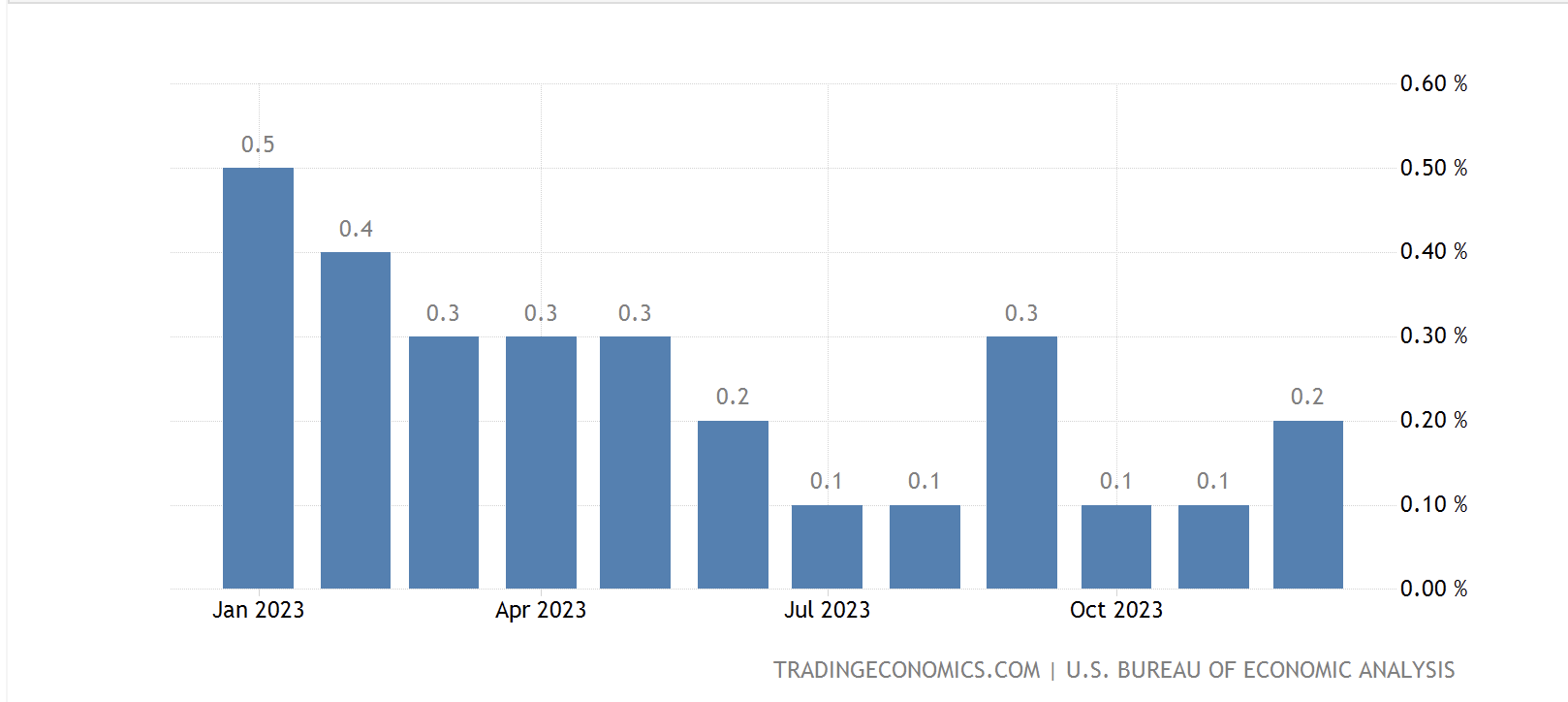
But back to PCE.  It appears that this PCE print has become pivotal to many macroeconomic views.  At least that is the case based on how much discussion surrounds it from both inflation hawks and doves.  As of now, and I don’t suppose it will change, the current consensus view of the M/M Core PCE print is 0.4% with a Y/Y of 2.8%.  As can be seen from the below chart from tradingeconomics.com, this will be the highest print in a year, and it would be easy to conclude that the trend here has turned upwards.

Of greater concern, though, is the idea that just like we saw the CPI data run hotter than expected earlier this month, what if this number prints at 0.5%?  Currently, the inflation doves are making the case that the trend is lower, and that if you look at the last 3 months or 6 months, the Fed has already achieved their target.  Their answer is the Fed should be cutting rates and soon.  For them, a 0.5% print would be much harder to explain and likely force a rethink of their thesis.

On the other side of the coin, the inflation hawks would feel right at home with that type of outcome and continue to point to the idea that the ‘last mile’ on the road back to 2.0% is extremely difficult and may not even be achievable without much tighter policy.  While housing is a much smaller part of the PCE data than the CPI data, remember, CPI saw strength throughout the services sector and that will be reflected.

One thing to consider here is the impact a hot number would have on the Treasury market.  Yields have already backed up from their euphoric lows at the beginning of the month by nearly 50bps.  Given the recent poor performance in Treasury auctions, where it seems buyers are demanding higher yields, if inflation is seen to be rising again, we could see much higher yields with the curve uninverting led by higher 10-year yields.  I’m not saying this is a given, just a risk on which few are focused.  In the end, tomorrow has the chance to be quite interesting and potentially change some longer-term views on the economy and the market’s direction.

But that is tomorrow.  Looking overnight, while Chinese stocks suffered, in Japan, equity markets were largely unchanged.  In Europe this morning, there is more weakness than strength with the FTSE 100 (-0.7%) and Spain’s IBEX (-0.7%) leading the way lower although other markets on the continent have seen far less movement.  As to US futures, at this hour (8:00), they are softer by about -0.3%.

In the bond market this morning, Treasury yields have fallen 2bps, while yield declines in Europe have generally been even smaller, mostly unchanged or just -1bp.  The biggest mover in this space was New Zealand, where their 10-year notes saw yields tumble 9bps after the aforementioned RBNZ meeting.

Oil prices (-0.3%) are giving back some of their gains yesterday, when the market rallied almost 2% on stories that OPEC+ was getting set to extend their production cuts into Q2.  It is very clear that they want to see Brent crude above $80/bbl these days.  In the metals markets, while precious metals are little changed, both copper and aluminum are softer by about -0.5% this morning.  I guess they are not feeling any positive economic vibes.

Finally, the dollar is much firmer this morning against pretty much all its counterparts.  While Kiwi is the laggard, AUD (-0.7%), NOK (-0.7%) and CAD (-0.4%) are all under pressure as well.  The same is true in the EMG bloc with EEMEA currencies really suffering (ZAR -0.5%, HUF -0.7%, CZK -0.4%) although there was weakness in APAC overnight as well (KRW -0.4%, PHP -0.6%).

On the data front, this morning brings the second look at Q4 GDP (exp unchanged at 3.3%), the Goods Trade Balance (-$88.46B) and then the EIA oil inventory data.  We also hear from Bostic, Collins and Williams from the Fed around lunchtime.  Yesterday’s data was generally not a good look for Powell and friends as Durable Goods tanked, even ex-transport, while Home Prices rose even more than expected to 6.1% and Consumer Confidence fell sharply to 106.7, well below the expected 115 reading.  

As we have been observing for a while now, the data continues to demonstrate limited consistency with respect to the economic direction.  Both bulls and bears can find data to support their theses, and I suspect this will continue.  With that in mind, to my eye, there are more things driving inflation higher rather than lower and that means that the Fed seems more likely to stand pat than anything else for quite a while.  Ultimately, I think we will see the ECB and BOE decide to ease policy sooner than the Fed and that will help the dollar.

Good luck

Adf

Not Even a Token

Like spring rains falling
So too, Japanese prices
Continue to slide


Once upon a time there was a tiny thought about Japan tightening monetary policy.  This thought, which had been seen lurking in the shadows of markets for the past thirty years, was largely ignored by all the ‘right’ people.  The illiterati economic gliteratti were all quite convinced that this would never happen as Japan was in a death spiral of rising debt and a shrinking population.  According to all the classical economic texts, interest rates could never rise again.

Then, one day there came along a virus that disrupted the world.  All the ‘important’ people in all the major nations determined that shutting down all economic activity while simultaneously printing trillions upon trillions of dollars, euros, pounds, and yen, and more importantly, giving that money to the people, was the best thing to do.  Not that surprisingly, with all that extra money chasing after fewer available goods and services, prices rose sharply almost everywhere.  Even in Japan, a nation that had suffered a generation-long deflationary bout, where companies literally apologized if they determined that a price rise was in order to cover rising expenses, prices started to go up more broadly.

This excited the policymakers in Japan as it was something they had been trying to achieve for the past 30 years.  It also excited the trading community as they became convinced that Japanese interest rates were set to explode higher.  And for a little while, Japanese inflation rates rose, surpassing the 2.0% target that had only been briefly brushed three times during that generation, the most recent being in the wake of the Covid actions.  Analysts were convinced that the new BOJ Governor, Kazuo Ueda, was getting set to raise the policy rate from its current level of -0.10%, its home for the past 8 years.  Traders positioned for JGB yields to rise and for the yen to strengthen against its currency counterparts.

Alas, so far this tale has not had that happy ending.  Instead, last night CPI in Japan printed at 2.2% headline, 2.0% core with both measures clearly trending lower for the past 18 months at least.  To be clear, in the very short term, these prints were marginally higher than market forecasts, which has resulted in a touch of strength in the yen (+0.3%), and a 1bp rise in 10-year JGB yields.  But bigger picture, this has further called into question the idea that Japanese inflation is going to remain stable at the BOJ’s 2% target.  In this situation, the idea the BOJ will tighten policy seems increasingly remote.  As such, all those delusions of tight money have been, once again, laid to rest.  The moral of this story is that; in Japan, the only money is easy money!

The newest Fed member has spoken
And Schmid said that things just ain’t broken
Thus, patience is needed
And so, he conceded
No rate cuts, not even a token
 
The Kansas City Fed’s new president, Jeffrey Schmid, made his first public comments yesterday but it could well have been his predecessor, uber-hawk Esther George, given that he hewed to the party line as follows:, “With inflation running above target, labor markets tight, and demand showing considerable momentum, my own view is that there is no need to preemptively adjust the stance of policy.  I believe that the best course of action is to be patient, continue to watch how the economy responds to the policy tightening that has occurred, and wait for convincing evidence that the inflation fight has been won.”  That’s pretty clear, and while he is not a current voter, it is simply another voice telling us that the Fed is not anxious to alter policy at all.  Even the market gets it now, with the March meeting down to a 0.5% probability of a cut, the May meeting down to a 16.3% probability and even the June meeting down to a 60% probability.  For all of 2024, the market is now pricing in just 3 ½ cuts, pretty darn close to the last dot plot.  Kudos to the Fed for getting their message across.
 
However, beyond those two stories, there is precious little to discuss this morning.  Data, beyond the Japanese CPI, has been sparse and the ECB speakers have also stayed true to their recent mantra of no reason to cut rates yet.  As such, it is not that surprising that markets remain mired in tight ranges overall.
 
Looking first at equity markets, after a lackluster session in the US yesterday, Japanese share prices were essentially unchanged although we did see some strength in Chinese shares with both the Hang Seng (+0.9%) and CSI 300 (+1.2%) rallying nicely on the back of increasing hopes for more Chinese stimulus coming in March at the annual plenary sessions.  As to the rest of Asia, activity was mixed with some countries seeing gains (India, Australia) and some losses (South Korea and Taiwan).  European bourses are also mixed with some gainers (Germany) and losers (Spain) while others have gone nowhere at all.  Finally, at this hour (6:45), US futures are ever so slightly firmer, just 0.1%.
 
In the bond market, both Treasuries and European sovereigns are seeing a bit of buying with yields lower by 1bp across the board.  Yesterday’s US 5-year auction was also somewhat unloved with a 0.8bp tail, quite large for that maturity.  It does appear that there is increasing pressure on the Treasury market as the pace of issuance picks up.  Over time, I believe this is going to matter a lot more to markets than it has thus far.
 
Oil prices, which rallied most of yesterday, are giving back some of those gains, down -0.4% this morning.  The rally was ostensibly based on further Red Sea concerns, but that really doesn’t make much sense given there were no new events there.  More likely, there was some short covering and analysts were looking for a story to tell.  Metals markets, though are in better shape this morning with gains in both precious (gold +0.3%) and base (copper +0.2%, aluminum +1.0%), largely on the back of the dollar’s modest weakness.
 
Which brings us to the dollar and the most confusing part of the session.  While it is true Treasury yields are lower by 1bp, that does not seem enough to weigh on the dollar, especially given the universal nature of yield declines.  The US curve actually inverted further, with the 2yr-10yr spread back to 42bps (it had been hanging around 25bps-30bps for several months), so that could be weighing on the greenback.  But whatever the cause, we are seeing pretty uniform weakness, although other than ZAR (+0.75%) which has clearly been helped by the metals rally, the rest of the movement is pretty modest, +/- 0.2% or less with more currencies gaining than losing.  I do not believe that the reaction function has changed here.  Rather, sometimes the FX market moves in funny ways.
 
On the data front, this morning brings Durable Goods (exp -4.5%, +0.2% ex transport) and Case-Shiller Home Prices (6.0%).  Yesterday saw a softer than expected New Home Sales and a weaker than expected Dallas Fed survey, although it was better than January’s print.  As well, we hear from Vice Chairman Barr, but there has been very little wavering from the message that patience is a virtue, and I don’t expect Mr Barr will change that tune.
 
The equity bulls took a rest yesterday but are clearly looking for more reasons to get back to buying.  To me, the potential problem will be home prices as, if they continue to rise, it will reduce hopes for any rate cuts at all, and there are still a number of pockets in the economy that are highly reliant on low interest rates to succeed.  Commercial real estate is simply the most frequently discussed, but consider much of the tech sector, where ideas that had been funded with free money that will not get the time of day if there is a cost of capital.  Ultimately, nothing has changed my idea of the dollar benefitting further as the market continues to understand that the Fed is not set to cut rates any time soon.  Of course, Thursday’s Core PCE could change a lot of views, mine included.
 
Good luck
Adf

Not Much Mystique

In looking ahead to this week
Eleven Fed members will speak
And Core PCE
On Thursday, we’ll see
But otherwise, not much mystique
 
And one other thing we will hear
Is maybe a shutdown is near
But history shows,
And everyone knows,
Investors, this problem, don’t fear


After a dull session on Friday across all markets, the weekend delivered exactly zero new information that might alter investor perspectives.  Hence, we are in the same place we left things before the weekend.  Of more concern for traders, although not for hedgers or investors, is that there are few potential catalysts on the horizon for at least the first part of the week.  Thursday’s Core PCE data is clearly the biggest data release, but there will be ample time to discuss that as we get closer.

In the meantime, based on everything we have seen of late; the entire narrative will remain focused on NVIDIA as well as AI in general in the stock market.  For bond junkies, there will be more questions about the sustainability of the current spending plans in the US and whether the market will absorb all the issuance that is coming.  Planned this week are auctions for $398 billion of T-bills, 2-year, 5-year, and 7-year notes.  That’s a lot of issuance, and there is no sign that it is going to slow down at any point in the near future.  Last week, the 20-year bond auction had its worst outcome in its history, with a 3.3bp tail, an indication that investors are getting full or at the very least concerned in some manner and need higher yields to be persuaded to continue investing. 

The issue here stems from the fact that interest payments are utilizing an increasing part of the Federal budget and as old debt matures and is rolled over at current yields, those payments will continue to grow.  While theoretically, the Treasury can simply continue to issue more debt in order to pay off whatever comes due, that means the stockpile of debt continues to grow, and with it, the interest needed to be paid each year.  Alternatively, the Fed can change their QT back to QE, purchase Treasury securities and cap rates or drive them lower.  However, if Powell goes down that road, the results are very likely to be a serious uptick in inflation and a serious decline in the dollar.  The point is the current pace of issuance is not sustainable in the long run.  Although, to be fair, people have been saying the same thing about Japan for the past twenty years, so it could still go on for a while.

I continue to believe that a bear-steepening outcome is the most likely, with bond yields rising above current the Fed funds target and the excessive supply of new bonds is one of the things driving that view.  However, that seems more like a late summer or autumnal issue, not something for right now.

But away from the bond discussion, there is little else to note.  A quick recap of the overnight session shows that Asian equity markets were on the sleepy side with Japan up a bit, 0.4% or so, while Chinese shares resumed their longer-term trend declines with the Hang Seng (-0.5%) and CSI 300 (-1.0%) both ceding ground, as there were no new stimulus programs announced.  It is seeming increasingly as though absent stimulus; Chinese shares are a sale.  In Europe, the action is mixed with both gainers and losers but nothing moving very far at all, 0.3% being the largest change on the day.  It is the same story in the US, with futures at this hour (7:30) basically unchanged from Friday’s closing levels.

In the bond market, Treasury yields (-1bp) are edging lower this morning, although we are seeing the opposite tendency in Europe with most sovereigns gaining 1bp in yields.  The outlier here is the UK, where 10-year Gilts have seen yields climb 6bps after a better-than-expected CBI Retail Sales print added to the Flash PMI data from last week and is pointing to a somewhat better economic outlook.  A quick look east shows that JGB yields slipped 3bps overnight as investors, looking ahead to tonight’s CPI data are expecting a soft print and less incentive for the BOJ to tighten policy.

Oil prices (-0.6%) continue to slide slowly as production continues apace but there are questions about demand given the weakness seen in Europe, the UK and China.  A stronger US economy is not enough, by itself, to drive oil prices higher.  In the metals markets, copper is the big loser, down -1.4%, as concerns over Chinese economic resurgence continue to dog the red metal.  It appears the relationship between copper and the CSI 300 is tightening up a bit.

Finally, the dollar is under modest pressure this morning as US yields continue to soften slightly after Friday’s decline.  But to indicate just how modest things are, the biggest mover today is the euro (+0.3%).  Literally every other major currency, whether G10 or EMG has had less movement than that.  In other words, there is no story here.  We need to see some monetary policy changes before this is going to heat up again.

On the data front, as indicated above, it is a pretty quiet week as follows:

TodayNew Home Sales680K
 Dallas Fed Manufacturing-8.0
TuesdayDurable Goods-4.5%
 -ex transport0.2%
 Case Shiller Home Prices6.0%
 Consumer Confidence115
WednesdayQ4 GDP3.3%
ThursdayInitial Claims210K
 Continuing Claims1874K
 Personal Income0.4%
 Personal Spending0.2%
 PCE0.3% (2.4% Y/Y)
 Core PCE0.4% (2.8% Y/Y)
 Chicago PMI48.0
FridayISM Manufacturing49.5
 ISM Prices Paid53.0
 Michigan Sentiment79.6
Source: tradingeconomics.com

Looking at everything, although there seems to be a lot of stuff, most of it is just not really that important.  I have to remark on the Case Shiller data as recall, a big piece of the disinflation theory is the decline in housing prices.  A 6.0% Y/Y print does not feel like it is declining to me, but then I am just an FX poet.  Obviously, all eyes will be on the PCE data Thursday morning.  In addition to this, we hear from eleven different Fed speakers including Waller and Williams, two of the more important voices, although Chairman Powell remains mum.

Nothing we have seen over the past weeks has changed my longer-term views and quite frankly, the first part of the week is shaping up as a sleeper.  Quiet markets are a boon to hedgers as executing is greatly eased, and banks will compete hard for your business.  In the end, the dollar continues to follow the yield story, so, if yields in the US slide from current levels, the dollar will likely follow.  The opposite is also true.

Good luck

Adf