Cracks Have Shown Through

A shift in the narrative view
On AI has started to brew
What folks had thought certain
From behind the curtain
Seems like, now, some cracks have shown through
 
For stock markets, this is bad news
‘Cause AI has been the true fuse
Of recent price action
And any distraction
Could well, bullish thoughts, disabuse


While equity markets around the world continue to trade near record highs which were set just weeks ago, there has been a subtle change in the narrative, at least based on my perusal of FinX.  Although there are still many in the ‘buy the dip’ camp who strongly believe that it is different this time and AI is the future, there has been an increase in the number of voices willing to say that things have gone too far.  One of the stories getting a lot of press is the fact that Tesla’s shareholders voted to give Elon Musk a pay package that could amount to $1 trillion if the company meets its milestones over the next 10 years, including having the company’s market cap rise to $8.5 trillion from the current $1.5 trillion.  This certainly has a touch of excess attached to it.

But more broadly, I couldn’t help but notice this graph, originally created by the Dallas Fed, but more widely disseminated by the FT showing the potential future of AI’s impact on humanity.  Under the standard of a picture is worth a thousand words, I might argue the information in this picture falls some 985 words short.  Rather, they simply could have said, ‘AI could be amazing, it could be catastrophic, or it might not matter at all.’ 

However, aside from the inanity of this chart, and more importantly for those paying attention to markets and their portfolios, things look a bit different.  There has been a lot of discussion regarding the everything bubble which has been led by the massive increase in value of the Mag7 stocks.  Recently, it set some new valuation records with the Shiller CAPE (Cyclically Adjusted Price Earnings) ratio now trading at its second highest level of all time, at 41.2, exceeded only during the dotcom bubble of 2000.

Source: @DavidBCollum on X

Added to this is the fact that only about half the companies in the S&P 500 are trading above their 200 day moving averages, a key trend indicator, which implies that the uptrend may be slowing, and the fact that we have had seven down days in the past eight sessions (and US futures are lower this morning by -0.2% as I type at 7:15) indicates that perhaps, a correction of some substance is starting to take shape.

Source: tradingeconomics.com

As of this morning, the S%P 500 is merely 3% below the highs seen on October 29th, so just a week ago.  The conventional description of a correction is a 10% decline, and a bear market is a 20% decline.  I am not saying this is what is going to happen, but my spidey sense is really starting to tingle.

Source: giphy.com

Remember, I’m just a poet, and an FX one at that, so my takes on markets are just one poet’s views based on too many years in markets.  This is not trading advice in any way, shape or form.  But what I can say is, be careful with your investments, things are changing.

So, let’s move on to the overnight session to see how things played out following the selloff yesterday in the US.  Let me say this, it wasn’t pretty.  Pretty much all Asian markets were lower to end the week led by Korea (-1.8%) which has seen its market race higher than the NASDAQ this year, but there was weakness in Japan (-1.2%), China (-0.3%), HK (-0.9%), Taiwan (-0.9%) and Australia (-0.7%) with most other regional exchanges flattish to lower by -0.5%.  Given the tech story is critical to Asia overall, if that is starting to falter, we can expect these markets to slip as well.  Too, there was news from China showing its Trade Surplus shrank slightly, to $90.7 billion, but more ominously, exports actually declined -1.1% while imports rose only 1.0%.  Arguably, the reason President Xi was willing to make a deal with President Trump is because the domestic economic situation in China is troublesome and he knows that more trade problems will be a domestic nightmare for him.

In Europe, red is the dominant color on screens as well with the IBEX (-0.9%) leading the way lower, but the DAX (-0.9%), FTSE 100 and (-0.7%) and CAC (-0.5%) all fading as well and losses the universal story on the continent.  Now, we know that it is not a tech story since, arguably, Europe has no tech presence.  So the problems here are more likely a combination of following the global trend lower and ongoing soft Eurozone data implying that economic growth, and hence corporate profits, are going to continue to be weak.  With the ECB taking themselves out of the equation for now, claiming rates are at the correct level and turning their focus to the idea of a digital euro (which will never be important), if we continue to see the US market slip, you can be certain that European bourses will follow.

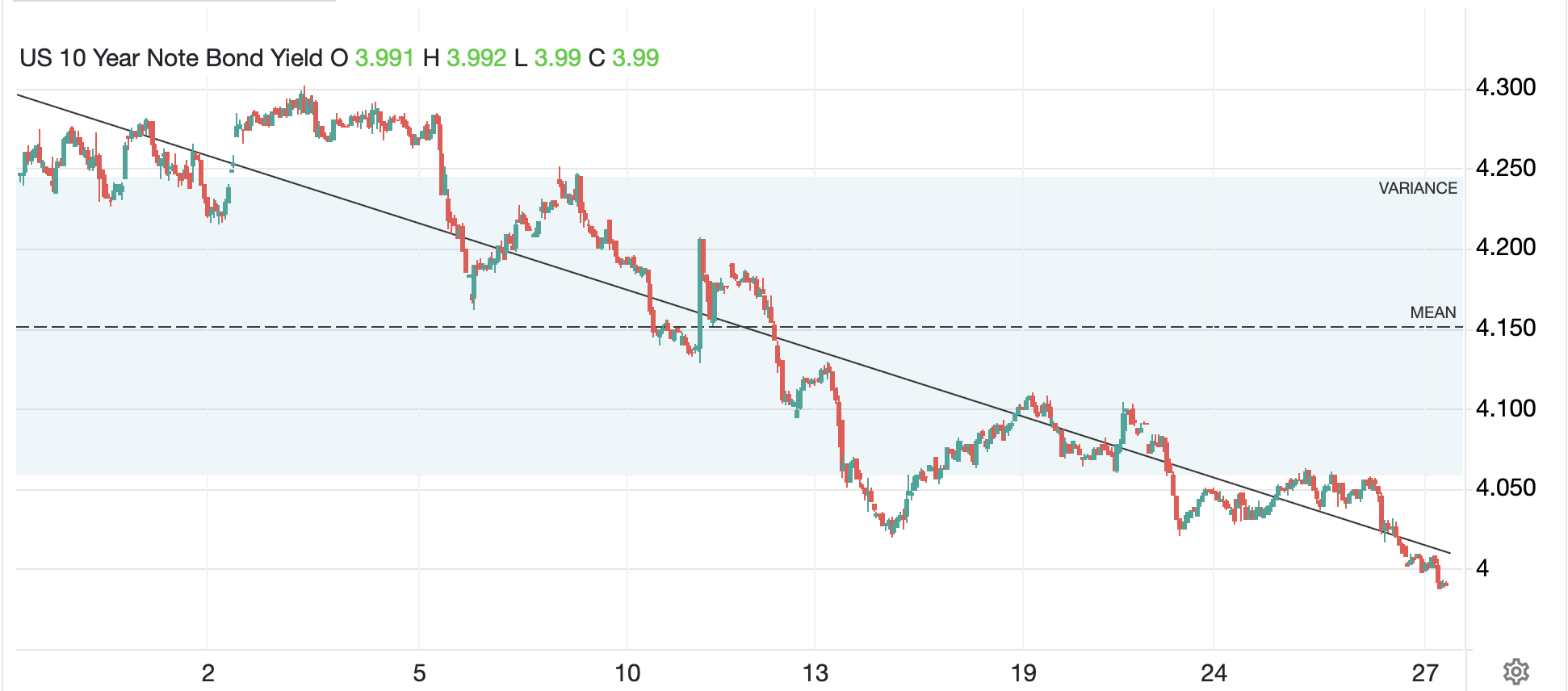
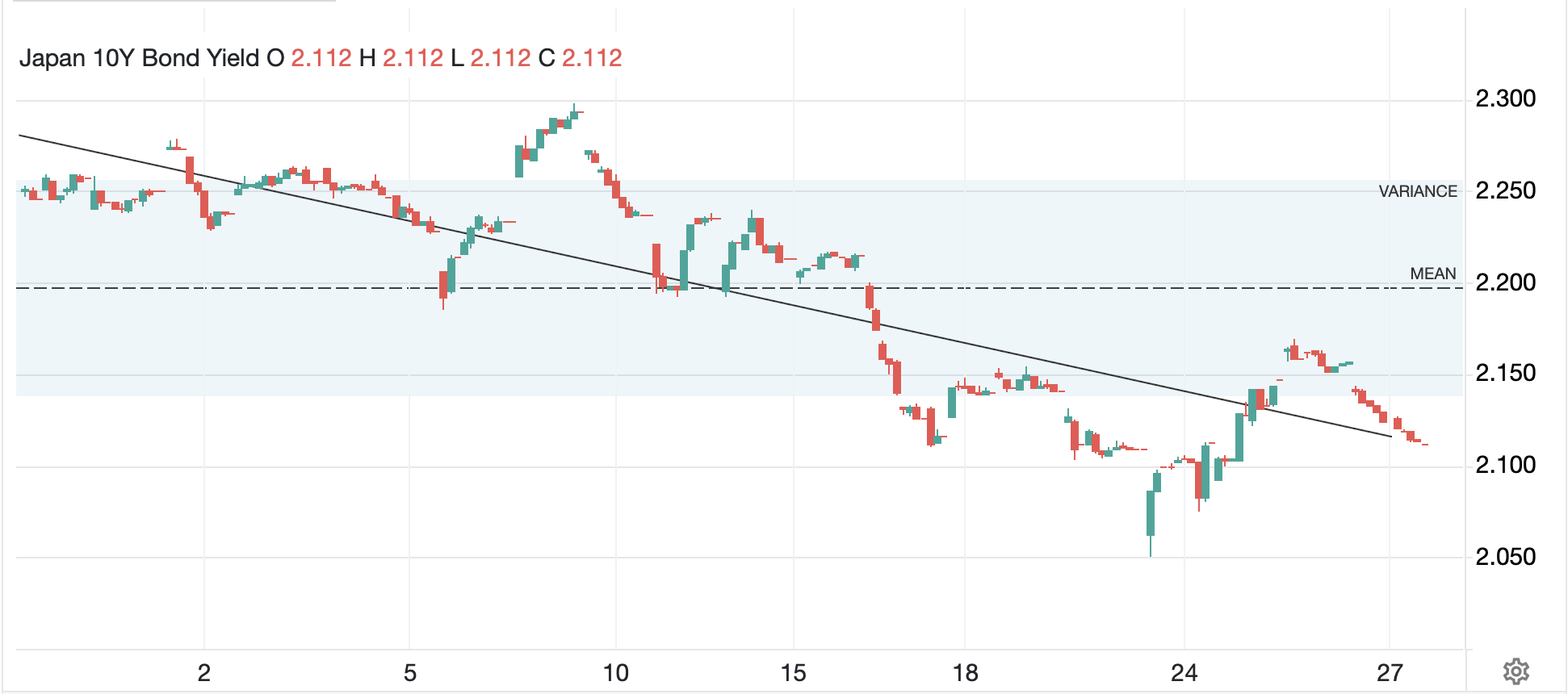
In the bond market, it is hard to get excited about anything right now as Treasury yields, which slipped a basis point yesterday, are higher by 1bp this morning.  We remain right at the level from the immediate aftermath of the FOMC meeting, which tells me that traders are awaiting the next major piece of news.  European sovereign yields are also higher by 1bp across the board with only the UK (+3bps) the outlier here today while JGBs overnight slipped -1bp following yesterday’s Treasury price action.

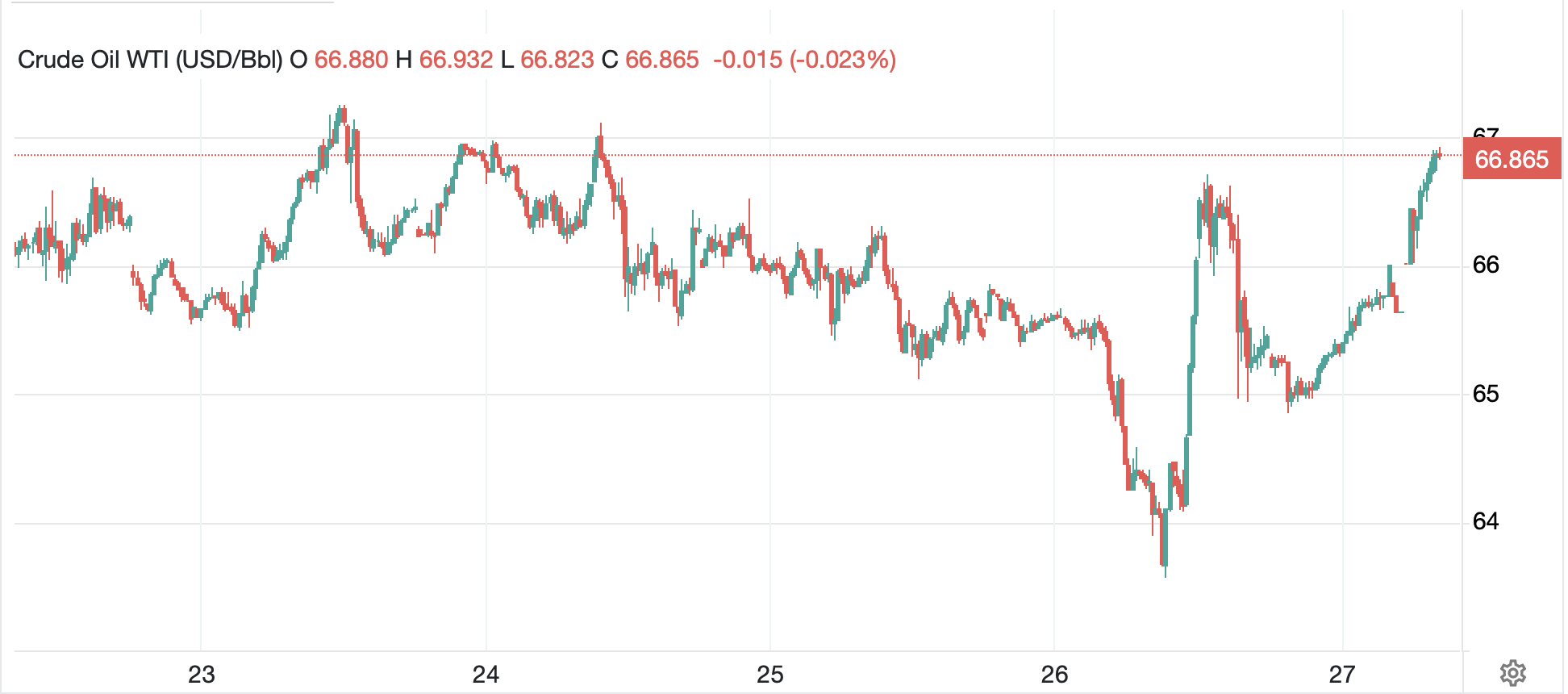
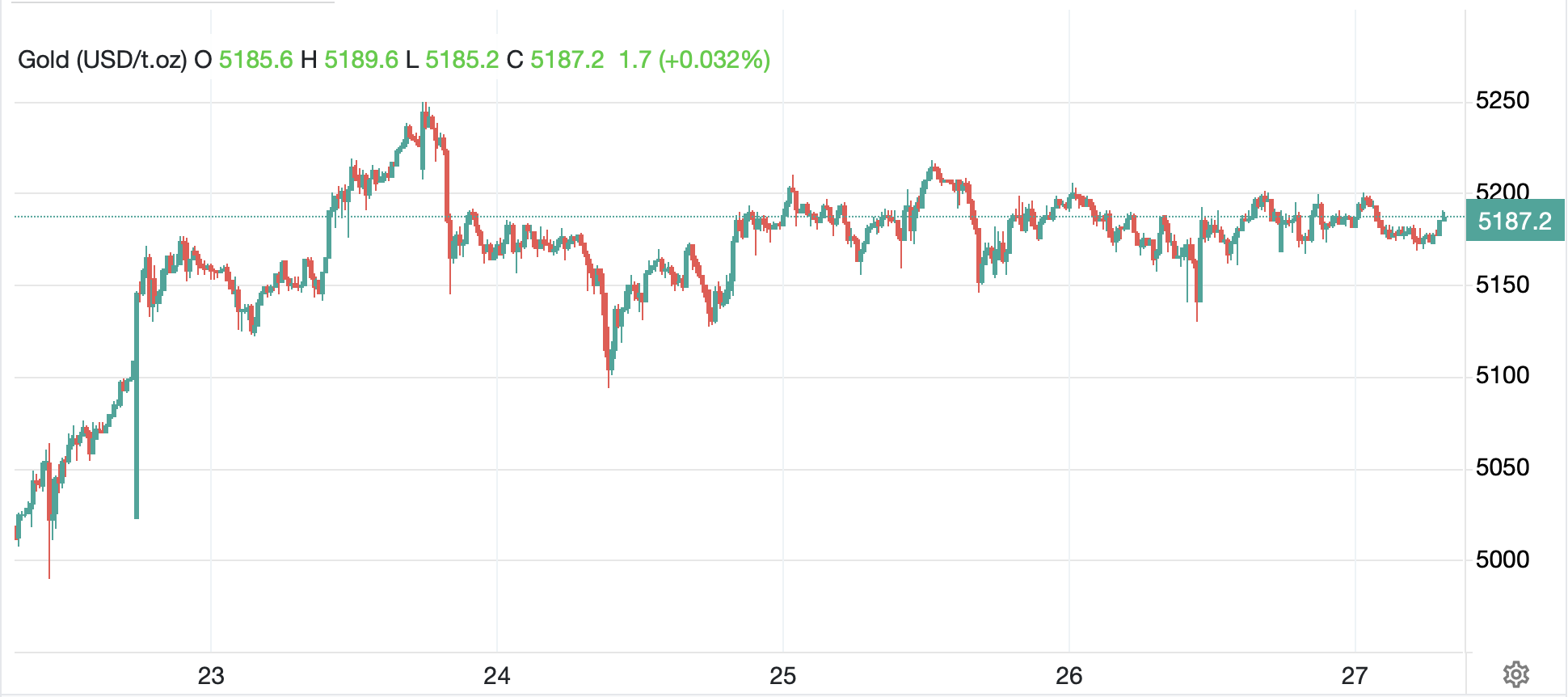
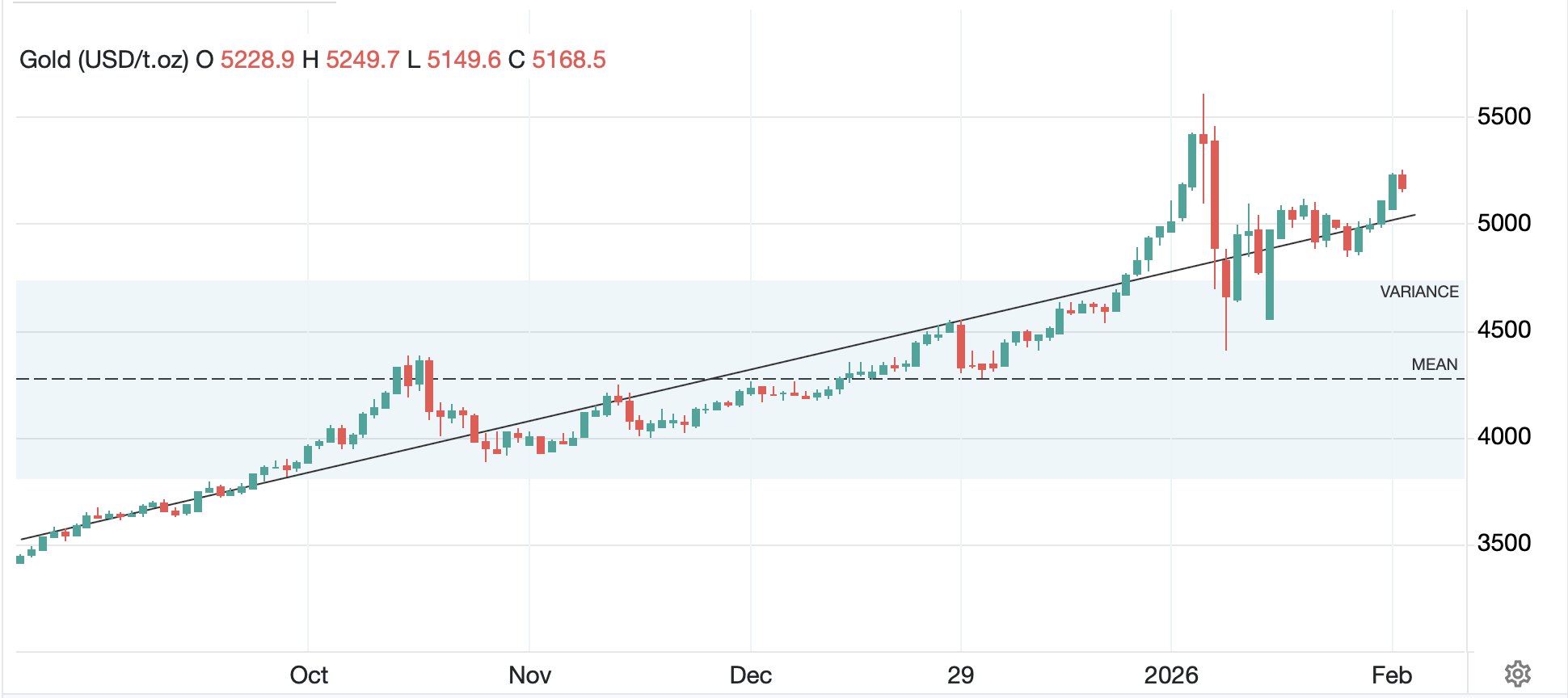
In the commodity space, both oil (+0.8%, but below $60/bbl) and gold (+0.5% but below $4000/oz) continue to trade in a range and basically have not moved anywhere of note over the past 2+ weeks as you can see in the chart below.

Source: tradingeconomics.com

There have certainly been some choppy moves, but net, nothing!  Silver (+1.0%) however, has gotten a boost after the US designated it a critical mineral implying government support.  It would not be surprising to see silver outperform gold for a while going forward.

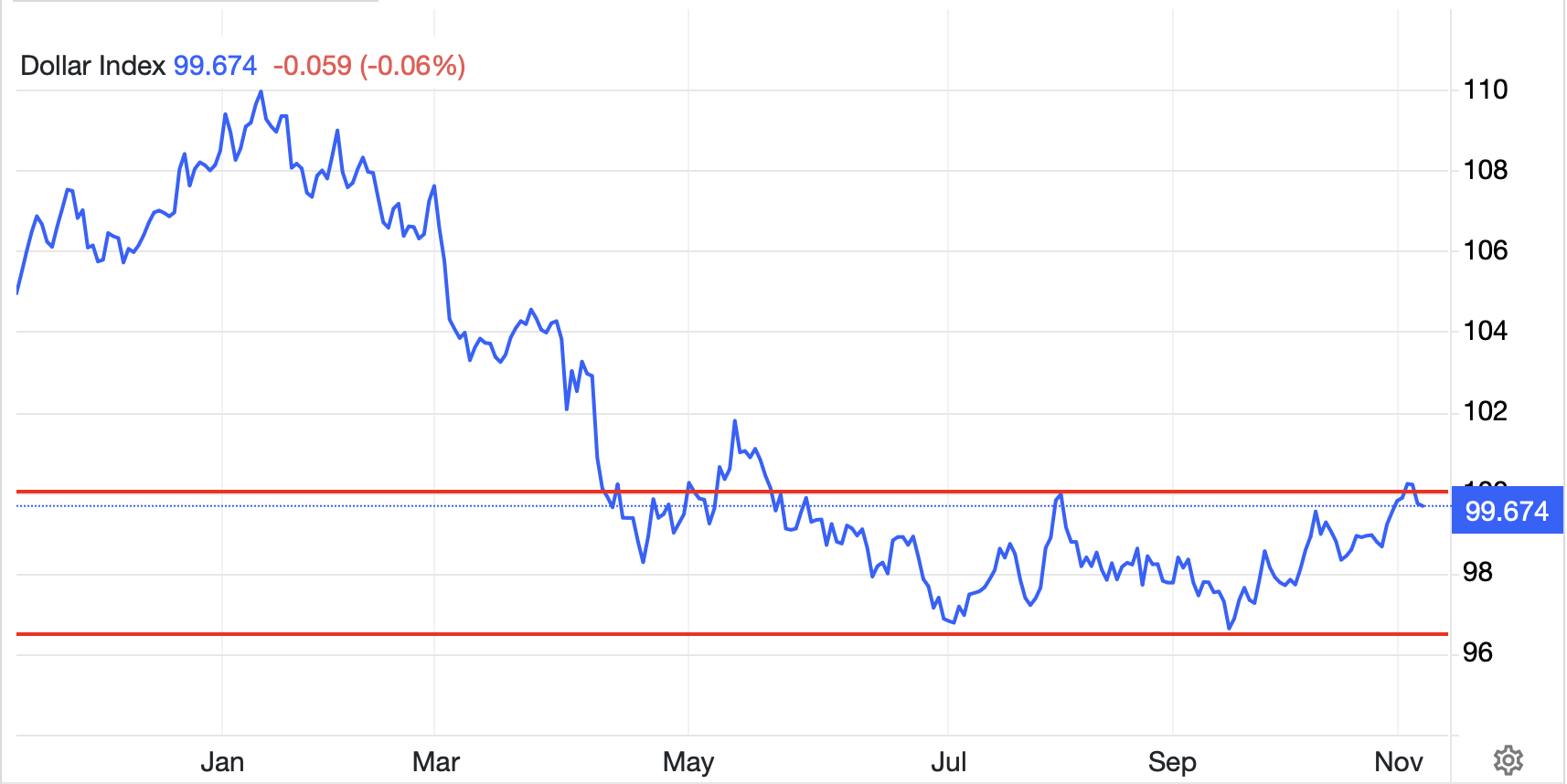
Finally, the dollar remains an afterthought to markets.  The DXY rallied to above 100 briefly, but has now slipped back below that level into its multi-month trading range as per the below chart.

Source: tradingeconomics.com

Looking at the major currencies today, +/-0.2% describes the price action, which means nothing is happening.  The only notable difference is KRW (-0.7%, which has continued to decline on the back of growing outflows of capital, perhaps anticipating the flows that will come with Korea’s promises for investing in US shipbuilding and semiconductor manufacturing.  But the won has been tumbling since early July, down 8% in that period.

Source: tradingeconomics.com

And that’s really it this morning.  Looking at the KRW, though, we must really consider what I mentioned yesterday about the Supreme Court’s tariff ruling, whenever that comes.  If the tariffs are overturned, it’s not the repayment of those collected that is the issue, it is the change in the investment flows, and that will be a very good reason to turn negative on the dollar.  But until such time, while risk managers need to stay hedged, traders have carte blanche.  If tech stocks really do correct, a risk off scenario is likely to support the dollar, at least for a while.  Hopefully, that won’t be today’s outcome.

Good luck and good weekend

Adf

Eclipse

This morning, the question on lips
Is where did DeepSeek get their chips
As well, there’s concern
That China will learn
Our secrets, and so, us, eclipse


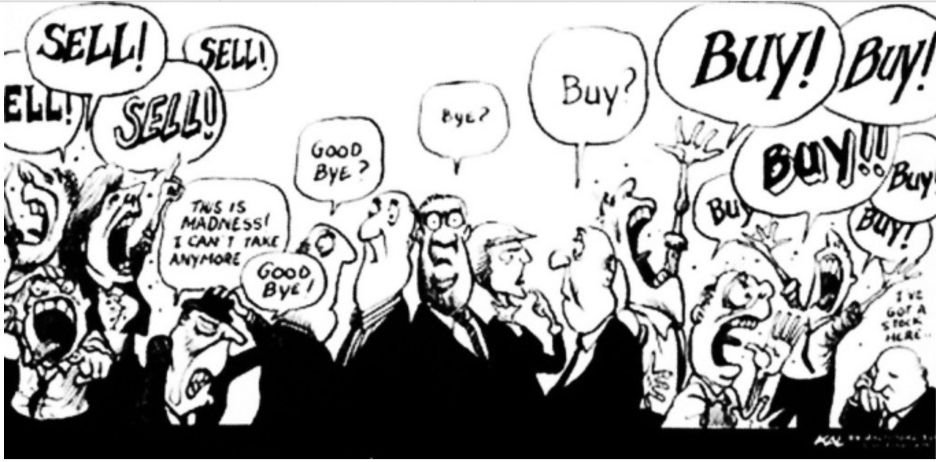
Narratives are funny things.  They seemingly evolve from nowhere, with no centralization, but somehow, they quickly become the only thing people discuss.  I’ve always been partial to the below comic as a perfect representation of how narratives evolve for no apparent reason.

Of course, yesterday’s narrative was that the Chinese LLM, DeepSeek, was built by a hedge fund manager with older NVDA chips and for far less money than the other announced models from OpenAI or Google and performed just as well if not better.  While equity traders were not going to wait around to determine if this was true or not, hence the remarkable selling on the open of all things AI, a little time has resulted in some very interesting questions being raised about the veracity of how DeepSeek was built, what type of chips they use and who actually built it.

For instance, a quick look at NVDA’s 10Q shows that, remarkably, Singapore is a major source of revenue, and it has been growing dramatically.

Source: SEC.gov

Now, it is entirely possible that Singapore is a hotbed of AI development, but from what I have read, that is not the case.  In fact, there is basically one lab there that has resources on the order of just $70mm.  But despite that lack of local investment, at least reported local investment, Nvidia shows that chip sales in Singapore nearly quadrupled in the last year.  Far be it from me to suggest that the narrative may change again, but who is buying those chips, more than $17 billion worth?  The idea that they have been trans shipped to China is quite plausible and they may well be what underpins DeepSeek.

Again, I have no first-hand knowledge of the situation but it is not beyond the pale to make the connection that China has been effectively circumventing US export controls through Singapore, have built their own LLM model using the exact same chips as OpenAI and others, but propagated a narrative that they have built something better for much less in order to undermine the US tech sector equity performance and call into question some underlying beliefs in the US market and economy.  Now, maybe this Chinese hedge fund manager did what he said.  But the one thing we know about China is, it is opaque in everything it does, so perhaps we need to take this story and dig deeper.  I am sure others will do so, and more information will be forthcoming, but it highlights that narratives continue to drive markets, but can also, at times, be constructed rather than simply evolve.

The thing is, this is still the only story of note in the market.  Scott Bessent was confirmed as Treasury Secretary yesterday, and indicated he was a fan of gradual tariff increases, perhaps 2.5% per month, rather than large initial tariffs, but that does not seem all that exciting.  And while Trump has not slowed down one iota, his focus has been on things like browbeating California into allowing reconstruction of LA rather than international issues, at least for the past twenty-four hours.  The upshot is that markets, which even yesterday closed far above their worst levels from the opening, are rebounding further today with many of yesterday’s moves reversing, at least to some extent.

Starting in the equity markets, despite the weakness in the tech sector, US market closes were far higher than the opens with the DJIA actually gaining 0.65% on the session.  However, while Japanese shares (-1.4%) definitely felt the pain of the tech sector, the rest of Asia saw some decent performance (Korea +0.85%, India +0.7%, Taiwan +1.0%) although Chinese shares (-0.4%) struggled.  Of course, one reason for that may be that the largest Chinese property company, Vanke, reported humongous losses and both the Chairman and CEO stepped down.

In Europe, though, all is well with every major exchange in the green led by Spain’s IBEX (+1.0%) although gains of 0.5% – 0.7% are the norm.  Now, remember, there is effectively no tech sector in Europe to be negatively impacted by the AI story, and it should be no surprise that these shares have followed the DJIA higher.  And this morning in the US futures market, at this hour (6:50), we are seeing gains on the order of 0.4% across the board.

In the bond market, yesterday’s early rally in prices (decline in yields) backed off as stocks bounced from their lows although Treasury yields still fell 10bps on the day.  This morning, the bounce in yields continues with Treasury yields higher by another 3bps and European sovereign yields rising between 1bp and 2bps on the session.  It will be very interesting to watch the bond market now that Bessent has been confirmed as Treasury Secretary given his goal to extend the maturity of the US debt outstanding.  Arguably, that should push up back-end yields, so we will see how effective he can be in reaching that goal.  

Turning to commodities, yesterday saw a rout there as well with both oil and the metals markets suffering greatly.  However, this morning, like many other markets, things are reversing course.  Oil (+0.75%) has bounced off its lows from yesterday, and despite a pretty rough past two weeks, is still higher than it was at the beginning of the year.  Gold and silver are unchanged from yesterday’s closing levels, and while off their recent highs, remain much higher in the past month.  Copper, too, is bouncing slightly and still much higher this month.  Perhaps yesterday’s price action was a catalyst for lightening up positions rather than changing views.

Finally, the dollar has rebounded vs. the G10 this morning, rising alongside US yields with the euro (-0.7%) and AUD (-0.8%) lagging the field, although dollar gains of 0.5% are the norm across the entire G10 this morning.  In the EMG bloc, the CE4 are all tracking the euro lower, with all down around -0.6% to -0.8%, but yesterday’s biggest laggards, MXN, COP and BRL are little changed this morning, not rebounding, but not falling further.  With the Fed expected to remain on hold while both the BOC tomorrow and ECB on Thursday are set to cut rates, perhaps the FX market is reverting to its more fundamental interest rate drivers than the hysteria of AI models.  If that is the case, then we are likely to turn our attention to Chairman Powell’s press conference as the next critical piece of news.

On the data front this morning, we see Durable Goods (exp 0.8%, 0.4% -ex Transport), Case Shiller Home Prices (+4.3%) and Consumer Confidence (105.6).  Yesterday saw New Home Sales rise more than expected but still resulted in the smallest number of sales for the year since 1995 when the population was far smaller.  

Once again, depending on where you look, you can find data that supports either economic strength or weakness.  It strikes me that today’s data will be of little consequence as traders will be focused on the equity market to see if the rebound has legs, as well as further news regarding DeepSeek.  Tomorrow, however, the Fed will take center stage.

Good luckAdf

A Bruising

While many consider AI
The future, and can’t wait to buy
The stocks that convey
The future’s today
Perhaps that result’s not yet nigh
 
For instance, today’s biggest news
Is Windows is stuck with, screen, blues
What’s happened is that
A bug, not a gnat
Disrupted what most people use

Oops!  That seems to be the response so far by Microsoft and Crowdstrike as they try to troubleshoot and fix an apparent bug in the most recent release of their software.  The result of this bug is that computers all over the world that use Microsoft Windows as their operating system have, this morning, the dreaded ‘blue screen of death’, something with which far too many of us are familiar.  This problem has affected airports, airlines, banks and businesses of all stripes, essentially shutting down key processes and by extension the businesses themselves.  And consider, this is allegedly because of a single bug in a new rollout of security software.
 
We all know that bugs are an inherent part of the computing world, and most of us have lived through glitches in the past.  The difference this time, though, is that as more and more businesses move more and more of their computing operations into the cloud, the impact of any imperfection in the computer code grows exponentially.  This will not stop the migration of business operations to the cloud, of that I am certain.  But perhaps it will force some businesses to rethink what it means to be secure.
 
Additionally, given the hype surrounding AI, and the growing belief amongst a subset of businesses and investors, that companies which are not utilizing AI are going to wither and die due to its absence, perhaps this situation will cause some to rethink the pace of that utilization.  Remember, the essence of the AI hype is that the computers will be able to replace humans in many jobs, thus increasing efficiency and with it, profitability.  However, not only is the jury still out, but I would contend it has not yet started deliberations as; to date, I have not seen a single application where the results from AI are so superior to human actions, that the vast expenses to train and run AI applications make economic sense.  There is no killer app. 
 
Rather, the best analogy I have seen is that AI represents an advance similar to Microsoft Excel, where prior to the existence of spreadsheets, calculations by hand were incredibly time consuming and correspondingly expensive, but once Excel came along, analyzing data became a routine and much less expensive task.  The difference is Excel was cheap to buy and didn’t use much power to run.  AI is hugely expensive to train and then to run as well.  And bringing this full circle, removing operations from human oversight opens the door to situations like today, where things just don’t work.  Also, consider that Nvidia has sold ~$60 billion of chips in the past year, which means that companies like Microsoft, Alphabet, Apple and Meta have spent that much money on those chips as they build out their AI capabilities.  However, their revenues have not increased by nearly that much, certainly not from any AI initiatives.  Maybe the “killer” in killer app refers to what it is going to do to company profitability for those firms trying to lead this charge.
 
And, since this is a note about money and finance, let’s consider one other issue, the drive by many governments to eliminate cash.  Consider how things would be if cash was gone and all payments were electronic, but then a bug in the system resulted in banking and payments software shutting down.  Exactly how will firms conduct business?  I’m not talking about large-scale manufacturing operations, but rather about the grocery store or the McDonalds or pizza place where you want to get something to eat.  If there is no cash, what do you do?  Money is truly a remarkable invention and until the point when computer systems work 100% of the time, not 99.9%, the absence of a physical medium of exchange has the potential to be devastating to many people if the network goes down.  Just sayin’.
 
For many it was quite confusing
That stocks could absorb such a bruising
But data keeps hinting
That nobody’s minting
More profits, they just might be losing
 
Ok, let’s take a look at markets as we try to prepare for today’s activities.  It seems that as of 7:00am in NY, the bug has been fixed and things are starting to get back to normal.  But this is going to leave a mark.  Yesterday saw the first down day across the board in US markets in weeks with the DJIA (-1.3%) leading the way lower.  Most of Asia followed this move although Japanese declines (Nikkei -0.2%) were mitigated by the release of CPI data that showed no acceleration in prices in Japan.  The Hang Seng (-2.0%) reflected the tech sell-off and equities throughout the region were lower with one exception, mainland Chinese shares rose 0.5% after the end of the Third Plenum.  While many had hoped for some new economic stimulus, it seems that President Xi believes he is already on the right path and will not change.  As to European bourses, they are all lower this morning, following the trend started in the US yesterday while US futures are little changed right now.
 
Treasury yields, which traded higher during yesterday’s session despite the sharp sell-off in stocks, are unchanged this morning and European sovereigns, which closed before the full move was complete in the US have edged up the last 1bp to 2bps to maintain their relative spreads.  The ECB left rates on hold, as universally expected, but Madame Lagarde disappointed the doves by not promising a cut in September.  Despite weakening growth on the continent, inflation remains uncomfortably high it seems.  The same is not true in the US, though, where more Fed speakers gave the same message that things are going well, they are watching unemployment, and a rate cut is likely coming in the not too distant future.
 
In the commodity markets, oil edged lower yesterday after a nice rally Wednesday, and is continuing that this morning, down a further -0.5%.  But the pain trade is in metals with gold (-1.2%) and silver (-1.8%) leading the way lower on what appears to be some market technical issues rather than specific fundamental questions.  Both copper and aluminum are also softer this morning, but that is reflective of the continued concerns over economic growth.
 
Finally, the dollar is firmer again this morning, despite the modestly more hawkish discussion from the ECB and despite the ongoing belief that the Fed is preparing to cut rates at the September meeting.  Yesterday saw some impressive movement with BRL (-1.0%) and CLP (-2.0%) amid that broad-based dollar strength.  However, this morning, the worst performers are SEK (-0.6%) and NOK (-0.4%) with the rest of both the G10 and EMG blocs within 0.2% of Thursday’s closing levels.  The NOK is clearly following oil lower, and SEK is following NOK, as there has been no news or commentary from either nation that would offer a solid rationale for the move.  As I often explain, sometimes currency markets are simply perverse.
 
There is no US data due this morning, but we do hear from two more Fed speakers, Williams and Bostic. However, both have already spoken this week and there certainly hasn’t been any data that would likely have changed their views.  It seems all eyes will be on the equity markets this morning.  If they follow yesterday’s moves lower, I think we may see a more traditional risk-off outcome, but even if stocks rebound, it is hard to get too negative on the greenback.
 
Good luck and good weekend
Adf


Clearly the Rage

While AI is clearly the rage
Where Mag 7 try to engage
Consider the fact
That during this act
They’re fighting each other backstage

Just a little aside regarding the situation in equity markets, which in the US really means the Magnificent 7 these days.  One of the key features of their cumulative success was that these companies had no significant overlap regarding their business models.  Online shopping, iphones, EV’s, search, GPUs, streaming services and a social network clearly intersected to some extent, but the main focus of all these companies was spread out in different directions.  Yes, Amazon prime competes with Netflix, as does Apple TV, and yes, Amazon Web Services, Microsoft Azure and Google Cloud are all in the same business, but there is a huge amount in that particular segment that is still unfulfilled, so competition but not cutthroat.

But AI is a different kettle of fish.  All of them are actively investing in their own AI programs and working to integrate them into their current services and products.  And we are already seeing announcements of new GPU’s to directly compete with Nvidia and bring that supply chain in-house for the other users.  The point is, there is going to be a lot more investment, if not overinvestment, in this space with, arguably, quite a while before whatever AI does starts to really help the bottom line.  In other words, do not be surprised to see margins start to decline in these companies which is unlikely to help drive their share prices higher.  As well, with investment focused on this new area, we need to expect to see a reduction in share repurchases, removing one of the key bids to the market.

All I’m saying is that even in a soft or no landing scenario, it strikes me that the Magnificent 7 may be running out of room to continue their amazing run of share price gains.  And if they start to stumble, just the very nature of the equity indices, where their capital weightings are so large combined, > 30%, I suspect the indices themselves may find themselves under a lot of pressure, regardless of whether the Fed cuts rates or not.  And if the Fed cuts rates because the economy is slipping into recession, or has already gotten there, that cannot be good for margins either.  While timing is everything in life, this is something that needs to be on everyone’s radar, because it will change the risk narrative, and that matters for all markets.  Just sayin’.

While last week was mercif’ly free
Of Fedspeak, the FOMC
This week will explain
Again and again
Why higher for longer’s the key

As the market returns to full strength, at least from a staffing perspective, post the Thanksgiving holiday, things are opening fairly quietly.  A quick recap of the data since I last wrote shows that the mix of good and bad continues to leave prospects uncertain going forward.  This has allowed both the soft/no landing camp and the recession camp to point to specific things and claim they are on the right track.  So, Durable goods were pretty lousy in October and Michigan Sentiment also fell sharply, but Initial Claims fell as well, indicating that the labor market remains robust overall.  In other words, uncertainty continues to reign.  

One of the interesting things is that different markets appear to be pricing very different outcomes.  For instance, commodity markets, or at least energy markets, are clearly in the recession camp as oil prices remain under pressure, falling another 1.5% this morning as the market awaits the outcome of Thursday’s delayed OPEC+ meeting.  Talk is that there could be another 1 million bbl/day production cut to help support prices, but nothing is yet certain.  At the same time, both copper and aluminum remain under pressure, sliding a bit further last week and this morning while gold (+0.5%) is back firmly above $2000/oz, hardly a sign of a positive future.

However, as dour as the commodity markets feel, equity markets remain quite resilient overall.  Although this morning, we are seeing modest declines around the world, with European bourses lower by -0.2% or -0.3%, and US futures are currently (8:00) down by -0.15%, the month of November has been a big winner almost everywhere.  Gains, ranging from 5% – 11% are the order of the month as equity investors have gone all-in on the idea of a soft landing and that the major central banks are going to be slowly reducing interest rates to ensure economic growth continues.

In truth, bond markets are of a similar mind as equities with 10-year yields lower by between 25bps and 40bps during November throughout the G10 (Japan excepted but even there lower by 10bps).  Clearly, all this can be traced back to the QRA released back on November 1st when Treasury Secretary Yellen let it be known that there would not be as much coupon issuance as had been anticipated, and that more of the Federal government’s borrowing would take place in the T-Bill market.  That was the starting gun for the bond market rally and the ensuing stock market rally. 

So, which of these two views is correct?  That, of course, is the $64 trillion question, and one with no clear answer yet.  As I have written numerous times, and as we saw last week, the data continues to be mixed, with both positive and negative signs.  While the Fed, and virtually every other G10 central bank continues to harp on the idea that they will not be cutting rates anytime soon, markets are pricing in rate cuts starting in early Q2 of 2024.

Ultimately, there will be a winner of this battle, but the game is still afoot.  FWIW, while I have long been concerned that the imbalances in the economy were going to lead to a more significant correction in equity prices, there is another side to the story that is worth exploring, and that is the concept of fiscal dominance.  

According to the St Louis Fed, a good definition of fiscal dominance is: “…the possibility that accumulating government debt and deficits can produce increases in inflation that dominate central bank intentions to keep inflation low.”  The corollary here is that the Fed is losing its power over one of its key mandates, stable prices, because the Federal government’s fiscal impulse is so great as to overwhelm the Fed’s actions.  

With 2024 a presidential election year, and with the TGA currently at $725 billion plus negotiations for more spending on Ukraine, Israel and the southern border, there will be no shortage of additional Federal moneys flowing into the economy.  Add to this the fact that the surge in T-Bill issuance will move savings from a “dead zone” in the standing RRP facility, which is still at $935 billion, to more active money, able to be used in the real economy, and it is easy to see how economic activity is going to be supported throughout 2024.  Whatever your views on the appropriateness of these policies, the reality on the ground is that the current administration will do everything in its power to be re-elected and that includes spending as much money as possible.  Remember, too, that there is no operable debt ceiling, so they can issue as much debt as they want to fund whatever they can get legislated.  

If the Fed has lost control of the narrative, and it does appear to be slipping through their fingers, then we will need to start to focus elsewhere to find market drivers. Of course, if the Fed is losing its grip, do not think for a moment they will go meekly into the sunset.  Instead, I could see several more rate hikes as they continue to try to fight for price stability amid an economy flush with cash.  In other words, this story is nowhere near finished.

At this point, let’s take a look at this week’s data, which will bring updated GDP and PCE readings amongst other things.

TodayNew Home Sales723K
 Dallas Fed Manufacturing-17
TuesdayCase Shiller Home Prices4.0%
 Consumer Confidence101.0
WednesdayQ3 GDP5.0%
 Goods Trade Balance-$85.7B
ThursdayInitial Claims220K
 Continuing Claims1872K
 Personal Income0.2%
 Personal Spending0.2%
 Core PCE0.2% (3.5% Y/Y)
 Chicago PMI45.4
FridayISM Manufacturing47.6

Source: Tradingeconomics.com

Despite Friday being the first of December, payrolls are not released until next week due to the holiday last week.  Plus, in addition to the data above, we hear from seven different Fed speakers over ten venues including Chairman Powell Friday morning.  That will be the last Fed speaker until the next FOMC meeting, so it will be keenly watched.  However, I would wager a great deal it will continue to harp on progress made but higher for longer to prevent any resurgence in inflation.

As to the dollar, right now, it is softening as market participants focus on the idea of Fed cuts and simultaneously reduce large, long USD positions.  For now, I feel like lower is the way forward, but if we start to see increased hawkishness again because there is no landing, merely continued growth, look for the dollar to return to its winning ways.

Good luck

Adf

The New Bling

Though pundits on all sides maintained

A debt default soon was ordained

Instead, what we got

Was spending a lot

Of cash sans debt issues restrained


So, fear has now faded away

While risk preference is on display

AI is the thing

That is the new bling

And everyone wants it today!


This poet is in no position to discuss the particular merits, or lack thereof, regarding the debt ceiling deal that was reached over the weekend.  The only thing that ultimately matters is that a deal was reached and that despite a great deal of huffing and puffing yet to come, will almost certainly be passed and signed into law this week thus preventing any chance of a debt default by the US Treasury.  As such, another “crisis” has been averted and the market can go back to focusing on its favorite topic, the Fed.  Or is AI the market’s new favorite topic?


Having been around long enough to well remember the dot com bubble of 2000-2001, the AI discussion certainly seems to have a lot of parallels to that time.  Essentially, look for company after company to announce they are utilizing AI to improve their productivity and enhance the features of their products as they try to share the current positive attitude investors have on the subject.  And this is not to dispute that AI has the potential to be very beneficial over time as its strengths and weaknesses are better understood, it is just a comment that in the early stages of a new mania, association with the ‘thing’ is just as important as how that ‘thing’ is used.  I have a sense that like in the gold rush in 1849 in California, the ones making money will not be the miners (all those companies claiming AI is part of their process), but rather the sellers of the picks and shovels and supplies (NVDA and other semiconductor manufacturers) who are building the pieces needed to create AI.  But that doesn’t mean that equity markets won’t rally a bunch from here, regardless of valuations.  Be wary.


However, let’s head back to the macro discussion, an area more in tune with poetry.  Starting with the debt ceiling deal, as with all compromises, neither side is happy as both feel they gave away too much.  But the important thing is that, as always, the time pressure was sufficient to force movement on both sides and whatever the final shape of the bill, it will be passed.  This is especially true because you can be sure that now that a compromise has been reached, any failure to complete the process will be squarely blamed on the House Republicans by the entire global media complex regardless of the particulars.


With that out of the way, a quick look back to Friday’s PCE data shows that despite a growing sentiment that inflation is heading back down to, and below, 2% shortly, the Core PCE reading was a tick higher than forecast at 0.4% M/M and 4.7% Y/Y.  Meanwhile, the rest of the data Friday showed relative economic strength.  Durable Goods rose sharply, +1.0%, while Personal Income and Spending remained robust.  Not only that, but the Advance Goods Trade Balance widened to a -$96.8B deficit, indicating a lot of imports coming in, and Michigan Sentiment rose to 59.2, still largely awful, but above forecasts.


But all this data was in conflict with other data, notably Gross Domestic Income (GDI).  As per the below from Investopedia, GDI measures the amount of earnings while GDP measures the amount of production:

  • GDI = Wages + Profits + Interest Income + Rental Income + Taxes – Production/Import Subsidies + Statistical Adjustments
  • GDP = Consumption + Investment + Government Purchases + Exports – Imports


The fudge factor is Statistical Adjustments, but GDP has been the benchmark as the data tends to be more recent.  In theory, they should be equal, but that is just not the case, largely because of the timing of data releases.  Here’s the thing, the GDI data released last week, alongside the GDP data, showed that in Q1, GDI fell -2.3% while Q4 2022 GDI was revised lower to -3.3%.  That is two consecutive quarters of negative GDI, a situation that, when it has occurred in the past, has always happened during a recession.  So, once again we are seeing conflicting data with some numbers indicating ongoing economic strength while others are indicating the opposite.


What’s a risk manager to do?  The beauty of hedging is that when done properly, it helps mitigate large movement in whatever is being hedged, whether that is profitability, cash flow or expenses.  However, if pressed, it remains very difficult to believe that we can have the Fed raise interest rates as quickly and as far as they have already done without having some negative economic consequences coming down the line.  Remember, monetary policy works with ‘long and variable lags’ which has historically varied between 6 and 29 months from the onset of policy changes.  We are only 14 months into this process (first rate hike in March 2022), and while the housing market has clearly felt an impact, it is not clear that the rest of the economy has seen that much yet.


Looking ahead, there is still a huge wall of debt refinancing to come with rates much higher than before thus, at the very least, significant cost pressures on companies bottom lines.  And there will be those companies that cannot find financing at a level allowing continued operations.  In fact, bankruptcies have already been running at a record rate with more than 230 so far this year (counting companies with >$50 million in liabilities).  There is no reason to believe that trend will slow down as the Fed continues to raise rates.


Speaking of the Fed, the market is now pricing a 60% probability of a 25bp rate hike in June, up from just 30% one week ago, 13% two weeks ago and 0% immediately following the last meeting.  In addition, the market is removing its pricing of rate cuts as well, with now just 2 rate cuts priced in one year from now.  That number had been upwards of 150bps of cuts last month.  The point is that the market is finally taking the Fed at their word that rates will remain higher for longer, and that another hike or two are well within the realm of possibility.


It remains difficult for me to see how risk assets can continue to outperform with ongoing monetary policy tightening as well as slowing growth elsewhere in the world, notably Germany, which is already in recession, and China, where growth continues to lag forecasts and models as the property market, which had been a primary mover for decades, continues to flounder.


As to markets today, risk is mixed with modest gains in Asia overnight, a mixed bag in Europe this morning and US futures pointing to continued NASDAQ gains while the rest of the market stagnates.  Bond markets have seen yields decline sharply as fears over that debt default disappear with Treasury yields falling 8.3bps and similar size yield declines throughout Europe.  In the commodity space, oil (-2.0%) is falling on concerns slowing economic growth will continue to undermine demand while both gold (+0.8%) and copper (+4.5%) are rallying, the former on a bit of dollar weakness while the latter has been getting a huge amount of press regarding the structural shortages that will be exacerbated by the attempts to electrify everything.


Finally, the dollar is mixed, largely stronger vs. most of the EMG basket, albeit not hugely so, while the G10 has been outperforming this morning with GBP (+0.6%) the leader after BRC shop prices hit a new all-time high of 9.0% encouraging belief the BOE will need to tighten further.


This is a big week for data as we get the payroll report on Friday but plenty before then.


Today

Case Shiller Home Prices

-1.60%


Consumer Confidence

99.0


Dallas Fed Manufacturing

-18.0

Wednesday

Chicago PMI

47.2


JOLTS Job Openings

9439K


Fed’s Beige Book


Thursday

ADP Employment

165K


Initial Claims

235K


Continuing Claims

1803K


Nonfarm Productivity

-2.6%


Unit Labor Costs

6.3%


ISM Manufacturing

47.0


ISM Prices Paid

52.5

Friday

Nonfarm Payrolls

193K


Private Payrolls

173K


Manufacturing Payrolls

5K


Unemployment Rate

3.5%


Average Hourly Earnings

0.3% (4.4% Y/Y)


Average Weekly Hours

34.4


Participation Rate

62.6%

Source: Bloomberg


Clearly, all eyes will be on NFP on Friday, but there is much to be gleaned between now and then.  On the Fed speaker front, we hear from 5 more speakers ahead of the beginning of the quiet period starting Friday.  I maintain that the NFP data is the key for the Fed.  As long as it remains strong, Powell has cover to raise rates as much as he likes.  But once it cracks, look out below.  For now, nothing has changed my dollar view of continued strength until such time as policies change. 


Good luck

Adf