Recession Repression

Though many conclude that recession
Is coming, this poet’s impression
Cannot overcome
A key rule of thumb
More jobs mean recession repression
 
As well, on the fourth of July
The naysayers all went awry
The BBB’s law
As Trump oversaw
Parades and a massive fly-by


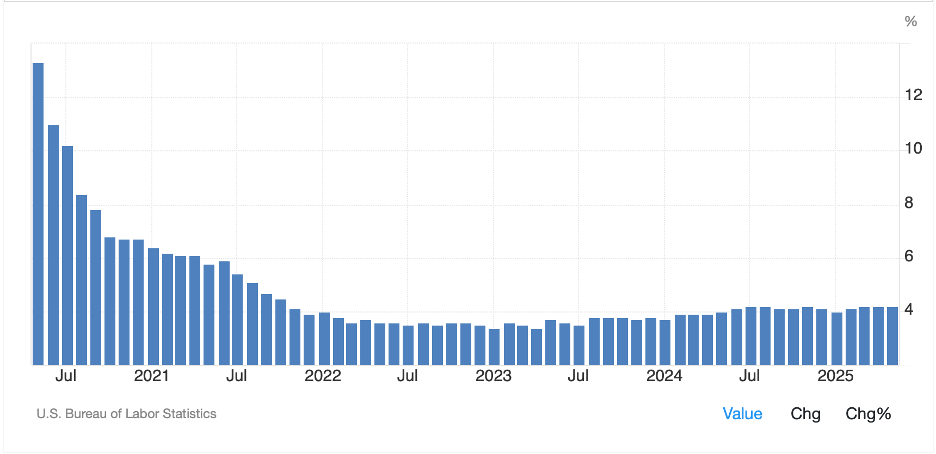
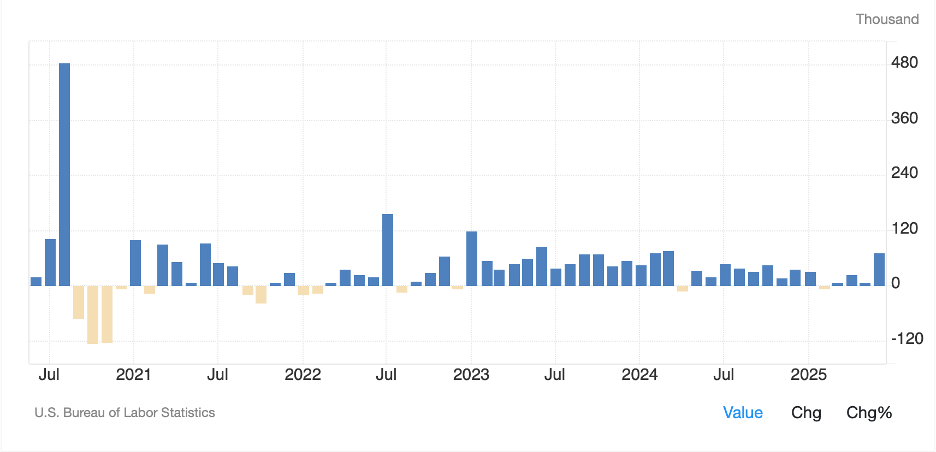
I will be brief this morning.  First, Thursday’s NFP report was much stronger than expected, with 147K new jobs and the Unemployment Rate falling to 4.1%.  This is clearly not pointing in a recessionary direction, although as would be expected by all those who have made that call, there was much analysis about the underlying makeup of the jobs report, with more government hires and less private sector ones.  And I agree, I would much rather see private sector hiring, but I don’t recall as much angst in the previous administration when they hired into the government extremely rapidly.  It is difficult for me to look at the below chart of government hiring over the past five years and conclude that this administration is being anywhere nearly as profligate.
Source: tradingeconomics.com

Second, despite all the naysaying by the punditry, President Trump got his Big, Beautiful Bill through Congress and he was able to sign it on his schedule, July 4th.  Whether you love Trump or hate him, you must admit that he is a remarkable political force, greater than any other president I can remember, although Mr Reagan was certainly able to accomplish many things with a very different style.  And perhaps, that is the issue, Trump’s style is unique in our lifetimes as a president, although I understand that throughout our history, there have been some presidents with a similarly brash manner, I guess Andrew Jackson is the best known.  And it is that style, I would say that leads to the Trump Derangement Syndrome, although his attack on the Washington elite is also a key driver there.

Thus far, the articles I have read about the legislation all focus on how many people are going to die because Medicaid is requiring able-bodied adults to work, volunteer or go to school 20 hours/week in order to remain eligible.  It would be helpful if these ‘news’ sources could keep a running tally so we can all see the results.  Given the law simply sets priorities, and not actual appropriations yet, my take is all this death and destruction may take a few months yet to materialize.

But after those two stories, there is a growing focus on the upcoming Tariff deadline this Wednesday, with a mix of views.  There is both a growing concern that the original level of tariffs is going to be put back in place, and that will disrupt global commerce, and there is a story gaining traction that the deadline will be delayed again.  The administration hinted there would be some notable deal signings this week, so we shall see.

As that’s all there is, let’s look at markets overnight.  Thursday’s US rally in the wake of the NFP data is ancient history.  Overnight in Asia, the major markets (Japan -0.6%, Hang Seng -0.1%, CSI 300 -0.4%) were under pressure but the rest of the region was mixed with some gainers (Korea, Indonesia, Singapore) and some laggards (Taiwan, Malaysia, Australia) although none of the movement was very large, 0.5% or less in either direction.  In Europe this morning, the DAX (+0.65%) is far and away the leader after a stronger than expected IP reading of +1.2%.  However, the rest of the continent and the UK are all tantamount to unchanged in the session.  US futures at this hour (7:00) are pointing slightly lower, about -0.025%.

In the bond market, Treasury yields which rallied 5bps on Thursday after the data are higher by one more basis point this morning.  European sovereign yields are all higher this morning as well, between 2bps and 3bps, as concerns over the timing of tariffs has investors cautious.  The rumors are solid progress has been made in these negotiations.

In the commodity space, oil (+0.7%) is higher this morning which is a bit of a surprise given that OPEC+ raised their production quotas by a more than expected 548K barrels/day at their meeting this weekend.  At this point, they are well on their way to eliminating those production cuts completely.  I guess demand must be real despite the recession calls.  Metals markets, though, are all lower this morning (Au -1.0%, Ag -2.0%, Cu -0.6%) as hopes for trade deals has reduced some haven demand.  Of course, copper’s decline doesn’t jibe with oil’s rally on a demand note, but the movements have not been that large, so it is probably just random fluctuations.

Finally, the dollar is stronger this morning, which is also weighing on the metals markets.  ZAR (-1.1%) is the biggest loser overnight although NZD (-0.9%) and AUD (-0.7%) are doing their best to catch up.  But the euro (-0.35%) and pound (-0.3%) are both under pressure as is the yen (-0.7%) and CAD (-0.5%) and MXN (-0.5%). In other words, the dollar’s strength is quite broad-based.  On this note, I couldn’t help but chuckle at this article in Bloomberg, Misfiring Models Leave Wall Street Currency Traders Flying Blind, which describes how all the old models no longer work in the current world.  This is a theme I have harped on for a while, mostly with the Fed, but also with the punditry in general.  The world today is a different place, and I might ascribe the biggest difference to the fact that for 20+ years, inflation had fallen to 2% or lower in most of the western world and markets behaved accordingly.  But now, inflation is higher, and those relationships no longer hold.

On the data front, this may be the least active week I have ever seen.

TuesdayNFIB Small Biz Optimism98.7
 Consumer Credit$10.5B
WednesdayFOMC Minutes 
ThursdayInitial Claims235K
 Continuing Claims1980K

Source: tradingeconomics.com

There are only 3 Fed speakers as well so pretty much, Washington is on vacation this week.  It is very hard to get excited about much right now.  We will all need to see the outcomes of the trade negotiations and which countries will see tariffs applied or not.  I have no forecasts for any of that.  In the meantime, I think the fact that implied volatilities are relatively low across most asset classes offers the opportunity for hedgers to protect themselves at reasonable prices.

Good luck

Adf
Too Extreme

The year is now halfway completed
While narrative writers repeated
The story, same old,
The dollar’s been sold
‘Cause global investors retreated
 
As well, they continue to scream
Trump’s policies are too extreme
His tariffs will drive
Inflation to thrive
While growth will soon start to lose steam


I don’t know about you, but this poet is tired of reading the same stories over and over from different pundits when it comes to the current macroeconomic situation.  And so, I thought I might take a look at what the current narrative seems to be and, perhaps, analyze some of the reasons it will be wrong.  I have full confidence it will be wrong because…it always is.  Add to that the fact that the narratives continue to try to build on expectations of what President Trump wants to do and let’s face it, there is no more unpredictable political leader on the planet right now.

In fact, we can look at one of the key narratives that had been making the rounds right up until Thursday night when the House and Senate agreed the terms of the BBB which has since been signed into law.  Serious pundits were convinced that the president could never get this done and yet there it is.

But let’s discuss another popular narrative, the end of American exceptionalism.  First, I’d like to define the term American exceptionalism because I believe that the equity analysts borrowed the term from the Ronald Reagan.  For the longest time, I would contend the term referred to the American experiment, writ large, with the dynamic market economy that was created by the legal framework in the US.  After all, no other nation, certainly not these days, has anything like this framework.  The combination of the 1st and 2nd Amendments to the Constitution have been critical in not only creating this framework but keeping it from getting too far out of hand. 

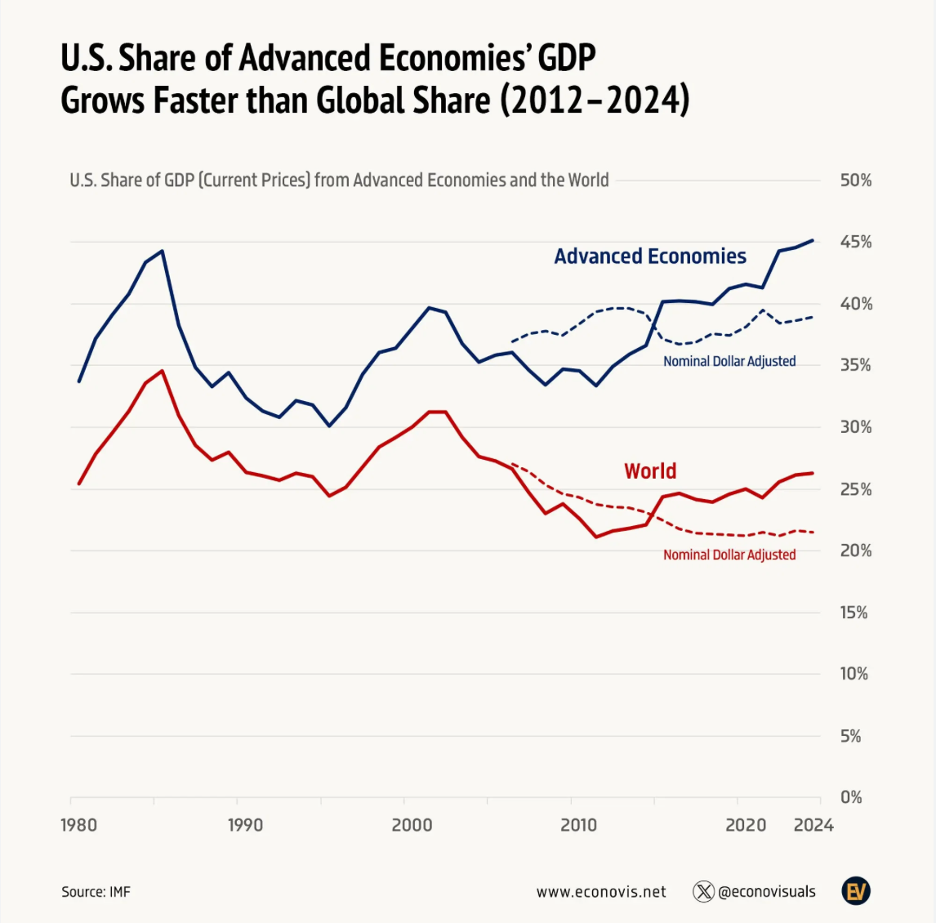
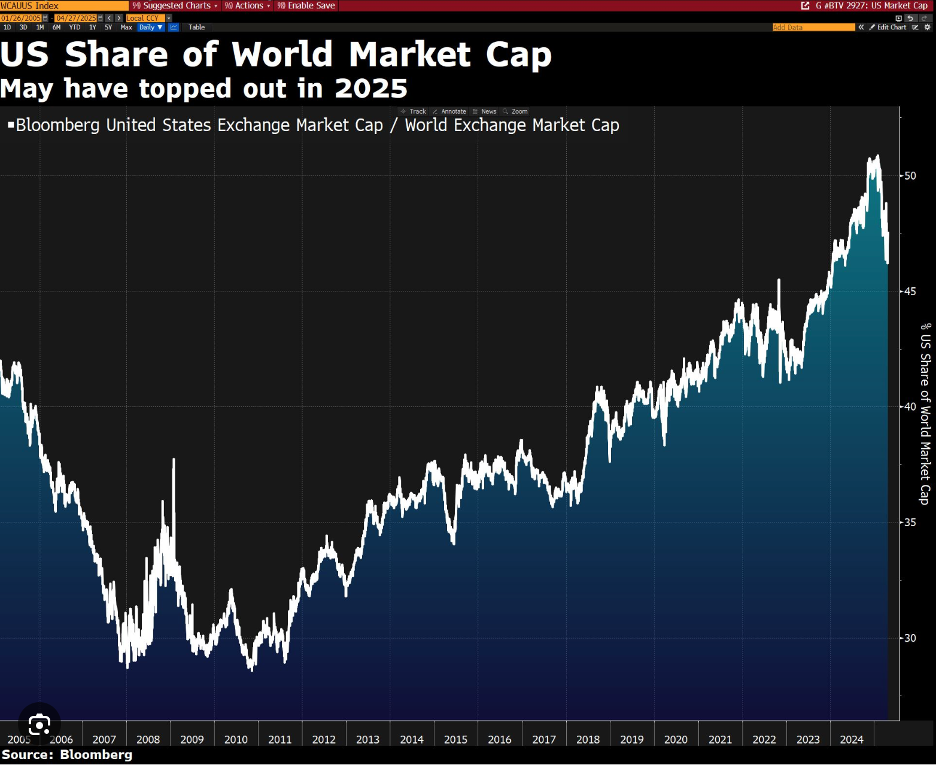
However, in the market context, American exceptionalism refers to the fact that the relative strength of the US economy drew investors from around the world into US equity markets, driving the value of US equities relative to both total global equities and the US proportion of global GDP to extreme heights.  While the chart below shows a peak just above 50% of global market cap and that number is declining right now, I have seen estimates that the number could be as high as 70% of global market cap.  I suppose it depends on how you define global market cap, but MSCI’s readings tend to be well respected.

In addition to the significant portion of equity market capitalization compared to the rest of the world is the fact that US GDP is a significantly smaller percentage, somewhere in the 23% – 26% range depending on how one calculates things with FX rates.  

The upshot is that heading into 2025, US equity valuation was at least twice the size of the US economy compared to the entire world.  Certainly, that is exceptional, and the term American exceptionalism seemed warranted.  But as you can see from the first chart, other markets have been outperforming the US thus far this year with the result that the US no longer represents quite as large a percentage of the world’s equity market capitalization.  So, is this the end of that form of American exceptionalism?  The pundits are nearly unanimous this is the case.

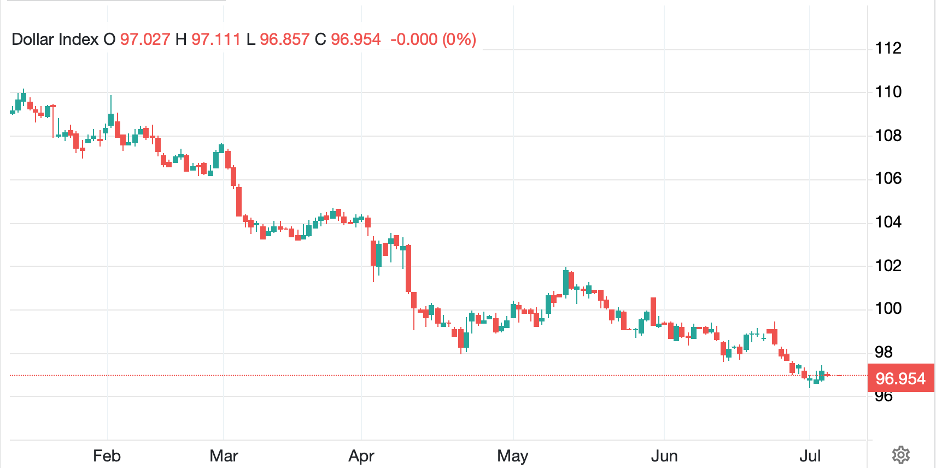
A knock-on effect of this is that the dollar has been under pressure all year, having declined more than 10% vs. the DXY and 13% vs. the euro.  In fact, a key factor in the weaker dollar thesis is that international investors are either selling their US stocks or hedging the FX exposure with either of those weighing on the dollar.

Source: tradingeconomics.com

Now, so far, that seems a logical conclusion and I cannot argue with it.  However, as we look forward, is it reasonable to expect that to continue?  In this instance, I think we need to head back to the BBB, which is undoubtedly going to provide significant economic stimulus to many parts of the economy (sorry green tech), and seems likely to help energy, tech and industrial companies continue to perform well.  Much has been made of the idea that American exceptionalism has peaked but I wouldn’t be so sure.  Net, I am not convinced the US ride is over, at least not for the economy, although segments of the equity market could well be in for a fall.

The other narrative that I continue to hear is that Trump’s policy mix, of tariffs and deportations is going to drive inflation much higher.  In fact, Dr Torsten Sløk, who does excellent work, explained this weekend that tariffs would raise US CPI a very precise 0.3% this year.  Of course, the problem with this story is that, thus far, inflation readings have been quite tame, falling since Liberation Day.  It is certainly early in the game, but it is not at all clear to me that tariffs are going to be a major driver of inflation.  First, many companies have decided to eat the cost themselves, notably Japanese car manufacturers.  Second, M2 in the US has basically flatlined since April 2022 (see chart below), and if money supply is not growing, inflation will be hard-pressed to rise too quickly.

Now, it is certainly possible that the Fed increases the supply of money, although given the antagonism between Powell and Trump, I sense that the Fed will remain tighter for longer as they will make no effort to help the president if the economy starts to visibly slow down.  

But, if I were to try to estimate what Trump’s end game is, I think the following chart is the most important.

This chart is the reason Donald Trump is our president, and it is one that the punditry does not understand.  It is also the reason that US equities have performed so well.  Corporate profit margins in the US have grown unabated since Covid.

Now, let’s put these two thoughts together.  Corporate profit margins have exploded higher, currently at an all-time high of 10.23%.  Meanwhile, the share of GDP that has gone toward labor has fallen dramatically since China entered the WTO.  The result has been workers in the US have seen their incomes decline relative to corporate income.  While it is true that, technically, the punditry is part of the work force, they are asset owners as opposed to Main Street who have far less invested in the equity markets.  Ask yourself, how did corporates improve their margins so significantly?  The combination of immigrant labor and moving production offshore weighed heavily on US wage growth.  If you want to understand why President Trump is speaking to Main Street and using tariffs with reckless abandon it is because he is trying to adjust this process.  

If he is successful, I expect that equity markets will lag other investments as those profit margins are likely to decline. If they just go back to pre-Covid levels of 6%, that represents a huge amount of money in the pockets of consumers.  Do not be surprised if the result is solid economic growth with lagging profits and lagging equity prices.  Too, a weaker dollar plays right into this game as it helps the competitiveness of US manufacturers both for domestic consumption and exports.

This is not the narrative, however.  The narrative continues to be that Trump’s tariffs are going to generate significant inflation and drive the economy into a recession.  In fact, just this morning I read that Professor Steven Hanke (a very smart fellow) now has a recession estimated at 80% to 90% probability.  All the uncertainty is preventing activity as corporate managers hold back on making decisions, allegedly.  Of course, now that the BBB is law, the tax situation is settled, and I will not be surprised to see investment return with clarity on that issue.

The narratives have been uniformly negative for a while.  Part of that is because many of the narrative writers objectively despise President Trump and cannot abide anything he does.  But part of that is because I believe the president is not focusing on the issues that market pundits have done for many years and instead is focusing on helping Main Street, not Wall Street.  Perhaps that is why Wall Street political donations were heavily biased toward VP Harris and every other Democrat.

I hope this made some sense to you all, as I try to keep things in context.  In addition, as it is Sunday evening, I expect tomorrow morning’s note to be quite brief.  Love him or hate him, President Trump clearly hears the sounds of a different drummer than the rest of the political class and has proven that he can get what he wants.  Do not ignore that fact.

Good luck

adf

Mind-Numbing

According to those in the know
The BBB’s ready to go
The vote is this morning
So, this is your warning
That President Trump will soon crow
 
As well, ere the Fourth of July
The NFP may quantify
If rate cuts are coming
(A subject, mind-numbing)
Or whether Fed funds will stay high


Perhaps this will be the last day we hear about the Big Beautiful Bill, or at least the last day it leads the news, as it appears that by the time you read this, the House will have voted on the changes and by all accounts it is set to pass.  If so, the President will sign it tomorrow amidst great fanfare and then it will just be a secondary story when somebody complains about something that was in the bill.  However, the drama over passage will have finally ended.  

(I guess what has really led the news was that Diddy was found not guilty of the RICO charges and Kohburger in Idaho got a plea deal avoiding the death penalty, but neither of those are market related.)

At any rate, the question now to be asked is will the BBB perform as advertised by either side of the aisle?  Experience tells us that while the economy will not take off rapidly while inflation collpases, neither will there be people dropping in the streets because of the changes in Medicare, although if you listened to the pundits on both sides of the aisle, that is what you might expect.  While this is not quite as bad as Nancy Pelosi’s immortal words, “we have to pass the bill to find out what’s inside it”, the fact that it approaches 1000 pages in length implies there is a lot inside it.

From what I have read, and it has not been extensive, it appears that there is some stimulus in the bill in the form of tax relief on tips and overtime as well as reductions for seniors, and spending on defense and the border.  It also appears there have been several previous subsidies, notably for wind and solar, that are being removed.  The fact that the CBO is claiming it will increase the budget deficit by $1.5 trillion, and given the fact that Jim Cramer is the only one with a worse track record than the CBO, tells me it will have limited impact on the nation’s fiscal stance initially, although if growth does pick up, that will clearly help things.

Which takes us to the other story this morning, the payroll report.  Here are the current median forecasts by economists for the results, as well as the rest of the data to be released:

Nonfarm Payrolls110K
Private Payrolls105K
Manufacturing Payrolls-5K
Unemployment Rate4.3%
Average Hourly Earnings0.3% (3.9% Y/Y)
Average Weekly Hours34.3
Participation Rate62.3%
Initial Claims240K
Continuing Claims1960K
ISM Services50.5
Factory Orders8.2%
-ex Transport0.9%

Source: tradingeconomics.com

Some will point to yesterday’s ADP Employment report which showed a decline of -33K, the first decline in more than 2 years, as a harbinger of a bad number, but as you can see from the chart below, there has been a pretty big difference between ADP (grey bars) and NFP (blue bars) for a while now.

Source: tradingeconomics.com

Perhaps of more concern is the Unemployment Rate, which is forecast to rise a tick to 4.3%, which would be its highest print since October 2021 and if I look at the chart below, it is not hard to see a very gradual trend rising higher here.  While markets really focus on NFP, I learned a long time ago from a very smart economist, Larry Kantor, that the Unemployment Rate was the best single indicator of economic activity in the US, and that when it is rising, that bodes ill for the future.  

Source: tradingeconomics.com

You may recall there was a great deal of discussion about a year ago regarding the Sahm Rule, which hypothesized that when the Unemployment Rate rose more than 0.5% above its cycle average within 12 months, the US was already in a recession.  The discussion centered on whether it had been triggered although the final claim was it hadn’t when extending the readings out to the second decimal place.  Now, for the past year, the Unemployment Rate has hovered between 3.9% and 4.2%, so there doesn’t seem to be any chance of a trigger here, although if it does rise, you can be sure you will hear about it.

And that’s what is on tap ahead of the long holiday weekend.  With that in mind, let’s look at the market action overnight. Excitement is clearly lacking in the equity markets these days as the summer doldrums are universal.  Yesterday’s new closing highs in the S&P 500 seem like they should be exciting but were anything but amid low volume.  As to Asia, Japan was flat, China (+0.6%) and Hong Kong (-0.6%) offset each other and in the rest of the region, other than Korea (+1.3%) which is starting to see a steady stream of foreign investment on the premise that the country is set to improve the regulatory structure for equities there, things were +/- a bit.

Meanwhile, in Europe, there is little net movement on the continent but the UK (+0.4%) is bouncing off recent lows after PM Starmer reiterated his support for Chancellor Reeves.  A story I missed yesterday was that when she was trying to make a case in parliament for spending cuts, the back bench liberals revolted, literally bringing her to tears.  The market response was that the UK would blow up its fiscal situation which saw Gilts tumble and yields rise 15bps yesterday at one point, while stocks fell.  But that problem has been addressed for now.  However, looking at the statement Starmer made, it reminded me of a baseball GM’s comments supporting his manager right before he fires him.

In the bond market, yields are declining, led by Gilts (-9bps) which are retracing yesterday’s gains on the above story.  But Treasury yields are down (-2bps) and European sovereigns are all seeing yields lower by between -4bps and -5bps.  In Japan, JGB yields are unchanged as PM Ishiba grapples with a trade deal where the US is keen to be able to export rice to the nation and Japan has a rice shortage with prices rising sharply but doesn’t want to accept imports.  Go figure.

In the commodity markets, oil (-0.2%) is slipping slightly after a solid rally over the past seven sessions where it rose over $3.50/bbl.  Gold (-0.3%) continues to trade around its pivot level of $3350/oz while silver (+1.0%) continues its longer run rally.

Finally, the dollar, which fell during yesterday’s session after I wrote, is effectively unchanged net this morning ahead of the data with very modest moves of +/-0.2% or less almost universal.  KRW (+0.4%) is the outlier here and based on equity inflows discussed above, that makes sense.

So, that’s where we stand heading into the payroll report and the long weekend.  If pressed on the NFP outcome, I expect a weak outcome, 50K or so, as the birth/death model continues to be revised.  But remember, the error bars on this number are huge.  However, if it is weak, look for the probability of a July rate cut (currently 25.3%) to rise and the equity market to follow that higher.  As to the dollar, I think for now, lower is still the trend.

Good luck and have a wonderful long weekend

Adf

Savants Disagree

The Senate completed their vote
And so, BBB, though there’s bloat
Will soon become law
As Dems say pshaw
While lacking a doctrine, keynote
 
So, eyes now turn to NFP
The key for the FOMC
The JOLTs showed that gobs
Of ‘vailable jobs
Exist, though savants disagree


Market activity continues to demonstrate lower volumes and despite several competing political narratives, price action remains muted overall.  The biggest news of late is the Senate passed their version of President Trump’s BBB last night and now it goes to committee for reconciliation before getting to the president for signing.  Of course, given the mainstream media’s complete antagonism toward the president, the headlines this morning refer to the problems the Republicans will have agreeing terms between the two houses, and I’m sure it will be difficult.  However, based on everything that President Trump has done to date, I expect it will get completed.  While perhaps not by Friday, probably by next week.

This matters to markets because it will help set the tone for government spending and the potential companies that will benefit, as well as those that will be negatively impacted, based on the change in focus from that of the Biden administration.  

At this point, it is impossible to forecast with any certainty how things will evolve, especially with respect to issues like the budget deficit and debt issuance.  While yesterday, Treasury Secretary Bessent did explain that they were going to continue to focus on short-term issuance, if (and it’s a big if) the bill does goose economic activity in the US, it is quite possible that faster GDP growth increases tax collections and reduces net government spending and the deficit.  I would estimate that view is not discounted at all in markets at this time given the constant messaging from media and the punditry that not only are people going to starve to death and lose their medical care because of this bill, but that it is unaffordable and will bankrupt the country.  Something tells me the results will be slow acting, although if the government does continue its deportations and stops subsidizing too-expensive green energy projects, we could see less government spending.  We shall see.

But markets need a focus and tomorrow’s NFP is as good as it gets.  Chairman Powell has been attending the ECB’s summer symposium and, in his speech, yesterday he essentially reiterated his views that the Fed will continue to watch and wait on rates as there is still concern that tariffs may drive inflation higher.  As to jobs, they are watching the situation closely, but thus far, the labor market has held up.  Proof of that idea was evident in yesterday’s JOLTs Job Openings data which showed a surprising jump of more than 300K new job listings available.  I haven’t seen a rationale yet, but perhaps it is related to the self-deportations by illegal immigrants who have left businesses with numerous vacancies.  The weekly claims data, while above its lowest levels lately, continues to run at very modest numbers on a long-term perspective as can be seen in the chart below with data from the Department of Labor.  If the job market holds up, I don’t see the Fed cutting rates despite President Trump’s ire.

Also, at Sintra was BOJ Governor Ueda who explained that Japanese policy rates were substantially lower than neutral and that inflation would likely continue creeping higher over time.  I guess we cannot be surprised that the yen (-0.5%) has slipped in the wake of those comments.  The final noteworthy comments from Sintra were from BOE governor Bailey who explained that despite sticky inflation, more rate cuts were on the way, helping to undermine the pound (-0.4%) this morning.

But there is one final thing to discuss regarding the Sintra meeting, and that is how many central bankers were suddenly concerned that their currencies were getting “too strong”!  We have been hearing about the dollar’s decline in the first half of the year as though it was a signal the US was in permanent decline.  Of course, given the nature of FX trading, a weaker dollar can also be seen as strength in other currencies. (To be clear, all fiat currencies continue to weaken vs. stuff as evidenced by the fact that inflation continues to be positive everywhere in the world, except perhaps Switzerland and China right now.)  However, I could not help but laugh at the ECB comments from several board members, that if the euro were to rise any further it could become a problem for the Eurozone economies.  All their models show that if a major export destination raises tariffs, their own currencies should decline to offset those tariffs.  Alas, once again, their models are not giving them answers that reflect the reality in markets.  And given Europe has built their economies on export reliance, a strong currency is a problem.

We must distinguish between a stronger exchange rate and a strong case to own a currency, especially as a reserve asset, but the two have historically been highly correlated.  As I have repeatedly explained, the dollar’s decline this year is neither anomalous nor particularly large in the broad scheme of things.  As well, it is exactly what the administration is seeking as it helps the competitiveness of US companies on the world stage.  However, my take is that at some point soon, the dollar will find a bottom.  I indicated a move to 90 on the DXY would be possible, and I think that is probably still true, although given the growing net short positions in USD vs. other currencies, the short squeeze will be spectacular when it arrives!

Ok, let’s see if we can get through the overnight activity without falling asleep.  Yesterday’s mixed US session was followed by a mixed session in Asia (Nikkei -0.6%, Hang Seng +0.6%, CSI 300 0.0%) with a mixture of modest gains and losses across the rest of the region, all on low volumes.  In Europe this morning, bourses are firmer led by the CAC (+1.1%) and Spain’s IBEX (+0.75%) as hopes for further rate cuts from the ECB dominate discussions.  As to US futures, they are modestly higher at this hour (7:30), about 0.15%.

In the bond market, after stronger than expected JOLTs data and ISM data, yields are backing up with Treasuries (+4bps) leading the way although both Germany (+5bps) and the UK (+6bps) are seeing selling pressure as well.  However, the rest of European sovereigns have only seen yields edge 1bp higher.  The only noteworthy comments I saw were from the Italian FinMin who explained Italy would be maintaining its fiscal prudence.  Not surprisingly, given Ueda-san’s comments, JGB yields rose 4bps overnight as well.

In the commodity space, oil (+1.25%) continues to drift higher as it tries to fill the gap seen last week.

Source: tradingeconomics.com

Apparently, the fact that supply seems to be rising rapidly has not dissuaded traders from the view that the ‘proper’ price range is $65-$75 rather than my belief of $50-$60.  But right now, they are looking smart.  In the metals markets, we continue to see support as the entire decline in the gold price at the end of June has been recouped and we are modestly higher this morning across all the metals (Au +0.1%, Ag +0.6%, Cu +0.4%, Pt +2.2%) with platinum merely showing its volatility due to lack of liquidity.

Finally, the dollar is firmer this morning against every one of its G10 and major EMG counterparts with the euro and pound (both -0.4% now) setting the tone.  Perhaps the best performer this morning is INR (-0.1%) which seems to be benefitting from the news that a trade deal is almost complete there.  As to trade with the Eurozone, that deal seems a bit further away, although I did see something about a European recognition that US tariffs would be, at a minimum, 10%.  At least for today, I haven’t read anything about the dollar’s ultimate demise!

On the data front, today brings ADP Employment (exp 95K) and then the EIA oil inventory data.  There are no Fed speakers either, so quite frankly, absent something newsworthy from DC, I suspect this will be a quiet session ahead of tomorrow’s NFP.  I guess the dollar is not dead yet.

Good luck

Adf

The Perfect Riposte

Attention right now’s being paid
To Congress on taxes and trade
The One BBB
Is seen as the key
To growth in the coming decade
 
Meanwhile, Sintra right now’s the host
To Powell, Lagarde and almost
All central bankers
Each one of whom hankers
To nurture the perfect riposte


The headlines this morning highlight that Congress put in an all-nighter last night as they try to get the BBB over the line and on the president’s desk by Friday.  My take is they were seeking sympathy for all the hard work they must do and trying to make it seem like they are slaving away on their constituents’ behalf.  Yet it appears that since the president’s inauguration on January 20, 161 days ago, Congress has been in session for somewhere between 40 and 50 days (according to Grok), about one-quarter of the time.  I have seen these estimates elsewhere as well, and quite frankly, it doesn’t speak well of Congressional leadership.  

In the end, though, I continue to expect the BBB to get passed by both houses and sent to the president.  I’m certain there are still a lot of things in the bill that many fiscal conservatives will not like, but I’m also confident that the fact that not a single Democratic representative or senator is going to vote for the bill is likely a sign that it does more good than harm.  I am completely aware of the debt and deficit issues and questions of their long-term sustainability, and I am not ignoring that.  But politics is the art of the possible, not the perfect, and my take is this is possible.  Consider for a moment the Orwellian-named Inflation Reduction Act from 2022, which passed the Senate on a tiebreaker vote by VP Harris.  That was a much more harmful piece of legislation from a fiscal perspective than this.  In fact, I would say this is the very definition of politics.

Through a market lens, if (when) this is passed, while there may be an initial ‘sell the news’ move, I suspect that the stimulus it entails will be a net benefit for risk assets overall.  And the only reason there would be a sell the news event is that the market is already pricing in a great future as evidenced by yesterday’s quarterly close at new all-time highs for the S&P 500, above 6200.

Turning to the other noteworthy news, the ECB is holding their faux Jackson Hole event this week in Sintra, Portugal where all the heads of major central banks are currently gathered along with academics and journalists who are there to spread the good word.  Chairman Powell speaks today, but this is the Powell story of the day.  Apparently, President Trump had this hand-written note delivered to the Fed Chair.  Are we not entertained?

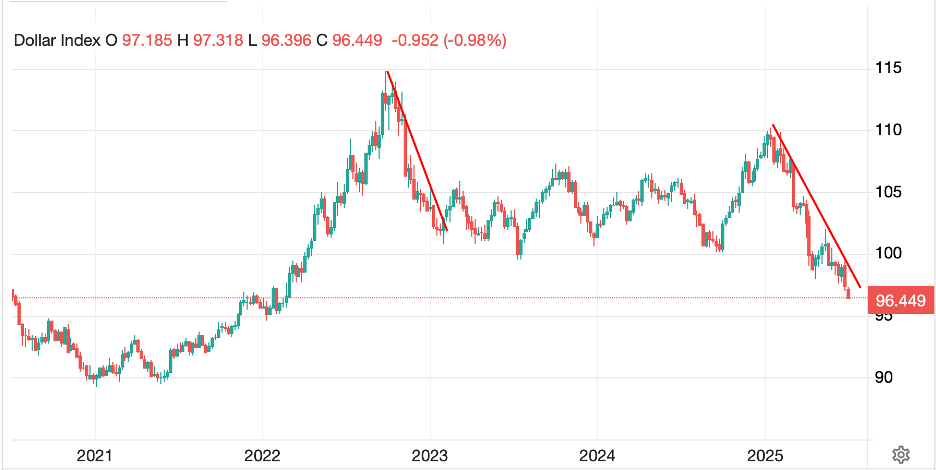
But ignoring for a moment the president’s desires, let us consider the dollar and its potential future direction.  The predominant current thinking is that it has further to slide as the trend is clearly lower and the rising anticipation of a recession in the US forcing the Fed to cut rates further will undermine the greenback.  Let’s break that down for a moment.  There is no question the dollar is currently in a downtrend as evidenced by the chart below.  A look at the red line on the right shows the slope of the decline thus far this year, which totals about 11%.

Source: tradingeconomics.com

In fact, much has been made of the decline thus far this year as to its speed and how it is a harbinger of both a recession and the end of the dollar’s hegemony.  Yet, we don’t have to go very far back in time, late 2022-early 2023 to see a virtually identical decline in the dollar over a slightly shorter period, hence the steeper slope of the line in the center of the chart, and I cannot find a single descrying of the end of the dollar at that time. Too, I remember being certain a recession was on the way then, when it never arrived.  According to JPMorgan, it seems the recession probability for 2025 is now 40%.  I have seen estimates ranging from 25% to 80% over the past few months which mostly tells me nobody has any idea.

We also don’t have to go very far back in time to see when the dollar was substantially weaker than its current levels.  I’m not sure why this time the dollar’s recent trend means the world is ending when that was not the case back in 2023 or any of the myriad times we have seen movement like this in the past.

But one other thing to consider regarding the dollar is that the BBB is going to provide significant stimulus to the economy.  Combining this with President Trump’s trade policies which are designed to draw investment into the US, and seemingly are working, and I think that despite his desire for lower interest rates, the Fed will have little reason to cut amid stronger growth in the economy.  I do not believe you can rule out a turn in the dollar higher once the legislation is passed as it is going to matter a great deal.  While spending priorities are going to change, it appears that investment is going to rise and that will help the buck.  Be wary of the dollar is dying thesis.

Ok, yesterday’s market activity, while reaching record highs in the equity markets, was actually incredibly slow with volumes shrinking.  My sense is folks are on holiday this week and those who aren’t are waiting for Thursday’s NFP data, so they can then run out of the office and go for their long weekend.  But the rest of the world doesn’t have the holiday Friday and are all trying to solve their trade situation with the US.  That led the Nikkei (-1.25%) lower yesterday as there appears to be a timing mismatch from a political perspective.  Ishiba doesn’t want to agree to open Japan’s market to US rice ahead of the election on July 20th as that will be a major political problem, but July 9th is approaching quickly, and Trump has said that is the date.  But aside from Japan and Hong Kong (-0.9%) the rest of the region had a pretty solid session led by Thailand (+2.1%) and Taiwan (+1.3%).  In Europe, though, PMI data was less than stellar, and bourses are modestly softer (DAX -0.5%, CAC -0.4%, FTSE 100 -0.3%) although Spain’s IBEX (+0.2%) has managed a gain as they had the best PMI outcome of the lot.  

In the bond market, yields continue to slide everywhere with Treasuries (-4bps) actually lagging the Eurozone which has seen declines of -6bps virtually across the board.  Madame Lagarde, in her Sintra opening speech, explained that the ECB would be altering their communication strategy to try to take account of the uncertainty in their forecasts, so not promise as much, but I have a feeling the movement is more a result of the softer PMI data as well as the Eurozone inflation release at 2.0% which has ECB members explaining things are under control.  Japan is a bit more confusing as JGB yields (-4bps) slipped despite what I would consider a strong Tankan report and a rise in their PMI data.  However, the newest BOJ board member did explain there was no reason to raise rates anytime soon, so perhaps that is the driver.

In the commodity markets, oil (+0.8%) continues to creep higher, perhaps a harbinger of stronger future economic activity around the world, or perhaps more short covering.  Gold (+1.4%) has completely erased the dip at the end of last week and is back at its recent pivot point of $3350 or so.  This has brought silver (+1.1%) and copper (+0.7%) along for the ride.

Finally, the dollar is clearly softer this morning with JPY (+0.6%) the leader in the G10 while ZAR (+0.9%) is the leading gainer in the EMG bloc as it follows precious metals prices higher.  Net, I would suggest that the average move here is about 0.25% strength in currencies.

On the data front, we get ISM Manufacturing (exp 48.8) and Prices Paid (69.0) and we get the JOLTs Job openings (7.3M) this morning.  Too, at 9:30, Chairman Powell speaks so it will be interesting to see if there is any change in his tune.

I see no reason for the dollar to turn higher right now but watch for the BBB.  Its passage could well change the dollar’s direction.

Good luck

Adf

Over the Hump

It’s beautiful and it’s quite big
Though more complicated than trig
But President Trump
Got over the hump
Though sans views that he is a Whig
 
As well, Friday’s Canada rift
Has ended, boy that was sure swift
Now, this week we’ll learn
If there’s still concern
‘Bout jobs, or if there’s been a shift


The weekend news revolves around the fact that the Senate has passed the BBB with a 51-49 vote, and it now moves to committee so both Houses of Congress can agree the final details before it gets to President Trump’s desk for signature and enactment.  This is another victory for the President, adding to last week’s wins and remarkably there have been several others as well.  The Supreme Court ended the ability of a single district court judge to injunct the entire nation based on a single case, a move that will prevent judges who disagree with the president from stopping his policy efforts.  Then, Canada announced they were going to impose a tax on US technology companies (the one that the Europeans just killed) and after Mr Trump ended the trade dialog quite vociferously, Canada backed down from that stance and is back at the negotiating table.

I mention this not to be political but as a backdrop to what is helping to drive the improved sentiment in US markets for both equities and bonds.  While a quick look at YTD performances of US equity indices vs. Europeans shows the US still lags, that gap is narrowing as the news cycle continues to point to positive things happening in the US.  Certainly, my understanding of the BBB is that it is quite stimulative, although it is changing priorities from the previous administration.

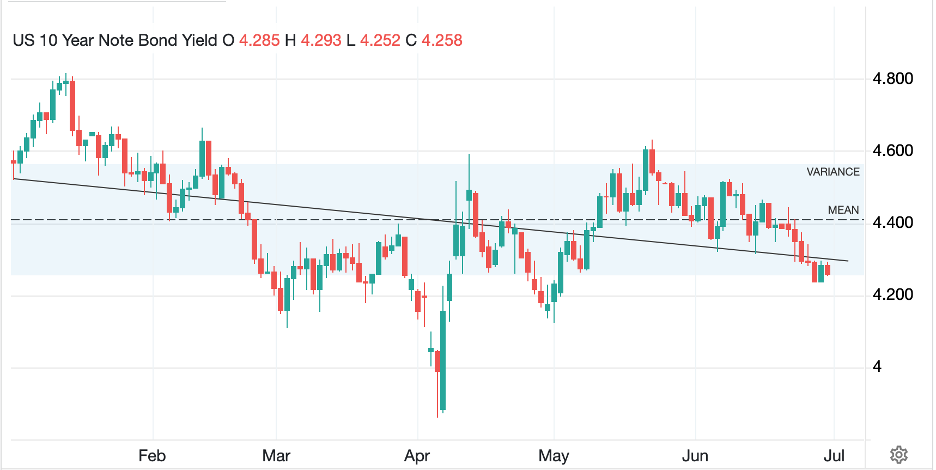
More interestingly, the Treasury market, which has been the subject of many slings and arrows lately from the part of the analyst community that continues to worry about refinancing the growing US debt pile, continues to behave remarkably well.  A quick look at the chart below shows that 10-year yields have been trending lower for the past 6 months, at least, and this morning are continuing that trend, slipping another -3bps.

Source: tradingeconomics.com

My point is that despite relentless doom porn regarding the economy, the big picture continues to point to ongoing growth in economic activity.  There are many anecdotes regarding the impending weakness, (the latest I saw was the increase in the number of credit card purchases that have been rejected is rising rapidly) and yet, the main data has yet to crack and roll over to point to a clear sign of significant slowing.  Perhaps this week when the NFP report is released on Thursday (Friday is July 4th holiday), we will see that long-awaited decline.  However, as of this morning, the Fed funds futures market continues to price just a 21% probability of a July rate cut as forecasts for NFP show the median to be 110K. 

While I completely understand the concerns that the doomers recite, I have come to understand that the idea of a recession is a policy choice, not a natural phenomenon.  While in the past, the business cycle was more powerful than the government, that is no longer the case.  Rather, what we have observed over the past 15 years at least, since the GFC and the onset of QE, is that the government has become a large enough part of the total economy to drive it at the margin.  And I assure you, if a recession is a policy choice, there is not a politician that is going to choose one.  Perhaps we will reach a point where the imbalances get beyond the control of the central banks and their finance ministries, but we are not there yet.

Ok, let’s take a peek at the overnight price action.  Despite all the spending promises by governments around the world, yields have slipped everywhere with all European sovereigns taking their lead from the US and lower this morning by -2bps to -3bps.  Even JGB yields (-1bp) have managed to decline slightly.  If inflation fears are building, they are not obvious this morning.

In the equity markets, Friday’s US rally was followed by most Asian bourses rising (Nikkei +0.8%, Australia +0.3%, China +0.4%) although HK (-0.9%) slipped after Chinese PMI data was released that indicated things weren’t collapsing, but that future monetary stimulus may not be coming after all.  The worst of both worlds for stocks.  Meanwhile, European exchanges are mostly a touch softer, but only on the order of -0.2%, so really very little changed amid light volume overall.  Interestingly, US futures are solidly higher at this hour (7:00), rising by 0.55% across the board.

In the commodity markets, oil (-0.35%) is slipping a bit, but is basically hanging around near its recent lows as the market remains unconcerned about an escalation of fighting between Iran and Israel and any possible closure of the Strait of Hormuz.  Meanwhile, gold (+0.4%) is bouncing from a weak performance Friday which appears to have been a bit oversold, although copper and silver are not following suit this morning with the former (Cu -0.7%) the laggard.  However, all the metals remain sharply higher this year and in strong up trends.

Finally, the dollar is modestly softer again this morning with KRW (+0.9%) the biggest mover, by far, while the entire G10 complex is showing gains on the order of 0.1% to 0.2%.  This trend lower in the dollar remains strong (see chart below), but as I continue to remind everyone, we are nowhere near an extreme valuation in the dollar.  If, and it’s a big if, we see substantial weakening in the employment data, I think the Fed could decide to act and that would increase the speed of the downtrend (as well as goose inflation higher), but absent that, I do not see a sharp decline, rather a slow descent.  Remember, this is exactly what Trump and Bessent want, a more competitive dollar for the manufacturing sector.

Source: tradingeconomics.com

As it is the first week of the month, there is plenty of data to digest.

TodayChicago PMI43.0
TuesdayISM Manufacturing48.8
 ISM Prices Paid69.0
 JOLTs Job Openings7.3M
WednesdayADP Employment 85K
ThursdayNonfarm Payrolls110K
 Private Payrolls110K
 Manufacturing Payrolls-6K
 Unemployment Rate4.3%
 Average Hourly Earnings0.3% (3.9% y/Y)
 Average Weekly Hours34.3
 Participation Rate62.3%
 Initial Claims240K
 Continuing Claims1960K
 ISM Services50.5
 Factory Orders8.0%
 -ex Transport0.9%

Source: tradingeconomics.com

In addition to the payrolls, we hear from Chairman Powell again on Tuesday and Atlanta Fed president Bostic twice.  I guess the rest of the FOMC took a long holiday week(end).

As it’s a holiday week, I expect that activity will be light, although headline bingo remains a key part of the markets today.  I feel like the trends are well entrenched though, with the dollar slipping, equities and commodities rallying and bonds currently leaning toward lower yields, although that seems out of sync with the other markets.  But in the summer, with less liquidity and activity, anomalies can continue for a while.

Good luck

Adf

The Mayhem-ber

Five years ago, some will remember
George Floyd was the riotous ember
But while cities burned
What some of us learned
Was markets ignored the mayhem-ber
 
Of late, as the headlines are filled
With riots, no one’s been red-pilled
While some may disdain
Risk assets, it’s plain
That most buying stocks are still thrilled


The tragic goings on in LA remain the top story as we have now passed the fourth day of rioting.  It strikes me that ultimately, the constitutional question that may be addressed is how much power the federal government has in a situation where a state government seemingly allows rampant destruction of private property.  Of course, we saw this happen just over five years ago in the wake of George Floyd’s death in May 2020 and the ensuing riots in Minneapolis which ultimately spread to Portland, Oregon and Seattle.  

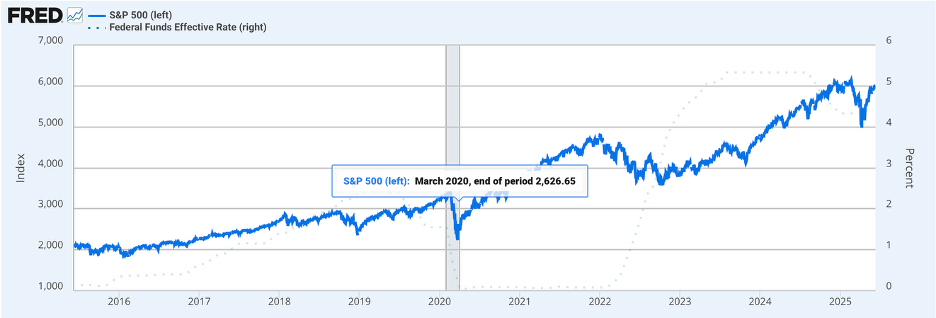
With this as a backdrop, I thought I would take a look at market behavior during that period, if for no other reason to be used as a baseline.  Of course, there are major caveats here as that was during Covid and the government had recently passed a massive stimulus bill while the Fed began to monetize that debt.  Now, we cannot ignore the BBB which looks a lot like a massive stimulus bill as well, so perhaps things are closer in kind than I originally considered.  At any rate, the chart below shows the S&P 500 leading up to and through the 2020 riots.

The huge dip before the riots began was the Covid dip, and the faint dotted line is the Fed Funds rate, so you can see things were clearly different.  However, the point I am trying to make is that despite the violence and disagreements over President Trump’s authority, I would contend the market doesn’t care at all about the situation there.  Investors remain far more concerned about the ongoing trade talks with China that are taking place in London and are “going well” according to Commerce Secretary Lutnick.  From what I read on X, it seems there is a growing expectation that a China deal of some sort will be announced soon and that will be the latest buy signal for stocks.  My larger point is that just because something dominates the headlines, it doesn’t mean that something is relevant in the financial world.

Funnily enough, because the LA riots are sucking the oxygen from every other story, there is relatively little to drive market activity, hence the relatively benign market activity we have been seeing for the past few days.  Yesterday was a perfect example with US equity markets trading either side of unchanged all day and closing pretty much in the same place as Friday.  In Asia overnight, the picture was mixed with the Nikkei (+0.3%) edging higher while both the Hang Seng (-0.1%) and CSI 300 (-0.5%) finished slightly in the red.  The one big outlier there was Taiwan (+2.1%) with other markets showing less overall interest.  I suspect this movement was on the back of the positive vibe the market is taking from the US-China trade talks.

As to Europe, the continent has a negative flavor this morning with the DAX (-0.5%) the laggard and other major indices edging lower by just -0.1% or so.  However, the FTSE 100 (+0.4%) has managed a gain after softer than expected employment data has increased discussion that the BOE will be cutting rates a bit more aggressively.  US futures are still twiddling their proverbial thumbs with no movement at this hour (7:10).

In the bond market, Treasury yields have slipped -3bps and we are seeing similar yield declines throughout the continent.  However, UK gilts (-7bps) are really embracing the slowing labor market and story of a more aggressive BOE rate cut trajectory.

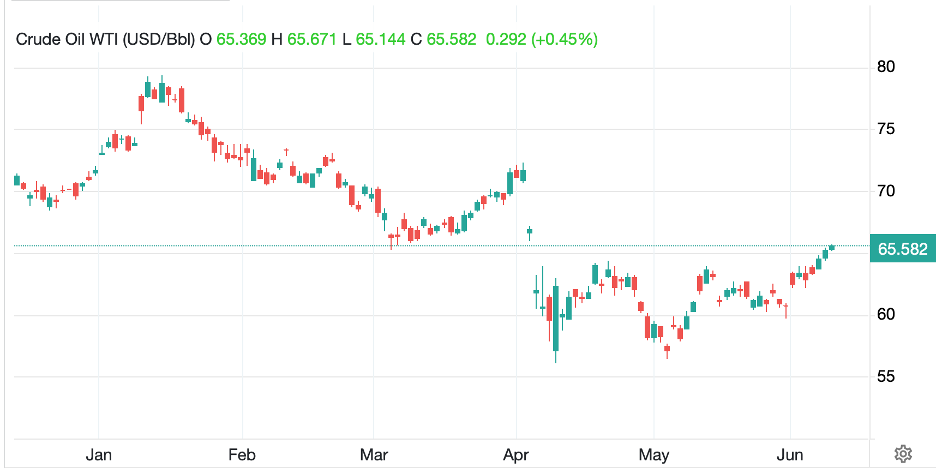
In the commodity markets, oil (+0.5%) continues to climb higher despite the alleged increases in supply and is close to filling the first gap seen back in April (see chart below from tradingeconomics.com)

Given OPEC+ and their production increases, this is a pretty impressive move, especially as the recession narrative remains largely in place.  One tidbit of information, though, is that the Baker Hughes oil rig count is down 37 rigs since the 1st of May, a sign that US production, despite President Trump’s desires for more energy, may be slipping a bit.  As to the metals markets, gold (+0.45%) keeps on trucking, with a steady grind higher although both silver and copper are little changed this morning.  I must mention platinum as well, given I discussed it yesterday, and we cannot be surprised that after a remarkable run, it is softer by -1.3% this morning taking a breather.

Finally, the dollar, like equities, is directionless overall with the pound (-0.3%) slipping on the weak labor data but the rest of the G10 within 0.1% of Monday’s closing levels.  In the EMG bloc, KRW (-0.9%) is the outlier, apparently responding to the positive signals from the US-China trade talks.  However, I question that narrative as no other APAC currency moved more than 0.1% on the session in either direction.  And truthfully, that pretty well describes the rest of the bloc in LATAM and EEMEA.

On the data front, the NFIB Small Business Optimism Index was released this morning at a better than expected 98.8, which as you can see below, is a solid reading overall, certainly compared to most of 2022-2024.

Source: tradingeconomics.com

And here is the rest of what we get this week:

WednesdayCPI0.2% (2.5% Y/Y)
 -ex food & energy0.3% (2.9% Y/Y)
ThursdayPPI0.2% (2.6% Y/Y)
 -ex food & energy0.3% (3.1% Y/Y)
 Initial Claims240K
 Continuing Claims1908K
FridayMichigan Sentiment53.5
 Michigan Inflation Expected6.6%

Source: tradingeconomics.com

However, we must take that Inflation expectation number with at least a few grains of salt (even assuming it has value as an indicator at all), as yesterday, the NY Fed released their own survey of Inflation expectations which fell to 3.2%.  A quick look at the two indicators overlaid on one another shows that the Michigan indicator, if nothing else, has much greater volatility which reduces its value as an indicator.

Source: tradingeconomics.com

It is difficult to get excited about movement in either direction right now.  At some point, the mayhem in LA will end and news sources will look for the next story.  I suspect that trade deals are going to grow in importance as Mr Trump will need to sign some more before long.  As well, the BBB, which I continue to believe will be passed in some form, is going to add some measure of certainty and stimulus to the economy, which, ceteris paribus, implies that the long-awaited reckoning in the stock market may be awaited even longer.  If that is the case, then the weak dollar story, one I understand, is likely to fade for a while as well.

Good luck

Adf

Mugwump

The feud between Elon and Trump
Show’s Musk has become a mugwump
But though there’s much drama
It’s not clear there’s trauma
As markets continue to pump
 
So, turning our eyes toward today’s
Report about jobs, let’s appraise
The call for recession
That’s been an obsession
Of some for six months of Sundays


Clearly the big headlines are all about the escalating war of words between President Trump and Elon Musk.  I guess it was inevitable that two men with immense wealth and power would ultimately have to demonstrate that one of them was king.  But other than the initial impact on Tesla’s stock price, it is not clear to me what the market impacts are going to be here.  After all, President Trump has attacked others aggressively in the past when they didn’t toe his line, and it is not a general market problem, only potentially the company with which that person is associated.  As such, I don’t think this is the place to hash out the issue.

However, I think it is worth addressing one point that Musk raised regarding the Big Beautiful Bill.  The thing about reconciliation is it only addresses non-discretionary spending, meaning Social Security, Medicare, Medicaid and the interest on the debt.  All the other stuff that DOGE made headlines for, USAID etc., could never be part of this bill.  That requires recission packages where Congress specifically passes laws rescinding the previously enacted payments.  So, if this was a part of the blowup, it was senseless.  I will say, though, that the Trump administration did not communicate this fact effectively as I read all over how people are upset that Congress is not addressing these other things.  At any rate, this is not a political commentary, but I thought it was worth understanding because I only learned of this in the past weeks and I don’t believe it is widely understood.

Onward to the major market news today, the payroll report.  As of this morning, according to tradingeconomics.com, here are the forecast outcomes:

Nonfarm Payrolls130K
Private Payrolls120K
Manufacturing Payrolls-1K
Unemployment Rate4.2%
Average Hourly Earnings0.3% (3.7% Y/Y)
Average Weekly Hours34.3
Participation Rate62.6%

Of course, Wednesday’s ADP Employment number was MUCH lower than expected, so the whispers appear to be for a smaller outcome.  As well, the key wildcard in this data is the BLS Birth-Death model which is how the BLS estimates the number of jobs that have been created by small businesses which aren’t surveyed directly.  As with every model, especially post-Covid, what used to be is not necessarily what currently is.  The most accurate, after the fact, representation of employment is the Quarterly Census of Employment and Wages (QCEW) but that isn’t released until 6 months after the quarter it is addressing, so it is not much of a timing tool.  It is also the genesis of all the revisions.  

Here’s the thing, a look at the chart below shows that the BLS Birth-Death model appears to still be substantially overstating the payroll situation.  Given the datedness of its model, that cannot be a real surprise, but I assure you, if there is a major revision lower in that number, and NFP prints negative, it WILL be a surprise to markets.  I am not forecasting such an occurrence, merely highlighting the risk. 

If that were to be the case, I imagine the market reaction would be quite negative for stocks and the dollar, positive for bonds (lower yields) and likely continue to push precious metals higher, although oil would likely suffer.  I guess we will all have to wait and see at 8:30 how things go.

In the meantime, ahead of the weekend, let’s see how markets behaved overnight.  Yesterday’s modest sell-off in the US was followed by a mixed session in Asia (Nikkei +0.5%, Hang Seng -0.5%, CSI 300 -0.1%) but strength in Korea (+1.5%) and India (+0.9%).  Trade discussions still hang over the market and there are increasing bets that both India and Korea are going to be amongst the first to come to the table.  As well, the RBI cut rates by 50bps last night with the market only expecting 25bps, so that clearly supported the SENSEX.  In Europe, no major index has moved even 0.2% in either direction as positive European GDP data was unable to get people excited and there is now talk that the ECB will not cut rates again until September.  As to US futures, at this hour (6:50) they are pointing higher by about 0.3% across the board.  It appears that the Tesla fears are abating.

In the bond market, yields continue to slide with Treasuries falling -1bp and European sovereign yields down between -3bps and -5bps despite the stronger than expected Eurozone data which also included Retail Sales (+2.3%) growing more rapidly than expected.  But this is a global trend as recession discussions increase while we also saw JGB yields slip -2bps overnight.  It feels like the bond markets around the world are anticipating much slower economic activity.

In the commodity space, oil (0.0%) is unchanged this morning and continuing to hang around at its recent highs, but unable to break above that $63+ level.  It strikes me that if slower economic activity is on the horizon, that should push oil prices lower as there appears to be ample supply.  But I read that Spain has stopped importing Venezuelan crude as US secondary sanctions are about to come into effect there.  As to the metals markets, silver (+1.5%) and platinum (+2.6%) have been the leaders for the past few sessions although gold (+0.2%) continues to grind higher.  The loser here has been copper (-0.8%) which if the economic forecasts of slowing growth are correct, makes some sense.  Of course, there is a strong underlying narrative about insufficient copper supplies for the electrification of everything, but right now, payroll concerns are the story.

Finally, the dollar is a bit firmer this morning, but only just, with G10 currencies slipping between -0.2% and -0.3% while EMG currencies have shown even less movement.  INR (+0.25%) stands out for being the only currency strengthening vs. the dollar after the rate cut and positive growth story, but otherwise, this is a market waiting for its next cue.

In addition to the payroll report, we get Consumer Credit (exp $10.85B) a number which gets little attention but may grow in importance if economic activity does start to decline.  As well, I cannot ignore yesterday’s Trade data which saw the deficit fall much more than expected, to -$61.6B, its smallest outturn since September 2023.  While I didn’t see any White House comments on the subject, I expect that President Trump is happy about that number.

Are we headed into a recession or not?  Will today’s data give us a stronger sense of that?  These are the questions that we hope to answer later this morning.  FWIW, which is probably not that much, my take is while economic activity has likely slowed a bit, I do not believe a recession is upon us, and as I do believe the reconciliation bill will be passed which extends the tax cuts, as well as adds a few like no tax on tips or Social Security, I expect that will turn any weakness around quickly.  What does that mean for the dollar?  Right now, it is piling up haters so a further decline is possible, but I cannot rule out a reversal if/when the tax legislation is finalized.

Good luck and good weekend

Adf