Alone in the Wilderness

Takaichi-san
Alone in the wilderness
No partners will play


In a major blow to Japan’s largest political party, the LDP, their long-time partner, Komeito, has withdrawn from the twenty-five year coalition.  Ostensibly, Komeito asked Takaichi for a commitment to address the financing corruption issue that was one of the reasons for the Ichiba government’s collapse and she either could not or would not do so immediately.  There seems to be a bit of he said, she said here but no matter, it is a major blow to the LDP.  While it remains the largest party in both Houses, it doesn’t have a majority in either one and there is the beginning of talk as to how a coalition of other parties may put forward a PM candidate leaving Ms Takaichi on the outside looking in.  

The one thing I have learned over the years is that all politics is temporary, at least when it comes to Western democracies.  So, whatever the headlines blare today, the opportunity for Komeito to rejoin the LDP remains wide open.  Additionally, after twenty-five years sharing power, I am pretty certain that they are unlikely to simply walk away and cede that benefit.  My take, and this is strictly from my observations of how politics works everywhere, is that this spat will be overcome and Takaichi-san will, in fact, become Japan’s first female Prime Minister.  

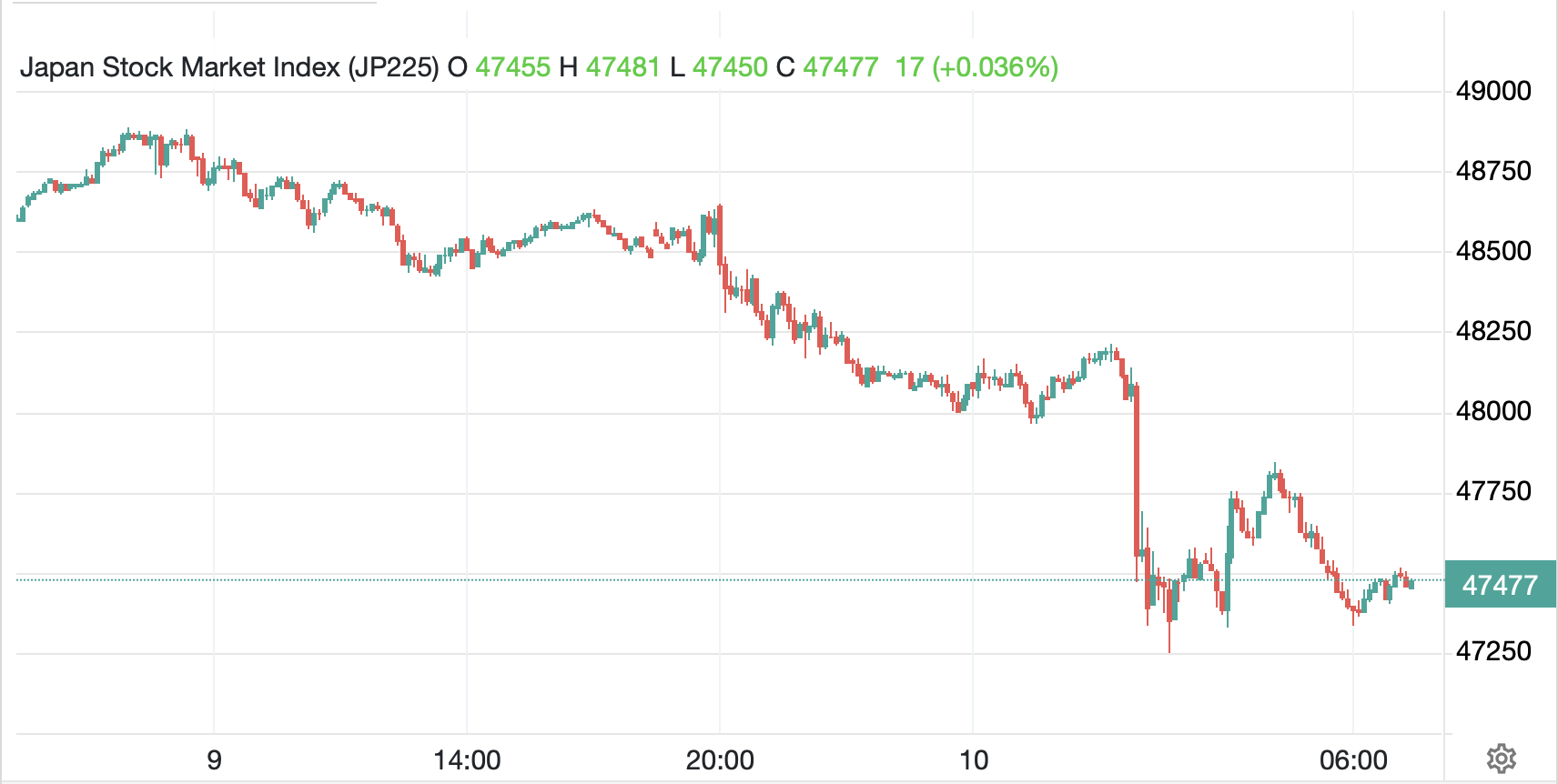
Japanese equity markets (-1.0%) were already closed ahead of the long weekend there (Japan is closed for Sports Day on Monday) when the news hit the tape, so it is not surprising that Nikkei futures fell further, another -1.25% (see chart below from tradingeconomics.com), but if I am correct, by Tuesday, all will be right with the world again.  As an aside, Japanese share weakness was a follow on from US equity weakness, and that sentiment was pervasive across all of Asia (China -2.0%, HK -1.7%, Thailand -1.8%) with only Korea (+1.7%) bucking the trend as it reopened for the first time in a week and was catching up to the rally it missed.
The Bureau of Labor Statistics
Though staffed by what often seems mystics
Has called some folks back
So that they can track
Inflation’s key characteristics

It turns out, the cost-of-living adjustments for Social Security payments are made based on the September CPI data which were originally due to be released on October 15th.  Of course, the government shutdown, which now heads into its second week, resulted in BLS employees being furloughed alongside many others.  However, it now appears that several of them have been called back into the office in order to prepare the report to be released some time before the end of the month, if not on the originally scheduled date.  One added benefit (?) of this is that the Fed, which meets on October 28thand 29th may have the data at the time of their meeting to help with their decision making.  Of course, the market continues to price a very high probability of a cut at that meeting, currently 95%, despite a continued mix of comments from Fed speakers.  Just yesterday, Governor Barr urged caution on further cuts, although we also have heard from others like Chicago Fed president Goolsbee, that the labor situation is concerning and that further cuts are appropriate.  Regarding the Fed, I think the doves outnumber the hawks and a cut is coming, if for no other reason than it is already priced in and they are terrified to surprise markets on the hawkish side.

Away from those two stories, all the market talk yesterday was on the early spikes in precious metals (gold touched $4058/oz, silver $50.93/oz) before they fell back sharply on what seemed to be either serious profit-taking or, more likely, a massive attempt to prevent these metals from rallying further.  There have long been stories that major banks have been manipulating prices, especially in silver, as they run huge short futures positions in their books.  I do not know if those stories are true or apocryphal, but there is no doubt that someone sold a lot during yesterday’s session.

Source: tradingeconmics.com

My friend JJ (Alyosha’s market vibes) made the observation that the price action felt as though suddenly algorithms, which have ignored these markets because they haven’t offered the opportunities that equity markets have, were involved.  If that is the case, it is very possible that we are going to see a very different characteristic to metals markets going forward, with much more controlled price action.  Food for thought.

Ok, let’s recap the rest of the markets ahead of the weekend.  The US equity declines were early with modest rallies into the close that left the major indices only slightly lower on the day.  We have already discussed Asian markets and looking at Europe, price action has been limited although Spain (+0.4%) is having a decent day for no particular reason.  Elsewhere, though, +/-0.2% describes the session.

Treasury yields (-3bps) are leading all government bonds higher (yields lower) with all European sovereigns seeing similar yield declines and even JGBs slipping -1bp.  The only data from the continent was Italian IP (-2.4%) which seems to be following in the footsteps of Germany.  Too, Spanish Consumer Confidence fell to 81.5, which while a tertiary data point, extends its recent downward trajectory.  In this light, and finally, the probability of an ECB cut at the end of the month has moved off zero, albeit just to 1%, but prior to today, futures were pricing a small probability of a rate hike!

Oil (-1.2%) has fallen back to the bottom of that trading range ostensibly because the Middle East peace process seems to be holding.  This is a wholly unsatisfactory thesis in my mind given my observation that the Israel/Gaza conflict seemed to have no impact on prices for a long time because of its contained nature.  Rather, Russia/Ukraine seems like it should have far more impact.  But then, I’m just an FX guy, so oil markets are not my forte.

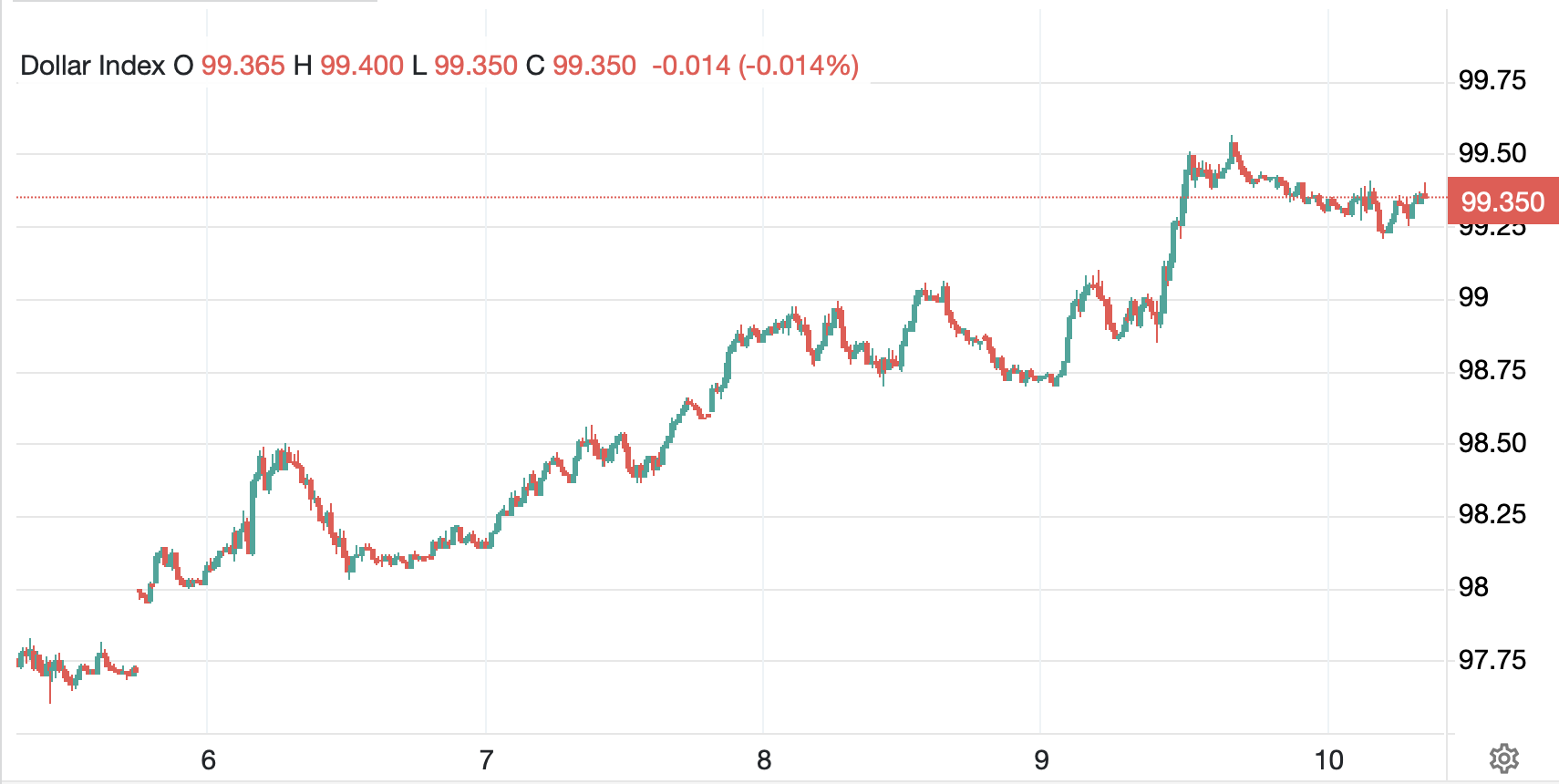
Finally, the dollar, which continues to rally in the face of all the stories about the dollar’s demise, is consolidating today after a pretty strong week.  Using the DXY as our proxy, this week’s trend is evident as per the below chart from tradingeconomics.com
A popular narrative amongst the ‘dollar is doomed’ set is that a look at dollar reserves at central banks around the world shows a continuing reduction in holdings with central banks exchanging dollars for other currencies, (euros, pounds, renminbi, Swiss francs, etc.) or gold.  Now, there is no doubt that central banks have been buying gold and that has been a key driver of the rally in the barbarous relic’s price.  But the IMF, who is the last word on this issue, makes very clear that any change recently has been due to the FX rate, not the volume of dollars held.  As you can see below, in Q2 (the latest data they have) virtually the entire reduction in USD reserves worldwide was due to the dollar’s first half weakness.
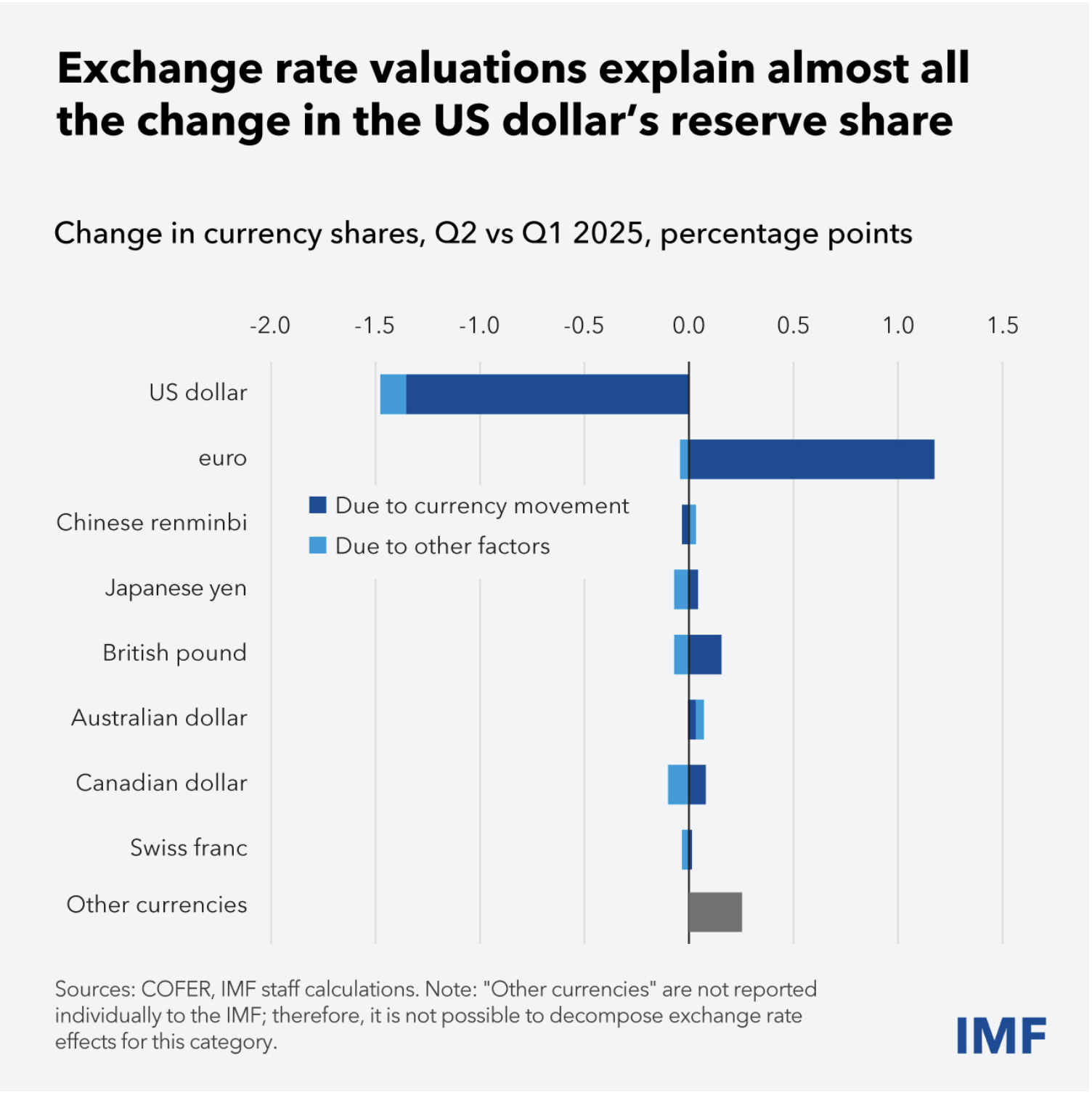
There are many problems in the US, and the fiscal situation is undoubtedly a mess, but as of now, there is still no viable alternative to holding dollars, especially given the majority of world trade continues to be priced and exchanged using the buck.

And that’s all for today.  We do get the Michigan Confidence number (exp 54.2), which is remarkably low given the ongoing rally in equities.  As you can see from the below chart overlaying the S&P 500 (gray line) with Michigan Confidence (blue line), something has clearly changed in this relationship.  This appears to be as good an illustration of the K-shaped economy as any, with the top 10% of earners feeling fine while the rest are not as happy.

Source: tradingeconomics.com

As we head into the weekend, with US futures pointing higher, I have a feeling that yesterday will be the anomaly and the current trends will reassert themselves.

Good luck and good weekend

Adf
Stock-pocalypse?

Inflation is on traders’ lips
As rate cuts now lead all their scripts
But what if it’s hot
And questions the plot?
Will that lead to stock-pocalypse?
 
Meanwhile pundits keep on complaining
That everything Trump does is straining
Their efforts to force
A narrative course
And so, their impact keeps on waning


It is CPI Day and there are several different stories in play this morning.  Naturally, the first is that President Trump’s dismissal of BLS head McEntarfar calls into question the veracity of this data, which has already been questioned because of a reduction in the headcount at the BLS.  While we cannot be surprised at this line of attack by the punditry, it seems unlikely that anything really changed at the BLS in the past week, especially since there is no new head in place yet.  

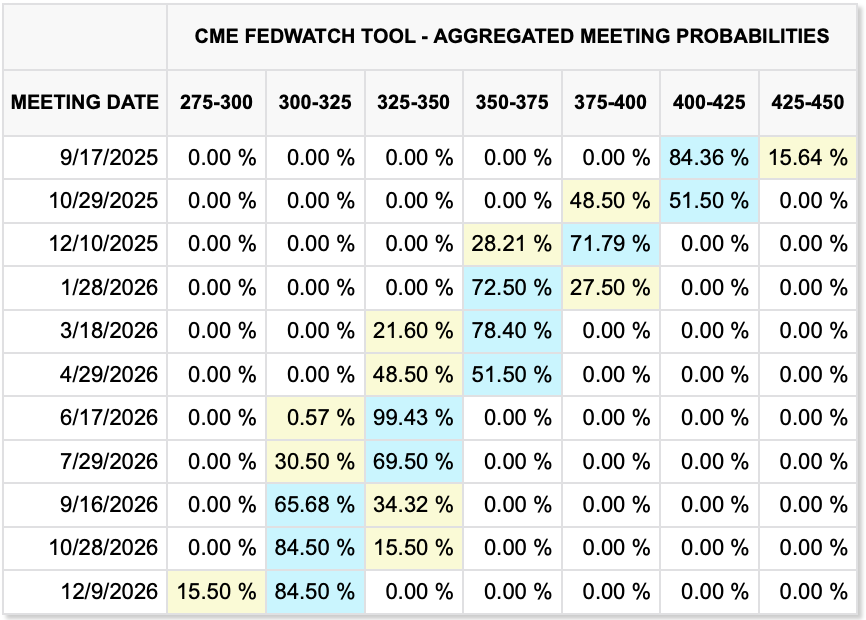
But the second question is how will this data impact the current narrative that the Fed is set to cut rates at each of the three meetings for the rest of this year?  At this hour (6:30) the probability, according to the CME futures market, of a September cut has slipped to 84.3% with a 72% probability of two cuts by year end as per the below table courtesy of cmegroup.com.

Interestingly, the market remains quite convinced that the trend in rates is much lower as there is a strong expectation of a total of 125 basis points of cuts to be implemented by the end of 2026.  I’m not sure if that is pricing in much weaker economic growth or much lower inflation, although I suspect the former given the ongoing hysteria about tariff related inflation.

To level set, here are the current median estimates for today’s release:

  • Headline: 0.2% M/M, 2.8% Y/Y
  • Core:         0.3% M/M, 3.0% Y/Y

Now, we are all well aware that the Fed uses Core PCE in their models, and that is what they seek to maintain at 2.0%.  But, historically, PCE runs somewhere between 0.3% and 0.5% below CPI, so no matter, they have not achieved their goal.  However, we continue to hear an inordinate amount of discussion and analysis as to why the latest NFP report signals that a recession is pending.  And in fairness, if one looks at indicators like the ISM employment indices, for both manufacturing and services they are at extremely low levels, 43.4 and 46.4 respectively, which have historically signaled recessions.  At the same time, concerns over inflation rising further due to tariffs and other policy changes remain front and center in the narrative.  In fact, one of the key discussion points now is the idea that the Fed will be unable to cut rates despite a weakening labor market because of rising inflation.  I’m not sure I believe that to be the case although the last time that situation arose, in the late 1970’s, Chairman Volcker raised rates to attack inflation first.  However, that doesn’t seem likely in the current environment.

Remember this, though, when it comes to the equity market, the bias remains bullish at all times.  In fact, I would suggest that most of the narratives we hear are designed with that in mind, either to attack a policy as it may undermine stocks, or to cheerlead something that is pushing them higher.  I suspect that the major reason any pundits are concerned over higher inflation is not because it is a bad outcome for the economy, but because it might delay Fed funds rate cuts which they have all concluded will lead to higher equity prices. After all, isn’t that the desired outcome for all policy?

Ok, as we await the data this morning, let’s see how things behaved overnight.  Yesterday’s lackluster US session was followed by a lot of strength in Asia.  Japan (+2.15%) led the way on a combination of stronger earnings from key companies and the news about tariff recalculations.  (remember, they were closed Monday).  China (+0.5%) and Hong Kong (+0.25%) benefitted from news that President Trump has delayed the tariff reckoning with China by 90 more days as negotiations remain ongoing.  Australia (+0.4%) was higher after the RBA cut rates 25bps, as expected, while Governor Bullard indicated further easing is appropriate going forward.  There was one major laggard in Asia, New Zealand (-1.2%) as tariffs on their exports rose to 15% and local earnings results were softer than forecast.

In Europe, the picture is mixed with Germany (-0.45%) the laggard after much weaker than expected ZEW Economic Sentiment data (34.7, down from 52.7 and below the 40.0 forecast).  As to the rest of the region, there are modest gains and losses, on the order of 0.15% or less with talk about what will come out of the Trump-Putin talks on Friday in Alaska and how that will impact the European defense situation.  As to US futures, at this hour (7:15) they are unchanged.

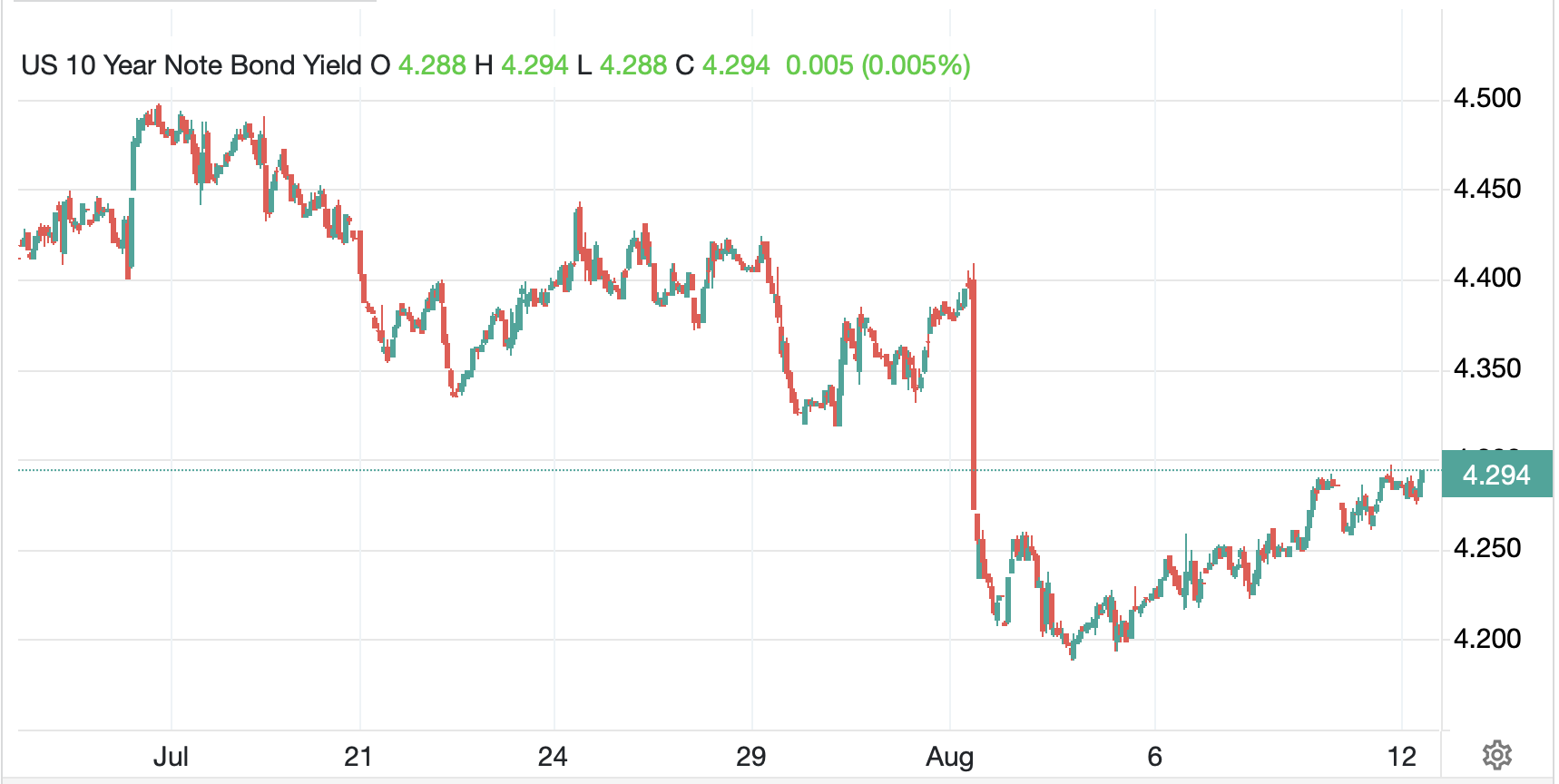
In the bond market, Treasury yields are unchanged this morning, remaining below 4.30% although still well below the recent peak at 4.50% in seen in mid-July.

Source: tradingeconomics.com

European sovereign yields are edging higher by 2bps across the board as investors show caution ahead of both the US CPI data as well as the uncertainty of what will come from the Trump-Putin talks.  However, UK gilts (+4bps) responded to better-than-expected payrolls data there, although the Unemployment Rate remained unchanged at 4.7%.

In the commodity markets, oil (-0.35%) is still in the middle of a narrow trading range as it seeks the next story, arguably to come from Friday’s talks, but potentially from this morning’s CPI data if it convinces people that a recession is imminent.  Metals markets are little change this morning, consolidating yesterday’s declines but not showing any bounce at all.

Finally, the dollar remains generally dull with the euro (-0.1%) unable to spark any life at all lately.  We did see AUD (-0.4%) slip after the rate cuts Down Under and in the EMG bloc, there is a bit of weakness, albeit not enough to note.  There was an amusing comment from Madame Lagarde as she tried to explain that now is the time for the euro to shine on a global reserve basis because of the perceived troubles of the dollar.  Not gonna happen, trust me.

And that’s really it for today.  Another summer day with limited activity as we all await both the data and the next story from the White House, as let’s face it, that is the source of virtually all action these days.  A soft print today ought to result in a rally in both equities and bonds while the dollar might slide a bit as the prognosis for a rate cut increases.  But a hot print will see the opposite as fear of stagflation becomes the story du jour.  Remember, too, two more Fed speakers, Barkin and Schmid, will be on the tape later this morning so watch for any dovishness there as both have been very clear that patience is their game.

Good luck

Adf

Typically Dumb

On Friday, the market was sure
The end was nigh, and we’d be poor
The dollar was sold
And stocks mem’ry-holed
While bonds sashayed like haute couture
 
But somehow, the end did not come
As markets around the world hum
Perhaps we should learn
That markets do churn
And pundits are typically dumb


I admit to being confused this morning as by Friday evening, the entire narrative was that the recession was here, equity markets had peaked, and the dollar was set to collapse.  All the negative outcomes that have been prognosticated by doom pornsters were arriving and Friday was merely the first step.

And yet, here we are this morning, and not only did the sun rise in the East again, but equity markets throughout Asia also saw far more winners (China +0.4%, Hong Kong +0.9%, Korea +0.9%, India +0.5%, Singapore +1.0%, Thailand +1.25%, Philippines +0.7%) than laggards (Taiwan -0.2%, Malaysia -0.4%, Indonesia -1.0%, New Zealand -0.35%).  As to Europe, it is universally green (DAX +1.25%, CAC +0.8%, IBEX +1.4%, FTSE 100 +0.3%) and US futures, at this hour (6:35) are higher by 0.7% or so.  

Meanwhile, the dollar is higher against the euro (-0.15%), yen (-0.2%) and Swiss franc (-0.5%), although we have seen modest gains in some G10 currencies (GBP +0.15%, AUD +0.15%).  And if we look across the EMG bloc, while KRW (+0.4%) has rallied along with CNY (+0.2%), those are the outliers with the rest of the space softer by about -0.2% or so.  In other words, there has not yet been a wholesale rejection of the dollar on global foreign exchanges.

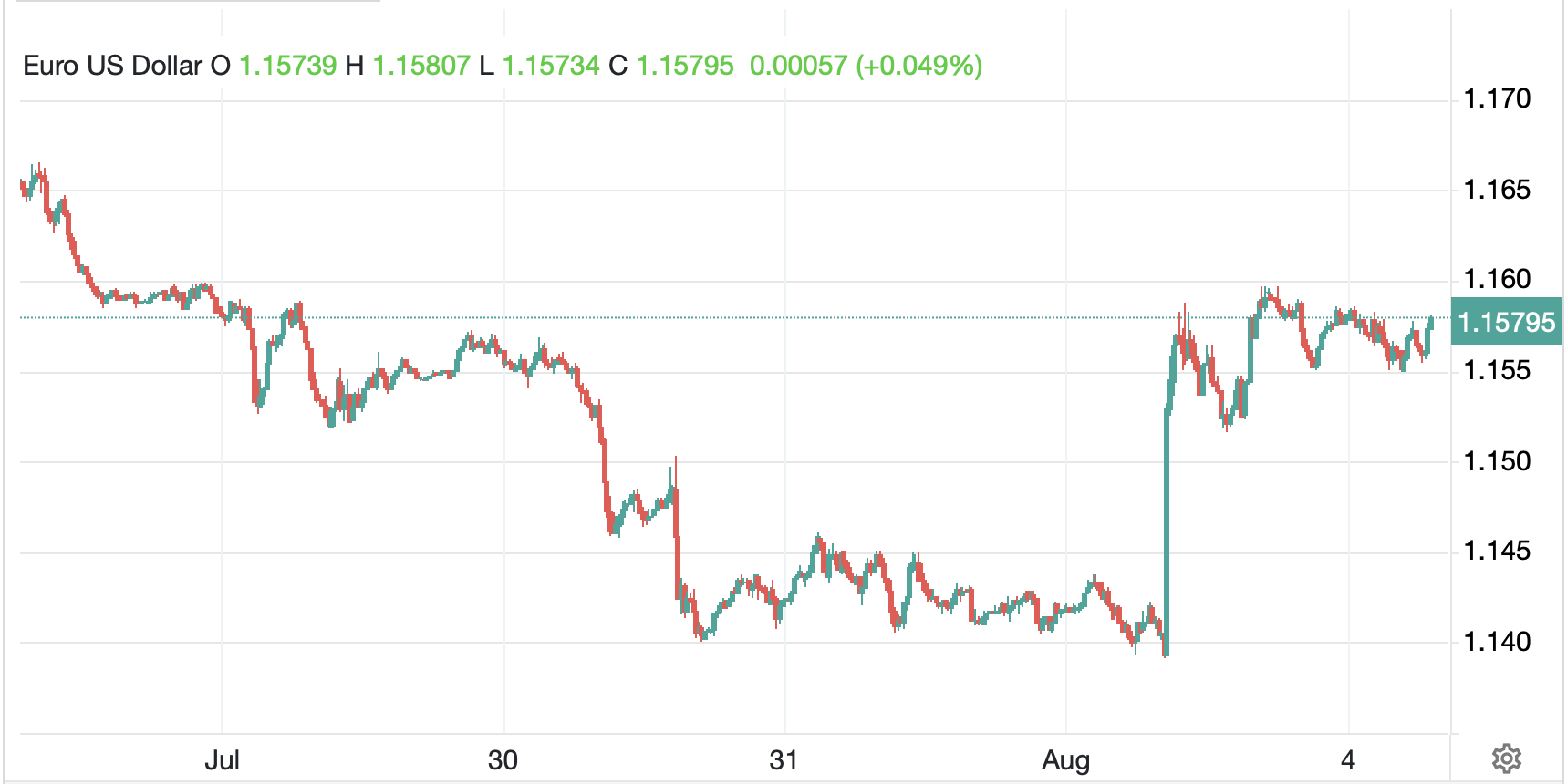
As to bond yields, after Friday’s dramatic decline, falling 15bps in the hour after the NFP report, they have largely stagnated, rising 1bp this morning.  European sovereign yields have slipped about 3bps on average as they continue the Friday move having closed before all the fun was finished.  In fact, while I have chosen the EURUSD exchange rate as a graph to depict the movement, basically every chart looks the same as this with a dislocation at the 8:30 mark on Friday and then a new range quickly established.

Source: tradingeconomics.com

I highlight this because so frequently, the narrative gets ahead of itself, and Friday was one of those days.  Yes, as I explained last night, the NFP data was weak, albeit still positive regardless of the fireworks surrounding the firing of the BLS Commissioner.  And remember, the idea that President Trump fired McEntarfar because the data displeased him does not mean she was not incompetent.  Certainly, nothing in her career demonstrates keen economic insights.  But that is still the talking point du jour.

However, that is a tired story at this point.  In fact, arguably, the reason it is getting so much press is that there is precious little else new to discuss amid the summer doldrums.  After all, the Russia Ukraine war continues apace with no end in sight, although it seems the rhetoric has increased with ex-president Medvedev seeming to threaten nuclear war and the US moving attack submarines closer to Russia.  

Texas Democratic state legislators have fled the state to avoid a special session where redistricting is due to be completed, so that has a lot of headlines, but seems likely to end like the last time this occurred, with the redistricting being completed, and Fed Governor Adriana Kugler stepped down a few months earlier than her term ends which opens another seat on the Fed for Mr Trump to fill.  

Of these stories, while our antenna should be raised given the Russia nuclear war scenario, it still seems a very low probability event, while Texas may matter in the midterm elections if they successfully redistrict as it is supposed to ensure another 5 Republican seats in the House.  But a new Fed governor, perhaps a precursor to the next Chair will have tongues wagging in the market until the seat is filled, and then until Powell is gone.

So, take your pick as to what is important.  Personally, I think the actual payroll data is the most important issue as we continue to see significant gyrations within the numbers.  Less government hiring (I read that 154,000 federal employees took the buyout) is an unalloyed good for the nation.  After all, if nothing else, given the average federal government employee salary is $106,382 (according to Grok) then that is about $16.4 billion less expenditure by the Federal government.  Every little bit helps.  In fact, all the data we have seen of late shows that the private sector continues to grow while the public sector is shrinking.  Over time, that is undoubtedly a better situation for the US and will reflect in the value of US assets.

But that’s really all there is to discuss, so let’s look at the data upcoming this week:

TodayFactory Orders-4.9%
 -ex Transport0.1%
TuesdayTrade Balance-$61.6B
 ISM Services51.5
ThursdayBOE Rate Decision4.00% (-0.25%)
 Initial Claims220K
 Continuing Claims1947K
 Nonfarm Productivity1.9%
 Unit Labor Costs1.6%
 Mexican Rate Decision7.75% (-0.25%)

Source: tradingeconomics.com

In other words, while we will hear from two more central banks as they cut rates (compared to a Fed that remains on hold, for now) it is hard to get that negative on the dollar.  Fed funds futures are pricing an 87% chance of a rate cut in September and now a 56% chance of three cuts this year, one at each meeting left, so that will weigh on the buck a bit, but if the US is cutting because recession is arriving, the economic situation elsewhere will be more dire.  After all, the US remains the consumer of last resort, and if the US pulls back, everyone else will feel it.

The big picture remains that the broader dollar trend is lower, but it is starting to make a case that trend is ending.  The data this week is largely second tier, and we need to wait until next week for CPI.  I have a feeling we will see very little net movement until then.

Good luck

Adf

He Axed Her

The NFP data was weak
And President Trump did critique
The BLS head
But unlike the Fed
He axed her as pundits did freak


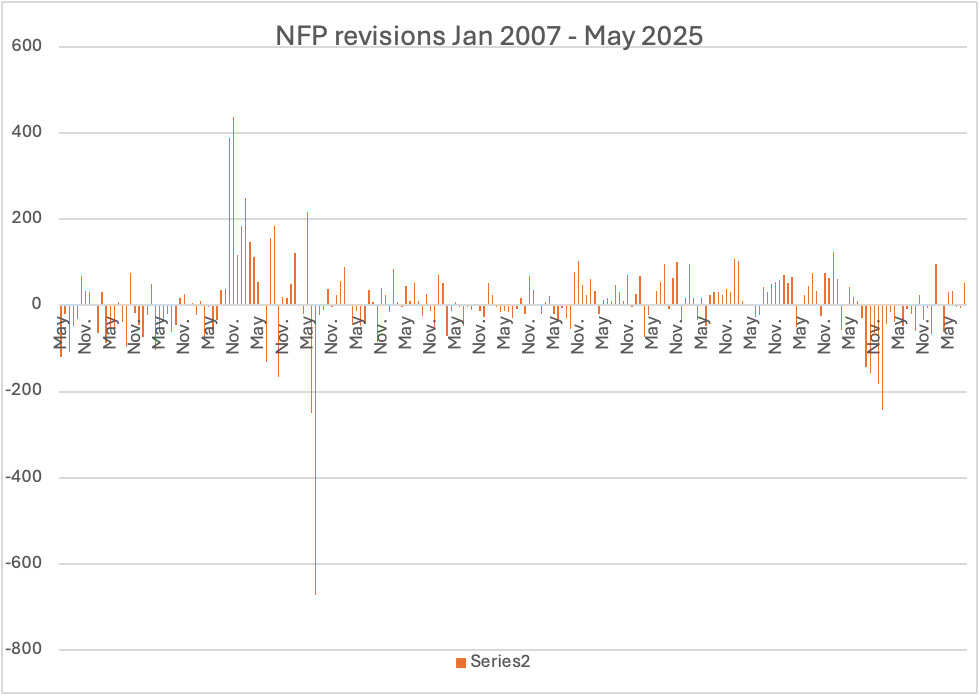
However, it is a fair question to ask if she was incompetent or politically motivated in her daily activities.  After all, it is abundantly clear there are many government workers who are ostensibly non-partisan who are, in fact, highly partisan.  As such, I took a look at the seasonally adjusted NFP data (the non-seasonally adjusted data is wildly volatile) to see if we could discern a pattern.  I created the chart below from BLS data on revisions with May 2025, the latest month with the normal two revisions, on the left and January 2007, prior to the GFC, all the way on the right.

If you look on the left side of the chart, you can see a great many negative revisions.  In fact, 21 of the last 29 months were revised lower from the original print.  If we assume that the BLS models are unbiased, then one would expect a roughly equal distribution of both positive and negative revisions over time.  It turns out, under the unbiased assumption, the probability of 21 out of 29 negative revisions is a very tiny 0.80%.

What conclusions can we draw from this?  My first thought is that the BLS models are not very effective at modeling reality.  I have raised this point many times in the past, the idea that the models that worked in the past, certainly pre-Covid, have been having trouble.  This begs the question as to why an economist of Ms McEntarfer’s long experience didn’t seek to develop a more accurate model.  As it is, there is no evidence that she did so.  I imagine as a government employee, the idea that one should change something that exists within the government framework is quite alien.  Thus, her competence could certainly be called into question, I think.

If we consider the alternative, that her actions were politically motivated, that will be more difficult to discern.  However, given the predominance of Democrat voting members of the federal government and given the fact she was appointed to this position by President Biden, it is fair to assume she is not in favor of the current administration, at the very least.  Now, during Mr Biden’s term, the initial NFP data was consistently better than expected, thus giving the impression that the economy was stronger than it may have otherwise been.  After all, stories about revised data are usually on page 12 of the paper, not headline news.  It is, therefore, possible that she was putting her proverbial thumb on the scale to flatter Biden’s economic performance.  As to her likely distaste of Mr Trump, I expect that to the extent she had the ability to do so, weaker headlines and large negative revisions would be exactly her contribution.

However, the political issue is largely speculation on my part, although I would argue it is plausible.  On the other hand, there is nothing in her background to suggest she is an especially thoughtful or creative economist and there is no indication that she examined the models she oversaw for flaws.  In the end, I come down on incompetence driving a political motive.  But I doubt we will ever know.  

Now, it is not a very good look for a leader to proverbially kill the messenger, which is essentially what Trump did.  Not surprisingly, much hair is on fire in the press and punditry, not because they though McEntarfer was particularly good at her job (I’m sure nobody had ever heard of her before) but because, as we have observed time and again, President Trump doesn’t follow their rules, and they don’t know what to do about it. 

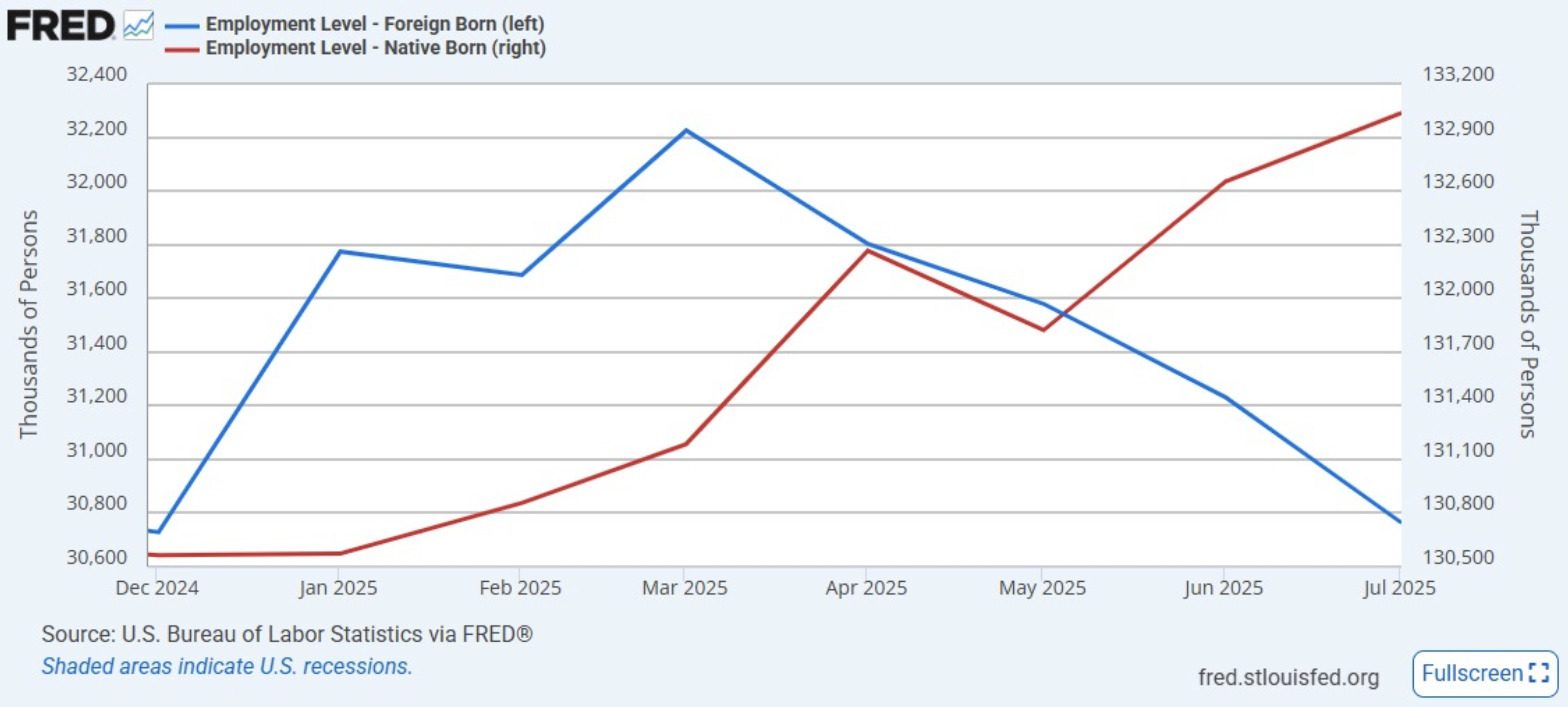
Will this matter in the end?  This is merely the latest tempest in a teapot in my opinion and will do nothing to change the economy.  However, there is one interesting feature of the employment situation that can be directly attributed to the immigration situation.  As you can see in the FRED chart below, since March, the number of foreign-born workers has declined by 1.46 million while the number of US born workers has increased by more than 1.8 million.  I would say that as long as American citizens are finding jobs, President Trump is likely to remain quite popular across the nation despite all the negative press.

The weak NFP report altered the narrative on Friday, with bond yields, equity markets and the dollar all tumbling and the probability of a September rate cut jumping to 80%.  Perhaps President Trump is correct, and it is time to cut rates.

That’s all for this special Sunday night edition.

Good luck

Adf

Gone Astray

The ADP Labor report
On Wednesday, came up a bit short
Investors decided
That they would be guided
By this and bought bonds like a sport
 
As well, there’s a story today
The BLS has gone astray
It seems that their data
Might have the wrong weight-a
So, CPI’s not what they say


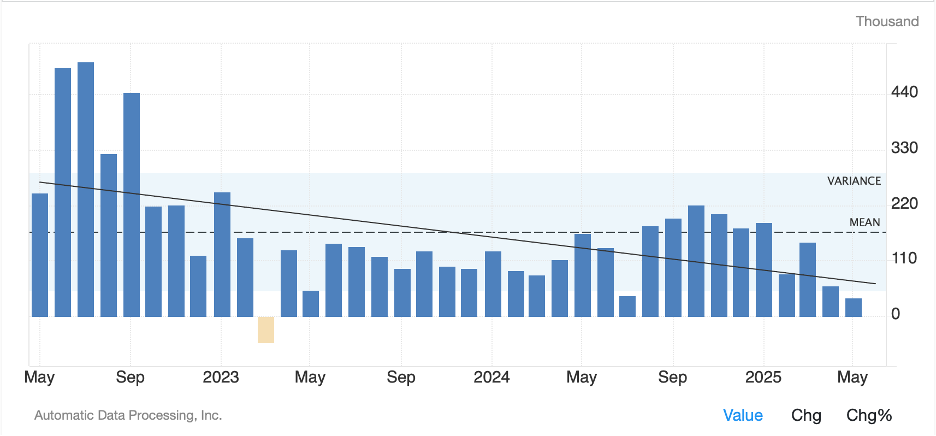
It has been another very dull session in most markets although yesterday did see a strong bond market rally after the ADP Employment Report was released much lower than expected at just 37K jobs created.  Certainly, the trend has been lower for the past three years as you can see in the below chart from tradingeconomics.com, so I guess we cannot be that surprised.

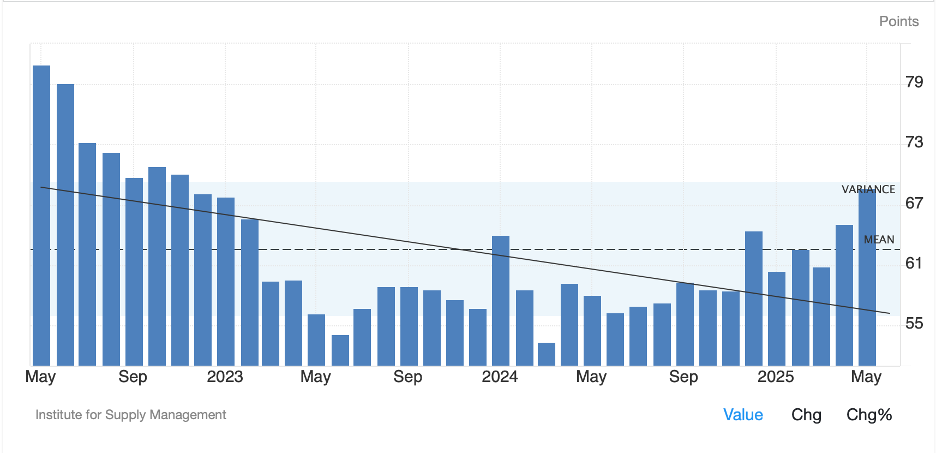
You will also not be surprised that this data brought out the recessionistas as they jumped all over the release to make their case that recession was just around the corner, and quite possibly stagflation.  Adding to their case was the ISM Services data which also disappointed at 49.9 and has also been trending lower for the past three years.  As well, they were almost gleeful in their description of the Prices Paid sub index rising to 68.7, its highest print since November 2022.  Alas, while Pries Paid have been rising for the past year or so, a look at the trendline shows they are continuing to retreat from the highs seen during the Bidenflation of 2022.

Source: tradingeconomics.com

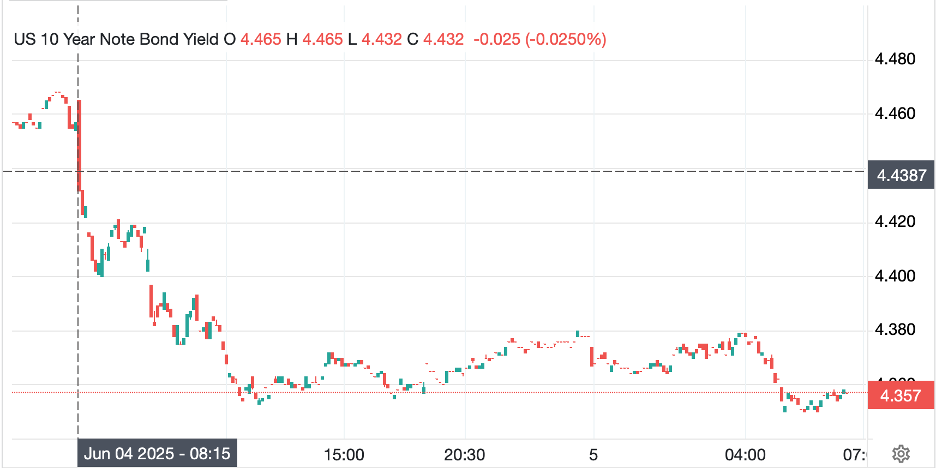
In the end, although this data was unquestionably disappointing, it feels a bit too early, at least to me, to declare the recession has arrived.  But not too early for the bond market where 10-year yields tumbled 11bps on the day and almost all the damage was done in the first hour after the ADP release although the ISM helped things along as well.

Source: tradingeconomics.com

Perhaps we are going into a recession, or even already in one, but overall, the data so far are just showing the beginnings of that.  I imagine opinions will be strengthened one way or another tomorrow when the NFP report is released, but for now, the recessionistas appear to have the upper hand, at least in the bond market.

The other story that is getting a response, at least amongst the Twitterati (X-eratti?) is the WSJ article about how the BLS, due to President Trump’s hiring freeze, is suddenly calling into question the accuracy of their statistical releases, notably the CPI report due next week.  I will let my friend, The Inflation Guy™, Mike Ashton, explain why this is a nothing burger. [emphasis added]

WSJ story about how staff shortages at BLS are affecting how many estimates the staff has to make instead of collecting actual data. It is very hard to make these errors accumulate to as much as 1-2bps on the monthly number.

UNLESS: there is bias in the estimating, or there are very large categories affected, or there are HUGE errors in some categories. Lots of random errors increases the overall error but is unlikely to affect the mean. And be honest. Do you have any idea what the MSE (mean standard error) of the CPI is?

People really should care about the error bars but even most economists almost never do. Unless it’s an opportunity to complain about budget cuts to economists, which is what this is. Nothing to see here.”

Otherwise, folks, another day in paradise with nothing else new, at least on the market front.  At some point, domestic politics, or geopolitics or war or something else is going to catch the fancy of the algos and change trading, but right now, that does not appear to be the case.  Perhaps Friday’s NFP data will be the catalyst to start a serious change in attitudes but I’m not holding my breath.

In the meantime, let’s survey market activity.  Yesterday’s US session was quite dull with limited movement and low volumes. Asia saw a mixed picture with the Nikkei (-0.5%) slipping, ostensibly, on concerns that a weaker US would negatively impact their export sector, tariffs be damned.  Hong Kong (+1.1%) though, rallied on Chinese PMI data holding on to recent levels rather than slipping further.  The rest of the region was far more positive, led by Korea (+1.5%) although the gains were more on the order of +0.5%.  Europe is all green this morning, with the CAC (+0.5%) leading the way, although the DAX (+0.4%) and FTSE 100 (+0.3%) are also holding up well on the back of positive German Factory orders data and solid UK Retail Sales.  Meanwhile, at this hour (7:00), US futures are ever so slightly firmer, +0.15% or so.

In the bond market this morning, after the big rally yesterday discussed above, Treasury yields this morning have edged lower by 1bp and European sovereigns have seen yields slide by between -3bps and -5bps as inflation data on the continent continues to soften encouraging the belief that the ECB, later this morning, may even consider more than the 25bp cut that is priced in.

The one true consistency lately has been gold (+0.8%) which has no shortage of demand, especially in Asia, and certainly feels like it is going to test, and break, the previous high of $3500/oz, which is now just $100 away.  But this has encouraged silver (+4.0%), copper (+2.65%) and now even platinum (+3.8%) has been invited to the party.  Regardless of the macroeconomic statistics, the ongoing global monetary policy of fiat debasement seems set to continue which can only help these metals.  As to oil (+0.3%), it continues to sit near its recent highs with not much activity in either direction.  It feels like we will need a major event/pronouncement of some sort, whether wider war in the Middle East or a change in OPEC policy to move this thing.

Finally, the dollar can best be described, again, as mixed.  While the euro and pound are marginally higher, the yen is marginally weaker.  In the EMG bloc, both KRW (+0.4%) and ZAR (+0.5%) are showing gains this morning, but nothing else of note is moving.  And when looking at the broad DXY, unchanged is where it’s at.  As with most markets right now, metals excepted, doing nothing seems the best choice.

On the data front, this morning brings the weekly Initial (exp 235K) and Continuing (1910K) Claims as well as the Trade Balance (-$94.0B) which if correct will almost certainly bring on a lot of White House crowing but is likely inconsequential with respect to the overall scheme of things.  We also see Nonfarm Productivity (-0.7%) and Unit Labor Costs (+5.7%) a combination of expectations that does speak to stagflation.  The ECB meeting will get some eyeballs, but unless they cut 50bps, a very low probability event based on current market pricing, it is hard to see much impact there either.

We are in a rut for now.  Whatever the catalyst that is required to change views substantially, it is not obvious at this point.  Bigger picture, nothing indicates any government is going to slow their spending or their money printing.  There is too much debt to ever be repaid, so a slow inflationary debasement is very likely our future.  I still think the dollar slides further, but it could be a few months before the current range breaks.

Good luck

Adf

Waxes and Wanes

The story of note for today
Is how will the BLS play
Employment revisions
And then what decisions
Will Powell be likely to weigh?
 
For now, markets still seem assured
That rate cuts will soon be secured
The doves still want fifty
But most are more thrifty
With twenty-five likely endured
 
But what if Chair Powell decides
Inflation, just like ocean tides
Both waxes and wanes
And though they’ve made gains
No rate cuts, to Fed funds, provides


So, the big story today, which I briefly discussed on Monday, is that the BLS is going to make benchmark revisions to their NFP data for the year through March 2024.  These revisions come from a closer analysis of the Quarterly Census on Employment and Wages (QCEW) data, which is the most comprehensive data set on jobs available.  Remember, for their monthly reports, the BLS uses a model that incorporates samples of data from respondent companies, and then includes their own adjustments based on the birth-death model of new businesses and how many jobs they create.  But the QCEW data doesn’t model things, it counts all the data from states regarding unemployment insurance and reports required to be filed by companies regarding quarterly contributions.  It is the gold standard.

Naturally, when the QCEW is released (the most recent was released in June), the analyst community goes through everything and makes their own estimates as to the changes that will occur.  Prior to any revision, the BLS data show that the economy added 2.9 million jobs in the 12 months from April 2023 through March 2024.  But analyst estimates range from a reduction in that number ranging from 300K to as much as 1 million fewer jobs.  

Given the increased importance the Fed has placed on the employment side of their mandate lately, and given that one of the reasons, if not the key reason, Powell has been willing to leave rates at current high levels is the employment situation has remained robust, if he and his colleagues were to suddenly find out that there were one million less employed people around, that would likely have a serious impact on their views as to where rates should be.

Based on the stories that I have seen on this topic over the past several days, as well as the positioning that is being revealed by the Commitment of Traders’ reports showing massive long positions in both treasury bond futures and SOFR call options, both of which are real money expressions of expectations of lower interest rates coming soon, it strikes me that the pain trade is the opposite.  In other words, what if this revision is much smaller than the largest estimates, maybe 100K or something.  Suddenly, the idea that the Fed is going to be pressured into cutting rates despite the fact that inflation, though lower, remains well above their target, is not quite as certain.  

The thing is, based on what I keep reading and hearing, it strikes me that the market is set up for a bond sell-off and higher yields today.  Either, the number is large, about 1 million jobs removed, and then we will see profit taking on the outstanding positions, or the number is small, and the entire story needs to be rewritten regarding the timing of the first rate cut, which means that positions need to be abandoned.  I’m not sure what the goldilocks number needs to be to have traders maintain their positions ahead of Friday’s Powell speech, but given that is a wild card as well, I think that is the least likely outcome, no change in positions.

Elsewhere, the only other noteworthy thing was a story about a BOJ staff paper that discussed the idea that inflation in Japan is still structural and that higher rates are still appropriate, but that is a staff paper, and not necessarily Ueda-san’s view.  The BOJ next meets on September 20, two days after the FOMC, so Ueda-san will have lots more new information to decide just how hawkish he wants to be.  Recall, the dramatic market collapse in Japan at the beginning of the month, while completely reversed now, forced their hand to back off their hawkishness.  Perhaps, the second time, if they remain hawkish, they will be able to withstand that type of movement.

So, as we all await this BLS revision, which comes at 10:00 this morning, here is how things behaved overnight.  After the first down day in the US in 9 sessions, Japanese (-0.3%) and Chinese (-0.3%) markets were also soft although the rest of the region was mixed with some gainers (India, Indonesia, Australia) and some laggards (Hong Kong, Taiwan, New Zealand).  In Europe, though, equity markets are modestly firmer this morning, somewhere between 0.25 and 0.5%, although there has been a lack of new information seemingly to drive things.  As to the US, futures at this hour (7:30) are edging higher by about 0.1%.

In the bond market, Treasury yields have edged up 1bp this morning, although they have been trending down for the past week in anticipation of this BLS employment adjustment.  European sovereign yields are essentially unchanged this morning while JGB yields dipped 1bp.  The story there remains that 10-year JGBs are yielding well less than 1.00%, the perceived key level at which more Japanese funds flow home.  I think we will need to see a much more hawkish BOJ to get that trade going.

In the commodity markets, oil (0.0%) has stopped falling for the time being, but remains under pressure overall, down more than 6.6% in the past month.  Yesterday’s API data (the private sector version of the EIA data to be released later this morning) showed a small build of inventory as opposed to the continued draws that we have seen lately and that were expected.  However, a look at the oil chart tells me that we are much closer to the bottom of its trading range for the past 3 years, than the top, and seem likely to rebound a bit.  Gold (-0.15%) is consolidating its recent gains and remains above that big round $2500/oz level but both silver (+0.5%) and copper (+0.5%) are rallying today.  I keep reading stories about how the physical shortages in both those markets, due to increased production of solar panels and batteries, is going to become the key driver going forward.  While I have believed that story, it is always hard to ascribe a given day’s movement to something like that absent a major new piece of information, and I haven’t seen that piece of the puzzle.

Finally, the dollar is bouncing slightly this morning, although that is after a pretty straight-line decline for the past two months.  Given the hype about Fed rate cuts, especially adding in this new focus on the BLS job data adjustment, it is easy to see why traders are looking for much lower US rates and therefore selling the dollar.  But remember, in the big scheme of things, at least based on the Dollar Index, the dollar is pretty much at its long-run average, neither weak nor strong.  I will say that if the Fed does enter a serious rate cutting cycle, the dollar is likely to weaken quite a bit more, perhaps with the euro testing 1.15 – 1.20 before it ends.  However, remember, if the Fed starts cutting aggressively, so too will the ECB, BOE and BOC, so any weakness will be somewhat limited.  As to today’s price action, the dollar’s strength is universal, but pretty modest overall with the biggest mover JPY (-0.5%) although obviously there are other things ongoing there.  

Aside from that employment report revision, there is no other data to be released and there are no Fed speakers scheduled today.  Today will be driven by that revision.  The larger the revision, the more likely we see the dollar decline, although the initial reaction on interest rates may be opposite on profit taking.

Good luck

Adf