Turns to Sh*t

The FOMC’s out in force
Explaining the still likely course
Of rates is to stay
Where they are today
Unless there’s some hidden dark horse
 
Investors, though, don’t give a whit
As Spooz seem quite likely to hit
Five thousand quite soon
Then onto the moon
Take care lest this view turns to sh*t


The WSJ led with an interesting article today with the below graphic as the teaser.  This is called a hair chart, for obvious reasons, with those light blue lines describing Fed funds futures curves and comparing them to the subsequent actual Fed funds rate over time.  The article’s point, which is important to understand, is that the futures market tends not to get things right very often.  In other words, just because the market is pricing in 5 or 6 rate cuts today does not mean that is what will occur over time.  In fact, looking at the chart, it almost seems that 5 or 6 cuts is the least likely outcome.  One need only look at the past several years to see that while they were pricing cuts, the Fed was still hiking.

Of course, this fits with my thesis that the Fed funds futures market is actually reflecting a bimodal outcome of either zero cuts or 10.  But regardless of my view, the equity market is all-in on the idea that the Fed is going to be cutting rates soon as evidenced by the fact that the S&P 500 is now trading just a hair below 5000 after yesterday’s 0.8% gain.  

In the meantime, yesterday we heard from four more Fed speakers and to a wo(man) they all said effectively the same thing; progress has been made on the inflation front but they still don’t have confidence that 2% inflation on a sustainable basis has been achieved.  In fact, several mentioned that the recent hot GDP and NFP data indicated more caution is warranted.  By the way, if we look at the Atlanta Fed’s GDPNow forecast, it currently sits at 3.4%, hardly a level of concern, while their Wage Growth Tracker remains at 5.0%.  Again, that is not data that indicates inflation is collapsing.  It remains very difficult for me to expect inflation to fall given the recent totality of the data.  In other words, nothing has changed my view that inflation will remain stickier than currently priced and very likely start to creep higher again, and that will ultimately have a negative impact on risk assets.  But not today!

The other news overnight was that Chinese CPI rose less than expected in January, just 0.3%, which took the annual change to -0.8%.  As China heads into their two-week Lunar New Year holiday, welcoming the Year of the Dragon, the question for investors around the world is, will Xi do anything to halt the decline?  Thus far, his efforts have been weak and insufficient as evidenced by the equity markets in Hong Kong and on the mainland both having fallen sharply over the past year with little net movement this year despite several efforts at support and stimulus.  Now, Xi has nearly two weeks to come up with a new plan to get things going when markets return on February 20th, but for the past several years he has been unwilling to fire a big fiscal bazooka.  Will it be different this time?  Remember, they still have a catastrophic mess in the property market there which will impinge on anything they do.  I expect there will be some more half-hearted measures, but nothing sufficient to turn things around.  Ultimately, while they don’t want to see the renminbi fall sharply, I suspect it may have a bit more weakness in it before things are done, especially if the Fed really does stay higher for longer.

Ok, let’s look at markets elsewhere overnight.  The Nikkei (+2.0%) rallied sharply after comments by a BOJ member indicating that even when rates get back above zero, they will not move very much higher, and it will take time.  This saw the yen weaken further while stocks benefitted.  Meanwhile, the only loser in Asia overnight was India, where investors were disappointed that the RBI left rates on hold rather than cutting them (see a pattern here?).  Otherwise, everything followed the US rally yesterday.  The same is broadly true in Europe with decent gains, about 0.5%, almost everywhere except the UK, which is flat on the day after comments by a BOE official that cuts may not come as soon as hoped.  As to the US, at this hour (7:30) futures are basically unchanged.

In the bond market, after a generally quiet session yesterday, yields are starting to creep higher again with Treasuries +2bps and European sovereign yields rising a similar amount across the board.  Once again, the global bond markets revolve around Treasury yields with the only exception being JGB’s which saw the yield decline 1bp after those BOJ comments.

In the commodity markets, oil (+0.9%) is higher once again with Brent trading back above $80/bbl, as Secretary of State Blinken returned to the US with no real improvement in the Israeli-Hamas war and no prospects for a cease-fire.  Meanwhile, the US was able to kill the Iranian commander who allegedly led the attack on a US base that killed three soldiers, certainly not the type of thing to cool down tensions in the region.  Between the rise in cost of shipping oil from the Mideast to the rest of the world because of the Red Sea situation, and the lack of hope for an end to the fighting, it seems oil may have some legs here.  As to the metals markets, there is a split with both gold and copper under some pressure but aluminum seeing a bid this morning.  Quite frankly, I understand the former two rather than the gains in aluminum, but in the end, none of these metals has moved very much over the past months and remain trendless for now.

Finally, the dollar is starting to assert itself this morning as though the yen (-0.75%) is leading the way lower, pretty much every G10 and EMG currency is weaker vs. the greenback at this time.  Again, I would contend this is all about the ongoing Fed message of caution and confidence regarding inflation’s disposition, and the prospects of higher for longer.  FWIW, the current probability of a March cut is 18.5%.  barring a collapse in the CPI data next week, I expect that to head toward zero over time.

As to the data situation, we only see the weekly Initial (exp 220K) and Continuing (1878K) Claims data first thing and then it is Fedspeak for the rest of the day.  I expect that traders are going to push the S&P 500 over 5000 early this morning, if for no other reason than to say it was done, but what happens after is far less certain.  Earnings data has been generally ok, but some pretty bad misses have had quite negative impacts on individual names.  As to the dollar, the more I hear Fed speakers urge caution in the idea for rate cuts soon, the better its prospects.

Good luck

Adf

Ain’t Hunky-Dory

For President Xi it appears
The stock market’s shed enough tears
So, he’s set to meet
The finance elite
And likely to box all their ears

As such, I expect we shall see
The Hang Seng will start on a spree
With New Year’s approaching
A little more coaching
By Xi, for a rally, is key

The big news overnight was that Chinese equity markets rebounded sharply (Hang Seng +4.0%, CSI 300 +3.5% CSI 1000 +7.0%) after the news that President Xi Jinping would be meeting with market regulators to find out what is going on there.  Banning short sales has not yet been effective nor has increased purchases by specific state funds.  According to Morgan Stanley, foreign investors sold $2.4 billion in Chinese equities in January, arguably a key driver of the market’s recent weakness there.  But the fact that Xi is getting involved directly has traders believing that more support from the government is on its way, hence today’s big rally.

While that is all fine and well for equity investors, the far more important question for the rest of us is will this stock market support help the Chinese economy as well?  Or will that continue to meander along at a weak growth pace?  Of course, it is far too early to know the answer to this question but given that the preponderance of Chinese individual wealth is tied up in real estate, not equities, I expect that this will have far less impact on the economy there than is hoped by both Xi and the traders.  After all, one of the key reasons so many in the US care about the stock market is that so much of our 401K investments are in equities, a rally shows up in our accounts daily.  But in China, that same situation does not hold.  Will a rally in stocks, if it even comes, be enough to sway the average person’s thinking there that things are getting better?  I have my doubts.

A turn to the interest rate story
Shows things there just ain’t hunky-dory
Yields just won’t stop rising
And that’s neutralizing
The thought rate cuts are mandatory

Friday morning, 10-year Treasury yields traded as low as 3.82% prior to the release of the NFP report.  This morning, they are trading at 4.16%, 34 basis points higher and the largest two-day yield rally since the covid volatility in March 2020.  Prior to that, it was 1981 when yields moved that far that fast.  Adding to Friday’s NFP story, yesterday’s ISM Services report was not only stronger than expected at 53.4, but the Prices index jumped to 64.0, its highest in a year and hardly a comforting thought for Chairman Powell and his fight against inflation.

At this point, the Fed funds futures market has lowered the March rate cut probability to 16.5%, and some of the punditry, although not yet any Fed speakers, have raised the question if another hike might be in order if things continue on their recent trajectory.  I assure you that the equity market has not priced in the possibility of a rate hike anywhere in the next 2 years at least.  Let’s just say that next week’s CPI report is going to be quite closely watched by everyone as if what I have seen as recent stickiness continues to exert itself, and with the economy seeming to be ticking over quite nicely, then the narrative could well change.  It is not impossible for the Fedspeak to turn even more hawkish if we were to see CPI rise 0.4%, a rate that is far too high for Fed comfort.  And that, my friends, would likely not be well-received by the equity market or risk assets overall.  While I have no special insight into how this data is going to evolve, I think the reaction function is clear.

Ok, let’s look at the overnight session beyond Chinese stocks.  In what cannot be that surprising after US equities struggled and given its recent negative correlation to Chinese stocks, the Nikkei fell -0.5% while the rest of Asia was mixed with some gainers (India, Taiwan) and some laggards (Korea, Australia).  However, the story in Europe is a little brighter with gains most everywhere except Germany, which is flat on the day after mixed data, with a blowout Factory Orders result of +8.9%, but the Construction PMI falling to 36.3.  Contradictory data leading to no movement.  As to US futures, at this hour (7:45) they are essentially unchanged on the day.

In the bond market, it seems traders are sitting on the sidelines after the bloodbath described above as 10-year Treasury yields are unchanged on the day and in Europe, the sovereign bonds are higher by a mere 1bp-2bps across the board.  We saw a similar lack of movement in Asia as well, despite the fact that the RBA, at their meeting last night, sounded somewhat hawkish although left policy rates on hold as universally expected.  As the treasury market is clearly leading the way globally, we will need to get some new information here, I think, before we see any substantive movement again.  Since the next big piece of data is CPI in one week’s time, it could be a quiet week for bonds.

In the commodity market, oil (+0.6%) is bouncing slightly this morning although it remains far lower than levels seen last week.  Gold (+0.1%) is also edging higher along with the industrial metals although there has been no strong catalyst here today given the lack of substantive rate movement.  Perhaps there is some optimism from the Chinese stimulus story, but that feels quite premature.

Finally, the dollar is a touch softer this morning, although only just.  While the euro has been unable to bounce, we have seen some modest gains in the pound (+0.25%) and Aussie dollar (+0.25%) as well as the renminbi (+0.3%).  In addition, the LATAM bloc is very modestly firmer this morning but generally, most of the movement is of that 0.25% magnitude or less.  This feels very much like a trading response to a powerful rally over the past two days.

There is no hard data to be released today but we do hear from three more Fed speakers, Kashkari, Collins and Mester, all this afternoon.  Yesterday, Chicago Fed president Goolsbee strayed from the Powell message, indicating he still believed a cut in March was possible, but he is not a voter this year and nobody really paid any attention.  After yesterday’s data, it would be hard to believe that any of these three would sound dovish, but you never know.

Overall, when looking at the dollar, as long as the inflation story has reawakened and is driving yields in the US, it is hard to see coming weakness.  This is especially true given the economic weakness we continue to see elsewhere in the world.  Today feels like a reaction, not a trend in the making, and I expect that the dollar has better days ahead for as long as inflation is once again the driving force.

Good luck
Adf

Nary a Doubt

The two things we’re watching today
Are Jay and the new QRA
The pundits are out
With nary a doubt
That easing is coming our way

But what if this faith is misplaced
And Jay, at the presser, bald-faced
Says policy ease
Is not what we please
And we’ll not get there in great haste

Reading the Fed Whisperer, Nick Timiraos of the WSJ, this morning was enlightening only to the extent that everybody he interviewed demonstrated they have no idea what will happen, and merely described what they would like to see.  Now, in fairness, I don’t think Powell himself really knows how things are going to play out as we continue to see mixed pictures on the economy.  For every strong datapoint (e.g., GDP, JOLTS, Case Shiller) indicating that there are many potential inflationary pressures extant, we see some softer data points (e.g., PCE, Empire Manufacturing, Dallas Fed) that indicate policy is excessively restrictive.  While it is very clear that the Fed will not adjust policy today, a look at Fed funds futures shows that the market is pricing in a 45% chance of a cut in March.  A month ago, that was over 70%, so Powell must be a bit happier, but 6 weeks is such a long time in this context, anything can happen between now and then.  And, oh yeah, the market is still pricing in 6 cuts this year.

Of course, long before the FOMC statement and Powell presser this afternoon, the Treasury will release its QRA and the market will learn if Secretary Yellen is going to continue down her recent path of leaning toward more T-bills and less coupons.  Based on her continuous comments that the soft landing has been achieved and inflation is no longer a problem, it seems quite clear that she wants to see the Fed cut rates soon.  After all, lower interest rates take pressure off the budget deficit, which is entirely her baby at this point.  Interestingly, she could essentially force Powell’s hand in this situation as follows:

1.     Issuing a high percentage of T-bills will lead to
2.     Reducing the RRP balances and bank reserves which will
3.     Force the Fed to respond by slowing/ending QT to prevent any systemic problems like seen in September 2019

Remember, we have already heard from Powell, as well as Dallas Fed President Lorie Logan, whose previous role was at the NY Fed overseeing the Fed’s reserve portfolio, that the time to discuss slowing or ending QT was fast arriving.  By itself, that is a policy ease, but it would also be a signal that further changes were on their way.  In fact, a continued heavy reliance on T-bill issuance would have two vectors to support the bond market; ending QT reduces the amount of bonds the market needs to absorb and reducing new supply by itself will do exactly the same thing.  At least for as long as inflation remains quiescent.  And in the end, that remains the biggest unknown, inflation.  All these plans and ideas revolve around the premise that the Fed has won its inflation fight.  But I ask you, what if they haven’t?

Too much digital ink has been spilled already on the inflation question and the two camps remain at distinct odds.  Forgetting all the conspiracy theorists who claim inflation is really 10% or more, and looking only at serious economists and analysts, while all agree that the rate of inflation has fallen from its peak levels in the summer of 2022, there is still a pretty even split between the two sides.  While I fall on the side of stickier inflation than the market is pricing, I can understand the other side of the story.  But the point is, there are two very real sides to the story and the outcome remains unwritten.  However, if inflation does remain stickier than the doves believe, it will destroy their entire thesis of why the Fed should be easing policy.  Given the stock market is making new highs regularly, I suspect investors and traders have largely bought into the ‘inflation is over’ view.  Just be careful if it’s not.

Ok, as we await today’s activities, let’s look at what happened overnight.  Following a mixed session in the US yesterday, Asian markets turned back the clock a few weeks with the Nikkei (+0.6%) continuing its longer-term rally while both the Hang Seng (-1.4%) and CSI 300 (-0.9%) revert to their losing ways.  It seems that investors simply do not believe that President Xi has either the ability or willingness to do anything to support the stock market there, at least, if not the economy.  I believe it would be a mistake to believe he is not willing, which calls into question exactly what they are going to do to prevent things from starting to impact the economy more negatively.  And perhaps we have seen the first steps.  The other noteworthy story in the WSJ this morning was about how Chinese authorities are “discouraging” negative takes on the economy from being published and instead telling news outlets to publish stories about the bright prospects there.

Moving on to Europe, the main indices have moved very little thus far today after a mixture of data showing inflation in Germany and France continue to decline but Retail Sales in Germany (-1.6%) and Switzerland (-0.8%) and Industrial Sales in Italy (-1.0%) all falling sharply in December.  Given the weak GDP data yesterday on the continent, none of this can be surprising.  Finally, US futures are mostly lower this morning, led by the NASDAQ (-1.0%) despite (because of?) what seemed to be solid earnings from Microsoft and Alphabet.  In the end, though, I sense that investors are far more focused on the QRA and FOMC right now.

Treasury yields are unchanged this morning but that is after a 4bp decline yesterday and we have seen European sovereign yields slide this morning as well, between 1bp and 3bps, which seems to be a catch up move to the Treasuries.  I must mention Australian government bonds, which saw yields tumble 13bps overnight on the back of a much softer than expected CPI reading which has the market talking rate cuts there again.  Finally, JGB yields edged 2bps higher, despite weaker than expected Retail Sales and IP data.

Oil prices (-1.1%) are backing off this morning after another positive day yesterday and a very strong month of January, where WTI rose > 9%.  (My take is that will not help the CPI data when it comes out in a few weeks’ time.)  Meanwhile, metals prices are trading near unchanged on the day as traders here are also awaiting the new information.

It should be no surprise that the dollar is, net, little changed this morning on the same premise of waiting for Godot Powell.  Looking at my screen, I don’t see any currency that has moved more than 0.3% in either direction so really no information yet today.

In addition to the QRA and FOMC meeting, we see the ADP Employment Report (exp 145K), the Employment cost Index (1.0%) and Chicago PMI (48.0).  Careful attention should be paid to the ECI as the Fed focuses on that metric for wage inflation data.  As an indication, prior to the pandemic, that index averaged around 0.6%, but since then, it is more like 1.0% on a quarterly basis.  That annualizes to more than 4% and will maintain upward pressure on inflation if it stays there.  Just something else to keep in mind.

If pressed, I believe that the QRA will show reduced coupon issuance and Powell will be more dovish than not.  While we know the Treasury is political, by definition, and will do everything in its power to stay in power and get re-elected, my take is the Fed is in that camp as well.  I would not be surprised to see a more dovish take this afternoon after the QRA this morning.  And initially, at least, that tells me the dollar will trade back toward its recent lows ceteris paribus.

Good luck
Adf

There’ll Be No Crash

Said Janet, I know we’ve been spending
Too much, but you’re not comprehending
I’ve plenty of cash
So, there’ll be no crash
Instead, stocks will keep on ascending

Til Wednesday, we’ll keep the suspense
But really, it’s just common sense
Chair Powell and I
Will help the Big Guy
And policy ease will commence

Well, the first shoe dropped yesterday afternoon as the Treasury explained that they would “only” be borrowing $760 billion in Q1, a solid $56 billion less than had been expected by the market as of yesterday morning.  With that significant reduction in potential Treasury issuance, the bulls went nuts and both stocks (+0.75%) and bonds (-7bps) rallied.  A cynic might believe that Secretary Yellen was trying to manipulate the stock market higher, but we all know that could never be the case.  At any rate, this sets us up for Wednesday when first thing in the morning we will see the Quarterly Refunding Announcement (QRA), where Yellen will describe the ratio of short-dated T-bills to long-dated coupon issuance, and then at 2:00, the FOMC Statement will be released with Chairman Powell speaking at the press conference 30 minutes later.

Given the excitement over yesterday’s events, I suspect that at least one of the two events tomorrow will be dovish rates/bullish equities but have no idea which way it will play out.  In the end, though, it doesn’t really matter.  Ultimately what we have learned is that Yellen is running the show, and all Powell can do is respond.  The one thing I have to wonder is, what if the government spends more than the $760 billion in Q1?  Where will that money come from, and what will the impact be on the markets?  (Obviously, they will simply borrow more, but it will not be an issue as there is no limit these days, nor for an entire year going forward.)  However, for now, that is just a concern for grumpy old men like me.

In China, though they have announced
More stimulus and stocks first bounced
It seems traders feel
Xi ain’t got that zeal
So, sellers once more have all pounced

You may recall last week when the Chinese stock market rallied sharply after a series of announcements regarding government support.  First there was the story of CNY 2 trillion of cash that would be coming home and invested in equities and then the PBOC cut the RRR by 50 basis points, freeing up another CNY 1 trillion.  These moves were supposed to demonstrate that Xi was going to fix things.  And he did…for a week.  But now, equity markets in both Hong Kong (-2.7%) and on the mainland (-1.8%) are falling again as it seems market participants have come to believe that there are too many problems for a mere CNY 3 trillion to fix.  And they could well be correct.

After all, China has been inflating their economy for decades and the property bubble they have blown is not nearly popped yet.  While this could be a modest correction in the beginning of a trend higher, I have a feeling that the fundamentals have a long way to go before they make sense for international investors.  With the European economy having stagnated for the past 5 quarters and the US moving an increasing amount of business to Mexico from China, it will be tough sledding in China, I fear.  Ultimately, I continue to believe the renminbi will suffer as it will be the most likely outlet valve.  But for now, I guess they can stand the pain.

And those are today’s stories as the market braces itself for tomorrow’s QRA and FOMC, Thursday’s BOE and Friday’s NFP data.  In the meantime, let’s recap the rest of the overnight action.

Despite the robust performance in the US yesterday, only Japan and Australia managed to show any signs of life in Asia overnight as China dragged down all the other regional markets.  This cannot be too surprising given the importance of the Chinese economy there, and if it is lagging other nations are going to struggle as well.  Europe, however, is having a much better go of it, with gains across the board, led by Spain’s IBEX (+1.25%) after both real and nominal GDP rose more than expected with inflation ticking higher alongside economic activity.  That may not bode well for the inflation story in Europe, but for now, everyone’s happy and the ECB comments have all pointed to rate cuts by the middle of the year.  As to US futures, at this hour (7:45) they are just barely on the red side of unchanged, with no market even -0.1%.

You will not be surprised that European yields slipped yesterday after the US bond rally as the combination of a prospect of lower yields in the US alongside the slightly more dovish talk from the ECB speakers was plenty of catalyst for a bond rally there.  While yields have edged back higher by 2bps or 3 bps this morning, they remain below yesterday morning’s levels.  In the US, Treasury yields have continued their decline, down another 1bp overnight while JGB yields have edged down another 1bp as well.  One other market to note, China, saw yields slip 3bps overnight and they are now at their lowest level since the early 2000’s as the market anticipated further policy ease from the government and PBOC.

Oil prices (-0.65%) are off a bit this morning as they continue to consolidate last week’s gains.  Clearly there is still concern regarding the US response to the attacks on its base in Jordan over the weekend as the intensity of that response is still completely unknown.  Weakness in China is not helping the oil market and European GDP data has also worked against the demand story, so uncertainty remains the watchword.  As to gold, it is continuing to creep higher but remains in its recent 2020/2060 trading range.  Lastly, the base metals are a touch softer this morning, but only a touch.

Finally, the dollar is a bit softer this morning after a benign day yesterday.  In a way, this is surprising as I would have expected the greenback to slide alongside Treasury yields, but I guess given the broader dovishness from ECB and other central bankers, on a relative basis not much changed.  As well, traders are reluctant to take large positions ahead of tomorrow’s big QRA and FOMC announcements.  As such, I suspect that we are going to see a very quiet session here across the board, just like we had overnight.

On the data front, while not as exciting as tomorrow, we do see Case Shiller Home Prices (exp 5.8%), JOLTS Job Openings (8.75M) and Consumer Confidence (115.0) this morning.  I keep listening to all the people who are telling me that falling housing prices are going to drive inflation lower, and the only reason the CPI and PCE calculations aren’t already lower is because they both have them at a lag.  Then I look at Case Shiller and say, what falling housing prices?  Anecdotally, in my neighborhood, we continue to see bidding wars and homes selling above asking.  If rates are really going to come down further, I suspect that will only drive that process even further.  The deflation story just makes no sense to me.  But anyway, probably not much today and all eyes are on tomorrow.

Good luck
Adf

Seems Like a Crisis

The Chinese have not finished yet
Their efforts to counter the threat
Of weaker stock prices
Which seems like a crisis
So new triple R rates were set

But one thing I don’t understand
Is while CCP’s in command
Just why do they care
‘Bout stocks anywhere
Perhaps communism ain’t grand

Yesterday, the Chinese government announced that there would be up to CNY 2 trillion of support for Chinese equity markets in their latest effort to stanch the 3-year bear market.  But apparently, that was not enough as last night Pan Gongsheng, the PBOC governor, announced they were reducing the Reserve Requirement Ratio (RRR or triple R) in order to free up additional loan capacity for the banks.  The move, a 0.50% cut in the ratio will ostensibly release another CNY 1 trillion into the economy.

There are two issues I’d like to address here.  First, given the property market in China remains under significant pressure as activity still seems to be lethargic, at best, and the economy overall is not really expanding at a significant pace, why do they think that allowing more loans will encourage people to take more loans.  After all, last week, they left the Loan Prime Rates unchanged, so were not trying to encourage more activity, and it is not clear that loan capacity has been a constraint in any manner during the past several years.  As global growth remains slow overall, it is entirely possible, if not likely, that there is just reduced demand for Chinese manufactures around the world right now.

The second issue is a bigger picture question, why does the Chinese Communist Party care at all about the stock market?  After all, a reading of Das Kapital would explain that there is no place for private ownership at all in a communist system and by extension, no place for shareholders.  The state is supposed to own everything.  My conclusion is that Xi, and the entire CCP, are full of s*it regarding their belief in communism.  In fact, I would contend that is true for every communist regime on the planet.  Rather, those in charge in communist regimes merely see it as the most effective way to command all the power and wealth personally and could care less about the concepts Marx espoused.  In the end, I would argue that the human condition is one where acquiring as much power and wealth as possible is the driving goal for most people.  While many people have much smaller ambitions, the sociopaths who rise to leadership roles in politics know no bounds as to what they believe is their due.  Just sayin!

Regardless of the underlying rationale, though, the PBOC had the desired impact as both the Hang Seng (+3.6%) and the CSI 300 (+1.4%) rallied sharply on the news.  As well, the Nikkei (-0.8%) slid a bit further as it seems there had been a growing position by CTAs and hedge funds in the long Japan/short China trade which I illustrated yesterday.  If China is rebounding, I expect that Japanese shares will have further to slide in the near-term.  As well, after another day with some record high closings in the US yesterday, European bourses are all in the green nicely this morning with the DAX (+1.3%) leading the way although the other main indices are also higher by about 1%.  The laggard here is the UK (+0.4%) and I attribute this movement to the Flash PMI data which was released this morning showing that continental growth continues to slide, hence increasing the chance of a rate cut sooner, while UK data was a bit better than expected, and well above 50 across the board, implying the BOE will lag any rate cuts going forward.  And happily, as I type at 8:00, US futures are all nicely in the green as well.

In the bond market, Treasury yields are a touch softer this morning, down 2bps, but still hanging right around the 4.10% level which has been a pivot for the past week.  European sovereigns have seen yields decline about 3bps across the board after that soft PMI data, while UK Gilts have moved the other direction on the stronger data there.  Of more interest, I think, is that JGB yields have jumped 5bps overnight and are now back above 0.70%.  It seems that there is an evolution in thinking regarding Ueda-san’s comments after the BOJ meeting Monday night, and the belief that they will be exiting NIRP in April is growing stronger.  We shall see.

Commodity prices are higher across the board this morning with oil (+0.3%) continuing to find support, arguably from the troubles in the Middle East, although some short-term issues like the shuttering of a Russian export terminal after a Ukrainian attack have also had an impact.  But metals markets are universally higher this morning as well, with gold (+0.25%) far less impressive than copper (+2.0%) or aluminum (+0.9%) as positivity from the Chinese RRR cut and the potential for stronger growth on the mainland feed through the markets.

Finally, the dollar is under pressure this morning across the board.  This is true in the G10 bloc with the euro and pound both firmer by 0.5%, while the yen (+0.8%) and CHF (+0.8%) are having even better days.  Similarly, the EMG bloc has seen gains across the board with the leader ZAR (+1.1%) on the back of those metals gains, but strength in PLN (+0.8%), CZK (+0.7%) and HUF (+0.65%) showing their high beta with respect to the euro, and gains in APAC currencies (KRW +0.4%, SGD +0.3%, CNY +0.3%) and LATAM currencies (MXN +0.6%, BRL +0.8%) as it is unanimous regarding the dollar’s weakness.

On the data front, today brings only the Flash PMI data (exp 47.9 manufacturing, 51.0 services) and the EIA oil inventories.  There are no Fed speakers due to the quiet period, so I foresee market activity focused on equity earnings releases although none of the big names are due today.  Right now, the dollar is under pressure amid ongoing belief that the Fed is going to cut ahead of other central banks.  Until that story changes, I expect that we could see a bit more dollar weakness.  But in the end, tomorrow’s GDP and Friday’s PCE data are going to really drive views.  Look for a quiet one today.

Good luck
Adf

Others to Blame

Apparently, President Xi
Is not very happy to see
That stocks made in China
Have lost all their shine-a
So, feels he must buy by decree
 
The upshot is two trillion yuan
Is what he will spend, whereupon
He’ll then get to claim
Twas others to blame
Though it’s his ideas that keep on
 
Last night the BOJ meeting was the non-event that was widely expected.  There was no change in policy and when looking at their forecasts, if anything they lowered their inflation views a touch for next year, thus reducing the chance of a policy change even more.  The follow-on commentary was not very inciteful either, explaining that they are prepared to take additional easing measures if necessary but uncertainties on the price outlook are high.  In other words, we still don’t know how to achieve our goal of sustainable 2% inflation so we’re going to watch a bit longer.
 
The punditry has decided that Ueda-san is going to adjust policy at the April meeting after the spring wage negotiations have been completed, but personally, i don’t believe he feels a compelling need to do anything absent a major decline in the yen from current levels.  After all, the economy is still ticking over nicely and the stock market has been rallying consistently for a year and is back at 34-year highs, approaching the 1989 bubble peak.  However, if USD/JPY were to trade back above 150 again and start to move more quickly, I suspect that might be the catalyst the BOJ and Ueda-san need to change their tune.
 
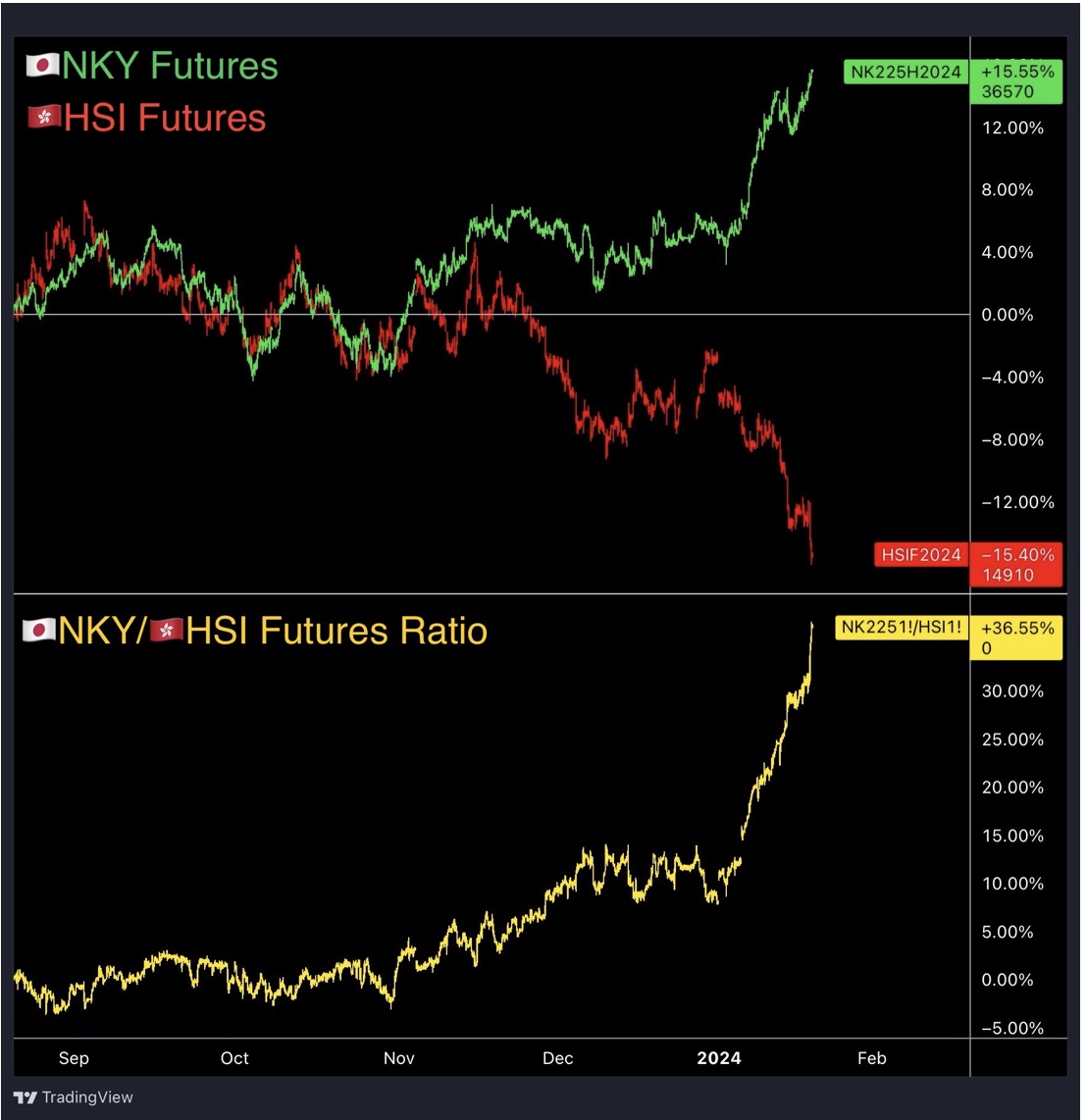
Arguably, of far more interest last night was the news that China is now considering a support package for the stock market there!  (For a communist country, it is quite ironic how much Xi Jinping cares about the most capitalistic institution there is, the stock market.)  The headline number is CNY 2 trillion (~$278 billion) which will be sourced from Chinese state-owned companies (SOEs) overseas and ostensibly will flow into the offshore market for Chinese shares as well as the Hang Seng in Hong Kong.  The below chart, courtesy of Weston Nakamura’s excellent substack is quite explanatory as to why Xi may be feeling some pressure.


The dramatic widening of the spread between Hong Kong and Japanese shares has been remarkable in the first three weeks of 2024, a substantial acceleration of what we have seen since November of last year.  My sense is Xi is taking it personally that the world is dismissing China as a serious global player as evidenced by the fact that nobody wants to invest there at all.  Obviously, there are sanction and tariff issues as well as a comprehensive effort by many western companies to reduce their reliance on China as part of their individual supply chains, but I guess this has become too much to bear for President Xi. 

While this mooted number is twice as large as the previous discussions, it remains to be seen if it will be effective beyond the knee-jerk response by the Hang Seng today (+2.6%).  After all, the Chinese property market is still a disaster, and all the other problems remain intact.  Chinese share prices have been falling for 3 years now, and my sense is it will take real policy changes rather than a buying spree by SOEs to change any views.  Perhaps communist-based stock markets are an oxymoron after all.

Away from those two stories though, not very much is ongoing.  Mainland Chinese shares also rose, but far less, just 0.4%, while Japanese shares were essentially unchanged on the day after the BOJ’s meeting.  In Europe, equity markets are a touch softer, although only about -0.2% or so across the board and after yet another positive day in the US yesterday, US futures are pointing slightly higher at this hour (7:45), about 0.2%.

In the bond market, yesterday’s price action is being reversed with yields across the US (+2bps) and Europe (+2bps across virtually all nations) backing up a bit.  As there continues to be a lack of data on which to trade, this price action seems almost like a classic risk-on take, with equities higher, the dollar softer, and bonds falling in price as well.  However, given that the movement is just 2bps, I would not get excited about any new information here.

In the commodity markets, oil (-0.75%) is slipping a bit this morning, but has been performing pretty well over the past week on the back of the ongoing tensions in the Middle East.  However, we are seeing positive price action in the metals space this morning with gold (+0.2%) and copper (+0.5%) both pushing a bit higher.

Finally, the dollar is mixed this morning, with no consistency across either the G10 or EMG blocs.  CNY (+0.3%) has rallied on the strength of the financing package while ZAR (+0.8%) is benefitting from the metals complex rally, as is CLP (+0.35%) and AUD (+0.25%).  However, the euro (-0.2%) is sliding along with several EMG currencies, notably PLN (-0.75%) and MXN (-0.5%), as idiosyncratic stories drive markets this morning rather than a broad dollar narrative.

The only marginal piece of data this morning is the Richmond Fed Manufacturing Index (exp -11), yet another manufacturing index that has been performing quite poorly.  Interestingly, there was a Twitter (X?) thread this morning from Anna Wong (@annaeconomist), a senior economist at Bloomberg, describing some potential reasons as to why the Initial Claims data, which has been running far lower than the recessionistas expect due to eligibility issues and the fact that UI pays so little, people would rather driver for Uber than collect.  This is another indirect sign that the economy is not nearly as positive as many, especially the soft-landing proponents and equity bulls, would have you believe.  Food for thought.

As to the rest of the day, given the lack of other data as well as the anticipation of the Thursday and Friday info on GDP and PCE, I anticipate a quiet session overall.  Momentum remains higher in stocks, but bonds are uncertain, and the dollar is mixed.  Don’t look for too much movement in either direction here today.

Good luck

Adf

Quite Restrictive

The Fed keeps on spinning the tale
They’re watching like hawks so that they’ll
Be able to jump
In case Donald Trump
Does not look like going to jail
Be able to act
And not be attacked
If ‘flation forecasts start to fail
 
Twas Bostic’s turn yesterday to
Explain that the policy skew
Is still quite restrictive
Though that’s not predictive
Of what they may finally do
 
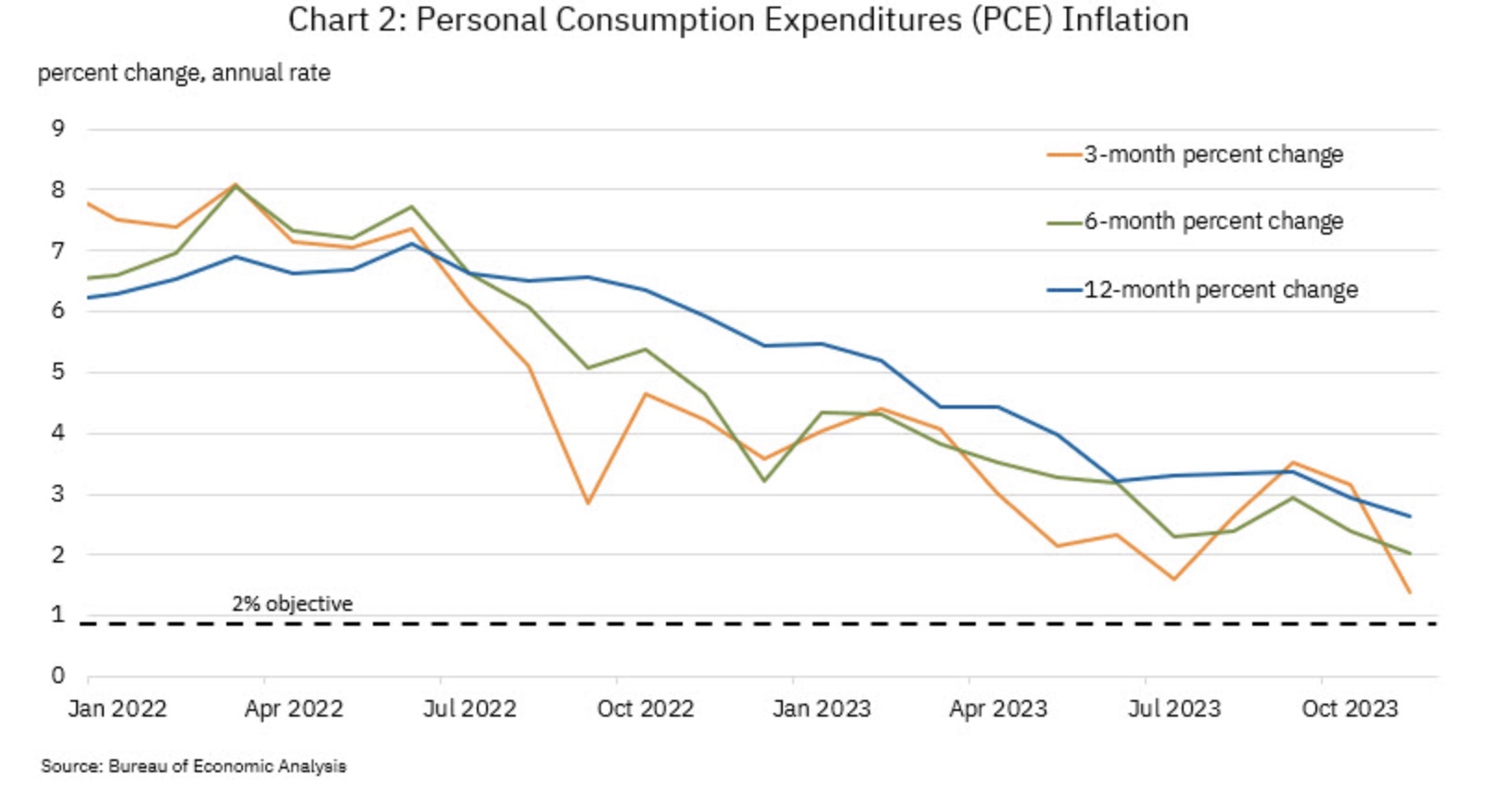
Atlanta Fed President Raphael Bostic was the latest FOMC member to regale us with his views on current policy settings amid two speeches yesterday.  The essence of his comments lines up with what we have heard for the past two weeks; policy is sufficiently restrictive to help drive inflation down to their 2% target, but they will be vigilant if that is not the outcome.  One of the things that he mentioned, and that has been a really popular chart crime over the past few months, at least for the doves, is he discussed annualizing the most recent three months of PCE data and the most recent 6 months of PCE data as proof that they are doing a good job.  In fact, in one of his two presentations, he used the following chart:

Unquestionably, if you look at the orange line, which represents the annualized value of the past 3 months, it shows that PCE is “now” running below their target.  But let me ask you a question, looking back to H1 of 2022, when inflation was peaking.  Both the 3-month and 6-month changes were well above the annual number at the time.  Do any of you remember the focus on those short-term nonsense numbers?  Me neither.  My point is the only number that matters is the actual annual one as that is their target.  Any indication that it is flattening or turning higher, just like the CPI data did earlier this month, is going to put paid to this story.  While I have no idea where next week’s data is going to print, we must be wary of the narrative spin on the actual data.  If we know one thing about the Fed, by definition, they are reactive.  That is what following the data means.  If they were predictive, they would move before the data, but they never do that. 
 
So, all this talk of cutting before inflation gets too low is not monetary policy.  However, we cannot rule out a cut based on the political implications as they view rate cuts as a way to boost the economy and try to ensure the current president is re-elected rather than the likely Republican candidate gets back in.  Alas, for now, we will have to live with the spin.  Today we hear from two more Fed speakers, SF’s Mary Daly and Governor Michael Barr.  I suspect we will hear exactly the same message from both.  Too early for cuts, but they are ready when the time comes.
 
Meanwhile, across the pond, the preponderance of ECB speakers has been very clear that March is off the table for a rate cut but June seems to be what they see as likely.  Here, too, they see the trend as their friend, but inflation readings are still nowhere near their 2.0% target.  However, it is clear that the pain of higher rates is having a much larger impact on Europe than on the US as GDP data continues to deteriorate.  Germany is in recession and much of the rest of the continent is on its way.  The benefit for Madame Lagarde is that the Europeans did not inject nearly as much stimulus during the Covid years as the US, so it is likely the Eurozone economy is following a better-known path.  In the end, though, they are very anxious for the Fed to get started as they really want to start cutting rates, I believe, but with inflation still far above target and the Fed still holding on, they would have no rational explanation for their actions.
 
One last thing to note is CPI in Japan was released last night and it fell to 2.6% headline and 2.3% core.  Any idea that the BOJ was going to need to tighten policy in the near-term to fight too high inflation has been dissipating quickly.  It turns out that they may have been correct to leave policy unchanged as now they do not need to do anything to be in the right spot.  The market response mostly made sense as the yen weakened with the dollar now above 148, while the Nikkei rose another 1.4% and is pushing those recent 30+ year highs.  The weird thing, though, was the JGB market which saw yields rally 4bps, back to their highest level in a month.  I have been unable to find any solid explanation for this move as certainly it is not fundamental.
 
Anyway, let’s look at the rest of the overnight session to see how things are feeling as we close the week.  After a solid US equity session yesterday, most of Asia had a good go of things with rallies pretty much everywhere except China and Hong Kong.  The equity markets in both those nations have been under significant pressure lately and show no signs of turning.  While the market is not the economy, President Xi has already called for the end of short sales and is now leaning on domestic institutions to not sell at all.  With the property market already in the tank, a rapidly declining stock market is not a good look for the concept of prosperity for all.  Europe, though, is modestly higher this morning and US futures are also in the green following yesterday’s session.
 
In the bond markets, Treasury yields are little changed on the day, but remain above the 4.10% level that some are calling a key technical spot.  European sovereigns, though, are all rallying more aggressively with yields falling between 3bps and 7bps despite what are continuous calls for the ECB to maintain tight policy for longer than the market is pricing.  Perhaps investors are feeling better about inflation prospects if the ECB holds the line.
 
After a rally yesterday, oil prices are essentially unchanged this morning.  The unrest in the Red Sea continues with the Houthis firing more missiles and fewer and fewer ships willing to transit the area while yesterday’s tit-for-tat Iran-Pakistan missile attacks are now merely history.  The fact that oil remains below $74/bbl implies it is not really pricing any possibility of a larger Middle East conflict.  That seems pretty hubristic to me as the probabilities seem to be far larger than zero.  As to the metals markets, both precious and base metals are firmer this morning in sync with softer yields and a softer dollar. 
 
Speaking of the dollar, while it is ever so slightly lower on a DXY basis this morning, it continues to hold the bulk of its gains for the past month.  Versus G10 currencies, the picture is mixed with GBP (-0.2%) underperforming after absolutely abysmal Retail Sales data was released this morning, but the rest of this bloc is higher by about 0.2% or so on average.  In the EMG space, the direction is broadly for currency strength, but the movement remains modest at best, on the order of 0.1%-0.3%.  In other words, not much is going on here.
 
On the data front, yesterday brought a mixed picture with Housing data slightly better than expectations, although starts fell compared to last month.  Initial Claims printed at 187K, their lowest in a very long time, but Philly Fed was at a worse than expected -10.6, not as bad as Empire State, but still not too bullish!  Today brings Michigan Sentiment (exp 70.0) and Existing Home Sales (3.82M) as well as the above-mentioned Fed speakers.  After today, the Fed is in their quiet period, so we will have to make up our own minds as to what the data means.
 
For now, the market seems quite comfortable buying dips and as evidenced by the Fed funds futures market, is still pricing a 55% chance of a March cut.  While that probability is shrinking slowly, there are still 6 cuts priced in for the year.  At this point, my thesis of the market fighting the Fed for the first half of the year before capitulating to higher inflation prospects and higher yields amid slowing growth remains my best guess.  But that is just me.  Absent something really surprising from Daly or Barr, I suspect that there will be limited price movement going into the weekend.
 
Good luck and good weekend
Adf
 

No Matter What

The story that’s got the most press

Is CPI’s sure to regress
So, Jay and the Fed
Without any dread
Can start cutting rates with success

But what if instead of a nought
The data is higher than thought?
Will markets adjust?
Or will folks still trust
That rate cuts come no matter what?

While all eyes truly remain on the FOMC meeting announcement tomorrow afternoon, and of course, the ensuing press conference by Chairman Powell, this morning brings the November CPI report, which could well have an impact on tomorrow’s outcome.  Current median expectations are for a M/M headline release of 0.0% leading to a Y/Y result of 3.1%.  As to the core (ex food & energy) result, M/M is forecast to be 0.3% with the Y/Y result being unchanged at 4.0%.

Lately, the inflation bulls, aka the deflationistas, have been harping on the fact that if you annualize the past 3 months’ worth of data or the past 6 months’ worth of data, the annualized outcome is 2.5% or lower, and so the Fed has basically done their job and returned inflation back to their target.  In the very next breath, they explain that with inflation back at target, they can start to cut rates because otherwise they will choke off the economy.

Even if I grant the first part of this thesis, of which I am suspect, it is the corollary rate cuts that make no sense at all.  Thus far, the bulk of the data that we have been observing has shown that the economy has held up extremely well despite 525 basis points of rate hikes over the course of less than two years.  This was made evident by Friday’s payroll report as well as the Q3 GDP report and much of the hard data that abounds.  Given the economy’s clear resilience to this higher rate structure, I can see no good case for the Fed to cut.

In fact, I think the key for the entire macroeconomic outlook revolves around just how long the US economy can maintain its growth trajectory with interest rates at their current levels.  The one thing of which we can be certain is that the Fed is not going to pre-emptively cut rates because they think a recession might show up, at least not now while inflation remains well above their target.  If the US economy continues to perform, meaning grow at 2%-2.5% over time while the Unemployment Rate stays below 4.5%, I would argue there is no incentive for the Fed to cut, at least not on a macro basis.  (There may be political reasons for them to cut, but that’s a different story.)  Now, if growth continues apace, will that be bullish or bearish for stocks?  For bonds?  For the dollar?  For commodities?  I would say that these are the questions we need to answer and are why the Fed remains such an important part of the discussion.  Do not discount a world where 10-year yields are 5.5%, Fed funds are 5.25% and GDP is 2.0% while inflation runs at 3.0%.  This could well be the near future.  It would also likely be quite a negative for risk assets.

My point is there continues to be a great dichotomy of thought as to how the future will unfold as we all are looking for the next clue to support our thesis.  While I continue to believe that a slowdown is coming, to date, there has been no clear evidence that is the case.  In fact, Friday’s Michigan Sentiment data was substantially better than anticipated while inflation expectations fell alongside the price of gasoline.  In fact, a marginally stronger than anticipated print this morning will simply be more proof that the market’s current anticipation for rate cuts in 2024, which sit between 4 and 5 cuts, will need to be repriced.  If risk assets have rallied on the basis of future Fed rate cuts, that could be a problem.  Just sayin’!

Ok, ahead of the data, this is what we have seen.  Yesterday’s modest US equity rally was followed by generally modest strength in Asia with the best performer being the Hang Seng (+1.1%).  Last night, China’s government made a series of announcements describing all the sectors of the economy that they would be supporting going forward with fiscal policy, although there were no numbers attached to any of it, it was all cheerleading.  Saturday night, Chinese CPI data was released at -0.5% both M/M and Y/Y, while PPI there fell to -3.0%.  The implication is that economic activity is not going very well.  In fact, it might be appropriate to define it as a recession, although I’m sure that won’t be the case.  However, looking for China to be the world’s growth engine may be a bad call for the time being.  As to Europe, it is a mixed picture there, with both modest gainers and modest laggards and no real direction overall.  US futures are higher by 0.2% at this hour (7:30) but are obviously keenly focused on the data release.

Yesterday’s bond market price action, where yields backed up, has been completely reversed this morning with 10-year Treasury yields lower by 5bps and European sovereign yields lower by even more, 6bps-7bps while UK gilts have really rallied, with yields there down by 12bps after the employment data showed wage pressures declining far more than anticipated.

On the commodity front, oil is drifting lower again this morning, down -0.6%, although the metals complex is showing strength with gains in gold (0.4%) and copper (0.3%), which seem to be rising on the back of a weaker dollar and lower US rates.  But a quick aside on oil and the commodities space in general.  I have made the point that the commodity markets are the only ones that are pricing in a recession.  And I would contend that is still the case.  Perhaps, though, I have been looking in the wrong place for that economic weakness.  Consider that China is the largest consumer of raw commodities in the world, by a wide margin.  Consider also that the Chinese economy is having all kinds of difficulty as the dash for growth seems to have reached its apex and is now sliding lower.  As I mentioned above, the idea that China is in a recession may not be absurd, and perhaps the fact that the commodity markets, in general, have been so soft is simply a recognition of that fact.  If this is the case, we need to watch Chinese economic activity closely in order to get a sense of the trend in commodities.  Or perhaps, we need to watch the trend in commodities to better understand the Chinese economy.  When base metals turn higher, look for Chinese stocks to do the same.

Finally, the dollar, as mentioned above, is under pressure this morning, down -0.3% when measured by the DXY.  The biggest mover is JPY (+0.7%) but we are seeing all the G10 bloc as well as the bulk of the EMG bloc rallying against the greenback.  Speaking of Japan, last night there was further commentary pushing back on the idea of any movement by the BOJ next Monday regarding the normalization of monetary policy in the near future.  I maintain that nothing will happen before they see the wage negotiation outcomes in March and, in the meantime, they are praying quite hard for the recent global inflation trend to remain downward as this will allow them to maintain their QE and fund the government.

And that’s really it for the day, as the CPI is the only news to be released.  Unless it is significantly different than the current expectations, I suspect that things will be quiet today, modest continued equity and bond rally as everybody places their bets that the Fed is getting ready to start to cut rates.  I’m not holding my breath.

Good luck

Adf

Already Wary

In China, the news wasn’t great

As Moody’s no longer could wait
Because of a glut
Of debt, they did cut
The outlook for China’s whole state

Investors were already wary
And as such, since last January,
Afraid of more shocks
Have been selling stocks
In quantities not arbitrary

The biggest news overnight was Moody’s downgrading their outlook for Chinese debt to negative from its previous stable view.  Moody’s currently rates the nation at A1, 4 notches below the best available of Aaa, but still a solid investment grade rating.  However, citing the property downturn in the country and the concomitant fiscal pressures that are building on local governments’ balance sheets, it appears there is a growing concern that national debt will be issued to cover the local failures.  

It must be very difficult to be a local government financial official in China as the competing pressures of ever faster growth and maintaining sound finances have become impossible to attain simultaneously.  The real question is, will President Xi determine that fiscal stability is more important than economic growth?  While that appeared to be his view last year, this year he seems to have changed his focus to growth.  Perhaps the fact that the US economy seems to be maintaining very solid growth while China is stumbling has become too much of a bad look for him to tolerate further.  (And that’s not to say things are fantastic here.) 

At any rate, his efforts to encourage more widespread economic activity while simultaneously deflating the immense property bubble there is starting to run into trouble.  As the pace of growth slows in the country, exacerbated by the demographic decline of the population (it is getting old and the population is shrinking), Xi appears to have thrown fiscal caution to the wind.  Once again, my concern is that if the domestic economy continues to deteriorate, Xi will determine that it is time for some international adventures to shore up his support at home.  I would contend that is not on anyone’s bingo card right now, but it is something to watch.

The market response to the news was to further sell Chinese equities with both onshore and Hong Kong markets suffering, each declining nearly 2%.  This weighed on Japanese markets (Nikkei -1.4%) as well as Taiwan, South Korea, and Australia, with only India ignoring the story.  It makes some sense that the China and India stories are uncorrelated given India is one of the few nations not reliant on China for much with respect to trade.  

Away from that story, however, things have been remarkably quiet on the economic front.  We saw Services PMI data from around the world with China, interestingly, one of the few nations printing above 50 (Caixin Services PMI 51.5), while all the continent remains firmly below the 50 boom-bust line save the UK which printed a much better than expected 50.9 reading.  While the market is waiting for US ISM Services data (exp 52.0) as well as JOLTS Job Openings data (9.3M), there is scant little else to discuss this morning.  Recall, though, as the week progresses, we will be receiving much more important data, notably the payroll report, which may help clarify the state of things now.

But, lacking anything else to discuss, let’s run down markets.  Away from Asia, equity markets are mixed with continental bourses all modestly firmer, on the order of 0.3%, although the FTSE 100 is lower by -0.5% despite the better than expected PMI data.  US futures are also pointing lower this morning, about -0.5% after a desultory day yesterday on Wall Street.

In the bond markets, Treasury yields have edged a bit lower this morning, -3bps, resuming what has been a powerful downtrend in yields.  In Europe, though, yields have really taken a dive, with sovereign bonds there all seeing declines of between 7bps and 9bps.  The weak PMI data has investors now bringing forward EB rate cuts to June.  Adding to this story were comments from the ECB’s Schnabel, historically one of the more hawkish members, describing the possibility of rate cuts next year as appropriate.  This seems quite similar to the Waller comments last week given Schnabel’s presumed importance on the ECB.  Finally, JGB yields are 2bps softer after slightly softer than expected Tokyo CPI data was seen as a harbinger for slowing inflation across Japan.  Once again, the idea that interest rate policy in Japan is due to normalize soon is being challenged by the facts on the ground.

Turning to commodities, oil (-0.3%) is slipping again as the weak PMI data encourages worries of an impending recession and the OPEC+ meeting was not taken seriously by the market as an effective manner to reduce supply.  Inventories have been building lately, so further pressure seems viable.  Meanwhile, metals markets are under further pressure with both copper and aluminum falling by more than -1.0% and gold, which had a remarkable session yesterday with a greater than $100 trading range, edging down a few bucks, but still well above the $2000/oz level.

Finally, the dollar refuses to obey the narrative and die.  Instead, it is higher again this morning vs. almost all its counterparts, both G10 and EMG.  The laggard today is AUD (-0.9%) which fell after the RBA left rates on hold, as expected, but apparently was not seen as hawkish as traders anticipated and the market has removed the pricing for any further rate hikes there.  The only exception to this movement has been the yen, which is now 0.1% firmer although in the wake of the Tokyo CPI data, it fell sharply.  USDJPY remains beholden to the twin narratives of declining US interest rates and normalizing monetary policy in Japan.  Right now, those stories are not working in concert, so until they do so, in either direction, I expect the yen will be choppy but not really make much headway in either direction.

Aside from the ISM and JOLTS data, we only see the API Crude Oil inventory data with a draw of 2.2 million barrels expected.  As there are no Fed speakers, it is shaping up to be a quiet day overall.  With that in mind, look for limited activity until 10:00 when the data is released and then I suspect that we remain in a ‘bad news is good’ regime.  So, weak ISM is likely to encourage risk taking on the belief the Fed will cut more aggressively and vice versa.  The same is true with the JOLTS data.  As to the dollar, I suspect it will follow the rate story, so strong data will help the buck and weak will see a bit of selling.

Good luck

Adf

The Bond, or Not the Bond

The bond, or not the bond, that is the question:
Whether ‘tis nobler for the Fed to consider
That long-term yields have offered outrageous fortune,
Or to take Arms against a Sea of inflation
And in opposing it: hike rates yet again

(with deepest apologies to William Shakespeare)

For some reason, the ongoing cacophony of Fedspeak regarding whether the rise in long-term yields is helping the Fed in their efforts, or whether it is merely incidental, brought this famous soliloquy to mind.  We have had no less than eight different Fed speakers from the time Dallas Fed president Logan first mentioned the idea several weeks ago through yesterday discuss the subject with the majority continuing to latch on to the benefits for the Fed, although some dismiss the issue.  Now, in any definition of financial conditions I have ever seen, long-term yields are part of the construction, so it is perfectly reasonable to take them into account.  Clearly, the Fed is aware of this as QE was created entirely to ease financial conditions and consisted of simply buying bonds to lower long-term yields.  However, now that the Fed is in QT mode, their ability to control the long end of the curve has vanished.  In fact, if anything it is simply pushing those yields higher by removing themselves, a price-insensitive buyer, from the mix.

The problem for Chairman Powell is that whatever the Fed’s reaction function is with respect to data, the market’s reaction function to any hint that the Fed has finished tightening policy is well understood by one and all; BUY STONKS!!  The reason I believe this is a concern for Powell and co. is that they fear a rally in equities will signal an all-clear on the inflation front.  And it is abundantly clear that there is nobody on the FOMC who is prepared to claim victory over inflation.  That is exclusively the stance of the CNBC bulls and the administration sycophants who are paid to make that case specifically.  Reality, however, continues to demonstrate that inflation remains a feature of our everyday lives and I suspect that the FOMC mostly understands that.  Remember, too, that the Fed is data dependent, or so they say, which implies that they are not in a position to anticipate the death of inflation, rather they will only accept that premise when they see the body.

Where does this leave us now?  I suspect that the ongoing dance between the Fed and the markets with respect to the future of inflation will continue to play out for at least another year.  In fact, nothing has changed my view that inflation will remain well above their 2.0% target for the foreseeable future, likely finding a new home in the 3.5% +/- range.  And as long as Powell is Fed Chair, I see no indication he is willing to reverse course.  While the Fed may not hike rates again, certainly the market does not believe that is going to be the case with just a 9.6% probability of a hike in December now priced, I find it extremely difficult to believe they will cut rates anytime soon absent clear signs that we are already in a recession.

Though soft-landing bulls have all scoffed
The fact that the data was soft
In China implies
It cannot surprise
If growth worldwide can’t stay aloft

So, is a recession coming soon to an economy near you?  That is the $64 trillion question and one where there are myriad views expressed daily.  The most recent inkling that economic activity is slowing more sharply than had previously been thought was the surprisingly weak Chinese trade data, where not only did their trade surplus decline substantially (to a still robust $56.5B) but exports fell in absolute terms, they did not merely rise more slowly than imports.  The implication is that global growth is slowing more rapidly than the narrative explains.  

We already know that Europe is in a world of trouble with Germany the current sick man of the continent, but we also have seen the latest Atlanta Fed GDPNow data showing that growth in the US is slowing as well with the latest reading at 1.2%.  The UK is struggling as are many Asian nations, notably South Korea and Taiwan, or at least their export industries which are the key economic drivers there.

Another clue is the recent sharp decline in the price of oil, which has fallen -5.0% this week and ~-10% in the past month.  Clearly, a part of this price decline is based on the growing belief (hope?) that the Israeli-Palestinian conflict will not spread into a wider Middle East conflagration that affects oil production.  But part of this is the fact that oil inventories are building as are gasoline and diesel inventories with the result that prices are falling sharply.  Given it wasn’t that long ago when there were shortages in these products, it appears that demand is falling sharply as well.  Remember, diesel fuel is what drives the world as essentially no industry or commerce could continue without its use.  The fact that less is being used is a clear signal of slowing activity.

Putting it all together shows that amidst what appears to be a slowing global growth impulse, markets are pricing out further central bank monetary policy tightening.  Equity markets have been looking at the second part of that equation, less tightening and potential easing, while ignoring the first part, slower growth leading to lower profits.  It is very easy, at least for me, to accept the idea that markets have not yet understood that slower economic activity will lead to lower profits and subsequently, lower equity prices.  Alas, I understand that sequence so remain quite cautious overall.

Ok, how has this translated overnight?  Well, after a modest rally in the US yesterday, equity markets in Asia were a bit softer, declining on the order of -0.35% while European bourses are edging slightly higher this morning, maybe +0.1%.  US futures at this hour (7:45) are basically unchanged as we all await Chairman Powell’s dulcet tones at 10:15 this morning.

Bond yields are also quiet this morning with Treasuries (+2bps) one of the larger movers as European sovereigns are almost all unchanged right now.  It seems that the market has found a new temporary home around the 4.60% level and the yield curve inversion continues to deepen, now at -36bps.  JGB yields, which have fallen from their recent YCC-tweak induced highs, have edged up overnight by 3bps, but are at 0.85%, still far from the 1.00% target or cap or concept, whatever they are calling it now.

We already know that oil is under pressure, having fallen sharply yesterday and another -1.2% this morning.  In fact, at $76.35/bbl, it is trading at its lowest level since mid-July.  Gold, too, has been suffering, down -0.3% this morning and drifting further away from the $2000/oz level as those Middle East fears seem to dissipate.  Copper and aluminum are also under pressure on the slowing growth story worldwide.  Foodstuffs, however, are generally bid lately, as we can all discern every time we go grocery shopping.

Finally, the dollar is back to its dominant ways again, rallying vs. almost all its counterparts in both the G10 and EMG blocs.  USDJPY is marching back toward 151 this morning, the euro is back below 1.07 and the pound back below 1.23.  Meanwhile, in the EMG space, ZAR (-1.1%) is the laggard although it has competition from CLP (-0.9%), KRW (-0.7%) and HUF (-0.7%) as virtually the entire bloc is under pressure.  In fact, CNY (-0.15%) is about the best performer as the PBOC continues to prevent any significant further declines.

Aside from Powell’s speech this morning, we hear from Williams, Barr and Jefferson, but there is absolutely no data to be released.  Given the dearth of new data on the calendar, this week is going to continue to be all about the Fedspeak.  In fact, Powell speaks again tomorrow and there are 5 more speakers as well by Friday, so rather than data, this week is about parsing language.  Of course, Powell will set the tone today, and I am confident he will continue to push back on the idea the Fed is done.  But we shall see.

In the end, it still seems to me that a higher dollar is the path of least resistance.  Manage accordingly.

Good luck

Adf