As It’s Been Wrote

Though China would have you believe
Their goals, they are set to achieve
Their banks are in trouble
From their housing bubble
So capital, now, they’ll receive
 
Meanwhile, with Ukraine there’s a deal
For mineral wealth that’s a steal
This will help the peace
If war there does cease
And so, it has broader appeal
 
But really, the thing to denote
Is everything is anecdote
The data don’t matter
Unless it can flatter
The narrative as it’s been wrote


Confusion continues to be the watchword in financial markets as it is very difficult to keep up with the constant changes in the narrative and announcements on any number of subjects.  And traders are at a loss to make sense of the situation.  This is evidenced by the breakdown in previously strong correlations between different markets and ostensibly critical data for those markets.  

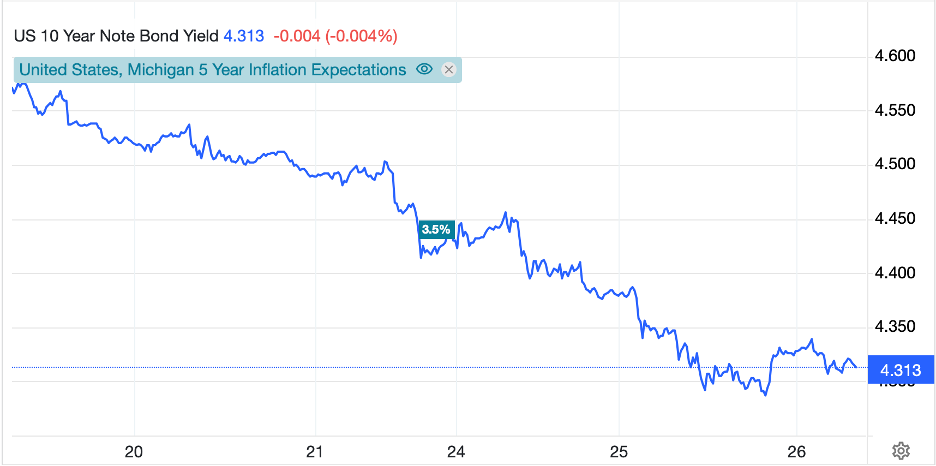
For example, inflation expectations continue to rise, at least as per the University of Michigan surveys, with last week’s result coming in at 4.3% for one year and 3.5% for 5 years.  And yet, Treasury yields continue to fall in the back end of the curve, with 10-year Treasury yields lower by nearly 15bps since that report was released on Friday.  So, which is it?  Is the data a better reflection of things?  Or is market pricing foretelling the future?

Source: tradingeconomics.com

At the same time, the Fed funds futures market is now pricing in 55bps of cuts this year, up from just 29bps a few weeks ago.  Is this reflective of concerns over economic growth?  And how does this jibe with the rising inflation expectations?  

Source: cmegroup.com

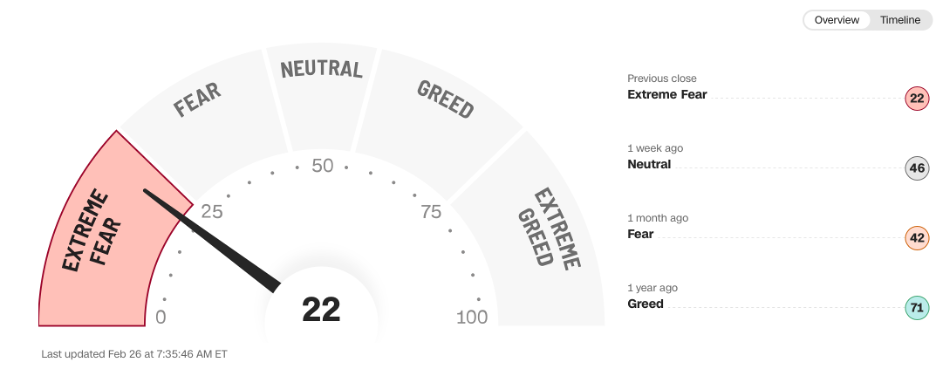
If risk is a concern, why is the price of gold declining?  

Source: cnn.com

My point is right now, at least, many of the relationships that markets and investors have relied upon in the past seem to be broken.  They could revert to form, or perhaps this is a new paradigm.  In fact, that is the point, there is no clear pathway.

Sometimes a better way to view these things is to look at policy actions at the country level as they reflect a government’s major concerns.  I couldn’t help but notice in Bloomberg this morning the story that the Chinese government is going to be injecting at least $55 billion of equity into their large banks.  Now, government capital injections are hardly a sign of a strong industry, regardless of the spin.  This highlights the fact that Chinese banks remain in difficult straits from the ongoing property market woes and so, are clearly not lending to industry in the manner that the government would like to see.  I’m not sure how injecting capital into large banks that lend to SOE’s is helping the consumer in China, which allegedly has been one of their goals, but regardless, actions speak louder than words.  Clearly the Chinese remain concerned over the health of their economy and are doing more things to support it.  As it happens, this helped equity markets there last night with the Hang Seng (+3.3%) ripping higher with mainland shares (+0.9%) following along as well.  Will it last?  Great question.

Another interesting story that seems at odds with what the narrative, or at least quite a few headlines, proclaimed, is that the US and Ukraine have reached a deal for the US to have access to Ukrainian rare earth minerals once the fighting stops.  The terms of this deal are unclear, but despite President Zelensky’s constant protests that he will not partake in peace talks, it appears that this is one of the steps necessary for the US to let him into the conversation.  Now, is peace a benefit for the markets?  Arguably, it is beneficial for lowering inflation as the one thing we know about war is it is inflationary.  If peace is coming soon, how much will that help the Eurozone economy, which remains in the doldrums, and the euro?  Will it lower energy prices as sanctions on Russian oil and gas disappear?  Or will keeping the peace become a huge expense for Europe and not allow them to focus on their domestic issues?

Again, my point is that there are far more things happening that add little clarity to market narratives, and in some cases, result in price action that is not consistent with previous relationships.  With this I return to my preaching that the only thing we can truly anticipate is increased volatility across markets.

With that in mind, let’s consider what happened overnight.  First, US markets had another weak session, with the NASDAQ particularly under pressure.  (I half expect the Fed to put forth an emergency rate cut to support the stock market.)  As to Asian markets, that Chinese news was well received almost everywhere except Japan (Nikkei -0.25%) as most other markets gained on the idea that Chinese stimulus would help their economies.  As such, we saw gains virtually across the board in Asia.  Similarly, European bourses are all feeling terrific this morning with the UK (+0.6%) the laggard and virtually every continental exchange higher by more than 1%.  Apparently, the Ukraine/US mineral rights deal has traders and investors bidding up shares for the peace dividend.  Too, US futures are higher at this hour, about 0.5% or so across the board.

As to bond yields, after a sharp decline in Treasury yields over the past two sessions, this morning, the 10-year is higher by 1bp, consolidating that move.  Meanwhile, European sovereign yields are all slipping between -2bps and -4bps as the peace dividend gets priced in there as well.  While European governments may be miffed they have not been part of the peace talks, clearly investors are happy.  Also, JGB yields, which didn’t move overnight, need to be noted as having fallen nearly 10bps in the past week as the narrative of ever tighter BOJ policy starts to slip a bit.  While the yen has held its own, and USDJPY remains just below 150, it appears that for now, the market is taking a respite.

In the commodity markets, oil (-0.25% today, -2.0% yesterday) has convincingly broken below the $70/bbl level as this market clearly expects more Russian oil to freely be available.  OPEC+ had discussed reducing their cuts in H2 this year, but if the price of oil continues to slide, I expect that will be changed as well.  Certainly, declining oil prices will be a driver for lower inflation, arguably one of the reasons that Treasury yields are falling.  So, some things still make some sense.  As to the metals markets, gold (-0.2%) still has a hangover from yesterday’s sharp sell-off, although there have been myriad reasons put forth for that movement.  Less global risk with Ukraine peace or falling inflation on the back of oil prices or suddenly less concern over the status of the gold in Ft Knox, pick your poison.  Silver is little changed this morning but copper, which had been following gold closely, has jumped 2.7% this morning after President Trump turned his attention to the red metal for tariff treatment.

Finally, the dollar is firmer this morning, recouping most of yesterday’s losses.  G10 currencies are lower by between -0.1% (GBP) and -0.5% (AUD) with the entire bloc under pressure.  In the EMG space, only CLP (+0.45%) is managing any strength based on its tight correlation to the copper price.  But otherwise, most of these currencies have slipped in the -0.1% to -0.3% range.

On the data front, New Home Sales (exp 680K) is the only hard data although we do see the EIA oil inventory numbers with a small build expected.  Richmond Fed president Barkin speaks again, but as we have seen lately, the Fed’s comments have ceased to be market moving.  President Trump’s policy announcements are clearly the primary market mover these days.

Quite frankly, it is very difficult to observe the ongoing situation and have a strong market view in either direction.  There are too many variables or perhaps, as Donald Rumsfeld once explained, too many unknown unknowns.  Who can say what Trump’s next target will be and how that will impact any particular market.  In fact, this points back to my strong support for consistent hedging programs to help reduce volatility in one’s financial reporting.

Good luck

Adf

Confusion

Confusion continues to reign
O’er markets though pundits will feign
That they understand
The movements at hand
Despite a quite rocky terrain
 
The speed with which Trump changes views
Can even, the algos, confuse
The pluses, I think
Are traders must shrink
Positions, elsewise pay high dues


For the longest time I believed that the algos were going to usurp all trading activity as their ability to respond to news was so much faster than any human.  Certainly, this has been the key to success for major trading firms like Citadel and Virtu Financial.  And they have been very successful.  I think part of their success has been that we have been in an environment where both implied and actual volatility has declined in a secular manner, so not only could they respond quickly, but they could lever up their positions with impunity as the probability of a large reversal was relatively less.

However, I believe that the algos and their owners may have met their match in Donald Trump.  Never before has someone been so powerful and yet so chaotic in his approach to very important things.  Many pundits complain that even he doesn’t have a plan when he announces a new policy.  But I think that’s his secret, keep everyone else off balance and then he has free reign.  Chaos is the goal.

The market impact of this is that basically, for the past three months since shortly after his election, the major asset classes of stocks, bonds and the dollar, have chopped around a lot, but not moved anywhere at all.  How can they as nobody seems willing to believe that the end game he has explained; reduced deficits, reduced trade balance, lower inflation and a strong military presence throughout the Western Hemisphere, is going to result from his actions.  And in fairness, some of the actions do have a random quality to them.  But if we have learned nothing from President Trump’s time in office, including his first term, it is that he is very willing to tell us what he is going to do.  It just seems that most folks don’t believe he can do it so don’t take it seriously.

So, let’s look at how markets have behaved in the past three months.  The noteworthy result is that the net movement over that period has been virtually nil.  Look at the charts below from tradingeconomics.com:

S&P 500

10-Year Treasury

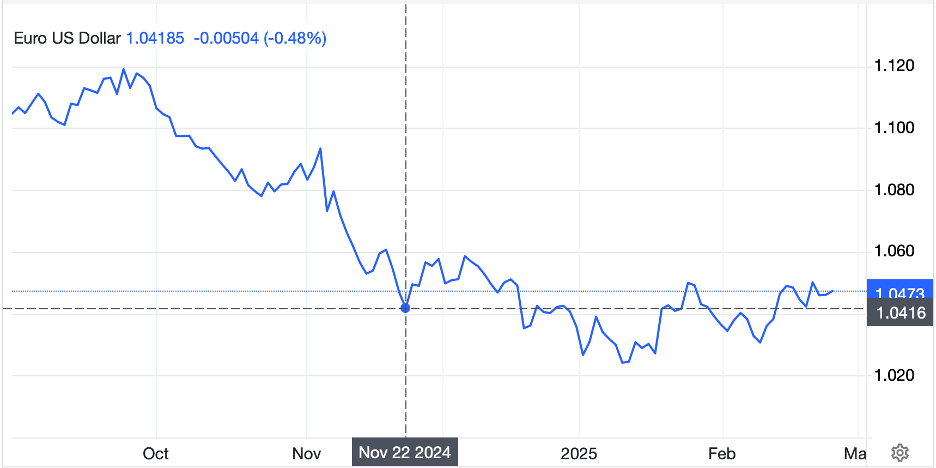
EUR/USD

While all these markets have moved higher and lower in the intervening period, they have not gone anywhere at all.  The biggest mover over this time is the euro, which has rallied 0.54% with the other major markets showing far less movement than that.

One interesting phenomenon of this price action is that despite significant uncertainty over policy actions by the President and the implications they may have on markets, and even though recent price action can best be described as choppy rather than trend like, the VIX Index remains in the lowest quartile of its long-term range. Certainly, it has risen slightly over the past few weeks, but to my eye, it looks like it is underpricing the chaos yet to come.  

Source Bloomberg.com

While I have no clearer idea how things will unfold than anyone else, other than I have a certain amount of faith that the President will achieve many of his goals in one way or another, I am definitely of the belief that volatility is going to be the coin of the realm for quite a while going forward.  We have spent the past many years with numerous strategies created to enhance returns via selling volatility, either shorting options or levering up, and that is the trend that seems likely to change going forward.  The implication for hedgers is that maintaining hedge ratios while having a plan in place is going to be more important than any time in the past decade or more.

Ok, let’s take a look at how markets did move overnight.  Yesterday’s net negative session in the US was followed by similar price action in Asia.  Tokyo (-1.4%), Hong Kong (-1.35) and China (-1.1%) all suffered on stories about tariffs and extra efforts by the Trump administration to tighten up export controls on semiconductors.  It should be no surprise that virtually every index in Asia followed suit with losses between -0.3% (Singapore) and -2.4% (Indonesia) and everywhere in between.  Meanwhile, in Europe, the picture is not as dour as there are a few winners (Spain +0.9% and Italy +0.5%) although the rest of the continent is struggling to break even.  The data point that is receiving the most press is Eurozone Negotiated Wage Growth (+4.12%) which rose less than in Q3 and has encouraged many to believe the ECB will be cutting rates next week.  Interestingly, Joachim Nagel, Bundesbank president was on the tape telling the rest of the ECB to shut up about their expectations of future rate moves as there is still far too much uncertainty and decisions need to be made on a meeting-by-meeting basis.  Apparently, oversharing is a general central bank affliction, not merely a Fed problem.  As to US stocks, at this hour (6:50) they are little changed.

In the bond market, yields continue to slide, at least in the US, with Treasury yields down -6bps this morning and back to levels last seen in December.  Apparently, some investors are beginning to believe Secretary Bessent regarding his goal to drive yields lower.  As well, he has reconfirmed that there will be no major increase in the issuance of long-dated paper for now.  European sovereigns, though, are little changed this morning with only UK gilts (-3bps) showing any movement after the CBI Trades report printed at -23, a bit less bad than expected.

In the commodity markets, oil (-0.15%) is little changed this morning after a very modest rally yesterday.  But the reality here is that oil, like other markets, has been in a trading range rather than trending, although my take is that the longer-term view could be a bit lower.  Gold (-0.35%), though lower this morning, is the one market that has shown a trend since Trump’s election, and truthfully since well before that as you can see in the chart below.

Source: tradingeconomics.com

Finally, the dollar is a touch softer this morning, with both the euro and pound rising 0.3% alongside the CHF (+0.3%) and JPY (+0.2%). Commodity currencies, though, are less robust with very minor losses seen in MXN, ZAR and CLP.  Given the decline in 10-year yields, I am not that surprised at the dollar’s weakness although it is in opposition to the gut reaction that tariffs mean a higher dollar.  This is of interest because yesterday President Trump confirmed that the 25% tariffs on Canada and Mexico were going into effect next week.  As I explained above, it is very difficult to get a sense of short-term price action here although given the clear intent of the president to improve the competitiveness of US exporters, he would certainly like to see the dollar decline further.  

It is very interesting to watch this president reduce the power of the Fed with words and not even have to attack the Chairman like he did in his first term.  It will be very interesting to see how Chair Powell responds to the ongoing machinations.

On the data front, this morning brings only the Case-Shiller Home Price Index (exp +4.4%) and Consumer Confidence (102.5).  We do hear from two Fed speakers, Barr and Barkin, but as I keep explaining, their words matter less each day. (It must be driving them crazy!)

It is hard to get excited about markets here.  There is no directional bias right now and the lack of critical data adds to the lack of information.  As well, given the mercurial nature of President Trump’s activities, we are always one tape bomb away from a complete reversal.  While I don’t see the dollar collapsing, perhaps the next short-term wave is for further dollar weakness.  

Good luck

Adf

Japanese Tao

Japanese prices
Are rising ever higher
Probably nothing!
 
Meanwhile Ueda
Explained QE can still be
The Japanese Tao


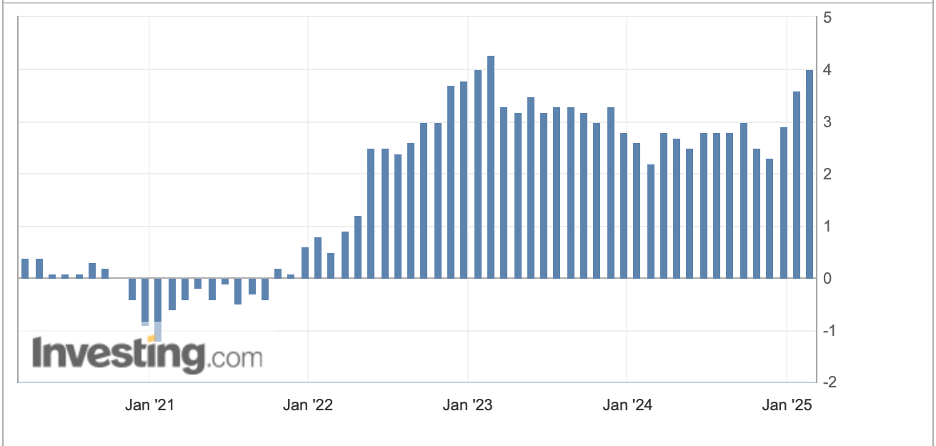
Japanese inflation data was released last night, and the picture was not very pretty.  In fact, let me show you.  The first chart shows the monthly readings of annual inflation for the past 5 years.  Last night’s 4.0% reading was not the highest in that period, (that distinction belongs to Feb 2023 at 4.3%), but it is pretty clear that any sense of declining inflation is beginning to dissipate and has been doing so for the past year.  PS, remember, Japanese interest rates range from 0.5% in the overnight to 1.425% in the 10-year, so real rates remain highly negative regardless of your timeframe.

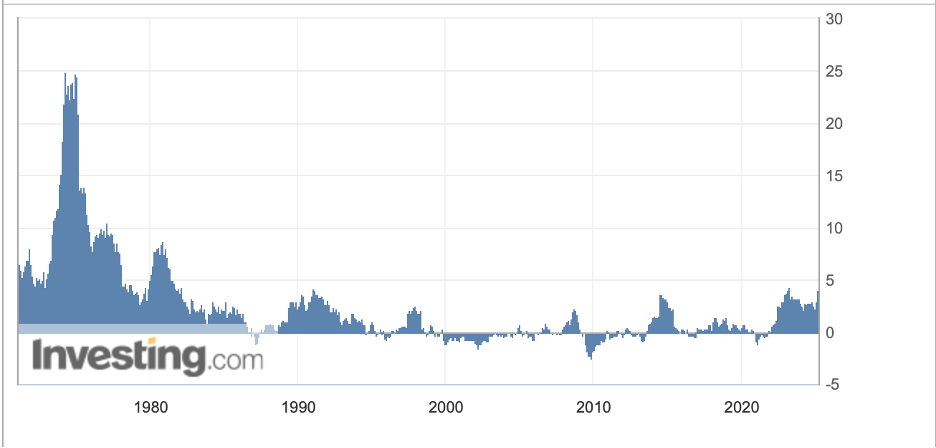
The second picture takes a longer-term perspective to help us better understand the long history of inflation in Japan.  While a decade ago, inflation showed an uptick of nearly the recent magnitude, that was driven specifically by the government raising the GST (goods and services tax) which was Japan’s answer to a VAT.  It was highly controversial at the time but was also understood to have a truly transitory impact as it was a one-off rise in prices.  However, beyond that period, the Japanese have been living with inflation somewhere between -2.2% in the wake of the GFC and 2.0% since the turn of the century.  In fact, going back to the 1990’s, inflation didn’t reach current levels, and one must head back to 1981 to see significant inflation in Japan.  This means there are two generations of people who have basically never seen prices rise in the current manner.

So, what do you think the central bank is considering?  Let me give you Ueda-san’s own words, [emphasis added] “In exceptional cases where long-term interest rates rise sharply in a way somewhat different from normal movements, we will flexibly increase purchases of government bonds to promote stable formation of interest rates in the market.”  You read that correctly inflation is rising sharply, JGB yields are rising in sync and the BOJ’s response is to BUY MORE BONDS!!!  You cannot make this stuff up.  I guess old habits die hard.

The market response to this was as you might expect.  JGB yields dipped 2bps, Japanese equities managed a modest rally (+0.3%) as they seem caught between lower rates and higher inflation, and the yen ( -0.5%) weakened.  In essence, it appears the combination of a strengthening yen and rising interest rates has the potential to wreck the Japanese government’s budget, and the BOJ went back to form and discussed more QE as a response.  This is simply more proof that there isn’t a central bank in the world that truly cares about inflation.  While stable inflation may be a mandate, it is the last of their concerns.

Inflation is, however, not the last of our concerns, at least as we try to live day to day.  This is what has me concerned about Chairman Powell and his minions at the Fed, they continue to believe that the current interest rate structure is restrictive and despite the fact there is virtually no evidence prices are ever going to get back to their target of 2.0%, let alone true stability, still see cuts as the way forward.  Perhaps I am mistaken to believe that the Fed will see the light and maintain current policy levels or even tighten as inflation rebounds.  If that is the case, my entire dollar thesis is going to come under a lot of pressure!

Ok, away from the Japanese antics overnight, a brief word about China.  Last night, Premier Li Qiang explained that China will look to “vigorously” improve the services sector of the economy, specifically education, health care, culture and sports, as they once again try to adjust the balance of economic activity to a more domestic focus rather than their historical mercantilist process.  Earlier this week the PBOC reiterated their support for the property market, although for both these efforts, this is not the first time they have been discussed, and the evidence thus far is all their efforts have been fruitless.  But for one day, at least, these comments have been embraced as the Hang Seng (+4.0%) and CSI 300 (+1.3%) both rallied sharply on the news of more domestic support for the Chinese economy.  The Chinese are set to hold a key economic confab as they try to plan how to shake things up a bit, and these comments, as well as a seeming promise the PBOC is going to cut rates again, are all of a piece.  Maybe they will be successful this time, but I am not holding my breath.

Otherwise, the only other noteworthy economic news came from the Flash PMI’s across Europe which were soggy at best, certainly not indicative of significant growth coming soon.  With that in mind, let’s look at the rest of the markets’ overnight performance.  The rest of Asia’s equity markets were mixed with Taiwan’s the best performer and several modest declines elsewhere including India, Australia and New Zealand.  In Europe, though, despite those modest PMI outcomes, most markets are higher led by the CAC (+0.5%).  Perhaps, the view is the ongoing weakness will force the ECB to cut rates more quickly, and we have heard several ECB members indicate further cuts are coming.  However, counter to that, Isabel Schnabel, one of the more hawkish members, mentioned this morning that she believed they were already at neutral, and more cuts may not be necessary.  While that is not the consensus view yet, it is worth remembering.  As to the US futures market, at this hour (7:00), all three major indices are basically unchanged.

In the bond market, yields have fallen across the board with Treasuries, after sliding yesterday, down another 2bps this morning and back below 4.50% for the first time in a week.  In a Bloomberg interview yesterday, Secretary Bessent explained that although his goal is to reduce the issuance of T-bills and term out debt, given the situation which he inherited from the previous administration, that process will take longer than some had considered previously.  In other words, there won’t be a large increase in 10-year issuance any time soon. European sovereign yields are also much softer, down between -3bps and -5bps on those further rate cut hopes, or perhaps the lackluster PMI data.

In the commodity markets, oil (-0.8%) is backing off its recent rally highs, but remains quiet overall and well within its ever-tightening trading range.  It seems traders don’t know how to handicap the constant discussions from the Trump administration and whether Russian sanctions will end or not, as well as how quickly OPEC may ramp up production and what is happening to demand.  While none of these things are ever certain, right now they seem particularly fraught.  In the metals space, gold (-0.4%) is backing off from yesterday’s latest all-time highs, and taking both silver and copper with it, but the uptrend in all three of these metals remains quite strong.

Finally, the dollar is higher this morning gaining ground against all its G10 counterparts with the yen being the worst performer, but also against all its EMG counterparts with HUF (-1.0%) the true laggard although the entire CE4 are under pressure, arguably responding to the mayhem over how the Ukraine situation plays out.  After all, they are the closest in proximity and likely to be the most impacted.

On the data front, this morning brings Flash PMI data (exp manufacturing 51.5. Services 53.0), Existing Home Sales 4.12M) and Michigan Sentiment (67.8).  We also hear from two more Fed speakers, Jefferson and Daly, but again, caution and stasis are the story until further notice, and that notice is not coming from Mary Daly but rather from Jay Powell.

Perhaps the most interesting thing happening right now is that although tariffs remain a major economic force and are clearly on the table, they are not even the 4th most important topic in the market.  Back to my earlier comments, I sincerely hope that the BOJ’s overwhelming dovish stance is not a harbinger of things to come here in the States.  Right now, I don’t think so, but I am far less confident than I was earlier this week.

Good luck and good weekend

Adf

Norms to Eschew

For market practitioners, Trump
Is more than a modest speed bump
His willingness to
Most norms to eschew
Can force long-term views to go bump
 
Meanwhile, as the markets prepare
For Powell to sit in his chair
In front of the Senate
A popular tenet
Is more rate cuts he will foreswear


It is very difficult to keep up with the news these days as President Trump really does address so many disparate issues in such short order, it is hard to know which ones will potentially impact markets and which will simply be headline fodder.  Obviously, the tariff discussions remain front and center, but even those plans seem to be evolving at a very fast pace, and while yesterday he did invoke 25% tariffs on steel and aluminum imports, that has literally become old news already.  The next question is what will occur with the latest idea of reciprocal tariffs, where the US will charge the same tariff on imports from other nations as those nations charge on imports from the US.

Generally speaking, US tariffs are the lowest overall around the world, which arguably is exactly what Trump wants to address.  I am not going to argue the merits or detractions of tariffs, that is pointless.  The only thing to consider is if they are implemented, what are the potential impacts.  One of the key things to remember about the effectiveness of tariffs is the price elasticity of the products being tariffed.  If, for instance, a product has substantial competition and is easily replaced, the nation being tariffed is likely going to absorb the bulk of the pain.  Consider Colombia and how quickly they caved regarding the deportations.  While I am not a coffee drinker, and I am sure there are those who believe Colombian coffee is the best, coffee also comes from Brazil, Vietnam, Hawaii and Indonesia, and as none of those nations (and obviously Hawaii) were subject to tariffs, Colombia would have paid the freight had they been implemented.

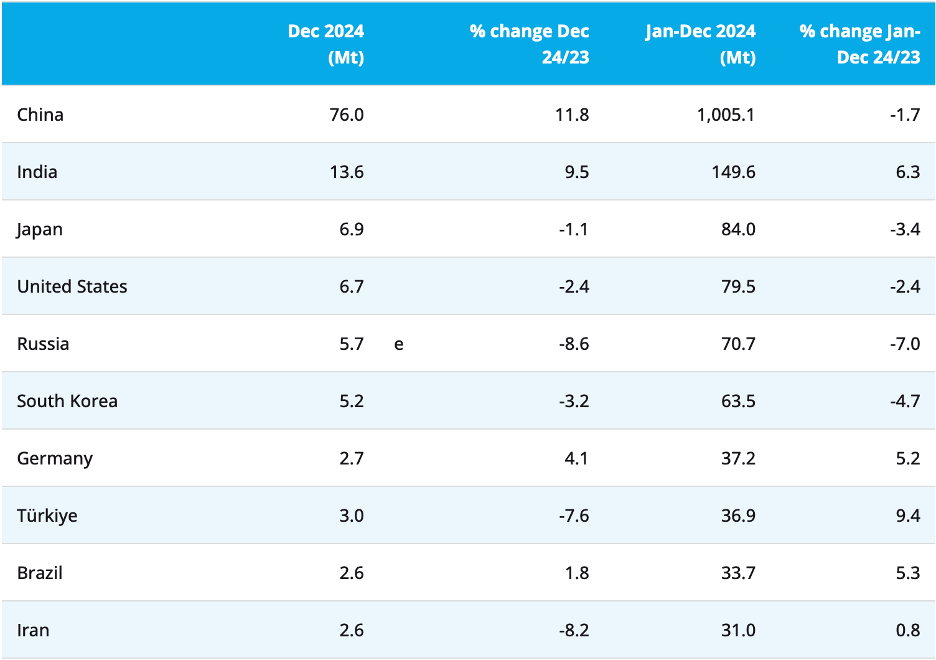
But, for a product like solar panels, where there are few suppliers other than the Chinese, to the extent the demand remained in place, the purchaser would see higher prices.  Turning to steel and aluminum, the below graphic shows the top 10 global steel producing nations and how much they produced in 2024.  This graphic says all you need to know about why President Trump is unhappy with China and their trade policies.  (well, this and the next one)

Source: worldsteel.org

And while this is not an exact apples-to-apples comparison, the below chart shows forecasts for steed demand in 2023 and 2024.  The mismatches are clear as China, South Korea and Japan have a significant surplus to export while the US and India need imports.

Source: mrssteel.com.vn

The point is President Trump is seeking to address that imbalance and is of the mind that the US would be better off if we make our own steel.  In fact, this is simply part of his entire philosophy to reshore US manufacturing capabilities.

Now, steel is a traded commodity, although in financial markets, not so much.  But changes in the flows of imports and exports will have an impact on FX markets, while tariffs could well also impact investment flows. In fact, it is not hard to see why Nippon Steel wants to buy US Steel.  if they own a steel manufacturer in the US, they can increase production with no concerns over tariffs.

Remember, too, this issue is merely a microcosm of the potential chaos that will be seen across industries and nations, both of which will impact financial markets.  Once again, I harp on the idea that a robust hedging program is a necessity these days.

Turning to today’s activities, Chairman Powell will be testifying before the Senate Banking Committee this morning.  On the one hand, I wonder if he is upset by the fact that virtually nobody is concerned about what he says these days as Trump continues to dominate every conversation.  For someone who has become quite accustomed to being the center of attention with respect to markets, this may well be a blow to his vanity and ego.  On the other hand, it is also quite possible that maintaining a low profile is precisely his strategy here, and if that is the case, I expect we will not learn anything new at all.  The Fed mantra is currently that they will be cautious before implementing any further rate cuts.  Remember, CPI is released tomorrow as well, so when he goes before the House, they will have that information in hand.  But to Powell’s benefit, Treasury Secretary Bessent made clear he and President Trump are far more concerned about the 10-year yield than Fed funds.  This may be the most amazing transformation of all, a Fed chair who becomes a wallflower!

Ok, after yesterday’s US equity rally, the story in Asia was far less positive.  Japan and Australia were unchanged while the Hang Seng (-1.1%) and CSI 300 (-0.5%) both suffered, perhaps on the tariff impositions.  Elsewhere in the region, Taiwan and South Korea both had solid sessions while weakness was evident in Indonesia, India and the Philippines.  In fact, all three of those markets have been declining steadily since October, with declines between 15% and 20% as prospects in those economies seem concerning, especially with Trump’s tariff mania.  In Europe, virtually every market is unchanged this morning as the EU quickly explained they would retaliate against any US tariffs.  Of course, that is what makes Trump’s reciprocal tariff structure so interesting.  How can Europe complain that other nations impose the same level of tariffs they do?  Meanwhile, at this hour (7:05), US futures are pointing slightly lower, about -0.25%.

In the bond market, yields are climbing with Treasuries higher by 3bps, now 12bps above the lows seen early last week, while in Europe, yields are substantially higher, with France (+10bps) leading the way, but the rest of the continent showing rises of between 4bps and 6bps.  Part of this move on the continent is driven by a catch up to yesterday afternoon’s US yield rally.  As to the French, seemingly their Unemployment Report, which showed a much better than expected 7.3%, may have investors concerned about quickening growth and inflation.  That feels like a lot, but there are no real explanations I have seen.

In the commodity markets, oil (+1.5%) is continuing to rebound off its recent lows, although still looks like it is in the middle of its trading range.  Gold (-0.7%) and silver (-1.2%) are both finally retracing some of the extraordinary rally that we have been witnessing for the past two months.  Copper (-2.7%), too, is under pressure this morning, unwinding some of its recent spectacular gains.

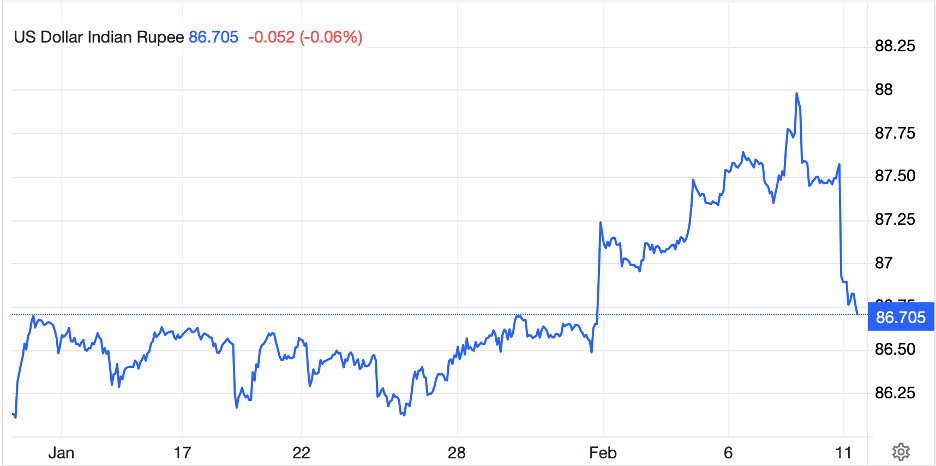
Finally, the dollar is very modestly softer, but not universally so.  For instance, the euro (+0.2%) and yen (-0.2%) seem to offset each other while most other G10 currencies have moved even less.  In the EMG bloc, though, INR (+0.9%) is the biggest gainer as the RBI has been intervening to address what had been an acceleration in the rupees decline in the past few weeks (see below).

Source: tradingeconomics.com

Elsewhere in the space, gains are less impressive, with moves on the order of +0.4% (PLN and HUF) or smaller.

On the data front, the NFIB Small Business Optimism Index was released at a softer than expected 102.8 as it seems the Trumpian chaos is having an effect for now.  Otherwise, the only thing is Powell and three other Fed speakers, but again, given the relative lack of discussion regarding Powell, the other three will get even less press in my view.

It is difficult to claim nothing has changed lately, but perhaps more accurately, there is no clear directional change at this point.  We need to start seeing some consistency in the policy impacts and that is likely to take months.  Until then, volatility is the watchword across all markets.

Good luck

Adf

Run Amok

The price level, sadly, will jump
According to President Trump
Will Canada shrink?
Will Mexico blink?
As tariffs cause things to go thump
 
The first thing that moved was the buck
While stock markets were thunderstruck
So, who will blink first?
And who will hurt worst?
No matter, things have run amok


Whatever you think of the man, you must admit that President Trump knows how to maintain the spotlight on himself and his policies to the exclusion of virtually everything else in the news.  And so, in the wake of two terrible aviation disasters in short order, pretty much all eyes are now focused on the tariffs that Trump imposed this weekend on Canada, Mexico and China.  While there had been a large school of thought that the tariff talk was a cudgel to be used during negotiations but would never actually be imposed as they would be too damaging, that thesis has been destroyed.  It appears that President Trump believes his long-term goals of reshoring significant parts of US industry and leveling the playing field with trade partners is achievable via tariff policy and will more than offset any short-term pain that may come.  We shall see if he is correct, but certainly, the short-term pain is beginning to arrive.

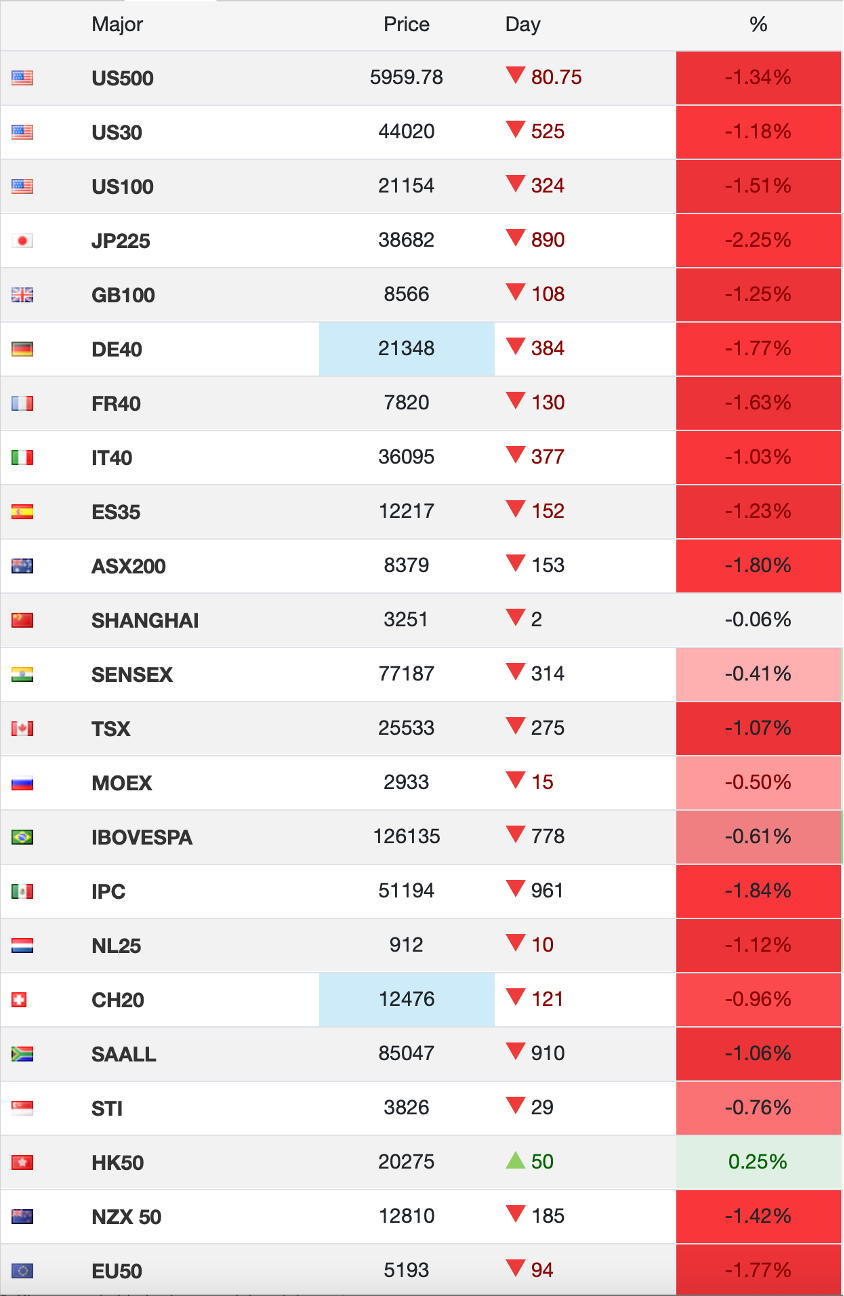
The early movement in equity markets was uniform around the world, and it was not pretty.  The below snapshot of equity futures markets, taken at 6:00am this morning shows that the only two markets that have not fallen are China and Hong Kong, and that is only because they remain closed for the Chinese New Year holidays.  But there is plenty of fear all around the world, especially considering that markets throughout Europe and Japan, as well as other nations that have not been named targets of tariffs, have also fallen sharply.

Source: tradingeconomics.com

Too, the FX markets have also responded dramatically, with the dollar exploding higher vs. virtually all its counterpart currencies this morning as 1% gains are the norm.

Source: tradingeconomics.com

A special shoutout to ZAR (-1.55%) which while not directly impacted by tariffs, caught Trump’s ire by their recently enacted legislation to confiscate property as they deem fit, oftentimes without compensation.  While South African officials have claimed it is akin to eminent domain rules in the US, those require compensation at all times, a not insubstantial difference.  

So, what’s a hedger to do?  Well, this is why you maintain a hedge program in the first place.  Lots of things happen in the world, most of which are beyond any individual or companies’ control, yet the impacts are real.  Some of what I have read this morning highlights the idea that Canada and Europe and Mexico are going to stick together to fight these tariffs.  However, at the end of the day, the US economy, and by extension its market, is the largest by far, and losing the US as an export destination will be a very difficult pill for those nations and their economies to swallow.  

My sense is that Trump, especially if he continues to address the immigration and government waste issues, will have far more runway than most other nations, especially given the precarious situation of many ruling parties right now.   But the other thing to consider is that there is no going back to the way things were in the past.  Alliances and treaties are going to come under much greater scrutiny by all sides as governments everywhere re-evaluate what they are trying to achieve with various policies and how they can partner with other nations to work together.  In fact, I suspect that the EU is going to continue to come under even greater pressure as it becomes more evident that while many countries believe in the trade benefits of the EU, the recent focus by Brussels on other issues like climate activism and immigration run counter to some members’ views.  No matter what, the world is changing dramatically, and my take is the change is going to come faster than many will have anticipated.

OK, there are a thousand stories on how the tariffs are going to impact the US, with initial calculations regarding the negative impact on GDP and how much they are going to raise inflation, so I’m not going to go there.  Needless to say, the universal belief is things will get worse on those metrics.  But here’s something else to consider.  On Friday, the BLS will be revising the 2024 jobs data, including their population estimates and the birth/death model that describes the number of new businesses that are formed, net, each month. Early estimates show that the number of jobs created is going to fall by nearly 1 million while population, now taking into account more immigration, is going to rise.  I have seen estimates that the Unemployment Rate may rise, or be revised, to 4.5% or 4.6%.  If that is the case, it will certainly call into question exactly what the Fed has been doing.  It will also, almost certainly, result in a Trumpian tirade about how the BLS is political and was cooking the books to burnish Biden’s economic record.  I suspect it will not help equity markets if that is the case, but also probably hurt the dollar as the Fed will be right back onto their rate cutting discussions.

As I’ve already shown the equity and FX markets above, a look at bonds shows that Treasury yields are unchanged this morning, as they seem to be caught between concerns of slower growth and higher inflation due to the tariffs.  Remember, too, that Wednesday, the Treasury will issue its Quarterly Borrowing Estimate with all eyes on the mix that new Treasury Secretary Bessent will be seeking as things go forward.  Remember, he was quite vocal, before he took the job, as to the mistakes that Yellen made in not terming out more Treasury debt when rates were at extremely low levels.  Meanwhile, European sovereign yields are all lower this morning, between -2bps (Italy) and -6bps (Germany) as PMI data released showed that though things were better than last month, they remain well below the key 50.0 level.  However, on the inflation front, both Eurozone and Italian data printed higher than expected, clearly not what Madame Lagarde wants to see.

Finally, commodity markets have seen oil prices (+2.6%) rise sharply as the US will be imposing 10% tariffs on imports of Canadian oil products, while NatGas prices have jumped by 9.0% on concerns over supply disruptions from those tariffs.  Like I said, the world is a different place today!  In the metals markets, both gold and silver are little changed this morning although copper (-0.9%) prices are slipping, perhaps on the idea that these tariffs are going to slow economic activity.  And that is one of the key belief sets amongst economists.

As to the data this week, it is reasonably busy, but all eyes will be on Friday’s NFP report, especially with the rumors of a major revision.

TodayISM Manufacturing49.8
 ISM Prices Paid52.6
TuesdayJOLTS Job Openings8.0M
 Factory Orders-0.8%
 -ex Transport+0.6%
WednesdayADP Employment150K
 Trade Balance-$96.5B
 ISM Services54.2
ThursdayInitial Claims215K
 Continuing Claims1855K
 Nonfarm Productivity1.7%
 Unit Labor Costs3.5%
FridayNonfarm Payrolls170K
 Private Payrolls140K
 Manufacturing Payrolls-2K
 Unemployment Rate4.1%
 Average Hourly Earnings 0.3%(3.8% Y/Y)
 Average Weekly Hours34.3
 Participation Rate62.5%
 Michigan Sentiment70.9
 Consumer Credit$10.5B

Source: tradingeconomics.com

In addition to all of this, we will hear from nine different Fed speakers, at least, over 13 different venues this week.  Now, things could get quite interesting here given Chairman Powell did not speak to tariffs as they were not yet implemented when he delivered the FOMC news last week, but all of these speakers will have an opinion.  I wonder if there will be a unified set of talking points or if each one will truly give their own views.  Of course, given that each is a neo-Keynesian economist, I suspect their views will all be aligned anyway.

One other thing from last week that didn’t get much press is that the BOC, after cutting the base rate by 25bps as widely expected, has indicated they will be ending their QT program and, in fact, restarting their QE program over the next several months in order to grow their balance sheet in line with the economy.  Do not be surprised if we see other major central banks go down this road as well, regardless of sticky inflation.  

Summing it all up, the world is very different this morning compared to Friday morning.  Trade and economic disruptions are going to become evident and there is still a great deal of vitriol to be vented at Trump by others, while Trump will continue to decry other nations efforts to weaken the US.  As I have written in the past, volatility will be the main underlying thesis this year.  Meanwhile, the beauty of a good hedge program is it helps through all market conditions.  Do NOT slow things down waiting for a better entry point, be consistent, as that better entry point may not materialize for a long time.  My strongest cue will be the bond market as if yields start to decline in anticipation of a significant economic slump, I expect the dollar will suffer, but if they hold up, then there is nothing to stop the dollar from testing and breaking its recent highs.

Good luck

Adf

Forked Tongue

The major discussion today
Is tariffs and if they’re in play
While Trump thinks they’re great
Economists hate
Their impact and watch with dismay
 
Meanwhile it has not been a week
And questions are rife ‘bout DeepSeek
The most recent questions
Are making suggestions
That China, with forked tongue, did speak


President Trump has promised to impose 25% tariffs tomorrow on all Canadian and Mexican exports to the US if those nations do not agree to further efforts to tighten border security regarding the movement of both immigrants and drugs across the borders.  Even within his administration, there are many who do not want to see them imposed given the potential disruption they would cause in supply chains throughout the nation.  And of course, economists abhor tariffs as a pure deadweight loss to the economy.  But Trump sees the world through very different eyes, that much is clear, and as evidenced by the very short-term row with Colombia last weekend, believes they can be useful tools to achieve strategic, non-economic outcomes.

This poet is not fool enough to try to anticipate what will actually happen as the mercurial nature of President Trump’s actions is far beyond my ability to forecast.  However, if history is any guide, we will see both Mexico and Canada make some additional concessions and an announcement that because of that, the tariffs will be delayed until negotiations can be completed by some new deadline.  (Well, maybe I am fool enough 🤣)

From our perspective observing market reactions, the only consistent view is that US tariffs will drive the dollar higher, or more accurately, other currencies lower, as the FX market adjusts to compensate for the tariffs.  If we look back at Trump’s first term, the first tariffs were imposed on China in early 2018 on solar panels and washing machines and a few other things.  A look at the chart below shows that the yuan (the green line) did, in fact, weaken substantially following those tariffs, with the dollar rising from 6.25 to 6.95 over the course of the ensuing six months.  However, if we broaden our horizons beyond the renminbi to the dollar writ large, as seen by the Dollar Index (the blue line), which rose from 88 to 96 over the same period, the renminbi’s price action was directly in line with the dollar overall.  There was only limited additional impact to CNY.  Remember, too, that in 2018, the US equity market was performing quite well, and funds were flowing into the US, thus driving the dollar higher, not dissimilar to what we have seen over the past year.  The point is that while the tariffs may have some impact, it is also likely that the dollar will move based on its traditional drivers of interest rate differentials and capital flows regardless.

Source: tradingeconomics.com

Away from the tariff talk, though, there is precious little other market related news, at least on a macro basis.  Yesterday’s data showed that GDP grew a tick less than anticipated at 2.3% in Q4, but Real Consumer Spending, which is a critical part of the economic picture, rose at 4.2%, a very solid performance and an indication that things in the economy are still ticking along just fine.  (The difference between that number and the GDP number is due to inventory adjustments, which are seen to wash out over time.). In fact, arguably, that solid growth was a key reason that the equity markets in the US had another strong session yesterday, with gains across the board.

Well, there is one other thing on many people’s minds, and that is the veracity of the claims about DeepSeek.  You may recall I highlighted the question of all those Nvidia sales to Singapore earlier in the week as somewhat strange.  Well, I was not the only one asking that question and this morning in Bloomberg, there is an exclusive story about a US government investigation into whether China actually got the most advanced H100 chips via Singapore after all.  If that is the case, then perhaps the DeepSeek claims are not as impressive as they were initially made out.  I suspect if this turns out to be the case, that worries over the need for AI to no longer utilize the most advanced chips will dissipate and the tech rally will regain momentum.

So, let’s look at markets now.  China and Hong Kong remain closed for their New Year celebrations.  Japan (+0.15%) had a modest gain and the truth is that only two Asian bourses had strong sessions, Singapore (+1.45%) and India (+1.0%) with the rest of the region mostly a touch firmer.  In Europe, all markets are slightly stronger this morning, on the order of 0.3% or so, as the combination of yesterday’s ECB rate cut and hints at future cuts by Madame Lagarde, seem to be underpinning the markets.  Certainly, today’s Eurozone data, showing German Unemployment climbing a tick to 6.2% while Retail Sales there fell -1.6% in December don’t seem like a rationale to buy equities.  In the US futures market, though, we are seeing solid performance, 0.5% or more, as I believe many are jumping back on the AI bandwagon.

In the bond market, Treasury yields have edged higher by 1bp, and remain just north of 4.50% as the tension between solid growth and slowing inflation dreams keeps the market quiet.  In Europe, though, yields are continuing their decline from yesterday, with sovereign yields down by between -3bps and -4bps as investors look for further easing from the ECB as the Eurozone sinks slowly toward recession.  However, in Japan, JGB yields rose 3bps as data overnight showed inflation remains above target and expectations for another rate hike in the first half of the year rise.

In the commodity markets, oil (-0.35%) continues to chop around in the middle of its trading range with no strong directional impulse (see chart below).

Source: tradingeconomics.com

It is very difficult to know how to view this market in the short run given the potential for disruptions by tariffs and even more sanctions, but nothing has changed my long-term view that there is plenty of oil around and prices will remain here or decline.  In the metals markets, both gold and silver are little changed on the morning although both have been in the midst of a strong rally with gold making new all-time highs in the cash market yesterday.  Copper (-0.7%) is offered this morning but is still much higher than at the beginning of the month/year.

As to the dollar, it is modestly firmer this morning rallying against most of its G10 counterparts, but not by very much, 0.3% (JPY) at most.  Versus its EMG counterparts, though, there is more strength with PLN (-0.6%) and ZAR (-0.4%) both under a bit of pressure.  The latter is responding to ESKOM, the national electrical utility, announcing that they may need to impose rolling blackouts to help repair parts of the grid.

On the data front, this morning brings Personal Income (exp 0.4%) and Spending (0.5%) but of more importance it brings PCE (0.3%, 2.6% Y/Y) and core PCE (0.2%, 2.8% Y/Y) along with the Chicago PMI (40.0) release at 9:45.  We also hear our first post-meeting Fed speaker, Governor Bowman, this morning but it would be shocking if she said anything other than they are going to be patient to watch inflation slowly move toward their target, almost as if by magic.

Once again, tape bombs are the biggest risk, as they will be for the next four years, but I imagine all eyes will be on Trump and the tariffs as the key driver.  For now, nothing has dissuaded me from my view the dollar is more likely to rise than fall, but we need to see how things evolve.

Good luck and good weekend

Adf

More Than a Tweet

In Davos, the global elite
Were treated to more than a Tweet
The president spoke
And in one broad stroke
Explained that he won’t be discreet
 
For oil, he wants prices falling
For Europe, he said it’s appalling
That nations don’t pay
Enough to defray
The costs of the war they’re forestalling


If, prior to yesterday, European leaders weren’t sure how things were going to play out now that Mr Trump is back in office, they have a whole lot better understanding now.  I imagine that all their fears were realized when Trump spoke via video at the WEF meeting in Davos, Switzerland.  It’s funny, Argentine president Javier Milei has been calling out the globalist agenda since his election last year and Europe didn’t care and didn’t change their behavior.  I guess that makes sense because the European press would never allow the narrative to change for a minor player like that.  Alas, for the European narrative now, the US, one of their largest trading partners and the nation that insures their safety via NATO membership, is calling them out for their behaviors, whether it is the rarely discussed tariffs they impose on US imports, or the lack of funding for a war they claim is critical to continue in Ukraine, and they are suddenly aware they better reconsider their positions. 

It will be very interesting to watch if things change in Europe (I think they will) and how quickly these changes will come (that could take more time).  Arguably, the biggest problem the current  European leaders have is that there are already large segments of their populations that are unhappy and have been voting accordingly, whether for AfD in Germany, or the RN in France to name two.  Trump’s comments are going to only foment more support for those positions.  I suspect the elections upcoming in Europe are going to see a further rightward swing, or perhaps simply a further swing against the incumbents given what appears to be a significant amount of dissatisfaction amongst the electorate.  No matter your view of Trump’s policies, we all must recognize he is a remarkable political force!

Fifty basis points
Is now Japan’s new baseline
Can it go higher?

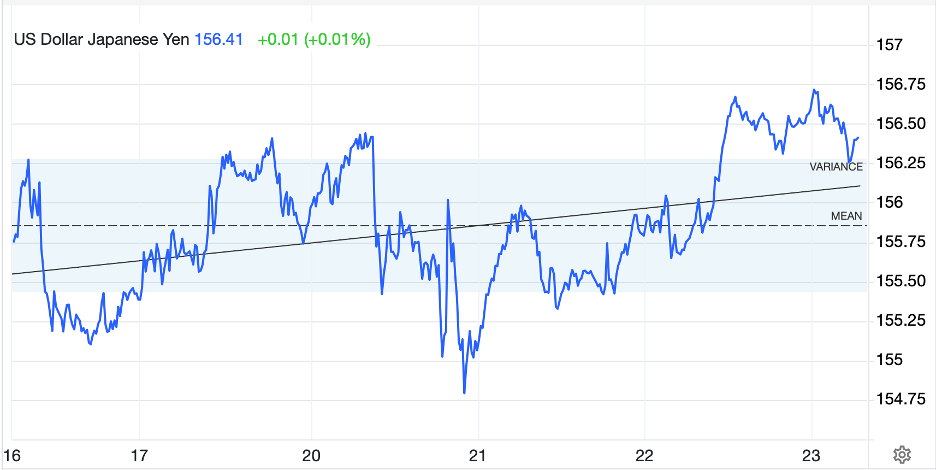
As widely expected, the BOJ hiked its base rate by 25bps last night to 0.50%, the highest levels since October 2008.  The immediate market response, as you can see in the chart below, was for the yen to rally (dollar decline) almost one full percent despite interest rate markets having fully priced in the hike.  However, as you can also see, the yen has given back virtually all those gains in the wake of Ueda-san’s press conference where he explained the BOJ was not “seriously behind the curve” which was taken as meaning that it will be a while before they move again.  

Source: tradingeconomics.com

While JGB yields did perk up 2bps on the session, it hardly seems like the start of a rout.  And, as I highlighted yesterday, the interest rate differential does not seem likely to have changed enough to alter investor plans. Going forward, I expect the yen to be entirely beholden to the dollar’s broad movement.  If, as I suspect, the market starts to price in a more hawkish Fed, USDJPY is likely to go back and test its highs from last summer.

Ok, let’s move on to the overnight market action.  Once again, US equities rallied yesterday, although at this hour (7:10), futures are essentially unchanged.  In Asia, Japanese shares shed early gains after the BOJ rate hike and Ueda presser and closed unchanged on the day.  However, both Hong Kong (+1.9%) and China (+0.8%) rallied on the news that Trump and Xi had a “friendly” conversation as traders and investors took that to mean that tariffs on Chinese goods were not coming right away.  As to the rest of Asia, once again there were both gainers (Korea, Taiwan, Australia) and laggards (India, Indonesia, Philippines) with the rest showing little net movement.  

In Europe, the picture is also mixed as the CAC (+0.9%) is leading the way higher as investors want to believe that Trump’s call for lower interest rates as well as lower oil prices will help the European economy, especially the luxury sector in France.  But elsewhere in Europe we see Germany (+0.3%) a bit higher while Spain (-0.4%) and the UK (-0.4%) are lagging with the former suffering from rising energy prices while the ongoing political mess in the UK has investors steering clear of the Kingdom for now.

In the bond market, Treasury yields are unchanged this morning, holding the recent 10bp bounce from the lows seen last week.  European sovereign yields are higher by 1bp to 2bps across the board, with activity quiet and we’ve already discussed JGBs.  

Ironically, after Trump’s call for lower oil prices, they are firmer this morning, up 0.6%, although in the broad scheme of things, relative to the recent price action, that is tantamount to unchanged.  Here is something to consider though, which is a little bit outside the box.  The Biden EO that cited the OCSLA of 1953 prohibited drilling across a series of areas including the Atlantic and Pacific Oceans as well as the Gulf of Mexico.  Now, what is one of the first things that Trump said?  He is renaming the Gulf of Mexico to the Gulf of America.  Does that nullify the EO?  (h/t Alyosha).  I’m sure that is a legal battle to be had, but it would be right in line with Trump’s MO.  It would also allow drilling to continue unabated there, which to my understanding, has the most fruitful potential new sites.

Meanwhile, in the metals markets, they are all rallying nicely this morning with gold (+0.85%) now just about 1% below the all-time high seen in October of $2826/oz.  There are many market technicians (and gold bugs) calling for a breakout to new highs, but there is a case to be made this remains a technical short squeeze into NY delivery next week.  However, gold has dragged both silver (+0.9%) and copper (+0.9%) along for the ride.

Finally, the dollar is under pressure this morning with the DXY (-0.5%) falling to its lowest level since mid-December.  Ironically, while the G10 weakness is widespread (EUR +0.7%, GBP +0.5%, AUD +0.5%) the yen, after the rate hike, is the massive underperformer.  In the EMG bloc, one of the biggest movers is CNY (+0.5%) which is clearly benefitting from that phone call, while SGD (+0.5%) is benefitting despite the MAS having eased monetary policy.  This is an indication of just how much of a dollar selling move this is this morning.  In fact, other than the yen’s modest decline, every other major counterpart currency is higher vs. the dollar today. 

On the data front, Flash PMI (exp 49.6 Manufacturing, 56.5 Services) leads off at 9:45 then at 10:00 we see Existing Home Sales (4.19M) and Michigan Sentiment (73.2).  With the Fed meeting next Tuesday and Wednesday, there are still no speakers.  Perhaps of more interest is the fact that we have not seen a single article from the Fed whisperer lately.  As the data is third tier this morning, I wouldn’t expect anything today either.  Too, next week there is limited data of note before the meeting so unless we see a narrative shift of substance, I imagine the Fed will do nothing next week and Powell will dodge any questions regarding the future.

For now, it is all Trump and his actions, comments and EOs.  And you can’t plan how to trade those.  Once again, this is why hedging is so important.

Good luck and good weekend

Adf

Trump’s Whirlwind

Markets have embraced
Trump’s whirlwind. Thus, Ueda
Is free to hike rates


Tonight, the BOJ is apparently set to hike rates by 25bps.  The market probability is essentially 100% and the key clue is that the Nikkei news organization wrote an article about it that was published after the first day of the BOJ’s two-day meeting.  At the December BOJ meeting, Ueda-san explained that if inflation remained at or above their 2.0% target (it has) and if there were no major ructions in markets after President Trump’s inauguration (there haven’t been), then the BOJ was likely to continue to move their policy rate toward what they believe is a neutral stance.  Currently, that neutral stance is mooted at 1.00%, so a 25bp hike tonight takes the overnight rate to 0.50%, somewhat closer.

With all this widely anticipated and markets pricing in the result, the key question is how what Ueda-san will say during his press conference that follows the meeting.  There are many who are looking for a so-called ‘dovish’ hike, where there is no indication of the timing of any further rate hikes and a benign view of the future.  Certainly, a look at the FX market, where the yen (unchanged today, -0.8% in the past week) doesn’t indicate a great deal of fear over a much tighter policy.

Source: tradingeconomics.com

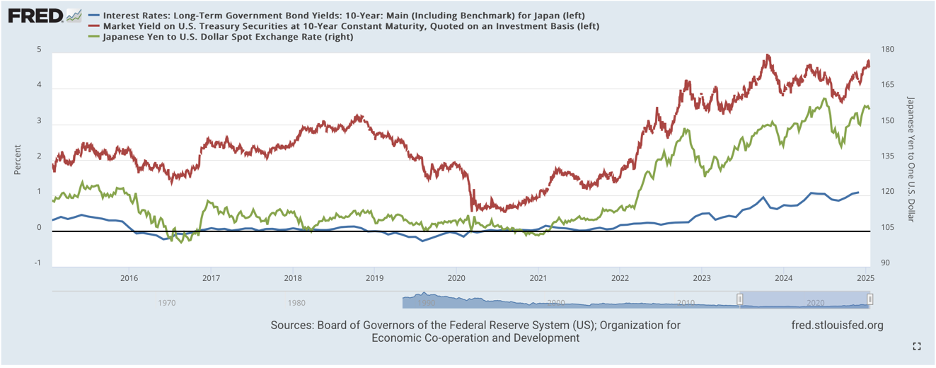
There has been a background narrative that explains the BOJ’s ongoing tightening is going to reach a point where Japanese investors are going to repatriate much of their overseas investment, driving a forceful upward move in the yen and having major negative impacts on risk assets around the world as liquidity retreats.  This is based on the idea that the Japanese are the largest exporters of capital in the world which is one of the key reasons equity markets are rallying everywhere, so if they bring that money home, that means they will sell their foreign equity holdings and buy yen.  While I believe this is a neatly wrapped idea, I would contend Japanese investment prospects are not yet near the same as in the US, so this idea may be premature.  In fact, a look at the chart below showing 10-year US Treasury and JGB yields overlaid with USDJPY indicates that the rate differential is nowhere near where it might need to be in order to encourage that type of behavior.  My take is absent some type of multilateral agreement to weaken the dollar, this will not happen organically.

Source: FRED database

In China, though communists rule
They favor the capital tool
Of equity bourses
And so, Xi endorses
A government stock buying pool

Elsewhere in the world, as we try to get outside the maelstrom that is Donald Trump, I couldn’t help but notice that, once again, Xi Jinping has called on his finance minions to do something, anything, to support the stock market.  And I cannot help but be struck by the irony of the Chinese Communist Party being so concerned about the situation in the most capitalistic institution of all.  The WSJ had an article discussing the latest measures that are on the board, including forcing encouraging insurance companies to increase the local equity portion of their portfolios and utilizing 30% of premium income to buy stocks.  This is on top of the PBOC reducing interest rates last year for companies that want to repurchase shares.

It continues to be very difficult for me to accept the idea that the Chinese are playing 4-D chess with long-term goals in mind while the US is playing checkers.  If that is the case, then the Chinese, or at least President Xi, is a really bad player.  His economy is under dramatic pressure because the property bubble he inflated has been shrinking for the past three years, undermining both the population’s wealth (property was their store of value) and confidence, while he ramps up more beggar thy neighbor trade policies at the same time the US has just elected a president whose middle name is Tariff.  Their population is shrinking because of the ‘foresight’ of their leadership to impose a one-child policy for two generations and while millions of people will risk their lives to immigrate to the US, people are looking to leave China.  Once again, I cannot look at this situation and conclude anything other than the CNY (-0.15%) is going to gradually decline all year long, and maybe not so gradually if pressure really builds.

Ok, let’s take a look at how markets are handling the latest set of Trumpian pronouncements and reactions by targets of his ire.  After yet another rally in the US, albeit on declining volumes so not as exciting as it might otherwise have been, Japanese shares rallied (+0.8%) as investors seem to believe that the interest rate hike tonight will be accompanied by a more dovish stance at the press conference.  Mainland Chinese shares (CSI 300 +0.2%) eked out a gain after the latest news discussed above, although Hong Kong shares (-0.4%) did not follow suit.  After all, the focus is on mainland shares.  The rest of the region was widely dispersed with gainers (Taiwan, Singapore, Philippines) and laggards (Korea, Australia, Thailand), many of these moves in excess of 1%.  It appears investors don’t know which way to turn yet given the speed of changes emanating from Washington.

In Europe, most bourses are modestly firmer (DAX +0.3%, CAC +0.5%) as we continue to hear more from ECB speakers that not only are rates going to be cut, but they are increasingly certain that they will achieve their inflation target.  Maybe they will.  As to US futures, at this hour (7:00) they are mixed to slightly softer with the NASDAQ (-0.4%) the laggard.

In the bond market, the decline in yields appears to be over, at least for now, as Treasuries (+3bps) continue to bounce from their recent lows at 4.54%.  As is almost always the case, this has carried European sovereign yields higher as well, by between 1bp and 3bps across the continent and UK and we saw JGB yields gain 1bp overnight.  I would contend there is still a great deal of uncertainty as to how the Trump administration is going to handle the conundrum of reducing inflation while expanding growth.  Outside of declining energy prices, which may be coming, it will be a tall task, and inquiring minds want to know.

Speaking of energy prices, oil (+0.35%) is edging higher after a lackluster session yesterday.  As with most markets, uncertainty is rife right now although this is clearly an area where Mr Trump is focused on expanding output.  NatGas (-0.3%) is a touch softer as forecasts for the end of the current Polar Vortex keep getting moved up. Metals markets are under some pressure this morning, with gold (-0.3%) backing away from that all-time high level and both silver and copper fading as well.  However, volumes remain light here implying not much interest overall.

Finally, the dollar is a touch stronger this morning, but there are few large movers in either the G10 or EMG blocs.  In fact, every G10 currency is within 0.2% of yesterday’s closing levels and none of them are at extremes.  The biggest loser today is ZAR (-0.6%) which seems to be responding to the precious metals complex backing off a bit overnight.  It remains very difficult to get a read on the dollar with all the other things ongoing.  As it happens, this is one market that has not received any Trumpian attention at all…yet.

We finally have a smattering of data this morning with the weekly Initial (exp 220K) and Continuing (1860K) Claims to be followed by the EIA’s oil inventory data where it appears a modest net build across products is forecast.  With the Fed quiet, and very little focus on Powell and company right now, today looks to be shaping up as another equity focused day with the dollar likely taking its cues there.  While we never know what will hit the tape these days, absent a new surprise vector, there is no reason to look for significant movement today at all.

Good luck

Adf

Cha-Ching

It wasn’t all that long ago
When data would headline the show
As traders would wait
For each release date
And then recount trades blow-by-blow
 
But now there is only one thing
That matters, Trump’s latest cha-ching
He speaks off the cuff
Which makes it quite tough
To plan from Berlin to Beijing


As the morning of the third day of President Trump’s second term dawns, it is nigh on impossible to keep up with all the things he is doing and their actual and potential impacts on markets going forward.  Arguably, the main FX market driver continues to be the tariff discussion and the question of if, and when, he may be imposing said tariffs. You will recall that on Monday, the mere absence of his reaffirmation that tariffs were coming resulted in a major dollar decline, which was subsequently reversed when he finally mentioned them in the evening.

Of course, those were aimed at Canada and Mexico with China, significantly, left out of the mix.  Last night he remedied that situation declaring that China and Europe were also in his sights for tariffs, although he mooted a 10% initial level, far below the 60% he discussed during the election campaign.  Once again, I would argue it is not possible at this point to make any serious market prognostications based on the lack of information as to the products to be impacted, the exact timing and what he is seeking in return for a reduction or elimination of those threats. 

At the same time, I find the strait-laced approach that ‘tariffs are bad and a tax on Americans which will lead to inflation’ which continues to be promulgated by orthodox academic economists, typically from a left-leaning lens, to be almost comical at this point.  We all should remember that during his first term, he imposed many tariffs, especially on China, and yet inflation was quiescent, with CPI averaging 1.9% during the entire term.  This is not to say things will be identical in 2024 and beyond, just that in fairness, his record demonstrates that tariffs are not necessarily inflationary.  Below is a chart of the monthly readings showing only 8 of the 48 months he was in office that headline CPI rose more than 0.3%, implying the rest of the time it was at or below that level.  Those were the days.

Source: tradingeconomics.com

Beyond the tariff discussion, the bulk of his time currently seems to be focused on the size of the government workforce, which is certainly due to shrink, and the border and immigration.  What will market impacts of these issues be like?  For the former, I would suggest that less government employees will lead to less government interference in the workplace, and arguably, be beneficial for productivity if nothing else.  As to the latter, it is a much more difficult problem to solve as there will likely be reductions in both labor supply but also demand for services like housing.  It seems quite possible that there will be a reordering of the economy, although it is unclear if that will lead to a net positive or negative from an overall growth perspective, or at least an inflation perspective.  Growth, of course, is the product of the size of the workforce * productivity, so a smaller workforce, if that is the outcome, will weigh on topline GDP, but not necessarily on per capita GDP.  As I mentioned above, there are far more unknowns than knowns at this time, so forecasting the future is a mug’s game.

As we keep in mind that nobody knows anything about the future, let’s take a look at what happened overnight amid all the knee-jerk reactions to the latest Trump comments.

Yesterday saw US equity markets continue in their winning ways seemingly trying to achieve new highs.  In Asia, the follow on was broad with Japan (+1.6%), Korea (+1.2%) and India (+0.75%) all nicely higher although Chinese shares suffered.  This should be no surprise now that Trump has squarely put China on the tariff map again, but there are other things happening here as well.  Perhaps the most confusing is the word that financial workers would be seeing pay cuts of up to 50% as President Xi no longer sees them as critical workers for the nation.  I’m sure this will help rebalance the consumption-production equation…not!  So, it should be no real surprise that both mainland (-0.9%) and Hong Kong (-1.6%) shares were under pressure.

Not so the case in Europe where the DAX (+1.2%) is leading the way higher although gains are universal, after comments from several ECB bankers that rate cuts were coming next week and likely will continue during the year.  While inflation remains the sole ECB mandate, the weak economic situation plus the threat of tariffs certainly has Madame Lagarde under pressure to do something to support the economy there.  Finally, it should be no surprise that US futures are nicely higher this morning with the NASDAQ (+0.9%) leading the way at this hour (7:15).

In the bond market, yields have stabilized after their recent 20bp decline in the past week and have edged higher by 1bp this morning.  The same price action has been seen in Europe where sovereign yields are little changed to higher by 2bps across the continent.  As to JGB yields, they, too, were unchanged on the session despite an increase in chatter that the BOJ is set to hike rates on Friday.

In the commodity space, gold continues to rally and is now within 1% of its all-time highs set back in late October.  This has dragged silver along for the ride, and copper, in truth, although today copper is ceding -0.6%.  however, a look at the price movement over the past month shows all three metals nicely higher (Au +5.3%, Ag +3.7%, Cu +6.2%).  Oil (0.0%) is flat today as it consolidates its recent retracement.  Recall, for the first two weeks of the year, it rallied sharply, up nearly $10/bbl, although it seems that may have been more of a short squeeze than a fundamental shift in thinking.  Since then, it has given back about $4/bbl as market participants try to decide if the theorized Trumpian demand increase will offset the supply increase of drill, baby, drill.

Finally, the dollar is little changed this morning overall.  That said, net over the past week, it has given back about 1.5% although that was from recent highs.  This price movement feels far more like consolidation than a change in view especially given that the tariff story remains front and center.  Now, it is possible that the market pushed the dollar higher ahead of the inauguration on a ‘buy the rumor’ idea and is now selling the news, but it remains difficult to see what has changed in the US economy relative to its counterparts that would encourage a change in rate expectations.  As to today’s movement, there are more gainers than laggards vs. the dollar, but nothing of any real significance.

On the data front, the only US data is the Leading Indicators (exp 0.0%) so traders will continue to look at corporate earnings and listen to the president for the next pronouncement.  I assure you; I have no idea what that will entail.  Once again, I am a strong proponent of being hedged because the one thing we have learned lately is that markets can turn on a dime.

Good luck

adf

A Trump Trope

For one day the markets expected
That tariffs were roundly rejected
But late yesterday
Trump said the delay
Was short with two nations affected
 
The upshot is all of that hope
That saw the buck slide down a slope
Has largely reversed
As dollar shorts cursed
That tariffs are not a Trump trope


This poet feels vindicated in not trying to anticipate what President Trump is going to do that might impact markets after yesterday’s events.  Early in the day there was a story that tariffs would be delayed and were seen as negotiating tools, not punishment.  FX traders (mis)read the room and sold the dollar aggressively, with the greenback suffering declines of more than 1% against some currencies, notably MXN.  Then, Mr Trump was inaugurated, made a speech, where he promised to make many changes within the operating system of the US, signed a load of Executive Orders and mentioned in a press conference much later in the evening that 25% tariffs on Mexico and Canada would be coming on February 1st.  The chart of USDMXN below shows the price action with the peso having given back the bulk of yesterday’s gains.

Source: tradingeconomics.com

Once again, if we learned nothing from Trump’s first term, it is that anticipation of his moves is a very fraught and dangerous way to manage market risk.  Now, will those tariffs actually be implemented?  Will they be universal if they are?  Or does he anticipate changes from behavior by both nations in the next 10 days?  The answer is, nobody knows, probably not even Trump.  The upshot is if you have financial market risk, hedging is critical to maintaining acceptable outcomes.  And, oh by the way, look for implied volatility of all financial products to rise as market makers also have no idea what is going to happen so will require hedgers to pay up for protection.

In Davos, the world’s glitterati
Are meeting, and though they are haughty
They’re losing their splendor
And edicts they render
Are sinking in value like zloty

While there is a great deal more that President Trump has promised to do immediately, the bulk of it seems likely to only have potential longer-term impacts on financial markets.  Meanwhile, in Davos, the World Economic Forum is under way and the main message that I can discern from what I’ve read is that, the members really liked it when everybody listened to what they said and are now really unhappy that President Trump is essentially raining on their parade and devaluing their views and comments.  With Trump withdrawing from the Paris Climate Accords and the WHO, key global initiatives are severely hamstrung, which means the WEF is less important.  And all their pronouncements regarding the need free trade and global cooperation has far less impact if the US has decided to focus on itself rather than the world at large.  My forecast is that by the end of Mr Trump’s term, the WEF will be a sideshow, not a headline event.

And really, at this point, that is pretty much what is happening.  Yes, UK Unemployment rose to 4.4% while wages rose 5.6%, but this has simply put the BOE in a tougher spot.  The Old Lady has only an inflation mandate, but if Unemployment is rising, they cannot ignore that, and the market is now far more convinced (82% probability) that they will be cutting the base rate by 25bps at their meeting the first week of February.  While the pound (-0.8%) is lower this morning, that seems much more about the dollar’s overall strength than this weaker than expected data point as since the release, the pound has fallen only another 0.2%.

So, let’s look around the world and see how markets responded to Trump 2.0.  Equity markets in Asia were largely in the green as neither Japan nor China were mentioned on the immediate tariff list, although the late-night proclamation regarding Canada and Mexico implies that this story has not yet been completed.  Nonetheless, gains in Japan (+0.3%), Hong Kong (+0.9%) and China (+0.1%) showed the way for most of the region with only India (-1.6%) really suffering during the session on a variety of fears regarding tariffs and interest rates despite no mentions by Trump.  In Europe, only Spain’s IBEX (-0.5%) is showing any movement of note and that appears to be specific to some slightly softer than expected corporate earnings results.  Surprisingly, Germany and the rest of the continent are little changed, as is the UK.  As to US futures, at this hour (7:10) they are pointing higher by about 0.4% in anticipation of more earnings reports today and a generally positive attitude from the new president.

In the bond market, Treasury yields have fallen 5bps overnight, seemingly on the idea that because Trump announced the government would do all it can to reduce prices, and therefore inflation, it would magically work.  While I am optimistic things will get better, that is a heavy lift in my opinion and the Fed will need to be far more emphatic on its inflation fighting actions to see this through.  In Europe, yields are basically unchanged across the board and similarly, there was no movement in Asia overnight.  Once again, the world is looking toward the US for directional cues.

In the commodity markets, oil (-1.3%) is sliding back as Trump’s promise to open up more drilling spaces on federal land as well as his overall encouragement of ‘drill, baby, drill’ has traders concerned that supply is going to come around more quickly than demand.  Last January I wrote about my view that there is plenty of oil and it is merely political will that prevents it from being accessed.  I have a feeling that is what we are going to begin to see, a change in that political will which means potentially lower prices and increased demand accordingly.  In the metals markets, gold (+0.5%) is continuing to climb as we approach month end.  There are many in this market who believe the technical picture (see chart below) is pointing to a break to new all-time highs soon.  However another, and perhaps more accurate narrative, is that there is an arbitrage between the NY, London and Shanghai exchanges for physical metal and metal is flowing into NY for delivery which begins next Friday. (H/T Alyosha)

Source: tradingeconomics.com

As to the other metals, they are little changed this morning.

Finally, as mentioned at the top, the dollar is much firmer across the board this morning with the peso and NOK (-1.0%) leading the way lower although most currencies seem to be down by at least -0.5%.  (Yes, PLN is weaker by -0.6%).  This is all dollar-driven with no other idiosyncrasies of note right now.  We shall see how this evolves over time.

On the data front, the rest of the week looks like the following:

WednesdayLeading Indicators0.0%
ThursdayInitial Claims218K
 Continuing Claims1860K
FridayFlash Manufacturing PMI49.6
 Flash Services PMI56.6
 Existing Home Sales4.16M
 Michigan Sentiment73.2

Source: tradingeconomics.com

The Fed is in its quiet period so with the lack of data, I suspect that markets will have heightened awareness to every Trump pronouncement with volatility the new normal.  Remember, consistency is not his strong suit, at least when it comes to commentary about how he may respond to things.

From the market’s perspective, as long as tariffs are still seen as the likely outcome, look for the dollar to remain well bid while equities will see a mixed performance depending on the nature of the company/industry with importers likely suffering.  

Good luck

Adf