Doesn’t Make Sense

In England they call it the pence
But now it just doesn’t make sense
While pennies will still
Live in the cash till
We’ll speak of them in the past tense
 
And as to the shutdown, Trump signed
The CR to leave it behind
While this is good news
It won’t change the views
Of those who are not Trump aligned


For 230 years, the penny was a staple of the US currency system with more than 300 billion currently in circulation.  Of course, I don’t know that I would call them in circulation as they are generally sitting next to the cashier in a dish to be used since most folks don’t want to deal with them, or in a jar in the bedroom where they remain as people cannot throw out something valuable, but don’t want to bother with them either.  Let’s say they are in existence.  But given the rise in the price of copper, as well as the rise in general inflation, the Treasury estimates that it costs about 3.7 cents to mint each one, obviously a losing trade.  While they will remain legal tender, be prepared for everything to be rounded to the nearest nickel soon.  I guess there is no better description of inflation than the fact that the penny has outlived its useful life.  An interesting tidbit, the last coin discontinued by the Mint was the half-penny, which ended in 1857.

On to more important things, last night, President Trump signed the CR and ended the government shutdown.  It strikes me this was a whole lot of politics with no substantive changes to anything.  But it, too, is now history and we move on.  It was interesting to me that there was not a broad “sell the news” outcome as the equity rally early in the week appeared to be based on the prospects that this would occur.  Perhaps that will be today’s trade, although the futures at this hour (7:00) are little changed.  But no matter, there appear to be an increasing number of cracks in the façade of ever higher asset prices.  While the DJIA did set another record yesterday, the NASDAQ slipped.  I don’t foresee a smooth path ahead for risk assets, especially with havens continuing to perform well.

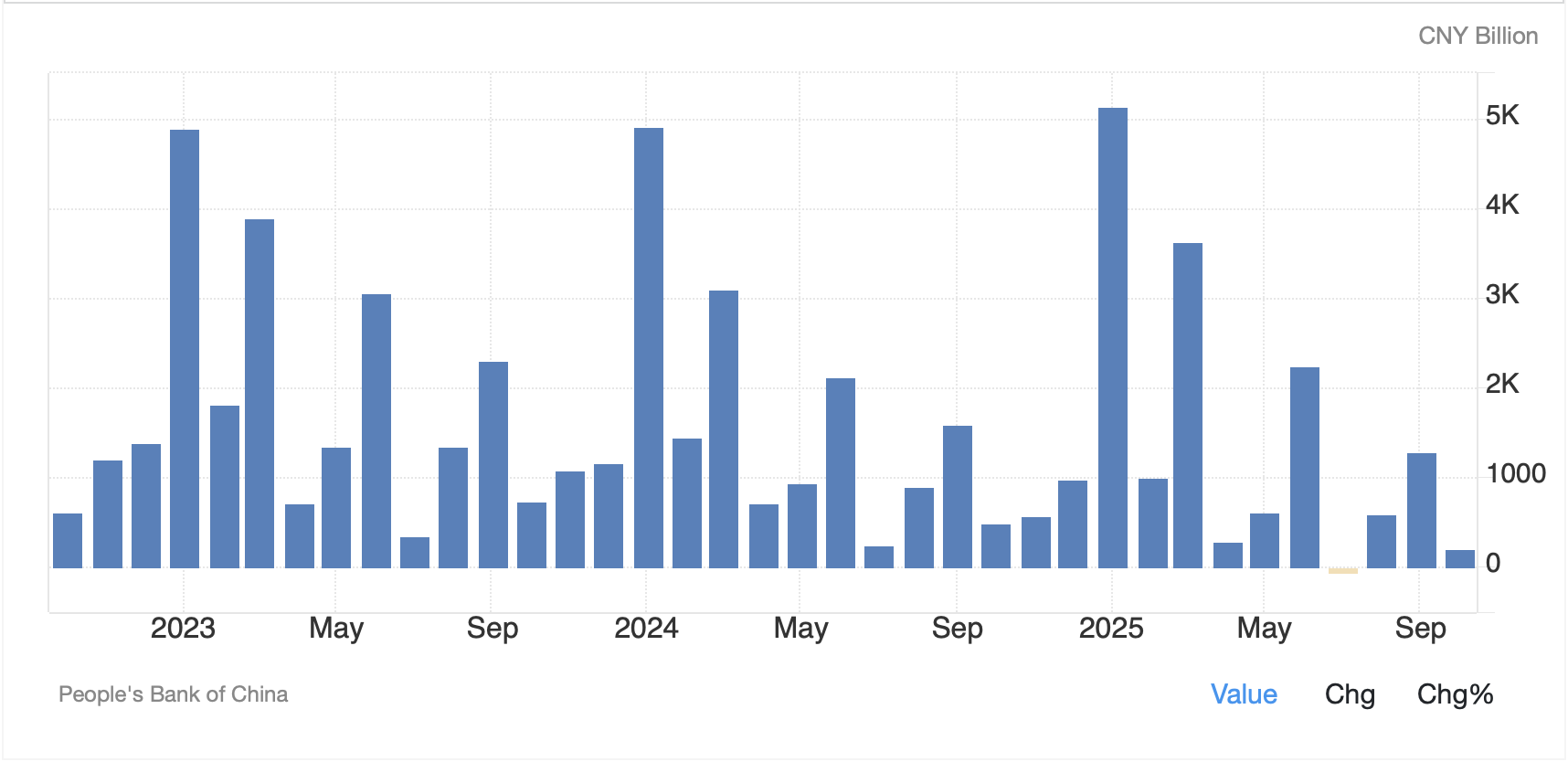
The last thing of note this morning was Chinese monetary data which was released last night.  Remember yesterday’s story about the ‘phantom’ loans?  Well, apparently, that has not been enough to keep the flywheel turning on the mainland as New Bank Loans fell to CNY220 billion, down more than CNY 1 trillion from September and well below last year’s October data of CNY 500 billion as per the chart below from tradingecomomics.com.  There is huge seasonality in this data, with every January showing massive growth, but looking at the past three years of data, my eye tells me things are slowing regularly despite their alleged 5% GDP growth.

Despite the 4th Plenum declaring they would be focusing on increasing domestic economic activity, President Xi continues to have a difficult time growing the economy organically.  The ongoing GDP targets warp investment decisions which result in overproduction of goods and massive infrastructure spending which drives up debt issuance.  The problem with this cycle is the lack of domestic consumption means that the returns on that infrastructure are terrible, likely negative, and so while building the stuff increases GDP, having it sit there idle doesn’t do anything once its built.  For now, investors continue to believe in the growth story, and I’m confident that Xi Jinping will never allow economic data to be released that would counter that narrative, but trouble is brewing there in my mind.  Just not today!

And that’s really the news this morning, at least from what I’ve seen, so let’s look at markets overnight.  The official end of the government shutdown was widely lauded in Asia with Tokyo (+0.4%), HK (+0.6%) and China (+1.2%) all closing higher in the session.  Korea (+0.5%) also rallied but elsewhere in Asia, things were less satisfactory with Australia, New Zealand and Taiwan all under modest pressure while India was unchanged.  

In Europe, the FTSE 100 (-0.6%) is slipping after weaker than expected GDP data with the Y/Y number slipping to 1.1% while IP fell -2.5%.  It is difficult to look at the chart of GDP below and get the sense that the UK economy is in very good shape.

Source: tradingeconomics.com

All this is with the backdrop of the Starmer government getting set to release its latest budget in just under two weeks and expectations they are going to be raising income taxes yet again as revenues cannot keep up with their welfare state promises.  The problem they have is the pound is not the global reserve currency nor are Gilts the global reserve asset, so it appears the Gilt vigilantes are alive and well although the bond vigilantes remain in hibernation.  As to the continent, the DAX (-0.6%) is also suffering despite no data releases while the CAC (+0.4%) is managing to rally.  The rest of the bourses are generally little changed with all eyes focused on the UK to see how they handle their problems.  Of course, virtually every country on the continent has the same problems!

In the bond market, after sliding -4bps yesterday, 10-year Treasury yields have backed up 2bps this morning.  we are seeing similar price action on the continent with virtually all sovereign debt showing rises of between 1bp (France) and 3bps (Germany, Netherlands), once again mostly tracking the Treasury market.

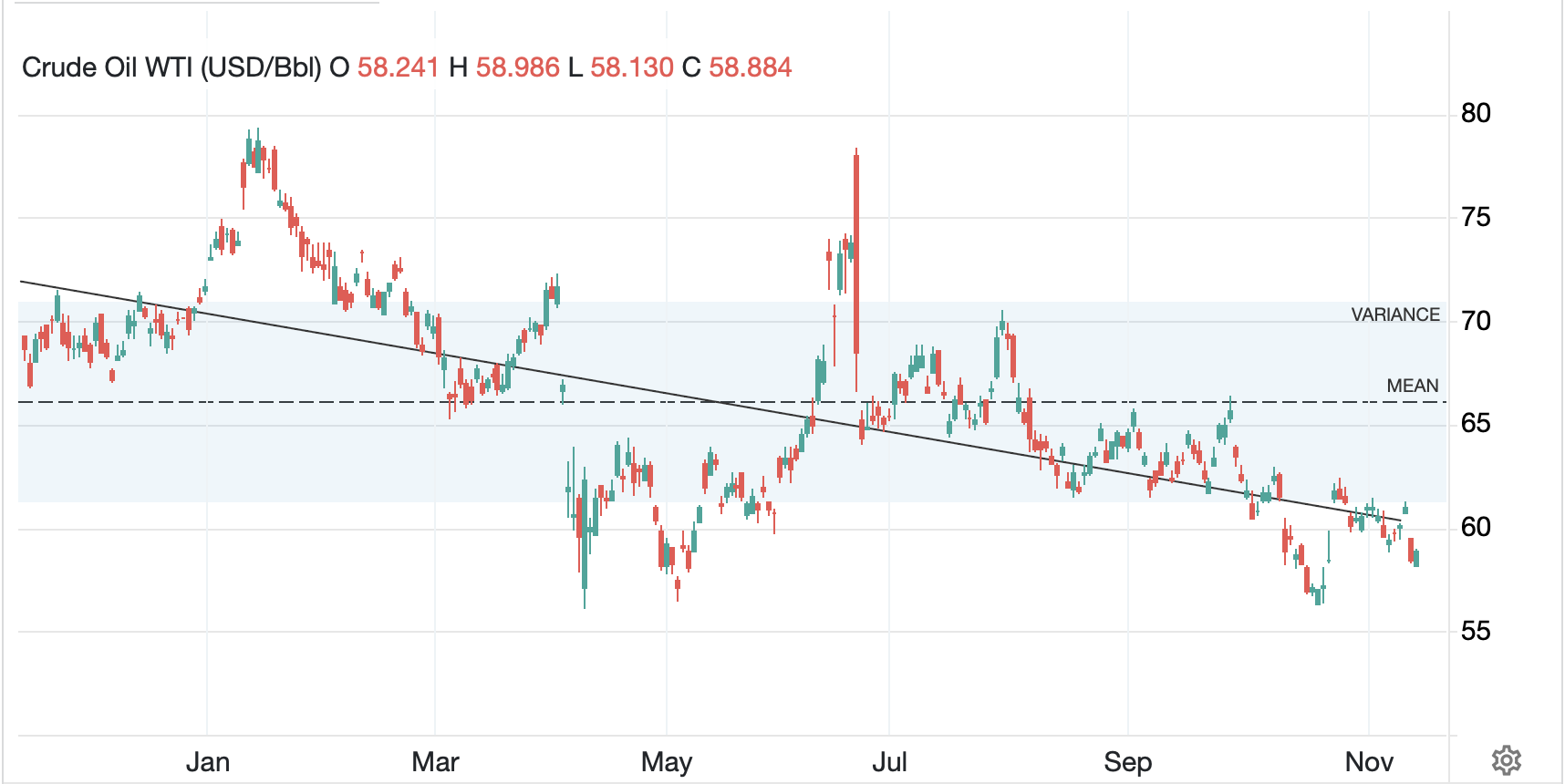
In the commodity space, oil (+0.7%) is bouncing after a disastrous session yesterday where it fell nearly $2/bbl on news that the IEA increased its supply forecasts (2.5 MM bbl/day) significantly more than its demand forecasts (780K bbl/day).  Certainly, this is aligned with my longer-term bearish view on oil and a look at the chart below shows the trend over the past year remains firmly downward.  Do not be surprised if we get to $50/bbl next year.

Source: tradingeconomics.com

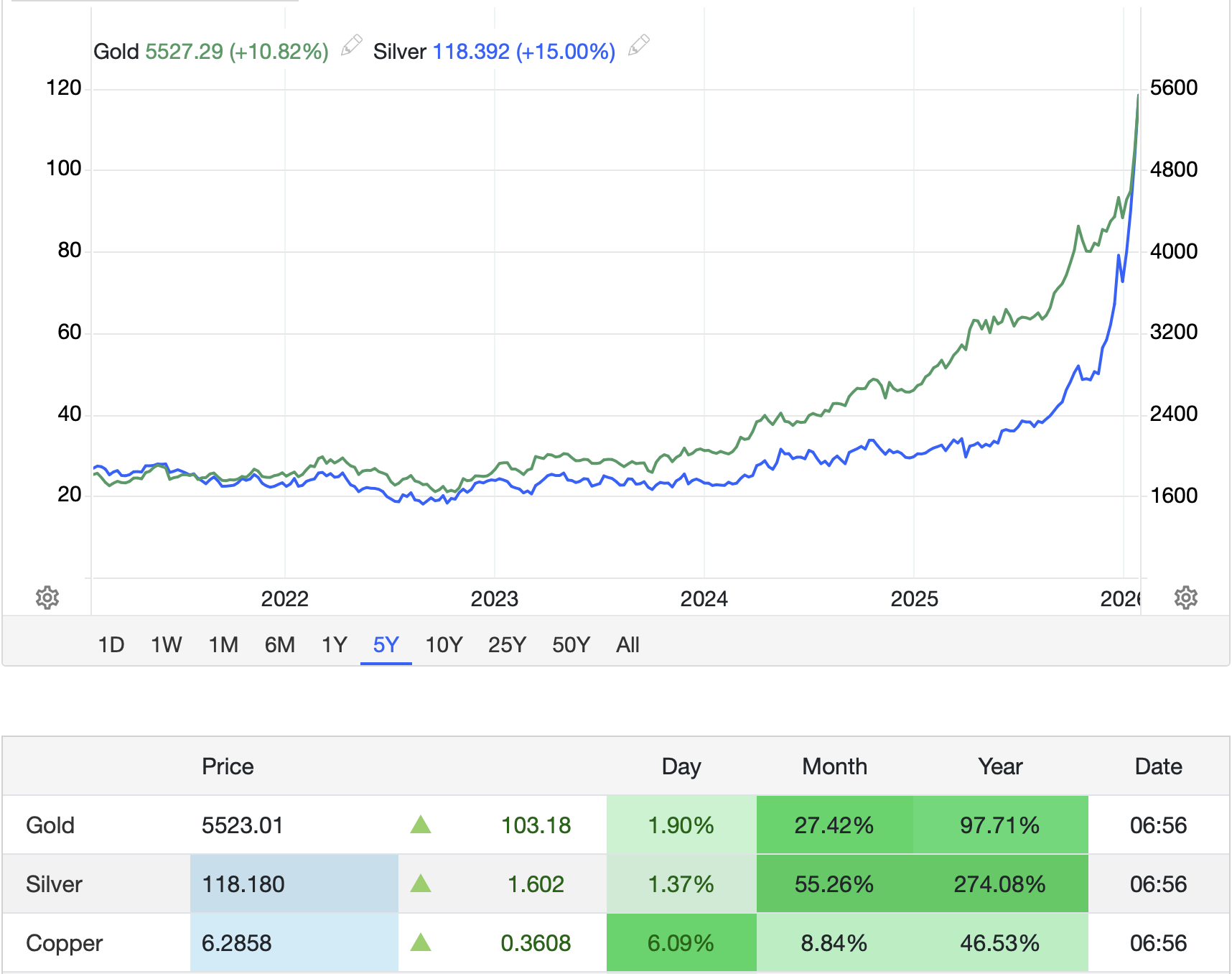
Turning to the metals markets, the rally continues across base and precious this morning and this steady climb after a sharp pullback a few weeks ago seems to have real legs.  This morning, we see gold (+1.0%), silver (+1.3% and pushing its recent ATH), copper (+0.9% despite the loss of penny demand) and platinum (+1.2%).  When governments run it hot, precious metals benefit.

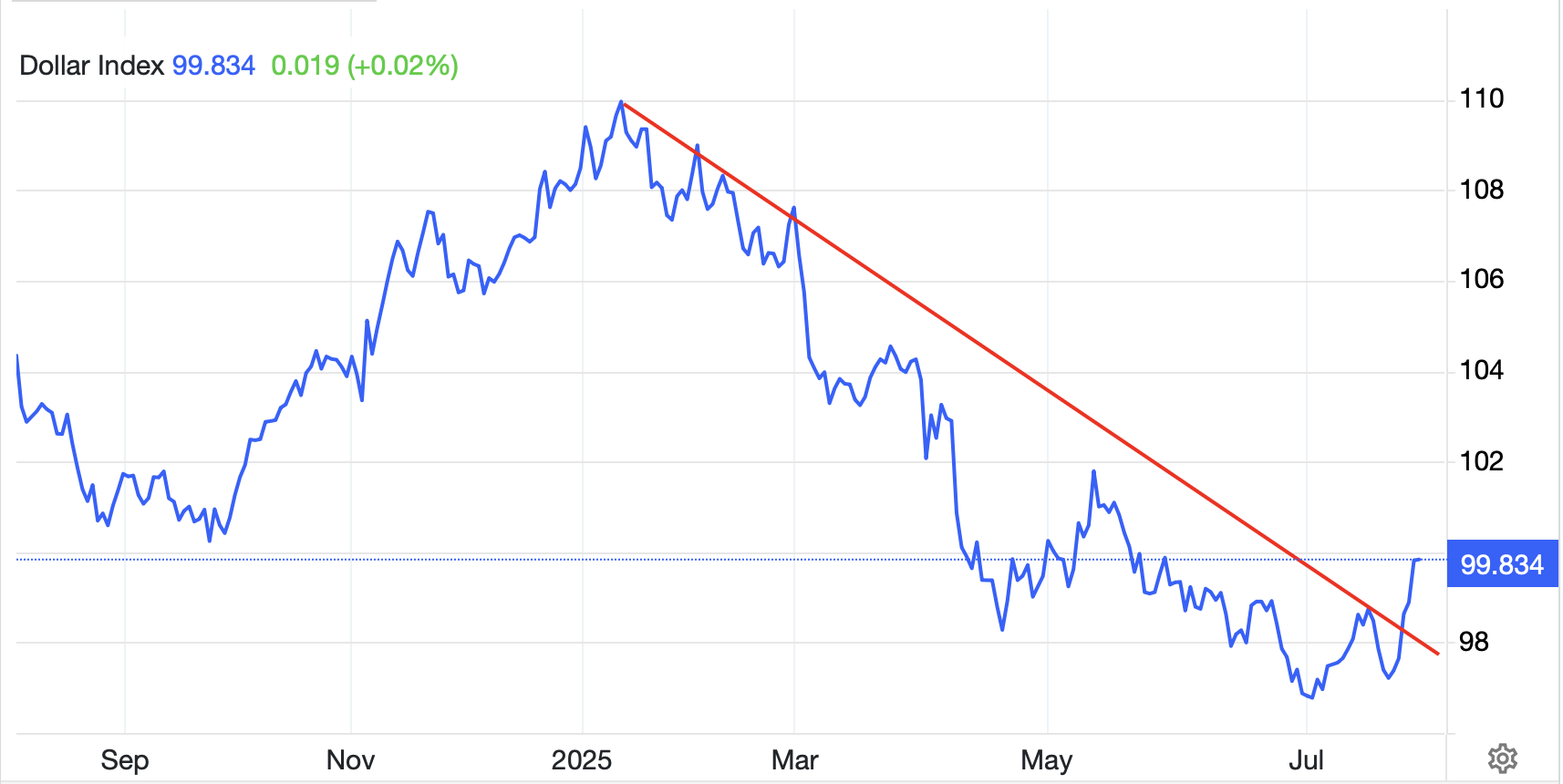
Finally, the dollar is softer this morning with the DXY (-0.25%) slipping back to the middle of its narrowing trading range as per the below chart.

Source: tradingeconomics.com

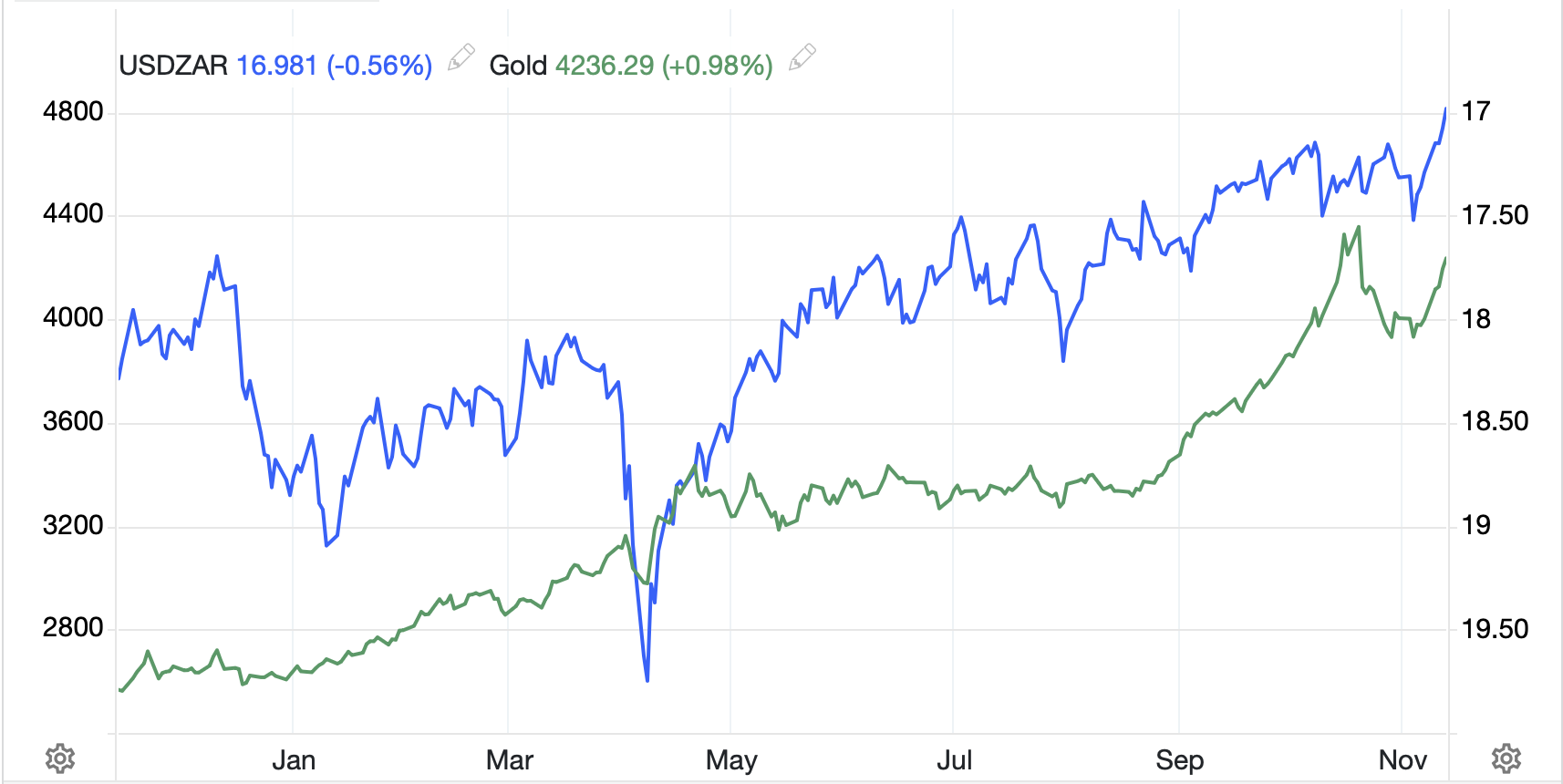
The weakness is universal, though with G10 and EMG currencies stronger across the board.  ZAR (+0.6%) is the leader today as the dollar has fallen back below 17.00 for the first time since January 2023 as it continues to benefit from the rally in gold and platinum.

Source: tradingeconomics.com

It strikes me that if one were so inclined to play a long-term trend in currencies, long ZAR vs. short NOK might be a very interesting way to play the dichotomy between oil’s ongoing decline and gold’s ongoing rally.  But everything is firmer vs. the dollar with the pound (+0.3%), euro (+0.2%) and AUD (+0.3%) highlighting the G10.  In the EMG bloc, CLP (+0.5%) is benefitting from copper’s rally while the CE4 are all higher by 0.3% to 0.4%, mirroring the euro’s rise.  Even CNY (+0.25%) is higher despite the weak monetary data.  Not to be outdone, both MXN (+0.2%) and BRL (+0.3%) are in thrall to a weaker dollar.

While the government is open now, given the closure, no data has been collected so it is not yet clear when we will be seeing the next set of numbers.  Yesterday’s Fedspeak showed caution the watchword regarding more cuts which has led the futures market to reduce the probability of a December cut to just 54% this morning and a definite change in flavor for the curve overall.  It is somewhat surprising that the dollar is not performing better given this adjustment in views. 

Equity prices feel extended and the fear and greed index continues to sit in extreme fear despite the seemingly daily record highs.  I am uncomfortable with stocks overall here and believe they are due for a reckoning, or at least a correction.  But metals have nowhere to go but up.

Good luck

Adf

Just a Bad Dream

Before yesterday traders whined
‘Bout how much that vol had declined
But President Trump
Caused copper to dump
And still, Chairman Powell, maligned
 
So, chaos is now the new theme
Though most hope it’s just a bad dream
And ere the week ends
Based on recent trends
We could see, results, more extreme


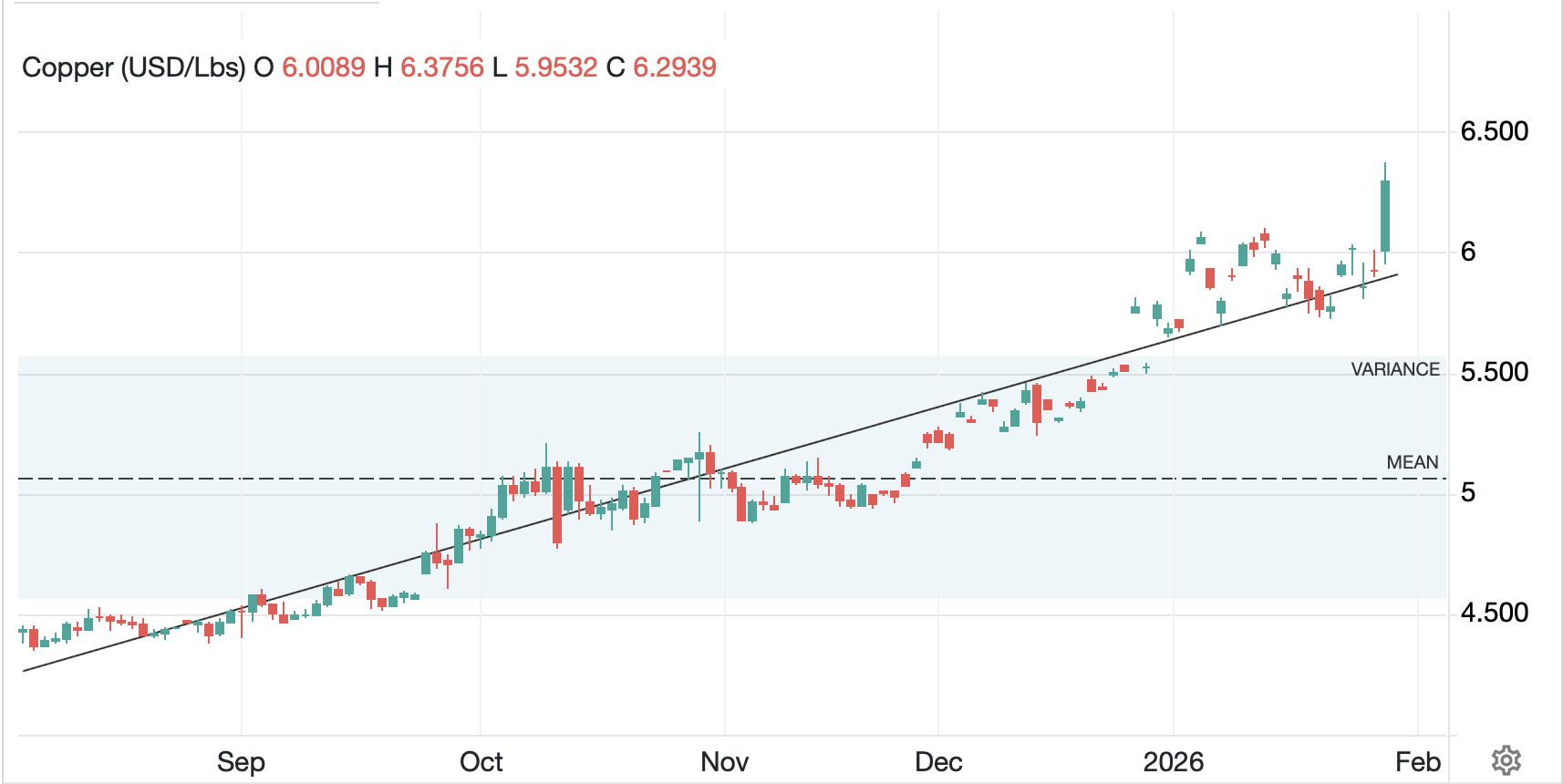
It isn’t often that copper is the talk of the town, but this is a new world in which we live, and as I’ve repeatedly explained, all that we think we knew about the way things work, or have worked in the past, is generically wrong.  It is with this in mind that I lead with a chart of the copper price, which after having rallied dramatically back in April, after Liberation Day, and again in July, both times on the back of tariff announcements, collapsed yesterday when President Trump altered the conversation by explaining that tariffs on copper would not be on the raw metal itself, but rather on refined products instead.  As you can see from the chart, this resulted in a massive decline, nearly 23% in the past twenty-four hours. 

Source: WSJ.com

Essentially, the US price, as traded on the COMEX, returned to be in line with the ROW price, as traded on the LME.  That doesn’t make the move any less dramatic, but the question of how long those price differentials could be maintained was always an open one.  At any rate, that was the biggest mover of the day yesterday and naturally, it had knock-on effects elsewhere with the entire metals complex falling sharply (Au -1.85%, Ag -3.0%, Pt -9.7%) as well as some currencies that are linked to those metals like CLP (-1.5%) and ZAR (-1.4%).  Remember how much complaining there was because market activity had slowed so much?  I bet most folks are looking wistfully at that pace this morning!

Turning to the other key focus of yesterday, the FOMC meeting, the FOMC statement was exactly as expected, with continued focus on “solid” labor market conditions and moderate economic activity acting as the rationale to leave rates on hold.  As widely expected, both Governors Bowman and Waller dissented, each calling for a 25 basis point cut.  The two schools of thought continue to be 1) headline data releases have been masking underlying economic weakness (declining home sales, declining air travel and restaurant activity); and 2) while those issues may be real at the margin, the fact that financial markets continue to rise, with significant speculative activity in things like meme coins and cryptocurrency in general, as well as Private Credit, indicate there is ample liquidity in the market and no reason to adjust policy.

This poet, while not a PhD economist (thankfully!), comes down on the side of number 2 above.  There has been talk by numerous, quite smart analysts, about the underlying weakness in the economy and how the data would be demonstrating it very soon.  Whether it is the makeup of the employment situation, the housing market showing a huge imbalance of homes for sale vs. buyers (at least at current prices) or the added uncertainty of tariffs and how they will impact the economy, this story has been ongoing for more than three years without any proof.  In fact, yesterday’s GDP reading for Q2 was a much higher than expected 3.0%, once again undermining the thesis that the economy is already in a recession.  If so, it is the fastest economic growth ever seen in a recession.

In fact, I do not understand the rationale for so many that a rate cut is necessary.  I realize the market continues to price a 60% probability of a cut in September and about 35bps of cuts by year end, but it makes no sense to me.  In fact, the market is pricing for 110 basis points of cuts through 2026.  Now, either market participants are anticipating a significant slowdown in inflation, which given all the tariff talk seems unlikely, or they see that recession on the horizon.  At this point, I have come to believe it is nothing more than wishful thinking because there is such a strong belief that Fed funds rate cuts lead to higher equity prices, and after all, isn’t that the goal?

Chairman Powell, despite all the pressure he receives from the White House, has not budged.  In this instance, I believe he is correct.  After all, if the data suddenly implodes, the Fed can cut far more substantially and do so on an intermeeting basis if necessary.  Remember, ahead of the election, he cut rates 50bps for no discernible reason based on the data.  Unemployment had risen from 3.9% to 4.2% over the prior three months and that was enough to scare him (although there was clearly a political motive as well).  If the Unemployment Rate rises to 4.5% on September 5th, they could cut that day if they thought things were really unraveling.  If the Fed is truly data dependent, then the data does not yet point to a major economic problem.  And the one thing we know about the Trump administration’s policies is they are going to try to run the economy as hot as possible.  That does not speak to lower interest rates.

Ok, let’s look at how markets around the world absorbed these changes, and how they are preparing for today’s PCE and tomorrow’s NFP data.  Despite all the noise, the DJIA was the worst performer yesterday, sliding just -0.4%, while the NASDAQ actually rallied at the margin, +0.15%.  And this morning, futures are pointing much higher (NASDAQ +1.4%, SPU +1.1%) as both Meta and Microsoft beat estimates handily.

Overnight, while Japanese shares (+1.0%) rallied nicely, China (-1.8%) and Hong Kong (-1.6%) significantly underperformed as weaker than expected PMI data put a damper on the idea that stimulus was going to solve Chinese problems.  A greater surprise is that Korea (-0.3%) didn’t perform better given the announcement that they had agreed a trade deal with the US with 15% baseline tariffs, although that may have been announced after the markets there closed.  But the rest of Asia had a rough session with most key regional exchanges (Singapore, Philippines, Indonesia, Malaysia) all declining about -1.0% with only Taiwan (+0.35%) on the other side of the ledger.  However, if we continue to see strength in the US tech sector, and trade deals keep getting inked, I suspect these markets will be able to rebound.

In Europe, the picture is also mixed, with the CAC and DAX essentially unchanged after in-line inflation readings, while Spain’s IBEX (+0.5%) reacted positively to Current Account data while the FTSE 100 (+0.5%) rallied on strong earnings data from Rolls Royce and Shell Oil.

Perhaps the most interesting aspect of yesterday was how the bond market sat out the chaos.  Treasury yields edged higher by 2bps yesterday and this morning they have fallen back by -1bp.  European sovereign yields this morning are essentially unchanged, although a few nations have seen yields slip -1bp.  In many ways, I feel that this is confirmation that despite a lot of noise, not much has really changed.

Oil (-0.5%), is giving back some of yesterday’s $2.00/bbl surge which was based on more sanctions talk from President Trump on Russia and reviving the discussion on 100% secondary sanctions on nations that import oil from Russia.  While EIA data showed a major inventory build, the talk was more than enough to spook traders.

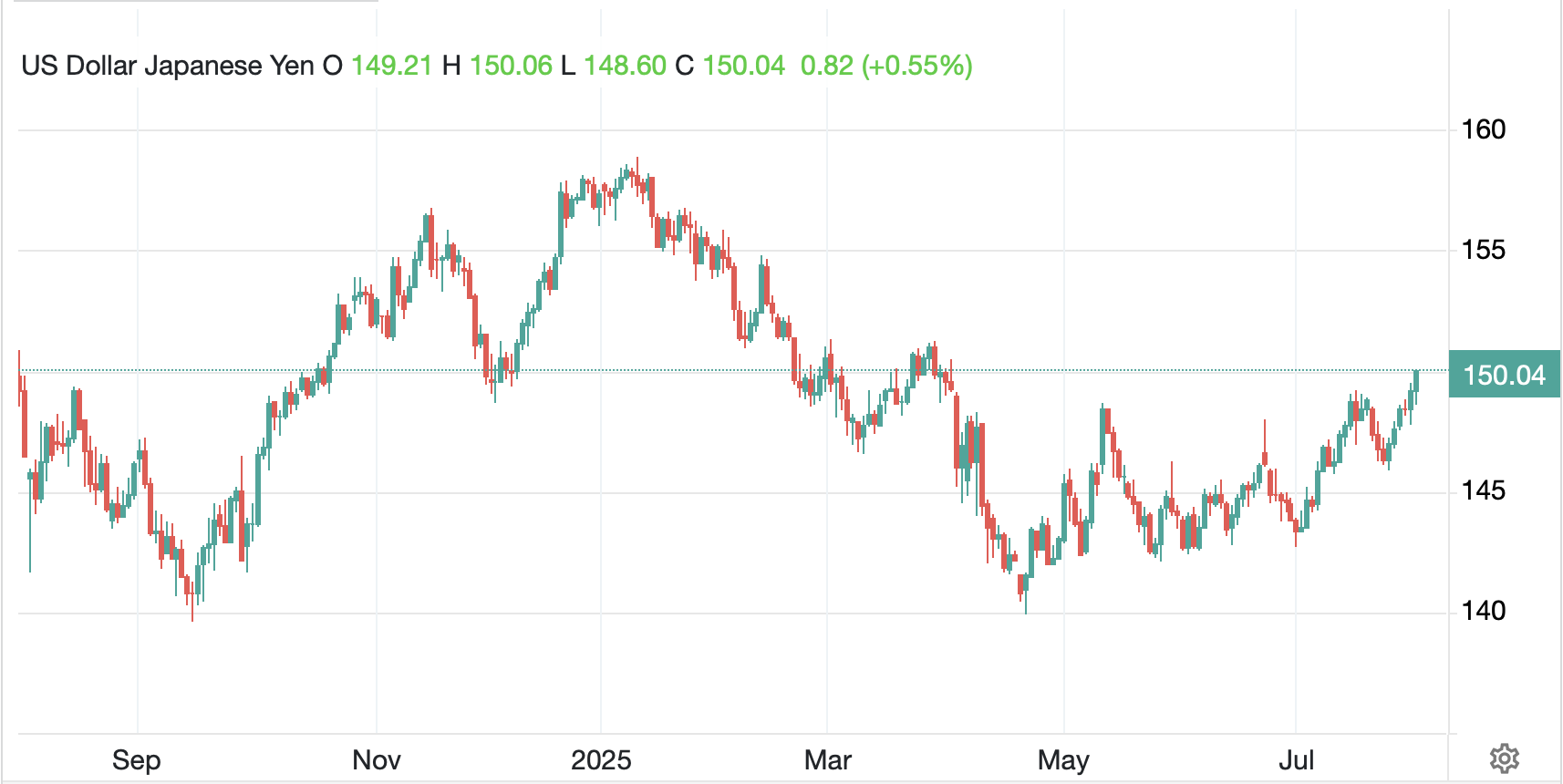
Finally, currency markets, which have seen dollar strength for the past several sessions, are relatively calm this morning, at least in the G10, where the DXY is unchanged, although at its highest level since just before Memorial Day.  In that bloc, JPY (-0.5%) is the laggard after the BOJ left policy on hold, as expected, and while the yen has not been the market’s focus lately, it is back to 150.00 this morning for the first time since March.

Source: tradingeconomics.com

Remember all the talk about the end of the carry trade and how the yen was going to explode higher?  Me neither!  As to the EMG bloc, other than the aforementioned metals focused currencies, there has not been much movement in this space either.  However, overall, while the longer-term trend has clearly been lower, this bounce looks more and more like it is gaining strength.  The DXY is a solid 2% through the trendline and a move to 102 seems well within reason in the near term.

Source: tradingeconomics.com

On the data front, this morning brings Initial (exp 224K) and Continuing (1960K) Claims, Personal Income (0.2%) and Spending (0.4%) and PCE (0.3%, 2.5% Y/Y headline, 0.3%, 2.7% Y/Y Core) all at 8:30.  Then at 9:45 we see Chicago PMI (42.0).  There are no Fed speakers and assuming today’s data is in line, I expect that all eyes will turn to earnings from Apple and Amazon after the close and then NFP tomorrow.  So, despite yesterday’s volatility, I see a respite for the day.

Good luck

Adf

Heartburned

There’s no one surprised that the Fed
Did nothing, and here’s what Jay said
We’re not in a hurry
To cut, but don’t worry
If things change, we can cut ahead
 
The narrative now has returned
To Trump, which has many concerned
That in the short run
The things that he’s done
Will leave many traders heartburned


As universally expected, the Fed left policy unchanged yesterday.  Everything we had heard from FOMC members prior to the quiet period indicated they had to be patient to see how things played out regarding the impact of tariffs.  Apparently, Chairman Powell used the term “wait” or some version of that idea 22 times in the press conference.  Tomorrow, the Fed speakers hit the circuit again, but absent some change in data, which will take at least another month or two, I don’t see that the Fed is relevant again for a while.  

I will note that the market is currently pricing only about a 17% chance of a cut at the June 18 meeting though they are still pricing in 3 cuts for the year.  It appears that the idea of a H2 recession is gaining ground amongst both the punditry and the futures market.

However, contra to that message, the bigger news of the day is that President Trump will be announcing, at 10am, the first trade deal in the new era, this one with the UK.  It strikes me that this should be the easiest of trade deals to negotiate since both economies produce the same types of things.  Neither has a labor cost advantage, and there is great commonality between them with respect to the overall culture.  Arguably, the biggest advantage the US has is its energy sector has not been destroyed by the government, something PM Starmer is working hard to accomplish on his end.  Realistically, the trade deal here is going to be more about services than goods I suspect, given that’s what drives both economies.  I guess we will learn later today.

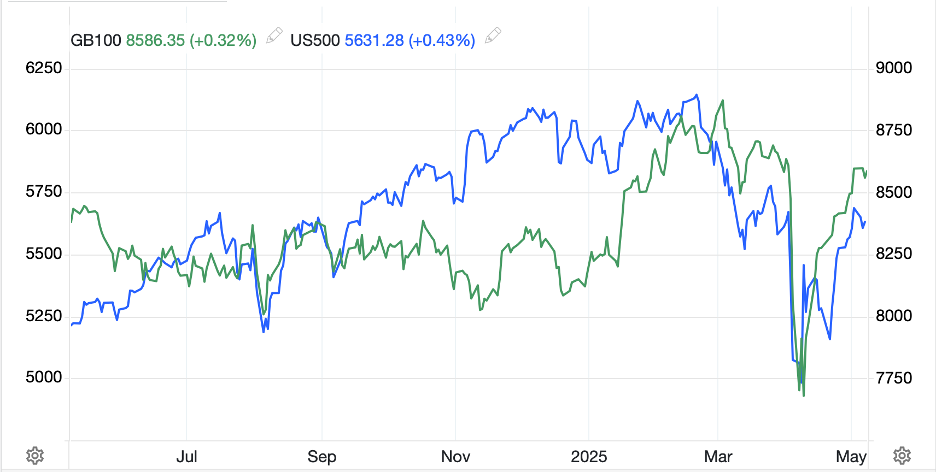
In a modest surprise, UK equities (FTSE 100 +0.4%) do not seem to see the benefits of such a deal, as they lag most of the rest of Europe.  Too, the BOE is expected to cut its base rate by 25bps this morning, which in isolation would ordinarily be seen as a positive for stock markets.  Perhaps, this is why the UK is the first to say yes, things there may be worse than meet the eye.  After all, the stock market there is higher by just 2% in the past year, hardly a breathtaking performance.  In fact, as you can see below, the FTSE 100 and S&P 500 have had very similar performances this year, tracking each other closely, although despite all the angst about recent volatility in US markets, the S&P is still 8% higher in the past year, decently outperforming the UK.

Source: tradingeconomics.com

Stepping back for a moment from individual markets, my take is the following: President Trump is keen to sign a number of key trade deals in this 90-day window.  If they agree deals with the UK, Japan, South Korea, Taiwan, Canada and Mexico, all of which seem quite possible, it will reduce the uncertainty and accompanying stress in markets.  If, as well, Congress can get the ‘big, beautiful budget bill’ passed, thoughts of recession will quickly dissipate.  Obviously, the China trade talks will still be outstanding, but both sides need to find a solution here.  While the punditry in the US will continue to harp on how those tariffs are going to kill the US economy, China has already shown they are having problems and need to come to an agreement.  It is quite possible that Mr Trump can be successful in his aims to reorder the nature of world trade such that the US reduces its deficits without destroying the world.  I think I am going to take the over on this question.

In the meantime, let’s see how markets have behaved overnight.  Yesterday saw US equity markets rally modestly after the Fed and that followed through in Asia, with modest gains being the best description.  The Nikkei (+0.4%), Hang Seng (+0.4%) and CSI 300 (+0.5%) all seemed to benefit from the US and hopes for a reduction in trade anxiety.  Of note in Asia was India (-0.5%) and perhaps more tellingly Pakistan (-6.0%) as the escalation in military conflict between those two nations has grown even hotter.  I expect that market impact will remain more isolated as neither market is a key destination of foreign capital, at least if the actual military conflict doesn’t spread into other areas.

Turning to Europe, both Germany (+1.1%) and France (+1.0%) are having very good days with both markets ostensibly responding to the news of the impending UK trade deal and perhaps some hopes there will be one with the EU.  As well, German IP data was released at a much better level than expected (3.0% vs. 0.8% expected), an indication that companies there are gearing up for all that mooted military spending.  As to US futures, at this hour (7:00) they are all higher by at least 1.0% with the NASDAQ higher by 1.6%.  

In the bond market, Treasury yields are higher by 4bps this morning, having recouped the declines yesterday.  But still, the 10-year hovers either side of 4.30% and has done for the past month as you can see in the chart below.  If anything, it appears that the trend remains toward modestly lower rates.

Source: tradingeconomics.com

In Europe, sovereign yields are also climbing slightly, higher by between 2bps and 3bps this morning and we saw similar movement in JGB markets overnight.  Frankly, bond markets have not been very exciting lately.

In the commodity markets, oil (+1.6%) is continuing its recent bounce from the lows seen Sunday night, but WTI remains below $60/bbl.  There is growing talk that at current prices, capex is going to decline and supply along with that, but you cannot look at what is happening in Guyana, for instance, as they seek to exploit the massive new oilfield discovered in their coastal waters last year and think that oil supply is going to shrink.  As well, OPEC+ looks set to produce all out.  I do not see a good case for higher oil prices in the near term.  Meanwhile, gold (-1.0%) is giving back some of its recent rebound gains, but nothing about the recent price action indicates to me that the bigger picture trend higher is over.  However, today, it is weighing on both silver (-0.2%) and copper (-0.8%).  

As aside about copper.  The red metal has been nicknamed Dr Copper given its importance in industrial activity.  Hence, when demand is strong, it foretells strong economic activity and vice-versa.  With that in mind, what does the below chart of copper tell you about economic activity?

Source: tradingeconomics.com

What it tells me is that this, too, is a former economic signal that had been reliable in the old world view but has lost its way as a signpost of future activity in the new world view.

Finally, the dollar is modestly stronger this morning, most notably vs. the yen (-0.6%) and INR (-0.8%). The latter is clearly suffering on the impacts of some negative military news, having lost several fighter jets and drones, while the former seems to be responding to the story that Mr Trump will not lower tariffs with China ahead of the first meetings that are upcoming this weekend, and that had been demanded requested by the Chinese to start talking.  Too, NZD (-0.6%) is softer but elsewhere, there is far less of interest overall with the euro unchanged and the pound edging higher by 0.25% after the BOE cut rates 25bps, as expected, but the vote was 7-2, with two MPC members voting for no change, a slightly more hawkish outcome than expected.

On the data front, this morning brings the weekly Initial (exp 230K) and Continuing (1890K) Claims data as well as Nonfarm Productivity (-0.7%) and Unit Labor Costs (5.1%).  Yesterday’s EIA oil inventory data showed modest draws, as expected and didn’t seem to matter much to the market.  It is difficult to get too excited about much these days as the landscape remains highly uncertain.  If, and it’s a big if, President Trump can come to agreement on trade deals with a number of countries, I suspect that we will see uncertainty wane and markets continue higher.  But the Fed won’t be cutting rates in that scenario.  Ultimately, though, I do believe that a lower dollar will be part of many of these deals, and for now, a lower dollar still seems the most likely outcome.

Good luck

Adf

They Will Get Burned

In Europe, the corporate elite
Have started, their worries, to bleat
They’re now quite concerned
That they will get burned
If dollar sales start to retreat
 
For years, when the dollar was rising
Weak unit sales, it was disguising
But now the buck’s falling
Which they find appalling
As earnings forecasts, they’re downsizing
 

Markets are very interesting constructs.  Not only do they help find a clearing price for supply and demand of something, but they also tend to take on anthropomorphic characteristics in many eyes as some type of creature beyond anyone’s control, but with a tinge of malevolence.  Part of that latter feeling comes from markets’ ability to make every pundit seem like a fool.  After all, it was just 3 days ago when I was reliably informed by the punditry that equity values were set to collapse as the US economy entered a depression.  It seems we may have to wait a few more days for that situation to play out.  And, in fact, they have now changed their tune.  While ascribing the rebound to President Trump’s reversal on some issues, the overall doom and gloom story has moved to the background.  But if there is one thing I have continuously discussed since Trump’s election is that volatility was very likely to increase, and that has certainly been the case. 

Shifting our focus to the FX markets, though, I couldn’t help but chuckle at a Bloomberg article this morning titled, The Dollar’s Slide is Raising Red Flags for Corporate Earnings.  As I am based in the US, the fact that this was a front-page article had me somewhat confused.  A long career in speaking with corporate accounts on FX made it clear that a weak dollar was the best thing for earnings of US multinationals.  Generally, when the dollar was strong, CFOs would ascribe any earnings problems to that issue as a catch-all excuse, but when the dollar declined, outperformance by a company was the result of brilliant execution.

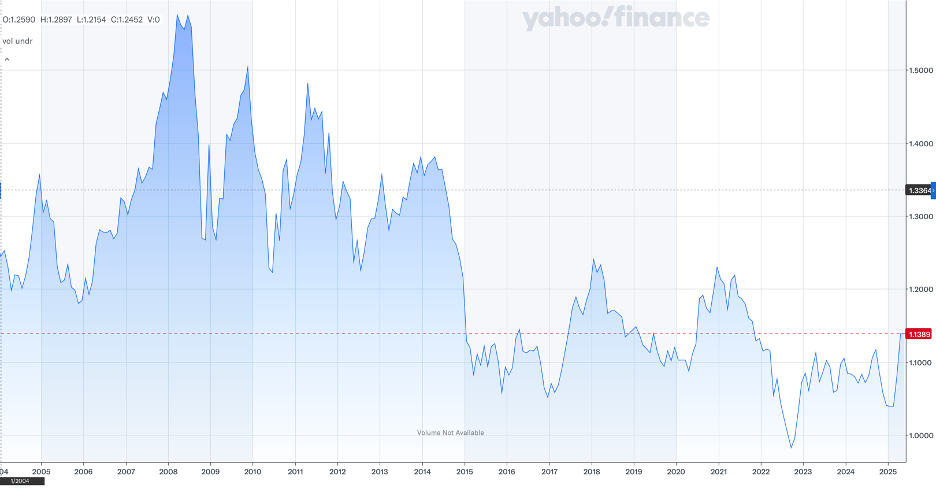
So, you can understand my initial confusion.  But upon reading the article, it turns out they were talking about European corporates, who for the first time in three years find that hedging their US dollar sales is critical.  Not only that, but they have also been quick to highlight that all new hedges will be at worse rates and therefore future earnings are already sure to be impacted.  Now, a quick look at the chart below does show that the euro has risen to its highest level in three years.  But it also shows that compared to the past 20 years, the euro is nowhere near high levels. In fact, it sits well below the median price (somewhere in the 40th percentile actually).  Perhaps European corporate Treasurers have simply forgotten their history.  Or more likely, just like US corporate Treasurers when the dollar is rising, they are seeking a scapegoat.

I cannot emphasize enough that the FX rate is not the driver, but the release valve for all the things that happen in the global economy.  Other actions take place, whether interest rate changes, policy or market, economic adjustments, policy or market, or exogenous events, and the FX rate is the place where equilibria are found.  In fact, arguably, that is the biggest flaw in the Trump administration’s idea that if they weaken the dollar, it will solve policy problems.  The dollar is the tail to the economy’s dog.

In the meantime, the reason one runs a hedge program with consistency is to mitigate the big moves in FX and their impacts on earnings.  But remember, even the best hedge programs lag large secular moves.

Ok, I’ll step down off my high horse and let’s look at how markets behaved overnight.  After yesterday’s second consecutive rally in the US, the picture elsewhere in the world is more mixed.  In Asia, the Nikkei (+0.5%) continued its rebound but the Hang Seng (-0.75%) and CSI 300 (-0.1%) saw no benefit overnight.  Elsewhere in the region winners and losers were pretty evenly split and nobody saw a movement of more than 0.8% in either direction.  In Europe, red is today’s color, but it’s a pale red with losses across the board of the 0.1% to 0.25% variety.  The only news overnight was German Ifo data, which showed a bit of a surprising uptick in the current business climate as well as expectations.  Perhaps the promise of more German fiscal largesse is outweighing concerns over tariffs.  As to US futures, they, too, are lower by about -0.15% at this hour (7:20).

In the bond market, yields are sliding around the world with Treasuries (-3bps) continuing to back away from their recent highs while European sovereigns see yields decline between -3bps and -4bps.  Even JGB yields slipped -1bp overnight.  My take is some of the fear has ebbed away from the market.

In the commodity markets, oil (+1.1%) remains in its recent trading range, with a still very large gap above the market in price terms.  The demand story seems fixed at weakening demand because of either slowing growth, or the electrification of everything or something like that, while the supply story is starting to see hints that oil companies are going to back off production with prices at current levels.  The latter feels like the larger short-term risk, although nothing has changed my longer-term view of lower prices here.  In the metals markets, gold (+0.7%) is rebounding after a difficult two days, arguably some real profit taking was seen.  Meanwhile silver (-0.5%) which actually outperformed gold for the past two sessions is giving some of those gains back and copper (+0.8%) is continuing its rebound after a dramatic decline from the all-time highs seen just one month ago.  Talk about a V-shaped recovery!

Source: tradingeconomics.com

Finally, the dollar is softer this morning, giving back about half of yesterday’s 1% gains.  In the G10, SEK and NOK (both +1.1%) are leading the way although the euro (+0.6%) is having a good day, as is the yen (+0.75%). The pound (+0.5%) is a bit of a laggard but after seeing this interview of Ed Miliband (UK Secretary of Energy and Climate Change), and his either inability to understand the implications of his policy, or his willingness to lie about it, I cannot believe the pound will continue to track the euro.  The UK’s energy policy appears designed to destroy the UK economy.  Consider that solar power is a key pillar of their future efforts to achieve net zero carbon emissions, and the UK is the nation that gets the least solar coverage in the world.  After all, it rains there half the time.  Meanwhile, the government is keen to end all other sources of energy.  No matter what you think of President Trump’s policies, they are not nationally suicidal like the UK’s.

Turning to the EMG bloc, gains are the norm, but not universal.  The CE4 are doing well but ZAR (-0.2%) and KRW (-0.6%) with the latter suffering from weaker than expected GDP growth in Q1 while the former, after a strong run since early in April, appears to merely be taking a breather.

We finally see some notable data this morning with Initial (exp 222K) and Continuing (1880K) Claims, Durable Goods (2.0%, 0.3% ex-Transport) and the Chicago Fed National Activity Index (0.11) all at 8:30, then at 10:00 we get Existing Home Sales (4.13M).  Yesterday saw New Home Sales pick up more than expected and the Beige Book indicate that economic activity was unchanged from the past, but uncertainty had risen.

Here’s what we know; the world is not ending but it is continuing to change from the structures created in the post WWII period.  This process is just beginning and anybody who claims to know where things are headed is lying.  I continue to believe in my bigger picture views, but day to day, there is no rhyme or reason, especially given the importance of headline bingo.

Good luck

Adf

Missing in Action

The PPI data was shocking
Though previous months took a knocking
So, what now to think
Will CPI sink?
Or will, rate cuts, it still be blocking?

One of the features of the world these days is that the difference between a conspiracy theory and the truth has shortened to a matter of months.  I raise this issue as yesterday’s PPI data was remarkably surprising in both the released April numbers, with both headline and core printing at MUCH higher than expected 0.5%, while the revisions to the March numbers were suspiciously uniform to -0.1% for both readings.  The result was that despite the seeming hot print, the Y/Y numbers for both core and headline were exactly as forecast!

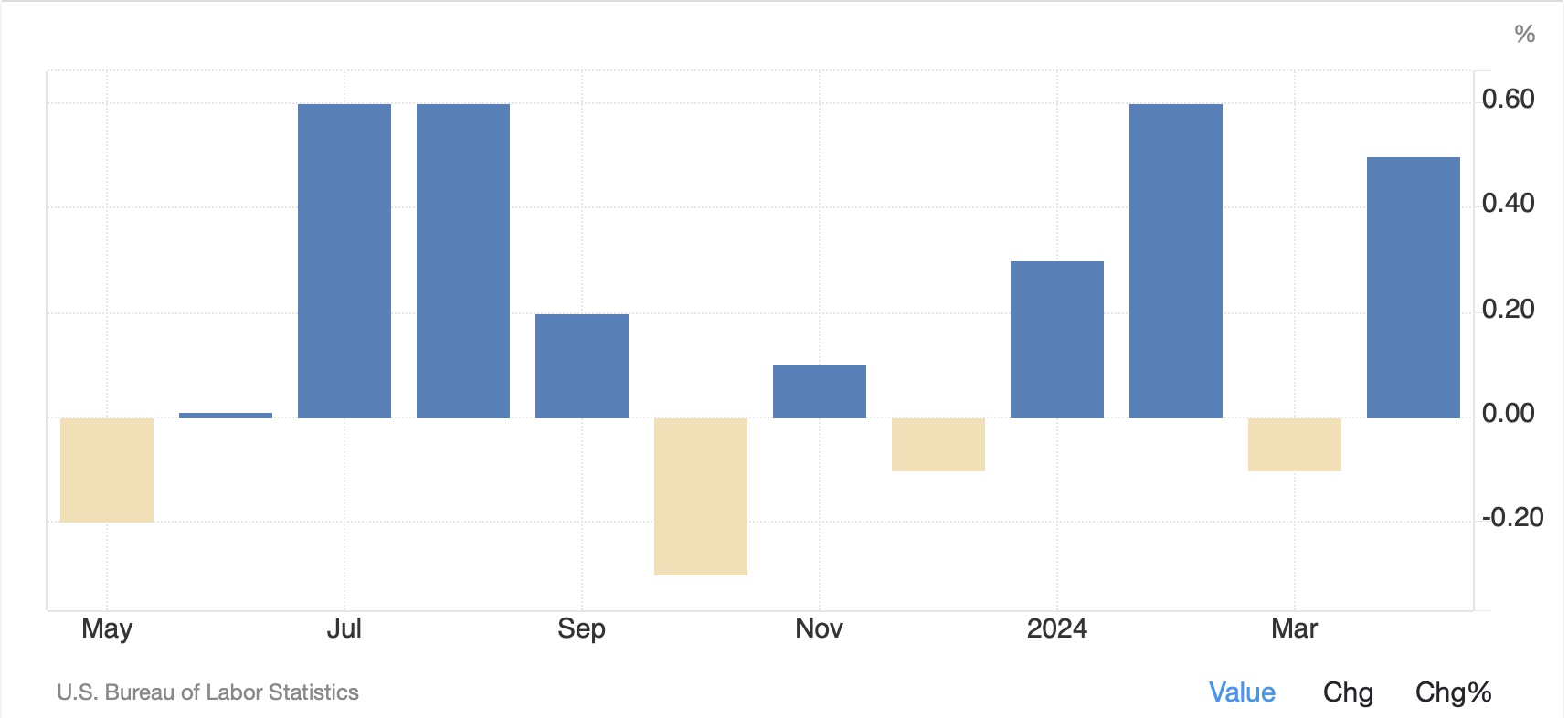
One of the things we know about data like PPI and CPI is that they are calculated from a sampling of data of the overall economy and there are fairly large error bars for any given reading.  In that sense, it cannot be surprising that the data misses forecasts regularly.  As well, given the sampling methodology, the fact that there are revisions is also no surprise.  But…it would not be hard for someone to suggest that the Bureau of Labor Statistics, when it saw the results of the monthly readings, manipulated the data to achieve a more comforting (for the current administration, i.e., their bosses) result.  I am not saying that is what happened, but you can see how a committed conspiracy theorist might get there. Now, in fairness, a look at the headline reading, on a monthly basis, for the past year, as per the below chart, shows that this is the 4th month in 12 that there was a negative reading.

Source: tradingeconomics.com

So, the fact that the revision fell to a negative number cannot be that surprising.  But it certainly got tongues wagging!  FWIW, I continue to believe that the process is where the flaws lie and that the BLS workers are trying to do their job in the best way they can.  In the end, though, much more attention will be paid to this morning’s CPI than to yesterday’s PPI.

For Jay and his friends at the Fed
His confidence ‘flation is dead
Is missing in action
Henceforth the attraction
That higher for longer’s ahead

Which brings us to Chairman Powell and his comments at the Foreign Bankers’ Association in Amsterdam yesterday.  In essence, he didn’t change a single thing regarding his views expressed at the last FOMC meeting, explaining he still lacked confidence that inflation would be reaching their 2.0% target soon.  As such, there is no reason to believe that the Fed is going to cut rates anytime soon.  As of this morning, the Fed funds futures market has a 9% probability of a rate cut priced for June, up from 3% yesterday, and a total of 45bps of cuts priced for the year.  There is obviously still a strong belief that the Fed will be able to act, although I am not sure why that is the case.  Interestingly, on the same panel, Dutch Central Bank president Klaas Knot essentially guaranteed an ECB cut in June.  As well, yesterday morning we heard Huw Pill, the chief economist at the BOE also talk up the probability of a June cut.  From a market response perspective, though, given these cuts are largely assumed, it will take new information to drive any substantive movement in the FX markets.

Here’s one thing to consider for everyone pining for that rate cut.  Given the history of the Fed always being behind the curve when it comes to policy shifts, if they realize they need to cut it is probably an indication that things in the US economy have turned down rather rapidly.  We may not want to see that either.  Just sayin!

In China, a new idea’s floated
Though not yet officially quoted
In thinking, quite bold
All houses, unsold,
Will soon be, for homeless, devoted

Ok, let’s move on from yesterday to the overnight session and then this morning’s CPI and Retail Sales reports.  The first thing to note was the story from Beijing that in an effort to deal with the ongoing property crisis in China, the government, via regional special funding vehicles that borrow more money, is considering buying all the unsold homes from developers, at a steep discount, and then converting them into low-cost affordable housing.  In truth, I think this is an inspired idea on one level, as it would allocate a wasted resource to a better use.  On the other hand, the idea that the government would issue yet more debt seems like a potential future problem will grow larger.  As of now, this is not official policy, but the leak was clearly designed as a trial balloon to gauge the market’s response.  Not surprisingly, the response was that the Shanghai property index rose sharply, but the rest of the Chinese share complex was in the red.  At the same time, the PBOC left rates on hold last night, as expected, but the CNY (+0.3%) managed to rally nicely on the combination of events.

But away from that China story, very little of note happened as all eyes await the CPI later this morning.  After yesterday’s somewhat surprising rally in the US, Asia beyond China had a mixed performance with some gainers (Australia, Taiwan, South Korea) and some laggards (Hong Kong, New Zealand, Singapore) as investors adjusted positions ahead of the big report.  In Europe, too, the picture is mixed although there are far more gainers than laggards.  In the end, none of the movement is that large overall, so also indicative of waiting for the data.  Finally, it will be no surprise that US futures are basically flat at this hour (6:30).

In the bond market, traders decided that the hot April number was to be ignored and instead have accepted the idea that inflation is not really that hot after all.  At least that is what we might glean from the price action yesterday and overnight where yields initially jumped a few basis points before grinding down over the session and closing lower by 4bps.  This morning, that decline has continued with a further 2bp drop in Treasuries.  In Europe this morning, sovereign yields are seeming to catch up to the Treasury price action with declines across the board of between 6bps and 8bps.  Part of that is also a result of changing expectations for Eurozone growth and inflation with a growing belief that inflation is headed lower and the ECB is set to cut and continue to do so going forward. 

In the commodity markets, the big story has been copper (+2.4%), which has rallied parabolically and is currently above $5.00/lb, a new all-time high.  This takes the movement this week to more than 10% and more than 36% in the past year.  The electrification story is gaining traction again, and I guess the fact that nobody is digging new mines may finally be dawning on traders.  Precious metals are coming along for the ride with gold rebounding (+0.4%) on this story as well as the dollar’s recent weakness.  As to the oil market, it is little changed this morning in the middle of its recent trading range.  Perhaps today’s EIA inventory data will drive some movement.

Finally, the dollar is under modest pressure this morning after slipping a bit during yesterday’s session as well.  The combination of the Powell comments being seen as dovish and the interpretation of the PPI data in the same manner (which seems harder for me to understand) weighed on the greenback against virtually all its counterparts.  It should be no surprise that CLP (+0.9%) is the biggest winner given the move in copper.  But JPY (+0.5%) has also performed well with no new obvious catalysts.  In fact, the movement has been quite broad with the worst performers merely remaining unchanged vs. the dollar rather than gaining.  However, this morning’s data is going to be critical to the near-term views, so we need to wait and see.

As to the data, here are the current forecasts: CPI (0.4% M/M, 3.4% Y/Y), core CPI (0.3% M/M, 3.6% Y/Y), Retail Sales (0.4%, 0.2% ex autos) and Empire State Manufacturing (-10.0).  In addition, we hear from two Fed speakers, Minneapolis Fed president Kashkari and Governor Bowman.  However, on the Fed speaker part, especially since Powell just reinforced his post-FOMC press conference message, it seems hard to believe that there will be any changes of note.

And that’s all she wrote (well he).  A hot print will likely be met with an initial risk-off take with both equity and bond markets suffering, but I suspect that it will need to be really, really bad to change the current narrative.  However, a cool print seems likely to result in a major rally in both stocks and bonds and a much sharper sell-off in the dollar.

Good luck

adf

Offsides

The PPI data revealed
Inflation has clearly not healed
Will Jay and the Fed,
When looking ahead
Now tell us one cut’s been repealed?

So, now here we are at the Ides
Of March, as opinion divides
Some still say a cut
Will come in June, but
Some others think, no that’s offsides

Once again, the inflation data did nothing to help the case for a rate cut anytime soon in the US.  This time the PPI data showed that prices rose far more than expected in February, 0.6% at the headline level and 0.3% at the core level.  The rises, when broken down, were across the spectrum of goods and services.  The point is despite what appears to be an overriding desire to cut rates by June, the data is not cooperating for Jay and his friends.  Will this be enough to dissuade them?  We still have 3 more months before the critical time and the market, despite itself, is now putting all its eggs in the June basket, having reduced the May probability to just 7%.  Clearly, it remains highly dependent on how the data progresses, and not just the inflation data, but also the employment data, but for now, I find it hard to make the case that the Fed should be cutting rates anytime soon.

Of course, there remains a large contingent of analysts, economists and pundits who believe that the Fed should cut next week, or May at the latest, as they are already doing grave damage to the economy.  You may recall the immediate response by the Nick Timiraos article to the hotter than expected CPI data.  Well, this morning, we have Bloomberg with an article that claims a solid majority of the forty-nine economists they surveyed continue to look for the first cut in June and three cuts this year.  It certainly appears there is a great effort to convince us that those rate cuts are coming, although as I have maintained, if the Fed is truly data dependent, the data is not pointing to cutting rates as the appropriate move at this time.  This argument discussion will continue for the foreseeable future, that is the only certainty.

Wages have blossomed
Will Ueda-san enjoy
The view, and end NIRP?

The preliminary indication from the Shunto wage negotiations shows that the average wage increases in Japan this year will be 5.28%, the largest rise in decades.  Apparently, Toyota accepted the union’s demands fully and didn’t even offer a counter!  When comparing this outcome to the most recent CPI readings in Japan, which showed a headline rate of 2.2% and a Core of 2.0%, it certainly appears that there could be some wage driven price increases upcoming.  As has been mentioned repeatedly, this was seen as a key issue for the BOJ ahead of their meeting this coming Monday night (Tuesday in Japan) in terms of being a sufficient catalyst for the BOJ to finally raise their overnight interest rate from its current -0.10%.

Now, while Ueda-san’s own words have seemed more circumspect, the growing consensus amongst the analyst community in Tokyo is that the move will happen next week with no need to wait until the April meeting.  But a funny thing has been ongoing in markets while this consensus has been building, the yen has been falling.  While there was essentially no movement overnight, since Monday, when the discussion began to heat up, the yen has declined more than 1.5% in value, almost as though the market is selling the news ahead of the news.  Perhaps of more interest is the fact that 2-year JGB yields have fallen this week by 2bps, which while not a great deal overall, represents a reversal of the gradual increase that has ostensibly been driven by the upcoming BOJ policy tightening.  I have a funny feeling that while NIRP may well turn into ZIRP next week, as the market looks ahead, there is much less tightening perceived in the future.  I have maintained that a move beyond +0.2% would be highly unlikely this year, and possibly next year.  As such, when considering the FX rate, USDJPY remains far more beholden to the Fed and US interest rates than to whatever the BOJ does at the margins.  Let’s face it, if the BOJ hikes rates to 0.2% by December, but Fed funds remains at 5.5%, it is still a very difficult case to buy yen.

And those have been the key stories driving things since I last wrote.  A look at the overnight session shows that Asian equity markets were mixed with the Nikkei sliding a bit, while the Hang Seng fell sharply (-1.4%), perhaps on fears of increased tech stress between China and the US.  However, the CSI 300 managed a small gain despite weak Loan data and the rest of the bloc saw a lot of red on the screen, following the US session losses yesterday.  In Europe this morning, it is the opposite reaction with green across the screen led by Spain (+1.1%) but modest strength everywhere as inflation data from Italy and France seemed to show more moderation.  Meanwhile, at this hour (7:30), US futures are edging higher by 0.3%, essentially unwinding yesterday’s losses.

In the bond market, yesterday’s PPI data saw bonds sell off aggressively in the US with yields across the entire curve rising 10bps.  This morning, Treasury yields have backed off 2bps, but remain at 4.27%, above what is perceived to be a trading pivot level of 4.20%.   European yields also rose yesterday, albeit not quite as aggressively as US yields, and this morning they are essentially unchanged.

In the commodity markets, oil (-0.5%) is giving back a bit of its recent gains but WTI remains above $80/bbl and Brent crude above $85/bbl.  Apparently, the IEA has revised its global oil demand figures higher by more than 1 million bbl/day and despite the fact that there is ample spare capacity in OPEC, the market is tightening right now.  Gold, which sold off yesterday on the rising rates / higher dollar situation, is rebounding a bit this morning, +0.3%.  Interestingly, copper (+1.3%) did not sell off on the interest rate or dollar story and is now back at its highest levels in nearly a year and firmly above $4.00/Lb.  Something is going on here which seems to be a positive hint for growth.

Finally, the dollar, which rocked yesterday, rising almost 0.65% across the board with some significant gains vs. specific currencies, is essentially unchanged overall this morning, holding onto those gains.  In fact, there are a few currencies that are still feeling pressure like KRW (-0.5%) and NZD (-0.5%) but there has been a modest bounce in ZAR (+0.4%) on the back of the strong metals complex.  Net, the DXY is unchanged on the day, back above the 103 level.

We finish the week with some more secondary data as follows:  Empire State Manufacturing (exp -7.0), IP (0.0%), Capacity Utilization (78.5%) and Michigan Sentiment (76.9).  Now, we have seen secondary data have an impact recently, and given the quiet period prevents any Fedspeak, market participants are looking for any clues they can find.  It will be very interesting to see if today’s data indicates that the economy is continuing at its above trend growth rate or implies things are fading.  My observation is manufacturing continues to struggle overall, and sentiment on the economy isn’t great, so I would look for weakness rather than strength.  In that case, perhaps bonds rally further, and the dollar unwinds some of yesterday’s gains.

Good luck and good weekend
Adf