Stanching Their Bleeding

For all of those pundits that claimed
inflation had died and been maimed
The data did show
What now we all know
Inflation is still quite inflamed

The upshot is all those who said
That real rates would soon force the Fed
To quickly cut rates
Are in dire straits
And stanching their bleeding instead

Wow!  Not much else you can say after yesterday’s market activities following the hotter than expected CPI data released in the morning.  As I wrote on Monday, a 0.1% difference in a monthly print is not really substantive in the broad scheme of things, but when the narrative is so strong and so many are convinced that the Fed is itching to cut rates because they don’t want to overtighten as inflation continues to fall, that 0.1% in the wrong direction means a lot.  Hence, yesterday’s price action (which I did presage in the last line of my note yesterday morning before the release.)

Of course, you are all aware that stocks got crushed, with the major indices falling -1.35% to -1.80% while the Russell 2000 small cap index fell -4.0%!  But it wasn’t just stocks, bonds joined the fun with the 10-year yield soaring 15bps to 4.30%, its highest yield since early December.  Gold got crushed, falling $30/oz and back below $2000/oz for the first time in two months, while the dollar exploded higher, rising about 1% against most currencies and almost 1.8% against the yen.

A quick analysis of the CPI data shows that the shelter component was the big surprise on the high side, although airfares also were higher than expected.  As well, wages remain much stickier than the Fed would like to see as they continue to support price increases in the services component of the data.  Forgetting the headline for a moment, a look at Median CPI, as calculated by the Cleveland Fed, shows that last month’s rise was 0.5% and the Y/Y number is +4.85%.  That feels to me like a much better estimate of what is happening than the newest darling of the bullish set, Truflation, which claims that inflation is “really” rising at only 1.39% as of yesterday.  One final thing, hopefully, all of those who claimed that the ‘real’ trend of inflation was sub 2% because the 3-month average had fallen there (please look at Monday’s note, What If?) will finally shut up for a while.

The new Mr. Yen
Said “we are closely watching”
So you don’t have to
Do not cross this line!

As mentioned above, the yen was the worst performer yesterday after the data which, not surprisingly, triggered a response from the Japanese government.  Now that USDJPY is back above 150.00, there are many who believe the MOF/BOJ will be intervening soon.  There is a terrific website called Harkster.com which aggregates all sorts of commentary and research from around the web as well as adding their own commentary.  I highly recommend it as a source for information.  At any rate, they have a very nice description of the historical actions that lead to intervention by the Japanese which I show here:

1.     Language such as “monitoring developments in currency markets”.
2.     “Sudden/abrupt/rapid” movements in currency markets are “undesirable”. In addition, markets are “not reflecting fundamentals”.
3.     “Excessive” is introduced next to describe the price movements alongside “clearly” in addition to referring to FX moves as “speculative”.
4.     Readying for action is normally reflected with the phrase “we are ready to take decisive action” which would suggest some action is imminent.
5.     Price checking is the step prior to actual intervention whereby the BoJ will call round selected Japanese banks and ask for a level of USDJPY. Even though they do not deal the act of them asking normally makes the banks, who have been contacted, sell USDJPY in anticipation of intervention and they will also spread the news around the market to encourage more selling.
6.     Same as 5 but this time the BoJ actually do sell USDJPY. This may happen in waves.
7.     Finally, coordinated intervention with other major central banks involved. This would generally happen early NY hours to include the US. This obviously has the most effect on the markets.

Arguably, we are somewhere between numbers 1 and 2 right now, but they can escalate this process quickly.  However, in the end, what matters for currencies over time are relative fiscal and monetary policy settings.  History has shown that to strengthen a currency, a country must run a tight monetary and loose fiscal policy.  To weaken a currency, the opposite is true.  Given the US 7% budget deficits and highest interest rates in the G10 + QT, it is pretty clear that the dollar should be strong.  Now, if the BOJ were to raise rates aggressively, it would have a chance to alter the trajectory of the yen, but while Ueda-san has implied that they may raise rates back to zero after the spring wage negotiations, assuming they agree large increases, unless there is a strong belief that they are going to continue to raise rates to attack inflation in Japan (which isn’t really a big problem) then absent the Fed starting to ease, there is no good reason to think the yen will strengthen very much at all.  Now, if the Fed does start cutting aggressively, that is a different story, but based on yesterday’s CPI, that feels like it is a long way in the future.

And those are the most noteworthy things to absorb.  Now, a look at the rest of the overnight session shows that Japanese stocks were softer, but the rest of Asia (absent China which is still on holiday) was mixed, with gains and losses around.  Europe, this morning, though is firmer, up about 0.5% except the UK, which is higher by 0.9% after CPI there fell more than expected, encouraging talk that the BOE will be cutting sooner.  Now remember, yesterday the UK lagged after their employment data was stronger than expected, especially wage data, so it is not clear which one to believe.  As to US futures, they are firmer at this hour (8:00), up about 0.5%.

After yesterday’s massive yield rallies, it is no surprise to see them slipping a bit today, with Treasury yields lower by 1bp and most European sovereign yields down by 3bps (UK Gilts are -6bps on that inflation data).  Overnight, the Asian session saw government bonds there slide with yields higher across the board although JGB yields were the laggard, rising just 3bps.

In the commodity markets, oil (flat today) is the only market that didn’t sell off yesterday and it has maintained those gains.  This is despite a much bigger inventory build than anticipated as it seems continued concerns over a wider Middle East war are extant, as is a new worry, as Ukraine has been able to bring the attack to Russia more effectively, sinking another Russian ship in the Black Sea last night.  Recall, they have been attacking Russian oil infrastructure and if they are successful in that effort, it will definitely give oil prices a boost.  But the rest of the commodity markets got crushed yesterday with gold, copper and aluminum all falling sharply.  This morning, though, those three markets are little changed, simply licking their wounds and not extending any losses.

Finally, the dollar is also little changed this morning, but that is after a massive rally across the board yesterday against both G10 and EMG currencies.  Against most major counterparts, it has traded back to levels last seen in mid-November, although the pound has been holding up better than most, with smaller net moves.  It is ironic that the dollar strengthens on a high inflation print as fundamentally, high inflation is supposed to weaken a currency.  Of course, this move has nothing to do with inflation per se, and everything to do with interest rate expectations.

On that subject, it is worth noting that the latest Fed funds futures rate cut probabilities are now; March 8.5%; May 37.9%; and there are now just 4 cuts priced into the year, down from 7 about a month ago.

There is no hard economic data released although the EIA oil inventories do come out later this morning.  We also hear from two Fed speakers, Goolsbee and Barr, and I imagine we could get a little ‘we told you so’ in their comments today.

If recent history is any guide, I suspect that equity markets will rebound a bit further early, but potentially drift lower as the day wears on.  The bulls were clearly shaken as their narrative took a big hit.  But this was just one data point of many.  I don’t believe the end is nigh, but in the longer term, it is not hard to believe that the Fed will remain the tightest policymaker of all the central banks and that will help the dollar while hurting risk assets.

Good luck
Adf
Finally Dead

It’s been, now, two weeks since the Fed
Said rate cuts were not straight ahead
Their confidence lacked
Support to abstract
Inflation was finally dead
 
Which brings us now to CPI
Where analysts identify
Used cars and soft gas
As just ‘nuff to pass
The test and wave ‘flation bye-bye


Finally, the CPI report will be released this morning so we will be able to collectively exhale!  The current consensus forecasts are for a 0.2% M/M rise in the headline, leading to a 2.9% Y/Y outcome and a 0.3% M/M rise in the ex-food & energy reading leading to a 3.7% Y/Y increase.  Those annual numbers would be down from 3.4% and 3.9% respectively.

A key part of the thesis for the ongoing decline is that Used Car prices will continue to fall as well as gasoline prices, which fell about 30 cents/gallon on the NYMEX exchange.  However, rent increases remain stubbornly high and any declines in foodstuffs seem to have ended.  There was a ‘brilliant’ article by a UC Berkeley economist, Ulrike Malmendier, that determined most people’s view of inflation was skewed by the prices of things they bought most frequently, rather than the ‘proper’ economists’ view of the totality of prices.  Who would have thunk it?  Honestly, it is hard to believe that some of these people have degrees at all.

At any rate, the market is highly fixated on the number and there is no doubt that many are looking for a soft outcome and, perhaps, sufficient proof for the Fed to gain enough confidence to cut rates in March.  As it stands, right now the Fed funds futures market is pricing a 15.5% probability of a March cut and a 57.5% probability of a May cut.  But the pining for this cut is palpable.  I will reiterate my view that based on the current trajectory of economic data, there is no reason for the Fed to cut at all absent a major downturn.  Clearly, given the government’s ongoing fiscal largesse, economic activity continues to move along.  While price rises have been slowing over time, I would contend there is no risk of a major deflationary event.  

The flip side of this argument is that the Federal government cannot afford to continue with interest rates this high.  Much has been made of the fact that interest payments on the Federal debt are now in excess of $1 trillion per annum, more than either defense spending or Medicare, and trending inexorably higher.  While they remain <5% of GDP, the fact that the government is running a budget deficit of >7% of GDP and slated to do so for the foreseeable future, there will come a time when this process will be unsustainable.  However, as Japan has proven over the past twenty years, things previously thought impossible are not necessarily so if the population tolerates them.  Right now, the major financial problem for the government is not the deficit, but inflation.  So that is where the attention is focused.  Eventually, something will have to give, but it is not clear that will occur within the next several political cycles, and ultimately, that’s the only time things like this will be addressed.  So, look for more of the same for now.

Turning back to markets, ahead of the CPI report, most markets around the world have remained quiet, with one notable exception, Japanese equities which have continued their impressive rally.  After a mixed and lackluster session yesterday in the US, the Nikkei rose nearly 3.0% overnight as the ongoing yen weakness and a growing suspicion that the BOJ is not going to act anytime soon continues to support things there. Chinese markets remain closed all week for the New Year holiday but the rest of the APAC markets had solid sessions.  European bourses, however, are under some pressure this morning with all of them lower by between -0.3% and -0.6%.  The data from the UK showed that the employment situation was better than expected, with lower Unemployment and firmer wage growth.  This will not encourage the BOE to consider cutting rates anytime soon.  As to US futures, at this hour (7:45) they are somewhat lower with the NASDAQ (-0.75%) leading the way down.

Meanwhile, in the bond market, yields have edged lower everywhere except the UK (+2bps and see employment data for explanation) as Treasuries (-2bps) show the way and most of Europe has followed directly in its footsteps with similar yield declines.  Interestingly, JGB yields were unchanged overnight despite the equity rally and yen weakness.

Oil prices (+0.75%) are bouncing this morning as any hopes of a ceasefire in the Middle East have faded for now but we are also seeing broad-based strength across the metals markets with gold (+0.4%), copper (+0.75%) and aluminum (+0.3%) all finding support this morning.  Perhaps this is on the back of dollar weakness in anticipation of a cool CPI print.

Speaking of the dollar, it is broadly softer, albeit not dramatically so.  GBP (+0.4%) is the leading G10 currency although CHF (-0.4%) has fallen on the back of a much lower than expected CPI reading there, just 1.3% Y/Y, with market participants now looking for rate cuts sooner rather than later.  In the EMG bloc, things are mixed although there are more gainers than laggards with ZAR (+0.5%) the leader of the pack on those strong metals prices.

Looking at this week’s data beyond today shows the following:

ThursdayInitial Claims220K
 Continuing Claims1880K
 Retail Sales-0.1%
 -ex autos0.2%
 Empire State Manufacturing-15
 Philly Fed-8
 IP0.3%
 Capacity Utilization78.8%
 Business Inventories0.4%
FridayPPI0.1% (0.6% Y/Y)
 Ex Food & energy0.1% (1.6% Y/Y)
 Housing Starts1.46M
 Building Permits1.509M
 Michigan Sentiment80.0

Source: tradingeconomics.com

As well, today we already saw the NFIB Small Business Optimism Index show a little less optimism printing at 89.9, down 2 points from last month.  Of course, things would not be complete without a bit more Fedspeak, with 6 more on the calendar including Governor Waller, perhaps the 3rd most important voice there.

Overall, while I don’t think the rate of inflation has much further to fall, and in fact, I expect it to rise again as the spring and summer progress, today’s number feels like it could be soft.  Here’s the thing, the market is anticipating that soft number so it is not clear to me how much further they can drive risk assets higher on this news.  They need something new.  However, if it is hot, look for a sharp down day in risk assets and higher yields and a higher dollar.

Good luck

Adf

What If?

What if inflation’s not dead
And set to go higher instead?
Can Fed funds still fall?
Well, that’s a tough call
If not, look for trouble ahead


As we await Tuesday’s latest CPI data, I thought it might be a good time to review how things currently stand on a macro basis.  As I am just an FX guy, I am not nearly smart enough to see through the headlines and determine what is wrong with the narrative story of Goldilocks.  However, I can look at the actual numbers and perhaps we can draw some conclusions from that data.

Let’s start with CPI, as that is the next shoe to drop.  Looking at the last twelve months of monthly data, we see the following results on both an original and adjusted basis:

 CPI m/mannualizedCPI m/m (adj)annualized
Dec-230.33.60.22.4
Nov-230.23.00.22.4
Oct-230.12.40.12.0
Sep-230.43.00.42.7
Aug-230.53.60.53.36
Jul-230.23.40.23.2
Jun-230.2 0.2 
May-230.1 0.1 
Apr-230.4 0.4 
Mar-230.1 0.1 
Feb-230.4 0.4 
Jan-230.5 0.5 
Data tradingeconomics.com, calculations @fx_poet

Since the January 2024 data hasn’t been released, there would ordinarily be no revision yet.  However, as I wrote last week, the BLS does an annual revision which lowered the December 2023 result by a tick.  

As you can see that one tick had a big impact on the annualization trend for the past 6 months, and especially the past 3 months (highlighted), reducing it substantially.  Now, given the imperfections of the measuring process, 0.1% is probably not significant in the broad scheme of things.  But oh boy, for the narrative, it is everything.  Prior to that revision, it was pretty easy for those who believe inflation has bottomed to highlight that turn higher in the annualization rate.  This was especially true given how much the ‘inflation is dead’ crowd was relying on just that point.  But now that turn looks like a dead-cat bounce and is not nearly so impressive.  Tuesday’s outcome will be quite interesting as anything that is soft will almost certainly encourage the doves to be calling for a March cut more aggressively, and just as certainly, we will see risk assets rally sharply as the dollar declines.  A hot print, though, 0.3 or more, will have the opposite impact.

What if the ‘conomy’s state
Was built by the deficit’s weight?
And actual growth
Ain’t fast, but more sloth
Will Janet, more spending create?


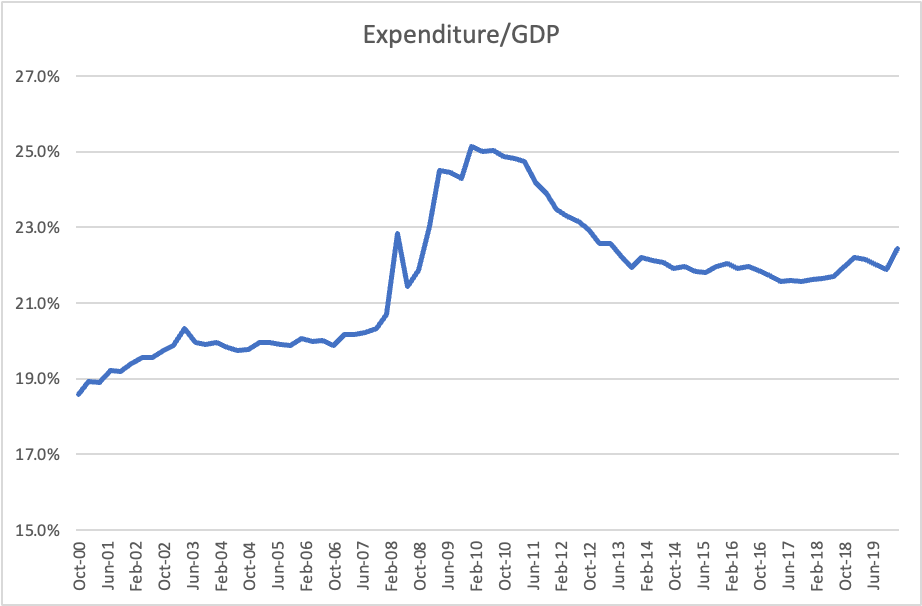
When looking at GDP data and Federal government expenditures, it becomes pretty easy to determine why GDP continues to percolate along so well.  Given that GDP = Consumption + Investment + Government + Net eXports (Y = C + I + G + NX), a quick look at the G component shows just how much support the government has been adding to the economy despite what has been recorded as strong growth.  Or perhaps, more accurately, this is why growth has been so strong.  The below chart shows the trend of government expenditures relative to total GDP growth.  I removed the Covid years because they are extremely volatile and confusing. However, looking at the trend since the GFC in 2008/2009, there has been a step change higher in the amount of government activity measured in the economy. 

Source: data FRED St Louis Fed, calculations @fx_poet

Given the current budget deficit is running > 7% of GDP and is projected to remain at least this high going forward, it is quite clear that there is a lot of nonorganic effort to raise the GDP measures.  Look at the sharp upward turn at the right side of the chart.  It appears that the administration will do everything they can to continue to show that the economy is strong.  

Of course, this is where the rubber meets the road.  If the administration continues to pump more government spending into the economy, can inflation really decline any further?  Remember, government spending is almost entirely consumption based, with limited investment at this time.  Even the CHIPS Act only created incentives for private companies to invest, it is not government investment per se.  The point is, pumping up consumption demand without adding productive capacity is very likely to drive prices higher.  And if anything, given this administration’s war on energy markets, they are discouraging investment in critical infrastructure.  It is hard to see how this plays out for a Goldilocks outcome.  Far more likely, in my view, is that they continue to pump as hard as possible, and prices start moving higher again.  Timing is everything in life, and perhaps they can work it out so price hikes are delayed until after the election, but I am skeptical given the vast incompetence this administration has shown in virtually every sphere in which it operates.

What if employment’s a mess
And actually in some distress?
Is JOLTS data real?
And what is the deal
With households, it’s hard to assess


The last big macro area is, of course, the employment situation.  We all know that the NFP report was much stronger than expected for January, rising 353K, but also seeing upward revisions of the previous months for the first time in quite a while.  In fact, one of the bearish stories had been that the revisions mattered more than the headline data, and if revisions were for the worse, that was indicative of a slowing economy.  

Remember, too, that the US employment situation is measured in two ways, via the establishment survey which is a survey of companies’ (both large and small) actual hiring activity and leads to the NFP number, and the household survey, which is a telephone survey of ~60,000 households and asks the question if someone is employed and if not, whether they are looking for work.  The Unemployment Rate is calculated from the household survey, so both are clearly critical in assessing the situation on the ground.  

The funny thing is that the numbers come across pretty differently when you dig down.  While in the long-term, both data series have shown a strong correlation (96% since January 2000), the Household survey is far more volatile and in the past year has been telling a somewhat different story than the establishment survey.  Look at this chart below mapping each since the beginning of 2023:

Source: data FRED St Louis Fed, calculations @fx_poet

Doing the math shows that the establishment survey claims that 3.409 million jobs were created while the Household survey comes in at just over half that amount, 1.852 million jobs.  Now, in a nation of 330 million people, especially given the expansion of the gig economy and the dramatic changes in employment overall, maybe that is not such a big deal.  As well, simply looking at the two lines shows that the Household survey is far more volatile than the Establishment survey.  Does this mean we should ignore the household survey, given it seems to have more noise and less signal?  The problem with this is the household survey drives the Unemployment Rate, and nobody is willing to ignore that.  And these differences beg the question, is the employment situation as rosy as it seems?  With the Unemployment rate remaining so low for so long, it certainly appears that there is ample demand for workers.  Of course, that also implies that the cost of labor seems unlikely to decline very much and could well increase further and faster.  If that is the case, the impact will be seen in the inflation data as well.

Trying to sum things up here, looking at the three critical macro variables, inflation, growth and employment, there is a strong case to be made that the combination of ongoing government support and continued demand for labor into an aging workforce can lead to solid nominal GDP growth with inflation remaining far stickier than many currently anticipate.  If that is the situation, all the hopes and dreams of the interest rate doves may be delayed, if not destroyed, as it will be increasingly difficult for the Fed to ease policy into an inflationary environment.  Arguably, this is why they are seeking greater confidence that inflation is really dead.  

Now, maybe Goldilocks is real, and inflation will continue to decline on its own because…well just because.  But I find it hard to look at the data and conclude that lower inflation is our future, at least for any length of time.

Ok, this has gotten much longer than I intended but fortunately, absolutely nothing of note happened overnight in markets.  Literally.  There has been de minimis movement in stocks, bonds, commodities and currencies, and there is a distinct lack of data to be released today.  Tomorrow’s CPI is THE number of the week, so perhaps that will get the juices flowing again and drive some movement.  Until then, a quiet day is usually a good one on which to establish hedges.

Good luck

Adf

So Puissant

Ueda explained
When NIRP disappears, ZIRP is
His view of the world

“Even if we end minus rates, the accommodative financial conditions will likely continue.”  This was the key comment from Kazuo Ueda’s testimony in parliament last night, which followed a similar comment from BOJ Deputy Governor Shinichi Uchida on Thursday.  It should be no surprise that this is the case as the recent data from Tokyo, notably the inflation data, has been softening quickly and reducing the need for tighter policy.  After all, for two decades the BOJ has been trying to overcome a generational view that deflation is a given and instill an inflationary mindset in the populace there.  If inflation readings are falling, they will definitely not be in a hurry to raise interest rates.

It appears, from these comments, that while the BOJ may lift the key deposit rate from its current -0.10% level, it would be a mistake to look for very much movement.  My money is on either 0.00% or +0.10% as the peak.  It should also be no surprise that the yen has suffered further on these comments with USDJPY having traded as high as 149.55 overnight, although it has since slipped back to unchanged at 149.40.  There remains a great deal of belief that the BOJ is highly focused on 150.00 as a line in the sand to prevent further weakness.  Personally, I think their line in the sand is higher, at least at 152.00 and perhaps even higher than that.  They are very consciously making dovish comments while listening to every Fed speaker reiterate higher for longer and no rate cuts in the US anytime soon.  They know the yen will fall further and are already prepared for that outcome; I assure you.

The talk of the market today
Is whether revisions display
That CPI’s recent
Decline is so puissant
Or if tis a ‘flation doomsday

It should not be that surprising that in a market bereft of serious data, traders and analysts are turning over every stone to find something on which to hang their hat.  Today’s story is the annual CPI revisions that are due from the Bureau of Labor Statistics at 8:30 this morning.  The reason this is getting so much play is that last year, the revision was dramatic, adjusting the annualized rate up to 4.3% from its pre-revision level of 3.1%, and casting doubt on just how much progress the Fed had actually made in their inflation battle.  But last year was a dramatic outlier with respect to revisions as historically, the average adjustment is something like 3 basis points, so the different between 3.10% and 3.13%.  In other words, nothing.

However, the concerns come from the fact that ever since Covid changed so much in the economy, measuring the data has become far more complex leading to potentially larger revisions.  I have no way of knowing what will happen here, and I suspect there is an equal chance of the revisions showing CPI has actually been lower than reported, but the point is, this obscure data adjustment has become the topic du jour on an otherwise quiet day.

What we can do is game out how markets may respond to a surprisingly large adjustment in either direction.  If, like last year, the revisions show inflation is running hotter than previously reported, I would look for bonds to sell off further, especially the 2-year, as it would push the probability of a rate cut further into the future.  This would likely weigh on stocks and support the dollar overall.  Oil has been in its own world, rallying on the increased middle east tensions, but metals would suffer, I think.  And if the revision is substantially lower, just turn around all those movements.  Any large revision will be a binary event.

But really, those were the major discussion points overnight.  Turning to the markets, after another set of records in the US (although the S&P 500 couldn’t quite make 5000), Japanese equities rallied further on the interest rate story from above, setting new 34-year highs and approaching the 1989 bubble peak.  Chinese shares are closed for a while now, but the Hang Seng, in a half-day session, managed to slide another -0.8%.  However, the rest of Asia was in the green.  In Europe, there is very little net movement this morning as we continue to hear from ECB speakers that rates will not be cut soon, although it is not clear anybody believes them given the overall economic weakness.  Lastly in the US, futures are a touch higher at this hour (7:45), but only about 0.2%.

In the bond market, yields continue to edge higher with Treasuries up 2bps, and most European sovereigns higher by just 1bp.  Interestingly, despite the Ueda comments overnight, JGB yields have crept 2bps higher along with everything else.  It is hard to know if bond investors are more concerned with sticky inflation or massive issuance, but something has them uncomfortable this morning.

Oil, which has rallied all week is unchanged this morning as the market digests the fact that there will be no cease-fire between Israel and Hamas, and the Houthis continue to fire missiles into the Red Sea.  As to the latter, given that ship traffic has fallen to near zero, that seems like a waste of ammunition, but so be it.  Metals markets, meanwhile, are a touch softer this morning with copper the underperformer (-0.5%) although precious metals have edged lower as well.

Finally, the dollar continues to perform well overall, as we have already discussed the yen, but are also seeing it edge higher against most of its counterparts in the G10.  The exception is NZD (+0.6%) which seems to believe that the RBNZ, after having paused in their rate hiking cycle, may raise rates yet again.  On the EMG side, the most noteworthy mover is ZAR (-0.35%) suffering from metals weakness although we are seeing a bit of strength from the LATAM bloc with both MXN and BRL edging higher this morning.

And that’s really it today.  Not only is there no additional data, but no Fed speakers are scheduled either.  Next week will see a number of holidays around the world as Carnival begins alongside the Chinese New Year.  Really, Tuesday’s CPI is the next key data point for us all.  Until then, I expect that traders will want to close the S&P over 5000 but do not see an explosive move higher coming.  As to the dollar, there is no reason for it to cede its recent gains.

Good luck and good weekend
Adf

Some Shocks

While many still seek goldilocks
The problem is we’ve seen some shocks
Inflation won’t fall
And oil’s in thrall
To US and UK war hawks
 
But if we adhere to the data
It’s really not looking that great-a
For those who think Jay
Will soon lead the way
By cutting the Fed’s funding rate-a

We are back to being inundated with new information from both economic data and global events, both of which are driving markets for now.  Interestingly, depending on the asset class, it seems that some are studiously ignoring what this new information means, at least what it has historically meant.

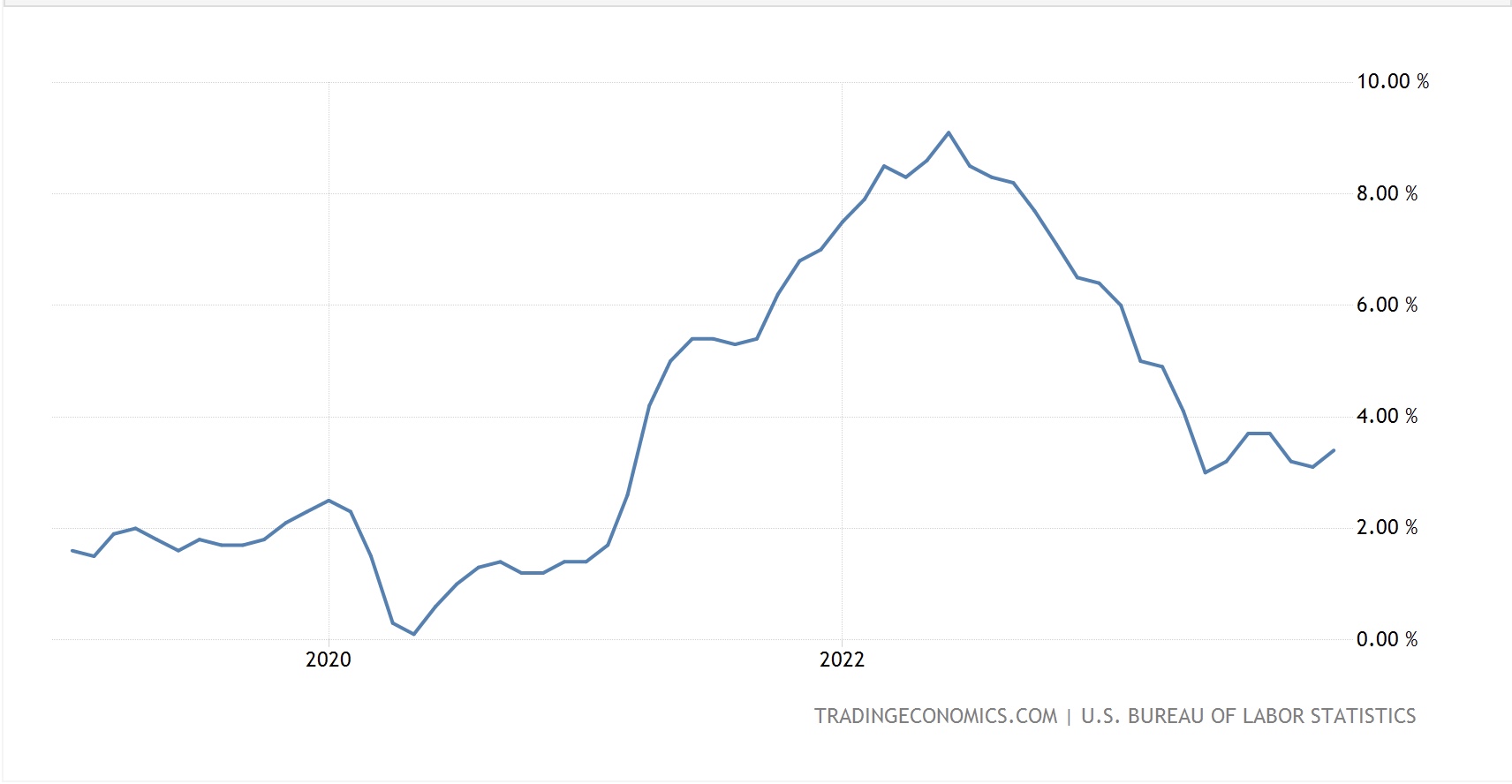
Let’s start with yesterday’s CPI data, which printed higher than forecast on both the headline (3.4%) and core (3.9%) measures.  One needn’t be a market technician to look at the chart below of annualized CPI over the past five years and consider the possibility that the downtrend has ended, and we are reversing higher.

Source: tradingeconomics.com

To the extent that financial data has trends, and I think that is a very realistic estimate of how things work, the Fed may have a much tougher time squeezing the last 1.0% – 1.5% out of the inflationary process than many seem to believe.  At least many in the bond market seem to believe that as despite the hotter than expected CPI data, bond yields actually declined yesterday.  As well, there is no indication from the Fed funds futures market that they have changed their view on the number of rate cuts coming in 2024 with an even higher probability of a March cut, > 70% this morning, and still 6 cuts priced in for the entire year.  

Regarding this seeming dichotomy, it is almost as if the market is trying to force the Fed’s hand.  Historically, the Fed has tried not to ‘surprise’ markets when it comes to decisions, keeping a close eye on market pricing on the day of each meeting.  As such, if the market is pricing in a cut or a hike, the Fed has been highly likely to follow through in the past.  When there have been disagreements, the Fed will typically roll out lots of speakers to get their view across before the meeting in order to prevent that surprise on meeting day.  As well, it is very clear that there is virtually no expectation of a rate adjustment at the FOMC meeting on January 31st, so perhaps the Fed doesn’t feel it is warranted to be that concerned yet.  And of course, the data may turn in the direction of much softer inflation and even modestly worse employment so a cut will become the de facto norm.  But my point is, the March 20th meeting is just 67 days away.  For an economy whose trends move very slowly, it seems like the market may be a bit ahead of itself in this case.

We did hear from three Fed speakers yesterday, Mester, Barkin and Goolsbee, all of whom indicated that while the broad direction of things seemed pretty good, a rate cut in March is very premature.  In fact, that has been the consistent theme from every Fed speaker and the market just doesn’t seem to care.  We will see two PCE reports, two more CPI reports and two more NFP reports before the March FOMC meeting.  And they will all be part of Q1 data, not Q4 data, so will at least have more relevance to the current situation.  Maybe the market is correct, and inflation is going to turn back lower, and the first signs of economic weakness will convince Powell and friends it’s time to preemptively cut rates.  However, even if that turns out to be the case, it is hard for me to see that as a > 70% probable outcome.  Of course, I am just an FX poet, so maybe I just don’t get it.

The other topic that is making an impact is the Middle East.  You may recall that oil prices had been on the soft side as the market saw weakening demand due to an impending recession with massive supply gains coming from better and better producer efficiency.  In fact, I wrote about the latter this past Sunday in Oil’s Price is not Rising.  However, all that efficiency is unimportant when compared to the escalation that we saw last evening in the Middle East, where US and UK forces attacked Houthi positions in Yemen in retaliation for the Houthi attacks on shipping in the Red Sea.  This morning, oil is higher by 3.5% and since Monday, the rise has been 6.6%.  

This poses several problems overall.  First, of course, is the widening of the Middle East conflict being a problem in and of itself.  The US military is already straining with its mission given the number of different places US troops are in harm’s way throughout the Middle East and Asia.  The one thing we have learned throughout history is that war is inflationary.  So, escalations in fighting will ultimately lead to escalations in prices of many things.  Oil is merely the first casualty.  

If you are Jay Powell whose current mission is to reduce inflationary pressures, a widening military conflict is not going to help the situation.  In fact, it is likely that he will be called upon to support the military by ensuring the Treasury can issue as much debt as necessary at reasonable prices.  This means the end of QT and a restarting of QE.  If that were to be the case, and that is a big if, inflation would start another strong leg higher, and markets will be greatly impacted.  Commodity prices will rise, the dollar will likely weaken, a bear steepening for bond yields would be in the cards and equity markets would rally, at least initially.  But it would throw out any ideas of low inflation.  I am not saying this is the current expectation, just that it is something that needs to be considered as events unfold going forward.

A quick look at the impact on markets today shows that equity markets are non-plussed by the escalation as yesterday’s benign US performance was followed by another rally in Japan although Chinese shares continue to lag after a big data dump showed economic activity there remains export oriented into a slowing global growth situation.  Inflation remains moribund there, the Trade Surplus grew, and domestic funding continues to grow at a slower and slower pace.    In Europe, though, there does not seem to be much concern as equity indices are all higher by about 0.5% although US futures are suffering a bit, -0.35%, at this hour (7:45).

In the bond market, Treasury yields are 3bps higher this morning than yesterday’s close, although they remain right at 4.00%, so are not really moving very much right now.  Meanwhile, European sovereign yields, which closed before the US yields declined late, are all down about 3bps this morning, helped by confirmation that final inflation readings in Europe remained at recent lows.  In the UK, the net data dump showed slightly weaker than forecast IP and GDP data which has helped drive the bid in Gilts. A quick JGB look, where yields fell 2bps, revolves around a story that the BOJ is going to reduce its end of year inflation forecast thus reducing the probability of any policy change anytime soon.  This is one of the things helping the Nikkei and also a key driver of USDJPY higher.

Aside from oil prices rising, we are seeing gold (+1.0%) on the move today on the back of the Middle East escalation although the base metals are mixed.  One other commodity note is uranium, a market which has been getting a lot more love lately given the recent acceptance by a portion of the eco community that its ability to generate electricity without producing CO2 is a net benefit.  40 nations have promised to increase their nuclear power use and demand for uranium has been rising amid a market where there is very limited supply and annual production does not meet current annual demand, let alone projected future demand.  I simply wanted to highlight that there are price movements all over the place and while uranium may not be a major contribution to inflation, the fact that its price is rising so rapidly (100% in the past year) is not going to push inflation lower.

Finally, the dollar is firming up this morning as risk assets come under pressure.  This is a typical war footing, where investors flee to the dollar in times of stress, just like they flee to gold.  While the movement thus far has not been substantial, just 0.3% on average, it definitely has room to move further if things deteriorate in the Red Sea.

On the data front, we see PPI this morning, expected 0.9% headline, 2.0% ex food & energy, although given CPI was released yesterday, I doubt it will matter very much.  As well, we hear from Minneapolis Fed president Kashkari, so it will be interesting to see if he has a different take than March is too soon, but things seem to be going well.

As we head into the weekend, the Middle East is the wild card.  If things heat up, look for oil prices to continue to rise and risk to be discarded.  That will probably help the bond market for now, and the dollar, but stocks will suffer.

Good luck and good weekend

Adf

Jay’s Coronation

The word for today is inflation
With many convinced its cessation
Is just round the bend
So, growth will ascend
Alongside Chair Jay’s coronation
 
But what if inflation don’t slow?
And rather, continues to grow
Can bonds stand the pain?
Will stocks feel the strain?
Or will we go on with the show?

The first thing to mention is the Bitcoin ETF was approved by the SEC last evening and the price…is basically unchanged.  As I mentioned yesterday, it seems quite ironic that Bitcoin, a shining symbol of freedom from the government and regulation is now tightly ensconced in government and regulation.  Do not be surprised if it becomes a much less interesting asset having lost one of the key things that makes it different.  Just a thought.

Ok, on to the more important stuff, the economy and today’s CPI report.  Current consensus forecasts are as follows: CPI 0.2% M/M (3.2% Y/Y) and -ex food & energy 0.3% M/M (3.8
% Y/Y).  If realized, these represent a 0.1% rise in the headline and 0.2% decline in the core readings from last month on an annual basis.  Now, in the broad scheme of things, and more importantly, in our day-to-day lives, that 0.1% or 0.2% has absolutely no meaning or impact.  However, the importance allotted to that 0.1% is remarkable.  Entire narratives will be spun about how the Fed has been amazing in their ability to achieve a soft landing, or the Fed is a group of 17 incompetent fools based on an estimated data point that is often revised and does not clearly measure what the words in its name describe.  As such, let’s simply focus on the market reaction function rather than the meaning of the data.

Heading into the release, my take is that given the recent run of softer than forecast inflation readings around the world, whatever the economists and analysts have forecast, the market is leaning toward a soft print.  The fact that oil prices fell about -6% during the month of December, although gasoline prices were nearly unchanged, has tongues wagging.  As well, discussions about slowing growth in China and their negative PPI as a driver of deflation is another key element of the narrative. 

Counter to this is the fact that the Fed refuses to take their victory lap.  Yesterday, John Williams explained, “My base case is that the current restrictive stance of monetary policy will continue to restore balance and bring inflation back to our 2% longer-run goal.  As inflation comes down over time, my expectation is interest rates will also come down over time.”  In other words, things are going well, but we have not reached the finish line.  This certainly didn’t sound like someone who was ready to cut interest rates in two months’ time although the market continues to price a better than 2/3 probability that the Fed will do just that.  Now, if we take him at his word and inflation fell another 0.6% or more by March, maybe that would be enough to get them into a cutting mood.  But I just don’t see that.

One of the things that is often either overlooked or not well understood is the fact that things move REALLY slowly in the economy, especially when it comes to measured moves of economic data points.  Of course, the exception that proves this rule was the Covid recession, but in order to get data to move at the same speed as markets required virtually every government in the world to shut their economies down at the point of a gun!  My take is that will not happen again in our lifetimes, regardless of the threat.  As such, we need to recognize that, to use a well-worn metaphor, the economy is an aircraft carrier and turning it takes time.  

When applying this concept to inflation, and prices more generally, especially wages, they don’t move that quickly.  In fact, they move quite slowly.  People get annual raises, not weekly or monthly ones.  While gasoline prices move up and down on a daily basis, the same is not true for menu prices, items in the supermarket or rent.  Real-time price adjustments are a flaw feature of financial markets, not of real life.  While many will point to the fact that the shelter portion of CPI (and PCE) is a smoothed average of the past twelve months and so not indicative of today’s situation, I would counter that most of the people who pay rent haven’t moved in the past twelve months and their rent remains the same.  It is certainly not declining, and I am still looking for that first story of the landlord who saw the CPI data slipping and cut his tenants rent to keep in line!  

The point is that expectations of a sharp move in a slow-moving data series are misplaced.  Much has been made of the fact that if you annualized the last 3 months or 6 months of CPI monthly data, CPI is already below the Fed’s target of 2.0% and so they should be cutting.  Personally, I find that ridiculous.  But more importantly, the Fed, as evidenced by Williams’ comments above, has no truck with that idea.  Add to this the fact that growth seems to be holding in at trend or better, despite interest rates being “too high” according to the cutting advocates, and it becomes that much harder to believe the Fed is ready to go.

Net, regardless of today’s number, the Fed is not going to change its mind soon.  Markets, however, are a different story.  If the readings are soft, look for a big rally in both stocks and bonds, for the dollar to fall, and for commodity prices to rally nicely.  At least initially.  And the converse should be true as well, a hot number will see red numbers in the stock market, higher yields, a stronger dollar and commodities come under pressure.

Leading up to the number, here’s what we see.  After a nice day in the US yesterday, Asian markets were all in the green led by the Nikkei continuing its rip higher, but this time dragging Chinese shares along for the ride.  In Europe, it appears things are more circumspect as they await the CPI data with most markets +/- 0.2% or less on the day while US futures are currently (7:30) modestly in the green.

Bond yields are definitely in the low inflation reading camp as Treasury yields have fallen 4bps this morning and we are seeing similar movement all across Europe.  The one exception to this story is Japan, where JGB yields edged higher by 2bps despite a couple of soft Leading Economic Index numbers.  However, since the peak, just below 1% in early November, this trend remains clearly lower for yields.

Apparently, the hijacking of an oil tanker in the Persian Gulf has been seen as an escalation of the situation there and oil prices are higher by nearly 2% this morning, although that simply takes the weekly change back to flat.  Gold prices are rallying, 0.5%, and not surprisingly in this environment, so are base metals prices with both copper and aluminum higher by 0.6% this morning.

Finally, on the dollar front, it is lower after a small decline yesterday.  This is of a piece with the inflation expectation story and the idea that the Fed is preparing to cut rates, boost stocks and undermine the dollar.  Even the yen has rallied a bit today, so no currencies are really bucking the trend of a weak dollar, whether G10 or EMG.

Aside from the CPI data, as it’s Thursday we also see Initial (exp 210K) and Continuing (1871K) claims and then early this afternoon we hear from Tom Barkin again.  At this stage, the Fed seems to be of a mind that things are going well, and they are not about to rock the boat in either direction.  Absent a huge surprise in the data this morning, I think this slow grind toward risk on continues.

Good luck

Adf

Markets Are Waiting

The macro event of the day
Is actually micro I’d say
The markets are waiting
For all the debating
‘Bout Bitcoin to end in OK
 
The irony here is too great
As TradFi, the Bitcoin bros, hate
But they’re still a buyer
If number goes higher
‘Cause really, it’s all ‘bout the rate

It is a very slow day in the markets as evidenced by the fact that the biggest story is whether or not the SEC is going to approve a cash Bitcoin ETF.  Today is the deadline for the first application to be approved, or not, and the working belief is that if they are going to approve one, they will approve all 13 that have applied in order to prevent any concerns over favoritism to a particular manager.  Yesterday afternoon, there was a tweet from the SEC that indicated approvals had been made, but then within 10 minutes, the SEC denied that was the case and explained their X (Twitter) account had been hacked.

One of the interesting things of late in this space is that there has been a 20% rally in Bitcoin since the beginning of December, seemingly in anticipation of this event.  This price action has many believing we are looking at a ‘buy the rumor, sell the news’ type story with expectations that a short-term sell-off is coming after the announcement.  However, last night, after the erroneous Tweet, Bitcoin rallied more than 2% before turning back around on the retraction.

With that in mind, the more ironic issue, at least to me, is that there is so much excitement in the Bitcoin community for a traditional finance product like an ETF.  Institutionalizing Bitcoin and creating all the same structure and regulation as any other trading vehicle seems at odds with the entire concept of a new digital transaction medium that does not require a centralized system and is free to one and all.  Arguably, what it highlights is that the entire appeal of Bitcoin is that it is a highly speculative and volatile trading vehicle and is appreciated solely because its number can go up really fast!

In the end, just as the odds of a BRICS currency coming along and usurping the dollar’s throne as top currency in the world (at least when it comes to utilization) are close to zero, the same holds true here.  Bitcoin is never going to replace any fiat currency in the role of money.  Just as with every other asset, its value is entirely dependent on what someone will pay for it.  While an ETF will widen the population that is involved in the space, and perhaps ensure that the government never makes any effort to cut it off from the banking world, it will not change the world in any way, shape or form.

Away from this, the market is turning its focus toward tomorrow’s CPI report in the US as the next critical piece of information for the macro story.  Recent data elsewhere in the world has continued to show a cooling rate of inflation, with Australia’s overnight print at 4.3% a tick lower than expected while Norway’s 5.5% Core rate was also a tick lower than expected.  This follows yesterday’s Tokyo CPI which came in soft and is continuing the theme that the Fed, and central banks around the world, have successfully put the inflation genie back into the bottle.  Personally, I think it is premature to make that claim as I have seen very limited evidence that prices for rent are falling and based on the wage data we saw last week in the NFP report, wage rises, at 4.1%, remain well above the rate necessary to see a stable 2% inflation outcome.  But that is the narrative and it is being pushed hard by Yellen and the mainstream media.

As to today, yesterday’s directionless session in the US led to a mixed performance in Asia where the Nikkei continued its recent rally, up another 2% and back to levels last seen in February 1990 as the Japanese bubble was deflating.  However, Chinese shares remain under pressure with the Hang Seng (-0.6%) continuing its recent slide and mainland shares faring no better.  In Europe, the screens are a pale red, with losses on the order of -0.2% or so across the board and US futures are essentially unchanged at this hour (7:15).

In the bond market, 10-year Treasury yields have edged down 2bps this morning and are trading right on 4.00%.  European sovereign yields are little changed on the day.  After a bond sell-off (yield rally) for the past several weeks, it seems that a bit of dovish commentary from some ECB members, notably de Guindos and Centeno has calmed things down a bit.  And you will not be surprised that JGB yields have slipped another 1bp lower this morning as inflation concerns subside everywhere.

Oil prices are little changed today, holding onto yesterday’s gains but not really responding to a new wave of missile and drone attacks by the Houthis in the Red Sea against some tankers.  Too, gold prices are only edging a bit higher, 0.25%, and essentially have remained in a very narrow range for the past six weeks.  As to the base metals, copper has rallied nicely this morning, up 1% but aluminum is unchanged on the session.

Finally, the dollar is under modest pressure this morning against most currencies, but the yen is the exception, falling -0.4% with the dollar back above 145.00.  I believe you cannot separate the Nikkei rally from the yen decline and the ongoing interest rate story in Japan.  With softer inflation readings leading traders and investors to reduce the likelihood of any monetary policy change by the BOJ, those are exactly the moves that would be expected.  In the meantime, the market is staring to price in a slightly higher probability of a March rate cut by the Fed, up to 67.6% despite no indication from any Fed speaker that is on the table.  However, while this is the narrative, I expect the dollar will have a little trouble going forward against both G10 and EMG currencies.

There is no noteworthy economic data today, but we do hear from NY Fed President Williams at 3:15 this afternoon.  Yesterday’s comments by Michael Barr were interesting in that he was adamant that the BTFP (the lending facility put into place in the wake of last year’s Silicon Valley Bank collapse) was going to be wound down when its term of 1 year comes up in March.  Personally, I am skeptical that will be the case, but at the very least, we can expect it to make a quick appearance as soon as there is any other banking trouble.

And that’s really it for today.  Until tomorrow’s CPI, there is very little about which to get excited.  I don’t believe the Bitcoin story, while mildly interesting, is going to have any impact on other markets for any length of time.  So, we shall be biding our time for another twenty-four hours at least.

Good luck

Adf

Magical Stuff

A critical piece of inflation’s
Aligned with the broad expectations
Of where it will be
In one year and three
As this feeds Jay’s model’s foundations
 
So, yesterday’s data release
That showed expectations decrease
Is magical stuff
And could be enough
To make sure all tight’ning will cease


While Thursday’s CPI report remains the key data point this week, there are plenty of other data points that get released on a regular basis that can give clues to how the economy is behaving, and perhaps more importantly to how the Fed’s reaction function may respond.  One of the lesser-known inflation readings is published by the NY Fed each month and shows Consumer Inflation Expectations one year ahead.  As can be seen in the below chart from tradingeconomics.com, the trend has been very positive (lower inflation expectations) for the past two years.

This must warm Powell’s heart as it appears his efforts at anchoring inflation expectations continue to work.  When combining this data with comments from two Fed speakers, Bostic and Bowman, who both indicated some satisfaction with the recent trajectory of inflation and were comfortable with the idea of rate cuts later this year, it is easy to see why yesterday was such a bullish one for risk assets.

Perhaps of more interest, at least to me, was the Consumer Credit Change report which showed that in November, consumer credit rose by a very large $23.75B!  This was the largest increase in twelve months and plays to the idea that people are using their credit cards to purchase consumer staples because they cannot afford them anymore.  On the flip side, given the way economic growth is measured, this will be a positive for Q4 as it implies more ‘stuff’ is being bought.  To my eye, this seems to be a short-term positive, but offers the chance of being a medium-term negative as delinquency in loans is typically not seen in a beneficial light and there are already many stories of people being overextended on their credit cards.

As well, Tokyo CPI was released overnight at 2.4%, 2.1% Core, which was right on expectations, but more importantly, indicative of the fact that inflation pressures in Japan are quickly ebbing.  Perhaps the BOJ’s view that they did not see sustainable price inflation despite almost 2 years of CPI prints above their 2.0% target, is turning out to be correct.  This has huge implications as it means there is little reason for the BOJ to consider exiting its current monetary policy combination of NIRP and QE combined.  As an aside, 10-year JGB yields fell 2bps last night and are currently at 0.58%.  This does not seem like a panicky level, nor one that is necessarily going to attract a lot of internationally invested Japanese money back home.  For all the JPY bulls out there, this is not a good sign.

Away from that news, European data continues to show Germany in a world of hurt, with IP falling -0.7% in November, far worse than expected and the 6th consecutive decline in the series.  However, Eurozone unemployment fell a tick, back to 6.4% and the lowest in the history of the series.  Meanwhile, the ECB just published a report indicating that the inflation suffered by the Eurozone was due almost entirely to supply chain disruptions with a small dose of energy price spike.  It had nothing to do with their policies!  To an outsider like me, this sounds like they are preparing to cut rates as soon as they can.  I wouldn’t be surprised if Madame Lagarde was on the phone with Chairman Powell right now!

And that’s really all we have seen overnight.  After yesterday’s strong rebound in the US, the overnight equity picture was somewhat mixed with Japan having a good session on the weak inflation data although the Hang Seng continues to slide.  Overall, there was no unifed trend in Asia with gainers and losers both.  European shares, though, are in the red this morning led by Spain’s IBEX (-1.75%) although that is the outlier worst performer.  (It seems that a single stock, Grifols, a pharma name, is down -28% on some recent reports about manipulated accounting and that is dragging the whole index lower.). However, US futures are also softer, down about -0.4% at this hour (8:00).  There is still much discussion if last week’s sell-off was just a reaction to a huge late 2023 rally, or the beginning of something much bigger.

In the bond market, Treasury yields have edged up 1bp this morning but remain either side of 4.0% for now.  European yields, though, are higher across the board once again, by between another 5bps and 6bps.  Now, this move is based on yesterday’s close, which saw a drop in yields at the end of the session there.  While the trend in European yields looks higher, they are little changed from this time yesterday.

Oil prices (+3.1%) are rebounding nicely from yesterday’s sharp decline.  You may recall that Saudi Arabia cut its selling price yesterday and the market read that as a sign of weak demand.  However, this morning, that story has faded and continuing tensions in the middle east seem to be having a bigger impact.  This is confirmed by the fact that gold (+0.35%) is rebounding as well although the base metals are mixed this morning with copper slightly higher and aluminum slightly lower.

Finally, the dollar is a touch stronger this morning, but not really by much.  Versus the G10, I see gains of about 0.15% or so with NOK (+0.25%) the exception as it is responding to the rebound in oil.  Versus the EMG bloc, the picture is clearer with almost all these currencies a bit softer, albeit between -0.2% and -0.4% generally.  The dollar continues to be the least interesting asset bloc around for now and is likely to remain so until the Fed starts to actually change policy rather than simply hint at it.

On the data front, we see the Trade Balance (exp -$65.0B) and we have already seen NFIB Small Business Optimism print at a better than expected 91.9.  But, while that is a nice outcome, recall that the index is back at levels below Covid and only above those seen in 2008 and 1980!  Fed Vice-Chair for regulation, Michael Barr speaks at noon, but my guess is he will be right in line with the recent commentary that things look good, but they are not done yet.

As I wrote yesterday, with the bulk of the focus on Thursday’s CPI print, I expect that while markets might be choppy, there will not be much directional information overall.  

Good luck

Adf

Ending QT

The lady from Dallas explained
The balance sheet might be constrained
So, ending QT
Is likely to be
The way the Fed’s goals are attained
 
However, investors ain’t sure
That ending QT is the cure
So, worries abound
As traders have found
Most stocks have now lost their allure

Over the weekend, Dallas Fed President Lorie Logan, whose previous role was head of markets at the NY Fed and so knows a thing or two about the monetary plumbing, explained in a speech that QT, at its current pace, is likely going to be too restrictive going forward.  While she threw in the obligatory line about the idea the Fed may still need to raise the Fed funds rate if inflation remains too robust, I would contend that this is another sign the Fed is coming to the end of its tightening regime.  She explained that the swift decline in the Reverse Repo (RRP) facility indicated there may be a significant decline in liquidity in markets and that could have a detrimental impact on equity prices the economy’s future path and derail the widely assumed soft-landing scenario.

For some context, the RRP facility peaked almost exactly one year ago, touching about $2.55 trillion as the Fed was paying more on excess reserves than was available in short-term paper and Treasury bills.  But as the government has flooded the market with T-bills of late, and there is no indication that pace is going to slow down, the yield on bills rose above the IOER rate the Fed was paying.  As such, money market funds have pushed funds from the RRP into purchasing bills and the RRP facility now has “just” $694 billion as of Friday.  A look at the chart below from the FRED database of the St Louis Fed shows the sharp downward trajectory of the facility’s balances.  But also notice that prior to March 2021, this facility basically was at $0 for its entire history.  My point is that this facility does not have a long history of supporting market activities or liquidity, rather it is a recent construct designed to help smooth out temporary fluctuations.  It’s just that the concept of temporary here seems akin to the Fed’s concept of transitory when it comes to inflation.

At any rate, the FOMC Minutes also mentioned the idea that QT would likely need to slow down, and the committee needed to discuss the proper timing of these things.  Logan’s comments were exactly in this vein as the Fed seem like they are working very hard to prepare market participants for the beginning of an easing cycle.  It’s kind of funny that throughout November and December, the Fed seemed a bit concerned that markets were overexuberant, but after a modest equity market sell-off to start the year, much of which can probably be put down to profit-taking on a tax advantaged* basis, they seem suddenly concerned that things are falling apart.

Logan’s comments were in the wake of Friday’s data which showed NFP stronger than expected, although another month of downward revisions for previous readings, and showed wages gaining a bit more than expected.  The initial move here was that further tightening was on the way, or certainly that easing was delayed, but then the ISM Services index was released at 10:00am and it was much worse than expected, 50.6, with the Employment sub-index printing at a horrible 43.7, its lowest level excluding the Covid months, and indicative that perhaps the job market is not quite so robust.  This helped unwind the tightening discussion and Friday’s markets ultimately closed little changed.

Which brings us to this morning, where the most noteworthy price action is in the commodity space with oil (-2.8%) sharply lower after Saudi Arabia cut its pricing indicating that demand is slow, and gold (-1.25%) falling sharply although a rationale there is far harder to find given the dollar is essentially unchanged on the day and it certainly doesn’t appear that peace is breaking out in either Israel/Gaza or in Ukraine.

While there has been a bit of data released from Europe, none of it was substantially different from expectations and it showed that the status quo remains there, overall, a weak Eurozone economy with prices still on the sticky side.  As well, there have been no speakers this morning which just leaves us all unsure of the next big thing.

Now, in fairness, we do have the next big data point coming on Thursday, CPI in the US, which I am assured by so many analysts is THE critical data point.  I was also confident that NFP was critical, so perhaps CPI will be less exciting than forecast.  In the meantime, a look at the rest of the overnight session shows that Japan was on holiday so there was no market activity, but Chinese shares have continued their weak ways, falling more than -1.3% across all the indices there.  It seems to me that despite some very real efforts to inculcate fear of China by certain politicians, President Xi has an awful lot of domestic issues to address.  European shares, though, are little changed with a few very modest gainers (DAX +0.15%) and a few very modest decliners (FTSE 100 -0.2%) and everything else in between.  US futures are softer this morning as the weekend story regarding Boeing’s 737 Max being grounded is weighing on the stock and the market as a whole.

In the bond market, Treasuries are unchanged on the day while European sovereigns are all seeing yields climb between 4bps and 5bps.  This move seems like a catch-up to Friday’s US price action, which if you remember saw a sharp decline in yields early and a rebound later on.  Ultimately, this space will continue to be driven by the central banks with the Fed funds futures market still pricing in a > 60% probability of a 25bp cut in March with Europe seen likely to follow shortly thereafter.

Having already touched on commodities, a look at the dollar shows that while the euro, pound and yen are all little changed, there is a bit more movement in the dollar’s favor amongst some less liquid currencies with AUD (-0.4%), NOK (-0.85% on weak oil prices) and KRW (-0.4%) leading the way.  I continue to see the FX markets as an afterthought to the broad economic picture right now but have not changed my view that if the Fed does lead the way in easing policy, the dollar is likely to slide.

On the data front, here is what this week brings:

TodayConsumer Credit$9B
TuesdayNFIB Small Biz Optimism91.0
 Trade Balance-$65.0B
ThursdayInitial Claims210K
 Continuing Claims1853K
 CPI0.2% (3.2% Y/Y)
 -ex food & energy0.2% (3.8% Y/Y)
FridayPPI0.1% (1.3% Y/Y)
 -ex food & energy0.2% (1.9% y/Y)

Source: tradingeconomics.com

As well, we do hear from several Fed speakers this week starting with Bostic today and then Williams and Kashkari as the week progresses.  At this stage, I expect that we are likely to see less volatility as my guess is most profit adjustments have been made and all eyes are turned to CPI on Thursday.  Until then, it is likely to be a dull week (famous last words!)

Good luck

Adf

*This tax advantage is simply that taxes will not be due until April 2025, so perhaps tax deferred is a better description.

No Matter What

The story that’s got the most press

Is CPI’s sure to regress
So, Jay and the Fed
Without any dread
Can start cutting rates with success

But what if instead of a nought
The data is higher than thought?
Will markets adjust?
Or will folks still trust
That rate cuts come no matter what?

While all eyes truly remain on the FOMC meeting announcement tomorrow afternoon, and of course, the ensuing press conference by Chairman Powell, this morning brings the November CPI report, which could well have an impact on tomorrow’s outcome.  Current median expectations are for a M/M headline release of 0.0% leading to a Y/Y result of 3.1%.  As to the core (ex food & energy) result, M/M is forecast to be 0.3% with the Y/Y result being unchanged at 4.0%.

Lately, the inflation bulls, aka the deflationistas, have been harping on the fact that if you annualize the past 3 months’ worth of data or the past 6 months’ worth of data, the annualized outcome is 2.5% or lower, and so the Fed has basically done their job and returned inflation back to their target.  In the very next breath, they explain that with inflation back at target, they can start to cut rates because otherwise they will choke off the economy.

Even if I grant the first part of this thesis, of which I am suspect, it is the corollary rate cuts that make no sense at all.  Thus far, the bulk of the data that we have been observing has shown that the economy has held up extremely well despite 525 basis points of rate hikes over the course of less than two years.  This was made evident by Friday’s payroll report as well as the Q3 GDP report and much of the hard data that abounds.  Given the economy’s clear resilience to this higher rate structure, I can see no good case for the Fed to cut.

In fact, I think the key for the entire macroeconomic outlook revolves around just how long the US economy can maintain its growth trajectory with interest rates at their current levels.  The one thing of which we can be certain is that the Fed is not going to pre-emptively cut rates because they think a recession might show up, at least not now while inflation remains well above their target.  If the US economy continues to perform, meaning grow at 2%-2.5% over time while the Unemployment Rate stays below 4.5%, I would argue there is no incentive for the Fed to cut, at least not on a macro basis.  (There may be political reasons for them to cut, but that’s a different story.)  Now, if growth continues apace, will that be bullish or bearish for stocks?  For bonds?  For the dollar?  For commodities?  I would say that these are the questions we need to answer and are why the Fed remains such an important part of the discussion.  Do not discount a world where 10-year yields are 5.5%, Fed funds are 5.25% and GDP is 2.0% while inflation runs at 3.0%.  This could well be the near future.  It would also likely be quite a negative for risk assets.

My point is there continues to be a great dichotomy of thought as to how the future will unfold as we all are looking for the next clue to support our thesis.  While I continue to believe that a slowdown is coming, to date, there has been no clear evidence that is the case.  In fact, Friday’s Michigan Sentiment data was substantially better than anticipated while inflation expectations fell alongside the price of gasoline.  In fact, a marginally stronger than anticipated print this morning will simply be more proof that the market’s current anticipation for rate cuts in 2024, which sit between 4 and 5 cuts, will need to be repriced.  If risk assets have rallied on the basis of future Fed rate cuts, that could be a problem.  Just sayin’!

Ok, ahead of the data, this is what we have seen.  Yesterday’s modest US equity rally was followed by generally modest strength in Asia with the best performer being the Hang Seng (+1.1%).  Last night, China’s government made a series of announcements describing all the sectors of the economy that they would be supporting going forward with fiscal policy, although there were no numbers attached to any of it, it was all cheerleading.  Saturday night, Chinese CPI data was released at -0.5% both M/M and Y/Y, while PPI there fell to -3.0%.  The implication is that economic activity is not going very well.  In fact, it might be appropriate to define it as a recession, although I’m sure that won’t be the case.  However, looking for China to be the world’s growth engine may be a bad call for the time being.  As to Europe, it is a mixed picture there, with both modest gainers and modest laggards and no real direction overall.  US futures are higher by 0.2% at this hour (7:30) but are obviously keenly focused on the data release.

Yesterday’s bond market price action, where yields backed up, has been completely reversed this morning with 10-year Treasury yields lower by 5bps and European sovereign yields lower by even more, 6bps-7bps while UK gilts have really rallied, with yields there down by 12bps after the employment data showed wage pressures declining far more than anticipated.

On the commodity front, oil is drifting lower again this morning, down -0.6%, although the metals complex is showing strength with gains in gold (0.4%) and copper (0.3%), which seem to be rising on the back of a weaker dollar and lower US rates.  But a quick aside on oil and the commodities space in general.  I have made the point that the commodity markets are the only ones that are pricing in a recession.  And I would contend that is still the case.  Perhaps, though, I have been looking in the wrong place for that economic weakness.  Consider that China is the largest consumer of raw commodities in the world, by a wide margin.  Consider also that the Chinese economy is having all kinds of difficulty as the dash for growth seems to have reached its apex and is now sliding lower.  As I mentioned above, the idea that China is in a recession may not be absurd, and perhaps the fact that the commodity markets, in general, have been so soft is simply a recognition of that fact.  If this is the case, we need to watch Chinese economic activity closely in order to get a sense of the trend in commodities.  Or perhaps, we need to watch the trend in commodities to better understand the Chinese economy.  When base metals turn higher, look for Chinese stocks to do the same.

Finally, the dollar, as mentioned above, is under pressure this morning, down -0.3% when measured by the DXY.  The biggest mover is JPY (+0.7%) but we are seeing all the G10 bloc as well as the bulk of the EMG bloc rallying against the greenback.  Speaking of Japan, last night there was further commentary pushing back on the idea of any movement by the BOJ next Monday regarding the normalization of monetary policy in the near future.  I maintain that nothing will happen before they see the wage negotiation outcomes in March and, in the meantime, they are praying quite hard for the recent global inflation trend to remain downward as this will allow them to maintain their QE and fund the government.

And that’s really it for the day, as the CPI is the only news to be released.  Unless it is significantly different than the current expectations, I suspect that things will be quiet today, modest continued equity and bond rally as everybody places their bets that the Fed is getting ready to start to cut rates.  I’m not holding my breath.

Good luck

Adf