Inflation’s Fate’s Sealed

The Minutes revealed that the Fed
When pondering their views ahead
Are no longer all
Completely in thrall
With hiking til more ink is red

However, they also revealed
That some felt a still higher yield
Was proper for June
And want more hikes soon
To make sure inflation’s fate’s sealed

Yesterday’s FOMC Minutes were interesting for the fact that after more than a year of the committee remaining completely in sync, it appears we have finally reached the point where there is a more robust discussion of the next steps.  The hawkish pause skip was very clearly an uneasy compromise between those members who thought it was appropriate, after 10 consecutive rate hikes, to step back and see if things were actually playing out in the manner their models predicted and those that remained adamant it was inappropriate to delay their process as there has been far too little progress on the reduction in services inflation.  Remember, the Fed’s models are entirely Keynesian in that they assume higher interest rates reduce demand by forcing financing costs higher.  It is why Chairman Powell has repeatedly explained that in order to achieve their goals, a little pain is going to be required.


But consider the nature of the current bout of inflation.  Was this driven by excess money being created in the banking sector and spent on business investment, or even share buybacks?  Or was this inflation driven by excess money being created, and then handed directly to the public in order to help everyone during the government-imposed lockdowns, thus spent immediately on goods, and eventually on services once the lockdowns were lifted?


I would argue that the latter is a more accurate representation of the current situation, one more akin to the post WWII economy than the 1970’s oil embargo led economy.  If this is the situation, then perhaps continuing to raise interest rates may not be the best solution to the problem.  In fact, as Lynn Alden indicates in her most recent piece, it could well be counterproductive.  If this inflation is fiscally (meaning government led) driven rather than monetarily (meaning bank lending led) driven, higher interest rates simply add to the amount of money available to spend by the public.  In fact, this process becomes circular as higher interest rates increase the amount of interest paid to bondholders adding to their disposable incomes, while simultaneously increasing the size of the fiscal deficit, thus increasing debt issuance, and driving interest rates higher still.  This is an unenviable place for the Fed to find itself, especially since its models don’t really accept this premise.  Rather, they continue to fight the 1970’s inflation via the Volcker playbook, which may only exacerbate the situation.


My growing concern is that the Fed is fighting the wrong enemy, and in fact, has no tools to fight the excessive fiscal spending which is currently the key driver of demand.  As such, it is very realistic to expect inflation, whether measured as PCE or CPI, is going to remain elevated on a core basis for quite a while yet.  When combining this thesis with both deglobalization and incremental labor shortages, the case for higher inflation for longer becomes even more compelling.  We have already seen that the housing market has not behaved at all in the manner expected by the Fed’s (or anybody’s) models, with prices holding up far better than anticipated given the dramatic rise in interest rates over the past 18 months.  It is not hard to believe that other variables in the Fed’s models are equally wrong.  In the end, this is further confirmation, to me, that the Fed will be fighting its inflation battle for a very long time.


How have markets reacted to this new information?  Not terribly well with financial assets falling in value around the world.  This is true in equities, where yesterday’s modest US declines were followed by much sharper falls in Asia and Europe with the Hang Seng (-3.0%) the laggard but all of Europe down by more than -1.0% today.  US futures are also under pressure, down about -0.4% as I type (7:30).


But despite the fall in equity markets, bond prices are tumbling as well with yields rising around the world.  Treasury yields are actually the best performers, rising only 4bps this morning, although that has taken them tantalizingly close to the 4.00% level which has proven to be a more significant hurdle for equities in the recent past.  But in Europe and the UK, bond yields are screaming higher with Gilts (+10bps) leading the way, but all Continental sovereigns seeing yields rise by at least 6bps.  This is interesting given the fact that the only data released today was Construction PMI data which was incredibly weak across all of Europe and the UK.  Clearly, the prospect of higher Fed funds is one of the driving forces here as higher for longer gets more deeply embedded in the market belief set.


Speaking of higher Fed funds, the market is currently pricing an 85% probability of a hike later this month and then only a slight chance of a second one, despite the Fed’s comments.  In Europe, the situation is similar, with a 90% probability priced for July but only one more hike in total by the end of the year.  And remember, the ECB is 125bps behind the Fed in terms of the level of rates, and inflation remains higher in the Eurozone than in the US.  It feels like there will be more changes to come in these markets.


Oil prices, meanwhile, continue to be supported with the rationale being the Saudi’s continued production cuts.  While there is a story that Iran has been pumping more oil into the market, the price action has certainly been a bit more bullish lately.  Structurally, there is still going to be a shortage of oil over time, but for now, that doesn’t seem to matter.  Meanwhile, base metals are edging lower this morning, after the weak construction data, and gold remains stuck in its consolidation.


As to the dollar, it is generally, though not universally, lower this morning with the yen (+0.6%) the leading gainer on fading risk sentiment, although there is also a building story that Ueda-san is going to be making some adjustments in the near future in order to mitigate the recent weakness.  While it has been relatively slow and steady, as it approaches 145, it clearly seems to be generating some discomfort.  But in the G10, the weakness is broad.  However, in the EMG bloc, the dollar has had a much better showing rising against a majority of the group with ZAR (-0.9%) the laggard on the weaker metals’ prices, but weakness throughout APAC and LATAM currencies as well.  If we continue to see US rates climb higher, I expect that the dollar will be dragged along for the ride.


On the data front today, there is a lot of stuff, starting with ADP Employment (exp 225K) and followed by the Trade Balance (-$69.0B), Initial Claims (245K), Continuing Claims (1734K), JOLTS Job Openings (9885K) and finally ISM Services (51.2) at 10:00.  I saw a story that there has been a seasonal adjustment issue with the Claims data because of the Juneteenth holiday, which is quite new, and so not necessarily properly accounted for in the release.  Over time, these things will smooth out, but do not be surprised if today’s Claims print is higher than expected.  And of course, this all leads up to tomorrow’s NFP report, something I will discuss then.  Dallas’s Lori Logan speaks today, but she is not currently a voter.  Next week, however, we hear from a lot of Fed speakers, so perhaps some fireworks are on the horizon.


Overall, I think there is a case to be made that the Fed is looking in the wrong direction and that they will continue to raise the Fed funds rate and drive all yields higher without having the desired disinflationary impact.  In that scenario, I think the dollar still looks the best of the bunch.


Good luck

Inflation’s at Bay

While waiting to hear more from Jay
Investors keep socking away
More assets that need
Low rates to succeed
With clues, now, inflation’s at bay

In Europe, the money supply
Although really still very high
Is starting to fall
As well, there’s a call
To start waving PEPP bonds bye-bye

Overall, it has been an uneventful session in the markets with risk assets generally performing well amid clues that all the central bank efforts to tame inflation may be starting to work.  The first sign was the release of lower-than-expected Italian CPI data at 6.7%, down sharply from last month’s 8.0% reading.  As well, Italian PPI continues its recent negative trend, printing at -6.8% Y/Y, widely seen as a harbinger of future CPI activity.  In addition, money supply data has continued to fall rapidly as per the below chart from the ECB, with M1 growth falling to -6.4%, its lowest reading ever.

Yesterday I mentioned the idea that the ECB was turning into a closet monetarist institution as they continue to see their balance sheet shrink and today’s data helps bolster that view.  In addition, there is increasing discussion at Sintra that the ECB should consider actually selling some of the bonds from their QE programs, APP and PEPP, rather than simply let them roll off without reinvesting.  Recall, that while the Fed is allowing $95 billion / month to mature without reinvestment, the ECB’s pace is a mere €15 billion / month.  Granted, the ECB also has the benefit of having a large slug of TLTRO loans maturing this week (approximately €500 billion) which has been the driving force behind their balance sheet’s decline, but whatever is driving the process, it seems like the ECB is tightening monetary policy more aggressively than the Fed. 


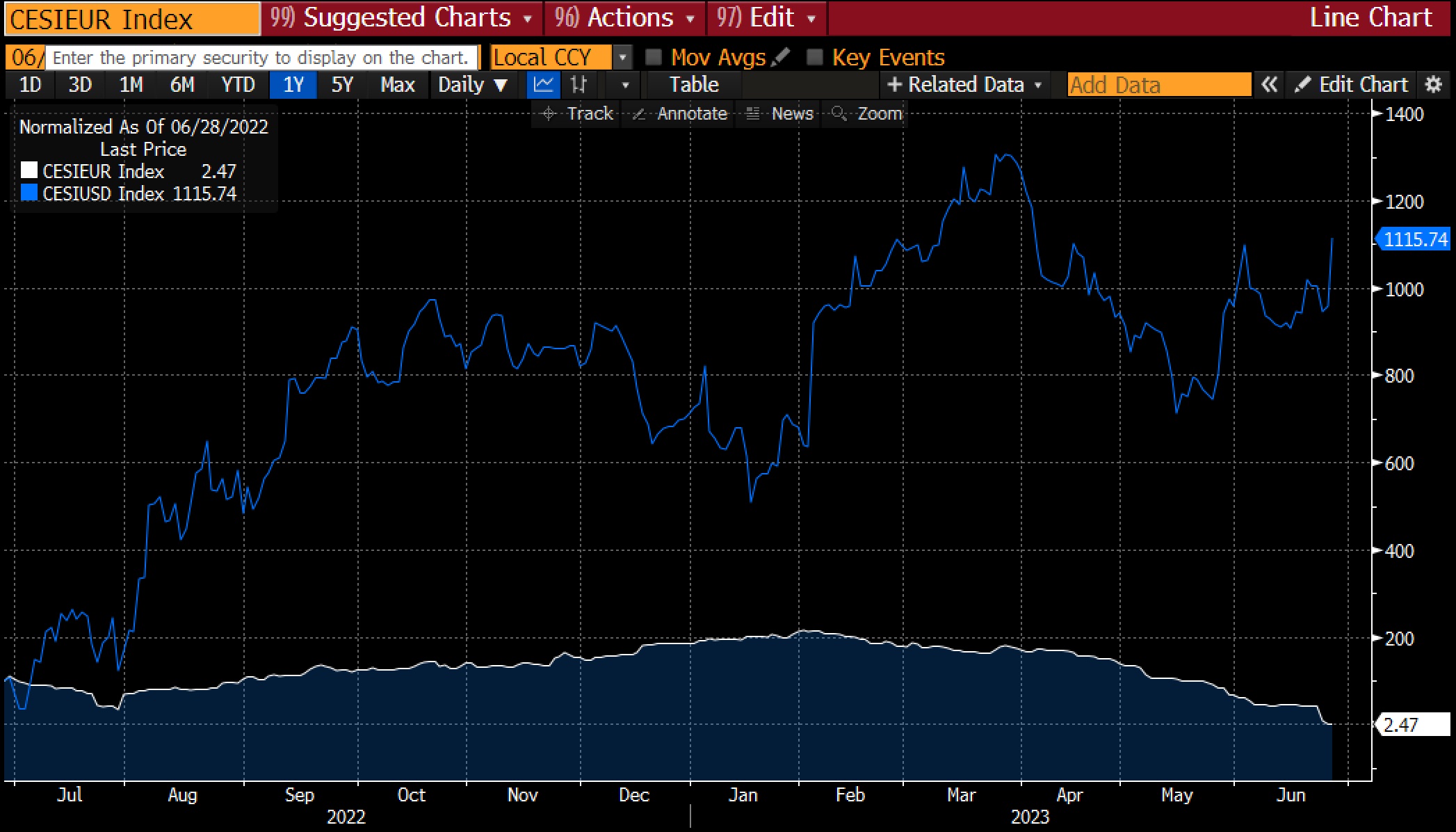
The big difference between the US and Europe, though, is that Europe is already clearly in a recession while the US, despite a widely anticipated slowdown, continues to perform quite well.  For instance, yesterday’s data releases were uniformly better than expected.  Durable Goods, Home Prices, New Home Sales, Consumer Confidence and the Richmond Fed Manufacturing Index all printed at better levels than expected.  This goes back to the Citi Surprise Index, which jumped nearly 17 points yesterday after the releases and sits firmly in positive territory in an uptrend.  Meanwhile, the same measure in the Eurozone is collapsing, deep in negative territory.  The below Bloomberg chart is normalized at 100 from one year ago.  It is quite easy to see the remarkable gap between the US (blue line) and Eurozone (white line) with respect to relative economic performance.

Arguably, one would expect that given the US economy’s seeming resilience, the Fed would be the more aggressive of the two central banks, but that is just not the case, at least based on the behavior of their respective balance sheets.


The big question is, can this dichotomy continue?  With the Eurozone already in a recession and showing no signs of coming out of it, can the ECB continue to tighten policy in the same manner they have to date?  As well, can the US equity market continue to perform well despite no indication that the Fed has any reason to pivot to easier money in the near future?  Logically, at least based on previous logic, one would have thought these conditions could not continue very long.  And yet, here we are with no obvious end in sight. 


My sense, and my fear, is that the ‘long and variable lags’ with which monetary policy impacts economic activity have not yet been felt in the US economy and that much more stress is still in the not-too-distant future.  If I had to select a particular weak spot it would be commercial real estate, especially the office sector, as already we have seen a number of high-profile mortgage defaults, and given the change in working conditions for so many people and companies, are likely to see many more.  The GFC was driven by the retail mortgage sector imploding.  It is not hard to imagine the next financial downturn being driven by the inability of commercial mortgage holders to refinance over the next year or two as they are currently upside down on their properties and cash flows are suffering dramatically to boot.  If this sector is the genesis of the problems, then given local and community banks are quite exposed to the sector all over the country, we are likely to be in for a rough ride, both in the economy and the stock market.  Be wary.


As to the overnight session, generally speaking, equity markets followed yesterday’s US rally with gains.  Japan was the leader with the Nikkei rallying 2% and only mainland China suffered as there was less clarity that the Chinese government was going to support the economy, and the currency.  European bourses are all nicely higher although US futures, especially the NASDAQ, are a bit softer after the Biden administration indicated further restrictions on semiconductor sales to China.


Bond yields are sliding a bit this morning but not too much, 2bp-3bp and quite frankly, all remain in a fairly narrow trading range.  Despite the Treasury issuance onslaught that has been proceeding since the debt ceiling was eliminated, yields have not moved very far at all.  It would seem that as issuance is pushed further out the maturity ladder, we would see higher yields, but that has not been evident yet.  Meanwhile, the yield curve remains massively inverted, right at -100bps this morning.


Oil prices are stabilizing this morning but have fallen more than 6% in the past week as this is the one market that truly believes the recession story.  Gold is also under pressure, falling further and pushing toward $1900/oz.  Higher yields continue to undermine the barbarous relic.  As to base metals, copper is under pressure, but aluminum is holding in reasonably well. 


Finally, the dollar is rebounding from a few days of softness with strength virtually across the board this morning.  Every G10 currency is weaker led by NZD (-1.3%) and AUD (-0.95%) as concerns over Chinese economic activity weigh on the antipodeans.  But the whole bloc is under pressure.  Meanwhile, in the EMG space, the picture is the same, virtual unanimity in currency weakness led by ZAR (-1.0%) and THB (-0.95%) with CNY (-0.3%) reversing course after the PBOC was absent from the market last night.  Despite hawkish comments from the SARB, the rand continues to suffer over concerns about the broader economy while the baht is suffering from political concerns.  This is an interesting story as Pita Limjaroenat was the surprise victor in recent elections but was not backed by the military.  Not surprisingly they are not happy, and he is having trouble putting a government together.


There is no major data today, so we are all awaiting Chairman Powell’s comments at 9:30 to see if he has any further nuance to impart.  At this point, I have to believe he will continue to push the higher for longer mantra as the data has certainly done nothing to dissuade him.  As such, I still like the dollar over time.


Good luck

Adf

Which One Means More?

The question is, which one means more?
The headline inflation? Or core?
The former declined
But please bear in mind 
The latter rose more than before

Which brings us today to the Fed
Where skipping a rate hike is said
To be what they’ll try
Then come late July
Will hike ere more water they tread

By now you are all aware that CPI’s release yesterday was a bit of a mixed bag with the headline number falling slightly more than expected to 4.0% while the core (ex food & energy) fell slightly less than expected to 5.3%.  As always, my go-to source on inflation is @inflation_guy, who in yesterdays’ post clearly laid out that there is very limited evidence that core inflation is going to decline sharply from these levels anytime soon.  In a nutshell, the key issue is that the housing portion of the index remains robust and that represents slightly more than one-third of the entire reading. 


Ask yourself the following question; why would a landlord reduce his asking rents if his costs are rising (taxes and maintenance) and his potential customers are all seeing wages rise healthily, at least as per measured by the BLS and the Fed?  Of course, the answer is that landlord is unlikely to reduce rents, but rather raise them, and that is not going to feed into lower inflation.  One other thing to note is the price of energy, which was the key driver of the decline in headline CPI, has the earmarks of a bottom here.  Not only have we seen production cuts from OPEC+, but it appears the Biden administration is beginning the process of finally refilling the SPR which means they have likely mapped the bottom of oil prices which have rebounded more than 5% from the lows seen Monday after the news broke.


As expected, the equity market took this news as a huge positive and continued its recent rally as it is almost certain that the Fed will be holding rates unchanged when they announce their policy update this afternoon.  The Fed funds futures market has reduced its pricing for a rate hike to just 9% this morning although the implied probability of a hike in July has risen to 71% now.  As an aside, the futures market is still pricing in the first rate cut by December or January 2024, although I suspect we will need to see a more significant decline in economic activity with much higher Unemployment for that to come to fruition.


This afternoon’s FOMC statement, and more importantly Chairman Powell’s press conference are the next critical features for the market.  There is much talk of this being a ‘hawkish pause’ where they will not change rates but really play up the still hot core inflation data to make sure that everyone knows they are not going soft on inflation.  As I have repeatedly explained, I continue to look at NFP as the most critical data point these days because as long as that number keeps printing solidly and beating expectations, the Fed will not be overly concerned a recession is coming and will feel comfortable tightening further if inflation starts to tick higher again.  And so, at this time, all we can do is wait for the outcome at 2pm.


Ahead of that, here’s what’s been happening:  risk has largely been in favor as yesterday’s US equity rally was followed by strength in Japan (+1.5%) and Australia (+0.3%) although many other APAC markets, notably China and South Korea, fell.  The China situation is quite interesting as there is news that the Chinese government has convened several meetings with business leaders to get ideas as to how to improve the economy there.  Not surprisingly, according to a Bloomberg story, the discussions focused on more market-oriented actions and less state planning as well as better coordinated fiscal and monetary policy stimulus.  My guess is that President Xi is not keen to let the market do the work as he will not control that, so it will be interesting to see how things there progress.  Meanwhile, European bourses are all much stronger this morning, even the FTSE 100 (+0.6%) despite a modestly weaker than expected set of GDP and IP data being released.  And of course, US futures continue to edge higher, at least NASDAQ futures do, although it would be quite surprising to see any large movement ahead of the FOMC this afternoon.


Of much greater interest to me is that bond yields rose so sharply yesterday with 10yr Treasuries rising 7 bps yesterday and another 1.5bps this morning, despite (because of?) the CPI data being soft.  The curve inversion remained essentially unchanged at -85bps, so I guess the story I saw that might have been the driver was when Treasury secretary Yellen was asked in Congressional testimony about the Fed and Treasury being prepared if China were to liquidate their entire portfolio of Treasuries, which is ~$875 billion.  That seems highly unlikely to me, but I guess anything is possible.  European sovereign yields are also rising after gains yesterday, which seems at odds with the equity markets that clearly believe in lower inflation.  Things are quite confusing these days.  As well, there will be much attention paid to China tonight to see if the PBOC follows through with a 10bp rate cut in the 1yr lending facility, or perhaps, if they are concerned about economic weakness, opts for more.


As mentioned, oil prices continue to rebound, pushing back to $70/bbl while gold got crushed yesterday seemingly in response to the rise in Treasury yields.  This morning the barbarous relic is ever so slightly firmer but in a bigger picture view, remains relatively unchanged over the past month.  Copper has continued its recent countertrend rally, but I expect that we will need to see real signs of an economic rebound for the red metal to get back to levels seen earlier this year above $4.00/pound.


Finally, the dollar remains under modest pressure overall, sliding about 0.25% against most of its G10 counterparts and a bit further against several EMG currencies.  Notably, ZAR (+1.0%) is the best performer today, after a solid Retail Sales print this morning.  As well, we see PLN (+0.7%) rising on rising zloty yields after the government increased the budget deficit on increased spending.  On the downside, KRW (-0.55%) is the laggard, falling after several days of a sharp rally has led to profit-taking.


Ahead of the Fed, we see PPI this morning (exp 1.5%, 2.9% ex food & energy) although that seems anti-climactic after yesterday’s CPI.  Add to that the Fed is coming and I cannot believe it will have any impact at all.


So, it is all about the Fed and how they sound since it seems pretty clear that they will not be adjusting rates today.  Look carefully at the dot plot as well, for clues to their forward-looking beliefs.  As to the dollar’s response, nothing has changed my big picture view that higher rates here will continue to support the greenback.


Good luck

Adf

Desperate Straits

Ahead of today’s CPI
Jobs data from England showed why
Inflation remains
The greatest of pains
That central banks can’t wave good-bye

Despite all their hiking of rates
In seeking to reach their mandates
The job market’s growing 
Which seems to be showing 
Their models are in desperate straits

Today’s key feature is the monthly CPI report from the US where expectations are for a 4.1% headline reading and 5.2% core reading, with both still far higher than the Fed’s 2.0% target.  While the headline number is certainly good news, the Fed’s problem is that the core reading continues to bump along pretty steadily above 5.0% and is not showing any indication of a sharp move lower.  While an exceptionally weak headline reading will almost certainly result in a further rally in risk assets on the premise that the Fed’s pause skip is now baked in, the greater question is how long can the Fed tolerate such a high core CPI reading before resuming their rate hikes?  As we head into the data, the Fed funds futures market is currently pricing just under a 25% chance of a hike tomorrow but nearly an 87% chance of at least one hike by July.  However, that is the peak with a cut then assumed by December.


Of course, the thing that is not getting any attention at this point is what happens if the reading is hot?  I have literally not read a single analysis that anticipates a higher outcome showing inflation has become even more intractable than it had seemed for the past several months.  My take is a higher-than-expected reading, especially in the core print, could see the market substantially increase their pricing for a rate hike tomorrow as well as another one or two before the year is over, and that may not be a positive for risk assets.


And that’s where the UK’s employment data comes into the discussion, as it is showing the same characteristics as the US employment data, surprising strength.  Briefly, instead of a rising Unemployment Rate, it fell to 3.8% with wages rising by 6.5% Y/Y, well above last month’s and well above forecasts.  There was a reduction in the number of jobless claims and a significant growth in employment of 250K on a quarterly basis, also far above forecasts.  In other words, despite a lot of doom and gloom regarding the UK economy and the irreparable damage that Brexit has done to the nation, it seems that there is continued economic activity at a decent pace and businesses are still hiring and paying up to do so.  I have to say that sounds suspiciously like the commentary regarding the US economy, where despite an ongoing belief that Unemployment is set to rise, each monthly data point has been surprising on the high side, often by a significant amount.  As I have written before, perhaps it is time for the central banking community to review the efficacy of their models as they no longer seem to represent any sense of reality.


The other noteworthy news overnight was that the PBOC reduced their 7-day Reverse Repo rate by 10bps to 1.90% in a surprising move.  Tomorrow night the PBOC has their monthly meeting and expectations are for a 10bp reduction in their medium-term lending facilities as the Chinese government struggles with a much slower than expected rebound from their latest Covid reopening.  In fairness, it is not just the Chinese government that is surprised as one of the main themes we have seen for the past several months was the expectation that China’s rebound would result in a significant increase in demand for commodities and that has just not occurred.  However, the fact remains that China is easing policy, both fiscal and monetary, while the G7 remains in a tightening phase.  The natural outcome here is that the renminbi has continued to slide.  While the onshore market closed little changed, with CNY -0.1%, the initial reaction upon the announcement of the rate cut was a little more substantial.  Net, though, the renminbi has been weakening steadily all year long and given recent very low inflation data, it is abundantly clear that the PBOC is not concerned at current levels.  I expect that USDCNY and USDCNH have much further to climb as the summer progresses, especially if CPI continues to run hot here in the US.


And those are really the key stories as we await that CPI print shortly.  Asian equity markets followed the US higher last night with the Nikkei continuing its sharp rally, rising 1.8%, and the rest of the markets trailing along behind. Europe, though, is having a less formidable session with minimal movement as the major indices are +/-0.1% from yesterday’s closing levels.  As to US futures, only NASDAQ futures are showing any movement, gaining 0.3% at this hour (7:30).


Bond markets are similarly dull, save the Gilt market which has seen 10yr yields rise 5.7bps, as both Treasuries and the rest of the European sovereign market are within 1bp of yesterday’s prices.  The Fed continues to be active in the Treasury market, taking down a significant portion of the issuance yesterday, albeit not directly as they bought off-the-run bonds instead of the issuances.  However, today’s data could easily have a significant impact as traders try to reassess the Fed’s response to a data surprise.


Oil prices have stopped falling and have bounce 1.8% from yesterday’s lowest levels of just below $67/bbl, although the trend continues to be lower.  As I have repeatedly written, this is the one market that is all-in on the recession call. Gold (+0.4%) has been pretty uninteresting lately as it stopped falling but has basically flat-lined for the past month just below $2000/oz.  Meanwhile, copper has rallied 2% this morning but is still well below highs seen earlier this year.  However, I think a large part of these movements are the fact that the dollar is generally softer this morning.


Versus its G10 counterparts, the dollar is softer across the board with GBP (+0.5%) the leading gainer but decent strength everywhere.  Versus the EMG bloc, there is a bit more variety with KRW (+1.3%) by far the leading gainer on a combination of reported corporate repatriation of overseas cash flows as well as hopes that China’s rate cut will support further growth in Korean exports.  However, after that, the bloc is basically split between gainers and laggards with the biggest moves just 0.3% either way, not enough to get excited about.


And that’s really it for today.  It is all about CPI this morning and depending on the data, we have the opportunity to get a better sense of how the Fed might behave tomorrow.


Good luck

Adf

Views Will Be Tested

When looking ahead to this week
With data and central bank speak
Some views will be tested
And some have suggested
The market is reaching its peak

But there is a growing belief
The future (that’s AI in brief)
Is shiny and bright
And stocks will take flight
Beware though, it could lead to grief

First a correction to Friday’s note regarding the blip lower in oil prices.  It was not inventory data but a story on a relatively obscure website, Middle East Eye, (h/t @inflation_guy) that discussed a seeming breakthrough in US-Iran talks that would allow Iran to export up to 1 million bbl/day in exchange for an agreement to slow their Uranium processing.  However, the story was vehemently denied by both the Iranians and the US and has been consistently denied since then by both sides repeatedly.  Now, I am of two minds on this story as denials of this extremity tend to point to some reality underlying the situation, but politically it would seem very difficult for the Biden administration to be seen to be negotiating with Iran heading into an election.  Regardless of the driver though, oil (-2.2%) is falling sharply again today with WTI below $69/bbl now.  This continues to point to the dichotomy of commodity markets sensing significant global slowing in growth while the equity markets see the world growing gangbusters.  Both sides cannot be correct, so at least one set of markets will need to adjust going forward.


Meanwhile, after an extremely lackluster week regarding new information, this week is exactly the opposite with critical data points like CPI as well as three major central bank meetings, Fed, ECB and BOJ.


Tuesday

NFIB Small Biz Optimism

88.4


CPI

0.2% (4.1% Y/Y)


-ex food & energy

0.4% (5.2% Y/Y)

Wednesday

PPI

-0.1% (1.5% Y/Y)


-ex food & energy

0.2% (2.9% Y/Y)


FOMC Rate Decision

5.25% (unchanged)

Thursday

ECB Rate Decision

3.50% (0.25% increase)


Initial Claims

250K


Continuing Claims

1787K


Retail Sales

-0.1%


-ex autos

0.1%


Empire Manufacturing

-15.1


Philly Fed

-13.0


IP

0.1%


Capacity Utilization

79.7%


Business Inventories

0.2%

Friday

BOJ Rate Decision

-0.1% (unchanged)


Michigan Sentiment

60.1

Source: Bloomberg


So, clearly, we have a lot to absorb this week although today is lacking in new news.  A quick look at the PPI data shows why there is a growing cadre of people who are in the ‘inflation is over’ camp, as the Y/Y data is collapsing back to levels with which we are more familiar over the past decades.  However, I would highlight that core CPI remains well above the Fed target with only a very slow decline ongoing.  I remain in the sticky inflation camp on the basis of both personal experience and the fact that a critical part of the statistic, housing, is not actually showing any real declines.  Here is a link to an excellent article that helps explain the fact that rents are not declining very much at all, in reality, and if housing costs continue to climb, so will CPI.


I think the real question is what will happen if the CPI number is hot, say 5.5% core and showing no indication that the much hoped for slowing is ongoing?  How will the Fed respond the following day?  Remember, the market is largely priced for a pause skip with a 27% probability of a rate hike currently in the futures market, although an 80% chance of one by next month.  However, we all thought Australia was done and they hiked last week.  We all thought Canada was done and they hiked last week.  Will the Fed be willing to ‘surprise’ the market if the data points to continuing inflation pressures? 


This is especially timely as this morning there was a story in Bloomberg explaining that the idea that wage pressures are driving inflation is losing credence with a far less certain outlook on that prospect.  Essentially, a Fed paper was published explaining that while wages and inflation are correlated, the direction of causality, if there is one, is not clear.  That seems like a way for the Fed to be able to pivot their views to a different underlying cause and given housing’s huge importance to the total CPI number, ongoing rises in rentals would certainly be a concern.  One thing we do know is that if the CPI data come out soft, the equity market will rocket higher, at least initially, as the working assumption will be that the Fed is done.  Like I said, lots to anticipate this week.


As to today, the bulls remain in control as Friday’s very modest US rally saw Asia follow higher and Europe currently showing gains on the order of 0.5% – 0.6%.  US futures are following suit, with NASDAQ futures up 0.5% at this hour (7:45) and leading the way.


Treasury yields are little changed this morning with the yield up just 1bp although European sovereign yields are all lower, especially Italy (-5.6bps) after the news that former Italian PM, Silvio Berlusconi, passed away overnight.  As he was still quite active in Italian politics and a key force in the Forza Italia party, the story is that his passing will have removed some anxiety from markets and allow the Bund – BTP spread to narrow further still.  Perhaps of more interest is the increasing inversion in the 2yr-10yr portion of the curve, now back to -86bps, and a direct result of the massive amount of Treasury issuance that has been happening since the debt ceiling was removed.  In fact, today there are auctions for 3m, 6m and 1y bills and 3y and 10y notes to the tune of $278 billion, a huge amount of supply.  Do not be surprised if the curve inversion continues further.


Finally, looking at the dollar, it is generally, though not universally softer.  Given oil’s decline, it is no surprise that NOK (-0.35%) is the G10 laggard, but there is also a bit of weakness in the CHF (-0.25%) on the back of a slight decline in Sight Deposits there.  Meanwhile, the rest of the bloc is modestly firmer with no outsized gainers.  In the EMG bloc, ZAR (+1.1%) continues its recent strength, having rallied 7% this month on continued belief that the electricity situation in the country is getting better.  But away from that, and the fact that TRY (-0.7%) continues to slide, the rest of the bloc appears to be awaiting the upcoming onslaught of news this week.


I have a sense that by the end of this week, we may have new marching orders from the markets.  I would not be surprised to see a hot CPI print get the Fed to hike instead of skipping and if we see something like that, I would look for the dollar to test its recent resistance levels and potentially break through.  Correspondingly, if CPI is soft, I imagine the market will assume the Fed is done, and we will see equities rally with the dollar falling, at least for the first leg of the move.  We shall see starting tomorrow.


Good luck

Adf

No Ceiling

The narrative’s taken a turn
As traders, for lower rates, yearn
Initial Claims jumped
And that, in turn, pumped
The idea that rate hikes, Jay’d spurn
To add to the positive feeling
Inflation in China is reeling
Now bulls are all in
And to bears’ chagrin
It seems that for stocks there’s no ceiling

Well, it seems that Initial Claims can have an impact after all!  Yesterday the data series printed at 261K, the highest level since October 2021 and significantly higher than all the economists’ forecasts.  The market impact was clear as it appears there is an evolution from the narrative preceding the data release to a newer version.  For clarity’s sake, I would argue the prevailing narrative went something like this:

  • Prices were falling sharply, and inflation would soon be back at or near the Fed’s 2% target.
  • Unemployment remains low because of a significant mismatch between job openings and potential employees so consumption would remain robust
  • This economic strength will overcome further Fed tightening…so
  • Buy stocks!


Arguably the newer narrative is something like this:

  • Initial Claims data shows that the employment situation may be deteriorating
  • Not only will the Fed skip hiking at next week’s meeting, but at any meeting going forward
  • Rising Unemployment will force the Fed to finally pivot and cut rates…so
  • Buy stocks!


Granted these may be somewhat simplistic descriptions, but I would argue that they are representative of the current zeitgeist.  If nothing else, I would argue that the algorithms that implement so much trading these days are written in this manner. 


At any rate, the impact was far more significant than would ordinarily be expected from an Initial Claims release.  Rate hike expectations by the Fed have begun to fade, not only for next week, but for the July meeting as well.  Treasury yields fell 8bps yesterday, although they have rebounded slightly this morning by 3bps along with European government bonds.  And, of course, equity markets all rallied further yesterday with the S&P 500 ticking up to a level 20% above the October lows so now “officially” in a bull market.  In fact, that equity rally continued through into Asia as all markets there were higher led by the Nikkei (+2.0%).  Life is good!


Is this sustainable?  I guess so, the market for risk assets has been willing to look through every potential problem and continue to rally.  Are there flaws in the argument?  I would argue there are, but as John Maynard Keynes explained to us all, the market can remain irrational far longer than you can remain solvent.


One other noteworthy data point was released overnight, Chinese CPI and PPI, both of which remain quite low.  CPI rose only 0.2% in the past year while PPI fell -4.6%.  These results have market participants looking for the Chinese to ease monetary policy still further to support the economy, continuing to widen the policy differential between China and the G10 nations which, at least for now, remain in tightening mode.  As such, it should not be that surprising that the renminbi (-0.3%) fell further last night.  Given the distinct lack of inflationary pressures currently evident in China, I suspect the PBOC will be quite comfortable watching CNY weaken further still, with another 3%-5% quite realistic as the year progresses.  After all, China remains a mercantilist economy highly reliant on exports and a weaker yuan will only help their cause.


Now, keep in mind that everything is not positive.  We continue to see weak economic activity throughout the Eurozone with this morning’s Italian IP data (-1.9% M/M, -7.2% Y/Y) showing there are still many problems on the continent.  It is no wonder that Italian PM Meloni is so unhappy with the ECB as the Italian economy continues to stumble while the ECB continues to tighten policy.  But it certainly appears that Madame Lagarde is unconcerned about Italy at least for the time being.  However, while the ECB will almost certainly raise rates next week, if the Fed truly has finished their rate hike cycle, the ECB will not be far behind.


So, as we head into the weekend, the equity markets that are actually trading at this hour (7:30) are in the red with all of Europe down on the order of -0.2% to -0.4% and US futures also slightly softer.  Meanwhile, oil prices (+0.25%) are edging higher this morning, although that was after a sharp afternoon decline yesterday on inventory data.  Meanwhile, gold, which rallied sharply yesterday amid a weak dollar session, is consolidating its gains and the base metals are mixed.


Finally, the dollar is mixed this morning with about a 50/50 split in the G10 led by NOK (+1.1%) after CPI printed at a higher than expected 6.7% in May and the market is now pricing in further policy tightening by the Norgesbank.  This seems to fly in the face of the inflation is collapsing narrative which should make next week’s US CPI data on Tuesday that much more interesting.  After that, the rest of the commodity bloc of currencies is slightly firmer vs. the greenback while the European currencies as well as the yen are all under a bit of pressure.  However, on the week, the dollar has definitely backed off its recent strength.


In the EMG bloc, the pattern is similar with KRW (+1.0%) the leading gainer on the view that more Chinese policy support will help the Korean economy substantially, while we continue to see ZAR (+0.5%) rally on the commodity price gains.  On the downside, TRY (-1.25%) continues to lag despite (because of?) the appointment of a new central bank chief, Hafize Gaye Erkan, within the new government.  Perhaps her background as co-CEO of First Republic Bank did not inspire confidence given its recent demise.  But regardless, TRY has fallen more than 10% this week alone and shows no signs of stopping the slide anytime soon.


And that, my friends, is all there is heading into the weekend.  There is neither data nor Fedspeak to look for so the FX market will almost certainly be taking its cues from the US equity markets for the day.  As such, if equity markets decline, I would look for the dollar to gain a bit and vice versa, but until we get at least through next Tuesday’s CPI, and more likely the FOMC on Wednesday, I see more range trading overall.


Good luck and good weekend

Adf

Policy, Tighter

Apparently, seven percent
Defined for Chair Jay the extent
Of just how high prices
Can rise in this crisis
Ere hawkishness starts to foment

But is it too little too late?
As he’s not yet out of the gate
Toward, policy, tighter
Despite a speechwriter
That claims he won’t fail his mandate

There is no shame in being confused by the current market situation because, damn, it is really confusing!  On the one hand we see inflation not merely rising, but fairly streaking higher as yesterday’s 7.04% Y/Y CPI reading was the highest since June 1982.  With that as a backdrop, and harking back to our Economics 101 textbooks, arguably we would expect to see interest rates at much higher levels than we are currently experiencing.  After all, in its simplest form, real interest rates, which are what drive investment decisions, are simply the nominal interest rate less inflation. As of today, with effective Fed Funds at +0.08% and the 10-year Treasury at 1.75%, the calculated real interest rates are -6.96% in the front end and -5.29% in the 10-year, both of which are the lowest levels in the post WWII era.  The conclusion would be that investment should be climbing rapidly to take advantage.  Alas, most of the investment we have seen has been funneled into share repurchases rather than capacity expansion.

With this in mind, it makes sense that dollar priced assets are rising in value, so stocks and commodities would be expected to climb, as would the value of other currencies with respect to the dollar.  However, the confusion comes when looking at the bond market, where not only are real yields at historically depressed levels, but there is no indication that investors are selling bonds and seeking to exit the space.

Our economics textbook would have us believe that negative real yields of this magnitude are unsustainable with two possible pathways to adjustment.  The first pathway would be nominal yields climbing as investors would no longer be willing to hold paper with such a steep negative yield.  Back in the 1990’s, the term bond vigilantes was coined to describe how the bond market would not tolerate this type of activity and investors would sell bonds aggressively thus raising the cost of debt for the government.  So far, that has not been evident.  The second pathway is that the inflation would lead to significant demand destruction and ultimately a recession which would slow inflation and allow bondholders to get back to a positive real yield outcome.  Not only would that be hugely painful for the economy, it will take quite a while to complete.

The problem is, neither of those situations appear to be manifest.  The question of note is, is the bond market looking at the current situation and pricing in much slower growth ahead?  Certainly, the punditry is not looking for that type of outcome, but then, the punditry is often wrong.  Neither is the Fed looking for that type of outcome, at least not based on their latest economic projections which are looking for GDP growth of 3.6%-4.5% this year and 2.0%-2.5% next with nary a recession in sight in the long run.

This brings us back to the $64 trillion question, why aren’t bonds selling off more aggressively?  And the answer is…nobody really knows.  It is possible that investors are still willing to believe that this inflationary spike is temporary, and we will soon see CPI readings falling and the Fed declaring victory, so bond ownership remains logical.  It is also possible that given the fact that the BBB bill was pulled and seems unlikely to pass into legislation, that Treasury issuance this year will decline such that the fact the Fed will no longer be purchasing new debt will not upset the supply/demand balance and upward pressure on yields will remain absent.  At least from a supply perspective.  The problem with this idea is that pesky inflation reading, which, not only remains at extremely high levels, but is unlikely to decline very much at all going forward.

Ultimately, something seems amiss in the bond market which is disconcerting as bond investors are typically the segment that pays closest attention to the reality on the ground.  While the hawkish cries from Fed members are increasing in number and tone (just yesterday both Harker and Daly said they expected raising rates in March made sense and 4 rate hikes this year would be appropriate), that implies Fed Funds will be 1.0% at the end of the year, still far below inflation and not nearly sufficient to slow those rising prices.

It seems to me there are three possible outcomes here; 1) bond investors get wise and sell long-dated Treasuries steepening the yield curve significantly; 2) the Fed gets far more aggressive, raising rates more than 100 basis points this year and pushes to invert the yield curve and drive a recession; or 3) as option 1) starts to play out, and both stocks and bonds start to decline sharply, the Fed decides that YCC is the proper course of action and caps Treasury yields while letting inflation run much hotter.  My greatest fear is that 3) is the answer at which they will arrive.

With all that cheeriness to consider, let’s look at how markets are behaving today.  Despite a modest equity rally in the US yesterday, risk has been less in demand since.  Asia (Nikkei -1.0%, Shanghai -1.2%, Hang Seng +0.1%) was generally lower and Europe (DAX 0.0%, CAC -0.5%, FTSE 100 -0.1%) is also uninspiring.  There has been virtually no data in either time zone, so this price action is likely based on growing concerns over the inflationary outlook.  US futures at this hour are basically unchanged.

As to the bond market, no major market has seen a move of even 0.5 basis points today with inflation concerns seeming to balance risk mitigation for now.

Commodity markets are mixed with oil (-0.1%) edging lower albeit still at its highest levels since 2014, while NatGas (-4.5%) has fallen as temperatures in the NorthEast have reverted back to seasonal norms.  Gold (-0.1%) has held most of its recent gains while copper (-0.7%) seems to have found a short-term ceiling after a nice rally over the past few sessions.

Finally, turning to the dollar, it is somewhat softer vs. most of its G10 brethren with NZD (+0.35%) leading the way, followed by CHF (+0.3%) and CAD (+0.2%) as demand for any other currency than the dollar begins to show up.  In EMG currencies, excluding TRY (-2.5%) which remains in its own policy driven world, the picture is more mixed.  RUB (-0.75%) has fallen in the wake of the news from Geneva that there was no progress between Russia, the US and NATO regarding the escalating situation in the Ukraine with the threat of economic sanctions growing.  BRL (-0.55%) is also under some pressure although this looks more like profit taking after a nearly 3% rally in the past two sessions.  On the plus side, THB (+0.5%) and PHP (+0.3%) are leading the way as they respond to the broadly weaker dollar sentiment.

Data today brings Initial (exp 200K) and Continuing (1733K) Claims as well as PPI (9.8%, 8.0% ex food & energy), but the latter would have to be much higher than expected to increase the pressure on the inflation narrative at this point. From the Fed we hear from Governor Brainerd as she testifies in her vice-chair nomination hearing, as well as from Barkin and Evans.  Given the commentary we have been getting, I expect that the idea of 4 rate hikes this year is really going to be cemented.

The dollar has really underperformed lately and quite frankly, it feels like it is getting overdone for now.  While I had always looked for the dollar to eventually decline this year, I did expect strength in Q1 at least.  However, given positioning seemed to be overloaded dollar longs, and with the Treasury market not participating in terms of driving yields higher, it is beginning to feel like a modest correction higher in the dollar is viable, but that the downtrend has begun.

Good luck and stay safe
Adf

Quite a Surprise

This morning’s report on inflation
Is forecast as verification
The Fed is behind
The curve and must find
The will to cease accommodation

While last night from China we learned
The trend in inflation has turned
In quite a surprise
It fell from its highs
A positive for all concerned

Ahead of this morning’s CPI report (exp 7.0%, 5.4% ex food & energy) investors around the world have been feeling positively giddy about the current situation.  Sure, China’s growth forecasts have been cut due to omicron infection outbreaks and the Chinese response of further lockdowns, but that just means that combined with the first downtick in PPI there since February 2020 (10.3%, exp 11.3%, prev 12.9%), talk has turned to the PBOC cutting interest rates next week by between 5 and 10 basis points.  So, while many other nations are aggressively fighting inflation (Brazil, Mexico, Hungary) or at least beginning to tighten policy (UK, Sweden, Canada), the market addiction to ever increasing liquidity may now be satisfied by China.  While it is still too early to know if lower interest rates are coming from Beijing, what is clear is that the credit impulse in China (the amount of lending) seems to have bottomed and is starting to reverse higher.  That alone augers well for future global growth; so, buy Stonks!

Meanwhile, I think it is valuable to consider what we heard from Chairman Powell yesterday at his renomination hearings, as well as what the two erstwhile hawks, Esther George and Loretta Mester, had to say about things.  Mr Powell, when asked why the Fed was continuing to purchase assets with inflation well above target and unemployment near historic lows inadvertently let the cat out of the bag as to the most important thing for the Fed, that if they were to move at a more aggressive pace, it could upset markets and there could be declines in both the stock and bond markets.  Apparently, the unwritten portion of the Fed’s mandate, prevent markets from falling, remains the most important goal.  While Powell paid lip service to the idea that the Fed would seek to prevent the inflationary mindset from becoming “entrenched”, he certainly didn’t indicate any sense of urgency that the Fed’s glacial pace of change was a problem.

Perhaps more surprisingly, neither Mester nor George were particularly hawkish, with both explaining that the Dot Plot from December was a good guide and there was no reason to consider a rate hike as soon as March.  Regarding QT, neither was anxious to get that started either although both wanted to see it eventually occur.  Finally, this morning, former NY Fed President (and current Fed mouthpiece) Bill Dudley explained in a Bloomberg column that there was no hurry to reduce the size of the balance sheet and that when it begins, the impact would be “like watching paint dry.”  Now, where have we heard that before?  Oh yeah, I remember.  Then Fed Chair Yellen used those exact same words to describe the last attempt to shrink the balance sheet right up until Powell was forced to pivot after the equity market’s sharp decline in 2018.  Apparently, the dynamics of drying paint are more interesting than we have been led to believe.

For those seeking proof that investors welcomed yesterday’s comments, one need only look at market behavior in their wake.  US equity markets rallied after the testimony and never looked back all day.  Treasury bonds did very little, with the sharp trend higher in yields having hit a key resistance and unable to find the will to push through.  Finally, the dollar took it on the chin, declining vs virtually every major and emerging market currency yesterday with many of those moves continuing overnight.  Recapping: higher stocks, unchanged bonds and a weaker dollar are not a sign that the market expects much tighter policy from the Fed.

Ok, so how are things looking this morning?  Well, in the equity market, the screen is entirely green. Last night, Asia followed the US lead  with gains across the board (Nikkei +1.9%, Hang Seng +2.8%, Shanghai +0.8%), and European bourses are also higher (DAX +0.35%, CAC +0.5%, FTSE 100 +0.7%) as data from the continent showed much better than expected Eurozone IP growth (2.3% vs 0.2% exp) as well as the first indication that inflation might be peaking in Germany with PPI there “only” printing at 16.1%, down from last month’s record 16.6%.  As to US futures, they are modestly higher ahead of the data, between 0.1%-0.2%.

In the bond market, while 10-year Treasury yields have edged higher by 0.7bps at this hour, they remain just below 1.75% and have shown no inclination, thus far, of breaking out much higher.  Arguably this implies that market participants are not yet full believers in the Fed tightening policy aggressively, and after yesterday’s performances, I think that is a good bet.  Meanwhile, European sovereign bonds are all rallying with yields falling nicely (Bunds -1.8bps, OATs -1.7bps, BTPs -1.3bps) as it remains clear that there is not going to be any tightening of note by the ECB this year.

On the commodity front, we continue to see strength in energy (WTI +0.5%, NatGas +5.2%) as well as industrial metals (Cu +2.9%, Zn +2.2%) although both gold -0.2%, and silver -0.2% are consolidating after strong moves higher yesterday.

Looking at FX markets, I would say the dollar is modestly weaker overall, albeit only in a few segments.  In the G10, NOK (+0.7%) and CAD (+0.2%) are the largest movers, by far, with both benefitting from oil’s continued rise.  The rest of the bloc, quite frankly, is tantamount to unchanged this morning.  In emerging markets, the picture is a bit more mixed with both gainers and losers about evenly split.  However, only 3 currencies have shown any real movement, BRL (-0.4%), KRW (+0.4%) and CLP (+0.3%).  The real seems to be consolidating some of its massive gains from yesterday, when it rallied 1.7% on the back of central bank comments implying that though inflation would fall back in 2022, it would require continued tight policy to achieve that outcome.  On the flip side, the won benefitted from a better than expected employment report showing more than 770K jobs added in the last year and indicating better economic growth going forward.  Finally, the Chilean peso seems to be benefitting from copper’s strong rally today.

Aside from this morning’s CPI report, we also see the Fed’s Beige Book at 2:00pm which has, in the past, been able to move markets if the narrative was strong enough.  Only one Fed speaker is on the docket, Kashkari, and even he, an uber-dove, is calling for 2 rate hikes this year as per his last comments.

The Fed tightening narrative is definitely having some difficulty these days which implies to me that the market has fully priced in its expectations and those expectations are that the Fed will not be able to tighten policy very much.  If the Fed is restrained, and tighter policy continues to get pushed further out in time, the dollar will suffer much sooner than I anticipated.  For those with opex and capex needs, perhaps moving up the timetable to execute makes some sense.

Good luck and stay safe
Adf

No Delay

Investors have not yet digested
The truth of what Jay has suggested
There’ll be no delay
QT’s on the way
(Unless the Dow Jones is molested)

Given the change in tone from the Fed and a number of other central banks, where suddenly hawkishness is in vogue, the fact that risky assets (read stocks) have only given back a small proportion of their year-long gains is actually quite remarkable.  The implication is that equity investors are completely comfortable with the transition to positive real interest rates and that valuations at current nosebleed levels are appropriate.  The problem with this thesis is that one of the key arguments made by equity bulls during the past two years has been that negative real interest rates are a crucial support to the market, and as long as they remain in place, then stocks should only go higher.

But consider how high the Fed will have to raise interest rates to get back to real ZIRP, let alone positive real rates.  If CPI remains at its current level of 6.8% (the December data is to be released on Wednesday and is expected to print at 7.0%), that implies twenty-seven 0.25% rate hikes going forward!  That’s more than four years of rate rises assuming they act at every meeting.  Ask yourself how the equity market will perform during a four-year rate hiking cycle.  My take is there would be at least a few hiccups along the way, and some probably pretty large.  Consider, too, that looking at the Fed funds futures curve, the implied Fed funds rate in January 2026 is a shade under 2.0%.  In other words, despite the fact that we saw some pretty sharp movement across the interest rate markets last week, with 10-year yields rising 25 basis points and 2-year yields rising 13 basis points, those moves would just be the beginning if there was truly belief that the Fed was going to address inflation.

Rather, the evidence at this stage indicates that the market does not believe the Fed’s tough talk, at least not that they will do “whatever it takes” to address rising inflation.  Instead, market pricing indicates that the Fed will try to show they mean business but have no appetite to allow the equity market to decline any substantial amount.  If (when) stocks do start to fall, the current belief is the Fed will come to the rescue and halt any tightening in its tracks.  As I have written previously, Powell and his committee are caught in a trap of their own design, and will need to make a decision to either allow inflation to keep running hot to try to prevent an equity meltdown, or take a real stand on inflation and let the (blue) chips fall where they may.  The similarities between Jay Powell and Paul Volcker, the last Fed chair willing to take the latter stand, stop at the fact neither man had an economics PhD.  But Jay Powell is no Paul Volcker, and it seems incredibly unlikely that he will have the fortitude to continue the inflation fight in the face of sharply declining asset markets.

What does this mean for markets going forward?  As we remain in the early stages (after all, the Fed is still executing QE purchases, albeit fewer than they had been doing previously) tough talk and modest policy changes are likely to continue for now.  Equity markets are likely to continue their performance from the year’s first week and continue to slide, and I would expect that bond markets will remain under pressure as well.  And with the Fed leading the way vis-à-vis the ECB and BOJ, I expect the dollar should continue to perform fairly well against those currencies.

However, there will come a point when investors begin to grow wary of the short- and medium-term outlooks for risk assets amid a rising rate environment.  This will be highlighted by the fact that inflation will remain well above the interest rate levels, and in order to contain the psychology of inflation, the Fed will need to continue its tough talk.  Already, when looking at the S&P 500, despite being just 3% below its all-time highs, more that 50% of its components are trading below their 50-day moving averages (i.e. are in a down-trend) which tells you just how crucial the FAANG stocks are.  And none of those mega cap stocks will benefit from higher interest rates.  In the end, there is significant room for equity (and all risk asset) declines if the Fed toes the tightening line.

Looking at markets this morning shows that no new decisions have been taken as both equity and bond markets are little changed since Friday.  Perhaps investors are awaiting Wednesday’s CPI data to determine the likely path going forward.  Or perhaps they are awaiting the comments from both Powell and Brainerd, both of whom will be facing the Senate this week for confirmation hearings for their new terms.  However, we do continue to hear hawkish comments with Richmond Fed President Barkin explaining that a March rate hike would suit him, and ex-Fed member Bill Dudley explaining that there is MUCH more work to be done raising rates.

So, after Friday’s late sell-off in the US, equities in Asia rebounded a bit (Hang Seng +1.1%, Shanghai +0.4%, Nikkei closed) although European bourses are all modestly in the red (DAX -0.3%, CAC -0.4%, FTSE 100 -0.1%). US futures are also turning red with NASDAQ futures (-0.35%) leading the way down.

Meanwhile, bond markets are mixed this morning with Treasury yields edging higher by just 0.4bps as I type, albeit remaining at its highest levels since before the pandemic, while we are seeing modest yield declines in Europe (Bunds -1.0bps, OATS -1.5bps, Gilts -0.3bps).  The biggest mover though are Italian BTPs (-5.3bps) as they retrace some of their past two-week underperformance.

On the commodity front, oil (-0.2%) has edged back down a few cents although remains much closer to recent highs than lows, while NatGas (+4.4%) has jumped on the back of much colder weather forecasts in the US Northeast and Midwest areas.  Gold (+0.3%) continues to trade either side of $1800/oz, although copper (-0.2%) is under a bit of pressure this morning.

As to the dollar, it is mixed today with SEK (-0.4%), CHF (-0.35%) and EUR (-0.3%) all under pressure while JPY (+0.25%) is showing its haven bona fides.  This definitely feels like a risk move as there was virtually no data or commentary out overnight.  In the EMG space, RUB (+0.9%) is the leading gainer as traders continue to look for further tightening by the central bank despite the fact that real rates there are actually back to positive already.  INR (+0.35%) and IDR (+0.35%) also gained with the rupee benefitting from equity market inflows while the rupiah responded to word that the government would soon lift the coal export ban.  On the downside, the CE4 are in the worst shape, but those are merely following the euro’s decline.

There is a decent amount of data coming up this week as follows:

Tuesday NFIB Small Biz Optimism 98.5
Wednesday CPI 0.4% (7.0% Y/Y)
-ex food & energy 0.5% (5.4% Y/Y)
Fed’s Beige Book
Thursday Initial Claims 200K
Continuing Claims 1760K
PPI 0.4% (9.8% Y/Y)
-ex food & energy 0.5% (8.0% Y/Y)
Friday Retail Sales -0.1%
-ex autos 0.2%
IP 0.2%
Capacity Utilization 77.0%
Michigan Sentiment 70.0

Source: Bloomberg

In addition to the data, we hear from seven Fed speakers and have the nomination hearings for Powell (Tuesday) and Brainerd (Thursday), so plenty of opportunity for more hawk-talk.

For now, I continue to like the dollar for as long as the Fed maintains the hawkish vibe.  However, I also expect that if risk assets start to really underperform, that talk will soften in a hurry.

Good luck and stay safe
Adf

A Wrong Turn

In Europe, the reading today
For CPI led to dismay
With prices still rising
Lagarde’s now revising
The timing for QE’s decay

Then later this morning we’ll learn
If Jay has a cause for concern
Should payrolls be strong
It will not be long
Til stock markets take a “wrong” turn

There seem to be three stories of note today with varying impacts on market behavior, and in the end, they are all loosely tied together.  Starting in Europe, CPI printed at a higher than forecast 5.0% in December, rising to a historic high for the Eurozone as currently constituted.  While energy prices were the largest driver of the data, even excluding those, CPI rose 2.6%, well above the current ECB target.  Given the series of remarkable energy policy blunders that have been made by the Europeans, one has to believe that it will be many more months before energy inflation has any chance of abating.  And as long as the continent remains reliant on Russia for its natural gas supplies, it will almost certainly be held hostage across other issues.  Remember, too, the more money spent on energy, where those funds leave the continent as they don’t really produce much of their own, the less money available for things like manufacturing and consumption of other goods.

The problem for the ECB is that the specter of slowing growth conflicts with their alleged desire to reduce QE and allow policy to “normalize”.  As we see in virtually every nation, the tension between addressing inflation and stifling growth is the crux of central bank decision making.  Madame Lagarde finds herself between the proverbial rock and hard place here.  As things currently stand, I fear the Eurozone is going to find itself in a position dangerously close to stagflation as the year progresses.  Do not be surprised if there are some major electoral changes this year.  PS, none of this is actually very good for the single currency, so keep that in mind as well.  While it has seemed to have stabilized over the past two months, another leg lower feels like it is still on the cards.  What Will Christine Do? History shows that central banks almost always err on the side of higher inflation, so do not be surprised if that is the case here as well.

Turning to the States, it is payroll day with the following forecasts:

Nonfarm Payrolls 447K
Private Payrolls 405K
Manufacturing Payrolls 35K
Unemployment Rate 4.1%
Average Hourly Earnings 0.4% (4.2% Y/Y)
Average Weekly Hours 34.8
Participation Rate 61.9%

Source: Bloomberg

With the market and investors still absorbing what seemed to be an even more hawkish set of FOMC Minutes than anticipated, where they extensively discussed QT, this has all the trademarks of a ‘good news is bad’ set-up, such that a strong print (>600K) will result in a bond and stock market sell-off as investors flee duration assets.  Remember, too, the ADP number printed at 807K, nearly double expectations and the highest since May21.  Since that release, forecasts have risen by about 50K and whispers even more.  The point is that if US data really starts to show significantly more strength, expectations are going to grow for more rate hikes this year as well as a quicker pace of allowing the balance sheet to shrink.  And that, my friends, will not be a good look for risky assets.

There once was a firm, Evergrande
In China, that bought tons of land
In order to build
Apartment blocks filled
With people, but now must disband

The problem for China is they
Explained, when this firm went astray
Twas under control
And they would cajole
Investors, their sales, to delay

Finally, before we move on to today’s markets, I would be remiss if I didn’t point out a change of tone from China overnight, one that was not officially announced but is true nonetheless.  You may remember back in September when we first heard about China Evergrande and the fact that the second largest property developer in that country, and the most indebted, was having trouble repaying its loans.  Initially there was talk by the doomsayers that this was China’s Lehman moment, and everything would unravel quickly.  Of course, that did not happen, although what we have seen since is a slower unraveling of that company and many others in the sector.  It turns out that when your business model is premised on borrowing excessive amounts of money to build apartment blocks in ghost cities, there could be problems down the line.

At any rate, the PBOC was adamant that everything was under control and that, anyway, China Evergrande’s borrowings weren’t that big compared to China’s GDP.  (That always sounded an awful lot like Bernanke’s comments regarding subprime mortgages.)  More recently, the PBOC imposed three ‘red lines’ regarding the ability of property developers to borrow money as they were really trying to squeeze the speculation out of the property market, but without causing the bubble to actually burst, simply deflate.  These rules, though, meant that Evergrande, and the other very weak companies in the space, suddenly had no source of funding.  Well, last night it was discovered that the PBOC has actually instructed banks to lend to property companies more aggressively.  Apparently the PBOC’s red lines have as much value as Qaddafi’s or Obama’s, in other words, none.  It can be no surprise that the PBOC has reversed course given the potential problems that exist in the Chinese property sector.  Just beware as things there remain opaque and in flux, although I doubt the renminbi is set to move dramatically soon.

Ok, quickly, after yesterday’s US equity fizzle, where markets slid slightly, Asia was mostly the same although the Hang Seng (+1.8%) did manage to rally sharply after it became clear Evergrande would get more funding.  Europe has done essentially nothing, despite a generally weak mix of data (German IP -0.2%, French IP -0.4%) as investors seem to be waiting for the payroll number to assess the Fed’s actions.  US futures are little changed at this hour as well.

We are seeing similar lack of activity in the bond market as here, too, investors await the payroll numbers.  Yesterday saw essentially no change in the 10-year Treasury yield although shorter maturity bonds did see yields rise a couple of ticks as the market continues to look for rate hikes sooner rather than later.  Europe is also biding its time to see what comes from NFP, with no major markets having moved even 1 basis point from yesterday’s levels.

Oil prices continue to rise (+0.75%) with WTI now above $80/bbl for the first time in two months.  But we are seeing strength throughout this space with NatGas (+1.4%) and Uranium (+3.5%) showing all energy is bid.  In fairness, the Uranium story is squarely on the back of the uprising in Kazakhastan where some 40% of global uranium is mined.)  On the metals front, both precious (Au +0.2%, Ag +0.2%) and base (Cu +0.3%, Al +0.5%, Zn +2.7%) are all in favor with only agricultural prices under pressure today.

As to the dollar, it is somewhat softer but not universally so.  SEK (+0.4%) and NOK (+0.3%) are the leading gainers in the G10 with oil helping the latter while the former continues to benefit from perceptions of still strong economic activity despite the latest wave of omicron.  However, other than these, movement is 0.1% or less in either direction, signifying absolutely nothing.  EMG currencies, though, have definitely seen more strength with ZAR (+0.7%), RUB (+0.7%) and CLP (+0.5%) all responding positively to the commodity rally.

And that is really it for the day.  My take on the NFP data is that good news (i.e. a strong print) will be a negative for risk assets as estimates will be that the Fed needs to move that much quicker to alleviate the inflation pressures.  That means a classic risk-off scenario of stronger dollar, stronger yen and weaker equities.  Bonds, however, are likely to see curve flattening more than higher rates, as the front end will be sold aggressively while the back lags appreciably.

Good luck, good weekend and stay safe
Adf