Trussed

The markets are worried that France
If given a half-decent chance
Will vote for Le Pen
And so, seems the ten-
Year OAT is now looked at askance
 
But ECB “sources” have said
There’s no TPI straight ahead
The French, rather, must
Show they won’t be “Trussed”
Else traders will leave them for dead


On an otherwise quiet summer morning, the ripples from the European Parliament election continue to grow. Not only did French President Macron dissolve parliament there and call new elections, but it appears the German government is far closer to falling as well.  However, right now, France is the story of note.

Elections in France are a two-stage affair where multiple candidates run for specific seats and then the two largest vote-getters in each district have a runoff a week later, if nobody won an outright majority.  Additionally, as is common throughout Europe, it is not a two-party affair like in the US, but there are several political parties vying for seats.  What makes this election so different from previous votes is the fact that the parties on the right are leading in all the polls.  Historically, throughout Europe, the right wing was anathema given that so many believed anything right of center would lead to the second coming of the Nazi Party.  This is the main reason that Europe has been consistently left of the US politically since the end of WWII.

However, what we have seen over the course of the past decade, and what has accelerated rapidly in the post-Covid era, is that many citizens of most Western countries are feeling dissatisfied with the politics of the left.  Immigration, which is obviously a huge issue in the US, is no less a problem in Europe.  The other key policy discrepancy is in the politics of global warming climate change global boiling, as it has become clearer each day that the policies that have been enacted, and those promised, have done nothing but raise the price of energy and the cost of living for all Europeans with no corresponding benefit to the climate.

The upshot is that many citizens throughout the continent are ready for a change, and this is beginning to frighten financial markets.  This can be seen in the chart below from tradingeconomics.com that shows German 10-yr yields in blue on the right-hand axis and French 10-yr yields in green on the left-hand axis.  While the spread has been creeping higher for the past six months, it has widened dramatically in the past week and is now at its widest (80 basis points) since the Eurozone crisis in 2013.

Source: tradingeconomics.com

It is not clear to me why financial markets are so concerned with excess spending by the right, as compared to excess spending by the left, but that seems to be the pattern.  (Recall the UK’s issue in October 2022 when Liz Truss, the newly minted PM, proposed a great deal of unfunded spending and the UK Gilt market sold off so sharply it put a number of insurance companies at risk and forced the BOE to buy gilts despite their efforts to shrink the balance sheet.)

At any rate, back in 2022, the ECB created a new program, the Transmission Protection Instrument (TPI) to help them prevent Italian BTPs from collapsing during the pandemic, thus maintaining what they believed to be an appropriate spread between bunds and BTPs.  While that spread peaked at 250bps, it is now a much more sedate 155bps, and despite Giorgia Meloni being a right-wing PM, the markets seem comfortable.  

However, with the ructions in France, there are many questions as to whether the ECB will dust off the TPI again to prevent a greater dislocation of French OATs vs. bunds.  Remember, too, that Madame Lagarde may have a personal vested interest in France, given her nationality, but as of yet, there has been no willingness to discuss using this tool.  However, if OATs continue to widen vs. Bunds, you can be certain this discussion will heat up even more.  We have already seen French stocks fall sharply, with French bank stocks down more than 10% in the past week.  It is movement like this that typically draws a response from central banks.  And of course, the euro is not immune to this situation as evidenced by its nearly 2% decline since the beginning of the month.  We will need to watch this closely until the elections at the end of the month and the second round on July 7th.

Beyond that, however, markets remain relatively dull.  Friday’s weaker than expected Michigan Sentiment data combined with the higher than expected inflation expectations was not very well received by risk assets (other than Nvidia and Apple) although by the end of the day, US major indices closed near flat.  Japanese shares fell sharply (Nikkei -1.8%) while the rest of Asia closed with much smaller declines, albeit they were declines.  In Europe, this morning, the picture is mixed with the big three markets, UK, Germany and France, all little changed on the day (a change for France of late) although there is more movement elsewhere but no consistency with both gainers and losers of up to 0.5%.  And following its recent pattern NASDAQ futures are edging higher this morning while DJIA futures are falling although neither has moved very much.  Arguably, the question is how long can the Magnificent 7 6 3 1 continue to rally in the face of increasing headwinds?

In the bond markets, yields are creeping higher with Treasuries (+2bps) bouncing off recent lows while European sovereigns all have shown similar yield gains except French OATs (+7bps) as the stress there continues to grow.  However, Asian bonds did little overnight with JGBs slipping one more basis point and now back to 0.92%, nearly 15bps lower than its peak at the end of May.  Things in Japan just take a verrryyy long time to play out.

In the commodity markets, oil (+0.25%) has managed to eke higher this morning, but the metals markets remain under pressure (Au -0.5%, Ag -1.0%, Cu -1.6%) as confidence in the economy ebbs alongside significant position reductions as metals had been one of the market themes for the first half of the year.  While I still like the long-term story, it seems clear there is no love for the space right now.

Finally, the dollar is mixed this morning with modest gains and losses overall across both G10 and EMG blocs.  The biggest winner is ZAR (+0.7%) which continues to retrace post-election losses as the new coalition government is gaining adherents in the investor community.  Alas, MXN (-0.2%) continues to feel pressure as concerns grow that president-elect Sheinbaum is going to be far more left leaning than markets expected.  In the majors, there is not much of distinction today with both gainers and laggards, although more laggards than gainers.  It should be no surprise that JPY (-0.25%) is pushing back to 158 given the yield moves overnight.

On the data front, there is some important stuff to be released this week, as well as a plethora of Fedspeak.

TodayEmpire State Manufacturing-9.0
TuesdayRetail Sales0.2%
 -ex Autos0.2%
 IP0.3%
 Capacity Utilization78.6%
ThursdayInitial Claims235K
 Continuing Claims1810K
 Philly Fed4.5
 Housing Starts1.38M
 Building Permits1.45M
FridayFlash PMI Manufacturing51.0
 Flash PMI Services53.3
 Existing Home Sales4.09M
 Leading Indicators-0.4%

Source: tradingeconomics.com

In addition to the data, we hear from seven Fed speakers with Richmond’s Thomas Barkin regaling us twice.  I would contend the narrative is searching for a direction other than BUY NVIDIA, as we continue to see a mixed picture.  While the NFP was strong, it appears data since then has softened.  If this remains the case, then the talk of a Fed cut sooner rather than later is going to really start to come back.  While July is only priced for a 10% chance of a cut, the market has September in its sights with a nearly two-thirds probability currently priced.  If the data weakens, that is viable.  In that scenario, I would expect the dollar to suffer and everything else to rally.  But we need to see a lot more soft data to reach that point.

Good luck

Adf

The Fed’s Tug-of-War

Each month there’s a Payrolls report
That pundits and traders exhort
To rise or to fall
Subject to their call
And whether they’re long or they’re short
 
But this month, there seems to be more
At stake, for the Fed’s tug-of-war
If joblessness rises
Each pundit advises
That rate cuts, this summer, we’ll score


Here we are on the first Friday of the month and, as almost always, markets remain quiet ahead of the release of the monthly Payroll report.  For good order’s sake, here are the current median expectations:

Nonfarm Payrolls185K
Private Payrolls170K
Manufacturing Payrolls5K
Unemployment Rate3.9%
Average Hourly Earnings0.3% (3.9% Y/Y)
Average Weekly Hours34.3
Participation Rate62.7%
Source: tradingeconomics.com

Recall, on Wednesday, the ADP Employment number was a bit softer at 152K while the ISM Employment sub-indices showed conflicting data between Manufacturing (much stronger at 51.1) and Services (weaker at 47.1).  Ironically, the headline ISM data was the other way around, with Manufacturing weaker and Services stronger than expected.  One other data point of note was the JOLTS Job Openings which shrunk about 300K to 8.059M, still high relative to the number of unemployed people, but with the ratio falling to 1.24 jobs/unemployed person.  That ratio is down from nearly 2:1 shortly after the pandemic, but up from about 1:1 pre-pandemic.

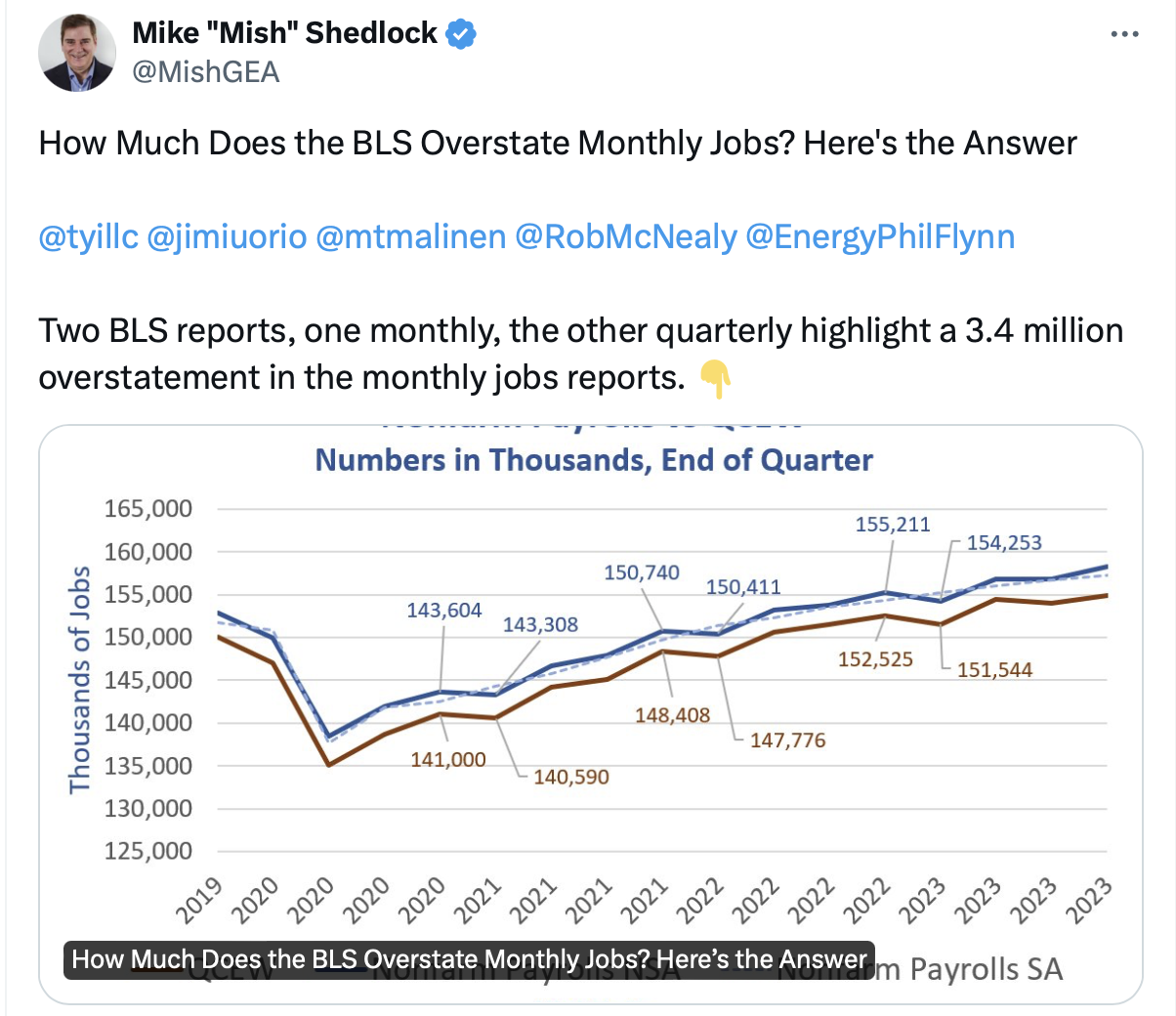
As with so much of the other data that we have seen over the past months, there is no clear direction here. Economy bulls can make the case that job growth remains solid and that there is no indication that a recession is on the way.  While the no-landing thesis has lost adherents, there are still many soft-landing adherents to be found.  At the same time, the economic bears have plenty of data to claim that a recession is around the corner, if we are not already in one.  I saw an analysis by Mike Shedlock (@MishGEA), a well-respected economist, that claims the NFP data has overstated job growth by 3.4 million jobs as per the following Tweet:

Since the beginning of 2023, looking at BLS data, the initial NFP report has been revised down in twelve of the fourteen months where there has been a third revision, by a total of 496K.  I created a chart to show the consistency of those revisions to help you get a better idea of the issue.

Source: data BLS, graph @fx_poet

Something that has always been true with respect to economic data, and NFP is no different than any other piece of information, is that the revisions tell an important story.  When initial data gets revised lower on a consistent basis, it has been indicative of a slowing economy.  Remember that when the NBER declares a recession, it is always a backward-looking effort, it is never in real-time.  But revisions are a key part of that process.  As well, given the fudge factors built into the BLS model, notably the birth/death factor for new businesses, history has shown that particular piece of the puzzle is always a lagging indicator as during a recession, more companies fail than are created, and that needs to be addressed via the revisions.

In the end, the issue is no matter the actual data point this morning, it will almost certainly be revised substantially before the end of the summer and could well tell a very different tale.  But today’s task is to understand what tale it is going to tell right now.

To that end, the narrative, the best that I can tell, is that we are seeing a gradual reduction in economic activity, but nothing dramatic.  Recession is still a remote concern, perhaps for 2025 or 2026, but the slowdown in activity will open the door for the Fed to start to ease policy going forward.  While the futures market is virtually certain that there will be no Fed action next week, the probability of a July cut has risen to 22.5% from less than 16% a week ago.  Several big banks are calling for a July cut, including JPM and Goldman Sachs, and there is a group of analysts who maintain that the underlying data that has been released indicates we are already in recession, and that rate cuts are coming very soon.

Here’s the thing, this focus on the Fed cutting rates remains, IMHO, a bad indicator of future risk asset strength.  Rather, as I showed earlier this week, when the Fed is cutting rates, it is usually because the economy is already in a recession and earnings are declining rapidly.  So, while the first cut may be sweet, the second should be a serious warning of what is coming down the pike.  I have already made my bed regarding my view that the top is in, but a softish number this morning, especially if the Unemployment Rate were to rise to 4.0% or 4.1%, would certainly increase the July cut probabilities, and almost certainly be followed by an equity market rally.  However, I would call that the last leg of the move.  As to my opinion of what today’s number will be, my sense, looking through my lens of further economic weakness (although still sticky inflation) is that it will be on the soft side, but not dramatically so.  Maybe 130K-150K.

Ok, ahead of the data, a quick tour of the markets shows that stocks in Asia were mixed with Japan edging lower, China and Hong Kong seeing declines of about -0.5%, but South Korea (+1.2%) and India (+2.1%) having strong sessions.  The same cannot be said for Europe, where every major index is lower by between -0.5% (Spain) and -1.0% (France) as German IP (-0.1%) continues to lag and the French Trade Balance (-€7.6B) fell into a deeper deficit than forecast.  Not surprisingly, US futures are essentially unchanged ahead of the NFP.

In the bond market, yields are edging up from their recent lows with Treasuries up 1bp and European sovereign yields higher by between 3bps and 5bps despite yesterday’s rate cut from the ECB.  Or perhaps because of it as remarkably, the ECB raised its own inflation forecasts and then cut rates.  The political imperative to cut interest rates is clearly growing quite strongly.

In the commodity markets, while oil (+0.7%) continues to rebound from its recent lows as OPEC+ worked to clarify their statements about future production, the big move today is in metals where gold (-1.8%) is selling off sharply after the news that the PBOC did not buy any additional metal during the month of May.  As they have been one of the key supporters of the barbarous relic, their absence really was a surprise.  Most pundits believe they are simply taking a break for now given the sharp rise in the price of the metal, but that they will return.  However, the other metals have all sold off alongside gold, with silver (-3.0%) and copper (-2.25%) giving back a good portion of their gains from the past two sessions.

Finally, the dollar is basically unchanged ahead of the NFP data with none of the G10 currencies moving more than 0.1%.  In the EMG bloc, though, ZAR (+0.9%) is the outlier, as despite the weakness in the gold price, the political situation seems to be getting better with a coalition government looking to be formed shortly.

In addition to the payroll data, we see Consumer Credit (exp $11B) this afternoon, and confusingly, despite the Fed being in its quiet period, Governor Lisa Cook is on the calendar to speak at noon today.  I would guess this will not be a discussion on monetary policy, but you never know.

At this point, it’s all about the data.  A hot number should see yields rise, stocks fall and the dollar bounce.  A cool number the opposite as more and more people anticipate that first rate cut.  Buckle up!

Good luck and good weekend

Adf

In Vogue

The cutting of rates is in vogue
And Madame Lagarde won’t go rogue
She’ll cut twenty-five
And keep hopes alive
That with Chair Jay, she did collogue
 
The stock market clearly believes
That soon they’ll be getting reprieves
In higher for longer
So, markets are stronger
As everyone, rate cuts, conceives


First it was Switzerland in March with a surprise 25bp rate cut.  Then Sweden cut 25bps in early May, although that was more widely touted ahead of the move.  Yesterday, the Bank of Canada joined the fray with a 25bp cut with Governor Tiff Macklem explaining that they are “not close to the limits” of the difference between US and Canadian interest rates and that with both inflation and growth receding, “markets have a very good idea of what’s on our minds” with respect to the value of CAD.  I think the last comment was an indication that they are comfortable if CAD were to weaken further, although after a very short-term dip of about -0.5% yesterday in the wake of the announcement, it is right back to where it was before and unchanged this morning.

With this as background, we turn now to the ECB which has virtually promised us a 25bp rate cut this morning and will almost certainly deliver it.  While many will remember that just last week, Eurozone CPI was released at a higher than expected 2.6% with core CPI also rising, up to 2.8%, at least those numbers have the same big figure as the ECB’s target.  But, as per the CPI chart below from tradingeconomics.com, it is not hard to make the case that the decline in inflation has bottomed above their target.

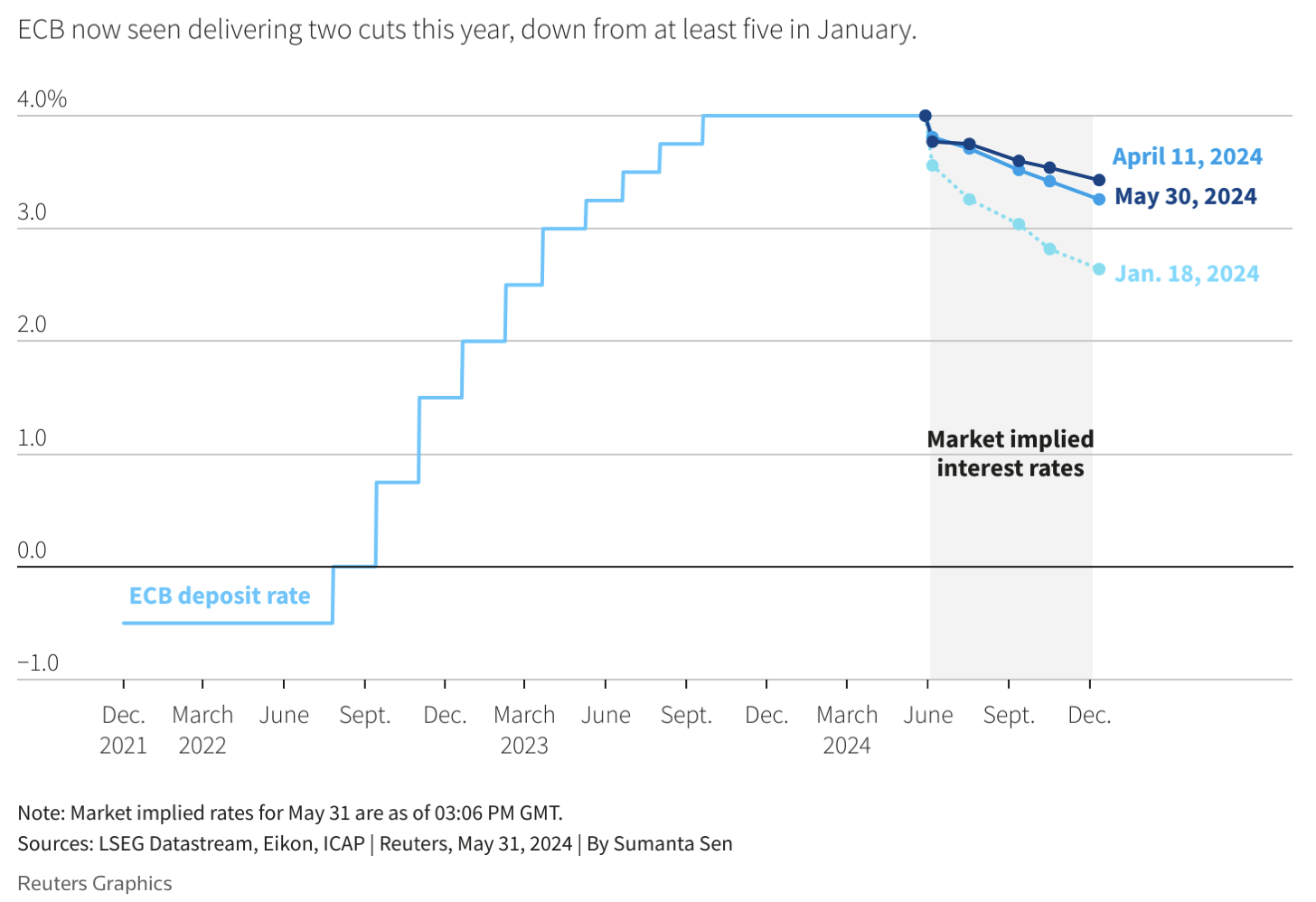
That could be awkward for their future actions but is also very likely why virtually every ECB speaker has been adamant that a July cut is not a given and they will continue to be data dependent.  Many analysts believe that there will be a total of three cuts this year, June, September and December, as the ECB will roll out their latest forecasts at those meetings, but beyond June, it is a bit less certain.  Market pricing shows that there are about 60bps total priced in at this stage, including today’s cut, as per the chart below.

Source: Reuters.com

Perhaps the most important question is, why do we care?  Well, certainly in the FX markets, given the importance of interest rate differentials, the relative speed of policy rate changes by the ECB and the FOMC can have an impact on the EURUSD exchange rate.  However, absent a surprise, something most central bankers try strenuously to avoid, the movement has already occurred ahead of the announcement.  Arguably, the more important part of this whole charade is the signal it gives for official views of future economic activity.  

When central banks are cutting interest rates, there is obviously concern that prospects for future economic activity to support the government in power are dimmer than they had been previously, hence the need to act.  As such, the very fact that a rate cutting cycle has begun in so many nations is indicative of the fact that expectations for future economic growth are diminishing.  It remains very difficult for me to understand that concept and expect that equity prices should rally substantially on the news.  But clearly, I am very old-fashioned in my thinking as evidenced by the fact that yet again, the S&P 500 and NASDAQ 100 have made new all-time highs on the strength of Nvidia’s non-stop rally.  While the Dow and NASDAQ Composite are still lagging, as are small cap stocks, euphoria remains the theme. (PS, my dour view from last Friday has been damaged, but I remain quite concerned with long-term prospects.)

However, this is where we are today.  The ECB will soon be the fourth major central bank to cut their policy rate and the pressure on the Fed to begin their cutting cycle will increase further.  Alas for the Fed, they continue to receive mixed signals from the data and rate cuts are not necessarily the proper prescription for what ails the US economy.  Just yesterday we received two contradictory signals with the ADP Employment report showing a weaker than expected 152K jobs created after a downwardly revised April number.  A few hours later, the ISM Services indicator was released at a much stronger than expected 53.8 reading, its highest since last August, and certainly not indicating that growth is ebbing.  As well, the Prices Paid subindex was a still hot 58.1, again not screaming out for a rate cut.

As of now, the market is pricing in virtually a zero probability of any rate move next week, but there has been a pickup in chatter about a cut at the July meeting with the probability of a cut then rising to 18.5% as of this morning, according to the Fed funds futures market.  If the Fed were to cut later this summer, nothing has changed my view that it will result in a significant decline in the dollar, and a significant rally in commodities. And, while the first move in both stocks and bonds might be higher, the specter of rising inflation will ultimately squash those moves.  But that is not today’s story, rather it is a story for the future.

Today, after those record highs in the US, we saw strength throughout most of Asia although Mainland Chinese shares did not participate in the fun.  That said, the gains were modest, between 0.25% and 0.5% overall.  In Europe this morning, the screens are all green with gains ranging from 0.3% in the UK to 0.7% in Germany as investors seem to believe in the goldilocks scenario there.  As to the US, futures at this hour (7:00) are unchanged as investors await tomorrow’s NFP data.

In the bond markets, after further declines yesterday, with 10-year Treasury yields touching their lowest level (4.27%) since the end of March, yields have bounced slightly this morning, higher by 2bps.  We are seeing similar price action throughout Europe, yield rallies of 2bps, except for the UK, which has seen a further 2bp decline despite the only data point, Construction PMI, rising the most in 2 years.  One last thing is that JGB yields, the ones that were supposed to be breaking out and running much higher now that the BOJ is leaving them alone, fell 5bps and are at 0.96%, below the 1.00% dotted line in the sand.

Commodity prices are rising this morning, continuing to rebound from the sharp declines earlier in the week, as oil (+0.6%) and NatGas (+0.4%) show there is still demand for energy regardless of the economic situation.  In the metals space, all the big four precious and industrial metals are higher this morning as it appears more and more like the weakness at the beginning of the week was a trading event, not a fundamental one.

Finally, the dollar is little changed overall this morning with the biggest mover being PLN (-0.3%), an indication that there is nothing ongoing.  While some currencies have managed small gains vs. the dollar and others have lagged, my sense is everyone is awaiting tomorrow’s NFP before deciding the next move, given the certitude of the ECB move later today.

We do, however, get some data this morning as follows: Initial Claims (exp 220K), Continuing Claims (1790K), Trade Balance (-$76.1B), Nonfarm Productivity (0.1%), and Unit Labor Costs (4.9%).  While we already know that the growth in the Trade Balance has been the key driver in the decline in the GDPNow figures (net exports are a subtraction from the calculation), I think the Fed may be more focused on the productivity numbers which are hardly inspiring and when combined with rising Labor Costs imply that inflation will have a tough time declining further.

So, the ECB will act first thing and then Madame Lagarde will very likely tell us that they remain data dependent, so nothing is promised for July or anytime the rest of the year.  As to today’s US data, I don’t believe it will be market moving.  This means that the equity bulls will continue to make their case and will need to be strongly disabused of the notion that the world is a great place right now.  When that time comes, beware, but it doesn’t seem likely today.

Good luck

Adf

Still Premature

The talk of the town has been gold
Whose rally, by some, was foretold
While Christine and Jay
Would give it away
Elsewhere it’s what folks want to hold
 
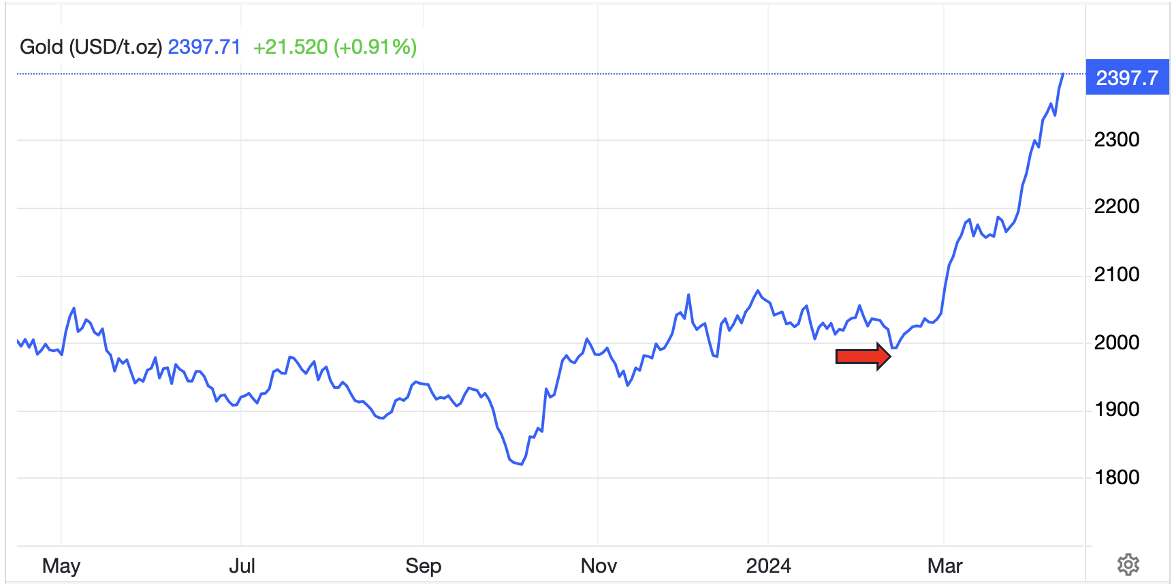
Under the rubric, a picture is worth a thousand words, have a look at the chart of the price of gold over the past twelve months below:

Source: tradingeconomics.com

That red arrow is pointing to the closing price on February 13, at $1988/oz, more than $400 lower than this morning’s market price.  There are many theories as to what is happening to drive this remarkable move in a commodity that has had a very limited role in the macroeconomic discussion for the past 53 years, ever since Nixon closed the gold window in 1971.  But the rally has been so strong it has fostered a host of theories as to what is driving it.  The latest is that there is a large, price-insensitive buyer acquiring large amounts outside the NY/London trading axis, with many people of the belief it is China and/or Russia preparing for a more complete break from the USD-based global monetary system.

Perhaps that is the case as we know from official reports that China has continued to acquire large amounts of gold over the past year.  But that has too much of a whiff of conspiracy theory in it for my taste.  My strong belief is that conspiracies are extremely difficult to maintain because people simply talk too much.  Rather, four decades of experience in financial markets, specifically FX and precious metals markets, has taught me that sometimes, markets move a long way on the basis of underlying fundamentals that have heretofore been ignored.  A simpler explanation could be that given its millennia-long history of being an able store of value and the fact that inflation remains rampant around most of the world while central bankers remain keen to cut interest rates and stop any efforts to fight it, many folks have decided it is a good idea to hold some portion of their personal wealth in the barbarous relic.  I know I do and have done so for quite a while.  I do not believe I am alone in that mindset.  Speaking of central bankers…

Said Christine, it’s still premature
To cut rates cause we’re not yet sure
Inflation is dying
Though we’re falsifying
It’s death from the Po to the Ruhr

At yesterday’s ECB meeting, as expected, there were no policy changes.  Madame Lagarde commented as follows: “If the Governing Council’s updated assessment of the inflation outlook, the dynamics of underlying inflation and the strength of monetary policy transmission were to further increase its confidence that inflation is converging to the target in a sustained manner, it would be appropriate to reduce the current level of monetary policy restriction.“  

That represents a lot of ten-dollar words to say, we want to cut rates, but we’re afraid if we do inflation might return so we are going to wait longer.  However, what was clear was that there is a wide range of views on the council.  For instance, this morning, Yannis Stournaris, the Greek central banker, said he thought that 4 cuts this year made sense.  At the same time, the last we heard from Robert Holtzmann of Austria, one cut was probably enough.  

Once again, Lagarde explained they are not waiting for the Fed, which is a good thing given the Fed seems less and less likely to cut this year at all, and Europe is in a recession already and needs lower rates.  This morning, the euro has fallen even further, down another -0.7%, and is back to levels last seen in early November.  It is becoming increasingly clear that monetary policies in the US and Europe are going to diverge further than currently priced and that does not bode well for the single currency going forward.

And those are really the big stories.  Yesterday’s PPI was a tick softer than expected, but the explanation was that in the calculation, the BLS seasonally adjusts the price of gasoline, so it showed a reduction despite the fact that gasoline prices, as we all know, have been rising steadily of late.  In any event, the market shook it off as we saw US equity markets perform well with both the S&P and NASDAQ reversing Thursday’s declines.  In Asia, however, while the Nikkei (+0.2%) managed a small gain, Chinese shares, and especially those in HK (-2.2%) had a lot more difficulty.  Chinese trade data was quite disappointing with the Trade balance shrinking dramatically (granted it is still >$50B) but both imports and exports declining.  And truthfully, all the other regional markets were lower to close the week.

European bourses, though, are all in the green, and nicely so, as investors and traders listen to the ECB doves and see more rate cuts, not less, coming.  This was confirmed with final pricing data showing the trend lower in inflation remains intact.  As to the US futures market, at this hour (7:50), they are lower by about -0.25% after weaker than expected earnings from JPM were released this morning.

In the bond market, after a week that has seen yields climb dramatically around the world, this morning Treasury yields are lower by 6bps, although still above 4.50%.  European sovereigns have seen yields decline even more, between 9bps and 11bps as the hope for rate cuts springs eternal.  Arguably, this is why the euro is under such pressure, the market narrative is gelling around the idea that the Fed won’t cut, and the ECB will be more aggressive.  One last thing, JGB yields are lower by 2bps this morning, but that is after a sharp rise seen in the wake of the US inflation report.  In fact, like many markets, with 10-year yields back at 0.84%, we are seeing levels not seen since November.

Turning to commodities, we have already discussed gold, and ignored silver (+2.0%) which is rallying even more aggressively, and copper (+1.80%) which is gaining on a combination of concerns over supply and a growing belief that China is going to add more stimulus to their economy.  Oil (+1.4%), too, is on the move, rebounding on growing concerns that the Middle East situation is getting even more dangerous with all eyes on Iran and any potential retaliation for Israel’s actions in Syria last week that resulted in the death of a key Iranian commander.  Historically, commodity rallies of this nature were accompanied by a weaker dollar, but not this time.  If this price action continues, there are going to be a lot of problems in nations all around the world that need to acquire commodities while their respective currencies are weakening.  Do not be surprised to see more market intervention in many places.

Finally, the dollar is back on top, rallying vs. virtually every currency this morning in a substantial manner.  In the G10, SEK (-1.3%) is the laggard, but the euro, pound, Aussie, Kiwi and Nokkie are all weaker by -0.6% or more.  In fact, only the yen (0.0%) is holding up, but that is after it blew through the previous ‘line-in-the-sand’ at 152.00 and is now above 153.00.  emerging market currencies are also uniformly weaker, although some are holding in better than others.  ZAR (-0.1%) is clearly benefitting from the metals rally, but not quite enough to rally on its own.  But KRW (-1.0%), MXN (-0.5%), BRL (-0.45%) and PLN (-0.65%) give a flavor of the overall price action.  Frankly, this is likely to continue until/unless we see a significant change in the data flow with US economic activity slowing, or at the very least, we get a consensus from all the Fed speakers that they are going to cut regardless of the data.

Speaking of the data, today we see only Michigan Sentiment (exp 79.0) and hear from two more Fed speakers, Bostic and Daly.  it doesn’t strike me that the data will matter that much, but market participants are quite keen to get more clarity from Fed speakers.  There is still a mix of views, although the one consistency is they have no confidence that inflation is falling toward their target sustainably.  However, some see a reversal higher as quite possible while others are holding out hope that this is a temporary bump in the road.  We will still see a significant amount of data before the FOMC meeting on May 1st including Retail Sales next week and the PCE data at the end of the month.  We will also hear much more from Fed speakers, so as of now, while there is no consensus, perhaps one will coalesce.  

Yesterday’s data did result in futures markets very slightly increasing the rate cut probabilities, with June now a 25% chance and 45bps priced for the rest of 2024.  I remain in the no-cut camp and so expect the dollar will continue to perform well vs. its brethren.  However, I see no reason for the commodity markets to back off either.  Bonds, however, are likely to see more pain going forward.

Good luck and good weekend

Adf

Hell or High Water

Though Jay was as clear as a bell
That rate cuts were coming through hell
Or high water, it seems
Not all the Fed’s teams
Are ready to cut rates as well
 
A group of the regional Feds
Seems at, with Chair Jay, loggerheads
They think maybe two,
Or one, cut could do
Now, traders are sh**ting their beds!


Yesterday morning, I claimed that it didn’t matter what the plethora of Fed speakers were going to say given that Chairman Powell had seemed to clear the decks for a rate cut by June.  He swept away concerns about ‘too hot’ inflation and was clearly ready to go forward.  It seems that I didn’t read the market zeitgeist that well after all.

It turns out during the day, we heard from four different Fed regional presidents, Chicago’s Goolsbee, Minneapolis’s Kashkari, Cleveland’s Mester and Richmond’s Barkin, and not one of them sounded like they were ready to cut rates anytime soon.  While only two, Barkin and Mester, are voters this year, the story we consistently hear is that everybody’s voice is heard during the meetings.  Listening to those voices yesterday, it certainly doesn’t sound like everybody is ready to move in June.

Mester: “I don’t think the pace of disinflation this year will match what we saw last year as we need to see a reduction in the demand side this year.  Although if the economy evolves as I envision, we should be able to lower the Fed funds rate later this year.”   

And that was the most dovish we heard.

Barkin: “It is smart for the Fed to take our time.  No one wants inflation to re-emerge.”

Kashkari: “If inflation continues to move sideways, that would make me question whether we needed to do those rate cuts at all.

Goolsbee: “I had been expecting it [inflation] to come down more quickly than it has.  The biggest danger to the inflation picture is continued high inflation in housing services.”

It is very hard to look at these comments and conclude that a June rate cut is a given.  And yet, the Fed funds futures market is now pricing a 64% probability of a June cut although is still pricing less than three full cuts for the rest of the year.

Risk assets were not enamored of these comments and the result was we saw a serious pullback in the equity markets in the US with all three major indices falling by between 1.25% and 1.40%.  Treasury yields fell as well, down 4bps, with its haven status making a comeback as did that status for both the yen (+0.4%) and Swiss franc (+0.6%).

Remember this, there are many different stories around the current market situation between the macroeconomics, the geopolitics of both Israel/Gaza and Russia/Ukraine and the central bank activities, not only with the Fed, but also the BOJ and ECB.  The point is markets are feeling many crosscurrents and it would not be surprising to see a more material breakout in one direction or the other on some seemingly less important piece of news.  In truth, when major moves begin, we rarely have a specific catalyst to which we can point.  I have a feeling the next big move will be confusing for a while.

While words have power
Policies ultimately
Matter much, much more
 
As summer passes
The transition to autumn
Should see prices rise


Adding to the cacophony of new information were comments from BOJ Governor Ueda that he believes the central bank may achieve its inflation target by late summer or early autumn as the impact of the recent wage negotiations begins to feed into the economy.  This story, Ueda’s first comments since the BOJ raised rates last month, has helped revive the yen bulls’ confidence that…this time it’s different!  Given the enormous size of the short yen positions outstanding, it is very possible that we see a sudden, sharp rise in the currency, but for the outcome to be more permanent, we will need to see much more aggressive BOJ tightening, or much more aggressive Fed easing.  Right now, I don’t believe either is in the cards, at least not until winter at the earliest.  This is especially true since when asked about the BOJ’s balance sheet, he indicated there was no reason for an immediate adjustment (sale) to ETF positions or their current, continued, ¥60 billion per month of JGB purchases.

Which brings us to this morning, when the monthly payroll report is set to be released at 8:30.  The latest consensus forecasts are as follows:

Nonfarm Payrolls200K
Private Payrolls160K
Manufacturing Payrolls5K
Unemployment Rate3.9%
Average Hourly Earnings0.3% (4.1% Y/Y)
Average Weekly Hours34.3
Participation Rate62.5%
Source: tradingeconomics.com

We have seen three consecutive reports above 200K, albeit replete with all types of revisions.  However, 200K new jobs per month is historically, a pretty good outcome.  It is certainly not indicative of a major decline in economic activity.  As well, yesterday’s Initial Claims data, at 221K, while a few thousand higher than expected, remains in a very comfortable place from the perspective of economic growth.  The point is the Fed’s concern over sticky inflation makes perfect sense when looking at these numbers.  After all, if people continue to work, they will continue to spend.

As it happens, my take today is we are setting up for a potential large ‘good news is bad’ type day and vice versa.  If the headline number is above 200K, and especially if the Unemployment Rate were to dip lower by a tick or two, I suspect that traders will quickly assume that the hawks are in control and any probability of a rate cut by June will dissipate.  Equity markets will not like this, nor will bond markets.  However, the dollar should continue to perform and, ironically, I see commodities doing the same thing.  We shall see how it plays out.

A quick recap of the overnight session shows that yesterday’s US selloff set the tone with declines throughout Asia (Nikkei -2.0%, China still closed) and Europe (DAX -1.45%, CAC -1.4%) as concerns grow regarding the future of monetary policy.  US futures, though, are modestly higher ahead of the data at this hour (7:00).

Ahead of the release, Treasury yields have reversed half of yesterday’s decline, currently higher by 2bps, and we are seeing similar movement across Europe with all markets seeing yields rise by between 1bp and 3bps.  Yesterday the ECB released their ‘minutes’ explaining they had seen further progress in their mission and the key elements, but that was before oil rebounded 10% from levels seen back then.  As has become the norm everywhere, there continues to be conflicting data and price movement clouding the picture for future policy actions.

Speaking of oil, this morning it is holding onto its gains from yesterday with WTI above $86/bbl and Brent crude at $91/bbl.  The ongoing tensions in the Middle East are clearly not helping things here as concerns grow that Iran is going to retaliate more directly to Israel’s actions earlier in the week, killing a senior Iranian general in Syria.  Of course, the entire combination of events continues to support gold prices, which are little changed this morning, but have absorbed all the selling pressure anyone can muster.  Copper and aluminum are also firmer this morning as the commodity sector seems on a mission right now.

Finally, the dollar is a touch higher this morning heading into the data.  While it has backed off its recent highs from Tuesday, the DXY remains above 104 and USDJPY remains above 151.  With that in mind, we must note ZAR (+0.65%) which continues to benefit from the rally across the entire metals complex and NOK (+0.3%) which is clearly benefitting from oil’s recent performance.  However, traders here are all anxiously awaiting this morning’s number alongside everyone else for more clarity on the next direction of travel.

Aside from the data this morning, we hear from three more Fed speakers to round out the week.  While Barkin is a repeat from yesterday, we also get some new perspectives from Boston’s Collins and Governor Bowman.  Yesterday’s market response to the hawkish views was quite surprising to me as I was very sure that Powell had set the tone.  If today’s data points to strength, do not be surprised to see equities sell off further alongside bonds.  However, a weak number is likely to signal the all-clear for the bulls to get back to business.

Good luck and good weekend

Adf

Not Fear, But Greed

It seems that on Friday, we learned
The prospect for rate cuts upturned
The ISM sunk
And Michigan stunk
So, doves got the data they yearned
 
And so, things are priced for perfection
Though history cautions reflection
Is what we all need
As not fear, but greed
Is likely to cause the correction


Markets are funny things with a history of reacting to catalysts that were completely unexpected while ignoring the ‘big’ things all the time.  Friday was a perfect example as the release of some second-tier data, ISM and Michigan Sentiment, drove a major change in the narrative and market prices in every asset class.  Prior to the Friday data releases, which saw ISM Manufacturing fall to 47.8, far below last month and forecasts, as well as the Michigan Sentiment index fall to 76.9, also well below last month’s number and forecasts, there had been a steady stream of strong data and hawkish Fed rhetoric.  

By now, you are all familiar with the Fed’s general lack of confidence that inflation is going to return to their 2.0% target soon as that sentiment has been expressed by, literally, all 17 FOMC members in the past three weeks.  The result of the hawkish talk and the solid data was a repricing in the Fed funds futures market of just how many rate cuts were coming in 2024, as well as their timing.  As well, we saw Treasury yields back up nearly 50bps during the month of February as the concept of higher for longer was finally getting internalized by market participants.  

But observing the market’s behavior, it was never clear that investors and traders really believed that tale of higher for longer.  Undoubtedly, there has been a camp, FX poets included, who have been singing that tune all year long.  But a much larger camp has been convinced that inflation was clearly on its way to 2% or lower and the Fed would want to cut sooner rather than later.  The rationales for these cuts had very little to do with the economy and focused instead on one of two things; the election this year and their effort to prevent President Trump from being elected support the current administration, or the fact that the extraordinary amount of funding that the Federal government needs to pay for its increasing deficits requires lower interest rates to prevent a fiscal disaster.

Then along comes Friday’s data and much of the Fed’s hard-won respect regarding higher for longer got tossed right out the window.  Treasury yields fell sharply, down 8bps, while the futures curves upped the ante for a May rate cut and made June that much more certain.  Not surprisingly, equity markets got quite the boost, although they have mostly been ignoring the rates story anyway. But perhaps the most interesting thing was what happened in the gold market, where the price of the barbarous relic jumped nearly 2% on the idea that rates were set to decline in the face of still high inflation.

It is important to remember that these two data points were, as I said at the top, secondary.  The fact that both pointed to economic weakness after a long string of strong data points was interesting, but was it really a signal that the trend has changed?  Personally, I am skeptical that is the case.  However, for a market that was looking for a reason to push back on the growing narrative of fewer rate cuts, they were a welcome sight.

In the broad scheme of things, though, this week is likely to be far more important in helping us all understand the nature of the current economy as well as the ongoing Fed reaction function thereto.  After all, not only do we hear from Chairman Powell as he testifies to the Senate and House on Wednesday and Thursday respectively, but Friday brings the payroll report.  Too, on Wednesday the Bank of Canada and on Thursday the ECB meet to lay out their latest views.  Remember, too, that the Chinese National People’s Congress is being held this week, and while leaks are rare, they will ultimately be announcing their growth targets for the year, so another crucial piece of information.  Net, I do not believe that last Friday’s data will have changed the minds of any FOMC members, and continue to believe that even a June cut is a low probability absent a significant overall economic decline, including lower inflation data.  But then, that’s what makes all this so exciting  A yellow face with a black line

Description automatically generated.

As we await all the activity to come, let’s recap the overnight session.  In Asia, only the Nikkei (+0.5%) managed to generate any excitement as it made yet another new all-time high and breached the 40,000 level for the first time.  Chinese shares were dull as was most of the rest of the region.  In Europe, the picture is mixed although the only mover of note is the FTSE 100 (-0.6%) which seems to be declining on the prospects of a lackluster budget announcement by the government this week.  Otherwise, bourses here are within +/- 0.2% of Friday’s closing levels.  And at this hour (8:00), US futures are edging slightly lower.

In the bond market, Treasury yields are backing up from Friday’s decline, rising 3bps this morning, but in Europe, sovereigns are mostly seeing some demand with yields slipping 2bps-4bps across the board.  The one exception is, again, the UK, where Gilt yields are unchanged on the day.  Overnight, JGB yields were unchanged, while we saw lower yields across the rest of Asia which seemed to simply be following the Treasury market.

In the commodity space, Friday also saw oil prices rise 2%, and this morning they are essentially unchanged, consolidating those gains.  OPEC+ announced that they would continue their lower production levels which clearly has had a bigger impact than rumors that a ceasefire would soon be taking place in Gaza.  Gold is also little changed this morning, holding its gains while copper is edging higher, and aluminum is slipping.  There are many analysts who discuss the coming super cycle for commodities, but thus far, there is little consistency in the price action there.

Finally, the dollar is mixed this morning.  In the G10 we are seeing weakness from SEK (-0.65%), NOK (-0.35%) and JPY (-0.3%) although some strength from the euro (+0.1%) and pound (+0.2%).  Similarly, EMG currencies are seeing gainers (ZAR +0.4%) and laggards (CLP -0.8%) and everything in between.  If the new narrative of easier Fed policy turns into reality, then I would look for the dollar to suffer.  However, I don’t yet accept that as the case.

As mentioned above, there is much on the data front this week as follows:

TuesdayISM Services53.0
WednesdayADP Employment150K
 Bank of Canada Rate Decision5.0% (unchanged)
 JOLTS Job Openings8.9M
 Fed’s Beige Book 
ThursdayECB Rate Decision4.0% (unchanged)
 Initial Claims215K
 Continuing Claims1885K
 Trade Balance -$63.4B
 Nonfarm Productivity3.1%
 Unit Labor Costs0.6%
 Consumer Credit$10B
FridayNonfarm Payrolls200K
 Private Payrolls158K
 Manufacturing Payrolls10K
 Unemployment Rate3.7%
 Average Hourly Earnings0.3% (4.4% Y/Y)
 Average Weekly Hours34.3
 Participation Rate62.6%

Source: tradingeconomics.com

In addition, as well as Chairman Powell’s testimonies in Congress, there are another four Fed speakers, although with Powell headlining, I don’t think folks will pay too close attention to them.  Last week, the Fedspeak onslaught was very consistent about that lack of confidence that inflation would reach target soon, and there is clearly no hurry to cut rates, although virtually all speakers expect rate cuts to be the case.  Perhaps the data this week will change some minds, but remember, the big number doesn’t come out until after Powell speaks, and after Friday, the Fed enters its quiet period ahead of the next FOMC meeting.  

Right now, I have to believe last Friday’s data was the exception, not the rule, but we will learn more as the week progresses.  In the end, I think the dollar remains tied to the yield story, so as long as growth remains stronger here than elsewhere, and doesn’t show signs of falling sharply, the dollar should maintain its broad level of strength.

Good luck

Adf

With Conceit

On Friday, two final Fed speakers
Explained they are both simply seekers
Of lower inflation
Hence, justification
That they’re simply policy tweakers
 
We now have nine days til they meet
When both bulls and bears will compete
To offer their vision
While casting derision
On each other’s views with conceit
 
It appears to be a slow day to start what has the potential for quite an interesting week.  While the Fed is in their quiet period, we have central bank meetings in Japan, the Eurozone, Norway and Canada as well as the first look at Q4 GDP and the all-important December PCE data.  As I said, while it is slow today, there is much to anticipate.

But first let’s finish up last week, where the equity rally continued unabated despite continued pushback from Fed speakers.  Notably, SF’s Mary Daly, who is usually a reliable dove, was very clear that it is too soon to consider cutting interest rates.  Her exact words, “We need to see more evidence that it is heading back down to 2% consistently and sustainably for me to feel confident enough to start adjusting the policy rate,” seem pretty clear that she is not ready for a cut yet.  Meanwhile, Chicago’s Austan Goolsbee was similarly confident that it is premature to consider cutting rates any time soon.  

Arguably, of more importance is the fact that the Fed funds futures market is now pricing in slightly less than a 50% probability of a rate cut in March and about 5 rate cuts this year, rather than the 6 to 7 cuts that were in the price ten days ago.  So, we heard a great deal of jawboning to remove just one rate cut from the market perception.  For the life of me, I cannot look at the recent CPI data as well as the situation in the Red Sea and the Panama Canal, where though caused by different situations, show similar outcomes in forcing a significant amount of shipping volumes to change their route to a longer, more costly one and see lower inflation in our future.  I understand that there was a disinflationary impulse, but to my eye that has ended.

Now, it is entirely possible that we see the rate of inflation decline on the back of a recession, but that is not the market narrative at this point.  Rather, the market appears to be priced for the perfection of a soft landing, where the Fed will be able to tweak rates lower while inflation continues to soften, and unemployment remains low.  Alas, I still see that as a pipe dream.  As I have written in the past, it seems far more likely that we see either one rate cut as the economy continues to perform and inflation remains stubborn or 10 or more amidst a sharp slowdown in economic activity and rising unemployment, but five doesn’t seem correct to me.

In the meantime, today is a waiting game for all the things yet to appear this week.  Looking at the overnight activity, we continue to see the dichotomy between China and Japan with the former seeing its equity markets continue to crater (CSI 300 -1.6%, Hang Seng -2.3%) while the latter has made yet another new 34 year high (Nikkei +1.6%).  Last night, the PBOC left their key Loan Prime Rates unchanged, as expected, but still a disappointment to a market that is desperate for some stimulus from the government there.  So far, all the activity has been directly in the financial markets where the Chinese have banned short-selling and “advised” domestic institutions to stop selling any equities, and yet the markets there continue to underperform.  Perhaps President Xi will decide that common prosperity requires fiscal stimulus of a significant nature, but that has not yet been the case.  Both the Hang Seng and mainland markets have fallen precipitously, but there is no obvious end game yet.  Meanwhile, European bourses are all in the green, on the order of 0.5% while US futures are higher by a similar amount at this hour (7:45).

Bond markets are having a better day around the world today with yields falling everywhere.  Treasury yields are the laggard, only down by 3bps, while European sovereigns have fallen 5bps and even JGB’s fell 1 bp overnight.  Perhaps it is the sterner talk by central bankers regarding rate cuts (ECB speakers have also pushed back hard on the idea that rate cuts are coming in March, with the June meeting the favorite now), which has investors becoming more comfortable that inflation will continue its recent declines.  As there has been exactly zero data released today, that is the most rational explanation I can find.

In the commodity markets, quiet is the word here as well with oil (+0.35%) edging higher, thus holding onto last week’s gains, while metals markets are mixed.  Gold is unchanged on the day; copper is modestly softer, and aluminum is modestly firmer.  As has been the case for the past several weeks, there is not much information to be gleaned from these markets right now.  I expect that over time, we will see commodity prices trade higher as the decade long lack of investment in the sector plays out, but in the short-term, there is little on which to see regarding price trends, absent a major uptick in the Middle East dynamics.  After all, even avoiding the Red Sea hasn’t had much impact.

Lastly, the dollar is mixed overall.  Against its G10 counterparts, JPY, GBP and NZD all have edged higher by about 0.2%, but we are seeing similar weakness in NOK and AUD.  In the EMG bloc, we actually see a few more laggards than leaders with ZAR (-0.8%), HUF (-0.5%), and KRW (-0.4%) all suffering a bit on the session while CLP (+0.5%) is the leading light in the other direction.  Ultimately, the big picture here remains the dollar is tied to the yield story and if the Fed really does maintain higher for longer, the dollar will find support.

As mentioned above, there is a lot of data to digest this week as follows:

TuesdayBOJ Rate Decision-0.1% (unchanged)
WednesdayFlash Manufacturing PMI48.0
 Flash Services PMI51.0
 Bank of Canada Rate Decision5.0% (Unchanged)
ThursdayNorgesbank Rate Decision4.5% (Unchanged)
 ECB Rate Decision4.0% (Unchanged)
 Durable Goods1.1%
 Q4 GDP2.0%
 Chicago Fed National Activity0.03
 Initial Claims200K
 Continuing Claims1828K
FridayPersonal Income0.3%
 Personal Spending0.4%
 PCE0.2% (2.6% Y/Y)
 Core PCE0.2% (3.0% Y/Y)

Source: tradingeconomics.com

So, the end of the week is when we get inundated, although the Eurozone Flash PMI data comes on Wednesday as well.  But without a major data miss, all eyes and ears will be on the central banks right up until we see Friday’s PCE data.  Regarding that, there is a growing expectation that the core number will be quite soft, with many pundits calling for an annual number below 3.0% on the core reading.  However, given what we have seen from inflation readings everywhere, including the slightly hotter than forecast CPI numbers, I would fade that view.

The one thing of which I am confident is that if the Core PCE print is soft, you can expect the futures markets to price 6 or 7 cuts into this year and more cuts everywhere with the concomitant rise in both stock and commodity prices, especially given the Fed’s inability to push back immediately.  However, my view is that the world of today is not the world of the past 15 years, and that higher inflation and higher interest rates are an integral part of the future.  As well, unless there is a financial crisis of some sort, where more banks are under pressure like last March, I remain in the very few rate-cuts camp and think the equity rally has an expiry date before the summer.  As to the dollar, I think it holds up well in that circumstance.  While I changed my view based on the Powell pivot at the December FOMC meeting, the data has not backed him up, at least not yet.

Good luck

Adf

Sufficiently

Said Madame Lagarde, I don’t care

‘Bout dovishness seen over there
Though I’m not omniscient
We need rates sufficient-
Ly high til inflation is rare

The Old Lady’s governor, too
Expressed that no cuts were in view
But can both withstand
More slowing than planned
And, with their tough talk, follow through?

A little housekeeping to start this morning.  Today will be the last poetry until January 2nd when I will publish my ‘crystal ball’ viewings in a long-form poem.  For all my readers, thank you for reading and have a wonderful Christmas, Hannukah (I know it’s’ over), Kwanzaa, Festivus or whichever holiday is important as well as let’s hope 2024 is a fantastic new year.

So, let us review yesterday’s activity, and then, more broadly, the state of things as we come to the end of the year.

Arguably, the biggest news yesterday was not that the ECB left rates on hold, which was universally expected, but that Madame Lagarde tried very hard to continue to sound hawkish despite the Fed’s turn on Wednesday.  “Based on its current assessment, the Governing Council considers that the key ECB interest rates are at levels that, maintained for a sufficiently long duration, will make a substantial contribution to this goal. The Governing Council’s future decisions will ensure that its policy rates will be set at sufficiently restrictive levels for as long as necessary.” [emphasis added.]

As well, she explicitly mentioned that there was no discussion of interest rate cuts in the meeting.  The hawks on the committee managed to get a bone thrown their way with the announcement of a phased exit from the PEPP program starting in the second half of next year.  At the same time, their staff projections for GDP growth and inflation were all reduced slightly for 2024 and 2025 with low numbers penciled in for 2026.  She maintained that inflation has been “too high for too long”, clearly true, and has been unwilling to consider anything but their inflation fight.

Alas, this morning’s Flash PMI data releases make ugly reading with French, German and the Eurozone overall reading weaker than last month and weaker than expected.  The Eurozone growth engine has been stalling for quite a while despite falling energy costs.  And now, in the wake of the Fed turning dovish, energy costs are rebounding which will almost certainly negatively impact the continent’s growth trajectory.  Maybe Lagarde can hold out for another month, but I suspect if the data continues to erode in the manner, it has recently, the ECB will recognize that the worst is over and it’s time to alter policy, just like the Fed has done. As well, given the economy in Europe is in far worse shape than here in the US, I expect that they will be cutting more quickly as 2024 progresses.  That will not help the euro, but that is a story for some time next year, not for the remainder of this one.

At almost the same time, the BOE also maintained their policy rate and also indicated that they were not anywhere near ready to cut rates.  In fact, 3 voters wanted a 25bp rate hike, which given inflation in the UK is the highest in the western world, with core still at 5.7%, makes sense.  But, as on the continent, economic activity continues to stumble along, with manufacturing, according to this morning’s Flash PMI reading of 46.4 in recession although Services activity, 52.7 does seem to be rebounding.  However, here, too, I believe the gravitational pull of a dovish Fed is going to quickly weigh on the BOE and we are going to see a pivot in the first half of next year amid weaker growth and slowing inflation.

One final note from yesterday was that Retail Sales were a bit stronger than expected, rising 0.3% and failing to show the slowdown that would be expected to help reduce inflationary pressures.  And just think, that was before the Fed pivot, which has ignited a massive risk-on rally in assets and likely will juice things even more in the short-term.

The result of these policy decisions is that stocks are rallying pretty much everywhere in the world, bonds are rallying pretty much everywhere in the world, commodities prices are rallying, and the dollar is falling.  Not only that, I see nothing that is likely to change those views until somewhere toward the end of Q1 2024 at the earliest.

But let’s step back for a moment and consider the medium-term impacts of all this change.  Remember this, a soft-landing is merely the last stop in the cycle before a hard landing.  The soft-landing narrative is clearly the majority view and driving force in markets as 2023 comes to a close.  But is that a realistic outcome?  

I think a very strong case can be made that we have seen the bulk of the disinflationary forces that are coming as the combination of Covid driven supply chain issues being fixed and higher interest rates / QT has weighed on marginal demand.  It has been a fun story while it lasted and has certainly cheered markets.

But structural issues remain, many of which are outside any central bank’s abilities to address adequately.  Consider what I believe is the biggest structural change, the turn from capital-focused economic policies to labor focused economic policies.  This is inherently inflationary and regardless of what Powell or Lagarde or Ueda or anyone in that chair does, this change is going to continue.  It is a political change, and one that is only getting started.  Politically, we call it populism, and one need only read the papers to recognize this is the new world.

For 40 years, since the Reagan/Thatcher leadership, the world has seen low inflation from a combination of demographics and globalization creating downward pressure on wages and reduced taxation increasing the return on capital.  This led to the financialization of western, especially the US, economies and expanded the wealth/income gaps that are prevalent around the world today.  

But this is changing, and changing far more rapidly than the current governments in power would like to see or believe.  As I wrote earlier, 2016 was a test run for what is looming in 2024.  Consider the populist views of recent election outcomes in Argentina and the Netherlands as well as the rise in the polls of the National Front in France, AfD in Germany, and the strength of both Trump and RFK Jr in the US, with populism as the driving force.  2023 saw more labor unrest in the US than any time in the past 20 years and harkens back to conditions in the 60’s and 70’s.  The big difference between now and then is that union membership has declined so dramatically in the interim.  Do not be surprised to see unions rise again in popularity.

But populism drives more than labor unrest, and ultimately rising wages, it also encourages governments to consider trade barriers and tariffs, both of which drive consumer prices higher.  And populism is very easy for governments to adopt because it sounds so good.  Consider the key tenets; buy domestic goods, limit immigration and tax the rich so they pay their fair share.  We will hear some version of these policies in every country around the world in 2024, and not just western nations, but communist bloc countries as well.  

If this is the future, and I believe it is, then the current risk rally is merely a hiatus before things turn much worse.  In a populist driven society, profit margins are going to decline, and capital will flee to where it feels safest.  That may be whichever nations push back against this trend, although they will be few and far between, and things like real assets, commodities, and real estate.  While I believe this will be the general trend, from an FX perspective, given everything is relative there, strength or weakness will depend on the relative decisions made in each nation.  Arguably, the less populist the decision outcomes, the stronger the currency, but ex ante, there is no way to know how that will turn out.  If I had to bet now, I would suggest that the nation least susceptible to this wave is Japan, a truly homogenous society, and that bodes well for the yen going forward.

In the meantime, as I head off, here are today’s data points with Empire State Manufacturing just released at a much worse than expected -14.5.  We are due to see IP (exp 0.3%), Capacity Utilization (79.1%), and the Flash PMI’s (Mfg 49.3, Services 50.6).  Through the rest of the month, the most important data point will be the PCE data on the 22nd, but arguably, Powell already told us it is not going to be hot, that’s why he turned away from higher for longer.

Today is triple witching in the equity markets, with stock options, future options and futures all expiring, so volume should be high and movement can be surprising.  But the trend right now is positive for risk assets, and I believe that will continue through the holidays and into January.

Good luck, good weekend and have a wonderful holiday

Adf

Miles Off Base

This poet was miles off base

As Powell, more growth, wants to chase
So, hawks have been shot
With nary a thought
While doves snap all stocks up apace.

It seems clear that Jay and the Fed
Decided inflation is dead
Through Q1 at least
Bulls will have a feast
Though after, take care where you tread

It turns out that not only were my tail risk ideas wrong, I was on the wrong side of the distribution!  Powell has decided that the soft-landing narrative is the best estimator of the future and wants to make sure the Fed is not responsible for a recession.  Concerns over inflation, while weakly voiced, have clearly dissipated within the Eccles Building.  I hope they are right.  I fear they are not.

In fairness, once again, yesterday I heard a very convincing argument that inflation was not only going to decline back to the Fed’s target of 2.0%, but it would have a 1 handle or lower by the middle of 2024 based on the weakening credit impulse that we have seen over the past 18 months.  And maybe it will.  But, while there is no question that money supply has been shrinking slowly of late, which has been a key part of that weakening credit impulse story, as can be seen from the chart below based on FRED data from the St Louis Fed, compared to the pace of M2 growth for decades, there are still an extra $3 trillion or so floating around the economy.  Iit seems to me prices will have a hard time falling with that much extra cash around.

Of course, there is one other place that money may find a home, and that is in financial assets.  So, perhaps the outcome will be a repeat of the post-GFC economy, with lackluster growth, and lots of money chasing financial assets while investors lever up to increase returns.  My guess is that almost every finance official in the world would take that situation in a heartbeat, slow growth, low inflation and rising asset prices.  The problem is that series of events cannot last forever.  As is usually the case with any negative outcome, the worst problems come from the leverage, not the idea.  When things are moving in one’s favor, leverage is fantastic.  But when they reverse, not so much.

A little data is in order here.  According to Statista, current global GDP is ~$103 trillion in current USD, current global stock market capitalization is ~$108 trillion, and the total amount of current global debt is ~$307 trillion according to the WEF.  In a broad view, the current debt/equity ratio is about 3:1 and the current debt/sales ratio is the same.  While this is not a perfect analogy, usually a debt/equity ratio of 3.0 is considered pretty high and a company that runs that level of debt would be considered quite risky.  Now, ask yourself this, if economic activity only generates $108 trillion, how will that >$300 trillion of debt ever be repaid?  The most likely answer is, it never will be repaid, at least not on a real basis.

If you wonder why central bankers favor lower interest rates, this is the primary reason.  However, at some point, there is going to be more discrimination between to whom lenders are willing to lend and who will be left out because they are either too risky, or the interest rate demanded will be too high to tolerate.  When considering these facts, it becomes much easier to understand the central bank desire to get back to the post-GFC world, doesn’t it?  And so, I would contend that Chairman Powell has just forfeited his efforts to be St Jerome, inflation slayer. 

The implication of this policy shift, and I would definitely call this a policy shift, is that the near future seems likely to see higher equity prices, higher commodity prices, higher inflation, first higher, then lower bond prices and a weaker dollar.  The one thing that can prevent the inflation outcome would be a significant uptick in productivity.  While last quarter we did see a terrific number there, +5.2%, the long-term average productivity growth, since 1948 is 2.1%.  Since the GFC, that number has fallen to 1.5%.  We will need to see a lot more productivity growth to keep goldilocks alive.  I hope AI is everything the hype claims!

Today, Madame Christine Lagarde

And friends are all partying hard
Now that Jay’s explained
Inflation’s restrained
And rate cuts are in the vanguard

This means that the ECB can
Lay out a new rate cutting plan
The doves are in flight
Which ought to ignite
A rally from Stuttgart to Cannes

Let’s turn to the ECB and BOE, as they are this morning’s big news, although, are they really big news anymore?  Both these central banks have been wrestling with the same thing as the Fed, inflation running far higher than target, although they have had the additional problem of a much weaker economic growth backdrop.  As long as the Fed was tightening policy, they knew that they could do so as well without having an excessively negative impact on their respective economies.  But given that pretty much all of Europe is already in recession, and the UK is on the verge, their preference would be to cut rates as soon as possible.  

But yesterday changed everything.  Powell’s bet on goldilocks has already been felt across European markets, with rallies in both equity and bond markets in every country.  The door is clearly wide open for Lagarde and Bailey to both be far more dovish than was anticipated before the FOMC meeting.  And you can be sure that both will be so.  While there will be no rate cuts in either London or Frankfurt today, they will be coming soon, likely early next year.  

At this point, the real question is which central bank will be cutting rates faster and further, not if they will be cutting them at all.  My money is on the ECB as there is a much larger contingent of doves there and the fact that Germany and northern European nations are already in recession means that the hawks there will be more inclined to go along for the ride.  Regardless, given the Fed has now reset the central bank tone to; policy ease is ok, look for it to happen everywhere.

Right now, this is all that matters.  Yesterday’s PPI data was soft, just adding fuel to the fire.  Inflation data that was released this morning in Sweden and Spain saw softer numbers and while Retail Sales (exp -0.1%, ex autos -0.1%) are due this morning along with initial Claims (220K), none of this is going to have a market impact unless it helps stoke the fire.  Any contra news will be ignored.

Before closing, there are two things I would note that are outliers here.  First, Japanese equity markets bucked the rally trend, with the Nikkei sliding -0.7% and the TOPIX even more (-1.4%) as they could not overcome the > 2% decline in USDJPY yesterday and the further 1% move overnight.  That very strong yen is clearly going to weigh on Japanese corporate profitability.  The other thing is that there is one country that is not all-in on the end of inflation, Norway.  This morning, in the wake of the Fed’s reversing course, the Norges Bank raisedrates by 25bps in a total surprise to the markets.  This has pushed the krone higher by a further 2.3% this morning and nearly 4% since the FOMC meeting.  

As we head toward the Christmas holidays and the beginning of a new year, it seems like the early going will be quite positive for risk assets and quite negative for the dollar.  Keep that in mind as you consider your hedging activities for 2024.

Good luck

adf

The Doves Will Be Shot


Inflation was just a touch hot

And certainly more than Jay sought
So, later today
What will the Fed say?
My sense is the doves will be shot

Instead, as Jay’s made manifest
Inflation is quite a tough test
So, higher for longer
Or language much stronger
Is like what he’ll say when he’s pressed

Let’s think a little outside of the box this morning, at least from the perspective of virtually every pundit and their beliefs about what will happen at the FOMC meeting today.  At this point, most of the punditry seems to believe that Powell cannot be very much more hawkish, especially since the market is expecting comments like inflation is still too high and the Fed will achieve their goal.  So, there is a growing camp that thinks any surprise can only be dovish, since if he doesn’t push back hard enough or talk about loosening financial conditions being a concern, the equity market response will be BUY STONKS!!!

But what if, the thing Powell really wants, or perhaps more accurately needs, is not a soft landing, but a full-blown recession!  Think about it.  As I have written repeatedly, the idea that the Fed will cut rates by 125bps next year because growth is at 1.5% or 2.0% and inflation has slipped to 2.5% seems like quite an overreaction.  But given the current US debt situation ($34 trillion and counting) and the fact that the cost of carrying that debt is rising all the time, what would get the Fed to really cut rates?  And the only thing that can do it is a full-blown, multiple quarters of negative GDP growth, rising Unemployment Rate, recession.  If come February or March, we start seeing negative NFP numbers, and further layoff announcements as well as declining Retail Sales and production data, that would get the Fed to act. 

At least initially, we would likely see inflation slide as well, and with that trend plus definitive weakness in the economy, it would open the door for some real interest rate cuts, 400bps in 100bp increments if necessary. Now, wouldn’t that take a huge amount of pressure off Treasury with respect to their refi costs?  And wouldn’t that encourage accounts all over the world to buy Treasuries so there would be no supply issues?  All I’m saying is that we cannot rule out that Powell’s master plan to cut rates is to drive the economy into a ditch as quickly as possible so he can get to it.  In fact, it would open the door to restart QE as well.

This is not to say that this is what is going to happen, just that it is not impossible, and I would contend is not on anyone’s bingo card.  Now, Powell will never say this out loud, but it doesn’t mean it is not the driving force of his actions.  Powell is incredibly concerned with his legacy, and he has made abundantly clear that he will not allow his legacy to be the second coming of Arthur Burns.  Instead, he has his sights on the second coming of Paul Volcker, the man who killed the 1970s inflation dragon.  St Jerome Powell, inflation slayer, is what he wants as his epitaph.  And causing a recession to kill inflation and then cut rates is a very clever, non-consensus solution.

How will we be able to tell if I’m completely nuts or if there is a hint of truth to this?  It will all depend on just how hard he pushes back on the current narrative.  Yesterday’s CPI results could best be described as ‘sticky’, not rebounding but certainly not declining further.  Shelter costs continue apace at nearly 6% Y/Y and have done so for more than 2 years.  I was amused this morning by a chart on Twitter (I refuse to call it X) that showed CPI less shelter rose at just 1.4% with the implication that the Fed needs to start cutting rates right away.  The problem with that mindset is that shelter is something we all pay, and there is scant evidence that housing markets are collapsing.  In fact, according to the Case Shiller index, they are rising again.  I would contend that there is plenty of evidence to which Powell can point that makes his case for an economy that is still running far too hot to allow inflation to slide back to their target.  And that’s what I expect to hear this afternoon.

Speaking of recession, let us consider the situation in China, where despite the CCP’s annual work conference just concluding with some talk of building a “modern industrial system” the number one goal this year, thus boosting domestic demand, they announced exactly zero stimulus measures to help the process.  Data from China overnight showed that their monthly financing numbers were all quite disappointing compared to expectations and the upshot was a further decline in Chinese and Hong Kong equity markets.  This ongoing economic weakness and the lack of Xi’s ability or willingness to address it continues to speak to my thesis that commodity prices will remain on the back foot.  If you combine the high interest rate structure in the G10 with a weaker Chinese economy, the direction of travel for energy and base metals is likely to be lower.  The one exception here is Uranium, where there is an absolute shortage of available stocks and a renewed commitment around the world to build more nuclear power plants.

At the same time, Europe remains pretty sick as well, with Germany leading the entire continent into recession, and likely dragging the UK with it.  Germany, France, Norway, the UK and others are all sliding into negative growth outcomes.  While Chairman Powell will continue to push back on the idea of rate cuts soon, I expect that tomorrow, when both the ECB and BOE meet, they will open the door to rate cuts early next year.  Inflation in both places has been falling sharply and there is no evidence that Madame Lagarde or Governor Bailey is seeking to be the next Paul Volcker.  Both will blink with the result that both the euro and the pound should feel pressure.

Summing it all up, today I think we get maximum hawkishness from the Fed with Powell pushing back hard on the market pricing.  Initially, at least, I expect we could see yields rise a bit and stocks sell off while the dollar continues its overnight rise.  But I also know that there are far too many people invested in the idea that the Fed must cut soon, and they will be back shortly, buying that dip until they are definitively proven wrong.  

As to the rest of the overnight session, aside from China’s weak performance, South Korea also lagged, but the rest of the APAC region saw modest gains.  Europe, meanwhile, is all green, although it is a very pale green with gains on the order of 0.2%, so no great shakes.  Finally, US futures are firmer by 0.1% at this hour (7:15) after yesterday’s decent gains.

Bond yields are sliding this morning, down 2bps in the US and falling further in Europe with declines of between -3bps and -6bps on the continent as investors and traders there start to price in a more aggressive downward path for interest rates by the ECB.  UK yields are really soft, -9bps, after GDP data this morning was disappointing across the board, especially the manufacturing data.

Oil prices (+0.45%) which got slaughtered yesterday, falling nearly 4%, are stabilizing this morning, as are gold prices, which fell yesterday, but not quite as much as oil.  However, the base metals complex continues to feel the pressure of weak Chinese demand.  I continue to believe that there are structural supply issues, but right now, the macro view of weak economic activity is the main driver, and it is driving prices lower.

Finally, the dollar is firmer this morning as weakness elsewhere in the world leaves fewer choices for where to park funds.  While the movement has not been overly large, it is quite uniform across both G10 and EMG currencies.  The laggards have been NZD (-0.6%) after a softer than expected CPI reading and ZAR (-0.6%) on the back of weakening metals prices.  If I am correct about the path going forward, the dollar should perform well right up until the Fed responds to much weaker economic activity and starts to cut rates aggressively.  At that point, we can see a much sharper decline in the greenback.

Ahead of the FOMC meeting, this morning we get November PPI (exp 1.0%, 2.2% core) which would represent a small decline from last month’s data.  We will also see the EIA oil inventory data, which has shown a recent history of builds helping to drive the oversupply narrative there.

At this point, it is all up to Jay.  I suspect that markets will be quiet until then, and it will all depend on the statement, the dot plot and the presser.

Good luck

Adf