Scapegoated

The people of Germany voted
With Friedrich Merz, at last, promoted
The nation, to lead
Though sure to misread
The sitch, with the Right still scapegoated


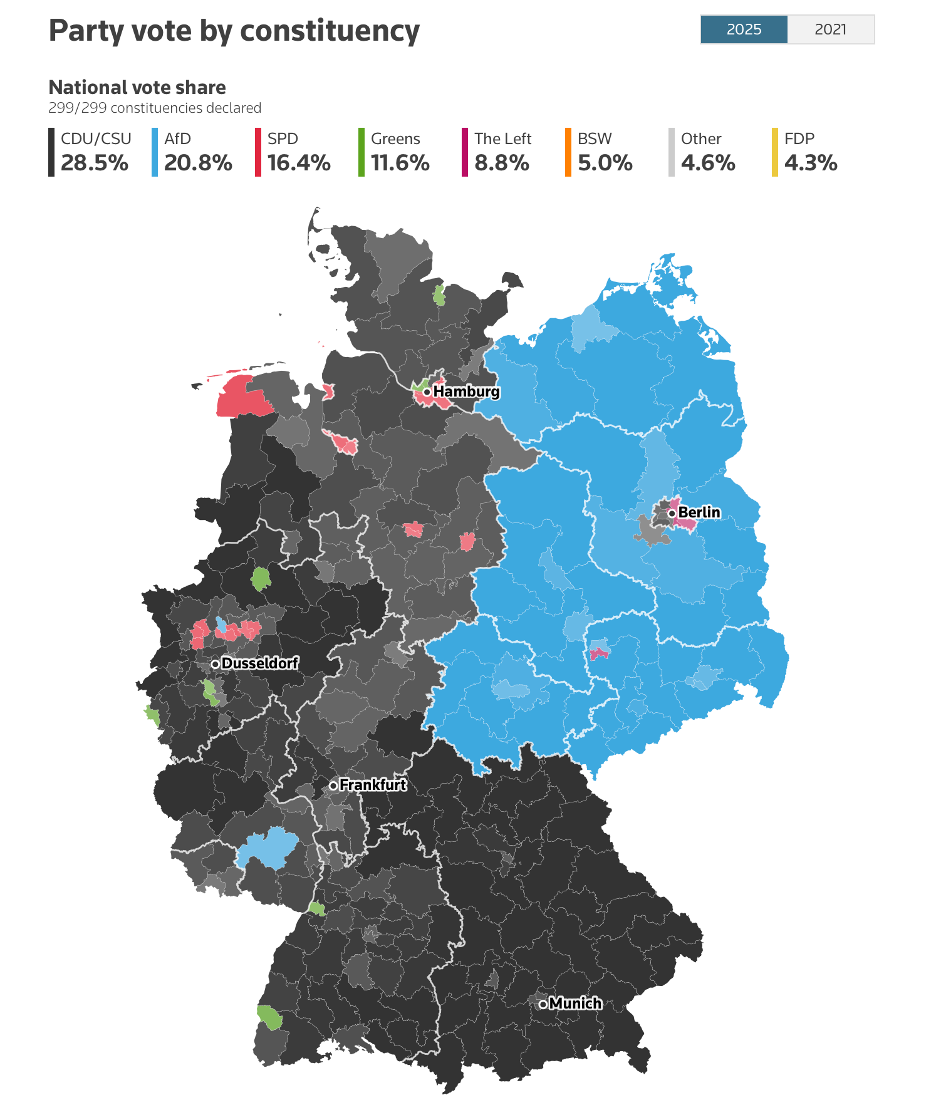
The result of the German Federal elections was very much as expected, the CDU/CSU won 28.5% of the votes and the largest share while AfD garnered 20.8%, the SPD just 16.4% (it’s worst showing in modern times) and the Greens gaining 11.6%.  A tail of other mostly very left-leaning parties made up the balance.  However, one cannot look at a map of the distribution of votes without noticing that the part of the country that was East Germany prior to the fall of the Berlin Wall, still sees things very differently than the rest of the nation.

Source: Reuters.com

Regardless of the distribution, however, the outcome will result in some sort of coalition government, almost certainly to be a combination of the CDU and SPD.  On the surface, it would seem this left-right coalition will be doomed to failure, and that could well be the case, but because the consensus amongst the ‘right-thinking’ people in politics is that AfD is the devil incarnate, or perhaps more accurately, Hitler incarnate, Herr Merz will not be able to rule with a sure majority of conservative voters.

As with virtually every election, the economy is a top priority of the voters, especially since GDP growth, as measured, has essentially been zero for the past three years as per the below chart, and is mooted to stay there on present policies.

Source: tradingeconomics.com

One of the key issues that is currently under discussion there is the constitutionally enshrined ‘debt-brake’ which prevents the German government from running deficits of greater than 0.35% of GDP in any fiscal year.  In order to change the constitution, there needs to be a 2/3’s approval in the Bundestag, but AfD holds a blocking minority and one of their policy platforms has been fiscal prudence.

Arguably, this begs a larger question, what exactly constitutes economic growth?  For instance, if government debt is rising more quickly than economic output, is that actually a growing economy?  And is that process sustainable going forward?  It is quite interesting to look at the government debt dynamics of different nations and ask that question, especially since Germany’s situation really stands out.  

Perhaps, after looking at this group of charts, it is worth reevaluating exactly how much actual growth has been occurring and how much economic activity has simply been government borrowing recycled into the economy across all these nations.  Of course, this process has not been restricted to G-7 nations, it is a global phenomenon, with China doing exactly the same thing as are virtually all nations.  In fact, Germany is unique amongst large nations for bucking the trend.

The reason this issue matters is there is a limit to how far a government can increase its leverage ratio.  At some point, investors will stop buying debt which will force the central bank to buy the debt.  Of course, they will do so by printing more money and devaluing the currency.  We know this because we have seen it happen before many times throughout history with Germany’s Weimar Republic in 1923, Argentina in the 1980’s and Zimbabwe in 2007-2008 as just the most recent examples.  In fact, the reason the Germans have the debt brake is that there is a national memory of that hyperinflation from a century ago.

Circling back to the growth question, what is it that constitutes economic growth?  If you remember your college macroeconomics classes, this is the equation that is used to calculate economic activity in an economy:

            Y = C + I + G + NX

Where:

Y = GDP

C = Consumption

I = Investment

G = Government spending

NX = Net Exports

This equation is taken as gospel in the economics and political worlds.  However, it is not often recalled that it was created in the 1930’s by John Maynard Keynes.  It is not a law of nature, but merely was Keynes’ way of expressing something that had not been effectively measured previously.  Nearly 100 years later, though, perhaps it is time to reevaluate the process.  Remember, economies grew prior to Keynes creating this equation when government activity was a much smaller proportion of the economy.  But as we can see by the dramatic rise in government debt, that is no longer the case.  Perhaps Germany is a peek behind the GDP curtain that shows absent constantly increasing government borrowing, economic growth is stagnant.  Neil Howe’s Fourth Turning could well be the conclusion of this period of government excess, where things will be extremely volatile during the change, but less government will be the norm on the other side, at least for a few generations!

Ok, sorry for the history and theoretical discussion, but that chart of German government debt vs. the rest of the world was really eye-opening.  Let’s turn to markets from the overnight session.

After Friday’s sharp downward movement in the US, the picture in Asia was far more mixed.  Japan (+0.25%) managed a small gain while Hong Kong (-0.6%) and China (-0.2%) both lagged.  Elsewhere in the region, New Zealand (-1.8%) stood out for its weakness, although Korea, India and Taiwan were all softer in the session as well.  Ironically, it seems that better than expected Retail Sales data in NZ hurt sentiment for further policy ease by the RBNZ and concerns over trade with China given US pronouncements is also hurting the situation there, at least for today.

In Europe, Germany’s DAX (+0.9%) is leading the way higher after IfO Expectation data was released a touch better than forecast at 85.4.  However, it is important to remember that while this was a positive outcome, the average reading prior to Covid was between 95 and 103.  As to the rest of Europe, there are more gainers than laggards but little of real note absent any other data.  US futures at this hour (7:00) are pointing higher by at least 0.5% across the board.

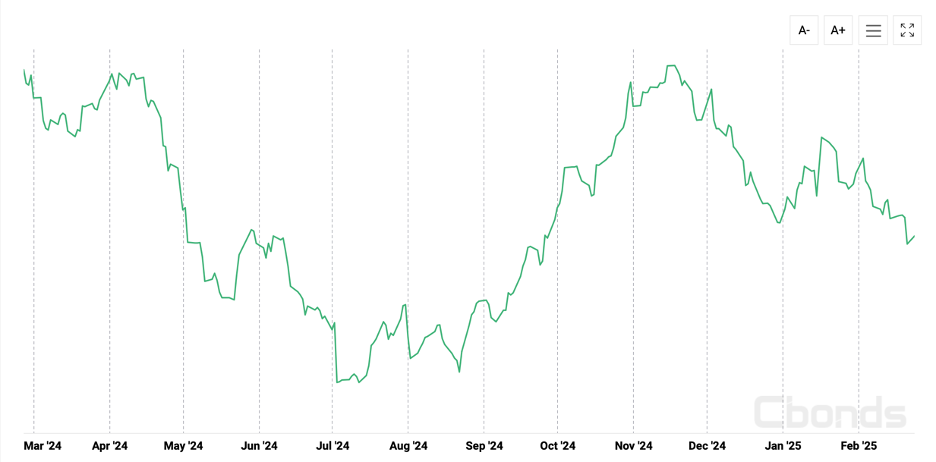
In the bond market, Friday saw a very sharp decline in yields, -10bps in Treasuries, after weak readings in the Flash PMI data, especially services at 49.7, Existing Home Sales and Michigan sentiment.  That helped bring global yields lower.  This morning, Treasuries have bounced just 1bp and we are seeing similar rises in most of Europe.  JGB yields are also unchanged and have continued to consolidate near recent highs.

In the commodity markets, after a sharp sell-off on Friday on the back of stories about increased supply from Kurdistan, oil (0.0%) is unchanged this morning.  Meanwhile gold (+0.5%) is rebounding from its regular Friday sell-off, almost as though there were efforts by some to depress the price at the end of every week.  It will be interesting to see what happens this Friday which is month end as well.  As to silver and copper, they are little changed and dull this morning.

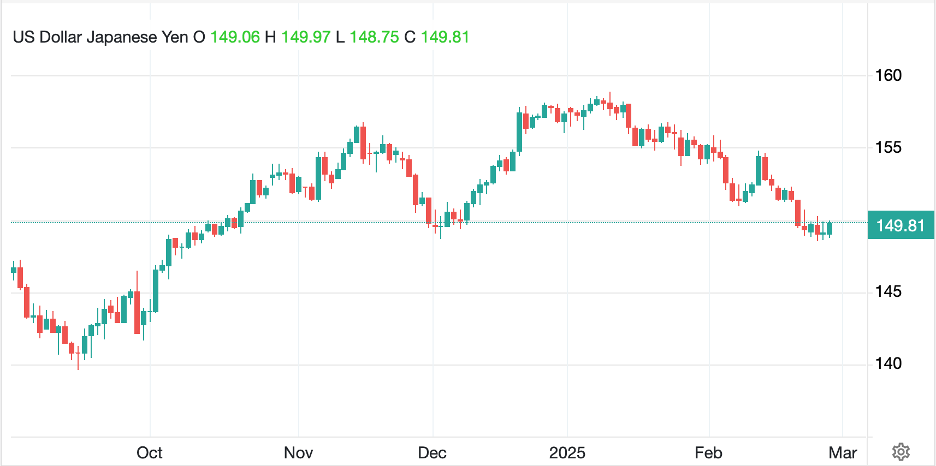
Finally, the dollar is asleep this morning, with very limited movement vs. almost any of its counterparts.  USDJPY remains below 150, but the yen has actually fallen -0.3% on the session, while the biggest movers are in Eastern Europe (CZK +0.8%, HUF +0.4%, PLN +0.35%), perhaps on the back of the German election results offering hope for a more useful German government.  We shall see about that.  Otherwise, nobody is concerned over the dollar right now.

On the data front this week, it is a quiet one with PCE data the highlight on Friday.

TodayChicago Fed Natl Activity0.21
TuesdayCase Shiller Home Prices4.4%
 Consumer Confidence103.0
WednesdayNew Home Sales680K
ThursdayInitial Claims220K
 Continuing Claims1874K
 Q4 GDP (2nd look)2.3%
 Real Consumer Spending4.2%
 Durable Goods2.5%
 -ex Transport0.3%
FridayPersonal Income0.3%
 Personal Spending0.2%
 PCE0.3% (2.5% Y/Y)
 Core PCE0.3% (2.6% Y/Y)
 Chicago PMI41.5

Source: tradingeconomics.com

In addition to the data, we also hear from seven Fed speakers over 9 venues, but again, are they really going to change the cautious approach at this stage?  And does it even matter?  For now, financial markets are far more focused on President Trump and his cabinet’s activities than interest rate policy which seems set to remain in place for a while.

When it comes to the dollar, nothing has changed my perspective on relative interest rates in the front end, with US rates likely to be far stickier at current levels than others, but the back end has a potentially different outcome.  Recall that Bessent and Trump are focused on the 10-year yield and getting that lower and seem far less concerned over the Fed for now.  To achieve that they will need to demonstrate the ability to reduce spending and the deficit situation.  While a promising start has been seen with DOGE, we are still a long way from a balanced budget.  My take is the dollar, writ large, is going to take its cues from the 10-year yield for now, so bonds are the market to watch.  If we see yields head back toward 4.0%, the dollar will decline and any significant move higher in yields will likely see the dollar climb as well.

Good luck

Adf

Japanese Tao

Japanese prices
Are rising ever higher
Probably nothing!
 
Meanwhile Ueda
Explained QE can still be
The Japanese Tao


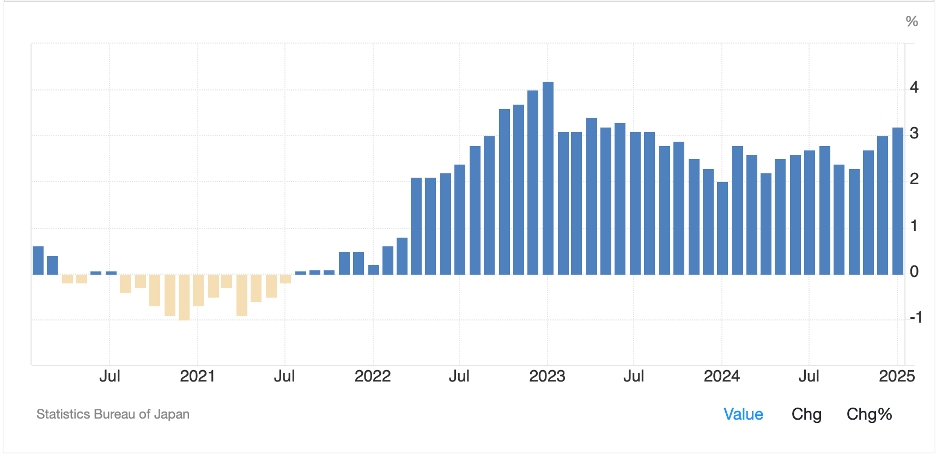
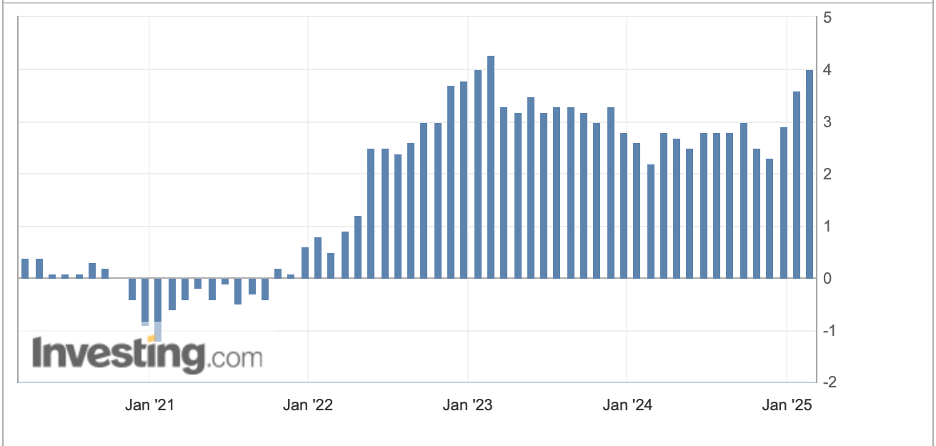
Japanese inflation data was released last night, and the picture was not very pretty.  In fact, let me show you.  The first chart shows the monthly readings of annual inflation for the past 5 years.  Last night’s 4.0% reading was not the highest in that period, (that distinction belongs to Feb 2023 at 4.3%), but it is pretty clear that any sense of declining inflation is beginning to dissipate and has been doing so for the past year.  PS, remember, Japanese interest rates range from 0.5% in the overnight to 1.425% in the 10-year, so real rates remain highly negative regardless of your timeframe.

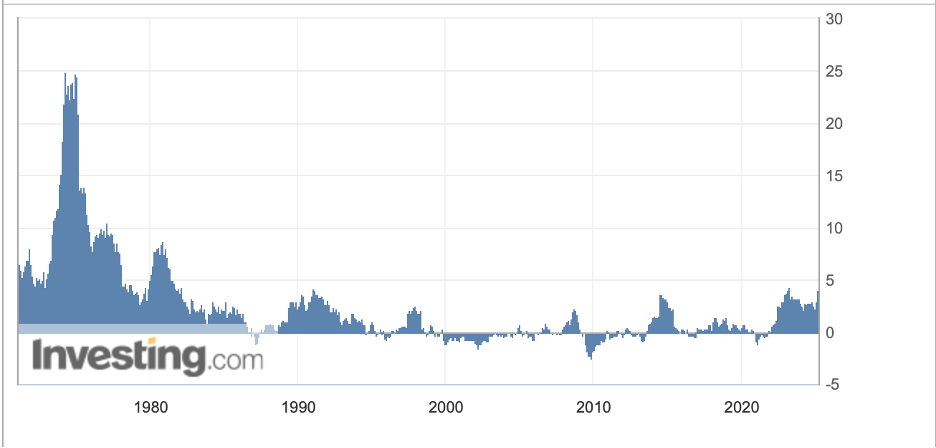
The second picture takes a longer-term perspective to help us better understand the long history of inflation in Japan.  While a decade ago, inflation showed an uptick of nearly the recent magnitude, that was driven specifically by the government raising the GST (goods and services tax) which was Japan’s answer to a VAT.  It was highly controversial at the time but was also understood to have a truly transitory impact as it was a one-off rise in prices.  However, beyond that period, the Japanese have been living with inflation somewhere between -2.2% in the wake of the GFC and 2.0% since the turn of the century.  In fact, going back to the 1990’s, inflation didn’t reach current levels, and one must head back to 1981 to see significant inflation in Japan.  This means there are two generations of people who have basically never seen prices rise in the current manner.

So, what do you think the central bank is considering?  Let me give you Ueda-san’s own words, [emphasis added] “In exceptional cases where long-term interest rates rise sharply in a way somewhat different from normal movements, we will flexibly increase purchases of government bonds to promote stable formation of interest rates in the market.”  You read that correctly inflation is rising sharply, JGB yields are rising in sync and the BOJ’s response is to BUY MORE BONDS!!!  You cannot make this stuff up.  I guess old habits die hard.

The market response to this was as you might expect.  JGB yields dipped 2bps, Japanese equities managed a modest rally (+0.3%) as they seem caught between lower rates and higher inflation, and the yen ( -0.5%) weakened.  In essence, it appears the combination of a strengthening yen and rising interest rates has the potential to wreck the Japanese government’s budget, and the BOJ went back to form and discussed more QE as a response.  This is simply more proof that there isn’t a central bank in the world that truly cares about inflation.  While stable inflation may be a mandate, it is the last of their concerns.

Inflation is, however, not the last of our concerns, at least as we try to live day to day.  This is what has me concerned about Chairman Powell and his minions at the Fed, they continue to believe that the current interest rate structure is restrictive and despite the fact there is virtually no evidence prices are ever going to get back to their target of 2.0%, let alone true stability, still see cuts as the way forward.  Perhaps I am mistaken to believe that the Fed will see the light and maintain current policy levels or even tighten as inflation rebounds.  If that is the case, my entire dollar thesis is going to come under a lot of pressure!

Ok, away from the Japanese antics overnight, a brief word about China.  Last night, Premier Li Qiang explained that China will look to “vigorously” improve the services sector of the economy, specifically education, health care, culture and sports, as they once again try to adjust the balance of economic activity to a more domestic focus rather than their historical mercantilist process.  Earlier this week the PBOC reiterated their support for the property market, although for both these efforts, this is not the first time they have been discussed, and the evidence thus far is all their efforts have been fruitless.  But for one day, at least, these comments have been embraced as the Hang Seng (+4.0%) and CSI 300 (+1.3%) both rallied sharply on the news of more domestic support for the Chinese economy.  The Chinese are set to hold a key economic confab as they try to plan how to shake things up a bit, and these comments, as well as a seeming promise the PBOC is going to cut rates again, are all of a piece.  Maybe they will be successful this time, but I am not holding my breath.

Otherwise, the only other noteworthy economic news came from the Flash PMI’s across Europe which were soggy at best, certainly not indicative of significant growth coming soon.  With that in mind, let’s look at the rest of the markets’ overnight performance.  The rest of Asia’s equity markets were mixed with Taiwan’s the best performer and several modest declines elsewhere including India, Australia and New Zealand.  In Europe, though, despite those modest PMI outcomes, most markets are higher led by the CAC (+0.5%).  Perhaps, the view is the ongoing weakness will force the ECB to cut rates more quickly, and we have heard several ECB members indicate further cuts are coming.  However, counter to that, Isabel Schnabel, one of the more hawkish members, mentioned this morning that she believed they were already at neutral, and more cuts may not be necessary.  While that is not the consensus view yet, it is worth remembering.  As to the US futures market, at this hour (7:00), all three major indices are basically unchanged.

In the bond market, yields have fallen across the board with Treasuries, after sliding yesterday, down another 2bps this morning and back below 4.50% for the first time in a week.  In a Bloomberg interview yesterday, Secretary Bessent explained that although his goal is to reduce the issuance of T-bills and term out debt, given the situation which he inherited from the previous administration, that process will take longer than some had considered previously.  In other words, there won’t be a large increase in 10-year issuance any time soon. European sovereign yields are also much softer, down between -3bps and -5bps on those further rate cut hopes, or perhaps the lackluster PMI data.

In the commodity markets, oil (-0.8%) is backing off its recent rally highs, but remains quiet overall and well within its ever-tightening trading range.  It seems traders don’t know how to handicap the constant discussions from the Trump administration and whether Russian sanctions will end or not, as well as how quickly OPEC may ramp up production and what is happening to demand.  While none of these things are ever certain, right now they seem particularly fraught.  In the metals space, gold (-0.4%) is backing off from yesterday’s latest all-time highs, and taking both silver and copper with it, but the uptrend in all three of these metals remains quite strong.

Finally, the dollar is higher this morning gaining ground against all its G10 counterparts with the yen being the worst performer, but also against all its EMG counterparts with HUF (-1.0%) the true laggard although the entire CE4 are under pressure, arguably responding to the mayhem over how the Ukraine situation plays out.  After all, they are the closest in proximity and likely to be the most impacted.

On the data front, this morning brings Flash PMI data (exp manufacturing 51.5. Services 53.0), Existing Home Sales 4.12M) and Michigan Sentiment (67.8).  We also hear from two more Fed speakers, Jefferson and Daly, but again, caution and stasis are the story until further notice, and that notice is not coming from Mary Daly but rather from Jay Powell.

Perhaps the most interesting thing happening right now is that although tariffs remain a major economic force and are clearly on the table, they are not even the 4th most important topic in the market.  Back to my earlier comments, I sincerely hope that the BOJ’s overwhelming dovish stance is not a harbinger of things to come here in the States.  Right now, I don’t think so, but I am far less confident than I was earlier this week.

Good luck and good weekend

Adf

Caution and Fear

For Jay and the FOMC
There’s nothing that’s likely to be
Enough to adjust
The often discussed
Reduction in rates, all agree
 
But as we look off to next year
The sitch has become much less clear
The dot plot and SEP
Could very well prep
Investors for caution and fear


*Let me begin by explaining this will be the last poetry for 2024 as I take some time to reflect on the past year as well as my views for 2025.  Come January 2nd, I will offer those views, as I always do, in a long-form poem.  For all of you who have come along for the ride, thank you very much, I sense next year may be even more interesting than the one ending in a few weeks*.

Now, back to our regularly scheduled programming.  To my eye, the ongoing coordinated policy easing by central banks around the world (US, Europe, UK, Canada, China, Switzerland, etc.) feels at odds to the ongoing inflation data that seems to show a reluctance for price rises to slow back to the preferred pace of those same central banks.  Certainly, in the US, as evidenced by both the CPI data Wednesday, and even more so by yesterday’s PPI data, the null hypothesis that the rate of inflation is slowing toward 2% feels as though it is no longer valid.  One needn’t dig too far under the surface to see core and median inflation readings with 3% and 4% handles and given this is almost entirely in the services sector, the sector that encompasses more than two-thirds of the economy, it seems increasingly hard to make the case that inflation is going to decline much further.  This is not to imply we are heading for hyperinflation, just that the slow pace of price increases that existed since the GFC seems to have ended.

At least in the US, the economic growth story appears to be a bit more positive than elsewhere around most of the world, and so the opportunity exists for wages to keep up with prices.  Alas, elsewhere in the world, that is not necessarily the case.  Yesterday, Madame Lagarde and the ECB cut rates by a further 25bps, as universally expected, and the market is looking for another 25bp cut in January.  However, despite what is a clearly slowing growth impulse on the continent, even Lagarde felt it necessary to caution about the sticky services prices in Europe and how they must be careful in their policy decisions to prevent a reemergence of inflation.  Remember, too, the ECB’s sole mandate is price stability, so theoretically, even if Europe falls into recession, it is not the ECB’s task to rescue the economy there.

Perhaps the one place where policy ease is appropriate is China, where the pace of activity in the economy is very clearly slowing.  President Xi and his minions have not yet been able to arrest the decline in the property market there, which given such a large proportion of Chinese GDP growth over the past decade was contingent upon an ever-growing property sector and consistently rising prices, is a problem.  An interesting feature of their recent announcements is that they seem ready to have the central bank lend directly to the government (monetizing debt) to finance activity rather than have the central bank buy bonds from the Chinese banking community (otherwise known as QE).  In fact, arguably the biggest problem in China is that the banking system there is dangerously overleveraged and undercapitalized when taking a true account of bad loans outstanding.  It seems that Xi and friends have figured out it would simply be cheaper to print money and directly give it to the government rather than pass it through a creaking banking system that no longer works.  While this almost certainly is smart policy given the circumstances, it doesn’t speak well of the overall situation there.

(As an aside, can we really be surprised that the Chinese banking system, which is basically an arm of the government’s finance ministry which directed lending to favored companies/industries without any real analysis, is having problems?)

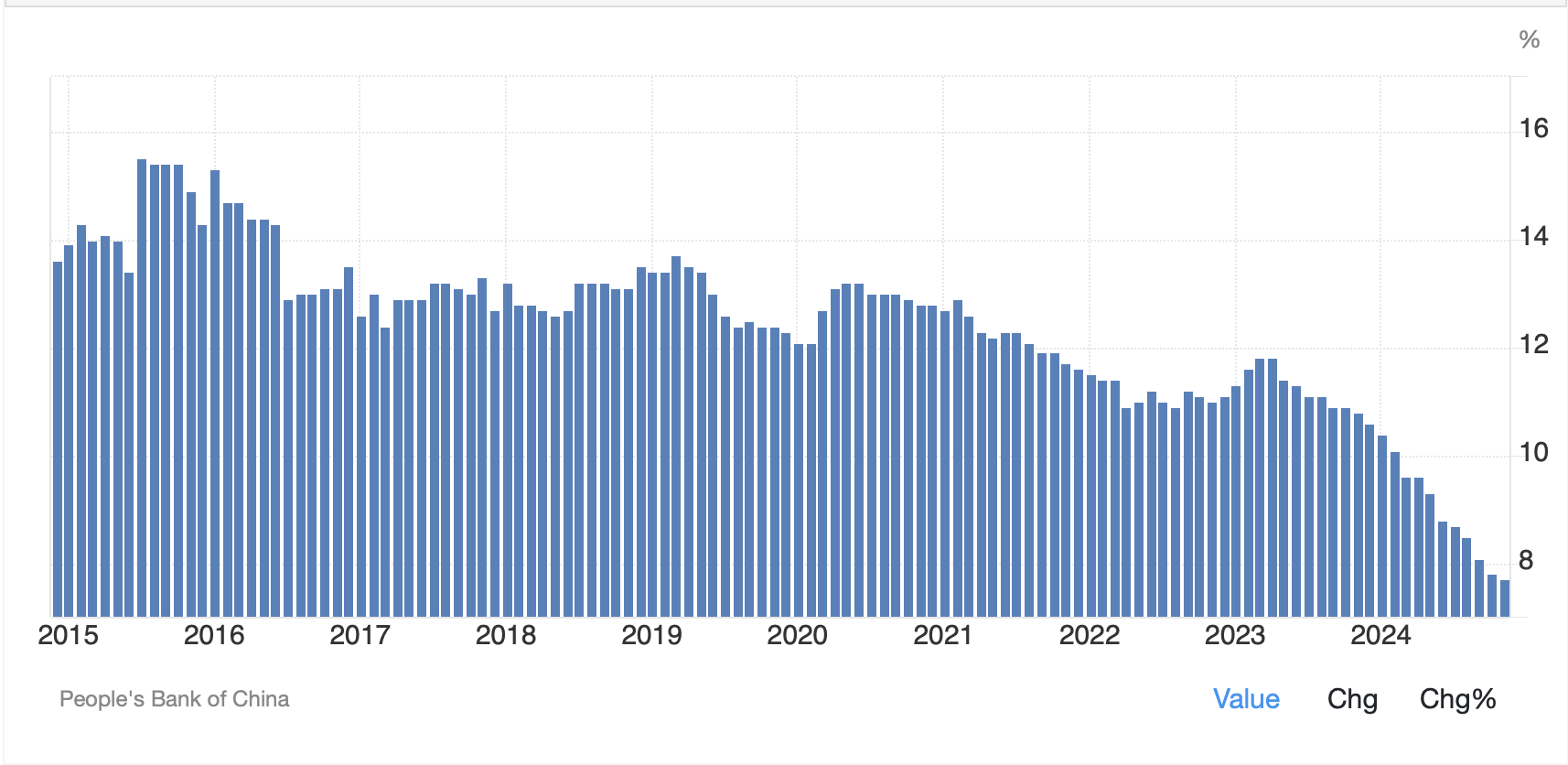
Under the guise, a picture is worth 1000 words, a quick look at the below chart from tradingeconomics.com which shows the trajectory of outstanding Yuan Loan Growth over the past 10 years is pretty descriptive.  Banks in China have lost their ability to help the government implement monetary policy so the government is going to simply do it themselves.  The “moderately loose” policy the Politburo announced seems likely to go beyond moderate as 2025 progresses, at least in this poet’s eyes.

In the end, there are many problems extant in the global economy.  As well, there has been an uptick in overall uncertainty with the election of Donald Trump as US president given his history of sudden, unpredictable pronouncements.  I would contend that the one constant in 2025 and beyond is that volatility is far more likely to increase than decrease across markets everywhere.

Ok, let’s take a quick tour of the overnight activity before my short-term hiatus.  Once again, US equity markets were under modest pressure yesterday as I continue to see more and more pundits calling for a short-term pullback before the next leg higher.  That weakness was followed by Asian markets selling off with China (-2.4%) and Hong Kong (-2.1%) both suffering from ongoing disappointment that the modest loosening wasn’t dramatic loosening!  Interestingly, despite the JPY (-0.55%) weakening further (its 5th consecutive down day) the Nikkei (-1.0%) couldn’t gain any traction, perhaps undercut by concerns over the tech story and rising US rates.  However, both Korea and India put in solid positive sessions.  Clearly Asia is not a monolithic market.  

In Europe this morning, the screens are green, but it is a pale green, with gains on the order of 0.1% to 0.3% only as investors seem to have taken some heart by the ECB’s cut and modest dovish follow up.  Meanwhile, US futures are slightly firmer at this hour (8:00).

In the bond market, yields continue to climb in the US (Treasuries +2bps) and Europe (Bunds +4bps, OATs +3bps Gilts +2bps) as bond investors are far more circumspect of the ECB cutting rates while inflation lurks in the background.  Chinese yields continue to fall, with the 10-year there hitting a new low of 1.78% and talk now that by the end of 2025, Chinese yields may fall below those in Japan!  Now that would be something, and I suspect the FX markets would see a lot of volatility if that happens.

Oil prices (+0.5%) continue to hold the $70/bbl level with very little impetus after the rally early in the week.  Metals prices, though, are under modest pressure this morning, perhaps on the idea that Chinese demand is going to falter.  After all, if Chinese shares can’t hold up, why would traders believe they will be buying up copper, silver and gold?  All three are lower by about -0.2% this morning.

Finally, the dollar is mixed this morning, having rallied vs. some counterparts like JPY, BRL (-0.75%) and ZAR (-0.55%) while declining vs. the euro (+0.45%), NOK (+0.75%) and the CE4 currencies.  My take is the euro’s rebound, and that of the CE4, is more position related after a sell-off yesterday and given today is Friday, rather than anything fundamental.

There really is no data today and while we do see Retail Sales next Tuesday (exp 0.5%, 0.4% ex autos), I think it’s really all about the Fed next Wednesday.  The market is still pricing 97% probability of a cut, and I don’t see anything changing that.  Rather, the Fed’s dot plot will be the story for markets as the narrative starts to account for higher inflation and therefore, a higher long-term outcome for the neutral rate.

Again, none of this portends a weaker dollar as we head to the end of 2024.  For 2025, you will need to wait for January 2nd to see my views then.

Good luck, good weekend and have a wonderful holiday season

Adf

Growth Stank

Three score and a year have now passed
Since flags in the States flew half-mast
In honor of Jack
Who wouldn’t backtrack
On his goal of world peace at last


It has been sixty-one years since President John F Kennedy was assassinated in Dallas.  This was one of the most dramatic and impactful events in the history of the US with many still of the belief that it was an inside job.  One needn’t wear a tin-foil hat all the time to recognize that the government has done nothing but grow dramatically since then, with the defense complex the leader of the pack.  Perhaps in his second term, President Trump will release the case files in an effort to shine a light on the underbelly of the government.  This poet has no idea what occurred that day (although I did recently visit the 6th floor museum in Dallas, a quite interesting place) and I would guess that all these years later, there are very few, if any, people who may have been involved that are still alive.  Of course, the risk is that powerful organizations like the CIA and FBI could be forever tarred with this if they were involved, and that would have dramatic implications going forward, hence their desire to maintain secrecy.  I highlight this simply as another potential flashpoint in the upcoming Trump presidency.

The data from Europe revealed
That if there is growth, it’s concealed
The PMI’s sank
And German growth stank
Thus Christine, her razor, will wield

Let us now discuss the Eurozone.  Not only do they have an increasingly hot war on their border and not only are they being inundated by a major blizzard interrupting power and transportation throughout France, Germany and Scandinavia, but their economies appear to be slowing down far more rapidly than previously anticipated.  But that inflation was slowing as quickly!

This morning the Flash PMI data was released for Germany, France and the Eurozone as a whole, as well as the UK.  It did not make for happy reading if you are a politician or policymaker in any of these nations.

IndicatorCurrentPrevious
 Germany 
Manufacturing PMI43.243.0
Services PMI49.451.6
Composite PMI47.348.6
 France 
Manufacturing PMI43.244.5
Services PMI45.749.2
Composite PMI44.848.1
 Eurozone 
Manufacturing PMI45.246.0
Services PMI49.251.6
Composite PMI48.150.0
 UK 
Manufacturing PMI48.649.9
Services PMI50.052.0
Composite PMI49.951.6

Source: tradingeconomics.com

One needn’t look too hard to see that the economic situation in Europe is ebbing toward a recession or at least toward much slower growth (German GDP was also released at a slower than expected 0.1% Q/Q, -0.3% Y/Y).  While the ECB is very aware of this situation, the problem is that like most other central banks, their strong belief that inflation is going to reach their 2.0% goal has not yet been realized let alone shown an ability to stay at that level over time.  However, the ongoing comments from ECB members is that more rate cuts are coming with only the timing and size in question.  There is still a strong belief that interest rates in Europe (and the UK) are well above ‘neutral’.

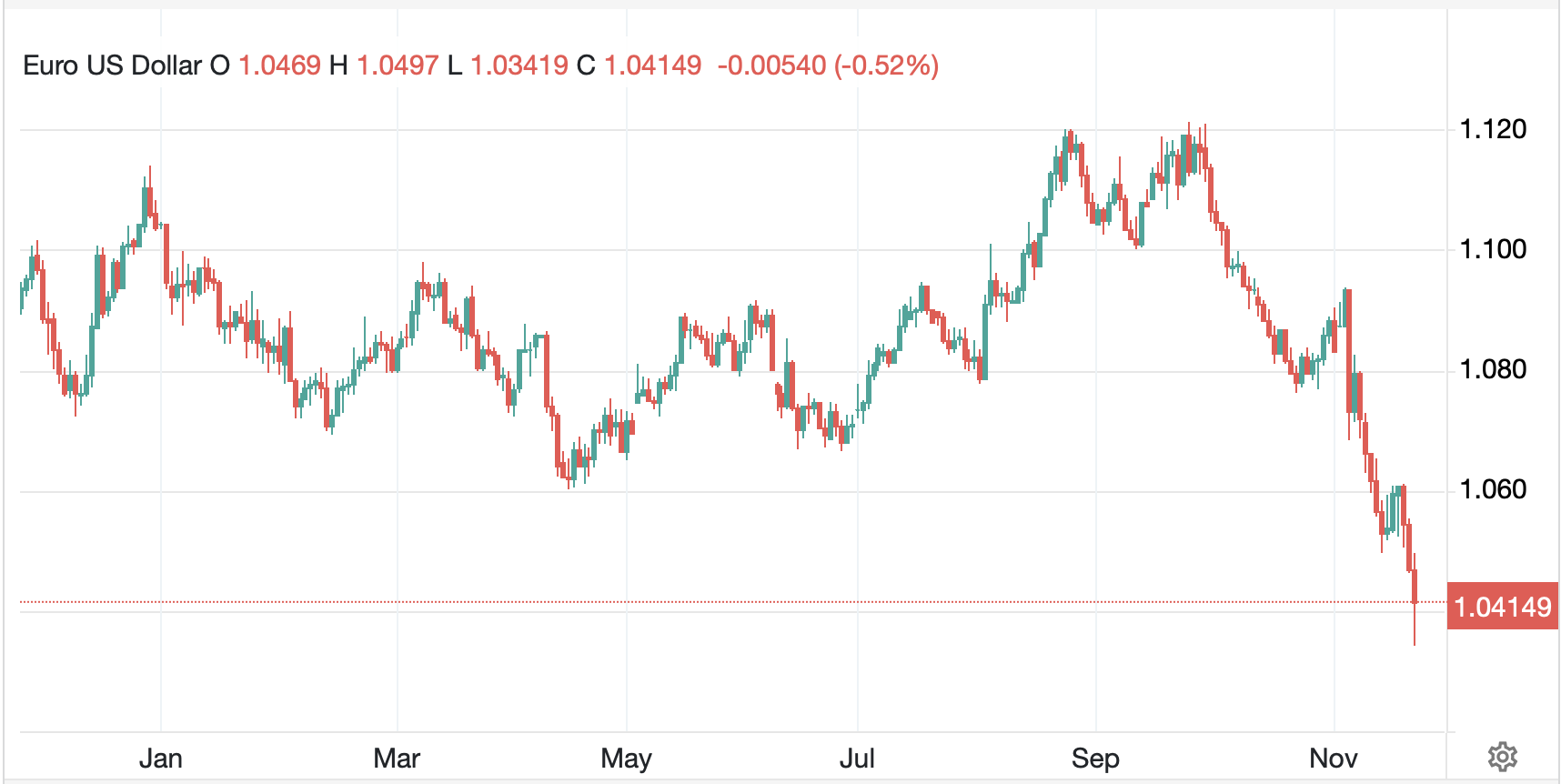
Of course, it will not surprise you to see the chart of the EURUSD exchange rate given this information as the single currency collapses continues its sharp decline.

Source: tradingeconomics.com

Since the end of September, the single currency has declined ~7.0% in a quite steady fashion.  All the technical levels that had been in play have been broken with the next noteworthy level to consider being parity.  I have been clear for a while that I expected the dollar to continue to perform well and nothing has changed that view.  The combination of an increase in fear amid the escalation of tensions in Ukraine and Russia’s intimation that the US and NATO have entered the war already and the very divergent paths of the US and Eurozone economies can only lead to the conclusion that the euro is going to continue to decline for a while.  And remember, this price action has very little to do with potential Trump tariff or other policies as they remain highly uncertain.  The euro is simply a victim of its own leaders’ ineptitude on both the economic and diplomatic/military fronts.  Any Trump tariffs that are imposed on Europe will simply add to the pain.

Before we head to other asset classes, let’s take a quick look beyond the euro in the FX markets.  It should be no surprise that the dollar is broadly higher, although not universally so.  Versus the rest of the G10, even the yen has not been able to find enough haven demand to hold up as the greenback rallies against them all with the euro (-0.6%) and pound (-0.6%) sharing honors as the laggards.  However, in the EMG bloc, the picture is more mixed with CE4 currencies all sliding but ZAR (+0.4%) rallying amid the ongoing rebound in the price of gold (+1.2%) which is also benefitting from increased fear and risk disposition.  As to Asian currencies, most were somewhat weaker but other than KRW (-0.4%) the moves were unimpressive.

On the commodity front, oil (-0.6%) is slipping a bit heading into the weekend but it has had an excellent week, rallying more than 4%.  There are many cross tensions in this market as on one side we have fears that the Russia/Ukraine situation will impact supply, or that Iran will react to Israel’s ongoing campaign in Lebanon and do something about the Strait of Hormuz.  These are obviously bullish for crude.  But the flip side is that Trump has made very clear his desire to open up far more land for drilling and is seeking to increase supply substantially, a negative price signal.  

Turning to bond markets, there is demand everywhere as the combination of risk aversion and weaker Eurozone growth have brought the buyers out of the woodwork.  Treasury yields have slipped -4bps and in Europe, the entire continent is seeing yields decline between -7bps and. -8bps.  After the PMI data this morning, the Euribor futures market upped pricing for a December ECB rate cut from a 15% to a 50% probability.  Add to that comments from ECB members Stournaras and Guindos and it seems quite likely that rates in Europe are going to decline.

Finally, equity markets have shown very little consistency.  Yesterday’s strong US rally was followed by strength in Japan (+0.7%) but massive weakness in China (CSI 300 -3.1%, Hang Seng -1.9%) as concerns over those Trump tariffs continue to weigh on investors there.  However, it was only China that suffered as pretty much every other market in the region saw gains, with some (India +2.55, Taiwan +1.6%, New Zealand +2.1%) quite substantial.  European shares, however, are more mixed with most continental bourses showing modest declines although the UK (+0.8%) has managed to buck that trend despite the weak PMI data and weak Retail Sales data as investors seem to be prepping for a BOE rate cut next month.  As to US futures, at this hour (7:30) they are little changed.

Yesterday’s data showed Initial Claims sliding but Continuing Claims rising to their highest level, above 1.9M, in three years.  It appears that while layoffs aren’t increasing, finding a job once you are unemployed is much tougher.  Philly Fed was also softer than forecast and that seemed to help the Fed funds futures market push up the probability of a December cut to 59% this morning, up from 55% yesterday.  This morning, we see the Flash PMI data here (exp Mfg 48.5, Services 55.0) and then Michigan Sentiment (73.7).  There are no Fed speakers on the schedule so I expect that this morning’s trends may run for a little longer, but as it is Friday, I would not be surprised to see a little reversal amid week ending profit taking.  However, the dollar has further to go, mark my words.

Good luck and good weekend

Adf