Somewhat Miffed

The Minutes did naught to explain
Why Jay might need raise rates again
But if we all harken
The Fed’s Thomas Barkin
The future seems cloudy with rain
 
So, now it seems Jay’s somewhat miffed
As he and his team try to shift
The views he expressed
That rate cuts were blessed
And markets did act sure and swift


Remember the certainty with which market participants determined that the Fed had not only finished raising interest rates, but that they would be cutting them quite soon?  That is so last year!  It seems that after a powerful Santa Claus rally that was inaugurated by Secretary Yellen’s move to issue more T-bills and less coupons, and then seemingly confirmed at the December FOMC meeting, where the dot plot showed no more rate hikes and a median expectation of three cuts this year, and where Chairman Powell, when given a chance to push back on this new narrative in the press conference, went out of his way to embrace the ‘rate cuts coming soon’ narrative, the Fed is no longer happy about the situation.  Instead, now they seem to want the market to ratchet back these expectations for a quick decline in interest rates.  At least, that’s what we heard from Richmond Fed president Tom Barkin yesterday, “The FOMC’s December meeting got a lot of attention. We acknowledged the progress on inflation and explicitly reaffirmed our willingness to hike if necessary.”  [emphasis added].

Meanwhile, the Minutes seemed to lean more hawkish than not, “It was possible that the economy could evolve in a manner that would make further increases in the target rate appropriate.  Several also observed that circumstances might warrant keeping the target range at its current value for longer than they currently anticipated.”  Arguably the best line, though, was “Participants generally perceived a high degree of uncertainty surrounding the economic outlook,” which is likely the most honest statement they have ever made.  In the end, the Minutes didn’t sound very dovish to me, but as I mentioned above, the press conference came across far more dovishly.  One other thing to note is that they mentioned QT for the first time in quite a while.  It seems that they recognize the incongruity of shrinking the balance sheet while cutting interest rates, so they have begun to consider how to message any changes there.

With this new information being absorbed, the market is now in the process of re-evaluating the idea that rate cuts are going to happen as quickly and as substantially as thought just a week ago.  At this time, there is just a 10% probability of a cut at the end of this month (it was nearer 20% last week) and the March probability is down to 70% (it was 79% last week) though the market is still pricing in 6 cuts in 2024.  FWIW, that seems outside the bounds of how things will ultimately play out, and I maintain that while a cut could easily be made by the May meeting, I do not foresee inflation cooperating which will force a lot of rethinking.

To summarize the Fed story, the market has sensed a disturbance in the easing force that had been widely assumed and a key driver of the late 2023 risk rally.  This morning, markets have stabilized after two consecutive negative days to open the year.  As such, let us keep our eyes peeled for more, new and, potentially non-narrative, information going forward. 

Looking at the latest data releases overnight and this morning, they consisted of the Services PMI data as well as German state inflation.  Regarding the former, both Australian and Japanese data were soft although Chinese data was better than expected with the Caixin Services PMI printing at 52.9, continuing its rebound from summer lows.  Across Europe, Italian (49.8), French (45.7), German (49.3) and the Eurozone composite (48.8) all showed contractionary numbers although the UK (53.4) vastly outperformed.  As to the German state-by-state inflation readings, every one of them bounced sharply from last month’s recent lows and the market is looking for a sharp rebound in the national CPI to 3.7% later this morning.  As I have written before, that combination of rising inflation and weak growth is a tough situation for Madame Lagarde.  My money is still on her to address the growth rather than the inflation, although she will likely wait until the Fed moves before doing so in Frankfurt.

With all this in mind, let’s take a look at the overnight market activity.  In Asia, the picture was mixed although there was more red than green on the screen.  While the Nikkei (-0.5%) fell, other Japanese indices held their own, and we saw some strength in Indian shares as well.  However, China remains under pressure, despite the stronger than anticipated PMI reading and that has been weighing on South Korea, Hong Kong and Australia overall.  However, in Europe, we are seeing modest gains this morning, only on the order of 0.1% or 0.2%, but green is more pleasant than the red of the past two days.  As to US futures, they are little changed at this hour, although again, better than their recent performance.

In the bond market, from the time I wrote yesterday morning, yields fell through the rest of the session by nearly 7bps in the 10yr Treasury market, and this morning, they have bounced back from the closing levels by 4bps.  We have seen similar price action throughout Europe where yesterday’s declines to closing lows have been reversed and we are now between 6bps and 9bps higher than the end of Wednesday’s session.  JGB yields, though, remain anchored at 0.60%, unchanged.

Oil (+1.0%) is continuing to rebound as the situation in the Middle East seems to be getting more complex.  The Houthis continue to attack Red Sea shipping, Israel killed a Hezbollah leader in Lebanon, potentially widening the conflict and there was a terrorist bombing in Iran (with the best guess it was internally executed by an unhappy faction) which can only serve to increase the overall tension levels.  While the broader weakness we have seen in this space is likely a response to weaker overall economic activity, especially in China, at some point, that activity will pick up and I expect oil prices to do so as well.  In the metals complex, base metals are under further pressure this morning, with both copper and aluminum down -0.6% or so, although gold (+0.2%) is bucking that trend, perhaps on the back of the dollar’s marginal weakness this morning.

Speaking of the dollar, as measured by the DXY it is -0.2% softer this morning with pretty uniform losses vs the major G10 and EMG currencies.  The one exception is the yen (-0.6%) which continues to suffer based on the idea that the BOJ will not be able to consider interest rate normalization in the wake of the recent earthquake on the country’s west coast.  In truth, the dollar seems to be quite the afterthought in markets right now, with much greater focus on the bond market and central bank actions as the drivers.  While I would carefully watch if the dollar starts to break these correlations, I don’t see it as a key driver right now.

On the data front, we see a few things this morning, starting with ADP Employment (exp 115K) and then Initial (216K) and Continuing (1883K) Claims.  As well the Services PMI data is released later this morning (51.3) and finally we get the EIA oil inventories with another large draw of 3.7 million barrels expected which ought to continue to support the black, sticky stuff.

There are no Fed speakers on the calendar although we must all be watchful for the pop-up CNBC interview if they feel their message, whatever it may currently be, is not getting proper attention.  While the first two sessions of the year were certainly uncomfortable for risk assets, I do not believe that my idea of a solid first half followed by more evident problems in the second half of the year has been dismantled.  Clearly, tomorrow’s NFP data will be critical, and we will discuss it ahead of the release.  Until then…

Good luck

Adf

Miles Off Base

This poet was miles off base

As Powell, more growth, wants to chase
So, hawks have been shot
With nary a thought
While doves snap all stocks up apace.

It seems clear that Jay and the Fed
Decided inflation is dead
Through Q1 at least
Bulls will have a feast
Though after, take care where you tread

It turns out that not only were my tail risk ideas wrong, I was on the wrong side of the distribution!  Powell has decided that the soft-landing narrative is the best estimator of the future and wants to make sure the Fed is not responsible for a recession.  Concerns over inflation, while weakly voiced, have clearly dissipated within the Eccles Building.  I hope they are right.  I fear they are not.

In fairness, once again, yesterday I heard a very convincing argument that inflation was not only going to decline back to the Fed’s target of 2.0%, but it would have a 1 handle or lower by the middle of 2024 based on the weakening credit impulse that we have seen over the past 18 months.  And maybe it will.  But, while there is no question that money supply has been shrinking slowly of late, which has been a key part of that weakening credit impulse story, as can be seen from the chart below based on FRED data from the St Louis Fed, compared to the pace of M2 growth for decades, there are still an extra $3 trillion or so floating around the economy.  Iit seems to me prices will have a hard time falling with that much extra cash around.

Of course, there is one other place that money may find a home, and that is in financial assets.  So, perhaps the outcome will be a repeat of the post-GFC economy, with lackluster growth, and lots of money chasing financial assets while investors lever up to increase returns.  My guess is that almost every finance official in the world would take that situation in a heartbeat, slow growth, low inflation and rising asset prices.  The problem is that series of events cannot last forever.  As is usually the case with any negative outcome, the worst problems come from the leverage, not the idea.  When things are moving in one’s favor, leverage is fantastic.  But when they reverse, not so much.

A little data is in order here.  According to Statista, current global GDP is ~$103 trillion in current USD, current global stock market capitalization is ~$108 trillion, and the total amount of current global debt is ~$307 trillion according to the WEF.  In a broad view, the current debt/equity ratio is about 3:1 and the current debt/sales ratio is the same.  While this is not a perfect analogy, usually a debt/equity ratio of 3.0 is considered pretty high and a company that runs that level of debt would be considered quite risky.  Now, ask yourself this, if economic activity only generates $108 trillion, how will that >$300 trillion of debt ever be repaid?  The most likely answer is, it never will be repaid, at least not on a real basis.

If you wonder why central bankers favor lower interest rates, this is the primary reason.  However, at some point, there is going to be more discrimination between to whom lenders are willing to lend and who will be left out because they are either too risky, or the interest rate demanded will be too high to tolerate.  When considering these facts, it becomes much easier to understand the central bank desire to get back to the post-GFC world, doesn’t it?  And so, I would contend that Chairman Powell has just forfeited his efforts to be St Jerome, inflation slayer. 

The implication of this policy shift, and I would definitely call this a policy shift, is that the near future seems likely to see higher equity prices, higher commodity prices, higher inflation, first higher, then lower bond prices and a weaker dollar.  The one thing that can prevent the inflation outcome would be a significant uptick in productivity.  While last quarter we did see a terrific number there, +5.2%, the long-term average productivity growth, since 1948 is 2.1%.  Since the GFC, that number has fallen to 1.5%.  We will need to see a lot more productivity growth to keep goldilocks alive.  I hope AI is everything the hype claims!

Today, Madame Christine Lagarde

And friends are all partying hard
Now that Jay’s explained
Inflation’s restrained
And rate cuts are in the vanguard

This means that the ECB can
Lay out a new rate cutting plan
The doves are in flight
Which ought to ignite
A rally from Stuttgart to Cannes

Let’s turn to the ECB and BOE, as they are this morning’s big news, although, are they really big news anymore?  Both these central banks have been wrestling with the same thing as the Fed, inflation running far higher than target, although they have had the additional problem of a much weaker economic growth backdrop.  As long as the Fed was tightening policy, they knew that they could do so as well without having an excessively negative impact on their respective economies.  But given that pretty much all of Europe is already in recession, and the UK is on the verge, their preference would be to cut rates as soon as possible.  

But yesterday changed everything.  Powell’s bet on goldilocks has already been felt across European markets, with rallies in both equity and bond markets in every country.  The door is clearly wide open for Lagarde and Bailey to both be far more dovish than was anticipated before the FOMC meeting.  And you can be sure that both will be so.  While there will be no rate cuts in either London or Frankfurt today, they will be coming soon, likely early next year.  

At this point, the real question is which central bank will be cutting rates faster and further, not if they will be cutting them at all.  My money is on the ECB as there is a much larger contingent of doves there and the fact that Germany and northern European nations are already in recession means that the hawks there will be more inclined to go along for the ride.  Regardless, given the Fed has now reset the central bank tone to; policy ease is ok, look for it to happen everywhere.

Right now, this is all that matters.  Yesterday’s PPI data was soft, just adding fuel to the fire.  Inflation data that was released this morning in Sweden and Spain saw softer numbers and while Retail Sales (exp -0.1%, ex autos -0.1%) are due this morning along with initial Claims (220K), none of this is going to have a market impact unless it helps stoke the fire.  Any contra news will be ignored.

Before closing, there are two things I would note that are outliers here.  First, Japanese equity markets bucked the rally trend, with the Nikkei sliding -0.7% and the TOPIX even more (-1.4%) as they could not overcome the > 2% decline in USDJPY yesterday and the further 1% move overnight.  That very strong yen is clearly going to weigh on Japanese corporate profitability.  The other thing is that there is one country that is not all-in on the end of inflation, Norway.  This morning, in the wake of the Fed’s reversing course, the Norges Bank raisedrates by 25bps in a total surprise to the markets.  This has pushed the krone higher by a further 2.3% this morning and nearly 4% since the FOMC meeting.  

As we head toward the Christmas holidays and the beginning of a new year, it seems like the early going will be quite positive for risk assets and quite negative for the dollar.  Keep that in mind as you consider your hedging activities for 2024.

Good luck

adf

The Doves Will Be Shot


Inflation was just a touch hot

And certainly more than Jay sought
So, later today
What will the Fed say?
My sense is the doves will be shot

Instead, as Jay’s made manifest
Inflation is quite a tough test
So, higher for longer
Or language much stronger
Is like what he’ll say when he’s pressed

Let’s think a little outside of the box this morning, at least from the perspective of virtually every pundit and their beliefs about what will happen at the FOMC meeting today.  At this point, most of the punditry seems to believe that Powell cannot be very much more hawkish, especially since the market is expecting comments like inflation is still too high and the Fed will achieve their goal.  So, there is a growing camp that thinks any surprise can only be dovish, since if he doesn’t push back hard enough or talk about loosening financial conditions being a concern, the equity market response will be BUY STONKS!!!

But what if, the thing Powell really wants, or perhaps more accurately needs, is not a soft landing, but a full-blown recession!  Think about it.  As I have written repeatedly, the idea that the Fed will cut rates by 125bps next year because growth is at 1.5% or 2.0% and inflation has slipped to 2.5% seems like quite an overreaction.  But given the current US debt situation ($34 trillion and counting) and the fact that the cost of carrying that debt is rising all the time, what would get the Fed to really cut rates?  And the only thing that can do it is a full-blown, multiple quarters of negative GDP growth, rising Unemployment Rate, recession.  If come February or March, we start seeing negative NFP numbers, and further layoff announcements as well as declining Retail Sales and production data, that would get the Fed to act. 

At least initially, we would likely see inflation slide as well, and with that trend plus definitive weakness in the economy, it would open the door for some real interest rate cuts, 400bps in 100bp increments if necessary. Now, wouldn’t that take a huge amount of pressure off Treasury with respect to their refi costs?  And wouldn’t that encourage accounts all over the world to buy Treasuries so there would be no supply issues?  All I’m saying is that we cannot rule out that Powell’s master plan to cut rates is to drive the economy into a ditch as quickly as possible so he can get to it.  In fact, it would open the door to restart QE as well.

This is not to say that this is what is going to happen, just that it is not impossible, and I would contend is not on anyone’s bingo card.  Now, Powell will never say this out loud, but it doesn’t mean it is not the driving force of his actions.  Powell is incredibly concerned with his legacy, and he has made abundantly clear that he will not allow his legacy to be the second coming of Arthur Burns.  Instead, he has his sights on the second coming of Paul Volcker, the man who killed the 1970s inflation dragon.  St Jerome Powell, inflation slayer, is what he wants as his epitaph.  And causing a recession to kill inflation and then cut rates is a very clever, non-consensus solution.

How will we be able to tell if I’m completely nuts or if there is a hint of truth to this?  It will all depend on just how hard he pushes back on the current narrative.  Yesterday’s CPI results could best be described as ‘sticky’, not rebounding but certainly not declining further.  Shelter costs continue apace at nearly 6% Y/Y and have done so for more than 2 years.  I was amused this morning by a chart on Twitter (I refuse to call it X) that showed CPI less shelter rose at just 1.4% with the implication that the Fed needs to start cutting rates right away.  The problem with that mindset is that shelter is something we all pay, and there is scant evidence that housing markets are collapsing.  In fact, according to the Case Shiller index, they are rising again.  I would contend that there is plenty of evidence to which Powell can point that makes his case for an economy that is still running far too hot to allow inflation to slide back to their target.  And that’s what I expect to hear this afternoon.

Speaking of recession, let us consider the situation in China, where despite the CCP’s annual work conference just concluding with some talk of building a “modern industrial system” the number one goal this year, thus boosting domestic demand, they announced exactly zero stimulus measures to help the process.  Data from China overnight showed that their monthly financing numbers were all quite disappointing compared to expectations and the upshot was a further decline in Chinese and Hong Kong equity markets.  This ongoing economic weakness and the lack of Xi’s ability or willingness to address it continues to speak to my thesis that commodity prices will remain on the back foot.  If you combine the high interest rate structure in the G10 with a weaker Chinese economy, the direction of travel for energy and base metals is likely to be lower.  The one exception here is Uranium, where there is an absolute shortage of available stocks and a renewed commitment around the world to build more nuclear power plants.

At the same time, Europe remains pretty sick as well, with Germany leading the entire continent into recession, and likely dragging the UK with it.  Germany, France, Norway, the UK and others are all sliding into negative growth outcomes.  While Chairman Powell will continue to push back on the idea of rate cuts soon, I expect that tomorrow, when both the ECB and BOE meet, they will open the door to rate cuts early next year.  Inflation in both places has been falling sharply and there is no evidence that Madame Lagarde or Governor Bailey is seeking to be the next Paul Volcker.  Both will blink with the result that both the euro and the pound should feel pressure.

Summing it all up, today I think we get maximum hawkishness from the Fed with Powell pushing back hard on the market pricing.  Initially, at least, I expect we could see yields rise a bit and stocks sell off while the dollar continues its overnight rise.  But I also know that there are far too many people invested in the idea that the Fed must cut soon, and they will be back shortly, buying that dip until they are definitively proven wrong.  

As to the rest of the overnight session, aside from China’s weak performance, South Korea also lagged, but the rest of the APAC region saw modest gains.  Europe, meanwhile, is all green, although it is a very pale green with gains on the order of 0.2%, so no great shakes.  Finally, US futures are firmer by 0.1% at this hour (7:15) after yesterday’s decent gains.

Bond yields are sliding this morning, down 2bps in the US and falling further in Europe with declines of between -3bps and -6bps on the continent as investors and traders there start to price in a more aggressive downward path for interest rates by the ECB.  UK yields are really soft, -9bps, after GDP data this morning was disappointing across the board, especially the manufacturing data.

Oil prices (+0.45%) which got slaughtered yesterday, falling nearly 4%, are stabilizing this morning, as are gold prices, which fell yesterday, but not quite as much as oil.  However, the base metals complex continues to feel the pressure of weak Chinese demand.  I continue to believe that there are structural supply issues, but right now, the macro view of weak economic activity is the main driver, and it is driving prices lower.

Finally, the dollar is firmer this morning as weakness elsewhere in the world leaves fewer choices for where to park funds.  While the movement has not been overly large, it is quite uniform across both G10 and EMG currencies.  The laggards have been NZD (-0.6%) after a softer than expected CPI reading and ZAR (-0.6%) on the back of weakening metals prices.  If I am correct about the path going forward, the dollar should perform well right up until the Fed responds to much weaker economic activity and starts to cut rates aggressively.  At that point, we can see a much sharper decline in the greenback.

Ahead of the FOMC meeting, this morning we get November PPI (exp 1.0%, 2.2% core) which would represent a small decline from last month’s data.  We will also see the EIA oil inventory data, which has shown a recent history of builds helping to drive the oversupply narrative there.

At this point, it is all up to Jay.  I suspect that markets will be quiet until then, and it will all depend on the statement, the dot plot and the presser.

Good luck

Adf

No Matter What

The story that’s got the most press

Is CPI’s sure to regress
So, Jay and the Fed
Without any dread
Can start cutting rates with success

But what if instead of a nought
The data is higher than thought?
Will markets adjust?
Or will folks still trust
That rate cuts come no matter what?

While all eyes truly remain on the FOMC meeting announcement tomorrow afternoon, and of course, the ensuing press conference by Chairman Powell, this morning brings the November CPI report, which could well have an impact on tomorrow’s outcome.  Current median expectations are for a M/M headline release of 0.0% leading to a Y/Y result of 3.1%.  As to the core (ex food & energy) result, M/M is forecast to be 0.3% with the Y/Y result being unchanged at 4.0%.

Lately, the inflation bulls, aka the deflationistas, have been harping on the fact that if you annualize the past 3 months’ worth of data or the past 6 months’ worth of data, the annualized outcome is 2.5% or lower, and so the Fed has basically done their job and returned inflation back to their target.  In the very next breath, they explain that with inflation back at target, they can start to cut rates because otherwise they will choke off the economy.

Even if I grant the first part of this thesis, of which I am suspect, it is the corollary rate cuts that make no sense at all.  Thus far, the bulk of the data that we have been observing has shown that the economy has held up extremely well despite 525 basis points of rate hikes over the course of less than two years.  This was made evident by Friday’s payroll report as well as the Q3 GDP report and much of the hard data that abounds.  Given the economy’s clear resilience to this higher rate structure, I can see no good case for the Fed to cut.

In fact, I think the key for the entire macroeconomic outlook revolves around just how long the US economy can maintain its growth trajectory with interest rates at their current levels.  The one thing of which we can be certain is that the Fed is not going to pre-emptively cut rates because they think a recession might show up, at least not now while inflation remains well above their target.  If the US economy continues to perform, meaning grow at 2%-2.5% over time while the Unemployment Rate stays below 4.5%, I would argue there is no incentive for the Fed to cut, at least not on a macro basis.  (There may be political reasons for them to cut, but that’s a different story.)  Now, if growth continues apace, will that be bullish or bearish for stocks?  For bonds?  For the dollar?  For commodities?  I would say that these are the questions we need to answer and are why the Fed remains such an important part of the discussion.  Do not discount a world where 10-year yields are 5.5%, Fed funds are 5.25% and GDP is 2.0% while inflation runs at 3.0%.  This could well be the near future.  It would also likely be quite a negative for risk assets.

My point is there continues to be a great dichotomy of thought as to how the future will unfold as we all are looking for the next clue to support our thesis.  While I continue to believe that a slowdown is coming, to date, there has been no clear evidence that is the case.  In fact, Friday’s Michigan Sentiment data was substantially better than anticipated while inflation expectations fell alongside the price of gasoline.  In fact, a marginally stronger than anticipated print this morning will simply be more proof that the market’s current anticipation for rate cuts in 2024, which sit between 4 and 5 cuts, will need to be repriced.  If risk assets have rallied on the basis of future Fed rate cuts, that could be a problem.  Just sayin’!

Ok, ahead of the data, this is what we have seen.  Yesterday’s modest US equity rally was followed by generally modest strength in Asia with the best performer being the Hang Seng (+1.1%).  Last night, China’s government made a series of announcements describing all the sectors of the economy that they would be supporting going forward with fiscal policy, although there were no numbers attached to any of it, it was all cheerleading.  Saturday night, Chinese CPI data was released at -0.5% both M/M and Y/Y, while PPI there fell to -3.0%.  The implication is that economic activity is not going very well.  In fact, it might be appropriate to define it as a recession, although I’m sure that won’t be the case.  However, looking for China to be the world’s growth engine may be a bad call for the time being.  As to Europe, it is a mixed picture there, with both modest gainers and modest laggards and no real direction overall.  US futures are higher by 0.2% at this hour (7:30) but are obviously keenly focused on the data release.

Yesterday’s bond market price action, where yields backed up, has been completely reversed this morning with 10-year Treasury yields lower by 5bps and European sovereign yields lower by even more, 6bps-7bps while UK gilts have really rallied, with yields there down by 12bps after the employment data showed wage pressures declining far more than anticipated.

On the commodity front, oil is drifting lower again this morning, down -0.6%, although the metals complex is showing strength with gains in gold (0.4%) and copper (0.3%), which seem to be rising on the back of a weaker dollar and lower US rates.  But a quick aside on oil and the commodities space in general.  I have made the point that the commodity markets are the only ones that are pricing in a recession.  And I would contend that is still the case.  Perhaps, though, I have been looking in the wrong place for that economic weakness.  Consider that China is the largest consumer of raw commodities in the world, by a wide margin.  Consider also that the Chinese economy is having all kinds of difficulty as the dash for growth seems to have reached its apex and is now sliding lower.  As I mentioned above, the idea that China is in a recession may not be absurd, and perhaps the fact that the commodity markets, in general, have been so soft is simply a recognition of that fact.  If this is the case, we need to watch Chinese economic activity closely in order to get a sense of the trend in commodities.  Or perhaps, we need to watch the trend in commodities to better understand the Chinese economy.  When base metals turn higher, look for Chinese stocks to do the same.

Finally, the dollar, as mentioned above, is under pressure this morning, down -0.3% when measured by the DXY.  The biggest mover is JPY (+0.7%) but we are seeing all the G10 bloc as well as the bulk of the EMG bloc rallying against the greenback.  Speaking of Japan, last night there was further commentary pushing back on the idea of any movement by the BOJ next Monday regarding the normalization of monetary policy in the near future.  I maintain that nothing will happen before they see the wage negotiation outcomes in March and, in the meantime, they are praying quite hard for the recent global inflation trend to remain downward as this will allow them to maintain their QE and fund the government.

And that’s really it for the day, as the CPI is the only news to be released.  Unless it is significantly different than the current expectations, I suspect that things will be quiet today, modest continued equity and bond rally as everybody places their bets that the Fed is getting ready to start to cut rates.  I’m not holding my breath.

Good luck

Adf

The New Allegory

On Friday, the data surprised

With job growth more than advertised
So, bonds took a bath
And stocks strode a path
Where growth is what’s now emphasized

But what of the soft landing story?
Will rate cuts now be dilatory?
If Jay just stands pat
Will stocks all go splat?
Or is this the new allegory?

Well, this poet was clearly wrong-footed by Friday’s employment report where not only were non-farm payrolls stronger than anticipated at 199K, but hours worked rose and the Unemployment Rate fell 2 ticks to 3.7%.  While revisions to previous reports were lower, as they have been all year, the report did not point to an imminent slowing of the economy nor a recession in the near-term.  Arguably, the soft-landing crowd made out best, as equity markets, which initially plunged on the report following Treasury prices, rebounded as investors decided that growth is a better outcome than not.  Yields jumped higher, as would be expected, rising 8bps in the US with larger gains throughout Europe before they went home for the weekend.  And finally, the dollar flexed its muscles again, rallying universally with gains against 9 of the G10 currencies, averaging 0.4% (only CAD (+0.1%) managed to hold its own) and against most of the EMG bloc with a notable decline by ZAR (-1.1%), although MXN (+0.6%) bucked the trend.

Does this mean the soft landing is coming?  As we start the last real data intensive week of 2023, it remains the favored narrative, but is by no means assured.  After all, before the end of this week we will have seen the latest CPI reading in the US (exp 3.1% headline, 4.0% core) and we will have heard from the FOMC, ECB and BOE as well as several smaller central banks like the Norgesbank and the SNB.  And let us not forget that the BOJ meets next Monday.  So, there is plenty of new, important information that is coming soon and will almost certainly drive potential narrative changes.

Perhaps an important part of the discussion is to define what we mean by a soft landing, or at least what the ‘market’ means by the concept.  My best understanding is as follows: GDP slides to 1% or so, but never goes negative.  Unemployment may edge higher than 4.0%, but only just, with a cap at the 4.2% or 4.3% area, and inflation, as measured by Core PCE finds a home between 2.0% and 2.5%.  This result, measured inflation falling back close to target while the growth and employment story just wobbled a bit, would be nirvana for Powell and friends.  

How likely is this outcome?  Ultimately, history is not on their side as arguably the only time the Fed ‘engineered’ a soft landing was in 1995, and on an analogous basis they had already started cutting rates by this time in the cycle.  The fact that we are still discussing higher for longer implies that there is much more pain likely to come than the optimists believe.  We have already seen the first signs of trouble as the number of bankruptcies soar and stories about non-investment grade companies needing to refinance their debt at much higher interest rates than the previous round fill the news.  Certainly, Friday’s employment data is encouraging for the economic situation, but the chink in the armor was the wage data which showed more resilience (+0.4%) than expected.  Given the Fed’s focus on wages and their impact on inflation, the fact that wage growth remains well above the levels the Fed deems appropriate to meet their inflation target is not a sign that policy ease is coming soon.

And ultimately, I believe that is the critical feature here.  The economy has held in remarkably well considering the pace and size of the interest rate changes we have already seen.  The big unknown is how much of that interest rate change has really been felt by the economy.  Obviously, the housing market has felt the impact, and to some extent the auto industry, but otherwise, it is not as clear.  Do not be surprised if this period of slow economic activity extends for a much longer time than in the past as the drip of companies that find themselves unable to refinance at affordable rates slowly grows.  By 2025, about $1 trillion of corporate debt that was issued at much lower interest rates will need to be refinanced.  I’m not worried about Apple refinancing their debt, but all the high-yield debt that was snapped up with a 4% or 5% handle during the period of ZIRP will now be at 10% or so and it is an open question if those business models will be functional with financing that expensive.  

So, perhaps, the story will be as follows:  economic activity is going to muddle along at low rates for an extended period, another 2 or 3 quarters, until such time as the debt ‘time-bomb’ explodes with refinancing rates high enough to force many more bankruptcies and start a more aggressive recessionary cycle with layoffs leading to rapidly rising Unemployment rates and economic activity falling more sharply.  In this timeline, we are talking about the recession becoming clear in Q3 of 2024, a time when most of that $1 trillion of corporate debt will be current.    While interest rates will certainly be slashed at some point, this does not bode well for risk assets in the second half of 2024.  For now, though, it certainly seems like the current narrative is going to continue.

There’s no urgency

To change policy quite yet
But…some day we will

A quick story about the BOJ which last night pushed back firmly against the growing narrative that they were about to start normalizing interest rate policy with a rate hike in either December or January.  Instead, several stories were released that described the recent decline in both GDP and inflation as critical and the fact that they still don’t have enough information with respect to wages in Japan, given the big spring wage negotiation has not yet happened, to make a decision.  In other words, the BOJ was successful at convincing markets to behave as the BOJ wants, not as the rest of the world wants.  The upshot was that the yen weakened sharply (-0.9%) while the Nikkei rose 1.5% and JGB yields were unchanged.  The BOJ pivot remains one of the biggest themes in the macro community, mostly because it is seen as the place where the largest profits can be made by traders.  But my experience (4 years working for a Japanese bank) helps inform my view that whatever they do will take MUCH longer to happen than the optimists believe.

Ok, let’s try a quick trip around markets here for today.  Aside from Japan, most of Asia had a good equity session with Hong Kong (-0.8%) the only real laggard.  Remember, a key story there remains the Chinese property sector as many of those firms are listed in HK.  Meanwhile, European bourses are mixed although movements haven’t been very large in either direction.  The worst situation is the UK (FTSE 100 -0.5%), while we are seeing some gains in the CAC and DAX, albeit small gains.  Finally, US futures are pointing a bit lower, -0.2%, at this hour (7:45).

In the bond market, after Friday’s dramatic price action, Treasury yields are continuing to rise, up 5bps this morning, although European sovereign yields are little changed on the day, with the bulk of them slipping about 1bp.  Given most saw quite large moves on Friday, and given the imminent policy decisions by the big 3 central banks, I suspect traders are going to be quiet for now.  

Oil prices (-0.3%) are slipping slightly this morning but are mostly consolidating Friday’s gains.  On the metals front, though, everything is red with gold, silver, copper and aluminum all under pressure.  Again, this is the one market that has been pricing a recession consistently for the past several months while certainly equity markets have a completely different view.

Finally, the dollar is continuing to rebound on the strength of rising Treasury yields.  While the euro is little changed on the day, the yen is driving price action in Asia with weakness also seen in CNY, KRW and TWD.  As well, ZAR (-0.8%) continues to suffer on weaker commodity pricing and both MXN and BRL are under pressure leading the LATAM bloc lower.  At this point, I would say the FX market has more faith in Powell’s higher for longer mantra than some other markets.

As mentioned, there is a lot of data this week:

TodayNY Fed Inflation Expectations3.8%
TuesdayNFIB Small Biz Optimism90.9
 CPI0.0% (3.1% Y/Y)
 -ex food & energy0.3% (4.0% Y/Y)
WednesdayPPI0.1% (1.0% Y/Y)
 -ex food & energy0.2% (2.3% Y/Y)
 FOMC Rate Decision5.5% (unchanged)
ThursdayECB Rate Decision4.5% (unchanged)
 BOE Rate Decision5.25% (unchanged)
 Retail Sales-0.1%
 -ex autos-0.1%
 Initial Claims221K
 Continuing Claims1891K
FridayEmpire State Manufacturing2.0
 IP0.3%
 Capacity Utilization79.2%
 Flash PMI Manufacturing49.1
 Flash PMI Services50.5

Source tradingeconomics.com

Thursday also has the Norges Bank and SNB, both of whom are expected to leave rates on hold.  For today, it strikes me that the discussion will continue as pundits try to anticipate what the FOMC statement will say and how Powell sounds in the press conference.  As such, it is hard to get excited that there is going to be a big move in either direction.  With all that in mind, my overall read on the economy is that while we may muddle along in the US for a while yet, it will be better than many other places in the world, notably the EU, the UK and China, and so the dollar is likely to hold up far better than most expect…at least until Powell changes his tune.

Good luck

Adf

Too Clever by Half

Said Jay, “it would be premature”

To think we’ve arrived at a cure
For higher inflation
Though there’s a temptation
By some to claim that we are sure

Instead, if we think it’s correct
More rate hikes we will architect
Investors, however,
Think Jay is too clever
By half and this view did reject

As we start a new week that will culminate in the payroll report on Friday, I think it is appropriate to consider how last week finished, notably how Chairman Powell left things leading into the Fed’s quiet period ahead of their next FOMC meeting on the 13th of this month.  To my ears, the two most important comments were as follows: “The strong actions we have taken have moved our policy rate well into restrictive territory, meaning that tight monetary policy is putting downward pressure on economic activity and inflation.”  A little later he explained, “It would be premature to conclude with confidence that we have achieved a sufficiently restrictive stance, or to speculate on when policy might ease. We are prepared to tighten policy further if it becomes appropriate to do so.”  

Now, interpretation is a subjective idea already, but FWIW my interpretation is he clearly understands they have tightened policy quite substantially, perhaps enough to achieve their goal of 2% inflation, but in a nod to this nation’s history, and ostensibly his hero, Paul Volcker, he is not going to get fooled by a temporary respite in inflation.  I believe he has made perfectly clear in the past that the Fed, or at least Chairman Powell, is willing to push the economy into a recession if he believes it is necessary to truly end inflation.

Of course, the biggest problem that he has is that the Fed is losing its ability to manage the situation as the Treasury continues to issue extraordinary amounts of new debt to fund spending.  This fiscal dominance results in a situation where the Fed’s actions have a diminishing impact on the macroeconomic variables they are trying to manage.  In fact, as I consider this situation it is actually a viable explanation for the fact that the market is very clearly ‘fighting the Fed’.  

One of the most common refrains from the post GFC period, when the Fed first introduced QE and kept repeating the exercise, driving asset prices substantially higher, although having very limited impact on goods and services inflation, was that investors, ‘don’t fight the Fed.’  The idea was that if the Fed was going to continue to print money, whatever the macroeconomic story was had limited impact on risk asset prices.  The Fed was the dominant factor and would continue to be so going forward. 

And that proved to be sage advice right up until the end of 2022.  The huge rally was supported by their easy money, and the reversal in 2022 was a result of them tightening policy substantially.  However, since then, and especially since the debt ceiling law was suspended until 2025, the Treasury has been able to issue as much debt as they like, and the government has been spending as quickly as possible.  While the Fed’s policy tightening was dramatic throughout 2022, it has slowed dramatically this year, and now it is being eclipsed, at least in a market response sense, by the flood of money entering the economy.  The result is that despite the Fed’s effort to maintain tight monetary policy, they are being overwhelmed by the Treasury’s profligate ways.  Hence, fighting the Fed is making sense.  It has largely worked in 2023 and while higher for longer may be the Fed’s mantra, it is being trumped by Yellen’s mantra of ‘issue another $1 trillion in T-bills just in case.’  

Setting aside, for a moment, the potential negative implications of the surge of Treasury issuance, its ability to crowd out private funding and therefore slow economic activity, from the market’s perspective, all those Federal dollars are being spent somewhere, and between the subsidies for ‘green’ energy, and the reshoring efforts across numerous manufacturing sectors, that money is circulating in the economy quite rapidly.  Since the government doesn’t really care what interest rate they pay (they will just borrow more to pay that interest), there is no financial brake on this activity.  It needs to be political.  And given there is a presidential election next year, the incentive for the incumbent administration to slow spending is not merely zero, it is negative.  

Ultimately, I believe this means that the Fed’s importance with respect to market movements overall is diminishing, although they will still have some impact.  Rather, I think we need to watch the spending plans more carefully.  One other thing to remember, especially for all the dollar bears out there, is that historically, a nation that runs tight monetary and loose fiscal policy winds up with a stronger currency.  This alone implies that news of the dollar’s demise may be greatly exaggerated.

Ok, while last week was all about Fed speak, this week is much more data focused.  Leading into the data dump, a look at markets shows that despite Friday’s strength in US equity markets, the rest of the world has been a little more suspect of things.  Both Japan and China saw weakness even though a court in HK ruled that China Evergrande had another 2 months to try to work things out before liquidation, although some other markets in Asia, notably India’s Sensex, (+2.0%) performed far better.  In Europe this morning, markets are mixed but I would argue are leaning slightly lower as both the FTSE 100 and CAC lower although the DAX and Spain’s IBEX are a touch firmer.  Finally, US futures at this hour (7:30) are pointing lower by about -0.35% across the board.

In the bond market, Treasury yields have backed up 5bps this morning, but are still at just 4.25%.  European sovereigns are also higher, albeit not quite as aggressively as Treasuries with the movement between 1bp and 3bps.  UK gilts are the outlier, also higher by 5bps.  Looking at Asia, while that 5bp rise was the norm Down Under, JGB yields are unchanged at 0.68%.  All this discussion regarding Japanese yields normalizing certainly seems to be premature at this stage.

In the commodity markets, oil (-0.6%) is slipping again as the response to the OPEC+ meeting has been less than impressive.  While production cuts were mooted, there is no clarity on which members will be cutting and by how much and for how long.  As we have been observing for the past months, the commodity market is the one that is truly pricing in a recession.  Equity markets are clearly on a different page although bond markets, given the magnitude of last month’s move, have certainly taken notice that things are slowing down.  In the metals markets, gold is little changed from Friday’s levels this morning, although Friday saw a sharp 1.5% rally.  As well, I would be remiss if I didn’t mention that in the overnight session, gold exploded to a new all-time high of $2135/oz before retracing those gains.  There is a growing interest in the barbarous relic, especially with the market’s growing belief that the Fed and other central banks are going to be cutting rates soon.  The rest of the metals complex, though, is under pressure this morning, once again pointing to concerns over a recession in the near future.

Finally, the dollar, overall, is slightly higher although there has been a mix in the components.  Notably, the yen strengthened sharply on Friday after the Powell comments but the same cannot be said of either the euro or the pound.  In fact, both of those currencies, as well as the rest of the European bloc, are under pressure as there is a growing certainty that Europe is entering, or perhaps already in, a recession, and the central banks there are going to be cutting rates soon.  As to the EMG currencies, today is a broadly dollar strength day and we are seeing virtually all of them under pressure vs. the greenback.  As I mentioned above, tight monetary and loose fiscal policies are a recipe for a currency’s strength.

Ok, let’s turn to the data story.

TodayFactory Orders-2.8%
TuesdayISM Services52.0
 JOLTS Job Openings9.35M
WednesdayADP Employment128K
 Trade Balance-$64.1B
 Nonfarm Productivity1.9%
 Unit Labor Costs-0.9%
ThursdayInitial Claims2223K
 Continuing Claims1940K
 Consumer Credit$9.0B
FridayNonfarm Payrolls180K
 Private Payrolls155K
 Manufacturing Payrolls25K
 Unemployment Rate3.9%
 Average Hourly Earnings0.3% (4.0% Y/Y)
 Average Weekly Hours34.3
 Participation Rate62.7%
 Michigan Sentiment62.0

Source: Tradingeconomics.com

So, a huge amount of new data with ISM to start the week and NFP to finish.  Perhaps there will be a decisive trend that implies either recession is coming soon or not at all but based on everything we have seen over the last 6 months, at least, I imagine there will be both hot and cold data to absorb.  Fortunately, there are no Fed speakers although keep your eyes peeled for a WSJ article from the current Fed whisperer, Nick Timiraos, if things start to point to even more aggressive rate cuts by the Fed next year (5 cuts are already priced starting in March).  

For today, my take is the market seems likely to take a breather after a remarkable risk rally last month.  Absent any real new news today, look for a quiet one.  But we need to watch the data this week carefully for clues as to whether the goldilocks or recession narrative will dominate.  Funnily enough, in either case, I feel like the dollar is likely to hold its own.

Good luck

Adf

Bulls’ Fondest Dreams

While everyone focused on Jay
The earlier news of the day
Showed Janet would not
The long bond, allot,
Too much, thus yields faded away

Combining that news with the Fed
And all of the things that Jay said
It certainly seems
The bulls’ fondest dreams
Are likely to still be ahead

While most of the headlines yesterday afternoon and this morning revolve around the FOMC meeting and, more importantly, Powell’s press conference, I would argue that as I discussed yesterday, the biggest story was the QRA early in the morning.  Historically, the Treasury has tried to keep T-Bill issuance between 15% and 20% of total Treasury issuance.  However, a look at the current mix shows that Secretary Yellen already has that ratio up to 22.6%.  One of the big questions was how that would play out going forward.

Recall, one of the narratives that has been invoked for the Treasury bond sell-off with corresponding rising yields, has been the supply story.  You know, the US is running massive budget deficits and needs to issue more debt to fund it, so there is a lot more supply coming.  A key assumption in this story was that the mix of debt, which already favored T-Bills, would not change much so the new debt would be forced into the back end of the curve.  Well, that’s not how things worked.  The QRA indicated that the Treasury was going to issue a lot more T-Bills, a total of $1.1 trillion over the next two quarters, raising the proportion of T-Bills to 23.2%, even further above the old ceiling.  Of course, the result is much less issuance in the 5yr and longer space, thus undercutting the excess supply argument.

The results cannot be surprising as even before Powell started speaking, 10-year yields had fallen 11bps although they continued to decline afterwards as well, finishing the day lower by 16bps or so.  All in all, an impressive bond rally.  But let’s consider for a moment a different consequence of yesterday’s announcements, the shape of the yield curve.  Prior to the QRA and the Fed, the yield curve, as measured by the 2yr-10yr spread had fallen from a low of -108bps to just -15bps and it seemed almost certain that it would normalize soon.  However, now that the QRA has shown there will be more issuance out to 2yrs and less beyond, the immediate impact is the curve is going to go back to inverting further, (it is already back to -22bps) at least until such time as the Fed actually does cut rates.  I have a feeling that we are going to hear a lot more about recession again even though Powell explicitly said the Fed was not expecting one.  In fact, Powell and the Fed may be the only people not expecting a recession at this point!

A quick look at the Fed funds futures market shows that for the December FOMC meeting, the market is currently pricing a 20% probability of a 25bp rate hike.  That is slightly lower than before the FOMC meeting yesterday, but within the margin of error.  However, at this point, the market has a 43% probability of a rate cut in May, with that probability growing as you head out further in time.  One of the things Powell reiterated yesterday is that the committee is not even discussing the idea of a rate cut.  Of course, he also said that they don’t believe a recession is coming so it is not surprising the market has a different rate view than the Fed.

In the end, I think this is a seminal shift in policy with the combination of Treasury and Fed actions indicative of a much easier policy stance going forward.  I have built my views based on the Fed maintaining its higher for longer stance and continuing to stress the system which remains massively leveraged.  However, if he is no longer going to follow that path, and I think we learned yesterday that the inflection point is here, then we need to rethink the future.  One consequence of this policy change, though, is that inflation, which I have maintained is going to remain far stickier than many anticipate, is going to become an even bigger problem down the road.  I just don’t know how far down the road that will be.  But for now, I think we are going to continue to see equities rebound into year end, bond yields fall, the dollar fall, and commodity prices rebound.  This is going to be a classic risk-on scenario through the end of the year in my view.

And despite, or perhaps because of, continued weaker data, that is what we are seeing in markets around the world.  Yesterday’s ISM Manufacturing data was quite soft at 46.7, and this morning the PMI data from the rest of the world was generally awful with all European readings between 40 and 45.  Yesterday’s ADP Employment data was soft, at 113K which just added fuel to the policy easing fire and though the JOLTS Job Openings data was still strong, the net perception is slower times are ahead, and with them, lower interest rates.

A look around markets shows that after yesterday’s US rally, with the NASDAQ leading the way higher by 1.6%, Asian shares rallied (Nikkei +1.1%, Hang Seng +0.75%) and we are seeing strength across the board in Europe with all major indices higher by at least 1.25%.  And don’t worry, US futures are pushing higher again, up about 0.5% at this hour (7:15).

It is, of course, no surprise that bond yields around the world are lower with European sovereigns declining by between 7bps and 12bps after both Australia and New Zealand saw yields tumble 16pbs and 25bps respectively.  Even JGB yields are softer by 3bps.  In fact, Dutch central bank president Klaas Knot, one of the most hawkish ECB members, is on the tape this morning with the following quote, “We should be a little patient and not raise rates too much.”  That may be the most dovish thing he has ever said.  The point here is that until such time as inflation really comes roaring back (and I fear that day will come), the direction of travel in interest rates is lower.

Oil prices, which remained under some pressure in the past week, have bounced 1.4% this morning with the movement seeming to be a response to the policy changes while gold (+0.3%) is also climbing, although a bit slower than I might have expected.  But we are seeing strength throughout the commodity complex on the lower rate story with copper (+0.5%) rallying despite the prospects of a recession.

Finally, the dollar is under pressure across the board with the DXY down -0.7% led by the euro (+0.6%), AUD (+0.7%) and NZD (+0.95%).  The yen (+0.4%) is a bit of a laggard today, though remains above the 150 level, but I suspect that we are going to see dollar weakness continue going forward.  Against EMG currencies, we are also looking at a weaker greenback with KRW (+1.0%) leading the way, but strength through APAC and EEMEA and MXN (+0.6%) firmer as the only representative of LATAM that is trading at this hour.  Yesterday Banco Central do Brazil cut their SELIC rate by 50bps to 12.25% as widely expected and BRL rallied 2% on the day.  Again, the theme is now a weaker dollar going forward.

To show how big a deal yesterday was, the BOE meets this morning, and nobody is even discussing it.  Expectations are for no policy change, although perhaps given the sudden dovishness breaking out worldwide, they will consider a cut!  We also see a bunch of US data as follows: Initial Claims (exp 210K), Continuing Claims (1800K), Nonfarm Productivity (4.1%), Unit Labor Costs (0.7%) and Factory Orders (2.4%).   There are no Fed speakers on the schedule today, but they get started again tomorrow.  Remember, tomorrow we also see NFP, so still some fireworks potentially.

For now, though, the new trend is risk on, dollar down.  

Good luck

Adf

A Loose Upper Bound

One percent is now
A loose upper bound, rather
Than a key level

Yen participants
Saw a signal to sell.  Is
Intervention next?

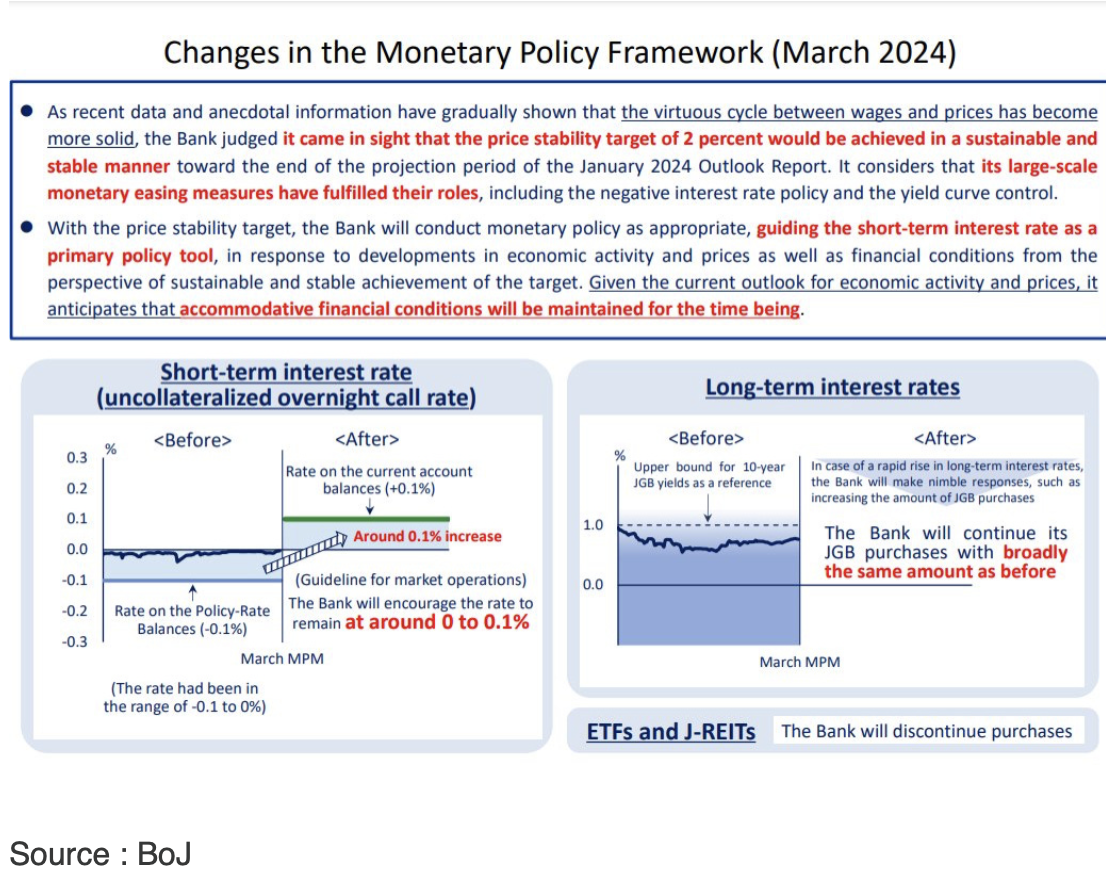
Below is what appears, to me at least, to be the critical comment from the BOJ after last night’s policy meeting.  As well, that graphic comes straight from the BOJ presentation.

“It is appropriate for the Bank to increase the flexibility in the conduct of yield-curve control, so that long-term interest rates will be formed smoothly in financial markets in response to future developments.”

The essence of this is that YCC as we knew it, where the control part was the key, is now dead.  Instead, Ueda-san is going to allow a great deal more leeway for the market to determine the yield on the 10-year JGB, and the entire yield curve there.  While they have not yet adjusted the policy rate, which remains at -0.10%, I imagine that change is only a matter of time.  Remember, though, the BOJ currently owns somewhere around 56% of the outstanding JGBs in the market.  It is very clear they are not going to sell any.  To me the question, which I did not see answered last night, is whether they will replace the bonds in their portfolio when old ones mature.  There was no mention of QT, but I guess we will have to see.  Based on their history, however, I would expect that the current balance of JGB’s they own will remain pretty constant going forward, at least on a nominal basis.  Given the Japanese government continues to run deficits, that will eventually reduce the percentage of holdings.  Of course, I suspect that this is subject to change if things get politically uncomfortable, but we shall see.

The market response was somewhat counter to what might have been expected.  Arguably, many were looking for a yen rally as higher yields in Japan would create a greater incentive for Japanese institutional investors to bring their money home.  But that is not what happened at all.  This morning, USDJPY is firmly above 150.00 with no hint that there is intervention coming anytime soon.  It seems, at least for now, that the MOF and BOJ are going to allow markets to find a new level by themselves.  If that is the case, I expect that USDJPY is going to revert to form and follow USD interest rates.  In fact, that is really the key, and something about which I have written in the past.  When the Fed turns their policy toward easier money, at that time the dollar will come under significant pressure.  However, until then, the dollar remains the place to be.

In China, the data has shown
The ‘conomy’s not really grown
Will Xi add more cash
To try for a splash
Or will he leave things on their own?

The other news overnight was from China where their PMI data proved weaker than expected for both manufacturing and services with the former falling back below the key 50.0 level at 49.5 and the latter falling to its lowest print since last December during the zero-Covid policy Xi had implemented.  It seems that slowing growth around most of the world plus a limited domestic economic impulse combined with the ongoing collapse of the Chinese property market is just too much to overcome right now.  Expectations are that Xi will agree to yet more stimulus (remember earlier this month they put forth a CNY 1 trillion (~$137 billion) plan, but that has not seemed to have had the desired impact.  At least not yet.  While Japanese equities rallied on the back of the BOJ activity, Chinese equities came under pressure, especially the Hang Seng (-1.6%) although mainland shares fell as well.  As to the renminbi, it continues to grind lower (dollar higher) and remains pegged at the 2% boundary vs. the PBOC’s daily fixing rate.  Nothing has changed my view of further weakness in the renminbi going forward, at least as long as the Fed retains its current policy stance.

If I were to sum up the situation in Asia at this time, I would suggest that the two major economies there are both very busy dealing with substantial domestic economic questions, although those questions are different in nature.  Japan is trying to come to grips with rising inflation absent substantial economic growth while China has a problem defined by weakening growth with inflation not a current issue.  But lack of growth is the common denominator here and as we have seen countless times around the world, I suspect we will see further fiscal stimulus in both nations before long.  

Of course, when it comes to fiscal stimulus, China and Japan are mere pikers compared to the US which has completely rewritten the record books on this matter.  And there is nothing that indicates the US is going to back off, at least while the current administration is in place, and likely the next regardless of the letter after the president’s name.  

On this subject, though, while yesterday I described the QRA as critical, the first part of the Treasury story was revealed yesterday morning when they announced that the funding requirement for Q4 would be $776 billion, some $75 billion less than the consensus estimates before the announcement.  But the key difference was that Secretary Yellen is aiming for an average TGA balance of “only” $750 billion, far less than some estimates of $1 trillion, and less than the current balance of $835 billion.  In fact, the difference between the current balance and the target is what makes up for the difference in the issuance estimates.  Under no circumstances should anyone believe that fiscal prudence is coming soon.

But this lower number has relieved some pressure in the bond market where we have seen yields slide a few more basis points this morning with the 10-year now trading at 4.83%.  This movement has been followed by the European sovereign market, where yields have fallen by between 4bps and 6bps across the board in sympathy.  In fact, the only major market that saw yields rise was the JGB market, where the 10yr yield is now at 0.93%, up 5 more bps from yesterday’s closing levels.  I suspect that we will be trading at 1.00% soon enough, and it will be quite interesting to see just how ‘nimble’ the BOJ will be if yields start to run higher more quickly.

As to equity markets, yesterday’s US rally has been followed by the European bourses, all up between 0.6% and 1.2% despite somewhat soft economic growth data released this morning.  However, Eurozone inflation data was also slightly softer than forecast and it seems traders are looking for the ECB to reverse to rate cuts sooner rather than later.  US futures, meanwhile, are very marginally firmer this morning as all eyes now turn toward tomorrow afternoon’s FOMC outcome.

Oil prices have bounced a bit, up 0.9%, but this seems to be a trading move rather than anything either fundamental or geopolitical.  Regarding the latter, the fact that the beginnings of the Israeli ground invasion of Gaza have not produced nearly the pyrotechnics feared, nor that the conflict has spread throughout the Middle East, at least not yet, has resulted in traders returning their attention to inventories and demand.  Slowing growth in most places around the world is likely the key driver right now.  As to gold, it has maintained its recent gains and is trading right at the $2000/oz level.  Clearly, there is a fear factor there, but remember, if the equity bulls are correct and the Fed is going to tell us they are done, that will be seen as dovish and we should see a reversal in the dollar, a rally in commodities, including gold, and an initial rally in stocks and bonds.  That is not my base case, but you cannot ignore the possibilities.

Finally, the dollar is best described as mixed today as the strength in USDJPY (+1.1%) has been offset by weakness in the greenback vs the euro (+0.4%) and the pound (+0.2%), as well as a number of EMG currencies (MXN +0.4%, PLN +0.5%, ZAR +0.6%).  If one considers the DXY, that is virtually unchanged on the day.

On the data front, this morning brings the Employment Cost Index (exp 1.0%), Case Shiller Home Prices (1.6%), Chicago PMI (45.0) and Consumer Confidence (100.0).  obviously, there are no Fed speakers as their meeting starts this morning and runs through tomorrow afternoon when we will see the statement and Powell will meet the press at 2:30.  

It seems to me like traders will be cautious ahead of the FOMC tomorrow.  I would think they would want more confirmation that the Fed has finished before running back into bonds as well as reversing the recent stock declines.  While the Fed is unlikely to do anything tomorrow, it will be all about the statement and press conference.  Til then, I suspect a quiet time.

Good luck

Adf

A Havoc Nightmare

While real wages fall
Kishida’s polls fall faster
Will Ueda act?

The first big thing this week is tonight’s BOJ meeting where many in the market are anticipating another tweak to the current YCC framework.  I have seen several analysts calling for a widening of the band to +/- 1.25% from the current +/- 1.00%.  While current yields have yet to reach the cap, they continue to grind higher and are currently at 0.88%, new highs for the move.  Ironically, it is likely the BOJ will need to buy even more JGB’s if they make an adjustment as the wider band would give the green light for speculators to short bonds even more aggressively.  Recall, since they widened from 0.50% to 1.00%, there have been at least five unscheduled bond buying episodes by the BOJ, with the last one, just a week ago, being the largest to date.

One thing to remember about the BOJ is that the concept of central bank independence is not as strong in Japan as it is, perhaps, elsewhere in the Western world.  (Of course, it is not that strong elsewhere either, but Japan is closer to China on this front than the US).  At any rate, the most recent polls in Japan show that PM Kishida’s approval ratings have fallen to new lows for his tenure, with an approval of just 33% according to the most recent Nikkei poll.  And this was after the announcement that he was cutting taxes to help people deal with the consistently rising inflation in Japan.  While it has not grown to levels seen in the US or Europe, it is clearly far higher than they have seen there in more than a generation.

But it doesn’t seem to be enough.  Now, there is no requirement for an election until sometime in 2025, but that doesn’t mean Kishida-san won’t feel the pressure to do more.  And arguably, one of the things they can do to fight inflation is raise rates and see if the yen can recapture some of the 35%+ that it has declined over the past two years.  

So, will they act?  My one observation on this is that unlike the Fed, which never likes to surprise the market, the BOJ has figured out that they only way they can have an impact is if they do surprise the market.  Given that an increasing number of people are starting to look for this outcome, I think the probability of a BOJ policy change tonight is quite low.  I would not be surprised, if I am correct, to see USDJPY head back through 150 and start to grind to new highs above the 152+ peak seen just before the intervention last year.

Meanwhile, for the rest of the week
Both meetings and data might wreak
A havoc nightmare
So, traders, beware
Of comments or data that’s bleak

Beyond tonight’s BOJ meeting, the week is jam-packed with other potential market moving catalysts between central bank meetings (FOMC on Wednesday, BOE on Thursday) and important data including ISM (Wednesday) and NFP on Friday.  However, there is one other thing set to be released Wednesday morning, well before the FOMC announcement and that is the Quarterly Refunding Announcement (QRA).  While, as its name suggests, this is released every quarter, it has generally been relegated to the agate type of market information as a technical feature for bond traders.  But this time, it has gained far more interest given the combination of the bond market’s performance since the last QRA (yields are higher by 80ish basis points) and the fact that the government budget deficit is continuing to grow with many new forecasts for a $2 trillion deficit this year thus a need for even more borrowing. 

Back in August at the last QRA, the Treasury increased issuance more than anticipated which has been seen as one of the drivers of the recent bond market decline.  If they were to increase it significantly again, there is certainly concern that bond yields can move much higher still.  Now, the Treasury could issue more short-term T-bills to take pressure off the bond market but bills already represent about 22% of the total debt outstanding.  That is a couple of points higher than the top of the historic range of 15%-20% and may be seen as a point of contention.  The positive is that given T-bill yields are all above 5.3%, there will be plenty of demand for their issuance.  However, on the flip side, that means that refinancing will need to occur far more frequently and that makes it subject to market dislocations and disruptions.

Another key part of the discussion will be just how large Secretary Yellen wants to keep the Treasury General Account (TGA), which is the government’s ‘checking’ account at the Fed.  As of Thursday, it held $835 billion and there has been talk she wants to increase it to $1 trillion to make sure the government has ample liquidity going forward, especially if there is another issue regarding government financing in Congress.  Historically, the Treasury has issued bills when they are seeking to build up balances in the TGA, which would tend toward seeing even more bills issued rather than substantial growth in the longer-dated maturities.  All in all, it is possible the QRA is going to have the largest potential impact on markets this week so beware.

In truth, the overnight session has been somewhat dull.  While the Israeli-Palestinian situation has seemed to enter a new phase regarding Israel’s incursion into Gaza, markets are non-plussed over the matter with bond yields little changed across the board, the dollar little changed across the board and oil prices sliding (-1.5%) this morning.  Even gold (-0.6%), which has been the best performer in the wake of the middle east crisis, has slipped back below the $2000/oz level, although remains higher by almost 10% in the past month.

In fact, the one area where things are moving is in equity space where we are seeing gains across the board in Europe, somewhere between 0.5% and 1.1%, in the major bourses as inflation data there showed that price rises have begun to slow down and Germany’s economy “only” shrunk by -0.1% in Q3, a much better than expected outcome!  US futures are also higher at this hour (7:15), up by 0.5% or so after a pretty awful week last week.  In fact, the only real outlier was Japan where the Nikkei slid -0.5% as Chinese shares were stronger along with most of the APAC markets.

As mentioned earlier, though, we do have a lot of news coming out this week so let’s go through it here:

TuesdayBOJ Rate Decision-0.1% (unchanged)
 BOJ YCC+ / – 1.00% (unchanged)
 Case Shiller Home Prices1.6%
 Chicago PMI45
 Consumer Confidence100
WednesdayADP Employment150K
 QRA$114 billion (+$11 billion)
 ISM Manufacturing49.0
 JOLTS Job Openings9.2M
 Construction Spending0.4%
 FOMC Decision5.5% (unchanged)
ThursdayBOE Decision5.25% (unchanged)
 Initial Claims210K
 Continuing Claims1795K
 Nonfarm Productivity4.0%
 Unit Labor Costs0.8%
 Factory Orders1.9%
FridayNonfarm Payrolls188K
 Private Payrolls145K
 Manufacturing Payrolls0K
 Unemployment Rate3.8%
 Average Hourly Earnings0.3% (4.0% Y/Y)
 Average Weekly Hours34.4
 ISM Services53.0

Source: tradingeconomics.com

So, as you can see, there is a lot of stuff coming our way starting tonight in Tokyo.  What that tells me is that we are not likely to see very much movement today as traders and investors await the plethora of new information that is due.  However, by the end of the week, we could have a very different narrative.  

Good luck

Adf

Concerns Are Severe

One look at the dot plot makes clear
Inflation concerns are severe
So, higher for longer
Is growing still stronger
And Jay implied few cuts next year

First, let’s recap the FOMC meeting.  The term hawkish pause had been used prior to the meeting as an expectation, and I guess that was a pretty apt description.  While they left policy on hold, as expected, the change in the dot plots, as seen below, indicate that even the doves on the Fed see fewer rate cuts next year, with just two now priced in from four priced in June.

Source: Fedreserve.gov

A quick reading shows that a majority of members expect one more hike this year, and now the median expectation for the end of 2024 has moved up to 5.125%, so 50bps lower than the median expectation for the end of 2023 and 50bps higher than the June plot.  To me, what is truly fascinating is the dispersion of expectations in 2025 and 2026, where there are clearly many opinions.  And finally, the longer run expectation has risen to 2.5% with many more members thinking it should be even higher than that.  The so-called neutral rate estimations seem to be creeping higher.  If you think about it, that makes some sense.  After all, given the ongoing forecasts for continued labor market tightness due to demographic concerns, and add in the massive budget deficits leading to significantly higher Treasury debt issuance, there is going to be pressure on rates to find a higher level.

The market response was quite negative, albeit not immediately, only after Powell started speaking.  But in the end, equity markets fell across the board in the US, with the NASDAQ taking the news the hardest, down -1.5%, as its similarity to long duration bonds was made evident.  Asian markets all fell overnight as well, with most tumbling more than -1.0% and European bourses are all under similar pressure, down -1.0% or so as well.  The one exception in Europe is Switzerland, where the SNB surprised the market and left rates on hold resulting in a weaker CHF and a very modest gain in their equity market.

However, the bigger market response was arguably in bonds, where yields rose to new highs for the move with the 2yr at 5.15% and the 10yr at 4.43%.  Once again, I point to the significant increase in debt that will be forthcoming from the US Treasury as they need to fund those budget deficits.  I have been making the case that a bear steepener would be the more likely outcome for the US yield curve.  That is where long-term rates rise more quickly than short-term rates due to the US fiscal policy and shrinking demand for US debt by key players, notably the Fed, but also China and Japan.  Nothing has changed that view.

Then early this morning, up north
Both Sweden and Norway brought forth
A quarter point hike
To act as a dike
Preventing price rises henceforth

After the Fed’s hawkish pause, we turn our attention to Europe, where the early movers, Sweden and Norway, both hiked twenty-five basis points, as expected, while both hinted that further hikes are not out of the question.  Inflation remains higher than target in both nations and in both cases, the currency has been relatively weak overall.  Switzerland left rates on hold, pointing to the fact that for the past three months, inflation has been within their target range, and they are beginning to see downward pressure on economic activity which they believe will keep that trend intact.

And lastly, from London we’ve learned
Another rate hike has been spurned
Though voting was tight
They said they’re alright
With waiting to see if things turned

As to the bigger story, the UK, expectations were split on a hike after yesterday’s tamer than expected CPI report while the pound fell ahead of the news.  And the change in expectations was appropriate as in a 5-4 vote, the BOE opted to remain on hold for the first time in two years.  They see that inflation may be easing more rapidly than previously expected, and they are concerned about overtightening.  While I have a hard time understanding how a 5.15% Base rate is tight compared to CPI running at 6.7% and core at 6.2%, I am clearly not a central banker.  At any rate, the pound fell further on the news and is now at its lowest level since March, while the FTSE 100 rallied back and is close to flat on the day from down nearly -1.0% before the announcement.  Gilt yields, however, are moving higher as the bond market there doesn’t seem to believe that the BOE is serious about fighting inflation.

And really, those are today’s key stories.  Late yesterday, Banco Central do Brazil cut the SELIC rate by 0.50%, as expected, and at the same time the BOE announced, the Central Bank of Turkey raised their refinancing rate by 5 full percentage points, to 30.0%, exactly as expected.  And to think, we get concerned over rates at 5%!

As to the rest of the day, there is a bunch of US data as follows: Philly Fed (exp -0.7), Initial claims (225K), Continuing Claims (1695K), Existing Home Sales (4.1M) and Leading Indicators (-0.5%).  As is typical, there are no Fed speakers scheduled the day after the FOMC meeting, but we will start to hear from them again tomorrow.

Putting it all together tells me that the Fed is not nearly ready to back off their current stance and will need to see substantial weakness in economic activity before changing their mind.  Meanwhile, last week’s ECB meeting and this morning’s BOE meeting tell me that the pain of higher interest rates in Europe is becoming palpable and the central banks are leaning more toward inflation as an outcome despite their mandates.  This continues to bode well for the dollar as the US remains the place with the highest available returns in the G10.

Tonight, we hear from the BOJ, where no change is expected.  I would contend, though, that the risk is there is some level of hawkishness that comes from that meeting as being more dovish seems an impossibility.  As such, there is a risk that the yen could see some short-term strength.  Keep that in mind as you look for your hedging levels.  

Good luck

Adf