
That Trade Again

Remember when everyone knew
That BOJ hikes would come through
The Fed would cut rates
And all the debates
Were focused on what next to do?
 
It turns out the very next thing
For those getting back in the swing
Was selling the yen
(Yes, that trade again)
And buying stuff that has more zing


We all know that the carry trade died two weeks ago.  After all, the BOJ hiked rates in a surprise to the markets which was followed by Chairman Powell essentially promising to cut rates.  Those actions spooked traders, and arguably algorithms as well, and we saw a dramatic decline in equity markets around the world, led by Japanese stocks.  The premise was that much of the market activity was driven by borrowing yen at near 0.0% and then converting those yen into other currencies and buying other assets, or just depositing the dollars, or Mexican pesos or Brazilian reals and earning the interest rate differential.

Now, don’t get me wrong, that was an active trade and clearly a part of the ongoing risk asset rally that was evident throughout most of the world.  But that trade took several years to build up, and the idea that it was unwound in a week is laughable.  But, that sharp move two weeks ago succeeded in doing one thing, it scared the 💩 out of the central bankers around the world.  Within days, the BOJ walked back all their tough talk about normalizing monetary policy and ending QQE.  As well, despite desperate calls from some of the punditry for an emergency rate cut, or at the very least, a guarantee of a 50bp cut in September by the Fed, the few Fed speakers we have heard continue with their mantra that while some things are looking encouraging, the time is not yet right to cut rates.

And, you know what that means?  It means that the interest rate differentials between Japan and the rest of the world remain plenty wide enough to reinvigorate that self-same carry trade that was declared dead just two weeks ago.  The obvious proof is in the equity markets which, while not quite back to the highs of July 16th, have rebounded between 6.8% (S&P500) and 8.8% (NASDAQ) from the bottoms seen at the beginning of the month.  (see chart below)

A graph of a line graph

Description automatically generated with medium confidence

Source: tradingeconomics.com

But equally important to this story is the fact that the yen has declined more than 4% from its highs at the peak of the fear as investors are far less concerned about much tighter BOJ policy.  This is also evident in the JGB market, where 10-year yields, while climbing 3bps overnight, remain well below the 1.0% level that was seen as a harbinger of the new monetary framework in Japan.

A graph showing the price of a stock market

Description automatically generated

Source: tradingeconomics.com

Of course, there has been other news that has abetted this price action, namely the recent US data which showed that the employment situation may not be as dire as the NFP report at the beginning of the month.  This was demonstrated yet again yesterday when Initial Claims fell to 227K, its lowest point in 5 weeks and the second consecutive decline in the result.  As well, Retail Sales were a much stronger than expected 1.0% (although the autos component seemed a bit funky), indicating that real economic activity was still growing.  Granted, the IP (-0.6%) and Capacity Utilization (77.8%) data were soft as were both the Philly Fed (-7.0) and Empire State Manufacturing (-4.7) surveys, but none of that matters when the markets get on a roll.

If I had to describe the narrative this morning it would be, everything’s fine.  The economy is still doing well, the jobs market is not collapsing, and the Fed is still on track to cut rates next month.  Goldilocks has come out of hiding and is back headlining the show.  While there are still some doubters out there, their voices are being drowned out by all the shouting to buy more stocks.

So, as we head into the weekend, let’s see how things have performed overnight.  In Asia, markets everywhere rallied following the strength in the US yesterday.  The Nikkei (+3.6%) led the way and has now rebounded more than 20% from its nadir at the height of the fear.  But the Hang Seng (+1.9%) showed strength and we saw strength throughout the region (Australia +1.3%, Korea +2.0%, India +1.7%) with one notable exception, mainland China, where shares edged up just 0.1%.  It seems that President Xi has, at the very least, a marketing problem with respect to getting investors to put money into China. In Europe, most markets are higher between 0.25% (CAC) and 0.6% (DAX) although the FTSE 100 (-0.4%) is struggling this morning after Retail Sales data there were seen as less than stellar.  As to the US, ahead of the opening futures markets are little changed at this hour (7:15).

In the bond market, yesterday’s stock euphoria played out as a sale of bonds with the corresponding rise in yields of 7bps in the US Treasuries.  However, this morning, those yields have backed off by 5bps and we have seen similar price action throughout Europe with sovereigns there showing yield declines of between 3bps and 5bps after following Treasury yields higher yesterday.  For now, bonds are certainly behaving like a haven asset.  Also, it is worth noting that the yield curve inversion is back to -17bps, edging slowing away from normalization.

In the commodity markets, after a solid performance yesterday, oil (-2.6%) is under real pressure this morning as market participants look to the lackluster Chinese economic activity and are worried that demand is not going to pick up anytime soon.  Certainly, yesterday’s Chinese data was nothing to write home about, and this morning they released their Foreign Direct Investment data showing it had decline -29.6% YTD in July.  This does not inspire confidence.  In fact, under the rubric a picture is worth 1000 words, here is a chart of that Chinese FDI.  It seems clear that something has changed in the way the world views China.

A graph of blue and orange lines

Description automatically generated

Source: tradingeconomics.com

As to the metals markets, gold (+0.4%) continues to find support as despite the equity rally, there remains a steady interest to hold something other than USD and fiat currencies.  However, the rest of the complex is softer this morning as weaker industrial activity would indicate less demand.

Finally, the dollar is ceding some of its gains from yesterday with some pretty substantial moves in both G10 and EMG blocs.   Versus the G10, the yen, which fell sharply yesterday, has rebounded 0.75% this morning, although remains above 148.  But we have seen strength in AUD (+0.3%), NZD (+0.7%) and GBP (+0.35%) as virtually all the G10 is firmer.  The pound is a bit odd given the equity market’s response to the UK data, but the other currencies seem to be simply retracing yesterday’s weakness.  In the EMG bloc, ZAR (+0.4%) is firmer on the back of gold and the generally weak dollar, but we are seeing MXN (-0.2%) lag the move.  CNY (+0.2%) is also benefitting today as broad dollar weakness plays out far more aggressively here than it has historically.  While the dollar’s long-awaited demise is still far in the future, today it is under some pressure.

On the data front, this morning brings Housing Starts (exp 1.33M), Building Permits (1.43M) and Michigan Consumer Sentiment (66.9).  As well, this afternoon we hear from Chicago Fed president Goolsbee.  He has been one of the more dovish FOMC members so look for him to talk up the chances of a more aggressive rate cut next month.  However, there is still a lot to learn between now and then with PCE next week, then another NFP and CPI report as well as the Jackson Hole conference.  As it stands this morning, the Fed funds futures market is pricing a 27% chance of a 50bp cut, with 25bps a lock.  But if the data continues to shine, please explain why they need to cut.  I think we are in a ‘good news is good’ scenario, so strength in this morning’s data should support the dollar and weakness impair it.  We shall see.

Good luck and good weekend

Adf
What If?

What if inflation’s not dead
And set to go higher instead?
Can Fed funds still fall?
Well, that’s a tough call
If not, look for trouble ahead


As we await Tuesday’s latest CPI data, I thought it might be a good time to review how things currently stand on a macro basis.  As I am just an FX guy, I am not nearly smart enough to see through the headlines and determine what is wrong with the narrative story of Goldilocks.  However, I can look at the actual numbers and perhaps we can draw some conclusions from that data.

Let’s start with CPI, as that is the next shoe to drop.  Looking at the last twelve months of monthly data, we see the following results on both an original and adjusted basis:

 CPI m/mannualizedCPI m/m (adj)annualized
Dec-230.33.60.22.4
Nov-230.23.00.22.4
Oct-230.12.40.12.0
Sep-230.43.00.42.7
Aug-230.53.60.53.36
Jul-230.23.40.23.2
Jun-230.2 0.2 
May-230.1 0.1 
Apr-230.4 0.4 
Mar-230.1 0.1 
Feb-230.4 0.4 
Jan-230.5 0.5 
Data tradingeconomics.com, calculations @fx_poet

Since the January 2024 data hasn’t been released, there would ordinarily be no revision yet.  However, as I wrote last week, the BLS does an annual revision which lowered the December 2023 result by a tick.  

As you can see that one tick had a big impact on the annualization trend for the past 6 months, and especially the past 3 months (highlighted), reducing it substantially.  Now, given the imperfections of the measuring process, 0.1% is probably not significant in the broad scheme of things.  But oh boy, for the narrative, it is everything.  Prior to that revision, it was pretty easy for those who believe inflation has bottomed to highlight that turn higher in the annualization rate.  This was especially true given how much the ‘inflation is dead’ crowd was relying on just that point.  But now that turn looks like a dead-cat bounce and is not nearly so impressive.  Tuesday’s outcome will be quite interesting as anything that is soft will almost certainly encourage the doves to be calling for a March cut more aggressively, and just as certainly, we will see risk assets rally sharply as the dollar declines.  A hot print, though, 0.3 or more, will have the opposite impact.

What if the ‘conomy’s state
Was built by the deficit’s weight?
And actual growth
Ain’t fast, but more sloth
Will Janet, more spending create?


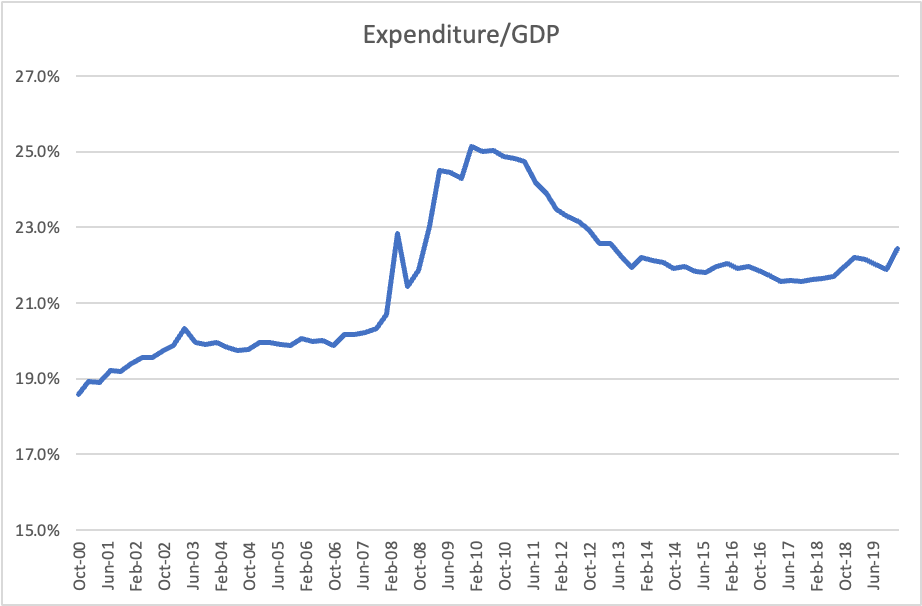
When looking at GDP data and Federal government expenditures, it becomes pretty easy to determine why GDP continues to percolate along so well.  Given that GDP = Consumption + Investment + Government + Net eXports (Y = C + I + G + NX), a quick look at the G component shows just how much support the government has been adding to the economy despite what has been recorded as strong growth.  Or perhaps, more accurately, this is why growth has been so strong.  The below chart shows the trend of government expenditures relative to total GDP growth.  I removed the Covid years because they are extremely volatile and confusing. However, looking at the trend since the GFC in 2008/2009, there has been a step change higher in the amount of government activity measured in the economy. 

Source: data FRED St Louis Fed, calculations @fx_poet

Given the current budget deficit is running > 7% of GDP and is projected to remain at least this high going forward, it is quite clear that there is a lot of nonorganic effort to raise the GDP measures.  Look at the sharp upward turn at the right side of the chart.  It appears that the administration will do everything they can to continue to show that the economy is strong.  

Of course, this is where the rubber meets the road.  If the administration continues to pump more government spending into the economy, can inflation really decline any further?  Remember, government spending is almost entirely consumption based, with limited investment at this time.  Even the CHIPS Act only created incentives for private companies to invest, it is not government investment per se.  The point is, pumping up consumption demand without adding productive capacity is very likely to drive prices higher.  And if anything, given this administration’s war on energy markets, they are discouraging investment in critical infrastructure.  It is hard to see how this plays out for a Goldilocks outcome.  Far more likely, in my view, is that they continue to pump as hard as possible, and prices start moving higher again.  Timing is everything in life, and perhaps they can work it out so price hikes are delayed until after the election, but I am skeptical given the vast incompetence this administration has shown in virtually every sphere in which it operates.

What if employment’s a mess
And actually in some distress?
Is JOLTS data real?
And what is the deal
With households, it’s hard to assess


The last big macro area is, of course, the employment situation.  We all know that the NFP report was much stronger than expected for January, rising 353K, but also seeing upward revisions of the previous months for the first time in quite a while.  In fact, one of the bearish stories had been that the revisions mattered more than the headline data, and if revisions were for the worse, that was indicative of a slowing economy.  

Remember, too, that the US employment situation is measured in two ways, via the establishment survey which is a survey of companies’ (both large and small) actual hiring activity and leads to the NFP number, and the household survey, which is a telephone survey of ~60,000 households and asks the question if someone is employed and if not, whether they are looking for work.  The Unemployment Rate is calculated from the household survey, so both are clearly critical in assessing the situation on the ground.  

The funny thing is that the numbers come across pretty differently when you dig down.  While in the long-term, both data series have shown a strong correlation (96% since January 2000), the Household survey is far more volatile and in the past year has been telling a somewhat different story than the establishment survey.  Look at this chart below mapping each since the beginning of 2023:

Source: data FRED St Louis Fed, calculations @fx_poet

Doing the math shows that the establishment survey claims that 3.409 million jobs were created while the Household survey comes in at just over half that amount, 1.852 million jobs.  Now, in a nation of 330 million people, especially given the expansion of the gig economy and the dramatic changes in employment overall, maybe that is not such a big deal.  As well, simply looking at the two lines shows that the Household survey is far more volatile than the Establishment survey.  Does this mean we should ignore the household survey, given it seems to have more noise and less signal?  The problem with this is the household survey drives the Unemployment Rate, and nobody is willing to ignore that.  And these differences beg the question, is the employment situation as rosy as it seems?  With the Unemployment rate remaining so low for so long, it certainly appears that there is ample demand for workers.  Of course, that also implies that the cost of labor seems unlikely to decline very much and could well increase further and faster.  If that is the case, the impact will be seen in the inflation data as well.

Trying to sum things up here, looking at the three critical macro variables, inflation, growth and employment, there is a strong case to be made that the combination of ongoing government support and continued demand for labor into an aging workforce can lead to solid nominal GDP growth with inflation remaining far stickier than many currently anticipate.  If that is the situation, all the hopes and dreams of the interest rate doves may be delayed, if not destroyed, as it will be increasingly difficult for the Fed to ease policy into an inflationary environment.  Arguably, this is why they are seeking greater confidence that inflation is really dead.  

Now, maybe Goldilocks is real, and inflation will continue to decline on its own because…well just because.  But I find it hard to look at the data and conclude that lower inflation is our future, at least for any length of time.

Ok, this has gotten much longer than I intended but fortunately, absolutely nothing of note happened overnight in markets.  Literally.  There has been de minimis movement in stocks, bonds, commodities and currencies, and there is a distinct lack of data to be released today.  Tomorrow’s CPI is THE number of the week, so perhaps that will get the juices flowing again and drive some movement.  Until then, a quiet day is usually a good one on which to establish hedges.

Good luck

Adf

Singing the Blues

Here’s what’s underlying most views
Inflation is yesterday’s news
But what if it’s not
And starts to turn hot?
Those bulls will be singing the blues
 
So, care must be taken, I think
As in the bulls’ armor, a chink
Is wages keep rising
While homes are surprising
Be careful, the Kool-Aid, you drink


Market activity has generally been benign as investors and traders await the next big news.  Arguably, that is next Tuesday’s US CPI data given the dearth of new information otherwise due to be released this week.  The one thing we have in spades this week is central bank speakers, with three from the Fed yesterday and four more today, including the first comments I have seen from the newest Governor, Adriana Kugler.  As well we have been regaled by ECB, BOE and BOC speakers and they will continue all week as well.

Thus far, the message has been pretty consistent with the general theme that inflation has fallen nicely and is expected to continue to do so.  However, in a great sign of some humility, they are unwilling to accept that because price levels have fallen for the past 3 months that their job is done.  Obviously, the recent NFP and ISM data have shown no indication that the economy is even teetering on the brink of a slowdown, let alone desperate for rate cuts for support.  And for this, I applaud them.

But in this case, the central bank community seems to be in a small minority of economic observers who are not all-in on the idea that rate cuts are necessary right now.  Because, damn, virtually every other analyst seems to be on that train.  

There is a very good analyst group that calls themselves Doomberg, which mostly write about energy policy and its impacts on everything else, but in this morning’s article, I want to highlight a more general comment they made which I think is really important:

“How can you tell the difference between an analyst and an advocate? It is all in the handling of data that runs counter to assertion. To an analyst, being wrong is disappointing, but it is primarily an opportunity to learn—an expected element in a feedback loop of continuous improvement. When knowledge is your only objective, there is no such thing as a bad fact, only one which you do not yet understand. Not so for the advocate. The advocate has tied their hopes (and often their livelihoods) to a specific outcome and feels compelled, whether consciously or not, to rationalize away or attack inconvenient realities. It is advocacy when every perturbation in the weather is tagged as evidence of climate change, each squiggle of unfavorable price action is declared market manipulation, and no act or utterance from a favored politician is disqualifying.”

First, I cannot recommend their writings highly enough as they are consistently thoughtful, well-researched and important.  But second, I think this point is exactly in tune with the Goldilocks welcoming committee as they will ignore every piece of data that runs counter to their narrative and double down by saying the Fed is overtightening because inflation is collapsing, and deflation is going to be the economic problem soon.

While I am often quite critical of the Fed and their comments, and still think they speak far too much, right now, I am very happy to see them maintain a reluctance to cut rates just because the market is pricing in those cuts.  Certainly, to my eye, looking at the totality of the data (as Chairman Powell likes to say) there is little indication that prices are collapsing.  In fact, the super-core data, which was all the rage last year, has turned higher.  I understand why Wall Street analysts are better described as Wall Street advocates, but for the independent analysts out there, and over the past several years those numbers have exploded higher, it is remarkable to me that more of them are not suspect on the idea that rates need to be cut and cut soon.  In fact, at this point, one month into the year, I continue to like my 2024 forecasts of perhaps one cut in the first half of the year, but a reversal as inflation reignites.

Yes, the futures market is now only pricing five cuts into 2024, but nothing has changed my view that the pricing is bimodal, either 0 or 10 cuts will be the outcome, with the former if the economy continues along its recent pace and the latter if the recession finally arrives.  Given that interest rates, led by Treasury yields, are the clear driver of global market movements, and given that inflation is going to play a critical role in their movement going forward, I have altered my view as to the most important piece of data.  Whereas I used to believe it was NFP, it is now entirely CPI/PCE.  As I wrote yesterday, if next week’s print is at 0.4% M/M, watch out for a significant repricing.

But now, let’s turn to today.  President Xi continues to have problems with his stock market and is seemingly getting a bit more desperate aggressive in his efforts to prevent a complete implosion.  Last night, the head of the CSRC (China’s SEC analog) was replaced as blame needs to be placed on others for Xi’s policy errors.  It ought not be surprising that Chinese shares, after a weak start, rebounded on the news and closed higher by about 1%.  However, the Hang Seng could not manage any gains and the Nikkei edged lower as well.  All in all, it was not a great session overnight.  In Europe this morning, the markets are lower by between -0.25% and -0.5% as once again we saw weak German data (IP -1.6%) continuing to point to a recession on the continent.  Finally, US futures are basically flat at this hour (7:30).

In the bond market, yields, which all slid a bit yesterday on what seemed to be a profit-taking move after that massive runup following the NFP and ISM data, are a bit higher this morning, with Treasury yields up by 3bps and most of Europe seeing similar movements, between 2bps and 4bps.  As I wrote above, this story remains all about inflation’s future, and as data comes in to add to the conversation, I suspect that will be the key mover going forward.

Oil prices (+1.0%) are continuing their modest recent rebound with WTI touching $74/bbl this morning and Brent above $79/bbl.  Comments by the Biden administration that they would continue to attack Iranian proxy groups seems to have traders worried about an escalation.  But a more concerning story is that Ukraine has been targeting Russian refineries in an effort to degrade Putin’s cash flow.  They have already hit several and reduced capacity by 4%-5%.  If that continues successfully, then oil prices are going to go much higher.  This doesn’t seem to be in the bigger narrative right now, so beware.  As to the metals markets, they are all slightly softer this morning, but movement has been tiny.

Finally, the dollar is under a modest amount of pressure this morning, which given the rising yields and softer commodities, seems out of character.  Granted, the movements are small, with most currencies just 0.1% – 0.2% firmer vs. the dollar.  And this could also be profit-taking given the dollar’s recent rally.  After all, the euro remains below 1.08 and USDJPY above 148.00 so this is hardly a collapse.

Turning to the data today, the Trade Balance (exp -$62.2B) is this morning’s release and then after oil inventories, at 3:00 we get Consumer Credit ($16.0B).  As mentioned above, we have many more Fed speakers as well, and I sense that will be of far more interest to market participants.  I don’t anticipate anybody straying from the current theme of inflation has been falling nicely but they are not yet convinced.  If someone strays, that could move markets, but again, I see little to drive things today, or this week.

Good luck

Adf

With Conceit

On Friday, two final Fed speakers
Explained they are both simply seekers
Of lower inflation
Hence, justification
That they’re simply policy tweakers
 
We now have nine days til they meet
When both bulls and bears will compete
To offer their vision
While casting derision
On each other’s views with conceit
 
It appears to be a slow day to start what has the potential for quite an interesting week.  While the Fed is in their quiet period, we have central bank meetings in Japan, the Eurozone, Norway and Canada as well as the first look at Q4 GDP and the all-important December PCE data.  As I said, while it is slow today, there is much to anticipate.

But first let’s finish up last week, where the equity rally continued unabated despite continued pushback from Fed speakers.  Notably, SF’s Mary Daly, who is usually a reliable dove, was very clear that it is too soon to consider cutting interest rates.  Her exact words, “We need to see more evidence that it is heading back down to 2% consistently and sustainably for me to feel confident enough to start adjusting the policy rate,” seem pretty clear that she is not ready for a cut yet.  Meanwhile, Chicago’s Austan Goolsbee was similarly confident that it is premature to consider cutting rates any time soon.  

Arguably, of more importance is the fact that the Fed funds futures market is now pricing in slightly less than a 50% probability of a rate cut in March and about 5 rate cuts this year, rather than the 6 to 7 cuts that were in the price ten days ago.  So, we heard a great deal of jawboning to remove just one rate cut from the market perception.  For the life of me, I cannot look at the recent CPI data as well as the situation in the Red Sea and the Panama Canal, where though caused by different situations, show similar outcomes in forcing a significant amount of shipping volumes to change their route to a longer, more costly one and see lower inflation in our future.  I understand that there was a disinflationary impulse, but to my eye that has ended.

Now, it is entirely possible that we see the rate of inflation decline on the back of a recession, but that is not the market narrative at this point.  Rather, the market appears to be priced for the perfection of a soft landing, where the Fed will be able to tweak rates lower while inflation continues to soften, and unemployment remains low.  Alas, I still see that as a pipe dream.  As I have written in the past, it seems far more likely that we see either one rate cut as the economy continues to perform and inflation remains stubborn or 10 or more amidst a sharp slowdown in economic activity and rising unemployment, but five doesn’t seem correct to me.

In the meantime, today is a waiting game for all the things yet to appear this week.  Looking at the overnight activity, we continue to see the dichotomy between China and Japan with the former seeing its equity markets continue to crater (CSI 300 -1.6%, Hang Seng -2.3%) while the latter has made yet another new 34 year high (Nikkei +1.6%).  Last night, the PBOC left their key Loan Prime Rates unchanged, as expected, but still a disappointment to a market that is desperate for some stimulus from the government there.  So far, all the activity has been directly in the financial markets where the Chinese have banned short-selling and “advised” domestic institutions to stop selling any equities, and yet the markets there continue to underperform.  Perhaps President Xi will decide that common prosperity requires fiscal stimulus of a significant nature, but that has not yet been the case.  Both the Hang Seng and mainland markets have fallen precipitously, but there is no obvious end game yet.  Meanwhile, European bourses are all in the green, on the order of 0.5% while US futures are higher by a similar amount at this hour (7:45).

Bond markets are having a better day around the world today with yields falling everywhere.  Treasury yields are the laggard, only down by 3bps, while European sovereigns have fallen 5bps and even JGB’s fell 1 bp overnight.  Perhaps it is the sterner talk by central bankers regarding rate cuts (ECB speakers have also pushed back hard on the idea that rate cuts are coming in March, with the June meeting the favorite now), which has investors becoming more comfortable that inflation will continue its recent declines.  As there has been exactly zero data released today, that is the most rational explanation I can find.

In the commodity markets, quiet is the word here as well with oil (+0.35%) edging higher, thus holding onto last week’s gains, while metals markets are mixed.  Gold is unchanged on the day; copper is modestly softer, and aluminum is modestly firmer.  As has been the case for the past several weeks, there is not much information to be gleaned from these markets right now.  I expect that over time, we will see commodity prices trade higher as the decade long lack of investment in the sector plays out, but in the short-term, there is little on which to see regarding price trends, absent a major uptick in the Middle East dynamics.  After all, even avoiding the Red Sea hasn’t had much impact.

Lastly, the dollar is mixed overall.  Against its G10 counterparts, JPY, GBP and NZD all have edged higher by about 0.2%, but we are seeing similar weakness in NOK and AUD.  In the EMG bloc, we actually see a few more laggards than leaders with ZAR (-0.8%), HUF (-0.5%), and KRW (-0.4%) all suffering a bit on the session while CLP (+0.5%) is the leading light in the other direction.  Ultimately, the big picture here remains the dollar is tied to the yield story and if the Fed really does maintain higher for longer, the dollar will find support.

As mentioned above, there is a lot of data to digest this week as follows:

TuesdayBOJ Rate Decision-0.1% (unchanged)
WednesdayFlash Manufacturing PMI48.0
 Flash Services PMI51.0
 Bank of Canada Rate Decision5.0% (Unchanged)
ThursdayNorgesbank Rate Decision4.5% (Unchanged)
 ECB Rate Decision4.0% (Unchanged)
 Durable Goods1.1%
 Q4 GDP2.0%
 Chicago Fed National Activity0.03
 Initial Claims200K
 Continuing Claims1828K
FridayPersonal Income0.3%
 Personal Spending0.4%
 PCE0.2% (2.6% Y/Y)
 Core PCE0.2% (3.0% Y/Y)

Source: tradingeconomics.com

So, the end of the week is when we get inundated, although the Eurozone Flash PMI data comes on Wednesday as well.  But without a major data miss, all eyes and ears will be on the central banks right up until we see Friday’s PCE data.  Regarding that, there is a growing expectation that the core number will be quite soft, with many pundits calling for an annual number below 3.0% on the core reading.  However, given what we have seen from inflation readings everywhere, including the slightly hotter than forecast CPI numbers, I would fade that view.

The one thing of which I am confident is that if the Core PCE print is soft, you can expect the futures markets to price 6 or 7 cuts into this year and more cuts everywhere with the concomitant rise in both stock and commodity prices, especially given the Fed’s inability to push back immediately.  However, my view is that the world of today is not the world of the past 15 years, and that higher inflation and higher interest rates are an integral part of the future.  As well, unless there is a financial crisis of some sort, where more banks are under pressure like last March, I remain in the very few rate-cuts camp and think the equity rally has an expiry date before the summer.  As to the dollar, I think it holds up well in that circumstance.  While I changed my view based on the Powell pivot at the December FOMC meeting, the data has not backed him up, at least not yet.

Good luck

Adf

Looks Askance

On Wednesday, twas John Williams chance
To help explain, though at first glance
Inflation is sinking
No Kool-aid, he’s drinking
So, at cuts, he still looks askance

And backing him up in this view
Was Retail Sales, which really grew
There’s no indication
That US inflation
Is going to fall down near two

The pushback by FOMC speakers continued yesterday as NY Fed president Williams was the latest to explain that although things were heading in the right direction, the committee was unlikely to cut rates anywhere nearly as quickly as the market is pricing.  Here are the money lines, “My base case is that the current restrictive stance of monetary policy will continue to restore balance and bring inflation back to our 2 percent longer-run goal. I expect that we will need to maintain a restrictive stance of policy for some time to fully achieve our goals, and it will only be appropriate to dial back the degree of policy restraint when we are confident that inflation is moving toward 2 percent on a sustained basis.” [Emphasis added]. Once again, the idea that the Fed is going to cut rates in March seems awfully remote, at least based on what they are telling us.

Now, it is entirely possible that the data starts to deteriorate more rapidly with growth clearly falling and Unemployment starting to rise more rapidly and if that were to occur, I think a March cut would not be impossible.  But then yesterday we saw a much better than expected Retail Sales print, (headline +0.6%, ex autos +0.4%) with the Y/Y growth up to 5.6% (nominal).  Data like that is not indicative of a collapse in economic activity.  The fact that much of it is reliant on a combination of massive fiscal stimulus and increased credit card debt does not mean the growth is false.  It merely sets up for weakness later.

In the end, the Fed funds futures market is backing away a bit further from that March rate cut with the probability reduced to 61% now from 70% just a week ago.  It can be no surprise that between the Williams comments and the stronger data, Treasury yields backed up 5bps and equity markets suffered a bit more, down about -0.5%.

To me, the key question is, at what point will the market accept that 6 rate cuts are not the most likely outcome this year?  Clearly, they are not ready to do so yet, although based on the equity market performance so far this year, there is a little bit of nervousness, at least, making its way through the investment community.  Analyzing the price action over the past month and considering the information that we have gotten since the last FOMC meeting, the outlier seems to be Powell’s dovishness at the press conference, not the macroeconomic data nor the commentary from other Fed speakers.  Of course, Powell’s voice is clearly the most important, but when both Waller and Williams, his two top lieutenants, reiterate that maintaining restrictive policy is the right move for now, I have to believe that the next FOMC statement is going to reiterate that stance.

What does all this say about the future?  Well, since everything is data dependent, or at least that’s what they tell us, then we need to continue to watch the data to help understand the reaction function.  The problem is that there is no consistency in the data.  For instance, in addition to yesterday’s strong Retail Sales data, we saw stronger than expected NFP and higher than expected CPI readings, all three being critical real data points.  On the flip side, we have seen weaker than expected ISM data, both manufacturing and services and Tuesday’s Empire State Manufacturing Index fell to -43.7, a level only exceeded by the Covid readings in early 2020.  In fact, that index has fallen more than 50 points in the past two months.  The upshot is that we continue to see negative survey data and solid real data.  So, I ask you, which set of data is the Fed watching more closely?

FWIW my assessment of the situation is as follows: the Fed is aware of the goldilocks narrative but has not bought into it at this stage, at least not Powell and his two key lieutenants, and they are the ones that matter. Whatever the survey data, if the hard data holds up, they are going to maintain policy right where it is.  While we know they care about surveys (look at their focus on inflation expectations), I think Powell is still very afraid of being Arthur Burns redux.  Right now, it looks like the outlier was the Powell press conference, not all the push back.  I changed my entire thesis based on that pivot and that may have been a mistake.  However, if we start to see weaker hard data, so Housing softens, PCE is soft, GDP misses expectations or something like that, look for goldilocks to make a return.  Otherwise, regardless of the survey data, I fear risk assets are going to have trouble as are bond markets which have priced in a lot of rate cuts.

Speaking of push back, we continue to hear ECB speakers on the same page as the Fed, rate cuts are not coming on the market’s current timeline.  June seems to be the earliest it will happen there unless the Fed cuts sooner.  I continue to believe given the very weak growth profile in Europe that Madame Lagarde is quite anxious to get started cutting rates, but she knows she cannot do so yet.  I imagine that Interpol will have an APB out on goldilocks pretty soon as they want to capture her and keep her in the public’s eye.

One other thing to mention away from the financial markets is what appears to be a further escalation of fighting in the Middle East.  Last night, Pakistan retaliated against Iran with missile strikes of their own, ostensibly killing Pakistani militants who were based in Iran.  Whatever the rationale may be for these moves, the one truism is that things in the Middle East are getting more dangerous and that is going to pressure oil prices higher.  We have seen that this morning, with small gains, but I would suggest that will be the direction of travel if this keeps up.

Ok, on to markets where yesterday’s lackluster US equity performance was largely ignored as Japanese stocks were just barely lower, Chinese and Hong Kong stocks finally rebounded a bit and the rest of APAC saw more gainers than losers.  European markets are firmer this morning, in what could well be a trading bounce as there was no data to encourage the process and US futures are firmer at this hour (7:30) by about 0.5%.

After yesterday’s continuation bounce in yields, this morning we are seeing a bit of a pullback with Treasury and most European sovereign yields lower by about 2bps.  The one outlier is Japan, where JGB yields picked up 3bps, although that could well be a delayed response to yesterday’s Treasury price action as the Japanese data overnight was quite soft (Machinery Orders and IP both falling in November) and not indicative of tighter policy in the future.

Aside from oil’s modest gains, gold has rebounded a bit this morning, up 0.5%, arguably on the increased tensions in Iran/Pakistan but the base metals are under pressure today.  Lately, it is very difficult to glean much information from the base metals as confusion over whether Chinese growth is real, and how overall growth is progressing seems to be keeping traders on the sidelines.

Finally, the dollar is backing off its highs from yesterday, but the movement has not been large, about 0.2% broadly across both G10 and EMG currencies.  The most noteworthy outlier is ZAR, where the rand has rallied 0.85% on the back of that gold strength.

On the data front today, Housing Starts (exp 1.48M), Building Permits (1.426M), Initial Claims (207K), Continuing Claims (1845K) and Philly Fed (-7) all show up at 8:30.  As well, Atlanta Fed president Raphael Bostic speaks twice today, early and late, so it will be very interesting to hear if he is going to push back further on the Powell pivot or agree with it.

Today brings both hard and survey data, so if it all lines up one way or the other, perhaps it will be a driver.  But my take is we will continue to see a mixed picture and so will be highly reliant on Fedspeak as after Bostic today, we get Daly and Barr tomorrow and then the quiet period.  I think a risk rebound is in order just because things have been weak.  But I am worried about the longer-term trend now that Powell is seeming more and more like the outlier, not the driver.

Good luck
Adf

Dragged Through the Mud

The year started out with a thud
As equity markets saw blood
The bond market fell
And oil’s death knell
Was sounded, whilst dragged through the mud
 
The question we now must address
Is, are markets set to regress?
Or, is this a blip
O’er which we can skip
Without adding too much new stress?


Has the narrative already changed?  That seems to be the question we really need to ask after just one day of trading in 2024.  It seems hard to believe that the macroeconomic fundamentals have changed very much, especially since we have not gotten any substantial data yet.  While ISM Manufacturing (exp 47.1) and JOLTS Job Openings (8.85M) are due later this morning, it beggar’s belief that the market is anticipating much there.  Sure, we get the payroll report on Friday, but given the goldilocks, soft-landing scenario had seemed to be the prevailing theory, have we actually seen anything that would change that view?

Of course, it is possible that market participants are fearful that the FOMC Minutes, which are released at 2:00 this afternoon are not going to reconfirm their broadly dovish views.  You may recall that at the December FOMC meeting, Chairman Powell did nothing to disabuse the markets of the idea that the Fed had not only finished tightening, but that it was getting set to ease.  From that point, the Fed funds futures market has priced in a total of six rate cuts for 2024, twice the number the median dot plot numbers showed and a pretty dramatic easing, especially if the economy does not fall into recession.

There is, of course, another possible rationale for yesterday’s weak start in risk assets; they were wildly overbought.  Since that Fed meeting in the middle of December, stocks had rallied sharply (S&P 500 +3.4% at its peak), 10-year yields fell 40bps at their trough and the dollar, as measured by the DXY, had fallen more than 2%.  The peak (trough) was seen immediately after Christmas, and we have been drifting back since then.  In fact, I think it is fair to say that markets got a bit exuberant in the wake of the FOMC meeting.

But as we get back to fully staffed trading desks and investment managers are back from their holiday breaks, I suspect that price action is going to moderate a bit while volumes improve.   As I tried to make clear yesterday, I believe that the recent uptrend in risk assets will continue broadly until we see enough data to change opinions.  There remains a pretty large group of analysts who are in the “inflation is going to 1%” camp and that will allow (force?) the Fed to cut rates more aggressively to prevent real interest rates from becoming too restrictive.  As that is a pleasing narrative, and one that the current administration would really like to see evolve, I expect that we will hear a lot about that for a while.  And maybe that is what will come to pass.

However, my suspicions and fears are that 2024 will be less idyllic than those goldilocks scenarios that are being painted by the soft-landing crowd.  I find it difficult to believe that amongst all the potential big picture problems, including escalation of the Middle East war, the Ukraine war, China’s recent threats about reunification of Taiwan, and the more than 40 elections that are due this year, culminating in the US election, there won’t be at least a few major hiccups.  In fact, the ongoing unhappiness in the US electorate is likely to be one of the biggest issues driving what I believe will be risk aversion before the year ends.  But that has not yet manifested itself, so we are likely to have interesting times ahead.

In the meantime, let’s look at the overnight price action.  After the weak US equity performance, APAC markets mostly fell, with only Japan (Nikkei -0.2%) really holding in well.  European bourses this morning are all lower, on the order of -1.0%, with the CAC (-1.5%) really suffering and US futures all in the red, led by the NASDAQ (-0.7%) although the others are down about -0.35% at this hour (7:45).  Clearly, there has been no joy yet.

As to the bond market, this morning has seen Treasury yields back up a further 4bps and they are now at 3.97%, well off the lows seen post-Christmas.  European bond markets have seen less aggressive rebounds in yields as the economic picture on the continent remains more dire than here in the US.  Arguably, the ECB has a much tougher job than the Fed right now as the inflation data in Europe remains higher than in the US while economic activity is clearly slowing much more rapidly.  (I guess if they had pumped as much fiscal stimulus into their economy as we did into ours, they wouldn’t be in this situation.  Of course, the debt situation might be worse…). Ultimately, however, I expect that the lack of growth is going to dominate the mindset in Europe and that Madame Lagarde will be cutting rates as soon as she can.  One last thing, Japan.  Remember all the stories in December about how the BOJ was getting set to normalize policy (i.e., return rates to positive territory) and that Japanese investors would be repatriating money soon?  Well, this morning 10-year JGB yields are at 0.60%, far below the 1.00% former YCC cap and the new reference rate and showing no signs of doing anything unusual.  

Turning to the oil market, while it is rebounding this morning, +0.8%, it has been under significant pressure lately despite what appears to be a serious increase in the military posture in the Red Sea amid Houthi rebel attacks on ships and the US Navy responding more aggressively.  In fact, Maersk, the largest shipping company in the world, has once again indicated it will not transit the Red Sea, an outcome that can only negatively impact the cost basis for shipping, and ultimately push upwards on inflation.  This is an area where we need to keep a close eye for new developments.  However, this morning the metals markets are under pressure as gold (-0.65%) is giving up some of its recent gains, although remains well above the $2000 level.  But we are seeing weakness in the base metals as well, with both copper and aluminum under pressure this morning.

Perhaps a key driver of the metals markets has been the fact that the dollar has continued its rebound with the DXY higher by 0.3% this morning, having rallied 1.5% from its recent post-Christmas nadir.  This has been a broad-based dollar rally with gains against both G10 and EMG currencies as it seems to be a dollar story.  The best I can figure is that there is concern/anticipation that the Minutes are going to sound more hawkish than people remember the meeting and press conference.

On the data front, we see the following:

TodayISM Manufacturing47.1
 ISM Prices Paid47.5
 ISM Employment 46.1
 JOLTS Jobs Openings8.85M
ThursdayADP Employment115K
 Initial Claims216K
 Continuing Claims1883K
FridayNonfarm Payrolls168K
 Private Payrolls130K
 Manufacturing Payrolls5K
 Unemployment Rate3.8%
 Average Hourly Earnings 0.3% (3.9% Y/Y)
 Average Weekly Hours34.4
 Participation Rate62.7%
 ISM Serv ices52.6
 Factory Orders2.1%

Source: Tradingeconomics.com

Interestingly, only Richmond’s Thomas Barkin is scheduled to speak this week, first this morning and then on Friday afternoon as well.  

Absent a new escalation in the Middle East, though, I would look for a little more profit-taking ahead of the payroll data.  However, I continue to believe the market is going to push for the bullish framework for a few months at least which means equities will rally, yields will slide, and the dollar will fall as well.

Good luck

Adf

Miles Off Base

This poet was miles off base

As Powell, more growth, wants to chase
So, hawks have been shot
With nary a thought
While doves snap all stocks up apace.

It seems clear that Jay and the Fed
Decided inflation is dead
Through Q1 at least
Bulls will have a feast
Though after, take care where you tread

It turns out that not only were my tail risk ideas wrong, I was on the wrong side of the distribution!  Powell has decided that the soft-landing narrative is the best estimator of the future and wants to make sure the Fed is not responsible for a recession.  Concerns over inflation, while weakly voiced, have clearly dissipated within the Eccles Building.  I hope they are right.  I fear they are not.

In fairness, once again, yesterday I heard a very convincing argument that inflation was not only going to decline back to the Fed’s target of 2.0%, but it would have a 1 handle or lower by the middle of 2024 based on the weakening credit impulse that we have seen over the past 18 months.  And maybe it will.  But, while there is no question that money supply has been shrinking slowly of late, which has been a key part of that weakening credit impulse story, as can be seen from the chart below based on FRED data from the St Louis Fed, compared to the pace of M2 growth for decades, there are still an extra $3 trillion or so floating around the economy.  Iit seems to me prices will have a hard time falling with that much extra cash around.

Of course, there is one other place that money may find a home, and that is in financial assets.  So, perhaps the outcome will be a repeat of the post-GFC economy, with lackluster growth, and lots of money chasing financial assets while investors lever up to increase returns.  My guess is that almost every finance official in the world would take that situation in a heartbeat, slow growth, low inflation and rising asset prices.  The problem is that series of events cannot last forever.  As is usually the case with any negative outcome, the worst problems come from the leverage, not the idea.  When things are moving in one’s favor, leverage is fantastic.  But when they reverse, not so much.

A little data is in order here.  According to Statista, current global GDP is ~$103 trillion in current USD, current global stock market capitalization is ~$108 trillion, and the total amount of current global debt is ~$307 trillion according to the WEF.  In a broad view, the current debt/equity ratio is about 3:1 and the current debt/sales ratio is the same.  While this is not a perfect analogy, usually a debt/equity ratio of 3.0 is considered pretty high and a company that runs that level of debt would be considered quite risky.  Now, ask yourself this, if economic activity only generates $108 trillion, how will that >$300 trillion of debt ever be repaid?  The most likely answer is, it never will be repaid, at least not on a real basis.

If you wonder why central bankers favor lower interest rates, this is the primary reason.  However, at some point, there is going to be more discrimination between to whom lenders are willing to lend and who will be left out because they are either too risky, or the interest rate demanded will be too high to tolerate.  When considering these facts, it becomes much easier to understand the central bank desire to get back to the post-GFC world, doesn’t it?  And so, I would contend that Chairman Powell has just forfeited his efforts to be St Jerome, inflation slayer. 

The implication of this policy shift, and I would definitely call this a policy shift, is that the near future seems likely to see higher equity prices, higher commodity prices, higher inflation, first higher, then lower bond prices and a weaker dollar.  The one thing that can prevent the inflation outcome would be a significant uptick in productivity.  While last quarter we did see a terrific number there, +5.2%, the long-term average productivity growth, since 1948 is 2.1%.  Since the GFC, that number has fallen to 1.5%.  We will need to see a lot more productivity growth to keep goldilocks alive.  I hope AI is everything the hype claims!

Today, Madame Christine Lagarde

And friends are all partying hard
Now that Jay’s explained
Inflation’s restrained
And rate cuts are in the vanguard

This means that the ECB can
Lay out a new rate cutting plan
The doves are in flight
Which ought to ignite
A rally from Stuttgart to Cannes

Let’s turn to the ECB and BOE, as they are this morning’s big news, although, are they really big news anymore?  Both these central banks have been wrestling with the same thing as the Fed, inflation running far higher than target, although they have had the additional problem of a much weaker economic growth backdrop.  As long as the Fed was tightening policy, they knew that they could do so as well without having an excessively negative impact on their respective economies.  But given that pretty much all of Europe is already in recession, and the UK is on the verge, their preference would be to cut rates as soon as possible.  

But yesterday changed everything.  Powell’s bet on goldilocks has already been felt across European markets, with rallies in both equity and bond markets in every country.  The door is clearly wide open for Lagarde and Bailey to both be far more dovish than was anticipated before the FOMC meeting.  And you can be sure that both will be so.  While there will be no rate cuts in either London or Frankfurt today, they will be coming soon, likely early next year.  

At this point, the real question is which central bank will be cutting rates faster and further, not if they will be cutting them at all.  My money is on the ECB as there is a much larger contingent of doves there and the fact that Germany and northern European nations are already in recession means that the hawks there will be more inclined to go along for the ride.  Regardless, given the Fed has now reset the central bank tone to; policy ease is ok, look for it to happen everywhere.

Right now, this is all that matters.  Yesterday’s PPI data was soft, just adding fuel to the fire.  Inflation data that was released this morning in Sweden and Spain saw softer numbers and while Retail Sales (exp -0.1%, ex autos -0.1%) are due this morning along with initial Claims (220K), none of this is going to have a market impact unless it helps stoke the fire.  Any contra news will be ignored.

Before closing, there are two things I would note that are outliers here.  First, Japanese equity markets bucked the rally trend, with the Nikkei sliding -0.7% and the TOPIX even more (-1.4%) as they could not overcome the > 2% decline in USDJPY yesterday and the further 1% move overnight.  That very strong yen is clearly going to weigh on Japanese corporate profitability.  The other thing is that there is one country that is not all-in on the end of inflation, Norway.  This morning, in the wake of the Fed’s reversing course, the Norges Bank raisedrates by 25bps in a total surprise to the markets.  This has pushed the krone higher by a further 2.3% this morning and nearly 4% since the FOMC meeting.  

As we head toward the Christmas holidays and the beginning of a new year, it seems like the early going will be quite positive for risk assets and quite negative for the dollar.  Keep that in mind as you consider your hedging activities for 2024.

Good luck

adf

Hawk-Eyed

A landing that’s soft will require

A joblessness growth multiplier
Demand needs to slide
Enough so hawk-eyed
Fed members, rate cuts can inspire

The thing is, when looking at data
The trend hasn’t been all that great-a
While prices are falling
Growth seems to be stalling
More quickly than Jay’d advocate-a

As we await the onslaught of data starting this morning with ADP Employment and culminating in Friday’s Payroll and Michigan Sentiment reports, I thought it would be worthwhile to try to take a more holistic look at the recent data releases to see if the goldilocks/soft landing narrative makes sense, or if there is a growing probability of a more imposing slowdown in growth, aka a recession.

The problem is, when looking at the past one month’s worth of data, the trend in either direction is not that clear.  One of the things that has been true for a while is that there continues to be a dichotomy between the survey data and the hard figures.  Survey data has tended toward weakness, with one outlier, the most recent Chicago PMI print at 55.8.  But otherwise, ISM data has been quite soft for manufacturing and so-so for services.  Looking at the regional Fed surveys, it has been generally much worse with more negative outcomes than positive ones.  

At the same time, we all remember last week’s blowout GDP result for Q3 at 5.2% and we continue to see employment growth, albeit at a slowing pace to what was ongoing last year and earlier this year.  Retail Sales finally fell slightly last month, but that is after a string of much stronger than expected prints, arguably why Q3 GDP was so strong.  Perhaps the more worrying points are that the Continuing Claims data has started to grow more rapidly, meaning that people are remaining on unemployment insurance for longer and longer periods and yesterday’s JOLTS data was substantially lower than expectations and lower than the November reading.  Finally, Durable Goods and Factory Orders have been quite weak.

If I try to add it up, it seems to point to a weaker outcome than a soft-landing with the proper question, will the recession be mild or sharp?  Funnily enough I think the data highlights the Biden administration’s ‘messaging’ problem.  Surveys are generally quite negative and now hard data seems to be rolling over.  That is clearly not the story that a president running for re-election is seeking to tell.  

All this begs the question, how will the Fed respond?  And here’s the deal, at least in this poet’s view; the current market pricing of upwards of 125 basis points of rate cuts through 2024 is not the most likely outcome.  Rather, I continue to strongly believe that we will see either very little movement, as higher for longer maintains, or we will see 300-350bps of cuts as a full-blown recession becomes evident.  

To complete the exercise, let’s game out how markets may behave in those two situations.  If the Fed holds to its guns and maintains the current policy stance with Fed funds at 5.50% and QT ongoing, risk assets seem likely to have problems going forward.  It is quite easy to believe that the key driver to last month’s massive equity rally was the pricing of easier monetary policy to support the economy, and by extension profitability and the stock market.  So, if the Fed does not accommodate this view, at some point investors and traders are going to need to reevaluate the pricing of their holdings and we could see a sharp decline in equities.  As well, this would likely result in a further inversion in the yield curve as expectations for a future recession would grow.  On the commodity front, this ought to weigh on both the energy and metals complexes even further than their current pricing.  Recall, I have been highlighting that the commodities markets seem to be the only ones pricing in a recession.  As to the dollar, in this scenario I expect to see it regain its strength as the rest of the world will be sliding into recession regardless of the US outcome, so rate cuts will be on the table for the ECB, BOE, BOC, and PBOC.

Alternatively, the economic situation in the US could well deteriorate far more rapidly than the current goldilocks set believes.  In fact, I believe that is what it will take to get the much larger rate cuts that everybody seems to be pining for.  But ask yourself, do you really want rate cuts because economic activity is collapsing?  That seems a tough time to be snapping up risk assets.  In fact, historically, equity market declines through recessions occur while the central bank is cutting rates.  Be careful what you wish for here.

But, to finish the scenario analysis, much weaker economic data (think negative NFP as a first step along with Unemployment at 4.5%) will almost certainly result in cyclically declining inflation data and a dramatic fall in demand.  So, equity markets would be under pressure everywhere.  meanwhile, the normalization of the yield curve would finally occur with the front end falling far faster than the back.  In the commodity markets, I think precious metals will outperform as real rates tumble and safety is sought.  However, industrial metals would decline and likely so would energy prices, both driving inflation lower.  As to the dollar, this is much trickier.  At this point, I would argue the Eurozone is ahead of the US in the economic down wave and so will also be cutting rates.  The dollar’s performance will be a product of the relative policy response and I suspect will result in a very choppy market.  At least against G10 currencies.  Versus its EMG counterparts, I suspect the dollar will significantly underperform absent a global recession.

But enough daydreaming, let’s take a look at the overnight session.  From an equity perspective, yesterday’s late rally in the US, getting things back close to unchanged, was followed by strength in Asia, notably in Japan (Nikkei +2.0%) but also across the board with India’s Sensex making yet more new all-time highs, and modest strength in Europe despite some weak German Factory Orders data.  Or perhaps because of that as traders grow their belief the ECB is going to start cutting rates soon.  US futures are edging higher at this hour (7:00), but only by 0.2% or so.

In the bond market, after a day where yields fell sharply, this morning we are seeing a slight bounce with Treasury yields backing up by 3bps and European sovereign yields edging higher by between 1bp and 3bps.  The European bond market is clearly of the opinion that the ECB is done hiking with that confirmation coming from the Schnabel comments yesterday morning.  Now, the only question is when they start to cut.  Something else to note is that JGB yields have fallen 3bps this morning and are essentially back at levels seen in early September before the BOJ’s latest comments about the 1% cap being a guideline, not a hard cap.  Perhaps the argument that the BOJ was going to normalize its policy was a bit premature.  

On the commodity front, oil prices continue to slide, down another 0.7% this morning and nearly 8% this week.  While this is great for when we go to fill up the gas tank, it is a harbinger of a weaker economy going forward, which may not be so great overall.  Gold prices have stabilized and are still above $2000/oz and we are also seeing stabilization in the base metals prices right now.

Finally, the dollar, which rallied nicely yesterday, and in fact has been climbing for the past week, is little changed this morning stabilizing with the euro below 1.08 and USDJPY above 147.  There continues to be a narrative that is calling for the dollar’s demise, and in fact, I understand the idea based on the belief that the Fed is turning easy.  But for right now, it is also becoming clear that the rest of the world’s central banks are rolling over on their policy tightening and given the lack of a strong interest rate incentive, plus the fact that a weaker global economy will send investors looking for safe havens, the dollar is likely to maintain its recent strength, if not strengthen further going forward.  In order to see a substantial dollar decline, IMHO, we will need to see the US enter a sharp recession without the rest of the world following in our footsteps.  As I see that to be an unlikely outcome, my guess is we have seen the bottom of the dollar for the foreseeable future.

On the data front, we start today with the ADP Employment (exp 130K) and also see the Trade Balance (-$64.2B), Nonfarm Productivity (4.9%) and Unit Labor Costs (-0.9%).  From North of the Border, at 10:00 we see the Ivey PMI (their ISM data, expected at 54.2) and the BOC interest rate decision where there is no change expected and there is no press conference either.

I really wanted to get bearish on the dollar and felt that way when we heard Fed Governor Waller talk about rate cuts, but lately, the news from everywhere is negative and I just don’t see the dollar suffering in this situation.  Stable, yes; falling no.

Good luck

Adf

Nirvana Sans Prayer

The Fed has regaled us this week

With speakers who all tried to tweak
Their message on rates
And foster debates
On havoc their actions might wreak

Some told us their hiking was done
That, as to inflation, they’d won
But others explained
They’d not yet obtained
Relief from this price rising run

Now into this breech steps the Chair
Who later this morning will share
His views where they stand
And how he has planned
To reach rate nirvana sans prayer

As we enter the final month of 2023, the bulls are in the ascendancy.  The 60/40 portfolio, which had been declared obsolete last year and certainly behaved that way most of this year, just had its best month since 1985.  US equity markets rallied between 8%-10% and 10-year Treasury yields fell 40bps through the month.  In other words, the price of virtually everything went higher.  This includes gold (+3.0%), silver (+10.5%) and copper (+5.0%) with only oil (-7.5%) and the dollar (DXY -2.5%) as the losers in November.   

To what do we owe this remarkable performance across asset classes?  Or perhaps the question should be to whom do we owe this outcome?  My vote is for goldilocks!  Her story of everything winding up ‘just right’ remains the dominant market narrative.  This has been encouraged by a plethora of Fed, and other central bank, speakers harping on the fact that inflation readings continue to decline nicely, and although nobody is ready, yet, to begin cutting interest rates, there seems to be an implicit wink, wink, nod, nod that the market is sensing rate cuts are coming soon.  And maybe they are, but that is certainly not my base case.

However, my base case is not relevant here, the market viewpoint is the driver.  Interestingly, yesterday we heard from NY Fed President Williams and while he has been encouraged over the recent path of inflation readings, when asked about the market’s pricing of rate cuts early next year he explained, “he wasn’t losing any sleep over the issue.”  In other words, he is unconcerned with the market chatter and is focused on the data and his perception of the economy’s performance.  In fact, I believe that to be the case for all the FOMC members, despite the prevailing narrative that the Fed will never surprise the market if they can avoid doing so.

This brings us to this morning’s speech by Chairman Powell.  His is the last communication by a Fed member ahead of the FOMC meeting on the 13th.  At this point, it remains unknown if he will hew toward the idea that things look good and they have reached an appropriately tight level of monetary policy and financial conditions, or if he will try to continue with the higher for longer concept, highlighting that while progress has been made, the dangers of easing prematurely are grave and must be avoided at all costs.  The fact that Governor Waller, earlier this week, expressed that it might be appropriate for rates to decline in 3-4 months’ time has the equity and bond bulls pawing the ground and ready to charge again.  However, I would contend that Williams’s comments yesterday, indicating little concern over market pricing and greater concern that they finish the job to be just as important.  Powell clearly listens to both these gentlemen closely.  In the end, the one thing that Powell has explained time and again is that he will not make the Arthur Burns mistake of easing before inflation was well and truly dead.  It is this consistency in his communications that leads me to believe that the bulls are a bit ahead of themselves for today.

Remember, too, we will see the NFP report next Friday, and the November CPI report the day before the FOMC announcement, as well as a bunch of other data to help fill in some blanks.  In fact, yesterday’s PCE data, both headline and core, were right on expectations as was virtually everything else except Continuing Claims, which at 1927K, was the highest since early 2022, and another sign that the labor market is loosening up.  Countering that, though was a dramatically higher than expected Chicago PMI print of 55.8, pointing to strong growth.  Again, the data continues to lack a unifying direction at this stage.  And so, regardless of Powell’s comments today, the FOMC will still have much to digest before they decide.

As to how this will impact markets, my take is the following: goldilocks is still the predominant narrative which means that weaker economic data will be seen as bullish news for both stocks and bonds because it will cement the view that the Fed is not only finished but that cuts are coming soon.  Correspondingly, strong data will be much harder to swallow as it will renew concerns that the Fed is not done hiking yet.  But until Powell speaks this morning at 11:00, we are in the dark.

Reviewing the overnight activity shows that equity markets in Asia were mostly lower with the Hang Seng (-1.25%) continuing to feel the pressure of the weak Chinese property market.  The story is that China Evergrande has until Monday to avoid liquidation with further potential ramifications for other property developers.  Alas, President Xi has not been able to find a Chinese solution for taking on too much debt and blowing a bubble that does not include popping that bubble.  As to Europe, after a strong November in equity markets there as well, this morning is seeing gains across the board on the order of +0.7% while US futures are currently (8:00) ever so slightly softer, -0.2%.

In the bond market, after a rip-roaring month around the world as the prevailing narrative grew that the peak in inflation, and therefore, yields has been seen, this morning is starting off quietly.  The yield on the 10yr Treasury is higher by just 1bp and in Europe, we are actually seeing modest yield declines, 1bp-2bps, as investors respond to still weak PMI data across the continent.  While the uber-hawks on the ECB are unwilling to discuss rate cuts, given the slowing growth in the Eurozone and the fact that inflation readings there are declining much more rapidly than in the US, the market is quite confident that rate cuts are coming soon.

Oil prices are slightly softer this morning, -0.5%, which takes them right back to where they started the week.  However, they have fallen for the previous 5 weeks.  The OPEC+ meeting was something of a dud, with what appears to be a further production cut, but there was certainly no unanimity of action there.  Gold prices are unchanged on the day, maintaining most of their recent gains and copper prices (+0.6%) are actually edging higher again.  To the extent that copper is an accurate harbinger of future economic activity, it certainly seems that prospects are improving and a recession will be avoided.

Finally, the dollar, which has seen universal hatred based on the decline in 10yr Treasury yields as well as the narrative that the Fed is going to be cutting rates early next year, continues to hold its own.  In fact, it is slightly firmer in the past week overall, although we have seen a mix of movements depending on the currency.  Among the weakest has been the euro, which while it peaked above 1.10 earlier this week for a brief time, is now back below 1.09 as traders start to understand that whatever the Fed may do with interest rates, the ECB is going to be cutting sooner than the Fed.  At the same time, we have seen some strength in the commodity bloc over the past week, with AUD, NZD, CAD, NOK and ZAR all showing solid performances on the back of the recent commodity strength.  

And lastly, we cannot ignore the yen, the currency that everyone was certain was set for a major rally as the diverging paths of the Fed (imminent cuts) and the BOJ (ending QE and tighter money) would finally change the trend.  Oops!  While the yen is a bit stronger this week, about 0.8%, that barely covers the negative carry of the position and with 10yr JGB yields back in the 60bps range, there is really no evidence that Japan is actually preparing to tighten policy.  While I personally think they do need to start doing so as inflation has remained above their 2% target for more than a year, things work differently in Tokyo than elsewhere.  For hedgers, I have to believe that JPY puts are the best protection around, relatively inexpensive and allowing for any significant rallies in the yen without locking in bad rates.

Leading up to Powell’s speech this morning, we see ISM Manufacturing (exp 47.6) although after yesterday’s blowout Chicago PMI number, don’t be surprised to see a bit higher.  Canadian Employment data was just released, largely in line with expectations as the Unemployment Rate ticked up to 5.8% as forecast.  Again, we continue to see a mixed picture with regard to the future of the economy.  I think that is why we put so much stock into central bank speakers, but also why things remain so confused.  After all, they don’t have any better models or insight than the rest of us and are just winging it anyway!

Big picture is, if Powell is hawkish and pushing back on the narrative, I expect the dollar to edge back higher.  However, if he does not push back, look for another serious equity and bond rally and for the dollar to sink.

Good luck and good weekend

Adf

Inflation is Dead

For anyone who’s ever doubted
Inflation is falling and touted
The price of their food
Or Natgas and crude
The market has recently shouted

Inflation is dead, can’t you see?
The CPI’s back down to three
Soon Jay and the Fed
Will clearly have said
It’s time to cut rates, we agree

Another day, another soft inflation reading, two of them, actually.  First, the UK reported that CPI there fell to 4.6% in October, its lowest point in two years and a bit below expectations.  While that was quite a sharp decline from the September print of 6.7%, things there are still a bit problematic as the core rate remains much higher, at 5.7%, and is not declining at anywhere near the same rate as the headline.  What this tells us is that the energy component is a big driver as the price of oil is down about 10% in the past month.

Then, US PPI printed with the M/M number at -0.5%, much softer than expected which took the Y/Y down to 1.3%.  Core PPI is a bit higher, 2.4% Y/Y, but obviously, at a level that is not seen as a major problem.  Meanwhile, Retail Sales was released at a slightly less negative than expected -0.1% and last month’s print was revised up to 0.9%, the indication being that economic activity is not collapsing yet.  For the optimists, this has all the earmarks of a soft landing, declining inflation, modest growth, and still relatively strong employment.  As well for the optimists, they are all in on the idea that not only has the Fed, and every other central bank, finished their rate hiking cycle, but that rate cuts are coming soon!

In fact, that is the clear narrative this morning, rate hikes are dead, long live rate cuts.  There are numerous takes on this particular subject, but the general view is that now that inflation is finally heading back toward target, the central bank community will need to cut rates to prevent destruction in economic activity.  Europe is already teetering on the edge, if not currently in recession, and though GDP in Q3 here in the US printed at a robust 4.7%, Q4 appears to be slowing down somewhat with the latest GDPNow estimate at 2.2%.  However, given that growth in the US remains far better than many anticipated considering the speed and magnitude of the Fed’s rate hikes, my question is, why would the Fed cut?  At this point, there is limited evidence in the data that the economy is going to fall into recession, and based on their models, strong growth is likely to be inflationary, so maintaining the current levels should be fine.

At any rate, that is the crux of the bull/bear argument these days, and for now, the bulls are leading the dialog.  Equity markets continue to buy into that narrative as evidenced not just by Tuesday’s powerful rally, but the fact that yesterday saw a continuation of those gains, albeit at a much more muted pace.  Now, Asian markets didn’t really participate last night, with Japanese shares modestly lower but Chinese shares, especially the Hang Seng (-1.4%) suffering more broadly.  The data from China continues to show that the property market is crumbling, with home prices reported declining further last month despite Xi’s government pumping more money into the sector.  That is a bubble that is going to haunt President Xi for a very long time.  As to European bourses, they are mixed this morning with some (Germany and Spain) modestly firmer while others (UK and France) are modestly softer.  It is hard to get a read from this, especially given there has been no data released this morning.  Finally, US futures are ever so slightly softer at this hour (7:10), maybe on the order of -0.2%.  However, this seems a lot like a consolidation rather than a major retracement.

The bond market story, though, is probably more inciteful with regard to the overall narrative.  Given the softer inflation data, and the fact that futures and swaps markets are now pricing in the first interest rate cuts by May and 100bps of cuts over 2024, interest rates are still the key focus.  You will remember that in the wake of the CPI number, 10yr yields crashed 20bps.  Yesterday they did rebound a bit, rising 10bps at one point in the day before closing higher by about 7bp at 4.54%.  this morning, though, they are slipping back again, lower by 5bps as that 4.50% level remains the market’s trading pivot.  We are seeing similar yield declines throughout Europe as well, with investors there embracing the slowing inflation story.  In fact, UK yields are down 8bps this morning continuing the positive inflation story there.

Interestingly, the oil market is not embracing the goldilocks narrative as oil prices are softer again this morning, -0.75%, and have no real life in them.  Yesterday we did see EIA data describe a much larger than expected inventory build, and the US continues to pump out record amounts of oil, 13mm bbl/day, so in the short run, there is clearly ample supply.  Do not be surprised to see other OPEC members discuss voluntary production cuts in the near future.  On the other hand, gold and silver continue to rally, taking their cue from lower interest rates and the weaker dollar while this morning, the base metals are little changed.  One thing to remember is that if we truly are in a new, declining interest rate regime, look for the dollar to fall, and all the metals to rally.

Speaking of the dollar, it is very slightly firmer overall this morning, but remains well below levels seen prior to the CPI print on Tuesday.  In the G10, AUD (-0.4%) and NZD (-0.8%) are the laggards with the rest of the bloc seeing much smaller price action.  But, to demonstrate that things seem to be heading back to pre-CPI levels, USDJPY is back firmly above 151, although has not yet threatened the apparent line in the sand at 152.  In the EMG bloc, the story is far more mixed with KRW (+0.7%) seemingly benefitting from the warmer tone between Presidents Biden and Xi at yesterday’s APEC meeting, while ZAR (-0.7%) is suffering on the back of signs the economy there is slowing more rapidly based on construction activity reports.  The big picture remains that the dollar should continue to follow US yields broadly.  This means that if the Fed really is done and that cuts are coming, the dollar is going to fall further.  This is especially true if they start cutting before inflation is truly under control.  This is the key risk which we will need to watch going forward.

On the data front, today brings the weekly Initial (exp 220K) and Continuing (1847K) Claims data as well as the Philly Fed Manufacturing Index (-9.0).  Later we will see IP (-0.3%) and Capacity Utilization (79.4%) and we hear from four more Fed speakers before the day is through.  So far, the cacophony of Fedspeak has not wavered from the Powell idea that higher for longer is the game plan and that they will not hesitate to raise rates if they feel it is necessary.  Not one of them has cracked and acknowledged that rate cuts may happen next year, so keep an eye for that.

However, absent a Fed slip of the tongue, I suspect that today will be relatively quiet although this bullish equity/bullish bond/bearish dollar move does seem to have legs.  With the big data now behind us, until GDP and PCE at the end of the month, my take is the bulls are going to push as hard as they can.  Be prepared.

Good luck

Adf