Not In a Rush

Said Waller, I’m not in a rush
To cut, though some hopes that may crush
Inflation’s still sticky
And so, it’s quite tricky
For us to cut with prices flush
 
He also said that PCE
Tomorrow, may help him to see
If trends from Q4
Still hold anymore
Or whether its new home is three


Investors and traders have a problem, or perhaps several of them.  The timing of key data and events coincides with the Easter holiday weekend as well as month- and quarter-ends (and for Japan, fiscal year end).  Their problem is to discern how much movement is based on new information and the anticipation of tomorrow’s releases versus how much movement is a result of declining liquidity as trading desks throughout Europe see staff exit early for the holiday weekend.  If movement is due to new information, perhaps a response is required.  However, if it is due to illiquidity, sitting tight may well be the right thing to do.

The biggest news yesterday came from a speech by Fed Governor Chris Waller.  He certainly didn’t bury the lead as this was his opening paragraph:

“We made a lot of headway toward our inflation goal in 2023, and the labor market moved substantially into better balance, all while holding the unemployment rate below 4 percent for nearly two years. But the data we have received so far this year has made me uncertain about the speed of continued progress. Back in February, I noted that data on fourth quarter gross domestic product (GDP) as well as January data on job growth and inflation came in hotter than expected. I concluded then that we needed time to verify that the progress on inflation we saw in the second half of 2023 would continue, which meant there was no rush to begin cutting interest rates to normalize the stance of monetary policy.”

He spent the rest of the speech going through particular details about the labor market and the broad economic measures and data we have seen with the conclusion being, higher for longer (H4L) is still the correct policy.  While he did not explicitly say he moved his ‘dot’ to less than three cuts, I believe we can infer that he is now in the 2-cut camp based on the entirety of the speech.

Given the absence of other data released yesterday, as well as the dearth of other commentary, he was the main event.  Interestingly, despite what appears to have been a more hawkish tone to his comments, equity markets were sanguine about the news and rallied anyway.  To me, that indicates equity investors have made their peace with the current interest rate structure.  

What does this mean for markets going forward?  First, let’s assume that there are three potential ways the Fed funds discussion can evolve going forward; 1) raising rates from here, 2) status quo (H4L) and 3) starting to reduce rates.  Based on recent market price action in both equities and bonds, there is very little fear attached to number 2.  Investors have absorbed this information, are pricing a 61% probability of a June rate cut but are now pricing slightly less than 3 cuts in for the rest of the year.  In other words, H4L is no longer frightening.  The key near-term risk to markets is number 1; if the inflation data not merely drags on at current levels but starts to accelerate again.  I believe that is what would be necessary for the FOMC to consider tightening policy further and my take is that risk assets will not respond well to that situation.  Stocks would suffer on a valuation basis while bonds would likely sell off on the basis of still untamed inflation.

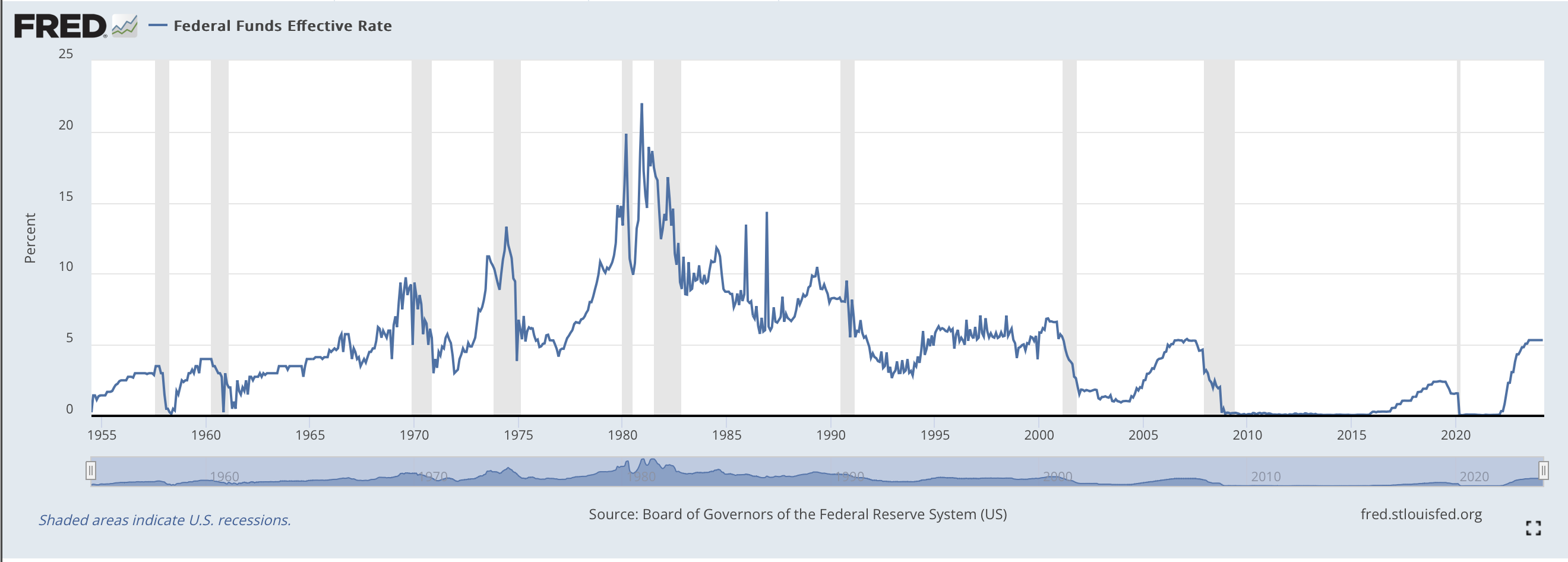
It is the third choice though, cutting rates, that is likely to generate the most fireworks.  Certainly, the initial movement will be a risk asset rally as investors will make the case that a lower discount rate means higher current values as well as invoke the idea that money currently invested in money-market funds will quickly move to stocks as interest rates decline.  At the same time, the front end of the yield curve will see yields decline amid what is likely to be a bull steepening of the curve.  And that’s the problem.  History has shown that when the curve re-steepens after a period of inversion, that is when trouble comes for markets.  As can be seen in the chart below from the St Louis Fed’s FRED database, the correlation between a declining Fed funds rate and a recession is very high (grey shaded areas represent recessions).  

This makes perfect sense as when the economy is heading into, or more likely already in, a recession, the Fed cuts rates to address the issue.  As such, the fervent desire to see rate cuts seems misplaced.  Strong economic activity comes alongside higher interest rates, not rate cuts.  If the Fed is cutting, that means there are problems as remember, whatever they say, they are always reactive, not proactive.  So, while the initial risk asset move may be positive, history has shown that during recessions, the average decline in the equity markets is on the order of 30%. Keep that in mind if you are hoping for the Fed to cut rates.

Ok, let’s tour the markets from overnight to see how things stand ahead of a bunch of data this morning. Japanese stocks suffered overnight, falling -1.5%, as the threat of intervention did little to strengthen the yen but certainly got some investors nervous.  As well, it is Fiscal year end there tonight, so I imagine we are seeing some profit taking given the remarkable run Japanese stocks have had in the past twelve months, rising 44% in yen terms.  The rest of Asia saw more gainers than losers with China, India and Australia all following the US markets higher although South Korea and Taiwan did lag.  In Europe, most bourses are higher this morning, but the gains have been more modest, on the order of 0.3% or so.  And as I write (7:30), US futures are unchanged on the day after yesterday’s gains.

In the bond market, yields are broadly higher with Treasuries (+3bps) reversing yesterday’s decline and similar price action in Europe with all sovereign yields higher by between 3bps and 5bps although Italy (+8bps) is an outlier as their finances are starting to look a bit dicier.  I would be remiss if I didn’t mention that JGB yields have edged down another basis point and are now at 0.70%.  There is no sign that yields are running away here.

Oil prices (+1.6%) continue to climb on the same story of reduced supply and ongoing demand.  Yesterday’s EIA data showed a smaller inventory build than forecast and there is no indication that OPEC+ is going to open the taps anytime soon.  Gold (+0.8%) is continuing its recent rally, following on yesterday’s move, as investors throughout Asia continue to hoard the barbarous relic.  As to the base metals, they are essentially unchanged over the past several sessions, seemingly waiting for the next economic data.

Finally, the dollar is feeling its oats this morning, rallying against every one of its G10 counterparts with this group (AUD -0.6%, NZD -0.6%, SEK -0.6%, NOK -0.6%) leading the way lower.  As well, the EMG bloc is also under pressure led by ZAR (-0.7%) and HUF (-0.6%) although the entire bloc is under pressure.  Of note is CNY (-0.15%) which the PBOC continues to struggle with as they cannot seem to decide if matching yen weakness is more important that maintaining stability.  It seems to me they are really hoping for BOJ intervention to reduce pressure on the renminbi.

On the data front, there is a bunch today starting with Initial (exp 215K) and Continuing (1808K) Claims, as well as the final look at Q4 GDP (3.2%).  As well we get Chicago PMI (46.0) and Michigan Sentiment (76.5) to finish out the morning.  There are no scheduled Fed speakers, but then, all eyes will be on Powell tomorrow.

It seems to me that Governor Waller made it clear that the tone in the Eccles Building is for more patience until they see inflation decline, or perhaps see the employment situation worse substantially.  With that as the backdrop, it is hard to see a good reason to sell dollars.  Keep that in mind for your hedging activities.

Good luck

Adf

The Dollar is King

The Old Lady left rates on hold
But two members changed views when polled
No longer did they
See hikes as the way
The outcome was pounds were then sold

In fact, the most noteworthy thing
Is watching the dollar’s upswing
Against all its foes
Its value has rose
And once more the dollar is king

Finalizing the commentary on central bank activity this week, while the BOE did not adjust its rates, as was universally expected, the excitement came when the votes were tallied up.  As I had mentioned on Monday, at the last meeting, the split was 1/6/2 for a cut, holding steady and a hike respectively.  It remains amazing to me that members of the committee could have viewed the data and come to completely opposite conclusions in the past.  But the big change was that the two members who had been consistently voting for a hike adjusted their view to holding steady with the outcome a single vote for a cut and the rest of the committee voting to keep policy unchanged.  Of course, in the world in which we live today, that was tantamount to a rate cut and seen as quite dovish with the result being the pound underperformed its peers and continues to do so this morning, falling another -0.6%.  The developing narrative here is that a rate cut is coming soon to the UK, certainly by the June meeting, even though inflation remains far above the BOE’s target.  Yes, the inflation readings earlier this week were a bit softer than forecast, but they are still running at 4.5% at the core level.

Arguably, the more amazing thing is that the narrative around the US seems to have subtly shifted despite Powell’s quite dovish tone at the press conference.  I have seen several analyses that indicate expectations are growing for other central banks to ease policy before the Fed.  Perhaps it was the SNB’s bold action yesterday that got people thinking the rest of the world wouldn’t wait for Powell.  Or perhaps, the punditry who push the narrative are finally considering the fact that the US economy continues to be the best performing one around with the least need for further stimulus.  For instance, yesterday’s US data showed softer than expected Unemployment Claims, higher than expected Home Sales with a huge jump in the average price, better than expected Philly Fed and better than expected Flash PMI data.

Whatever the driver, analysts all over are discussing the relative hawkishness of Powell vs. his central bank brethren.  The good news is that we will get to hear from the man himself again this morning at 9:00am so perhaps he will clarify the situation.

FWIW, which is probably not that much, I remain incredulous that the Fed can even consider cutting rates in the near future.  The data are certainly indicating that economic activity remains strong, and we have seen an increase in pricing pressures discussed in a number of the surveys, like yesterday’s Philly Fed and PMI.  As long as unemployment remains quiescent, and we don’t have a major banking catastrophe it is unclear what the motivation behind cutting rates would be on an economic basis.  And consider for a moment that home prices yesterday rose 5.7%, another dagger in the heart of the idea that the shelter component of inflation measures is going to decline.  Let’s see what he says.

Until then, a look at the overnight session shows a mixed picture after yet another record setting day in US equity markets yesterday.  Japan is keeping pace, holding on to its recent gains and drifting higher but Chinese shares had a very tough time, with the Hang Seng (-2.2%) leading the way lower while mainland shares (CSI 300-1.0%) fell as well.  Throughout the rest of the region, the tale was an amalgam of gainers (India, Taiwan, New Zealand) and losers (South Korea, Australia).  In Europe, the UK (+0.8%) is the best of the bunch after posting stronger than expected Retail Sales data, although the Y/Y numbers there are still negative.  But the change was good.  However, on the continent, it is also an amalgam of gainers (Italy, Spain, Germany) and losers (France, Greece) as despite comments from Bundesbank president Nagel that a cut was coming in June, excitement remains lacking.  US futures at this hour (7:30) are essentially unchanged.

The bond market has been a bit more positive with yields sliding across the US (2bps) and all of Europe (between 1bp and 4bps) as investors prepare for the initial move by the ECB.  JGB yields are unchanged as any idea that the BOJ’s recent action was the starting signal for a rush higher in interest rates have been completely quashed.  Perhaps the one area where there is more anticipation is in China, which has seen a very consistent decline in yields for the past year with the 10-year there now sitting at 2.3%, a historic low.  However, despite that, there are many analysts looking for further policy ease by the PBOC and the potential for yields to decline even further.

Oil prices (+0.1%) while essentially unchanged this morning are consolidating losses from the past three sessions which were driven by an increase in chatter about a ceasefire in Gaza.  At the same time, we continue to see net drawdowns of inventories as reported by the EIA which is typically a sign of future strength in the price.  After a great run, gold (-0.6%) and copper (-1.0%) are both under pressure this morning, a situation I attribute entirely to the dollar’s broad strength.

Finally, turning to the dollar, OMG it is ripping higher today.  Versus its G10 counterparts, it is nearly universal with the euro (-0.4%), AUD (-0.8%) and the Scandies (SEK -0.9%, NOK -0.95%) all under pressure.  The only currency not declining is JPY, which is flat on the day but remains at its recent lows (dollar highs) well above 151.50.  in the EMG space, ZAR (-1.15%) is leading the way lower, but the real surprise is CNY (-0.8%) a huge move for a currency with 5% volatility, as it appears the PBOC has stepped away from its efforts to support the currency.  Given the huge rate differential with the dollar, by rights, we would expect USDCNY to be closer to 7.50 than its current level of 7.28, and I expect it will continue to move in that direction.  Watch carefully, especially if/when the PBOC reduces the Reserve Ratio Requirement again in the next several months.

At any rate, you get the idea that the dollar is top of the charts today, ultimately on this renewed narrative of a relatively hawkish Fed versus relatively dovish central banks elsewhere.

There is no hard (or soft) data from the US today, all the new information comes from the speakers, with Powell leading off, and then, Jefferson, Barr and Bostic.  I guess everything will depend on Powell.  Will he try to walk back some of the dovishness that was seen in the press conference or will he double down.  It appears the market expects a less dovish voice.  As such, if he doubles down on the idea rate cuts are coming soon, despite all the data, I would look for the dollar to reverse course.  However, if he tries to but the dove back into its cage, I expect risk assets to be under some pressure and the dollar to hold its gains.

Good luck and good weekend
Adf

Just a Memory

The doves are in flight
Alongside Dollar / Yen. NIRP
Just a memory


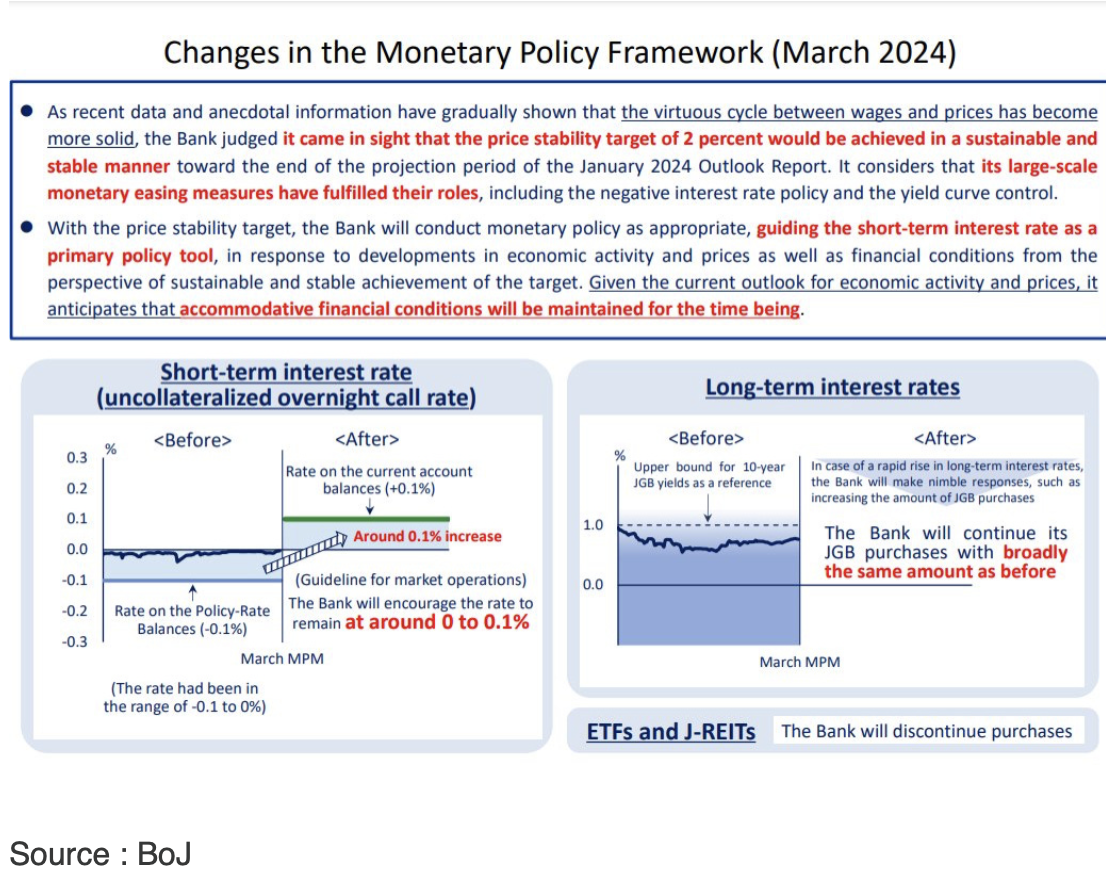
As many had been forecasting, notably the Nikkei News who as I mentioned yesterday have a perfect forecasting record, the BOJ ended NIRP by raising their overnight call rate to a range of 0.00% – 0.10%.  Thus ends one of the longest policy experiments in history.  I continue to believe when future historians look back at this time they will ask, what were they thinking?  At any rate, here is what they offered up to the world:

Summarizing the key changes, there is now a range for the short-term rate, like the Fed’s range, which is a new feature, although they maintain they will seek to keep the rate close to the ceiling.  As well, YCC is gone for good with no targets of any sort.  However, they committed to continuing to purchase JGBs in roughly the current amounts and retain the flexibility to increase that amount at any time as they see fit.  Regarding equities, REITs, and corporate bonds, they have officially declared those programs to be over, although in practice that has been the case for the past several months.

The market response was a classic ‘sell the news’.  The yen has fallen 0.9% and is firmly back above 150 this morning while JGB yields edged lower yet again, down 3bps and trading at 0.73%.  In the press conference, Ueda-san explained, “We judged that achieving the goal of sustainable 2% inflation has come within view. The large-scale monetary easing policy served its purpose.”  However, he was clear that this was not the beginning of a massive tightening of policy a la the Fed or other G10 central banks.  At the same time, PM Kishida said, “[The government] believes it is appropriate that the accommodative financial environment will be maintained from the perspective of taking a new step forward in light of the current situation and further ensuring positive economic developments.”

Summing everything up I would say that while this policy is marginally tighter than previous policy, there is no evidence that the BOJ is hawkish in any sense of the word.  They will still be buying JGBs regularly, ergo monetizing government debt, and they will respond ‘nimbly’ as they see fit if something changes.  My take on the impact is that the yen will be beholden to the Fed now and if the recent more hawkish narrative continues to evolve, look for USDJPY to continue to rise.  JGB yields are likely to drift higher alongside yields elsewhere is the world while the Nikkei has room to run.

It’s time now to turn to the Fed
With pundits now starting to dread
The idea rate cuts
Are now seeming nuts
An idea to which they were wed
 
So, while we know rates will remain
Unchanged, we’ve got dots on the brain
Are three cuts in store?
Or fewer called for?
That outcome is what’s most germane


Interestingly, given how much has been written by analysts and pundits, as well as this poet, already on the topic of the FOMC meeting that starts at 9:00 this morning and culminates in their statement at 2:00pm tomorrow, I feel like all that is necessary here is a recap.

As I type this morning, the Fed funds futures market is now pricing just 72bps of rate cuts for all of 2024 and 139bps of cuts through September of 2025.  While I had started discussing the concept of the dot plot pointing to a median of only two cuts this year several weeks ago, before the quiet period began and we started hearing more hawkish language from several FOMC members, that has become a mainstream discussion now.  In fact, I suspect that is the default setting for most analysts, although the dovish acolytes will still be arguing for at least three cuts.  Perhaps of more interest will be where the longer-term dots are printed.  

Remember, the dot plot shows each members forecasts for the next three years individually as well as the ‘Longer Run’.  In December, the Longer Run had a median of 2.50% and that has been the case for a very long time.  The implication is that the Fed’s broad view of their policy is that the infamous r*, or neutral interest rate, is 2.5% which consists of a 2% inflation target and a 0.5% real interest rate.  However, there has been a significant increase in the discussion amongst the analyst community about how that might change.  If we consider that the nature of the economy post-pandemic, has changed in two key areas, the size of the workforce has shrunk and the efforts at reshoring or nearshoring productive capacity has expanded greatly, both of those things would lead one to expect a higher level of inflation and correspondingly higher interest rates.  So, while a change in the Fed’s target rate is not likely anytime soon, a change in the Fed’s thinking of the appropriate r* is very possible.  

Do not be surprised to see that median rise to 2.75% as members increasingly accept that the current state no longer resembles the previous, pre-pandemic, state.  And that, I believe, is where there is more potential for market reaction than anywhere else.  A rise in the longer run median forecast implies that Treasury yields, and in fact, the entire yield curve, should be permanently higher.  While there has been some discussion of this idea, I would contend that is nowhere near the consensus view, and certainly not the current market narrative.  But that would imply a pretty sharp sell-off in bonds with a corresponding rise in yields.  Initially, I do not believe that would be a net positive for risk assets, although ultimately, I believe equity markets will absorb the news as companies adjust to the change.  But it could get messy during that adjustment.  This is where my eyes will be tomorrow.

Ok, let’s recap the overnight session.  After a solid day in the States yesterday to start the week, the Nikkei (+0.65%) managed to recapture the 40K level amid a weaker yen and the new understanding that policy is not going to ratchet much tighter.  China, on the other hand saw equity weakness in both Hong Kong (-1.25%) and on the mainland (-0.7%) as traders await the news tonight as to whether the PBOC is going to reduce the Loan Prime Rate again as they did last month.  Clearly, there is not much hope right now!  In Europe, markets are mostly a touch higher, but movement is very modest, +/-0.2% basically, as all eyes there are also on the FOMC tomorrow.  As to US futures, they are modestly weaker this morning at this hour (7:30), down -0.4% on average.

In the bond market, Treasury yields are unchanged this morning after having drifted another 2bps higher yesterday.  In Europe, it is a mixed picture with UK Gilt yields sliding 3bps, while the continent is seeing either no movement or a 1bp rise.  The only data of note was German ZEW sentiment which rose significantly, to 31.7, back to its highest level in two years.  We also continue to hear from ECB speakers that they are not yet ready to cut rates and remain data, not Fed, dependent!

Oil (+0.1%) continues to power higher on the back of softer supply data, increased success by Ukraine in attacking Russian refineries and a new situation, Iraq promising to abide by the OPEC+ production cuts.  WTI is firmly above the $80/bbl level and looks like it wants to try for a move toward $90/bbl, at least on a technical basis.  That cannot be helping central bank efforts at reducing inflation.  As to the metals markets, they are softer this morning with gold (-0.2%) still holding up quite well given the dollar’s rebound, and copper (-1.1%) also under pressure today, but also holding the bulk of its recent gains.

Finally, the dollar is in the ascendancy today as not only is the yen under pressure, but too, the Aussie dollar (-0.6%) and its little brother NZD (-0.5%) after the RBA left rates on hold last night, as universally anticipated, but adopted modestly more dovish language in their statement and Governor Bullock was unable to convince the market in her press conference that they could still raise rates if inflation reappeared.  But the dollar is higher vs. essentially all its counterparts, both G10 and EMG, with the CHF (0.0%) the best performer of the bunch.  There is no need to seek other idiosyncratic stories for this move.

As to the data today, Housing Starts (exp 1.425M) and Building Permits (1.495M) are all we’ve got.  Keep an eye on Canadian CPI (exp 3.1%) as that would represent an uptick from last month akin to what we are seeing elsewhere in the G10.  Inflation is not dead my friends.

And that’s really it for today.  It is hard to see the data having a substantive impact and that means that traders will spend the day adjusting their positions to prepare for tomorrow afternoon’s excitement.  I imagine we could see the dollar drift off a bit today given how far it’s come, but nothing of note seems likely.

Good luck

Adf

Annoyed

Seems President Xi is annoyed
His stock market has been devoid
Of buyers, so he
Has banned, by decree
The strategies quant funds employed
 
But otherwise, markets are waiting
To see if inflation’s abating
The PCE print
Will give the next hint
If cuts, Jay will be advocating


Market activity remains on the quiet side of the spectrum as all eyes continue to focus on the Fed, and by extension all central banks.  As an indication, last night the RBNZ left their OCR rate on hold, as widely expected, but sounded less hawkish in their views, dramatically lowering the probability that they may need to hike rates again.  Prior to the meeting, there was a view hikes could be the case, but now, cuts are seen as the next step.  The upshot is the NZD fell -1.2% as all those bets were unwound.  One of the reasons this was so widely watched is there are some who believe that the RBNZ has actually led the cycle, not the Fed, so if hikes remained on the table there, then the Fed may follow suit.  However, at this stage, I would say all eyes are on tomorrow’s PCE print for the strongest clues of how things will evolve.

Before we discuss that, though, it is worth touching on China, where last night “unofficially” the Chinese government began explaining to hedge funds onshore that they could no longer run “Direct Market Access” (DMA) products for external clients.  This means preventing new inflows as well as winding down current portfolios.  In addition, the proprietary books using this strategy were told they could not use any leverage.  (DMA is the process by which non broker-dealers can trade directly with an exchange’s order book, bypassing the membership requirement, and in today’s world of algorithmic trading, cutting out a step in the transaction process, thus speeding things up.)  

Apparently, this was an important part of the volume of activity in China, but also had been identified as a key reason the shares in China have been declining so much lately.  Last night was no exception with the Hang Seng (-1.5%) and CSI 300 (-1.3%) both falling sharply and the small-cap CSI 1000 falling a more impressive -6.8%.  Once again, we need to ask why the CCP is so concerned about the most capitalist thing in China.  But clearly, they are.  I suppose that it has become a pride issue as how can Xi explain to the world how great China is if its stock market is collapsing and investment is flowing out of the country.  This is especially so given the opposite is happening in their greatest rival, the US. 

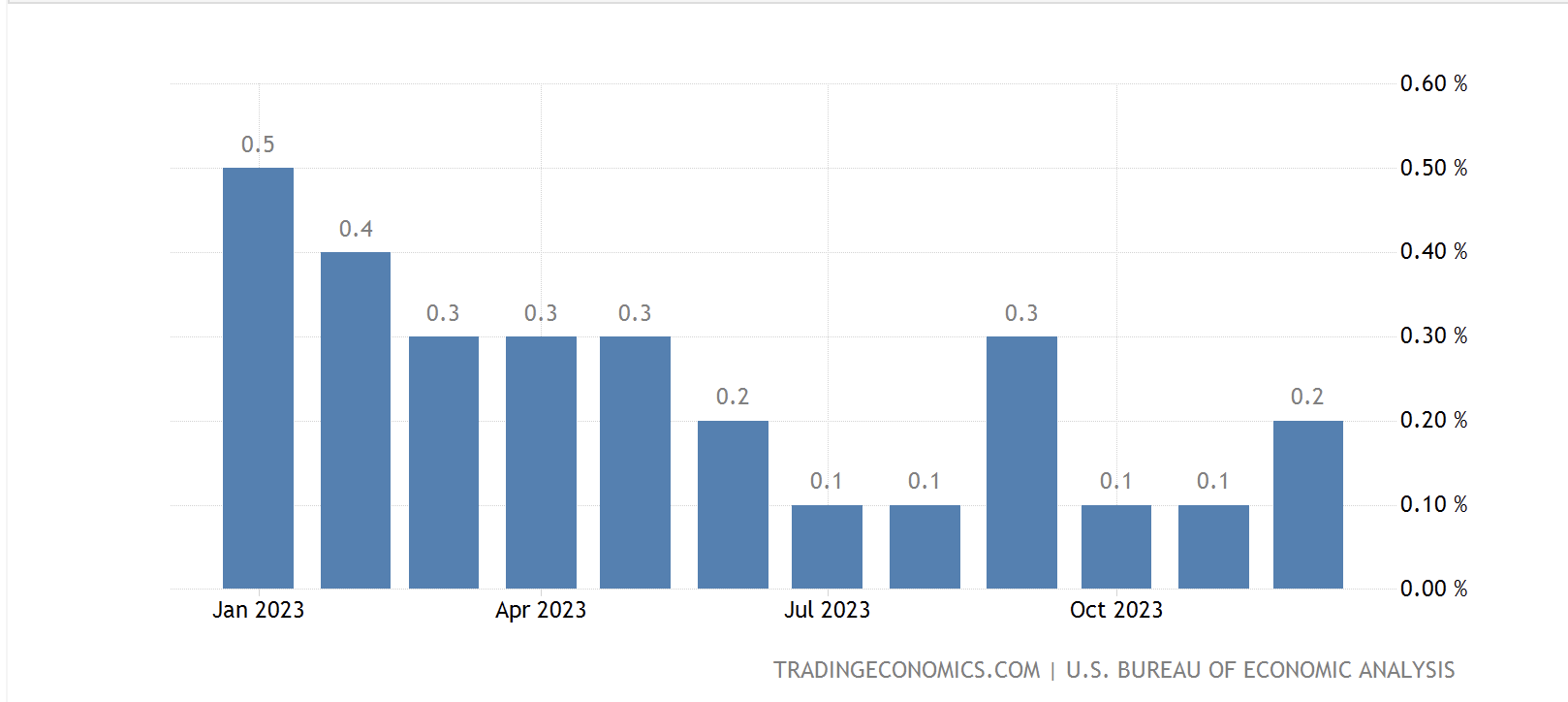
But back to PCE.  It appears that this PCE print has become pivotal to many macroeconomic views.  At least that is the case based on how much discussion surrounds it from both inflation hawks and doves.  As of now, and I don’t suppose it will change, the current consensus view of the M/M Core PCE print is 0.4% with a Y/Y of 2.8%.  As can be seen from the below chart from tradingeconomics.com, this will be the highest print in a year, and it would be easy to conclude that the trend here has turned upwards.

Of greater concern, though, is the idea that just like we saw the CPI data run hotter than expected earlier this month, what if this number prints at 0.5%?  Currently, the inflation doves are making the case that the trend is lower, and that if you look at the last 3 months or 6 months, the Fed has already achieved their target.  Their answer is the Fed should be cutting rates and soon.  For them, a 0.5% print would be much harder to explain and likely force a rethink of their thesis.

On the other side of the coin, the inflation hawks would feel right at home with that type of outcome and continue to point to the idea that the ‘last mile’ on the road back to 2.0% is extremely difficult and may not even be achievable without much tighter policy.  While housing is a much smaller part of the PCE data than the CPI data, remember, CPI saw strength throughout the services sector and that will be reflected.

One thing to consider here is the impact a hot number would have on the Treasury market.  Yields have already backed up from their euphoric lows at the beginning of the month by nearly 50bps.  Given the recent poor performance in Treasury auctions, where it seems buyers are demanding higher yields, if inflation is seen to be rising again, we could see much higher yields with the curve uninverting led by higher 10-year yields.  I’m not saying this is a given, just a risk on which few are focused.  In the end, tomorrow has the chance to be quite interesting and potentially change some longer-term views on the economy and the market’s direction.

But that is tomorrow.  Looking overnight, while Chinese stocks suffered, in Japan, equity markets were largely unchanged.  In Europe this morning, there is more weakness than strength with the FTSE 100 (-0.7%) and Spain’s IBEX (-0.7%) leading the way lower although other markets on the continent have seen far less movement.  As to US futures, at this hour (8:00), they are softer by about -0.3%.

In the bond market this morning, Treasury yields have fallen 2bps, while yield declines in Europe have generally been even smaller, mostly unchanged or just -1bp.  The biggest mover in this space was New Zealand, where their 10-year notes saw yields tumble 9bps after the aforementioned RBNZ meeting.

Oil prices (-0.3%) are giving back some of their gains yesterday, when the market rallied almost 2% on stories that OPEC+ was getting set to extend their production cuts into Q2.  It is very clear that they want to see Brent crude above $80/bbl these days.  In the metals markets, while precious metals are little changed, both copper and aluminum are softer by about -0.5% this morning.  I guess they are not feeling any positive economic vibes.

Finally, the dollar is much firmer this morning against pretty much all its counterparts.  While Kiwi is the laggard, AUD (-0.7%), NOK (-0.7%) and CAD (-0.4%) are all under pressure as well.  The same is true in the EMG bloc with EEMEA currencies really suffering (ZAR -0.5%, HUF -0.7%, CZK -0.4%) although there was weakness in APAC overnight as well (KRW -0.4%, PHP -0.6%).

On the data front, this morning brings the second look at Q4 GDP (exp unchanged at 3.3%), the Goods Trade Balance (-$88.46B) and then the EIA oil inventory data.  We also hear from Bostic, Collins and Williams from the Fed around lunchtime.  Yesterday’s data was generally not a good look for Powell and friends as Durable Goods tanked, even ex-transport, while Home Prices rose even more than expected to 6.1% and Consumer Confidence fell sharply to 106.7, well below the expected 115 reading.  

As we have been observing for a while now, the data continues to demonstrate limited consistency with respect to the economic direction.  Both bulls and bears can find data to support their theses, and I suspect this will continue.  With that in mind, to my eye, there are more things driving inflation higher rather than lower and that means that the Fed seems more likely to stand pat than anything else for quite a while.  Ultimately, I think we will see the ECB and BOE decide to ease policy sooner than the Fed and that will help the dollar.

Good luck

Adf

Turns to Sh*t

The FOMC’s out in force
Explaining the still likely course
Of rates is to stay
Where they are today
Unless there’s some hidden dark horse
 
Investors, though, don’t give a whit
As Spooz seem quite likely to hit
Five thousand quite soon
Then onto the moon
Take care lest this view turns to sh*t


The WSJ led with an interesting article today with the below graphic as the teaser.  This is called a hair chart, for obvious reasons, with those light blue lines describing Fed funds futures curves and comparing them to the subsequent actual Fed funds rate over time.  The article’s point, which is important to understand, is that the futures market tends not to get things right very often.  In other words, just because the market is pricing in 5 or 6 rate cuts today does not mean that is what will occur over time.  In fact, looking at the chart, it almost seems that 5 or 6 cuts is the least likely outcome.  One need only look at the past several years to see that while they were pricing cuts, the Fed was still hiking.

Of course, this fits with my thesis that the Fed funds futures market is actually reflecting a bimodal outcome of either zero cuts or 10.  But regardless of my view, the equity market is all-in on the idea that the Fed is going to be cutting rates soon as evidenced by the fact that the S&P 500 is now trading just a hair below 5000 after yesterday’s 0.8% gain.  

In the meantime, yesterday we heard from four more Fed speakers and to a wo(man) they all said effectively the same thing; progress has been made on the inflation front but they still don’t have confidence that 2% inflation on a sustainable basis has been achieved.  In fact, several mentioned that the recent hot GDP and NFP data indicated more caution is warranted.  By the way, if we look at the Atlanta Fed’s GDPNow forecast, it currently sits at 3.4%, hardly a level of concern, while their Wage Growth Tracker remains at 5.0%.  Again, that is not data that indicates inflation is collapsing.  It remains very difficult for me to expect inflation to fall given the recent totality of the data.  In other words, nothing has changed my view that inflation will remain stickier than currently priced and very likely start to creep higher again, and that will ultimately have a negative impact on risk assets.  But not today!

The other news overnight was that Chinese CPI rose less than expected in January, just 0.3%, which took the annual change to -0.8%.  As China heads into their two-week Lunar New Year holiday, welcoming the Year of the Dragon, the question for investors around the world is, will Xi do anything to halt the decline?  Thus far, his efforts have been weak and insufficient as evidenced by the equity markets in Hong Kong and on the mainland both having fallen sharply over the past year with little net movement this year despite several efforts at support and stimulus.  Now, Xi has nearly two weeks to come up with a new plan to get things going when markets return on February 20th, but for the past several years he has been unwilling to fire a big fiscal bazooka.  Will it be different this time?  Remember, they still have a catastrophic mess in the property market there which will impinge on anything they do.  I expect there will be some more half-hearted measures, but nothing sufficient to turn things around.  Ultimately, while they don’t want to see the renminbi fall sharply, I suspect it may have a bit more weakness in it before things are done, especially if the Fed really does stay higher for longer.

Ok, let’s look at markets elsewhere overnight.  The Nikkei (+2.0%) rallied sharply after comments by a BOJ member indicating that even when rates get back above zero, they will not move very much higher, and it will take time.  This saw the yen weaken further while stocks benefitted.  Meanwhile, the only loser in Asia overnight was India, where investors were disappointed that the RBI left rates on hold rather than cutting them (see a pattern here?).  Otherwise, everything followed the US rally yesterday.  The same is broadly true in Europe with decent gains, about 0.5%, almost everywhere except the UK, which is flat on the day after comments by a BOE official that cuts may not come as soon as hoped.  As to the US, at this hour (7:30) futures are basically unchanged.

In the bond market, after a generally quiet session yesterday, yields are starting to creep higher again with Treasuries +2bps and European sovereign yields rising a similar amount across the board.  Once again, the global bond markets revolve around Treasury yields with the only exception being JGB’s which saw the yield decline 1bp after those BOJ comments.

In the commodity markets, oil (+0.9%) is higher once again with Brent trading back above $80/bbl, as Secretary of State Blinken returned to the US with no real improvement in the Israeli-Hamas war and no prospects for a cease-fire.  Meanwhile, the US was able to kill the Iranian commander who allegedly led the attack on a US base that killed three soldiers, certainly not the type of thing to cool down tensions in the region.  Between the rise in cost of shipping oil from the Mideast to the rest of the world because of the Red Sea situation, and the lack of hope for an end to the fighting, it seems oil may have some legs here.  As to the metals markets, there is a split with both gold and copper under some pressure but aluminum seeing a bid this morning.  Quite frankly, I understand the former two rather than the gains in aluminum, but in the end, none of these metals has moved very much over the past months and remain trendless for now.

Finally, the dollar is starting to assert itself this morning as though the yen (-0.75%) is leading the way lower, pretty much every G10 and EMG currency is weaker vs. the greenback at this time.  Again, I would contend this is all about the ongoing Fed message of caution and confidence regarding inflation’s disposition, and the prospects of higher for longer.  FWIW, the current probability of a March cut is 18.5%.  barring a collapse in the CPI data next week, I expect that to head toward zero over time.

As to the data situation, we only see the weekly Initial (exp 220K) and Continuing (1878K) Claims data first thing and then it is Fedspeak for the rest of the day.  I expect that traders are going to push the S&P 500 over 5000 early this morning, if for no other reason than to say it was done, but what happens after is far less certain.  Earnings data has been generally ok, but some pretty bad misses have had quite negative impacts on individual names.  As to the dollar, the more I hear Fed speakers urge caution in the idea for rate cuts soon, the better its prospects.

Good luck

Adf

Not Quite Mawkish

On Friday, in quite the surprise
Our payrolls did massively rise
At least that’s what printed
But where those jobs minted?
Or will, next month’s data revise?
 
Perhaps Chairman Jay had a sense
And that’s why his press confer-ence
Was ever so hawkish
Although not quite mawkish
So, traders, more buys, did commence


I would contend that nobody was anticipating the NFP data on Friday which printed so much higher than forecasts it was remarkable.  A headline number of 353K with a revision up for December of 116K is huge and certainly puts paid to any thoughts of the economy slowing.  As well, Average Hourly Earnings rose a more than expected 0.6%, certainly good for workers, but another nail in the coffin of a quick rate cut by the Fed.  Of course, none of that seems to matter anymore to equity investors as despite every indication that given the recent data, the Fed will remain higher for longer, stocks rocked higher.  Bonds did not fare quite as well, though, as 10-year yields rocketed 15bps higher by the close.

Another interesting anomaly was in the Fed funds futures market where in the immediate wake of the FOMC meeting, the probability of a March rate cut (which you may recall Powell specifically took off the table) fell to 20% from a coin toss earlier.  But Friday, that closed back at 38%! (PS, this morning it is down to 15.5%, so remains quite volatile.)  Rounding out the asset classes, the dollar followed yields, with the euro falling nearly 1% and other currencies close behind.  As to oil, that slid about $1, but it has been softening all week, so there are obviously other issues there.  What gives?

The first thing to recall is that January data tends to be pretty sloppy.  My good friend, Mike Ashton (aka @inflation_guy) made the point eloquently as follows:

This is not to say that the adjustments WILL be huge, just that over time, that has been the case.  Recall that almost every reading last year was revised lower in subsequent reports.  All I’m saying is that as terrific as that number was, add at least a pinch of salt, I think.

The other thing that doesn’t seem to square is that so many other employment indicators are trending in the opposite direction.  After all, ADP was only 107K, and the employment reading in the ISM fell last month along with the employment readings in many of the regional Fed surveys.  As well, continuing claims have been trending higher for the past several months, generally not a good sign for employment.  Again, all I am trying to highlight is that this number may not be quite as robust as it seems on the surface.  At the same time, for the Fed, if they need an excuse to leave policy at current levels, the combination of strong job growth and rising wages is plenty of ammunition.

Sunday night, Chairman Powell was interviewed on 60 Minutes but really didn’t tell us anything new.  Essentially, I would say he repeated his Wednesday press conference with one exception, he did, when asked, indicate that the current fiscal profligacy would be a problem in the long run.  To date, he has been reluctant to even discuss the issue, so perhaps that is a signal of something, but of what I have no idea.

Moving on from Friday, finally, the weekend saw the Biden administration’s retaliation for the deaths in Jordan of 3 US soldiers, however, that is not a market impactful event.  Coming into the new week, the Services PMI data has been released everywhere and we are awaiting ISM Services this morning in NY.  In aggregate, the data showed that some nations are doing better than others.  In the positive camp, India (61.8 final) was by far the nation with the highest reading, but Japan, China, Spain, Italy and the UK all showed growth above 50.  On the other side of the ledger, Australia, Germany, France and the Eurozone overall remain well below 50, although seem to have found a bottom for now.  As to the US, the current forecast is for a 52.0 print, up from December’s number of 50.6.

Is this really telling us that much?  Remember, the question that is asked in these surveys is, how do things compare this month to last month?  Remember, too, that recent data has shown weakness across the surveys with strength in the hard data.  Friday’s NFP is the perfect encapsulation of that idea.  Perhaps the one thing we can consider is that if today’s ISM is quite strong, it will be enough to completely remove March from the rate cut schedule.  Of course, my question is, if today’s data is strong, why exactly will the Fed feel the need to cut rates at all?  I simply do not understand this baseline assumption that interest rates are “too high”.  In fact, based on the evidence provided by GDP and NFP data, they seem to be just fine.  And, hey, isn’t it better for all of us to earn 5% in our Money Market Fund accounts than 0.0% like we did for years?  In fact, based on the common view that there are several trillion dollars of “excess” savings in the economy, it seems the holders of those savings must be quite happy with rates where they are.

Ok, let’s tour overnight market behavior quickly before we finish up.  In the equity space, Japanese stocks continue to rise with the Nikkei up another 0.5% while Chinese stocks continue to struggle.  While the CSI 300 managed a 0.6% gain, the small-cap CSI 1000 fell 8% as small cap stocks around the world remain unloved.  However, the Chinese government is definitely concerned as rumors of another rescue package are all over the tape.  As to Europe, modest gains are the order of the day, with most markets higher by about 0.25%.  meanwhile, US futures, they are ever so slightly softer at this hour (7:15), down about -0.1%.

Turning to the bond market, apparently everybody is turning away from the bond market!  Yields are higher across the board with Treasuries leading the way, up a further 7bps, but all European sovereign yields higher by between 3bps and 5bps as well.  The story in Asia was even more impressive with JGB’s (+5bps) and Australia (+12bps) all catching up to the Treasury story.  Ultimately, the issue I see is that while growth in the US remains strong, pretty much all of Europe is in recession.  This seems likely to lead to the ECB cutting rates before the Fed as they will have a reason to do so, while as I ask above, what is the Fed’s rationale for a cut?

The higher interest rate story has weighed heavily on commodity prices with oil sliding -0.8% this morning, although it has been falling for a week.  But we see metals prices under pressure as well with gold (-0.6%), copper (-0.4%) and aluminum (-0.6%) all sliding this morning amid the move in yields.

Not surprisingly, the dollar has been a major beneficiary of the higher yield story, following Friday’s sharp rally with a continuation across the board.  The euro is back to 1.0750, a level not seen since mid-November, while USDJPY is back above 148.50 and USDCNY above 7.21.  In fact, the only currency bucking the trend today is KRW (+0.4%) which managed to rally despite any obvious macro catalysts.  Equities fell there alongside Chinese stocks, so it was not investment inflow.  Sometimes, currencies just move, that much we know.

Turning to the data this week, there is much less on the docket than we saw last week with, arguably, today’s Services ISM the most important number.

TodayISM Services52.0
WednesdayTrade Balance-$62.2B
 Consumer Credit$15.0B
ThursdayInitial Claims220K
 Continuing Claims1902K

Source: tradingeconomics.com

However, we do hear from 10 different Fed speakers this week starting with Atlant’s Raphael Bostic and then inundated rhoguhout the week.  But I ask you, will they really stray far from Powell’s message?  Especially after the blowout NFP number?  Higher for longer still lives, and if we continue to get strong data, May will soon start losing its appeal for a rate cut.  This will not help the bond market, that’s for sure, but it will help the dollar.

Good luck

Adf

Led to Dismay

The first thing we saw yesterday
Was ADP led to dismay
But Treasury news
Adjusted some views
And stocks started trading okay
 
However, t’were two things we learned
First NYCB stock was spurned
Now, you may recall
That their greatest haul
Was Signature Bank, which was burned
 
And lastly Chair Powell, at two
Explained what he’s likely to do
They’re not cutting rates
As both their mandates
Remain far ahead in their view
 
Just when you thought it was safe to go back in the water…
 
I am old enough to remember when there was a growing certainty that not only was the Fed virtually guaranteed to cut rates by the May meeting, but the March meeting was very much on the table.  After all, inflation was below their 2.0% target (if you look at the recent 6-month run rate anyway) and therefore they just had to cut rates or stock prices might fall!  Or something like that.  But somehow, Jay and the FOMC missed that memo.  Instead, what they told us was [my emphasis];
 
The Committee seeks to achieve maximum employment and inflation at the rate of 2 percent over the longer run. The Committee judges that the risks to achieving its employment and inflation goals are moving into better balance. The economic outlook is uncertain, and the Committee remains highly attentive to inflation risks.
In support of its goals, the Committee decided to maintain the target range for the federal funds rate at 5-1/4 to 5-1/2 percent. In considering any adjustments to the target range for the federal funds rate, the Committee will carefully assess incoming data, the evolving outlook, and the balance of risks. The Committee does not expect it will be appropriate to reduce the target range until it has gained greater confidence that inflation is moving sustainably toward 2 percent. In addition, the Committee will continue reducing its holdings of Treasury securities and agency debt and agency mortgage-backed securities, as described in its previously announced plans. The Committee is strongly committed to returning inflation to its 2 percent objective.”
 
In other words, while it is highly unlikely that they will need to hike rates further, unlike the markets or the punditry, Powell has little confidence that they have won the inflation battle and rate cuts remain merely a distant prospect.  Certainly, there was no obvious concern that interest rates are “too” high at this time.  In other words, this was a much more hawkish statement, and Powell’s answers in the press conference were in exactly the same vein.  Memories of the dovish December meeting have faded from view.    And this was the denouement to quite a day, one which gave us so much new information.
 
Things started with a weaker than expected ADP Employment result, just 107K, although that data point’s correlation to NFP has been diminishing of late.  Regardless, it was the type of softness that got people primed for a dovish Fed.  Then, the QRA indicated that the Treasury will be issuing what appears to be about $45-$50 billion in new coupons this quarter to fund a $400 billion or $500 billion budget deficit.  The balance of that will be via T-bills which means that while the ratio is not as aggressively leaning toward T-bills as last quarter, it is still miles above the historical rate of 20% ish.  Those two stories got bond bulls hyped, although equity markets struggled on some weak earnings numbers. 
 
And then we heard from New York Community Bank (NYCB), which you may recall, was the lucky recipient of the Signature Bank assets last March.  Well, it turns out they made a hash of things, losing a bunch of money with some pretty bad loan impairments added on to increased capital requirements because they grew to a new, larger risk-weighting tier after the acquisition.  At this time, there is no indication they are about to go bust, but the question has been asked a lot as the stock cratered and investors ran into Treasury debt just to be safe.  As it happens, the stock, which had basically doubled over the past year after buying Signature, has reverted to its pre-acquisition price and that added jitters to everyone’s views.  PS, those loan impairments were CRE based which naturally leads to the question of what is going on with other regional banks.
 
Finally, during the press conference, Chairman Powell was clear that a March rate cut was highly unlikely and that was the final nail in the equity market’s coffin.  So, the NASDAQ led the way lower, falling -2.2% while the S&P 500 tumbled -1.6%.  At the same time, 10-year yields dropped like a stone, down 12bps to 3.91%.
 
Looking ahead, I wonder how all those folks who were certain the Fed HAD to cut because policy was just TOO TIGHT for their liking will reframe their narrative.  To my eye, yesterday’s equity declines are a blip and will not even register at the Eccles Building.  There is a bit of irony in that the doves need now eat so much crow.
 
Ok, on to this morning, where the overnight price action saw another mixed picture in Asia, but this time with Japan (Nikkei -0.75%) sliding while Chinese shares (Hang Seng +0.5%, CSI +0.1%) edging higher.  There was yet another announcement of a bit of further fiscal support from the Chinese government, but Xi remains reluctant to bring out the bazookas.  European shares are also mixed with gains in the UK and Spain and losses in France and Germany.  PMI data showed that the Flash numbers were pretty much spot on and all of Europe remains well below 50.0 except Norway (50.7) which benefits from its oil industry.  It remains very difficult to get excited about the Eurozone’s economic prospects these days which should ultimately weigh on the ECB to cut rates sooner and the euro to suffer in that case.  As to US futures, after a wipeout yesterday, this morning they are firmer by about 0.5% at this hour (6:45).
 
In the bond market, after yesterday’s Treasury yield collapse, 10-year yields are higher by 3bps this morning and European sovereigns have risen about 4bps on average.  This movement is more a response to the large move yesterday rather than a result of new information.  Overnight, JGB yields slipped 4bps, clearly following in the footsteps of Treasury yields. 
 
As to commodities, oil (+1.0%) has bounced after a weak session yesterday that was driven by demand worries.  But tensions in the Middle East seem to be reasserting themselves with several stories in the press this morning regarding the danger to the world from a potential collapse in shipping capabilities.  The ongoing Houthi attacks in the Red Sea are starting to really take their toll on supply chain situations.  This is not only bad for inflation readings but could well impair the ultimate delivery of critical things like oil, thus driving its price even higher.  As to the metals markets, they are all under pressure this morning with gold holding on best given its haven status but all the industrial metals lower by 1% or more.
 
Finally, the dollar is coming up roses this morning.  While in the early going yesterday, before the FOMC meeting, the dollar broadly sold off on the softer ADP and dovish QRA, Powell changed everything, and the dollar reversed course in the middle of the day and rallied back nicely.  This is true against virtually all its G10 and EMG counterparts.  The weakest members are AUD (-0.7%) after weak housing data Down Under added to thoughts of a rate cut coming soon.  As well, we see GBP (-0.4%) just ahead of the BOE meeting where expectations are for a more dovish statement although no policy change.  But we are seeing weakness in CLP (-1.3%) on the back of that weak copper price and weakness in ZAR (-0.4%) on the weak metals complex as well.  Given the hawkish tilt from Powell yesterday, unless there is a concerted effort by the Fed speakers that will be flooding the tape over the coming weeks to reverse that course, I suspect the dollar will benefit in the near-term.
 
On the data front, this morning brings Initial (exp 212K) and Continuing (1840K) Claims, Nonfarm Productivity (2.5%), Unit Labor Costs (1.6%) and ISM Manufacturing (47.0).  With NFP tomorrow, I expect that the productivity and ULC data should be of the most interest as they will play most deeply into the Fed’s thinking.  Improved productivity implies that there is less reason to cut interest rates as the “neutral rate” should be higher than previously thought.  In fact, that dynamic would be very positive for the dollar, and interestingly, for the equity market as well as it would be a clear boost to earnings potential.  We shall see how it turns out.
 
Good luck
Adf


Democracy’s Died

There once was a fellow named Trump
Whose plan was, Joe Biden, to dump
He started last night
By winning the fight
And heads to New Hampshire to stump

Political pundits worldwide
Now claim that democracy’s died
But markets don’t seem
In touch with that theme
Instead, interest rates are their guide

The Iowa caucus results can be no surprise to anyone as the polls were quite clearly in Donald Trump’s favor.  In the end, he won with slightly more than 50% of the vote while Governor DeSantis came second, Ambassador Haley was in third and Vivek Ramaswamy was a weak fourth.  Ramaswamy has now dropped out of the race and thrown his support behind Trump.  Next week, is the New Hampshire primary and then two weeks later is the South Carolina primary.  After that, comes Super Tuesday in early March, and quite frankly, it would be shocking, at this point, if Trump did not wrap up the nomination by then.

I only mention this because of all the elections this year, arguably the US presidential one is the most impactful on the world at large as well as financial markets.  I will remind you of the equity market behavior in 2016 when Trump was elected the first time and as the evening progressed, the initial response was to see equity futures fall sharply as it became clearer that Trump was going to win, but by the time the markets opened in NY, they had completely reversed and rallied quite sharply, several percent.  Ultimately, I would not be surprised to see more market impacts this year as well.  It is one of the reasons that I believe the major theme this year is going to be more volatility across all markets than we have seen in the past several years combined.

However, right now, we are too early in the cycle and there has been no change of views or broad polling results, so investors are going to focus elsewhere, namely central bank actions.  This brings us to the question of will the Fed actually be cutting interest rates six times in 2024, or more accurately, will they be reducing the Fed funds rate by 150bps?  Funnily enough, I think that may be the least likely outcome of the array of possibilities that exist.  Instead, I expect that the futures market is pricing in an almost binary outcome.  On the one hand, the Fed remains true to their comments that inflation remains too high and while some cuts will come, it is very premature, so perhaps only one or two cuts this year.*  On the other hand, the recessionistas are correct, a hard landing is coming and the Fed is going to have to cut by 300bps or 350bps to support the market.  Play with these probabilities and it is pretty easy to come up with a scenario that shows 150bps of cuts this year.

But for now, whatever my views on how the Fed and other central banks are going to behave, the only important thing is what the market is anticipating.  This takes us back to the market’s assumption about the Fed’s reaction function regarding all the data that is coming our way.  Hence, the fact that the market largely ignored what appeared to be a hotter than expected CPI print last week, but jumped all over a softer than expected PPI print is telling in and of itself.  The market is desperate for the Fed to cut rates which will open the doors for all the other central banks to cut rates.

And in truth, I think this is exactly what we should expect for the time being.  The market is all-in on the idea that not only has the peak in inflation been seen, but that it is quickly falling back to the 2% target that is almost universal.  And they are all-in on the idea that central banks will be able to lower rates back to much more comfortable levels for those in debt while supporting risk asset prices.  My take is we will need to see a long series of data that indicates anything other than this scenario before market views change.  So, any data that indicates inflation remains sticky will be ignored, while data that indicates it is falling sharply will be regurgitated constantly.  The same will be true in the employment and production data.  All I’m saying is we need to be prepared to see certain data that doesn’t fit the narrative get completely ignored for now.  Manage your risk accordingly.

As to the overnight session, things have been less optimistic overall with most stock markets in Asia under pressure, even Japan (Nikkei -0.8%) and Hong Kong (-2.2%) really feeling pressure although mainland Chinese shares held in there after word that the Chinese government would be issuing an emergency CNY 1 trillion (~$139 billion) of debt to fund spending domestically.  As to Europe, all red there, albeit only on the order of -0.4% across the board and US futures are also lower this morning, something around -0.25% at this hour (7:45).

In the bond market, after the US holiday prevented any changes of note yesterday, we see Treasury yields backing up 7bps this morning, a similar move to what we saw in Europe yesterday.  Arguably, this seems like a catch-up move.  In fact European sovereign yields are essentially unchanged on the day as German GDP data confirming the recession of 2023 did nothing to change views, nor surprisingly, did slightly better than expected UK employment data where wage growth was seen rising less rapidly than anticipated.  JGB yields remain moribund and the idea that the BOJ is going to change anything seems a more and more distant prospect for now.

Oil prices (+0.6%) are a touch higher amid further threats from the Houthis as well as some missile attacks by Iran on areas in Iraq and Syria.  I cannot keep up with all the different allegations here, but we cannot ignore the fact that things seem to be escalating.  This cannot be a good outcome for oil prices, or perhaps more accurately, seems likely to push them higher.  The higher interest rates are weighing on precious metals with gold and silver both lower, but surprisingly, copper and aluminum are both rallying this morning.

Finally, the dollar is flexing its muscles this morning, higher against all its counterparts in both the G10 and EMG spaces.  AUD, NOK and SEK have all declined by -0.8% or so, leading the way in the G10 space, although -0.6% covers the bulk of the rest of the bloc.  In the EMG space, KRW (-1.25%), PLN (-1.0%) and MXN (-1.0%) are the laggards across an entire bloc that is under pressure.  This is all about the dollar this morning with no idiosyncratic stories to drive things.

On the data front, we only have the Empire State Manufacturing Index (exp -5.0) and we hear from Fed Governor Waller as well at 11:00.  It seems to me that the market has really gone a bit too far in its bullish beliefs and today is a bit of a correction.  Unless we start to see a lot more push back regarding policy ease though, I expect this movement will be short-lived.  Although ultimately, I believe that we will see a weaker economy, higher inflation and weaker asset prices, I do not think that is the near-term view.  Rather, I expect we will see more dip buying for risk assets by tomorrow at the latest.

Good luck
Adf

*I am well aware that the recent dot plot indicated a median expectation of 75bps of rate cuts this year, but do not forget that the dispersion of that grouping was quite wide, with one assuming no cuts and several assuming just one or two.  I feel it is very weak thinking to say the Fed has indicated three rate cuts this year, they have done no such thing!

Quite Frail

While everyone’s waiting to see
How high or low payrolls might be
The news from elsewhere
Is starting to wear
Quite thin, look at China’s Zhongzhi
 
This bankruptcy sounds the alarm
That others there might come to harm
The soft-landing tale
Which still is quite frail
Has started to lose its quaint charm

Before we start on the payroll report, I think it is important to mention a significant issue that was revealed last night in China, where Zhongzhi, one of the largest non-bank financial and investment companies on the mainland, filed for bankruptcy and liquidation.  It has been missing both interest and principal payments for the past several months and it simply became too great a problem to ignore any longer.  The data released indicates that the company had ~$31 billion more in liabilities than assets and has become one of the largest bankruptcies in China’s history.  

The company was a major player in the property market there, although its main business was high yielding investment products, essentially structured notes, where much of the property backed collateral has fallen dramatically in value and where cash flows that had underpinned the notes have now ceased amid the property collapse.  This is hardly an advertisement for the Chinese economy and another sign that things there remain in a downtrend.  While the renminbi is marginally firmer this morning, up 0.2%, that is a consequence of the PBOC establishing the CFETS fixing at a much stronger than expected level in their effort to prevent substantial weakness in the currency.  

The upshot is that the Chinese economy remains in difficult straits, and the government’s reluctance to increase fiscal support is being felt everywhere.  (On the other hand, the PBOC has added $600 billion in liquidity to the economy in the past week.)  Ongoing weakness in Europe is another problem for Chinese exporters and the ongoing disagreements and tariff wars with the US simply add additional pressure to President Xi.  Next Saturday the first big election of 2024 will be held, in Taiwan, and if the incumbent party retains control, currently the betting favorite, Xi may find himself with quite a few problems to address this year.  A weak economy, rising geopolitical tensions globally and a rejection of his entreaties to the people of Taiwan is a bad look for a megalomaniacal dictator like Xi.  Just sayin’.

OK, let’s turn to this morning’s big story, the NFP report.  Here are the analyst consensus estimates according to tradingeconomics.com:

Nonfarm Payrolls170K
Private Payrolls130K
Manufacturing Payrolls5K
Unemployment Rate3.8%
Average Hourly Earnings0.3% (3.9% Y/Y)
Average Weekly Hours34.4
Participation Rate62.7%
ISM Services 52.6
Factory Orders2.1%

Now, yesterday we saw two other pieces of employment data, the ADP (164K and much higher than expected) and Initial Claims (202K and much lower than expected).  These numbers have many in the market looking for a strong print although the correlation between ADP and NFP has been underwhelming for quite a while.  While we can discuss the merits of the estimates and the overall strength of the economy, I think we are better served, this morning, to focus on the potential impacts of a given number and how that has been evolving so far this week/year.

This morning, the 10-year yield is up to 4.04%, some 25bps above the lows touched post-Christmas, and starting to indicate that some people are having second thoughts on the idea of the Fed aggressively cutting rates this year.  As an example, while I never believed there to be a chance of a rate cut at the end of January, the market was pricing a 17.5% chance of that just a week ago.  This morning the probability is down to 4.7%.  As well, just last week the market was pricing in 6 rate cuts in 2024.  That is now down to 5 cuts and fading. One of the big stories around this morning is that someone has put on a very large option position expiring later today that the 10-year yield will be above 4.15%.  To profit, this trade will require one of the largest yield moves seen in months.

The point is that the nirvana belief set that had been driving markets since the beginning of November is clearly under a significant amount of pressure here.  After all, the NASDAQ has had 5 consecutive negative closes, bond yields, as mentioned, have rallied sharply and are breaking through short-term technical resistance, the dollar is rallying, and the bulls are feeling quite unloved.

Is this the end of the bull story?  Frankly I don’t believe that is the case.  However, risk assets got a bit overexuberant during November and December and have come a long way in a short time.  It is not surprising to see a retracement of prices to help unwind some of the froth.  Ultimately, I believe the question that matters in the medium and long term is the state of the economy and whether the recent growth trajectory will continue, or if we have peaked for now.

One of the things that has me concerned in the medium term is the fact that the government continues to run a massive fiscal deficit despite what appears to be a reasonably strong economy.  Recall, Keynes instructed governments to spend during recession, but tighten their belts during good times.  However, the new mantra is far more in line with Modern Monetary Theory, which is spend as much as you can at all times.  

A quick thought experiment regarding the underlying economy might look like this: GDP = $27 trillion, Federal spending = $10 trillion, Federal deficit = $1.7 trillion.  What if the government didn’t run a deficit, but was neutral?  Removing that much stimulus from the economy would have a significant negative impact on the US economy’s growth trajectory, which is the reason no politician wants to do that.  But the question at hand is how healthy is the economy on its own?  And are growth prospects there really that substantial?  One of the keys to the recent employment picture is that government jobs continue to grow rapidly (look at the gap between NFP and private payrolls).  As long as the US government can continue to borrow money cheaply to fund its profligate ways, it is completely realistic to expect the economy to continue to grow.  However, the reason the bond market story is so important is that the bond market is the place where it will become clear if this is possible.  If Treasury yields continue their recent climb, the pressure on the economy will increase, and the pressure from the government on the Fed to support the bond market will increase.  Forget ending QT.  If the Fed were to find itself in a place where they needed to restart QE to support the bond market, that would be an incredibly important signal that inflation was going to accelerate again, and likely commodity prices would follow.  That would also be a very negative sign for the dollar.  So, lower bonds, lower dollar, higher commodities and likely a nominal rise in equities, at least initially.  My point is there is much about which we need be concerned and wary.

In the quickest of recaps possible, equities around the world have mostly been under pressure with only Japan managing to rally but weakness in China and across all of Europe.  The same is true with US futures, all in the red this morning by about -0.3%.

Bond yields are also rising around the world (except in Japan) with gains on the order of 6bps-8bps across the continent, similar to what we saw in Australia overnight. 

Oil prices are rebounding this morning, up 1.3%, despite much larger than expected inventory builds shown in yesterday’s IEA data, but the metals markets are continuing under pressure for now with the base metals weak and gold edging lower.

And finally, the dollar is continuing its rebound led by USDJPY, where the yen is down a further 0.4% and back above 145 for the first time since early December.  In the G10 space, I would say the movement has been about -0.3% overall, but in the EMG space, things are a bit more active with average declines here of about -0.7% across the three main geographic blocs.

That’s really it.  Now we just wait for the payroll report and later this morning the ISM Services number, and then we get to hear from Tom Barkin again, but it would be shocking if his view changed from just two days ago.  For some reason, I have a feeling the payroll data will fall short this morning, but that’s just a feeling.

Good luck and good weekend

Adf

Dragged Through the Mud

The year started out with a thud
As equity markets saw blood
The bond market fell
And oil’s death knell
Was sounded, whilst dragged through the mud
 
The question we now must address
Is, are markets set to regress?
Or, is this a blip
O’er which we can skip
Without adding too much new stress?


Has the narrative already changed?  That seems to be the question we really need to ask after just one day of trading in 2024.  It seems hard to believe that the macroeconomic fundamentals have changed very much, especially since we have not gotten any substantial data yet.  While ISM Manufacturing (exp 47.1) and JOLTS Job Openings (8.85M) are due later this morning, it beggar’s belief that the market is anticipating much there.  Sure, we get the payroll report on Friday, but given the goldilocks, soft-landing scenario had seemed to be the prevailing theory, have we actually seen anything that would change that view?

Of course, it is possible that market participants are fearful that the FOMC Minutes, which are released at 2:00 this afternoon are not going to reconfirm their broadly dovish views.  You may recall that at the December FOMC meeting, Chairman Powell did nothing to disabuse the markets of the idea that the Fed had not only finished tightening, but that it was getting set to ease.  From that point, the Fed funds futures market has priced in a total of six rate cuts for 2024, twice the number the median dot plot numbers showed and a pretty dramatic easing, especially if the economy does not fall into recession.

There is, of course, another possible rationale for yesterday’s weak start in risk assets; they were wildly overbought.  Since that Fed meeting in the middle of December, stocks had rallied sharply (S&P 500 +3.4% at its peak), 10-year yields fell 40bps at their trough and the dollar, as measured by the DXY, had fallen more than 2%.  The peak (trough) was seen immediately after Christmas, and we have been drifting back since then.  In fact, I think it is fair to say that markets got a bit exuberant in the wake of the FOMC meeting.

But as we get back to fully staffed trading desks and investment managers are back from their holiday breaks, I suspect that price action is going to moderate a bit while volumes improve.   As I tried to make clear yesterday, I believe that the recent uptrend in risk assets will continue broadly until we see enough data to change opinions.  There remains a pretty large group of analysts who are in the “inflation is going to 1%” camp and that will allow (force?) the Fed to cut rates more aggressively to prevent real interest rates from becoming too restrictive.  As that is a pleasing narrative, and one that the current administration would really like to see evolve, I expect that we will hear a lot about that for a while.  And maybe that is what will come to pass.

However, my suspicions and fears are that 2024 will be less idyllic than those goldilocks scenarios that are being painted by the soft-landing crowd.  I find it difficult to believe that amongst all the potential big picture problems, including escalation of the Middle East war, the Ukraine war, China’s recent threats about reunification of Taiwan, and the more than 40 elections that are due this year, culminating in the US election, there won’t be at least a few major hiccups.  In fact, the ongoing unhappiness in the US electorate is likely to be one of the biggest issues driving what I believe will be risk aversion before the year ends.  But that has not yet manifested itself, so we are likely to have interesting times ahead.

In the meantime, let’s look at the overnight price action.  After the weak US equity performance, APAC markets mostly fell, with only Japan (Nikkei -0.2%) really holding in well.  European bourses this morning are all lower, on the order of -1.0%, with the CAC (-1.5%) really suffering and US futures all in the red, led by the NASDAQ (-0.7%) although the others are down about -0.35% at this hour (7:45).  Clearly, there has been no joy yet.

As to the bond market, this morning has seen Treasury yields back up a further 4bps and they are now at 3.97%, well off the lows seen post-Christmas.  European bond markets have seen less aggressive rebounds in yields as the economic picture on the continent remains more dire than here in the US.  Arguably, the ECB has a much tougher job than the Fed right now as the inflation data in Europe remains higher than in the US while economic activity is clearly slowing much more rapidly.  (I guess if they had pumped as much fiscal stimulus into their economy as we did into ours, they wouldn’t be in this situation.  Of course, the debt situation might be worse…). Ultimately, however, I expect that the lack of growth is going to dominate the mindset in Europe and that Madame Lagarde will be cutting rates as soon as she can.  One last thing, Japan.  Remember all the stories in December about how the BOJ was getting set to normalize policy (i.e., return rates to positive territory) and that Japanese investors would be repatriating money soon?  Well, this morning 10-year JGB yields are at 0.60%, far below the 1.00% former YCC cap and the new reference rate and showing no signs of doing anything unusual.  

Turning to the oil market, while it is rebounding this morning, +0.8%, it has been under significant pressure lately despite what appears to be a serious increase in the military posture in the Red Sea amid Houthi rebel attacks on ships and the US Navy responding more aggressively.  In fact, Maersk, the largest shipping company in the world, has once again indicated it will not transit the Red Sea, an outcome that can only negatively impact the cost basis for shipping, and ultimately push upwards on inflation.  This is an area where we need to keep a close eye for new developments.  However, this morning the metals markets are under pressure as gold (-0.65%) is giving up some of its recent gains, although remains well above the $2000 level.  But we are seeing weakness in the base metals as well, with both copper and aluminum under pressure this morning.

Perhaps a key driver of the metals markets has been the fact that the dollar has continued its rebound with the DXY higher by 0.3% this morning, having rallied 1.5% from its recent post-Christmas nadir.  This has been a broad-based dollar rally with gains against both G10 and EMG currencies as it seems to be a dollar story.  The best I can figure is that there is concern/anticipation that the Minutes are going to sound more hawkish than people remember the meeting and press conference.

On the data front, we see the following:

TodayISM Manufacturing47.1
 ISM Prices Paid47.5
 ISM Employment 46.1
 JOLTS Jobs Openings8.85M
ThursdayADP Employment115K
 Initial Claims216K
 Continuing Claims1883K
FridayNonfarm Payrolls168K
 Private Payrolls130K
 Manufacturing Payrolls5K
 Unemployment Rate3.8%
 Average Hourly Earnings 0.3% (3.9% Y/Y)
 Average Weekly Hours34.4
 Participation Rate62.7%
 ISM Serv ices52.6
 Factory Orders2.1%

Source: Tradingeconomics.com

Interestingly, only Richmond’s Thomas Barkin is scheduled to speak this week, first this morning and then on Friday afternoon as well.  

Absent a new escalation in the Middle East, though, I would look for a little more profit-taking ahead of the payroll data.  However, I continue to believe the market is going to push for the bullish framework for a few months at least which means equities will rally, yields will slide, and the dollar will fall as well.

Good luck

Adf