Not Quite Yet Dead

Inflation is not quite yet dead
And that has some thinking the Fed
May now have concern
That there’ll be no turn
And possibly more hikes instead

Last week, though, more Fedspeak, we heard
And three speakers’ comments sent word
That higher long rates
Have altered the fates
Now they think hikes could be deferred

Before I touch on the markets, I must acknowledge the heinous acts that occurred last weekend in Israel.  It is abundantly clear that this will not be ending soon, and it seems likely that it may ultimately have an impact on financial markets.  However, this commentary revolves around how global markets move, what new catalysts are driving things and how we might consider all the information when trying to determine the best way to hedge outstanding FX exposures.

So, before we talk about the overnight session, let’s quickly recap my week away.  Inflation, in both the guise of PPI and CPI, was a bit hotter than expected which has put a crimp in the Paul Krugman ‘inflation battle is won’ narrative.  I am constantly amazed at the disingenuity of analysts explaining that if you ignore food, energy, rent, used cars and any other thing that rose, then inflation is back at the Fed’s target.  It is not clear to me if they don’t eat, use energy, or pay for living expenses, but that is simply ridiculous.  The consumer confidence data makes clear that folks are extremely unhappy with the current economic situation and too high inflation remains the primary cause.  Regardless of the data points, people are feeling it when they buy gas and groceries, or if they go out for dinner, let alone buying other stuff.  

I have maintained this is not going to end soon and that 3.5% – 4.0% is going to be the new normal inflation rate.  While Daly, Logan and Jefferson all explained that the steepening of the yield curve with long end rates rising more rapidly than short end rates was helping the Fed’s cause, not one of them indicated they were even thinking about thinking about cutting rates.  In fact, my money is on at least one more hike, probably in December at this point, and I cannot rule out further hikes in 2024.  And folks, higher rates are going to wind up breaking more things.  Do not believe the soft-landing narrative, things are going to get worse, almost certainly.  Arguably, that sums up last week.

Turning to the overnight session, there was limited new news in the way of data or commentary.  Market participants continue to focus on central banks and any potential adjustments in their policies, economic data and clues as to whether the long-anticipated recession is finally coming, and the trajectory of inflation and whether the price of oil is going to have a longer-term impact on that trajectory.

Regarding the first of these issues, in addition to the above-mentioned Fedspeak, the market is anxiously awaiting Chairman Powell’s comments to be made Thursday afternoon just before the Fed’s quiet period begins.  While we will hear from ten other Fed speakers over sixteen different venues (!), the reality is that Powell’s words are the most important.  However, given the seeming unanimity in the new message about the long end of the curve helping the Fed, I suspect that Powell will touch on that subject as well.  To my mind, this is not an indication they are unhappy with the bond market selloff, rather that they are quite comfortable and will not do anything to stop it.  That could well give the bond market vigilantes a signal to sell even more aggressively so be prepared.

Last night we did hear from Kanda-san of the MOF who explained that rate hikes are one option when excessive forex moves are seen.  Now, that seems a bit of a surprise in that the BOJ is ostensibly the one controlling interest rates, but this shows that the concept of central bank independence is quite tenuous in Japan, and probably in most places.  You may recall a few weeks ago when USDJPY touched 150 and immediately reversed and fell 2% in mysterious fashion as no intervention was confirmed.  Do not be surprised if we see similar price action at various levels higher in the dollar, although helpfully, there was a comment that the fundamentals (meaning interest rate differentials) were responsible for much of the movement in FX.  Nothing has changed my view that USDJPY has higher to go.

On the economic data front, obviously last week’s inflation data had an impact with Treasury yields shaking off their safe-haven bid due to the Israeli-Palastinian conflict and rising again this morning.  While they are not yet back at the highest levels seen two weeks ago, I expect we will get back there and move higher still going forward.  This week’s Retail Sales data (exp 0.3%, 0.2% ex autos) is the big print and recall, it has been running hotter than expected for a while now.  Understand that Retail Sales counts the dollars spent, not the items bought, so rising inflation will drive this number higher even if things aren’t improving.  But for now, there is scant evidence that the economy is slowing rapidly, at least based on the headline data we have been seeing for the past months.

Finally, the inflation story is part and parcel of all the discussions.  Oil’s rise on the back of the Israeli-Palestinian conflict has been pronounced and this morning it remains some 7% higher than before things started there.  There is a growing concern that if the conflict widens, OPEC could consider an embargo of some sort, just like in 1973 in the wake of the Yom Kippur War, which would likely drive oil prices much higher, at least to $150/bbl.  Obviously, that would have a dramatic impact on financial markets as well as on our everyday lives.  It would also have a dramatic impact on inflationary readings.  But the other concern is that despite some of the more Pollyanna-ish narratives about the Fed has already achieved its goals, the reality appears to be that core inflation is simply not falling any further and ultimately, this is going to weigh on equity multiples and earnings as well as further on bond prices.  I would contend that inflation remains the primary issue for the foreseeable future.

With all this in mind, a quick look at the overnight session shows that after a mixed session in the US on Friday, Asian equity markets were all lower by at least -1.0%.  European bourses, however, have managed to eke out very modest gains, on the order of 0.2% and US futures are currently (7:30) higher by about 0.25%.

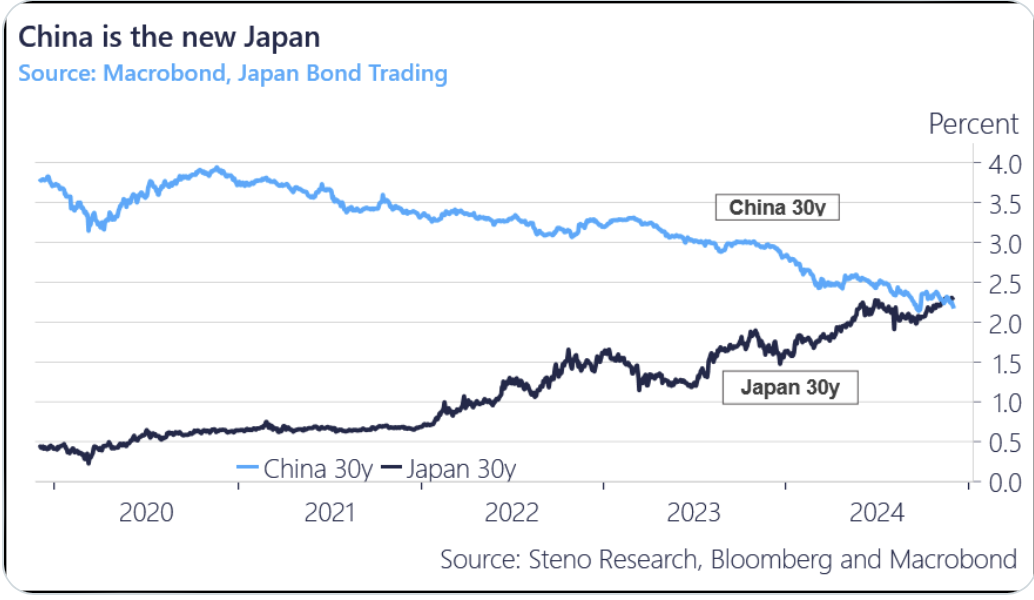
Meanwhile, Treasury yields are higher by 9bps this morning and we are seeing yields on European sovereigns all higher by between 4bps and 5bps.  Clearly inflation concerns are rampant, as are concerns over continuing increases in supply as every major nation runs a growing budget deficit.  Of course, the exception to this rule is Japan, where yields are unchanged on the day and currently sitting at 0.75%, their high point for the past decade, although still well below the current YCC cap of 1.00%.

Turning to commodities, with oil quiet this morning focus is turning to the metals markets where gold (-0.8%) is retracing some of last week’s 5.0% rally as the combination of rising inflation and fear seems to have underpinned the barbarous relic.  As to base metals, they are mixed this morning with copper a touch higher and aluminum a touch lower, a perfect metaphor for the confusion on the economic situation.

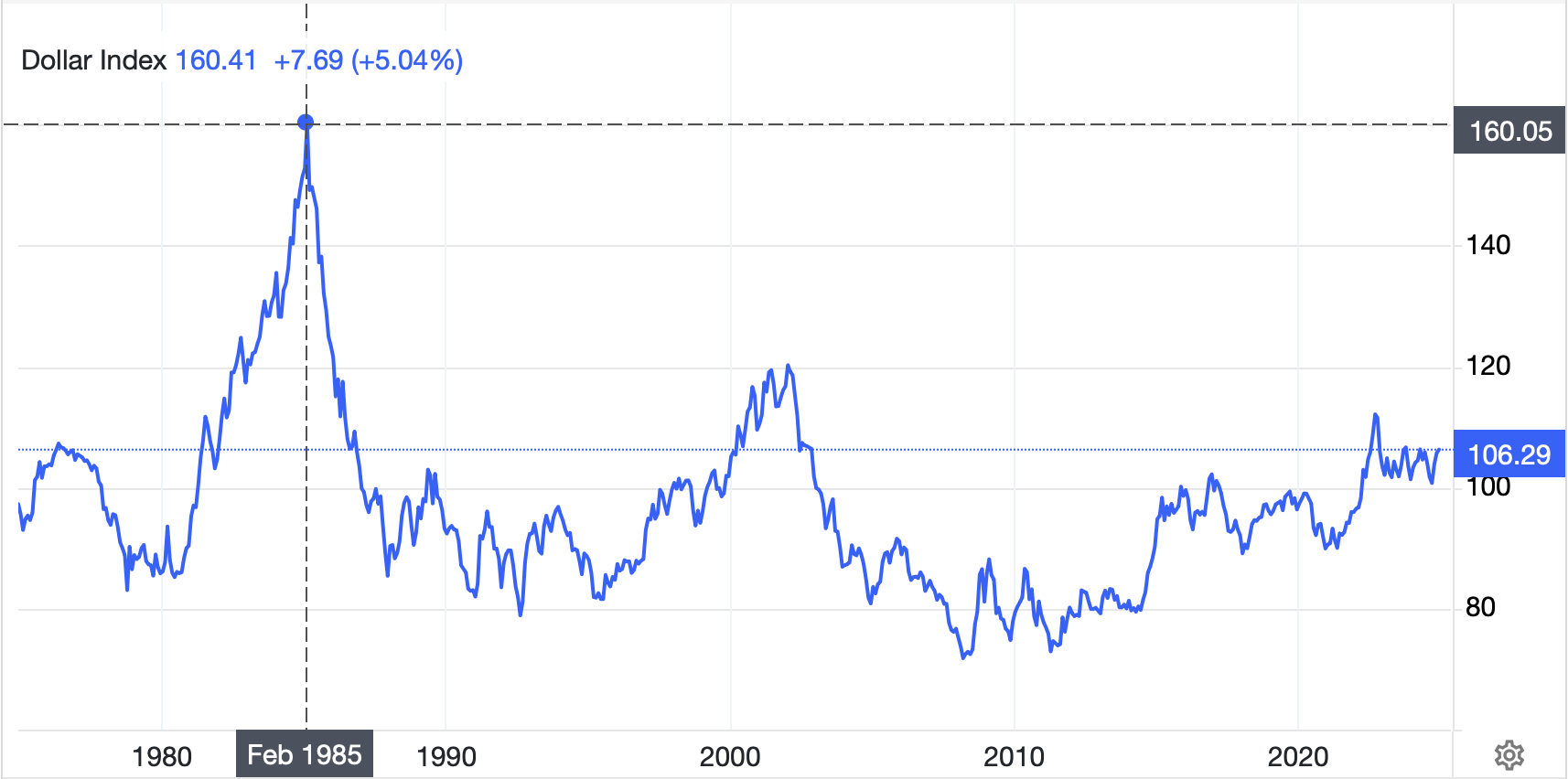
Finally, the dollar is clearly not dead yet.  While this morning it is consolidating last week’s gains and has edged lower about 0.15%, last week saw gains in excess of 1% vs. most major counterparts.  The dollar, despite all the problems in the US, continues to be the haven of choice for most investors.

On the data front, aside from Retail Sales and the remarkable amount of Fedspeak, we see the following:

TodayEmpire Manufacturing-7
TuesdayRetail Sales0.3%
 -ex autos0.2%
 IP0.0%
 Capacity Utilization79.6%
WednesdayHousing Starts1.38M
 Building Permits1.455M
ThursdayInitial Claims213K
 Continuing Claims1707K
 Philly Fed11.1
 Existing Home Sales3.89M

Source: TradingEconomics.com

For my money, barring something surprising from the Middle East, like an OPEC move, I expect that the market will be entirely focused on Powell’s speech Thursday at noon.  We are also at the beginning of earnings season, so we could get some surprises there.  However, the big picture remains sticky inflation, massive new supply of Treasuries and higher yields along with a higher dollar overall.

Good luck

Adf

Quickly Slowing

We will take action
Threatened Vice FinMin Kanda
If you speculate

If these moves continue, the government will deal with them appropriately without ruling out any options.”  So said Vice FinMin Masato Kanda, the current Mr Yen.  Based on these comments, one might conclude that ‘evil’ speculators were taking over the FX market and distorting the true value of the yen.  One would be wrong.  The below chart shows the yields for 10yr JGBs vs 10yr Treasuries.  You may be able to see that the most recent readings show a widening in that yield spread in the Treasury’s favor.  It cannot be a surprise that investors continue to seek the highest return and the yen most certainly does not offer that opportunity.

While I don’t doubt there is a place where the BOJ/MOF will intervene, they know full well that the yen’s weakness is a policy choice, not a speculative outcome.  They simply don’t want to admit it.  The upshot is that the yen edged a bit higher overnight, just 0.2%, as market realities are simply too much for words to overcome.  The yen has further to fall unless/until the BOJ changes its monetary policy and ends YCC while allowing yields in Japan to rise.  Until then, nothing they can say will prevent this move.

While ECB hawks keep on screeching
More rate hikes are not overreaching
The data keeps showing
That growth’s quickly slowing
So, comments from Knot are just preaching

I continue to think that hitting our inflation target of 2% at the end of 2025 is the bare minimum we have to deliver.  I would clearly be uncomfortable with any development that would shift that deadline even further out.  And I wouldn’t mind so much if it shifted forward a little bit.”   These are the words of Dutch central bank chief and ECB Governing Council member Klaas Knot.  As well, he intimated that the market might be underestimating the chance of a rate hike next week, which at the current time is showing a 33% probability. Another hawk, Slovak central bank chief Peter Kazimir also called for “one more step” next week on rates.  

The thing about these comments is they came in the wake of a German Factory Orders number that was the second worst of all time, -11.7%, which was only superseded by the Covid period in March 2020.  Otherwise, back to 1989, Factory Orders have never fallen so quickly in a month.  This is hardly indicative of an economy that is going to grow anytime soon.  Rather, it is indicative of an economy that has inflicted extraordinary harm to itself through terrible energy policies which have forced producers to leave the country.  

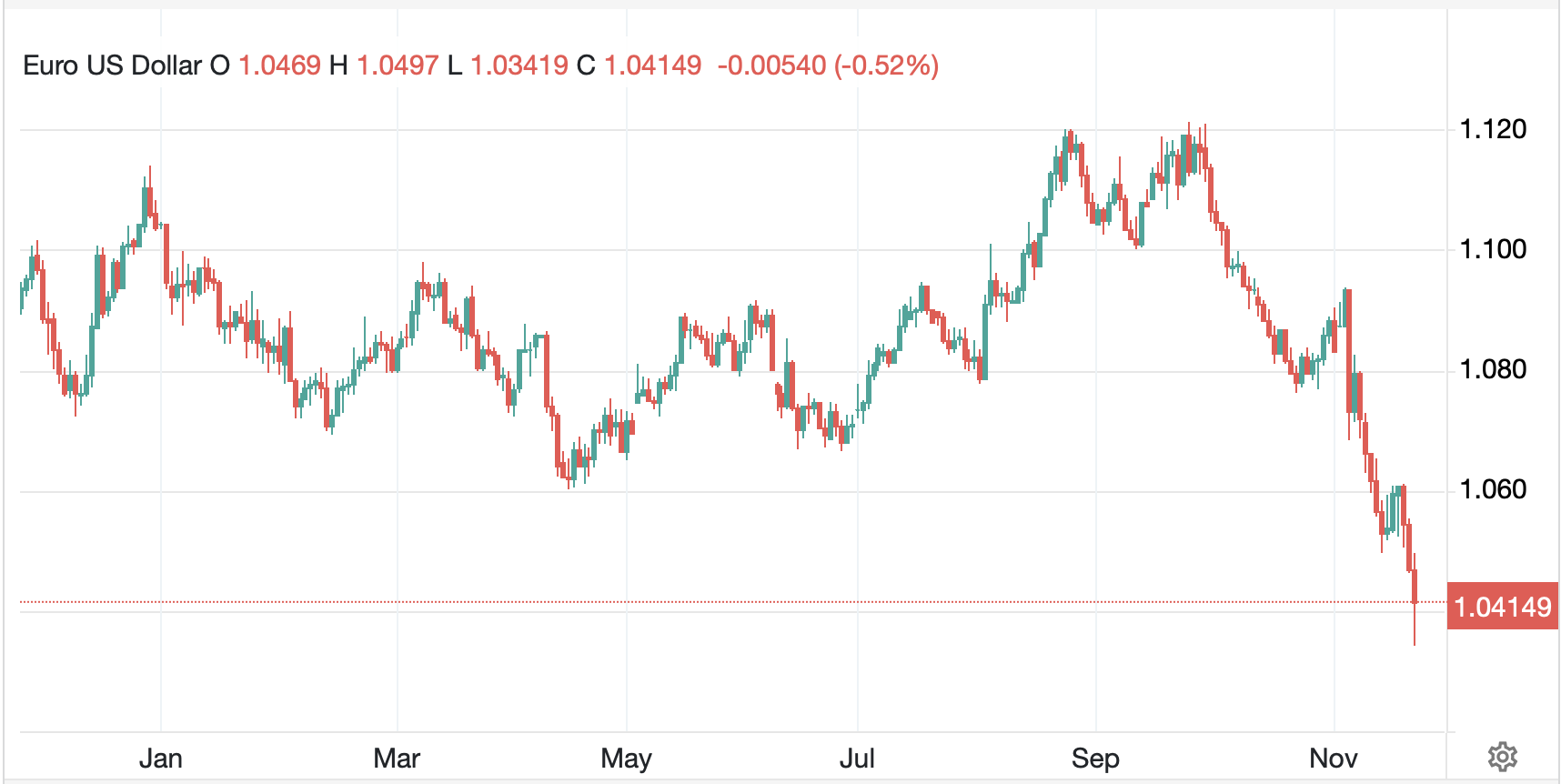
The key unknown is whether the slowing economic growth will also slow price growth.  Given oil’s continued recent strength, with no reason to think that process is going to change given the supply restrictions we have seen from the Saudis and Russia, I fear that Germany is setting up for a very long, cold winter in both meteorological and economic terms.  With the largest economy in the Eurozone set to decline further, it is very difficult to be excited at the prospect of a stronger euro at any point in time.  It feels to me like the late summer downtrend in the single currency has much further to go.  

This is especially true if the US economy is actually as resilient in Q3 as some economists are starting to say.  Yesterday, I mentioned the Atlanta Fed GDPNow number at 5.6%, but we are seeing mainstream economists start to raise their Q3 forecasts substantially at this point given the strength that was seen in July and August.  Not only will this weigh on the single currency, and support the dollar overall, but it may also put a crimp in the view that the Fed is done hiking rates.  Consider, if GDP in Q3 is 3.5% even, it will not encourage the Fed that inflation is going to slow naturally.  And while they may pause again this month, it seems highly likely they would hike again in November with that type of data.

Which takes us to the markets’ collective response to all this news.  Risk is definitely under some pressure as the combination of stickier inflation and slowing growth around the world is weighing on investors’ minds.  The only market to manage a gain overnight was the Nikkei (+0.6%) which continues to benefit from the weaker yen, ironically.  But China, which is also growing increasingly concerned over the renminbi’s slide, remains under pressure as do all the European bourses and US futures.  Good news is hard to find right now.

Meanwhile, bond investors are in a tough spot.  High inflation continues to weigh on prices, but softening growth, everywhere but in the US it seems, implies that yields should be softening with bond buyers more evident.  This morning, 10yr Treasury yields are lower by 2bp, but that is after rallying 16bps in the past 3 sessions, so it looks like a trading pullback, not a fundamental discussion.  But in Europe, sovereign yields are edging higher as concern grows the ECB will not be able to rein in inflation successfully.  As to JGB yields, they seem to have found a new home around 0.65%, certainly not high enough to encourage yen buying.

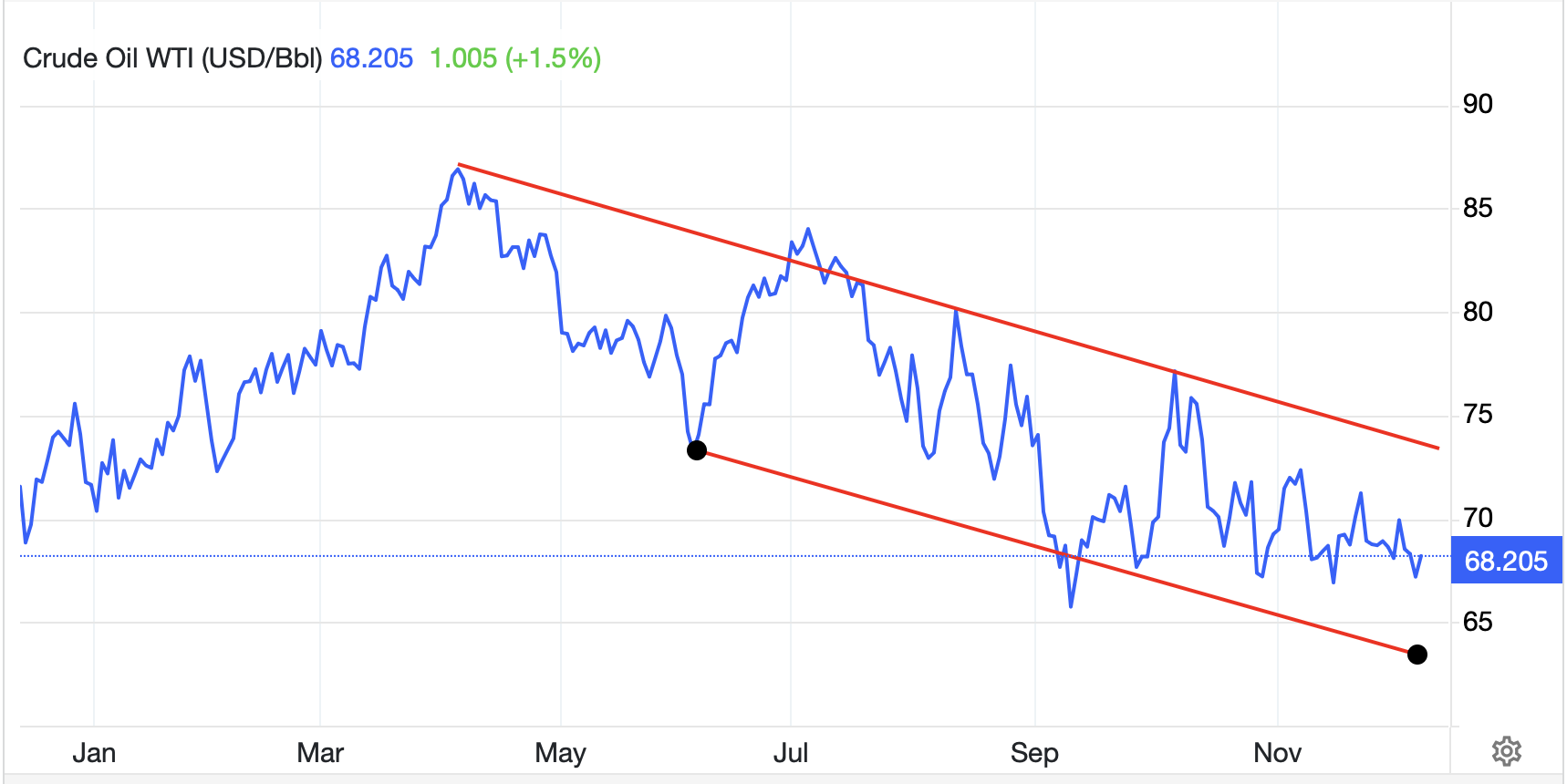
Oil prices (-0.1%) while consolidating this morning, continue to rally on the supply reduction story and WTI is back to its highest level since last November.  Truthfully, there is nothing that indicates oil prices are going to decline anytime soon, so keep that in mind for all needs.  At the same time, metals prices are mixed this morning with copper a bit softer and aluminum a bit firmer while gold is unchanged.  It seems like the base metals are torn between weak global economic activity and excess demand from the EV mandates that are proliferating around the world.  Lastly a word on uranium, which continues to trend higher as more and more countries recognize that if zero carbon emissions is the goal, nuclear power is the best, if not only, long term solution.  The price remains below the marginal cost of most production but is quickly climbing to a point where we may see new mining projects announced.  For now, though, it seems this price is going to continue to rise.

Finally, the dollar is mixed this morning, having fallen slightly vs. most G10 currencies, but rallied slightly vs. most EMG currencies.  This morning we will hear from the Bank of Canada, with expectations for another pause in their hiking cycle, but promises to hike again if needed.  Meanwhile, the outlier in the EMG bloc is MXN (-0.7%) which seems to be a victim of the overall risk situation as well as the belief that its remarkable strength over the past year might be a bit overdone.  In truth, this movement, five consecutive down days, looks corrective at this stage.

On the data front, we see the Trade Balance (exp -$68.0B) and ISM Services (52.5) ahead of the Beige Book this afternoon.  We also hear from two FOMC members, Boston’s Susan Collins and Dallas’s Lorrie Logan.  Yesterday, Fed Governor Waller indicated that while right now, the data doesn’t point to a compelling need to hike, he is also unwilling to say they have finished their task.  However, that is a far cry from the Harker comments about cutting in 2024 seems appropriate.  I suspect Harker is the outlier for now, at least until the data truly turns down.

Net, the big picture remains that the US economy is outperforming the rest of the world and the Fed is likely to retain the tightest monetary policy around, hence, the dollar still has legs in my view.

Good luck

Adf

Baked in the Cake

A quarter is baked in the cake
Ere next time, when Jay takes a break
At least that’s the view
Of so many who
Get paid for, such statements, to make

The question, of course, is why Jay
Would wait, lest inflation’s at bay
The narrative, though,
Is all-in that low
Inflation is now here to stay

Well, it’s Fed Day so all focus will be there until this afternoon at 2:00 when the Statement is released and then, probably more importantly, at 2:30 when Chairman Powell begins his press conference.  Under the guise of a picture is worth a thousand words, I believe the next two charts, both unadulterated from Bloomberg are very effective at describing the current market expectations.  The first is a tabular and graphic depiction of the Fed funds futures market over the next year, which shows that today’s hike is fully priced in, and then there is a just under 50% probability of a hike either September or November.  After that, though, the market is convinced that Fed funds are going to fall, with more than 100 basis points of decline priced in through 2024.

Now, compare that to the second chart, the Dot Plot from the June FOMC meeting:

In truth, the two curves look pretty similar with perhaps the biggest difference the Fed’s current belief that they will absolutely hike twice before the end of 2023 rather than simply a 50% probability of such.  So, can we just assume this is the way things are going to be?  After all, if markets and the Fed agree on the same outcome, it seems likely to be realized, no?

Alas, this is where the narrative is based on crystal balls, not on data.  Whether it is the punditry or the Fed (or the FX Poet), nobody knows how things are actually going to play out.  One of the things that seems to be a throwaway line by every Fed speaker but is actually the most important part of the commentary is that their views are based on, ‘if the economy evolves as we expect it to.’  The problem is that the history of Fed prognostications is awful. 

Obviously, the most recent glaring error was the ‘inflation is transitory’ narrative that they peddled for a year while inflation was rising sharply for many very clear reasons.  Why we should think that their modelling prowess has improved since then is beyond me.  I have often opined that the problem for the Fed is that every one of their models is broken since they don’t accurately reflect the economy, not even a little bit.  Add to that the underlying premise which is that inflation is naturally at 2% and will head back there on its own, something with exactly zero empirical or theoretical support, and you have a recipe for policy errors.  

The latest policy error was the transitory delay, but perhaps the bigger problem for the Fed is the potential for a relatively unprecedented set of economic variables with higher than target inflation combined with slow economic activity yet low unemployment (due to the shrinkage of the labor force.). I don’t think their playbook has a play to address that problem and I fear that the politics of the outcome will have a disproportionate impact on any policies they implement.  If there is one thing of which we can be sure, it is that political solutions to economic problems are the worst kind with the longest-term negative impacts.  

It is for this reason that Powell’s press conference is so widely anticipated as that is where we will learn any new information.  But until then, I expect that markets will remain relatively benign.

A quick tour of the overnight session shows that there was no follow through to Monday night’s Chinese equity performance with the main exchanges in China and Japan all modestly lower.  Europe, however, is having a much tougher time this morning with the CAC (-2.0%) leading the way lower as concerns seem to be growing over the ongoing central bank tightening policies continuing into a recession.  There was vanishingly little data and no commentary of note, but we have seen some weaker than expected earnings numbers out of the continent, a sign that not all is well.  As to US futures, they are essentially unchanged at this hour (8:00) as investors await this afternoon’s Fed meeting.  I would be remiss, though, not to point out that there were several worse than expected earnings numbers, notably from Microsoft, which is a chink in the armor of the idea of infinite growth for AI.

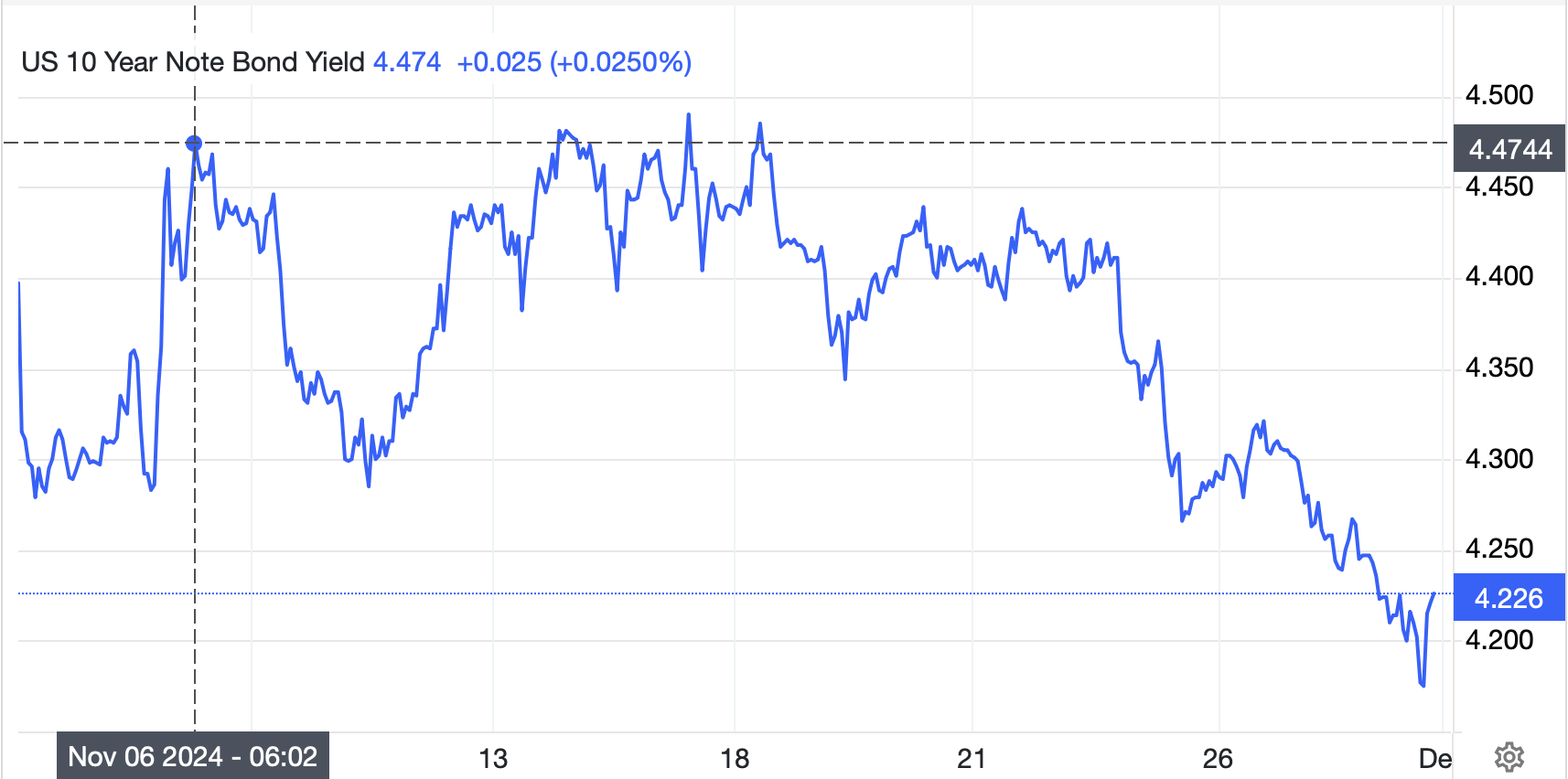
Meanwhile, bond markets are under pressure in Europe with yields higher across the board there, on the order of 2.5bps to 3.5bps.  This appears to be a move based on expectations of continuing higher interest rates from the ECB.  Treasury yields, though, are unchanged on the day, and at 3.88%, currently sit right in the middle of the trading range we have seen for 2023.  As to JGB yields, they slipped 2bps last night with limited concern that Ueda-san is going to rock the boat tomorrow night.

Oil prices (-1.0%) are a bit softer, but this looks like a trading correction after a strong run higher rather than a fundamentally based story.  Base metals are also softer this morning as the Chinese inspired euphoria seems to have dissipated quickly while gold (+0.4%) is creeping higher despite rising yields and a modestly firmer dollar.  It appears to me there is an underlying bid to the yellow metal that will not go away regardless of the macro situation.

Finally, the dollar is slightly firmer this morning as risk aversion seems to be supporting the greenback.  JPY (+0.35%) is the G10 outlier on the plus side with the commodity bloc under the most pressure (AUD -0.7%, NOK -0.7%, SEK -0.5%).  In the emerging markets, THB (+0.7%) has been the best performer after a surprisingly positive Trade Balance with a large negative one anticipated.  However, the rest of the EMG space is mixed with some very weak currencies (HUF -1.0%, ZAR -0.9%) and some other modestly strong ones (BRL +0.4%, MYR +0.3%).  The forint story continues to revolve around central bank activity, with concerns they will ease policy with inflation still high, while the rand is simply suffering from its commodity basis.  Meanwhile, the real jumped after Fitch upgraded the country’s debt rating BB (stable) from BB-.

Ahead of the FOMC decision, we see New Home Sales (exp 725K) but that will be a nonevent given the afternoon’s agenda.  It is a fool’s errand to try to anticipate exactly how Powell will respond to the questions he receives, or even exactly how they will phrase their current views.  As such, today is one to watch and wait, then evaluate afterwards.

Good luck

Adf

The Citizen’s Pain

Last night, t’was Australia that showed
Employment growth had not yet slowed
And so, please expect
The central bank sect
To keep on the rate hiking road

They’ll not be content til they’ve slain
Inflation, and end this campaign
Yet, if all along
Their thesis is wrong
They’ll ne’er feel the citizen’s pain

On a very slow day in the markets, the most noteworthy news came from Down Under, where the Unemployment Rate fell back to 3.5% in a bit of a surprise while job growth continued at a speedier pace than analysts forecasted.  The market response was immediate with the Aussie dollar jumping sharply and it is now higher by 1.0% on the session, the leading gainer across all currencies, G10 or EMG today.  The rationale for the move is quite straightforward as market participants simply expect the RBA to maintain tighter policy than previously expected.  In the OIS market, the probability of a rate hike at the next RBA meeting on August 1st rose to 48% from just 27% prior to the release.  And correspondingly, Australian government bond yields jumped more than 8bps on the news.

Ultimately, the question that must be addressed is, does strong employment growth lead to higher prices overall?  As my good friend @inflation_guy has said consistently, we should all be ecstatic to have a wage-price spiral as the implication is prices rise AFTER our wages rise, so we are always ahead of the curve.  But we all know, and it has been made abundantly clear in this cycle, that wages follow prices higher.  One need only look at how prices continue to rise on a much more continuous basis than your salaries to see this clearly.  

However, this is gospel in the central banking sect of economists, that tight labor markets drive the general price level higher.  You may have heard of the Phillips Curve, which was a study done in 1958 regarding the relationship between the price of labor (i.e. wages) and the unemployment rate in the UK from 1861-1957.  William Phillips was the New Zealand economist who performed the analysis and basically it confirmed what we all learned in Economics 101, reduced supply of labor drove up wages while an increased supply of labor pushed wages lower.  Nowhere in the study did it discuss the general price level.  That came later with a litany of big name economists, finally with Milton Friedman explaining that in the long-run, there was no relation between wages and inflation, although on a short-term basis, it could evolve.

As so often happens in today’s world, it was easier to take the short-cut view, and that had an intuitive appeal, hence the current central bank mantra of we must bring wage growth down.  (Will they ever get concerned over bringing money growth down?  I fear not.).  At any rate, this is the widely accepted view of the world and so whatever its structural merits, when employment data shows a tighter labor market, the market response is to expect higher policy interest rates.  This was the story last night, hence the Aussie’s rally along with yields Down Under, and this has been the story consistently since the beginning of 2022, when global central banks embarked on the current round of policy tightening.  This is also why we consistently hear Chairman Powell explain that in order for the Fed to reach its 2% inflation target, there will need to be some pain, i.e. people need to lose their jobs.

But away from that, there has been very little of note ongoing.  Equity markets in Asia were unable to match yesterday’s modest gains in the US, with the Nikkei (-1.25%) the laggard of the bunch.  European bourses, however, have had a better go of it, with most of them higher on the order of 0.4% although Sweden’s OMX is down nearly -1.0% on the session bucking the trend.  US futures this morning are softer as there were several weaker than expected earnings numbers overnight including Netflix and Tesla.

In the bond market, Treasury yields have moved higher by 3bps this morning in the 10-year space, but even more in the 2-year space as the yield curve inversion gets deeper, now back above -101bps.  However, European sovereign bonds are little changed on the day with no data of note and the market trying to determine just how hawkish/dovish the ECB will be one week from today.  As to JGBs, their yields have stopped rising and they remain 5bps below the cap.  Do not expect any BOJ action next week.

Oil prices are a touch higher after a lackluster session yesterday, but remain above the key $75/bbl level.  Meanwhile, gold (+0.25%) continues to edge higher and is once again closing in on $2000/oz despite obvious catalysts or lower US interest rates.  As to the base metals, both copper and aluminum are nicely higher this morning as the entire commodity comlex is feeling some love.

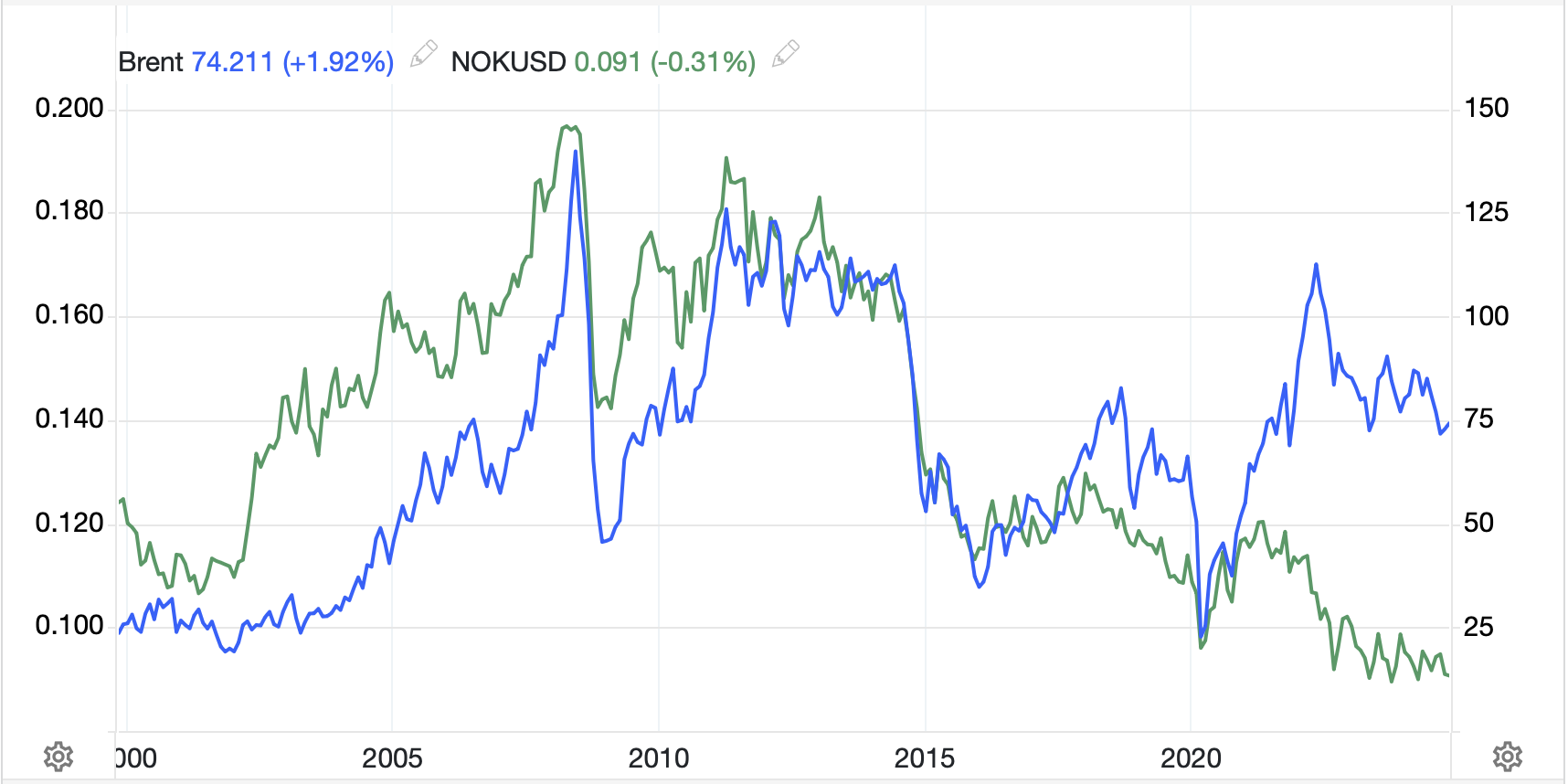
Finally, the dollar is under pressure as not only is AUD firmer, but also NOK (+1.1%) on the back of oil’s gains, and virtually the entire bloc except for the pound (-0.3%) which still seems to be suffering from yesterday’s inflation data.  In the EMG bloc, CNY (+0.8%) is the leading gainer, a surprising outcome given its generally managed low volatility, but the fact that the PBOC did NOT reduce the Loan Prime Rate last night, in either the 1-year of 5-year term, was a bit of a surprise to the market as there is a growing belief the Chinese government will be adding more stimulus to a clearly slowing economy there.    But in this bloc, there are also a number of laggards with MXN (-0.4%) the worst of the bunch on what appears to be some profit-taking as traders start to position for the first rate cut since October 2020.

On the data front, yesterday’s housing data in the US was soft, with downward revisions to the previous month’s numbers.  This morning we see Initial (exp 240K) and Continuing (1722K) Claims as well as Philly Fed (-10.0), Existing Home Sales (4.20M) and Leading Indicators (-0.6%), the last of which have been pointing to recession for nearly a year.  However, once again, I expect the dollar will be beholden to the equity markets as none of these data points are likely to move the needle ahead of the FOMC next week.

For now, I think choppy price action is the likely outcome until we get more clarity from Powell and the Fed, as well as Lagarde and the ECB next week.  Who will be the most hawkish?  That is the $64 billion question.

Good luck
Adf

A Rate Hike Boycott

Said Yellen, the job market’s cooling
Not faltering, but it’s stopped fueling
Inflation, and so
You all need to know
More rainbows are coming, no fooling!

Meanwhile, from the EU, Herr Knot
Was strangely less hawkish than thought
Inflation’s plateaued
Which opens the road
To starting a rate hike boycott

As we await today’s US Retail Sales data, and far more importantly, next week’s FOMC and ECB meetings, it seems that there is a concerted effort to talk inflation down by both the US and European governments.  For instance, yesterday, Treasury Secretary Yellen was explaining how, “the intensity of hiring demands on the part of firms has subsided.  The labor market’s cooling without there being any real distress associated with it.”  Now, I have no doubt that Secretary Yellen would dearly love that to be the case, although her proof on the subject remains scant.  Perhaps she is correct and that is the situation but given her track record regarding forecasting economic activity (abysmal while at the Fed and in her current role), I remain skeptical.  Certainly, while last month’s NFP data was slightly softer than forecast, it did not speak to a significant change in the labor market situation.

She proceeded to add how inflation was clearly coming down, although was careful to warn against reading too much into one month’s numbers, kind of like she was doing.  One thing she was not discussing was how the ongoing surge in deficit spending by the government, which she was personally overseeing, was having any impact on inflation.  Alas, history shows that there is a strong link between large deficits and rising inflation.  Maybe this time is different, but I doubt it.

But as I said, there seems to be a concerted effort to start to talk down inflation, especially as the efforts to actually address it are increasingly politically painful.  The next example comes from the Eurozone, where Klaas Knot, Dutch central bank chief and number one hawk on the ECB Governing Council suddenly changed his tune regarding a rate hike in September.  It was just a month ago, in the wake of the ECB’s last rate hike, when Madame Lagarde essentially promised a July hike, that he was on the tape explaining that a September hike was also critical and certain.  But now, his tone has changed dramatically, with comments like “[it] looks like core inflation has plateaued,” and he’s “optimistic to see inflation hitting 2% in 2024.”  

Again, maybe that outlook is correct and inflation in the Eurozone is going to come crashing down (remember, it is currently 5.4% on a core basis, far above the 2% target), but this also seems unlikely.  For instance, this morning’s headline, FRANCE TO RASE REGULATED ELECTRCITY PRICES BY 10%, would seem to be working against the idea that inflation is going to fall sharply.  In fact, one of the key reasons inflation ‘only’ rose as high as it did in the Eurozone, peaking at 10.6% last year, was that virtually every government subsidized skyrocketing energy prices for their citizens much to their national fiscal detriment.  Now that energy prices have come off the boil, they are ending those subsidies and hence, prices are rising to reflect the current reality.  So, the inflation they prevented last year will simply bleed into the statistics this year.

Politically, what makes inflation so difficult for governments is the fact that regardless of how they try to spin the situation, the population sees rising prices in their everyday lives and are unlikely to believe the spin.  However, that will not stop governments from doing their best to change attitudes via words rather than deeds.  Of course, given the prevailing Keynesian view that there is a direct tradeoff between employment and inflation, that puts politicians in a very difficult spot.  No politician is going to encourage rising unemployment just to get inflation down hence the ongoing attempts to jawbone inflation lower.  Ultimately, nothing has changed my view that inflation, as measured by CPI or PCE, is going to find a base in the 3.5%-4% area and be extremely difficult to push past those levels absent a catastrophic event.  And I certainly don’t wish for that!

But let’s take a look at how markets are responding to the renewed attempts to talk inflation lower, rather than actually push it lower.  Certainly, yesterday’s US equity performance showed no concerns over mundane issues like inflation as all 3 major indices continued to rally to new highs for the year.  Alas, there is less joy elsewhere in the world as Chinese stocks suffered along with most of Asia, although the Nikkei did eke out a small gain.  In Europe this morning, while the screen is virtually all red, the movements have been infinitesimal, on the order of -0.1% across the board.  And US futures at this hour (7:45) are showing similarly sized tiny declines.

The real news is in the bond market, which has taken this new government push to heart, and we now see yields falling across the board, in some cases quite sharply.  Treasury yields are down -4.5bps, but that pales in comparison to European sovereigns, all of which are lower by at least 7bps with Italian yields tumbling 12.5bps.  This newfound ECB dovishness is clearly a welcome relief for European governments, French electricity prices be damned.

In the commodity space, the base metals continue to signal a recession is on its way as both copper and aluminum continue to slide, but oil seems to have found a base for now, and is still higher on the month.  As to gold, it should be no surprise that it is rallying this morning, pushing back above $1960/oz as the combination of lower yields and a lower dollar are both tail winds for the barbarous relic.

Turning to the dollar, excluding the Turkish lira, which has tumbled 2.5% in anticipation of another underwhelming monetary policy response this week when the central bank meets, the rest of the EMG bloc is firmer, led by THB (+1.2%) on the combination of a broadly weaker dollar and hopes that the political stalemate in the wake of the recent election there is soon to be solved with a new candidate coming forward.  But the strength is broad-based across all 3 regions.  In the G10, NZD (-0.7%) is the only real laggard as market participants position themselves for tonight’s CPI release there with growing concerns that the central bank is not doing enough to support the currency and economy.  Otherwise, the bloc is generally firmer, albeit not dramatically so.

On the data front, Retail Sales (exp 0.5%, 0.3% ex autos) leads the way followed by IP (0.0%) and Capacity Utilization (79.5%) at 9:15.  There are still no Fed speakers, so while a big miss in Retail Sales could have an impact, I continue to expect that the equity earnings schedule is going to be the driving force in markets until the Fed meets next week.  So far, the first sets of numbers have been positive, but there is a long way to go.  

For now, the dollar remains on its heels, and I suspect that is where it will stay until next Wednesday at least.

Good luck
Adf

A Series of Fails

The narrative that we’ve been fed
Explains a soft landing’s ahead
With CPI falling
And job growth enthralling
The equity bulls lack all dread

But part of this thesis entails
That Chinese expansion prevails
Alas for that view
The data that’s new
Shows Xi’s had a series of fails

Pop quiz: what do you call an economy that demonstrates anemic economic output with relatively high inflation yet relatively low unemployment?  The future.  In truth, I don’t think economists have come up with a new descriptor for the situation to where we are headed.  Stagflation may be appropriate, but the key outlier in this scenario is the low unemployment situation.  To help better understand how a recession is defined in the US (as opposed to the shorthand view of 2 consecutive quarters of negative real GDP growth), here is an excerpt directly from the NBER’s website describing the things they consider [emphasis added]:

“Because a recession must influence the economy broadly and not be confined to one sector, the committee emphasizes economy-wide measures of economic activity. The determination of the months of peaks and troughs is based on a range of monthly measures of aggregate real economic activity published by the federal statistical agencies. These include real personal income less transfers, nonfarm payroll employment, employment as measured by the household survey, real personal consumption expenditures, wholesale-retail sales adjusted for price changes, and industrial production. There is no fixed rule about what measures contribute information to the process or how they are weighted in our decisions. In recent decades, the two measures we have put the most weight on are real personal income less transfers and nonfarm payroll employment.”

Based on this description, if the unemployment rate remains low, recession is not on the cards.  Now, politically, the current administration will spend a lot of time during the current election cycle touting their achievements, but will this situation, where inflation continues to plague the economy amid very slow growth, really feel like times are good?  The employment situation appears to be a structural change with a large reduction in the workforce in the wake of the pandemic and related policies.  While this seems likely to keep unemployment low, it will also keep upward pressure on inflation.  This will be good for the nation’s fiscal stance, as high nominal activity along with high inflation (exactly the situation I foresee) will do wonders for reducing the real value of the outstanding debt.  However, it is not clear it will do much for the nation’s psyche.  

One of the key features of the soft landing scenario is that economic activity will be widespread.  Now, we know that Europe and the UK are both struggling, but of equal, if not greater importance, is the stituaiton in China.  There has been a near universal view that the post zero-Covid economy in China would revive quickly and that growth there would be sufficient to support the entire world.  Last night, though, we got some bad news on that front as Chinese data was generally weaker than expected, specifically the GDP result where growth rose just 0.8% on the quarter (5.5% Y/Y) far below economists’ forecasts.  It seems that the China reopening is not nearly as impressive as previously expected.  Property investment continues to fall (-7.9%), Retail Sales continue to slide (3.1%) and IP remains far below historic levels.  Oh yeah, while the Surveyed Jobless Rate remained unchanged at 5.2%, youth unemployment (people between ages 16-24) rose still further to 21.3%!  This is not the sign of an expanding economy.

It seems that the combination of slowing world activity and ongoing trade wars is starting to really take a toll.  Exports fell last month, and apparently, the Chinese consumer is not picking up the slack.  Now, the latter should be no surprise as there was precious little fiscal policy support for the Chinese people by the Xi government during covid, and their largest source of savings, housing, has been collapsing for at least 2 years, so it is not clear why anyone should expect an uptick in activity.  The Chinese people just don’t have the money for it.  Despite Xi’s earnest desire to have the economy pivot away from export-led growth to consumption led growth, it just ain’t gonna happen real soon.  And if Chinese economic activity remains in the doldrums, we could be in for a longer period of overall slow growth around the world.  That will not help the soft-landing scenario at all.  

Maybe things will be much better, but I cannot get over the view that the worst of this economic cycle is yet to come.  Beware.

How are markets responding to the latest news?  Pretty much as you might expect with risk assets under pressure and bond markets rallying.  For instance, after Friday’s mixed picture in the US, Chinese equity markets were under pressure, although the rest of Asia was pretty benign.  European bourses, though, are all in the red led by the CAC (-1.25%).  As to US futures, at this hour (7:30) they are all slightly softer as the market awaits earnings, this week’s Retail Sales data and, of course, next week’s FOMC.

Bond markets, though, are unambiguous in their views with yields falling sharply across the board.  Treasury yields are down 5bps, as are virtually all European sovereigns and UK gilts.  The decline in US CPI last week is clearly spilling over, as is the weaker Chinese growth data.  While central banks have insisted that they are not done fighting inflation by raising interest rates, markets are pretty clearly expressing the view that yes another hike may be coming soon, but that by early next year, they will be cutting rates quickly.  

As to the commodity markets, oil, which had really rallied nicely over the past week or so, has fallen again this morning, down -1.20%, and we are seeing weakness in the base metals as well with both copper and aluminum lower by about -2.0%.  Only gold is managing to maintain a little bid as the dollar remains under some pressure this morning.

Finally, the dollar is mixed this morning, with about half its counterparts in both the G10 and EMG blocs higher and the other half lower.  Given the Chinese data, it is no surprise CNY and several other Asian currencies are weaker this morning.  Perhaps a little more surprising is that the ZAR is stronger despite softer metals prices.  But given that there has been a broad-based theme of dollar weakness in the wake of the CPI data last week, my sense is traders are simply adjusting positions ahead of the Fed next week.  This idea is bolstered by the fact that the yen remains one of the best performing currencies of late as the yen continues to be the favored funding currency for short positions given its still negative interest rate structure, but as the long dollar idea fades, traders are forced to cover those short yen positions.  I suspect that there is further to go in this trade.

On the data front, Retail Sales is the highlight of the week, although there is a decent amount of stuff, as follows:

Today	Empire Manufacturing	-3.5
Tuesday	Retail Sales	0.5%
	-ex autos	0.4%
	IP	0.0%
	Capacity Utilization	79.5%
Wednesday	Housing Starts	1475K
	Building Permits	1490K
Thursday	Initial Claims	241K
	Continuing Claims	1730K
	Phily Fed	-10.0
	Existing Home Sales	4.21M
Source: Bloomberg

With no Fed speakers, I expect that the market will be focused on the Retail Sales data from an economic perspective, but we are also entering the earning period, so it is likely that is going to have a bigger impact on all markets without any Fed narrative.  Barring extreme results in either data or earnings, I suspect a quiet week as all eyes focus not only on the 25bp hike coming next week from Powell and company, but more importantly, the tone of the statement and the press conference.  

Good luck
Adf

Just a Dream

Inflation is clearly passé
As traders and markets display
Remarkable trust
The Fed will adjust
The path of rate hikes come what may

The upshot is there’s a new meme
A landing so soft it would seem
No jobs will be lost
And there is no cost
Alas I fear it’s just a dream

I’m not sure if you saw the announcement yesterday, but everything is beautiful!  Inflation is a thing of the past, the economy continues to tick over quite nicely with employment remaining robust and the idea of recession is just a figment of the permabears’ imagination.  At least that’s what it seems like based on market movements of late.

Yes, PPI printed lower than forecast, which after the somewhat softer CPI and the known base effects, was not hugely surprising.  Perhaps a bit more surprising was that the Claims data, both on an Initial and Continuing basis, printed lower than expected.  The implication here is that the labor market remains quite robust with those folks who have been laid off able to find new employment quite rapidly.  While there is still plenty of data pointing to a manufacturing recession (ISM, IP, Factory Orders), the Services situation remains far better with increased activity and rising wages still apparent.  So, perhaps the optimists have it nailed, and believe Chairman Powell has managed to create a soft landing, where inflation comes back to target without having to cause a recession.

However, it feels like it is still a little early to take that victory lap.  After all, the inflation data was literally one data point driven largely by base effects and regardless of your view, one data point does not a trend make.  Certainly, the equity market is all-in on the soft-landing scenario.  The Treasury market, at least since the CPI print on Wednesday has rallied dramatically (another 10bps yesterday) and is now 29bps lower over the past week.  In fact, the 2yr Treasury has rallied even further, with yields there falling by 35bps over the same period.  To say that the market has adjusted its views on the Fed’s future activities would be an understatement.   There is still a 91% probability priced into a 25bp rate hike this month, but there are no more hikes after that priced at this stage and the first cut is seen in either March or May next year, at least according to the Fed funds futures market.

And what of the dollar?  While it is bouncing a little today, that is clearly modest position adjustment amid profit-taking as it is sharply lower on the week against all its G10 counterparts and almost all its EMG brethren.  

There is, of course, one fly in the ointment, oil prices, and commodities in general.  One of the key features of markets over time is that they tend to be self-correcting.  The saying, the solution to high prices is high prices is trying to explain the idea that high prices result in additional supply coming to market (to take advantage of those high prices) which results in prices falling back to earlier, lower levels.  The same process occurs with low prices as well, where low prices inspire increased demand and reduced supply thus driving prices higher again.  

Well, oil is exhibit A for this process.  Since oil continues to be priced and traded largely in dollars, when the dollar is strong, non-dollar countries (basically everybody else) finds that oil is expensive and so demand wanes a bit resulting in softening oil prices.  However, when the dollar declines, as we have seen in the past week, that opens the door for oil, and most commodities which are priced in dollars, to rally sharply.  Of course, if you are the Fed and continue to try to dampen price pressures, the last thing you want is a weak dollar and high commodity prices as both lead directly to rising inflation.  In fact, one reason that US inflation did not reach the levels seen in Europe and the UK is that the dollar remained quite strong throughout this period thus reducing inflationary pressures.  But right now, that dynamic is reversing with the dollar under pressure and commodity prices rising.  That bodes ill for continued declines in CPI and PPI which is certainly not part of the new narrative.  

(As an aside, it is this very feature that drives the de-dollarization narrative as you can easily understand why China, who is the largest importer of oil in the world, would like to see the dollar dethroned so they can pay for their imports with their own currency (printed as necessary) rather than have to earn dollars elsewhere to pay for their oil and other commodity imports.)

At any rate, I feel it is very important for everyone to remember that it is never the case when all signals point in the same direction.  It is only the case that the market responds to a group of signals that reinforce their underlying view, happily ignoring the rest.  As another saying accurately makes clear, nothing matters until it matters.

Ok, as we head into the weekend with a week’s worth of euphoria behind us, what is today shaping up to be?  Well, equity markets are muddling about with most ever so slightly higher but some sliding after the previous two days’ strong rallies.  US futures are also lackluster at this hour (8:00) barely higher as traders prepare for another summer weekend.  

Bond markets, too, are quiet after a raucous week, with yields little changed on the day in the US and throughout Europe and in Japan.  One cannot be surprised by the market response to the CPI data and now that this new narrative of rainbows, unicorns and lollipops is making its way around to every corner of the market, there is no reason to think that much will change in the near term.  Arguably, even if inflation is beaten and is heading back to 2%, a big IF, there is precious little reason for 10-year yields to fall very far as they would currently be offering a 1.75% real yield, a very normal situation throughout history.  Although, there would certainly be cause to believe the 2yr is set to see yields decline further and the yield curve normalize.  But again, I believe it is very early to take that as gospel.

Commodity markets are following the same pattern here, consolidation after a week of strong rallies in all the major commodities so the question is, will those rallies continue next week?  Or have we reached the end.  This story is true of the dollar as well, which is intimately linked to the commodity story.

Will today’s Michigan Sentiment (exp 65.5) change any views?  I doubt it although if the reading is quite strong, and given the growing bullish zeitgeist, it could certainly pump risk assets further.  However, a soft reading seems unlikely to derail the current risk attitude at this point.  With the Fed commentary under wraps until the FOMC meeting, today is likely to be entirely equity focused.  To that end, the big banks have been reporting Q2 earnings this morning and so far, they have all beaten (dramatically reduced) forecasts.  I expect that is all that is needed for risk to retain its luster, so do not be surprised to see the dollar continue its recent slide and stocks and commodities finish higher on the day.

Good luck and good weekend
adf

Double Secret Inflation

In Sintra, each central bank head
From Europe, Japan and the Fed
Explained all was well
Amongst their cartel
So, ideas of changing were dead

However, in Asia it seems
The PBOC’s latest schemes
To strengthen the yuan
Have failed to catch on
Look, now, for a change in regimes

The panel in Sintra that mattered had the three key central bank heads on the dais, Powell, Lagarde and Ueda, and each one held true to their recent word.  Both Powell and Lagarde insisted that inflation remains too high and that the surprising resilience in both the US and European (?) economies means that they would both be continuing their policy tightening going forward.  Powell hinted at a July hike and Lagarde promised one a few weeks ago.  At the same time, Ueda-san explained that while headline inflation was higher than their target, given the lack of wage growth, the BOJ’s ‘double-secret’ core inflation reading was still below 2% and so there would be no policy changes anytime soon.  He did explain that if this key reading moved sustainably above 2%, it would be appropriate to tighten monetary policy, but quite frankly, my take (and I’m not alone) is that all three of these central bank heads are very happy with the current situation.


Why, you may ask, are they happy?  Well, politically, inflation remains the biggest headache for both Powell and Lagarde, and quite frankly most of the rest of the world, while in Japan, recent rises in inflation have not raised the same political ire.  At the same time, as long as the BOJ continues YCC and QE with negative rates, the flood of liquidity into the market there helps offset the liquidity withdrawn by the Fed and ECB.  The result of this policy mix is a very gradual reduction in total global liquidity along with an ongoing demand for US and European sovereign issuance.  It should be no surprise that Japan is now the largest holder of US Treasuries outside the Fed.  As well, the policy dichotomy has resulted in a continued depreciation of the yen which supports the mercantilist aspects of the Japanese economy.  And finally, higher inflation in Japan helps erode the real value of the 250% of GDP worth of JGBs outstanding, allowing eventual repayment of that debt to proceed more smoothly.  Talk about a win, win, win!  Until we see a material change in the macroeconomic statistics in one of these three areas, it would be a huge surprise if policies changed.


The upshot of this analysis is that it seems unlikely that we are going to see any substantive movement in yields, either up or down, given the relative offsets in policy, and that the yen is likely to continue to erode in value.  Last autumn, the yen fell very sharply, breaching 150 for a short time and generating serous angst at the BOJ and MOF.  We saw intervention and the idea was there was a line in the sand at that level.  However, my take is that as long as the move remains gradual, and it has been gradual as the yen has steadily, but slowly depreciated for the past 5 months, about 2%/month, we are likely to see more verbal intervention, but not so much in the way of actual activity.  In the end, unless policies change, actual intervention simply serves to moderate the move.


Speaking of failed intervention, we can turn to China which has a similar problem to Japan, weakening growth and low inflation.  As I have written before, a weak renminbi is the best outlet valve they have, and the market has been doing the job.  However, here the movement has been a bit faster than the PBOC would like thus resulting in more overt and covert intervention.  On the overt side, we continue to see the PBOC try to fix the onshore currency strong (dollar lower) than the market would indicate as they try to get the message across that they don’t want the currency to collapse.  On the covert side, there has been an increase in the number of stories regarding Chinese banks, like China Construction Bank and Bank of China, actively selling USDCNH, the offshore renminbi in an effort to slow the currency’s depreciation.  But the story that is circulating is that all throughout Africa and Asia, nations that were encouraged to accept CNY for sales of commodities are now quite unhappy with the CNY’s weakness and are quickly selling as much as they can in order to preserve their reserve’s value.  My sense is this process will continue as the dichotomy between a stronger than expected US economy and a weaker than expected Chinese one continues to push the renminbi lower.  PS, for everyone who was concerned about the dollar losing its reserve currency status to the renminbi or some theoretical BRICS backed currency, this should help remind you of why any change to the dollar’s global status is very far in the future.


And those are today’s stories.  Yesterday’s mixed US risk picture has been followed overnight with Chinese shares, both Mainland and Hong Kong, suffering but the Nikkei eking out a gain.  In Europe, the FTSE 100 is under pressure, but we are seeing strength on the continent despite what I would consider slightly worse than expected data prints in German State CPIs as well as Eurozone Confidence measures.  However, the one place where inflation slowed sharply was Spain, where headline fell to 1.9%!  While that was a touch higher than forecast, it is the first reading of any country in the Eurozone below the 2% level since early 2021.  Alas, what is not getting much press is the fact that core CPI there fell far less than expected to 5.9% and remains well above targets.  The ECB has a long way to go.


Bonds are under pressure across the board today, with yields higher by about 3bps-4bps in Treasuries and across Europe.  This seems to be a response to the idea that a) neither the Fed nor ECB is going to stop raising rates and b) inflation is not falling as quickly as hoped.  JGB yields, though, remain well below the YCC cap at 0.38% so there is no pressure on Ueda-san to change his tune.


Oil prices are creeping higher this morning but remain below $70/bbl and in truth have not done very much lately.  The big picture of structural supply deficits vs. concerns over shorter term demand deficits due to the coming recession continue to play out as choppy markets but no direction.  Copper has fallen sharply this morning and is down more than 5% in the past week.  Its recent rally appears to have been a short squeeze more than a fundamental view.  Gold, meanwhile, continues to consolidate just above $1900/oz.


Finally, the dollar is mixed on the day, with both gainers and losers across the EMG space although it is broadly lower vs the G10.  AUD (+0.5%) is the leading major currency after better-than-expected Retail Sales data was released overnight but the rest of the bloc, while higher, is just barely so.  In the EMG, PLN (+0.75%) is the best performer, but that is very clearly a position rebalancing after a week of structural weakness.  On the downside, KRW (-0.75%) is the worst performer after weaker Chinese data impacted the view of Korea’s future.  Otherwise, most currencies are relatively unchanged on the day.


We get some important data today starting with Initial Claims (exp 265K) and Continuing Claims (1765K) as well as Q1 GDP (1.4%).  Frankly, since this is the third look at GDP, I expect that the Claims data, which has been trending higher lately, is the most critical piece.  If we see another strong print, be prepared for the recession narrative to come back with a vengeance, but if it is soft, then there will be nothing stopping the Fed going forward.


Powell made some comments this morning in Madrid, but they were about bank stability not economic policy, and we hear from Bostic this afternoon.  But frankly, I see little reason for a change in sentiment anywhere on the Fed given the data continues to show surprising economic strength.  As such, I still like the dollar medium term.


Good luck

Adf

No Longer Clear

Inflation remains
Far higher than desired
Will Ueda-san blink?

Which one of these is not like the other?


Central Bank

Policy Interest Rate

Core CPI

Federal Reserve

5.25%

5.3%

ECB

4.00%

5.3%

BOE

5.00%

7.1%

Bank of Canada

4.75%

4.2%

RBA

4.10%

6.8% (headline)

BOJ

-0.10%

3.2%

Source: Bloomberg


Japanese inflation readings were released overnight, and they showed no signs of declining.  In fact, they were actually a tick higher than the median forecasts.  However, there has been zero indication that the BOJ is set to respond to the highest inflation in decades.  As everything economic is political, by its very nature, the reality seems to be that there is not yet any political price for PM Kishida to pay for rising inflation.  Recall, as inflation started to pick up sharply in the wake of the pandemic reopenings, the universal central bank response was, inflation is transitory and it will subside soon.  Politically, at that time, governments were keen to keep interest rates near (or below) zero as part of their belief that it would foster economic activity and recession was the big concern.


However, once it became so clear that even central banks understood this bout of inflation was not a transitory phenomenon, policy prescriptions changed rapidly leading to the very rapid rise in interest rates we have seen since early 2022.  Politically, inflation was the lead story in every media outlet with governments around the world and their central banks being blamed, so they had to respond.  (Whether their response has been effective is an entirely different story).  Except in one place, Japan.  As is abundantly clear from the table I constructed above, the BOJ has yet to alter their monetary policy stance despite core CPI remaining at extremely elevated levels far above the BOJ’s 2% target.  In fact, prior to the recent spike, you have to go back to 1981 to see Japanese core CPI this high.


Apparently, though, inflation is not making headlines in Japan as it has been throughout the rest of the G7 and so the BOJ is perfectly happy to continue on their path of infinite QE and YCC.  Remarkably, 10-year JGB yields fell further last night, now around 0.35%, as there is seemingly very little concern that a policy change is in the offing there.  Certainly, there has been no indication from any BOJ commentary nor from Kishida’s government.  As such, it can be no surprise that the yen continues to fall, declining 1% this week and more than 3% over the past month. 


Interestingly, there has definitely been an uptick in the buzz from market talking heads about the need for the BOJ to abandon YCC and that a change is imminent.  I have seen a number of analyses that foretell of the inevitable change and how the yen is likely to rise dramatically when it happens.  FWIW, which may not be that much, I agree that when the BOJ does change policy, we are likely to see the yen rally sharply.  The problem is, I see no indication that is going to happen anytime soon.  Show me the headlines in the Asahi Shimbun or the Nikkei Shimbum (major Japanese newspapers) that are focused on inflation and I will change my view.  But until it is a political problem, the BOJ is serving its current function of supplying the world’s liquidity with a correspondingly weaker yen as a result.

The messaging’s no longer clear
Regarding the rest of the year
While some at the Fed
See more hikes ahead
Some others feel ending is near

Once again yesterday we heard mixed messages from Fed speakers with some (Barkin) talking about evaluating their actions so far and waiting for more proof that further tightening was needed while others (Bowman, Waller) seeming pretty clear that more hikes are in the offing.  Powell’s Senate testimony was largely the same as the House testimony on Wednesday with more of the questions focused on bank capital rather than monetary policy.  Of course, the big question remains, are they done or not?  Fed funds futures are still pricing a 72% chance of a hike in July and a terminal rate of 5.33%, so one more hike from current levels.  But the arguments on both sides remain active.  It appears to me that as long as the employment situation remains robust, they will continue to hike until inflation falls closer to their target.  Yesterday’s Initial Claims data printed just a touch higher, 264K, and the trend certainly seems to be moving higher, but is not nearly at levels consistent with recession.  The NFP report in two weeks will be critical but until then, we are likely to be whipsawed by commentary.


As to the overnight session, risk is very definitely on its heels this morning with equity markets in the red around the world, with all of Asia falling by -1.5% or more although European bourses have not suffered quite as much, -0.3% to -0.8%.  US futures are also under pressure, down about -0.5% at this hour (8:00).


Bond markets, on the other hand, are performing their role as safe haven, with yields sharply lower this morning. Treasury yields, which had risen yesterday have given all that back and then some, down 6bps, while in Europe, sovereigns are down 12-13bps virtually across the board.  The latter seems to be a response to the Flash PMI data which was released showing slowing activity across the continent, especially in France where both Manufacturing and Services fell below 50 and where German Manufacturing PMI tumbled to 41.0.  If the Eurozone economy is truly performing so poorly, it is hard to believe that the ECB will continue on its current path much longer.  One other rate story is the short-term GBP rates which are now pricing a terminal rate by the BOE at 6.13%, pricing another 5 rate hikes into the curve by the middle of next year.


However, on this risk off day, it is the dollar that is truly king of the world, rallying vs every one of its counterparts in both the G10 and EMG.  NOK (-2.2%) is the G10 laggard on the back of general risk aversion as well as the fact that oil prices are tumbling again, down a further -1.25% this morning on the recession fears.  But the weakness is pervasive with AUD (-1.0%) weak and the euro (-0.7%) giving up chunks of its recent gains in short order.  Interestingly, the yen (-0.1%) is the best performer in the G10.  The picture in the emerging markets is similar, with substantial losses across the board led by TRY (-1.3%) and ZAR (-1.1%).  Of course, Turkey’s lira is destined to continue collapsing given the dysfunctional monetary policy there, but ZAR is feeling the pressure of declining metals prices, especially gold, which is down again this morning and now pressing $1900/oz.  Meanwhile, China’s renminbi continues to slide, trading to new lows for this move with the dollar marching inexorably higher.


On the data front, today brings Flash PMI data (exp 48.5 Manufacturing, 54.0 Services, 53.5 Composite) and that’s it. Two more Fed speakers, Bullard and Mester, are due to speak and both have been leading hawks so we know what to expect.  So, looking at the rest of the session, I suspect that the dollar will maintain most of its gains, but do not be surprised to see a little sell off as we head into the weekend and positions are reduced.


Good luck and good weekend

Adf

4% is the New 2%

The Kingdom that’s sort of United
Reported inflation’s ignited
And simply won’t fall
Regardless of all
The rate hikes that they’ve expedited

But of more importance today
Is hearing what Jay has to say
He’ll speak to the House
Whose members will grouse
Though their views will not hold much sway

Starting with the first big data point, CPI in the UK was higher than expected yet again, printing at 8.7%, unchanged from April’s reading and above the 8.4% consensus expectation.  Core CPI actually rose further, to 7.1%, a new high reading for the current bout of inflation and an indication that thus far, the BOE has not been very effective in fighting inflation.  The market response was mostly in line with what one would expect as the equity market sold off alongside Gilts as yields climbed further.  In fact, 2yr Gilt yields are now above 5.0% for the first time since 2008 and the UK yield curve is also steeply inverted, albeit not as steeply as the US curve.  As well, the OIS market is now pricing a one-third probability of a 50bp rate hike by the BOE when they meet tomorrow.  But weirdly, the pound is under pressure this morning.  It is the worst performing G10 currency (-0.4%) and unlike most recent market reactions, where higher interest rates lead to currency strength, it has a throwback feel to your old International Finance textbooks where higher inflation leads to currency weakness.


Arguably, the biggest problem that Governor Bailey has right now is that it doesn’t seem to matter what the BOE does, prices are continuing to rise.  My sense is that interest rate hikes may not be the right medicine for the UK’s current ailments (which could well be true in the US) as the genesis of this inflation is not excessive economic growth driving demand but rather fiscal policy profligacy driving demand.  If it is the latter, then higher interest rates may only exacerbate the inflation situation as the increased cost of debt service simply adds to the growing budget deficit which increases the amount of money available for people to spend.  Consider, if one owns 2yr Gilts yielding 5%, the amount of income available to that person/entity is far greater than when 2yr Gilts were yielding 1% two years ago and so there is more money to spend.  Just like in the US, the employment situation in the UK remains tight and wages are rising along with interest rates.  In other words, there is a lot more money floating around chasing goods, a pretty surefire recipe for increasing inflation.  Alas, this idea doesn’t fit well within the Keynesian dogma so I fear things will take a long time to recover in the UK.


Turning to the US, this morning we will hear from Chairman Powell for the first time since the FOMC meeting a week ago as he testifies before the House Financial Services Committee.  While it is always difficult to anticipate what types of questions people like Representative Maxine Waters (who thankfully no longer chairs this committee) will ask, I expect that there will be a lot of discussion regarding whether the Fed should continue tightening policy in the face of recent softer, albeit still high, inflation readings, and what is being done about issues like bank safety and oversight.  I am also quite confident that there will be questions/demands for the Fed to do something about climate change although Chairman Powell has already made clear it is not in their mandate.


However, ex ante, trying to assess what Powell is likely to say, I would estimate he will continue with the current Fed mantra of inflation remains far too high and that they are going to bring the rate of inflation back to their 2% target.  He is also likely to admit that doing so will cause pain via rising unemployment, something no Congressman/woman is going to want to hear.  But just like in the UK as explained above, it is entirely possible that the Fed’s reading of the current situation may not be accurate.  The playbook, as written by Paul Volcker, explains that the way to squash inflation is to raise interest rates high enough to cause a recession, kill demand and watch price increases end.  And that worked well in 1980-1982 as the US was dealing with both rising commodity prices as well as a demographic boom as Baby Boomers were entering the workforce along with women and there was a significant uptick in activity and productivity. 


The problem for Powell, who came of age during that period, is that is not very descriptive of today’s economy.  Instead, we have just come through a massive fiscal policy spend on the back of the pandemic response (similar to the end of a war) but the demographics are far less impactful as population is growing far more slowly and the working population is growing even slower.  Higher interest rates have increased the income for retirees and allowed them to increase demand as they spend that newfound money.  I’m not saying that cutting rates is the right path, just that raising them a lot more may not be very effective either.  Fiscal discipline would be a far more effective tool to fight inflation in the current environment I believe.  Alas, that is something that simply no longer exists.  As such, I fear that we are going to see inflation remain much higher than we had become used to for a much longer time.  I expect 4% is the new 2%.


At any rate, ahead of the Powell comments, which begin at 10:00am, this is what we’ve seen overnight.  Japanese equities continue to rock, rising again and now up nearly 29% YTD in yen terms.  The Nikkei has reached its highest level since December 1989, although has not yet passed the peak set in September of that year.  However, Chinese equities are on a completely different trajectory right now, with both the Hang Seng and mainland indices down on the year.  It seems investors are not enamored of President Xi’s economic leadership right now.  As to Europe, it is mostly softer, albeit not by much and US futures are similarly down slightly ahead of the opening.


Bond yields are edging higher outside of the UK with Treasuries back up 3bps and most of the continent up around 1bp.  Looking at Treasury activity lately, it has been choppy but not trending either higher or lower and sits in the middle of the 3.50% – 4.0% range that has defined trading since September.


Oil prices are little changed this morning and are also hanging about in a range lately as the market tries to determine the supply/demand function.  Is China growing enough to increase demand substantially?  How much oil is Iran getting into the market?  These are the questions that have no clear answers so visibility into trends is limited.  Meanwhile, gold got clobbered yesterday on dollar strength and the base metals had a similar response.


Finally, the dollar remains stronger rather than weaker overall, rallying yesterday against most of its counterparts and holding the bulk of those gains.  Today’s outlier is KRW (-0.9%) which suffered after the release of its export data showed a 12.5% decline of exports to China.  In truth, this bodes ill for both currencies, the won and the renminbi, which saw the offshore version trade through 7.20 last night for the first time in this move.  As I have written before, this has further to go.


There is no data today so basically, all eyes will be on the tape at 10:00 to hear what Powell has to say and how he responds to the questions.  For now, the market is losing conviction that another rate hike is coming, although there is no indication from Fed speakers that they have changed their view.  Next week, we will see the PCE data, and I suspect much will depend on how that prints before any new views can be expressed.  In the meantime, the dollar is caught between a sense of risk-off and a sense the Fed may be done.  Choppy is the name of the game.


Good luck

Adf