He Axed Her

The NFP data was weak
And President Trump did critique
The BLS head
But unlike the Fed
He axed her as pundits did freak


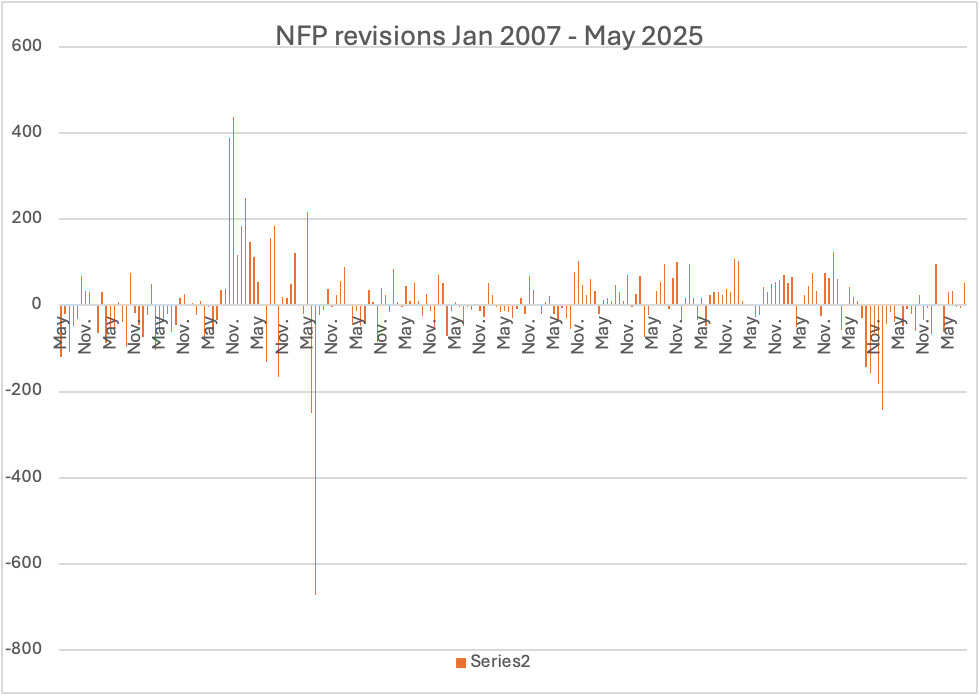
However, it is a fair question to ask if she was incompetent or politically motivated in her daily activities.  After all, it is abundantly clear there are many government workers who are ostensibly non-partisan who are, in fact, highly partisan.  As such, I took a look at the seasonally adjusted NFP data (the non-seasonally adjusted data is wildly volatile) to see if we could discern a pattern.  I created the chart below from BLS data on revisions with May 2025, the latest month with the normal two revisions, on the left and January 2007, prior to the GFC, all the way on the right.

If you look on the left side of the chart, you can see a great many negative revisions.  In fact, 21 of the last 29 months were revised lower from the original print.  If we assume that the BLS models are unbiased, then one would expect a roughly equal distribution of both positive and negative revisions over time.  It turns out, under the unbiased assumption, the probability of 21 out of 29 negative revisions is a very tiny 0.80%.

What conclusions can we draw from this?  My first thought is that the BLS models are not very effective at modeling reality.  I have raised this point many times in the past, the idea that the models that worked in the past, certainly pre-Covid, have been having trouble.  This begs the question as to why an economist of Ms McEntarfer’s long experience didn’t seek to develop a more accurate model.  As it is, there is no evidence that she did so.  I imagine as a government employee, the idea that one should change something that exists within the government framework is quite alien.  Thus, her competence could certainly be called into question, I think.

If we consider the alternative, that her actions were politically motivated, that will be more difficult to discern.  However, given the predominance of Democrat voting members of the federal government and given the fact she was appointed to this position by President Biden, it is fair to assume she is not in favor of the current administration, at the very least.  Now, during Mr Biden’s term, the initial NFP data was consistently better than expected, thus giving the impression that the economy was stronger than it may have otherwise been.  After all, stories about revised data are usually on page 12 of the paper, not headline news.  It is, therefore, possible that she was putting her proverbial thumb on the scale to flatter Biden’s economic performance.  As to her likely distaste of Mr Trump, I expect that to the extent she had the ability to do so, weaker headlines and large negative revisions would be exactly her contribution.

However, the political issue is largely speculation on my part, although I would argue it is plausible.  On the other hand, there is nothing in her background to suggest she is an especially thoughtful or creative economist and there is no indication that she examined the models she oversaw for flaws.  In the end, I come down on incompetence driving a political motive.  But I doubt we will ever know.  

Now, it is not a very good look for a leader to proverbially kill the messenger, which is essentially what Trump did.  Not surprisingly, much hair is on fire in the press and punditry, not because they though McEntarfer was particularly good at her job (I’m sure nobody had ever heard of her before) but because, as we have observed time and again, President Trump doesn’t follow their rules, and they don’t know what to do about it. 

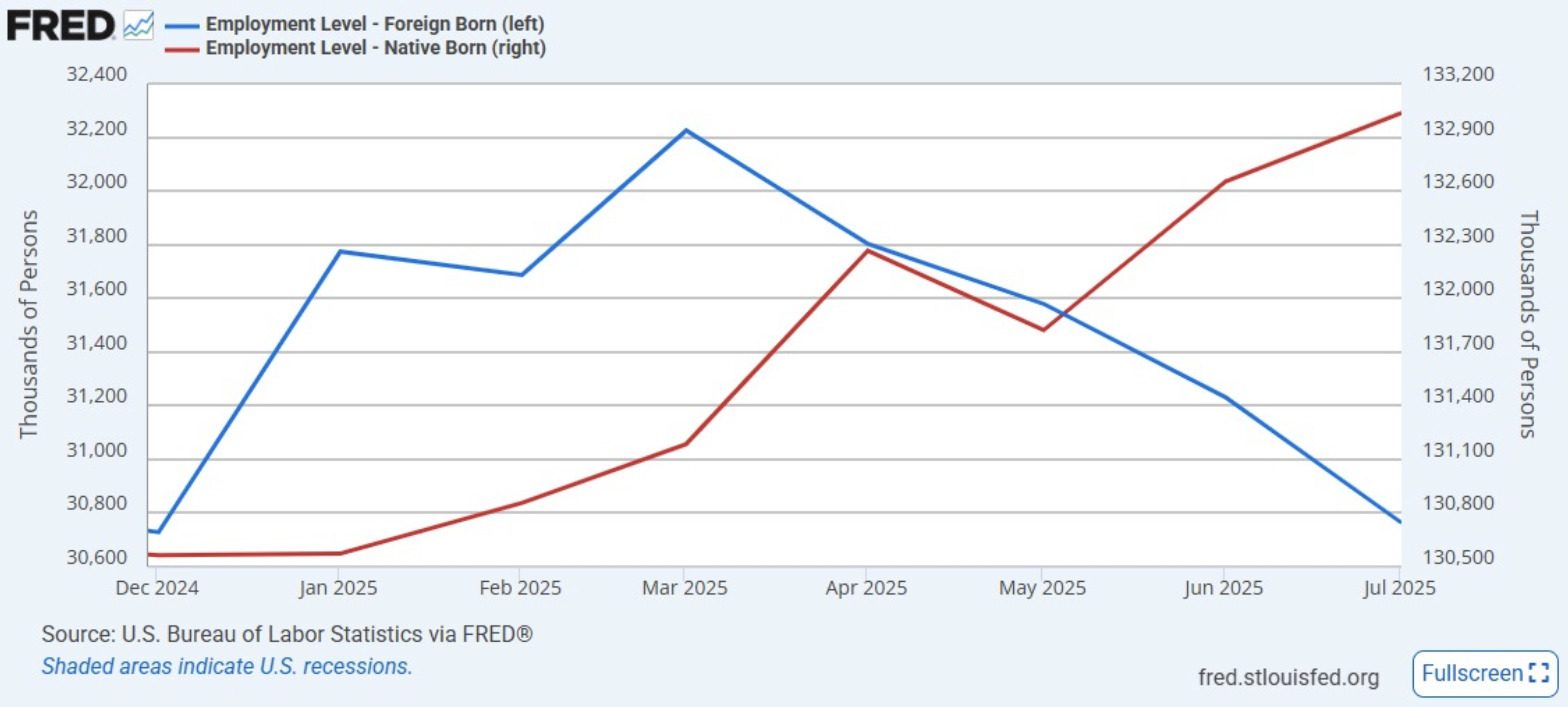
Will this matter in the end?  This is merely the latest tempest in a teapot in my opinion and will do nothing to change the economy.  However, there is one interesting feature of the employment situation that can be directly attributed to the immigration situation.  As you can see in the FRED chart below, since March, the number of foreign-born workers has declined by 1.46 million while the number of US born workers has increased by more than 1.8 million.  I would say that as long as American citizens are finding jobs, President Trump is likely to remain quite popular across the nation despite all the negative press.

The weak NFP report altered the narrative on Friday, with bond yields, equity markets and the dollar all tumbling and the probability of a September rate cut jumping to 80%.  Perhaps President Trump is correct, and it is time to cut rates.

That’s all for this special Sunday night edition.

Good luck

Adf

The Perfect Riposte

Attention right now’s being paid
To Congress on taxes and trade
The One BBB
Is seen as the key
To growth in the coming decade
 
Meanwhile, Sintra right now’s the host
To Powell, Lagarde and almost
All central bankers
Each one of whom hankers
To nurture the perfect riposte


The headlines this morning highlight that Congress put in an all-nighter last night as they try to get the BBB over the line and on the president’s desk by Friday.  My take is they were seeking sympathy for all the hard work they must do and trying to make it seem like they are slaving away on their constituents’ behalf.  Yet it appears that since the president’s inauguration on January 20, 161 days ago, Congress has been in session for somewhere between 40 and 50 days (according to Grok), about one-quarter of the time.  I have seen these estimates elsewhere as well, and quite frankly, it doesn’t speak well of Congressional leadership.  

In the end, though, I continue to expect the BBB to get passed by both houses and sent to the president.  I’m certain there are still a lot of things in the bill that many fiscal conservatives will not like, but I’m also confident that the fact that not a single Democratic representative or senator is going to vote for the bill is likely a sign that it does more good than harm.  I am completely aware of the debt and deficit issues and questions of their long-term sustainability, and I am not ignoring that.  But politics is the art of the possible, not the perfect, and my take is this is possible.  Consider for a moment the Orwellian-named Inflation Reduction Act from 2022, which passed the Senate on a tiebreaker vote by VP Harris.  That was a much more harmful piece of legislation from a fiscal perspective than this.  In fact, I would say this is the very definition of politics.

Through a market lens, if (when) this is passed, while there may be an initial ‘sell the news’ move, I suspect that the stimulus it entails will be a net benefit for risk assets overall.  And the only reason there would be a sell the news event is that the market is already pricing in a great future as evidenced by yesterday’s quarterly close at new all-time highs for the S&P 500, above 6200.

Turning to the other noteworthy news, the ECB is holding their faux Jackson Hole event this week in Sintra, Portugal where all the heads of major central banks are currently gathered along with academics and journalists who are there to spread the good word.  Chairman Powell speaks today, but this is the Powell story of the day.  Apparently, President Trump had this hand-written note delivered to the Fed Chair.  Are we not entertained?

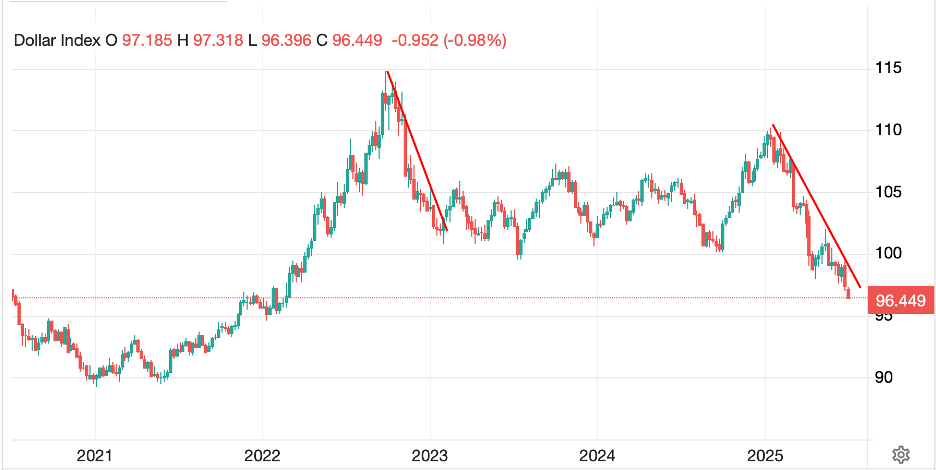
But ignoring for a moment the president’s desires, let us consider the dollar and its potential future direction.  The predominant current thinking is that it has further to slide as the trend is clearly lower and the rising anticipation of a recession in the US forcing the Fed to cut rates further will undermine the greenback.  Let’s break that down for a moment.  There is no question the dollar is currently in a downtrend as evidenced by the chart below.  A look at the red line on the right shows the slope of the decline thus far this year, which totals about 11%.

Source: tradingeconomics.com

In fact, much has been made of the decline thus far this year as to its speed and how it is a harbinger of both a recession and the end of the dollar’s hegemony.  Yet, we don’t have to go very far back in time, late 2022-early 2023 to see a virtually identical decline in the dollar over a slightly shorter period, hence the steeper slope of the line in the center of the chart, and I cannot find a single descrying of the end of the dollar at that time. Too, I remember being certain a recession was on the way then, when it never arrived.  According to JPMorgan, it seems the recession probability for 2025 is now 40%.  I have seen estimates ranging from 25% to 80% over the past few months which mostly tells me nobody has any idea.

We also don’t have to go very far back in time to see when the dollar was substantially weaker than its current levels.  I’m not sure why this time the dollar’s recent trend means the world is ending when that was not the case back in 2023 or any of the myriad times we have seen movement like this in the past.

But one other thing to consider regarding the dollar is that the BBB is going to provide significant stimulus to the economy.  Combining this with President Trump’s trade policies which are designed to draw investment into the US, and seemingly are working, and I think that despite his desire for lower interest rates, the Fed will have little reason to cut amid stronger growth in the economy.  I do not believe you can rule out a turn in the dollar higher once the legislation is passed as it is going to matter a great deal.  While spending priorities are going to change, it appears that investment is going to rise and that will help the buck.  Be wary of the dollar is dying thesis.

Ok, yesterday’s market activity, while reaching record highs in the equity markets, was actually incredibly slow with volumes shrinking.  My sense is folks are on holiday this week and those who aren’t are waiting for Thursday’s NFP data, so they can then run out of the office and go for their long weekend.  But the rest of the world doesn’t have the holiday Friday and are all trying to solve their trade situation with the US.  That led the Nikkei (-1.25%) lower yesterday as there appears to be a timing mismatch from a political perspective.  Ishiba doesn’t want to agree to open Japan’s market to US rice ahead of the election on July 20th as that will be a major political problem, but July 9th is approaching quickly, and Trump has said that is the date.  But aside from Japan and Hong Kong (-0.9%) the rest of the region had a pretty solid session led by Thailand (+2.1%) and Taiwan (+1.3%).  In Europe, though, PMI data was less than stellar, and bourses are modestly softer (DAX -0.5%, CAC -0.4%, FTSE 100 -0.3%) although Spain’s IBEX (+0.2%) has managed a gain as they had the best PMI outcome of the lot.  

In the bond market, yields continue to slide everywhere with Treasuries (-4bps) actually lagging the Eurozone which has seen declines of -6bps virtually across the board.  Madame Lagarde, in her Sintra opening speech, explained that the ECB would be altering their communication strategy to try to take account of the uncertainty in their forecasts, so not promise as much, but I have a feeling the movement is more a result of the softer PMI data as well as the Eurozone inflation release at 2.0% which has ECB members explaining things are under control.  Japan is a bit more confusing as JGB yields (-4bps) slipped despite what I would consider a strong Tankan report and a rise in their PMI data.  However, the newest BOJ board member did explain there was no reason to raise rates anytime soon, so perhaps that is the driver.

In the commodity markets, oil (+0.8%) continues to creep higher, perhaps a harbinger of stronger future economic activity around the world, or perhaps more short covering.  Gold (+1.4%) has completely erased the dip at the end of last week and is back at its recent pivot point of $3350 or so.  This has brought silver (+1.1%) and copper (+0.7%) along for the ride.

Finally, the dollar is clearly softer this morning with JPY (+0.6%) the leader in the G10 while ZAR (+0.9%) is the leading gainer in the EMG bloc as it follows precious metals prices higher.  Net, I would suggest that the average move here is about 0.25% strength in currencies.

On the data front, we get ISM Manufacturing (exp 48.8) and Prices Paid (69.0) and we get the JOLTs Job openings (7.3M) this morning.  Too, at 9:30, Chairman Powell speaks so it will be interesting to see if there is any change in his tune.

I see no reason for the dollar to turn higher right now but watch for the BBB.  Its passage could well change the dollar’s direction.

Good luck

Adf

Too Much Debt

In Spain, electricity failed
In Canada, Carney prevailed
But markets don’t care
As movement’s quite spare
It seems many traders have bailed
 
But problems, worldwide, still abound
Though right now, they’re in the background
There’s far too much debt
And still a real threat
That no true solutions are found


The two biggest stories of the past twenty-four hours were clearly the national scale blackout in Spain and Portugal yesterday, and the slim victory for Mark Carney in Canada, where the Liberal Party appears to have a plurality, but not a majority, and will oversee a minority government.

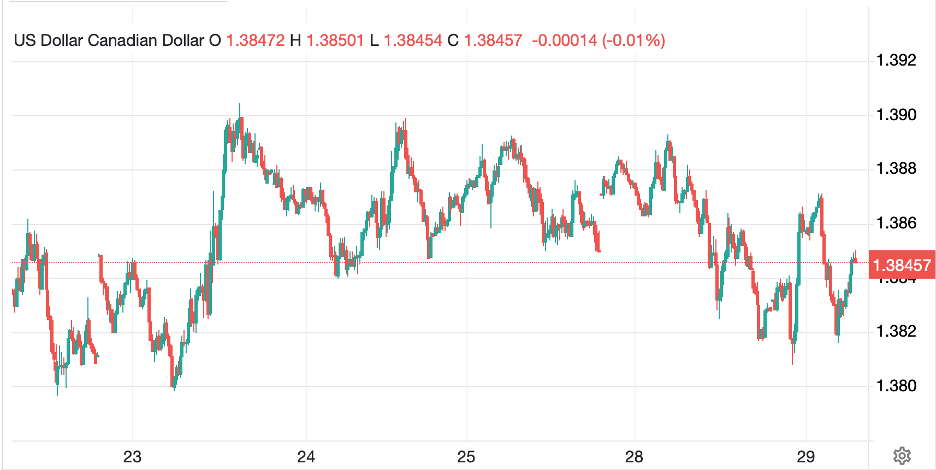
Touching on the second story first, in truth there is not much to discuss.  Much has been made of the vote being an anti-Trump statement with the idea that Carney is better placed to defend Canada from President Trump’s (imagined) predations.  However, given the lack of a majority government, it is not clear how effective this line of reasoning will prove.  As there is no futures market for the TSX, we really don’t have a sense yet of how the Canadian equity market will greet the news.  Yesterday’s modest gains of 0.35% amid a general atmosphere of modest gains doesn’t really tell much of a tale.  As to CAD (-0.1% today), a quick look at the past week shows it has done nothing even in the wake of the news. (see below).  My take is this is a nothingburger event, a perfect description for Mark Carney, a nothingburger of a politician.

Source: tradingeconomics.com

As to the story about Spain’s electricity, I think it may be more instructive on two levels.  The first is as a warning to the risks inherent of powering your electric grid with more than 25% – 30% intermittent, renewable energy sources like wind and solar.  It is somewhat ironic that just twelve days prior to the blackout, Spain’s entire electricity requirement was met by solar, wind and hydro power, the Green dream.  Alas, here we are now and while no answers have yet been forthcoming, and I assume the media will downplay any blame on too much renewable power, virtually every engineering study has shown that once a grid has more than that 25% renewables, it tends towards instability.  This issue will be argued by both sides for a while, although as always, physics will be the final arbiter.  

But I have to wonder if the sudden failure of the electric grid is an omen of sorts, for what may be happening in global markets.  If we analogize global supply chains to the electrical grid, over the course of the past 50 years, we have seen the world create a massively complex web of trade with raw materials, intermediate goods and final products all crisscrossing the world.  There have been myriad benefits to all involved with real per capita economic benefits abounding, and for everybody reading this note, the ability to essentially buy whatever you want/need with limited interference and trouble.  Certainly, the availability of everyday necessities like food and clothing is widespread.

However, underpinning that bounty were two networks.  The first being the obvious one, the supply chains which since Covid have been much discussed by the punditry.  But the second, which gets far less notice is the network of debt that is issued around the world by governments and companies, as well as taken on by individuals, and that has grown to be more than 3x the entire global economic output.  While we most often read about the US government debt which is quickly approaching $37 trillion, total global debt is much greater than that.  In fact, at this point, the debt market is not about issuing new debt to fund new investment, rather it is almost entirely a refinancing mechanism.  

It is this latter issue that should concern us all.  What happens if, one day, the ability to refinance some of that debt, whether US Treasuries, German bunds or Chinese government bonds, has a hiccup of some sort?  A failed US Treasury auction, where the Fed is required to purchase bonds, or a power outage in a key financial center that prevents trades from being confirmed/settled and moneys not moving as expected, or some other force majeure type event that disrupts the current smooth functioning of global debt markets.  

Frankly, the combination of the changes being wrought by President Trump to the global economy, where globalization is giving way to mercantilism, and the significant weight of global debt that hangs over the global economy and is given very little thought seems a potentially volatile mix.

Ironically, as much as I have lately been describing how the Fed’s role seems to have diminished, in the event that something upsets this apple cart, the Fed will be the only game in town.  While this is not a today event, it is something we must not forget.

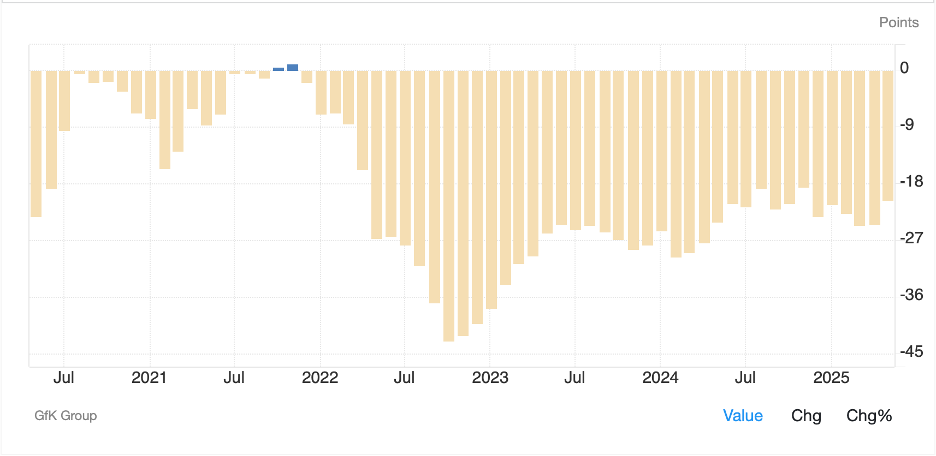
I apologize for my little diatribe, but with so little ongoing in markets, and the parallel to the Spanish electrical grid, it seemed timely.  Let’s look at markets.  Asian equity markets were mixed with the main markets very quiet but a couple of 1% gainers (Australia, Taiwan and Korea) although the rest of the region was +/- 0.3% or less.  Too, volumes were quite lethargic.  In Europe, it should be no surprise that Spain (-0.8%) is the laggard today as the first economists’ to opine on the impact of the blackout said it could be a hit of as much as 0.5% of GDP.  Germany (+0.6%) is the other side of the coin after the GfK Consumer Confidence reading came out at a better than expected -20.6.  Now, maybe it’s just me, but if I look at the past 5 years’ worth of this index, it is difficult to get excited about German economic prospects.

Source: tradingeconomics.com

Yes, this was a better reading, but either the people of Germany are manic depressive, or the index is indicative of major structural problems in the country.  Maybe a bit of both.  As to US futures, at this hour (7:10) they are basically unchanged after being basically unchanged yesterday.

In the bond market, Treasury yields have bounced 2bps this morning after touching their lowest level in 3 weeks yesterday.  European sovereign yields, though, are all softer by 1bp to 2bps this morning as comments from ECB members seem to highlight more rate cuts as Europe achieves their inflation target and are now getting concerned they will fall below the 2.0% rate.

In the commodity markets, oil (-1.7%) is under pressure this morning ostensibly on a combination of concerns over slowing growth and little movement in the US-China trade talks as well as a report that Kazakhstan is pushing up output and other OPEC+ members are talking about increasing production further when they meet next week.  Meanwhile, gold (-0.75%), which rallied back to unchanged in NY yesterday is once again finding sellers at its recent trading pivot of $3340ish (H/T Alyosha).  However, gold’s slide has not impacted either silver (+0.4%) or copper (+0.9%) at least so far in the session.

Finally, the dollar is firmer, largely across the board, this morning.  The euro (-0.3%), pound (-0.4%), JPY (-0.4%) and CHF (-0.6%) are all under some pressure, perhaps profit taking.  But in truth, other than INR (+0.15%) the rest of the major currencies, both G10 and EMG, are all softer vs. the greenback.  I guess the dollar’s demise will need to wait at least one more day.

On the data front, the Goods Trade Balance (exp -$146B), Case Shiller Home Prices (4.7%) and JOLTs Job Openings (7.48M) are the main numbers, although we also see Consumer Confidence (87.5).  But with no Fed discussions much more crucial data on Thursday (GDP, PCE) and Friday (NFP) it seems that today is setting up for not much excitement.

In fact, lack of excitement seems the best description of markets right now.  I don’t know what the next catalyst will be to change things, but absent peace in one of the wars, kinetic or trade, or another force majeure event, it feels like range trading is the order of the day for a while.  My big picture view of a slowly declining dollar is still intact, but day-to-day, it’s hard to see much right now.

Good luck

Adf

Not in a Hurry

Said Powell, we’re not in a hurry
To cut after last year’s late flurry
Instead, wait and see
Is likely to be
The future lest ‘flation hawks worry


The opening paragraph of the FOMC Statement was concise as they acknowledge that things aren’t too bad right now.  “Recent indicators suggest that economic activity has continued to expand at a solid pace. The unemployment rate has stabilized at a low level in recent months, and labor market conditions remain solid. Inflation remains somewhat elevated.”  

Of course, that didn’t stop Chairman Powell from still describing rates as restrictive or “meaningfully above” the neutral rate, although in fairness, he did explain “We do not need to be in a hurry to adjust our policy stance.”  When asked about the impact of President Trump’s mooted policies regarding tariffs and trade, he explained, “The committee is very much in the mode of waiting to see what policies are enacted. We need to let those policies be articulated before we can even begin to make a plausible assessment of what their implications for the economy will be.”

In the end, I don’t believe very much changed with respect to expectations for the Fed with the futures market still pricing in a total of 46 basis points of cuts for the rest of the year with just an 18% probability of a cut in March.  Certainly, nothing we heard or saw today changed my view of rates remaining here and potentially going higher before the end of 2025.  But for now, I don’t think there is much else to say on the subject.

In Europe, the data was bleak
As growth there remains awful weak
Today they’ll cut rates
And on future dates
A base rate much lower they’ll seek

As we await the ECB’s meeting announcement later this morning, where Madame Lagarde is virtually certain to cut their interest rate structure by 25bps, we were entertained by GDP data from the Eurozone as well as several of its members.  The numbers were disappointing even compared to weak forecasts.  For instance, in Q4, France (-0.1%) and Germany (-0.2%) both saw declining activity while Italy (0.0%) managed to not fall.  Not surprisingly, the Eurozone, as a whole, also saw a result of 0.0% GDP growth in Q4.  In every case, the annual number is below 1.0%.  Of course, if just looking at this data, it would be easy to say the ECB needs to cut rates further.  However, inflation remains uncomfortably higher than target and as evidenced by Spanish data this morning, showing it rose to 3.0% Y/Y in January, Madame Lagarde cannot ignore the sole ECB mandate of stable prices at 2.0%.

Under the rubric a picture is worth a thousand words, I think the chart below of quarterly GDP activity in Germany and the Eurozone speak volumes of how things are progressing on the continent. 

Source: tradingeconomics.com

The current policy mix in Europe is clearly not getting the job done, assuming the job is to grow the economy in a non-inflationary manner.  While the ECB can continue to cut rates in their effort to support growth, the problems on the continent have far more to do with energy policy than anything else.  The focus on ending the use of fossil fuels has resulted in the highest energy costs of any region which has led to the steady deindustrialization of the continent.  It doesn’t really matter where interest rates are if companies cannot power their operations and that is the crux of the ECB’s problems.  No matter what Lagarde and her friends do, it cannot reverse this decline.  If you were wondering why so many, including this poet, are negative on the euro’s prospects going forward, this is it in a nutshell.

Ok, let’s turn to the overnight market activity.  First, a moment’s thought for the tragedy that took place in Washington DC last night where a commuter jet collided with a military helicopter near Reagan National Airport.  As I write, it is not known how many fatalities occurred, but the word is there were 60 passengers plus crew on board the plane and 4 on the helicopter.

Yesterday’s US session was less positive than many had hoped with the specter of DeepSeek still haunting many investors but the situation in Asia was a bit more upbeat with the Nikkei (+0.25%) and Australia (+0.55%) both showing gains.  I read an entire X post as to why the next Chinese stimulus package was really going to change things and support the economy there although I continue to remain skeptical. (As an aside, it is Chinese New Year, the year of the snake, so markets in China and Hong Kong are closed for a few days.). Meanwhile, in Europe, all markets are higher as traders anticipate not only today’s ECB rate cut, but clearly more in the future as economic activity continues to wane.  So, gains across the board of between 0.35% (DAX) and 0.7% (IBEX).  US futures, too, are higher this morning, up by 0.4% at this hour (6:50).

In the bond market, yields are sliding as Treasuries (-3bps) are sitting right on 4.50% after Chairman Powell seemed to indicate they actually do care about inflation.  Meanwhile, European sovereign yields are all lower by between -6bps and -7bps ahead of the ECB announcement and responding to the weak GDP data.  Clearly, investors on the continent are convinced there are more rate cuts coming.  On the other side of that rate coin, JGB’s saw yields climb 2bps as Deputy BOJ Governor Himino indicated that further rate hikes would be appropriate given Japanese real interest rates remain negative.  Not only did that support JGB yields, but the yen (+0.5%) was also a beneficiary.  Finally, I would be remiss to ignore the Brazilian central bank, which hiked rates 100bps last night, taking their SELIC rate to 13.25%!  (And equity investors in the US complain rates are too high!)

In the commodity space, oil (-0.1%) is little changed this morning although remains near the bottom of its recent trading range.  There is so much discussion regarding what will happen here, whether Trump will be able to encourage more drilling in the US, how OPEC is going to respond to both Trump and the market, and what is going to happen in the Russia/Ukraine war, that it is very difficult to get a good handle on things.  Nothing has changed my long-term view that there is plenty of oil around and it is a political decision, not a technical nor geological one, that will determine the price.  As to metals markets, gold (+0.65%) continues to perform well and edges closer to the all-time high levels reached back in late October.  There is much discussion about the arbitrage between COMEX and LME gold with many deliveries apparently due in NY and not enough 100toz bars available.  This may be driving prices higher as those with short positions scramble to either roll their positions are get ready for delivery.  As to silver (+0.4%) and copper (+0.2%), they are both along for the ride.

Finally, the dollar is mixed this morning as while it is modestly stronger vs. some G10 counterparts (EUR -0.2%, SEK -0.2%), the yen’s strength is moderating the overall movement.  Versus its EMG counterparts, BRL (-0.8%) is the most notable mover as traders take profit after the BCB’s rate hike last night.  It was widely assumed to occur and real rates in Brazil are now nearly 9%, a very attractive level that has helped the currency appreciate more than 6% in the past month.  However, elsewhere, the movement is basically random.

On the data front, aside from the ECB rate decision, we see the weekly Initial (exp 220K) and Continuing (1890K) Claims data and the first look at Q4 GDP (exp 2.6%). Yesterday’s Goods Trade Balance was a record deficit of -$122.1 Billion as it appears many companies were ordering stuff to get ahead of the threatened tariffs.  Also, yesterday the BOC cut rates by 25bps, as widely expected, but nobody really noticed.  With the Fed sidelined for now, I suspect that we will continue to follow the equity stories more closely than the macro ones, although we do see PCE tomorrow, so a big surprise there could certainly impact the narrative.  But for now, it remains difficult to be too bearish the dollar.

Good luck

Adf

Chaos is Spreading

Around the world, chaos is spreading
As government norms get a shredding
Korea’s the latest
But not near the greatest
Seems to the Fourth Turning we’re heading

While Russia/Ukraine knows no end
And Israel seeks to defend
The French are about
To toss Michel out
And all this ere Trump does ascend


If you view markets through a macro lens, the current environment can only be described as insane.  Niel Howe and William Strauss wrote a book back in 1997 called The Fourth Turning (which I cannot recommend highly enough) that described a generational cycle structure that has played out for hundreds of years.  If you have ever heard the saying 

  • Hard times make strong men (1st Turning)
  • Strong men make good times (2nd Turning)
  • Good times make soft men (3rd Turning)
  • Soft men make hard times (4th Turning)

Or anything in the same vein, this book basically describes the process and how it evolves.  The essence is that about every 20-25 years, a new generation, raised by its parents whose formative years were in the previous Turning, falls into one of these scenarios.  Howe and Strauss explained that at the time they wrote the book, we were in the middle of the 3rd Turning, and that the 4th Turning would be upon us through the 2020’s.  One of the features they highlighted was that every 4th Turning was highlighted by major conflict (WWII, Civil War, Revolutionary War, etc.) with the implication that we could well be heading toward one now.

Of course, we already have a few minor wars with Russia/Ukraine (although that seems to have the potential to be more problematic) and Israel/Hezbollah/Hamas, with Iran hanging around the edges there.  In a funny way, we have to hope this is the worst we get, but there are still more than 5 years left in the decade for things to deteriorate, so we are not nearly out of the woods yet.  

But turmoil comes in many forms and political turmoil is also rampant these days.  This is evident by the number of sitting governments that have been ejected in the most recent elections as well as the increasingly strident blaming of others for a nation’s current problems.  In this vein, the latest situation will happen shortly when the French parliament votes on a no-confidence motion against the current PM, Michel Barnier.  As it is, he is merely a caretaker PM put in place by President Macron after Macron’s election gamble in June failed miserably.  Adding to France’s problems, and one way this comes back to the markets, is that the French fiscal situation is dire, with a current budget deficit exceeding 6% of GDP and no good way to shrink it.  In fact, Barnier’s efforts to do so are what led to the current vote.  I have already discussed French yields rising relative to their European peers and the underperformance of the CAC as well. 

On the one hand, today’s vote, which is tipped to eject Barnier, may well be the peak (or nadir) of the situation and things will only improve from the current worst case.  However, it strikes me this is not likely to be the case.  Rather, there are such a multitude of problems regarding immigration, culture, economic activity and government responsiveness, that we have not nearly found the end.  My fear is we will need to see things deteriorate far more than they have before populations come together and agree that ending the mess is the most important outcome.  Right now, there are two sides dug in on most issues and the split feels pretty even.  As such, neither side is going to give up what they believe for the greater good, at least not yet.

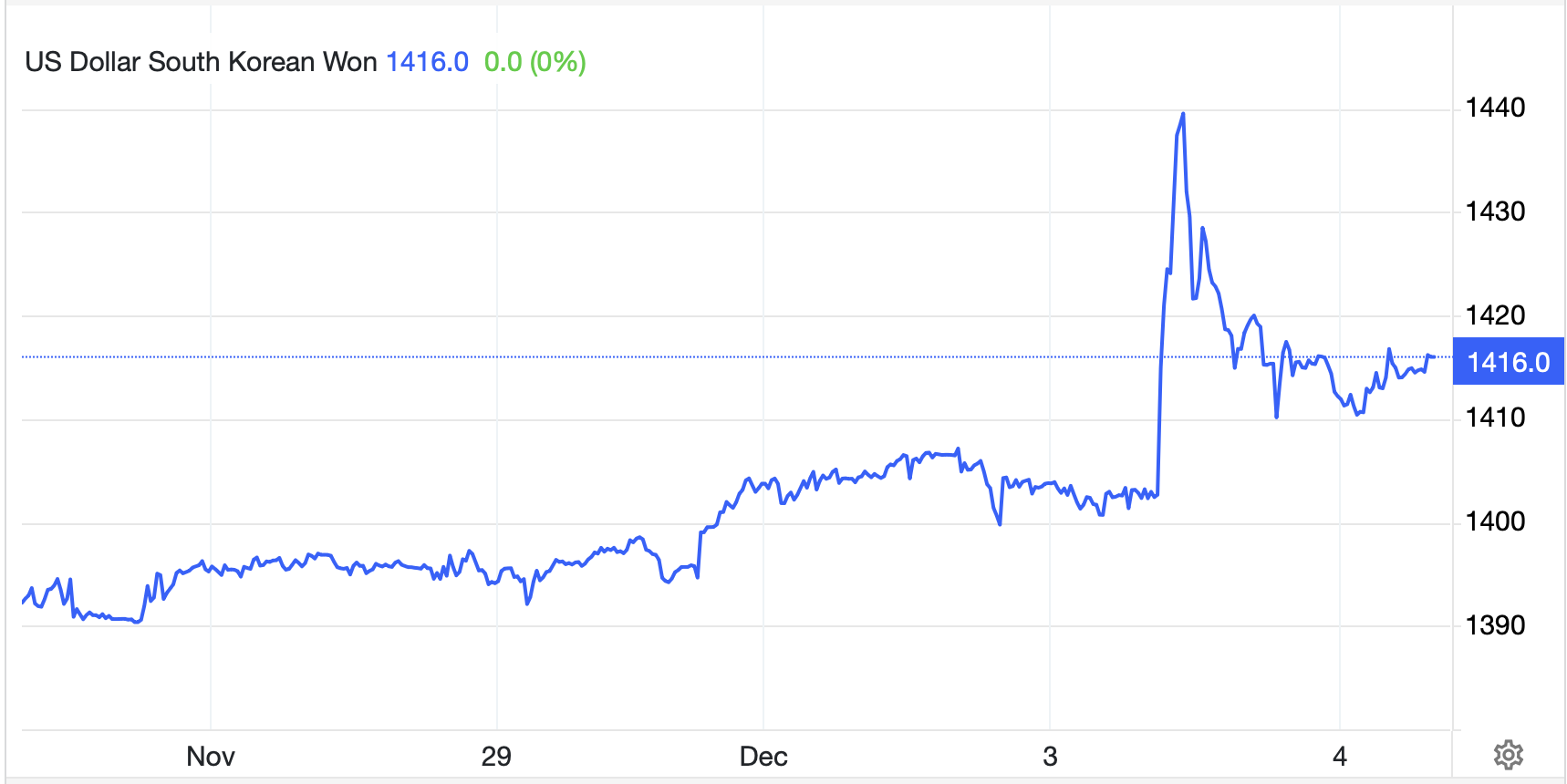
And before I move on to the markets, I cannot ignore the remarkable events in South Korea yesterday, where President Yoon Suk Yeol declared martial law in the early hours on the basis of the opposition’s efforts to paralyze the government (I guess that means they didn’t agree with him).  In the end, the Korean Parliament voted to rescind the order, and the military has since stood down with all eyes on the next steps including likely impeachment hearings for the President.  Not surprisingly, Korean assets suffered during this situation with the won tumbling briefly, more than 2.6%, before retracing the bulk of those losses once the order was rescinded.  

Source: tradingeconomics.com

Too, the KOSPI (-1.5%) suffered although that was off the worst levels of the day after things settled down.  The point to keep in mind here is that markets are subsidiaries of economies.  They may give indications of expectations for the future, or sentiments of the current situation, but if we continue to see geopolitical flare ups, markets are going to respond as investors seek havens.  In this case, the dollar, despite all its flaws, remains the safest choice in many investors’ eyes, so should remain well bid overall.

Ok, let’s look at how markets have been behaving through this current turmoil.  In Asia, given the events in Korea, it ought not be surprising that equities had little traction.  Japanese shares were unchanged as were Hong Kong although mainland Chinese (-0.5%) and Australian (-0.4%) shares were under some pressure.  That said, Australia suffered on weaker than forecast GDP data which puts more pressure on the RBA to cut rates despite inflation remaining sticky.  Australia dragged down New Zealand (-1.5%) shares as well with really the only notable winner overnight being Taiwan (+1.0%).  In Europe, investors seem to be betting on a more aggressive ECB as somewhat weaker than expected PMI Services data has led to gains on the continent (DAX +0.85%, CAC +0.5%, IBEX +0.7%) although UK shares (-0.2%) are not enjoying the same boost.  I guess the French market has already priced in the lack of a working government, hence the market’s underperformance all year.  US futures, at this hour (8:00) are pointing higher by between 0.3% and 0.6%.

In the bond market, yields are rising, with Treasuries (+4bps) leading the way although most of Europe are higher by between 3bps and 4bps.  It has the feel that bond markets are starting to decouple from central banks as they see inflationary pressures building and central banks still in active cutting mode.  I fear this will get messier as time goes on.

In the commodity markets, oil is unchanged this morning, right at $70/bbl, having continued its rally for the week on news that OPEC+ will maintain its production cuts through March 2025.  NatGas (-2.0%) has been sliding since the spike seen 2 weeks ago ahead of the current cold spell as warmer weather is forecast for next week.  In the metals market, gold (-0.2%) seems stuck in the mud right now while silver (-1.3%) and copper (-0.6%) appear to be victims of the dollar’s strength.

Turning to the dollar, it is stronger across the board with AUD (-1.3%) the laggard after that GDP data and it dragged NZD (-1.0%) down with it.  JPY (-1.1%) is also under pressure as hopes for that BOJ rate hike dissipate.  Away from those, the euro (-0.2%) and pound (-0.1%) are softer, but much less so.  In the EMG bloc, ZAR (-0.5%) is feeling the weight of the weaker metals prices and we are seeing BRL (-0.3%) and CLP (-0.1%) also sliding slightly although both are stabilizing after more pronounced weakness earlier in the week.

On the data front, this morning brings ADP Employment. (exp 150K) along with ISM Services (55.5) and then the Fed’s Beige Book.  Perhaps of more importance, at 12:45, Chairman Powell will be speaking and taking questions, so all eyes will be there looking for clues as to how the Fed will be viewing things going forward.  Fed funds futures have been increasing the probability of that rate cut, now up to 74%, which implies we are going to see one, regardless of the inflation story.

Central banks around the world are in a bind as inflation refuses to fall like they want but many nations are seeing slowing economic activity.  In the end, I expect that the rate cutting cycle has not ended, but the dollar is likely to remain well bid given both its haven status and the fact that the US economy is outperforming everywhere else.

Good luck

Adf

Missiles are Flying

Apparently, nerves are on edge
Though pundits, no worries, allege
But missiles are flying
So, traders are buying
Safe havens as they start to hedge
 
So, it cannot be that surprising
The dollar and gold keep on rising
While sales are quite brisk
For assets with risk
Like stocks with investors downsizing


While some of you may be concerned over the news that Russia has launched an intercontinental ballistic missile in an its latest attack on Ukraine (as an aside, since both Russia and Ukraine are in Europe, was it really intercontinental?), by focusing on mundane aspects of life and death, you may have missed the truly important news release from yesterday afternoon, Nvidia’s guidance was disappointing and its stock price declined!  It is for situations like this that I write this morning missive, to make sure you focus on the important stuff.

All kidding aside, the knock-on effects of the escalation of the fight in Ukraine are likely to be more impactful over time, especially for Europe.  Consider the fact that most of Europe has recently been blanketed by a major winter storm with much colder than normal temperatures, and another one is forecast for the coming days.  As well, part of this weather pattern is weaker than normal wind speeds, so much of the continent is suffering a dunkelflaute again.  The energy implications are significant as both wind and solar power are virtually non-existent which means they are hugely reliant on NatGas to both keep the lights on and keep warm.  

However, Europeans continue their energy suicide and have recently closed one of the only domestic sources of NatGas to satisfy their Green tendencies.  This means they will be buying more LNG and competing more aggressively with Asia for cargoes.  While NatGas prices in the US have risen sharply in the past month, ~46%, they remain far below prices in Europe, less than one-quarter as expensive.  It is exactly this reason that an increasing number of companies in Europe are looking to relocate to areas with less expensive energy, like the US, and why investment in the US continues to outpace investment elsewhere.  Look no further than this to understand a key ingredient of the dollar’s ongoing strength.

Of course, there is another story that is dominating the press, the ongoing Trump cabinet picks and all the prognostications as to what they all mean for the future of US policies.  You literally cannot read a story without someone elsewhere in the world quoted as explaining they are awaiting the inauguration to see how things evolve and so they are postponing any new actions.  This is true for both governments and private companies (although obviously, the Biden administration is taking the opposite tack of trying to do as much as possible before the inauguration, like starting WWIII it seems).  

And that is the world this morning, anxiety over the escalation in Ukraine, disappointment that Nvidia didn’t beat the most optimistic forecast expectations and uncertainty over what President-elect Trump is going to do once he is in office.  It is with this in mind that we look at markets and see that the best performances are coming from havens and necessities.  On days like this, risk does not seem as appetizing.

Let’s start in the commodity markets this morning, where oil (+2.0%) is responding to both the Russia/Ukraine escalation and the US veto of a UN ceasefire resolution in Gaza with both of these prompting increased concerns of a short-term supply disruption.  While yesterday’s US inventory data showed some builds, for now, fear is the greater factor.  Meanwhile, NatGas (+6.3%) is skyrocketing amid forecasts for colder weather as a polar blast hits both Europe and the West Coast.  While the longer-term implications of a Trump presidency are for energy prices to stabilize or decline on the back of increased supply, that is not yet the case.  Meanwhile, gold (+0.5%) continues its rebound from its recent correction as havens are clearly in demand.  Remember, too, that almost every central bank remains in easing mode as they all convince themselves they have beaten inflation.

However, a look at equity markets shows a less resilient picture, at least from Asia where we saw the Nikkei (-0.85%) slip after that Nvidia result and the Hang Seng (-0.5%) also feel that pain.  Remember, these indices are very tech focused and Nvidia remains the tech bellwether.  While mainland Chinese shares were little changed, there was weakness in India, Taiwan, Malaysia and Indonesia, as a taste of how things behaved overnight.  Europe, though, is managing to shake off some of its concerns and most markets have edged higher, between 0.2% and 0.4% although the CAC (-0.15%) is lagging.  The latter is somewhat ironic given that French Business Confidence rose more than expected to 97, although that is merely back toward the long-term average of that series.  Arguably, the European move is on the back of US futures, which had been lower all evening but at this hour (7:30) are now all in the green by at least 0.2%.

However, under the heading havens are in demand, bond yields are backing off a bit with Treasury yields lower by -2bps and most European sovereigns lower by between -1bp and -3bps.  The tension in this market remains between recent declines in some inflation readings and growing concerns over the potential inflationary policies that President Trump will enact when he gets into office.  Nothing has changed my view that inflation is not dead and that a grind higher in yields seems the most likely outcome.

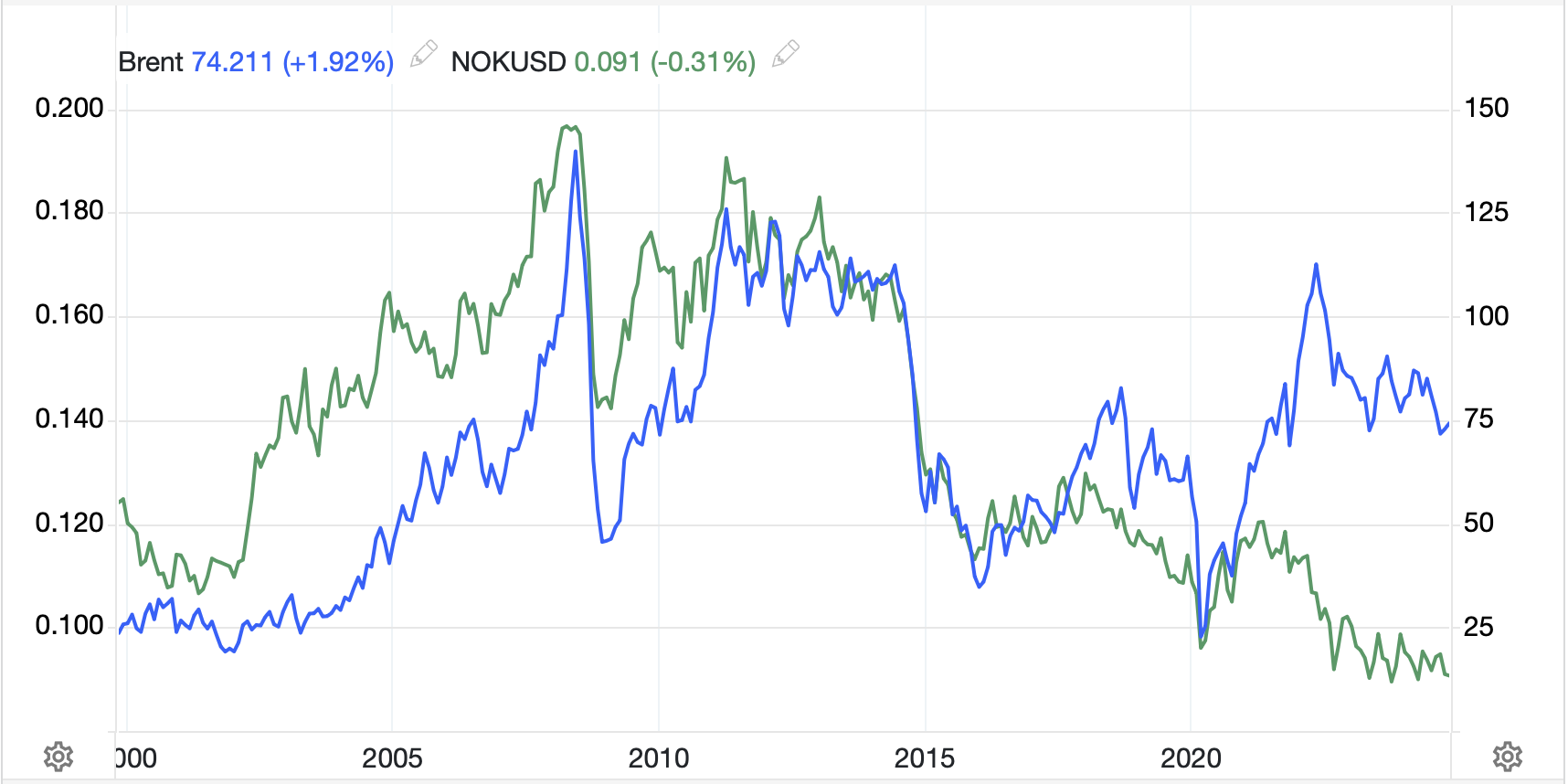
Finally, the dollar continues to find support versus almost all its counterparts, although this morning the yen (+0.5%) is demonstrating its own haven characteristics.  But broadly, the DXY is higher by 0.1% with the euro creeping ever closer to 1.0500 and the pound to 1.2600.  As well, NOK (+0.3%) is benefitting from the oil’s rise. This latter relationship, which makes perfect economic sense given the importance of oil to Norway’s economy, has been quite strong for a long time as can be seen in the chart below.  While daily wiggles may be different, the only true disruption was the start of the Ukraine war where oil jumped massively, and NOK did not follow along given its proximity to the war.  But otherwise, it’s pretty clear.

Source: tradingeconomics.com (NOKUSD is the inverse of what you typically see)

As to the emerging markets, we are seeing weakness in LATAM (BRL -0.8%, MXN -0.5%) as well as EEMEA (PLN -0.3%, CZK -0.5%, HUF -0.5%) although ZAR (+0.2%) seems to be benefitting from the ongoing rise in gold.  Asian currencies were much less impacted overnight and have not moved much at all.

On the data front, this morning brings the weekly Initial (exp 220K) and Continuing (1870K) Claims data as well as Philly Fed (8.0) and then at 10:00 Existing Home Sales (3.93M) and Leading Indicators (-0.3%).  Chicago Fed president Goolsbee speaks this afternoon, but again, it would be quite a surprise if he veers away from Powell’s comments last week.  This morning, the Fed funds futures are pricing a 55.7% probability of that December rate cut, and today’s data seems unlikely to change that.  Next week’s PCE data will be far more important.

It is interesting to see the equity market rebound but there is a huge amount of belief that Mr Trump is going to fix everything.  While I hope his policies improve the situation, and there is much to improve, it will take time before we see any truly positive impacts I believe.  I understand that markets are forward looking, but clarity remains elusive at this time.  The one thing that remains clear to me, though, is the demand for dollars is likely to continue for a while yet.

Good luck

Adf

Half-Crazed

The rest of the world is amazed
And frankly, I think, somewhat dazed
The vote in the States
Deteriorates
Each cycle, as folks turn half-crazed
 
But still, everyone cannot wait
To find out if we will be great (again)
Or if we will turn
The page and thus spurn
The chance to encourage debate


By now, I imagine most of you have figured out my preference for the election outcome and whatever your view, I sincerely hope you don’t hold it against me.  However, if that is the case, so be it.  In the meantime, whatever happened in markets yesterday and overnight just doesn’t matter at all as the opportunity for a major revision of perceptions is so large as to make any price information completely useless, at least in the US markets.

I have seen numerous studies showing the history of how markets behave in presidential election cycles, but I think it is a fair assessment that the current cycle is unlike any previous cycle that we have seen since, perhaps, just before the Great Depression.  Simply consider the massive amount of information that is available to the average person from numerous sources these days compared to anytime in the past.  As such, I don’t put much faith in any of those studies.

Which takes us to this morning.  Do we truly have any idea what the outcome will be?  I would argue not although we all have our favored outcomes.  And that bias, I believe, is deeply embedded in virtually every analysis.  As such, I will not try to analyze.  Rather, I will observe.

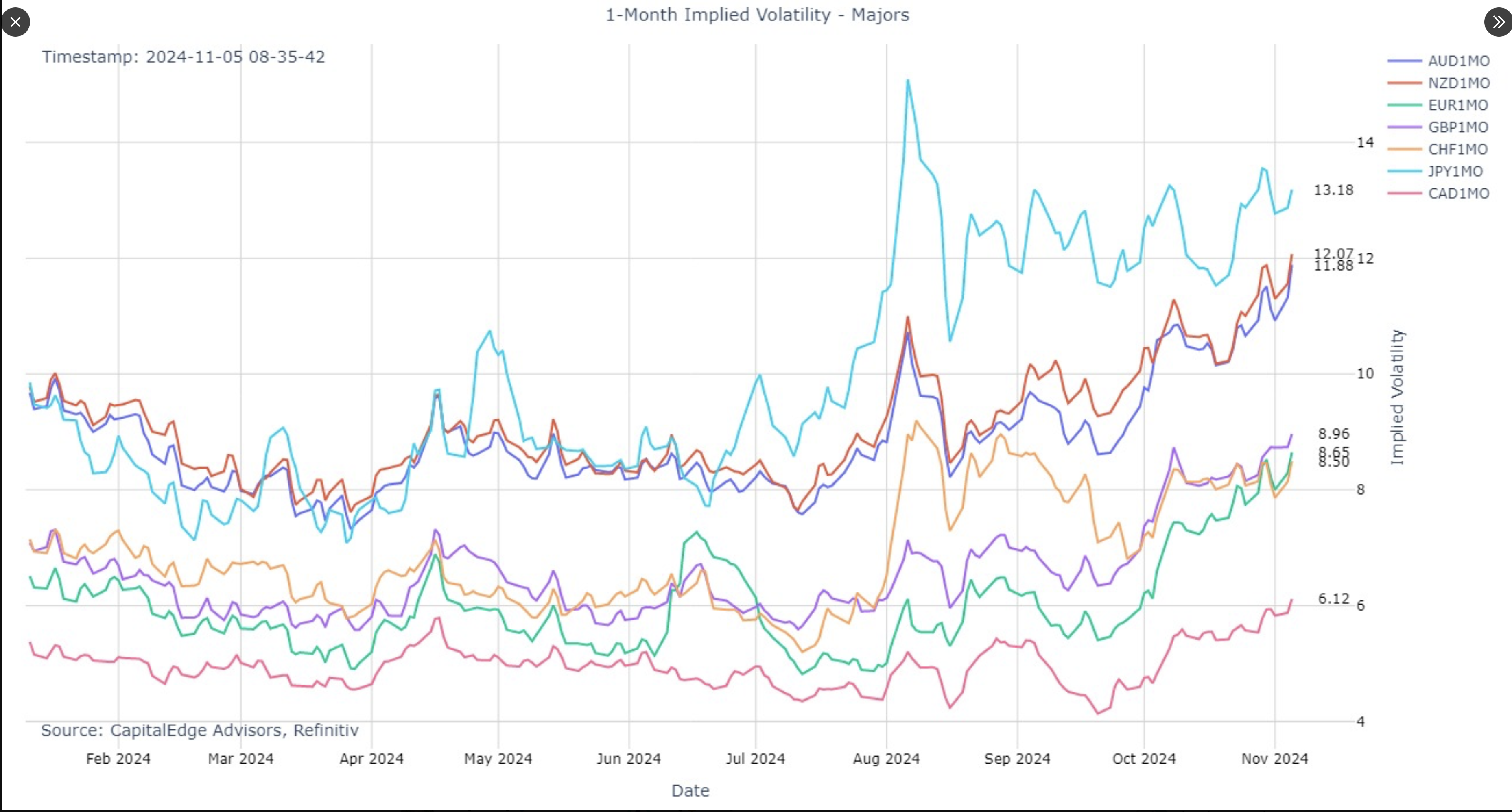
The first observation is that market implied volatility has been rising for the past weeks as the seemingly dramatic differences in policy outcomes depending on the ultimate winner mean market dislocations in either direction are quite possible.  

For example, let’s look at 1-month implied volatility in the major USD currency pairs this year as per the below:

Source: Capital Edge Corner via X

They have been rising steadily since early October as a combination of corporate hedgers trying to protect themselves and hedge funds and traders trying to profit from the dislocation have increased demand steadily.  The one truism here is that upon confirmation of a winner, regardless of the underlying move in the dollar, implied volatility is going to decline.

Much has been made of the ‘Trump trade’ which appears to mean that if Trump wins, the prospects for higher growth and inflation will steepen the yield curve, driving yields higher, while supporting the dollar (much to Trump’s chagrin) as foreign investors flock to US equities.  In fact, the most common explanation for the dollar’s decline over the past several sessions has been that Harris has improved in the polls.  

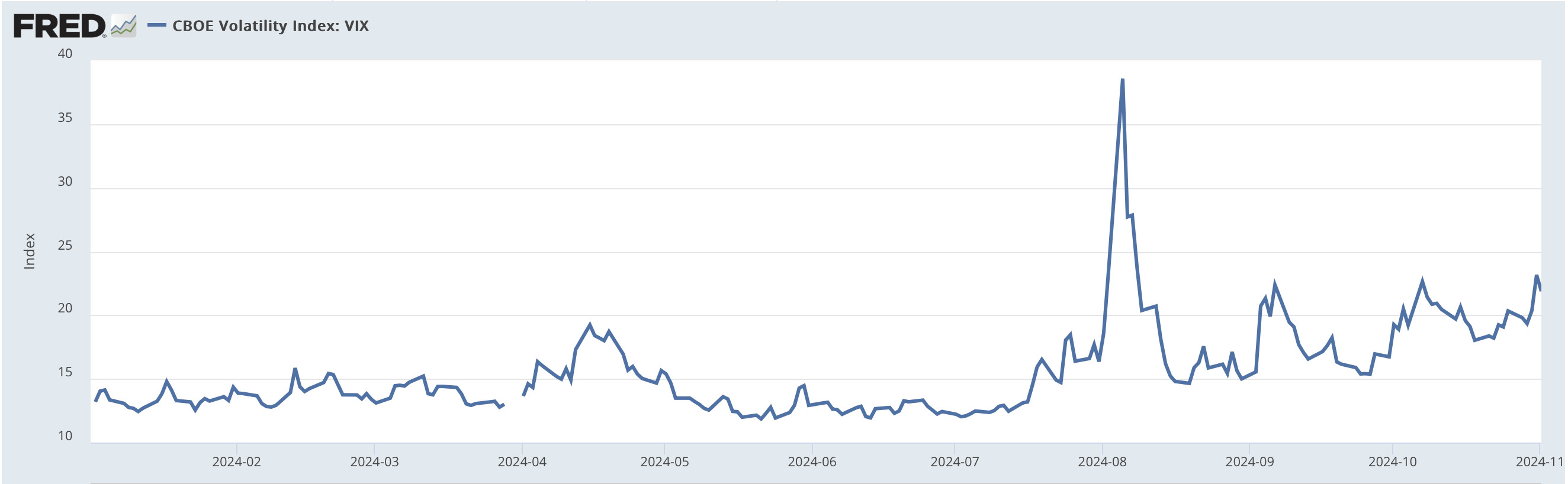
But it is not just the FX markets where implied volatility is rising, look at the VIX below, which is also showing a steady climb over the past two months.

Source: Fred.gov

That spike in August was the almost forgotten market response to the BOJ tightening policy and the -12% decline in the Nikkei just days after the Fed didn’t cut interest rates as many had hoped.  But if you eliminate that event, the trend higher remains intact.

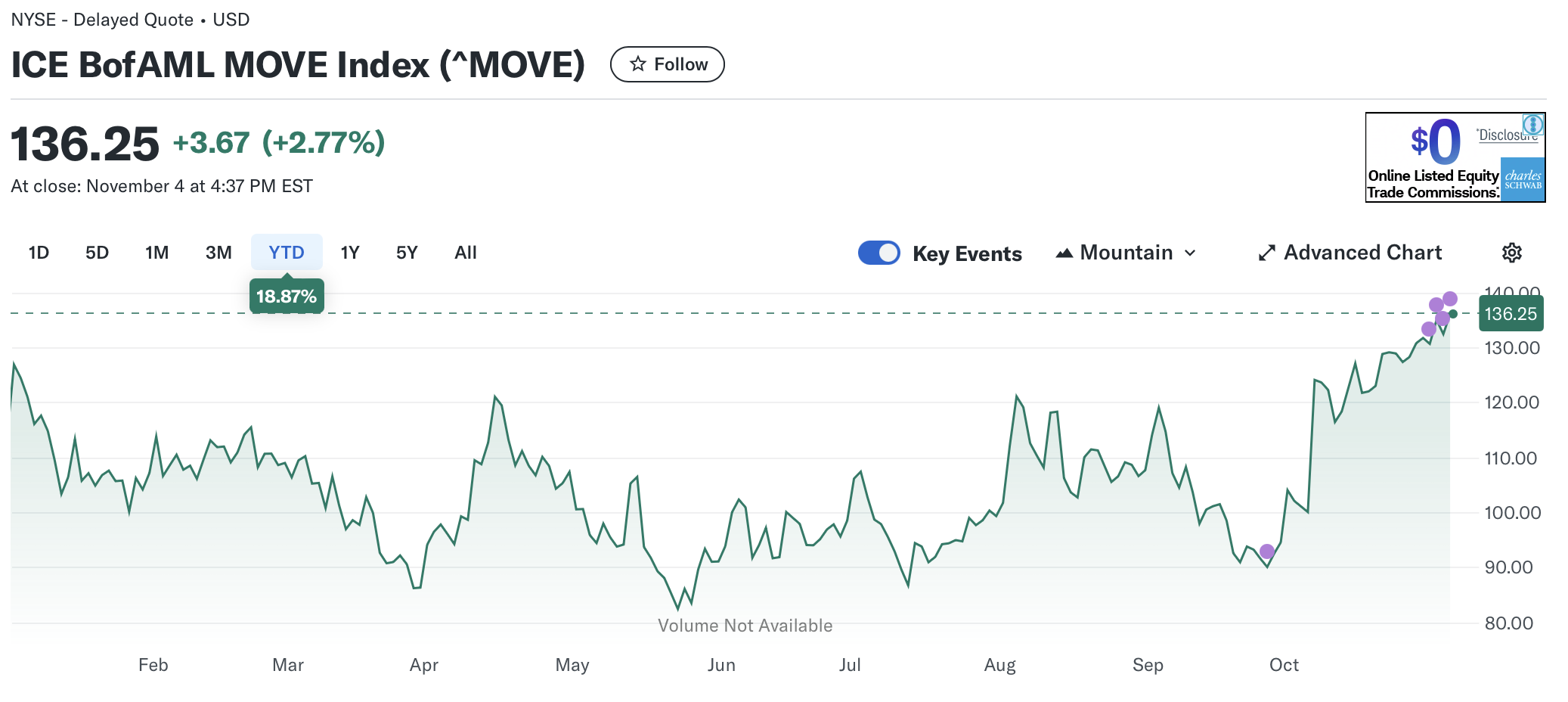
Finally, the MOVE Index, which is the bond market volatility index shows very similar behavior, a steady climb over the past month especially, but truly trending higher since the summer as seen below:

Source: Yahoo Finance

My point is that given the growing uncertainty across all markets as well as the complete inability to, ex ante, determine who is going to win the election, the signal to noise ratio of price movement right now is approximately 100% noise, at least in financial markets.  Commodity markets have a bit of a life away from the election, so price action there is far more representative of true supply and demand issues.  Arguably, this is merely another consequence of the financialization of most things, the loss of market signals as they have been overwhelmed by the flood of liquidity provided by central banks around the world.

At any rate, until we know who wins, it will be difficult to establish a view of the near-term or long-term future of market activity. So, let’s recap the overnight session as its all we have left.

After yesterday’s equity selloff in the US, most Asian exchanges posted gains led by China (+2.5%) and Hong Kong (+2.1%) which responded to comments from Chinese Premier Li Qiang’s comments that, “The Chinese government has the ability to drive sustained economic improvement.”  And perhaps they do, although there are clearly issues regarding the local entities that are willing to gain at the expense of each other in order to demonstrate their own progress.  But Japanese shares (+1.1%) also rallied along with most of the region, perhaps a direct analogy to the US decline as the ‘Trump trade’ has included weakness in markets likely subject to Trump’s promised tariffs.  Meanwhile, in Europe, bourses have edged slightly higher this morning, between 0.1% and 0.2%, with no new data or news of note.  Interestingly, US futures are starting to trade higher at this hour (6:50), perhaps an indication of market beliefs, although just as likely part of the random walk down Wall Street.

In the bond market, Treasury yields (+3bps) are creeping higher again, also in line with the Trump trade, and that seems to be dragging European sovereign yields along for the ride as all those markets have seen yields climb between 4bps and 5bps.  Again, given the lack of new data, and the history of these yields following Treasuries, I see no other strong explanation. 

In the commodity markets, oil (+0.3%) continues its rebound and has now gained more than 6.5% in the past week.  The combination of OPEC+ delaying their planned production increases and seeming hopes for a pickup in Chinese demand on the back of the coming details of the stimulus package seems to have traders in a better mood these days.  As to the metals markets, they are all firmer this morning with gold (+0.2%) mostly biding its time ahead of the election, but both silver (+0.8%) and copper (+0.9%) starting to accelerate a bit.  Nothing has changed my view that regardless of the election outcome, this space is far more dependent on continued central bank policy easing and there is no indication that is going to end soon.

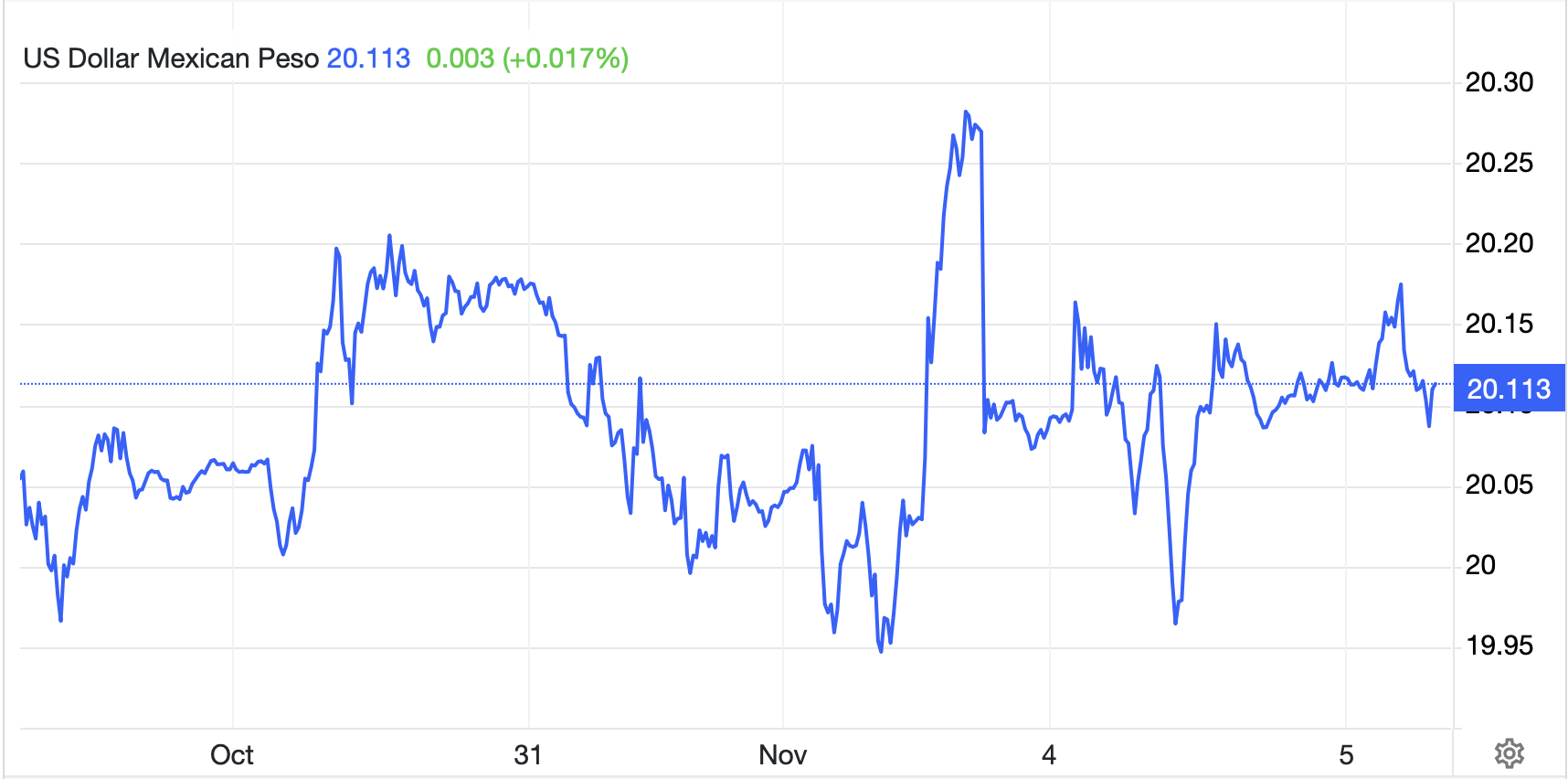
Finally, the dollar is softer again this morning, but in a more muted fashion than the past several sessions.  Although, with that in mind, we still see the euro and pound both climbing a further 0.25% and AUD (+0.6%) today’s leader after the RBA left rates on hold with a more hawkish statement than anticipated.  But the weakness is widespread with NOK (+0.4%) continuing to benefit from oil’s rise while ZAR (+0.6%) gains on the back of the rise in metals.  Of course, the currency that has seen the most discussion ahead of the election is MXN.  It is basically unchanged this morning, a perfect description of the narrative that the election will be extremely close.  However, a quick look at its price movement over the past week shows that it follows every bump in the polls.

Source: tradingeconomics.com

And that’s really it this morning.  We see the Trade Balance (exp -$84.1B) and ISM Services (53.8) but honestly, nobody is going to respond to that data.  Instead, all eyes will be on the early exit polls and the reporting of how the election is going.  No matter what, it seems hard to believe we will really have an idea before 10:00pm this evening, and then only if it is a blowout in either direction, seemingly a low probability.  So, today is a day to watch and wait if you don’t already have hedges in place because honestly, it’s probably too late to do anything now.

Good luck and go vote

Adf

A Brand-New World

Even in Japan
Incumbency is questioned
It’s a brand-new world


Yesterday’s elections in Japan brought about the downfall of yet another incumbent government as people around the world continue to demonstrate they are tired of the status quo.  Recently appointed PM, Shigeru Ishiba called for a snap election within days of his appointment following the resignation of previous PM Kishida on the heels of a funding scandal.  Ishiba’s idea was to receive a fresh mandate from the electorate so he could implement his vision.  Oops!  It turns out that his vision was not in sync with the majority of the population.  Ultimately, the LDP and its key ally, Komeito, won only 215 seats in the Diet (Japan’s more powerful Lower House), well below the 233 necessary for a majority and even further from the 293 seats they held prior to the election.  The very fact that this occurred in Japan, the most homogenous of G10 nations, is indicative of just how strong the anti-incumbent bias has grown and just how tired people are of current leadership (keep that in mind for the US election).

Now, turning to the market impact, the tenuous hold any government formed from these disparate results means that Japan seems unlikely to have a clear, coherent vision going forward.  One of the key issues was the ongoing buildup in defense expenditures as the neighborhood there increasingly becomes more dangerous.  But now spending priorities may shift.  Ultimately, as the government loses its luster and ability to drive decisions, more power will accrue to Ueda-san and the BOJ.  This begs the question of whether the gradual tightening of monetary policy will continue, or if Ueda-san will see the need for more support by living with more inflation and potentially faster economic growth.The yen’s recent decline (-0.25% today, -8.5% since the Fed rate cut in September) shows no signs of slowing down as can be seen from the chart below.  As the burden of policy activity falls to the BOJ, I expect that we could see further yen weakness, especially when if the Fed’s rate cutting cycle slows or stops as December approaches.  If this process accelerates, I suspect the MOF will want to intervene, but that will only provide temporary respite.  Be prepared for further weakness in the yen.

Source: tradingeconomics.com
 
This weekend’s Israeli response
To missile attacks from Iran-ce
Left bulls long of oil
In massive turmoil
As prices collapsed at the nonce

The other major market story this morning was the oil market’s response to Israel’s much anticipated retaliation to the Iranian missile barrage from several weeks ago.  The precision attacks on military assets left the energy sector untouched and may have the potential to de-escalate the overall situation.  With this information, it cannot be surprising that more risk premium has been removed from the price of oil and this morning the black, sticky stuff has fallen by nearly 6% and is well below $70/bbl.  This has led the entire commodity sector lower in price with not only the entire energy sector falling, but also the entire metals sector where both precious (Au -0.6%, Ag -0.9%) and base (Cu -0.2%, Al -1.1%) have given back some of their recent gains.  While declining oil prices will certainly help reduce inflationary readings over time, at least at the headline level, I do not believe that the underlying fundamentals have changed, and we are likely to continue to see inflation climb slowly.  In fact, Treasury yields (+3bps) continue to signal concern on that very issue.

Which takes us to the rest of the overnight activity.  Friday’s mixed session in NY equity markets was followed by a lot more green than red in Asia with the Nikkei (+1.8%) leading the way on the back of both lower energy prices and the weaker yen, while Chinese stocks (+0.2%) managed a small gain along with Korea (+1.1%) and India (+0.8%).  However, most of the other regional markets wound up with modest declines.  In Europe, mixed is the description as well, with the CAC (+0.25%) and IBEX (+0.4%) in good spirits while both the DAX and FTSE 100 (-0.1%) are lagging.  Given the complete lack of data, the European markets appear to be responding to ECB chatter, which is showing huge variety on members’ views of the size of the next move, and questions about the results of the US election, with President Trump seeming to gain momentum and traders trying to figure out the best way to play that outcome.  As to US futures, this morning they are firmer by 0.5% at this hour (7:20).

Although Treasury yields have continued their recent climb, European sovereign yields are a touch softer this morning, although only by 1bp to 2bps, as clarity is missing with respect to ECB actions, Fed actions and the US elections.  My sense is that we will need to see some substantial new news to change the current trend of rising yields for more than a day.

Finally, the dollar is net, a little softer today although several currencies are suffering.  We have already discussed the yen, and we cannot be surprised that NOK (-0.4%) is weaker given oil’s decline, but we are also seeing MXN (-0.3% and back above 20.00 for the first time since July) under pressure as that appears to be a response to a potential Trump electoral victory.  But elsewhere, the dollar is under modest pressure with gains on the order of 0.1% – 0.3% across most of the rest of the G10 as well as many EMG currencies.  There are precious few other stories of note this morning.

On the data front, it is a very big week as we see not only NFP data but also PCE data.

TuesdayCase-Shiller Home Prices5.4%
 JOLTS Job Openings7.99M
 Consumer Confidence99.3
WednesdayADP Employment115K
 Q3 GDP3.0%
ThursdayInitial Claims233K
 Continuing Claims1880K
 Personal Income0.2%
 Personal Spending0.4%
 PCE0.1% (2.1% Y/Y)
 Core PCE 0.1% (2.7% Y/Y)
 Chicago PMI47.5
FridayNonfarm Payrolls180K
 Private Payrolls160K
 Manufacturing Payrolls-35K
 Unemployment Rate4.2%
 Average Hourly Earnings0.3% (4.0% Y/Y)
 Average Weekly Hours34.2
 Participation Rate62.5%
 ISM Manufacturing47.5
 ISM Prices Paid48.2

Source: tradingeconomics.com

Of course, with the FOMC meeting next week, we are now in the Fed’s quiet period, so there will be no more official commentary.  The one thing to watch is if something unexpected occurs, then look for an article from the Fed whisperer, Nick Timiraos of the WSJ.  But otherwise, this is shaping up as a week that starts slowly and builds to the back half when the data comes.

Regardless of the election outcome, I expect that the budget situation will only devolve into greater deficits.  I believe that will weigh on the bond market, driving yields higher and for now, I think that will likely help the dollar overall, but not too much.  It remains difficult for me to see the dollar reverse course lower absent a much more aggressive FOMC, and that just doesn’t seem to be on the cards.

Good luck

Adf