The Time Has Come

(with apologies to Lewis Carroll)

The time has come, the Chairman said,
To speak of many things.
Of joblessness and how inflation,
            Social unrest, brings
And whether we have done our job
            Although we live like kings
 
But wait a bit, the pundits cried
            Before you do explain
For we thought that inflation was
            The overwhelming bane
It was, the Chairman did remark
            But now its jobs that reign


On Friday morning, Fed Chair Jay Powell laid out his vision for the immediate future, and much as many had hoped, he was quite clear in his belief that the inflation mission is accomplished.

A person in a suit and tie

Description automatically generated

Now, many of us remember how that worked out for the last official who exclaimed that concept a bit too early, but hey, maybe this time IS different!  At any rate, during his Jackson Hole speech, the below comments were what got speculative juices quickening, although a quick look at history indicates all may not be well, at least in the risk asset world.  But first to the soothing words of the Chairman [emphasis added]:

The time has come for policy to adjust. The direction of travel is clear, and the timing and pace of rate cuts will depend on incoming data, the evolving outlook, and the balance of risks.”  

“We will do everything we can to support a strong labor market as we make further progress toward price stability. With an appropriate dialing back of policy restraint, there is good reason to think that the economy will get back to 2 percent inflation while maintaining a strong labor market. The current level of our policy rate gives us ample room to respond to any risks we may face, including the risk of unwelcome further weakening in labor market conditions.”

So, why, you may ask, would anything negative occur if the Fed is finally going to cut rates?  After all, lower rates add monetary stimulus and allow companies to borrow more cheaply while allowing individuals to reduce their borrowing costs and afford more stuff, like cheaper mortgages making houses more affordable.  But under the rubric, a picture is worth a thousand words, the following chart purloined from X in @allincapital’s feed, does an excellent job of highlighting how equity markets have performed after the Fed pivots to cutting rates.

A screenshot of a graph

Description automatically generated

You may have notices that each pivot led to a substantial decline in the S&P 500.  Of course, if you think it through, the basic reason the Fed is pivoting is because the economy is typically heading into, or already in, a recession.  And there has never been a recession when corporate earnings rose across the board. 

This is the crux of the recession argument.  If those who are convinced we are already in a recession are correct, then the prospects for risk assets are dour at best.  On the other hand, for those who remain pollyannaish and believe that the data continues to point to economic strength, the first question is, why should the Fed cut?  And the second question is, why is the data showing rising unemployment, which has an almost perfect correlation of occurring during recessions, not indicating a recession this time?

One last thing, inflation.  You remember that bugaboo, the thing that has had the Fed’s undivided attention for the past two plus years.  Well, given that the money supply has resumed its growth, and money velocity continues to rise, while Chairman Powell has convinced himself that he won the battle, so did Chairman Arthur Burns…three times!  Friday, the equity bulls were in the ascendancy and the market moved to price a 36% chance of a 50bp cut in September with 100bps priced in for the rest of the year while the major indices all rose > 1%.  Personally, I’m a bit wary.

But enough of Friday.  It will take a great deal of new and contradictory information to change the narrative now with the next real chance the NFP report to be released on September 6th.  In the meantime, let’s see what happened overnight.  There was very little in the way of data or activity with only German Ifo readings showing a continuation in their trend lower, printing at 86.6.  It has become increasingly difficult to look at Germany, and its place within Europe as the largest economy by far, and not be concerned over the entire continent’s economic situation.  Energy policies around the Eurozone have hamstrung the economy significantly, and there is no indication that this is either recognized, or if it is, of concern to the governments across the continent.  I understand the short-term view that the Fed is going to start cutting rates and that the dollar has the opportunity to decline because of that, but the longer-term prospects for the euro seem far more dire, at least to my eyes.

Ok, let’s see how markets are handling the unmitigated joy of the Fed finally doing what everyone was so fervently wishing them to do.  In Asia, the Nikkei (-0.7%) didn’t get the bullish memo, likely suffering on the yen’s strength (+1.3% Friday, +0.2% this morning) which started on Friday, right as the Powell speech began.  However, the Hang Seng (+1.0%), India (+0.75%) and Australia (+0.8%) all followed the US movement.  Alas, mainland Chinese shares (-0.1%) continue to lag as the PBOC left rates on hold last night, although some were hopeful of another cut.  In Europe, Germany (-0.3%) is the laggard this morning, not surprisingly given the Ifo data, but overall, markets are moving very little with only the FTSE 100 (+0.5%) showing any life as the only market there following the US.  As to US futures, at this hour (7:10) they are essentially unchanged.

In the bond market, Treasury yields are unchanged this morning, but did fall 5bps on Friday.  In Europe, sovereign yields have all rebounded 2bps, basically unwinding the Friday declines seen in the wake of the Powell comments.  In truth, this is surprising given the lackluster data that was released from Germany, but markets can be that way.  As to JGB yields, they slipped 1bp lower overnight, still not showing any evidence that there is concern the BOJ is going to tighten policy substantially going forward.

In the commodity markets, oil (+2.6%) is rocketing higher after Israel initiated a pre-emptive attack on Hezbollah in Lebanon and Hezbollah responded.  While the WSJ headline is that both sides are now trying to de-escalate things, the oil market, which has seemingly been underpricing risks of a greater supply disruption, has woken up to those risks this morning.  Arguably part of that wakening was the fact that Libya just declared force majeure and has stopped pumping oil because of internal conflict over the central bank and its use of monetary reserves.  Hence, a supply disruption!  Remember, though, the Saudis have a decent amount of spare capacity to fill in if prices start to rise “too” quickly.  

In the metals markets, green is today’s theme with gold (+0.6%) continuing to show its luster as a haven asset.  Meanwhile, silver (+0.9%) has been gaining rapidly amidst stories that China is hording it along with stories that there is not enough silver around to meet the plans for all the solar panels that are still expected to be built.  This movement is dragging copper and aluminum higher as well.

Finally, the dollar is slightly higher this morning overall, although there are some reasonably large movers in smaller currencies.  Surprisingly, NOK (-0.9%) is under pressure despite the big move in oil price higher.  As well, NZD (-0.5%) has slipped, but that was after a very sharp rally on Friday of nearly 2% which seemed to be based on the Fed rate cut story, although NZD responded far more aggressively than any other currency.  We are also seeing weakness in MXN (-0.4%) and SEK (-0.5%) while the euro (-0.2%) and pound (-0.2%) hold up slightly better.  ZAR (-0.1%) may be the best performer today as the metals’ strength seems to be offsetting the dollar’s own strength.

On the data front, there is a decent amount of new information culminating in the PCE data on Friday.

TodayDurable Goods5.0%
 -ex transport-0.1%
TuesdayCase Shiller Home Prices6.0%
 Consumer Confidence100.6
ThursdayInitial Claims234K
 Continuing Claims1870K
 Q2 GDP (2nd look)2.8%
 Goods Trade Balance-$97.5B
FridayPCE0.2% (2.5% Y/Y)
 Ex food & energy0.2% (2.7% Y/Y)
 Personal Income0.2%
 Personal Spendinmg0.5%
 Chicago PMI45.5
 Michigan Sentiment68.0

Source: tradingeconomics.com

In addition to the data, we hear from Fed Governor Waller and Atlanta Fed president Bostic but given that Powell just basically gave the market the roadmap for the Fed’s thinking, it would be surprising if either one changed anything at all.  And given the next really important data point is NFP at the end of next week, Fed speak is likely not that important right now.

At this point, Powell has explained what the Fed is going to do, so the data will help traders and investors adjust the amount of risk they want to take, at least until the point where a recession is more obvious.  Maybe Powell will have successfully prevented a recession, but I still believe the odds are against him.  With that in mind, though, I expect the dollar will remain under pressure for as long as the market believes that Powell is going to cut more aggressively than everybody else.

Good luck

Adf

Scuppered

There once was a time many thought
That equities had to be bought
Then, darn it, Japan
It scuppered the plan
And havoc is all that they wrought
 
So, last week, not greed, but fear, won
And risk assets ended their run
But now folks are sure
In fact, it’s de jure
That rate cuts, next month, are, deal, done


Congratulations everyone.  You made it through the end of the world!  I must admit, though, that on this side of that extraordinary event, things don’t really seem that different.  A quick recap reminds us that on July 31st, the BOJ surprised markets and raised interest rates by 15bps, taking their overnight funding rate to 0.25%, its highest level in 15 years.  Twelve hours later, the FOMC did not cut rates, as some had been advocating, but seemed to promise that a cut was coming in September.  Then, two days later, the US employment report showed substantially weaker jobs activity than expected.  Over the ensuing several sessions, USDJPY declined dramatically, falling nearly 10 big figures as can be seen in the first chart below.

A graph with numbers and a line

Description automatically generated

Source: tradingeconomics.com

After an initial reflexive trading bounce, it was starting to slide again when, on August 6th, BOJ vice-governor Ichida explained that the BOJ would not, in fact, be aggressively tightening policy immediately.  The result was a relief rally and now USDJPY sits about halfway between the level prior to the rate hike and the low’s plumbed afterwards.

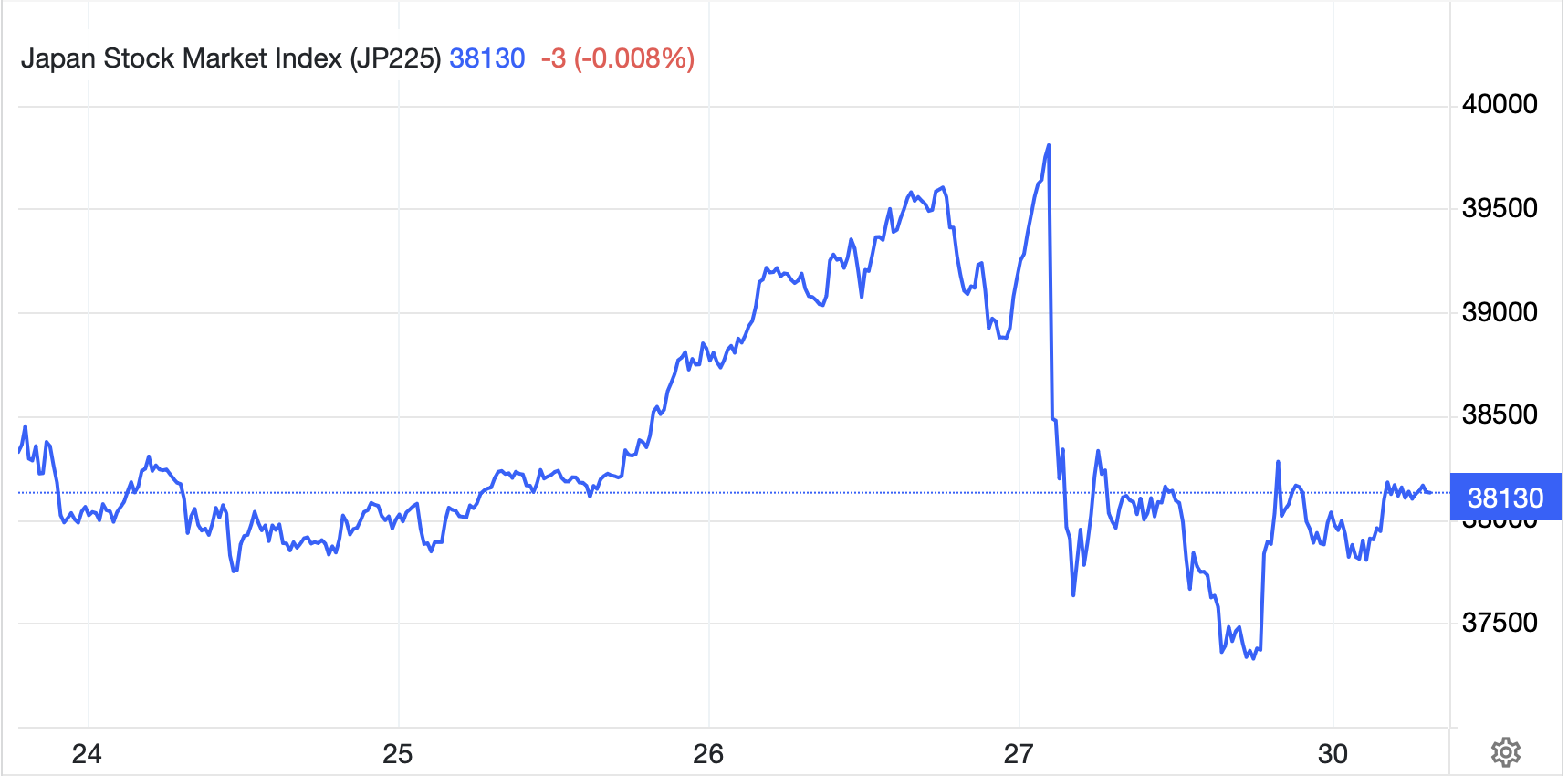
Perhaps just as interesting is the fact that the Nikkei 225 showed virtually the identical trading pattern, with its decline last Monday, August 5th, as the second largest single-day decline in its history.

Source: tradingeconomics.com

And yet, it is not hard to see that the trading pattern for both the Nikkei 225 and USDJPY are virtually identical, with the same catalysts.  In fact, we can look at other markets, 10yr Treasury yields and the NASDAQ come to mind, and see extremely similar price action.  (Alas, I couldn’t get the BOJ and Unemployment rate points on the combined chart, but you can see it is the same pattern.)

A graph of stock market

Description automatically generated

Source: tradingeconomics.com

The one truism that holds is that during a time of stress, all correlations go to one!

But perhaps it’s time to consider, once again, the idea of recession.  As of now, there are still two camps:

  1. Recession is already here and started sometime in the late spring.  This is based on the declining trend in manufacturing activity, the rise in the unemployment rate (the Sahm Rule), the rising number of bankruptcies and increasing size of household debt along with delinquencies.  Constant downward revisions of previous data releases also weigh on the view, and of course, the yield curve continues to point to lower interest rates going forward, the implication being growth is slowing.  One last feature is the dramatic difference between GDP and GDI, two different measures of US economic activity that should show the same thing, however currently, GDI (Gross Domestic Income) is printing below 1% real growth.
  • Meanwhile, the soft/no-landing scenario remains popular amongst a different set of analysts.  Perhaps the most comprehensive discussion comes from Apollo Research’s Torsten Slok as he highlights the fact that real-time indicators like air travel, restaurant seatings, income tax withholdings and Retail Sales remain quite strong.  As well, the Atlanta Fed’s GDPNow is currently running at 2.9%, which certainly doesn’t appear to be pointing to a recession.

So, which is it?  Of course, that’s the $1 trillion question.  However, let us consider a few incontrovertible truths.  First, business cycles still exist.  Despite all the efforts by finance ministries and central banks to create an ever upward trajectory in economic activity, or more accurately because of those efforts, excesses are created and at some point, that growth is no longer sustainable.  In other words, governments and central banks blow bubbles and eventually they pop.  Second, not all parts of the economy grow at the same pace and respond to the same catalysts in a similar manner.  So, certain parts of the economy may be under pressure while others are doing fine.  Third, trees don’t grow to the sky.  There are no magic beans which grow that beanstalk ever higher.  Rather, at some point, gravity becomes a stronger force, and things return to earth. 

From this poet’s viewpoint, we are continuing to see sectoral weakness that has not yet tipped into general weakness.  We’ve all heard about commercial real estate and the problems ongoing in that sector.  As well, we’ve all heard the excitement about AI and the massive (over)investment that has been focused on that sector, supporting the companies at the heart of the story.  In between, there are many shades of grey with some areas holding up better than others.  But on an economy-wide basis, it seems likely that given the amount of ongoing fiscal stimulus that is still being pumped into the economy, overall, a recession will still be delayed further.

Perhaps the bigger problem for the economy is that inflation remains a very real phenomenon. As the WSJnoted this morning, it is the prices of things with which we cannot do without (e.g., food, shelter, insurance) that continue to rise, rather than the discretionary items, which seem to see prices ebbing.  Ultimately, the downturn will come, but you can be sure that the government, and the Fed, will do all they can to prevent it happening, at least before the election.

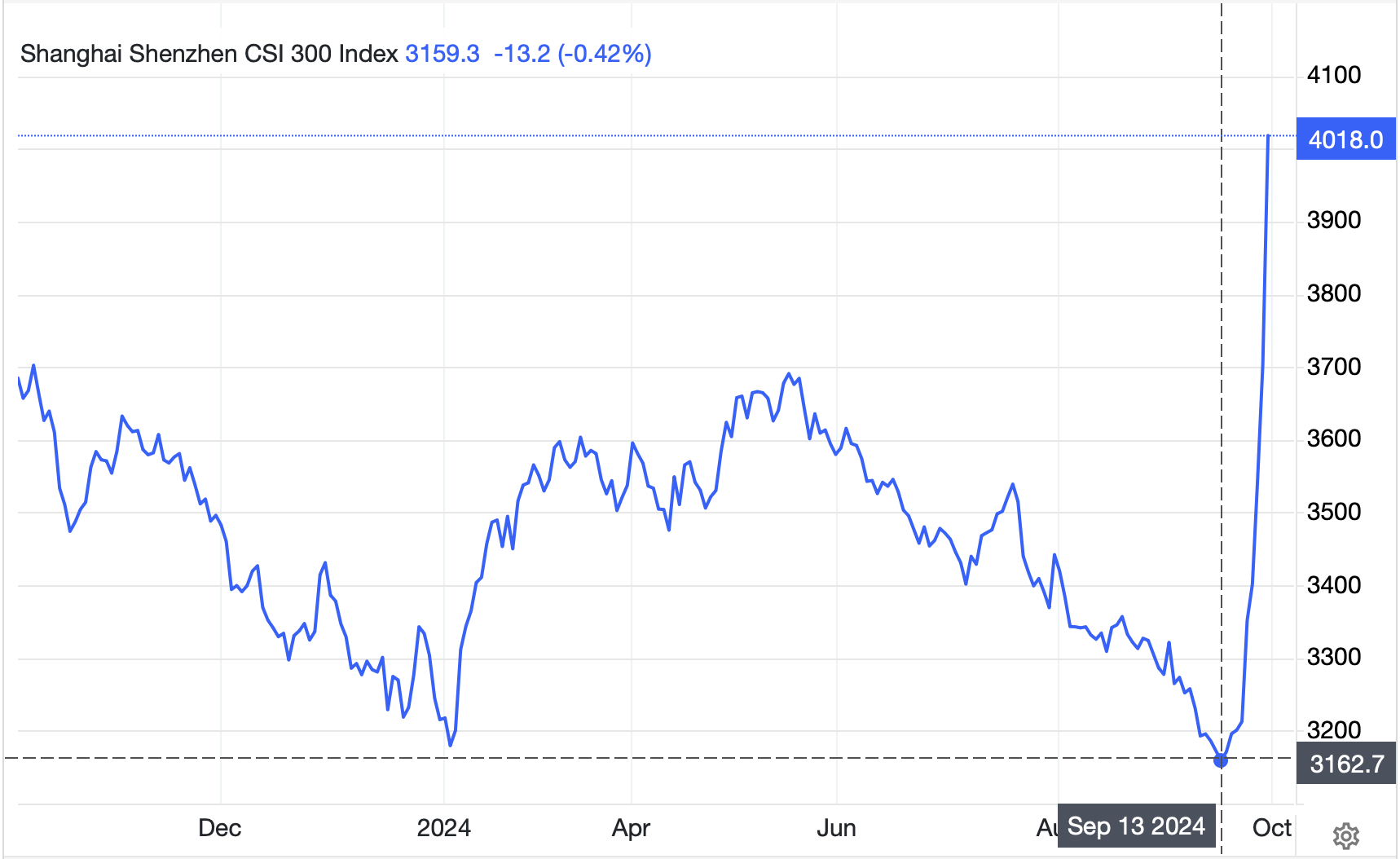
Ok, with that in mind, let’s look at markets overnight as well as what this week’s data releases will bring.  After modest gains in the US on Friday, with the early part of last week’s dramatic declines essentially elimiated, Asian equity markets were generally stronger (Korea, Taiwan, Australia) although Chinese shares continue to lag (CSI 300 -0.2%) as data showed that investment into China has turned to divestment from China for the second quarter of the past four. (see chart below).  This is obviously not a positive story for the Chinese economy or its equity markets.  As an aside, Japanese markets were closed for a holiday last night.

A graph of a graph showing the value of a stock market

Description automatically generated with medium confidence

Source: Bloomberg.com

Meanwhile, European bourses are generally little changed, +/-0.15% or less except for the UK, where the FTSE 100 is higher by 0.5% despite hawkish comments from BOE member Catherine Mann warning against complacency on inflation and pushing back against the idea of consistent interest rate cuts.  Lastly, US futures are edging higher at this hour (7:15), up about 0.2% across the board.

In the bond market, yields are edging back up this morning, with Treasuries higher by 2bps and similar gains across all of Europe.  To the extent that government bonds are serving as havens again, the idea that equity markets are rebounding would certainly imply less demand for them.  The one place where yields continue to decline is in China, where 10-year yields are trading near the historic lows seen at the end of July, and clearly still trending lower, an indication that growth expectations are falling.

A graph with a line graph

Description automatically generated

Source: tradingeconomics.com

In the commodity markets, oil (+1.25%) is gaining on the growing expectation that Iran is set to finally respond to Israel and launch a significant assault with fears this can grow into a wider conflagration and impact supply.  That fear seems to be bleeding into gold (+0.5%) as well, which is back toward its historic highs, and taking the entire metals complex (Ag +1.8%, Cu +1.1%) with it.

Finally, the dollar is mixed this morning, rising strongly against the yen (-0.7%) and CHF (-0.5%) but lagging the commodity currencies (AUD +0.5%, NZD +0.5%, ZAR +0.6%).  As to the more financial currencies, like EUR, GBP, CAD, they are little changed on the session.  Ultimately, the story remains driven by expectations of Fed activity with the market currently pricing a 50:50 chance of a 50bp rate cut come September.

On the data front, we do see important things this week as follows:

TodayNY Fed Inflation Expectations3.0%
TuesdayNFIB Small Biz Confidence91.7
 PPI0.1% (2.3% Y/Y)
 -ex food & energy0.2% (2.7% Y/Y)
WednesdayCPI0.2% (2.9% Y/Y)
 -ex food & energy0.2% (3.2% Y/Y)
ThursdayInitial Claims235K
 Continuing Claims1880K
 Retail Sales0.3%
 -ex autos0.1%
 Empire State Mfg Index-6.0
 Philly Fed7.0
 IP0.1%
 Capacity Utilization78.6%
FridayHousing Starts1.35M
 Building Permits1.44M
 Michigan Sentiment66.7

Source: tradingeconomics.com

In addition, we hear from several Fed speakers, with at least three on the docket, but I imagine we will get more than that.  Last week’s fears have been memory-holed.  The vibe this morning is that it was all the BOJ’s fault and that everything is going to be great.  Maybe that will be the case, but I remain a skeptic.  Just consider, if everything is great, why would the Fed cut rates?  And the one thing that seems clear to me is that a Fed rate cut is the base case for virtually everyone. I maintain if they cut, especially 50bps, the dollar will fall sharply.  But if that recession data doesn’t start to appear soon, some folks are going to need to change their views, and positions, regarding how things unfold.

Good luck

Adf

A Stock Jamboree

Said Jay, there are two goals we seek
Strong job growth while prices are weak
And as I sit here
The way things appear
Come autumn, Fed funds we may tweak

The market responded with glee
Twas truly a stock jamboree
Plus, bonds joined the fun
And went on a run
The dollar, though, sank in the sea

At this point, the only question in market participants’ minds is whether the Fed will cut 25bps or 50bps in the September meeting.  Yesterday afternoon, as widely expected, the FOMC left rates unchanged and tried to offer a balanced view of the future, explaining that both of their dual mandate goals were normalizing.  Obviously, inflation, which has been their primary focus for the past two years, has been moving in the right direction and Chairman Powell reiterated that they are gaining ‘confidence’ that they will achieve their 2% target.  But this time, Powell spent more time describing the job market and how it was now coming into balance.  In other words, what had previously been a significant inflationary pressure in the Fed’s collective view, was now having less of an impact on prices.

At the press conference, Powell would not be pinned down on a September cut, although based on pricing in the Fed funds futures market, you would be hard pressed to believe that.  This morning, the market is pricing more than 28bps of rate cuts (a 13.5% probability of a 50bp cut) into the September meeting, so the key will be to watch how that probability of a 50bp cut evolves.  If we start to see hard data, like tomorrow’s NFP or CPI, in two weeks’ time, decline, I’m confident that the market will be calling for a 50bp cut before long.

In the end, the recent correction seen in risk asset markets seems to have been just that, a correction, and now the narrative is that there are blue skies ahead with lower rates to support things and the Fed is going to stick the soft landing.  This poet is less certain that the best case will obtain, but that’s what makes markets.

So, even though we have not yet heard from the third major central bank as I write (the BOE is due to announce in a few hours’ time), I don’t think that is going to impact the global narrative.  Let me start by saying that I believe they will cut rates in the UK as yesterday’s activities in the US make it all but certain a cut is coming here, and given the ECB, BOC and Riksbank have all cut already, they have plenty of company.  However, let’s recap where things are now and what the market narrative is now explaining to us all.

Policy normalization is the new watchword as we hear that the BOJ is normalizing policy by raising interest rates and tightening while the rest of the G10 are normalizing policy by cutting rates and ending activities like QT.  I guess the definition that the punditry ascribes to normal policy is, every country has the same interest rate!  In fact, I say that only half tongue in cheek, as there is some merit to the discussion.  While it is certainly true that global economies have evolved in greater synchronicity over the past decades, interest rate policy has always been based on the idiosyncrasies of each economic area.  For instance, money supplies and productive capacities differ widely amongst countries, so why should we believe that the “proper” monetary policy is the same level of interest rates across the board.  Of course, we shouldn’t, but for market participants, it is much easier if they have one target for everything rather than being forced to understand each economy in its own right.

But with that in mind, let’s recap where things currently stand around the major economies.

1.     US – economic activity is slowing, but the pace of that slowdown is very modest, at least based on the recent GDP reading.  Inflation is slowly receding but has not yet achieved the Fed’s target and the jobs market has, to date, held up reasonably well.  Of course, we will know more about that tomorrow.  On the flip side, the manufacturing portion of the economy has been the laggard, with PMI and regional Fed surveys pointing to subpar activity.  There seems to be a disconnect between the slowing economy and the roaring equity market, but markets have a life of their own.
2.     Europe – economic activity overall is modest with a reversal in the weak vs. strong players as Germany is the sick man of Europe and the PIGS economies are all faring far better.  Inflation here is a bit stickier than it seems in the US as evidenced by yesterday’s higher than expected readings and remains well above the 2% target here.  Most nations are seeing more substantial weakness in their manufacturing sectors, although for some (I’m looking at you Germany) it is self-inflicted based on insane energy policies driving energy costs much higher.
3.     Japan – recent growth signs have been quite poor with a negative GDP release just last week indicating things are not going well.  This has been accompanied by above target inflation, which while seeming to slow, is slowing very gradually.  In fact, this is the one place where the FX rate seems to really have had an impact, with the yen’s previous weakness adding to inflationary pressures and offsetting their very modest monetary policy tightening.  However, the combination of the BOJ hiking and the Fed seeming to promise a cut has led the yen to recoup nearly 8% over the past several weeks and now that USDJPY is below 150, I expect to see this move continue.  That should help ameliorate some of the inflation pressures, although it is not clear to me it will help economic growth.
4.     China – last night’s Caixin Manufacturing PMI was a disappointing 49.8, down two points and below expectations.  The indication is that economic activity in China remains hampered by the lack of consumer activity.  China’s long-term policy of mercantilism is running into its limits as nations around the world are unwilling to take their excess production freely, and the domestic economy remains in the doldrums, still suffering from the ongoing deflation of the property bubble.  While the PBOC did reduce interest rates recently, the fact that neither the Third Plenum nor the Politburo were willing to inject real stimulus into the economy indicates that things are going to remain lackluster going forward.

Arguably, the lesson from this recap is that economic activity is in a downtrend and that inflation is also in a downtrend, just a shallower one.  Policy makers around the world are struggling to find the right mix because oftentimes, the right mix means something politically difficult.  Net, I expect this process will continue and that we will see more and more efforts to turn around the economic trend while ignoring the inflation trend.

Ok, this has turned into more than I expected, so let’s be quick on markets today.  Yesterday’s Fed led to a huge tech sector rally in the US but that was not enough to help the rest of the world.  Despite that optimism, Japanese shares (-2.5%) were down sharply on the continued strength of the yen, while Chinese shares, in both Hong Kong (-0.25%) and the mainland (-0.7%) saw no love either.  In fact, the whole region was under water.  The same is true in Europe this morning with all the continental bourses lower on average by -0.65% or so after continued weak PMI data was released this morning.  The only exception here is the UK, where the FTSE 100 is now higher by 0.3% after the BOE, as I expected, cut rates by 25bps at 7:00am.  As to US futures, euphoria is still alive and they are all higher at this hour, just past 7:00.

In the bond market, yields are declining around the world led by Treasury yields which fell 10bps yesterday, although they have rebounded by 2bps this morning.  2yr yields also fell a similar amount so the yield curve’s inversion remains at -23bps this morning.  In Europe, yields also slid yesterday, albeit not as much as in the US and are a further 2bps lower this morning as they try to catch up.  The exception here is the UK, again, as 10yr Gilt yields are lower by 5bps this morning in the wake of the BOE cut.  JGB yields overnight fell 1bp, although given the move in Treasury yields, that gap has still narrowed substantially.

In the commodity markets, oil (+0.9%) continues to rally as fears over an Iranian retaliation against Israel grow with no clear idea where this will stop.  Consider, though, WTI remains below $80/bbl still, so right in the middle of its longer term range.  I imagine we could see a bump higher, but remember, OPEC has a lot of spare capacity, so if some countries are forced to stop producing, the Saudis can turn on the taps.  Gold (-0.4%) is backing off the new all-time highs it reached yesterday, but remains far above $2400/oz.  In fact, all the metals markets saw gains yesterday and this morning they are ceding some of those gains, but I don’t think this story has changed; if the Fed gets more aggressive, I expect these commodity prices to rise further.

Finally, the dollar is on fire this morning, rallying against everything but the Swiss franc right now.  The pound (-0.7%) is under the most pressure in the G10 after the rate cut, but we are seeing weakness everywhere else but Norway and Switzerland.  Even the yen, which had broken through the 150 level earlier this morning is now back below (dollar above) that level, although I expect there are further declines to come here in the dollar.  One other surprisingly large mover is CNY (-0.4%) which has given back more than half its gains from the activities last week involving the PBOC rate cuts and intervention.  Remember, if the yen continues to strengthen, the renminbi will be able to do so at a very gradual rate and maintain increased competitiveness vs. Japanese exports.

On the data front, this morning brings Initial (exp 236K) and Continuing (1860K) Claims, Nonfarm Productivity (1.7%), Unit Labor Costs (1.8%) and ISM Manufacturing (48.8).  Remarkably, there are no Fed speakers on the schedule, but I imagine they will not be able to keep quiet for long.  However, while there is a definite glow amongst investors, all eyes will turn to tomorrow’s NFP data, where a hot number will not be taken well, at least not at first, but if we print below NFP expectations, look for stocks to rock on a growing expectation of 50bps in September.  That will also hurt the dollar, which should retrace some of today’s gains.

Good luck
Adf

A Shocking Surprise

On Wednesday the data was dreck
On Friday, twas more of a wreck
The read’s now that growth
Is set for more slowth
Will this break the Fed’s bottleneck?
 
Meanwhile, in a shocking surprise
In France, tis the Left on the rise
But no party there
Is willing to share
Their power and reach compromise
 
And while day-to-day matters greatly
The populists, worldwide, are lately
Ascending to power
And ready to shower
Their voters with cash profligately


This morning, the world is a very different place than it was when I last wrote.  Broadly speaking there are three key stories of note; US data was much weaker than expected, the French election surprised one and all with the coalition of hard-left parties winning the most seats, although no group is even close to a majority of the French parliament, and the questions over President Biden’s capacity to remain on the job, let alone his ability to be president for the next four years, have been coming fast and furious from the mainstream media, many Democrats in Congress and the Democratic donor base.

So, let’s address them in order.  On the US data front, arguably the best release was the Trade Balance printing at a slightly smaller deficit than forecast by the Street.  Otherwise, ISM Services was miserable at 48.8, Factory Orders fell -0.5%, -0.7% ex Transport, and Initial and Continuing Claims both rose to new high levels for the cycle.  And that was just Wednesday.  On Friday, while the headline NFP number did beat forecasts, once again, there were major revisions lower to the past 3 months, -111K, the Unemployment Rate rose to a new high for the cycle at 4.1%, its highest level since November 2021 and a continuation of the recent uptrend in the data.  A look at the chart below seems to show a defined trend higher in the Unemployment Rate, and as I explained last week, this is a statistic that tends to have momentum once it gets going.  I would argue this number is going to continue to climb higher as the year progresses.

Source: tradingeconomics.com

As well, the biggest piece of the report was an increase of 70K Government jobs, compared to just 136K Private sector jobs and a loss of -8K in Manufacturing.  The one thing we know is that government jobs do not add to economic growth as they are the least productive of all.  

The upshot is that based on the data from Wednesday and Friday, the story of still strong growth in the US has clearly been called into question.  Will Powell, who testifies before Congress this week, pay homage to the weaker data and hint that perhaps higher for longer has reached its sell-by date?  While this is only one set of data, and he has been adamant that he needs to see several months of data, the market is becoming more convinced that a September rate cut is coming as the Fed funds futures probability of that cut has risen to 75%.  It should be an interesting week given both the CPI release and the Powell testimony.

On to the French and what was truly a shocking outcome, at least on one level.  After the first-round last week, the abject fear by the press in France, and all of Europe, of the idea that a right-wing government could come to power in a key European nation resulted in the numerous parties on the Left working with President Macron’s centrists to try to prevent any such thing from happening.  As such, they strategically pulled candidates from different seats in order to prevent splitting the vote and allowing Marine Le Pen’s RN party from achieving a majority.  And they were effective in that.  Alas, they now have a completely unworkable setup where no party has anywhere close to a majority and so passing any legislation will be nigh on impossible.  

Jean-Luc Melenchon, the Left’s most well-known proponent, and leader of a sect called France Unbowed, has declared that he wants his party’s agenda implemented full-on.  That means reducing the retirement age, raising wages and establishing price controls on power and energy as well as expanding wind and solar power.  Of course, the math on that won’t work, even if they raise taxes, but that certainly never stopped a populist once in office.  

Interestingly, while on the surface it would have been easy to conclude that French OATs would see yields rise vis-à-vis German Bunds as fears of larger government deficits build, that has not yet been the case.  In fact, this morning, yields across Europe are little changed as bond traders and investors seem to be ignoring the situation.  The rationale here is that given no group has a majority, the probability of having any party’s wish list implemented by parliament is vanishingly small.  The most likely outcome is a year of muddling through, with no decisions of any substance made and another election held next summer.  (By law, President Macron must wait one year after an election to call a second one.)  In fact, it will be very interesting to see how a prime minister will even be elected in parliament as it seems unlikely that any individual will have support of a majority of the chamber. 

As to the other potential impacts of this election, neither French equities nor the euro have shown any substantive movement as traders in both these spaces see the same situation, a very low probability of any substantive policy changes given the lack of parliamentary leadership.  Ultimately, while the political ramifications in France are large, the economic ones are not as obvious yet.

This is different than in the UK, where Keir Starmer and his Labour party swept to victory as widely expected.  In the UK, Labour runs the show now and so will be able to implement whatever policies they deem appropriate.  So far, there has been little in the way of concern demonstrated by market participants for UK assets either, but I fear the risk here is greater as the policy prescriptions that Starmer favors are likely to have a much larger negative economic toll.

Finally, in what must be THE most surprising aspect of the presidential election cycle in the US, former President Trump is NOT the major topic of conversation.  Rather, in the wake of the debate 10 days ago, the only topic is President Biden’s fitness for office now, and in the future.  This is certainly not a good look for the US, especially with a key NATO meeting this week in Washington D.C., but it is the current situation.  Thus far, US risk assets have ignored all this, arguably because the fiscal spending spigot has not been turned off.  But it is not hard to imagine that there are myriad problems ahead as Secretary Yellen tests just how many bonds the US can issue and still find buyers.

So, with all that remarkable news in our memory banks, let’s look at how markets are behaving this morning and what happened overnight.  Ironically, it seems Asian investors are the ones most upset by the European elections of last week as equity markets throughout the time zone fell.  The Hang Seng (-1.55%) was the laggard, although China (-0.85%) and Australia (-0.8%) also performed quite poorly and the Nikkei (-0.3%) was a star by comparison.  There was very little in the way of economic data to drive things here, so this seems merely to be part of the usual ebb and flow of markets.  The real surprise, though, is in Europe where equity markets are higher across the board.  Despite the pressures for more spending and higher taxes that will come from both France and the UK, the CAC (+0.45%) and the FTSE 100 (+0.3%) are nonplussed by the situation.  In the UK, as laws are implemented, I expect there will be a bigger reaction, but in France, perhaps the view that there is gridlock which will prevent any new legislation of note, means equities can run higher.  As to the US, futures markets at this hour (7:00) are basically unchanged.

As mentioned above, bond yields throughout Europe have been limited in their movement while Treasury yields have rebounded 2bps from last week’s declines.  While I was out, the weak data certainly encouraged bond investors to increase allocations as visions of a Fed rate cut grow.  For now, the bond markets are not signaling any concerns over the electoral outcomes.  My take is that may be appropriate for France and the continent, but I would be wary of UK Gilts given the likelihood of a downturn in the fiscal situation as more spending is implemented by parliament.

In the commodity markets, the end of last week saw sharp rallies in the metals markets, perhaps on those fears of a RN electoral victory in France, or perhaps on expectations of quicker Fed rate cuts, but this morning, commodities across the board are softer, with oil (-1.3%) leading the way, although WTI remains well above $82/bbl.  As to the metals, both precious (Au -0.7%, Ag -0.7%) and industrial (Cu -0.2%, al -0.1%) are giving back some of those gains.

Finally, the dollar is somewhat higher than it closed on Friday, although not very much.  In the G10, NOK (-0.5%) is suffering on oil’s decline which has dragged SEK (-0.4%) along with it.  The yen (-0.1%) which fell to near 162 vs. the dollar last Wednesday recouped some of those losses into the weekend but seems to have bounced with 160.00 now showing technical support in USDJPY.  In the EMG bloc, HUF (-0.8%) is the laggard as despite a lack of data, it seems markets are looking at the right-leaning politics of PM Orban and see continued friction between Hungary and the rest of the EU, specifically when it comes to subsidy payments.  KRW (-0.5%) is softer as the government’s efforts to expand trading hours in the currency have not yet borne fruit although it is still early days.  They are trying to improve onshore currency trading in order to allow more convertibility for equity investors and thus get Korean stock markets included in more global indices.

On the data front, while the calendar is not packed, it is impactful.

TodayConsumer Credit$10B
TuesdayNFIB Small Biz Optimism89.5
 Powell Testimony 
WednesdayPowell Testimony 
ThursdayInitial Claims240K
 Continuing Claims1860K
 CPI0.1% (3.1% Y/Y)
 -ex food & energy0.2% (3.4% Y/Y)
FridayPPI0.1% (2.3% Y/Y)
 -ex food & energy0.2% (2.5% Y/Y)
 Michigan Sentiment68.5
Source: tradingeconomics.com

In addition to Powell, 5 other Fed speakers are slated, but clearly all eyes will be on Powell.  And the CPI reading.  After last week’s soft data, there is a growing expectation that price pressures are going to fall back further and allow the Fed to cut rates.  Certainly, if CPI prints soft, I expect to see a rally in risk assets, but we must wait to hear Powell’s spin ahead of those numbers.

Net, the market is seemingly turning toward a more dovish approach with visions of rate cuts coming fast and furious once they get started.  That seems excessive to me, but for now, it is hard to like the dollar’s status as rate cut expectations build, especially given the market has ignored potential problems elsewhere.

Good luck

Adf

Thwarted?

For those of the dovish persuasion
Last Friday was quite the occasion
At zero percent
Those doves are now bent
On writing a new Fed equation
 
If PCE really is nil
It’s likely that Chair Powell will
Be forced to cut rates
And shut down debates
Inflation is bothersome still
 
Meanwhile, out of France its reported
Macron’s government’s been aborted
Will Madame Le Pen
Now lead all Frenchmen
Or will her success soon be thwarted?


A funny thing happened on the way to lower interest rates on Friday; the long end of the curve, from 10-year to 30-year Treasury yields, exploded higher by 15bps from their post PCE nadir.  While the initial reaction to the PCE data, which, by the way, was exactly in line with forecasts, was to see a modest decline in yields as all those pushing for Fed rate cuts were out in force making their case again, by the end of the day, the damage was done with yields 10bps higher despite the data.  

Now, part of that move might be blamed on the fact that Chicago PMI printed at a much better than expected 47.4, indicating that last month’s horrendous figure of 35.4 was the true aberration.  And part might be blamed on the Michigan Consumer sentiment, having barely fallen, to 68.2, rather than the expected 3+ point fall the analysts had forecast.  Of course, there were those who raised the question of the outcome of the US elections in November after Thursday night’s debate and the disastrous Biden performance seemed to open the door for a Trump victory.  For some reason, bond investors seem to think that Trumpian spending is worse than Bidenomics spending although both are likely to be far too much overall.

Or perhaps, this is the first step toward a growing concern that the trajectory of US government spending is becoming problematic writ large.  After all, there is no indication that whoever is the next president is going to rein in spending and run an austerity budget.  While they may spend on different things, it will still require the Treasury to borrow trillions more dollars.  Perhaps the biggest buyers of Treasury debt, be they foreign governments, hedge funds or individual investors do not believe that the Fed is going to do, as Mario Draghi once promised, “whatever it takes” to achieve their 2.0% inflation target.  If this is the case, then beware as yields will be able to rise much further.  I’m not saying this is what is happening, just that it is one possible explanation.

While there is much yet to discern in the US, we must, at this stage, turn to France, where the first round of President Macron’s snap election was held yesterday and the results were largely as expected, although Marine Le Pen’s RN party did not quite achieve quite the heights that some had feared forecasted.  However, she did win more than one-third of the vote relegating Macron to just over 20% and the awkward coalition of the Left, the so-called New Popular Front, to 29% or so. (Maybe they aren’t as popular as they thought!)

The upshot is that there are now all types of maneuvering between the New Popular Front and Macron to figure out a way to prevent Le Pen’s RN from winning an outright majority of 289 seats.  That vote comes this Sunday so we will have to wait and see what happens, but between now and then, there is an enormous amount of new information due to arrive including the results of the UK elections on July 4th and then the US employment report on July 5th.  This week has the opportunity to be quite volatile given the news forthcoming and the fact that in the US, there will be many trading desks that are lightly staffed due to the holiday.

So, let’s take a look at how markets are behaving given all the new information.  The first thing to note is that despite a strong start in US equity markets Friday, all three major indices closed in the red, not dramatically so, but certainly a concerning reversal of fortune.  This, of course, coincided with the melt down in Treasury prices.  However, in Asia, there is far more green than red on the screen led by China (+0.5%) and India (+0.5%) with most other markets showing less enthusiasm and Australia following the US markets as the only nation with equity declines.  Japanese Tankan data was largely in line with expectations with one outlier, the Non-Manufacturing Outlook was much weaker than expected.  Chinese Manufacturing PMI data was unchanged at 49.5, still hovering below the growth/slowdown line while the Non-Manufacturing Index fell to 50.5, down 0.6 and indicative of the fact that economic growth in China is slowing more quickly than expected.  It appears that market participants are now looking for more stimulus from the government, hence the support in the equity markets.

In Europe, markets are powering ahead this morning led by the CAC (+1.25%) in Paris as the new story is there is hope that Le Pen’s RN party will not win an outright majority of Parliament and therefore be unable to implement their policies.  It is not clear why a caretaker government, which would be the result in that case, is seen as so positive, although arguably, this is simply a modest retracement of the CAC’s 8% decline over the past six weeks as fears over a Le Pen victory rose.  However, the rest of the continent is also moving higher this morning despite (because of?) PMI data showing that the continent remains in the economic doldrums.  I guess the view is ongoing weakness will reduce inflationary pressures and thus allow the ECB to cut rates more aggressively.  Finally, US futures at this hour (6:00) have edged higher by 0.1% or so.

The bond market, though, is where there has been far more activity as following Friday’s massive sell-off in the US, we are seeing European yields climb, although there are idiosyncratic stories here as well.  For instance, German Bunds have seen yields jump 8bps, while French OATs are only higher by 2bps and Italian BTPs are unchanged.  It appears that bond investors have taken equal solace in the fact that the RN party may not win an outright majority on Sunday coming, and so are modestly less worried about more pressure in the Eurozone.  However, it cannot be overlooked that yields are generally higher this morning across the board than they were las Monday, and the market appears far more concerned over the future.

In the commodity markets, oil (+0.55%) is modestly higher this morning as are the metals markets with both precious and base metals all in the green.  While oil has had a life of its own lately, responding to idiosyncratic features of the market, the metals have lately been closely linked to the dollar, rallying when the dollar is under pressure and vice versa.  Today is a perfect example of that movement with the dollar largely weaker across the board.

The biggest mover in the dollar, at least vs. the G10 currencies, is the euro (+0.35%) as traders and investors follow French stocks and have shown some relief in the fact that an RN victory may not be forthcoming.  (Just be prepared for a major reversal if RN does win an outright majority.). This has helped virtually all the other G10 currencies except the yen (-0.15%) and CHF (-0.3%), both of whom have lost some of that haven status this morning.  In the EMG bloc, things are largely as you would expect with the CE4 all gaining and ZAR (+0.8%) gaining slightly more with the help of metals markets.  As to APAC currencies, they are essentially sitting out the French elections and are little changed across the board this morning.

On the data front, as it is the first week of the month, there is much to await.

TodayISM Manufacturing49.1
 ISM Prices Paid55.9
TuesdayJOLTS Job Openings7.85M
WednesdayADP Employment 170K
 Initial Claims235K
 Continuing Claims1841K
 Trade Balance-$76.0B
 ISM Services52.5
 Factory Orders0.3%
 -ex Transport0.3%
 FOMC Minutes 
FridayNonfarm Payrolls195K
 Private Payrolls169K
 Manufacturing Payrolls5K
 Unemployment Rate4.0%
 Average Hourly Earnings0.3% (3.9% Y/Y)
 Average Weekly Hours34.3
 Participation Rate62.7%
Source: tradingeconomics.com

In addition to all this, we hear from Chairman Powell tomorrow morning and NY Fed president Williams on Wednesday and Friday.  Given Friday’s PCE data moved closer to their target, there are many looking for a clear signal that rate cuts are coming soon.  The Fed funds futures market has not really changed its pricing with a bit more than a 10% probability of a July cut and a roughly two-thirds probability for September.  And remember, virtually every Fed speaker in the past two weeks has looked through the data and indicated they need to see more of it moving in their direction to consider it to be time to ease policy.  I suspect that Friday’s NFP and Unemployment Rate are going to be critical at this juncture although certainly Chairman Powell can change the tone of the narrative all by himself.

One last thing, Thursday, the UK will hold an election with the Labour Party is so far ahead in the polls, it appears a foregone conclusion that they will win, ousting the Tories after 14 years in power.  As such, the market has already made their peace with that.  In the end, the hopes and prayers of many are that inflation is truly ebbing and that the Fed will be able to take their foot off the brakes.  Certainly, if the NFP is weak, we need to look for them to hit the gas and rate cuts will be back in play for this month.  In that case, look for the dollar to tumble and stocks to rock.  But if NFP and Unemployment remain solid, there is little cause for the Fed to change the current higher for longer.

Good luck

Adf

Crushed

On Friday, the NFP showed
That job growth has not really slowed
And wages were hot
So, pundits all thought
That ‘flation just might well explode
 
But under the NFP’s hood
Some things didn’t look quite so good
The joblessness rate
Itself did inflate
Though household jobs fell, understood?
 
Meanwhile across Europe the vote
For Parliament seems to denote
Incumbents were crushed
And governments flushed
While media seeks a scapegoat


Remember the narrative that had everyone feeling so good?  Inflation was drifting lower, albeit not in a straight line, but central bankers around the world were quite confident that their collective 2.0% targets were coming into view, and pretty soon at that.  This would lead to lower bond yields, continued strong performance in risk assets and slowing, but still solid economic activity.  In other words, many were invested in the Goldilocks thesis of a soft landing.  

Now, the data that we had seen last week seemed to indicate that was a viable process as the ADP Employment number was a touch soft, the JOLTS Job Openings number was definitely soft and although the ISM Services data was a lot stronger than anticipated, the ISM Manufacturing number was soft as well.  In addition, if we go back to the previous week, the Chicago PMI print was abysmal at 35.4.

This was all a prelude to Friday’s NFP data which confirmed confused everything.  While the headline number was much stronger than expected at 272K, the Unemployment Rate rose to 4.0% for the first time in more than two years, and Average Hourly Earnings rose 0.4% with an annual increase of 4.1%.  But even more confusing was the fact that looking at the Household survey, the survey that is used to calculate the Unemployment Rate, showed the number of jobs FELL by 408K while 250K people exited the workforce.  Now, if things were truly running smoothly, as the NFP number indicated, we would expect to see that household number of jobs rise, not fall.  Something is amiss.

Having read far too much about this over the weekend, it appears that the BLS data and its models are not a very accurate representation of the current reality, at least for the monthly data.  The BLS also produces a quarterly survey called the Quarterly Census of Employment and Wages (QCEW) which is a census of 11 odd million businesses in the US, rather than a survey of some 600k businesses for the NFP.  If one looks at the growing discrepancy between the number of jobs shown in that data vs. the NFP data, the NFP data has been rising far faster with the gap widening severely.   This can be seen in the below graph from the mishtalk.com website (from Mike Shedlock, an excellent economist/analyst).

The upshot is that while that headline NFP number has looked very good, there appears to be something else happening in the underlying data.  Early next year, the BLS will revise its NFP data, and you cannot be surprised if they reduce the readings significantly.  But revisions don’t have the same cachet as headlines, and so this is our current world. 

The market response was as you would expect; bonds got crushed with the entire yield curve jumping 15bps, the dollar rallied sharply, up nearly 1% on the DXY with several currencies falling farther than that (e.g., MXN -2.85%, NOK -1.5%, BRL -1.6%), and equity markets falling although not nearly as much as you might expect, only about -0.15% on average across the big indices.  But the notable moves were in commodities with gold (-2.2%), silver (-3.9%) and copper (-3.0%) just in the wake of the NFP data, with larger declines overall on the day.  Energy was the only space that held in on the day, but of course, it has been under pressure for several weeks.

What’s next?  Well, this week brings a great deal of new information including CPI, PPI, the FOMC Meeting and the BOJ meeting.  My take is many traders are licking their wounds right now, so given today’s calendar is quite benign, I imagine things will be a bit choppy as positions get adjusted, but direction will be hard to discern.  Except…

The European Parliament elections were held starting last Thursday but running through Sunday, with all 27 nations in the EU voting for their parliamentary representatives.  The story is, as you will clearly have heard by now, that the left wing, center-left and centrist parties got decimated while everyone on the right side of the aisle massively outperformed.  The Belgian PM resigned and there will be elections there.  French President Macron dissolved parliament for a snap election as his party won just 15% of the vote while Marine Le Pen, the conservative candidate leading the National Rally, won more than 31% of the votes.  As well, German Chancellor Olaf Sholz has been decimated as have the Green parties across the continent.  Times, they are a-changin’.  It is no surprise that the euro continues to falter after Friday’s declines as the European part of the equation just added to the woes from the US implication of higher interest rates.

What will these elections mean for markets?  The clearest message that I see is that the climate agenda is likely to be altered such that demand for oil and gas may well increase.  Do not be surprised to see more European nations abandon the Net Zero concept, at least reaching it by 2050.  Ironically, while the first move was seen as a negative for the euro, this may well be a harbinger of future euro strength if the Eurozone economies waste less money on impossible dreams and spend more on actual economic activity that generates benefits and income for its citizens without government subsidies.  But that will take a bit more time.

Perhaps the most important thing is that this election may well be a harbinger of the US election in November as the European people have clearly rejected the current themes and are looking for a change.  Far left Green policies that have been promulgated by the Biden administration have found no favor in Europe and certainly the current polling indicates it is equally unpopular in the US.

OK, a quick tour of the overnight session shows that Japanese equity markets performed well after GDP data there last night showed a less negative outcome in Q1 than originally reported, while most of the rest of Asia was closed for various holidays.  European bourses, however, are under pressure across the board led by France (-2.2%) although most of the rest of the continent has seen declines on the order of -1.0%.  As to the US futures markets, at this hour (6:15), they are lower by -0.3%.

Bond yields continue to climb with Treasuries up another 2bps and European sovereigns rising between 2bps (Germany) and 8bps (France and Italy) as the combination of higher US yields and some concerns over the future direction in Europe have come to the fore.  Overnight, JGB yields also jumped 7bps and are back above 1.00%, with the Japanese data and US data the drivers.  The BOJ meets Friday this week, so there is much speculation as to the outcome, although a rate hike is not forecast.

In the commodity markets, after Friday’s rout in the metals space, the big ones are all firmer this morning, although this looks like a trading bounce rather than a change of views.  Oil markets are little changed this morning, trading at the lower end of their recent ranges but NatGas, something I haven’t discussed in a while, is rallying again.  It is higher by 3% this morning and 26% in the past month, rising to $3.00/MMBtu, its highest price since November and double the lows seen in March.  Consider that if there is continued pushback against the Green agenda, as evidenced by the European elections, demand for NatGas is likely to grow quite strongly.

Finally, the dollar is continuing to gain strength this morning, with the euro down -0.6% following Friday’s declines and the EEMEA currencies all falling more than that.  Given the holidays in Asia, there was limited trading in the onshore markets there, and other than MXN, which is unchanged this morning, the rest of LATAM hasn’t opened yet.  However, remember that the peso has fallen 10% in the past week, so there is likely going to be some more movement in that space going forward.  Markets typically don’t dislocate by 10% and then just stop.

As if last week didn’t bring enough surprises between the NFP and election results in India, Mexico and Europe, this week we have a lot more to look for, although today is a blank slate.

TuesdayNFIB Small Biz Optimism89.8
WednesdayCPI0.1% (3.4% Y/Y)
 -ex food & energy0.3% (3.5% Y/Y)
 FOMC Rate Decision5.5% (unchanged)
ThursdayInitial Claims224K
 Continuing Claims1800K
 PPI0.1% (2.5% Y/Y)
 -ex food & energy0.3% (2.5% Y/Y)
FridayBOJ Rate Decision0.10% (unchanged)
 Michigan Sentiment72.0
Source: tradingeconomics.com

As this is a quarterly meeting of the FOMC, we will get new projections and a new dot plot, and of course, Chairman Powell will be speaking afterwards.  As of now, the market is pricing about a 50:50 chance of the first cut coming in September and a total of one and one-half cuts for the rest of the year.  It remains very difficult to discern what is really happening in the economy with all the conflicting data.  However, whatever the growth stories, nothing has indicated that inflation is going to decline very far.  I maintain the Fed is going to be higher for longer for even longer.  It continues to be difficult to see the benefits of many other currencies, although I would not be surprised to see MXN regain much of its lost ground as I doubt Banxico will be easing policy anytime soon, and president-elect Sheinbaum is not going to change things there that much and doesn’t take office until October.

Good luck

Adf

The Fed’s Tug-of-War

Each month there’s a Payrolls report
That pundits and traders exhort
To rise or to fall
Subject to their call
And whether they’re long or they’re short
 
But this month, there seems to be more
At stake, for the Fed’s tug-of-war
If joblessness rises
Each pundit advises
That rate cuts, this summer, we’ll score


Here we are on the first Friday of the month and, as almost always, markets remain quiet ahead of the release of the monthly Payroll report.  For good order’s sake, here are the current median expectations:

Nonfarm Payrolls185K
Private Payrolls170K
Manufacturing Payrolls5K
Unemployment Rate3.9%
Average Hourly Earnings0.3% (3.9% Y/Y)
Average Weekly Hours34.3
Participation Rate62.7%
Source: tradingeconomics.com

Recall, on Wednesday, the ADP Employment number was a bit softer at 152K while the ISM Employment sub-indices showed conflicting data between Manufacturing (much stronger at 51.1) and Services (weaker at 47.1).  Ironically, the headline ISM data was the other way around, with Manufacturing weaker and Services stronger than expected.  One other data point of note was the JOLTS Job Openings which shrunk about 300K to 8.059M, still high relative to the number of unemployed people, but with the ratio falling to 1.24 jobs/unemployed person.  That ratio is down from nearly 2:1 shortly after the pandemic, but up from about 1:1 pre-pandemic.

As with so much of the other data that we have seen over the past months, there is no clear direction here. Economy bulls can make the case that job growth remains solid and that there is no indication that a recession is on the way.  While the no-landing thesis has lost adherents, there are still many soft-landing adherents to be found.  At the same time, the economic bears have plenty of data to claim that a recession is around the corner, if we are not already in one.  I saw an analysis by Mike Shedlock (@MishGEA), a well-respected economist, that claims the NFP data has overstated job growth by 3.4 million jobs as per the following Tweet:

Since the beginning of 2023, looking at BLS data, the initial NFP report has been revised down in twelve of the fourteen months where there has been a third revision, by a total of 496K.  I created a chart to show the consistency of those revisions to help you get a better idea of the issue.

Source: data BLS, graph @fx_poet

Something that has always been true with respect to economic data, and NFP is no different than any other piece of information, is that the revisions tell an important story.  When initial data gets revised lower on a consistent basis, it has been indicative of a slowing economy.  Remember that when the NBER declares a recession, it is always a backward-looking effort, it is never in real-time.  But revisions are a key part of that process.  As well, given the fudge factors built into the BLS model, notably the birth/death factor for new businesses, history has shown that particular piece of the puzzle is always a lagging indicator as during a recession, more companies fail than are created, and that needs to be addressed via the revisions.

In the end, the issue is no matter the actual data point this morning, it will almost certainly be revised substantially before the end of the summer and could well tell a very different tale.  But today’s task is to understand what tale it is going to tell right now.

To that end, the narrative, the best that I can tell, is that we are seeing a gradual reduction in economic activity, but nothing dramatic.  Recession is still a remote concern, perhaps for 2025 or 2026, but the slowdown in activity will open the door for the Fed to start to ease policy going forward.  While the futures market is virtually certain that there will be no Fed action next week, the probability of a July cut has risen to 22.5% from less than 16% a week ago.  Several big banks are calling for a July cut, including JPM and Goldman Sachs, and there is a group of analysts who maintain that the underlying data that has been released indicates we are already in recession, and that rate cuts are coming very soon.

Here’s the thing, this focus on the Fed cutting rates remains, IMHO, a bad indicator of future risk asset strength.  Rather, as I showed earlier this week, when the Fed is cutting rates, it is usually because the economy is already in a recession and earnings are declining rapidly.  So, while the first cut may be sweet, the second should be a serious warning of what is coming down the pike.  I have already made my bed regarding my view that the top is in, but a softish number this morning, especially if the Unemployment Rate were to rise to 4.0% or 4.1%, would certainly increase the July cut probabilities, and almost certainly be followed by an equity market rally.  However, I would call that the last leg of the move.  As to my opinion of what today’s number will be, my sense, looking through my lens of further economic weakness (although still sticky inflation) is that it will be on the soft side, but not dramatically so.  Maybe 130K-150K.

Ok, ahead of the data, a quick tour of the markets shows that stocks in Asia were mixed with Japan edging lower, China and Hong Kong seeing declines of about -0.5%, but South Korea (+1.2%) and India (+2.1%) having strong sessions.  The same cannot be said for Europe, where every major index is lower by between -0.5% (Spain) and -1.0% (France) as German IP (-0.1%) continues to lag and the French Trade Balance (-€7.6B) fell into a deeper deficit than forecast.  Not surprisingly, US futures are essentially unchanged ahead of the NFP.

In the bond market, yields are edging up from their recent lows with Treasuries up 1bp and European sovereign yields higher by between 3bps and 5bps despite yesterday’s rate cut from the ECB.  Or perhaps because of it as remarkably, the ECB raised its own inflation forecasts and then cut rates.  The political imperative to cut interest rates is clearly growing quite strongly.

In the commodity markets, while oil (+0.7%) continues to rebound from its recent lows as OPEC+ worked to clarify their statements about future production, the big move today is in metals where gold (-1.8%) is selling off sharply after the news that the PBOC did not buy any additional metal during the month of May.  As they have been one of the key supporters of the barbarous relic, their absence really was a surprise.  Most pundits believe they are simply taking a break for now given the sharp rise in the price of the metal, but that they will return.  However, the other metals have all sold off alongside gold, with silver (-3.0%) and copper (-2.25%) giving back a good portion of their gains from the past two sessions.

Finally, the dollar is basically unchanged ahead of the NFP data with none of the G10 currencies moving more than 0.1%.  In the EMG bloc, though, ZAR (+0.9%) is the outlier, as despite the weakness in the gold price, the political situation seems to be getting better with a coalition government looking to be formed shortly.

In addition to the payroll data, we see Consumer Credit (exp $11B) this afternoon, and confusingly, despite the Fed being in its quiet period, Governor Lisa Cook is on the calendar to speak at noon today.  I would guess this will not be a discussion on monetary policy, but you never know.

At this point, it’s all about the data.  A hot number should see yields rise, stocks fall and the dollar bounce.  A cool number the opposite as more and more people anticipate that first rate cut.  Buckle up!

Good luck and good weekend

Adf

A Modest Decrease

On Friday, the latest release
For some, showed a modest decrease
In pace of inflation
Although observation
By others was not of that piece


As an indication of just how confusing everything is in the macroeconomic world, and how earnestly different pundits try to make their individual cases, the following two headlines were in the same email roundup of market and economic articles that I receive daily.

The Fed’s Favored Inflation Gauge Reinforces The Disinflationary Trend

Federal Reserve Watch: Inflation Not Dropping

Parsing a specific data point that is subject to so much revision is always a fraught activity, and this time is no different.  Did the PCE data Friday indicate the inflation trend is starting to head back down or not?  Beats me. Below are the forecasts and actual results as released Friday morning by the Bureau of Economic Analysis (BEA).  While the M/M Core PCE print was a tick lower than the consensus forecast, everything else was right there.  If anything, the fact that Personal Spending fell ought to be a bigger concern.

Source: tradingeconomics.com

So, ask yourself this question, based on the information above, is the disinflationary trend being reinforced?  Or is inflation still sticky and rising?  Personally, I don’t think we have enough information to have changed our views from whatever they were ahead of the release, but that’s just me.  If nothing else, perhaps this will help you understand just how little anybody really knows about the situation.  One other seeming anomaly is that the M/M Core PCE number was lower than expected, yet the Y/Y number was right on target.  Whatever your null hypothesis, it doesn’t seem as though there is enough new information in this report to reject it.  Of course, that didn’t stop the punditry!

In Mexico, voters have spoken
And Claudia Sheinbaum’s awoken
This morning as prez
From Roo to Juarez
Alas, now the peso’s been broken

In a historic, although completely expected outcome, Claudia Sheinbaum has been elected president of Mexico, the first woman to hold the office.  She is current president Lopez Obrador’s protégé as well as the former mayor of Mexico City.  Now, she will be ruling from Quintana Roo in the south to Ciudad Juarez in the north of the country.  However, perhaps the bigger news, at least from the market’s perspective, is that her party, Morena, looks like it will win a supermajority in both the House and Senate there.  This matters because it will allow congress to alter the constitution as they see fit with no checks against it.  Given that Morena is a left-wing party, markets have suddenly become concerned that there could be serious impacts to the nature of business in Mexico which might impact both strategic and operational questions.
 
Consider, part of Mexico’s attractiveness as a manufacturing base was its relatively low wages.  However, with this type of political control, it is not hard to believe that a much higher minimum wage would be imposed, perhaps only on companies that export goods, but one that would substantially reduce the profitability of those operations.  As well, changes in the constitution would now be achievable with no recourse.  Reduction of judicial independence and the removal of the presidential term limit are two key domestic issues that may be addressed and are garnering concern.  After all, the one thing we all know is that when one political party can change the rules without the opposition having a say, those rule changes are generally designed to maintain power in perpetuity.  History has shown that is not typically a great situation.
 
As to the market impact, under the rubric, a picture is worth 1000 words, behold the chart of the peso as of this morning.

Source: tradingeconomics.com

FX traders and investors have determined there is a great deal of risk attached to the overall election outcome, and the peso has suffered accordingly.  This morning it has fallen -2.6% and is showing no sign of slowing down.  Remember, the peso has been a favorite currency in the hedge fund world as the carry trade has been a huge winner since last October.  Not only did traders benefit from Mexico’s higher interest rates, but the currency appreciated nearly 10% as well from October through late May.  But as of this morning, MXN has weakened nearly one full peso from its level just two weeks ago.  I sense that many risk managers are forcing a lot of position unwinding as the broader concerns over the future direction of the country increase as per the above issues.  For those of you with MXN revenues or assets, this will be a tricky time as hedging remains very expensive.  For those with MXN expenses, flexibility will be key with option structures likely to be very effective right now.

However, beyond those stories, the overnight session was relatively muted.  PMI data was largely in line with expectations around the world, confirming that economies are not seeing either significant growth or weakness, but rather muddling through.  So, let’s see how markets behaved overall.

Friday’s late US rally was followed throughout Asia with the Nikkei (+1.1%), Hang Seng (+1.8%) and ASX 200 (+0.8%) all having solid sessions but pretty much all markets rallying overall.  European bourses are also having a good day led by the DAX (+0.85%) and Spain’s IBEX (+0.8%) with green being the dominant color on screens here as well.  US futures at this hour (6:45) are pointing higher, except for the Dow which is down ever so slightly.

In the bond market, yields are continuing their recent slide with Treasuries down 2bps this morning and 15bps from the levels seen just last Wednesday.  European sovereign yields are also lower this morning, but between 4bps and 6bps as it appears traders remain highly confident the ECB, which meets Thursday, will cut rates by 25bps despite last week’s firmer than expected CPI data there.  The fact that the PMI data was lackluster has probably helped this mindset.

In the commodity markets, oil prices have edged higher by 0.1% after OPEC+ laid out that they will maintain production cuts through 2025, but also created a process by which they would eventually grow production again.  Given the fact that there is no indication demand for oil has peaked, I expect that all that production and more will ultimately be needed.  In the metals markets, both precious and industrial metals are continuing their modest rebound after the recent selloff.  Of course, given the strength of the rally since March across the board here, more consolidation seems quite likely for a while.  However, I believe the direction of travel remains higher for all metals going forward.

Finally, in the FX markets, while the peso is the outlier, (now -3.4% just 45 minutes later than the earlier update), the dollar is mixed otherwise.  ZAR (+0.6%) is benefitting from the news that a coalition government is forming, and Cyril Ramaphosa is likely to remain president.   Meanwhile, KRW (+0.5%) rallied on the back of stronger PMI data.  However, the euro (-0.1%) and its CE4 acolytes are all softer this morning as there has been more saber rattling over Ukraine’s use of recently acquired long-range missiles and ammunition from the West to attack deeper into Russia.  Threats are now being made about an escalation of this conflict in terms of the sphere (i.e. Eastern Europe) and the tools (i.e. nukes), so the euro is feeling a little heat.

On the data calendar this week, there is a decent amount of new information culminating in the payroll report on Friday.  As well, we hear from both the Bank of Canada and the ECB this week.

TodayISM Manufacturing49.6
 ISM Prices Paid60.0
TuesdayJOLTS Job Openings8.34M
 Factory Orders0.6%
WednesdayADP Employment173K
 BOC Rate Decision4.75% (5.00% current)
 ISM Services50.5
ThursdayECB Rate Decision4.25% (4.50% current)
 Initial Claims220K
 Continuing Claims1798K
 Trade Balance-$76.0B
 Nonfarm Productivity0.3%
 Unit Labor Costs4.7%
FridayNonfarm Payrolls190K
 Private Payrolls170K
 Manufacturing Payrolls5K
 Unemployment Rate3.9%
 Average Hourly Earnings03% (3.9% Y/Y)
 Average Weekly Hours34.3
 Participation Rate62.7%
 Consumer Credit$10.5B
Source: tradingeconomics.com

So, lots to look forward to all week with two key central bank rate decisions and rate cuts seen as the most likely outcome.  As well, the payrolls will be a critical piece of the Fed discussion.  But mercifully, the Fed is in its quiet period so there will be no actual Fed discussion.

Last week, investors and traders got excited over the prospect that inflation was heading back toward target which would allow the Fed to finally cut rates.  However, that interpretation seems tenuous to me, as I do not see the data as pointing strongly in that direction.  Given it seems likely that both the BOC and ECB will be cutting rates, Friday’s data will be extremely important in helping us determine the tone of the FOMC meeting.  I believe we are seeing a growing split between the Fed governors and regional presidents with the former anxious to start easing policy while the latter see that as quite risky.  My take is that split will prevent any actions for quite a while as both sides argue their case and so any rate cuts will not be coming until next year at the earliest.  That is, of course, unless we see a significant economic downturn, which seems highly unlikely right now.  In the end, I think the dollar will maintain its value overall as the Fed remains the most hawkish central bank around.

Good luck

Adf

Kind of a Mess

The narrative which had been forming
Was prices were constantly warming
While job growth was strong
The bears were all wrong
And buyers of stocks were now swarming
 
But Friday the data was less
Impressive, and kind of a mess
At first, NFP
Was weak, all agree
Then ISM caused more distress


It is remarkable how quickly a narrative can change, that’s all I can say!  One week ago, the story was all about how the economy continued to perform well overall, that inflation remained sticky at levels higher than targeted and that the Fed would stick with higher for longer with a chance of a rate hike on the table.  This morning, in the wake of a clearly dovish Powell press conference and softer than expected ISM and employment data, the narrative appears to be coalescing around the idea that cuts are back on the table while a recession can no longer be ruled out.

The table below, courtesy of the Chicago Mercantile Exchange, shows the current probabilities for Fed funds based on futures pricing for the December 2024 contract as well as how they have evolved over the past week and month.

Source: CME

When calculating how much is priced into the market, one simply multiplies the size of the cut by its stated probability and voila, the answer appears.  To save you the trouble of doing the math, the current market pricing shows that as of this morning, the market is pricing in 47.6bps of cuts by year-end, so essentially two cuts.  One week ago, that number was 34.8bps while one month ago it was 65.7bps.  in other words, we have seen a bit of movement in this sentiment indicator.  And really, that’s exactly what this is, a measure of the market’s sentiment and expectations of how Fed funds are going to evolve over time.  

What should we make of this information?  Well, anecdotally, for the past several weeks I have not been reading about recession at all.  The no-landing scenario seemed to be the favorite as the soft-landing idea ebbed amid too high inflation readings.  But this morning, in concert with the Fed funds futures market, I have seen several stories discussing that a recession is on the horizon now and coming into view.  The ISM data was clearly a problem as both the Manufacturing (49.2) and Services (49.4) numbers slipped below the 50.0 boom/bust line while the Chicago PMI release was abysmal at 37.9.  Even worse, the Prices paid data for both Manufacturing (60.9) and Services (59.2) rose sharply, exactly what Chair Powell did not want to see.  In fact, this data rhymes with the Q1 GDP data which showed the mix of activity was turning toward less growth (1.6%) and more inflation (3.7%) for a given amount of activity.

Now, Powell was very clear that he saw neither the ‘stag’ nor the ‘flation’ sides of the idea that the US was slipping into stagflation, and certainly compared to the situation in the 1970’s, we are nowhere near that type of situation.  But there is a bit of whistling past the graveyard here, I believe, as slowing real growth and rising prices are not the combination that any central bank wants to have to fight.  When Mr Volcker took over the role as Fed Chair in 1979, he pretty quickly decided that it was more important to fight inflation first, and deal with any recession later, hence the double-dip recessions of 1980 and 1982.  But that set the stage for structurally lower interest rates for two generations.

Based on Powell’s press conference comments as well as the tone of many of the mainstream media stories that are currently in print regarding the economic situation, it appears to this poet as though Mr Powell may be far more willing to allow inflation to run hotter than target for longer as he tries to prevent a sharp recession, especially ahead of the presidential election.  With rate hikes no longer an option, any semblance of higher inflation will be met with words alone, and that will not do the trick.  I have maintained for a long time that if the Fed eased policy before inflation was squashed, it would be bad for bonds, bad for the dollar and good for commodities and stocks.  I am now coming to believe that we are entering this environment, and that while the initial move in bonds may be higher (lower yields) as it becomes clear that inflation remains with us, bond investors will quickly decide that the risk/reward in an inflationary environment is quite poor, and we will see the back end of the curve sell off.

After those cheery thoughts for a Monday morning, let’s look at how markets have behaved overnight.  Friday’s rip-roaring rally in the US was mostly followed by strength throughout Asia where markets were open (Japan and South Korea were closed) with China, Hong Kong, Australia, and Taiwan all having good sessions, up between 0.75% and 1.25%.  It should also be no surprise that European bourses are all in the green this morning as rate pressures eased and adding to the happiness were PMI Services reports that were generally on target or slightly better than the flash numbers.  In other words, all is right with the world!  Finally, US futures are also firmer by a bit this morning, up 0.2% or so with the main talk still about Apple’s massive stock repurchase program as well as the Berkshire Hathaway AGM this past weekend.

Of course, bonds were the big mover on Friday, with yields plummeting in the wake of the softer than expected NFP data, where not only were claims lower, but so was earnings data and the Unemployment Rate ticked up to 3.9%.  The initial move was a 9bp decline in the 10yr and and 10bps in the 2yr although by Friday’s close, both markets had retraced half of those declines.  This morning, though, yields are sliding again with 10yr Treasuries down 3bps and all European sovereigns following suit, falling 4bps.  (As an aside, on Friday, the European yields followed Treasuries tick for tick.). With Japan closed, there was no JGB movement overnight.

In the commodity markets, crude oil (+1.0%) is bouncing today from yet another weak performance on Friday as the weaker economic data is weighing on the demand story there.  However, regarding geopolitics and the middle east, this morning’s headlines regarding Israel telling Palestinians to leave Rafah has the market on edge.  But metals markets are back on fire this morning with both precious (Au +0.7%, Ag +2.1%) and industrial (Cu +2.0%, Al +1.1%) rallying on the lower interest rate, higher inflation story that is percolating through markets.

Finally, the dollar, too, is under pressure this morning continuing its trend from last week, although it is not collapsing by any stretch with the DXY still trading just above 105.00.  There is a great deal of discussion as to whether the BOJ/MOF have been successful in their efforts to stem the yen’s decline permanently.  It is clear that their two bouts of intervention (neither officially admitted) has done a good job in the short run.  The story here, though, is all about interest rates.  If, and this is a big if, the Fed is truly turning their sights on cutting rates with any help at all from inflation showing signs of ebbing again, then the higher dollar thesis is going to run into real trouble.  I have made no bones about the idea that the dollar’s strength was entirely reliant on the fact that the Fed was the most hawkish of all the main central banks.  If that is no longer the case, then the dollar is going to come under universal pressure and the yen probably has the most to recover.

**This is really critical for JPY asset and receivables hedgers.  There is no better time to consider using purchased options or zero premium collars than right now.  If the recent movement is a head fake, and the inflation story in the US grows such that the Fed puts hikes back on the table, then you will have put hedges in place.  But…if this is the beginning of a truly new narrative, where US rates are going to decline, USDJPY can fall a very long way in a very short time.  Look at the 5-year chart of USDJPY below.  It was in 2022 when USDJPY was trading at 115 and that had been the level for several years.  we can go back there in a hurry, believe me!**

Source: tradingeconomics.com

As to the rest of the currencies out there, you will not be surprised that ZAR (+0.5%) is top of the heap this morning although a thought must be given to CLP’s 2.25% gain on Friday (market not open yet) as it rallied alongside copper’s rally.  Ironically, the one currency that is under pressure this morning is JPY (-0.5%), but remember, it has risen 4% from the levels when the BOJ first intervened, so a little bounce is no surprise.

Turning to the data this week, it is an incredibly light week, with CPI not coming until next week.

TuesdayConsumer Credit$15B
ThursdayInitial Claims212K
 Continuing Claims1895K
FridayMichigan Sentiment77.0
Source: tradingeconomics.com

As well, we have eight Fed speakers including NY president Williams and vice-Chair Jefferson.  It will be very interesting to hear how they play the apparent pivot.  While I expect that the governors are all on board, the regional presidents will have more leeway to speak their mind I believe.

And that’s what we have for today.  I believe that things have changed and that the Fed is now very clearly far more willing to allow inflation to run hotter.  Be very wary of your bond positions and watch for the dollar to remain under pressure until something else changes.

Good luck

Adf

At Long Last

With Jay and the Fed finally passed
All eyes are on jobs, at long last
These readings of late
Have all had the trait
Of rising more than the forecast
 
But now that Chair Powell has said
No rate hikes are likely ahead
If NFP’s hot
While stocks will be bought
Will bond markets trade in the red?


As we are another day removed from the FOMC meeting, perhaps we can get a better sense of what investors believe the future will bring.  But the clear dovishness that Powell expressed, while a positive for markets yesterday, will force many to rethink the Fed’s reaction function to data going forward.  And there is no single piece of data that garners more reaction than the payroll report.  So, let’s start with a look at current median expectations:

Nonfarm Payrolls243K
Private Payrolls190K
Manufacturing Payrolls5K
Unemployment Rate3.8%
Average Hourly Earnings0.3% (4.0% Y/Y)
Average Weekly Hours34.4
Participation Rate62.7%
ISM Services52.0

Source: tradingeconomics.com

Nine of the past twelve months have resulted in headline numbers higher than the forecast and the recent trend remains for substantial growth.  Certainly, there has been limited indication based on this data, that the job market is under significant negative pressure.  Clearly, that is one of the keys for the Fed’s maintenance of their higher for longer stance as both inflation and the job market remain hot. 

But now that Powell has taken a rate hike off the table, or at least raised the bar dramatically, how will markets respond to a hot number?  In the past, another big beat would likely have seen the bond market sell off quickly and equities suffer on the thesis that not only was no rate relief going to be coming anytime soon, but that higher rates could be in the cards.  However, most investors appear to have made their peace with the current interest rate framework and if they are no longer concerned about even higher funding costs, a hot number may simply be seen as an indication that profitability is going to continue to improve, and stocks are a raging buy.  At the same time, while the long end of the yield curve is likely to suffer somewhat on a big beat, the front end is now anchored by Powell’s comments.  In essence, we could easily see the yield curve bear steepen as inflation concerns grow and bond investors reduce duration risk while the front end of the curve remains relatively static.

Of course, despite the recent past, this morning’s data could be soft with a much lower print.  In that case, given Powell’s clear dovish bias, I suspect the bond market would rally sharply, as it would really change the calculus on the timing of that first rate cut, and stocks would be flying along with commodities.  In fact, the only loser in this scenario would be the dollar.

As it currently stands, the Fed funds futures market is now pricing just a 14% probability of a cut in June and still about 40bps of cuts total for the rest of the year.  On a timing basis, September is now the estimated first chance for a cut.  But a soft number, anything below 200K I think, is very likely to see that June probability jump substantially.  In fact, it would not surprise me if that type of print resulted in a one-third probability of a June cut by the end of the session.  Many people really want to see the Fed cut, and so they will push on any chance to drive the narrative.

To complete the discussion on the US session, we also see the ISM Services data at 10:00 and included with that will be the prices paid data.  That has been an important data point for many analysts when trying to determine the future course of inflation.  As can be seen from the chart below, unlike many other inflation readings, this one has the look of a still intact downtrend.

Source: tradingeconomics.com

And finally, we hear from our first Fed speakers post Wednesday’s meeting, with Goolsbee, Williams and Cook all on the calendar.  As always, it is a mug’s game to try to guesstimate what this morning’s data is going to be like numerically, but based on the recent overall trend in data, I have a feeling that we are going to continue with strong results, and a continued risk rally.

A quick peak at the overnight session shows that while Japan and China remain closed, there was more green than red in Asia with the Hang Seng (+1.5%) leading the way higher, but gains, too, in Taiwan, Australia, New Zealand and Indonesia.  Alas, both South Korea and India were under pressure, so not as universal a positive as might be hoped.  In Europe, though, it is unanimous with every market higher, mostly by about 0.5%, clearly following yesterday’s US outcome as there was virtually no data or commentary to note there other than the Norgesbank leaving their base rate on hold as expected.  As to US futures this morning, they are higher on the strength of Apple’s positive earnings report, and perhaps more importantly its newest buyback plan of $110 billion this year!

In the bond market, after rates declined yesterday despite data indicating higher prices (Unit Labor Costs +4.7%) along with weaker activity (Productivity 0.3%), it is clear that investors are simply paying attention to the Chairman’s messaging.  So, yields fell across the board yesterday, with 2yr yields sliding 8bps while 10yrs fell only 5bps.  That is the exact response you would expect given the end of any thoughts of a rate hike.  European bond yields fell yesterday as well on the order of 4bps and this morning, everything, Treasuries and European sovereigns, are all seeing yields lower by one more basis point.

In the commodity markets, oil (+0.3%) is edging higher today after a pretty flat day yesterday, although remains more than 5% lower than when the week began.  It appears that we have seen substantial position reductions here, but they seem to be finished for now.  However, the surprising inventory builds of the past few weeks are likely to keep a lid on the price.  Metals markets, too, were benign yesterday although this morning, copper (+1.2%) is showing some life.  My take is the investment community here is waiting to get a better sense of the pace of interest rate adjustments (aka cuts) since that is what everybody is assuming.  As well, metals prices have rocketed higher over the past several months, so this corrective price action can be no surprise.

Finally, the dollar is a touch softer this morning, arguably on the back of the recent decline in yields.  The outlier here continues to be the yen, which is consolidating near 153 now, well below the initial levels seen on Monday that inspired the first wave of intervention.  Remember, Japanese markets are closed, so liquidity there is suspect but more importantly, as the narrative adjusts to the idea that US rates will not be rising from here, that reduces substantial pressure on the yen.  One other noteworthy mover yesterday was BRL, which rallied 1.5% on the back of an improved economic outlook helping to allay concerns of rate cuts coming soon.  Away from those two, though, the overnight session has seen generally modest USD weakness pretty much across the board.

And that’s really all we have for today.  As I said before, I expect the data will be above the median forecast based on the fact that has been its recent trend as well as the other solid data we have seen. 

Good luck and good weekend

Adf