Buyers’ Chagrin

Last month everything was just fine

As stocks traded up on cloud nine
But this week has been,
To buyers’ chagrin,
Less fun, and perhaps e’en malign

While soft is the landing of choice
And one where the Fed would rejoice
As data keeps slipping
The narrative’s flipping
Said some, in a very low voice

Oops!  ADP Employment fell further last month, down to 103K, well below forecast and moving into a more dangerous territory for the growth story.  Last month’s outcome was revised lower as well and the 3-month moving average is now 99K.  This is certainly not a level that inspires confidence in future economic activity.  Now, we all know that ADP is not the really important number, that is Friday’s NFP, but of late, the story there has also not been that fantastic either.  Last month printed just 150K, and revisions for virtually the entire year have been lower.  All I’m saying is that I get a soft landing requires slowing growth which will impact the employment situation.  But this is a $27 trillion economy, and not something that is steered so easily.  Be prepared for the narrative to start to slip from soft-landing to recession and perhaps onto deep recession.  

One number does not a trend make, but as I discussed yesterday, the weight of evidence is beginning to pile up on the slowing growth story.  The market that really is buying the recession story is the oil market, where prices fell a further 4% yesterday with WTI settling below $70/bbl.  That is not a market that is convinced demand is going to be robust!

I guess the question is, at what point does the data stop confirming the goldilocks wishes and point to a more significant economic decline?  With respect to the employment situation, I suspect we will need to see a series of negative NFP prints as the Unemployment Rate rises.  While the former has not yet been seen, the Unemployment Rate has risen by 0.5% over the past seven months.  While tomorrow’s rate is forecast to be unchanged at 3.9%, there will be much angst in some circles if it goes higher.  As far as other metrics, Retail Sales, which had a very strong run in Q3, slipped last month and is forecast to be -0.1% when released next week.  Currently, the GDPNow forecast from the Atlanta Fed is calling for a 1.3% growth rate in Q4, much weaker than last quarter but not recessionary.

Combining these ideas, plus the other ancillary ones that come from the plethora of data released each month, it is easy to understand the belief in the soft landing.  But remember this, monetary policy famously works with long and variable lags.  That is just as true when the Fed is easing policy as when they are tightening policy.  Currently, there is an ongoing debate over whether the Fed’s 525 basis points of tightening is fully embedded in the economy, or if there is still more pain to come.  But if we are already seeing economic activity slow and the Fed continues to expound its higher for longer mantra, it is easy to make the case that the slowdown will be far deeper than a soft landing.  

One other thing, all this is happening while measured inflation remains well above the Fed’s target which is likely to remain a constraining factor on their behavior going forward.  If pressed, I would say the economy is heading toward a more significant recession, probably starting in Q1 or early Q2 of next year unless we see a remarkable turn of events in the US.  Given the intransigence that the current House of Representatives is demonstrating with respect to funding Ukraine, it appears that fiscal help may be a quarter or two later than hoped.  Be prepared.

Is the BOJ

Ready to change policy?
No breath-holding please!

One other thing of note was an article in Nikkei Japan that discussed recent comments from Governor Ueda as well as Deputy Governor Himino, where the implication seems to be that the committee there is contemplating the idea of raising their base rate to 0.0% or even 0.1% from its current -0.1% level.  Certainly, the market is willing to believe this story as evidenced by the moves last night where 10-year JGB yields jumped 11bps while the Nikkei fell 1.75%.  As to the yen, this morning it is the outlier in the FX market, with a 1.4% rally and is now trading back to its strongest level (weakest dollar) since August.  While the most recent inflation data from Japan has continued to show consumer prices rising above the BOJ’s 2% target, 19 straight months now, wages remain more benign and that is a key metric there.  While I’m sure that the BOJ will alter policy at some point, it still feels like it is a mid 2024 event.

And one other thing to note with respect to USDJPY, tomorrow the December futures options on the CME expire and there is some very substantial open interest at strike prices right here.  Apparently, a single buyer purchased upwards of $2 billion notional of JPY calls with strike prices ranging from 145.50 down to 144.75 back in mid-November, which are now at- and in-the-money.  The thing to look for here is a choppier market as dealers hedge their gamma risk.  And don’t be surprised if we see another leg lower in USDJPY before they expire tomorrow.

Ok, let’s look at how all the other markets have behaved overnight as we await today’s Initial Claims data, but more importantly, tomorrow’s payroll report.  After another soft showing in the US yesterday regarding equity markets, Asia, aside from Japan were broadly weaker, albeit not dramatically so.  In Europe, the screens are all red too, but the losses are quite small, between -0.1% and -0.2%.  Adding to the idea that there is very little ongoing, US futures, at this hour (7:30) are essentially unchanged.

Turning to the bond markets, Treasury yields, which had fallen below 4.10% briefly yesterday, have bounced on the day and are firmer by 5bps.  But European sovereign bonds are little changed on the day with only UK Gilts (+5bps) an outlier here.  Perhaps that move was on the back of the Halifax House Price Index, which rose slightly more than expected, but I suspect it has more to do with position adjustments ahead of tomorrow’s US payroll data.  After all, remember, the US is still the straw that stirs the drink.

After a horrific day yesterday, oil (+0.6%) is trying to stabilize although WTI remains below $70/bbl.  There is now talk in the market that OPEC+ is going to cut production further, although given they just held their monthly confab last week, this seems premature.  Gold (+0.4%) is finding support again after its wild ride earlier in the week, and copper and aluminum are both showing green today.

Finally, the dollar, away from the yen, is mixed with modest weakness vs. most G10 currencies, and a completely uncertain picture in the EMG bloc.  For instance, MXN (-0.5%) is under pressure this morning while ZAR (+0.9%) is putting in quite a performance.  Looking at the entire space, it is hard to characterize a general theme here today.  As such, it strikes me that choppiness ahead of tomorrow’s data is the most likely outcome in the session.

As mentioned before, Initial (exp 222K) and Continuing (1910K) Claims are the only data this morning although we do see Consumer Credit ($9.0B) this afternoon at 3:00pm.  Right now, the dollar is trendless, except perhaps against the yen, although that means that hedging should be quite viable right now.  As to the broader economic trend, tomorrow’s data will really set the tone for the FOMC meeting next week, and for Q1 next year.

Good luck

Adf
Hawk-Eyed

A landing that’s soft will require

A joblessness growth multiplier
Demand needs to slide
Enough so hawk-eyed
Fed members, rate cuts can inspire

The thing is, when looking at data
The trend hasn’t been all that great-a
While prices are falling
Growth seems to be stalling
More quickly than Jay’d advocate-a

As we await the onslaught of data starting this morning with ADP Employment and culminating in Friday’s Payroll and Michigan Sentiment reports, I thought it would be worthwhile to try to take a more holistic look at the recent data releases to see if the goldilocks/soft landing narrative makes sense, or if there is a growing probability of a more imposing slowdown in growth, aka a recession.

The problem is, when looking at the past one month’s worth of data, the trend in either direction is not that clear.  One of the things that has been true for a while is that there continues to be a dichotomy between the survey data and the hard figures.  Survey data has tended toward weakness, with one outlier, the most recent Chicago PMI print at 55.8.  But otherwise, ISM data has been quite soft for manufacturing and so-so for services.  Looking at the regional Fed surveys, it has been generally much worse with more negative outcomes than positive ones.  

At the same time, we all remember last week’s blowout GDP result for Q3 at 5.2% and we continue to see employment growth, albeit at a slowing pace to what was ongoing last year and earlier this year.  Retail Sales finally fell slightly last month, but that is after a string of much stronger than expected prints, arguably why Q3 GDP was so strong.  Perhaps the more worrying points are that the Continuing Claims data has started to grow more rapidly, meaning that people are remaining on unemployment insurance for longer and longer periods and yesterday’s JOLTS data was substantially lower than expectations and lower than the November reading.  Finally, Durable Goods and Factory Orders have been quite weak.

If I try to add it up, it seems to point to a weaker outcome than a soft-landing with the proper question, will the recession be mild or sharp?  Funnily enough I think the data highlights the Biden administration’s ‘messaging’ problem.  Surveys are generally quite negative and now hard data seems to be rolling over.  That is clearly not the story that a president running for re-election is seeking to tell.  

All this begs the question, how will the Fed respond?  And here’s the deal, at least in this poet’s view; the current market pricing of upwards of 125 basis points of rate cuts through 2024 is not the most likely outcome.  Rather, I continue to strongly believe that we will see either very little movement, as higher for longer maintains, or we will see 300-350bps of cuts as a full-blown recession becomes evident.  

To complete the exercise, let’s game out how markets may behave in those two situations.  If the Fed holds to its guns and maintains the current policy stance with Fed funds at 5.50% and QT ongoing, risk assets seem likely to have problems going forward.  It is quite easy to believe that the key driver to last month’s massive equity rally was the pricing of easier monetary policy to support the economy, and by extension profitability and the stock market.  So, if the Fed does not accommodate this view, at some point investors and traders are going to need to reevaluate the pricing of their holdings and we could see a sharp decline in equities.  As well, this would likely result in a further inversion in the yield curve as expectations for a future recession would grow.  On the commodity front, this ought to weigh on both the energy and metals complexes even further than their current pricing.  Recall, I have been highlighting that the commodities markets seem to be the only ones pricing in a recession.  As to the dollar, in this scenario I expect to see it regain its strength as the rest of the world will be sliding into recession regardless of the US outcome, so rate cuts will be on the table for the ECB, BOE, BOC, and PBOC.

Alternatively, the economic situation in the US could well deteriorate far more rapidly than the current goldilocks set believes.  In fact, I believe that is what it will take to get the much larger rate cuts that everybody seems to be pining for.  But ask yourself, do you really want rate cuts because economic activity is collapsing?  That seems a tough time to be snapping up risk assets.  In fact, historically, equity market declines through recessions occur while the central bank is cutting rates.  Be careful what you wish for here.

But, to finish the scenario analysis, much weaker economic data (think negative NFP as a first step along with Unemployment at 4.5%) will almost certainly result in cyclically declining inflation data and a dramatic fall in demand.  So, equity markets would be under pressure everywhere.  meanwhile, the normalization of the yield curve would finally occur with the front end falling far faster than the back.  In the commodity markets, I think precious metals will outperform as real rates tumble and safety is sought.  However, industrial metals would decline and likely so would energy prices, both driving inflation lower.  As to the dollar, this is much trickier.  At this point, I would argue the Eurozone is ahead of the US in the economic down wave and so will also be cutting rates.  The dollar’s performance will be a product of the relative policy response and I suspect will result in a very choppy market.  At least against G10 currencies.  Versus its EMG counterparts, I suspect the dollar will significantly underperform absent a global recession.

But enough daydreaming, let’s take a look at the overnight session.  From an equity perspective, yesterday’s late rally in the US, getting things back close to unchanged, was followed by strength in Asia, notably in Japan (Nikkei +2.0%) but also across the board with India’s Sensex making yet more new all-time highs, and modest strength in Europe despite some weak German Factory Orders data.  Or perhaps because of that as traders grow their belief the ECB is going to start cutting rates soon.  US futures are edging higher at this hour (7:00), but only by 0.2% or so.

In the bond market, after a day where yields fell sharply, this morning we are seeing a slight bounce with Treasury yields backing up by 3bps and European sovereign yields edging higher by between 1bp and 3bps.  The European bond market is clearly of the opinion that the ECB is done hiking with that confirmation coming from the Schnabel comments yesterday morning.  Now, the only question is when they start to cut.  Something else to note is that JGB yields have fallen 3bps this morning and are essentially back at levels seen in early September before the BOJ’s latest comments about the 1% cap being a guideline, not a hard cap.  Perhaps the argument that the BOJ was going to normalize its policy was a bit premature.  

On the commodity front, oil prices continue to slide, down another 0.7% this morning and nearly 8% this week.  While this is great for when we go to fill up the gas tank, it is a harbinger of a weaker economy going forward, which may not be so great overall.  Gold prices have stabilized and are still above $2000/oz and we are also seeing stabilization in the base metals prices right now.

Finally, the dollar, which rallied nicely yesterday, and in fact has been climbing for the past week, is little changed this morning stabilizing with the euro below 1.08 and USDJPY above 147.  There continues to be a narrative that is calling for the dollar’s demise, and in fact, I understand the idea based on the belief that the Fed is turning easy.  But for right now, it is also becoming clear that the rest of the world’s central banks are rolling over on their policy tightening and given the lack of a strong interest rate incentive, plus the fact that a weaker global economy will send investors looking for safe havens, the dollar is likely to maintain its recent strength, if not strengthen further going forward.  In order to see a substantial dollar decline, IMHO, we will need to see the US enter a sharp recession without the rest of the world following in our footsteps.  As I see that to be an unlikely outcome, my guess is we have seen the bottom of the dollar for the foreseeable future.

On the data front, we start today with the ADP Employment (exp 130K) and also see the Trade Balance (-$64.2B), Nonfarm Productivity (4.9%) and Unit Labor Costs (-0.9%).  From North of the Border, at 10:00 we see the Ivey PMI (their ISM data, expected at 54.2) and the BOC interest rate decision where there is no change expected and there is no press conference either.

I really wanted to get bearish on the dollar and felt that way when we heard Fed Governor Waller talk about rate cuts, but lately, the news from everywhere is negative and I just don’t see the dollar suffering in this situation.  Stable, yes; falling no.

Good luck

Adf

Bad News is Good

It seems that when bad news is good
Some things are not well understood
So, risk assets rally
And traders who dally
Miss out making gains that they could

But that was the story last week
And looking ahead we shall seek
The narrative changes
That altered the ranges
Of assets that used to look bleak

It has been a pretty quiet session overall and, in truth, the upcoming week does not look all that interesting from a market perspective.  While we do get the RBA policy announcement tonight (exp 25bp hike to 4.35%), and a great deal of Fedspeak including Powell on both Wednesday and Thursday, from a data perspective, there is nothing of note on the horizon.

As such, I feel like it is a good time to review the recent data and policy decisions that have led to the market gyrations through which we have been living.  If you recall, heading into last week, the narrative had been focused on the continued bear steepening of the yield curve as bond yields were rising on the anticipation of a significant increase in supply.  This movement was weighing on equity markets, which had just finished an awful week.  While risk was under pressure, we saw dollar strength although oil markets were in the midst of pricing out an expansion of the Israeli-Hamas conflict into a wider Middle East war impacting oil production or shipments.  Generally, the mood was bearish and there were many questions as to the timing of the much-anticipated recession.

And then last week turned almost everything on its head.  Starting with the BOJ, which adjusted its YCC policy again, although in a more flexible manner, removing the hard cap on yields at 1.00% and instead calling that a goal, rather than a cap.  Not surprisingly, the first move was for JGB yields to rise sharply, although they have not yet touched 1.00%, and, also, not surprisingly, the BOJ was in the market with an unscheduled round of JGB purchases the next day.  In the end, I think it is fair to say that while the BOJ is still running the easiest monetary policy in the world, it is somewhat tighter at the margin.

Meanwhile, the Fed’s reaction function seems to have been adjusted by the bond market’s bear steepening price action.  Several weeks prior to the FOMC meeting last week, Dallas Fed President Lorrie Logan was the first to mention that higher long-dated yields were tightening financial conditions and doing some of the Fed’s work for them.  Subsequently, we heard several other Fed speakers reiterate that idea, with some going as far as saying they thought it was worth between 50bps and 75bps of tightening.  At the FOMC press conference last Wednesday, Chairman Powell jumped on that bandwagon, and though he attempted to sound somewhat hawkish, claiming that they remained data dependent and if inflation remained hot, they would hike again, nobody really believes him anymore.  According to the Fed funds futures market, the current probability of a rate hike in December is down to 9.8%.  That was nearly 30% just before the FOMC meeting and has been sliding ever since.

It seems fair to ask, what has changed all these attitudes?  I would argue that the Treasury’s Quarterly Refunding Announcement (QRA) which is generally completely under the radar, was the big news that altered the narrative.  Then, adding to the new momentum, we got clearly weaker than expected employment data, implying that the Fed’s data dependence was going to be heading toward rate cuts sooner rather than rate hikes at all.

Briefly, the QRA is, as its name suggests, the document the Treasury issues each quarter to inform the market of how much new Treasury debt will be issued for the next two quarters, as well as the anticipated mix of issuance between T-bills and longer dated coupons.  In the most recent version, Secretary Yellen indicated that the Q4 issuance would be lower than had previously been expected, and she also indicated that a greater proportion would be in T-bills than expected.  The combination of these two features cut the legs out from under the oversupply issue, at least temporarily (there is still an enormous amount of debt coming) and combined with what had clearly been developing short bond positions by the hedge fund and CTA communities, saw a major reversal in bond prices with yields declining > 40bps last week.

It should be no surprise that stock markets took that news and ran with it.  Part of the previous narrative was the continuous rise in yields was devaluing future earnings in the equity market.  As well, earnings season saw decent numbers, but lots of lower guidance by company management downgrading future assessments.  While Q3 GDP was a hot, hot, hot 4.9%, the Atlanta Fed’s first look at Q4 GDP is for a much more sedate 1.2%.  If that is what Q4 is going to look like, it is hard to get excited about earnings growth.  So, prior to last week, equity markets had declined ~10% from their recent highs, a very normal correction, and the big question was, is this the beginning of the next leg lower in a longer-term bear market, or was this just a correction?

Taken together, and adding in a much weaker than forecast NFP report on Friday, where the headline number fell to 150K, and there were revisions lower for the previous two months by an additional 40K while the Unemployment Rate ticked up to 3.9%, its highest print since January 2022 and 0.5% higher than the cycle lows, the new market narrative seems to be as follows: the Fed is done hiking and the only question is when they will start to cut rates.  The high in longer-term yields has been seen as well since the data is starting to roll over.  This will lead to further downward pressure on inflation and the soft landing will be completed.  The upshot of this narrative is, of course, BUY STONKS!!!

And that was the outcome from Wednesday on last week, a major reversal in equity market weakness, a huge rally in bond prices and decline in yields and a general warm and fuzzy feeling.  And who knows, maybe they will be correct.  But…

  1. The combination of higher stocks and lower bond yields has eased financial conditions considerably in just the past week.  This implies the Fed may be forced to act to continue their program lest inflation reasserts itself.
  2. The idea that slowing growth is a positive for equity prices seems a bit skewed as slowing growth typically leads to weaker profits.
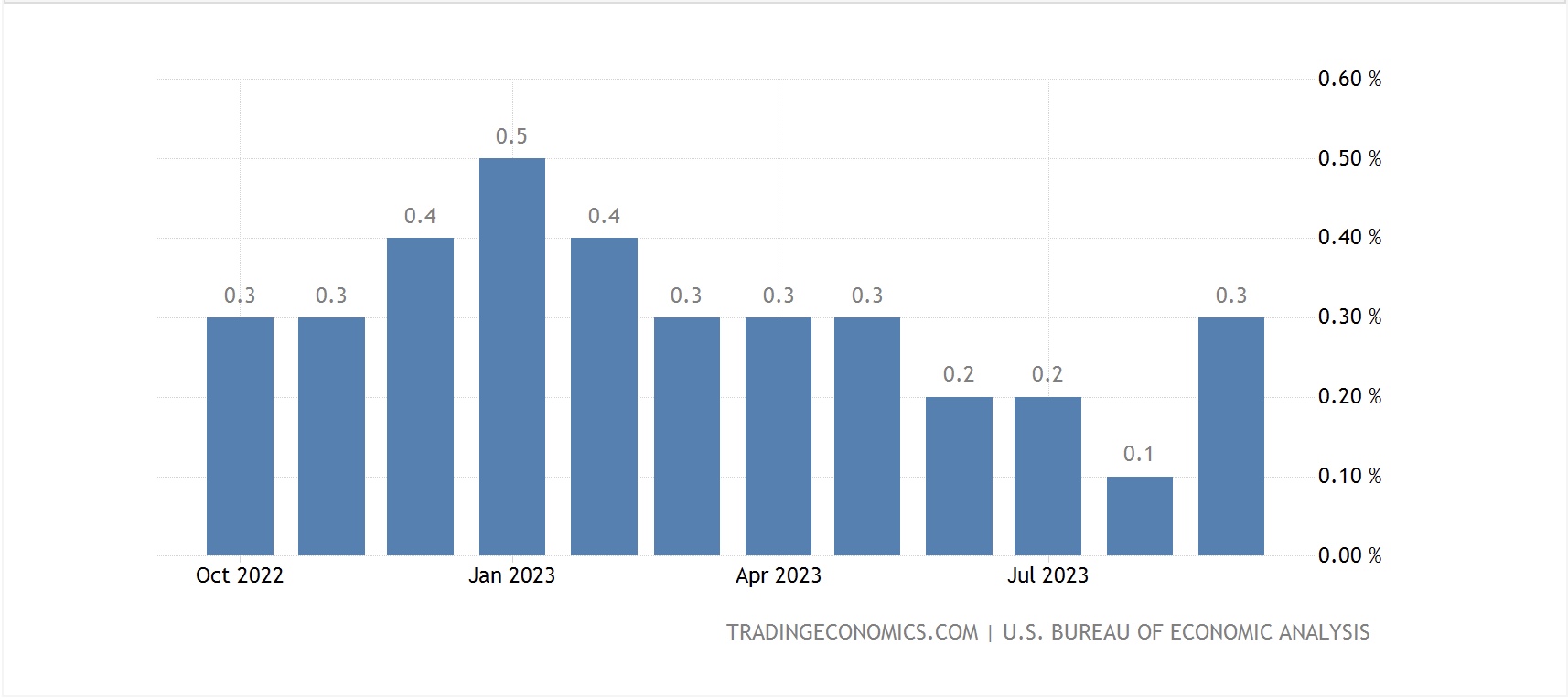
  3. Inflation is not dead yet, and the most recent Core PCE reading did not indicate that it is slowing that rapidly.  As can be seen from the chart below, 0.3% M/M PCE equates to 3.6% annual, well above the Fed’s target.

While I believe that the market is going to run with this narrative for a while, and we could easily see stocks continue to rebound and yields grind a touch lower, I fear that reality will set in soon enough and these moves will prove ephemeral.

Tying this up with a bow on the dollar leaves me with the following view; as long as this current narrative holds, the dollar will remain under pressure.  I suspect this can last through the end of the year, although much beyond that I am far less certain.  I would contend there are two ways things can evolve from here:

  1. This relaxation in financial conditions forces the Fed to reassert themselves and they start hiking rates again.  In this case, the dollar will once again rise as no other central banks will have the ability to keep up with a newly hawkish Fed, or
  2. The much-anticipated recession finally shows up, perhaps in Q1 2024, and the Fed, after a little hesitation starts to ease policy.  However, by that time, I suspect that the rest of the world will also be in recession and central banks elsewhere will be cutting rates even more quickly.  While the dollar is likely to slide initially, I don’t think it will decline very far as in that situation, it seems likely that the US will remain the proverbial ‘cleanest shirt in the dirty laundry.’

As for today, it is hard to get excited about anything really, at least with respect to the FX market.

There will be no poetry tomorrow, but I will return on Wednesday.

Good luck

Adf

No Longer a Threat

Opinions are already set
The Fed is no longer a threat
Today’s NFP
Will help all to see
That buying stocks is the best bet

At least that’s the narrative tale
The talking heads want to prevail
The question’s, will Jay
Have something to say
If finance conditions, up, scale

To conclude what has already been a tumultuous week, this morning brings the monthly payroll report, a key piece of evidence for the Fed to determine the health of the economy.  Expectations for the readings are as follows:

Nonfarm Payrolls180K
Private Payrolls158K
Manufacturing Payrolls-10K
Unemployment Rate3.8%
Average Hourly Earnings0.3% (4.0% Y/Y)
Average Weekly Hours34.4
ISM Services53.0

Source: tradingeconomics.com

Apparently, the whisper number is a bit above 200K, but we also must pay close attention to the revisions.  Recall last month had a blowout 336K result, which was much larger than expected.  If that number retains its strength, it would certainly be indicative of a still healthy labor market.  This matters a great deal as after Powell’s press conference on Wednesday and the surprising QRA that shortened the duration of upcoming Treasury bond issuance, the market is all in on the goldilocks story, solid growth with low inflation.  The corollary to this is that the market is looking for the Fed to back off the current rate policy and begin to reduce the Fed funds rate, thus helping all the DCF models pump up the value of equities.

But even though I have been highlighting the importance of the NFP number for the past two years as a key for the FOMC, it is not clear to me that today’s is so important.  I only say this because the Fed just met two days ago, and we will see another NFP before they meet again.  Arguably, this one will get lost in the fog of memory.  

If that is the case, then it is probably a good time to recap what we have seen this week and how it has affected market sentiment.  The bulls are on a roll right now as we have seen a significant pullback in Treasury yields with 10yr down to 4.66%, down 36bps from their peak back on October 23rd.  While that is certainly a large move in a short period of time, it is in line with the types of movement we have been seeing all year, so hardly unprecedented.  But Powell’s comments, which have been read as dovish despite his best efforts to prevent that view, and the bond market movement have many market participants licking their chops for a massive equity rally going forward.

Interestingly, one of the things the talking heads have been using to pump their story has been the tightening in financial conditions that were a result of declining stock and bond prices.  The whole issue of tighter financial conditions doing the Fed’s work for them has been a key story for the past several weeks since it was first mentioned by Dallas Fed President Lorrie Logan.  However, the big rally in both stocks and bonds, as well as the decline in the dollar, are all critical features in the calculation of those financial conditions, and they are all pointing to easier conditions.  The point is, if tighter conditions was a reason for the Fed to have stopped tightening further, the fact that they are now easing implies the Fed may feel the need to raise rates again in December, although that is clearly not the consensus view.

At any rate, right now, momentum is on the bulls’ side, and it is tough to overcome.  Certainly, the economic data continues to point to a resilient economy which implies, to me at least, that the Fed will not feel any urgency to cut rates soon.  There has also been a great deal of discussion regarding the fact that the average time the Fed has held rates at a peak before cutting is just 7 months.  We are now three months into the most recent hold, and, by definition, since the next meeting is not until December, we will be at 5 months then.  My observation about Chairman Powell, though, is at this point he is unconcerned with statistics of that nature and is far more focused on achieving their objective of 2% inflation.  

One last thing about inflation before we touch on markets.  There has been a growing chorus that deflation is on its way because M2 money supply growth is currently declining.  However, for the economics majors out there, recall that the key monetary equation is M*V = P*Q.  P = prices, and Q = quantity of goods, or, combined economic output.  M = Money supply and V = Velocity of money.  It is the last piece that is often ignored but remains quite important.  My good friend @inflation_guy, has just published a piece which is well worth reading.  The essence is that while M2 may be declining, V is rising rapidly, offsetting that impact and creating conditions for much stickier inflation than many believe.  I have a feeling the Fed is going to stay on hold, if not tighten further, for a much longer time than currently anticipated.  While this week’s news has clearly been seen as bullish, the long-term trends have not yet changed in my view.

Ok, so a quick look at markets shows that after another gangbusters day in the US, where all three major indices were higher by 1.7% or more, Asian markets followed suit, with virtually every index there higher by at least 1.0%.  Europe, however, has been more circumspect with markets essentially unchanged this morning, just +/- 0.1% on the day.  US futures are ever so slightly softer at this hour (7:30) down about -0.15% on average, as investors and traders await this morning’s data.

At this point, bonds seem to be taking a rest after a huge price rally / yield decline over the past several sessions and we are seeing very little movement on the day with Treasuries and European sovereigns all within 1 basis point of yesterday’s closing.  Even JGB yields slid a bit yesterday but remain above 0.90% as of now.  As to the shape of the yield curve, that inversion is starting to show its head again, with the current 2yr-10yr spread back to -32bps.  Remember, two days ago that was at -18bps.  Broadly speaking, yield curve inversions are not signs of economic strength.

In the commodity space, oil is creeping back higher, up 0.4% this morning although still lower on the week.  Gold is basically unchanged this morning, continuing to hang out just below $2000/oz, which continues to surprise me given the sharp decline in yields, at least nominal yields.  As to the rest of the space, base metals are mixed amid small changes this morning and foodstuffs, something I have not mentioned in a while, have actually been declining with the FAO’s world food price index falling to its lowest level in more than 2 years last month.  It may not seem that way in the grocery store, but perhaps future price rises will be more muted.

Finally, the dollar is generally biding its time ahead of the data, although leaning lower overall.  In the G10, the average gain of a currency is about 0.2% while in the EMG bloc we have seen a few outliers, notably KRW (+1.2%) but a more general rise of 0.4% or so.  You already know that my view has changed given the seeming change in the underlying drivers.  For now, and likely through the end of the year at least, I think the dollar will be under pressure.

Aside from the data this morning, we get our first Fed speaker, Supervision Vice-Chair Michael Barr, this afternoon, but the topic is the Community Reinvestment Act, which makes it unlikely he will swerve into monetary policy.  So, as is often the case, the data will see a flurry of activity at 8:30 and then I suspect the recent trends will reassert themselves in a slower session overall.  We will need to see an extraordinarily strong NFP print to help reverse the dollar’s current malaise.

Good luck and good weekend

Adf

A Havoc Nightmare

While real wages fall
Kishida’s polls fall faster
Will Ueda act?

The first big thing this week is tonight’s BOJ meeting where many in the market are anticipating another tweak to the current YCC framework.  I have seen several analysts calling for a widening of the band to +/- 1.25% from the current +/- 1.00%.  While current yields have yet to reach the cap, they continue to grind higher and are currently at 0.88%, new highs for the move.  Ironically, it is likely the BOJ will need to buy even more JGB’s if they make an adjustment as the wider band would give the green light for speculators to short bonds even more aggressively.  Recall, since they widened from 0.50% to 1.00%, there have been at least five unscheduled bond buying episodes by the BOJ, with the last one, just a week ago, being the largest to date.

One thing to remember about the BOJ is that the concept of central bank independence is not as strong in Japan as it is, perhaps, elsewhere in the Western world.  (Of course, it is not that strong elsewhere either, but Japan is closer to China on this front than the US).  At any rate, the most recent polls in Japan show that PM Kishida’s approval ratings have fallen to new lows for his tenure, with an approval of just 33% according to the most recent Nikkei poll.  And this was after the announcement that he was cutting taxes to help people deal with the consistently rising inflation in Japan.  While it has not grown to levels seen in the US or Europe, it is clearly far higher than they have seen there in more than a generation.

But it doesn’t seem to be enough.  Now, there is no requirement for an election until sometime in 2025, but that doesn’t mean Kishida-san won’t feel the pressure to do more.  And arguably, one of the things they can do to fight inflation is raise rates and see if the yen can recapture some of the 35%+ that it has declined over the past two years.  

So, will they act?  My one observation on this is that unlike the Fed, which never likes to surprise the market, the BOJ has figured out that they only way they can have an impact is if they do surprise the market.  Given that an increasing number of people are starting to look for this outcome, I think the probability of a BOJ policy change tonight is quite low.  I would not be surprised, if I am correct, to see USDJPY head back through 150 and start to grind to new highs above the 152+ peak seen just before the intervention last year.

Meanwhile, for the rest of the week
Both meetings and data might wreak
A havoc nightmare
So, traders, beware
Of comments or data that’s bleak

Beyond tonight’s BOJ meeting, the week is jam-packed with other potential market moving catalysts between central bank meetings (FOMC on Wednesday, BOE on Thursday) and important data including ISM (Wednesday) and NFP on Friday.  However, there is one other thing set to be released Wednesday morning, well before the FOMC announcement and that is the Quarterly Refunding Announcement (QRA).  While, as its name suggests, this is released every quarter, it has generally been relegated to the agate type of market information as a technical feature for bond traders.  But this time, it has gained far more interest given the combination of the bond market’s performance since the last QRA (yields are higher by 80ish basis points) and the fact that the government budget deficit is continuing to grow with many new forecasts for a $2 trillion deficit this year thus a need for even more borrowing. 

Back in August at the last QRA, the Treasury increased issuance more than anticipated which has been seen as one of the drivers of the recent bond market decline.  If they were to increase it significantly again, there is certainly concern that bond yields can move much higher still.  Now, the Treasury could issue more short-term T-bills to take pressure off the bond market but bills already represent about 22% of the total debt outstanding.  That is a couple of points higher than the top of the historic range of 15%-20% and may be seen as a point of contention.  The positive is that given T-bill yields are all above 5.3%, there will be plenty of demand for their issuance.  However, on the flip side, that means that refinancing will need to occur far more frequently and that makes it subject to market dislocations and disruptions.

Another key part of the discussion will be just how large Secretary Yellen wants to keep the Treasury General Account (TGA), which is the government’s ‘checking’ account at the Fed.  As of Thursday, it held $835 billion and there has been talk she wants to increase it to $1 trillion to make sure the government has ample liquidity going forward, especially if there is another issue regarding government financing in Congress.  Historically, the Treasury has issued bills when they are seeking to build up balances in the TGA, which would tend toward seeing even more bills issued rather than substantial growth in the longer-dated maturities.  All in all, it is possible the QRA is going to have the largest potential impact on markets this week so beware.

In truth, the overnight session has been somewhat dull.  While the Israeli-Palestinian situation has seemed to enter a new phase regarding Israel’s incursion into Gaza, markets are non-plussed over the matter with bond yields little changed across the board, the dollar little changed across the board and oil prices sliding (-1.5%) this morning.  Even gold (-0.6%), which has been the best performer in the wake of the middle east crisis, has slipped back below the $2000/oz level, although remains higher by almost 10% in the past month.

In fact, the one area where things are moving is in equity space where we are seeing gains across the board in Europe, somewhere between 0.5% and 1.1%, in the major bourses as inflation data there showed that price rises have begun to slow down and Germany’s economy “only” shrunk by -0.1% in Q3, a much better than expected outcome!  US futures are also higher at this hour (7:15), up by 0.5% or so after a pretty awful week last week.  In fact, the only real outlier was Japan where the Nikkei slid -0.5% as Chinese shares were stronger along with most of the APAC markets.

As mentioned earlier, though, we do have a lot of news coming out this week so let’s go through it here:

TuesdayBOJ Rate Decision-0.1% (unchanged)
 BOJ YCC+ / – 1.00% (unchanged)
 Case Shiller Home Prices1.6%
 Chicago PMI45
 Consumer Confidence100
WednesdayADP Employment150K
 QRA$114 billion (+$11 billion)
 ISM Manufacturing49.0
 JOLTS Job Openings9.2M
 Construction Spending0.4%
 FOMC Decision5.5% (unchanged)
ThursdayBOE Decision5.25% (unchanged)
 Initial Claims210K
 Continuing Claims1795K
 Nonfarm Productivity4.0%
 Unit Labor Costs0.8%
 Factory Orders1.9%
FridayNonfarm Payrolls188K
 Private Payrolls145K
 Manufacturing Payrolls0K
 Unemployment Rate3.8%
 Average Hourly Earnings0.3% (4.0% Y/Y)
 Average Weekly Hours34.4
 ISM Services53.0

Source: tradingeconomics.com

So, as you can see, there is a lot of stuff coming our way starting tonight in Tokyo.  What that tells me is that we are not likely to see very much movement today as traders and investors await the plethora of new information that is due.  However, by the end of the week, we could have a very different narrative.  

Good luck

Adf

Worse Than Just Sloth

With payrolls on everyone’s mind
The overnight range was confined
The bulls live in fear
That job growth’s still clear
While bears worry payrolls declined

But, looking beyond NFP
There’s something the bulls fail to see
Liquidity’s growth
Is worse than just sloth
It’s shrinking to quite a degree

Before I start this morning, please know I will be on vacation next week so there will be no poetry again until the 16th.

Now, to start this morning, all eyes are on the payroll report where the market is definitely in the ‘bad is good’ frame of mind.  Median analyst expectations are as follows:

Nonfarm Payrolls170K
Private Payrolls160K
Manufacturing Payrolls5K
Unemployment Rate3.7%
Average Hourly Earnings0.3% (4.3% Y/Y)
Average Weekly Hours34.4
Participation Rate62.9%

Source: tradingeconomics.com

We know that Wednesday’s ADP number was quite weak, and we know that Tuesday’s JOLTS number was quite strong.  Yesterday’s Initial Claims data was also a harbinger of strength with the weekly number falling to 207K.  If we look at the ISM employment sub-indices, both showed relative strength with the Manufacturing number rising above 50 for the first time in 5 months while the Services employment index remains at a healthy 53.4 level.  Much of what I have read over the past several weeks has focused on the idea that companies are still reluctant to lose employees as they remember how difficult it was to hire post the Covid fiasco.   I have a funny feeling we are going to see a better than expected number this morning, as between the JOLTS and Claims data it feels like we’re due for a pop.  However, I believe we need to see a print above 200K to have a meaningful impact on the markets.

To be clear, if I am correct, I would look for bond yields to retest their recent highs, equities to fall and the dollar to rebound from its recent consolidation/correction.

But let’s discuss the dollar for a moment and a data point that gets short shrift these days, the Trade Balance.  A brief history lesson shows that once upon a time, the Trade Balance was the most important monthly release for the FX market.  This was during the Reagan years when US policy was highly focused on the trade deficit with Japan and concerns over whether Japan was going to replace the US as the preeminent global economy.  (We know how that worked out!). But the point is trade data used to matter.  One of the things that gets little attention these days but is directly impacted by the trade data is the amount of global USD liquidity that exists. Despite all the hyperventilation over the concept of dedollarization, the reality is that the dollar has never been a more integral part of the global financial system than now.  The reason for this is the fact that there is somewhere north of $275 trillion of USD debt outstanding around the world, according to the IMF, and the US portion is only on the order of $95 trillion.  This means the rest of the world needs to service $180 trillion of debt, paying USD interest.   

How, you may ask, does everybody get those dollars to pay the interest on that debt?  Well, one of the keys had been the US running a massive trade deficit, buying stuff and sending dollars all over the world.  Those dollars were used to service the debt.  But lately, the US trade deficit has been declining pretty steadily, with yesterday’s better than expected reading of -$58.3 billion a continuation of the last two years’ trend from the worst print of -$105B in March 2022.   The thing is, if the US trade deficit is shrinking, we are not sending as many dollars out into the world for everyone else to use.  There has also been a great deal of discussion lately about how M2 money supply has been shrinking at an unprecedentedly fast rate, yet another sign that liquidity is drying up.  One consequence of these two factors, shrinking M2 and a shrinking trade deficit, is that foreigners need to bid more aggressively for the dollars they need to service and repay their USD notional debt.  This has been a key driver in the dollar’s recent strength and there is no sign this is going to change in the near future.

But shrinking liquidity also weighs on other things, notably risk assets.  Again, think about the post GFC era when QE’s 1 through infinity were ongoing and all the calls for inflation to ramp up never materialized.  Well, as I wrote during that time and is becoming clearer today, there was plenty of inflation, it was just concentrated in asset prices like stocks, bonds and real estate, as opposed to everyday items like groceries, clothing and dining out.  At this point, we realize that the Covid fiscal stimulus around the world is what unleashed the recent bout of inflation, and that central banks are working feverishly to halt this trend.  Combine the Fed leading the way, having raised rates the furthest of the major central banks, and the fact that there are less dollars around due to shrinking money supply and trade deficits, and you come up with a good understanding of why the dollar remains well bid.  Regardless of the short-term impact of numbers like today’s NFP, the underlying structural effects continue to point to dollar strength.

With that structural backdrop in mind, a look at today’s price activity shows modest net activity ahead of the data.  Asian equity markets that were open had a mixed session with the Nikkei sliding while the Hang Seng managed some solid gains (+1.6%) and mainland Chinese markets remained closed, set to reopen on Monday.  European bourses, though, are having an ok day, with gains on the order of 0.5% or so after better than expected Factory Orders data from Germany.  As to US futures, they are currently (7:30) higher by 0.1% and trading in a tight range.

Bond yields are backing up again with Treasuries and most of Europe higher by 3bps or so.  One move that has been growing lately is the Bund-BTP spread, which is now 202bps, right at the level where the ECB has historically started to get a bit nervous.  If this spread continues to widen look for more ECB talk about, first, how the market is wrong, and then second, how the TPI, their program to buy BTPs and sell Bunds, is likely to be appropriate.  At 250bps, their hair will be on fire, but that still feels pretty far off.

Oil prices, which are unchanged today, appear to be consolidating after a hellacious week where they fell >$10/bbl.  The thing is demand data continues to point to growth and supply data continues to point to limits.  The recent price action has all the earmarks of Russian disinformation a trading response to the massive run higher through the summer where a lot of trend followers got into the market too late.  Longer term, the direction here remains higher in my view.  As to the metals markets, they also are consolidating after a rough period with gold unchanged though silver, copper and aluminum are all higher between 0.3% and 0.9% this morning.  Again, we have seen a pretty sharp decline here, so this feels like a trading reaction, not a fundamental thing.

Finally, the dollar is a bit firmer this morning as we await the data.  USDJPY continues to hold the 149 level and it looks to be merely a matter of time before we test 150 again.  According to the flow data from the BOJ, there was no indication that they intervened earlier this week which implies there was some rate checking.  However, it is very clear they remain quite concerned over the movement.  One currency that has really seen some movement lately is MXN, which after a long period of strength on the back of a very stout monetary policy by Banxico, has given back 10% in the past 5 weeks.  Interestingly, the US is running a growing trade deficit with Mexico, which should help alleviate some pressure on the peso, but right now, the difference in tone between the Fed’s higher for longer and Banxico’s we are done is the driver.

Aside from payrolls this morning we see consumer Credit (exp $11.7B) and hear from Governor Waller at noon.  Yesterday’s Fed speak was much of a muchness with no changes in tone overall.  At this point, all we can do is wait.

Good luck, good weekend and until Monday October 16th

Adf

Two-Faced

On Tuesday the market was JOLTed
And buyers of assets revolted
But then ADP
Said, no, look at me
And bulls, toward risk assets, all bolted

Now those numbers offer a foretaste
Of how market prices are two-faced
But really the key
Is Sep’s NFP
Ahead of which, traders will stay chaste

Remember all the carnage on Tuesday?  Never mind!  In truth, it is remarkable that the market response to the Tuesday JOLTS data was so strong, given the number has historically not been a key market driver. At the same time, yesterday’s weaker than expected ADP Employment data, just 89K new jobs, had the exact opposite impact on the market.  So, bonds rallied, and yields declined sharply, with 10-yr Treasury yields lower by 14bps from the highs seen yesterday pre-data, while stocks rallied nicely, led by the NASDAQ’s 1.4% gains although the other two indices lagged that badly.

My first thought was to determine what type of relationship both numbers have with the NFP data which is set for release tomorrow morning.  I ran some simple regressions for the past year and as it happens, the Rbetween NFP and ADP is 0.5 while between NFP and JOLTS it is 0.65.  I do find it interesting that the JOLTS data, which has a bigger lag built in, has the stronger relationship, but I also remember that ADP changed its model and formulation and since they have done that, the fit to NFP is far less impressive.

It is anyone’s guess as to what tomorrow’s data is actually going to be like, but it is clearly instructive that the market was so keen to react to both of these data points so dramatically ahead of the release.  Ostensibly, the market has come around to my view that NFP is the data point on which the Fed is relying to continue their higher for longer mantra.  As such, a weak number (something like 100K or lower) seems very likely to soften the tone of Fedspeak and result in an immediate rip-roaring rally in the stock market.  Correspondingly, a strong number (200K or higher) seems more likely to bring out the hawkishness that remains widely evident on the FOMC.  The consensus view appears to be 160K, but then consensus for ADP was 150K and that missed badly.

The point is, for now, the market is hyper focused on the NFP number, and I suspect that between now and then, we are unlikely to see too much movement.  As an aside, one of the best indicators of the employment situation is Initial Claims, which is more frequent and thus timelier, and that number, which is expected at 210K this morning, has clearly been trending lower, a sign of a strong jobs market.  I believe we will need to see a lot of convincing evidence for the Fed to alter their current stance, but tomorrow’s NFP will certainly be important.

Away from that, right now other fundamentals just don’t seem to matter very much.  The dysfunction in Washington is a big issue in Washington, but not in financial markets, at least not yet.  I guess if we wind up in a situation where there is a government shutdown it may wind up mattering, but we know there is six weeks before that will come up again.  Next week is the Treasury refunding auction with $102 billion of notes and bonds coming to market.  I believe a key part of the bond market’s recent downward trend is the concern over the massive supply that is coming to market.  Next week’s realization, plus the fact that there is no end in sight should continue to weigh on bond prices and support yields.  And as long as US yields are forced higher, so too will be European sovereign, and truthfully, global yields.

On the oil front, the OPEC+ meeting came and went without incident as the production cuts that the Saudis initiated back in June are to remain in place through December, at least, with the group set to revisit the issue later in the year.  While oil (-2.0%) has been slumping badly during the past week, falling $10/bbl in that short time frame, I would contend the trend remains higher.  Remember, oil is a highly volatile commodity, both in reality and from a market price perspective.  We have heard nothing to alter my long-term conclusion that oil demand is going to continue to grow and oil supply remains constricted.  In truth, if I were a hedger, I would be looking to take advantage of the current price action, especially since the market is in backwardation (future prices are lower than current spot prices) so hedging is quite cost effective.  It’s kind of like earning the points in FX.

At the same time, metals prices remain under pressure with gold suffering from the combination of still high US yields and a strong dollar, while industrial metals like copper and aluminum are both pointing to weaker economic activity.  I continue to believe this is a short-term fluctuation in a broader long-term move higher in commodities in general, but again, if I were a hedger, current prices would be interesting.

A look at equity markets overnight showed that the Nikkei (+1.8%) approved of the US price action and that dragged much of the rest of Asia along for the ride although, recall, mainland China remains closed for their Golden Week holidays.  In Europe, today has been far less impressive with very modest gains across the continent averaging about 0.2% while US futures are little changed at this hour (7:30).  As I said before, I anticipate a slow day ahead of tomorrow’s NFP report.

Turning to the dollar, it, too, is little changed this morning after a bit of a sell-off yesterday.  For instance, the euro, which has rebounded from its recent lows, is still just barely above 1.05 and higher by just 0.1% this morning.  And those gains are similar across all the major currencies.  Now, if we look at the EMG bloc, despite the dollar’s pullback against some G10 counterparts, we see MXN (-1.0%) and ZAR (-1.25%) leading the way lower as both of those nations have large commodity sectors and the decline in prices there is more than sufficient to offset any benefit of a little bit of dollar weakness broadly.  Here, too, I see no reason to change my view on the dollar following yields higher, and the fact that yields have backed off for a day does not change the underlying reality.

In addition to the Initial Claims data, we see the Trade data (exp -$62.3B) and we hear from three more Fed speakers, Mester, Daly and Barr.  ADP did not change the world.  We will need to see more data demonstrating that growth, at least as defined by the Fed, is slowing before they are going to change their tune.  Today is shaping up as quite dull, but tomorrow, at least immediately after the 8:30 data print, could be interesting.  Remember, too, that Monday is Columbus Day, so markets will have less liquidity and be susceptible to larger movements.

Good luck

Adf

Selling will be THE New Sport

Last Friday the payroll report
Inspired some bears to sell short
As job growth starts shrinking
It seems that their thinking
Is selling will be THE new sport

But bulls will all argue the Fed
Will act if there’s weakness ahead
Rate cuts will come soon
And yields will then swoon
As stocks rise to green from the red

A brief recap of Friday’s payrolls data shows a mixed picture overall.  The positives were the NFP was higher than forecast, as were manufacturing jobs, and hours worked rose along with the participation rate.  The negatives were that the revisions to previous data were once again lower, the seventh time in the past eight months, and the Unemployment Rate jumped 0.3% to 3.8%.  Not surprisingly, the market response was as confusing as the data with equity markets in the US closing ever so slightly higher on the day while bond yields rose pretty sharply.  The latter was a bit of a surprise as there seemed to have been a growing consensus that we have seen the peak in yields.  I guess, though, if the idea is now there is no recession coming, then higher yields would be appropriate.  And that idea is gaining traction everywhere as evidenced by this morning’s report from the “great vampire squid wrapped around the face of humanity” as described by Rolling Stone Magazine in 2010, aka Goldman Sachs, that they now believe the probability of a recession has fallen to just 15%.

This poet’s view is that Friday’s data was hardly conclusive in either direction for the Fed which will be looking closely at the CPI data to be released next week, as well as myriad other signals on the economy and its prospects ahead of their next meeting in a few weeks’ time.  For instance, the Atlanta Fed’s GDPNow forecast is still at 5.6%, a crazy high number in my view, but one that is likely to have credence with those in the Eccles Building as evidence the economy is still quite strong.

Perhaps the more interesting thing about today’s market activity is that bond yields around the world are higher despite a run of pretty awful Services PMI data across Europe and Asia.  The most notable Asian casualty was China, where the Caixin PMI Servies was released at 51.8, more than 2 points below last month and nearly 2 points below expectations.  Then, we got to see weak prints from Spain, Italy, France, Germany and the UK, all in recession territory below 50.0 and most failing to meet weakened expectations.  Net, the situation doesn’t look that good for the Eurozone as the economy appears to be sliding into a full-blown recession across all nations, while price pressures remain stickily high.  After today’s weak PMI data, the probability of an ECB rate hike in September has fallen to just 25% from 50% last week.  And yet, sovereign yields continue to climb.  They got issues over there!

So, we’ve seen weakness in China and weakness in Europe.  What about the US?  While recent data has begun to disappoint slightly, it is not nearly in the same camp as the rest of the world.  Tomorrow’s ISM Services index is forecast to be 52.5, not huge, but clearly not recessionary.  And, in fact, while the jobs report was mixed, it was not a disaster.  While there is still good reason to believe a recession is coming to the US, perhaps by the end of this year, the US remains well ahead of the rest of the world in terms of growth at this stage.

With that in mind, it can be no surprise that the dollar is soaring today higher against every one of its major counterparts in both the G10 and EMG blocs.  While the particular drivers are different, they are all of a piece in the sense that problems elsewhere are greater than in the US.  In the G10, AUD (-1.45%) and NZD (-1.2%) are the worst performers having fallen immediately after the weak Chinese data.  But the best performer is CAD (-0.4%) to give an idea of just how strong the dollar is today.  In the EMG bloc, HUF (-1.4%) is the laggard after a ruling that the central bank’s losses would not be paid for by the government, but just deferred until they start to make money again.  Meanwhile, they have significant budget issues as well, so both fiscal and monetary concerns there.  But the entire bloc is under pressure, with APAC currencies suffering on the China news while EEMEA currencies feel the pain of a weakening Eurozone.  Today is not indicative of the looming end of dollar hegemony, that’s for sure.

As to yields, as mentioned above they are firmer across the board, with 10yr Treasuries up 4bps and all European sovereigns seeing yields higher by between 2.5bps and 4.0bps.  while I’m no market technician, looking at the below chart (source Bloomberg) of 10yr Treasury yields, it is not hard to see the strong trend higher at this point.

In the equity markets, it is no surprise that Chinese shares were softer, nor most of the APAC markets, although the Nikkei (+0.3%) managed to close higher as the weaker yen improves profit performance for many large Japanese companies.  European bourses are mixed at this hour, with net, little movement and US futures are also mixed, with the NASDAQ a bit softer but the DOW up a touch at this hour (8:00).

Finally, in the commodity space, oil (-0.5%) is under some pressure this morning, although given the magnitude of the dollar’s strength, I would have thought we would see much more pressure on the commodity markets.  It seems that the Saudi production cuts are having their desired impact and are likely to continue to push prices there higher.  Of more interest is the fact that gold (-0.4%) is retaining most of its recent gains despite a strong dollar, indicating that there is buying interest all over the place for the barbarous relic.  Base metals this morning are somewhat softer, which is to be expected given the PMI data.

Speaking of data, because the payroll data was so early this month, this week is pretty quiet with CPI not released until next week.  However, here is what is on the calendar:

TodayFactory Orders-2.5%
 -ex Transports0.1%
WednesdayTrade Balance-$68.0B
 ISM Services52.5
 Fed Beige Book 
ThursdayInitial Claims234K
 Continuing Claims1715K
 Nonfarm Productivity3.4%
 Unit Labor Costs1.9%
FridayConsumer Credit$17.0B

Source: Bloomberg

On the Fed front, we hear from 7 speakers plus retired St Louis Fed President Bullard over 10 events this week.  As we approach the quiet period starting Saturday, the most noteworthy comments since Powell’s Jackson Hole speech have been from Harker who thought that enough has been done and cuts next year made sense.  It will be key if we hear other Fed speakers reiterate that sentiment or continue to push back.  This week, NY Fed President Williams is probably the most impactful speaker on the docket. 

In the end, while I definitely see signs of macroeconomic weakness in the US, they are much less concerning than those elsewhere in the world and so nothing has changed my view of dollar strength for the time being.

Good luck

Adf

A Crack in the Sheen

Ahead of the holiday flight
The payroll report is in sight
This week we have seen
A crack in the sheen
That everything still is alright

So right now, bad news is all good
But there seems a high likelihood
That worsening data
Could impact the beta
And bad news turn bad, understood?

As we wake up on this Payrolls Friday, the market is biding its time ahead of the release this morning.  As I have been writing for a number of months now, I continue to believe the NFP number is the most important on the Fed’s radar as its continued strength has given Chairman Powell all the cover he needs to continue tightening monetary policy.  If job growth is averaging near 200K per month and the Unemployment Rate has a 3 handle, the doves have no solid case to make that policy is too tight.  With that in mind, here are the current median analyst expectations according to Bloomberg:

Nonfarm Payrolls170K
Private Payrolls148K
Manufacturing Payrolls0K
Unemployment Rate3.5%
Average Hourly Earnings0.3% (4.3% y/Y)
Average Weekly Hours34.3
Participation Rate62.6%
ISM Manufacturing47.0
ISM Prices Paid44.0
Course: Bloomberg

So far this week, we have received three pieces of employment data with a mixed outcome.  JOLTS Job Openings was much lower than expected and that encouraged the bad news is good phenomenon.  ADP Employment was weaker on the headline by a bit but had a very large revision higher to last month, so mixed news.  Meanwhile, Initial Claims were lower than expected and any sense of a trend higher in this series is very difficult to discern.  Anecdotally, I have to say I expect a softer number today, not a firmer one, but I believe it is anybody’s guess.

With that in mind, I believe a weak number, whether lower payrolls or a jump in the Unemployment Rate, will be met with an equity rally into the holiday weekend.  Investors are looking for ‘proof’ that the Fed is done so they can get on with rate cuts and support the stock market.  However, remember, if the data is weak and we are heading into recession sooner rather than later, all that bad news will likely not be taken well by equity investors as money will flow back to bonds as a haven.  At least, that has been the history.  So, a really bad number could well result in ‘bad news is bad’ and an equity market decline.  Alas, nothing is straightforward in markets.

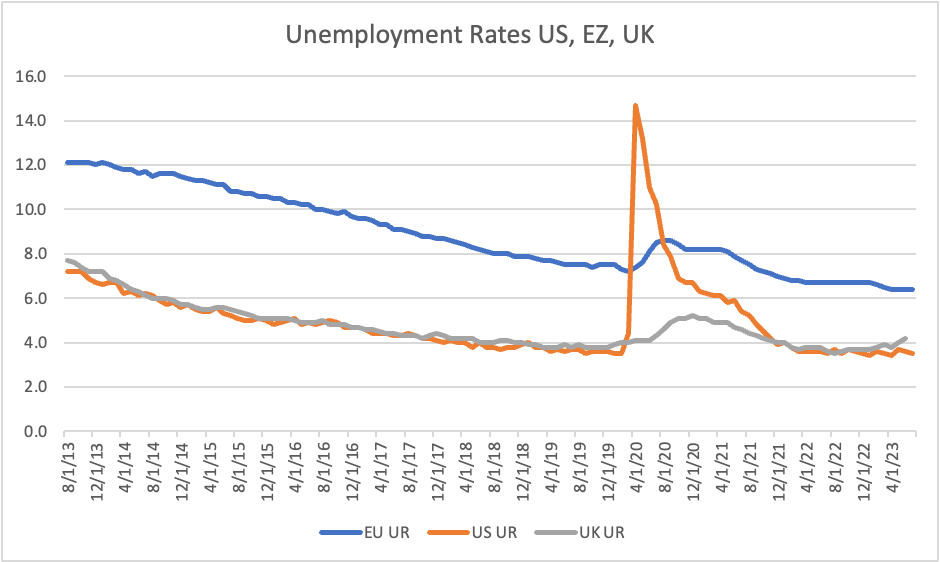
One other thing to keep in mind is the relative Unemployment situation which can be seen below in the chart created with data from Bloomberg.  Structural unemployment in the Eurozone remains substantially higher than in either the US or the UK.  If you are wondering why I continue to have a favorable outlook on the dollar, this is one part of that puzzle.  Despite all the policy blunders questions that have been raised, things in the US remain far better than elsewhere.

In China, despite what they’ve done
To try to support the short-run
It’s not been enough
So, they did more stuff
Last night, though investors still shun

It wouldn’t be a day in the markets if there wasn’t yet another action by the Chinese to try to fix their myriad problems.  Today is not different as last night the PBOC reduced the FX RRR to 4% from its previous level of 6%.  This required reserve ratio defines the amount of reserves Chinese banks need to hold against their FX positions.  Reducing that number effectively boosts the amount of foreign currency available locally, and therefore takes pressure off market participants to horde their dollars, thus weakening the buck.  

And it worked…for about an hour as the renminbi initially rallied about 0.5%.  However, it has since ceded all those gains and is essentially unchanged on the day.  At the same time, the government has reduced the size of the down payment needed to buy a home while encouraging banks to lend more to home buyers to try to support the crumbling property market.  While certainly welcome relief to an extent, it does not appear to be enough to change the current trajectory, which is definitely lower.  At this point, we know that the PBOC is quite concerned over potential renminbi weakness and the central government is quite concerned over broad economic weakness led by the property sector.  We have not seen the last of these moves.

President Xi did, however, get one piece of positive news overnight, the Caixin Manufacturing PMI rose to 51.0, up 2 points from last month and well above expectations.  The combination of those factors helped the CSI 300 gain 0.7% last night, but that seems weak sauce overall.  As to the rest of the market’s risk appetite, I guess you would consider things mildly bullish.  While Hong Kong was weaker, the Nikkei managed a small gain and most of Europe is in the green, notably the UK (+0.7%) after weaker than expected House Price data encouraged belief that inflation may be ebbing sooner than previously expected.  As well, the UK revised higher its GDP data to show that they have, in fact, recovered all the Covid related losses.  US futures, meanwhile, are edging higher at this hour (7:00).

Bond yields are mixed this morning, but the moves have been small, generally +/- 1bp from yesterday’s close.  And yesterday’s closing levels, at least in Treasuries, was little changed from Wednesday.  Granted, European sovereigns saw yields decline yesterday on the order of 5bps, so this morning’s 1bp rise is not that impactful I would contend.

Turning to the commodity markets, they have embraced the Chinese stimulus efforts with oil (+1.5%) rising again and pushing close to $85/bbl, while metals markets are also robust with gold (+0.25%), copper (+1.6%) and aluminum (+1.3%) all seeing demand this morning.  While I have doubts about the effectiveness of the Chinese moves, for now the market is quite pleased.

Finally, the dollar is mixed and little changed net this morning.  In the G10, not surprisingly, NOK (+0.3%) is the leading gainer on the back of oil’s rally, but the rest of the bloc is +/- 0.1% or less, so essentially unchanged.  In the EMG bloc, I guess there are a few more laggards than gainers with HUF (-0.6%) the worst performer as traders prepare for a ratings downgrade from Moody’s after the close today, while MXN (-0.6%) suffered after Banxico indicated it would be winding down its forward FX program where it consistently supplied the market with dollars, buying pesos.  On the plus side, ZAR (+0.8%) is the lone outlier on the back of the commodities rally.

We hear from Bostic and Mester today, with Bostic already having told us he thinks it’s time to pause, although I doubt we will hear the same from Mester.  But in reality, it is all about the employment report.  For now, I believe bad news is good and vice versa, but that is subject to change with enough bad news.

Good luck and have a good holiday weekend.  There will be no poetry on Monday.

Adf

Lacking In Gains

The PMI data remains
A place clearly lacking in gains
At least cross the pond
And Asia beyond
But will the US feel those pains?

The hard data hasn’t supported
That weakness, but is it distorted?
The latest we hear
Is NFP’s near
Revisions that show growth’s been thwarted

As market participants look ahead to Friday’s Powell speech at Jackson Hole, and seemingly more importantly to Nvidia’s earnings report and forecasts this afternoon, we must look at a few things that are going on in the economy.  The most noteworthy situation is that there remains, at least in the US, a wide gap between the survey data and the actual data.  We continue to see weak readings from the regional Fed manufacturing surveys, as well as PMI and ISM data, yet the key numbers, like NFP and Retail Sales continue to perform at a better than expected rate consistently.  While we await this morning’s Flash PMI data (exp Mfg 49.0, Services 52.2, Composite 51.5), which are essentially unchanged from last month’s readings and perhaps the best in the G10, there is a story this morning that the NFP data is going to be revised down by 650K jobs at the preliminary revisions today.  That is a huge adjustment and one that would certainly call into question the ongoing strength in the labor market.

It is not yet clear if it will impact the Unemployment Rate but if this story is accurate, it will almost certainly impact some of the thinking at the Eccles Building.  Consider that, after revisions, the seven NFP numbers have totaled 1807K so far this year, with the last two months showing 185K and 187K respectively.  If that 650K number is correct, and it comes from the past two months, then they will be revised into negative territory, a very different indication than anyone has considered to date.  However, even if it is more evenly spread across the year, it still represents more than one-third of the alleged jobs created.  This feels important to me.  While I have no way of determining if this story is accurate, it is important to understand it is making its way through the markets.  If this is the case, I would expect that the market’s view on the economy, as well as the Fed’s is likely to change somewhat.  

Arguably, the market response would be to alter pricing for interest rates going forward with more rate cuts priced in and priced in sooner than the middle of next year.  At the same time, though, former St Louis Fed President Bullard was interviewed by the WSJ yesterday and was crowing about how the market got the recession call wrong and the economy is doing much better than expected.  These diametrically opposed views are the norm in the markets these days, with no clear consensus that things are going to improve or worsen.  Again, it is this situation that informs why hedges for natural exposures are so important.

Turning to the other PMI’s released this morning, the story in Europe remains one of desultory growth or outright shrinkage.  The German manufacturing sector PMI printed at 39.1, better than last month’s 38.8, but still deep in recessionary territory.  While the French and Eurozone numbers were a bit better, they were both well in recession territory.  In fact, given the weakness of this data, and the fact that the ‘hard’ data in Europe has also been soft, the new narrative is the ECB is finished.  What had been a 50:50 probability for a hike in September has fallen to a one-third chance and if we continue to see weaker data, I expect that will fall further.  As to the UK, it also saw weak PMI data, with both Services and Manufacturing below the key 50 level, and the market has pulled back to just two 25bp rate hikes over the next 6 months despite the fact that inflation in the UK remains the highest in the developed world at 6.9% core, while the base rate sits at 5.25%.

It is not hard to look at this data and understand why the dollar continues to perform well.  Despite all the problems in the US, especially regarding the debt and massive interest payments, as well as the recent credit downgrade by Fitch, the US remains the most attractive opportunity around in the G10.  In fact, this is why that story about the massive downward revision in NFP data is so important.  Without it, the distinction is very clear, buy the USD, but if it is true, opinions are likely to change somewhat.

Turning to the overnight session, while most markets managed to do reasonably well in Asia, the mainland equity markets continue to suffer with the CSI 300 down -1.6%.  In Europe, the picture is mixed with some early gains being ceded and only the UK (+0.7%) managing to stay positive while the continent slips slightly into the red.  US futures, meanwhile, are barely in the green as all eyes await the Nvidia earnings after the close.

In the bond market, it is a one-way street with yields falling across the board and in a meaningful way.  Treasuries are actually the laggard with yields only down by 5bps while European sovereigns have seen yield declines of 9bps and UK gilts of 11bps.  Clearly, the bond market is responding to the weak PMI data and anticipating weakness in the US as well.  One other interesting thing is that the yield curve inversion, which had been unwinding for the past week or two, widened again yesterday and is back above the -75bp level, having traded as low as -65bps just a few days ago.

Recession is the view in the commodity space as well, at least in energy, as oil prices (-1.5%) fall again and are now back below the $80/bbl level.  Stories of more Iranian crude making its way to the market as well as fears over reduced demand are having an impact.  Interestingly, the metals markets are holding up this morning with both base and precious varieties all in the green led by copper (+1.0%).  This is a harder outcome to square with the recession fears.

Finally, the dollar is doing quite well this morning, which given the growing risk-off attitude makes some sense.  Vs. the G10, only the yen (+0.25%) has managed any gains, and they are small.  Meanwhile, the rest of the bloc is weaker across the board led by the pound (-0.9%) and NOK (-0.9%) for obvious reasons.  In the EMG bloc, ZAR (+0.5%) is the lone gainer of note after South African data implied better times ahead.  On the flipside, though, weakness is broad based with APAC, EEMEA and LATAM currencies all under pressure amidst the risk sentiment today.

Yesterday’s Existing Home Sales data was a bit softer than expected and as well as the PMI data due, we also see New Home Sales (exp 703K) and that NFP revision.  Clearly, all eyes will be on that last piece of data given the rumors of a large decrease.  So, we will need to see how that comes.  If it is benign, then I expect risk appetite may return as the bulls look for a big Nvidia story this afternoon.  However, if that huge revision appears, I suspect risk will remain in abeyance for now.

Net, nothing has changed the medium-term view of dollar strength, but the day to day remains open to the news.

Good luck

Adf