A Trump Trope

For one day the markets expected
That tariffs were roundly rejected
But late yesterday
Trump said the delay
Was short with two nations affected
 
The upshot is all of that hope
That saw the buck slide down a slope
Has largely reversed
As dollar shorts cursed
That tariffs are not a Trump trope


This poet feels vindicated in not trying to anticipate what President Trump is going to do that might impact markets after yesterday’s events.  Early in the day there was a story that tariffs would be delayed and were seen as negotiating tools, not punishment.  FX traders (mis)read the room and sold the dollar aggressively, with the greenback suffering declines of more than 1% against some currencies, notably MXN.  Then, Mr Trump was inaugurated, made a speech, where he promised to make many changes within the operating system of the US, signed a load of Executive Orders and mentioned in a press conference much later in the evening that 25% tariffs on Mexico and Canada would be coming on February 1st.  The chart of USDMXN below shows the price action with the peso having given back the bulk of yesterday’s gains.

Source: tradingeconomics.com

Once again, if we learned nothing from Trump’s first term, it is that anticipation of his moves is a very fraught and dangerous way to manage market risk.  Now, will those tariffs actually be implemented?  Will they be universal if they are?  Or does he anticipate changes from behavior by both nations in the next 10 days?  The answer is, nobody knows, probably not even Trump.  The upshot is if you have financial market risk, hedging is critical to maintaining acceptable outcomes.  And, oh by the way, look for implied volatility of all financial products to rise as market makers also have no idea what is going to happen so will require hedgers to pay up for protection.

In Davos, the world’s glitterati
Are meeting, and though they are haughty
They’re losing their splendor
And edicts they render
Are sinking in value like zloty

While there is a great deal more that President Trump has promised to do immediately, the bulk of it seems likely to only have potential longer-term impacts on financial markets.  Meanwhile, in Davos, the World Economic Forum is under way and the main message that I can discern from what I’ve read is that, the members really liked it when everybody listened to what they said and are now really unhappy that President Trump is essentially raining on their parade and devaluing their views and comments.  With Trump withdrawing from the Paris Climate Accords and the WHO, key global initiatives are severely hamstrung, which means the WEF is less important.  And all their pronouncements regarding the need free trade and global cooperation has far less impact if the US has decided to focus on itself rather than the world at large.  My forecast is that by the end of Mr Trump’s term, the WEF will be a sideshow, not a headline event.

And really, at this point, that is pretty much what is happening.  Yes, UK Unemployment rose to 4.4% while wages rose 5.6%, but this has simply put the BOE in a tougher spot.  The Old Lady has only an inflation mandate, but if Unemployment is rising, they cannot ignore that, and the market is now far more convinced (82% probability) that they will be cutting the base rate by 25bps at their meeting the first week of February.  While the pound (-0.8%) is lower this morning, that seems much more about the dollar’s overall strength than this weaker than expected data point as since the release, the pound has fallen only another 0.2%.

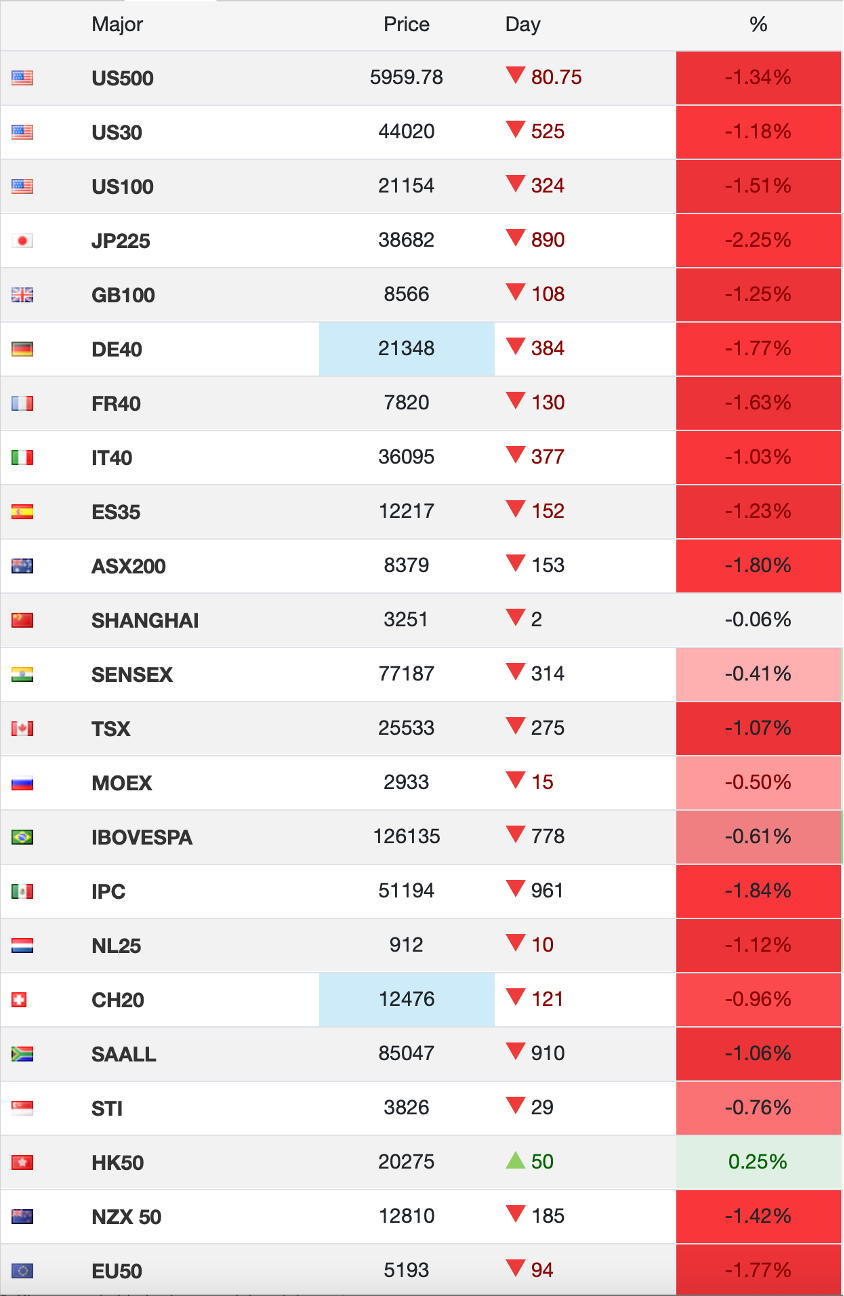
So, let’s look around the world and see how markets responded to Trump 2.0.  Equity markets in Asia were largely in the green as neither Japan nor China were mentioned on the immediate tariff list, although the late-night proclamation regarding Canada and Mexico implies that this story has not yet been completed.  Nonetheless, gains in Japan (+0.3%), Hong Kong (+0.9%) and China (+0.1%) showed the way for most of the region with only India (-1.6%) really suffering during the session on a variety of fears regarding tariffs and interest rates despite no mentions by Trump.  In Europe, only Spain’s IBEX (-0.5%) is showing any movement of note and that appears to be specific to some slightly softer than expected corporate earnings results.  Surprisingly, Germany and the rest of the continent are little changed, as is the UK.  As to US futures, at this hour (7:10) they are pointing higher by about 0.4% in anticipation of more earnings reports today and a generally positive attitude from the new president.

In the bond market, Treasury yields have fallen 5bps overnight, seemingly on the idea that because Trump announced the government would do all it can to reduce prices, and therefore inflation, it would magically work.  While I am optimistic things will get better, that is a heavy lift in my opinion and the Fed will need to be far more emphatic on its inflation fighting actions to see this through.  In Europe, yields are basically unchanged across the board and similarly, there was no movement in Asia overnight.  Once again, the world is looking toward the US for directional cues.

In the commodity markets, oil (-1.3%) is sliding back as Trump’s promise to open up more drilling spaces on federal land as well as his overall encouragement of ‘drill, baby, drill’ has traders concerned that supply is going to come around more quickly than demand.  Last January I wrote about my view that there is plenty of oil and it is merely political will that prevents it from being accessed.  I have a feeling that is what we are going to begin to see, a change in that political will which means potentially lower prices and increased demand accordingly.  In the metals markets, gold (+0.5%) is continuing to climb as we approach month end.  There are many in this market who believe the technical picture (see chart below) is pointing to a break to new all-time highs soon.  However another, and perhaps more accurate narrative, is that there is an arbitrage between the NY, London and Shanghai exchanges for physical metal and metal is flowing into NY for delivery which begins next Friday. (H/T Alyosha)

Source: tradingeconomics.com

As to the other metals, they are little changed this morning.

Finally, as mentioned at the top, the dollar is much firmer across the board this morning with the peso and NOK (-1.0%) leading the way lower although most currencies seem to be down by at least -0.5%.  (Yes, PLN is weaker by -0.6%).  This is all dollar-driven with no other idiosyncrasies of note right now.  We shall see how this evolves over time.

On the data front, the rest of the week looks like the following:

WednesdayLeading Indicators0.0%
ThursdayInitial Claims218K
 Continuing Claims1860K
FridayFlash Manufacturing PMI49.6
 Flash Services PMI56.6
 Existing Home Sales4.16M
 Michigan Sentiment73.2

Source: tradingeconomics.com

The Fed is in its quiet period so with the lack of data, I suspect that markets will have heightened awareness to every Trump pronouncement with volatility the new normal.  Remember, consistency is not his strong suit, at least when it comes to commentary about how he may respond to things.

From the market’s perspective, as long as tariffs are still seen as the likely outcome, look for the dollar to remain well bid while equities will see a mixed performance depending on the nature of the company/industry with importers likely suffering.  

Good luck

Adf

No Reprieve

The scuttlebutt had it correct
Trudeau hit the button, eject
But he’s yet to leave
And there’s no reprieve
His legacy will be neglect


Those reports from yesterday morning were spot on as around 11:00am, PM Trudeau announced that he would, in fact, be stepping down.  There is a somewhat convoluted process involved which sees the Canadian Parliament prorogued until late March, while the ruling Liberal party seeks a new leader.  At that point, Parliament will be called back into session, and it seems likely a vote of no confidence will be held.  Assuming that vote goes against the new leader, an election will be called.  No matter how long the Liberals delay this process, and you can bet they will hang on for as long as possible, by October, an election is required.  As well, currently all things point to the Conservative party led by Pierre Poilievre winning that election and taking power with a significant majority.  Obviously, Poilievre would like the election to happen sooner, rather than later, but it seems hard to believe now, regardless of the new Liberal leader, that the Conservatives will fail to win.

The market impact of this news needs to be separated from the broader drivers, but as I showed yesterday, CAD had been weakening more quickly than the dollar writ large, and now it seems to be moving back into line with the general movement as per the below chart showing the movements between the DXY and USDCAD right on top of each other. 

Source: tradingeconomics.com

My sense is that Canada has now had its day in the sun and will soon retreat to the background of most market consciousness going forward.  After all, despite it being our largest trading counterparty, it has a small population and small economy with limited impact on the global situation.

Certification’s complete
And Trump, in two weeks, takes his seat
Between now and then
Again and again
Prepare for a surfeit of Tweet(s)

In truth, aside from the Canadian story, the bulk of the discussion in both financial and political circles is focused on exactly what President Trump will do when he is inaugurated on the 20th.  The biggest financial discussion revolves around tariffs and exactly how he plans to utilize them going forward.  For the surface thinkers, tariffs are an unadulterated bad policy with significant negative consequences.  As well, the idea that tariffs = higher dollar is axiomatic to these people.  In fact, yesterday’s reversal in the dollar’s recent substantial gains was based entirely on a story that despite some campaign rhetoric of large tariffs imposed on Day 1 of the new Trump administration, in fact things would be far more nuanced.

While I understand the economic case behind tariffs driving the dollar higher (nations hit with tariffs will devalue their currency sufficiently to offset the tariff and allow their exports to remain competitive in the US), I have always been suspect of that theory and logic.  First, we can look at Trump’s first term and see how things played out.  The chart below of USDMXN, a tariff target, shows that, in fact, initially the peso strengthened upon Trump’s inauguration and range traded for the bulk of his term, only weakening substantially during the Covid market dislocations.

Source: tradingeconomics.com

We can look at USDCNY as well and see that over Trump’s first term, there were several large ebbs and flows in the yuan but that, in fact, CNY was stronger vs. the dollar at the end of his term than at the beginning.  Again, this assumption the dollar will appreciate strongly because of tariffs is a talking point, not an empirical reality.

Source: tradingeconomics.com

The other thing to remember about Trump (although it is not clear how you can forget it) is that he is a businessman, not a politician.  He is very transactional and wants to make deals.  I am a strong proponent of the idea that Trump sees tariffs as a negotiating tool and while he is a man of great bluster in his public pronouncements, his ultimate goal remains clearly to achieve his sense of fairness in trade relations.  If his belief is that a nation is maintaining a weak currency to enhance its mercantilist model, Trump will respond aggressively.  Ultimately, I believe a large part of the angst that is evident in governments around the world is that Trump will not behave in a diplomatic manner and will call out all the problems he sees or believes.  And other governments are uncomfortable with their own dirty laundry left to air dry.  While I continue to believe that inflation remains far stickier than the Fed is willing to admit now, nothing has changed my view that the Fed will not cut again and may be forced to raise rates before the year ends.  And that will support the dollar!

Ok, let’s turn to the overnight session.  After a mixed Wall Street performance, where the Mag7 continue to shine, but not so much else, we saw the Nikkei (+2.0%) rally sharply as well, following the NASDAQ.  Chinese shares (CSI 300 +0.7%, Hang Seng -1.2%) were split with the former benefitting from the reduced tariff story while the Hang Seng suffered largely on the back of Tencent Holdings being named a military contractor by the US DOD with its shares tumbling 8% in the US and HK.  Elsewhere in the region, there were both gainers and laggards but nothing of any note in either direction.  In Europe, UK shares (-0.3%) are under pressure as 30yr Gilt yields have risen to their highest level since 1998, an indication that investors are becoming concerned over the UK’s future path.  For context, current levels are 50bps above those which triggered the October 2022 gilt crisis and spelled the end of PM Liz Truss’s time in office.  Meanwhile, continental bourses are modestly higher led by the CAC (+0.6%) which seems to be benefitting from both the lower tariff story as well as hopes that Chinese stimulus will support the luxury goods sector.  As to US futures, at this hour (7:05) they are essentially unchanged.

In the bond market, yields are continuing to edge higher everywhere with Treasuries up 1bp and European sovereign yields higher by between 2bps and 4bps across the board.  Asian government bond markets continue to sell off as well, with yields there climbing in Japan and Australia and even Chinese 10yr yields edging higher by 1bp.  As long as central banks around the world insist that rate cuts are the future (and most of them do) look for bond yields to continue to climb.

In the commodity space, oil (+0.8%) continues to hold its own as trading activity remains modest and hopes are pinned on Chinese stimulus.  NatGas (-3.2%) is backing off its highs as the winter storm has passed (although it is still really cold here!) while the metals markets are performing well.  Gold (+0.5%) continues to trade either side of $2650/oz as speculators await the next major leg.  However, silver (+1.1%) and copper (+0.5%) have both bounced nicely from recent lows as specs look for another breakout higher.

Finally, the dollar is under modest pressure this morning compared to yesterday’s closing levels but is actually slightly firmer than when I wrote yesterday morning.  My point is that while it has been selling off from its peak late last week, there is no collapse coming and all eyes will be turning toward the data later this week to see if the Fed will have room to ease further, or if the NFP report will once again show strength and push any further rate cuts off in time.  The leading gainer in the G10 is NZD (+0.65%) which is benefitting from a combination of higher commodity prices, hopes for more Chinese stim and the tariff reduction story.  But for the rest of the market, 0.2% gains are the norm with only JPY (-0.15%) bucking the trend.

On the data front, this morning brings the Trade Balance (exp -$78.0B) as well as ISM Services (53.3) and JOLTS Job Openings (7.70M).  Yesterday’s PMI data while solid was softer than forecast and Factory Orders, too, were a tick lower than expected at -0.4%.  First thing this morning we will hear from Richmond Fed president Barkin who has been on the more hawkish side lately.  After the weekend chorus that cuts needed to be deliberate, I expect more of the same here.

For now, the broad themes remain unchanged, higher US yields on the back of inflation concerns forcing the Fed to reverse course this year.  But on a day-to-day basis, it would not be surprising to see the dollar continue to give back some of its recent gains given the significant size and speed with which they were attained.  I still like hedgers picking levels and leaving orders to buy dollars a bit cheaper from here.

Good luck

Adf

Think More Than Twice

The verdict, as best I can tell
Is Trump and his new personnel
Are being embraced
So, buy risk, post-haste
Lest owners all choose not to sell!
 
And yet there seems always a price
Where owners will sell in a trice
But if it’s that high
It just might imply
It’s worth it to think more than twice


Euphoria is one way to describe what we have seen in markets over the past several sessions, with substantial gains across both equity and bond markets while havens like gold and the dollar have been discarded. Insanity may be a better way to do so.  Regardless of your description, the facts are that risk assets have been consistently higher since the election results and there is a palpable excitement about how the future, at least for markets, will unfold.  I hope all this excitement is not misplaced, but it is still early days.  Just remember, that whatever ideas are currently being bandied about regarding Trumpian policies, it is almost certain that the reality will not quite live up to the hype.

Consider, too, for a moment just how different the impact will be on different markets.  The obvious first thought is China, where we have seen a significant divergence between the S&P 500 and the CSI 300 over the past week as seen in the chart below.  

Source: tradingeconomics.com

My point is all that euphoria is very country specific.  After all, yesterday’s comments by President-elect Trump that on day one he will impose tariffs of 25% on all imports from both Mexico and Canada had the expected impact on their currencies, weakening both substantially.  In fact, it is quite interesting to look at a longer-term chart of USDCAD and see that this is the third time in the past decade the exchange rate has traded above 1.40.  The previous two times were the beginnings of Covid, amid massive risk-off trading…and in 2016 when Mr Trump was previously elected president.

Source: tradingeconomics.com

I assure you that whatever China decides to do, and they have many inherent strengths as well as weaknesses, both Mexico and Canada are going to ultimately concede to whatever Trump wants as they cannot afford to ignore it.  In fact, my take is that the reason so many political leaders around the world are distraught is because they recognize that they are going to have to change their policies to keep in Trump’s good graces.  To me, the implication is that we are due for much more volatility as markets respond to all the changes that are coming.

And that should be our watchword going forward, volatility.  We live in a time where previous theories that led to previous policies are being questioned and upended.  We are also living through what appears to be the end of the Pax Americana era, where the US is turning its focus inward rather than concerning itself with pushing its brand globally.  These realignments are going to be ongoing for quite a while, and as new models will need to be developed and implemented, in both the public and private sectors, outcomes are going to remain quite uncertain for a while.  It is this that will drive all the volatility.  Once again, I urge hedgers to keep this in mind and maintain robust hedging programs as risk mitigation is going to be critical for future performance.

Ok, so let’s look at how things turned out overnight.  While the rally in the US equity market continues, especially in value and small-cap stocks, the story in Asia was far less positive with declines in Japan (-0.9%), China (-0.2%) and Australia (-0.7%) and almost every regional exchange in the red overnight.  This seems a direct response to the resurgence of tariff talk from Trump and I expect may be the guiding force for a while yet, perhaps even until the Inauguration.  Of course, we could also see some nations capitulating quickly in an effort to gain favor and I would expect those markets to reflect a more positive stance in that situation.  Neither is Europe immune from tariff talk as every bourse on the continent is weaker this morning amid concerns that tariffs are coming for them as well.  In addition, Trump has made it clear he is uninterested in supporting the Ukraine effort which means that either Europe will need to spend more money, or the map is going to change in an uncomfortable manner.  As to US futures, at this hour (7:20) they are modestly firmer.

In the bond market, yesterday saw the largest rally (-14bps) since the July NFP report showed Unemployment jumped to 4.3% in early August and triggered all sorts of claims that recession had started.  Yesterday’s catalyst was far more ambitious, ascribing success to Treasury Secretary selection Scott Bessent’s ability to rein in the fiscal deficit.  That bond rally dragged European sovereign yields lower, although a much smaller amount, 3bps-5bps, and this morning things are back to more normal trading with Treasury yields unchanged while Europeans are generally trading with yields lower by -2bps.  Certainly, if fiscal issues are successfully addressed, the opportunity for bond yields to decline exists, but this seems like a lot of hope right now.

In the commodity markets, gold had its worst day in forever, falling $110/oz although it is rebounding a bit this morning, up $21/oz or 0.8%.  That move seemed entirely driven by this same euphoria that has been underpinning both stocks and bonds, namely the future is bright, and havens are no longer needed.  Silver, too, had a rough day yesterday and is rebounding this morning, +1.4%, while copper sits the whole move out.  Oil (+0.8%) sold off yesterday amid the same risk thoughts as well as the news that an Israeli/Hezbollah ceasefire may be coming soon, reducing Middle East risk.  In the short-term, the day-to-day vicissitudes of oil’s price are inscrutable to all but the most connected traders, but nothing has changed my longer term view, which has only been enhanced by Trump’s drill, baby, drill thesis, that there is plenty of oil around and sharp price rises are unlikely going forward.

Finally, the dollar seems to have put in a top last Friday and has been selling off since the Bessent announcement.  I’m not sure I understand the logic here as Bessent is seeking to increase real GDP growth while reducing the deficit, both of which strike me as dollar positives.  Perhaps the idea is interest rates will be able to be lower in that situation, thus undermining the dollar, but again, on a relative basis, it seems quite clear that the US remains in far better macroeconomic condition than virtually every other nation.  So, if the US is cutting rates, others will be cutting even faster.  However, that is where we are this morning, with both the euro (+0.5%) and pound (+0.4%) climbing alongside the yen (+0.7%).  Offsetting that is the Loonie (-0.7%) and MXN (-0.8%) as both are the initial targets of those potential tariffs.  It strikes me that we are likely to see a number of previous relationships break down as the tariff talk adjusts views on different national outcomes.  Once again, volatility seems the watchword.

On the data front, this morning brings Case-Shiller Home Prices (exp 4.8%), Consumer Confidence (111.3) and New Home Sales (730K) and then the FOMC Minutes are released at 2:00.  All eyes will be there as things have so obviously changed since the meeting earlier this month, including Chairman Powell’s downshifting on the rate cutting cycle.  You remember, he is no longer in a hurry to do so.  Interestingly, as of this morning, the futures market is pricing in a 60% chance of a cut next month, up from 52% yesterday morning.  Perhaps that is a result of yesterday’s Chicago Fed National Activity Index, a meta index looking at numerous other indicators, which printed at -0.40, much worse than the expected -0.20, and as can be seen below, has shown a consistent trend that growth may not be what some of the headline data implies.

Source: tradingeconomics.com

Remember, too, with the holiday on Thursday, tomorrow brings a huge data dump so macro models will be waiting to respond.  As well, given the holiday, liquidity is likely to be less robust than normal meaning price dislocations are quite possible.

My sense is the dollar’s decline is more of a profit taking exercise (recall it rallied more than 7% in a few months) than a change in the long-term fundamentals.  But it is always possible that the new administration’s policies will be focused on pushing the dollar down, although funnily enough I don’t think Trump really cares about that this time.  My take is he is far less concerned about growing exports than reducing imports and bringing production home.  We shall see.

Good luck

Adf

Whining and Bleating

In Rio, the G20’s meeting
With typical whining and bleating
No progress was made
On tariffs or trade
And Trump, though not there, took a beating
 
Seems leaders in most of these nations
Are fearful of future relations
With Trump and the States
Which just demonstrates
How low are their own expectations


I guess the idea of these broad talking shops is rooted in a desire to keep open lines of communication between parties with different views on the way things should be in the world.  But, boy, the G20 has really deteriorated over time.  Probably, this is merely a symptom of the underlying changes in international relations.  Remember, the G20 is an outgrowth of the Group of 7 nations (US, Germany, UK, Japan, France, Canada and Italy) and only began in 1999.  The idea was to help develop the globalization initiative by creating an organization that included both developed and developing nations.  It was this group that led to China joining the WTO in 2001 and, ironically, which laid the groundwork for its own slow disintegration.

This is not to say that these leaders are going to stop meeting each year, just that the opportunity for substantive policy proposals has likely passed us by.  And understand, this has been the case for a while now as the Chinese mercantilist policy has seemingly reached the end of its global acceptance.  While President-elect Trump tends to get the most bashing for this, one need look no further than Europe to see tariff and non-tariff barriers rising quickly.  Below, I will allow Bloomberg’s reporters to summarize some of the key issues highlighting the lack of agreement on anything.

  • Germany’s Olaf Scholz and France’s Emmanuel Macron are pushing for tougher language in the summit communique against Hamas and Russia on the wars. Brazil doesn’t want to reopen the text, fearing that it will reignite battles over other issues too. 
  • UK Prime Minister Keir Starmer irritated Chinese officials by raising human rights and the issue of Taiwan with President Xi Jinping at their first bilateral meeting.
  • The potential impact of Donald Trump’s impending return to the White House on trade and diplomatic relations hung over many of the day’s bilaterals. 
  • The rivalry between host Brazil’s Luiz Inacio Lula da Silva and Argentina’s Javier Milei was on full display on everything from the role of the state in fighting poverty to climate change, with the latter leader maintaining his contrarian stance to some of the key points in the summit’s statement.
  • There was even drama around the traditional family photo, which US President Joe Biden, Canada’s Justin Trudeau and Italian Prime Minister Giorgia Meloni somehow missed.

As I said, I expect that these meetings will continue but their usefulness is very likely to continue to deteriorate.  One way you know that this process has reached the end of the road is that no financial markets have reacted to any commentary from anyone at the meeting.  In the past, the G20 statement or comments from leaders on the sidelines would move markets as they implied policy shifts.  No longer.  Remember, too, that at least four of these leaders are lame ducks (Biden, Macron, Scholz and Trudeau) and will be out of office within a year.

Away from the photos and sun
Investors see fear and not fun
Ukraine’s getting hotter
Midst greater manslaughter
While pundits, new stories, have spun

However, if we step away from the glitz (?) of the G20 meeting, markets are demonstrating a fearful tone this morning.  Yesterday saw US equities with a mixed session as investors continue to try to determine the impacts of President Trump’s return.  Will there be tariffs?  If so, how big and on what products?  And which companies will benefit or be hurt by the process.  Generally speaking, the thought has been small-cap companies would be the big beneficiaries while both Big Pharma and Big Food would feel pressure from this new administration.  But how has that impacted other nations and other markets?

In truth, I have a feeling one of the key issues this morning is that President Biden’s change in policy to allow Ukraine to fire long-range missiles into Russia is now a growing concern.  Russia has altered their nuclear response policy, essentially threatening that if this keeps up, they will both blame the US and NATO and respond with nuclear weapons if they determine that is appropriate.  Funnily enough, investors, especially those in Europe, have determined that may not be a positive outcome for European companies.  Hence, bourses across the continent are all lower this morning with declines greater than -1.1% everywhere with Poland (-2.1%) the laggard.  As to Asian markets overnight, they were broadly firmer as the potential escalation in Europe is likely to have a smaller impact there.  But US futures are under pressure this morning, -0.4% across the board at this hour (6:30).

That risk off feeling is being felt in bond markets as well, with yields falling everywhere as investors switch from stocks to bonds.  Treasury yields have fallen -6bps and we are seeing similar declines, between -4bps and -6bps, across the continent as well.  Fear is palpable this morning here.

This fear is clear in the commodity markets as well where oil (-1.0% after a 3.3% rally yesterday) is softer along with copper (-0.7%) but precious metals (Au +0.8%, Ag +0.5%) are both in demand.  The one other noteworthy move this morning is NatGas (+0.6%), bucking the oil trend as despite the oft-feared global boiling (to use UN Secretary General Antonio Guterres term), Europe is feeling an unseasonable cold spell with rain and temperatures just 40° Fahrenheit, some 15° below normal.

Finally, the dollar is back on top this morning as fear has driven investors and savers to holding the greenback despite all its problems.  Using the Dollar Index (DXY) as our proxy, you can see from the below chart that despite all the huffing and puffing that the post-election climb of the dollar had ended last Thursday, in fact, we have only seen a very modest correction of the sharp election move and my take is we have higher to go from here.

Source: tradingeconomics.com

Adding to the risk-off thesis is the fact the JPY (+0.4%) is firmer and CHF (0.0%) has not declined with both of those traditional havens holding up well.  One other note is AUD (-0.2%) is one of the better performers after the RBA Minutes last night indicated that the central bank Down Under is also in no hurry to cut rates with fears of inflation still percolating there.  A quick look across the EMG bloc shows us that virtually all these currencies are softer with PLN (-0.8%) and ZAR (-0.65%) the laggards.  I guess given the concerns over Poland and a potential escalation of the war in Ukraine, it is no surprise the zloty is under pressure.

On the data front, this morning brings Housing Starts (exp 1.33M) and Building Permits (1.43M) as well as Canadian inflation (1.9% headline, 2.4% Median).  There are no Fed speakers scheduled today and quite frankly; it doesn’t strike me that Housing data is critical to decision making right now.  Fear is in the air and that is likely to continue to drive markets.  With that in mind, a deeper equity correction along with continued USD strength seem like the best bets for the day.

Good luck

Adf

The Throes of Anguish

The answer this morning is clear
The president starting next year
Is Donald J Trump
Who always could pump
Excitement when he did appear

The market response has been swift
With equities getting a lift
The dollar, too, rose
But bonds felt the throes
Of anguish while getting short shrift

The punditry was quite convinced that it would be a long time before the results of the election were clear as they anticipated significant delays in the vote count in the battleground states.  Fears were fanned that if Trump were to lose, he wouldn’t accept the election.  As well, virtually every pundit in the mainstream media portrayed the race as “tight as a tick’ (a somewhat odd expression in my mind).

But none of that is what happened at all.  Instead, somewhere around 3:00am NY time, Donald J Trump was called the winner of the presidential election, effectively in a landslide as he appears set to win > 300 electoral votes and, perhaps more importantly as a signal, the popular vote, and will be inaugurated as the 47thpresident of the United States on January 20th, 2025.  Congratulations are in order.

It ought not be surprising that the ‘Trump trade’ is back in full force early on with US equity futures rallying about 2%, Treasury bonds selling off sharply with 10-year yields jumping 20bps and the dollar exploding higher, jumping by about 1.5% as per the DXY, with substantial gains against virtually all its G10 and EMG counterparts.  Oil prices are under pressure as the prospect of ‘drill, baby, drill’ is the future and Bitcoin has exploded higher to new all-time highs amid the prospects of a pro-crypto Trump administration.

Much digital ink will be spilled over the next weeks and months as the punditry first tries to understand how they could have been so wrong, and then tries to create the new narrative.  However, if we learned nothing else from this election it is that the previous narrative writers, especially the MSM, have lost a great deal of sway and that it will be the new narrative writers, those independents on X and Substack and podcasters, who don’t answer to a corporate master, who will be leading the way imparting information and stories.  I’ve no idea how this will play out with respect to financial markets, but I am confident it will have an impact over time.

With all of the votes being tallied
While stocks and the dollar have rallied
We’ll turn to the Fed
Who soon will have said
On rate cuts, we’ve not dilly-dallied

With the election now past, at least as a point of volatility, all eyes will likely turn to the FOMC meeting, which starts this morning and will run until the statement is released tomorrow at 2pm with Chairman Powell’s press conference coming 30 minutes later.  The election result has not changed any views on tomorrow’s rate cut, with futures markets still pricing in a 98% probability, but the pricing as we look further out the curve has changed a bit more.  For instance, the December meeting is now priced at less than a 70% probability for the next 25bps, and if we look out to December 2025, the market has removed at least one 25bp cut from the future.

This makes sense based on the idea that a Trump administration is going to be heavily pro-growth and one consequence will potentially be more inflationary pressures.  Of course, if energy prices decline, that is going to help cap inflation, at least at the headline level, so the impact going forward is very hard to discern at this time.  As well, if that pro-growth agenda helps improve the employment situation, the Fed will be far less compelled to cut rates further.  In fact, the only reason to do so at that time would be to address the massive debt load and that cannot be ruled out, but my take is Powell is not inclined to try to help President Trump in any way, so will likely feign allegiance to the mandate when the situation arises.

But with all the election excitement today, my sense is the Fed is tomorrow’s market discussion, not today’s.  Rather, let’s see how markets around the world have responded to the news.

It seems that yesterday’s US markets foretold the story with a solid rally across the board.  Overnight, Japanese shares (+2.65%) were beneficiaries as the yen (-1.7%) weakened sharply along with all the other currencies.  Elsewhere in the region, China (-0.5%) and Hong Kong (-2.2%) both suffered on prospects of more tariffs coming and Korea (-0.5%) was also under pressure, but almost every other regional exchange rallied nicely.  As to Europe, green is the predominant color with the DAX (+0.9%), CAC (+1.5%) and FTSE 100 (+1.2%) all performing well although Spain’s IBEX (-1.5%) is underperforming allegedly on fears of some tax issues that will impact the Spanish banking sector.  But I would look at Spain’s Services PMI falling short of expectations as a better driver.

In the bond market, while US yields have rocketed higher as discussed above, in Europe, that is not the case at all.  Instead, we are seeing declines of between 4bps and 5bps across the continent as concerns grow that Eurozone economic activity may suffer with Trump in office as threats of tariffs rise.  The market has now priced in further rate cuts by the ECB and that seems to be the driver here.

Aside from oil prices falling, metals, too, are under severe pressure with the dollar’s sharp rally.  So precious (Au -1.3%, Ag-2.3%) and industrial (Cu-2.8%, Al -1.0%) are all selling off.  Now, this space has seen a strong rally overall lately so a correction can be no real surprise.  However, it strikes me that if the growth story is maintained, demand for industrial metals will expand and gold is going to find buyers no matter what.

Finally, the dollar just continues to rock, climbing further since I started writing this morning.  the biggest loser is MXN (-2.9%) which has fallen to multi-year lows amid concerns they will be an early target of tariffs.  While the dollar, writ large, is stronger across the board today, it is only back to levels last seen in July, hardly a massive breakout.  However, do not be surprised if this rally continues over time as investors learn more specifics of how President Trump wants to proceed on all these issues about the economy, taxes and tariffs.

The only meaningful data releases this morning are the EIA Oil inventories, which last week saw a large draw and are expected to see a further one today.  Otherwise, European Services PMI data, aside from Spain’s disappointing showing, was actually better than expected, probably helping equity markets there as well.  Of course, as the Fed doesn’t come out until tomorrow, there is no Fedspeak so traders will likely continue to push the Trump trade for now.  As such, look for the dollar to remain strong until further notice.

Good luck
Adf

A Bummer

The narrative writers have turned
Their focus, as markets they’ve spurned
It’s politics now
That they all endow
With ideas we need be concerned
 
And so, if the pricing is right
Come next week, the Fed will sit tight
The rest of the summer
Could well be a bummer
For traders, with volumes quite light


It is not uncommon for the summer months to lack interesting new information for market participants.  While the regular monthly cycle of data continues to be released, the fact remains that there seems to be less interest overall.  This is not to say there have never been summer surprises, but the very fact we call them surprises is indicative of their relative scarcity.  

This year, especially, seems likely to have even fewer financial or economic discussions than usual given the ongoing drama in the US political cycle.  And while this poet has opinions as to how things may work out (and of course what I would like to see) that is not what this morning missive is all about.  Rather, I continue to try to find the stories that drive market activity and alert you to what is happening.  But the ongoing political narrative is now so dominant, everything else pales in comparison.  And as I wrote yesterday, while political narratives can have some market impact, it is not typically that significant.

I mention this because there were exactly zero stories of any market consequence overnight.  Much was written about the US elections and there were some ‘thought’ pieces on issues like the long-term impacts of President Xi’s iron grip on China and what that means for the economy there, but there was no data to excite, there were no comments of note and basically, it was all quite dull.  For instance, I’ll bet you were unaware that the G20 is meeting in Rio de Janeiro because it is almost impossible to find a story on the meeting.  I suspect that Thursday’s GDP and Friday’s PCE data are going to be the most exciting things that occur this week.  

Unless, of course, there is a real summer surprise.  It is earnings season with the Mega-cap tech companies set to report this week and next, but those are generally not market wide movers.  So, with that in mind, let’s take a look at the overnight market activity and call it a day.

After US equity markets showed their resilience yesterday, laughing off the concept of a rotation out of tech or the beginning of a serious correction, Asian markets mostly followed that same line of thinking if you ignore Japan (flat) and China (CSI 300 -2.1%, Hang Seng -1.0%) as the rest of the region was in the green, with some markets really enjoying a boost, notably Taiwan (+2.75%).  The Chinese story seems to be ongoing disappointment that the Third Plenum did nothing to indicate support for the economy and the 10bp rate cuts were seen as insufficient.  As to Japan, the tension between the rebound in tech shares and the strengthening in the yen led to no net movement.  In Europe, though, bourses are all following the US lead and rising nicely, led by the DAX (+1.2%) as hints by some ECB members indicate that a cut is coming in September despite Madame Lagarde’s insistence that no decisions have been made.  As to the US futures markets, at this hour (7:15) they are little changed overall.

Bond markets have seen yields decline this morning with Treasuries (-2bps) the laggard compared to Bunds (-4bps) and OATs (-3bps).  Of course, this follows yesterday’s session where yields edged higher by a few basis points and basically shows that investors are unwilling to take any directional views until we at least see the PCE data, if not until the FOMC next Wednesday.  Since the beginning of the month, Treasury yields have been choppy in a range of 4.15% – 4.30% and are currently sitting right in the middle.  There continue to be two longer term views, with the recessionistas calling for a sharp decline in yields as it becomes clear the US economy is slowing and the Fed will cut rates to stimulate, while the fiscal policy bears keep pointing to the massive deficits and issuance that accompanies those deficits, and explains that at some point, demand will not meet supply and yields will rise sharply.  My own view is that both of these outcomes will obtain, with the first recession signals helping to send yields lower before longer-term troubles emerge for the US fiscal picture.  But right now, it’s hard to get excited in either direction.

In the commodity space, oil (-0.3%) remains under pressure although today’s decline is far less severe than we’ve seen in the past several sessions.  Rumors of OPEC increasing production in Q4 seem to be one driver as well as forecasts for inventory builds in the US this week.  Gold (+0.6%) continues to find buyers and remains above $2400/oz as Asian demand, from both central banks and individuals remains a key driver.  Copper (-1.0%) on the other hand continues to suffer, down more than -6.0% this month, as the slowdown in China’s economy weighs on demand for the red metal.

Finally, the dollar, which has been written off more times than I can count, is firmer again, back above 104.00 on the DXY.  For all the discussion about how the dollar is set to decline, a quick look at the DXY over the past year tells me that there is no discernible downtrend at all (nor is there an uptrend).  

Source: tradingeconomics.com

There has been an uptick in the long-term ‘dollar will die’ narrative, but certainly that has not had any impact on the ordinary activity that we watch regularly.  As to today’s activity, NOK (-0.5%) is leading the G10 lower although we are seeing declines averaging -0.25% elsewhere with one exception, JPY (+0.5%) which is bucking the trend.  From a currency perspective, one might think it is a risk off day, with investors flocking to havens, but given equity market strength, that is clearly not the case.  As to the EMG bloc, ZAR (-0.9%) continues to demonstrate impressive volatility overall, suffering on weakness in commodity markets and the CE4 are also soft, tracking the euro’s decline.

On the data front, we see Existing Home Sales (exp 3.99M) at 10:00 this morning and that is all she wrote.  It is difficult to get excited about today’s market and I suspect that absent some terrible earnings data that causes a real stock market decline, tomorrow when we wake up, things will be close to where they are now.

Good luck

Adf

Fight!

When fired upon, his response
Was jumping back up at the nonce
His cry was to “Fight!”
And some on the right
Now claim he’s a man, renaissance!


As John Lennon told us in 1977:

Nobody told me there’d be days like these
Strange days indeed

While this poet tries to keep politics largely out of the discussion, during these strange days, it is THE story of note.  Of course, by now you all not only have heard of the assassination attempt on former President Trump’s life on Saturday at a political rally in Butler, PA, but you all almost certainly have your own opinions about all the different theories, conspiracy and otherwise, so I will not go down that road.  I will simply note that it speaks poorly of the current political zeitgeist.  And while cooler heads are calling for a step away from the abyss, I have not yet seen the public take that step backwards.  Maybe soon.

In the meantime, my efforts are designed to help make sense of how both the political and economic storylines may impact the markets, and correspondingly, try to help those of you who need to hedge financial exposures, with a little understanding.  But history shows, when politics leads the news, the degree of difficulty goes up significantly.

The first thing to note is that sometimes, when momentous things occur in the real world, any financial implications take some time to manifest themselves.  With that in mind, I thought I would take a 30,000 foot view of the macroeconomic situation as we head into the new week.

The data of late calls into question
If we are now in a recession
With joblessness rising
And prices downsizing
Perhaps growth is seeing regression
 
And it’s not just here in the States
Where growth appears in dire straits
In China, as well,
Things have gone to h*ll
As data of late demonstrates

The question that is being asked more frequently is, are we currently in a recession?  While the data that has been released of late has been slowing, in the US it has not generally reached levels consistent with inflation, although there are some outliers that do point in that direction.  For instance, Friday’s Michigan Sentiment reading was pretty lousy at 66.0, well below expectations, and as can be seen in the below chart from the FRED data base, seemingly heading toward, if not already at, levels consistent with recessions (gray shaded areas).

Source: FRED Data base

As well, a look at the Citibank Economic Surprise Index, an index that tracks the difference between the actual data releases and the consensus forecasts ahead of time, shows that data is consistently failing to meet expectations.

Source: Yardeni.com

Here, too, the data does not appear to have quite reached levels seen in the previous two recessions, but recall that those two recessions were not garden-variety, with the GFC the deepest recession since the global depression in 1929, and the Covid recession remarkably short and sharp in the wake of the unprecedented government shutdowns that occurred in early 2020.  But going back in time, it is generally true that if data released consistently underperform expectations, it is a signal of overall economic weakness.

There are many other data points that are showing similar tendencies like the Unemployment Rate, which I have discussed lately, and is gaining momentum in its move higher.  As well, a look at almost all production factors or Retail Sales, which are reported in nominal terms, shows that when they are deflated by the inflation data of the past several years, real activity has been minimal or even declining.  A look at the below chart shows Retail Sales in both nominal and real terms with the latter actually declining since 2021 despite the rising nominal figures.  In other words, people are simply paying more for the same amount or less of stuff.

Source: brownstone.org

And this is not just a US situation.  As is typically the case, if the US is slowing, the rest of the world is going to suffer given its place as both the largest economy overall, and the largest mass consumer of everybody else’s stuff.  So, last night when China released its latest data, it showed the Q2 GDP disappointed, printing 4.7% while Retail Sales rose only 2.0%, far below Industrial Production, which grew 5.3%.  

Source: Bloomberg.com

In fact, this chart is the graphic representation of why nations around the world are calling for more tariffs on Chinese goods.  The combination of a still-collapsing property market there with the absence of significant government stimulus and a massive debt overhang has led President Xi to seek to increase industrial output and exports (remember the trade data from last week where exports soared, and imports actually declined) thus flooding other markets with goods and harming local manufacturing in other nations.  This is merely one more issue that policymakers must navigate amid a growing global concern over both political and economic unrest.

Summing it all up, I believe the case for there being a recession is growing strongly, and while nominal GDP is likely to remain positive, especially in the US given the government’s nonstop spending spree, real economic activity is suffering.  This has major implications for markets, especially as they appeared to still be priced for that perfect 10-point landing.  As I have written consistently, if (when) things turn more sharply, the Fed will respond quickly and cut rates and the impact on markets will be significant, especially for the dollar which will almost certainly decline sharply.  Just be nimble here.

I am sorry for the extended opening, but obviously, there is much ongoing.  So, let’s take a look at how things are behaving this morning.  At the opening of trading on Sunday evening, arguably the market that was showing the most impact was FX, where the dollar, which had fallen sharply at the end of last week in the wake of that CPI data, had rebounded a bit.  The narrative seems to be that the assassination attempt will secure President Trump’s reelection and the dollar will benefit from the economic policies that are believed to come with that.  As well, at this hour, (6:30) we are seeing US equity futures rallying, up 0.4% across the board.  That’s quite the contrast with the overnight session where the Nikkei (-2.5%) came under severe pressure as investors grow concerned over potential JPY strength.  Too, the Hang Seng (-1.5%) fell sharply although mainland shares have behaved better, little changed overnight, as investors look toward the Third Plenum with hopes that President Xi will unveil something to help the Chinese economy.

In Europe, though, this morning sees red across the screens, albeit not dramatically so.  The CAC (-0.4%) in Paris and the IBEX (-0.5%) in Madrid are the laggards, unwinding some of last week’s rebound, but every major market is under pressure this morning.  The lone piece of data released was Eurozone IP (-0.6%) which fell back into negative territory for the 6th time in the past twelve months.  Certainly, this is not pointing to a robust economy in Europe.

In the bond market, Treasury yields have backed up 4bps, also on the “Trump” trade, as investors believe that a Trump victory will result in more aggressive growth policies and higher US yields.  However, in the Eurozone, and in Asia, government bond yields are essentially unchanged from Friday’s levels as I don’t think foreign investors know what to think now about the US and how it may impact other nations going forward.  After all, if the US does grow more quickly in response to a Trump victory, will that mean more or fewer opportunities for tariffs and other mechanisms to affect foreign nations?

In the commodity markets, things are quiet with oil essentially unchanged this morning, as it consolidates at its recent highs.  Market technicians are looking for a break above $85.00/bbl, but I think that will require some substantially better economic data, which as explained above, does not seem to be in our immediate future.  In the metals markets, precious metals are little changed with gold consolidating above the $2400/oz level near its recent all-time highs, although copper (-0.9%) and aluminum (-0.8%) are both under pressure on the weaker economic picture.

Finally, the dollar is little changed overall this morning from Friday’s levels.  The early dollar strength seen last night has ebbed a bit although we still are seeing some strength against peripheral currencies like ZAR (-1.2%), NOK (-0.5%) and SEK (-0.5%).  The rand story seems to be more about local politics and the inability to get the new government up and running, while deeper investigation into the Skandies shows that this is a phantom move based on an unusual close on Friday.  My sense is there has really been no net movement here, as we have seen in the euro and the pound, both of which are mere pips from Friday’s closing levels.

On the data front this week, there is some important news as well as a series of Fed speeches starting with Chairman Powell this afternoon at 12:30.

TodayEmpire State Manufacturing-6.0
TuesdayRetail Sales0.0%
 -ex autos0.1%
 Business Inventories0.3%
WednesdayHousing Starts1.31M
 Building Permits1.39M
 IP0.3%
 Capacity Utilization78.6%
ThursdayECB Rate Decision4.25% (unchanged)
 Initial Claims235K
 Continuing Claims1855K
 Philly Fed2.9
 Leading Indicators-0.3%
Source: tradingeconomics.com

While there is not as much information due as we saw last week, I think the Retail Sales data will be instructive as another indicator of whether the economy is starting to roll over.  As well, watch for revisions from previous data releases as history shows that revisions to weaker numbers are another signal of a recession.  It will be quite interesting to see if Powell hints at a cut at the end of the month.  Certainly, the Fed funds futures market is not looking for that with <5% probability currently priced in although the September meeting is now a near-lock at 94%.  Remember, too, that after Friday’s speeches conclude this week’s group of 10 Fed comments, they will enter their quiet period and we won’t hear anything else until the FOMC meeting on July 31st.

While there is much to digest, my take is that we have rolled over in the economy.  The real question is about inflation and its ability to continue to decline.  Friday’s PPI data was the opposite of the CPI data on Thursday, showing hot prints for both headline and core, and indicative of resurging price issues.  Alas, I don’t rule out more stagflationary outcomes.  Funnily, I think that will ultimately help the dollar after an initial dip.

Good luck

Adf

Fearmongers Now Say

A question that’s going around
Is where will the buyers be found
For all the new debt
That nations are set
To issue as budgets compound
 
As well, the fearmongers now say
A crisis is coming our way
If voters elect
The folks who reject
The status quo finance cliché


As markets return from yesterday’s US holiday, activity remains somewhere between muted and ordinary in most markets.  At times like these, it is interesting to take note of the tone of the articles in financial journals, whether the WSJ, Bloomberg or the New York Times, as they are the place where I find politics is inserted into the discussion.  

For instance, there have been several articles regarding the pending French election and the market’s concern about a victory by Marine Le Pen on the right.  The thesis seems to be if her RN party wins and takes over parliament, that her plans will result in a collapse in French finances based on the promises she has made throughout the campaign.  There are many analogies to what occurred in October 2022 in the UK, when the newly elected PM, Liz Truss, put forth a program of unfunded spending and the Gilt market fell sharply.  You may recall the result was that the BOE had to step in to buy Gilts even though at that time, they had just begun to sell them to reduce the size of their balance sheet. 

Of course, what gets far less press is the fact that UK insurance companies had levered up their balance sheets because of ZIRP as they tried to earn a sufficient return to match their pension liabilities and when the BOE started tightening policy, those companies were already in trouble.  Certainly, the market response accelerated the problem, but even without Truss, as the BOE kept raising rates, the outcome would likely have been the same.  However, it was politically expedient for the press to blame Truss and the Tories.

Now consider the US, where government profligacy is truly breathtaking as the current government is borrowing $1 trillion every 100 days or so.  Certainly, this topic has been reported, although it is difficult to find a discussion from the mainstream media that makes the leap that spending as much as is currently happening is the underlying cause.  (Yes, there are many stories of this from conservative media as well as on Twitter, but not on the CBS Nightly News.)  However, those same mainstream sources threaten everyone that in the event Donald Trump is elected, it will spell the end of the bond market and the US economy because of his policy proposals of tax cuts and supporting energy growth.

It is commentary of this nature that, in my opinion, has reduced the value of mainstream media via the constant politicization of every subject.  This is also why alternate media sources, like the numerous excellent articles on Substack, have become so popular and widely read.  Analysts who are not beholden to a corporate policy and politics are able to give much more accurate and politically unbiased views.

At any rate, there was much concern ahead of this morning’s French bond auctions (they issued €10.5 billion across various maturities from 3-8 years) as this was the first attempt to sell debt since President Macron called his snap election after his European Parliament electoral disaster.  However, happily for all involved (except the doom mongers) things went just fine with a solid bid-to-cover ratio and a modest decline in market spreads.  All told, while nobody knows the future, it is difficult to expect that a Le Pen government will be any worse financially than the current Macron led government.  After all, France has just been warned by the European Commission that it must reduce its budget deficit from the current 5.5% to 3.0% as per the Maastricht Treaty, and there is no “far-right” influence on the current government.

Enough politics, let’s recap the overnight markets.  Asian markets were mixed as the Nikkei edged higher (+0.15%) but the Hang Seng (-0.5%) gave back some of yesterday’s spectacular rally.  The laggard, though, was mainland China (-0.7%).  In Europe this morning, despite the fears of a Le Pen victory, the CAC (+1.0%) is the leading gainer as either we are seeing a trading bounce after a terrible week last week, or maybe the initial hysteria is being seen for what it was, unfounded hysteria.  Meanwhile, as the BOE just left rates on hold, as widely expected, the FTSE 100 has bounced about 0.3% in the first 15 minutes since the announcement and is up 0.5% on the day.  Overall, Europe is having a good day with the DAX and virtually all markets ahead.  US futures, too, are firmer this morning, with both the NASDAQ and S&P higher by 0.5% or more although the Dow continues to lag.

In the bond market, Treasury yields have backed up 2bps this morning but the picture in Europe is much more mixed.  German yields are higher by 3bps, but UK yields have slipped a similar amount.  In fact, looking at all the nations there, it appears that there is slightly less concern over Europe as a whole as French yields are only higher by 1bp and Italian yields have slipped 1bp, thus narrowing the spread with Germany overall.  Turning to Asia, JGB yields rose 2bps, following USDJPY higher, or perhaps anticipating a higher inflation reading tonight.

In the commodity markets, crude oil (+0.15%) is edging higher this morning, although it slipped in futures trading yesterday (the only market open).  This morning brings the inventory data which is anticipating a draw of 2M barrels.  Metals markets are solid again with gold (+0.4%), silver (+1.7
%) and copper (+0.2%) all continuing their rebound from the dramatic decline two weeks ago.

Finally, the dollar is stronger this morning against most of its counterparts, notably the JPY (-0.3%) and CNY (-0.1%).  I highlight these because the yen story remains critical to the global financial markets, and it appears that Japanese investors are beginning to turn back toward Treasuries and away from JGBs supporting the moves in those markets and USDJPY.  

Regarding China, last night the PBOC fixing was at 7.1192, its highest level since November 2023 and the largest move (33 pips) in weeks.  It appears that there are numerous changes being considered and ongoing in China regarding its domestic bond market (the PBOC is looking to become more involved to support liquidity) as well as the overall monetary structure (there is talk that they will be adjusting the framework of three different rates to something more akin to what Western central banks use with a single policy rate).  In the end, given the ongoing lackluster performance of the Chinese economy, a weaker CNY remains my base case and while it may be gradual, it seems it is the PBOC’s view as well.  The onshore market continues to trade at the edge of the 2% allowable band and the offshore market is a further 35bps higher (weaker CNY) than that.  

Elsewhere, ZAR (-0.85%) which has had a good run on the back of the ultimate electoral outcome, seems to be afflicted with some profit-taking and then most of the rest of the currencies are softer vs. the dollar by about 0.2%.  One last exception is CHF (-0.65%) which has slipped after the SNB cut their policy rate by 25bps, as expected, to 1.25%.

On the data calendar today, we see Initial (exp 235K) and Continuing (1810K) Claims, Philly Fed (5.0), Housing Starts (1.37M) and Building Permits (1.45M), all at 8:30.  Then, later this afternoon, Thomas Barkin of the Richmond Fed will undoubtedly remind us that things are moving in the right direction, but patience is required.

Summing it all up, while I didn’t specifically mention it, the key thing in financial markets continues to be Nvidia, which is much higher in pre-market trading again, and apparently is the driver of everything.  However, traditional relationships have been under strain as although it appears to be a risk-on day, both the dollar and precious metals are firmer.  Overall, nothing has changed my view that the Fed is going to remain firm for now, and that (too) much credence will be assigned to next Friday’s PCE data.  But such is the state of the world.

Good luck

Adf
Can’t Stop the Pain

While central banks worldwide compete
To broaden their own balance sheet
They also complain
They can’t stop the pain
Lest more money reaches Main Street

Fiscal policy is the topic du jour as not only are there numerous stories about the ongoing theatrics in Washington, but we continue to hear virtually every member of the Fed calling for more fiscal stimulus.  Starting from the top, where in a speech on Tuesday, Chairman Powell excoriated Congress for not acting more quickly, and on through a dozen more speeches this week, there is one universal view; the Fed has done everything in its power to support the economy but it is up to the government to add more money to the mix to make up for the impact of the government shutting down businesses.  And while this is not just a US phenomenon, we hear the same thing from the ECB, BOE, BOC and BOJ, it appears that the market is coming to believe that the US is going to be the nation that acts most aggressively on this front going forward.

There is a conundrum here, though, as this view is seen as justification for a weaker dollar.  And frankly, I am confused as to the logic behind that view.  It appears there is a growing belief, based on polling data, that President Trump will lose the election, and that there will be a Democratic sweep taking back the Senate.  With that outcome in mind, investors expect a huge fiscal stimulus will quickly be enacted, perhaps as much as $4 trillion right away.  Now, if this is indeed the case, and if fiscal stimulus is what is required to get the economy growing again, and if the US is going to be the country taking the biggest steps in that direction, wouldn’t it make sense that the dollar would be in demand?  After all, if US data improves relative to that in Europe or elsewhere, doesn’t it stand to reason that the dollar will benefit?

Adding to this conundrum is the fact that we are hearing particularly dovish signals from other central banks (in addition to their calls for more fiscal stimulus) with the Bank of Canada the latest to explain that negative interest rates could well be appropriate policy if the government doesn’t spend more money.  So now, NIRP has the potential to become policy in virtually every G10 nation except the US, where the Fed has been consistent and explicit in saying it is not appropriate.  So, I ask, if US rates remain positive across the curve, while other nations all turn negative, is that really a dollar bearish signal?  It doesn’t seem so to me, but then I’m just a salesman working from home.

And yet, dollar weakness is certainly today’s theme, with the greenback lower vs. every one of its major counterparts today.  For example, the euro is higher by 0.4% this morning despite the fact that production data from the three largest economies point to a renewed slowdown in activity.  French IP has fallen -6.2% since August of last year, rising a less than forecast 1.3% on a M/M basis.  Monday, we saw German IP data fall -0.2% in August, taking its Y/Y results to -9.6%.  hardly the stuff of bullishness.  And while it is true that Italy’s data was better than expected (+7.7% in August, though still -0.3% Y/Y), looking at that suite of outcomes does not inspire confidence in the Eurozone economy.  And recall, too, that the ECB Minutes released Wednesday were clear in their concern over a rising euro, implying they would not allow that to come to pass.  But here we are, with the euro back at 1.1800 this morning.  Go figure.

The pound, too, seems to be defying gravity as despite much worse than forecast monthly GDP data (2.1% vs. 4.6% expected) and IP data (0.3% M/M, -6.4% Y/Y), the pound, which has been a strong performer lately, is slightly higher this morning, up 0.1%.  Again, this data hardly inspires confidence in the future economic situation in the UK.

But as they say, you can’t fight city hall.  So, for whatever reason, the current narrative is that the dollar is due to fall further because the US is going to enact more stimulus.  There is, however, one market which seems to understand the ramifications of additional stimulus, the Treasury market.  10-year Treasury yields, which had found a home near 0.65% for a long time, look very much like they are heading higher.  While this morning, bonds have rallied slightly with the yield declining 1.5 bps, we are still at 0.77%, and it seems only a matter of time before we are trading through this level and beyond.  Because, remember, if the narrative is correct and there is a huge stimulus coming, that’s $4 trillion in new paper to be issued.  That cannot be a positive for bond prices.

The European government bond market is also having a good day, with yields declining between 2 and 3 basis points everywhere.  At least here, if the ECB is to be believed, the idea of additional QE driving bond yields lower makes sense, especially since we are not looking at the prospect of multiple trillions of euros of additional issuance.

Looking at those two markets, it is hard to come up with a risk framework for today, and the equity markets are not helping.  Asian markets overnight were generally slightly softer (Nikkei -0.1%, Hang Seng -0.3%) but we did see Shanghai rally nicely, +1.6%, after having been closed all week long.  That seems like it was catching up to the week’s price action.  Europe, on the other hand is mixed, with strength in some markets (CAC +0.35%, FTSE 100 +0.45%) and weakness in others (DAX 0.0%, Spain -0.6%, Italy -0.3%).  I find it interesting that the UK and France, the nations that released the weakest IP data are the best performers.  Strange things indeed.  US futures, though, are pointing higher, somewhere on the order of 0.4%-0.5%.

And as I mentioned, the dollar is weaker across the board.  The best performers in the G10 are NZD (+0.6%) and NOK (+0.5%), with the former looking more like a technical rebound after some weakness earlier this week, while the krone has benefitted from its CPI data.  Earlier this year, as NOK weakened, Norwegian CPI rose sharply, to well over 3.0%, but it appears that the krone’s recent strength (it has rallied back to levels seen before the pandemic related market fluctuations) is starting to have a positive impact on inflation.

EMG currencies are also entirely in the green this morning with CNY (+1.35%) the biggest gainer.  In fairness, this appears to be a catch-up move given China had been closed since last Thursday.  But even CNH, which traded throughout, has rallied 0.7% this morning, so clearly there is a lot of positivity regarding the renminbi.  This also seems to be politically driven, as the assumption is a President Biden, if he wins, will be far less antagonistic to China, thus reducing sanctions and tariffs and allowing the country to resume its previous activities. But the whole bloc is higher with the CE4 showing strength on the order of 0.5%-0.7% and MXN, another politically driven story, rising 0.5%.  The peso is also assumed to be a big beneficiary of an impending Biden victory as immigration restrictions are expected to be relaxed, thus helping the Mexican economy.

And that’s really it for the day.  There is no data to be released and only one Fed Speaker, Richmond’s Barkin, but based on what we have heard this week, we already know he is going to call for more fiscal stimulus and not much else.  Also, as Monday is the Columbus Day holiday, look for things to slow down right around lunch, so if you have things to get done, get them done early.

Good luck, good weekend and stay safe
Adf